Showing posts with label arms sales. Show all posts

3/28/2020

Revealed: £1bn of taxpayers' cash to help foreign countries buy British arms

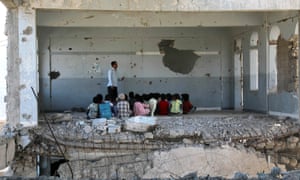
A damaged school in Yemen’s third-city of Taez
A damaged school in the Yemeni city of Taez. Civilian infrastructure has been damaged during the years of war between the Saudi-led coalition and the Houthi rebels. 

Source: The Guardian
By Jamie Doward
March 28 2020

The government has quietly drawn up proposals to lend other countries £1bn of public money so that they can buy British-made bombs and surveillance technology.

The move has been attacked by arms-control campaigners who say that taxpayers’ cash may end up fueling conflict and human rights abuses.

The plan was revealed in a single sentence slipped into this month’s budget. Unveiling a new £2bn lending facility for projects supporting clean growth, the government also announced the creation of “a new £1bn (fund) to support overseas buyers of UK defence and security goods and services”.

It is understood that the fund will be overseen by UK Export Finance, which gives loans to help foreign countries, especially those with developing economies, buy British goods and services.

“Even in times of crisis, the government is showing that it will go to any length to sell as many weapons as possible,” said Andrew Smith of Campaign Against Arms Trade. “The arms deals being supported with this money could be used in enabling atrocities and abuses for years to come. Government should be regulating and controlling arms sales, not using public money and doing everything it can to promote them.”

The government sees the defense industry as a major contributor to Britain’s post-Brexit economy. The Department for International Trade has a specialist team to promote UK arms sales.

In 2018, the latest figures available, the UK won arms contracts worth £14bn. Between 2008 and 2018 the UK was the second biggest arms exporter in the world, with 19% of the market share. Three-fifths of arms sales over the period went to the Middle East.

Some £5.3bn of arms have been licensed to Saudi Arabia since the war in Yemen began. There are concerns that the Saudi-led coalition, which is fighting Houthi rebels in the country, may have committed human rights violations by targeting civilian infrastructure.

Smith said the crisis in Yemen showed how policies to promote UK arms sales could backfire: “Over the last five years we have seen the devastating impact of UK-made fighter jets, bombs and missiles on Yemen. The war has killed tens of thousands of people, and created the worst humanitarian crisis in the world. Those arms sales need to end now, but so do the policies that allowed them to happen in the first place.”

The Treasury did not respond to requests for comment.

2/12/2016

Lockheed Martin to modernize Greek P-3B aircraft

The Lockheed Martin P-3B is a maritime surveillance aircraft designed with anti-submarine warfare capabilities. Photo by the U.S. Navy

Πηγή: UPI
By Ryan Maass
12 Feb 2016


WASHINGTON, Feb. 12 (UPI) -- The U.S. Navy has given Lockheed Martin a $141.9 million contract to support Greece's P-3B modernization program.

Under the contract, Lockheed Martin will reactivate one P-3B aircraft and supply hardware kits for upgrades and modernization of four additional P-3B aircraft.

The contract also includes phased depot maintenance, updated avionics systems, additional hardware and a Greece indigenous mission integration and management system. Work on the contract will be performed at various locations in Greece and also in South Carolina and Maryland.

Work is expected to be complete in July 2019.

The Lockheed Martin-made P-3B is a four-engine turboprop maritime surveillance aircraft designed with long-range anti-submarine warfare capabilities. The planes were initially developed as land-based patrol craft, however various updates to the planes were done to make the P-3 more suited for surveillance operations.

The U.S. Navy uses the latest variant, the P-3C for maritime surveillance missions.


3/24/2015

Greece wants 100 mln euros in damages from German defense firms


Πηγή: ekathimerini
March 24 2015

Greece's government wants more than 100 million euros ($110 million) in compensation from German defense companies it says paid bribes to win arms deals, a senior defense ministry source confirmed on Monday.

German newspaper Bild reported that Airbus' Eurocopter helicopter unit was alleged to have paid 41 million euros in bribes to Greek officials to sell 20 NH-90 helicopters.

German defense group Rheinmetall, STN and Atlas Elektronik are also alleged to have paid a total of 62 million euros in bribes for submarine contracts, Bild said.

The defense ministry source confirmed to Reuters that Greece would seek about 100 million euros in compensation from these firms as part of an investigation that includes other cases.

"It's a series of cases, not only German ones but mainly German, and Greece hopes it can get 500-800 million euros,» the source said. «Any firm that will be convicted (of bribery) and wants to continue trade relations with Greece should come to an out of court compromise,» the source said.

Greece has spent heavily on arms and has cut down in the last few years, partly to deal with a debt crisis that led to European Union and IMF bailouts totaling 240 billion euros ($328 billion) in 2010 and 2012.

Relations between Germany and Greece have been deteriorating as Athens tries to renegotiate its bailout terms and Berlin fears it will ditch previously agreed financial promises. Prime Minister Alexis Tsipras has also accused Berlin of using legal tricks to avoid paying compensation for the Nazi occupation.

Greece said last year it would overhaul arms procurement to make it more transparent.

A spokesman for Airbus Helicopters declined to comment, while a spokesman for Rheinmetall said the company did not have any notice of a new investigation.

In December, its subsidiary Rheinmetall defense Electronics paid 37 million euros in fines to end a criminal investigation in Germany into suspected bribes in Greek arms deals.

No one at Atlas Elektronik was immediately available for comment. STN was acquired by Rheinmetall in 2003 and split into two companies.


2/18/2014

Jerusalem silent on report Greece blocked Israeli arms shipments to Iran

An American F-4 Phantom
Πηγή: Times of Israel
Feb 17 2014

Spare parts for F-4 Phantom jets said despatched by a ghost company near Haifa; TV report wonders whether this was some kind of sting operation against Iran.

ATHENS — Greek authorities intercepted arms shipments apparently sent by one or more Israelis and intended for Iran, in violation of international sanctions, a Greek newspaper reported.

Greek officials, working together with the American Homeland Security Investigations agency, uncovered two shipments of spare parts for F-4 Phantom jets in December 2012 and again in April 2013, the Kathimerini daily reported over the weekend.

Israeli officials declined Sunday to comment on the report which, if true, would represent the shocking effort by Israelis to supply arms to the country’s most bitter enemy. Israel’s nightly news broadcasts featured the story prominently, but highlighted its sensitivity and stressed that they were basing their coverage on “foreign reports” rather than original coverage that might have been subjected to military censorship.

The United States was aware of the shipments “in real time,” Israel’s Channel 2 news reported, and was thus able to thwart them. The TV report added that “it has to be assumed that Israel knew too, and was updated by the United States.” Finally, the Channel 2 report suggested that this may have been some kind of sting operation against the Iranians, since “it could be that whoever did this was not acting against Israel’s interest.”

The rival Channel 10 news, by contrast, noted that “there have been cases in the past where the lust for money” overcomes the national interest.

A Greek court ordered the shipments confiscated and transferred to the Americans, according to Kathimerini, which claimed to have a copy of the investigation report.

According to the Greek report, the shipment originated in the Israeli town of Binyamina-Giv’at Ada and was sent via a Greek company based in Athens.

Investigators from the drugs and weapons unit of Greece’s Financial Crimes Squad determined the company was a ghost company, Kathimerini reported.

The firm was registered by a British national from the northern city of Thessaloniki who could not be traced.

The report did not name the Israeli or Israelis thought to be behind the smuggling attempt.


7/29/2013

Email links Lockerbie bomber's prison transfer to £400m Libyan arms deal

Tony Blair with Muammar Gaddafi in May 2007. 
Πηγή: The Guardian
July 28 2013
By Andrew Sparrow

Document emerges from 2008 showing agreement 'ready for signature' as soon as purchase of air defence system concluded.

An email has emerged suggesting a connection between the prisoner transfer deal negotiated between Libya and the last Labour government, which ultimately paved the way for the release of the Lockerbie bomberAbdelbaset al-Megrahi, and a £400m arms deal.

The document, which shows that Sir Vincent Fean, the then British ambassador to Libya, wrote to Tony Blair in June 2008 saying that the prisoner transfer agreement was "ready for signature in London" as soon as Libya went ahead with the purchase of an air defence system, was obtained by the Sunday Telegraph.

Blair was no longer prime minister at the time, but Fean mentioned the two issues in a 1,300-word briefing for Blair before a visit to Tripoli where he was meeting Muammar Gaddafi, the Libyan dictator.

The prisoner transfer agreement was eventually signed in November 2008. It did not directly trigger the release of Megrahi, but it enabled the Scottish government to release him on compassionate grounds in August 2009 because he was suffering from terminal cancer. The arms deal was never concluded.

The release of Megrahi, who eventually died in May 2012, provoked outrage in the US and elsewhere. At the time ministers rejected claims that the decision to allow him to return home was influenced by commercial concerns, but the new email, obtained using the Freedom of Information Act, suggests the Foreign Office was trying to link the two issues.

Before he resigned as prime minister, Blair met Gaddafi in Libya in May 2007. At that meeting the Libyans agreed they would buy a £400m missile defence system from MBDA, a weapons manufacturer part-owned by BAE Systems.

The following year, in his email to Blair, Fean said that he hoped that the former prime minister would raise this with Gaddafi in his meeting, which was primarily about matters relating to Africa. Fean wrote: "There is one bilateral issue which I hope TB [Tony Blair] can raise, as a legacy issue. On 29 May 07 in Sirte, he and Libya's PM agreed that Libya would buy the air defence system (Jernas) from the UK (MBDA). One year on, MBDA are now back in Tripoli (since 8 June) aiming to agree and sign the contract now – worth £400m, and up to 2,000 jobs in the UK.

"Linked (by Libya) is the issue of the four bilateral justice agreements about which TB signed an MoU [memorandum of understanding] with [Al-Baghdadi Ali al-Mahmoudi, the Libyan prime minister at the time] on 29 May. The MoU says they will be negotiated within the year: they have been. They are all ready for signature in London as soon as Libya fulfils its promise on Jernas."

A spokesman for Blair said that it was the Libyans who were trying to link the prisoner transfer agreement to the arms deal and that the email confirmed this. The spokesman also said it was made clear to Gaddafi that any decision about the release of Megrahi was a matter for the Scottish government, not the UK government.

The Foreign Office said it was not appropriate to comment on the papers of a previous administration and pointed to the review published by Sir Gus O'Donnell, the then cabinet secretary, in February 2011 covering matters relating to the release of Megrahi. That concluded that the UK government did all it could to facilitate the release of Megrahi, whilst at the same time avoiding overtly pressurising the Scottish government, which had the final say.

3/18/2013

China Becomes World's Fifth Largest Arms Exporter


Πηγή: CNBC
By AP
March 17 2013

China has bypassed Britain as the world's fifth largest arms exporter, a Swedish think-tank said Monday.

The volume of Chinese weapons exports rose by 162 percent in the five years 2008-2012, compared to the previous five-year period, the Stockholm International Peace Research Institute said in its report. That means China's share of all international arms exports increased to 5 percent from 2 percent, and the country climbed to fifth from eighth in the rankings.

The largest buyer of Chinese weapons was Pakistan, which accounted for 55 percent of the country's exports, followed by Myanmar with 8 percent and Bangladesh with 7 percent, SIPRI said.

"China's rise has been driven primarily by large-scale arms acquisitions by Pakistan," said Paul Holtom, director of the SIPRI Arms Transfers Programme. "However, a number of recent deals indicate that China is establishing itself as a significant arms supplier to a growing number of important recipient states."

Such deals include the sale of three frigates to Algeria, eight transport aircraft to Venezuela and 54 tanks to Morocco, SIPRI said.

The U.S. remains the world's top arms exporter during the 2008-2012 period, with 30 percent of the global volume. Russia is second with 26 percent, Germany third with 7 percent, and France fourth with 6 percent, SIPRI said.

China's move into the top-five means Britain (now in sixth place) dropped off the list of the top five for the first time since at least 1950, the earliest year covered by SIPRI data.

The institute said Asia dominated the global imports of weapons, with the top five importers all located in that region.

Here's SIPRI's list of the top 5 arms exporters in 2008-2012 (share of international exports in parenthesis):

1. United States (30 percent)

2. Russia (26)

3. Germany (7)

4. France (6)

5. China (5)

The top 5 arms importers in 2008-2012 (share of international imports in parenthesis):

1. India (12 percent)

2. China (6)

3. Pakistan (5).

4. South Korea (5).

5. Singapore (4)


1/17/2013

Revealed: America’s Arms Sales To Bahrain Amid Bloody Crackdown


Πηγή: ProPublica
By Justin Elliott
Jan 15 2013

Despite Bahrain’s bloody crackdown on pro-democracy protesters, the U.S. has continued to provide weapons and maintenance to the small Mideast nation.

Defense Department documents released to ProPublica give the fullest picture yet of the arms sales: The list includes ammunition, combat vehicle parts, communications equipment, Blackhawk helicopters, and an unidentified missile system. (Read the documents.)

The documents, which were provided in response to a Freedom of Information Act request and cover a yearlong period ending in February 2012, still leave many questions unanswered. It’s not clear whether in each case the arms listed have been delivered. And some entries that only cite the names of weapons may in fact refer to maintenance or spare parts.

Defense Department spokesman Paul Ebner declined to offer any more detail. “We won’t get into specifics in any of these because of the security of Bahrain,” said Ebner.

While the U.S. has maintained it is selling Bahrain arms only for external defense, human rights advocates say the documents raise questions about items that could be used against civilian protesters.

“The U.S. government should not be providing additional military equipment that could make matters worse,” said Sunjeev Bery, Middle East advocacy director for Amnesty International USA.

There have been reports that Bahrain used American-made helicopters to fire on protesters in the most intense period of the crackdown. Time magazine reported in mid-March 2011 that Cobra helicopters had conducted "live ammunition air strikes" on protesters.

The new Defense Department list of arms sales has two entries related to “AH-1F Cobra Helicopters” in March and April 2011. Neither the exact equipment or services being sold nor the delivery timetable are specified.

The U.S. is also playing a training role: In April 2012, for example, the Army News Service reported that an American team specializing in training foreign militaries to use equipment purchased from the U.S. was in Bahrain to help with Blackhawk helicopters.

Bahrain’s ambassador to the U.S., Houda Nonoo, said the country’s military has not targeted protestors. Bahrain’s military “exists to combat external threats,” Nonoo told ProPublica. “[T]he potential for U.S. foreign arms sales to be used against protestors in the future is remote.”

The Obama administration has stood by Bahrain’s ruling family, who are Sunni, during nearly two years of protests by the country’s majority Shia population. Bahrain is a longtime ally and the home to a large American naval base, which is considered particularly important amid the current tensions with nearby Iran.

The itemized arms sales list does not include dollar values but a separate document says military equipment worth $51 million was delivered to Bahrain in the year starting in October 2010. (That period includes several months before the protests began.)

The U.S. has long sold weapons to Bahrain, totaling $1.4 billion since 2000, according to the State Department. The sales didn’t come under scrutiny until security forces killed at least 19 people in the early months of the crackdown in 2011. (Dozens have died since then.)

The administration put a hold on one proposed sale of Humvees and missiles in Fall 2011 following congressional criticism. But Foreign Policy reported that other unspecified equipment was still being sold without any public notification.

The new documents offer more details on what was sold during that period — including entries related to a “Blackhawk helicopter armament” in November 2011 and a missile system in January 2012.

In May 2012, the administration announced it was releasing some unspecified items to Bahrain’s military that “are not used for crowd control” while maintaining a hold on the Humvees and TOW missiles.

State Department spokesman Noel Clay told ProPublica, “We continue to withhold the export of lethal and crowd-control items intended predominately for internal security purposes, and have resumed on a case-by-case basis items related exclusively to external defense, counter-terrorism, and the protection of U.S. forces.”

The U.S. has also sold Bahrain a helicopter fit for the royal family.

In September, Missouri-based aviation services firm Sabreliner reported that, as part of an official government arms sale, it delivered to Bahrain a fully customized UH-60 Blackhawk Helicopter for “a variety of missions including transporting heads of state.” The aircraft was outfitted with a “clam shell door” for ease of entry, a “new VIP interior,” and a “custom Royal Bahraini” paintjob.

In other recent developments in Bahrain, the country’s highest court this month upheld lengthy prison sentences for 13 high-profile activists accused of plotting to overthrow the government.

In a rare occurrence in November, a series of homemade bombs were set off in the capital of Manama, killing two and leading some observers to argue that the opposition is growing more militant. Also in November, an Amnesty International report found that despite government promises, “the reform process has been shelved and repression unleashed.”

9/23/2012

Russia ‘Ready’ to Export Su-30 Fighters to Africa


Πηγή: RIANOVOSTI
Sept 22 2012

Russia is ready to sell Su-30s and other modern fighter jets to African countries, state-controlled arms exporter Rosoboronexport said on Saturday.

Click on image to enlarge
Delivery contracts with countries such as Uganda, Angola, Ethiopia and others should include personnel training programs and after-sales servicing, Rosoboronexport’s deputy chief Alexander Mikheyev said.

This year Russia has delivered six Su-30MK2 multirole fighters to Uganda and is currently in talks to diversify cooperation, he added.

Mikheyev said on Friday Uganda expressed interest in buying another six aircraft of that type.

Rosoboronexport has also signed a contract to sell six Mi-17 helicopters to Ghana, he said.


8/26/2012

China’s arms exports flooding sub-Saharan Africa

Soldiers from the Uganda People's Defence Force engage in weapons training at the Singo training facility in Kakola, Uganda on Monday, April 30, 2012.

Πηγή: Washington Post
By Colum Lynch
August 25 2012

UNITED NATIONS — China’s arms exports have surged over the past decade, flooding sub-Saharan Africa with a new source of cheap assault rifles and ammunition and exposing Beijing to international scrutiny as its lethal wares wind up in conflict zones in violation of U.N. sanctions.

Weapons from China have surfaced in a string of U.N. investigations in war zones stretching from the Democratic Republic of the Congo to Ivory Coast, Somalia and Sudan. China is by no means alone in supplying the arms that help fuel African conflicts, and there is no proof that China or its arms exporters have intentionally violated U.N. embargoes in any of those countries.

But China has stood apart from other major arms exporters, including Russia, for its assertive challenge to U.N. authority, routinely refusing to cooperate with U.N. arms experts and flexing its diplomatic muscle to protect its allies and curtail investigations that may shed light on its own secretive arms industry.

The stance highlights the tensions between China’s responsibilities as a global power and its interests in exploiting new markets. It has also raised questions about whether Chinese diplomats have a grip on the reach of the country’s influence in the arms industry beyond its borders.

Beijing has responded to the disclosures not by enforcing regulations at home but by using its clout within the Security Council to claw back the powers of independent U.N. arms investigators. Those efforts have helped undercut the independence of U.N. panels that track arms trading with Iran and North Korea.

“This is really a case of unbridled capitalism, and I think the Chinese government is not even always aware of what these companies are doing,” said David Albright, president of the Institute for Science and International Security, which has been tracking Iran’s and North Korea’s procurement of nuclear technology from Chinese companies. When the Chinese are “confronted with evidence,” Albright said, “they respond very defensively and legalistically.”

China has blocked the release of embarrassing U.N. revelations of illicit arms transfers, stopped the reappointment of an arms expert who uncovered Chinese weapons and sought to restrict the budget to fund investigations. It has also consistently refused to allow U.N. investigators to trace the origin of Chinese weapons discovered in war zones.

The country’s mission to the United Nations did not respond to repeated requests for comment for this report, but its representatives have repeatedly denied accusations that the country is violating sanctions.

More broadly, China has made clear that it has a philosophical aversion to sanctions, which were imposed on Beijing by the European Union following the Tiananmen Square events in 1989, and that it believes most major political disputes are better addressed through diplomatic talks.

Council diplomats say China has gone along with the proliferation of U.N. sanctions panels in order to maintain a cooperative relationship with the West, particularly the United States. Today, the United Nations enforces arms embargoes against 13 countries or groups, including the Taliban, al-Qaeda and seven African countries.

But China’s willingness to play along has been tested over the past decade as it has transformed itself from the world’s largest importer of arms to a major producer, with domestic production exploding by 95 percent from 2002 to 2006 and from 2007 to 2011, making it the sixth-largest arms exporter in the world.

The trend has been most sharply felt in sub-Saharan Africa, where China, a major presence at arms trade shows in Africa, sells weapons to 16 countries, more than any other top arms trader from outside the region.

According to the Stockholm International Peace Research Institute, it now accounts for 25 percent of the market, not including South Africa. (SIPRI notes that a number of large Ukrainian and Russian arms sales to Sudan and Uganda are likely to force China out of the top ranking in 2012.)

“Africa is quite an important market for the Chinese arms industry because it is a stepping stone” to becoming a first-tier arms exporter, said Pieter D. Wezeman, the chief author of the SIPRI report, noting that China’s offerings are far too inferior to compete in the industrialized arms market. “They have to start somewhere,” he said.

Some of those arms have been diverted to conflict zones under U.N. sanctions.

In May 2011, a team of U.N. arms experts collected several high-explosive incendiary cartridges in the Darfur town of Tukumare, where Sudanese armed forces had recently battled rebels, according to a confidential report that was produced by three U.N. arms experts and first publicly disclosed by the London-based newsletter Africa Confidential.

The cartridges — which were manufactured in China in 2010, more than five years after the arms embargo first went into effect — were compatible with weapons systems used in Sudan’s Russian-made Mi-24 attack helicopters and Su-25 ground attack aircraft. But China rebuffed requests by a U.N. panel to attempt to trace the cartridges back to their manufacturer.

It was not the first time.

A review of Chinese compliance compiled by SIPRI showed that China has routinely provided panel members with incomplete answers when confronted with evidence of Chinese arms in the Democratic Republic of Congo, Ivory Coast, Sudan and Somalia, where China declined a request from a U.N. panel that discovered 15 Chinese RPGs in the hands of Somali pirates.

It is in the case of Darfur, where Chinese ammunition has become a feature of annual U.N. reports, China has moved most aggressively to clamp down on a panel’s findings.

In 2011, China blocked the release of the Darfur panel’s report, then singled out the arms expert, Holger Anders of Germany, who had uncovered boxes of Chinese cartridges, and dismissed his work as unprofessional.

“An undergraduate student could have done better work; nothing was verified; it was nothing more than hearsay,” China’s delegation told the panel, according to an account provided by an official familiar with the matter. Anders responded by presenting the Chinese with an envelope filled with cartridges and asking them to analyze them themselves, according to the official, who declined to speak for the record because of the sensitivity of the issue.

The Chinese diplomats took the shells, but never responded.

In January 2011, China placed a hold on the U.N. decision to renew Anders’s contract, effectively shutting him out of the Security Council panels. Anders has since gone to work for the U.N. peacekeeping mission in Ivory Coast.

U.S. and European officials have sought to persuade China to take a more conciliatory approach in Darfur, saying that China was needlessly drawing attention to itself even though other countries such as Russia, Belarus and Ukraine were supplying Sudan with deadlier and more advanced weapons, including attack helicopters.

Council diplomats said that while Chinese diplomats in New York recognize the futility of their response, they have been hemmed in by hard-liners in Beijing, particularly within the People’s Liberation Army, which oversees China’s arms exports. Council diplomats also say they remain unsure how much control China’s diplomats have over China’s arms trade.

Last September, the Canadian newspaper Globe and Mail reported that it had obtained documents showing that Libyan officials met with Chinese companies to buy arms on July 11, 2011, several months after the council had imposed an arms embargo on Libya.

The Foreign Ministry in China, which had voted in favor of the Libya sanctions, said the contacts had taken place without the government’s knowledge. They said no arms were delivered, and that they would strictly implement the Libya sanctions.

“The PLA has a very powerful voice at the table, and on some of the arms issues what we hear is, this might look like benign munitions in country X but this is going to set people off in our capital,” according to a Security Council diplomat who has worked closely with the Chinese. “The Chinese get extremely sensitive.”

In practice, China has shown the “minimum amount of effort” in enforcing arms embargoes it supports at the Security Council, the official added. “Get them off the record and they say, ‘Look, we have been subjected to sanctions ourselves.’ ”

The United States has sought to assuage Chinese sensitivities by granting Beijing and other key powers greater political control over U.N. investigators enforcing sanctions. In 2009, for instance, the Obama administration proposed inviting the Chinese, along with the council’s other permanent members, plus South Korea and Japan, to appoint their own national experts to enforce sanctions against North Korea.

Beijing’s diplomats have worked assiduously to limit the experts’ ability to do their jobs, pressing for budget cuts that would curb their ability to travel to carry out investigations and attend specialist conferences. China has refused numerous requests by the North Korea panel to visit Beijing to discuss its own efforts to enforce sanctions, and it blocked the publication of the panel’s annual report in 2011.

“It has had a bit of a chilling effect,” said a council diplomat. “It has made the panels a little gun-shy because their reports might not see the light of day if they are too blunt.”

U.S. and European diplomats said that despite Chinese reticence, they have been able to leverage U.N. sanctions, particularly in places like Iran and North Korea, to reinforce U.S. and European sanctions, and to apply pressure on countries that do business with them. “The fact that the panels exist has given a jolt to [Western efforts] to enforce these sanctions and that is a positive thing,” said the council diplomat.

Western diplomats say that they have also succeeded in gradually convincing China to expose itself to greater scrutiny. This year, China allowed the release of the North Korea panel’s 2012 report, which documented the role of China’s Dalian port as a trans-shipment point for luxury goods entering North Korea in violation of U.N. sanctions.

They also noted the mysterious appearance of a new KN-08 portable missile launcher on the back of a truck during parade celebrating the 100th anniversary of Kim Il Sung’s birth. However, they said, the suspected supplier of the missile launcher — China — was excised from the final report.


4/11/2012

Russia’s weapons sales up by $2Bln in 2011


Πηγή: The Moscov News
By Alina Lobzina
April 10 2012

Russian leading arms exporter Rosoboronexport's weapons sales were up by $2 billion in 2011, Anatoly Isaikin, head of the state-run agency, said. 

"Last year we shipped military equipment worth $10.7 billion abroad, and I mean exports through Rosoboronexport solely," Newsru quoted him as saying.
 
Rosoboronexport, which is in charge of 90 percent of Russia's arms export, worked in 57 countries in 2011, Isaikin said in an interview published by Voenno-Promyshlenny Kuryer on Tuesday. 

The main importers of the Russian weapons were countries in the Asia-Pacific region, as well as the Middle East and North Africa, which have been struck by ongoing unrests, according to Isaikin.

Revolutions hurting business

But the recent series of revolutions, especially in North African countries, were a problem for Russian arms sellers, rather than an opportunity to cash in. 

"We couldn't deliver some of the planned supplies over the past two years, but we are trying to compensate for it by working more intensively in other regions of the world," Isaikin said.

According to Rosoboronexport's boss, 24 percent of its exports were planned for North African and Middle Eastern states, including Syria. 

The agency, however, maintains contacts with the new governments of North African countries. "I'm sure the outlook for developing our relationships in the future is good," he said.

Asia-Pacific is Russia's largest customer

Latin America received 14 percent of all Russian arms supplies last year, and 10 percent and 7 percent was destined for the CIS and countries in the south Sahara area respectively. 

The largest share - 43 percent of arms supplies - was for the Asia-Pacific region, and Europe and the US together took only 2 percent, Isaikin added.

Aviation brings the biggest sales

The structure of arms supplies has seen no changes recently, according to Isaikin. Air force equipment is the most popular products, making up 51 percent of all Russia's military exports.

Twenty-one percent of exports is for ground forces equipment, and over 11 percent is for navy and air defense, according to Isaikin.
 
"This range of the type of products supplied by Rosoboronexport correlates in general with the trends on the world's arms market and figures demonstrated by other major arms manufacturing countries," he concluded.


3/26/2012

EU figures show crisis-busting arms sales to Greece

Greek soldier - the country is buying billions of euros of arms from EU countries despite the crisis

Πηγή: EUobserver
By ANDREW RETTMAN
March 7 2012

BRUSSELS - Official figures show that EU countries sold Greece over €1 billion of arms at the same time as negotiating its first bail-out back in 2010.

France was by far the biggest seller, with a €794 million aircraft deal, according to recently-released European Council data on arms licences granted by member states. It also sold €58 million of missiles and €19 million of electronics used for aircraft countermeasures and target acquisition.

Pro-austerity advocates the Netherlands and Germany together sold almost €90 million of mostly electronics and ground vehicles. Italy sold €52 million of rifles and aircraft parts, while Spain sold €33 million of military-grade chemicals.

Greece is currently trying to shave every possible centime off its budget, but it still remains one of the biggest arms spenders in the region due to a perceived threat from Turkey.

The then Greek deputy defence minister, Panos Beglitis, in 2010 told Reuters that fellow member states did not put pressure on Athens to buy the arms in order to get the bail-out. "This [large scale arms purchases] has always been the case with these countries. It is not because of the crisis, there is no link," he said.

But an aide to the then Greek leader, George Papandreou, who asked to remain anonymous, told the news agency: "No one is saying 'Buy our warships or we won't bail you out.' But the clear implication is that they will be more supportive if we do."

Looking to the Middle East, the 2010 figures tell a tale of EU countries arming their Sunni Muslim allies against Shia Muslim enemies Iran and Syria.

EU countries granted €2.5 billion of licences for exports to Saudi Arabia, €1.5 billion for the United Arab Emirates and €1.2 billion for Oman. Sales to smaller Sunni-controlled regimes - Bahrain, Jordan, Kuwait, Qatar and Yemen - added up to €1.1 billion.

They sold almost nothing to Iran and Syria (barring half-a-million-worth of Greek aircraft parts for Syria's President Assad, who buys mostly from Russia).

The arms sales overlap with EU Arab Spring politics.

EU countries over the past year gave Sunni dictatorships plenty of leeway on repression while condemning human rights abuses in, for instance, Iran, or strategically less important countries in north Africa.

Arms for autocrats


Some EU diplomats are worried Algeria could see unrest in May elections, where Islamist political groups will challenge septuagenerian autocrat Abdelaziz Bouteflika. A previous confrontation in 1992 prompted a bloody civil war.

If Algeria becomes the next Libya or Syria, there will be no shortage of EU-made weapons on the ground.

Total arms licences in 2010 were €933 million, including €584 million of British and Italian aircraft; €94 million of Italian and French electronic countermeasure equipment; €40 million of French naval vessels; and €24 million of Bulgarian ammunition.

EU licences for pre-Arab-Spring dictators in Egypt, Libya and Tunisia came to €531 million. The weapons are still sloshing around in Libya, which on Tuesday (6 March) split in two when leaders in the oil-rich east claimed autonomy.

The figures also show how much wiggle-room there is in the EU arms ban on China, which goes back to the 1989 Tiananmen Square massacre. Despite the embargo, it granted almost €218 million of licences in 2010.

The lion's share came from France and the UK for aircarft and ground vehicle parts, electronic equipment, missiles and over €13 million of: "Chemical or biological toxic agents, 'riot control agents,' radioactive materials."

Clear risk


The EU figures are collected on the basis of a 2008 Code of Conduct, which says member states should not sell to places if there is "a 'clear risk' that the weapons will be used for internal repression" or "could provoke or prolong armed conflict."

The reporting system is known for its sloppiness.

In 2009, for instance, Italian firm Beretta sold €8 million of guns to Libya. But the shipment was incorrectly registered as being of Maltese origin and worth €80 million, after a shipping firm, W.J. Parnis England, made a typo which went unnoticed for two years.

"If this is what is happening in the official and legal arms trade, I can only imagine what is happening in the illegal arms trade," Francesco Vignarca, the director of Italian arms control NGO, Rete Disarmo, told EUobserver at the time.


What America Lost Over Libya


Πηγή: Strategy Page
March 26 2012

Air operations in Libya made it clear that European made missiles and smart bombs were every bit as good as the American stuff. As a result, the major European arms manufacturers (mainly BAE, EADS, and Finmeccanica) suddenly have billions of dollars in new orders. While some of this business comes from existing customers replacing all the missiles and bombs they used in Libya, a lot of new customers have shown up. These European weapons are now "battle tested" in a highly publicized and successful operation. Many countries are glad to see credible competition for American weapons. Competition means the buyer can negotiate a better deal.

The air campaign over Libya also demonstrated that one European missile, the Brimstone, was unique and superior to anything the U.S. had. Brimstone also demonstrated, once more, that smaller is often better. Smaller missiles and bombs reduce civilian casualties and enable aircraft to carry more weapons (and hit more targets). The star of this category in Libya was the British 55 kg (109 pound) Brimstone. Originally developed as an upgraded version of the American Hellfire, Brimstone ended up as a Hellfire in general shape only. Weighing the same as the Hellfire (48.5 kg/107 pounds), Brimstone was designed to be fired by fighter-bombers, not just (as with Hellfire) from helicopters and UAVs. Aircraft can carry more of these lightweight missiles. These are perfect for small targets, including vehicles that need to be hit, without causing injuries to nearby civilians or friendly troops.

Four years ago, Britain added a dual-mode (radar and laser) seeker to its Brimstone missiles. Originally, Brimstone was to be just an American Hellfire with a British seeker (a miniature, millimeter wave, radar) and configured to be launched from jets. Brimstone did that, but never got a chance to show how effective it was until Afghanistan and Libya. The performance of Brimstone was particularly impressive in Libya, and that got the Americans and French interested in using it as a highly effective anti-vehicle weapon for their fast-movers (jet fighter-bombers).

Hellfire was first developed three decades ago as a helicopter launched anti-tank weapon, but has proved to be very useful against enemy infantry hiding out in buildings or caves. Hellfire later proved to be an ideal weapon for use by larger UAVs. The current version has a range of eight kilometers, while Brimstone has a range of 12 kilometers.

The Brimstone radar seeker makes it easier to use the missile in "fire and forget" mode. The laser seeker is more accurate (to within a meter or two of the aim point.) When used on jet fighters, like the Tornado, there is a special launcher that holds three Brimstone missiles (instead of one larger missile). The launcher hangs from one of the Tornado hardpoints. This launcher will also be used on the new Eurofighter. The nine kilogram (20 pound) warhead is sufficient to destroy vehicles, without causing a lot of casualties to nearby civilians. British fighter pilots have become quite good at coming in low and taking out individual vehicles with Brimstone missiles. Carrying a dozen Brimstones, a fighter-bomber can easily use all of them in one sortie, all the while staying out of range of ground fire.


11/07/2011

British delegation will visit Libya in effort to kick-start arms deals


Πηγή: The Independent
By JEROME TAYLOR 
Nov 5 2011

It has been little more than a fortnight since Muammar Gaddafi was pulled from a culvert in his hometown of Sirte and shot dead.

As Libya struggles to rebuild, power effectively rests in the hands of the heavily armed militias who ousted the former dictator.

But that hasn't stopped the British government from pushing ahead with plans to renew arms sales to the war-torn country. The Independent has learned that a defence industry trade delegation is planning to travel to Libya early next year in the hope the country's new pro-western National Transition Council will become lucrative customers.

UK Trade and Investment (UKTI), the government department which promotes British business interests abroad, is planning to take defence manufacturers to Tripoli in February for a series of meetings with senior government officials. The news will alarm human rights campaigners, who have spent the past nine months documenting the readiness of autocratic Middle Eastern regimes to use imported equipment to violently quell popular opposition movements.

UKTI insists that plans to send the delegation are still at a discussion stage and will only involve "civil security", not military hardware. "Libya is still under a UN arms embargo so any exports would need to go through the UN," a UKTI spokesperson said.

"The mission would be to see where Britain could offer help on civil security such as police training and border patrols. We have not approached any British companies yet, although we hope to do so over the coming weeks."

Last month Lord Green, minister for Trade and Investment, visited Tripoli to see what role Britain could play in rebuilding Libya's infrastructure and economy. After months of internecine conflict in a country with vast energy reserves, international businesses are well aware of the vast sums of money to be made.

Those nations that took part in the Nato airstrikes against Gaddafi's regime – notably Britain and France – are determined to reap the rewards of backing the National Transition Council and claw back some of the money spent on their costly bombing campaign. Some have estimated the value of contracts in oil, infrastructure and education to be worth as much as £200bn.

Kaye Stearman, from the Campaign Against Arms Trade, criticised the delegation plans and its timing. "The UK government professes to support a democratic and peaceful future for Libya, yet, even before the dead and injured have been counted, it is mounting trade missions to sell arms to a damaged and traumatised people," she said. "They show no shame at their past record on arms sales and no willingness to change."

During questions in Parliament this week, Trade Minister Mark Prisk revealed a list of other countries UKTI's Defence and Security Organisation are planning to visit over the next five months. Among those listed are a number of human rights abusers including Saudi Arabia, Colombia, Kazakhstan and India. Later this month a delegation will travel to the Saudi capital Riyadh in what a UKTI flyer has advertised as "a great opportunity for UK Defence & Security companies to meet decision makers of the major Saudi organisations active in Saudi Arabia's Defence & Security sector".

Saudi Arabia is preparing for its first major security exhibition, IFSEC Arabia. The country is one of Britain's largest defence customers despite concerns over its autocratic rulers and a dismal human rights record. Recently Saudi troops were sent to Bahrain to help the Sunni Khalifa dynasty quell pro-reform protests led by the country's majority Shi'as.

Brothers In Arms

Saudi Arabia

King Abdullah's monarchy remains Britain's largest arms purchaser despite its dismal human rights record and involvement in suppressing protests in Bahrain earlier this year. Earlier this summer Saudi Arabia was invited to Britain's DSEi arms fare and there are UKTI (UK Trade and Investment) trips planned for this month and March next year. In 2006 an attempt by the Serious Fraud office to investigate bribery allegations over the sale of Typhoon fighter jets to Saudi Arabia was halted by Tony Blair.

Colombia

UKTI is planning to send a defence delegation to Colombia in February. The government insists that weapon sales to Colombia are minimal and that defence contracts revolve around drug busting. But Colombia's armed forces, who lead the fight against drugs, have been accused of a plethora of human rights abuses.


11/04/2011

Some in Congress balk at arms sale to Turkey

The AH-1W Super Cobra helicopter at an air base in the Gulf region

Πηγή: The Washington Post
By Craig Whitlock
Nov 4 2011

Time may not be on their side, but some members of Congress are still trying to make the Pentagon sweat over a proposed weapons sale to Turkey.

Reps. Shelly Berkely (D-Nev.) and Eliot Engel (D-N.Y.) have introduced a bill that seeks to block the Defense Department from selling three AH-1W Super Cobra attack helicopters to Turkey. The lawmakers said they want to scuttle the deal because they’re unhappy with Turkey for not getting along better with three neighbors: Israel, Armenia and Cyprus.

“We are deeply concerned by Turkey’s increased saber rattling, its threats against Israel, its outlook toward the European Union, its occupation of Cyprus and its unrelenting blockade of Armenia,” Berkley and Engel said in a joint statement Friday. “The U.S. should be busy raising these very serious concerns with Turkey, rather than selling arms to them.”

The Democrats have three Republican co-sponors on the bill: Reps.Michael Grimm (N.Y.), Gus Bilirakis (Fla.) and Ed Royce (Calif.).

The Pentagon formally notified Congress Oct. 28 that it intended to sell the choppers to Turkey as part of a package — including parts, maintenance and training — valued at $111 million.

Under the law, Congress has 15 days to pass legislation that would either block or modify the sale; otherwise the deal automatically goes through. That leaves only eight days for Congress to get moving, a fast-closing deadline that the bill’s sponsors might have a tough time making.

Even if they fail this time, however, the sale of the choppers is probably only round one in a much bigger fight with the Pentagon and Obama administration over selling Predator or Reaper drones to Turkey.

The Turks have been keen for years to acquire some drones to help them crack down against Kurdish militants in northern Iraq. The Pentagon wants to oblige, but acknowledged this week that Congress isn’t as eager.


11/03/2011

Arms sales to Bahrain under the scanner


Πηγή: Aljazeera
By Joel Beinin
Nov 3 2011

As Bahrain's human rights record is probed, the US backs down from a proposed weapons deal with the troubled Gulf state.

After a false alarm announcing that a proposed $53m arms sale to Bahrain would be authorised, the Obama administration backtracked and postponed final approval of the sale pending a review of the findings of the Bahrain Independent Commission of Inquiry (BICI) established on June 29. The BICI's report was expected to be issued on October 30. But King Hamad bin Isa Al Khalifa authorised a delay until November 23. The commission's mandate is to "engage in fact finding" and to compile a contextualised narrative of the events during the movement for democratic reforms in February and March. It will also determine if suppression of the movement involved human rights violations.

The commission includes several respected figures in the international human rights field. But the Bahrain Centre for Human Rights has already criticised its proceedings. On August 15 demonstrators, including workers dismissed for engaging in a general strike in March organised by the "Return to Work is My Right" group, stormed the offices of the BICI, forcing its closure.

If the proceedings of the Bahrain National Dialogue convened on July 1 and related developments are any indicator, the BICI report, whatever its conclusions, is unlikely to lead to substantive reforms. Before the initial session of the national dialogue, US Assistant Secretary of State Michael Posner visited Bahrain to encourage the government to speak with its opposition. But soon after it began, the Shia-oriented al-Wefaq, the largest political opposition group in Bahrain, and the General Federation of Bahrain Trade Unions withdrew from the national dialogue. They claimed that regime supporters refused to include their grievances, including the rehiring of fired workers, on the agenda.

Last February 27, al-Wefaq's 18 parliamentary representatives (out of a total parliamentary membership of 40) resigned to protest suppression of the democracy movement. Parliamentary by-elections were held to replace them on September 24, an indication that the monarchy is not inclined to engage in meaningful dialogue with its most substantial opposition.

The Obama administration is well-aware of Bahrain's violent repression of the movement for democratic reforms. In a Middle East policy address given in May, the president pointedly stated that, "mass arrests and brute force are at odds with the universal rights of Bahrain's citizens." In a much sharper expression of displeasure, in June, the US ambassador to the UN Human Rights Council included Bahrain in a list of countries requiring the special attention of the Council for violating human rights, along with Iran, Burma, North Korea and Zimbabwe. Ambassador Donahoe told the United Nations High Commissioner for Refugees (UNHCR) that Bahrain "has arbitrarily detained medical workers and others perceived as opponents". Nonetheless, these characterisations are polite diplomatic understatements.

Harsh treatment

"Some of the ammunition the military and police fired at non-violent pro-democracy protesters may very well have been made and supplied by the US."

International human rights organisations estimate that since protests demanding democratic reforms began in February, at least 35 Bahrainis have been killed by armed forces of the regime and its allies, over 1,400 have been arrested, and as many as 2,600 have been dismissed from their jobs, including leaders of the General Federation of Bahrain Trade Unions. Four people have died in custody in suspicious circumstances. Harsh prison sentences have been imposed on 21 prominent political leaders. 47 doctors and medical workers who cared for wounded protesters were tried in military courts; some received sentences as long as 15 years. After loud international condemnation, a new civilian trial was ordered for 20 of them.

When the near-finalisation of the $53m arms sale - which includes Humvee combat vehicles, missiles and rocket launchers - was announced, Stephen Seche, Deputy US Assistant Secretary of State for Arabian Peninsula Affairs, said, "Congress has expressed no opposition to this sale". This is formally correct, in the sense that no resolution opposing the sale was adopted, although one has since been introduced. But at least five congressmen had written to the Obama administration expressing their concerns about supplying arms to a regime engaged in such recent and blatant violations of the human rights of its citizens.

In the months before the protests began in February, the US sold more than $200m in weapons and equipment to Bahrain, including $760,000 for firearms. Some of the ammunition the military and police fired at non-violent pro-democracy protesters may very well have been made and supplied by the US.

In his May Middle East policy address, Obama proclaimed that, "The United States supports a set of universal rights. And these rights include free speech, the freedom of peaceful assembly, the freedom of religion, equality for men and women under the rule of law, and the right to choose your own leaders - whether you live in Baghdad or Damascus, Sanaa or Tehran." It remains to be seen whether this applies to residents of Manama and other Arab capitals, where relationships between autocrats and the US government remain reliably stable, and military alliances have historically trumped human rights.

10/19/2011

Arms Transfers To The Middle East and North Africa


LESSONS FOR AN EFFECTIVE ARMS TRADE TREATY
Amnesty International report

The numerous unlawful killings and other gross human rights abuses committed in response to the mass protests and demands for change that have gripped the Middle East and North Africa (MENA) region since late 2010 underscore, both vividly and tragically, the urgent need for the establishment and implementation of an effective global Arms Trade Treaty (ATT). 

All across the region, government authorities responded to protests seen as heralding an “Arab Spring” by using excessive, often lethal force even against peaceful demonstrators while deploying a wide range of weaponry, munitions, armaments and related material much of it imported from abroad.

In Bahrain, Egypt and Yemen, riot police and internal security forces used firearms, shotguns and shotgun cartridges, live ammunition, rubber bullets, tear gas, water cannons and armoured vehicles to suppress and disperse protesters. In Libya, as the country slid into armed conflict, Colonel Mu’ammar al-Gaddafi’s forces launched Grad rockets, mortars and fired artillery into densely-populated civilian residential areas. In Syria
too, government forces have used heavy weaponry, artillery and tanks to fire at civilian areas in their efforts to crush the protests. Incredibly, however, thousands upon thousands of ordinary people have maintained their protests and refused to be cowed by high levels of state violence.


Arms to MENA, AI Report

10/11/2011

U.S. Arms Bahrain While Decrying Russian Weapons in Syria


Πηγή: IPS news
By Thalif Deen
Oct 11 2011

UNITED NATIONS, Oct 11, 2011 (IPS) - Peeved at Russia's Security Council veto derailing a Western- sponsored resolution against Syria last week, U.S. Ambassador Susan Rice implicitly accused the Russians of protecting the beleaguered government of President Bashar al-Assad primarily to safeguard their lucrative arms market in the Middle Eastern country.


But around the same time, the United States was evaluating a 53- million-dollar weapons contract with Bahrain, where political unrest has claimed the lives of 34 people, mostly civilians, at least 1,400 others have been arrested, and more than 3,600 dismissed from their jobs for participating in street demonstrations demanding a democratic government.

"The U.S. government appears hypocritical when it condemns the use of force against Syrian protestors but condones similar behaviour in Bahrain," Dr. Natalie J. Goldring, a senior fellow with the Center for Peace and Security Studies in the Edmund A. Walsh School of Foreign Service at Georgetown University, told IPS.

Sadly, she said, the administration of President Barack Obama is on shaky ground when it lectures other countries about their arms transfers.

"Its recent announcement of proposed weapons sales to Bahrain signals business as usual, at a time when we should be doing the opposite," she said.

The proposed arms contract, which has triggered strong protests from human rights groups, includes 44 armoured high mobility multipurpose wheeled vehicles (HMMWVs), wire-guided and other missiles and launchers, along with related equipment and training.

Maria McFarland, deputy Washington director at Human Rights Watch, said, "It will be hard for people to take U.S. statements about democracy and human rights in the Middle East seriously when, rather than hold its ally Bahrain to account, it appears to reward repression with new weapons."

Goldring pointed out that Ambassador Rice said the opponents of the U.N. resolution would rather sell arms to the Syrian regime than stand with the Syrian people.

"Transferring weapons to Bahrain leaves the U.S. government vulnerable to the same accusation that we would rather sell arms to the Bahrain regime than to stand with the people of Bahrain." she added.

The Obama administration would be in a much stronger position to influence other countries behaviour if it stopped selling weapons to countries that abuse their citizens' human rights, Goldring said.

Although a majority of the Security Council members - nine out of 15 - voted in favour of last week's resolution, qualifying it to be adopted, the two vetoes by Russia and China negated the positive result.

The draft resolution, which strongly condemned the continued grave and systematic human rights violations by Syrian authorities, drew positive votes from Bosnia and Herzegovina, Colombia, France, Gabon, Germany, Nigeria, Portugal, the UK and the United States.

The countries abstaining were India, Brazil, South Africa (collectively known as IBSA) and Lebanon.

The resolution, which was co-sponsored by France, Germany, Portugal and the UK, also called on Syria to immediately cease the use of force against civilians.

If Syria failed to do so within 30 days, the Security Council would consider "other options", a euphemism for economic and military sanctions.

Pieter Wezeman, a senior researcher in the Arms Transfers Programme of the Stockholm International Peace Research Institute (SIPRI), told IPS Russia is Syria's most important arms supplier.

In the past five years, he said, Russia delivered an estimated 36 Pantsyr-S1 mobile air defence systems and a quantity of Igla-S man portable surface-to-air missiles.

All indications are that more is on order and to be delivered, including reportedly 24 MiG-29SMT combat aircraft, a Bastion coast defence system with Yakhont missiles, several Buk longer range surface-to-air missile systems and an unknown number of YAK-130 combat trainer aircraft.

"Altogether the Syrian orders make up a significant amount in revenues for the Russian arms industry," Wezeman said.

After losing the Iranian and Libyan markets, he said, they would not be keen to lose this market too, and this is likely to be one reason, amongst others, for Russia to resist arms-related sanctions on Syria.

Goldring told IPS that Syria is a key Russian political and military ally in the Middle East. But Russia also has strong economic motivations to maintain this relationship.

According to a recently released Congressional Research Service report, Syrian arms sales accounted for nearly a quarter of Russia's global arms sales agreements reached between 2007 and 2010.

"While China has also had an active arms transfer relationship with Syria, Russia has dominated the Syrian market, accounting for nearly 90 percent of all arms sales agreements with Syria between 2007 and 2010," Goldring said.

After China and Russia vetoed the Security Council resolution, Ambassador Rice said, "Those who oppose this resolution...will have to answer to the Syrian people and, indeed, to people across the region who are pursuing the same universal aspirations."

She didn't refer to China and Russia by name, although they were the only countries that voted against the resolution.

"Russia and China seem to have united against a common adversary. Together, they're acting as a counterweight to U.S. diplomatic and military activity in the Middle East," said Goldring.

After the vote, Rice told reporters: "No, I don't think diplomacy or pressure has reached a dead end."

"I mean, the fact of the matter is, despite the vote that we saw today in the Council, the majority of members supported the resolution," she said.

"This is not, as some would like to pretend, a Western issue. We had countries all over the world supporting this resolution, and we have countries throughout the region who have been very clear that the brutality of the Assad regime has to end and that the behaviour of the regime is absolutely intolerable."


10/08/2011

US politicians seek to halt Bahrain arms deal

The US already exported millions of dollars worth of guns, teargas, and other arms to Bahrain

Πηγή: AlJazeera
Oct 8 2011


Concerned about the kingdom's response to a popular uprising, members of Congress aim to bloc a $53m sale.


US members of Congress, concerned about the Bahraini government's response to a popular uprising, introduced a rare measure that would halt a $53m arms sale to the Gulf Arab state.

US Senator Ron Wyden of Oregon and US Representative James McGovern of Massachusetts, both Democrats, said they introduced resolutions in both houses of Congress on Friday to prevent the sale of US weapons to Bahrain "until meaningful steps are taken to improve human rights" there.

"Selling weapons to a regime that is violently suppressing peaceful civil dissent and violating human rights is antithetical to our foreign policy goals and the principle of basic rights for all that the US has worked hard to promote," Wyden said in a statement posted on his website.

"The US should not reward a regime that actively suppresses its people. This resolution will withhold the sale of arms to Bahrain until the ruling family shows a real commitment to human rights," Wyden said.

The Pentagon last month notified Congress that it had approved the sale of $53m of weapons to Bahrain, including more than 44 armored vehicles and 300 missiles, 50 of which have bunker busting capability.

Prime contractors for the arms sale would be AM General and Raytheon Co, according to the Defence Security Co-operation Agency, the part of the Pentagon that oversees foreign arms sales.

The notice of the sale was officially reported to Congress on September 14, triggering a 30-day period during which Congress can pass a resolution opposing the sale.

Members of Congress seldom challenge arms sales notifications since weapons sales are generally vetted with Congress before being made public.

In the wake of the so-called "Arab spring," which swept the governments of Egypt, Tunisia and Libya from power, Bahrain's Shia majority turned up the political heat in the island country, which put down a pro-democracy uprising earlier this year with the help of neighboring Saudi Arabia.

Many Shia areas are witnessing almost nightly clashes with police. Opposition groups say heavy-handed police tactics are worsening tension on the street.

Hundreds of Shia were dismissed from their jobs over suspected roles in the protests and many remain in police detention.

About 30 people, mainly Shia, died when the protest movement erupted in February, but ongoing clashes and deaths in police custody have taken the total past 40, according to the Bahrain Center for Human Rights (BCHR).

McGovern said it was not in the United States' national security interest to sell weapons to Bahrain.

"Human rights ought to matter in our foreign and military policy," he said. "Now is not the time to sell weapons to Bahrain."


10/03/2011

French millionaire arms broker admits selling arms to Libya and Syria for Sarkozy

Thick as thieves: French millionaire arms broker Ziad Takieddine (L) and President Nicholas Sarkozy scheming in the run up to Sarkozy's successful election in 2007, apparently bought with suitcases full of kickbacks from arms deals to the very countries he would later invade as president.


Πηγή: sottnet
By Press TV
Oct 2 2011


A French businessman says President Nicholas Sarkozy and Interior Minister Claude Gueant must acknowledge their roles in the kickbacks on the arms deal and illegal funding.

In an interview with French financial newspaper La Tribune published on Saturday, French millionaire arms broker Ziad Takieddine said that he was commissioned by Gueant, Sarkozy's former presidential election campaign head, to conclude arms contracts with former Libyan ruler Muammar Gaddafi, and Syrian President Bashar al-Assad.

"I remember telling Gueant: You know me more than anyone else. Each of my acts amount to an official mission," Takieddine stated.

"I went to see Gaddafi in Libya, and Assad in Syria only on the request and authorization from the president," the Franco-Lebanese businessman added.

The remarks come as Gaddafi's son, Saif al-Islam had said in March that Libya would publicize all the bank details relating to Sarkozy's campaign funding in 2007.

In a half-dozen interviews this weekend, Takieddine has called on Sarkozy to lift the lid on French arms sales to Pakistan and Saudi Arabia that were illegally kicked back to fund the 1994-5 presidential campaign of Edouard Balladur.

Sarkozy, Balladur's budget minister and presidential campaign spokesman at the time, has validated the commission system.

Takieddine also told La Liberation that he has met twice with Sarkozy when he was the French interior minister.

The Franco-Lebanese millionaire, however, denies having served as a middleman for the diversion of commissions from French arms deals.

Takieddine is said to have received payment from a sale of frigates to Saudi Arabia, a contract authorized in 1994 by Sarkozy.

Documents obtained by examining magistrates suggest that he has received €91 million (USD 120 million) between 1997 and 1998.

France also signed a deal that year to sell three submarines to Pakistan. Several witnesses have told the magistrates that Takieddine was imposed by the Balladur camp as an intermediary.

French judge Renaud van Ruymbeke believes that through offshore accounts in Luxembourg Takieddine has returned a portion of the money earned via arms contracts to France. He, however, has withdrawn the money from his accounts once he was in Switzerland.

The judge has found that at least €3 million (USD 4 million) as parts of the "commissions" were siphoned off to help fund the 1994 presidential campaign of Edouard Balladur, then prime minister.

Takieddine was charged in September with fraud over arms contracts with Pakistan and Saudi Arabia in which he was allegedly the middleman.

Nicolas Bazire, 54, the manager of Balladur's presidential campaign and now a director of luxury goods giant LVMH, and Gaubert, 60, an advisor to Sarkozy when he was budget minister, have also been charged with the misuse of public funds.


9/22/2011

China steps up condemnation of U.S. over Taiwan arms

A soldier stands guard at the Mashan observatory in Kinmen, one of Taiwan's offshore islands, August 22, 2011.


Πηγή: Reuters
By Chris Buckley
Sep. 22 2011


China stepped up its condemnation of the United States on Thursday for selling arms to Taiwan saying they could disrupt military exchanges, a warning that is likely to unsettle, but not derail, ties with Washington.

Arms sales are one of several irritants in the Sino-U.S. relationship which include Washington's decision to challenge Chinese duties on U.S. poultry products and U.S. pressure on China to loosen controls on its currency.

China's Foreign Ministry has already lambasted the Obama administration for telling Congress that it plans a $5.3 billion upgrade of Taiwan's F-16 fighter fleet, and Beijing warned that the step would damage Sino-American military and security links.

China considers Taiwan a breakaway province to be reunified with the mainland eventually, and by force if necessary.

"The Chinese military expresses its utmost indignation and strong condemnation of this action that gravely interferes in China's domestic affairs and damages China's sovereignty and national security interests," a Ministry of Defense spokesman, Senior Colonel Geng Yansheng, said on the ministry's website (www.mod.gov.cn).

The U.S. offer -- which includes sales of advanced air-to-air missiles, laser- and GPS-guided bombs and radars -- would "create serious obstacles to the development of ordinary exchanges between our two militaries," said Geng.

China opposes U.S. arms sales to Taiwan on the grounds they sabotage Beijing's plans for reunification. Washington says it wants Beijing and Taipei to determine their future peacefully, and that it is obliged by law to help the island defend itself.

Chinese authorities were probably still weighing just how to punish the United States and would be closely watching domestic opinion, said Sun Zhe, a professor at Tsinghua University in Beijing who specializes in U.S. policy.

"This could be a spiraling response that can be adjusted up or down," Sun said.

"When it comes to arms sales to Taiwan, the (Chinese) public is strongly against and the central government will have to take into account public opinion or risk being criticized as too weak."

But despite Beijing's anger, tensions appear unlikely to match last year's, when Chinese outrage over an earlier U.S. arms offer to Taiwan added to several disputes that roiled relations with Washington for many months.

This year both sides have sought to keep relations on a steadier path ahead of 2012, when U.S. President Barack Obama faces re-election and China's Communist Party undergoes a leadership handover.

Obama, who chose the upgrade rather than offer new planes, and Chinese President Hu Jintao will have chances to meet in coming months at regional summits and the G20 meeting in France, which is likely to discourage lingering tension.

Asked whether last year's threat to sanction U.S. companies involved in weapons sales to Taiwan still applied, Chinese Foreign Ministry spokesman Hong Lei did not give a direct answer.

"Whoever engages or participates in activities or actions that harm China's sovereignty and territorial integrity will certainly encounter the resolute opposition of the Chinese people," he told a news briefing.

Republican presidential contender Mitt Romney deplored Obama's decision to upgrade the jets rather than sell Taiwan new ones as "yet another example of his weak leadership in foreign policy."

He has also called China a cheater and vowed to slap tariffs on Chinese imports and label Beijing a currency manipulator if it didn't move quickly to float its currency.

The People's Daily, the main paper of China's ruling Communist Party, warned the United States that it has a big economic stake in ties with China.

"American politicians are totally mistaken if they believe they can, on the one hand, demand that China behave as a responsible great power and cooperate with the United States on this and that issue, while on the other hand irresponsibly and wantonly harm China's core interests," said the paper.

The U.S. upgrade of Taiwan's 145 F-16s will give them much the same capabilities as late-model F-16 C/Ds that Taiwan has sought for years without success, Washington officials said.

The United States was likely to approve selling those newer F-16 fighters later, said I-Hsin Chen, a professor of American studies at Taiwan's Tamkang University, noting the risks to pilots flying aging planes and China's growing air strength.

"If other nations in this region think that the U.S. is not fully fulfilling its security commitment to Taiwan, they would also be afraid that some day they would be abandoned," he said.