Showing posts with label Greece. Show all posts

1/23/2023

Washington Ratchets Up Maritime Disputes in the Eastern Mediterranean


January 23 2023
by Conor Gallagher


Washington is reportedly pushing a deal with Ankara that would see the US sell Türkiye F-16s (which it has been requesting the past two years), and in exchange Türkiye would forgo any military incursion into northern Syria and would agree to the admission of Finland and Sweden to NATO.

It’s unlikely this will meet Türkiye’s price as Ankara has demanded that Sweden stop supporting what Türkiye deems to be Kurdish terrorists and made specific requests, including extraditions. Sweden has said it will not meet these demands, and the Quran-burning protests against Türkiye in Stockholm on Saturday almost certainly made it politically untenable for Turkish President Recep Tayyip Erdoğan to agree to any deal ahead of what’s expected to be a tight election on May 14.

Additionally, any deal would likely need to include promises from Washington to scale back its military support for Greece, such as its planned F-35 sale. As the following post illustrates, Washington is also using contested waters in the eastern Mediterranean as another pressure point and is likely to escalate there if Erdogan doesn’t relent on Sweden’s NATO bid and back off in Syria.

***

The race to drill and bring to market natural gas in the eastern Mediterranean Sea has taken on additional importance ever since Europe decided to cut itself off from its main supplier in Russia. The rush for underwater natural gas comes at a time when the US is heavily arming Greece and Cyprus in an effort to pressure Türkiye into falling in line on Washington-led policies on Russia and NATO.

Disagreements over waters and exploratory rights have brought Greece and Türkiye to the brink of conflict recently, and as more gas fields are discovered and the US inserts itself on the side of Athens, conflict is becoming increasingly likely.

The following is a rundown of Greek, Turkish, and Cypriot competing claims and the current situation in the race for eastern Mediterranean gas.

***

Last year saw new gas discoveries off Cyprus, including an estimated 70 billion cubic meters (bcm) field and a 57-84 bcm field. The finds raise the possibility of the island country finally becoming a gas exporter; it also raises the possibility of conflict as Türkiye, Greece, and Cyprus have wide-ranging disagreements over maritime boundaries.
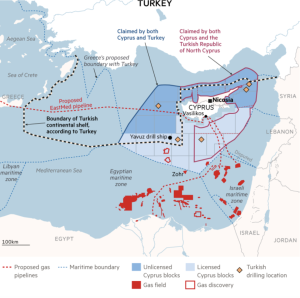

Greece argues that its islands in the Aegean sea can generate their own Exclusive Economic Zones (EEZ) which would allow Greece to explore more than 200 nautical miles. Türkiye has argued that islands can not generate their own EEZs and that Greece’s EEZ should start from its mainland, rather than from each of its hundreds of islands.

Under the UN’s Law of the Sea (UNCLOS), every state has the right to establish the breadth of its territorial sea up to a limit not exceeding 12 nautical miles. Türkiye, however, is not a signatory to UNCLOS and does not agree with the rights of the Aegean islands to such a distance. Ankara has threatened Athens with military action should it extend its waters. Both Greece and Türkiye currently claim six nautical miles off of their territory in Aegean and 12 nautical miles off their other shores.

While the EEZ governed by UNCLOS allows trading ships to pass freely, the passage of military naval ships is highly contested and Türkiye is threatened by the possibility of having to ask Greece permission for military navigation. Should Greece extend its EEZ to 12 nautical miles off its Aegean islands, it would make a drastic difference:
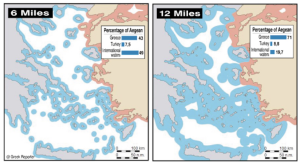


Six nautical miles have been in force since 1936. Tensions over the 12 nautical mile question ran highest between the two countries in the 1990s when UNCLOS was coming into force. In 1995, the Turkish Parliament officially declared that unilateral action by Greece to extend the Aegean islands to 12 nautical miles would constitute a casus belli, a position Ankara maintains today.

Well now Greece says that in March it’s going to extend its territorial waters to 12 nautical miles off of the island of Crete, which also happens to host a US naval base at Souda Bay. The US and Greece are also upgrading and expanding the facility with the goal to transform it into a permanent base for part of the Hellenic Navy, in order to facilitate faster and more direct access to the Eastern Mediterranean.

The move is reportedly being driven by ExxonMobil efforts to drill for natural gas and oil to the west and southwest of Crete. The Greek daily Kathimerini reported last week that ExxonMobil, in partnership with Greece’s HELLENiQ Energy, will push ahead with its search for natural gas and oil to the west and southwest of Crete despite Turkish opposition, fueling further suspicion in Ankara that the US is trying to punish the NATO member for its refusal to join the bloc’s aggressive approach against Russia.

US Arms Add Fuel to Fire

For decades the US acted as an impartial mediator between Greece, Türkiye, and Cyprus. Greece and Türkiye came close to military conflict in 1987, 1996 and in 2020, the last of which was over an accident when a Greek and a Turkish warship were involved in a minor collision during a standoff in the eastern Mediterranean. NATO stepped in in 1987 and in 1996 to help both sides cool off, and in 2020, Germany, which had the rotating presidency of the EU, took on the role of mediator.

The US is neutral no more. NATO’s war in Ukraine has brought long-festering issues between Ankara and Washington out into the open. The disagreements include US support of Kurds in Syria, Türkiye blocking Sweden’s NATO bid, Ankara’s refusal to open the Dardanelles to NATO warships, US sanctions and threat of sanctions, Washington’s refusal to extradite a cleric Türkiye blames for a 2016 coup attempt, Ankara’s purchase of Russian S-400 missile systems, Türkiye’s refusal to apply sanctions on Russia, and Ankara’s overall unwillingness to follow orders from Washington.

The US is now providing strong backing for Greece, which is clearly meant to send a message to Erdogan – at least that’s the belief inside Türkiye. Hasan Koni, a scholar on strategic studies at Istanbul Kultur University, told Türkiye’s Anadolu Agency::

The American security apparatus has also recognized that the balance of power in the region is shifting toward Türkiye and needs to be “checked by empowering Greece,” he said, adding that Washington’s push for more Greek bases is aimed at “containing Türkiye.”

The US has backed Greece despite the risk of a full break with Türkiye – the most important member of NATO due to its control of the Dardanelles and access to the Black Sea, as well as its second largest standing army in NATO.

Last year Greece deployed US-donated armored vehicles on the islands of Lesbos, Chios, and Samos, which is in violation of the 1923 Treaty of Lausanne and the 1947 Paris Peace Treaty. Ankara is also enraged about Greece’s militarization of islands within sight of Türkiye’s western coast, such as the Dodecanese chain that includes Rhodes.

There have been reports of Greek military exercises involving tanks, artillery and attack helicopters being held on Rhodes and Lesbos. Ankara has issued protests through diplomatic channels to both Athens and Washington and sent letters of complaint to the UN, all to no avail.

The US is also proposing to the Greek armed forces to replace all Russian-made military equipment including air defense systems with new military equipment produced by the US, including US Patriot missiles, which is a slap in Türkiye’s face.

Beginning during the Gulf War, Türkiye asked NATO multiple times to deploy early warning systems and Patriot missiles to Türkiye, but was always turned down. US security experts Jim Townsend and Rachel Ellehus explained it like this:

Long suspicious that NATO did not appreciate Türkiye’s vulnerability in such a dangerous neighborhood, Ankara came to view its missile defense requests as a litmus test for how much NATO really cared about Türkiye.

Ankara didn’t like the answer to that litmus test. Türkiye felt ignored by its western partners as its EU membership was all but dead, and it wasn’t getting the military hardware it requested. In 2017 Türkiye turned to Russia. It purchased Russian S-400 missile defense systems, which only further strained ties with NATO.

In December, a consortium of Italy’s Eni and France’s TotalEnergies found more natural gas off Cyprus. The Greek Cypriot administration’s exploration program is also disputed by Türkiye, which claims overlapping jurisdictions either on its own continental shelf or in the waters of the Republic of Northern Cyprus. Cyprus is split between the internationally recognized Republic of Cyprus in the south and the Turkish Republic of Cyprus in the north, which is recognized only by Ankara.

The US, wanting to keep the peace in NATO between Greece and Türkiye, had a decades-old policy of favoring negotiations on divided Cyprus and often acted as a mediator between the Turkish and Greek Cypriots.

But In September the Biden administration lifted the 35-year-old ban on the sale of US arms to the Republic of Cyprus. Congress restricted the sale of U.S. arms to Cyprus in 1987, hoping it would incentivize a diplomatic settlement to the island’s conflict.

Cyprus was required to block Russian naval vessels from accessing its ports in order to get the US arms sale ban lifted. Türkiye already has about 40,000 troops on the island, and Erdogan recently declared plans to reinforce them with land, naval and aerial weapons, ammunition and vehicles.

The decades’ old and UN-sanctioned principle of a bizonal, bicommunal federation on Cyprus has now broken down in favor of a two-state solution.

Despite the mad rush for Mediterranean gas in the wake of Europe and Russia schism, it still will not come close to replacing the amount that was piped in from Russia and requires rapid expansion of liquefaction capabilities, the connection of Israeli and Cypriot gas fields to such facilities, and/or implement pipelines, all of which will take years.

The EastMed Pipeline

The Trump administration backed a gas pipeline that would connect Israeli and Cypriot offshore gas fields to Greece and Italy. From there it would be shipped to the rest of Europe. The EastMed pipeline would have been the world’s longest (1,900 kilometers) and deepest underwater pipeline, initially providing 9-12 billion cubic meters annually.

One problem with the plan, however, was that it excluded Türkiye. In response, Erdogan opted to pursue Türkiye’s self-interest in gas through aggressive offshore oil exploration in disputed waters claimed by Cyprus. Turkish war vessels accompanied its drill ships near Cyprus, resulting in standoffs with Greek and French naval fleets. Ankara also began signing agreements with the government in Tripoli. From Dr Othon Anastasakis, Director of the European Studies Centre at the University of Oxford:

In November 2019, in response to Greece’s backing of the Mediterranean Gas Forum with Cyprus, Egypt, Israel, Italy and Jordan, Türkiye signed a maritime agreement with Libya that cuts a corridor across the Aegean to demarcate new maritime boundaries, with the proposed line in this accord running close to the eastern side of the island of Crete. On October 3, 2022, Ankara signed a follow up preliminary agreement with the Tripoli government to explore for oil and gas off the Libyan coast without specifying whether the surveys would take place in waters south of Greece. In effect, Libya has become an important third actor in the bilateral dispute between Greece and Türkiye and relations between the Athens and Tripoli governments have suffered a major blow as a result.

In January 2022, the Biden Administration abruptly halted American support of EastMed. Israeli and even some American officials were reportedly surprised by the sudden decision as the State Department did not appear to have adequately consulted with Cyprus, Greece, and Israel ahead of time. Additionally, Biden was a vocal supporter of the project during his time as Obama VP, and the US position was consistently that Europe needed to wean itself off of Russian natural gas.

The US government and American private sector were not directly involved in the pipeline project (the agreement was signed in January 2020 by the governments of Israel, Greece, and Cyprus), but as Henri Barkey, an adjunct senior fellow at the Council on Foreign Relations, told the National:


American support always affects a good housekeeping seal. When you have American buy-in, it’s easier for banks to provide financing for more countries to be interested. In that sense, what the US says is important.

US Under Secretary of State for Political Affairs Victoria “Fuck the EU” Nuland has taken an active role in the Eastern Mediterranean and had this to say about the pipeline:

“Frankly, we don’t have 10 years, but in 10 years from now, we want to be far, far more green and far more diverse” in energy sources, Nuland said. “So what we’re looking for within the hydrocarbon context are options that can get us more gas, more oil for this short transition period.”

That short transition period also happens to rely heavily on US exports of LNG.

In November Greece canceled the long-planned privatization for the Alexandroupolis port with Mitsotakis declaring it too precious of a resource to relinquish. Instead the US military has set up shop there, using it as an entry point to funnel weapons to Ukraine. There are also plans in the works to create a floating gas storage and regasification unit at the port, which will be serviced by American LNG supplies. A pipeline from Alexandroupolis is also planned to send that gas north to the Balkans.


12/02/2022

Could Turkey Use A False Flag Attack To Start A War With Greece?


Source: 1945
December 2 2022
By Michael Rubin


The Cost of Western Silence in the Face of Turkish False Flag Terrorism: On November 13, 2022, a small bomb shook a pedestrian mall in central Istanbul. Within a day, Turkish officials suggested they had their suspect. Ahlam Albashir, a Syrian woman whom Turkish authorities alleged took her orders from Syrian Kurds in Kobane. They paraded her before President Recep Tayyip Erdogan’s court media in a “New York” sweatshirt. Lest Turks not get the message, Interior Minister Süleyman Soylu suggested the United States was complicit.

There is actually no proof beyond Turkish insistence that Albashir has connection with Syrian Kurds; indeed, the evidence linking her to the Turkish-backed Free Syrian Army is stronger. Rather, it seems Erdogan is using the bombing as a pretext to carry out a preplanned operation to undermine the democratic Kurdish experiment in northeastern Syria. In the wake of the Istanbul attack, Turkish warplanes have repeatedly struck targets in Syria’s Kurdish zone, killing not only political officials but also numerous other civilians as well.

The mantra that the Syrian Democratic Forces are, by nature of their evolution from the Kurdistan Workers Party (PKK), a terrorist group, is not justification for Turkey’s actions for two reasons. First, the PKK has evolved over the years, much like Turkey itself. Today, President Recep Tayyip Erdogan’s Turkey is unrecognizable from what Turkey was two decades ago. The same holds true with the PKK, a group that once briefly held me at gunpoint while I was a Pentagon official in Iraqi Kurdistan. Politically, intellectually, and culturally, it is not the same organization. Second, while the State Department operates on auto-drive and some think tank analysts seek to be more Turkish than many Turks in their ostracization of the PKK, it is useful to remember that Turgut Özal, who dominated Turkey from 1983 until 1993, was willing to make peace with the group. Prior to his 1993 death, he had sent out feelers to PKK leader Abdullah Öcalan and appeared ready to negotiate an end to the Kurdish insurgency.

The White House and many European diplomats may believe they can turn a blind eye to Turkey’s ongoing assault on northern Syria. After all, the Kurds are not a state and so do not have a seat at the diplomatic table. Out of sight, out of mind. The problem with such logic is not only its moral perversity. Rather, whether accusing environmentalists of being part of a vast terror conspiracy after the Gezi Park protests, or exaggerating Gülenist complicity in the 2016 abortive coup or seeking a pretext to attack Iraq or Syria, false accusations against enemies as a pretext for police or military action have become common place for Turkey. The reason is simple: Erdogan has concluded such tactics work.


This brings us to Greece. Over the decades, Turkey has repeatedly accused Greece of terrorism. As Erdogan saber-rattles against his NATO neighbor as he seeks to redraw the Aegean map and expand Turkey’s Exclusive Economic Zone, he will need a pretext for military action. If Europe allows Erdogan to get away with a false accusation against Syrian Kurds in order to justify a Turkish land grab south of his border, it is not farfetched to consider another scenario leading to a land grab west of the border: a bomb goes off in Izmir, Bodrum, or Marmaris. A day later, Soylu will parade a suspect in an “Athens” sweatshirt, claiming that he or she confessed to acting on the orders of Greek nationalists. Europe might then issue its denials, but Erdogan will not care: He has become too accustomed to the West accepting Turkish standards of evidence or countries like Sweden humiliating themselves to please him.

This will be a miscalculation on his part—European fortitude is stronger than Sweden’s 2022 Stockholm syndrome might suggest. Wars often start because of such miscalculations, however. That is why clarity is so important. Stopping Turkish aggression against Kurds today can prevent a deadly conflict with Greece as Turkey’s elections approach.

It is time to stand up to Erdogan, stop funding and equipping Turkey’s military and, indeed, raise the cost should Turkey seek to operate outside its borders.

Now a 1945 Contributing Editor, Dr. Michael Rubin is a Senior Fellow at the American Enterprise Institute (AEI). Dr. Rubin is the author, coauthor, and coeditor of several books exploring diplomacy, Iranian history, Arab culture, Kurdish studies, and Shi’ite politics, including “Seven Pillars: What Really Causes Instability in the Middle East?” (AEI Press, 2019); “Kurdistan Rising” (AEI Press, 2016); “Dancing with the Devil: The Perils of Engaging Rogue Regimes” (Encounter Books, 2014); and “Eternal Iran: Continuity and Chaos” (Palgrave, 2005).


2/18/2022

“The only thing I can say is good luck”: How trains abolished by Switzerland are now back in business in Greece


February 18 2022
By Eurydice Bersi


Delays, breakdowns, cancellations... For years, ETR 470 trains were the biggest headache of the Swiss railways. In the end, the Swiss sent them for scrap. But the Italian railways — which has been running all Greek passenger trains since 2017 — presented the very same trains as state-of-the-art. "Stay away from these trains," say executives who know them first hand. So why is this train — that has repeatedly put passengers in danger in the past — getting a new lease of life?

Twenty years ago, the Swiss press dubbed the ETR 470 train — serving the Milan-Switzerland route — ‘Pannenzug’, meaning ‘breakdown train’. Meanwhile, the website that documented its problems was named CessoAlpino, meaning (in elegant translation) ‘Alpine toilet’. Two former officials familiar with this train, who were contacted by Investigate Europe and Reporters United, find it hard to believe that the five remaining ETR 470s not sent to the scrapyard are now being touted as the future of the Athens-Thessaloniki rail link — the most important route in the Mediterranean country.

“The advice from Switzerland: hands off these trains,” says Walter Finkbohner, former secretary of the board of directors of Cisalpino AG, the subsidiary of Italian and Swiss railways that bought the ETR 470s from the manufacturer, Fiat Ferroviaria in the 1990s. “Buy proven trains or new trains. There is nothing for free in life,” he adds. But Greece is not in a position to accept such recommendations, nor to choose which rolling stock circulates on its tracks, since its railways were fully privatised five years ago, as required by its creditors. The Italian state company Ferrovie dello Stato Italiane (FSI) bought 100% of TRAINOSE, the Greek rail operator, for a mere €45 million. The privatisation contract remains secret, but people familiar with its terms, such as the current vice-minister for infrastructure and transport, Giorgos Karayannis, dub it “colonial”. This is unusually strong language from a member of a conservative government. The Greek transport ministry has agreed to subsidise the Italian company to the tune of €50 million a year to run certain routes, as outlined in a Public Service Obligations (PSO) contract.

Secret contracts

However, this contract also remains secret, despite Freedom of Information requests submitted by opposition MPs. Thus, passengers in Greece can only complain about subsidised routes being scrapped or neglected, without being able to prove a breach of contract. Meanwhile, PSO contracts between railway companies and most other EU governments, including between Ferrovie dello Stato and the government of Italy, are public. The Greek government promises more transparency and better oversight from now on. Last but not least, TRAINOSE has secured, until 2024, an exception from the EU Passengers Rights regulation that obliges railway companies to compensate passengers for mishaps. In practice, TRAINOSE does sometimes offer compensation for delays and cancellations but these payouts are voluntary and the sums are determined by the company.

TRAINOSE and its parent company are hitting back against criticism by drumming up the imminent launch of the “new trains that will improve comfort, safety and speed at the Athens-Thessaloniki line”.

“When network infrastructure upgrades are complete with the implementation of the ETCS (European Train Control System) traffic management system in 2022/2023, a maximum speed of 200km/h will be possible, covering the distance between Athens and Thessaloniki in less than 3.5 hours,” says Ferrovie dello Stato spokesman Carlo Valentino. The ETR 470 is indeed a fast train, faster than the meagre 160 km/h that the Greek network can support in its current state. Speed, however, is not the only characteristic that counts in the purchase of a used car, much less in the procurement of five used trains.
Tilting troubles

The key feature of the ETR 470 is its tilting mechanism, which has given it the name “Pendolino”, meaning small pendulum. When entering curves, the train is lifted by a hydraulic system on the outside and “sinks” on the inside, gaining an 8-degree inclination, which allows it to reach higher speeds. Tilting was seen as the future of railways 30 years ago, and today, some tilting trains are still in operation in Europe.

Some experts argue that the reason tilting technology hasn’t caught on was that these trains were too complex and thus not robust enough. Alstom, which absorbed Fiat Ferroviaria, manufacturer of the ETR 470, has retained the popular “Pendolino” name, but now many new models bearing that name do not have a tilting mechanism.

“The ETR 470s were not bad trains. What did not go well was the poor maintenance in Italy (Milano), despite high costs. The maintenance of ETR 470s is more than demanding. I doubt if it can be guaranteed far away from Savigliano [Alstom’s headquarters near Turin],” says Finkbohner. “Your research is very important, better to prevent than cure afterwards. After all, these trains are now of a respectable age,” he adds.

Alstom Greece has upgraded the train depot of Menemeni, in Thessaloniki, in order to provide for the maintenance of the ETR 470s. The upbeat announcements about this “new railway era” for Greece are in sharp contrast to yet another warning from Switzerland. The Swiss Railways (SBB) couldn’t fix the ETR 470’s issues even after increasing funding and taking full control of their maintenance. The former head of SBB, Benedikt Weibel, told Investigate Europe: “At one point, 50% of the complaints we received were about the [ETR 470] Pendolino, while it served 1% of rail traffic.” Weibel’s successor at the helm of SBB, Andreas Meyer, was even blunter. “We’d better get this horror over with,” he was quoted as saying in 2011.
 
Fires, breakdowns, cancellations

The ETR 470 is the train that led the Swiss railway unions to require, on a permanent basis, two specially trained staff, in addition to the driver, on trains entering tunnels longer than 1,000 metres. This was the conclusion drawn from the incident on 11 April 2006, when a Pendolino ETR 470 travelling south from Stuttgart caught fire inside the Zimmerberg tunnel. The passengers were evacuated with the help of a second railway employee who happened to be travelling on that train. That year saw the end of the ETR 470’s short career in Germany, where it was initially received with great enthusiasm as it saved almost one hour on the Milan-Stuttgart route. According to the website hochgeschwindigkeitszuge.com, it was withdrawn from service in Germany because the tilting system repeatedly malfunctioned at a certain point on the route.

Another fire broke out on an ETR 470 in May 2011, only five minutes before entering the 15 km-long Gotthard tunnel. In 2012, an ETR 470 caught fire in the Zurich Central Station. In the same year, a carriage turned into a “shaker”, wobbling its passengers for 10 minutes at Lucerne Central Station due to an extremely rare malfunction of the tilting system.

“The ETR 470s must be immediately replaced by other rolling stock,” said a joint resolution of the Swiss train drivers’ and railway employees’ associations in May 2011. “Since their entry into service in 1993, the ETR 470s have continually experienced the same technical problems, which cannot be resolved. They constantly cause enormous difficulties for traffic and damage the image of the railways. They often fail to keep to timetables, stop mid-journey or break down completely. All this puts staff under great pressure, exacerbated by constant and justified complaints from passengers.”

Finally, in 2014, when Swiss Railways sent its own four ETR 470s to the Kaiseraugst train dismantling yard, saving one first-class carriage for the railway museum, Trenitalia rerouted its own five on the gentler Rome-Reggio Calabria route. There, as on the Swiss line, the ETR -470s were complementary to other, more advanced trains. There is no data on how many of the five were fit to run at the same time. When asked by Investigate Europe, Ferrovie dello Stato spokesman Carlo Valentino replied that everything went well: “After the initial period of adjustment to new engineering systems, the performance of the trains has always been very good, with absolute maintainability and reliability compared to the rest of the train fleet,” he said.

But in fact, the ETR 470s differ from the rest of Trenitalia’s fleet because they were never fitted with modern fire protection systems. By 2005, past incidents had convinced Italian authorities to toughen fire protection regulations and to require high-pressure water mist systems on the ceiling of every wagon entering tunnels longer than 500 metres (UNI 11565 standard, revised in 2016). The regulation was immediately applicable to all new trains, while trains already in service had to either be modernised or withdrawn before spring 2020 (due to the pandemic, the deadline was slightly postponed). Instead of upgrading the ETR 470s to make them fit for tunnels, FSI sent them to Greece.

On the Athens-Thessaloniki route, there are several tunnels over 500 metres long, while four (the Kallidromon, Othrys, Tempi and Platamonas tunnels) are over 2.5 km long. Was the advanced active fire-fighting system included in the overhaul of the ETR 470s after they left service in Italy and before they arrived in Greece? Investigate Europe requested the list of works from Alstom Greece, which did not reply, directing questions to TRAINOSE, which didn’t provide the list either.

Press reports indicate that the answer is no. The trains were reportedly adapted to the Greek 25kv power supply network and fitted with the ETCS traffic management system, new passenger information screens and WiFi. Ferrovie dello Stato states that “ETR 470s have a fire protection system and there are fire extinguishers on the trains. The UNI11565 standard is Italian legislation. The ETR 470s comply with Greek legislation”.

They most certainly should comply, otherwise, they will not be licensed by the Greek railway regulator, RAS. (In spring 2021, TRAINOSE was met with a firm no by RAS after applying to licence the ETR 470s without fitting them with adhesion-improving sand-dispersion devices, as required by Greek national rules.) But, on fire safety, RAS told Investigate Europe that in Greece, there is no national rule requiring high-pressure, water mist active fire-fighting systems for wagons entering tunnels, like there is in Italy.
 
Neglected network

There is more. Turin Polytechnic transport engineering professor and author of studies on tilting trains, Bruno Dalla Chiara, explained to IE that these trains require excellent track maintenance, otherwise they interpret the uneven height of the rails as entering a curve, activating the tilting mechanism, even though the train is travelling on a straight line. Also, their big asset — their capacity for swift acceleration, increases the risk of losing traction. “Good track maintenance is a prerequisite. If you send a tilting train on a line that is not well maintained, you’re going to have a problem,” Dala Chiara pointed out to Investigate Europe. But in Greece, large creditor-mandated cutbacks have left the new OSE (network operator), with 800 employees, a ratio of workers to kilometres of rail lines that is less than half the European average. The former state monopoly, OSE, employed around 12,500 people.

Today, the new OSE (network) and TRAINOSE (train operations and train maintenance) employ around 2,000 people in total. Many older workers retired without a chance to share hard acquired know-how with a younger generation of railway personnel. This workforce struggles to meet the most basic needs, as was painfully obvious during the January 24 cold snap when, for the first time in living memory, two intercity trains were stuck in the snow for multiple hours, in the main and most modern line of the country, between Athens and Thessaloniki. On this point too, Ferrovie dello Stato sees a non-issue for the deployment of the ETR 470: “As far as railway infrastructure is concerned, there are no particular limitations,” said spokesman Carlo Valentino.

Finkbohner, the former secretary of the board of Directors of Cisalpino, points out that there are examples of trains similar to the ETR 470 that work very well, such as the CPA4000 in Portugal, which connects Lisbon and Porto at speeds of up to 220 km/h. Portuguese train drivers told Investigate Europe that they enjoy the ability to enter curves without slowing down, while Comboios de Portugal (CP, the Portuguese Railways) said they were satisfied with the performance of these trains. “In 2003, we switched to an RCM II maintenance methodology, similar to that used in nuclear power plants and aviation, increasing the availability of these trains by 20% and their reliability by 50%,” says CP spokeswoman Ana Portela.

The CPA4000s, assembled in Portugal and sourcing components from different contractors than the ETR 470s, run on a flat line along the Atlantic coast, one without tight bends and steep gradients. Between Lisbon and Porto, there is no trace of a hill, unlike the steep mountains found between Athens and Thessaloniki, where the terrain is more akin to the Italian-Swiss Alps than to the Portuguese coastal plain.

So how have the ETR 470s fared so far in the test runs on the Athens-Thessaloniki line? Could it be that, in order to simplify maintenance and prevent potential issues, TRAINOSE will deactivate the tilting mechanism, reducing train speed, as the Polish railways have done with their own Pendolinos? Then why all the fuss about “fast trains”?

“On the Pendolino,” says Weibel, the former head of Swiss Railways, “the only thing I can say is good luck.”

With contribution from Paulo Pena, Maria Maggiore, Ingeborg Eliassen and Lorenzo Buzzoni. Editing by Sindhuri Nandhakumar and Nikolas Leontopoulos (Reporters United).


9/14/2020

War Within NATO? Why Is Turkey Getting So Aggressive With Greece?


Source: The National Interest
By Startfor Worldview
Sept 13 2020


Turkey is putting its 50-year view on maritime rights into practice through its Blue Homeland Doctrine, growing its naval and commercial presence in Mediterranean waters that it claims are part of its exclusive economic zones (EEZs). Oil and gas exploration is becoming a crucial tool in implementing this strategy. But Ankara's attempts to claim extensive maritime resource rights risk broadening to a wider conflict with Greece and other NATO allies that would bring foreign energy projects, and potentially the United States, into the fray.

Turkey's Maritime Ambitions


Turkey claims that all of its neighboring waters in the Aegean, Black and Mediterranean seas deserve special treatment under international law, and that the islands in the Aegean Sea (which Greece controls the majority of) should not enjoy the same rights as large countries like Turkey with lengthy coastlines. The international community never adopted these distinctions, which is why Turkey is not a signatory to the United Nations Convention for the Law of the Sea (UNCLOS) and prefers to resolve disputes through bilateral negotiations in lieu of not international arbitration. This has so far led to two major disputes with Greece in the Aegean and Mediterranean seas, as well as a major dispute with Cyprus in the eastern Mediterranean.


Turkey's most important dispute is in the Aegean Sea, where thousands of Greek islands help boost Greece's maritime claims over Turkey's, and where the two countries disagree on how to even start drawing a maritime border due to the disparity in the number of islands between them. Turkey has just three islands in the Aegean Sea, while Greece claims more than 3,000. Given the higher number of Greek islands, Turkey has long maintained that any expansion of Greek maritime claims from six nautical miles (nm) to 12 nm off Greece's shores would constitute a "casus belli," or cause of war. While Greece and Turkey have nearly gone to war several times over disputes in the Aegean Sea, the two countries have so far avoided declaring full EEZs in the region, as well as claiming territorial waters beyond six nautical miles. But that doesn't mean they can't do so in the future. 

Ankara has argued that if both Greece and Turkey extended their claims beyond 12 nm, Turkey's percent ownership of the territory would only marginally increase, while Greece would see its territorial control reach nearly three-quarters of the entire Aegean Sea.
The use of Greece's islands in the Aegean Sea to demarcate a maritime border for EEZs, which extend up to 200 nm from the coast, would also leave Turkey with virtually no rights to the natural resources and fisheries in the Aegean Sea.
Turkey has argued that a more equitable way to split the sea's resources would be by ignoring the islands altogether and starting off with an equidistant line between the Greek and Turkish mainlands.


By more aggressively flexing its claims through energy exploration and naval exercises in the eastern Mediterranean, Turkey is trying to both legitimize its declared EEZ claim, as well as delegitimize any potential EEZ claims in the region that Greece has through its islands of Crete, Rhodes and Kastellorizo. Kastellorizo, in particular, has the potential to generate a significant EEZ claim for Greece that could connect to Cyprus's own claimed EEZ, thus significantly limiting Turkish claims to resources between Crete and Cyprus. Further escalation could result in Greece finally claiming its full EEZ in the eastern Mediterranean, which Athens has so far been reluctant to do for fear of spurring a wider conflict.

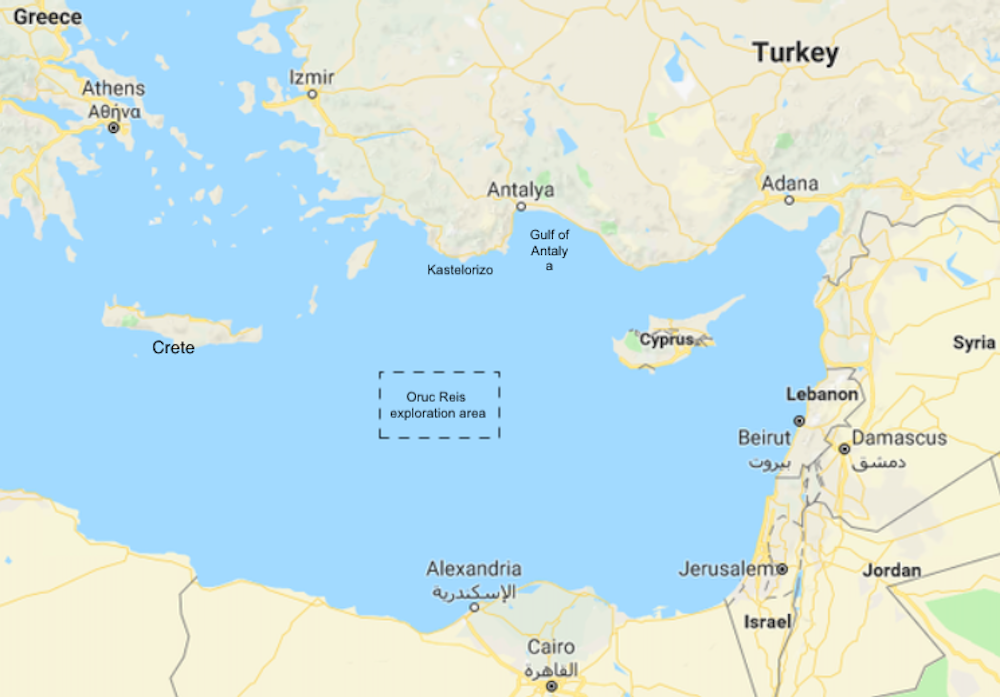
Protected by a Turkish naval convoy, Turkey's Oruc Reis surveying vessel has been active throughout the Mediterranean Sea since the beginning of the year.

Turkey's December 2019 maritime agreement with Libya's Government of National Accord aims to legitimize Turkey's claims by establishing a border between Turkish and Libyan waters that ignores Crete and Kastellorizo. 

On Aug. 27, the Greek parliament ratified a maritime border agreement with Egypt aimed at countering Turkey's pact with Libya by legitimizing a potential EEZ border generated via its control of Crete with Egypt. Greece's deal with Egypt is a first step in potentially declaring a full EEZ in the eastern Mediterranean, but the agreement with Egypt does not legitimize potential claims that Kastellorizo could give Greece rights to.


Turkey has also been actively attempting to delegitimize Cyprus' claimed EEZ in the eastern Mediterranean by both conducting energy exploration in waters that Cyprus directly claims, as well as harassing foreign companies that are operating on behalf of the Cypriot government. Turkey has argued that Cyprus' claimed EEZ is not legal because it was not done in coordination with the Turkish Republic of Northern Cyprus, which Ankara recognizes as a legitimate government for all of Cyprus. Turkey also argues that, as an island, Cyprus cannot claim a full EEZ.

Turkey's Yavuz vessel is currently drilling off the coast of Western Cyprus.

Turkey's Barbados vessel is also currently researching in the Northern Cyprus territorial waters that Turkey recognizes as a part of an oil exploration block held by the state-owned Turkish Petroleum Corporation.

In 2018, the Turkish navy prevented the Italian oil firm Eni from drilling on its Cuttlefish prospect in an exploration block the company received from Cyprus.

The Specter of War


Turkey's increased provocations will continue to drive the United States and other NATO countries, including France and Greece, to boost their own naval presence in the eastern Mediterranean. Both Turkey and Greece will try to refrain from crossing red lines that could spur a larger confrontation that neither wants, but the higher presence of ships in the eastern Mediterranean will nonetheless increase the possibility of incidents, as evidenced by the Aug. 10 collision between the Greek frigate Limnos and the Turkish frigate Kemal Reis. International mediation would likely avoid further escalation to a military conflict between Greece and Turkey, but is unlikely to result in a diplomatic solution to their dispute.

In the case of a wider crisis, most NATO members would view Turkey as the aggressor and would likely back Greece. This would likely reinforce Ankara's overall pursuit of its maritime strategy and intensifying national security push by offering Turkey further proof that NATO does not prioritize its national security priorities. Countries can only leave NATO on their own accord, which Turkey remains is unlikely to do. Instead, Ankara would probably continue to reduce collaboration with NATO countries.


Despite Cyprus and Greece's calls for a more significant response to deter Turkey's behavior, the European Union will likely be hesitant to impose more drastic measures for fear of prompting Ankara to reduce cooperation on migration and other EU priorities. Unless Turkey starts to more directly protect its claims in the Aegean Sea, fires upon a Greek or another European vessel, or conducts drilling or exploration activities around Crete, Brussels will likely limit its sanctions pressure to companies and individuals supporting Turkish activities in the Mediterranean. 

Decisions on implementing EU sanctions require unanimity among the bloc's member states. And some countries, such as Germany, are more concerned about aggressive sanctions only inflaming Brussels' tensions with Turkey. 

If the European Union does not take significant action on Turkey, Cyprus is now threatening to veto proposed EU sanctions against Belarus amid the country's ongoing political crisis. This may result in slightly stronger EU sanctions that target more Turkish individuals and companies, but more broad-based economic sanctions against the Turkish government remain unlikely.

Energy Projects in the Crossfire


The United States will likely let the European Union continue to take the lead in responding to Turkey's attempts to delegitimize Greek and Cypriot maritime claims, but Chevron's recent entry into the eastern Mediterranean could eventually draw Washington more directly into the conflict. On July 20, Chevron announced an agreement to acquire the Houston-based oil and gas firm Noble Energy, which operates both the Leviathan gas field off the coast of Israel and the Aphrodite gas field off the coast of Cyprus. Ankara, however, will likely adopt a more hands-off approach to U.S. companies operating in the region, as the United States would be more willing to impose hardline sanctions in response to American firms being drawn into its maritime disputes.

By continuing to increase the cost of developing resources in Cypriot waters, Turkey's ongoing harassment of foreign energy firms will drive its neighbors closer together on both maritime security and energy exploration issues. But it could also potentially halt their construction of the proposed East Med pipeline. Cyprus, Egypt, Greece and Israel created the East Mediterranean Gas Forum in 2019. The quartet has since collaborated to construct the roughly $6 billion pipeline project, which would carry natural gas from the eastern Mediterranean to Europe. Under international law, Turkey is technically required to allow other countries to build pipelines through its EEZ. But Ankara retains the power to demand that any constructors of the East Med pipeline adhere to its environmental reviews and oversight, which would be de facto recognition of Turkey's EEZ. Otherwise, Turkey could send its navy to harass or intercept vessels involved with construction as Ankara did in 2018 with a drillship planning to spud a well in Cypriot waters. 

9/11/2020

US eyes Greek island as alternative to Turkish base due to ‘disturbing’ Erdogan actions, senior senator claims


By Joel Gehrke, Foreign Affairs Reporter
Sept 10 2020


Turkish President Recep Tayyip Erdogan’s “disturbing” foreign policy has spurred U.S. officials to intensify preparations to withdraw from Incirlik Air Force base, according to a senior Republican senator and American analysts.


“We don't know what's gonna happen to Incirlik,” Wisconsin Sen. Ron Johnson, who chairs the Senate Foreign Relations subcommittee for Europe, told the Washington Examiner. “We hope for the best, but we have to plan for the worst.”

Erdogan has threatened American access to the base, which reportedly houses dozens of U.S. nuclear weapons, multiple times since he squashed a failed coup attempt in 2016.

A withdrawal would signal a major shift in the balance of trust between the United States and the country that boasts the second-largest military in NATO, but Erdogan’s increasing affinity for Russian President Vladimir Putin and truculence with other NATO allies has angered American officials and raised the specter of other crises in the transatlantic alliance.
Recommended For You

“We want to maintain our full presence and cooperation in Turkey,” Johnson said. “I don’t think we want to make that strategic shift, but I think, from a defensive posture, I think we have to look at the reality of the situation that the path that Erdogan is on is not good.”

The disagreements between Turkey and other NATO allies has grown in recent years, in part due to Erdogan’s purchase of advanced Russian anti-aircraft missile systems — a decision that led President Trump’s administration to expel Turkey from the F-35 stealth fighter program. More recently, Erdogan has gotten embroiled in a maritime boundary dispute with Greece, a controversy grave enough to prompt NATO officials to intervene to try to ensure that the two alliance members avoided a military clash.

“My main worry is an unintentional clash,” the Foundation for Defense of Democracies Aykan Erdemir, a former Turkish lawmaker and Erdogan critic, said during a discussion of the Turkey-Greece dispute. “Even a short-lived military conflict could be extremely detrimental to NATO. Because when you think about it, you know, from the Russian perspective, nothing could be better than two key members of NATO's southeastern flanked from fighting with one another.”

Both Turkey and Greece joined NATO in 1952, but the U.S. relationship with the two countries is trending in opposite directions. “We're already looking at Greece as an alternative,” Johnson said while considering a prospective exit from Incirlik.

The U.S. Navy maintains a base at Souda Bay on the Greek island of Crete, and the significance of the outpost is growing along with the tensions between Washington and Ankara.

“It's very unfortunate the path that Erdogan is taking Turkey, or has put Turkey on,” Johnson said. “It’s disturbing. It's very concerning, which is one of the reasons we certainly are increasing and improving our military cooperation with Greece ... beefing up our presence in Souda Bay, because our presence, quite honestly, in Turkey is certainly threatened.”

Erdogan’s dispute with Greece is just one of the maritime boundary controversies involving his government, spurred in part by recent natural gas discoveries that make the eastern Mediterranean a desirable economic asset. Turkey and Cyprus, where Turkey has maintained a major military presence since seizing part of the island in 1974, also disagree about who has jurisdiction over energy-rich waters.

And in the midst of these controversies, Secretary of State Mike Pompeo announced last week that Cyprus would be allowed to purchase “nonlethal defense articles and services,” providing partial relief from an arms embargo imposed in 1987.

“It is in our national security interest to lift these outdated decadeslong arms restrictions and deepen our security relationship with the Republic of Cyprus,” New Jersey Sen. Bob Menendez, the top Democrat on the Foreign Relations Committee, said in support of Pompeo’s announcement.

State Department officials identified the Cyprus decision as a way to help mitigate Russian influence on the island, which traditionally allows Russian naval vessels to refuel at Cypriot ports. Yet the strengthening of security ties between Cyprus and the U.S. also stands as a warning to Erdogan and a sign that the U.S. is preparing an array of new basing options in case the Turkish leader’s policy decisions makes Incirlik untenable for American forces.

“One of the issues with regard to the Cyprus arms embargo was just allowing them to be prepared to host our forces a lot more — not in a formal base, but in various exercises,” the American Enterprise Institute’s Michael Rubin said.

Erdemir, the former Turkish lawmaker, agreed that the overtures to Cyprus and Greece are partly designed as a hedge against Erdogan’s threats to Incirlik.

“Washington is not necessarily thinking of one alternative to Incirlik, but a number of rebasing options which are complementary as a contingency plan to Incirlik,” he said. “This has been going on for quite some time, in steps. I would definitely argue that it’s nothing new, but it might be changing qualitatively in terms of the nature and the extent of U.S. presence and investments in that.”

---

Background story: Turkey's Erdogan threatens to close strategic bases to US military


8/28/2020

If France and Egypt actively support Greece, Turkey will be defeated


August 28 2020
By Alexander Khramchikhin


MOSCOW, (BM) – The scenario of a war between two NATO members, Greece and Turkey, described quite recently, is becoming more and more real and tangible. The specific reason for a possible war is the division of the Mediterranean shelf with oil and gas fields.

At the same time, the country, which is also a NATO member, unexpectedly but very decisively came out on the side of Greece. And this country is a whole France, a nuclear power, a permanent member of the UN Security Council. However, it is clear that the nuclear potential of this country is irrelevant, it will not be used under any circumstances. But the usual potential of the French Armed Forces has, as it were, even openly demonstrated.

In the event of a military confrontation only between Greece and Turkey, the latter has an obvious advantage. The intervention of France radically changes the situation.

The French ground forces have the least influence on this situation. In terms of the number of tanks and artillery systems, they are much weaker than both the Greek and Turkish ones. Ground military air defense is absolutely insignificant; now it consists only of Mistral MANPADS.

There are still a few SAMR / T and Krotal air defense systems, but they are part of the Air Force and are intended to protect military airfields. And it is difficult to imagine the transfer of French ground contingents to Greece. But it is no less difficult to imagine in general a land war between Greece and Turkey through a very short and geographically inconvenient continental border between these countries, especially since the border is far from the disputed shelf. Accordingly, the weakness of the French ground forces does not matter much. What matters is French air and sea potential.

In terms of the number of American F-16C / D fighter-bombers, Turkey currently has an advantage over Greece 235 to 154, according to the old, but still vigorous Phantoms – 43 to 33, while Turkey also has 20 equally old ones in service. but upgraded F-5. In addition, at least one and a half hundred different outdated aircraft are in storage on each side, but their return to service is hardly possible.

True, Greece has 42 more French fighter-bomber Mirage-2000, to which France can add 156 similar aircraft of several modifications at once [and the French have up to 64 such aircraft in storage]. This already significantly changes the balance of power, but France has 105 much more modern Rafale-V / S, belonging to the 4+ generation [F-16 and Mirage-2000 – 4th generation].

Even a partial use of this potential immediately changes the balance of power against Turkey. It may be recalled that in the only real air battle in October 1996, the Greek Mirage-2000 shot down a Turkish F-16D. “Rafal” is obviously much better than the F-16 [with “Phantoms” belonging to the 3rd generation, it is generally pointless to compare them].

Another 43 “Raphael-M” is carried by the only French nuclear-powered aircraft carrier “Charles de Gaulle”. However, nothing prevents the deck “Raphael” from flying from ground airfields, further increasing the superiority of the Franco-Greek coalition in the air.

According to the German-built submarines of the project 209 of various modifications, Turkey has an advantage over Greece of 12 to 7, however, Greece has four newest submarines of the project 214. France can put up four Rubis-class submarines, thereby providing the Franco-Greek side with a certain superiority under water. In terms of frigates, Turkey surpasses Greece by a ratio of 22 to 13.

France has 29 frigates, of which 11 are actually destroyers (they are classified as “1st rank frigates”). Of these destroyers, 8 (2 of the Forbin type, 6 of the Aquitaine type) are the latest ships, significantly superior in their performance characteristics to any of the Turkish frigates. In terms of the number of missile boats, Turkey bypasses Greece by very little (19 and 17), so the Franco-Greek coalition will have a significant superiority in the surface forces. It is clear that in a potential conflict it is impossible to involve all available air and sea forces, but this applies equally to all parties.

If the war is air-sea, then the ground air defense of the parties will not be able to make a special contribution to it. Although the Greeks are able to deploy their air defense systems on the islands in the Aegean Sea, and they have already deployed the S-300P in Crete. This could create additional problems for the Turkish Air Force.

However, the Turks are theoretically able to bring the S-400 to their Mediterranean coast, then the French and Greeks will become sad. The question is how much the Turkish military mastered the newly purchased air defense system and how much they bought the air defense system for it.

There is evidence that there are only about 120 missiles, that is, less than Greece and France have combat aircraft. True, if the S-400 knocks down at least a couple of dozen aircraft, the rest will sharply diminish the desire to climb into its zone of action.

Although ground-based air defense adds to the uncertainty, the overall quantitative and qualitative superiority is on the side of Athens and Paris. Moreover, their task is purely destructive: to prevent Turkish geological exploration on the shelf, as well as, possibly, the transfer of Turkish troops to Libya.

This makes the coalition’s actions even easier, since it does not need to defend anything, and makes Turkey’s position completely unpleasant – its Air Force and Navy, on the contrary, find themselves “tied” to defenseless geophysical and transport vessels. Oil rigs will be even more vulnerable if it comes to installing them offshore.

The situation becomes simply exciting if the Libyan scenario is added to the Mediterranean scenario, where France is on the side of the “opposition” (LNA led by Haftar), and Turkey actively supports the “legitimate government” (PNS led by Saraj). The main support of the LNA, as you know, is Egypt, which in fact is already in a state of covert war with Turkey and is one step away from a direct invasion of Libya (“The Expected Impossible”).

At the same time, he is also actively involved in offshore affairs. Earlier this year, Turkey and Libya (represented by the PNC) signed an agreement to “close” their economic zones in the Mediterranean Sea, to which Greece and Egypt recently responded with a similar “closure”. The arbitrary delimitation of Mediterranean waters by both pairs has a very distant relationship to the law of the sea, but it creates the possibility of another conflict, since each of the pairs divided the same waters.

Accordingly, Cairo can quite openly side with Paris and Athens. And put up against Ankara up to 300 modern combat aircraft (F-16, Mirages-2000, Rafaley and MiG-29M2), three Project 209 submarines, 11 frigates (including one “actual destroyer” of the “Aquitania” type), not less than 30 missile boats.

After which the superiority of the “troika” becomes overwhelming. Moreover, the United Arab Emirates, which have 78 F-16s of the most advanced E / F modifications and up to 58 Mirages-2000 in the Air Force, at least 30 missile corvettes and boats in the Navy, can also act on its side. It is clear that the Emirates will not send all this into battle, but even a third of this potential will make Turkey’s position completely sad.

In this situation, it would be strange for Greece not to attempt to liquidate the Turkish Republic of Northern Cyprus. The war for Cyprus between only Greece and Turkey is almost guaranteed to be won by Turkey (despite the participation of the Cypriot land forces on the side of the Greeks), but in the configuration described here, on the contrary, Greece is practically guaranteed to win.

At the same time, Cyprus is becoming an excellent “unsinkable aircraft carrier” for the coalition, allowing its aircraft to penetrate deep into Turkish airspace. And in this case, the Syrian troops and Kurdish formations, with the “feasible help” of the Russian aviation, will be able to cleanse Idlib and Afrin from the Turks and their local puppets.

Ironically, out of five potential war participants, three are NATO members, and the other two are the most westernized countries in the Arab world. But this is certainly not what will stop the war, for there is no longer that West in general, and even more so NATO in particular. It will be stopped by the fear of human and material losses, which in the event of such a grandiose “batch” will be huge for all participants in the war. On the other hand, someone may just accidentally break off or just as accidentally re-bluff. After that, an uncontrolled escalation will follow.

Originaly posted to VPK. Alexander Khramchikhin is a Deputy Director of the Institute of Political and Military Analysis.


8/19/2020

EU Commission exposes Greek health minister over COVID-19 vaccine


Source: Euractiv
By Sarantis Michalopoulos
August 19 2020


The European Commission yesterday (18 August) refuted claims by Greece’s health minister that a first batch of COVID-19 vaccines is expected in December saying there is no timeline as there is no vaccine yet.

Asked by EURACTIV, EU spokesperson Vivian Loonela said: “We are in a situation where we cannot tell the exact date of delivery. We are working to have the vaccine ready as fast as possible as well as safe as possible.”

Loonela added that the executive is currently in talks with several pharma companies to make sure enough vaccines are available for EU member states as well as for donations to low-income countries.

Last week, EU Commission chief Ursula von der Leyen announced a first deal with British-Swedish multinational AstraZeneca to purchase a potential vaccine against COVID-19.

According to the agreement, the EU will purchase on behalf of EU member states 300 million doses of the AstraZeneca vaccine, with an option to purchase 100 million more.

Speaking on TV, Greek health minister Vasilis Kikilias said once the AstraZeneca vaccine passes the last testing phase, Greece would receive 700,000 doses in December and overall some three million doses until June 2021.

However, the Commission made it clear that no delivery date has been given to EU member states considering that the testing phases are still underway.

The executive hopes that a vaccine could be ready by the end of 2020 or beginning of next year, in line with industry projections.

Nathalie Moll, the director-general of the European Federation of Pharmaceutical Industries and Associations (EFPIA), said in April that a vaccine could be available in the beginning of 2021 if the testing phase is successful.

Strong reactions in Athens


The Commission’s statement triggered strong reactions in Athens, with the main leftist opposition Syriza party accusing the right-wing New Democracy government (EPP) of populism.

“If it weren’t for such a serious issue it would be almost ridiculous […] Cheap government populism playing with citizens’ anguish is both unacceptable and dangerous,” Syriza said in a statement.

Meanwhile, the country reported yesterday a new record of 269 new coronavirus cases and two new deaths. The total number of COVID-10 cases has reached 7,472.

The government claims that the vast majority of cases occurred domestically and are not related to tourism. Many cases are also related to young people.

Meanwhile, the opposition accused the government of inefficient preparation against a second wave of infection and called on Prime Minister Kyriakos Mitsotakis to stop putting the blame on young people.


Turkey-Greece conflict in eastern Mediterranean is less about gas than vaccuum left by Trump


August 18 2020


The worsening stand-off in the eastern Mediterranean, frequently described as a gas conflict, has been gaining momentum. Yet it is a strange time to be fighting over gas when prices remain in a slump due to weak demand and investors withdrawing. So what explains the escalating conflict between Turkey, Greece, Cyprus and Egypt, which is drawing in other regional and European powers?

Large reserves of oil and gas were discovered in the region a decade ago. The estimates are worth trillions of dollars to the surrounding countries even at today’s prices.

On August 13 Turkish president Recep Tayyip Erdoğan warned there would be a heavy price for anyone attacking the Turkish drilling vessel Oruç Reis, which is exploring for oil and gas in waters claimed by both Turkey and Greece. This came after a collision between Greek and Turkish navy frigates left international actors on high alert.

France immediately pledged military support to Greece, while Angela Merkel reportedly called the Greek and Turkish leaders to help de-escalate tensions. The old Aegean rivals are now almost as close to open conflict as during Turkey’s 1974 Cyprus invasion.


Until recently, the Turkish-Greek conflict over oil and gas was very much associated with the Cyprus problem: Turkey was drilling off the coast of Turkish Cyprus, a state not recognised by the rest of the international community. But the current stand-off has dramatically shifted the conflict into open sea.

Turkey claims exploitation rights within an area it claims as continental shelf. Greece’s counter claim is that all its inhabited islands are surrounded by a 200-mile exclusive economic zone (EEZ), per the UN Convention on the Law of the Sea, to which Turkey is not a party. A blind application of these rules “locks” Turkey’s exploitation rights into a small corner around the Gulf of Antalya.

Both claims are formalised in bilateral agreements with other countries in the region. Turkey signed an EEZ agreement in late 2019 with the Libyan Government of National Accord (GNA) in Tripoli and, more recently, Greece with Egypt.

The Turkish-Libyan agreement implies that not even the largest Greek island, Crete, has a continental shelf – let alone the much smaller Kastelorizo off the Turkish (Lycian) coast. This position is legally tricky, but Turkey’s claim for some share of the offshore cake seemed in particular to be understood by Germany. EU leaders haven’t been able to agree to impose new sanctions on Turkey to add to the ones they previously imposed in response to the drilling off Cyprus – at least for the time being. Erdoğan has allegedly promised Merkel that Turkey will soften its position in the days ahead.
Gas bonanza?

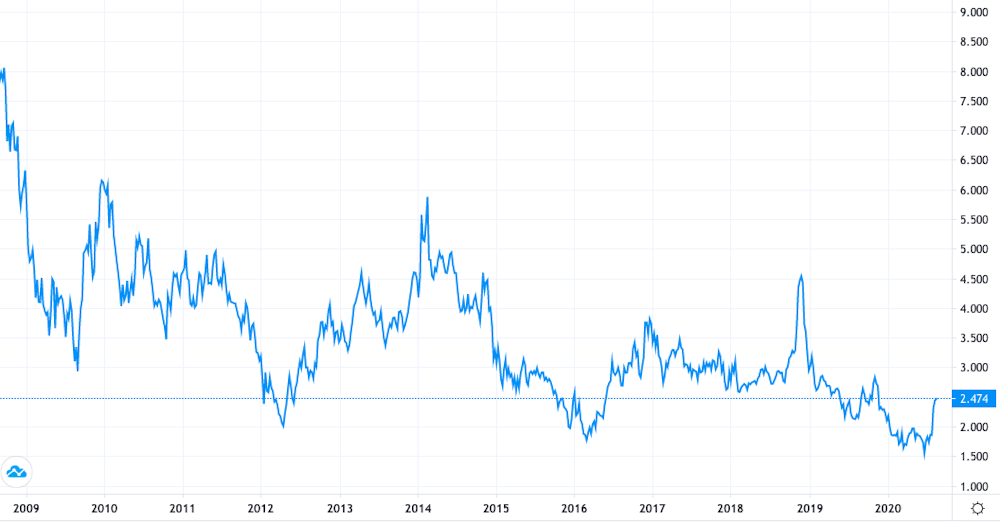
With gas prices so low, it calls into question whether it would be profitable to extract these resources right now – let alone the plan between Israel, Greece and Cyprus to build an EastMed pipeline to sell the gas to the EU (which excludes Turkey and any notion of Turkish Cyprus).


Gas price, US$/therm

Yet the collapse of gas prices is outweighed by the implosion of the Turkish lira. Turkey is hungry for hydrocarbon-based growth and urgently needs more foreign exchange to prop up its currency, having lately been relying on dollars from Qatar. In this context, seeking energy wealth seems intuitive.

Except that it is not. Gas exploration and production, especially on a seabed, requires hefty upfront investment – never mind the geopolitical cost. Unsurprisingly, Israel now prefers solar energy to gas-fired power stations, while (legal) drilling has stopped off Cyprus altogether.

Undeterred, Turkey claims its position is more defensive than expansionist, but some commentators point to its “mavi vatan” (“blue homeland”) strategy in the eastern Mediterranean. At best, this is about naval hegemony. At worst, it implies revising borders agreed in the 1923 Lausanne treaty.

Turkey’s continuing commitment to Turkish Cyprus, alongside introducing the lira to the parts of northern Syria it controls, are seen as clear evidence. Yet with Turkey frozen out by the EastMed pipeline and most EEZ agreements in the region, Erdoğan’s assertiveness may be less about seizing territory or energy than pushing for a seat at the negotiating table.
Regional alignments

Nonetheless, Turkish assertiveness has naturally galvanised potential adversaries – including Greece, Cyprus, Egypt, France and also Iraq, where Turkish forces are conducting a large operation against the Kurdish-separatist PKK. Meanwhile, the United Arab Emirates (UAE) that has come out as spearhead of this alliance.

The Gulf monarchies and Egypt are threatened by Turkey and Qatar’s pro-Muslim Brotherhood position, plus their military cooperation agreements – most recently including a naval facility in the Libyan rebel stronghold of Misrata. The UAE is intervening in Libya too, openly claiming responsibility for a recent airbase attack in western Libya where Turkish drones operate in support of the GNA. Together with the Turkey-Libya EEZ agreement, it shows how tightly the gas conflict is linked to Libya’s civil war.

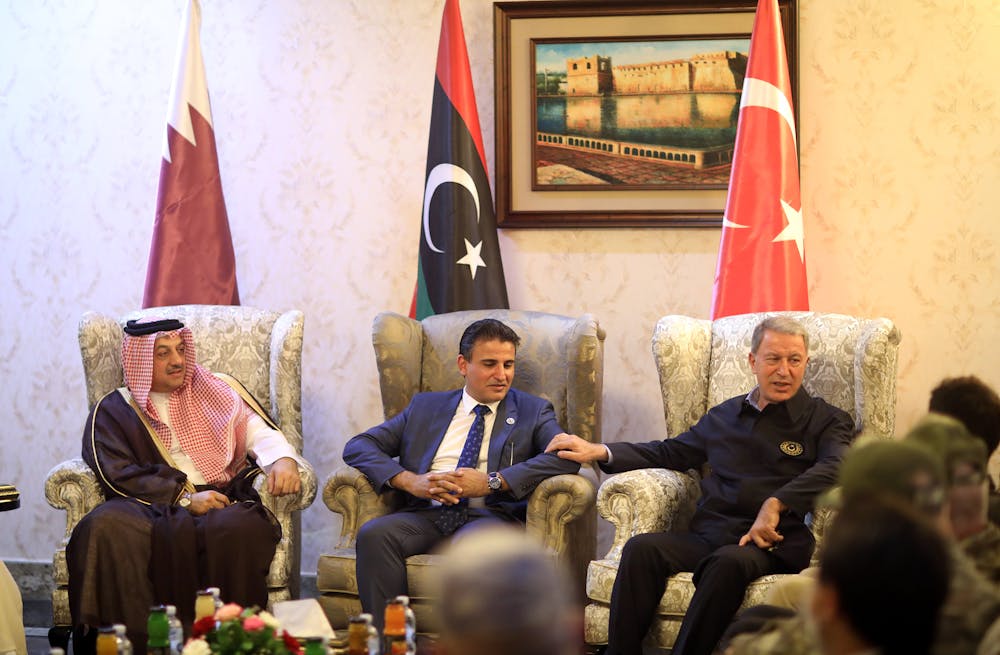
Defence ministers from Turkey, Libya and Qatar meeting in Tripoli on August 17. EPA

The UAE’s peace deal with Israel can be seen in light of this Turkish expansionism – about which Jerusalem has been conspicuously quiet. But if Israel is tacitly supporting the alliance, more assertive is another Mediterranean power, headed by a president who declared NATO “brain dead” in 2019 partly in reference to Turkey’s invasion of northern Syria.

Emmanuel Macron’s visit to Beirut was by no means as accidental as the explosion that devastated the Lebanese capital. He and the UAE pledged to co-fund harbour repairs, pre-empting Turkey’s own bid. France now has military agreements with the UAE, Greece, Cyprus and Egypt, all geared towards curbing the actions of a fellow NATO member and EU candidate.

And while Berlin is left trying to reach a balance in the Greece-Turkey confrontation, Washington, traditionally the guarantor of peace between the Aegean NATO rivals, has been almost totally silent. There is a sense that all parties want to take advantage of this, onshore and offshore, before the US elections. It is oddly this vacuum, rather than fossil fuels, that is fanning regional rivalries. With the US withdrawn, Moscow continuing its opaque brinkmanship and the EU split over Turkey, the scene is unfortunately set for more instability to come.

8/15/2020

Greek Shippers Threatened With Sanctions, Forced to Hand Over Iranian Oil Cargo to US, Report Says


Source: Sputnik
By Aleksandra Serebriakova
August 15 2020


Last year, the White House pledged to sanction any actor involved in purchase or transaction of Iranian oil, citing Tehran’s alleged support for militant groups in the region and its ballistic missile programme. Despite the threats, a number of countries still continued their oil business with Iran.

Washington has forced Greece-based shipowners to surrender their cargo of Iranian fuel to the US government or face sanctions from the Trump administration, The Wall Street Journal reported, citing people familiar with the confiscation.

The ships in question, reportedly owned by Greek Vienna LTD and Palermo SA, were said to be loaded with Iranian oil, despite the sanctions imposed on Tehran. According to the report, their owners “grew frightened” due to the threat of US sanctions that could target the shippers and their crews, potentially depriving them from access to US banks and dollar depositions.

After a US federal prosecutor filed a suit to seize the tankers, the shippers agreed to transfer the oil cargo to Greece’s Eurotankers and Denmark’s Maersk vessels. They were subsequently expected to arrive in Houston, and according to US President Donald Trump’s comments to the press, might have already come to the US port. If the oil cargo will be recovered from the court, the money from its sale will go to the US Victims of State-Sponsored Terrorism Fund, the Department of Justice said in a press release. According to sources familiar with the transaction, the cargo has already been paid for by Venezuela.

The operation was confirmed by the US Justice Department, which said that oil cargo was confiscated from four Greek vessels: the Luna, the Bella, the Bering and the Pandi, which were heading to Venezuela. The development took place in international waters, with no physical presence of US authorities, insiders revealed, including one unnamed American governmental official. There was no personal communication between the owners of the ships and the US officials, the sources said.

© AP PHOTO / ERNESTO VARGAS
Iranian oil tanker Fortune is anchored at the dock of the El Palito refinery near Puerto Cabello, Venezuela, Monday, May 25, 2020

The DoJ thanked US Special Representative for Iran Brian Hook for assisting the department and the Homeland Security office in the cargo’s confiscation. From his part, Hook argued that Iran was using “oil revenues to fund terrorism”.
“We have collapsed Iran’s oil sector through a significant sanctions regime, and we enforce our sanctions. We have warned the maritime community for two years of the dangers of moving Iranian oil,” the official alleged.

Following reports about the seizure of the four ships, which were initially alleged to be Iranian, the country’s Ambassador to Venezuela Hojat Soltani denied the claims, calling them “psychological warfare by the US propaganda machine”.

The US is set to target any actors, companies or countries which purchase Iranian oil or take parts in the transaction, accusing Tehran of supporting terrorist groups operating within the country. The Trump administration is also attempting to halt the Iranian nuclear programme and the development of ballistic missiles by Tehran. Recently, the US also introduced a proposed UN Security Council resolution that will call for an extension of the arms embargo on the country, which is set to expire in October.


8/10/2020

Greek national security council meets amid Turkey tension


Source: AlJazeera
August 19 2020


Greece raises alert after the announcement of Turkish exploration drilling in the eastern Mediterranean.

Greece's Prime Minister Kyriakos Mitsotakis has convened the government's national security council after Turkey announced its research vessel would be conducting exploratory drilling in the eastern Mediterranean in an area between Cyprus and Greece.

The council, which includes the ministers of foreign affairs and defence, met on Monday as Greece's navy ships were monitoring the Turkish seismic research ship Oruc Reis.

"We are in complete political and operational readiness," Minister of State George Gerapetritis said on state television ERT. "Most of the fleet is ready to be deployed wherever necessary," he said.

Turkey issued a Navtex, or international maritime safety message, announcing Oruc Reis and two auxiliary vessels would be conducting exploratory drilling from Monday until August 23.

Turkish Energy and Natural Resources Minister Fatih Donmez said Monday that the Oruc Reis had arrived in its area of operation from its anchorage off Turkey's southern coast, near the Greek island of Kastellorizo.

He also said "83 million back the Oruc Reis", referring to Turkey's population.

Click map to enlarge

Rising tension


Tension has been high in the region in recent months over drilling rights and maritime boundaries.

Late last month, Turkey had said it was suspending its exploratory drilling in the eastern Mediterranean, and the move was seen as somewhat defusing the situation.

But last week, Ankara slammed a deal signed between Greece and Egypt delineating maritime boundaries and the countries' exclusive economic zones for drilling rights.

Last year, Turkey signed a similar deal with the UN-recognised Libyan government in Tripoli, sparking outrage in Greece, Cyprus and Egypt, who all said the Turkish-Libyan deal infringed on their economic rights in the Mediterranean.

NATO allies and neighbours Greece and Turkey have been at odds for decades over a wide variety of issues, including sea boundaries, and have come to the brink of war three times since the mid-1970s.

Recent discoveries of natural gas and drilling plans across the east Mediterranean have led to a spike in tension.

Mitsotakis spoke on Monday morning with European Council President Charles Michel, informing him about the Greek-Egyptian agreement and the situation in the eastern Mediterranean, officials said.

Turkish position


In a television interview on Sunday, Turkish President Recep Tayyip Erdogan's spokesman, Ibrahim Kalin said Turkey and Greece had been holding talks in Berlin for more than two months and were on the verge of issuing a joint statement when the Greek-Egyptian agreement emerged.

"The moment the agreement with Egypt was announced, we received a clear instruction from our president: 'You are halting the talks. Inform the Germans and the Greeks, we are not pressing ahead with the negotiations,'" Kalin told CNN-Turk television.

"This is another move to keep Turkey out of the eastern Mediterranean and to restrict it to the Gulf of Antalya," Kalin said.

Kalin said Turkey is in favour of resolving the dispute through dialogue. "But it is the Greek side that disrupted the agreement and broke the trust," he said.