Showing posts with label EU. Show all posts

8/13/2023

‘Greenlash’: Why it’s getting harder to pass environmental reforms in the EU


Source: Euronews
August 13 2023

What is ‘greenlash’? Here's how right-wing parties are using the cost of living crisis to roll back green policies.

A growing 'greenlash' against Europe's environmental agenda has so far failed to derail its decarbonisation plans. But looming elections could put future climate and nature measures at risk.

The European Union has polished its role as a leader on climate change, enshrining carbon reduction targets in law and proposing policies to slash emissions this decade.

And so far the impact of the green backlash is limited, say policymakers and analysts, because most of Europe's main CO2-cutting policies are fixed into law.

But as policymakers seek to translate net-zero targets into measures that extend beyond power generation to areas such as buildings and transport, they face increasing resistance as citizens struggle with a cost of living crisis.

Angst over a law to phase out oil and gas heating brought Germany's ruling coalition close to breaking point, while in the Netherlands, anger at plans to cut nitrogen pollution led to a shock poll win for a new farmers' protest party.


Politicians are tapping into fears about the cost of green policies

Analysts say politicians are increasingly tapping into worries about the expense of green policies ahead of regional, national and EU elections over the next year-and-a-half.

"It's definitely different circumstances than in 2019 when we started with this maximum support and the political willingness to act from... across the parties," European Environment Commissioner Virginijus Sinkevicius told news agency Reuters.


Politicians must take into account polls showing a large majority of citizens are worried about climate change and strong business interests behind the green transition.

"We have this stable majority which supports the green deal," he said, referring to the level of support in the European Parliament for the EU's overall green agenda.

"But then we come to more difficult files [EU legal proposals] where I think, inevitably, they are very much affected by the political debate," Sinkevicius added.

It's getting harder to pass green laws in the EU

As a result, officials say it is getting harder to pass green laws, with some EU governments resisting new emissions limits for cars and seeking to weaken pollution controls for livestock farms. A proposal to improve the energy efficiency of buildings faces pushback from countries worried by the cost.

Poland's government, which faces October elections, is even suing Brussels over climate policies.

"Does the EU want to make authoritarian decisions about what kind of vehicles Poles will drive?" its Minister of Climate and Environment Anna Moskwa asked last month.

Nature conservation measures face even greater opposition than decarbonisation ones due to lobbying by the powerful agriculture sector and a lack of strong business incentives for change, said Nathalie Tocci, director of Italian international relations think tank Istituto Affari Internazionali.
'Selfish': UK to grant 100 new licenses for North Sea oil and gas exploration

Although a recent campaign by the centre-right European People's Party, the biggest group in the European Parliament, to kill off a proposed law to restore damaged environments failed, the proposal looks set to be diluted.

"The elections to the European Parliament next year will be very decisive if one looks further ahead, because the centre right group is turning more negative to green policies," the European Council on Foreign Relations' Mats Engström said.


Europe risks falling behind on green technology

Another concern is the impact on Europe's diplomatic standing and investor confidence, coming as the United States offers multi-billion dollar green subsidies and tax breaks.

"It's slightly ironic that Europe is having these problems when the United States has finally got its act together," said Bob Ward, policy and communications director at the Grantham Research Institute on Climate Change and the Environment at the London School of Economics and Political Science.

Ward said Europe risked falling behind India and China in establishing green industries and technologies.

Last year, India boosted solar capacity by 28 per cent, outpacing the capacity growth of European heavyweights.

"If Europe is wavering, it will allow other countries to take advantage in the international markets in electric vehicles and other technologies," Ward said.

Britain has already quickly gone from being a leader on the world stage to looking quite weak on green policies, he said.

Britain's climate advisers said in June the country is not doing enough to meet its 2050 net zero target, while a government-commissioned review found businesses complained of weaknesses in Britain's investment environment.

Progress in UK onshore and offshore wind has been hampered by rule changes, for example, prompting some developers to warn they will struggle to invest without better incentives.

Prime Minister Rishi Sunak, who faces an election within 18 months, last month warned of climate policies that "unnecessarily give people more hassle and more costs".


How can the EU drum up support for green policies?

Europe's green policies are still more credible than US ones, given see-sawing between electoral cycles in the United States, some analysts said.

But EU politicians are going to need to address more concerns of citizens and businesses if they want to maintain support as they legislate on sectors that hit close to home.

Dutch Minister for Climate and Energy Policy Rob Jetten told Reuters in June that the main challenge for the next few years was for politicians to show that the green transition was also a just one, with support available for those in need.

Rows over green policies have propelled right-wing populist parties to second place in both Dutch and German polls.

The German heating law debacle underscored the importance of ensuring green laws enabled transition without overwhelming anyone, Nina Scheer, climate protection spokesperson for the ruling Social Democrats in parliament, said.

"Otherwise citizens might start to feel that climate policy is always financially overwhelming and bad, and that sentiment is then exploited by populists."

Crafting a strong green industrial policy is key, said Simone Tagliapietra, Senior Fellow at think-tank Bruegel.

"If we don't create green jobs in Europe, if we don't make sure to have these industrial and economic opportunities, we will be in trouble," Tagliapietra said.


2/10/2023

Out of Alignment: What the War in Ukraine Has Revealed About Non-Western Powers


Source: Foreign Affairs
By Shivshankar Menon
February 9, 2023


For the past year, many Western analysts have regarded the war in Ukraine as marking a turning point in geopolitics, bringing together not only the United States and its NATO allies but also a broader liberal coalition to counter Russian aggression. In this view, countries around the world should naturally support the West in this defining contest between democracy and autocracy.

Beyond the borders of North America and Europe, however, the past 12 months have looked very different. At the outset of the war, numerous countries in the global South identified with neither the West nor Russia. Several dozen—including such large democracies as India, Indonesia, and South Africa, as well as numerous other countries in Africa—abstained from resolutions condemning Russia at the UN General Assembly and in the UN Human Rights Council. Many of them have also been reluctant to formally adopt the West’s economic sanctions against Russia while respecting them in practice, and as the war has unfolded, some of them have sought to maintain relations with Russia as much as with the West.

Moreover, in many parts of the world, the most crucial issues of 2022 had little to do with the war in Ukraine. Emerging from the havoc of the pandemic and confronted by far-reaching challenges ranging from debt crises to a slowing world economy to climate change, many developing countries have been alienated by what they view as the self-absorption of the West and of China and Russia. For them, the war in Ukraine is about the future of Europe, not the future of the world order, and the war has become a distraction from the more pressing global issues of our time.

Yet despite this disillusionment, a coherent third way, a clear alternative to current great-power rivalry, has yet to emerge. Instead, these countries have sought to work with present realities, respecting Western sanctions on Russia, for instance, in an international system that no longer inspires much faith in its relevance to their security and economic concerns. In this sense, for many parts of the globe, a year of war in Ukraine has done less to redefine the world order than to set it further adrift, raising new questions about how urgent transnational challenges can be met.

GREATER RIVALRY, DIMINISHED POWER

A year of war in Ukraine has weakened the world order in two important ways. First, the Russian invasion, combined with the continuing effects of the pandemic and the global economic slowdown, diminished all the great powers in both power and prestige. The diminution was most apparent for Russia itself: in the unanticipated course of the war, in the country’s increasing economic and political isolation, and in the acceleration of its decline. It was least evident in the United States, which has managed to respond forcefully to the war without involving its own forces or causing serious escalation while strengthening Western unity and staying focused on the main game in Asia.

Worries remain, however, about the United States being distracted by Ukraine from its roles elsewhere, particularly in the Middle East and Africa. The precipitate withdrawal from Afghanistan in 2021 also raised questions about U.S. staying power and perseverance, especially now as it enters a new presidential electoral cycle. Nor has its own domestic politics permitted the United States to provide constructive leadership to the international multilateral system. For Europe, the war has limited its ability to play a broader global role, given its preoccupation with European order for the foreseeable future, regardless of whether the war ends in victory for either side or in a protracted frozen conflict.

China, too, has been taxed by the war. Because of its secondary effects on the world economy, on China’s own energy and food imports, and on China’s virtual alliance with Russia, the war has limited Beijing’s influence abroad. Unlike other permanent members of the UN Security Council, China has not played a meaningful political or military role in the Ukraine crisis. Other middle powers outside Europe have experienced similar effects. But in China’s case, two additional factors have been at play. One was Beijing’s domestic preoccupation through much of the year with its own economic slowdown and its need to project a smooth buildup to the 20th National Congress of the Chinese Communist Party in October. The other was China’s “zero COVID” policy, which compounded its inward fixation. Together, these domestic concerns reinforced the effects of China’s unproductive “Wolf Warrior” diplomacy, which created an inability to find negotiated solutions to bilateral disputes or to play a meaningful role on transnational issues such as climate change and the developing-country debt crisis.

It is not yet certain how China and the other powers will respond to their straitened circumstances. Since the party congress, China seems to be attempting to restore some balance in important relationships with Australia, Europe, and the United States. But Beijing’s domestic imperatives to reignite economic growth and to control the social and political fallout of its COVID-19 policies are likely to take precedence and limit meaningful shifts away from its recent assertive actions in maritime Asia and its land border with India.

The second effect of a year of war is that economic policies of major powers such as China, the United States, and Europe are now shaped by politics as much as by economics. Today, in many cases, security of supply and political interests take priority over price considerations in global manufacturing and value chains. “Friend shoring” and onshoring are being driven by political considerations rather than by economic responses to the changing situation. Although globalized markets have limited the extent of decoupling between China and the United States, they have not prevented strong efforts by both countries to reduce mutual dependence in strategic sectors such as semiconductor manufacturing, artificial intelligence, energy, and rare-earth metals.

The response of countries that have hitherto relied on their economic strength for global influence has varied. Japan is now making a transition to stronger defense and security policies that are better suited for today’s challenges, giving it a more balanced stance that emphasizes political and military power, too. Germany’s government speaks of a Zeitenwende, or historic turning point. And China, a global economic power that is militarily and politically constrained in its own neighborhood, has recalibrated both the nature of its engagement abroad and the way that it projects that engagement to its own people and to the world. Meanwhile, Europe and many countries in the global South pay an economic price for the West’s unprecedented sanctions against Moscow, and recession looms in some of the world’s most important economies.

ALIENATED AND UNALIGNED

As much as the war has affected relations between the major powers, the effect of a weakening world order is also profound on countries outside the West. One year later, these countries seek alternatives to the present order, but a clear third way, whether economically or politically, has yet to emerge. A growing debt crisis has affected over 50 countries in Africa, Asia, and Latin America since before the pandemic, according to the International Monetary Fund. This limits the developing world’s ability to strike out on an independent economic path. Indeed, most countries have respected the sanctions on Russia in practice.

Politically, too, the present situation inhibits the emergence of a single or coherent third way akin to the Non-Aligned Movement during the Cold War. A crucial difference is that today, unlike in the Cold War, there is no bipolar order. For all the talk of autocracies and democracies facing off against each other, economic interdependence between China and the United States and the reality of a globalized economy mean that the world does not have a clear two-part division offering opportunities for traditional balancing. Instead, it is a world in which great-power rivalry is not between two superpowers but among multiple players. As a result, the multisided competition and great-power rivalry have led many countries in the global South to be unaligned rather than nonaligned, dissociated from the present order and seeking their own independent solutions rather than an alternative set of widely held approaches to global issues.

Alienated and resentful, many developing countries see the war in Ukraine and the West’s rivalry with China as distracting from urgent issues such as debt, climate change, and the effects of the pandemic. Take South Asia. Three countries in the region—Bangladesh, Pakistan, and Sri Lanka—have been in talks with the IMF for more than a year about adjustment packages to deal with their debt. And over the last 18 months, five countries in the region—Afghanistan, Myanmar, Nepal, Pakistan, and Sri Lanka—have also changed governments, and not always smoothly or constitutionally. Sri Lanka defaulted on its international debts in April 2022. During the summer, one-fifth of Pakistan’s population was rendered homeless by floods inundating one-third of the country—a devastating consequence of climate change. Neither international institutions, nor the West, nor its Chinese and Russian rivals, have found or offered meaningful solutions to these problems.

Great-power rivalry complicates the task of addressing such issues. In dealing with Sri Lanka’s debt, for instance, the West is naturally reluctant to pay for Sri Lanka to settle accounts with China, the country’s largest creditor. For its part, Beijing is waiting for the rest of the international community to act, worried that if it moves to reschedule Sri Lanka’s debt, it will set a precedent for other countries that have taken on significant loans in China’s $1 trillion Belt and Road Initiative, many of which are only marginally more solvent than Sri Lanka. Indeed, the situation in South Asia is paralleled in many other parts of the developing world. Many countries now feel that they have been left to their own devices in the absence of a working multilateral system or international order. But this malaise has yet to produce a coherent or organized response.

INDIA’S OPPORTUNITY?

All in all, the war in Ukraine and the growing rivalry between China and the United States has produced a fluid situation for countries outside the United States and Europe. For some larger and more powerful middle powers, there are new opportunities in this uncertain world. India, for example, can work with neighbors to build the peaceful and more prosperous periphery that its own development demands. It can participate in the remaking of the rules of the international system now underway, particularly in new domains such as cyberspace. And it can reengage economically with the dynamic economies of Asia, participating in global value chains, to further its own transformation.

But many smaller states are more vulnerable than ever. And overall systemic risk is higher than it has been for many decades. That heightened risk is less about the prospect of a direct great-power conflict: as the first year of the war in Ukraine and the aftermath of former House Speaker Nancy Pelosi’s visit to Taiwan in August have shown, the United States and other great powers are capable of avoiding direct conflict among themselves. But their ability to contain local conflicts, or even to get their way in their own neighborhoods, has been constrained by their rivalry and by the demands of a globalized economy. It is also limited in Asia in particular by the fact that power in the region is much more evenly distributed than it was during the Cold War or the subsequent unipolar moment of U.S. dominance.

With India chairing the G-20 in 2023, New Delhi may be tempted to try to mediate between Ukraine and Russia, though that seems unlikely to produce results for now. A more fruitful way ahead would be for India to bring the concerns of the global South to the forefront of the international agenda. For the time being, however, it seems likely that the international system will continue to drift. Amid a prolonged war and continued great-power rivalry, the coming year is unlikely to see more than incremental progress in addressing the urgent issues that preoccupy much of the developing world.

SHIVSHANKAR MENON is Visiting Professor of International Relations at Ashoka University. From 2010 to 2014, he served as National Security Adviser to Indian Prime Minister Manmohan Singh.


2/07/2023

US Inflation Reduction Act ‘existential threat’ to EU and UK


Hugh Brady, president of Imperial College London. Photo: Imperial College London


Source: Science Business
By David Matthews
February 7 20223


The US Inflation Reduction Act (IRA) is an “existential threat” to the economies of both the UK and EU, the president of Imperial College London has warned, and means London and Brussels should end their “family row” over Horizon Europe.

Hugh Brady told Science|Business that unless the UK and EU resolve their differences, they risk having their green technology industries decimated by the US.

“The US has made this major play,” he said. “If we don't man mark them, in 20 years’ time, we could be answering some pretty awkward questions from the younger generation.”

“There's a danger that we're fixated on the family row that’s happening, and miss this major play by a competitor.”

This week, the French and German economy ministers, Bruno Le Maire and Robert Habeck, are in Washington trying to convince the US government to carve out exceptions for EU companies in the IRA.

The act, worth hundreds of billions of dollars, imposes requirements that certain green technologies like electric vehicles have US-made parts, threatening European manufacturers. It also promises huge blanket subsidies for green hydrogen, tempting EU producers to set up shop across the Atlantic.

The Commission has unveiled plans to counter the IRA in the form of a Green Deal Investment Plan, although MEPs and think tanks were underwhelmed when it was released last week.

Car manufacturers based in the UK have also voiced concerns about the IRA making them less competitive. And last month, Britishvolt, a much hyped lithium-ion battery startup with government backing, collapsed into administration, heightening anxieties about the UK’s own green industrial sector.

Brussels mission

Brady is in Brussels this week to argue the threat from the US means the Commission should finally allow the UK to associate to Horizon Europe. He has spoken to MEPs and EU research leaders, and met the UK ambassador to the EU, Lindsay Croisdale-Appleby.

Since 2021, the Commission has blocked the UK from joining because of threats from London to ditch the Northern Ireland Protocol, a key part of the wider Brexit deal, designed to avoid a hard border on the island of Ireland.

Brady, who is Irish, and whose career as an academic clinician and university leader has spanned Harvard Medical School, University College Dublin and the University of Bristol, said both the UK and EU have struggled with productivity and growth compared to the US. “If we don’t react to it, we can fall further behind”.

However, this is not the first time hopes have been raised that geopolitical events would shock the Commission into allowing the UK to associate. When Russia invaded Ukraine last February, and the UK and EU coordinated on sanctions on military aid, some thought this would overcome differences and smooth an agreement on Horizon – but Brussels has held firm.

Glimmers of progress

Still, under the recently-installed UK prime minister Rishi Sunak, whose political style involves less Brussels-bashing than his predecessors, London and Brussels appear to have made tentative negotiating progress on the Northern Ireland Protocol in recent weeks.

If a deal is reached, this could unlock Horizon Europe association, although the UK government faces a tough task selling any agreement to Brexit hardliners in the ruling Conservative party and to the Democratic Unionist Party in Northern Ireland, which opposes the protocol because it puts a form of customs barrier in the Irish sea between Northern Ireland and Great Britain.

“The mood, the language, has definitely changed,” Brady said of the new negotiations. “We understand that there is the bones of agreement there. It of course has to be sold to a variety of different constituencies.”

“I’m an optimist without being deluded,” he said.

Over the last 18 months, UK universities have faced a kind of stick-or-twist dilemma over Horizon association. Their preference has been to associate, but the UK government has also worked up a “Plan B” alternative to Horizon Europe, complete with a British alternative to the European Research Council (ERC), in case association doesn’t work out.

London has set aside money for both contingencies – association and Plan B – but the longer the impasse drags on, the greater the risk the cash-strapped government decides to use this money for something else. Hence some in the UK research system have wondered whether to simply “bank” the money and launch Plan B, giving up on Horizon.

But Brady said UK universities are still committed to association. Last week, at a regular meeting of the Russell Group of large research universities, vice chancellors unanimously voted to keep trying for association. This has been communicated to the science minister George Freeman, Brady said.

UK guarantee

Still, without association, UK universities that were once big winners from the EU framework programmes have barely received anything from Horizon Europe.

Imperial received €323 million from Horizon 2020, the previous framework programme, but has won less than €1 million so far in Horizon Europe. A similar story is true for other former big winners like the universities of Oxford, Cambridge and Edinburgh.

But Brady stressed that this doesn’t mean Imperial is losing out financially, nor that its researchers aren’t applying to Horizon grants.

Under a UK government guarantee scheme, UK-based winners of ERC grants get an equivalent award (although whether it is as prestigious is debatable). The UK is also funding participants in Horizon consortia projects, meaning the UK can still play a role in industrial and global challenge calls, although participation in this area has dropped off somewhat compared to Horizon 2020.

These UK guarantee schemes have replaced “virtually all” of what Imperial would have expected to receive through Horizon Europe, said Brady.

In the academic year 2021-22, Imperial received over £52 million from the UK guarantee scheme in over 100 projects, “which is, roughly speaking, what we would expect to get if we were fully associated,” he said. Applications to Horizon calls have held up too, he said.

“It still gives us optimism that with the mood music changing around the Northern Ireland Protocol, hopefully, hopefully, association with Horizon Europe ends up being a win-win that would follow on quickly,” he said.


12/01/2022

Tensions overshadow Macron’s White House visit


From left, US President Joe Biden, French President Emmanuel Macron, Jill Biden, the US first lady, and Brigitte Macron at a restaurant in Washington. Twitter


Source: Gulf Today
December 1 2022

French President Emmanuel Macron arrived in Washington late on Tuesday for a state visit hosted by President Joe Biden where hard-nosed disagreements about US-EU trade will overshadow the White House pomp and ceremony. Due to Covid delays, this is the first formal state visit of Biden’s presidency and US officials say the choice of France for the honour reflects both deep historical ties and their intense current partnership in confronting Russia over its war in Ukraine.

Macron touched down at Joint Base Andrews, the air force facility used by Biden outside Washington. While in the capital, the French leader will be given a full ceremonial military welcome to the White House, an Oval Office sit down with Biden and a state banquet on Thursday, where Grammy-award winning American musician Jon Batiste will perform.

Compared to Macron’s edgy first experience of a state visit as the guest of Donald Trump in 2018, this trip — concluding with a stop Friday to the once-French city of New Orleans — will be a carefully choreographed display of transatlantic friendship. Certainly the diplomatic furor that erupted last year when Australia canceled a deal for French submarines and instead signed up for US nuclear subs is now buried.

But even with little risk of Trump-style fireworks, Macron has major grievances to air. Top of these is tension over Biden’s signature green industry policy, the Inflation Reduction Act, or IRA, which will pump billions of dollars into climate-friendly technologies, with strong backing for American-made products. Similar effort is being put into microchip manufacturing.

Europeans fear an unfair US advantage in the sectors just as they are reeling from the economic consequences of the Ukraine war and Western attempts to end reliance on Russian energy supplies.

Talk in Europe is now increasingly on whether the bloc should respond with its own subsidies and championing of homegrown products, effectively starting a trade war. “China favours its own products, America favors its own products. It might be time for Europe to favour its own products,” French Finance Minister Bruno Le Maire told France 3 radio on Sunday.

Biden was certainly in no mood to apologize, saying in a speech at a microchip factory in Michigan on Tuesday that the push for a revitalized US-based industrial base is “a game changer.”

Companies began moving jobs overseas rather than moving product overseas,” he said. “We’re not going to be held hostage anymore.”

Another gripe in Europe is the high cost for US liquid natural gas exports — surged to try and replace canceled Russian deliveries. Responding to accusations that the United States is effectively profiteering from the Ukraine war, a senior US administration official said this was a “false claim.”

The official also played down IRA-related tensions, saying a “very constructive set of conversations” is underway on how to prevent European companies from being shut out. To underline the importance of the issue for Paris, Macron met with dozens of business executives ahead of his departure to Washington, urging them to keep investing in France. These included representatives from US giants Goldman Sachs and McDonald’s.

The breadth of Macron’s entourage — including the foreign, defense and finance ministers, as well as business leaders and astronauts — illustrates the importance Paris has put on the visit.

However, at the White House, a senior official said the main goal is to nurture the “personal relationship, the alliance relationship” with France — and between Biden and Macron.

That more modest sounding goal will include improving coordination on helping Ukraine to repel Russia and the even more vexing question of how to manage the rise of the Chinese superpower. “We are not allies on the same page,” one adviser to Macron said forecasting “challenging” talks with Biden.

Despite his strong support for Kyiv, Macron’s insistence on continuing to maintain dialogue with Russian President Vladimir Putin has irked American diplomats. The China question — with Washington pursuing a more hawkish tone and EU powers trying to find a middle ground — is unlikely to see much progress. “Europe has since 2018 its own, unique strategy for relations with China,” tweeted French embassy spokesman Pascal Confavreux in Washington. A senior US official said even if their approaches were “not identical,” they should be at least “speaking from a common script.”

Agence France-Presse

OSCE and the collapse of pan-European security system


Source: CGTN
December 1 2020
By Glenn Diesen

The 29th Ministerial Council of the Organization for Security and Cooperation in Europe (OSCE) takes place from December 1-2 in Poland. Established in 1994 to develop a common peace in an inclusive Europe, the OSCE has become the largest regional security organization in the world, which includes the U.S. on its western edge and Russia on its eastern. Therefore it could have played a key role in restoring peace amid the Ukraine conflict. However, the peace initiative was abandoned in favor of a hegemonic project facilitated by NATO expansionism.

The war in Ukraine and the decline of the OSCE are both symptoms of the collapsing pan-European security order.

A common Europe vs. continued bloc politics

In 1989, then Soviet Union leader Mikhail Sergeyevich Gorbachev and then U.S. President George W. Bush held the Malta Summit, which ultimately led to the declaration of the end to the Cold War, a negotiated peace that promised to replace confrontational bloc politics with a new peaceful Europe. In 1990, the Charter of Paris for a New Europe was signed, in which all participants committed themselves to construct a new and inclusive Europe without dividing lines based on "indivisible security" and "sovereign equality." In 1994, these principles laid the foundation for a new and inclusive pan-European security organization – the OSCE.

But Russia was weak, and the U.S. pushed a parallel security architecture based on unipolarity and hegemony. When the Soviet Union collapsed in 1991, two years after the end of the Cold War, the U.S. abandoned the narrative of a negotiated peace for a common Europe. Jack Matlock, the U.S. ambassador to the Soviet Union who had contributed to negotiating an end to the Cold War, warned that the "mythmaking" and historical revisionism began in Washington as soon as the Soviet Union collapsed. One month after the Soviet Union collapsed, President Bush triumphantly proclaimed: "By the grace of God, America won the Cold War… The Cold War didn't end, it was won… We are the United States of America, the leader of the West that has become the leader of the world." The new narrative of victory legitimized a new Europe based on hegemony, in which the OSCE would be a marginal organization.

NATO expansionism would facilitate the new Europe, which canceled the key principles of the OSCE. "Indivisible security" was abandoned as NATO began to expand its security at the expense of Russian security. "Sovereign equality" was replaced with sovereign inequality as NATO claimed the prerogative to interfere in the domestic affairs of other states, topple governments and invade under the guise of advancing liberal values. Last, the OSCE's principle of "no dividing lines" was abandoned in favor of gradually moving the dividing lines in Europe toward Russian borders.
 
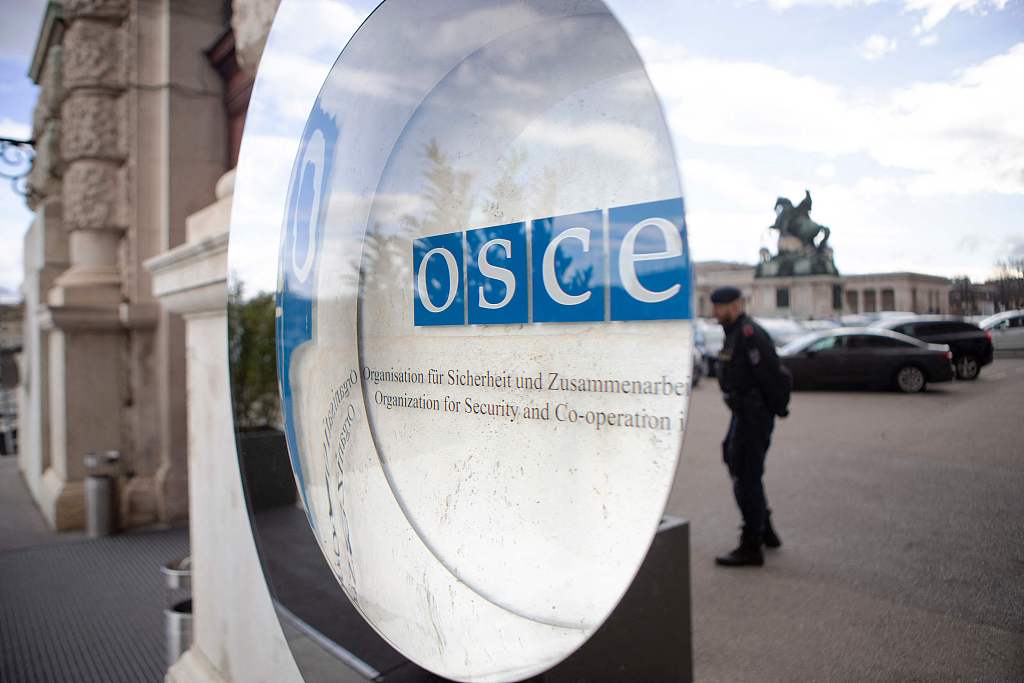
The logo of the Organization for Security and Cooperation in Europe (OSCE), at the OSCE headquarters in the Hofburg Palace in Vienna, Austria, February 21, 2022. /CFP


The consequence of replacing the inclusive OSCE with NATO hegemony might be a new Cold War. The main conflict between NATO and Russia is over where to draw the new dividing lines, in which the divided societies in Ukraine, Georgia, Belarus, and Moldova are becoming the battlefield. The current war was both predictable and avoidable. American diplomat George F. Kennan cautioned in 1998 that NATO expansionism would be the beginning of a new Cold War: "Of course there is going to be a bad reaction from Russia, and then [the NATO expanders] will say that we always told you that is how the Russians are – but this is just wrong."

Excluding Russia from the OSCE

On November 18, Poland refused Russian Foreign Minister Sergey Lavrov to attend the OSCE meeting in Poland as he is under EU sanctions.

Poland's decision to deny Sergey Lavrov access is either inspired or directly advocated by the U.S. In September, Washington denied Russian diplomats to travel to New York for participating in the sessions of the UN General Assembly. We now see Poland similarly abusing its role as a host of the OSCE meeting to dictate who should be allowed to participate.

This decision is very dangerous as the international security architecture collapses when states place exclusive military alliances above inclusive institutions that develop common rules. The principal loyalty to NATO and EU above the UN and the OSCE is a feature, not a bug in the European security architecture.

The erosion of a common Europe began less than two weeks after NATO's first expansion, as NATO claimed the authority to invade Yugoslavia in 1999 without a UN mandate. The invasion was unmistakably a violation of international law, yet it was argued to be legitimate as NATO was argued to serve liberal democratic values. Decoupling legality from legitimacy was intended to assign priority to NATO as the ultimate authority in Europe.

The efforts of replacing international law with the "international rules-based order" formalizes this logic of sovereign inequality. The fundamental idea is that the world should be divided between liberal democracies and authoritarian states – and the former should not be restrained by the same rules as the latter. Consequently, the U.S.-led alliance striving for hegemony is elevated above the OSCE and the UN as inclusive institutions that develop common rules.

The OSCE was developed to mitigate and transcend bloc politics, although it is now used instead as an instrument of bloc politics. The consequence of eliminating the common institutions and rules is now evident. A major war continues to rage on in Ukraine that might escalate into a nuclear war between NATO and Russia, yet there seems to be no willingness to engage in diplomacy.

Glenn Diesen is a professor at the University of South-Eastern Norway. 


11/27/2022

The German or French way? International interdependence vs European sovereignty


Source: UK In a Changing Europe
November 27 2022
By Professor Volker Roeben and Professor Jukka Snell


Volker Roeben and Jukka Snell suggest that the current rift in Franco-German relations reflects a deeper difference that stems from clashing strategic visions – one based on the idea of international interdependence and the other on European sovereignty.

It is no secret that France and Germany are going through a bad patch. Pointed differences have emerged both in EU and bilateral meetings. The absence of the UK from the EU renders the problems all the more salient. There is a greater pressure for the Franco-German partnership to deliver.

But this bad patch reflects something more fundamental. It signifies a clash of strategic visions. One such vision is the idea of international interdependence that has guided Germany but has now lost its potency.

At the same time, France has a fully articulated alternative on offer, namely European sovereignty. This involves greater European integration to better defend its values and interests on the world stage – internal cohesion leading to external power. While Germany sometimes speaks of European sovereignty as well, it has been reluctant to fully embrace the idea.

The idea of international interdependence, encapsulated in the mantra of ‘Wandel durch Handel’ (change through trade), has a long history – from Montesquieu, who wrote ‘[p]eace is the natural effect of trade’ through to the thinking that animated European integration. Robert Schuman, for example, called for economic cooperation between France and Germany as a first step in the federation of Europe ‘indispensable to the preservation of peace’.

The idea of international interdependence played a critical role in Germany’s policy towards Russia ever since the Ostpolitik of 1970s. In the field of European integration, Germany has been in favour of greater openness for international trade and has opposed proposals for the erection of a ‘fortress Europe’. A prime example is Germany’s insistence that the EU liberalise capital movements not just between the different EU states but also between the EU and third countries as a price for its acceptance of the single currency. This was duly written into the EU treaties, despite serious doubts harboured by France.

Germany was not alone in its belief in interdependence. In the case of China, many saw its admission into the WTO in 2001 as a way to make it into a responsible stakeholder in the global economic system. However, Germany and German companies have been particularly assiduous in pursuing trade opportunities in China, and they have continued to do so when others have become more cautious.

The idea of international interdependence seems to have been tested to destruction by recent developments. The Russian invasion of Ukraine shows that economic interdependence has not led to peace; instead, it brought energy dependency. China is becoming an Orwellian autocracy that is more aggressive than before. The idea that has guided Germany has lost its power.

France does not have the same problem. Its guiding idea is European sovereignty. President Macron articulated this with clarity in 2017, but the idea goes back to the 1956 Suez crisis. European sovereignty starts from the premise that the world is dominated by giants such as the US and China, and that European countries are individually too weak to protect their values, especially the European combination of markets and social justice. They can only do so together and a greater pooling of national sovereignty is needed. While the pooling of sovereignty has always been a part of the EU project, this would now more deeply affect some of the most sensitive areas, such as security, foreign policy, and taxation.

Germany has on occasion referred to European sovereignty as well; for example, Chancellor Scholz used this concept in a major speech in Prague in August 2022. He argued that it ‘means… that we grow more autonomous in all fields’, singling out areas such as key technologies and defence.

However, German actions in the context of integration do not truly reflect the idea of European sovereignty. A number of recent examples can be given.

One aspect of European sovereignty is the creation of EU fiscal capacity – something that the IMF also emphasizes for the proper functioning of the eurozone. In the context of the current energy crisis, France led the calls for joint borrowing, which would represent an important move in this direction. By contrast, Germany has preferred a domestic support program, despite concerns that it distorts the internal market.

A second key aspect of European sovereignty is defence cooperation, including joint development of new capabilities. Here Germany, while increasing its defence spending, has chosen not to focus on investing in European technology projects but has instead preferred to buy off-the-shelf equipment from the US. As a key example, it is expected that the European Sky Shield Initiative will include US and possibly Israeli air defence systems, to the exclusion of the Franco-Italian SAMP/T system. Fears have also been expressed that the German purchase of the US F-35 fighter jets might endanger the European Future Combat Air System (FCAS) project.

Third, the EU’s recent investment screening regulation creates a framework for the protection of security and public order in areas such as critical infrastructure and technologies. In this context, the German government very recently approved an important Chinese investment, relating to the port of Hamburg, reportedly against the advice of the security authorities and the European Commission. It was also set to approve the purchase of the microchip maker Elmos by a Chinese company, but has abruptly changed its mind.

Fourth, France underlined the importance of Europe speaking with one voice to China in 2019, when Macron invited the Commission President and the German Chancellor to Paris to meet with President Xi. By contrast, Germany declined Macron’s invitation to coordinate Scholz’s China visit with France; instead of a joint visit, the Chancellor travelled with a German business delegation.

Altogether, it seems that Germany continues to act on habits formed under the idea of international interdependence. It has not found an alternative idea, but seems to be operating in a way often driven purely by domestic concerns. This is putting a strain on European unity. There might even be opportunities for the UK to exploit the differences and seek closer engagement with France.

Unfortunately, the problem may not be easy to solve. Germany, by virtue of its political culture and constitutional structures, is a consensus-seeking bottom-up democracy, where finding a new way will not be as easy or quick as it might be in a more top-down system, like France or the UK.

By Jukka Snell, Professor of Laws, University of Turku, and Volker Roeben, Professor of International Law, Durham Law School.

2/19/2022

European Court of Auditors leaves vital questions unanswered


Source: eureporter
Feb 19 2022
By Dick Roche


It is estimated that 5G could add up to €1 trillion to EU gross domestic product and to create or transform up to 20 million jobs in the short term, writes Dick Roche.

The Court of Auditors Special Report 5G Roll-out in the EU released on 24 January could have provided policymakers with an objective appraisal as to the validity of issues that have dominated the 5G debate. It could have provided an objective cost and benefit analysis of the alternative approaches to ensuring the security of 5G networks. Regrettably, it fails to do.

The report which has been largely overlooked raises more questions than it answers.

Who should call the shots?

The Court of Auditors [ECA] set itself three basic objectives in its Special Report 5G Roll-out in the EU. First, to examine how effectively the EU Commission has performed its responsibilities. Second to analyse “aspects related to both the implementation of 5G networks ---- and their security” and third to provide “insights and recommendations” for the deployment of secure 5G networks across the 27 EU member states.

Overall the Court is critical of the general approach taken by the EU Commission on 5G and raises questions as to the Commission’s effectiveness.

The ECA disagrees with the EU Commission's view as to where responsibility for the security of the 5G network should lie. The Auditors advance the highly political view that as 5G security cuts across national and EU competences, it is a shared competence and as should be the subject measures made in Brussels.

It argues that by taking what it refers to as a “narrow interpretation of security” the Commission has restricted itself to playing a supporting role and sidelined itself on the issue of security of 5G networks.

In an EU where the role of Brussels is increasingly resented the line taken by the ECA seems particularly tone-deaf. It is hard to see a Government in Berlin, Paris, or any other capital agreeing to play second fiddle to Brussels on the issue of national security.

The 5G toolbox

The report is critical of the EU’s 5G Toolbox, the measures agreed in 2020 to mitigate security risks arising from the rollout of 5G.

The ECA criticises the pace at which Toolbox is being rolled out. It notes that as of October 2021 only 13 member states had enacted or amended national legislation.

It also notes that as the Toolbox came into effect four years after the launch of the 5G Action Plan after many of Europe’s major network operators had already made contracts for the 5G equipment required to build out their networks – a valid criticism.

The clarity of the criteria for adjudicating as to whether equipment suppliers are “high-risk” is raised. The question of how Internal Market impacts arising from the different approaches being adopted by the member states is also flagged.

The Commission, while ‘noting’ the ECA comments pointed out that Member States viewed its approach “as timely, effective and proportionate”.

The Commission also argued that the collaborative approach adopted involved not only the Commission and Member State authorities but other key stakeholders and by so doing allowed “Member States to adopt measures to their national circumstances”.

Multi-Billion Euro Question not Asked or Answered

The ECA notes that the cost of deploying 5G across all member states could reach €400 billion and that the estimated investment over the period 2121 to 2025 could range between €281 billion and €391bn.

Following on from an intervention by the Trump administration, a central issue in Europe’s 5G debate has been the proposition that equipment supplied by companies based in China should be excluded from the build-out of Europe’s networks.

Despite the centrality of this issue, the ECA notes that the Commission “does not have sufficient information” about the costs of banning such equipment an extraordinary admission.

The ECA cites an Oxford Economics report which suggested that restricting a key vendor from participating in 5G buildout would add €2.4 billion per year over the next decade. It also records an estimate by Danish consultants that put the cost of ripping out and replacing existing equipment from Chinese vendors since 2016 at “about €3 billion”, a figure that looks on the low side given the investment made in 5G across the EU in the last five years.

The failure to compile an independent estimate of the costs that arise from a ‘country of origin’ policy of vendor exclusion, a central issue in the 5G debate, can only be described as disturbing. Making public policy without knowing the full costs makes no sense.

The lack of cost data is all the more extraordinary given the multiple statements by major network operators as to the costs and rollout delays that they would face from restricting their right to deal with leading equipment suppliers with whom they have been dealing for decades.

Myths unchallenged and self harm ignored.

The failure to independently establish the cost implications associated with removing long-established vendors is not the only shortcoming.

There is no in-depth analysis of the delays in 5G rollout that will inevitably arise from limiting equipment suppliers - delays that will particularly hit non-urban populations.

There is, equally, no in-depth analysis of the other long-term implications that arise from limiting the ‘pool’ of suppliers which European MNOs can use, of the vulnerabilities that arise from limiting the capacity of operators the opportunity to spread their bets and of the consequences of preventing them from engaging with the fullest range of evolving technologies.

The ECA also fails to make any critical examination as to the truthfulness of allegations on which the idea of excluding suppliers has been based. Allegations about company ownership, state funding, and intellectual property which have largely been thrown into the mix from the US and which have been swallowed by many in the EU are not examined, even though it would not have been hard for the ECA to establish the facts.

Importantly no effort is made to weigh up warnings, again of US origin, about ‘back doors’, malware, or ‘vulnerabilities against the actual record or to examine the alternative approaches available to address security concerns. The ECA fails to question the false binary peddled by the US that banning specific suppliers is the way to ensure network security. It also ignores the reality that the complexities of global supply chains make the idea of determining Europe’s policy for 5G, the key enabler for digital transformation, on the ‘country of origin’ approach untenable.

The ECA report could and should have objectively and comprehensively reviewed all aspects of the debate that has ranged on 5G over the last few years. Regrettably, it has failed to do so.

Dick Roche is a former minister for European affairs and former minister for environment and local government.


4/03/2021

EU: "Corruption? What Corruption?"


Source: NewEurope
April 3 2021
By Mihai-Razvan Corman


In response to the unprecedented social and economic crisis triggered by COVID-19, the EU agreed on a historic recovery plan worth €1.8 trillion in November 2020. Member States that have been experiencing serious corruption received considerable financial assistance. Given the huge amounts of money involved, the plurality of funding sources and complex allocation criteria, the rescue package is prone to increased risks of corruption and fraud.

The Rule of Law Reports and the budget conditionality – the EU’s most recent response to corruption backsliding – are unfit to prevent further corruption backsliding in Europe.

The EU’s once comprehensive approach towards corruption has long fallen into oblivion. In 2014, the European Commission published the Anti-Corruption Report – the first EU-wide, uniform monitoring mechanism against corruption. In an unprecedented manner, the document addressed corruption as a cross-cutting issue and recommended country-specific actions for follow-up.

The Commission intended to use these periodic snapshots as a starting ground for enhanced policy actions against corruption. However, after having publicly committed to publishing the nearly finished follow-up report, in a widely criticised letter to the European Parliament the Commission surprisingly announced to discontinue the monitoring mechanism in 2017.

Following severe corruption and rule of law backsliding in the EU, in 2019, the Commission put forward a new set of actions aimed at strengthening the rule of law. After having pursued a ‘two-track approach’, where corruption and the rule of law were treated as entirely distinct policy areas, the Commission redefined anti-corruption as an implicit objective of strengthening the rule of law. Suddenly, the rule of law became the silver bullet for corruption. This recent switch to focusing exclusively on the ‘rule of law track’ was made at the expense of a comprehensive EU anti-corruption policy.

The 2020 Rule of Law Report, one of the main pillars of the ‘rule of law track’, reveals that the Commission’s approach towards anti-corruption is fragmentary and superficial. The extensive scope of the new EU monitoring mechanism, which is supposed to annually assess a variety of rule of law aspects in the Member States takes the focus off of crucial areas with increased risks for corruption. The reports entirely ignored corruption in public procurement – the area most affected by the misappropriation of EU funds. This is surprising, given that the EU disposes of precise data in this area. Since July 2019, the European Single Market scoreboard provides red flag procurement indicators that trace corruption in the EU in real time.

Moreover, the 2020 Report does not include any country-specific recommendations. One can only wonder how the Commission intends to ‘measure’ progress in the next rule of law cycle of 2021. This naïve form of benchmarking renders the rule of law reports completely toothless and marks the Commission’s failure to live up to its objective to “develop possible solutions … to problems before they escalate”.

The report also reveals serious methodological flaws. Instead of spotlighting objective country facts, the Commission chose to mainly focus on the legal and institutional frameworks of the bloc’s members and perception-based corruption indicators. However, as has been observed elsewhere, the legislative and institutional set-up in a country is devoid of substantive significance regarding the extent of corruption on the ground. While corruption surveys allow to identify general trends, they provide unreliable data on corruption levels across longer periods of time.

The EU budget conditionality – the second main pillar of the ‘rule of law track’ – foresees cutting funds for members that do not respect the rule of law.

While it is an innovative legal instrument in many ways, the budget conditionality has an extremely narrow scope of application, as it only covers rule of law breaches that cause negative effects for the financial interests of the EU. Moreover, it adopts a narrow and bribery-focused criminal law understanding of corruption. Consequentially, the budget conditionality will hardly contribute to alleviating the pressing issues the EU is currently faced with – state capture, the destruction of institutional checks and balances and COVID-19-related public procurement corruption in the health care sector and cronyism, nepotism and favouritism in the recruitment and management of the health care workforce.

Most importantly, the EU rule of law track has not been able to find an answer to the question of how to proceed when the bloc’s 27 members deliberately seek to establish corrupt autocratic regimes and are not interested in strengthening the rule of law. Increased dialogue and enhanced cooperation – the key features of the ‘rule of law track’ – are unlikely to change the hearts and minds of Member States that sabotage EU anti-corruption initiatives or misappropriate EU funds on purpose.

Mihai-Razvan Corman is PhD Researcher at Ghent University and Research Fellow at the Institute of European Democrats (IED) in Brussels and the Institut für Europäische Politik (IEP) in Berlin.

12/30/2020

Europe Embraces Multipolar World With Nord Stream 2 and China Investment Deal


Source: Strategic Culuture
Dec 30 2020
By Finian Cunningham


Material need usually wins out against ideological creed. Necessity over dogma. Twice this week, the European Union demonstrated that maxim in practice when it rebuffed Washington over the Nord Stream 2 gas pipeline with Russia; and then again over a major investment pact with China.

Germany’s Foreign Minister Heiko Maas pointedly stated this week that the European bloc was going ahead with completion of the Nord Stream 2 project in partnership with Russia. Construction of the pipeline under the Baltic Sea had been temporarily halted by U.S. sanctions. But now Germany is saying it won’t be deterred from finishing the project.

Maas said that while the EU looks forward to having better relations with the United States under a new Biden administration, the bloc was asserting its prerogative to trade with Russia for increasing natural gas supply as a matter of sovereignty.

“We do not need to talk about European sovereignty if it means that, in the future, we will only do everything Washington wants,” Maas is quoted as saying. “The [German] federal government will not change its position on Nord Stream 2,” he added.

Given that the Nord Stream 2 pipeline will double the flow of relatively affordable Russian gas to the EU this is also a vital matter of helping to boost European economies.

Despite repeated exhortations, as well as threats of economic sanctions, from Washington for the EU to drop the Russian energy supplier in place of more expensive American gas, the Europeans are adamantly putting their economic material interests above ideological constructs that would be best left to bygone Cold War years.

The European flexing of independence from Washington is all the more notable in the context of the Navalny furore. The Russian activist’s alleged poisoning by Kremlin agents was used to pile pressure on Germany to ditch the Nord Stream 2 project. Many critics saw Alexei Navalny’s purported assassination plot as a false flag provocation whose purpose was to further sabotage relations with Moscow and in particular to scupper Nord Stream 2. Evidently, that ruse has failed, given Berlin’s assertion this week of completing the gas project.

The second remarkable rebuff from the EU to Washington came with the announced conclusion of a major investment pact with China. The negotiations have been seven years in the works, but now both sides are ready to sign up by the end of this week. It’s impossible to overstate the importance of this trade and investment accord between the EU and China. It brings the world’s two largest trading entities into ever closer integration. This is a key manifestation of China’s global policy of paving New Silk Routes to underpin a vision of a multipolar world. “Eurasia” – from Russia’s Far East through Japan, Korea, China, Central Asia, the Middle East to Western Europe – is now, more than ever, an emerging economic colossus.

It seems that Beijing deftly made concessions to the Europeans in terms of increasing business access to the vast Chinese market. That had the effect of splitting Europe away from Washington’s coercive calls for transatlantic unity in confronting China.

Only the day before the announcement of the EU-China investment pact, President-elect Joe Biden made a renewed call for a unified approach between the U.S. and Europe to confront the rise of China. Obviously, the Europeans know from which side their bread is buttered, and ignored Biden’s appeal for Cold War-like hostility.

This is a hugely significant development. It cannot be accidental. Last week, when there was growing expectation of the EU-China deal being made, Biden’s nominated national security advisor Jake Sullivan expressed Washington’s concerns.

Referring to the pending EU-China trade deal, Sullivan said: “The Biden-Harris administration would welcome early consultations with our European partners on our common concerns about China’s economic practices.”

Well, guess what, the EU sidelined Washington’s appeal and has pressed ahead to conclude the investment pact with China.

This is vindication of the reality of a multipolar world. The integrated and interdependent nature of the global economy means that the Cold War ideology promoted by the United States is no longer tenable. It may be desirable for Washington to promote that ideology in some notion of pursuing global hegemony. But that concept is no longer viable, given the multipolar reality of today’s world and the realization by nations that partnership and co-development is the only way forward, based on mutual respect for sovereignty and law and order.

The United States’ political and economic system seems incapable of adapting to the new multipolar paradigm. Like a dinosaur it is doomed to perish because its mode of behavior and ideological depiction of the world are no longer viable in a changed political environment.

Material need and awareness of self-preservation are pushing the Europeans to trade with Russia and China. There maybe diehard Cold War-types still within the European political establishment (hence the Navalny fiasco), but for the most part the exigencies of economic and social needs are the ultimate determinants.

Mick Wallace, an Irish Member of the European Parliament gave the following incisive comments to SCF: “The EU has a longstanding problem, which hasn’t gone away, with its blind adherence to U.S. Imperialism. But when it comes to China, things could be different. The U.S. has decided to treat China as a security threat, when the truth is that China is just a threat to U.S. economic supremacy. But as long as the U.S. continues to treat China as a military threat, it’s happy days for the American military industrial complex. Europe disappoints, but it’s not stupid. There is a lot of mindless anti-China rhetoric in the European Parliament but less of it coming from the Commission or Council. The EU is really a one-man show, consisting of Germany – it dominates totally. And while Germany wasn’t lying awake at night about a deal or no-deal Brexit, it is very interested in having good relations with China. The Germans will follow the money, and are unlikely to have much of an appetite for following the U.S. down an economic war dead-end, which can have just one winner – the People’s Republic of China.”

So, the incoming Biden administration may try to revamp U.S. global power and its apparatus of allies by talking up confrontation towards Russia and China. But, on a hopeful note, the rest of the world knows it can’t afford to indulge such American zero-sum mentality. The only solution for present challenges is global cooperation. This week, the EU demonstrated an appreciation of reality with regard to Russia and China. And Uncle Sam is left holding the ideological baggage.


8/19/2020

EU Commission exposes Greek health minister over COVID-19 vaccine


Source: Euractiv
By Sarantis Michalopoulos
August 19 2020


The European Commission yesterday (18 August) refuted claims by Greece’s health minister that a first batch of COVID-19 vaccines is expected in December saying there is no timeline as there is no vaccine yet.

Asked by EURACTIV, EU spokesperson Vivian Loonela said: “We are in a situation where we cannot tell the exact date of delivery. We are working to have the vaccine ready as fast as possible as well as safe as possible.”

Loonela added that the executive is currently in talks with several pharma companies to make sure enough vaccines are available for EU member states as well as for donations to low-income countries.

Last week, EU Commission chief Ursula von der Leyen announced a first deal with British-Swedish multinational AstraZeneca to purchase a potential vaccine against COVID-19.

According to the agreement, the EU will purchase on behalf of EU member states 300 million doses of the AstraZeneca vaccine, with an option to purchase 100 million more.

Speaking on TV, Greek health minister Vasilis Kikilias said once the AstraZeneca vaccine passes the last testing phase, Greece would receive 700,000 doses in December and overall some three million doses until June 2021.

However, the Commission made it clear that no delivery date has been given to EU member states considering that the testing phases are still underway.

The executive hopes that a vaccine could be ready by the end of 2020 or beginning of next year, in line with industry projections.

Nathalie Moll, the director-general of the European Federation of Pharmaceutical Industries and Associations (EFPIA), said in April that a vaccine could be available in the beginning of 2021 if the testing phase is successful.

Strong reactions in Athens


The Commission’s statement triggered strong reactions in Athens, with the main leftist opposition Syriza party accusing the right-wing New Democracy government (EPP) of populism.

“If it weren’t for such a serious issue it would be almost ridiculous […] Cheap government populism playing with citizens’ anguish is both unacceptable and dangerous,” Syriza said in a statement.

Meanwhile, the country reported yesterday a new record of 269 new coronavirus cases and two new deaths. The total number of COVID-10 cases has reached 7,472.

The government claims that the vast majority of cases occurred domestically and are not related to tourism. Many cases are also related to young people.

Meanwhile, the opposition accused the government of inefficient preparation against a second wave of infection and called on Prime Minister Kyriakos Mitsotakis to stop putting the blame on young people.


8/01/2020

Public debt monetisation and the credibility of the ECB


July 28 2020
By Pompeo Della Posta


What stops public debt being monetised to avoid the pain of prolonged austerity after the pandemic? An obsolete economic theory of ‘credibility’.

In the conditions, akin to wartime, resulting from the Covid-19 pandemic, public debt is being created—and more will have to be created—to meet the exceptional fiscal needs arising. Many economists, of different orientations (Blanchard and Pisani-Ferry, Giavazzi and Tabellini, Galì, De Grauwe), suggest that this debt should be ‘monetised’—bought up on primary markets by central banks, with the creation of new money. This would avoid the accumulation of public debt and the consequent need to adopt future austerity policies for its repayment, hindering growth.

The main objections to such direct-money financing of public expenditure in the European economic and monetary union (EMU) relate to its institutional feasibility—given the requirements of the Treaty on the Functioning of the European Union—and the negative effects it would supposedly have on the anti-inflationary credibility of the European Central Bank.

The first objection is, of course, rather serious—although only so long as insufficient political will prevents its resolution via treaty change, to which I shall return. To deal with the second, it is worth recalling the evolution of the theory of ‘credibility’.

‘Rational expectations’


The first generation of credibility theory, dating back to the 1970s and 1980s—in particular the contributions of Kydland and Prescott and Barro and Gordon—contended that central banks should follow monetary rules rather than exercise discretion. In the latter case, it was asserted, the ‘rational expectations’ of economic actors would anticipate the central bank’s ‘time inconsistency’ problem, namely its purported incentive to renege on the initial promise not to run an expansionary monetary policy and instead reduce unemployment by managing a surprise injection of money to increase the price level—thereby reducing real wages and inducing employers to hire more workers.

The expectation of inflation would, it was contended, pre-emptively become a self-fulfilling prophecy, leaving no real effect on unemployment and production, which would remain anchored to levels presumed naturally dictated by the market. ‘Tying the hands’ of central banks by imposing strict rules on them, then, would solve the ‘time inconsistency’ problem.

This theory—however questionable its deterministic chain of argumentation—was convenient for those believing in the unconditional virtues of free markets and unconcerned about unemployment in the post-Keynesian era. It became the theoretical basis on which the ECB’s institutional architecture was built, to preserve its anti-inflationary credibility.

Optimum currency areas


This conclusion conflicted with the basic approach of the parallel flow of literature on optimum currency areas (OCA). From a different perspective, this also implied tying the hands of the central bank, although through participation in a fixed exchange-rate system or a monetary union, rather than by imposing stringent domestic rules.

More specifically, OCA theory examined the conditions to be met for a currency or monetary union—in which exchange-rate and monetary independence were renounced—to be optimal. It did so by asking how likely an asymmetric shock affecting a country would be (Kenen’s product-diversification criterion), how easily it could be absorbed by automatic market mechanisms (Mundell‘s criterion on mobility and flexibility of labour and capital) and how effective the forsworn exchange-rate instrument might have been (McKinnon‘s criterion on the degree of openness).

Credibility theory, being based until then on deterministic models, should not have been part of this debate, but it was wrongly credited as being the ‘new’ OCA theory (Tavlas). In this view, since monetary independence produced only an inflationary bias, without any substantive benefit, giving it up by joining a currency or monetary union would always be optimal, because it would avoid running the risk of inflation.

Justice was only done when the second generation of credibility theory took instead a stochastic approach—recognising contingency and randomness. This led to the same conclusion as OCA theory: if production is hit by an unexpected and asymmetric shock, one can no longer conclude that rules (whether a domestic or an external tying of hands) are always preferable to discretion.

If the problem is uncertainty as to central-bank behaviour over time, credibility is at issue, but this is not the problem when a stochastic shock affects the economy and needs to be absorbed in the here and now (Lohmann). The rules, therefore, should not be fixed, but rather state-contingent (Svensson) and policy-makers cannot gain credibility by following policies that are not credible (Drazen and Masson). How, in 1992, for example, could the Italian central bank gain credibility and an anti-inflationary reputation by following a fixed rule of exchange-rate stability that damaged the Italian economy?

Less costly


And, in the current situation, how could the ECB lose its anti-inflationary credibility if it agreed to buy government bonds on the primary market or if it financed citizens directly by crediting their current account—which would not entail any inflationary risk and would be less costly for the euro-area economies than recourse to debt? After all, that is what the Bank of England and the Federal Reserve are doing. In fact, the future repayment of these debts would risk jeopardising the economic-recovery capacities of the countries in question, which would have to resort to recessionary austerity policies.

During the eurozone crisis, European countries already followed restrictive fiscal policies, the opposite of what the United Kingdom and the United States did. It is not to these policies—which perversely increased the ratio of public debt to gross domestic product, due to their larger contractionary effect on the denominator—that we owe the end of the crisis. Rather, that came with the reassurance of the ‘whatever it takes’ monetary commitment by the then ECB president, Mario Draghi.

Restrictive fiscal policies were implemented not because they were coherent or validated but because of the distrust of European countries towards one another. It was this mistrust which fostered the belief that, without limiting fiscal looseness, the associated ‘moral hazard’ would produce excessive growth of public debt.

It seems that today we shall make a similar mistake—this time in terms of an inappropriate monetary, rather than fiscal, policy. The reason, however, is the same—mutual mistrust and the fear that the expectation of debt monetisation would induce irresponsible, ‘freeriding’ behaviour.

Such fear is engendered by the continuing incompleteness and indeed fragmentation of economic and monetary union. Which carries a high cost—a cost that should be sufficient to foster the political will necessary to avoid it and so to enjoy the full benefits of EMU.


7/29/2020

After Coronavirus: A Recent Atlantic Council Analysis


Source: EPRS
July 2020


Summary

The Atlantic Council’s analysis starts from the assumption that the coronavirus pandemic is delivering a substantial shock to the post-war order, established by the United States and its allies. For the past 75 years, they have led a rules-based system predicated on liberal democratic values, an open global economy, and formal institutional bodies backed by powerful democratic states. The study argues that a downturn in Western economies could boost a rising China, while a global depression could breed support for protectionism. International bodies designed to safeguard public health appear weak and unable to contain the crisis, and alliances with transatlantic partners are fraying as nations turn inward and close borders. Sustaining and revitalizing the rules-based order that has guaranteed freedom, prosperity, and peace for decades requires a decisive global and US-led response to the pandemic’. It concludes that, in a context where coronavirus might become entrenched, US-China rivalry could continue to intensify and go global’, setting up pressures that could destabilise the European Union and endanger the US' alliance system in Asia. In response, it argues that America, Europe and China can and must respond to the emerging situation by cooperating to develop a positive, global 'new normal'.