Showing posts with label Russia. Show all posts

2/10/2023

Out of Alignment: What the War in Ukraine Has Revealed About Non-Western Powers


Source: Foreign Affairs
By Shivshankar Menon
February 9, 2023


For the past year, many Western analysts have regarded the war in Ukraine as marking a turning point in geopolitics, bringing together not only the United States and its NATO allies but also a broader liberal coalition to counter Russian aggression. In this view, countries around the world should naturally support the West in this defining contest between democracy and autocracy.

Beyond the borders of North America and Europe, however, the past 12 months have looked very different. At the outset of the war, numerous countries in the global South identified with neither the West nor Russia. Several dozen—including such large democracies as India, Indonesia, and South Africa, as well as numerous other countries in Africa—abstained from resolutions condemning Russia at the UN General Assembly and in the UN Human Rights Council. Many of them have also been reluctant to formally adopt the West’s economic sanctions against Russia while respecting them in practice, and as the war has unfolded, some of them have sought to maintain relations with Russia as much as with the West.

Moreover, in many parts of the world, the most crucial issues of 2022 had little to do with the war in Ukraine. Emerging from the havoc of the pandemic and confronted by far-reaching challenges ranging from debt crises to a slowing world economy to climate change, many developing countries have been alienated by what they view as the self-absorption of the West and of China and Russia. For them, the war in Ukraine is about the future of Europe, not the future of the world order, and the war has become a distraction from the more pressing global issues of our time.

Yet despite this disillusionment, a coherent third way, a clear alternative to current great-power rivalry, has yet to emerge. Instead, these countries have sought to work with present realities, respecting Western sanctions on Russia, for instance, in an international system that no longer inspires much faith in its relevance to their security and economic concerns. In this sense, for many parts of the globe, a year of war in Ukraine has done less to redefine the world order than to set it further adrift, raising new questions about how urgent transnational challenges can be met.

GREATER RIVALRY, DIMINISHED POWER

A year of war in Ukraine has weakened the world order in two important ways. First, the Russian invasion, combined with the continuing effects of the pandemic and the global economic slowdown, diminished all the great powers in both power and prestige. The diminution was most apparent for Russia itself: in the unanticipated course of the war, in the country’s increasing economic and political isolation, and in the acceleration of its decline. It was least evident in the United States, which has managed to respond forcefully to the war without involving its own forces or causing serious escalation while strengthening Western unity and staying focused on the main game in Asia.

Worries remain, however, about the United States being distracted by Ukraine from its roles elsewhere, particularly in the Middle East and Africa. The precipitate withdrawal from Afghanistan in 2021 also raised questions about U.S. staying power and perseverance, especially now as it enters a new presidential electoral cycle. Nor has its own domestic politics permitted the United States to provide constructive leadership to the international multilateral system. For Europe, the war has limited its ability to play a broader global role, given its preoccupation with European order for the foreseeable future, regardless of whether the war ends in victory for either side or in a protracted frozen conflict.

China, too, has been taxed by the war. Because of its secondary effects on the world economy, on China’s own energy and food imports, and on China’s virtual alliance with Russia, the war has limited Beijing’s influence abroad. Unlike other permanent members of the UN Security Council, China has not played a meaningful political or military role in the Ukraine crisis. Other middle powers outside Europe have experienced similar effects. But in China’s case, two additional factors have been at play. One was Beijing’s domestic preoccupation through much of the year with its own economic slowdown and its need to project a smooth buildup to the 20th National Congress of the Chinese Communist Party in October. The other was China’s “zero COVID” policy, which compounded its inward fixation. Together, these domestic concerns reinforced the effects of China’s unproductive “Wolf Warrior” diplomacy, which created an inability to find negotiated solutions to bilateral disputes or to play a meaningful role on transnational issues such as climate change and the developing-country debt crisis.

It is not yet certain how China and the other powers will respond to their straitened circumstances. Since the party congress, China seems to be attempting to restore some balance in important relationships with Australia, Europe, and the United States. But Beijing’s domestic imperatives to reignite economic growth and to control the social and political fallout of its COVID-19 policies are likely to take precedence and limit meaningful shifts away from its recent assertive actions in maritime Asia and its land border with India.

The second effect of a year of war is that economic policies of major powers such as China, the United States, and Europe are now shaped by politics as much as by economics. Today, in many cases, security of supply and political interests take priority over price considerations in global manufacturing and value chains. “Friend shoring” and onshoring are being driven by political considerations rather than by economic responses to the changing situation. Although globalized markets have limited the extent of decoupling between China and the United States, they have not prevented strong efforts by both countries to reduce mutual dependence in strategic sectors such as semiconductor manufacturing, artificial intelligence, energy, and rare-earth metals.

The response of countries that have hitherto relied on their economic strength for global influence has varied. Japan is now making a transition to stronger defense and security policies that are better suited for today’s challenges, giving it a more balanced stance that emphasizes political and military power, too. Germany’s government speaks of a Zeitenwende, or historic turning point. And China, a global economic power that is militarily and politically constrained in its own neighborhood, has recalibrated both the nature of its engagement abroad and the way that it projects that engagement to its own people and to the world. Meanwhile, Europe and many countries in the global South pay an economic price for the West’s unprecedented sanctions against Moscow, and recession looms in some of the world’s most important economies.

ALIENATED AND UNALIGNED

As much as the war has affected relations between the major powers, the effect of a weakening world order is also profound on countries outside the West. One year later, these countries seek alternatives to the present order, but a clear third way, whether economically or politically, has yet to emerge. A growing debt crisis has affected over 50 countries in Africa, Asia, and Latin America since before the pandemic, according to the International Monetary Fund. This limits the developing world’s ability to strike out on an independent economic path. Indeed, most countries have respected the sanctions on Russia in practice.

Politically, too, the present situation inhibits the emergence of a single or coherent third way akin to the Non-Aligned Movement during the Cold War. A crucial difference is that today, unlike in the Cold War, there is no bipolar order. For all the talk of autocracies and democracies facing off against each other, economic interdependence between China and the United States and the reality of a globalized economy mean that the world does not have a clear two-part division offering opportunities for traditional balancing. Instead, it is a world in which great-power rivalry is not between two superpowers but among multiple players. As a result, the multisided competition and great-power rivalry have led many countries in the global South to be unaligned rather than nonaligned, dissociated from the present order and seeking their own independent solutions rather than an alternative set of widely held approaches to global issues.

Alienated and resentful, many developing countries see the war in Ukraine and the West’s rivalry with China as distracting from urgent issues such as debt, climate change, and the effects of the pandemic. Take South Asia. Three countries in the region—Bangladesh, Pakistan, and Sri Lanka—have been in talks with the IMF for more than a year about adjustment packages to deal with their debt. And over the last 18 months, five countries in the region—Afghanistan, Myanmar, Nepal, Pakistan, and Sri Lanka—have also changed governments, and not always smoothly or constitutionally. Sri Lanka defaulted on its international debts in April 2022. During the summer, one-fifth of Pakistan’s population was rendered homeless by floods inundating one-third of the country—a devastating consequence of climate change. Neither international institutions, nor the West, nor its Chinese and Russian rivals, have found or offered meaningful solutions to these problems.

Great-power rivalry complicates the task of addressing such issues. In dealing with Sri Lanka’s debt, for instance, the West is naturally reluctant to pay for Sri Lanka to settle accounts with China, the country’s largest creditor. For its part, Beijing is waiting for the rest of the international community to act, worried that if it moves to reschedule Sri Lanka’s debt, it will set a precedent for other countries that have taken on significant loans in China’s $1 trillion Belt and Road Initiative, many of which are only marginally more solvent than Sri Lanka. Indeed, the situation in South Asia is paralleled in many other parts of the developing world. Many countries now feel that they have been left to their own devices in the absence of a working multilateral system or international order. But this malaise has yet to produce a coherent or organized response.

INDIA’S OPPORTUNITY?

All in all, the war in Ukraine and the growing rivalry between China and the United States has produced a fluid situation for countries outside the United States and Europe. For some larger and more powerful middle powers, there are new opportunities in this uncertain world. India, for example, can work with neighbors to build the peaceful and more prosperous periphery that its own development demands. It can participate in the remaking of the rules of the international system now underway, particularly in new domains such as cyberspace. And it can reengage economically with the dynamic economies of Asia, participating in global value chains, to further its own transformation.

But many smaller states are more vulnerable than ever. And overall systemic risk is higher than it has been for many decades. That heightened risk is less about the prospect of a direct great-power conflict: as the first year of the war in Ukraine and the aftermath of former House Speaker Nancy Pelosi’s visit to Taiwan in August have shown, the United States and other great powers are capable of avoiding direct conflict among themselves. But their ability to contain local conflicts, or even to get their way in their own neighborhoods, has been constrained by their rivalry and by the demands of a globalized economy. It is also limited in Asia in particular by the fact that power in the region is much more evenly distributed than it was during the Cold War or the subsequent unipolar moment of U.S. dominance.

With India chairing the G-20 in 2023, New Delhi may be tempted to try to mediate between Ukraine and Russia, though that seems unlikely to produce results for now. A more fruitful way ahead would be for India to bring the concerns of the global South to the forefront of the international agenda. For the time being, however, it seems likely that the international system will continue to drift. Amid a prolonged war and continued great-power rivalry, the coming year is unlikely to see more than incremental progress in addressing the urgent issues that preoccupy much of the developing world.

SHIVSHANKAR MENON is Visiting Professor of International Relations at Ashoka University. From 2010 to 2014, he served as National Security Adviser to Indian Prime Minister Manmohan Singh.


1/23/2023

Over 90% of western firms have remained in Russia


Source: REMIX
January 23 2023
By MONEY.PL/PAP

Only 8.5 percent of all EU and G7 companies have actually left Russia, according to research from the University of St. Gallen and the IMD business school in Lausanne, Switzerland.

Before the outbreak of war, there were more than 2,400 company branches and 1,400 companies from the EU and G7 operating in Russia. By the end of November last year, only 120 companies had left Russia or sold their company there.

The research indicates that the news of a mass exodus of Western firms from Russia has been largely exaggerated. In fact, businesses have resisted calls from governments, media, and civil society, according to the Belgian daily newspaper Het Laatste Nieuws.

Companies remain skeptical and reluctant about leaving Russia over fears of losing their business and staff. Those who have left have ended up transferring assets into Russian hands, even for a single symbolic ruble or euro, as was the case with Renault and Nissan.

According to Forbes, the biggest beneficiary was oligarch Wladimir Potanin, whose Interros company bought Rosbank from Societe Generale, making nearly 50 billion rubles (€667 million) in the process. The second-biggest earner was Vladyslav Sviblov, whose Highland Gold Mining bought the assets of Canada’s Kinross corporation, which netted him almost 40 billion rubles.

Not far behind was Ivan Tirishkin from SPB, who bought 49.5 percent of the shares in HKF-Bank LLC, making over 35 billion rubles. Fourth on the list was the state research center FSUE NAMI, which took over the plants owned by Renault and Nissan, gaining assets worth just under 35 billion rubles.


12/01/2022

OSCE and the collapse of pan-European security system


Source: CGTN
December 1 2020
By Glenn Diesen

The 29th Ministerial Council of the Organization for Security and Cooperation in Europe (OSCE) takes place from December 1-2 in Poland. Established in 1994 to develop a common peace in an inclusive Europe, the OSCE has become the largest regional security organization in the world, which includes the U.S. on its western edge and Russia on its eastern. Therefore it could have played a key role in restoring peace amid the Ukraine conflict. However, the peace initiative was abandoned in favor of a hegemonic project facilitated by NATO expansionism.

The war in Ukraine and the decline of the OSCE are both symptoms of the collapsing pan-European security order.

A common Europe vs. continued bloc politics

In 1989, then Soviet Union leader Mikhail Sergeyevich Gorbachev and then U.S. President George W. Bush held the Malta Summit, which ultimately led to the declaration of the end to the Cold War, a negotiated peace that promised to replace confrontational bloc politics with a new peaceful Europe. In 1990, the Charter of Paris for a New Europe was signed, in which all participants committed themselves to construct a new and inclusive Europe without dividing lines based on "indivisible security" and "sovereign equality." In 1994, these principles laid the foundation for a new and inclusive pan-European security organization – the OSCE.

But Russia was weak, and the U.S. pushed a parallel security architecture based on unipolarity and hegemony. When the Soviet Union collapsed in 1991, two years after the end of the Cold War, the U.S. abandoned the narrative of a negotiated peace for a common Europe. Jack Matlock, the U.S. ambassador to the Soviet Union who had contributed to negotiating an end to the Cold War, warned that the "mythmaking" and historical revisionism began in Washington as soon as the Soviet Union collapsed. One month after the Soviet Union collapsed, President Bush triumphantly proclaimed: "By the grace of God, America won the Cold War… The Cold War didn't end, it was won… We are the United States of America, the leader of the West that has become the leader of the world." The new narrative of victory legitimized a new Europe based on hegemony, in which the OSCE would be a marginal organization.

NATO expansionism would facilitate the new Europe, which canceled the key principles of the OSCE. "Indivisible security" was abandoned as NATO began to expand its security at the expense of Russian security. "Sovereign equality" was replaced with sovereign inequality as NATO claimed the prerogative to interfere in the domestic affairs of other states, topple governments and invade under the guise of advancing liberal values. Last, the OSCE's principle of "no dividing lines" was abandoned in favor of gradually moving the dividing lines in Europe toward Russian borders.
 
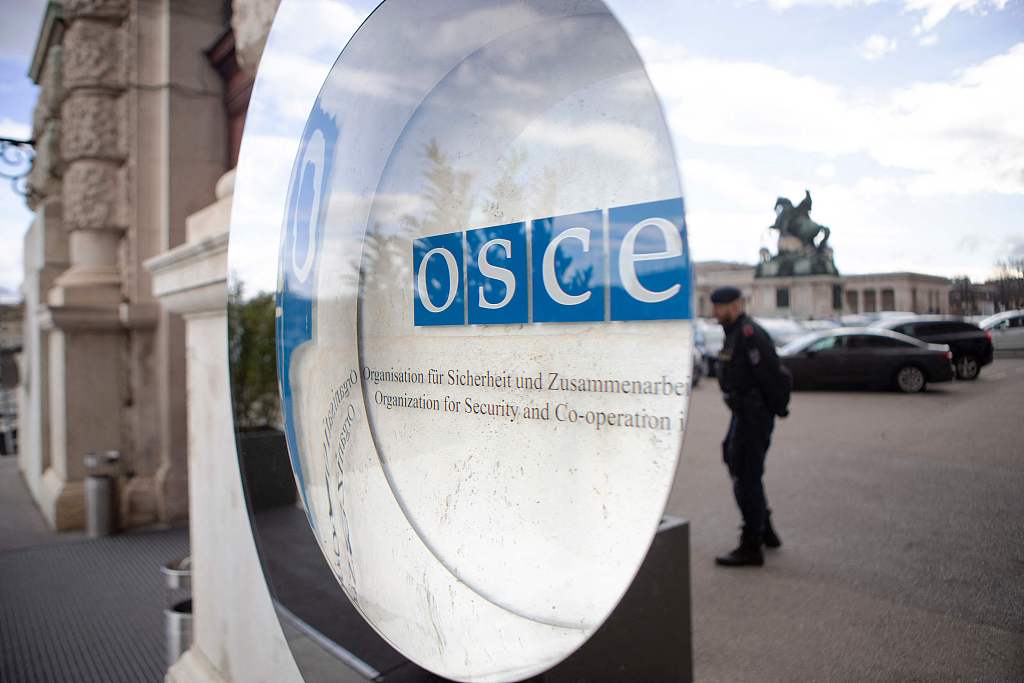
The logo of the Organization for Security and Cooperation in Europe (OSCE), at the OSCE headquarters in the Hofburg Palace in Vienna, Austria, February 21, 2022. /CFP


The consequence of replacing the inclusive OSCE with NATO hegemony might be a new Cold War. The main conflict between NATO and Russia is over where to draw the new dividing lines, in which the divided societies in Ukraine, Georgia, Belarus, and Moldova are becoming the battlefield. The current war was both predictable and avoidable. American diplomat George F. Kennan cautioned in 1998 that NATO expansionism would be the beginning of a new Cold War: "Of course there is going to be a bad reaction from Russia, and then [the NATO expanders] will say that we always told you that is how the Russians are – but this is just wrong."

Excluding Russia from the OSCE

On November 18, Poland refused Russian Foreign Minister Sergey Lavrov to attend the OSCE meeting in Poland as he is under EU sanctions.

Poland's decision to deny Sergey Lavrov access is either inspired or directly advocated by the U.S. In September, Washington denied Russian diplomats to travel to New York for participating in the sessions of the UN General Assembly. We now see Poland similarly abusing its role as a host of the OSCE meeting to dictate who should be allowed to participate.

This decision is very dangerous as the international security architecture collapses when states place exclusive military alliances above inclusive institutions that develop common rules. The principal loyalty to NATO and EU above the UN and the OSCE is a feature, not a bug in the European security architecture.

The erosion of a common Europe began less than two weeks after NATO's first expansion, as NATO claimed the authority to invade Yugoslavia in 1999 without a UN mandate. The invasion was unmistakably a violation of international law, yet it was argued to be legitimate as NATO was argued to serve liberal democratic values. Decoupling legality from legitimacy was intended to assign priority to NATO as the ultimate authority in Europe.

The efforts of replacing international law with the "international rules-based order" formalizes this logic of sovereign inequality. The fundamental idea is that the world should be divided between liberal democracies and authoritarian states – and the former should not be restrained by the same rules as the latter. Consequently, the U.S.-led alliance striving for hegemony is elevated above the OSCE and the UN as inclusive institutions that develop common rules.

The OSCE was developed to mitigate and transcend bloc politics, although it is now used instead as an instrument of bloc politics. The consequence of eliminating the common institutions and rules is now evident. A major war continues to rage on in Ukraine that might escalate into a nuclear war between NATO and Russia, yet there seems to be no willingness to engage in diplomacy.

Glenn Diesen is a professor at the University of South-Eastern Norway. 


4/04/2021

Ukraine to hold join military drills with NATO amid escalating tensions with Russia


Source: The Hill
March 4 2021
By Tal Axelrod


Ukraine’s military announced Saturday that it will hold joint military drills with NATO troops later this year amid escalating violence with pro-Russian separatists in the eastern part of the country.

The armed forces said in a statement on Facebook that the drills will be held with more than 1,000 military personnel from at least five NATO member states in a few months.

“In particular, defensive actions will be worked out, followed by an offensive in order to restore the state border and territorial integrity of a state that has been subjected to aggression by one of the hostile neighboring countries,” the statement said, in an apparent reference to Russia.

An exact date for the drills, which were described as routine, was not provided.

“Exercise Cossack Mace is a routine exercise which is still in the planning stage," a U.K. UK Ministry of Defence spokesperson said in a statement to The Hill. "It is due to take place in Summer 2021.”

Moscow had preemptively rebuked any potential deployment of NATO personnel to Ukraine, warning that it would ramp up pressure along the border between the two countries.

But pressure has already ramped up along the border, with Russia building up its military presence on its side of the barrier. Fighting also increased with separatists backed by Moscow in eastern Ukraine, spelling the potential end to a cease-fire in the Donetsk region.

The Ukrainian parliament this week put out a statement declaring an “escalation” along the front, citing a “significant increase in shelling and armed provocations by the armed forces of the Russian Federation.”

Ukraine, which represents NATO’s front line in Eastern Europe against Russian expansion, pressed Western governments to “continue and increase international political and economic pressure on Russia.”


9/27/2020

Russia, China blocking report into Libya conflict arms embargo violations


Source: euronews
By AP
Sept 27 2020


Russia and China blocked the official release of a report by U.N. experts on Libya that accused its warring parties and their international backers - including Russia - of violating a U.N. arms embargo on the conflict-wracked country, U.N. diplomats said Friday.

Germany’s deputy U.N. ambassador, Günter Sautter, said he brought the issue to the Security Council after the two countries blocked the report’s release by the committee monitoring sanctions on Libya, which Germany heads.


“Many delegations have asked for the publication of the panel of experts’ interim report,” he said. “This would create much-needed transparency. It would contribute to naming and shaming those who continue to blatantly violate the arms embargo in spite of agreements that have been made.”

But diplomats, speaking on condition of anonymity because Friday’s council consultations were closed, said Russia and close ally China again blocked the report’s publication.


Sautter said before the meeting, when asked what Germany could do if Russia and China blocked the report’s release again: “Let me assure you I will continue to use every tool at hand in order to make sure that we have the necessary transparency.”

The report, seen by The Associated Press earlier this month, said the arms embargo was being violated by Libya’s U.N.-supported government in the west, which is backed by Turkey and Qatar, and by rival east-based forces under commander Khalifa Hifter, backed by the United Arab Emirates, Russia and Jordan. The panel said the embargo remains “totally ineffective.”

The experts said 11 companies also violated the arms embargo, including the Wagner Group, a private Russian security company that the panel said in May provided between 800 and 1,200 mercenaries to Hifter.

In addition, the experts said the warring parties and their international backers, along with Egypt and Syria, failed to inspect aircraft or vessels if they have reasonable grounds to believe the cargo contains military weapons and ammunition, as required by a 2015 Security Council resolution.

Anwar Gargash, the United Arab Emirates’ minister of state for foreign affairs, told a group of reporters at a virtual briefing Friday that he wouldn’t comment on a report he hadn’t seen. But he said that “we categorically deny” many of the “wild allegations that we’ve been hearing in the press.”

In the years after the 2011 uprising that toppled longtime autocrat Moammar Gadhafi, Libya has sunk further into turmoil and is now divided between two rival administrations based in the country’s east and west, with an array of fighters and militias backed by various foreign powers allied with each side.

Tensions in oil-rich Libya escalated further when east-based forces Hifter launched an offensive in April 2019 trying to capture the capital, Tripoli. But Hifter’s campaign collapsed in June when militias backing the U.N.-supported government in Tripoli, with Turkish support, gained the upper hand, driving his forces from the outskirts of the capital and other western towns.

The Security Council adopted a resolution on Sept. 15 demanding that all countries enforce the widely violated U.N. arms embargo on Libya and withdraw all mercenaries from the North African nation. It also extended the U.N. political mission in Libya and called for political talks and a cease-fire in the war, which the U.N. has been pursuing.

One glaring gap for the U.N. has been the failure to replace its former top envoy, Ghassan Salame, who resigned in March, mainly as the result of a U.S. demand to split his job in two. The resolution adopted last week did split it, putting a special envoy in charge of the U.N. mission to focus on mediating with Libyan and international parties to end the conflict and providing for a coordinator to be in charge of day-to-day operations.

But finding a replacement acceptable to all Security Council diplomats has proven exceedingly difficult.

One possibility is the U.N.’s current top Mideast envoy, Nikolay Mladenov, a former Bulgarian foreign minister, U.N. diplomats said, speaking on condition of anonymity because discussions have been private. But the diplomats said the three African members of the council — South Arica, Niger and Tunisia — oppose him because they want an African in the job.

Germany's Sautter said the Security Council has agreed that there will be a special envoy “and we need an agreement urgently on who that is going to be."

7/25/2020

Russia Delivers First Arctic Oil To Key Ally China


Source: Oil Price
July 21 2020
By Simon Watkins


Ensuring a leading position in the exploration and development of the Arctic’s huge gas deposits has long been a key part of President Vladimir Putin’s overall vision to project the power of his new Russia. Not only has it allowed Russia to dramatically increase its liquefied natural gas (LNG) output – finally in line with Russia’s status as an oil and gas superpower, as Putin sees it – but it has also allowed Russia to become the key gas supplier to China in the future. With Russia’s presence in the Arctic gas sector now extremely substantial, it was only natural to expect a corollary roll-out of development of the oil sector, and this is precisely what is now underway.

Last week saw Russia’s Gazprom Neft, the country’s third biggest oil company by output and the oil arm of state gas giant Gazprom, ship its first cargo of oil produced in the Arctic to China via the Northern Sea Route (NSR). This shipment East adds to its existing Western exports via the NSR to Europe. According to Gazprom Neft, it took 47 days to deliver a full cargo of 144,000 tonnes of sweet, light Novy Port oil from the Yamal peninsula developments to the Chinese port of Yantai on the Bohai Sea, from Russia's north-western city of Murmansk. “Successful experience in the sale of Arctic oil in the European market and an in-depth insight of Asia-Pacific markets allow Gazprom Neft to offer Novy Port oil with a unique year-round logistics scheme to Asian partners,” said Gazprom Neft’s deputy director general for logistics, processing and sales, Anatoly Cherner, last week.

The NSR saw its first trial voyage (from the Far-Eastern Russian port of Vladivostok via the East Siberian and Laptev Seas, to St Petersburg) by a large-sized and strengthened container ship only as recently as August 2018. Since then, its development as a key transport route for Russian hydrocarbons to the East has run alongside the earlier developments of Russia’s number two gas producer (after Gazprom), Novatek, in its Yamal-centred LNG projects, that now uses it to deliver cargoes both East and West. After the very slick management at Novatek had delivered each stage of its Yamal Peninsular (Yamal LNG) project on budget and on time - despite the full weight of U.S. sanctions being imposed on Russia in 2014 as a result of its annexation of Crimea – until the delay to the fourth train announced last year, Gazprom and Gazprom Neft were bound to follow.Related: Mexico's Pemex Scrambles To Save Itself From Oil Price Crash

Much more is to come from Gazprom Neft, which started exporting oil produced in Russia’s Arctic exploration and development region in 2013, and which has delivered at least 40 million tons of oil – including both the ARCO (Prirazlomnoye field) and Novy Port (Novoportovskoye field) blends – to various European countries since then. In broad terms, the Novy Port oil field is one of the largest oil and gas condensate fields in the Russian Arctic, with at least 250 million tons (around 1.8 billion barrels) of reserves. Using a now proven system developed alongside Novatek – including the Prirazlomnaya oil production platform, the Arctic Gates oil terminal in the Gulf of Ob, a reinforced ice-class tanker fleet, including LNG vessels, escort icebreakers and an offshore oil shipment terminal in Murmansk - Gazprom Neft says that it can transport oil year-round (at minimal cost) to Europe.

To the East, there are more natural constraints, as very thick ice makes deliveries outside the summer period extremely difficult for much of the time, and the costs higher than those to Europe. Previously, the Novy Port oil grade shipped last week via the NSR to China - understood by OilPrice.com to have gone to state refiner, the China National Chemical Corporation (ChemChina) – had not been exported East by Russia, but rather directed towards Europe, However, the enormous hit to the European refining sector caused demand to drop away, whilst demand in China dipped by a much degree and recovered fully much more quickly. “Although Gazprom Neft has historically sent ESPO crude to China via the pipeline, this new capability will be useful to other Russian companies for oil as well, not just Novatek for LNG,” a senior oil and gas analyst in Moscow told OilPrice.com last week. Russia’s number two oil company, Lukoil, also conducted a test crude oil delivery last September, featuring its Varandey blend. This has very similar specifications to the Novy Port blend, with the latter having an API gravity of 35 degrees and a 0.1 per cent sulphur content, whilst Varandey has an API gravity of 35-37 degrees and a sulphur content of around 0.5 per cent.

At the same time as opening up new export routes for its oil, Gazprom Neft is working towards dramatically increasing the oil volumes from the Arctic that it can offer to the East. In 2017, it acquired the development rights to the Tazovskoye and Severo-Samburgskoye fields in the Yamalo-Nenets region, with the subsoil usage rights to the Tazovskoye block running until 2025, and those to the Severo-Samburgskoye block until 2027. The Tazovskoye field is estimated to have recoverable oil reserves of at least 72 million tonnes, condensate reserves of 4.6 million tonnes, and non-associated gas reserves of at elast 183.3 billion cubic metres. The Severo-Samburgksoye block’s estimated oil reserves are even higher, at 90.5 million tonnes. This followed the commissioning only a year before of the huge Novoportskoye oil and gas field (estimated recoverable reserves of more than 250 million tonnes of crude and condensate, as well as more than 320 billion cubic metres of gas) and the Vostochno-Messoyakhskoye oil and gas field (recoverable reserves of more than 470 million tonnes of oil and gas condensate, and 188 billion cubic metres of gas).


5/29/2020

Moscow, Ankara 'divide up influence' in Libya: analysts


Source: AFP
May 29 2020
By Rim Taher


Tripoli (AFP) - After backing rival sides in Libya's long-running conflict, Russia and Turkey appear to have agreed to avoid direct confrontation and instead carve the country into "spheres of influence", analysts say.

The oil-rich North African nation has suffered almost a decade of violence since longtime dictator Moamer Kadhafi was toppled and killed in a 2011 uprising backed by several Western powers.

Since April last year, eastern Libya-based strongman Khalifa Haftar has been battling to take the capital Tripoli from the UN-recognised Government of National Accord (GNA).

But despite the backing of Russia and the United Arab Emirates, among others, his offensive stalled on the edges of the capital.

And in recent weeks the GNA, supported by Turkey with drones and air defence systems, has inflicted a string of battlefield setbacks on Haftar's forces.

In April they reseized key western coastal cities, followed by the strategic Al-Watiya airbase southwest of Tripoli.

In recent days, hundreds of Russian mercenaries belonging to the Wagner Group, a shadowy paramilitary organisation seen as close to President Vladimir Putin, have withdrawn from combat zones south of the capital.

The US Africa Command on Tuesday accused Russia of "clearly trying to tip the scales in its favour in Libya" and also accused Moscow of sending fighter jets to support the mercenaries.

France's Foreign Minister Jean-Yves Le Drian on Wednesday expressed concern about the "Syrianisation of Libya".

How do analysts assess the latest developments?

Have Moscow and Ankara made a deal?

GNA forces on Monday suspended air attacks and gave their rivals 72 hours to withdraw from the Tripoli region.

Hundreds of Wagner fighters were evacuated to Bani Walid, southeast of the capital.

Russian military aircraft then transported them to the central Al-Jufra air base, some 500 kilometres (300 miles) south of Tripoli.

"The suspension of Turkish drone strikes during the withdrawal of Russian mercenaries... suggests there is a Russian-Turkish understanding," said Wolfram Lacher, a senior associate at the German Institute for International and Security Affairs.

"The Russian fighter jets recently deployed to Jufra now appear to serve as a deterrent against any attempts by GNA forces to advance beyond" the wider northwestern Tripolitana region, Lacher said.

"Taken together, these developments suggest that Turkey and Russia are trying to carve up spheres of influence in Libya."

What will happen next?

Lacher said it remained to be seen how other foreign powers would react.

"The US, the UAE, Egypt and France might all try to torpedo a Russian-Turkish arrangement in Libya, since this would marginalise them and accord Russia and Turkey long-term influence" there, he said.

Jalel Harchaoui, a research fellow at the Clingendael Institute in The Hague, said the failure of Haftar's campaign may allow Russia to increase its influence in eastern Libya without completely breaking off ties with Ankara.

"Moscow does not wish to wage a long and costly war in Libya as it has done since 2015 in Syria," he added.

Emad Badi, Senior Fellow at the Atlantic Council, told AFP that Russia would still take steps to "increase Haftar's dependence on them, as he is now in dire need for any form of foreign support to sustain his offensive and not lose face".

Is Haftar losing Russia's support?

Haftar has had support from the United Arab Emirates and Egypt since 2014, and analysts say Gulf countries including the UAE are bankrolling the Wagner Group's intervention.

The Kremlin, for its part, has always denied involvement in the group's presence in Libya -- and there are questions over Russia's commitment to Haftar.

Moscow appears to be involved in a rapprochement with another key figure: Aguila Saleh, speaker of the elected parliament based in the east who is technically allied with Haftar.

In a video circulating online, Saleh is seen surrounded by eastern tribal dignitaries reading a list of recommendations from his "Russian friends".

He is heard saying that Moscow advises restarting dialogue, as it no longer sees a positive outcome to Haftar's offensive.

Russian Foreign Minister Sergei Lavrov on Tuesday reaffirmed the need for an immediate ceasefire and "constructive dialogue" in Libya after talks with Saleh.

Harchaoui said that, "if it was up to the Russians, Haftar would hold much less power today".


5/13/2020

Russian hackers accessed emails from Merkel's constituency office: Der Spiegel


Source: Reuters
May 8 2020

BERLIN (Reuters) - Russia’s GRU military intelligence service appears to have got hold of many emails from Chancellor Angela Merkel’s constituency office in a 2015 hack attack on Germany’s parliament, Der Spiegel magazine reported on Friday, without citing its sources.

A spokesman for the German government had no immediate comment. There was also no immediate comment from Moscow, which has denied previous allegations of hacking abroad.

Der Spiegel said federal criminal police and the federal cyber agency had been able to partially reconstruct the attack and found that two email inboxes from Merkel’s office had been targeted.

They contained email correspondence from 2012 to 2015 and Der Spiegel said the hackers appear to have managed to copy both mailboxes to another computer.

Germany’s Bundestag lower house of parliament discovered its systems had been broken into in May 2015 and concluded that the intrusions had been continuing since at least the beginning of that year. It was impossible to determine what information had been stolen.

The Russian embassy in Berlin was not immediately available for comment.

German federal prosecutors have issued an arrest warrant for an individual linked to the 2015 hacking incident, the Sueddeutsche Zeitung reported this week. Prosecutors have not commented on the report.


5/05/2020

Is The U.S. Using Sanctions To Elbow Russia Out Of The European Natural Gas Market?


Source: Forbes
May 5 2020
By Ken Silverstein

Is the United States sanctioning Russia’s natural gas pipeline that ends at Germany’s edge because it wants to sell more liquefied natural gas (LNG) to Europe or because Russia illegally annexed Crimea? The stated aim has a dual purpose — to prevent Western Europe from becoming dependent on Russia’s energy sources while also diminishing Russia’s economic leverage in Eastern Europe.

The distinctions are important: If the purpose is to save Western Europe from Russian dominance, the Europeans are not buying it. They are perfectly capable of choosing a fuel supplier, they say, and view the United States as a reliable way to diversify their natural gas sources. The other energy partners are Norway, Algeria, Qatar and Nigeria. The continent, meanwhile, is building receiving terminals — or those to take-in the LNG that is frozen and shipped.

“LNG is often the lower-priced option thanks to a strong supply push,” says Michael Stoppard, chief strategist, global gas for IHS Markit INFO. “Major pipeline suppliers, such as Russia to Europe, are choosing not to flood the market any further. It all adds up to LNG being relatively resilient in the face of gas demand declines.”

It’s one thing if the United States is able to compete on the merits. It’s quite another if it is using economic sanctions as a weapon. At issue is Russia’s so-called Nord Stream 2 pipeline — a companion to its Nord Stream 1 pipeline. It not only allows Russia to double its natural gas capacity headed to Europe but it also allows it circumvent its nemesis, Ukraine. Nord Stream 2 is owned by Gazprom and is a $10.5 billion project that stretches 745 miles from Russia’s gas fields to Germany’s Baltic coast. The U.S. says Russia lacks the technology to finish the pipeline. Russia says it will complete it by 2021.

Russia now supplies 39% of Europe’s natural gas. The United States supplies 3.5%, although a third of all U.S. LNG went to the European Union between January and November 2019, the European Commission says.


U.S. Senator Ted Cruz, R-Texas, is a leading proponent of the sanctions that went into effect in December 2019, saying that Nord Stream 2 is a lose-lose: first, the natural gas sales help finance Russian territorial goals while second, the line bypasses Ukraine and deprives it of revenues to run its country. Ukraine, of course, has aligned strategically with the West, creating conflict with Russia with which it shares cultural and business interests.

“It’s far better for Europe to be relying on energy from the United States than to be fueling Putin and Russia and dependent on Russia and subject to economic blackmail,” Cruz said in December when the Nord Stream 2 sanctions were approved. The sanctions also apply to any third party builder or financier. At that time, the Swiss contractor Allseas Group stopped participating while others with money on the table — Shell Oil and Engie — were befuddled by Washington’s moves.

Ulterior Motive


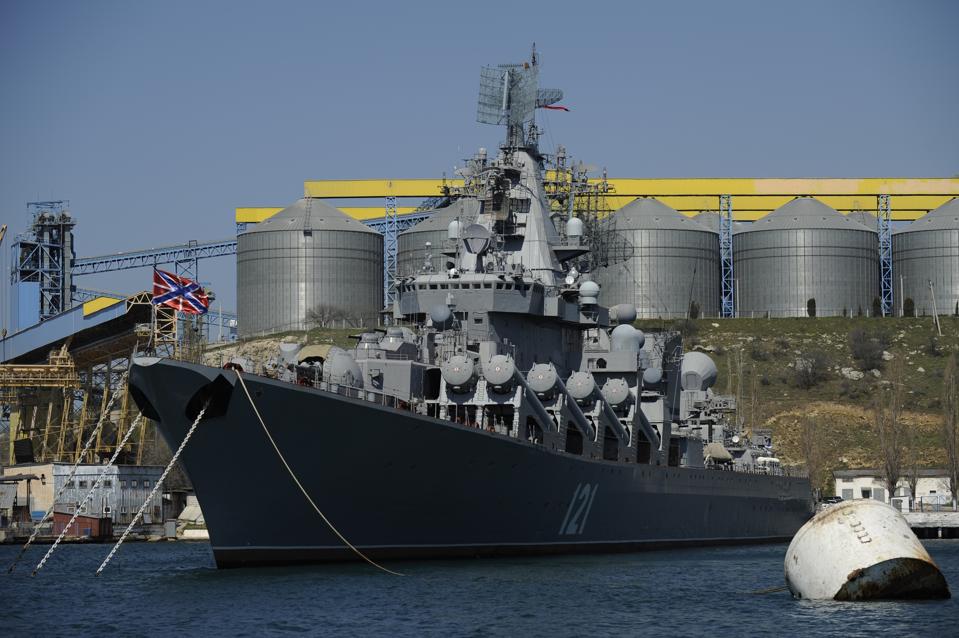
Russian Black Sea fleet Missile Cruiser "Moskva" is anchored in one of the bays of Sevastopol, ... [+] ASSOCIATED PRESS
But Cruz has an ulterior motive: he represents an oil-and-natural gas-producing state, which needs to jack-up sales to Europe — especially now. The lack of demand coupled with the oversupply means falling prices and job losses.

The Nord Stream 2 sanctions are helping the U.S. crack open European natural gas markets. But they have also had a practical and tangential effect of getting Russia to negotiate with Ukraine. At the end of 2019, the two countries formally agreed on a contract to send Russian gas through Ukraine and into Europe. It is a $7 billion deal that lasts five years.

If —’big if’ — those talks would lead to more deals and the subsequent withdrawal of Russia from Ukraine and Crimea, the sanctions will have paid off. But the developed world is already sanctioning Russia by banning the necessary technologies to develop oil and gas while also preventing those deals from getting financed. Russia has also been kicked out of the Group of Seven, formerly Eight. Its economy is contracting while nosediving energy prices are leading to fewer revenues and budget shortfalls.

With its abundance of unconventional natural gas, the United States has become a net exporter LNG since 2017. Donald Trump’s pitch to the American people is that this country would become an energy dominant source — that the country would feed its own needs and then export its shale oil and gas around the world. In that regard, the U.S. Federal Energy Regulatory Commission has approved a dozen LNG export terminals, on top of the five that currently exist.

“LNG demand is weak right now,” says Neil Chattejee, chair of the Federal Energy Regulatory Commission during a call hosted by the Atlantic Council. U.S. “companies are trying to secure long-term contracts and the U.S. is now a net exporter of energy. This has positive benefits economically and geopolitically: It is an alternative to Russia and it is beneficial to our allies. A resurgence of demand will come.”

The biggest European markets for the United States are the United Kingdom, Spain and France. But Germany is the most lucrative catch — a country that is in the process of shutting down all of its nuclear and coal plants. Germany has a goal of replacing much of that energy with renewables. Before that can happen, however, it will look to natural gas to fill the void — a fuel needed to “back up” wind and solar power when the weather does not play ball.

For the record, the Germans are peeved at the Americans, saying that their sanctions against Russia are having an “extraterritorial effect.”

The European Union would be casting a wide net for more natural gas suppliers with or without the U.S. sanctions on Nord Stream 2. In Western Europe, the penalties are largely seen as heavy-handed. In Eastern Europe, and specifically Ukraine, the sanctions are viewed as a hammer — a mechanism to get Russia to the bargaining table.

The geopolitics are complicated. But one thing is not: if the United States wants to gain increasing access to European natural gas markets, it will have to rely on free enterprise and not on coercive techniques.


5/04/2020

Russia’s Gazprom Moves Forward With New Mega Pipeline


Source: Oil Price
May 3 2020
By Viktor Katona

The Russian gas export monopoly Gazprom has hit the wall with new European projects – Nord Stream 2 will be finished at some point in the second half of 2021, the exact route of TurkStream’s second line remains veiled in ambiguity and no other major gas importer voiced their interest in carrying out a new project. Thus, the only remaining prospect for growth lies in Eastern Asia and primarily China. Apart from a tangible gas market saturation in Europe, there are two main premises for a second-phase Gazprom expansion into China: its largely untapped Eastern Siberian gas reserves that would be very costly to move all across Russia onto European markets and the competitiveness of Russian pipeline gas on the Chinese market.

Gazprom’s current China-bound project, the 38 BCm per year Power of Siberia (PoS) pipeline, started up in December 2019. Surprisingly, the Russian firm halted gas exports via PoS mid-March for a (previously non-indicated) two-week maintenance which turned out to be an elegant way of circumventing the massive demand drop in China. Even with another round of maintenance announced for autumn, Gazprom should be able to meet its export target for 2020 – 5 BCm, rising steadily to 10 BCm per year in 2021 and 15 BCm in 2022. By 2025 Power of Siberia should reach its nominal capacity and it is the next step after that currently exercises the minds of Russian policy makers and gas traders alike.

The contours of the next major project have been emerging for some time already – the idea to construct Power of Siberia-2 (PoS-2) was flaunted already in the early 2010s, its purpose being of meeting the gas requirements of Western Chinese provinces via Mongolia. This late March Gazprom’s request of conducting a feasibility study for PoS-2 has found President Putin’s approval. The projected pipeline would have a throughput capacity of 50 BCm per year and would be traversing Russia’s Altay region before crossing over to Mongolia and Western China. The first thing that struck market observers was that at some point in early 2020 the capacity of Power of Siberia-2 was upgraded from a preliminary estimate of 30 BCm per year to an officially presented volume of 50 BCm per year.

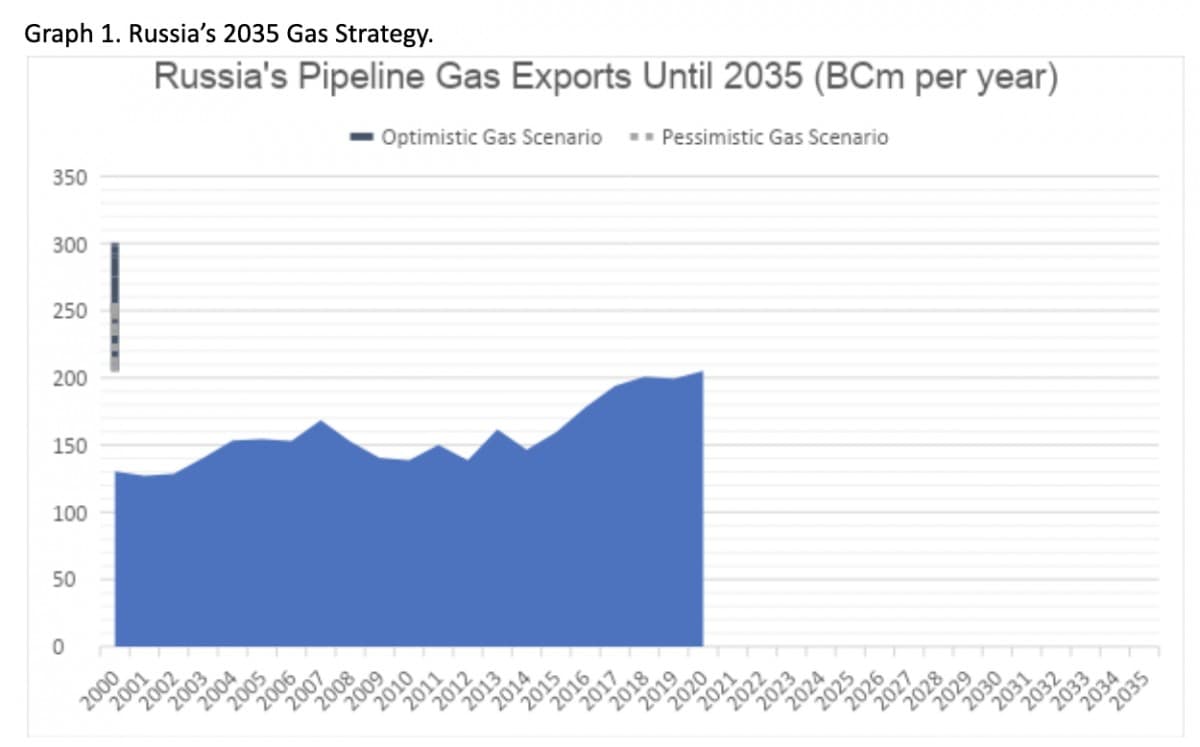
The framework for Power of Siberia-2 (also known as the Altai pipeline) was laid down in 2015 when Gazprom and the Chinese state-owned company CNPC signed a preliminary gas supply deal, without specifying the technicalities of pricing. Given that Pos-1 pricing talks took a decade to conclude, the tardiness of PoS-2 negotiations is hardly surprising. Yet at the same time Russian authorities are betting heavily on it happening – the recently issued Energy strategy-2035 sees pipeline gas exports reaching 300 BCm per year by 2035, of which 80 BCm per year will go to China, with European pipeline exports effectively stalling for the next decade and half. It has to be noted that the Energy Strategy also surmises a “pessimistic scenario”, whereby Gazprom’s gas exports increase from 220 BCm in the base year of 2018 to 255 BCm per year in 2035, meaning a slight decline in European demand and Power of Siberia-1 remaining the only China-bound gas conduit, with no Pos-2 construction taking place.


Graph 1. Russia’s 2035 Gas Strategy.


(Click to enlarge)
Source: Author’s data. 

Gazprom needs Power of Siberia-2 for many reasons. First of all, its immense 2P reserve base of 24.3 TCm (which keeps on increasing with time by 0.1-0.2 TCm in the last couple of years) compels it to act upon it whilst Eurasian economies still perceive natural gas as a bridging energy source and do not penalize its utilization. Second, China is the only easy-to-access market outlet whose demand for natural gas has still not peaked – once China reaches that stage, there remain only more adventurous and technologically complex variants (eg.: constructing a pipeline to South Korea, subsea or transiting North Korea). Thirdly, Gazprom might dovetail Pos-2 with one of its long-time ambitions – linking the gas transmission system of Russia’s Far East to the ones in Western Siberia and Europe. Given that still only 69 percent are connected to the federal gas transmission system, this would be a politically very useful objective.

Graph 2. Map of Power of Siberia-2.


(Click to enlarge) 

There is one additional novelty in how Power of Siberia-2 would look like – namely, the inclusion of Mongolia as a transiting country. Heretofore Mongolia has neither produced nor imported natural gas, hence Gazprom could potentially enter a completely new market. This being said, as of today the main reason for including Mongolia lies in the possible bifurcation of the pipeline so that at least some part of it heads towards northeast China. In addition to the above listed commercial rationale, the agreement, as indicated during President Putin’s meeting with Mongolian Prime Minister Ukhnaagiin Khurelsukh in December 2019, might also turn out to be a stepping stone to something much more politically complex. Despite all the benefits that Russia might garner from Power of Siberia-2, Gazprom has to face an array of challenges that will seriously jeopardize its viability.

Above all others, there is the question of Chinese pipeline gas demand – the Western route (from the Chinese point of view) pits Gazprom against Central Asian producers, namely Kazakhstan and Turkmenistan, who already have a separate conduit to supply the Chinese market. The 55 BCm/year capacity Central Asia Gas Pipeline was utilized last year to the extent of 87 percent (47.9 BCm), with most of the delivered gas coming from Turkmenistan. China remains the main market outlet for Galkynysh production, therefore unwanted competition in the form of Gazprom vying for a place under the sun would be hardly welcome news for Ashgabat. Thus, it is not only competition against LNG that Gazprom ought to win but also deal with a China-dependent Turkmenistan, all this against the background of tough-as-usual Chinese price negotiations. At least things have started moving after a prolonged lull.


Turkey Seeks US Funds, but Roadblocks Lie Ahead

Russian President Vladimir Putin and Turkish President Tayyip Erdogan shake hands during a news conference following their talks in Moscow, Russia March 5, 2020.

Source: The Jerusalem Post
May 3 2020
By Christina Jovanovski

Turkey’s pursuit of US funding to limit an economic crisis faces a major roadblock after Ankara said it would eventually go ahead and activate a key Russian weapon system.

The country averted a crisis with Washington in April when it pulled back from a plan to operationally deploy its Russia-made S-400 air-defense missiles. But Ibrahim Kalin, spokesperson for President Recep Tayyip Erdogan, has now said that the system will indeed be activated.

“There has been a delay because of the coronavirus, but [the deployment] will move forward as planned,” he said on Thursday.

Ankara’s purchase of the anti-aircraft system frustrated Washington, which kicked Turkey out of the F-35 fighter jet program and threatened sanctions. The deal still remains a bone of contention, though, as Turkey seeks financial support to stave off further economic turmoil that has seen the lira drop to new lows against the dollar.

The US ambassador to Turkey, David Satterfield, says Ankara has been in contact with the Federal Reserve. The Reuters news agency, citing Turkish sources last month, reported that the country was seeking a lira-dollar swap.

Muzaffer Senel, an assistant professor of political science and international relations at Istanbul Şehir University, says the situation is dire.

“There’s no real prescription that we have for the recovery of the economy,” he told The Media Line. “We need money.”

Senel estimates that nearly half of the Turkish population could find itself unemployed if companies continue to stop operating amid the pandemic.

Erdogan has resisted a full lockdown, instead ordering those above age 65 to stay indoors and applying lockdowns only on weekends, meaning people can still go to work.

Unpacking the S-400s could lead to sanctions from the US Congress, worsening the situation.

“Turkey doesn’t want to harm its good relationship with [US President Donald] Trump,” Senel said. “Ankara needs Trump as a counterbalance to Congress.”

Turkish leaders saw the damage that sanctions could do after a 2018 diplomatic crisis with the US over their detention of an American pastor. Following the sanctions, the country’s currency went into freefall, leading to rising inflation and unemployment, and eventually to a recession.

Senel says Erdogan’s popularity has already taken a hit over his Syria policy. Opinion polls suggest that many in the country are unhappy with the deaths of Turkish soldiers in Idlib Province, where hundreds of thousands of Syrians have moved closer to the border with Turkey amid increased attacks by the Moscow-backed regime of Bashar al-Assad.

“It’s a challenging time for Ankara to create a balance between those groups, the Americans [and] the Russians,” he noted.

Under Erdogan, Turkey has drifted farther away from the US and NATO, especially after a failed 2016 coup attempt that, according to Ankara, showed the military alliance’s unwillingness to defend its member-state. At the same time, Turkey has moved closer to the East, especially Russia, which is a major supplier of energy.

But it was last year’s deal for the S-400s that made the shift take center-stage. The US is concerned that Moscow could uncover secret stealth technology if Turkey were to deploy F-35s alongside the Russian air-defense missiles.

Nicholas Danforth, a senior visiting fellow focusing on Turkey at the German Marshall Fund, is pessimistic that Ankara will succeed in gaining US financial support while remaining committed to activating the S-400s.

“It’s going to make a deal very difficult,” he told The Media Line.

“Turkey keeps saying the United States needs to support [it] during this [economic] crisis, that the two countries have to work together…,” he said. “But then at the same time, [Turkish leaders are] implying that as soon as the crisis is over, they’re going to go right back to the policies that initially antagonized Washington.”

Kerim Has, a Moscow-based political analyst focusing on Russia and Turkey, said the pandemic gave Erdogan an excuse to delay the activation of the weapons, with Moscow unlikely to pressure Turkey to activate them at the moment.

“It’s not an urgent need right now,” he told The Media Line. “The Kremlin is probably going to keep its wait-and-see position.”

Has warned, though, that Russia would at some point lean on Turkey to activate the system, believing that Moscow could block arms being sent to Libya’s Government of National Accord, which Ankara supports, or increase attacks on areas in Syria where Turkey has a military presence.

Additional attacks in Idlib Province would push Syrians fleeing the fighting even closer to the border with Turkey, leading to fears in Ankara of another refugee crisis.

“For [Erdogan’s] political survival, he can’t risk relations with Russia,” Has said.


5/01/2020

Trust deficit: The roots of Russia’s standoff with the West


April 29 2020

It was Dec. 25, 1991, when the USSR abruptly ceased to exist.

Just before midnight, the Soviet red hammer-and-sickle banner was pulled down from the Kremlin for the last time, and up fluttered an unfamiliar white-blue-red tricolor that proclaimed the birth – or rebirth – of Russia.

It was truly an inflection point. The Soviet Union, the communist behemoth that had defined one pole of a binary world order for decades, had simply evaporated. It had already abandoned its Eastern European empire and dissolved its military alliance. Now its rivalry with the United States, complete with a hostile anti-capitalist ideology, a costly nuclear arms race, and multiple proxy wars around the world, was gone.

Commentators hailed this not merely as an end to a divided world with its permanent threat of nuclear war, but as a chance to create an inclusive, ideology-free order that might improve the lot of all humankind.

It was a world that seemed within reach thanks to the discovery, as the walls crumbled and the Cold War stereotypes receded, that most Russians were surprisingly, enthusiastically pro-Western. Vladimir Pozner, an American-Russian who grew up in New York, then spent 30 years working in the bowels of the Soviet propaganda machine before becoming a TV personality in both the U.S. and Russia, recalls it as the most exhilarating moment of his life.

“There was this emotional upsurge in the country. People felt like they were coming out of a cocoon after a very long time,” he says. “Many of us thought, finally, we are going to become part of the world – as we always really wanted to be – be accepted, be participants. It was a really enthralling vision.”

Things have, conspicuously, not turned out that way. Tracking polls that showed Russians overwhelmingly pro-American in the 1990s now show majorities of Russians suspicious of the U.S. Even though today’s Russia is a capitalist country, without an empire or an antagonistic ideology, American attitudes toward Russia have turned as negative as they ever were toward the old USSR.

It’s difficult to hold a conversation with any Russian foreign policy specialist today without getting dragged into polemics: angry accusations, defensive responses, and the underlying assumption that the other side must change its behavior before a more constructive global order becomes feasible.

But most agree that, in a world facing common challenges like climate change, the persisting danger of nuclear conflict, and a relentless coronavirus pandemic, the replay of the Cold War is a serious obstacle to international efforts to stave off global disaster. Some even offer a few practical ideas for how Russia and the West might at least formulate some new priorities to minimize confrontation and maximize cooperation.

“I do believe that most of the issues between us can be solved, not by one vanquishing the other, but by finding new terms of mutual acceptance,” says Andrei Klimov, deputy chair of the foreign affairs committee of Russia’s upper house of parliament. “My dream is, maybe during my lifetime, that we will see normal politicians on both sides sit down together with a readiness to formulate pragmatic answers to the questions that vex our relationship.”

A Russia ignored


From the Russian perspective, the evolution of disillusionment with the West was a natural progression.

Alexei Gromyko, as director of the official Institute of Europe, often serves in an advisory role to today’s Russian leaders. On an overcast afternoon in mid-March, the institute, an ornate 19th-century building near the Kremlin, was empty amid the beginnings of Russia’s coronavirus shutdown. But Mr. Gromyko was in his office, willing to talk about how he sees East-West relations.
About these ads

In his view, today’s inflamed geopolitical crisis was rooted in the post-Cold War failure to create a security system, primarily in Europe, that would fully include Russia. Western leaders gave Mikhail Gorbachev strong verbal assurances NATO would not be expanded into the former Soviet sphere but, as Mr. Gromyko ruefully notes, Mr. Gorbachev failed to get that in writing. Following the USSR’s demise, U.S. President Bill Clinton took office and adopted other plans. That lesson was not lost on the Russians.

“After the collapse of one pillar of the former bipolar world order, it became fashionable in the West to think that the world order could become unipolar, with the U.S. at the helm,” he says. “In the 1990s, Russia descended into its worst crisis since 1917. It not only ceased to be a superpower, it suffered political, economic, and social collapse as well. It was not even clear that Russia would survive physically. So, perhaps believing that Russian interests and views didn’t matter anymore, Clinton made the decision to enlarge NATO to the east.”

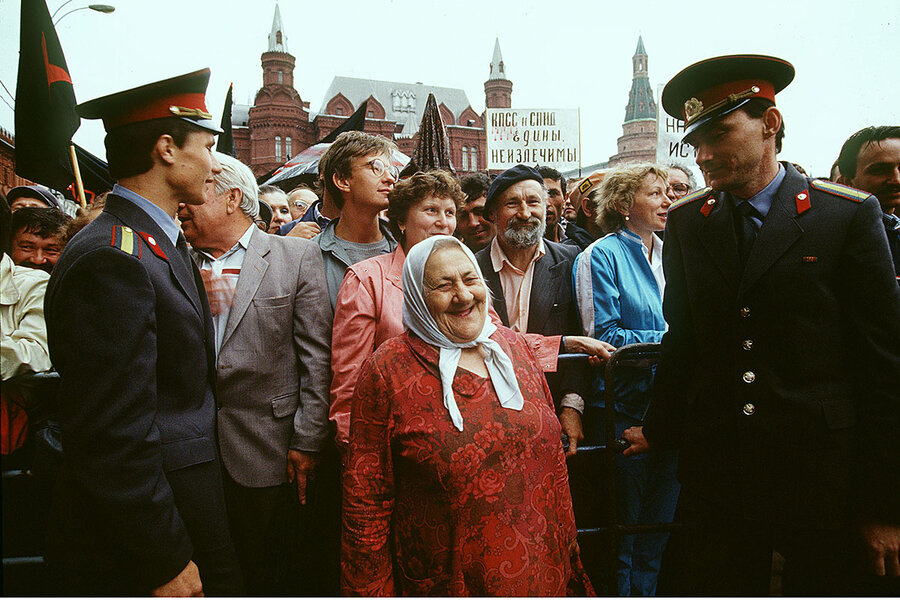
Under Mikhail Gorbachev, Russians exercise their freedom of expression during a demonstration in Manyezh Square in Moscow, Russia, Soviet Union, in July 1990. The demo is anti-Communist, pro-democracy.
“But just because Russia couldn’t do anything about it at the time doesn’t mean that we accepted it. We never did. Since then the process of NATO expansion has been unstoppable, and so has the subsequent chain of events.”

The Western alliance has since taken in all of the former Soviet Union’s Warsaw Pact allies, as well as the three former Soviet Baltic republics. Mr. Gromyko says the Russians signaled repeatedly to Western counterparts that inducting Ukraine or Georgia into the alliance would be a red line. At its 2008 Bucharest Summit, NATO shelved those countries’ applications, but issued a statement insisting they would eventually join.

A few months later Georgia attacked the Russian-backed statelet of South Ossetia, which belongs to Georgia but had de facto independence since the early ’90s. Russia staged a military intervention and drove Georgian forces back.

In early 2014, after a disorderly change of power in Kyiv brought pro-Western nationalists to power, Russia again intervened, seizing the Crimean Peninsula – where the main base for Russia’s Black Sea naval fleet is located – and orchestrating a referendum in which Crimeans voted to join Russia. Moscow subsequently stirred up, armed, and gave military support to anti-Kyiv separatists in Ukraine’s east.

Mr. Gromyko insists Russia has nothing to apologize for. The idea of Ukraine joining NATO is as unthinkable for Moscow as, say, Mexico joining a Chinese-led military alliance would be for Washington, he suggests.

“It’s not that we view NATO as an existential threat right now,” he says. “But Russia cannot accept that a country next door would be a member of a military alliance that is hostile to Russia,” he says. “We are not opposed to Ukraine being democratic. It’s fine with us if a neighbor has a different political and social system. But not a member of an adversarial bloc. Security is the central issue.”

He says that, at least in Europe, people have concluded that NATO expansion has reached its natural limit. If that can be formalized, he suggests, it might ease the standoff over Ukraine and lead to wider negotiations for a more stable security order in Europe.

But he is not optimistic about relations with the U.S. Only one of the Cold War-era networks of nuclear arms-control agreements remains in force, and it will soon expire. And the U.S. keeps ramping up sanctions.

“Even if we have a breakthrough on Ukraine tomorrow, we are quite sure that U.S. sanctions will not be lifted,” Mr. Gromyko says. “Sanctions have taken on a life of their own, and new ones have no direct connection with the situation between Ukraine and Russia.”

Sanctions have also hastened Russia’s drift into China’s strategic and economic embrace. But the pivot wasn’t just about the Kremlin’s desire to show the West it has alternatives, say Russian experts. “The process of strengthening ties with China has been going on since 1989,” says Mr. Klimov. “That ship sailed well before the current crisis.”

Watching the Western example


The public’s view of Russia’s standoff with the West is not well covered, and the story gets told in the voices of political leaders. But Russian experts note that Russians’ disenchantment with their system played a role in the USSR’s collapse, while the widespread perception of the West as a superior civilization conditioned the pro-American orientation of Boris Yeltsin’s post-Soviet government.

Yevgeny Bazhanov, now retired, was a longtime professor and for some years the rector of the Diplomatic Academy, which trains Russian diplomats. He recalls watching students over the years morph from admirers of the West into hardened critics. That tendency was informed by the examples they perceived the U.S. setting, he says.

“You can blame Putin, or some kind of Russian stubbornness, but that wasn’t the main thing,” he says. “In the early ’90s we wanted to be a prosperous, democratic country, and the West was the model for our development. But reforms enacted on Western advice produced economic disaster and mass misery. People started to believe that the West didn’t want Russia to succeed. It looked like the U.S. wanted Russia to become a junior partner, like Germany or the U.K. But most Russians wanted to follow an independent policy, to be friends and partners with the West, but to be ourselves.”

He says several events led many Russians to question not only the idea of U.S. leadership, but competence. The 1999 war over Kosovo illustrated to them that NATO was not simply a defensive alliance. The 2003 U.S.-led invasion of Iraq, and subsequent Middle East misadventures, created the impression the U.S. was an aggressor, and one that didn’t seem to know what it was doing. The 2008 financial crash tarnished the U.S. economic model.

“When you wonder why Putin often opposes the West, and Russians tend to support him, you need to see that side of it,” says Mr. Bazhanov.

“Citizen diplomacy” might be the best antidote to the war of words, says Mr. Pozner. He may be uniquely qualified in that respect. For the past three years he has given lectures at the Middlebury Institute of International Studies, in Monterey, California, addressing mainly Russia-studies students, but also holding events with wider audiences. He travels Russia to give public talks, and hosts one of the most popular public affairs shows on state TV.

“Sometimes Americans ask me, how can you live with your government when it does things like poisoning the Skripals, or interfering in our elections? I answer that, like most Russians, I have no idea what Russian secret services are doing, but I am dubious about these accusations,” Mr. Pozner says. “In Russia, people are long accustomed to our authorities blaming the ‘foreign hand’ when things go wrong. It’s convenient because it displaces blame and tars critics with enemy associations. I’m sorry, I just don’t believe that anything Russia did could have swayed an American election. It’s a bit depressing to hear Americans talking like this, as if they were in the Soviet Union, and uncritically believing something their secret services tell them.”

During the 1980s Mr. Pozner took part in “Space Bridge” programs that brought ordinary Americans together with Soviets over a satellite link, and let them converse.

“The whole Cold War mood simply evaporated as they started comparing their lives, their hopes, talking about their families, even emptying their handbags to show each other what kind of stuff they had. The real Cold War disappeared shortly thereafter. I am convinced that if you get people together to dialogue, they may not become friends but they will find terms of coexistence,” he says.

The “trust deficit”


It’s hard to guess at the future. Most Russian experts agree the coronavirus pandemic is an urgent global wake-up call, and fostering international cooperation an existential issue.

But before Russia and the West can establish areas of cooperation, it is probably necessary to address the gaping “trust deficit,” or the urge to see everything the other side does through a dark prism. An example is Russia’s efforts to provide coronavirus assistance to Italy, and the U.S., during the pandemic’s worst days. What might have been greeted as a good deed – albeit with the ulterior motives that usually apply with aid – was almost universally treated in Western media as a propaganda ploy and an attempt to disrupt European unity.

“During the old Cold War, the West was genuinely united and self-confident. They not only claimed to be right, they were fully convinced of it,” says Fyodor Lukyanov, editor of Russia in Global Affairs, a Moscow-based foreign policy journal. “Today, many Western countries face deep internal discord and uncertainty. There are serious strains within the alliance.

“I believe this urge to disproportionately blame Russia comes from that new place of insecurity and lack of confidence. I doubt there is much we can do to change this atmosphere of acrimony and recrimination until they start to fix their own problems. Amid this crisis we all need to work on that, and Russia too will need to change itself to survive. Maybe after we come through this we can find modes of dialogue.”


Alleged Kremlin Poison Plot Highlights Czechs' Russian Spy Problem

Prague 6 Mayor Ondrej Kolar said he had been told by the authorities that the Russian agent had been dispatched to "liquidate" him.
Source: RFE
April 30 2020
By Tony Wesolowsky

A suspected Russian intelligence agent was reported to have flown into the Czech capital with a deadly mission.

The agent was tasked with taking out three local Czech officials, including the mayor of Prague, Zdenek Hrib, according to the Czech investigative weekly Respekt.

Each of the three had taken or supported steps that angered Moscow, including the removal of a statue of a controversial Soviet general and the renaming of the square in front of the Russian Embassy in Prague after the slain Kremlin critic Boris Nemtsov.

One of the alleged targets, Ondrej Kolar, a district mayor in Prague, was blunt, saying he had been told by Czech authorities that the Russian had been dispatched to "liquidate" him and the two others.

Upon arrival the suspected intelligence agent was driven to the Russian Embassy compound in a leafy residential neighborhood of Prague, according to Respekt, which broke the story on April 26.

Respekt said the Russian national entered the country with a suitcase containing the toxin ricin. That suitcase could have escaped customs inspection as per diplomatic protocol.

There are few other details in the Respekt report that, nevertheless, has sparked outrage in Prague and denials in Moscow, which has been accused of similar plots in the past, including the 2018 poisoning in Britain of former Russian spy Sergei Skripal.

Czech Prime Minister Andrej Babis said it was "not acceptable -- if it's true -- for a foreign state to take action against our citizens here."

Kremlin spokesman Dmitry Peskov has dismissed the reports, saying it "looked like a canard."

Russia's 'Spy War'


But Western intelligence experts find the alleged plot possible, especially given the number of Russian spies reported to be operating out of the Czech Republic.

For John Schindler, a security expert and former National Security Agency analyst and counterintelligence officer, the ricin scandal would mark a dangerous escalation of Russian President Vladimir Putin's espionage activities in the West.

"Russian intelligence services feel safe operating very aggressively in Prague, I've gotten their rough treatment there myself, but the ricin thing is crazy, insane even for the Kremlin. Putin's gloves are off now," Schindler told RFE/RL.

In 2006, Putin launched his "spy war" against NATO and the European Union, gradually increasing the number of Kremlin spies operating abroad, Schindler has said.

"Now, cadres of Russian spies in NATO countries are bigger than even in the worst days of the Cold War, and Prague has more than perhaps anywhere else in the West," Schindler wrote in a 2017 article in The Observer.

For years, the Czech counterintelligence service, BIS, has issued report after report warning of the threat posed by Russian spies.

BIS said all Russian intelligence services, including Russia’s Foreign Intelligence Service (SVR), military intelligence (GRU), plus departments of the Federal Security Service (FSB), have been detected operating on Czech territory.

BIS and other security experts all agreed that the Russian Embassy in Prague, with its estimated 140 personnel, is a hive of Russian espionage activity.

"A long-term security problem remains the oversized Russian diplomatic mission in the Czech Republic, which raises the threat of Czech citizens coming into contact with the intelligence service of a foreign power," the BIS said in its latest annual report, issued in November 2019.

"The Russian Embassy remains a key site for many of their activities in Europe," Ladislav Sticha, a BIS spokesman, told RFE/RL in a phone interview.

David Stulik, a senior analyst at the Prague-based European Values Center for Security Policy, said operating under diplomatic cover "greatly facilitates" Russian espionage.

"They are undermining our institutions, gathering information, and making the Czech Republic a de facto base for Russia intelligence services for the Schengen area," Stulik explained, referring to the visa-free, EU travel zone.

Embassy Staff


Following the revelations from the Respekt report, the Czech Senate's Foreign Affairs Committee in condemning the alleged plot also called for action from the government to come up with a plan to reduce the number of declared Russian diplomats in the country.

The last time the Czech Republic expelled any Russian diplomats was in 2018 in the wake of the Skripal nerve-agent poisoning. Prague kicked out three Russian Embassy personnel as part of a coordinated Western response.

With more than 150 Russian diplomats recalled from two dozen states, it was the biggest wave of expulsions since the Cold War. The Russians announced their own expulsions in response.

Later that same year, Czech Foreign Minister Tomas Petricek in November told Czech TV that Prague and Moscow were in talks on reducing the Russian Embassy staff. Petricek said the number should "correspondent to the population and importance of the state."

The Russian Embassy in Prague, however, quickly issued a denial. In a Twitter post at the time, the embassy said there was no "intensive dialogue" with Prague about possibly reducing diplomatic staff. It said not only that such talks "had not occurred," but added "they will not."

Sticha declined to say whether the BIS had recommended to the government to push for a staff reduction, emphasizing that the Czech counterintelligence agency has repeatedly pointed out the large number of Russians with diplomatic status in the country.

"It's not a decision for us. It's a political decision," Sticha said.

Political Courage Lacking?


Jakub Janda, executive director of the European Values Center for Security Policy, said he doubted the political will exists in the Czech Republic to take drastic measures akin to those taken by Britain in the past to rid the country of Soviet or Russian spies.

"In the 1970s, Britain disrupted nearly all the KGB spy networks in the country, expelling almost all diplomatic and intelligence personnel, Janda told Seznam.cz in 2018.

"We could expel practically all diplomatic and intelligence personnel in the Czech Republic, which Moscow would reciprocate," Janda said. "In addition, we would break most of the Russian spy networks in the Czech Republic, the main goal of such a move. However, that requires political courage of the government, which today is dependent on Russia through the president and communists."

Czech President Milos Zeman is considered to have warm ties with Russian President Vladimir Putin, having questioned the point of sanctioning Russia for its support of a separatist conflict in eastern Ukraine and Moscow's annexation of Crimea.

Czech fear of reciprocity -- that Russia would shrink the Czech Embassy in Russia if Prague moved against the Russian diplomatic mission in the Czech Republic -- may be putting the brakes on the Czechs taking action, Stulik explained.

"The Czech Republic has its interests in Russia: economic, but also maintaining the graves of Czechoslovak legionnaires," Stulik added, referring to the Czechs and Slovaks who fought in Russia during World War I and in the Russian Civil War on the side of the White Army.

However, Schindler said the alleged ricin plot may serve as a wake-up call for Czech political leaders. "BIS, despite being overwhelmed by the scale of the Russian Intelligence Security threat, understand the stakes and work against it, but Zeman, et al, aren't enthusiastic about pushing back on the Kremlin here," Schindler explained in e-mailed comments.

"The ricin incident is so brazen that, like the novichok attack in the U.K., we can hope for change. Maybe," Schindler said.


4/28/2020

Iran, Russia Reject US ‘Delusional’ Plan for JCPOA

Iran, Russia Reject US 'Delusional' Plan for JCPOA

Source: IFPnews
April 28 2020

The foreign ministers of Iran and Russia have dismissed the “delusional” US plan for the 2015 nuclear deal, under which Washington seeks to remain a participant state in the JCPOA for the purposes of restoring the UN sanctions on Iran.

In a telephone conversation on Tuesday, Iranian Foreign Minister Mohammad Javad Zarif and his Russian counterpart Sergei Lavrov talked about the latest political developments in Afghanistan and the ongoing efforts to establish reconciliation and political consensus in that country.

The Iranian and Russian ministers also held consultations about the US’ new delusional plan for the JCPOA, and dismissed it as rejected and impractical.

The reaction from Iran and Russian came after US Secretary of State Mike Pompeo said he is preparing a legal argument that the US would remain a participant in the JCPOA –already renounced by the US president- as part of an intricate strategy to pressure the UN Security Council to extend an arms embargo on Tehran.

According to Pompeo’s plan, bound to be opposed by many of Washington’s European allies, the US would, in essence, claim it legally remains a “participant state” in the nuclear accord only for the purposes of invoking a “snapback” that would restore the UN sanctions on Iran that were in place before the nuclear deal.

Russia has already told American and European officials it is eager to resume conventional arms sales to Iran.