Showing posts with label US. Show all posts

2/10/2023

Out of Alignment: What the War in Ukraine Has Revealed About Non-Western Powers


Source: Foreign Affairs
By Shivshankar Menon
February 9, 2023


For the past year, many Western analysts have regarded the war in Ukraine as marking a turning point in geopolitics, bringing together not only the United States and its NATO allies but also a broader liberal coalition to counter Russian aggression. In this view, countries around the world should naturally support the West in this defining contest between democracy and autocracy.

Beyond the borders of North America and Europe, however, the past 12 months have looked very different. At the outset of the war, numerous countries in the global South identified with neither the West nor Russia. Several dozen—including such large democracies as India, Indonesia, and South Africa, as well as numerous other countries in Africa—abstained from resolutions condemning Russia at the UN General Assembly and in the UN Human Rights Council. Many of them have also been reluctant to formally adopt the West’s economic sanctions against Russia while respecting them in practice, and as the war has unfolded, some of them have sought to maintain relations with Russia as much as with the West.

Moreover, in many parts of the world, the most crucial issues of 2022 had little to do with the war in Ukraine. Emerging from the havoc of the pandemic and confronted by far-reaching challenges ranging from debt crises to a slowing world economy to climate change, many developing countries have been alienated by what they view as the self-absorption of the West and of China and Russia. For them, the war in Ukraine is about the future of Europe, not the future of the world order, and the war has become a distraction from the more pressing global issues of our time.

Yet despite this disillusionment, a coherent third way, a clear alternative to current great-power rivalry, has yet to emerge. Instead, these countries have sought to work with present realities, respecting Western sanctions on Russia, for instance, in an international system that no longer inspires much faith in its relevance to their security and economic concerns. In this sense, for many parts of the globe, a year of war in Ukraine has done less to redefine the world order than to set it further adrift, raising new questions about how urgent transnational challenges can be met.

GREATER RIVALRY, DIMINISHED POWER

A year of war in Ukraine has weakened the world order in two important ways. First, the Russian invasion, combined with the continuing effects of the pandemic and the global economic slowdown, diminished all the great powers in both power and prestige. The diminution was most apparent for Russia itself: in the unanticipated course of the war, in the country’s increasing economic and political isolation, and in the acceleration of its decline. It was least evident in the United States, which has managed to respond forcefully to the war without involving its own forces or causing serious escalation while strengthening Western unity and staying focused on the main game in Asia.

Worries remain, however, about the United States being distracted by Ukraine from its roles elsewhere, particularly in the Middle East and Africa. The precipitate withdrawal from Afghanistan in 2021 also raised questions about U.S. staying power and perseverance, especially now as it enters a new presidential electoral cycle. Nor has its own domestic politics permitted the United States to provide constructive leadership to the international multilateral system. For Europe, the war has limited its ability to play a broader global role, given its preoccupation with European order for the foreseeable future, regardless of whether the war ends in victory for either side or in a protracted frozen conflict.

China, too, has been taxed by the war. Because of its secondary effects on the world economy, on China’s own energy and food imports, and on China’s virtual alliance with Russia, the war has limited Beijing’s influence abroad. Unlike other permanent members of the UN Security Council, China has not played a meaningful political or military role in the Ukraine crisis. Other middle powers outside Europe have experienced similar effects. But in China’s case, two additional factors have been at play. One was Beijing’s domestic preoccupation through much of the year with its own economic slowdown and its need to project a smooth buildup to the 20th National Congress of the Chinese Communist Party in October. The other was China’s “zero COVID” policy, which compounded its inward fixation. Together, these domestic concerns reinforced the effects of China’s unproductive “Wolf Warrior” diplomacy, which created an inability to find negotiated solutions to bilateral disputes or to play a meaningful role on transnational issues such as climate change and the developing-country debt crisis.

It is not yet certain how China and the other powers will respond to their straitened circumstances. Since the party congress, China seems to be attempting to restore some balance in important relationships with Australia, Europe, and the United States. But Beijing’s domestic imperatives to reignite economic growth and to control the social and political fallout of its COVID-19 policies are likely to take precedence and limit meaningful shifts away from its recent assertive actions in maritime Asia and its land border with India.

The second effect of a year of war is that economic policies of major powers such as China, the United States, and Europe are now shaped by politics as much as by economics. Today, in many cases, security of supply and political interests take priority over price considerations in global manufacturing and value chains. “Friend shoring” and onshoring are being driven by political considerations rather than by economic responses to the changing situation. Although globalized markets have limited the extent of decoupling between China and the United States, they have not prevented strong efforts by both countries to reduce mutual dependence in strategic sectors such as semiconductor manufacturing, artificial intelligence, energy, and rare-earth metals.

The response of countries that have hitherto relied on their economic strength for global influence has varied. Japan is now making a transition to stronger defense and security policies that are better suited for today’s challenges, giving it a more balanced stance that emphasizes political and military power, too. Germany’s government speaks of a Zeitenwende, or historic turning point. And China, a global economic power that is militarily and politically constrained in its own neighborhood, has recalibrated both the nature of its engagement abroad and the way that it projects that engagement to its own people and to the world. Meanwhile, Europe and many countries in the global South pay an economic price for the West’s unprecedented sanctions against Moscow, and recession looms in some of the world’s most important economies.

ALIENATED AND UNALIGNED

As much as the war has affected relations between the major powers, the effect of a weakening world order is also profound on countries outside the West. One year later, these countries seek alternatives to the present order, but a clear third way, whether economically or politically, has yet to emerge. A growing debt crisis has affected over 50 countries in Africa, Asia, and Latin America since before the pandemic, according to the International Monetary Fund. This limits the developing world’s ability to strike out on an independent economic path. Indeed, most countries have respected the sanctions on Russia in practice.

Politically, too, the present situation inhibits the emergence of a single or coherent third way akin to the Non-Aligned Movement during the Cold War. A crucial difference is that today, unlike in the Cold War, there is no bipolar order. For all the talk of autocracies and democracies facing off against each other, economic interdependence between China and the United States and the reality of a globalized economy mean that the world does not have a clear two-part division offering opportunities for traditional balancing. Instead, it is a world in which great-power rivalry is not between two superpowers but among multiple players. As a result, the multisided competition and great-power rivalry have led many countries in the global South to be unaligned rather than nonaligned, dissociated from the present order and seeking their own independent solutions rather than an alternative set of widely held approaches to global issues.

Alienated and resentful, many developing countries see the war in Ukraine and the West’s rivalry with China as distracting from urgent issues such as debt, climate change, and the effects of the pandemic. Take South Asia. Three countries in the region—Bangladesh, Pakistan, and Sri Lanka—have been in talks with the IMF for more than a year about adjustment packages to deal with their debt. And over the last 18 months, five countries in the region—Afghanistan, Myanmar, Nepal, Pakistan, and Sri Lanka—have also changed governments, and not always smoothly or constitutionally. Sri Lanka defaulted on its international debts in April 2022. During the summer, one-fifth of Pakistan’s population was rendered homeless by floods inundating one-third of the country—a devastating consequence of climate change. Neither international institutions, nor the West, nor its Chinese and Russian rivals, have found or offered meaningful solutions to these problems.

Great-power rivalry complicates the task of addressing such issues. In dealing with Sri Lanka’s debt, for instance, the West is naturally reluctant to pay for Sri Lanka to settle accounts with China, the country’s largest creditor. For its part, Beijing is waiting for the rest of the international community to act, worried that if it moves to reschedule Sri Lanka’s debt, it will set a precedent for other countries that have taken on significant loans in China’s $1 trillion Belt and Road Initiative, many of which are only marginally more solvent than Sri Lanka. Indeed, the situation in South Asia is paralleled in many other parts of the developing world. Many countries now feel that they have been left to their own devices in the absence of a working multilateral system or international order. But this malaise has yet to produce a coherent or organized response.

INDIA’S OPPORTUNITY?

All in all, the war in Ukraine and the growing rivalry between China and the United States has produced a fluid situation for countries outside the United States and Europe. For some larger and more powerful middle powers, there are new opportunities in this uncertain world. India, for example, can work with neighbors to build the peaceful and more prosperous periphery that its own development demands. It can participate in the remaking of the rules of the international system now underway, particularly in new domains such as cyberspace. And it can reengage economically with the dynamic economies of Asia, participating in global value chains, to further its own transformation.

But many smaller states are more vulnerable than ever. And overall systemic risk is higher than it has been for many decades. That heightened risk is less about the prospect of a direct great-power conflict: as the first year of the war in Ukraine and the aftermath of former House Speaker Nancy Pelosi’s visit to Taiwan in August have shown, the United States and other great powers are capable of avoiding direct conflict among themselves. But their ability to contain local conflicts, or even to get their way in their own neighborhoods, has been constrained by their rivalry and by the demands of a globalized economy. It is also limited in Asia in particular by the fact that power in the region is much more evenly distributed than it was during the Cold War or the subsequent unipolar moment of U.S. dominance.

With India chairing the G-20 in 2023, New Delhi may be tempted to try to mediate between Ukraine and Russia, though that seems unlikely to produce results for now. A more fruitful way ahead would be for India to bring the concerns of the global South to the forefront of the international agenda. For the time being, however, it seems likely that the international system will continue to drift. Amid a prolonged war and continued great-power rivalry, the coming year is unlikely to see more than incremental progress in addressing the urgent issues that preoccupy much of the developing world.

SHIVSHANKAR MENON is Visiting Professor of International Relations at Ashoka University. From 2010 to 2014, he served as National Security Adviser to Indian Prime Minister Manmohan Singh.


1/23/2023

Washington Ratchets Up Maritime Disputes in the Eastern Mediterranean


January 23 2023
by Conor Gallagher


Washington is reportedly pushing a deal with Ankara that would see the US sell Türkiye F-16s (which it has been requesting the past two years), and in exchange Türkiye would forgo any military incursion into northern Syria and would agree to the admission of Finland and Sweden to NATO.

It’s unlikely this will meet Türkiye’s price as Ankara has demanded that Sweden stop supporting what Türkiye deems to be Kurdish terrorists and made specific requests, including extraditions. Sweden has said it will not meet these demands, and the Quran-burning protests against Türkiye in Stockholm on Saturday almost certainly made it politically untenable for Turkish President Recep Tayyip Erdoğan to agree to any deal ahead of what’s expected to be a tight election on May 14.

Additionally, any deal would likely need to include promises from Washington to scale back its military support for Greece, such as its planned F-35 sale. As the following post illustrates, Washington is also using contested waters in the eastern Mediterranean as another pressure point and is likely to escalate there if Erdogan doesn’t relent on Sweden’s NATO bid and back off in Syria.

***

The race to drill and bring to market natural gas in the eastern Mediterranean Sea has taken on additional importance ever since Europe decided to cut itself off from its main supplier in Russia. The rush for underwater natural gas comes at a time when the US is heavily arming Greece and Cyprus in an effort to pressure Türkiye into falling in line on Washington-led policies on Russia and NATO.

Disagreements over waters and exploratory rights have brought Greece and Türkiye to the brink of conflict recently, and as more gas fields are discovered and the US inserts itself on the side of Athens, conflict is becoming increasingly likely.

The following is a rundown of Greek, Turkish, and Cypriot competing claims and the current situation in the race for eastern Mediterranean gas.

***

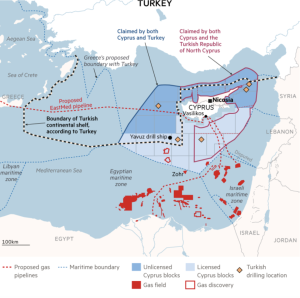
Last year saw new gas discoveries off Cyprus, including an estimated 70 billion cubic meters (bcm) field and a 57-84 bcm field. The finds raise the possibility of the island country finally becoming a gas exporter; it also raises the possibility of conflict as Türkiye, Greece, and Cyprus have wide-ranging disagreements over maritime boundaries.


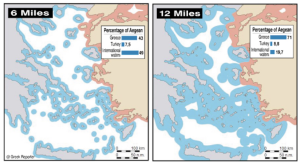
Greece argues that its islands in the Aegean sea can generate their own Exclusive Economic Zones (EEZ) which would allow Greece to explore more than 200 nautical miles. Türkiye has argued that islands can not generate their own EEZs and that Greece’s EEZ should start from its mainland, rather than from each of its hundreds of islands.

Under the UN’s Law of the Sea (UNCLOS), every state has the right to establish the breadth of its territorial sea up to a limit not exceeding 12 nautical miles. Türkiye, however, is not a signatory to UNCLOS and does not agree with the rights of the Aegean islands to such a distance. Ankara has threatened Athens with military action should it extend its waters. Both Greece and Türkiye currently claim six nautical miles off of their territory in Aegean and 12 nautical miles off their other shores.

While the EEZ governed by UNCLOS allows trading ships to pass freely, the passage of military naval ships is highly contested and Türkiye is threatened by the possibility of having to ask Greece permission for military navigation. Should Greece extend its EEZ to 12 nautical miles off its Aegean islands, it would make a drastic difference:


Six nautical miles have been in force since 1936. Tensions over the 12 nautical mile question ran highest between the two countries in the 1990s when UNCLOS was coming into force. In 1995, the Turkish Parliament officially declared that unilateral action by Greece to extend the Aegean islands to 12 nautical miles would constitute a casus belli, a position Ankara maintains today.

Well now Greece says that in March it’s going to extend its territorial waters to 12 nautical miles off of the island of Crete, which also happens to host a US naval base at Souda Bay. The US and Greece are also upgrading and expanding the facility with the goal to transform it into a permanent base for part of the Hellenic Navy, in order to facilitate faster and more direct access to the Eastern Mediterranean.

The move is reportedly being driven by ExxonMobil efforts to drill for natural gas and oil to the west and southwest of Crete. The Greek daily Kathimerini reported last week that ExxonMobil, in partnership with Greece’s HELLENiQ Energy, will push ahead with its search for natural gas and oil to the west and southwest of Crete despite Turkish opposition, fueling further suspicion in Ankara that the US is trying to punish the NATO member for its refusal to join the bloc’s aggressive approach against Russia.

US Arms Add Fuel to Fire

For decades the US acted as an impartial mediator between Greece, Türkiye, and Cyprus. Greece and Türkiye came close to military conflict in 1987, 1996 and in 2020, the last of which was over an accident when a Greek and a Turkish warship were involved in a minor collision during a standoff in the eastern Mediterranean. NATO stepped in in 1987 and in 1996 to help both sides cool off, and in 2020, Germany, which had the rotating presidency of the EU, took on the role of mediator.

The US is neutral no more. NATO’s war in Ukraine has brought long-festering issues between Ankara and Washington out into the open. The disagreements include US support of Kurds in Syria, Türkiye blocking Sweden’s NATO bid, Ankara’s refusal to open the Dardanelles to NATO warships, US sanctions and threat of sanctions, Washington’s refusal to extradite a cleric Türkiye blames for a 2016 coup attempt, Ankara’s purchase of Russian S-400 missile systems, Türkiye’s refusal to apply sanctions on Russia, and Ankara’s overall unwillingness to follow orders from Washington.

The US is now providing strong backing for Greece, which is clearly meant to send a message to Erdogan – at least that’s the belief inside Türkiye. Hasan Koni, a scholar on strategic studies at Istanbul Kultur University, told Türkiye’s Anadolu Agency::

The American security apparatus has also recognized that the balance of power in the region is shifting toward Türkiye and needs to be “checked by empowering Greece,” he said, adding that Washington’s push for more Greek bases is aimed at “containing Türkiye.”

The US has backed Greece despite the risk of a full break with Türkiye – the most important member of NATO due to its control of the Dardanelles and access to the Black Sea, as well as its second largest standing army in NATO.

Last year Greece deployed US-donated armored vehicles on the islands of Lesbos, Chios, and Samos, which is in violation of the 1923 Treaty of Lausanne and the 1947 Paris Peace Treaty. Ankara is also enraged about Greece’s militarization of islands within sight of Türkiye’s western coast, such as the Dodecanese chain that includes Rhodes.

There have been reports of Greek military exercises involving tanks, artillery and attack helicopters being held on Rhodes and Lesbos. Ankara has issued protests through diplomatic channels to both Athens and Washington and sent letters of complaint to the UN, all to no avail.

The US is also proposing to the Greek armed forces to replace all Russian-made military equipment including air defense systems with new military equipment produced by the US, including US Patriot missiles, which is a slap in Türkiye’s face.

Beginning during the Gulf War, Türkiye asked NATO multiple times to deploy early warning systems and Patriot missiles to Türkiye, but was always turned down. US security experts Jim Townsend and Rachel Ellehus explained it like this:

Long suspicious that NATO did not appreciate Türkiye’s vulnerability in such a dangerous neighborhood, Ankara came to view its missile defense requests as a litmus test for how much NATO really cared about Türkiye.

Ankara didn’t like the answer to that litmus test. Türkiye felt ignored by its western partners as its EU membership was all but dead, and it wasn’t getting the military hardware it requested. In 2017 Türkiye turned to Russia. It purchased Russian S-400 missile defense systems, which only further strained ties with NATO.

In December, a consortium of Italy’s Eni and France’s TotalEnergies found more natural gas off Cyprus. The Greek Cypriot administration’s exploration program is also disputed by Türkiye, which claims overlapping jurisdictions either on its own continental shelf or in the waters of the Republic of Northern Cyprus. Cyprus is split between the internationally recognized Republic of Cyprus in the south and the Turkish Republic of Cyprus in the north, which is recognized only by Ankara.

The US, wanting to keep the peace in NATO between Greece and Türkiye, had a decades-old policy of favoring negotiations on divided Cyprus and often acted as a mediator between the Turkish and Greek Cypriots.

But In September the Biden administration lifted the 35-year-old ban on the sale of US arms to the Republic of Cyprus. Congress restricted the sale of U.S. arms to Cyprus in 1987, hoping it would incentivize a diplomatic settlement to the island’s conflict.

Cyprus was required to block Russian naval vessels from accessing its ports in order to get the US arms sale ban lifted. Türkiye already has about 40,000 troops on the island, and Erdogan recently declared plans to reinforce them with land, naval and aerial weapons, ammunition and vehicles.

The decades’ old and UN-sanctioned principle of a bizonal, bicommunal federation on Cyprus has now broken down in favor of a two-state solution.

Despite the mad rush for Mediterranean gas in the wake of Europe and Russia schism, it still will not come close to replacing the amount that was piped in from Russia and requires rapid expansion of liquefaction capabilities, the connection of Israeli and Cypriot gas fields to such facilities, and/or implement pipelines, all of which will take years.

The EastMed Pipeline

The Trump administration backed a gas pipeline that would connect Israeli and Cypriot offshore gas fields to Greece and Italy. From there it would be shipped to the rest of Europe. The EastMed pipeline would have been the world’s longest (1,900 kilometers) and deepest underwater pipeline, initially providing 9-12 billion cubic meters annually.

One problem with the plan, however, was that it excluded Türkiye. In response, Erdogan opted to pursue Türkiye’s self-interest in gas through aggressive offshore oil exploration in disputed waters claimed by Cyprus. Turkish war vessels accompanied its drill ships near Cyprus, resulting in standoffs with Greek and French naval fleets. Ankara also began signing agreements with the government in Tripoli. From Dr Othon Anastasakis, Director of the European Studies Centre at the University of Oxford:

In November 2019, in response to Greece’s backing of the Mediterranean Gas Forum with Cyprus, Egypt, Israel, Italy and Jordan, Türkiye signed a maritime agreement with Libya that cuts a corridor across the Aegean to demarcate new maritime boundaries, with the proposed line in this accord running close to the eastern side of the island of Crete. On October 3, 2022, Ankara signed a follow up preliminary agreement with the Tripoli government to explore for oil and gas off the Libyan coast without specifying whether the surveys would take place in waters south of Greece. In effect, Libya has become an important third actor in the bilateral dispute between Greece and Türkiye and relations between the Athens and Tripoli governments have suffered a major blow as a result.

In January 2022, the Biden Administration abruptly halted American support of EastMed. Israeli and even some American officials were reportedly surprised by the sudden decision as the State Department did not appear to have adequately consulted with Cyprus, Greece, and Israel ahead of time. Additionally, Biden was a vocal supporter of the project during his time as Obama VP, and the US position was consistently that Europe needed to wean itself off of Russian natural gas.

The US government and American private sector were not directly involved in the pipeline project (the agreement was signed in January 2020 by the governments of Israel, Greece, and Cyprus), but as Henri Barkey, an adjunct senior fellow at the Council on Foreign Relations, told the National:


American support always affects a good housekeeping seal. When you have American buy-in, it’s easier for banks to provide financing for more countries to be interested. In that sense, what the US says is important.

US Under Secretary of State for Political Affairs Victoria “Fuck the EU” Nuland has taken an active role in the Eastern Mediterranean and had this to say about the pipeline:

“Frankly, we don’t have 10 years, but in 10 years from now, we want to be far, far more green and far more diverse” in energy sources, Nuland said. “So what we’re looking for within the hydrocarbon context are options that can get us more gas, more oil for this short transition period.”

That short transition period also happens to rely heavily on US exports of LNG.

In November Greece canceled the long-planned privatization for the Alexandroupolis port with Mitsotakis declaring it too precious of a resource to relinquish. Instead the US military has set up shop there, using it as an entry point to funnel weapons to Ukraine. There are also plans in the works to create a floating gas storage and regasification unit at the port, which will be serviced by American LNG supplies. A pipeline from Alexandroupolis is also planned to send that gas north to the Balkans.


12/01/2022

Tensions overshadow Macron’s White House visit


From left, US President Joe Biden, French President Emmanuel Macron, Jill Biden, the US first lady, and Brigitte Macron at a restaurant in Washington. Twitter


Source: Gulf Today
December 1 2022

French President Emmanuel Macron arrived in Washington late on Tuesday for a state visit hosted by President Joe Biden where hard-nosed disagreements about US-EU trade will overshadow the White House pomp and ceremony. Due to Covid delays, this is the first formal state visit of Biden’s presidency and US officials say the choice of France for the honour reflects both deep historical ties and their intense current partnership in confronting Russia over its war in Ukraine.

Macron touched down at Joint Base Andrews, the air force facility used by Biden outside Washington. While in the capital, the French leader will be given a full ceremonial military welcome to the White House, an Oval Office sit down with Biden and a state banquet on Thursday, where Grammy-award winning American musician Jon Batiste will perform.

Compared to Macron’s edgy first experience of a state visit as the guest of Donald Trump in 2018, this trip — concluding with a stop Friday to the once-French city of New Orleans — will be a carefully choreographed display of transatlantic friendship. Certainly the diplomatic furor that erupted last year when Australia canceled a deal for French submarines and instead signed up for US nuclear subs is now buried.

But even with little risk of Trump-style fireworks, Macron has major grievances to air. Top of these is tension over Biden’s signature green industry policy, the Inflation Reduction Act, or IRA, which will pump billions of dollars into climate-friendly technologies, with strong backing for American-made products. Similar effort is being put into microchip manufacturing.

Europeans fear an unfair US advantage in the sectors just as they are reeling from the economic consequences of the Ukraine war and Western attempts to end reliance on Russian energy supplies.

Talk in Europe is now increasingly on whether the bloc should respond with its own subsidies and championing of homegrown products, effectively starting a trade war. “China favours its own products, America favors its own products. It might be time for Europe to favour its own products,” French Finance Minister Bruno Le Maire told France 3 radio on Sunday.

Biden was certainly in no mood to apologize, saying in a speech at a microchip factory in Michigan on Tuesday that the push for a revitalized US-based industrial base is “a game changer.”

Companies began moving jobs overseas rather than moving product overseas,” he said. “We’re not going to be held hostage anymore.”

Another gripe in Europe is the high cost for US liquid natural gas exports — surged to try and replace canceled Russian deliveries. Responding to accusations that the United States is effectively profiteering from the Ukraine war, a senior US administration official said this was a “false claim.”

The official also played down IRA-related tensions, saying a “very constructive set of conversations” is underway on how to prevent European companies from being shut out. To underline the importance of the issue for Paris, Macron met with dozens of business executives ahead of his departure to Washington, urging them to keep investing in France. These included representatives from US giants Goldman Sachs and McDonald’s.

The breadth of Macron’s entourage — including the foreign, defense and finance ministers, as well as business leaders and astronauts — illustrates the importance Paris has put on the visit.

However, at the White House, a senior official said the main goal is to nurture the “personal relationship, the alliance relationship” with France — and between Biden and Macron.

That more modest sounding goal will include improving coordination on helping Ukraine to repel Russia and the even more vexing question of how to manage the rise of the Chinese superpower. “We are not allies on the same page,” one adviser to Macron said forecasting “challenging” talks with Biden.

Despite his strong support for Kyiv, Macron’s insistence on continuing to maintain dialogue with Russian President Vladimir Putin has irked American diplomats. The China question — with Washington pursuing a more hawkish tone and EU powers trying to find a middle ground — is unlikely to see much progress. “Europe has since 2018 its own, unique strategy for relations with China,” tweeted French embassy spokesman Pascal Confavreux in Washington. A senior US official said even if their approaches were “not identical,” they should be at least “speaking from a common script.”

Agence France-Presse

OSCE and the collapse of pan-European security system


Source: CGTN
December 1 2020
By Glenn Diesen

The 29th Ministerial Council of the Organization for Security and Cooperation in Europe (OSCE) takes place from December 1-2 in Poland. Established in 1994 to develop a common peace in an inclusive Europe, the OSCE has become the largest regional security organization in the world, which includes the U.S. on its western edge and Russia on its eastern. Therefore it could have played a key role in restoring peace amid the Ukraine conflict. However, the peace initiative was abandoned in favor of a hegemonic project facilitated by NATO expansionism.

The war in Ukraine and the decline of the OSCE are both symptoms of the collapsing pan-European security order.

A common Europe vs. continued bloc politics

In 1989, then Soviet Union leader Mikhail Sergeyevich Gorbachev and then U.S. President George W. Bush held the Malta Summit, which ultimately led to the declaration of the end to the Cold War, a negotiated peace that promised to replace confrontational bloc politics with a new peaceful Europe. In 1990, the Charter of Paris for a New Europe was signed, in which all participants committed themselves to construct a new and inclusive Europe without dividing lines based on "indivisible security" and "sovereign equality." In 1994, these principles laid the foundation for a new and inclusive pan-European security organization – the OSCE.

But Russia was weak, and the U.S. pushed a parallel security architecture based on unipolarity and hegemony. When the Soviet Union collapsed in 1991, two years after the end of the Cold War, the U.S. abandoned the narrative of a negotiated peace for a common Europe. Jack Matlock, the U.S. ambassador to the Soviet Union who had contributed to negotiating an end to the Cold War, warned that the "mythmaking" and historical revisionism began in Washington as soon as the Soviet Union collapsed. One month after the Soviet Union collapsed, President Bush triumphantly proclaimed: "By the grace of God, America won the Cold War… The Cold War didn't end, it was won… We are the United States of America, the leader of the West that has become the leader of the world." The new narrative of victory legitimized a new Europe based on hegemony, in which the OSCE would be a marginal organization.

NATO expansionism would facilitate the new Europe, which canceled the key principles of the OSCE. "Indivisible security" was abandoned as NATO began to expand its security at the expense of Russian security. "Sovereign equality" was replaced with sovereign inequality as NATO claimed the prerogative to interfere in the domestic affairs of other states, topple governments and invade under the guise of advancing liberal values. Last, the OSCE's principle of "no dividing lines" was abandoned in favor of gradually moving the dividing lines in Europe toward Russian borders.
 
The logo of the Organization for Security and Cooperation in Europe (OSCE), at the OSCE headquarters in the Hofburg Palace in Vienna, Austria, February 21, 2022. /CFP


The consequence of replacing the inclusive OSCE with NATO hegemony might be a new Cold War. The main conflict between NATO and Russia is over where to draw the new dividing lines, in which the divided societies in Ukraine, Georgia, Belarus, and Moldova are becoming the battlefield. The current war was both predictable and avoidable. American diplomat George F. Kennan cautioned in 1998 that NATO expansionism would be the beginning of a new Cold War: "Of course there is going to be a bad reaction from Russia, and then [the NATO expanders] will say that we always told you that is how the Russians are – but this is just wrong."

Excluding Russia from the OSCE

On November 18, Poland refused Russian Foreign Minister Sergey Lavrov to attend the OSCE meeting in Poland as he is under EU sanctions.

Poland's decision to deny Sergey Lavrov access is either inspired or directly advocated by the U.S. In September, Washington denied Russian diplomats to travel to New York for participating in the sessions of the UN General Assembly. We now see Poland similarly abusing its role as a host of the OSCE meeting to dictate who should be allowed to participate.

This decision is very dangerous as the international security architecture collapses when states place exclusive military alliances above inclusive institutions that develop common rules. The principal loyalty to NATO and EU above the UN and the OSCE is a feature, not a bug in the European security architecture.

The erosion of a common Europe began less than two weeks after NATO's first expansion, as NATO claimed the authority to invade Yugoslavia in 1999 without a UN mandate. The invasion was unmistakably a violation of international law, yet it was argued to be legitimate as NATO was argued to serve liberal democratic values. Decoupling legality from legitimacy was intended to assign priority to NATO as the ultimate authority in Europe.

The efforts of replacing international law with the "international rules-based order" formalizes this logic of sovereign inequality. The fundamental idea is that the world should be divided between liberal democracies and authoritarian states – and the former should not be restrained by the same rules as the latter. Consequently, the U.S.-led alliance striving for hegemony is elevated above the OSCE and the UN as inclusive institutions that develop common rules.

The OSCE was developed to mitigate and transcend bloc politics, although it is now used instead as an instrument of bloc politics. The consequence of eliminating the common institutions and rules is now evident. A major war continues to rage on in Ukraine that might escalate into a nuclear war between NATO and Russia, yet there seems to be no willingness to engage in diplomacy.

Glenn Diesen is a professor at the University of South-Eastern Norway. 


2/19/2022

Biden's real challenge is not Russia or China, but poverty in America


Source: MEMO
February 19 2022
By Dr Ramzy Baroud


Mainstream US media continues to celebrate the supposed strength of the US economy. Almost daily, headlines speak of hopeful numbers, sustainable growth, positive trends and constant gains. The reality on the ground, however, tells of something entirely different, which raises the questions: Are Americans being lied to? And for what purpose?

"US Economy Grew 1.7% in Fourth Quarter, Capping a Strong Year," the New York Times reported. "US Economy Grew 5.7% in 2021, Fastest Full-Year Clip," the Washington Post added. Reuters, Voice of America, the Financial Times, CNN, Market Watch and many others all concurred. But if that is the case, why then is US President Joe Biden's approval rating at an all time low? And why are many Americans literally going hungry?

In a national opinion poll conducted by Reuters/Ipsos and published on 3 February, only 41 per cent of US adults approved of Biden's performance in office. A whopping 56 per cent disapproved. The numbers were not a complete shock as the downward trajectory of the Biden presidency has been in effect since soon after he moved to the White House over a year ago.

The truth is, Biden was not the Democrats' top choice nominee for president. Judging by various opinion polls and the early results of the Democratic primaries in 2020, it was Bernie Sanders who represented the Democratic hope for real, substantive change. Party politics, liberal media insistence that Sanders was not 'electable' and fear-mongering regarding a second Trump term in office pushed Biden through the ranks of nominees to be presented as America's only hope for salvation.

While Republicans remain committed to the Donald Trump legacy and are still largely politically and ideologically united, Democrats are growingly unconfident in their leadership and uncertain regarding the future of their democracy, governance and economy. Of course, they are blameless in holding such views.

While the Democratic leadership continues to obsess with its fear of Trump, and while liberal media insists that the US economy is as healthy as it can be, the average American continues to struggle against encroaching poverty, inflation and lack of future prospects.

Here are some sobering numbers: 56 per cent of all Americans cannot produce a meager $1,000 as an emergency expense from their existing savings, CNBC reported; one in 10 US adults went hungry last December as a result of poverty, Forbes.com reported; Columbia University Center on Poverty and Social Policy revealed that child poverty rate in the US stands at 17 per ent, "one of the highest among developed countries".

If American workers are studied separately from the larger population, the numbers are even more grim: three quarters of American workers said that "it was very or somewhat difficult to make end's meet," according to a study conducted by Shift Project, and reported in NBC News online. Forty per ent of the polled workers said that they are not able to come up with $400 in emergency money. But the most shocking of all, according to the same study, is that "around 20% said that they went hungry because they couldn't afford enough to eat".

Aside from occasional government handouts, which were provided by both the Trump and Biden administrations, little has been done by way of structural changes to the US economy that would ensure greater equality among all sectors of society. Instead, the administration's priorities seem to be allocated to something else entirely.

Writing in Politico, David Siders describes the current political discourse within Democratic Party circles, where "Democrats are losing their minds over 2024". Since the Democratic President's public approval ratings are "dismal", Democrats fear the return of Trump. "All anyone can talk about is Trump —donors, policy folks, party insiders, the media," Siders quoted a Democratic adviser as saying. The same adviser described "a weird cycle" where the "conversation keeps coming back to Trump".

Whether conscious of this obsession or not, the Biden administration seems to operate entirely according to a political strategy that is predicated on tarnishing Trump and his supporters, retelling, over and over again, the story of the January 6 insurrection, hoping for a Republican split or any other miracle that would bolster their chances of maintaining their Congressional majority in the next November mid-term elections.

While doing so, the Democratic leadership seems oblivious to the harsh reality on the ground, where food prices are skyrocketing and where inflation has reached unbearable levels. According to new data, released on 10 February by the Bureau of Labor Statistics, the US consumer price index (CPI) rose by 7.5 per cent in January compared to the same month a year ago, making it the "fastest annual pace since 1982," the Financial Times reported.

The rise in inflation is not a one time off event, as CPI has been rising at a sustainable level of 0.6 per cent on a monthly basis. Ordinary people can feel this increase almost every time they go shopping. Small business owners, especially restaurants, bakeries and grocery stores, are left with one out of two options: either increasing their prices or shutting down completely. Consequently, large segments of the already vulnerable US population are growing more desperate than ever.

To avoid providing real answers to difficult questions about the welfare of millions of Americans, about the real function of their democratic institutions and about existing corruption within the US political system – regardless of who controls the Congress or resides in the White House – Democrats and their media are either blaming their Republican rivals or creating foreign policy distractions. They continue to speak of a 'China threat' and an 'imminent' Russian invasion of Ukraine and such, while the real threat is that of detached politicians who are amassing wealth, fighting for power and prestige while their countrymen and women continue to go hungry.


4/04/2021

Ukraine to hold join military drills with NATO amid escalating tensions with Russia


Source: The Hill
March 4 2021
By Tal Axelrod


Ukraine’s military announced Saturday that it will hold joint military drills with NATO troops later this year amid escalating violence with pro-Russian separatists in the eastern part of the country.

The armed forces said in a statement on Facebook that the drills will be held with more than 1,000 military personnel from at least five NATO member states in a few months.

“In particular, defensive actions will be worked out, followed by an offensive in order to restore the state border and territorial integrity of a state that has been subjected to aggression by one of the hostile neighboring countries,” the statement said, in an apparent reference to Russia.

An exact date for the drills, which were described as routine, was not provided.

“Exercise Cossack Mace is a routine exercise which is still in the planning stage," a U.K. UK Ministry of Defence spokesperson said in a statement to The Hill. "It is due to take place in Summer 2021.”

Moscow had preemptively rebuked any potential deployment of NATO personnel to Ukraine, warning that it would ramp up pressure along the border between the two countries.

But pressure has already ramped up along the border, with Russia building up its military presence on its side of the barrier. Fighting also increased with separatists backed by Moscow in eastern Ukraine, spelling the potential end to a cease-fire in the Donetsk region.

The Ukrainian parliament this week put out a statement declaring an “escalation” along the front, citing a “significant increase in shelling and armed provocations by the armed forces of the Russian Federation.”

Ukraine, which represents NATO’s front line in Eastern Europe against Russian expansion, pressed Western governments to “continue and increase international political and economic pressure on Russia.”


4/02/2021

US-funded Uyghur activists: "Wipe out China!"


Source: The Grayzone
March 31 2021
By Ajit Signh


Cultivated by the US government as human rights activists, Uyghur American Association leaders partner with far-right lawmakers and operate a militia-style gun club that trains with ex-US special forces.

On March 21, US-government-funded Uyghur activists were caught on video disrupting a gathering against anti-Asian racism in Washington DC, barking insults at demonstrators including, “Wipe out China!” and “Fuck China!” The Uyghur caravan flew American and “East Turkestan” flags and drove vehicles adorned signs bearing slogans such as, “We Love USA,” “Boycott China,” and “CCP killed 80 million Chinese people.”

Organized by the Uyghur American Association (UAA), the drive-by heckling of anti-racist demonstrators drew widespread condemnation on social media, including from other sections of the Uyghur separatist movement. Salih Hudayar, the self-proclaimed “Prime Minister of the East Turkistan Government-in-Exile,” slammed “the UAA’s reckless drive-by” for causing “severe backlash against Uyghurs,” and insisted that Uyghur Americans were “not racist.”

The UAA has attempted to distance itself from accusations of extremism and racism, stating that its members’ actions were misrepresented. Despite refusing to rescind their call for China to be “wiped out,” the UAA declared that it “condemns any form of bigotry and stands with all victims of racism.”

12/30/2020

Europe Embraces Multipolar World With Nord Stream 2 and China Investment Deal


Source: Strategic Culuture
Dec 30 2020
By Finian Cunningham


Material need usually wins out against ideological creed. Necessity over dogma. Twice this week, the European Union demonstrated that maxim in practice when it rebuffed Washington over the Nord Stream 2 gas pipeline with Russia; and then again over a major investment pact with China.

Germany’s Foreign Minister Heiko Maas pointedly stated this week that the European bloc was going ahead with completion of the Nord Stream 2 project in partnership with Russia. Construction of the pipeline under the Baltic Sea had been temporarily halted by U.S. sanctions. But now Germany is saying it won’t be deterred from finishing the project.

Maas said that while the EU looks forward to having better relations with the United States under a new Biden administration, the bloc was asserting its prerogative to trade with Russia for increasing natural gas supply as a matter of sovereignty.

“We do not need to talk about European sovereignty if it means that, in the future, we will only do everything Washington wants,” Maas is quoted as saying. “The [German] federal government will not change its position on Nord Stream 2,” he added.

Given that the Nord Stream 2 pipeline will double the flow of relatively affordable Russian gas to the EU this is also a vital matter of helping to boost European economies.

Despite repeated exhortations, as well as threats of economic sanctions, from Washington for the EU to drop the Russian energy supplier in place of more expensive American gas, the Europeans are adamantly putting their economic material interests above ideological constructs that would be best left to bygone Cold War years.

The European flexing of independence from Washington is all the more notable in the context of the Navalny furore. The Russian activist’s alleged poisoning by Kremlin agents was used to pile pressure on Germany to ditch the Nord Stream 2 project. Many critics saw Alexei Navalny’s purported assassination plot as a false flag provocation whose purpose was to further sabotage relations with Moscow and in particular to scupper Nord Stream 2. Evidently, that ruse has failed, given Berlin’s assertion this week of completing the gas project.

The second remarkable rebuff from the EU to Washington came with the announced conclusion of a major investment pact with China. The negotiations have been seven years in the works, but now both sides are ready to sign up by the end of this week. It’s impossible to overstate the importance of this trade and investment accord between the EU and China. It brings the world’s two largest trading entities into ever closer integration. This is a key manifestation of China’s global policy of paving New Silk Routes to underpin a vision of a multipolar world. “Eurasia” – from Russia’s Far East through Japan, Korea, China, Central Asia, the Middle East to Western Europe – is now, more than ever, an emerging economic colossus.

It seems that Beijing deftly made concessions to the Europeans in terms of increasing business access to the vast Chinese market. That had the effect of splitting Europe away from Washington’s coercive calls for transatlantic unity in confronting China.

Only the day before the announcement of the EU-China investment pact, President-elect Joe Biden made a renewed call for a unified approach between the U.S. and Europe to confront the rise of China. Obviously, the Europeans know from which side their bread is buttered, and ignored Biden’s appeal for Cold War-like hostility.

This is a hugely significant development. It cannot be accidental. Last week, when there was growing expectation of the EU-China deal being made, Biden’s nominated national security advisor Jake Sullivan expressed Washington’s concerns.

Referring to the pending EU-China trade deal, Sullivan said: “The Biden-Harris administration would welcome early consultations with our European partners on our common concerns about China’s economic practices.”

Well, guess what, the EU sidelined Washington’s appeal and has pressed ahead to conclude the investment pact with China.

This is vindication of the reality of a multipolar world. The integrated and interdependent nature of the global economy means that the Cold War ideology promoted by the United States is no longer tenable. It may be desirable for Washington to promote that ideology in some notion of pursuing global hegemony. But that concept is no longer viable, given the multipolar reality of today’s world and the realization by nations that partnership and co-development is the only way forward, based on mutual respect for sovereignty and law and order.

The United States’ political and economic system seems incapable of adapting to the new multipolar paradigm. Like a dinosaur it is doomed to perish because its mode of behavior and ideological depiction of the world are no longer viable in a changed political environment.

Material need and awareness of self-preservation are pushing the Europeans to trade with Russia and China. There maybe diehard Cold War-types still within the European political establishment (hence the Navalny fiasco), but for the most part the exigencies of economic and social needs are the ultimate determinants.

Mick Wallace, an Irish Member of the European Parliament gave the following incisive comments to SCF: “The EU has a longstanding problem, which hasn’t gone away, with its blind adherence to U.S. Imperialism. But when it comes to China, things could be different. The U.S. has decided to treat China as a security threat, when the truth is that China is just a threat to U.S. economic supremacy. But as long as the U.S. continues to treat China as a military threat, it’s happy days for the American military industrial complex. Europe disappoints, but it’s not stupid. There is a lot of mindless anti-China rhetoric in the European Parliament but less of it coming from the Commission or Council. The EU is really a one-man show, consisting of Germany – it dominates totally. And while Germany wasn’t lying awake at night about a deal or no-deal Brexit, it is very interested in having good relations with China. The Germans will follow the money, and are unlikely to have much of an appetite for following the U.S. down an economic war dead-end, which can have just one winner – the People’s Republic of China.”

So, the incoming Biden administration may try to revamp U.S. global power and its apparatus of allies by talking up confrontation towards Russia and China. But, on a hopeful note, the rest of the world knows it can’t afford to indulge such American zero-sum mentality. The only solution for present challenges is global cooperation. This week, the EU demonstrated an appreciation of reality with regard to Russia and China. And Uncle Sam is left holding the ideological baggage.


10/05/2020

A Clash with Turkey Is Becoming Inevitable


Source: The National Interest
Oct 10 2020
By Michael Rubin


Turkey has essentially become like Iraq in early 1990: Erdoğan, like Saddam, sees his economy collapsing and recognizes that he will not be able to deflect blame from his own mismanagement and choices. That means trouble is brewing.

ate last month, Mike Pompeo became the first secretary of State to visit Greece twice. While his initial remarks sought de-escalation, the reality is only one side is responsible for the conflict that now looms: In recent months, Turkey has not only encroached on Cyprus’ internationally-recognized exclusive economic zone and Greek waters but, in recent days, reportedly Israel’s exclusive economic zone as well. Whereas compartmentalized analysts might see Turkish president Recep Erdoğan backing down in the face of diplomatic pushback and military mobilizations, a more holistic view is that Erdoğan is determined to lash out for reasons both ideological and populist and will continue to do so until he determines where a small military investment could bring the greatest gains.

One possible flashpoint to watch is Famagusta. After Cypriot independence, Famagusta—and especially its southern Varosha quarter—became a major tourist hub that attracted European and Western glitterati to its pristine beaches and resorts. That all ended when Turkey invaded in 1974. It first bombed the city forcing many residents to flee and then occupied it. Famagusta’s residents expected to return upon the ceasefire but never did. Varosha became a ghost town with billions of dollars of real estate fenced off and empty, its former residents permanently displaced.

Generations of diplomats have expected Famagusta—and the return of its residents—to be key to any negotiated peace on Cyprus. That Turkey left Varosha fallow gave Cypriots, Western Europe, and UN diplomats hope that Ankara was still interested in a resolution to the Cypriot conflict. Now, however, Erdoğan signals that Turkey may act unilaterally to populate and develop Varosha. Not only does Erdoğan want to signal his toughness after backing down in his recent maritime dispute with Greece, but he and his key supporters also stand to gain billions of dollars as they use Turkish state funds and perhaps the proceeds of resources looted by Turkey to reconstruct the apartment buildings and hotels which after five decades must be razed and replaced. Consider it Turkey’s version of China’s salami-slicing strategy. Erdoğan has long argued that the treaties determining Turkey’s borders should be revised; populating Varosha would allow him to put his rhetoric into action.

The problem is not only in Cyprus or the Eastern Mediterranean, however. Turkey has troops in Syria and Iraq, and has also intervened in Libya and, most recently, Azerbaijan. Troublingly, Turkey’s new modus operandi is to use Syrian proxies, many of whom are veterans of the Islamic State or Al Qaeda affiliates. In effect, Turkey now uses its Syrian militiamen the way that Iran utilizes Lebanese Hezbollah or its parallel Afghan and Pakistani militias. That Turkey is so rapidly inserting its Syrian proxies into various conflicts signals Turkey’s simultaneous desire to broaden its interventions overseas and its efforts to maintain plausible deniability.

Beyond its military posturing, Turkey has also grown more aggressive toward dissidents abroad. Earlier this year, a Turkish intelligent agent entered an Austrian police station and stated that Turkey’s intelligence service had ordered him to assassinate a former Austrian parliamentarian, also of Kurdish descent.

On September 25, three unidentified individuals in Stockholm, Sweden attacked Abdullah Bozkurt, perhaps Turkey’s most prominent dissident journalist who previously worked for Fethullah Gülen’s flagship Zaman prior to Erdoğan’s crackdown on Gülen’s movement. While Turkey has instigated attacks on dissidents and opposition—including in Washington, DC—assassinating European politicians and attacking journalists as prominent as Bozkurt suggests that Erdoğan is ratcheting up aggression to a new level.

The U.S. and European response is restrained, which only encourages Erdoğan’s aggression. Like Vladimir Putin in Russia and Xi Jinping in China, he believes the West is weak and he get away with dictating to it. He has nowhere near the power of his political peers, but he is right to detect European and U.S. weakness.

The major problem Europe—and by extension the United States—faces is Germany. Angela Merkel is reluctant to apply meaningful sanctions against Turkey because her country fears three things. Diplomats say privately that Merkel’s bigger fears are that Turkey might utilize refugees as cover to precipitate violence inside Germany, or that Erdoğan might incite Germany’s large ethnic Turkish population.

This plays into the hands of those within the State Department who seek to undermine efforts to hold Turkey to account. Rather than impose sanctions unilaterally on Turkish officials and companies complicit in violating Cypriot or Greek waters, mid-level U.S. diplomats argue they want only to impose sanctions in conjunction with the European Union knowing that Germany will effectively block their implementation. Pompeo, therefore, may talk a robust game with regard to Turkey’s regional aggression from the seventh floor of the State Department but, in practice, his Bureau of European and Eurasian Affairs slow-rolls any cost to Turkey to the point that Erdoğan believes he will face no pushback for his aggression.

The Eastern Mediterranean is a tinderbox. Wars are seldom caused by a desire for resources alone, but rather by overconfidence. Turkey has essentially become like Iraq in early 1990: Erdoğan, like Saddam, sees his economy collapsing and recognizes that he will not be able to deflect blame from his own mismanagement and choices. Like Saddam, he sees neighbors possessing valuable resources and believes the international community to be paper tigers. In 1990, Saddam had April Glaspie equivocate and turn a blind eye to his ambitions; in 2020, Erdoğan has equally credulous envoy James Jeffrey. Turkey’s recent escalations in the region show that Erdoğan’s ambitions are out-of-control. The question for Washington, Berlin, and Brussels is whether the United States and Europe are willing to stand up and shut down those ambitions before Erdoğan pulls the trigger, or whether they will instead wait until a resolution is far more costly to Turks and everyone in the Eastern Mediterranean.

Michael Rubin is a resident scholar at the American Enterprise Institute.


9/27/2020

Urgent: Move US Nuclear Weapons Out Of Turkey


Source: FAS
By Hans M. Kristensen
Oct 16 2019


Should the U.S. Air Force withdraw the roughly 50 B61 nuclear bombs it stores at the Incirlik Air Base in Turkey? The question has come to a head after Turkey’s invasion of Syria, Erdogan’s increasingly authoritarian leadership and deepening discord with NATO, Trump’s inability to manage U.S. security interests in Europe and the Middle East, and war-torn Syria only a few hundred miles from the largest U.S. nuclear weapons storage site in Europe.

According to The New York Times, State and Energy Department (?) officials last weekend quietly reviewed plans for evacuating the weapons from Incirlik. “Those weapons, one senior official said, were now essentially Erdogan’s hostages. To fly them out of Incirlik would be to mark the de facto end of the Turkish-American alliance. To keep them there, though, is to perpetuate a nuclear vulnerability that should have been eliminated years ago.”

That review is long overdue! [Actually, I’ve heard there have been several reviews and a lively internal debate since the 2016 coup attempt.] Some of us have been calling for withdrawal for years (see here and here), but officials have resisted saying it wasn’t as bad as it looked and that the deployment still served a purpose. They were wrong. And by waiting so long to act, the United States has painted itself into a corner where the choice between nuclear security and abandoning Turkey has become unnecessarily stark and urgent.

The situation is even more untenable because Incirlik in just a few years is scheduled to receive a large shipment of the new B61-12 guided nuclear bomb, which would be a recommitment to nuclear deployment in Turkey.

This year is the 60th anniversary of the first deployment of nuclear weapons to Turkey. It is time to bring them home.

Nuclear Weapons At Incirlik


The specific reference in the New York Times article made by officials to nuclear weapons at Incirlik is the most recent and authoritative confirmation that nuclear weapons are still stored at the base. That confirms what I have been hearing and sources at US Air Forces Europe confirmed the report, telling William Arkin the weapons are still there. There have been rumors the weapons were removed after the coup attempt in 2016 (and some really bad disinformation that they had been moved to Romania). All of those rumors were wrong. An article on the official Incirlik Air Base web site even confirms that the mission of the 39th Operations Support Squadron is “to orchestrate and control US, Turkish, and coalition forces operating at Incirlik Airbase in the execution of full-spectrum airpower and nuclear deterrent operations” (emphasis added). Given that the article will likely be removed now that I have pointed this out, it is reproduced in full below:


I have estimated for the past several years that the Air Force stores about 50 B61 nuclear gravity bombs at Incirlik, one-third of the 150 nuclear weapons currently deployed in Europe (see figure below). This estimate has been used by a wide range of news reports and commentators. The number of bombs at Incirlik has decreased over the past two decades from 90 in 2000. In those days, 40 of the 90 bombs were earmarked for delivery by Turkish F-16s. Those 40 bombs used to be stored in 6 vaults at both Akinci AB and Balikesir AB (20 at each) until they were moved to Incirlik when the US Air Force withdrew its Munition Support Squadrons from the Turkish bases in 1996. The 40 “Turkish” bombs remained at Incirlik until around 2005 when they were shipped back to the United States as part of the Bush administration’s unilateral nuclear reduction in Europe.


The US Air Force stores 150 nuclear bombs at six bases in five NATO countries. Click on map to view full size.

The remaining 50 bombs are for use by US jets, even though Turkey never allowed the US Air Force to permanently base fighter-squadrons at Incirlik. Jets would have to fly in during a crisis to pick up the weapons or they would have to be shipped to other locations before use. As a result, the nuclear posture at Incirlik has been more a storage site than a fighter-bomber base during the past two decades.

Although the Turkish participation in the NATO nuclear sharing mission was lessened (some would say mothballed) by the withdrawal of the “Turkish” weapons, the Turkish F-16s continued to serve a nuclear role. Despite local reports that F-16s never had a nuclear role, the US Air Force in 2010 informed Congress that “Turkey uses Turkish F-16s to execute their nuclear mission,” and that some of the F-16s would be upgraded to be able to deliver the new B61-12 bomb until the F-35A could take over the nuclear strike mission in the 2020s. That is now not going to happen after the Trump administration canceled the F-35 sale.

In 2015, satellite images revealed construction of a new security perimeter around most of the aircraft shelters with nuclear weapons storage vaults. Of the 25 shelters that originally were equipped with vaults, only 21 were included in the new security area with a capacity to store up to a maximum of 84 nuclear bombs. Normally only about two bombs are stored in each vault, for a total of inventory of 40-50 bombs at Incirlik.


The nuclear weapons mission areas at Incirlik AB include the “NATO Area” where nuclear weapons are stored and the nuclear weapons maintenance unit that manages the underground storage vaults

As recently as last month, Vice Chief Staff of the Air Force, Gen. Stephen W. Wilson, visited Incirlik and was given tours of the various functions and facilities at the base. One of these was Protective Aircraft Shelter H-2 inside the “NATO Area” where he spoke to members of the 39th Security Force that protects the nuclear weapons (see below). He was likely also shown the inside of the shelter and the weapons in the vault.


Last month, the Air Force Chief of Staff was taken to a nuclear weapons storage shelter at Incirlik AB. Click on image to view full size.

Recent Activities


If the Air Force decided to withdraw the B61 bombs from Incirlik, it would look pretty much like activities captured by Maxar’s satellites in 2019 and 2017. Those images show what appears to be either actual nuclear weapons movements or training to remove them.

One photo from March 22, 2019, shows a C-17 transport aircraft – likely from the 4th Airlift Squadron of the 62nd Airlift Wing at Joint Base Lewis-McChord in Washington – parked right outside the main gate to the NATO Area. The 4th Airlift Squadron, which is the only unit in the Air Force that is qualified to airlift nuclear weapons, flies Prime Nuclear Airlift Force (PNAF) and Emergency Nuclear Airlift Operations (ENAO) missions (see images below).


The satellite image shows the C-17 and gate area surrounded by armored vehicles and armed guards of the 39th Security Force as well as technicians to protect and carry out the weapon movement. One of the unique vehicles seen is an 18-meter truck lined up with the loading pad of the C-17. The same type of truck can be seen parked at the weapons maintenance unit building a few months later (see image
below).


This Maxar satellite image acquired via Earth Watch shows what appears to be a nuclear weapons movement or exercise in March 2019. Click on image to view full size.


Another set of Maxar satellite photos of a possible nuclear weapons movement or exercise is from December 2017. A Nuclear Security Inspection that year (and 2014) reportedly included weapons emergency evacuation drills. The scenario on the 2017 image is similar to that on the 2019 image: a C-17 parked outside the gate, security vehicles surrounding the scene, and transporters for moving weapons. But the 2017 photos are unique because they were taken moments apart as the satellite passed overhead. As a result, movements become visible: On the first image, a possible weapons trailer towed behind a truck in a column of armored security vehicles is moving toward the outer gate of the NATO Area. On the second photo, the column has passed through the gate onto the tarmac and the towed trailer is turning toward the rear of the C-17. The aircraft shadow shows the loading ramp is open and ready to receive the weapons (see image below).This unique double-image shows what appears to be a nuclear weapons movement or exercise in December 2017. Click on image to view full size.


The Task At Hand: Withdraw The Weapons!


The B61 nuclear bombs at Incirlik should have been withdrawn long ago but tradition, Cold War thinking, and bureaucratic inertia prevented officials from doing the right thing. Now things have come to a head where the United States is faced with the choice of securing its weapons or be seen as abandoning Turkey.

Withdrawing the weapons does not, of course, mean the United States is abandoning Turkey. That relationship is already in serious trouble and keeping the weapons at Incirlik based on the idea that it will somehow counterweight Turkey’s further drift away from NATO is probably an illusion. That boat seems to have sailed; the relationship is likely to deteriorate whether or not there are nuclear weapons at Incirlik. That is the reality the Air Force must relate to now.

Nuclear weapons security convoy at Incirlik AB in 2009.

Another argument against withdrawal will be that moving them out of Turkey will cause the other members of the so-called nuclear sharing arrangement (Belgium, Germany, Holland, Italy) to question why they should continue to store U.S. nuclear weapons. Withdrawal from Turkey could, so the argument goes, trigger a domino effect of withdrawal from other countries as well.

But the withdrawal of U.S. nuclear bombs from Greece in 2001 and from England five years later did not cause the other countries to demand withdrawal as well or the collapse of NATO. If they truly believe deployment of U.S. nuclear weapons is important for NATO security, then they will stay. If the mission falls with withdrawal from Turkey, then they obviously don’t think it’s important and the weapons should be withdrawn from all the countries anyway. The U.S. extended deterrence posture in Europe can adequately be maintained with advanced conventional forces backed up by strategic forced in the background.

The B61 bombs at Incirlik could easily be dispersed to empty storage vaults in the other countries. Space is not a problem. There are a total of 96 empty weapon slots in the active WS3 vaults in Belgium, Germany, Holland, and Italy. Moreover, there are 25 empty and inactive WS3 vaults with room for 100 bombs at RAF Lakenheath. But public and parliamentary opposition would likely prevent increasing the number of nuclear bombs stored in those countries. If the order goes out to evacuate Incirlik, it seems more likely the bombs would be returned to the United States.

There will be some people who will argue that deteriorating relations with Russia and Moscow’s alleged increased reliance on a so-called “escalate-to-deescalate” strategy of using tactical nuclear weapons first prevent the United States from reducing – certainly withdrawing – its tactical nuclear weapons from Europe. Those are curiously the same people who also argue that the United States should deploy a new low-yield warhead on its strategic submarines and a new nuclear cruise missile on its attack submarines to better counter Russian tactical nuclear weapons – a thinking that was recently endorsed by the Trump administration’s Nuclear Posture Review. That seems to signal to the European allies that the United States actually no longer believes the deployment of B61 nuclear bombs in Europe is credible and that other and better weapons are needed.


Whatever one might think about U.S. tactical nuclear weapons in Europe, Turkey is no longer an acceptable location. Erdogan’s confrontational and authoritarian leadership is rapidly undermining Turkey’s status as a reliable NATO ally, and the deteriorating security situation in the region presents a real physical threat to the weapons at Incirlik. That threat is real and the U.S. military sees it as real. So much so that an extra security force squadron deployed to Incirlik from Aviano Air Base in Italy to beef up nuclear security in response to “regional turmoil and government instability” according to USAF source, and Ohio Army National Guard military police reportedly were dispatched to Incirlik specifically to increase base security.

The security threat to the weapons at Incirlik is urgent and the continued deployment of nuclear weapons at the location is unjustifiable and incompatible with U.S. nuclear security standards. If you don’t believe that, ask yourself this question: If there were no U.S. nuclear weapons in Turkey and someone asked for them to be deployed to Incirlik, would the Pentagon approve?

I doubt it. It’s time to face reality and withdraw the weapons from Turkey before they have to be evacuated under fire.

Hans M. Kristensen is the director of the Nuclear Information Project at the Federation of American Scientists where he provides the public with analysis and background information about the status of nuclear forces and the role of nuclear weapons.

------

Editor's note


9/17/2020

What did Serbia and Kosovo sign in Washington?


By Sandra Maksimović
Sept 17 2020


Serbian President Aleksandar Vučić and Kosovo Prime Minister Avdullah Hoti pledged to normalize economic relations on 4 September, signing an agreement in the presence of US President Donald Trump in Washington. However, issues such as what exactly was signed, what are the consequences of this agreement for Belgrade and Pristina, as well as what is the future of the Belgrade-Pristina dialogue that is being conducted in Brussels, have remained unresolved.

Instead of economic cooperation, the provision concerning the relocation of the Serbian embassy to Jerusalem, which opposes the EU’s foreign policy, and the mutual recognition between Israel and Kosovo attracted the most attention.

Assistant professor at the Faculty of Political Sciences in Belgrade Milan Krstić explained that Belgrade and Pristina have not signed a legally binding agreement in Washington, or any bilateral agreement, either with the United States, as claimed by Serbian government officials, or with each other, as Richard Grenell suggested.

“A political document was signed, a legally non-binding statement of will which assumes certain political obligations. Formally, legally, it is not an international document. This does not mean that the document does not have political weight and political implications, especially having in mind the place where the document was signed, which is the White House “, Krstić pointed out in EWB Screening show.

Executive Director of the Belgrade Fund for Political Excellence (BFPE) Marko Savković stated earlier for EWB that it is still being discussed whether this agreement is actually an international agreement that produces obligations.

“I think this is a kind of declaration of will, or political commitment to this administration, not the next one. We will see whether Biden will insist on the agreement sponsored by Grenell. However, there are points that will be interesting to him or “his people”, which represent a reflection of broader and long-term American interests – in the field of energy security (diversification, less reliance on Russia) and cyber security (5G technology, less reliance on China)”, said Savković, adding that it is not clear how this will be implemented, and that is why he thinks that we should still wait for November.

On the other hand, Krstić pointed out that even if Trump does not win the elections, the spirit of the agreement will remain.

“The agreement is not formally legally binding even now, so nullity in the formal legal sense is not an issue either. In essence, politically, I do not believe that the spirit of the agreement will be annulled, and it implies economic cooperation and economic rapprochement between Belgrade and Pristina. And that element will be something that the Biden administration would use and insist on. After all, economic integration was not invented by Trump,” said Krstić.


Going against the EU?


Shortly after the meeting in Washington, the EU warned Serbia and Kosovo that their decision to move their embassies to Jerusalem could undermine their EU membership prospects.

According to EU Spokesperson for Foreign Affairs and Security Policy Peter Stano, the embassy move goes against the official policy of the EU which states that the status of Jerusalem has to be worked out between Israel and the Palestinians and that it should be part of the peace negotiations between the two parties.

“There is no EU member state with an embassy in Jerusalem”, stressed Stano.

He added that Kosovo and Serbia’s decision to open and move their embassies to Jerusalem is not aligned with EU’s common position on Jerusalem.

“Since Kosovo and Serbia identified EU accession or EU integration as their strategic priority, the EU expects both to act in line with this commitment, so the European perspective is not undermined,” Stano highlighted.

Professor at the University of Graz and member of Balkans in Europe Policy Advisory Group (BiEPAG) Florian Bieber stated earlier for EWB that Kosovo might be forced to follow through with the decision to move the embassy to Jerusalem, but Serbia might change its position, depending on who wins the presidential elections in the US in November.

“Overall, I doubt that there will be much left from the agreement”, concluded Bieber.

Apart from the provision on Israel, the document also contains other clauses that are difficult to connect with the process of normalization of relations between Belgrade and Pristina. Such clauses include banning the use of 5G equipment supplied by “unreliable suppliers”, diversifying energy sources, and classifying Hezbollah as a terrorist organization. However, these clauses may be linked to the political activities of members of the Trump administration.

Krstić explains that the Israel clause was set for the needs of Donald Trump’s campaign for the US presidential elections in November.

“It served him for the needs of the inner public. Nor is it a question of the embassy in Jerusalem, the attitude towards Hezbollah, the 5G network, the diversification of energy sources or the decriminalization of homosexuality in connection with the relations between Belgrade and Pristina. The primary goal was to achieve short-term benefits for the needs of the campaign for the US presidential elections”, said Krstić for EWB Screening.


Concrete results


As for immediate issues in Serbia-Kosovo relations, Kosovo agreed to a one-year moratorium on seeking membership in international organizations, while Serbia agreed to also suspend the campaign against Kosovo’s recognition for a year, which took effect immediately.

Both sides agreed to implement the railway and highway agreements from February, as well as open and manage the joint Merdare crossing.

Also, Belgrade and Pristina will join the “mini-Schengen” zone, which Serbia, Albania and North Macedonia declared in October 2019, and will take full advantage of it. In addition, the signatories will mutually recognize diplomas and professional certificates.

Serbia and Kosovo pledged to speed up efforts to locate and identify the remains of missing persons, but also to identify and implement long-term, lasting solutions for refugees and internally displaced persons.

Krstić said that economic normalization is something that everyone should stand for.

“It is something that is good for ordinary citizens, it is in their interest. This is a good development opportunity for the economy, both for Serbia and for Albanians in Kosovo, and we often forget that it is in the interest of Serbs in Kosovo too,” underlined Krstić.

Bieber said that he believes that neither Serbia or Kosovo have gained a lot in Washington, but that it was much more of a win for Trump and for Israel.

“Kosovo gained one recognition, by Israel, and both sides got the moratorium on Kosovo seeking membership in international organisations for Serbia, and for Kosovo, Serbia stopping the derecognition campaign. This is all very modest and the economic side is just a set of declarations, without concrete goals and timelines. Unless there is a follow-up it will be of little significance”, stressed Bieber.