Showing posts with label Africa. Show all posts

8/14/2020

How US Special Forces Are Colonizing Africa


August 12 2020

There are more than 6,000 US Special Forces commandos actively operating in 22 African countries. None among the general public has ever known the purpose for the presence of massive US military in Africa, especially commandos. This has led many experts to question if the US Special Forces are indeed colonizing Africa.

A new report published in South African newspaper The Mail and Guardian brings up the issue of massive American military presence in Africa. Just last year, elite U.S. Special Operations forces were functional in 22 African countries. That translates to almost 14 percent of all American commandos deployed overseas.

Officially, the US isn’t planning a war with any African nation. Hence, when U.S. operatives die in Africa, particularly in Niger, Mali or Somalia, the public, and even the media respond by asking “why are American soldiers there in the first place?”


None among the general public has ever known the purpose for the presence of US military, especially commandos. Neither Washington not the African governments publicly acknowledged it. US. Africa Command (AFRICOM) claims that special forces go no further than “AAA” (advise, assist and accompany) missions.
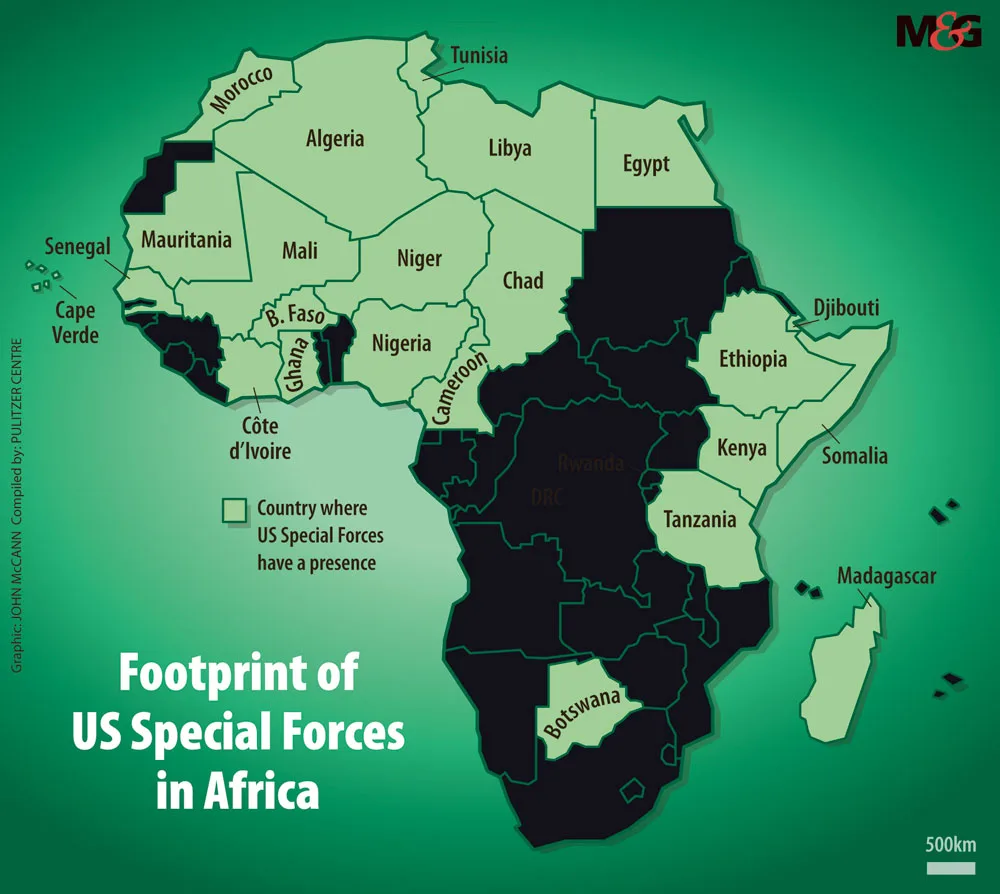
Footprint of US Special Forces in Africa. The Mail and Guardian

The United States has roughly 6,000 military personnel dispersed throughout the continent, with military attachés outnumbering diplomats in numerous embassies across Africa. The Intercept reported that the military operates 29 bases on the landmass. Among these are what The Hill calls “the largest U.S. Air Force-led construction project of all time.” The formation cost independently was over $100 million, with the operating costs expected to top $280 billion by 2024.

According to Washington the military’s fundamental role in the region is to suppress the rise of extremist troops, including Al-Shabaab, Boko Haram, and other al-Qaeda affiliated groups. But, much of the reason for their rise can be traced back to earlier American activities; these comprise the destabilization of Yemen, Somalia, and the overthrow of Colonel Gaddafi in Libya.

The United States also plays a pivotal role in educating and training the soldiers and security armies of many nations. The US pays Bancroft International, a private military contractor to train elite Somali units. According to The Mail and Guardian, these Somali fighters are also supported by the U.S. taxpayer.

The U.S. government also depleted decades in educating tens of thousands of military and police to employ effective “internal security” at the popular School of the Americas at Fort Benning, GA.

On surface, the idea of training foreign armed forces in basic tactics doesn’t seem fruitful. But such contractors come in handy when you’re planning a coup followed by an invasion to topple the current regime and replace it with a candidate of yours. Such a plot was recently uncovered in Venezuela.

Venezuelan intelligence crushed a secret plot to overthrow President Nicolás Maduro funded by US billionaires and organised by the former security chief of British billionaire Richard Branson, an ex-Green Beret running the private security firm Silvercorp USA, in Florida.

The U.S. military also occupies the island of Diego Garcia in the Indian Ocean, which was previously claimed by the island nation of Mauritius. During the 1960s and 1970s, the British government began expelling the entire local population and sent them in the slums in Mauritius. Surprisingly most of them still live there.

The United States utilizes the island as its own military base and a station for nuclear weapons. The island has always been important to US, it served as a place critical to American military activities during both Iraq Wars. The Americans also used this Naval base at Diego Garcia to spy on India’s Mission Shakti.

Diego Garcia is the key launchpad for western powers in case of an attack on Iran. In the wake of the assassination of Iranian General Qassem Soleimani in a drone strike, Pentagon sent six B-52 strategic bombers to military base on Diego Garcia that is beyond the range of Iran’s ballistic missiles to prepare to hit Tehran if given the order. In response, Iran has announced its intention to establish a permanent Naval Base in the Indian Ocean by March next year to counter Anglo-American base of Diego Garcia.

4/26/2020

Coronavirus pandemic may sow the seeds of political revolutions as lockdowns drag on and food supply chains are tested

A man is questioned by a South African National Defence Force patrol after his corner shop was found open in Eldorado Park on March 30. South Africa came under a nationwide lockdown on March 27, joining other African countries imposing strict curfews and shutdowns in an attempt to halt the spread of Covid-19. Photo: AFP

Source: SCMP
April 26 2020
By Daniel Wagner


  • The absence of critical health care coupled with food insecurity in highly indebted poor countries could set off social and political unrest
  • People from the developed world may find they suddenly have something fundamental in common with their developing world brethren – survival
Among the plethora of risks the global economy is experiencing as a result of Covid-19, the potential for rising social and political unrest is lurking just beneath the surface.

That has not been the subject of much public focus since the pandemic began, but as the virus spreads rapidly through more nations, civil disobedience and associated violence is becoming a greater concern.

Those most at risk in the near term are populations in the highly indebted poor countries, where a combination of food insecurity and ongoing fiscal strain make meeting basic needs a real challenge. Nearly all these countries are in Africa, where critical resources necessary to fight the virus are in extremely short supply.

Although not all of these countries publish data on the number of intensive care unit beds that exist, a 2015 study from the US National Library of Medicine noted that seven African countries each had 10 or fewer such beds. Of the 13 African countries addressed in the study, Tanzania had the highest number of ICU beds, at 50. Ethiopia, Kenya and Uganda each had about 30.

Similar statistics are undoubtedly true among most of the world’s poorest countries. Although global aid organisations will surely donate additional equipment to these countries as the virus progresses, the acute demand for ICU beds and personal protective equipment will surely outstrip supply by a wide margin.

To starve or get sick: Africa’s lockdown dilemma amid the coronavirus pandemic


Combining the absence of critical care capabilities with food insecurity could produce a combustible mix. The United Nations Food and Agricultural Organisation recorded significant spikes in the price of food in 2008 and 2011, which corresponded with rising political violence in countries throughout Africa and the Middle East.

Although food prices dropped globally by around 4 per cent in March, supply chains are being tested as the virus progresses, making future food supply uncertain.

The risk of famine had risen considerably in recent months as a plague of locusts has ravaged large parts of East Africa. Rice prices have risen for the past three months as some governments have begun stockpiling food and some disruption in food supplies has already occurred.

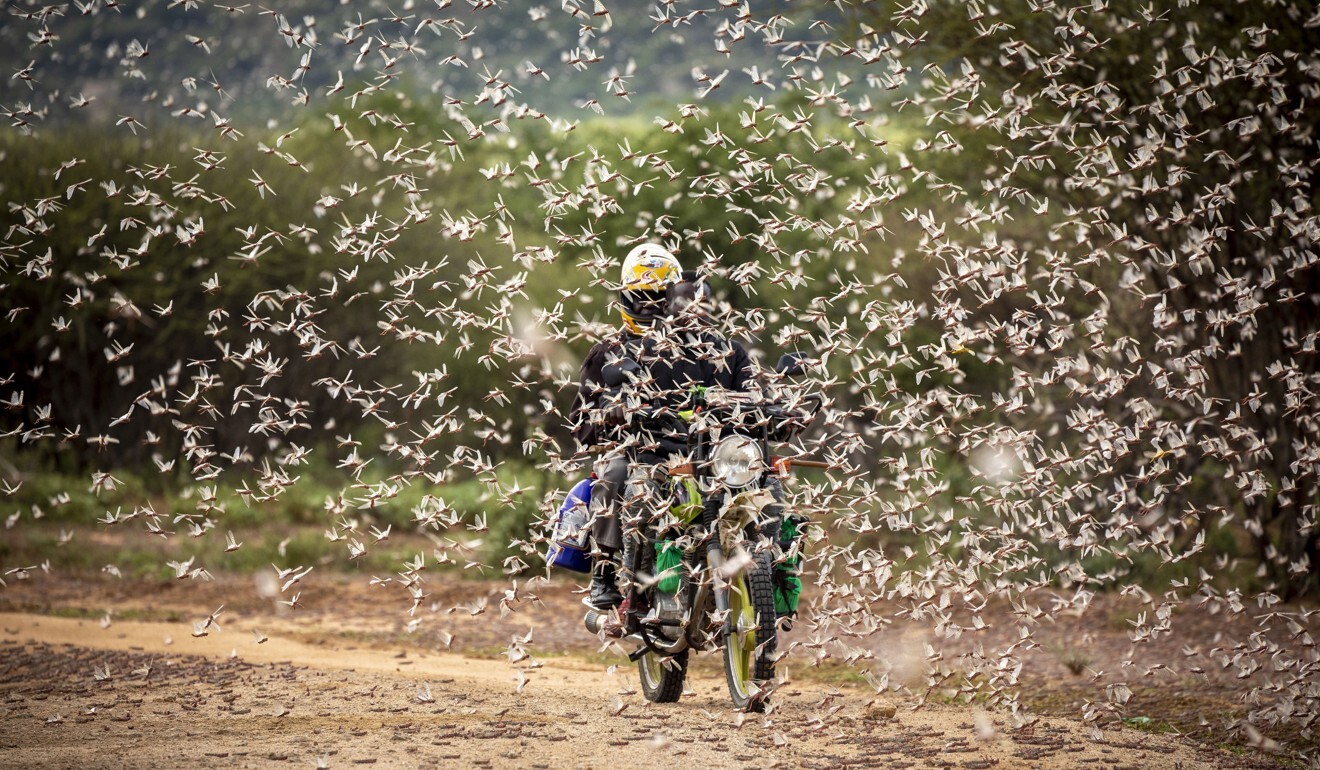
A motorcyclist rides through a swarm of desert locusts in Kipsing, Isiolo county, Kenya, on March 31. Weeks before the coronavirus spread through much of the world, parts of Africa were already threatened by another kind of plague, the biggest locust outbreak some countries had seen in 70 years, and now the second wave of the voracious insects, some 20 times the size of the first, has arrived. Photo: FAO via AP
Governments with limited financial resources will be forced to make some difficult choices as they devote more funds to national medical needs. In some cases, their ability to import food efficiently may become imperilled and food prices will eventually rise.

In the developed world, rationing and shortages have already occurred for some food and other high-demand items, such as toilet paper and cleaning products. In America, multiple meat processing plants have been closed because of large outbreaks of the virus. Ongoing outbreaks along the food supply chain have impacted the delivery and distribution of food.

It does not take too much imagination to envision a scenario where a significant portion of the population has run out of savings, local and state governments have run out of money, rents and mortgages are not being paid, food prices rise, and individuals desperate to meet their basic needs decide they have nothing to lose by rioting and looting.

Girls hold US flags as demonstrators gather to protest against coronavirus stay-at-home orders during a rally in Denver, Colorado, on April 19. Photo: AFP

That does not seem so far-fetched in America where, surprisingly, around 40 per cent of the population could not afford to pay off a US$400 emergency expense in cash before the arrival of Covid-19. As lengthy delays in securing unemployment benefits, small business loans and other forms of assistance endure, more people could become desperate.

That is surely at least part of the reason so many developed-nation governments around the world are incessantly printing money in an attempt to delay the day of reckoning. Clearly, that cannot continue indefinitely. Although it has been only three months since the virus began its march across the globe, it has taken little time to turn our collective world upside down.

Assuming, as many now do, that the new normal will last for months, or possibly years, in the absence of an effective treatment, the tipping point between when governments run out of
stopgap funding solutions and citizens begin to gravitate toward lawlessness en masse may appear sooner than we might like to think.

Extension of India’s nationwide coronavirus lockdown sparked chaos in Mumbai
Only in a few countries are stay-at-home orders mandatory and actually backed by police or military force. In many parts of the world, lockdown orders are entirely voluntary, and most of the world’s citizens have been willing to comply.

But as money and resources become more scarce, they endure more pressure, and find they have increasingly fewer options, many people may decide to stop complying and take desperate measures to keep a roof over their heads and food on the table.

If that time comes, people from the developed world may find they suddenly have something fundamental in common with their developing world brethren – survival. How will the world’s governments react? Would a crackdown result in forcing these populations back into their homes, or would it sow the seeds of future political revolutions?

As the rule book continues to be rewritten with each month that passes during this pandemic, anything is possible.

Daniel Wagner is CEO of Country Risk Solutions and author of the new book The America-China Divide


2/17/2013

Mali, Niger Unrest Highlights Need for Uranium Asset Diversification


Πηγή: Uranium Investing News
By Melissa Pistilli
Feb 14 2013

France’s military intervention in Mali, its former West African colony, highlights industrialized nations’ supreme need to secure access to economically strategic assets — in France’s case, uranium. That theme will increasingly be seen playing out on the world stage over the coming years.

Mali’s Kidal region, which is controlled by Islamist militants, borders the northwestern desert region of Niger, where France’s nuclear power giant AREVA (EPA:AREVA) has been mining uranium for more than half a century.

In light of current hostilities at its Arlit mine, which in 2010 was the site of a kidnapping that may have been backed by al-Qaeda, AREVA has said it’s strengthening its security measures at both its Arlit and Imouraren mining operations. The BBC recently reported that the security detail includes French special forces.

France’s deployment of special forces to protect AREVA’s uranium assets reveals that the nation’s priorities include ensuring access to a steady and reliable supply of uranium. France relies on nuclear power to generate about 75 percent of its electricity, and according to a parliamentary report, the western nation acquires about 18 percent of its nuclear fuel from Niger, the world’s fifth-largest uranium producer.

Mali isn’t the only problem neighbor bordering Niger. Islamist militants recently launched a bloody attack on a BP (NYSE:BP,LSE:BP) gas plant in Algeria, which borders Niger on the northwest, and to the northeast of the country is Libya, where Muammar Gaddafi’s death has left opposing groups vying for power.

Diversifying via joint ventures in lower-risk jurisdictions

Complicating problems for AREVA is the fact that Niger’s president, Mahamadou Issoufou, recentlysaid his government wants to renegotiate the terms of its uranium mining agreement with the France-based company. He stated that “it’s not acceptable” that Niger’s most valuable export only contributes about 5 percent to the nation’s annual budget. The country’s government is reportedlyasking for at least 20 percent of revenue from the industry.

President Issoufou also suggested that Niger is looking to “diversify [its] uranium mining partners,” hinting that China is a possible suitor. China Nuclear International Uranium is currently the largest shareholder in Societe des Mines d’Azelik, a company that produces uranium at Azelik, which is located 160 kilometers southwest of Arlit.

“This is resource nationalism, plain and simple,” Chris Berry, founder of House Mountain Partners and co-author of Morning Notes, told Uranium Investing News. Increased revenue for Niger may come in the form of more mining taxes, royalties or even a stake in AREVA; any of those options would lower returns for investors and discourage future investment, explained Berry.

Investment analysts are advising those with resource investments in Mali to get out while they can,according to a Canadian Press report. Certainly, investments in politically unstable mining jurisdictions carry huge risks that often are not worth the profit potential. For example, Khan Resources’ (CNSX:KRI) Dornod uranium property was expropriated by the Mongolian government several years ago, and, more recently, South American Silver’s (TSX:SAC) Malku Khota mine suffered the same fate at the hands of the Bolivian government.

Major companies like AREVA and Cameco (NYSE:CCJ,TSX:CCO) understand how important it is to mitigate such risks through geographically diversifying their assets. These companies are looking to replace mined pounds of uranium with deposits in stable, mining-friendly jurisdictions. Joint venture agreements are one strategy that majors use to diversify their risk profile while rebuilding their resource base, and that’s a strategy we’re sure to see more of as nations around the world continue to seek secure sources of nuclear fuel.

Both Cameco and AREVA have entered into a joint venture project with Purepoint Uranium Group (TSXV:PTU) at Hook Lake in the Athabasca Basin, and Cameco has an agreement with Uranium Resources (NASDAQ:URRE) in South Texas. Most recently, Aura Energy (ASX:AEE) signed a partnership agreement with AREVA for the Häggån project in Sweden.

Another example is AREVA’s involvement with early-stage developer European Uranium Resources (TSXV:EUU), which holds the Kuriskova deposit in Slovakia. AREVA is a major shareholder in the company and provides metallurgical expertise and technical assistance.

Uranium Investing News asked Berry, an advisor to and shareholder in European Uranium, what attracted him to the company’s story. “For all of the negative press the nuclear industry has received in Europe post-Fukushima, there are still about 160 operating reactors in Europe. Yet there is only one operating uranium mine in Europe,” said Berry, who is very much in the bull camp when it comes to uranium.

“Slovakia generates 50 percent of its electricity from nuclear power. The Slovakian government has publicly stated that it is in favor of nuclear power and is currently in the process of building additional reactors,” explained Berry. “European Uranium and the Slovakian government have signed a memorandum of understanding to help jointly develop the deposit, which has shown grades amongst the highest in the world, outside of the Athabasca Basin.”

North American resource companies offer favorable risk profiles

While Kazakhstan and Niger represent about 45 percent of annual global uranium production, Saskatchewan’s Athabasca Basin and Wyoming’s Powder River Basin, both of which are located in North America, offer the most favorable risk profiles for both major resource companies and resource investors eyeing new portfolio additions.

“Some of the best places for uranium mining right now are in the Athabasca Basin and the Western United States, particularly Wyoming. Uranerz Energy (TSX:URZ,AMEX:URZ) and Ur-Energy (TSX:URE,AMEX:URG) are two of my favorites for a number of reasons, but predominantly because of where they are located,” explained Berry. “We’re interested in finding those low-cost, near-term production stories in reliable geopolitical jurisdictions where you don’t need to worry about expropriation of assets.”

Companies in North America obviously have their own risks in terms of environmental permitting, which can draw out the time it takes to get a mine permitted and into production, but Berry believes they deserve a premium over companies operating in countries exposed to resource nationalism and political instability.

“Wyoming has a rich history of uranium mining and its state government is very friendly to uranium exploration and production.” Berry, like most of the analysts who’ve spoken with Uranium Investing News, believes Ur-Energy is worth a look by investors interested in this sector. “Ur-Energy has a great story. It’s in the right part of the world, led by fantastic management, looking at low-cost production and the project has the backing of Wyoming’s governor.”

Writing in Morning Notes at the dawn of the new year, Berry called the uranium sector one of his top picks for 2013. Uranium Investing News asked Berry about his long-term outlook for the uranium market. “I don’t see the spot price moving up quickly, but rather gradually, allowing for a longer-lived rally than we’ve seen in some markets, where the prices of resources have gone parabolic only to come crashing down. I’m much more comfortable with the gradual escalation in uranium spot prices.”


11/22/2012

The Secret War Between China and the US for Africa's Oil Riches


Πηγή: Oilprice
By Chris Mansur
Nov 20 2012

In the struggle to secure energy resources, the great powers consider all states to be fair game. Indeed, this is precisely what characterizes American foreign policy in the modern era. When it comes to economic and geopolitical interests, Washington seldom differentiates between democratic leaders and despots, especially when those interests involve oil. Currently, the stakes are high in the rush to secure oil resources and nowhere is this more evident than in the Sino-American rivalry in Africa. Both states are competing to secure their share of oil supplies in order to quench their addiction to the coveted ‘black gold.’

One of Washington’s primary energy security concerns has been to diversify its sources of foreign oil. During the 1970s oil crisis, the United States imported one-third of its petroleum. Now, it imports approximately 11.4 million barrels per day of petroleum (which includes crude oil and petroleum products), amounting to 45 percent of all petroleum consumed in America [1]. While most of its foreign oil comes from the western hemisphere, a sizable portion comes from Africa and the Persian Gulf [2]. Despite the fact that America’s reliance on foreign oil has decreased since its peak in 2005, it is still vulnerable to supply disruptions, oil price shocks and OPEC supply squeezing. For Washington, the need to decrease its vulnerability to foreign oil is a principle national security interest, and the solution lies in diversifying imports away from overreliance on any one region.

West African oil remains strategically important for U.S. policy makers, especially since it provides an alternative to Persian Gulf oil. West Africa is also geographically closer, making transportation less costly than oil from the Persian Gulf. The high-quality sweet crude that is produced by the Gulf of Guinea states is crucial to the U.S. market. As such, oil corporations are doing whatever they can to secure this important hydrocarbon and Washington is fervently promoting free trade in Africa in order to make it easier for them.

Sub-Saharan Africa is home to two of the largest oil-producing states: Nigeria and Angola. These two states account for 53 percent and 26 percent of total U.S. petroleum imports from Sub-Saharan Africa respectively [3]. Thus, it is no surprise that the two states also receive the largest share of U.S. security assistance to Africa.

In order to boost its influence in Africa and secure the loyalty of governments, the U.S. has provided military arms and developed military training programs with individual African governments. To increase its military presence, it has acquired basing rights and access to airfields in Djibouti, Uganda, Mali, Senegal and Gabon, along with port facilities in Morocco and Tunisia. In addition, it has also expanded its covert intelligence operations across Africa in the name of combatting terrorism [4]. Yet, these operations also serve another purpose. By expanding its military presence in Africa, Washington is reminding its rivals that it is both willing and able to respond to threats to its strategic interests, the likes of which include the unimpeded flow of African oil.

In 2007, the U.S. African Command (AFRICOM) was established as the ninth of the Unified Combatant Commands under the supervision of the U.S. Department of Defence (DoD). The alleged purpose is to oversee American military operations on the African continent in order to enhance the stability of the region and to promote U.S. national security objectives. Many critics of AFRICOM, including energy security expert Michael T. Klare, believe there is a direct relationship between the existence of AFRICOM and America’s interest in African oil [5].

There is a parallel between America’s increased military presence in Africa and its military expansion into the Persian Gulf since the establishment of the Carter Doctrine. While this endeavour is noticeably more limited in Africa and does not involve any significant oil-for-security arrangements- at least, not yet- there is no doubt that America would respond with force if oil supplies were threatened. The difference is in style, not substance; America seeks a more subtle presence in order to engage in rapid combat and covert operations, when necessary. This operational capacity is equal parts the U.S. bending to the strategic realities of the 21stcentury and a response to African governments, for obvious historical reasons, not welcoming permanent military bases on their soil.

There may be another, often overlooked, purpose of AFRICOM. The presence of China in Africa is creating some concern for American officials. Beijing is competing with Washington for both the loyalty of African governments and the steady supply of African oil. There is a growing sentiment in Washington that China’s presence in Africa could challenge U.S. security interests now and in the years to come. China’s unconditional financial aid and its steady flow of cheap goods to African states (in exchange for oil contracts) have often made it a more appealing trading partner than America. Indeed, a 2005 DoD report indicated that China’s need to forge close ties with African governments to secure energy supplies could lead to ‘a more activist [Chinese] military presence abroad’ [6]. In this regard, AFRICOM would monitor Chinese activity and contain any Chinese incursion into American zones of interest by flexing America’s naval presence.

The stakes for Beijing, however, seem to be greater for three reasons. First, China has an annual GDP growth rate of 7.4 percent. To sustain this, the Chinese economy relies heavily on the consumption of oil. It is constantly seeking new sources of oil to meet its domestic demand, but its African oil supplies are indispensable. Second, China imports more from oil from Africa than America does (30 percent vs. 20 percent) [7]. China’s oil imports from Africa will likely grow to be bigger than America’s in the decades to come, and China is expected to take America’s spot as the world’s biggest oil importer very soon. By 2020, China will import approximately 65 percent of its oil [8]. Lastly, China is not a newcomer to Africa. In the 1960s and 1970s, it supported many national liberation movements, provided a large share of arms to post-independence governments and invested heavily in national infrastructure projects [9]. In this sense, Beijing perceives its presence in Africa as a continuation of its legacy and as an important geopolitical interest on the road to major power status.

However, Africa might not provide the most secure alternative to Persian Gulf oil. Africa’s production capacity is more limited than that of the Persian Gulf, and it also has fewer proven reserves. In terms of aggregate global oil production, Africa is still lagging behind other major crude oil-producing regions [10]. If we assume that ‘peak oil’ estimates are accurate, then (according to BP’s reserves-to-production ratio) Sub-Saharan Africa, as a whole, has an oil-producing capacity that will end by 2030. This would leave only Nigeria and Sudan as major oil-producing states in the region (of course, this assumes that production will remain constant and that no new reserves will be discovered) [11].

In addition, Africa’s political environment can be as unstable as the Persian Gulf. Internal instability, the rise of transnational terrorist networks, military coups, civil strife, endemic corruption and the conflict-stricken Niger Delta all pose significant problems for business operations in the African continent.

America must show restraint in its expansion into Africa. While a military conflict with China over access to African oil may seem presently unrealistic- especially given America and China’s mutual economic dependence- future regional developments and the further militarization of the region could shift the Sino-American rivalry into a more adversarial direction [12]. The ‘military security paradox’ is an important lesson to be learned by the great powers. Militarizing a region in the pursuit of regional stability and security can often have the opposite effect. Only time will tell if Washington and Beijing heed this warning.

References

[1] http://www.eia.gov/tools/faqs/faq.cfm?id=727&t=6

[2] http://www.eia.gov/energy_in_brief/foreign_oil_dependence.cfm

[3] http://www.nationalaglawcenter.org/assets/crs/RL31772.pdf (p. 8)

[4] http://www.washingtonpost.com/world/national-security/us-expands-secret-intelligence-operations-in-africa/2012/06/13/gJQAHyvAbV_story.html

[5] http://www.tomdispatch.com/post/174943

[6] http://www.defense.gov/news/jul2005/d20050719china.pdf (p. 10).

[7] http://www.cfr.org/china/expanding-china-africa-oil-ties/p9557

[8] http://www.china-briefing.com/news/2011/04/13/the-geopolitics-of-china-african-oil.html

[9] Klare, Michael and Daniel Volman. “America, China, and the Scramble for Africa’s Oil.” Review of African Political Economy. No. 108 (2006): 297-309.

[10] http://www.eia.gov/todayinenergy/detail.cfm?id=4710

[11] Yates, Douglas. The Scramble for African Oil: Oppression, Corruption and War for Control of Africa’s Natural Resources (New York: Pluto Press, 2012), 21.

[12] Klare, 307.

(Chris Mansur is a contributor to Geopolitical Monitor.

Geopoliticalmonitor.com is a Canadian intelligence publication and consultancy. Our team of experts provide a unique Canadian perspective on situations and events that have a substantive impact on political and economic affairs both domestically and abroad.

Based in Toronto, Canada, Geopoliticalmonitor.com offers members an original, timely and comprehensive analysis on nations of international significance to Canadian and international readers).


10/18/2012

Liberia: Report Reveals Why Ellen Wants Africom in Liberia


Πηγή: All Africa
Oct 11 2012

Report gathered by this paper has revealed that Liberian President Ellen Johnson-Sirleaf's interest in hosting in Liberia a base for the United States Africa Command (AFRICOM) appears to have had more to do with protecting the George Soros and Rothschild mining operations in West Africa than in championing stability and human rights.

George Soros is a Hungarian-American business magnate, investor, philosopher and philanthropist. The 82- year-old is the chairman of Soros Fund Management, and also the chairman of the Open Society Institute.

HE IS THE NEW YORK HEDGE FUND MANAGER AND ONE OF THE MOS

Since the mid-1980s in particular, he has used his immense influence to help reconfigure the political landscapes of several countries around the world--in some cases playing a key role in toppling regimes that had held the reins of government for years, even decades. Vis à vis the United States, a strong case can be made for the claim that Soros today affects American politics and culture more profoundly than any other living person.

The report, which was published online nearly a year now, indicates that for the sole purpose of protecting the George Soros and Rothschild mining operations in West Africa, President Johnson-Sirleaf and her friend Leymah Gbowee received two Nobel gold medals to help the Rothschild/Soros team control all the gold metal," adding, "A little gold for all the gold."

The report divulges that: "As with so many international constructs that started out with good intentions, the Norwegian Nobel Committee, like the International Olympic Committee, has become contrivances for global corporations," adding that: "It is now clear that the decision by the Nobel committee to award the Nobel Peace Prize to two Liberian women, along with a female Yemeni human rights campaigner, was to engage in a bit of influence-peddling in mineral resource-rich West Africa while also attempting to recognize the "Arab Spring" democracy movement."

The report avers that, While the awarding of the Nobel Peace Prize to Yemeni human rights activist seems appropriate, considering the work she has done to oust Yemen's brutal dictator Ali Abdullah Saleh from power, the awarding of the Peace Prize gold medals to Liberian President Johnson-Sirleaf and Liberian human rights activist Leymah Gbowee, just before the Liberian presidential election in 2011, appears to be a blatant act of trying to influence the outcome of the election and rewarding the Liberian leader for her support for the U.S. Africa Command (AFRICOM).

"In addition to being Africa's first elected female head of state, the report adds, "Sirleaf also has the distinction of being the only African head of state to offer AFRICOM a base of operations and headquarters in Africa - Liberia."

According to the report, "Sirleaf's invitation to AFRICOM was unsettling to many Liberians who are cognizant of Liberia's past as a colony founded by freed slaves from the United States and run for decades by a series of American-Liberian dictators who acted as virtual proxies for Washington and the Firestone Rubber Corporation."

The report maintains that President Johnson-Sirleaf was implicated in supporting Liberia's brutal dictator, Charles Taylor, in a report issued in 2009 by the Liberian Truth and Reconciliation Commission (TRC), but she rejected the TRC report and also reneged on her promise to serve only one term as president.

Winston Tubman, the nephew of Liberia's long-serving President William Tubman and who ran against then candidate Johnson-Sirleaf, the report indicates, "questioned the timing of the Nobel Committee's awarding of the peace prize to his opponent, only a few days before the October 11 election," adding that "It is also noteworthy that after the announcement of this year's Nobel awards, Gbowee, the other Liberian peace prize awardee, endorsed Sirleaf's re-election."

"Sirleaf, a Harvard graduate, has long been a darling of George Soros's "human rights" and "civil society" contrivances, including the Open Society Institute and Foundation," says the report. The report states that: "On September 9, 2008, WMR reported: "Soros is a close friend of Liberian President Ellen Johnson Sirleaf, a former Vice President of Equator Bank in Washington, DC. Equator was later bought by HSBC, which, not surprisingly is a financial partner of Soros."

"Soros has much more of an interest in Liberia and surrounding countries -- including Ivory Coast, which saw French troops fight troops loyal to ousted president Laurent Gbagbo to install a Rothschild/Soros-run World Bank veteran, Alassane Ouattara and his French Zionist wife, into power -- than promoting "civil society," the report adds.

The report unveils that: "Liberia is a nexus for gold mining and Soros's senior partner, Nathaniel Rothschild, is, according to WMR's sources, buying up all the world's gold mines in anticipation of the collapse of several world currencies, including the euro and the dollar."

"Rothschild and Soros, through Rothschild-controlled Newmont Mining Corporation, along with other Rothschild-controlled companies like Vallar and Glencore, are currently moving in to buy up gold mining companies and mining operations in Indonesia, Papua New Guinea, the United States, Peru, Ghana, Guinea, Canada, Namibia, Kyrgyzstan, Russia, Ivory Coast, Mexico, Sierra Leone, and Liberia," the report among others stated.

When the 2nd Vice Presidential Press Secretary of President Johnson-Sirleaf, Mr. Christopher Sele was Monday 8 October 2012 contacted via cell phone for the Liberian leader's reaction to the report, an unidentified individual believed to be a staff member of the office of the Presidential Press Secretary, answered the call and stated that he [Mr. Sele] was upstairs, but promised that Mr. Sele would immediately return the call. However, neither did the unidentified staff nor Mr. Sele return the call up to press time.


9/23/2012

Russia ‘Ready’ to Export Su-30 Fighters to Africa


Πηγή: RIANOVOSTI
Sept 22 2012

Russia is ready to sell Su-30s and other modern fighter jets to African countries, state-controlled arms exporter Rosoboronexport said on Saturday.

Click on image to enlarge
Delivery contracts with countries such as Uganda, Angola, Ethiopia and others should include personnel training programs and after-sales servicing, Rosoboronexport’s deputy chief Alexander Mikheyev said.

This year Russia has delivered six Su-30MK2 multirole fighters to Uganda and is currently in talks to diversify cooperation, he added.

Mikheyev said on Friday Uganda expressed interest in buying another six aircraft of that type.

Rosoboronexport has also signed a contract to sell six Mi-17 helicopters to Ghana, he said.


8/17/2012

America's 'shadow wars' in Africa


Πηγή: Defence Management
By Peter Feuilherade
August 15 2012

Peter Feuilherade sheds light on the Pentagon's ongoing operations in Africa and the continent's growing strategic importance to US interests…

America's new and still evolving defence strategy is strongly focused on Asia-Pacific and the Middle East, as well as heralding a new phase of restraint in military spending. Over the next 10 years, the Pentagon faces budget cuts of $487bn.

On his first visit to Japan as Pentagon Chief in October 2011, US Defense Secretary Leon Panetta stated that America would remain a global economic and military power despite the cuts, and that the Asia-Pacific region would be central to the US national security strategy. Washington's shift in focus towards Asia is in response to China's growing military power.

But the expanding US military presence in Africa suggests that Washington is also increasingly concerned about the expansion of transnational terrorism into the sub-Saharan region of the continent.

US forces or advisers are active in the Horn of Africa, and East and Central Africa, while in at least 10 countries in the Maghreb, the Sahel and West Africa US personnel are providing counterterrorism training and building up national armies.

Africom

Countering extremists is the top military priority for the continent, says General Carter Ham, Commander of the US Africa Command (Africom). Africom's mission, its website notes, is to 'protect and defend the national security interests of the United States by strengthening the defense capabilities of African states and regional organizations and, when directed, conduct military operations, in order to deter and defeat transnational threats and to provide a security environment conducive to good governance and development'.

Responsible for US military relations with 54 African countries, Africom's operational launch took place in 2008. With President George W Bush facing almost unanimous opposition from African leaders to hosting the command on the continent, its HQ was located in Stuttgart, Germany instead. Africom typically has fewer than 5,000 troops in Africa at any time.

Drones

The US media spotlight turned briefly to Africa in 2011 when the US sent 100 military advisers, mostly Army Special Forces, to help soldiers from four Central African countries – Uganda, Congo, South Sudan and the Central African Republic – fight the rebel Lord's Resistance Army and capture its leader Joseph Kony. But for several years, the US Air Force has been flying drones over Northeast Africa and Yemen from bases in Djibouti and more recently southern Ethiopia and the Seychelles.

In combating the Somalia-based Islamic insurgent group al-Shabaab, only a handful of US troops are involved directly, usually special forces who enter the country on clandestine missions to kill militant targets. However, America has funded 9,000 African Union troops from Uganda and Burundi, and provided background support to invading Kenyan and Ethiopian troops, all involved in military operations against al-Shabaab.

In March 2012, General Ham told the US House of Representatives Armed Services Committee that al-Qaeda affiliates in East and Northwest Africa posed the greatest security threat to the US. Noting that al-Qaeda and al-Shabaab (which has recruited and trained dozens of American citizens) had publicly formalised their longstanding merger, he described the stated intention of the leaders of these extremist groups to work more closely together as "his greatest concern".

Unholy trinity

On the other side of the continent, the US is conducting counterterrorism training and equipping armies in Algeria, Burkina Faso, Chad, Mali, Mauritania, Morocco, Niger, Nigeria, Senegal and Tunisia. US involvement could escalate if events confirm reports that some members of al-Qaeda's core leadership have moved to North Africa from Pakistan after suffering heavy losses in US drone attacks there.

US officials say there are 'clear indications' that al-Qaeda in the Islamic Maghreb (AQIM) is involved in trafficking arms from Libya, and that the upheavals in Libya and Tunisia have created opportunities for AQIM to establish new 'safe havens'. The US, along with several European countries, is concerned that AQIM and Boko Haram, the militant group from northern Nigeria formed in the 1990s, together with al-Shabaab, are "attempting to share training and to collaborate in other ways in pursuit of their goal of attacking the US and other foreign targets", according to a September 2011 speech by General Ham. Some analysts dismiss such an alliance as unlikely, given the cultural and ethnic differences that separate the three groups.

Both AQIM and separatist Tuareg insurgents in northern Mali opposed to the Malian government received sophisticated weapons from Libya in 2011, allowing Tuareg rebels to resume armed operations inside Mali in January 2012.

In March, a group of Malian junior officers, angered by the lack of government support to help the army fight the rebels, seized control in a coup, before agreeing to the return of civilian rule in mid-April. At the time of writing, rebel groups remained in control of northern Mali, their ranks reportedly swelled by foreign Islamist militants. The whole country was also mired in a regional humanitarian crisis, with over 1.4 million Malians in need of emergency food assistance, according to EU estimates.

The New York Times recently described Mali as 'an impoverished desert nation' and, 'an important American ally against the regional al-Qaeda franchise'. Mounting insecurity there, and fears that destabilisation could spread to Niger and elsewhere in the Sahel region, suggest that the American military mission in Mali is likely to have its work cut out combating regional terrorism.

The US will share similar concerns to France, which has warned that the seizure of northern Mali by Tuareg separatists, in a loose alliance with Islamic militants, could turn the region into an AQIM stronghold.

Oil rush

US military operations in Africa face a range of difficulties, including a lack of bases and international agreements on flight paths, limited communications and the reluctance of many African countries to have any significant US force within their borders. One option for the US is increasing the use of sea-based intelligence, surveillance and reconnaissance.

As the Pentagon cuts back on traditional military operations in the post-Iraq and Afghan war era, and after defence budget cuts kick in, it will rely increasingly on smaller elite units to carry out targeted operations. US special operations forces (SOF) will expand to maintain a continuous presence around the globe. SOF will 'begin to return to its roots as expert trainers of counterterrorism forces in other countries', with a large portion of the worldwide SOF presence focusing on Africa and the Pacific, according to Pentagon officials.

However, public opinion and legislators in the US are concerned about the costs of military forays into Africa at a time of budget cuts, while the deployment of advisers has prompted comparisons with the escalation of US involvement in South Vietnam in the 1960s.

In Africa too, the growing US presence is regarded with some suspicion. "After the Libyan case of 2011 (the imposition of the no-fly zone) some African leaders, intellectuals and policymakers are advocating change in the way international organisations or individual states intervene in African political crises. Some issues that make Africans suspicious about US involvement include the increased deployments of special forces, trainers and military contractors by the Pentagon, and the political objectives behind some of the interventions," Dr Petrus De Kock, Senior Researcher at the South African Institute of International Affairs, told DMJ.
America's critics, meanwhile, see Africa becoming a battleground where the US and its European allies jostle for access to the continent's strategic oil and mineral resources with China, which has been striking commercial deals with governments across Africa for decades.

The last few years have seen significant new oil and natural gas discoveries reported across East Africa, from the Horn of Africa in the northeast, down to Tanzania and Mozambique in the south, and inland in Uganda and the Democratic Republic of Congo around Lake Albert.

As General Ham stated in March 2012: "With six of the world's fastest growing economies in the past decade, combined with democratic gains made in a number of African nations in 2011, Africa's strategic importance to the United States will continue to grow."

For all parties involved, the stakes are high and rising.

Peter Feuilherade, a former BBC World Service Journalist, is a UK-based writer specialising in Middle East affairs.


7/22/2012

U.S. Drug War Expands to Africa, a Newer Hub for Cartels

William R. Brownfield of the State Department is a leading architect of new antidrug strategies. 

Πηγή: New York TImes
By CHARLIE SAVAGE and THOM SHANKER
July 21 2012

WASHINGTON — In a significant expansion of the war on drugs, the United States has begun training an elite unit of counternarcotics police in Ghana and planning similar units in Nigeria and Kenya as part of an effort to combat the Latin American cartels that are increasingly using Africa to smuggle cocaine into Europe.

The growing American involvement in Africa follows an earlier escalation of antidrug efforts in Central America, according to documents, Congressional testimony and interviews with a range of officials at the State Department, the Drug Enforcement Administration and the Pentagon.

In both regions, American officials are responding to fears that crackdowns in more direct staging points for smuggling — like Mexico and Spain — have prompted traffickers to move into smaller and weakly governed states, further corrupting and destabilizing them.

The aggressive response by the United States is also a sign of how greater attention and resources have turned to efforts to fight drugs as the wars in Iraq and Afghanistan have wound down.

“We see Africa as the new frontier in terms of counterterrorism and counternarcotics issues,” said Jeffrey P. Breeden, the chief of the D.E.A.’s Europe, Asia and Africa section. “It’s a place that we need to get ahead of — we’re already behind the curve in some ways, and we need to catch up.”

The initiatives come amid a surge in successful interdictions in Honduras since May — but also as American officials have been forced to defend their new tactics after a commando-style team of D.E.A. agents participated in at least three lethal interdiction operations alongside a squad of Honduran police officers. In one of those operations, in May, the Honduran police killed four people near the village of Ahuas, and in two others in the past month American agents have shot and killed smuggling suspects.

To date, officials say, the D.E.A. commando team has not been deployed to work with the newly created elite police squads in Africa, where the effort to counter the drug traffickers is said to be about three years behind the one in Central America.

The officials said that if Western security forces did come to play a more direct operational role in Africa, for historical reasons they might be European and not American.

In May, William R. Brownfield, the assistant secretary of state for international narcotics and law enforcement, a leading architect of the strategy now on display in Honduras, traveled to Ghana and Liberia to put the finishing touches on a West Africa Cooperative Security Initiative, which will try to replicate across 15 nations the steps taken in battling trafficking groups operating in Central America and Mexico.

Mr. Brownfield said the vision for both regions was to improve the ability of nations to deal with drug trafficking, by building up their own institutions and getting them to cooperate with one another, sharing intelligence and running regional law enforcement training centers.

But because drug traffickers have already moved into Africa, he said, there is also a need for the immediate elite police units that have been trained and vetted.

“We have to be doing operational stuff right now because things are actually happening right now,” Mr. Brownfield said.

Some specialists have expressed skepticism about the approach. Bruce Bagley, a professor at the University of Miami who focuses on Latin America and counternarcotics, said that what had happened in West Africa over the past few years was the latest example of the “Whac-A-Mole” problem, in which making trafficking more difficult in one place simply shifts it to another.

“As they put on the pressure, they are going to detour routes, but they are not going to stop the flow, because the institutions are incredibly weak — I don’t care how much vetting they do,” Professor Bagley said. “And there is always blowback to this. You start killing people in foreign countries — whether criminals or not — and there is going to be fallout.”

American government officials acknowledge the challenges, but they are not as pessimistic about the chances of at least pushing the trafficking organizations out of particular countries. And even if the intervention leads to an increase in violence as organizations that had operated with impunity are challenged, the alternative, they said, is worse.

“There is no such thing as a country that is simply a transit country, for the very simple reason that the drug trafficking organization first pays its network in product, not in cash, and is constantly looking to build a greater market,” Mr. Brownfield said. “Regardless of the name of the country, eventually the transit country becomes a major consumer nation, and at that point they have a more serious problem.”

The United Nations says that cocaine smuggling and consumption in West Africa have soared in recent years, contributing to instability in places like Guinea-Bissau. Several years ago, a South American drug gang tried to bribe the son of the Liberian president to allow it to use the country for smuggling. Instead, he cooperated with the D.E.A., and the case resulted in convictions in the United States.

Even more ominous, according to American officials, was a case in which a militant group called Al Qaeda in the Islamic Maghreb offered three of its operatives to help ship tons of cocaine through North Africa into Europe — all to raise money to finance terrorist attacks. The case ended this past March with conviction and sentencing in federal court in New York.

American counternarcotics assistance for West Africa has totaled about $50 million for each of the past two years — up from just $7.5 million in 2009, according to the State Department. The D.E.A. also is opening its first country office in Senegal, officials said, and the Pentagon has worked with Cape Verde to establish a regional center to detect drug-smuggling ships.

While the agency has not sponsored units in West Africa before, it has long worked with similar teams — which are given training, equipment and pay while being subjected to rigorous drug and polygraph testing — in countries around the world whose security forces are plagued by corruption, including the Dominican Republic, El Salvador, Guatemala and Panama.

It is routine for D.E.A. agents who are assigned to mentor the specially trained and screened units to accompany them on raids, but it has been unusual for Americans to kill suspects. Several former agents said the recent cases in Honduras suggested that the D.E.A. had been at the vanguard of the operations there rather than merely serving as advisers in the background.

By contrast, the effort in West Africa is still at the beginning stages, officials say. But the problems there are the same — and growing. Officials described one instance in which a methamphetamine lab was discovered in Africa, with documents suggesting that it had been set up by a Mexican trafficking organization. William F. Wechsler, the Pentagon’s top counternarcotics officer, said that observing drug traffickers’ advances into West Africa, and the response from American and local authorities, was like watching a rerun of the drug war in this hemisphere in years past.

“West Africa is now facing a situation analogous to the Caribbean in the 1980s, where small, developing, vulnerable countries along major drug-trafficking routes toward rich consumers are vastly under-resourced to deal with the wave of dirty money coming their way,” he said.


6/14/2012

US expanding secret spy bases in Africa: report


Πηγή: Deccan Herald
June 14 2012

The US is expanding a secret network of air bases across Africa in order to spy on Al-Qaeda and other militant groups.

The surveillance is carried out by small, unmarked turboprop planes with hidden state-of-the-art sensors that fly thousands of miles between air bases and bush landing strips across the vast continent, the Washington Post reported.

The surveillance programme started in 2007, the paper said and underscores the massive expansion of US special forces operations in recent years and the steady militarisation of intelligence operations during the decade-long war on Al-Qaeda.

Bases in Burkina Faso and Mauritania are used to spy on Al-Qaeda in the Islamic Maghreb (AQIM), while bases in Uganda are used in the hunt for the Lord's Resistance Army, a brutal guerrilla movement led by Joseph Kony, who is wanted for war crimes by the International Criminal Court.

The Post said there were plans to open another base in South Sudan to help hunt for Kony, who is wanted in connection with a series of atrocities and operates in some of the most remote and inaccessible parts of central Africa.


In East Africa, US aircraft operating out of Djibouti, Ethiopia, Kenya and the Seychelles archipelago spy on Somalia's Qaeda-inspired Al-Shebab militia and have reportedly launched attacks on wanted militants.


The Post said the fleet of surveillance planes is made up of single-engine Pilatus PC-12s, small passenger and cargo planes manufactured in Switzerland.
The newspaper said one of the secret bases is in a secluded hanger in Ouagadougou, capital of the predominantly Muslim country of Burkina Faso in West Africa.

Burkina Faso's Foreign Minister Djibril Bassole, in an interview with the Post, declined to answer questions about US special forces operations in his country but said he appreciates US security cooperation.

"We need to fight and protect our borders," the Post quoted him as saying. "Once they infiltrate your country, it's very, very difficult to get them out," he said, referring to Al-Qaeda.


3/12/2012

WWF proposes China-Africa cooperation for green economy

Rice cultivating, Dongting Lake, Hunan Province, China

Πηγή: WWF
March 9 2012

Beijing – Africa and China can work together towards the common goal of sustainable development, says WWF, the global conservation organization.

The upcoming China-Africa Ministerial Conference, in July 2012, presents a key opportunity to make China’s trade and capital flows a driving force for global footprint reduction and green growth in Africa a possible future. Ahead of the Conference, WWF puts forward proposals to interject environmental and social considerations in the ever growing and expanding China-Africa relationship.

“In recent years China’s outward investments have grown at a fast pace particularly in Africa and the trend continues,” said Dr. Li Lin, Deputy Country Representative at WWF China. “Investing in sustainability is fundamental for both Africa and China’s long-term prosperity. It is in both China’s and Africa’s interests that high environmental standards are part of the aid, trade and investment portfolio of China in Africa, positively influencing China’s footprint in the continent.”

WWF’s proposals target three major sectors: financial cooperation, extraction of natural resources and clean energy.

A commitment to fully implement the green lending guidelines recently issued by the China Banking Regulatory Commission for loans and investments would significantly reduce risks while at the same time bring benefits to the environment and local economies. WWF encourages organisation of specific trainings on the guidelines for branches of Chinese banks in Africa to help ensuring that environmental and social risks often associated with infrastructure and extractive projects are properly assessed and mitigated.

With regard to extraction of natural resources, WWF encourages development of guidelines – including “no-go zones” – for companies in environmentally sensitive sectors such as mining. The forestry guidelines issued in 2009 by China’s Ministry of Commerce and the State Forestry Administration for Chinese companies operating overseas in this sector are a stepping-stone towards international certification.

WWF believes that Africa will not reach its full development potential without clean, affordable and reliable energy services. China has the potential to share its experience of providing renewable energy to rural communities (such as clean energy cook stoves), helping Africa gain access to clean energy sources for millions of people while improving health and reducing deforestation related to use of charcoal.

“While capitalising on growth opportunities, it is necessary to build economies that manage natural capital wisely to ensure security and stability, and to protect unique ecosystems such as the Congo Basin and the coast of East Africa upon which millions people depend for their livelihood,” said Laurent Somé, Director of External Relations and Partnerships at the WWF Africa Programme.

The 5th Ministerial Conference of the Forum on China-Africa Cooperation (FOCAC), the most important platform for Sino-African relations, will take place in Beijing in July 2012. At the event, China and 49 African countries will define principles and commitments for Chinese investments and cooperation with Africa in the coming three years.


2/23/2012

US troops now in 4 African countries


Πηγή: IOLnews

By Jason Straziuso
Feb 23 2012

Nairobi - US troops helping in the fight against a brutal rebel group called the Lord's Resistance Army are now deployed in four Central African countries, the top US special operations commander for Africa said Wednesday.

The US announced in October it was sending about 100 US troops - mostly special operations forces - to Central Africa to advise in the fight against the LRA and its leader Joseph Kony, a bush fighter wanted by the International Criminal Court for crimes against humanity.

Rear Adm. Brian L. Losey, the top US special operations commander for Africa, said the US troops are now stationed in bases in Uganda, Congo, South Sudan and Central African Republic.

“We've already seen a decrease in the lethality of LRA activities, which we think is attributable in part to the pressure we and our partners are applying,” Losey said in a telephone briefing to journalists.

Losey said counter-LRA actions will increase in frequency and effectiveness in coming months.

The LRA began its attacks in Uganda in the 1980s, when Kony sought to overthrow the government. Since being pushed out of Uganda several years ago, the militia has terrorized villages in Central Africa.

A top State Department official, Karl Wycoff, said that Kony has shown the ability to mobilize combatants and militant leaders to carry out “horrible atrocities” for the LRA, which he called “some kind of cult,” given that the group has no clear agenda. He said the US effort was not just aimed at Kony but at all the LRA leaders.

However, Col. Felix Kulayigye, the spokesman for Uganda's military, said the hunt for Kony was an important aspect of the anti-LRA effort.

“Kony is the LRA and the LRA is Kony,” he said. “Other than Kony the only other person who had the capacity to sustain the LRA was (Vincent) Otti, who is gone. You get Kony and you have the LRA done.”

Otti, Kony's former deputy, has been presumed dead since the failure of peace talks mediated by South Sudan ended in 2008. Ugandan army officials say Kony ordered his death, fearing he was about to defect.

The LRA's tactics have been widely condemned as vicious. The US troops are helping to fight a group that has slaughtered thousands of civilians and routinely kidnaps children to be child soldiers and sex slaves.

The anti-LRA group Resolve in a report released Wednesday urged the US to encourage Uganda to dedicate more troops and helicopters to their counter-LRA operations. The group also urged the US to fund more transport helicopters and improved communications equipment for Ugandan troops, and to increase intelligence gathering by expanding the use of aerial surveillance.

Losey said there are no drone aircraft currently being used by US troops involved in the counter-LRA fight. US forces are working on improving communications in the region and how to integrate intelligence.

Many of the US forces are stationed in Uganda. Others are based in Obo, Central African Republic; Dungu, Congo; and in Nzara, South Sudan, Losey said. Each of those locations had established bases where troops from partner countries have been based.

The LRA operates in an area the size of California, Losey said.


10/20/2011

The US power grab in Africa


Πηγή: Asia Times
By Pepe Escobar
Oct 20 2011

Beware of strangers bearing gifts. Post-modern Amazon and United States Secretary of State Hillary Clinton finally landed in Tripoli - on a military jet - to lavish praise on the dodgy Transitional National Council (TNC), those pportunists/defectors/Islamists formerly known as "North Atlantic Treaty Organization rebels".

Clinton was greeted on Tuesday "on the soil of free Libya" (her words) by what the New York Times quaintly described as an "irregular militia" (translation: a heavily armed gang that is already raising hell against other heavily armed gangs), before meeting TNC chairman Mustafa Abdel-NATO (formerly known as Jalil).

The bulk of the US gifts - US$40 million - on top of the $135 million already disbursed since February (most of it military "aid") is for a missile scramble conducted by "contractors" (ie mercenaries) trying to track the tsunami of mobile anti-aircraft rockets that by now are already conveniently ensconced in secret Islamist warehouses.

Clinton told students at the University of Tripoli, "We are on your side." She could not possibly connect the dots and note that theshabab (young people) who started demonstrating against Muammar Gaddafi in February have absolutely nothing to do with the TNC's opportunists/defectors/Islamists who hijacked the protests. But she did have time to unveil another US foreign policy "secret" - that the US wants Gaddafi "dead or alive", George W Bush-style (or as the beneficiary of targeted assassination, Barack Obama-style).

The new Fallujah 

In her exhausting six-and-a-half hours on "free Libya" soil, Clinton couldn't possibly find the time to hitch a helicopter ride to Sirte and see for herself how NATO is exercising R2P ("responsibility to protect" civilians).

A few hundred soldiers and no less than 80,000 civilians have been bombed for weeks by NATO and the former "rebels". Only 20,000 civilians have managed to escape. There's no food left. Water and electricity have been cut off. Hospitals are idle. The city - under siege - is in ruins. Sirte imams have issued a fatwa(decree) allowing survivors to eat cats and dogs.

What Gaddafi never did to Benghazi - and there's no evidence he might have - the TNC is doing to Sirte, Gaddafi's home town. Just like the murderous US offensive in Fallujah in the Iraqi Sunni triangle in late 2004, Sirte is being destroyed in order to "save it". Sirte, the new Fallujah, is brought to you by NATO rebels. R2P, RIP.

It gets much nastier. Libya is just one angle of a multi-vector US strategy in Africa. Wacko presidential candidate Michelle Bachmann, during Tuesday's Republican debate in Las Vegas, may have inadvertently nailed it. Displaying her geographical acumen as she referred to Obama's new US intervention in Uganda, Bachmann said, "He put us in Libya. Now he's putting us in Africa." True, Libya is not in Africa anymore; as the counter-revolutionary House of Saud would want it, Libya has been relocated to Arabia (ideally as a restored monarchy).

As for Obama "putting us in Africa" (see Obama, King of Africa Asia Times Online, October 18, 2011), those 100 special forces in Uganda billed as "advisers" should be seen as a liquid modernity remix of Vietnam in the early 1960s; that also started with a bunch of "advisers" - and the rest is history.

Murderous mystic crackpot Joseph Kony's Lord's Resistance Army (LRA) is now a rag-tag bunch of no more than 400 warriors (they used to be over 2,000). They are on the run - and not even based in Uganda, but in South Sudan (now a Western protectorate), the Central African Republic and the long border with the Democratic Republic of Congo.

So why Uganda? Enter London-based Heritage Oil, and its chairman Tony Buckingham, a former - you guessed it - "contractor" (ie mercenary). Here's Heritage's modus operandi, described by Buckingham himself; they deploy "a first mover strategy of entering regions with vast hydrocarbon wealth where we have a strategic advantage".

Translation: wherever there's foreign invasion, civil war, total breakdown of social order, there are big bucks to be made. Thus Heritage's presence in Iraq, Libya and Uganda.

Profiting from post-war fog, Heritage signed juicy deals in Iraqi Kurdistan behind the back of the central government in Baghdad. In Libya, Heritage bought a 51% stake in a local company called Sahara Oil Services; this means it's now directly involved in operating oil and gas licenses. Pressed about it, TNC honchos have tried to change the conversation, alleging that nothing is approved yet.

What's certain is that Heritage barged into Libya via a former SAS commando, John Holmes, founder of Erinys, one of the top mercenary outfits in Iraq apart from Xe Services, former Blackwater. Holmes cunningly shipped the right bottles of Johnnie Walker Blue Label to Benghazi for the right TNC crooks, seducing them with Heritage's mercenary know-how of enforcing "oil field security".

Got contractor, will travel 

Obama's Uganda surge is also a classic Pipelineistan gambit. The possibly "billions of barrels" of oil reserves discovered recently in sub-Saharan Africa are located in the sensitive cross-border of Uganda, South Sudan, the Central African Republic and the Democratic Republic of Congo.

Believe it or not, Heritage was the top oil company in Uganda up to 2009, drilling on Lake Albert - between Uganda and the Democratic Republic of Congo - and playing one country against another. Then they sold their license to Tullow Oil, essentially a spin-off, also owned by Buckingham, bagging $1.5 billion in the process and crucially not paying 30% of profits to Washington's bastard, the government of Ugandan President Yoweri Museveni.

Enter Libya's state oil company, Tamoil, which was part of a joint venture with the Ugandans to build a crucial oil pipeline to Kenya; Uganda is landlocked, and badly needs the pipeline when oil exports start next year. The NATO war on Libya paralyzed the Pipelineistan gambit. Now everything is open for business again. Tamoil may be out of the picture - but so may be other players.

Trying to sort out the mess, the parliament in Uganda - slightly before Obama's announcement - decided to freeze all oil contracts, hitting France's Total and the China National Offshore Oil Corporation, but especially Tullow oil.

But now, with Obama's special forces "advising" not only Uganda but also the neighbors, and linking up with Heritage - which is essentially a huge oil/mercenary outfit - it's not hard to fathom where Uganda's oil contracts will eventually land.

The Amazon rules 

Unified Protector, Odyssey Dawn and all other metaphors Homeric or otherwise for the Africom/NATO 40,000-plus bombing of Libya have yielded the desired result; the destruction of the Libyan state (and much of the country's infrastructure, to the delight of disaster capitalism vultures). It also delivered the lethal unintended consequence of those anti-aircraft missiles appropriated by Islamists - a supremely convincing reason for the "war on terror" in northern Africa to become eternal.

Washington couldn't care less about R2P; as the Libyan Clinton hop shows, the only thing that matters is the excuse to "securitize" Libya's arsenal - the perfect cover story for US contractors and Anglo-French intel ops to take over Libyan military bases.

The iron rule is that "free" Libya should be under the control of the "liberators". Tell that to the "irregular militias", not to mention the Abdelhakim Belhaj gang and his al-Qaeda assets now in military control of Tripoli.

It's useful to remember that last Friday, the same day the US State Department announced it was sending "contractors" to Libya, was the day Obama announced his Uganda surge. And only two days later, Kenya invaded Somalia - once again under the R2P excuse of protecting civilians from Somali jihadis and pirates.

The US adventure in Somalia looks increasingly like a mix of Sophocles and the Marx Brothers. First there was the Ethiopian invasion (it failed miserably). Then the thousands of Ugandan soldiers sent by Museveni to fight al-Shabaab (partially failed; after all the Washington-backed "government" barely controls a neighborhood in Mogadishu).

Now the Kenyan invasion. A measure of the Central Intelligence Agency's brilliance is that operatives have been on the ground for months alongside bundles of mercenaries. Soon some counter-insurgency hotshot in Washington praying in the altar of new CIA head David Petraeus will conclude that the only solution is an army of MQ-9 Reapers to drone Somalia to death.

The big picture remains the Pentagon's Africom spreading its militarized tentacles against the lure of Chinese soft power in Africa, which goes something like this: in exchange for oil and minerals, we build anything you want, and we don't try to sell you "democracy for dummies".

The Bush administration woke up to this "threat" a bit too late - at Africom's birth in 2008. Under the Obama administration, the mood is total panic. For Petraeus, the only thing that matters is "the long war" on steroids - from boots on the ground to armies of drones; and who are the Pentagon, the White House and the State Department to disagree?

Italian geographer and political scientist Manlio Dinucci is one of the few to point out how neo-colonialism 2.0 works; one just needs to look at the map. In Central Africa, the objective is US military supremacy - on air and in intel - over Uganda, South Sudan, the Central African Republic and the Democratic Republic of Congo.

In Libya, the objective is to occupy an absolutely strategic crossroads between the Mediterranean, northern Africa and the Middle East, with the added (nostalgic?) benefit of the West - as in Paris, London and Washington - finally getting to hold military bases as when King Idris was in power (1951 to 1969). As a whole, control must be established over northern Africa, central Africa, eastern Africa and - more problematically - the Horn of Africa.

The trillion-dollar question ahead is how China - which plots strategic moves years in advance - is going to react. As for Amazon Clinton, she must be beaming. In Iraq, Washington meticulously destroyed a whole country over two long decades just to end up with nothing - not even a substantial oil contract. Clinton at least got a private army - the "advisers" who will be stationed in the bigger-than-the-Vatican US Embassy in Baghdad.

And considering that Obama's new African "advisers" will be paid by the State Department, now Clinton's also got her own African private army. After November 2012, Clinton might well consider a move into the contractor business. In the sacred name of R2P, naturally.

Pepe Escobar is the author of Globalistan: How the Globalized World is Dissolving into Liquid War (Nimble Books, 2007) and Red Zone Blues: a snapshot of Baghdad during the surge. His new book, just out, is Obama does Globalistan (Nimble Books, 2009).

He may be reached at pepeasia@yahoo.com.


10/11/2011

Cholera epidemic spreads in west, central Africa: U.N.


Πηγή: Reuters
By Stephanie Nebehay
Oct 11 2011


A cholera epidemic sweeping through west and Central Africa, one of the biggest in the vast region's history, has infected more than 85,000 people, killing at least 2,466 so far this year, United Nations aid agencies said Tuesday.

The virulent diarrhea disease is spreading quickly along waterways between and within countries, causing an "unacceptably high" rate of fatalities, the U.N. Children's Fund UNICEF said.

"The size and the scale of the outbreaks mean the region is facing one of the biggest epidemics in its history," UNICEF spokeswoman Marixie Mercado told a news briefing in Geneva.

Chad is experiencing its largest cholera outbreak ever recorded, 9 out of 10 districts in Cameroon are reporting cases and the case fatality rate in western Democratic Republic of Congo is above five percent, she added.

The acute intestinal infection, often linked to contaminated drinking water or food, causes severe diarrhea and vomiting, leaving young children especially vulnerable to death from dehydration. Malnourished children are especially at risk.

Aid agencies say that with proper treatment, fewer than one percent of cholera patients should die.

Five countries -- Cameroon, Chad, Democratic Republic of Congo, Ghana, Nigeria-- account for 90 percent of overall cases and deaths in more than 20 countries, spokesman Tarik Jasarevic of the World Health Organization (WHO) said.

UNICEF said that many outbreaks had begun outside of the typical cholera season and now affected countries where the disease is not endemic. It feared further spread in coastal areas of central Africa where higher than normal rainfall was expected till year-end.

It identified three major cross-border cholera outbreaks: the Lake Chad Basin (Chad, Cameroon, Nigeria and Niger), the West Congo Basin (Democratic Republic of Congo, Republic of Congo and the Central African Republic) and Lake Tanganyika (Democratic Republic of Congo and Burundi).

UNICEF said it was providing treatment kits and conducting community awareness campaigns on hygiene as poor sanitation is the underlying cause for cholera outbreaks.

The WHO is providing technical assistance and helping authorities improve disease surveillance to detect cases, Jasarevic said.

Every year there are an estimated 3-5 million cholera cases worldwide and 100,000-120,000 deaths from the disease whose short incubation period of two hours to five days enhances the potentially explosive pattern of outbreaks, the agency says.


10/08/2011

America's Conquest of Africa: The Roles of France and Israel


Πηγή: Global Research
Introduction by Cynthia McKinney
by Mahdi Darius Nazemroaya and Julien Teil
Oct 6 2011


Introduction: “Operation Gladio” Then and Now...

I will begin with the scandal of Operation Gladio that climaxed in the murder of former Italian Prime Minister, Aldo Moro, who on the day of his kidnapping, was to announce an Italian coalition government that would include the Italian Communist Party.

Leader of the Christian Democratic Party at that time, Francesco Cossiga, admits in the 1992 BBC Timewatch documentary about Operation Gladio, that he chose to “sacrifice” Moro “for the good of the Republic.” Not unlike the targeted assassinations that the U.S. government engages in around the world, where someone extrajudicially makes decisions on who lives and who dies. In the three-part documentary, Cossiga states that the decision caused his hair to turn white.

Operation Gladio is the ugly real-life tale of the U.S. government’s decision to hire members of the state security apparatus of various European countries, and in collaboration with recruited community allies, wreak terror on innocent citizens by blowing up train stations, shooting customers in grocery stores, and even killing police officers in order to convince populations in Europe to give up their rights in exchange for certain security measures and enhanced state power.

Yes, Operation Gladio, along with Operation Northwoods and U.S. policy toward Libya, shows us that the United States is willing to create terror groups in order to justify a fight against terrorists! Sadly, this has become the modus operandi of our government in Afghanistan and Pakistan, Europe and Africa. And the U.S. government after 9/11/01 has become like a “Gladio laboratory” of state policies that rip the U.S. Bill of Rights to shreds and lie to the public.

The beginning of the end of Operation Gladio occurred when the existence of the U.S. program was revealed. Characteristically, instead of stopping such insanity, the Europeans joined in creating multiple other “Operation Gladios.” Placed in this context, Mahdi Darius Nazemroaya’s second installment in a four-part series reveals how U.S. policy in Libya falls right in line with U.S. actions in the past. In my opinion, Libya will not be the last location for such illegal activities unless we stop our government.

Along with French videographer Julien Teil, Nazemroaya weaves the incredible-but-true scenario of U.S. finance of alleged terrorists, wanted by Interpol, who became the chief protagonists in the NATO genocide currently unfolding in Libya.

Cynthia McKinney, 1 October 2011.

Cynthia McKinney is a former U.S. Congresswoman who served in two different Georgia federal dictricts in the U.S. House of Representatives from 1993 to 2003 and from 2005 to 2007 as a member of the U.S. Democratic Party. She was also the U.S. Green Party presidential candidate in 2008. While in the U.S. Congress she served in the U.S. Banking and Finance Committee, the U.S. National Security Committee (later renamed the U.S. Armed Services Committee), and the U.S. Foreign Affairs Committee (later renamed the U.S. International Relations Committee). She also served in the U.S. International Relations subcommittee on International Operations and Human Rights. McKinney has conducted two fact-finding missions in Libya and also recently finished a nationwide speaking tour in the United States sponsored by the ANSWER Coalition about the NATO bombing campaign in Libya.

The war against Libya is built on fraud. The UN Security Council passed two resolutions against Libya on the basis of unproven claims that Qaddafi was killing his own people in Benghazi...

Order from Chaos?

A repeat of the disorder and pandemonium generated inside Afghanistan is in the works for the continent of Africa.

The United States, with the help of Britain, Pakistan, and Saudi Arabia, created the brutal Taliban and then eventually waged war on its Taliban allies. Similarly, across Africa, the United States and its allies are creating a new series of future enemies to fight, but after initially working with them or using them to sow the seeds of chaos in Africa.

Washington has literally been helping fund insurgencies and regime change projects in Africa. “Human rights” and “democratization” are also being used as a smokescreen for colonialism and war.

So-called human rights and humanitarian organizations are now partners in this imperialist project directed against Africa.