
Showing posts with label Turkey. Show all posts

1/23/2023

Washington Ratchets Up Maritime Disputes in the Eastern Mediterranean


January 23 2023
by Conor Gallagher


Washington is reportedly pushing a deal with Ankara that would see the US sell Türkiye F-16s (which it has been requesting the past two years), and in exchange Türkiye would forgo any military incursion into northern Syria and would agree to the admission of Finland and Sweden to NATO.

It’s unlikely this will meet Türkiye’s price as Ankara has demanded that Sweden stop supporting what Türkiye deems to be Kurdish terrorists and made specific requests, including extraditions. Sweden has said it will not meet these demands, and the Quran-burning protests against Türkiye in Stockholm on Saturday almost certainly made it politically untenable for Turkish President Recep Tayyip Erdoğan to agree to any deal ahead of what’s expected to be a tight election on May 14.

Additionally, any deal would likely need to include promises from Washington to scale back its military support for Greece, such as its planned F-35 sale. As the following post illustrates, Washington is also using contested waters in the eastern Mediterranean as another pressure point and is likely to escalate there if Erdogan doesn’t relent on Sweden’s NATO bid and back off in Syria.

***

The race to drill and bring to market natural gas in the eastern Mediterranean Sea has taken on additional importance ever since Europe decided to cut itself off from its main supplier in Russia. The rush for underwater natural gas comes at a time when the US is heavily arming Greece and Cyprus in an effort to pressure Türkiye into falling in line on Washington-led policies on Russia and NATO.

Disagreements over waters and exploratory rights have brought Greece and Türkiye to the brink of conflict recently, and as more gas fields are discovered and the US inserts itself on the side of Athens, conflict is becoming increasingly likely.

The following is a rundown of Greek, Turkish, and Cypriot competing claims and the current situation in the race for eastern Mediterranean gas.

***

Last year saw new gas discoveries off Cyprus, including an estimated 70 billion cubic meters (bcm) field and a 57-84 bcm field. The finds raise the possibility of the island country finally becoming a gas exporter; it also raises the possibility of conflict as Türkiye, Greece, and Cyprus have wide-ranging disagreements over maritime boundaries.
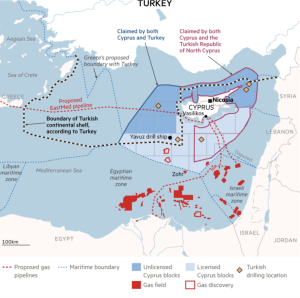

Greece argues that its islands in the Aegean sea can generate their own Exclusive Economic Zones (EEZ) which would allow Greece to explore more than 200 nautical miles. Türkiye has argued that islands can not generate their own EEZs and that Greece’s EEZ should start from its mainland, rather than from each of its hundreds of islands.

Under the UN’s Law of the Sea (UNCLOS), every state has the right to establish the breadth of its territorial sea up to a limit not exceeding 12 nautical miles. Türkiye, however, is not a signatory to UNCLOS and does not agree with the rights of the Aegean islands to such a distance. Ankara has threatened Athens with military action should it extend its waters. Both Greece and Türkiye currently claim six nautical miles off of their territory in Aegean and 12 nautical miles off their other shores.

While the EEZ governed by UNCLOS allows trading ships to pass freely, the passage of military naval ships is highly contested and Türkiye is threatened by the possibility of having to ask Greece permission for military navigation. Should Greece extend its EEZ to 12 nautical miles off its Aegean islands, it would make a drastic difference:
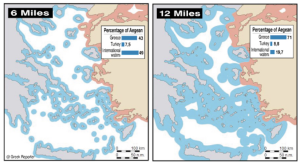


Six nautical miles have been in force since 1936. Tensions over the 12 nautical mile question ran highest between the two countries in the 1990s when UNCLOS was coming into force. In 1995, the Turkish Parliament officially declared that unilateral action by Greece to extend the Aegean islands to 12 nautical miles would constitute a casus belli, a position Ankara maintains today.

Well now Greece says that in March it’s going to extend its territorial waters to 12 nautical miles off of the island of Crete, which also happens to host a US naval base at Souda Bay. The US and Greece are also upgrading and expanding the facility with the goal to transform it into a permanent base for part of the Hellenic Navy, in order to facilitate faster and more direct access to the Eastern Mediterranean.

The move is reportedly being driven by ExxonMobil efforts to drill for natural gas and oil to the west and southwest of Crete. The Greek daily Kathimerini reported last week that ExxonMobil, in partnership with Greece’s HELLENiQ Energy, will push ahead with its search for natural gas and oil to the west and southwest of Crete despite Turkish opposition, fueling further suspicion in Ankara that the US is trying to punish the NATO member for its refusal to join the bloc’s aggressive approach against Russia.

US Arms Add Fuel to Fire

For decades the US acted as an impartial mediator between Greece, Türkiye, and Cyprus. Greece and Türkiye came close to military conflict in 1987, 1996 and in 2020, the last of which was over an accident when a Greek and a Turkish warship were involved in a minor collision during a standoff in the eastern Mediterranean. NATO stepped in in 1987 and in 1996 to help both sides cool off, and in 2020, Germany, which had the rotating presidency of the EU, took on the role of mediator.

The US is neutral no more. NATO’s war in Ukraine has brought long-festering issues between Ankara and Washington out into the open. The disagreements include US support of Kurds in Syria, Türkiye blocking Sweden’s NATO bid, Ankara’s refusal to open the Dardanelles to NATO warships, US sanctions and threat of sanctions, Washington’s refusal to extradite a cleric Türkiye blames for a 2016 coup attempt, Ankara’s purchase of Russian S-400 missile systems, Türkiye’s refusal to apply sanctions on Russia, and Ankara’s overall unwillingness to follow orders from Washington.

The US is now providing strong backing for Greece, which is clearly meant to send a message to Erdogan – at least that’s the belief inside Türkiye. Hasan Koni, a scholar on strategic studies at Istanbul Kultur University, told Türkiye’s Anadolu Agency::

The American security apparatus has also recognized that the balance of power in the region is shifting toward Türkiye and needs to be “checked by empowering Greece,” he said, adding that Washington’s push for more Greek bases is aimed at “containing Türkiye.”

The US has backed Greece despite the risk of a full break with Türkiye – the most important member of NATO due to its control of the Dardanelles and access to the Black Sea, as well as its second largest standing army in NATO.

Last year Greece deployed US-donated armored vehicles on the islands of Lesbos, Chios, and Samos, which is in violation of the 1923 Treaty of Lausanne and the 1947 Paris Peace Treaty. Ankara is also enraged about Greece’s militarization of islands within sight of Türkiye’s western coast, such as the Dodecanese chain that includes Rhodes.

There have been reports of Greek military exercises involving tanks, artillery and attack helicopters being held on Rhodes and Lesbos. Ankara has issued protests through diplomatic channels to both Athens and Washington and sent letters of complaint to the UN, all to no avail.

The US is also proposing to the Greek armed forces to replace all Russian-made military equipment including air defense systems with new military equipment produced by the US, including US Patriot missiles, which is a slap in Türkiye’s face.

Beginning during the Gulf War, Türkiye asked NATO multiple times to deploy early warning systems and Patriot missiles to Türkiye, but was always turned down. US security experts Jim Townsend and Rachel Ellehus explained it like this:

Long suspicious that NATO did not appreciate Türkiye’s vulnerability in such a dangerous neighborhood, Ankara came to view its missile defense requests as a litmus test for how much NATO really cared about Türkiye.

Ankara didn’t like the answer to that litmus test. Türkiye felt ignored by its western partners as its EU membership was all but dead, and it wasn’t getting the military hardware it requested. In 2017 Türkiye turned to Russia. It purchased Russian S-400 missile defense systems, which only further strained ties with NATO.

In December, a consortium of Italy’s Eni and France’s TotalEnergies found more natural gas off Cyprus. The Greek Cypriot administration’s exploration program is also disputed by Türkiye, which claims overlapping jurisdictions either on its own continental shelf or in the waters of the Republic of Northern Cyprus. Cyprus is split between the internationally recognized Republic of Cyprus in the south and the Turkish Republic of Cyprus in the north, which is recognized only by Ankara.

The US, wanting to keep the peace in NATO between Greece and Türkiye, had a decades-old policy of favoring negotiations on divided Cyprus and often acted as a mediator between the Turkish and Greek Cypriots.

But In September the Biden administration lifted the 35-year-old ban on the sale of US arms to the Republic of Cyprus. Congress restricted the sale of U.S. arms to Cyprus in 1987, hoping it would incentivize a diplomatic settlement to the island’s conflict.

Cyprus was required to block Russian naval vessels from accessing its ports in order to get the US arms sale ban lifted. Türkiye already has about 40,000 troops on the island, and Erdogan recently declared plans to reinforce them with land, naval and aerial weapons, ammunition and vehicles.

The decades’ old and UN-sanctioned principle of a bizonal, bicommunal federation on Cyprus has now broken down in favor of a two-state solution.

Despite the mad rush for Mediterranean gas in the wake of Europe and Russia schism, it still will not come close to replacing the amount that was piped in from Russia and requires rapid expansion of liquefaction capabilities, the connection of Israeli and Cypriot gas fields to such facilities, and/or implement pipelines, all of which will take years.

The EastMed Pipeline

The Trump administration backed a gas pipeline that would connect Israeli and Cypriot offshore gas fields to Greece and Italy. From there it would be shipped to the rest of Europe. The EastMed pipeline would have been the world’s longest (1,900 kilometers) and deepest underwater pipeline, initially providing 9-12 billion cubic meters annually.

One problem with the plan, however, was that it excluded Türkiye. In response, Erdogan opted to pursue Türkiye’s self-interest in gas through aggressive offshore oil exploration in disputed waters claimed by Cyprus. Turkish war vessels accompanied its drill ships near Cyprus, resulting in standoffs with Greek and French naval fleets. Ankara also began signing agreements with the government in Tripoli. From Dr Othon Anastasakis, Director of the European Studies Centre at the University of Oxford:

In November 2019, in response to Greece’s backing of the Mediterranean Gas Forum with Cyprus, Egypt, Israel, Italy and Jordan, Türkiye signed a maritime agreement with Libya that cuts a corridor across the Aegean to demarcate new maritime boundaries, with the proposed line in this accord running close to the eastern side of the island of Crete. On October 3, 2022, Ankara signed a follow up preliminary agreement with the Tripoli government to explore for oil and gas off the Libyan coast without specifying whether the surveys would take place in waters south of Greece. In effect, Libya has become an important third actor in the bilateral dispute between Greece and Türkiye and relations between the Athens and Tripoli governments have suffered a major blow as a result.

In January 2022, the Biden Administration abruptly halted American support of EastMed. Israeli and even some American officials were reportedly surprised by the sudden decision as the State Department did not appear to have adequately consulted with Cyprus, Greece, and Israel ahead of time. Additionally, Biden was a vocal supporter of the project during his time as Obama VP, and the US position was consistently that Europe needed to wean itself off of Russian natural gas.

The US government and American private sector were not directly involved in the pipeline project (the agreement was signed in January 2020 by the governments of Israel, Greece, and Cyprus), but as Henri Barkey, an adjunct senior fellow at the Council on Foreign Relations, told the National:


American support always affects a good housekeeping seal. When you have American buy-in, it’s easier for banks to provide financing for more countries to be interested. In that sense, what the US says is important.

US Under Secretary of State for Political Affairs Victoria “Fuck the EU” Nuland has taken an active role in the Eastern Mediterranean and had this to say about the pipeline:

“Frankly, we don’t have 10 years, but in 10 years from now, we want to be far, far more green and far more diverse” in energy sources, Nuland said. “So what we’re looking for within the hydrocarbon context are options that can get us more gas, more oil for this short transition period.”

That short transition period also happens to rely heavily on US exports of LNG.

In November Greece canceled the long-planned privatization for the Alexandroupolis port with Mitsotakis declaring it too precious of a resource to relinquish. Instead the US military has set up shop there, using it as an entry point to funnel weapons to Ukraine. There are also plans in the works to create a floating gas storage and regasification unit at the port, which will be serviced by American LNG supplies. A pipeline from Alexandroupolis is also planned to send that gas north to the Balkans.


1/18/2023

What if Turkey blocks Finland and Sweden NATO bids?


Source: Responsible Statecraft
By Mark Episkopos
January 18 2023


Many believe Ankara can be mollified — at a cost — but rejection of the Nordic countries’ ascension remains a real possibility.

Turkish Foreign Minister Mevlut Cavusoglu is set to meet his U.S. counterpart Antony Blinken in Washington this week. There are scant expectations among observers that the visit will resolve any of the outstanding issues in what has been an increasingly troubled bilateral relationship, with the Biden administration keeping its distance from Ankara over allegations of human rights abuses and the Eurasian country’s increasingly warm ties with Moscow.

Turkey has reaffirmed its uncompromising stance on the fraught NATO bids of Sweden and Finland, setting the stage for a showdown with serious long-term implications for both Ankara and the alliance.

Ibrahim Kalin, a spokesman for Turkish President Recep Tayyip Erdogan, said on Saturday that Ankara is “not in a position” to approve Sweden’s NATO bid until all of Turkey’s concerns have been addressed. “We have a time issue if they want to join NATO before the NATO summit in June,” he added, noting that Sweden’s judicial system must change its legal definition of terrorism for Turkey to lift its opposition to Stockholm’s accession, which requires the unanimous approval of all member states.

Stockholm and Helsinki simultaneously submitted applications to join the alliance in May 2022, citing the new security realities brought on by Russia’s February 24 invasion of Ukraine. Their accession process, which NATO Secretary General Jens Stoltenberg assured last summer will be the fastest in the alliance’s history, has been delayed indefinitely amid unresolved Turkish objections.

Ankara officials said the two Nordic countries have continued to shelter Kurdish militants, with President Erdogan insisting their accession bids cannot move forward until they agree to extradite persons sought by Turkish authorities on terrorism charges. Yet Swedish and Finnish courts have denied several extradition requests, including one reportedly pertaining to exiled dissident journalist Bulent Kenes. Cavusoglu decried the rejection as a “very negative” development, insisting that the two Nordic countries have not taken sufficient steps to satisfy Turkey’s strict conditions for clearing its objection to their accession. “We no longer want to hear good words from Sweden and Finland, we want to see concrete steps,” Cavusoglu said.

Swedish Prime Minister Ulf Kristersson said early in the new year that his country has done all it could to address Ankara’s concerns even as Turkish officials continue to insist Stockholm has not done nearly enough. Tensions over Sweden’s NATO bid reached a fevered pitch after footage emerged last week of an Erdogan effigy hanging from a lamppost in Stockholm, prompting a furious response from Turkish officials. “Unless the activities of terrorist organizations are halted, it is not possible for the NATO membership process to progress,” said Kalin, according to Al Jazeera.

The Nordic applicants appear no closer to sealing an accession deal with Turkey today than they were over half a year ago when talks began. Turkish experts contend Ankara is unlikely to drop its opposition to NATO enlargement until after the June election cycle in Turkey, with Erdogan facing a stiff re-election challenge against a six-party opposition coalition. Others have suggested Turkey’s extradition demands from the two applicants are a facade for larger concessions it is seeking to extract from the United States — namely, a $20 billion sale of F-16 fighter jets. Though the Biden administration has signaled it intends to greenlight the deal, at least one top senate Democrat — Bob Menendez, chairman of the Senate Foreign Relations Committee — has already vowed to block it.

It is generally consistent with Erdogan’s modus operandi to levy ambitious demands vis-a-vis his interlocutors only to settle for a more modest set of concessions when all is said and done. Yet there is also a clear precedent for the Turkish leader doubling down in response to international pressure. Erdogan proceeded in 2018 with plans to purchase the Russian S-400 missile system despite U.S. warnings that there will be significant consequences and refused to reverse his decision even in the face of CAATSA sanctions and Turkey’s costly removal from the F-35 partner program.

The current impasse over NATO enlargement could play out in several ways over the coming months. Anxious to bring the matter to a close, Washington and its allies may become progressively more heavy-handed in pressuring Ankara to back down through public and private channels. Erdogan, who is well-known for his eristic tendencies even in dealing with leaders of allied nations, may very well respond by lashing out in unpredictable ways.

Though it remains unlikely that a confrontation along these lines would lead to Turkey leaving or being expelled from NATO, it would shake the unity of the alliance at a dangerous moment for European security. Further still, an aggrieved Erdogan bent on undermining the organization from within could prove just as corrosive to NATO in the long run as a formal divorce between Turkey and the alliance.

Then there is the not-insignificant possibility — one that appears to have grown more likely in recent weeks and months — that Turkey could end up torpedoing the NATO bids of Finland and Sweden altogether, leaving the applicants and the alliance in uncharted waters. But regardless of how the accession drama plays out, the standoff has exposed what has become a foundational challenge for NATO in the post-Cold War world: the principle of limitless horizontal expansion has heightened the risk of internal contradictions among NATO’s increasingly diverse membership, making it more difficult over time to distill common geopolitical goals and to maintain the credibility of the Article V commitment that is at the heart of the alliance.

This dynamic poses a serious and growing liability for an organization that must make every major decision on a consensus basis.

Turkey’s actions in holding up NATO enlargement come as part of Erdogan’s larger effort to chart what he sees as an independent foreign policy course between Russia and the West. Ankara rejected the maximum pressure strategy against the Kremlin adopted by NATO’s leadership and most member states in response to Russia’s invasion, instead positioning itself as a neutral broker between Moscow and Kyiv.

Ankara’s neutrality has yielded some success in the form of the Black Sea Grain Initiative, the only significant international treaty involving both Russia and Ukraine since the war’s outbreak. Erdogan has been able to carve out this niche in a unique wartime context: none of the major Western powers have been willing to engage Russia in direct talks, giving outside players opportunities to fill the void.

The conflict poses something of a paradox for Ankara. Erdogan is committed to facilitating a negotiated end to the war and came much closer than anyone else to doing so, according to reports from the failed Antalya summit in March. Yet it is precisely the war that has empowered Turkey with a degree of international clout that would otherwise have been unattainable. It remains to be seen to what extent Erdogan’s successor — regardless of whether they enter office as a result of this year’s election or at a later point — will seek to carry on his ambitious vision, nor is it clear how exactly the inevitable transition to a post-Ukraine War landscape will alter the strategic imperatives confronting Turkey.

The war has been a catalyst for geopolitical change, prompting both NATO and Turkey to pursue policies unthinkable in peacetime. The story of these transformations, closely tied as they are to the war’s course and its eventual outcome, is still being written.


5/30/2021

Turkish-made drone could attack humans without orders - Pentagon report


Source: Ahval
May 30 2021

The Pentagon has released a report warning that autonomous drones could mistakenly attack civilians unless measures are taken to ensure their programming, Fox News reported on Sunday.

"How brittle is the object recognition system? How often does it misidentify targets?" the report asked.

Last year in Libya, a Turkish-made autonomous weapon—the STM Kargu-2 drone—may have “hunted down and remotely engaged” retreating soldiers loyal to the Libyan General Khalifa Haftar, according to a recently released UN document, the Bulletin of Atomic Scientists reported in May.

“The Kargu-2 signifies something globally significant: A new chapter in autonomous weapons, one in which they are used to fight and kill human beings based on artificial intelligence,” the report points out.

As of this writing, no autonomous weapon has yet been used to kill a human being.

The UN report calls the Kargu-2 a lethal autonomous weapon. “It’s maker, STM, touts the weapon’s “anti-personnel” capabilities in a grim video showing a Kargu model in a steep dive toward a target in the middle of a group of manikins.

There have been calls to ban autonomous drones, because they could kill without being able to distinguish between soldiers and civilians. They work on machine-language learning programmes which have to be ‘trained’ by repetitive operations.

Devices using such programmes have been known to make bad decisions. Regulation on a global scale is needed before swarms of autonomous drones are let loose and make the wrong decision about who to kill, the report concludes.


4/01/2021

Jihadis Are Becoming Turkey’s Permanent Proxy Force


Source: BESA
April 1 2021
By Burak Bekdil


EXECUTIVE SUMMARY: Turkey, a member of NATO, now effectively has a jihadi proxy force that it has deployed in its Syrian homeland as well as in faraway war theaters like Libya and Nagorno-Karabakh.

An assortment of jihadi groups holed up in northern Syria under Turkey’s protection are becoming the permanent proxy force of the new Ottomans.

This looks like a marriage made in heaven. Turkey and the jihadis share an ideological and sectarian bond and have common goals. There is money and logistical support, as well as geographical proximity. They share a taste for adventurism in faraway lands, particularly in the service of what they consider a holy cause.

The 27th report of the Analytical Support and Sanctions Monitoring Team submitted to the UN Security Council concerning ISIL (Islamic State), al-Qaeda, and associated individuals and entities concludes that Iraq and Syria remain the core area for ISIL, with the Idlib area, where Al-Qaeda also has affiliates, a particular source of concern.

”The Idlib area” refers to Syria’s northwestern tip neighboring Turkey, the last rebel stronghold in the war-torn country. Idlib has become a de facto Turkish province. The Turkish lira is the medium of exchange, and Turkish government agencies provide services like education, housing, and preserving public safety. Since early 2020, the Turkish military has been controlling the area under the pretext of protecting Turkish observation posts from a Syrian military offensive and creating a safe zone for displaced persons.

The UNSC report said:


The Idlib de-escalation zone remains important to ISIL as a limited safe haven. Hay’at Tahrir al-Sham (HTS) regularly arrests ISIL fighters. However, some ISIL leaders continue to reside in the region and it is a target destination for many former ISIL fighters and families as the safest gateway into Turkey.

HTS is still the dominant militant group in the northwest of the Syrian Arab Republic, with approximately 10,000 fighters, most of them Syrian. HTS seeks further to consolidate its control of the Idlib de-escalation zone and applies pressure on local leaders to accept the group’s authority, ensuring that the population complies with its version of sharia law.

In addition to taxation of local businesses, HTS maintains a monopoly over the import and distribution of gasoline and diesel fuel…The group’s earnings from trading fuel and energy are estimated at approximately $1 million monthly. HTS is also reported to control distribution of humanitarian aid through an entity known as Maktab Sho’oun Al-Munathamat (the Bureau of Organization Affairs), which limits direct distribution of goods to the local population by humanitarian organizations. It also confiscates portions of these goods to reinforce HTS patronage networks.

The other major Al-Qaeda affiliate in the Idlib area is Hurras al-Din (HAD), with between 2,000 and 2,500 fighters. It was weakened by a significant number of leadership losses in 2020 and is overshadowed by HTS, with which it competes for recruits and reputation among the local population.

The Idlib area continues to harbour other terrorist groups composed mainly of contingents of foreign terrorist fighters who remain subject to the authority of HTS. These groups include the Khattab Al-Shishani Brigade (Chechen fighters), Katiba al-Tawhid wal-Jihad (KTJ, Central Asian fighters) and the Eastern Turkistan Islamic Movement (ETIM), also known as the Turkistan Islamic Party. The latter is reportedly composed of 3,000 to 4,500 members.

That was Idlib at the end of 2020. The umbrella militant group for the jihadi groups is the Free Syrian Army (FSA), Turkey’s official ally and combat force in Syria, which in 2019 reflagged itself as the Syrian National Army (SNA). The SNA has been trained and equipped by the Turkish military since 2016.

Turkish loyalists of Sunni Arab origin have been accused of wreaking havoc in northern Syria, displacing hundreds of thousands, and committing alleged war crimes on a daily basis. The Ankara-commanded proxy militias bear most of the blame for many of the reported atrocities that have affected local Kurds, including executions, kidnappings, rapes, looting, and other crimes.

Apparently, the self-styled SNA, FSA’s new brand of jihadists, followed suit. According to an October 15, 2019 report, Turkey’s extremist proxies “vowed to kill ‘pigs’ and ‘infidels,’ paraded their Kurdish captives in front of cameras and, in one graphic video, fired several rounds into a man lying on the side of a highway with his hands bound behind his back.”

With over 200,000 displaced according to UN figures, many refugees are claiming that the Turkish forces are planning to flush the Kurds out of the settlements and replace them with Arabs loyal to Ankara. They have also been fighting Syrian Kurdish militias, Turkey’s principal military target. That’s unusual notoriety for the proxy ally of a NATO member state.

According to a December 31, 2012 article in Huffington Post:


[The FSA] has in the recent past stolen wheat reserves intended for the residents of Aleppo and sold it to private Turkish grain traders, expropriated stocks of pharmaceuticals and forcibly resold them back to its owners, and ransacked schools…

In the outskirts of Aleppo, the FSA has implemented a Sharia law enforcement police force that is a replica of the Wahhabi police in Saudi Arabia—forcing ordinary citizens to abide by the Sharia code…

Lebanese newspapers such as Al-Akhbar and Assafir, and Alex Jones’ infowars.com, have broadcast a disturbing video of a 12-year-old child apparently forced by the FSA to cut off the head of a Syrian military officer…

The FSA has also been targeting the infrastructure of the country. One of the main power plants in Damascus was knocked out for three days last week, impacting 40 percent of the city’s residents.

Amnesty International compiled evidence of war crimes committed by Turkish forces and Turkish-backed Syrian armed groups during the offensive. It reports, based on witness testimony from October 12-16, 2019, on “how Turkish forces have displayed a disregard for civilian life, including through summary killings and unlawful attacks that have killed and injured civilians…The information provides damning evidence of indiscriminate attacks in residential areas—including attacks on a home, a bakery and a school—carried out by Turkey and allied Syrian armed groups.”

As Turkey’s neo-Ottoman ambitions pushed the country into Libya’s civil war, Ankara deployed its semi-official proxy army into that new war zone. According to the Pentagon’s inspector general, Turkey sent between 3,500 and 3,800 paid Syrian fighters to Libya over the first three months of 2020. That was the Defense Department’s first report detailing Turkish deployments that aimed to change the course of Libya’s war. The quarterly report on counterterrorism operations in Africa by the Pentagon’s internal watchdog said Turkey paid and offered citizenship to thousands of mercenaries fighting alongside Tripoli-based militias against troops of east Libya-based commander Khalifa Hafter.

Later in 2020, Turkey would deploy its jihadi allies in a conflict raging far from its own borders in a land many had barely heard of a few months earlier. In October, the bodies of more than 50 Syrians killed in the Azeri-Armenian war were returned home for funeral preparations. They were members of militias that had fought on Turkey’s behalf in the disputed enclave of Nagorno-Karabakh. Once again, President Erdoğan was the first world leader to jump into the fray when a long-simmering conflict in the south Caucasus burst into open warfare. Turkey also supplied weapons, especially armed drones, as well as training to Azerbaijan.

According to a report by Observer Research Foundation, fighters from Syria are an amalgamation of circumstances and ground realities.

“Many who are finding their way into other conflict theaters such as Libya or now Azerbaijan don’t necessarily come from the same backgrounds of militants, militias, Islamists and so on. While the ones fighting on Turkey’s behalf in Libya most likely are hardened militias who see Turkish President Recep Erdoğan’s self-styled Sunni-power leader image as palatable, and do so in support of Ankara’s regional geopolitical maneuvers,” the report said. But the fighters in Azerbaijan, reportedly hired by private contractors, were largely people who suffered economic destitution back home and saw the alien war theater as a paying job.

“Despite the time it took and the cost that Turkey has incurred, decision makers in Ankara have grown increasingly amenable to the use of proxies, prompting a change in psychology and perception that represents a significant departure from Turkey’s historic policy of relying on conventional forces,” said Osman Sert, research director at the Ankara Institute. “Proxies are now perceived as being a critical component of Turkey’s regional security interests, and no longer simply a measure that could be indirectly operationalized through other proxy sponsors in the region.”


10/05/2020

A Clash with Turkey Is Becoming Inevitable


Source: The National Interest
Oct 10 2020
By Michael Rubin


Turkey has essentially become like Iraq in early 1990: Erdoğan, like Saddam, sees his economy collapsing and recognizes that he will not be able to deflect blame from his own mismanagement and choices. That means trouble is brewing.

ate last month, Mike Pompeo became the first secretary of State to visit Greece twice. While his initial remarks sought de-escalation, the reality is only one side is responsible for the conflict that now looms: In recent months, Turkey has not only encroached on Cyprus’ internationally-recognized exclusive economic zone and Greek waters but, in recent days, reportedly Israel’s exclusive economic zone as well. Whereas compartmentalized analysts might see Turkish president Recep Erdoğan backing down in the face of diplomatic pushback and military mobilizations, a more holistic view is that Erdoğan is determined to lash out for reasons both ideological and populist and will continue to do so until he determines where a small military investment could bring the greatest gains.

One possible flashpoint to watch is Famagusta. After Cypriot independence, Famagusta—and especially its southern Varosha quarter—became a major tourist hub that attracted European and Western glitterati to its pristine beaches and resorts. That all ended when Turkey invaded in 1974. It first bombed the city forcing many residents to flee and then occupied it. Famagusta’s residents expected to return upon the ceasefire but never did. Varosha became a ghost town with billions of dollars of real estate fenced off and empty, its former residents permanently displaced.

Generations of diplomats have expected Famagusta—and the return of its residents—to be key to any negotiated peace on Cyprus. That Turkey left Varosha fallow gave Cypriots, Western Europe, and UN diplomats hope that Ankara was still interested in a resolution to the Cypriot conflict. Now, however, Erdoğan signals that Turkey may act unilaterally to populate and develop Varosha. Not only does Erdoğan want to signal his toughness after backing down in his recent maritime dispute with Greece, but he and his key supporters also stand to gain billions of dollars as they use Turkish state funds and perhaps the proceeds of resources looted by Turkey to reconstruct the apartment buildings and hotels which after five decades must be razed and replaced. Consider it Turkey’s version of China’s salami-slicing strategy. Erdoğan has long argued that the treaties determining Turkey’s borders should be revised; populating Varosha would allow him to put his rhetoric into action.

The problem is not only in Cyprus or the Eastern Mediterranean, however. Turkey has troops in Syria and Iraq, and has also intervened in Libya and, most recently, Azerbaijan. Troublingly, Turkey’s new modus operandi is to use Syrian proxies, many of whom are veterans of the Islamic State or Al Qaeda affiliates. In effect, Turkey now uses its Syrian militiamen the way that Iran utilizes Lebanese Hezbollah or its parallel Afghan and Pakistani militias. That Turkey is so rapidly inserting its Syrian proxies into various conflicts signals Turkey’s simultaneous desire to broaden its interventions overseas and its efforts to maintain plausible deniability.

Beyond its military posturing, Turkey has also grown more aggressive toward dissidents abroad. Earlier this year, a Turkish intelligent agent entered an Austrian police station and stated that Turkey’s intelligence service had ordered him to assassinate a former Austrian parliamentarian, also of Kurdish descent.

On September 25, three unidentified individuals in Stockholm, Sweden attacked Abdullah Bozkurt, perhaps Turkey’s most prominent dissident journalist who previously worked for Fethullah Gülen’s flagship Zaman prior to Erdoğan’s crackdown on Gülen’s movement. While Turkey has instigated attacks on dissidents and opposition—including in Washington, DC—assassinating European politicians and attacking journalists as prominent as Bozkurt suggests that Erdoğan is ratcheting up aggression to a new level.

The U.S. and European response is restrained, which only encourages Erdoğan’s aggression. Like Vladimir Putin in Russia and Xi Jinping in China, he believes the West is weak and he get away with dictating to it. He has nowhere near the power of his political peers, but he is right to detect European and U.S. weakness.

The major problem Europe—and by extension the United States—faces is Germany. Angela Merkel is reluctant to apply meaningful sanctions against Turkey because her country fears three things. Diplomats say privately that Merkel’s bigger fears are that Turkey might utilize refugees as cover to precipitate violence inside Germany, or that Erdoğan might incite Germany’s large ethnic Turkish population.

This plays into the hands of those within the State Department who seek to undermine efforts to hold Turkey to account. Rather than impose sanctions unilaterally on Turkish officials and companies complicit in violating Cypriot or Greek waters, mid-level U.S. diplomats argue they want only to impose sanctions in conjunction with the European Union knowing that Germany will effectively block their implementation. Pompeo, therefore, may talk a robust game with regard to Turkey’s regional aggression from the seventh floor of the State Department but, in practice, his Bureau of European and Eurasian Affairs slow-rolls any cost to Turkey to the point that Erdoğan believes he will face no pushback for his aggression.

The Eastern Mediterranean is a tinderbox. Wars are seldom caused by a desire for resources alone, but rather by overconfidence. Turkey has essentially become like Iraq in early 1990: Erdoğan, like Saddam, sees his economy collapsing and recognizes that he will not be able to deflect blame from his own mismanagement and choices. Like Saddam, he sees neighbors possessing valuable resources and believes the international community to be paper tigers. In 1990, Saddam had April Glaspie equivocate and turn a blind eye to his ambitions; in 2020, Erdoğan has equally credulous envoy James Jeffrey. Turkey’s recent escalations in the region show that Erdoğan’s ambitions are out-of-control. The question for Washington, Berlin, and Brussels is whether the United States and Europe are willing to stand up and shut down those ambitions before Erdoğan pulls the trigger, or whether they will instead wait until a resolution is far more costly to Turks and everyone in the Eastern Mediterranean.

Michael Rubin is a resident scholar at the American Enterprise Institute.


9/27/2020

Urgent: Move US Nuclear Weapons Out Of Turkey


Source: FAS
By Hans M. Kristensen
Oct 16 2019


Should the U.S. Air Force withdraw the roughly 50 B61 nuclear bombs it stores at the Incirlik Air Base in Turkey? The question has come to a head after Turkey’s invasion of Syria, Erdogan’s increasingly authoritarian leadership and deepening discord with NATO, Trump’s inability to manage U.S. security interests in Europe and the Middle East, and war-torn Syria only a few hundred miles from the largest U.S. nuclear weapons storage site in Europe.

According to The New York Times, State and Energy Department (?) officials last weekend quietly reviewed plans for evacuating the weapons from Incirlik. “Those weapons, one senior official said, were now essentially Erdogan’s hostages. To fly them out of Incirlik would be to mark the de facto end of the Turkish-American alliance. To keep them there, though, is to perpetuate a nuclear vulnerability that should have been eliminated years ago.”

That review is long overdue! [Actually, I’ve heard there have been several reviews and a lively internal debate since the 2016 coup attempt.] Some of us have been calling for withdrawal for years (see here and here), but officials have resisted saying it wasn’t as bad as it looked and that the deployment still served a purpose. They were wrong. And by waiting so long to act, the United States has painted itself into a corner where the choice between nuclear security and abandoning Turkey has become unnecessarily stark and urgent.

The situation is even more untenable because Incirlik in just a few years is scheduled to receive a large shipment of the new B61-12 guided nuclear bomb, which would be a recommitment to nuclear deployment in Turkey.

This year is the 60th anniversary of the first deployment of nuclear weapons to Turkey. It is time to bring them home.

Nuclear Weapons At Incirlik


The specific reference in the New York Times article made by officials to nuclear weapons at Incirlik is the most recent and authoritative confirmation that nuclear weapons are still stored at the base. That confirms what I have been hearing and sources at US Air Forces Europe confirmed the report, telling William Arkin the weapons are still there. There have been rumors the weapons were removed after the coup attempt in 2016 (and some really bad disinformation that they had been moved to Romania). All of those rumors were wrong. An article on the official Incirlik Air Base web site even confirms that the mission of the 39th Operations Support Squadron is “to orchestrate and control US, Turkish, and coalition forces operating at Incirlik Airbase in the execution of full-spectrum airpower and nuclear deterrent operations” (emphasis added). Given that the article will likely be removed now that I have pointed this out, it is reproduced in full below:


I have estimated for the past several years that the Air Force stores about 50 B61 nuclear gravity bombs at Incirlik, one-third of the 150 nuclear weapons currently deployed in Europe (see figure below). This estimate has been used by a wide range of news reports and commentators. The number of bombs at Incirlik has decreased over the past two decades from 90 in 2000. In those days, 40 of the 90 bombs were earmarked for delivery by Turkish F-16s. Those 40 bombs used to be stored in 6 vaults at both Akinci AB and Balikesir AB (20 at each) until they were moved to Incirlik when the US Air Force withdrew its Munition Support Squadrons from the Turkish bases in 1996. The 40 “Turkish” bombs remained at Incirlik until around 2005 when they were shipped back to the United States as part of the Bush administration’s unilateral nuclear reduction in Europe.


The US Air Force stores 150 nuclear bombs at six bases in five NATO countries. Click on map to view full size.

The remaining 50 bombs are for use by US jets, even though Turkey never allowed the US Air Force to permanently base fighter-squadrons at Incirlik. Jets would have to fly in during a crisis to pick up the weapons or they would have to be shipped to other locations before use. As a result, the nuclear posture at Incirlik has been more a storage site than a fighter-bomber base during the past two decades.

Although the Turkish participation in the NATO nuclear sharing mission was lessened (some would say mothballed) by the withdrawal of the “Turkish” weapons, the Turkish F-16s continued to serve a nuclear role. Despite local reports that F-16s never had a nuclear role, the US Air Force in 2010 informed Congress that “Turkey uses Turkish F-16s to execute their nuclear mission,” and that some of the F-16s would be upgraded to be able to deliver the new B61-12 bomb until the F-35A could take over the nuclear strike mission in the 2020s. That is now not going to happen after the Trump administration canceled the F-35 sale.

In 2015, satellite images revealed construction of a new security perimeter around most of the aircraft shelters with nuclear weapons storage vaults. Of the 25 shelters that originally were equipped with vaults, only 21 were included in the new security area with a capacity to store up to a maximum of 84 nuclear bombs. Normally only about two bombs are stored in each vault, for a total of inventory of 40-50 bombs at Incirlik.


The nuclear weapons mission areas at Incirlik AB include the “NATO Area” where nuclear weapons are stored and the nuclear weapons maintenance unit that manages the underground storage vaults

As recently as last month, Vice Chief Staff of the Air Force, Gen. Stephen W. Wilson, visited Incirlik and was given tours of the various functions and facilities at the base. One of these was Protective Aircraft Shelter H-2 inside the “NATO Area” where he spoke to members of the 39th Security Force that protects the nuclear weapons (see below). He was likely also shown the inside of the shelter and the weapons in the vault.


Last month, the Air Force Chief of Staff was taken to a nuclear weapons storage shelter at Incirlik AB. Click on image to view full size.

Recent Activities


If the Air Force decided to withdraw the B61 bombs from Incirlik, it would look pretty much like activities captured by Maxar’s satellites in 2019 and 2017. Those images show what appears to be either actual nuclear weapons movements or training to remove them.

One photo from March 22, 2019, shows a C-17 transport aircraft – likely from the 4th Airlift Squadron of the 62nd Airlift Wing at Joint Base Lewis-McChord in Washington – parked right outside the main gate to the NATO Area. The 4th Airlift Squadron, which is the only unit in the Air Force that is qualified to airlift nuclear weapons, flies Prime Nuclear Airlift Force (PNAF) and Emergency Nuclear Airlift Operations (ENAO) missions (see images below).


The satellite image shows the C-17 and gate area surrounded by armored vehicles and armed guards of the 39th Security Force as well as technicians to protect and carry out the weapon movement. One of the unique vehicles seen is an 18-meter truck lined up with the loading pad of the C-17. The same type of truck can be seen parked at the weapons maintenance unit building a few months later (see image
below).


This Maxar satellite image acquired via Earth Watch shows what appears to be a nuclear weapons movement or exercise in March 2019. Click on image to view full size.


Another set of Maxar satellite photos of a possible nuclear weapons movement or exercise is from December 2017. A Nuclear Security Inspection that year (and 2014) reportedly included weapons emergency evacuation drills. The scenario on the 2017 image is similar to that on the 2019 image: a C-17 parked outside the gate, security vehicles surrounding the scene, and transporters for moving weapons. But the 2017 photos are unique because they were taken moments apart as the satellite passed overhead. As a result, movements become visible: On the first image, a possible weapons trailer towed behind a truck in a column of armored security vehicles is moving toward the outer gate of the NATO Area. On the second photo, the column has passed through the gate onto the tarmac and the towed trailer is turning toward the rear of the C-17. The aircraft shadow shows the loading ramp is open and ready to receive the weapons (see image below).This unique double-image shows what appears to be a nuclear weapons movement or exercise in December 2017. Click on image to view full size.


The Task At Hand: Withdraw The Weapons!


The B61 nuclear bombs at Incirlik should have been withdrawn long ago but tradition, Cold War thinking, and bureaucratic inertia prevented officials from doing the right thing. Now things have come to a head where the United States is faced with the choice of securing its weapons or be seen as abandoning Turkey.

Withdrawing the weapons does not, of course, mean the United States is abandoning Turkey. That relationship is already in serious trouble and keeping the weapons at Incirlik based on the idea that it will somehow counterweight Turkey’s further drift away from NATO is probably an illusion. That boat seems to have sailed; the relationship is likely to deteriorate whether or not there are nuclear weapons at Incirlik. That is the reality the Air Force must relate to now.

Nuclear weapons security convoy at Incirlik AB in 2009.

Another argument against withdrawal will be that moving them out of Turkey will cause the other members of the so-called nuclear sharing arrangement (Belgium, Germany, Holland, Italy) to question why they should continue to store U.S. nuclear weapons. Withdrawal from Turkey could, so the argument goes, trigger a domino effect of withdrawal from other countries as well.

But the withdrawal of U.S. nuclear bombs from Greece in 2001 and from England five years later did not cause the other countries to demand withdrawal as well or the collapse of NATO. If they truly believe deployment of U.S. nuclear weapons is important for NATO security, then they will stay. If the mission falls with withdrawal from Turkey, then they obviously don’t think it’s important and the weapons should be withdrawn from all the countries anyway. The U.S. extended deterrence posture in Europe can adequately be maintained with advanced conventional forces backed up by strategic forced in the background.

The B61 bombs at Incirlik could easily be dispersed to empty storage vaults in the other countries. Space is not a problem. There are a total of 96 empty weapon slots in the active WS3 vaults in Belgium, Germany, Holland, and Italy. Moreover, there are 25 empty and inactive WS3 vaults with room for 100 bombs at RAF Lakenheath. But public and parliamentary opposition would likely prevent increasing the number of nuclear bombs stored in those countries. If the order goes out to evacuate Incirlik, it seems more likely the bombs would be returned to the United States.

There will be some people who will argue that deteriorating relations with Russia and Moscow’s alleged increased reliance on a so-called “escalate-to-deescalate” strategy of using tactical nuclear weapons first prevent the United States from reducing – certainly withdrawing – its tactical nuclear weapons from Europe. Those are curiously the same people who also argue that the United States should deploy a new low-yield warhead on its strategic submarines and a new nuclear cruise missile on its attack submarines to better counter Russian tactical nuclear weapons – a thinking that was recently endorsed by the Trump administration’s Nuclear Posture Review. That seems to signal to the European allies that the United States actually no longer believes the deployment of B61 nuclear bombs in Europe is credible and that other and better weapons are needed.


Whatever one might think about U.S. tactical nuclear weapons in Europe, Turkey is no longer an acceptable location. Erdogan’s confrontational and authoritarian leadership is rapidly undermining Turkey’s status as a reliable NATO ally, and the deteriorating security situation in the region presents a real physical threat to the weapons at Incirlik. That threat is real and the U.S. military sees it as real. So much so that an extra security force squadron deployed to Incirlik from Aviano Air Base in Italy to beef up nuclear security in response to “regional turmoil and government instability” according to USAF source, and Ohio Army National Guard military police reportedly were dispatched to Incirlik specifically to increase base security.

The security threat to the weapons at Incirlik is urgent and the continued deployment of nuclear weapons at the location is unjustifiable and incompatible with U.S. nuclear security standards. If you don’t believe that, ask yourself this question: If there were no U.S. nuclear weapons in Turkey and someone asked for them to be deployed to Incirlik, would the Pentagon approve?

I doubt it. It’s time to face reality and withdraw the weapons from Turkey before they have to be evacuated under fire.

Hans M. Kristensen is the director of the Nuclear Information Project at the Federation of American Scientists where he provides the public with analysis and background information about the status of nuclear forces and the role of nuclear weapons.

------

Editor's note


9/14/2020

War Within NATO? Why Is Turkey Getting So Aggressive With Greece?


Source: The National Interest
By Startfor Worldview
Sept 13 2020


Turkey is putting its 50-year view on maritime rights into practice through its Blue Homeland Doctrine, growing its naval and commercial presence in Mediterranean waters that it claims are part of its exclusive economic zones (EEZs). Oil and gas exploration is becoming a crucial tool in implementing this strategy. But Ankara's attempts to claim extensive maritime resource rights risk broadening to a wider conflict with Greece and other NATO allies that would bring foreign energy projects, and potentially the United States, into the fray.

Turkey's Maritime Ambitions


Turkey claims that all of its neighboring waters in the Aegean, Black and Mediterranean seas deserve special treatment under international law, and that the islands in the Aegean Sea (which Greece controls the majority of) should not enjoy the same rights as large countries like Turkey with lengthy coastlines. The international community never adopted these distinctions, which is why Turkey is not a signatory to the United Nations Convention for the Law of the Sea (UNCLOS) and prefers to resolve disputes through bilateral negotiations in lieu of not international arbitration. This has so far led to two major disputes with Greece in the Aegean and Mediterranean seas, as well as a major dispute with Cyprus in the eastern Mediterranean.


Turkey's most important dispute is in the Aegean Sea, where thousands of Greek islands help boost Greece's maritime claims over Turkey's, and where the two countries disagree on how to even start drawing a maritime border due to the disparity in the number of islands between them. Turkey has just three islands in the Aegean Sea, while Greece claims more than 3,000. Given the higher number of Greek islands, Turkey has long maintained that any expansion of Greek maritime claims from six nautical miles (nm) to 12 nm off Greece's shores would constitute a "casus belli," or cause of war. While Greece and Turkey have nearly gone to war several times over disputes in the Aegean Sea, the two countries have so far avoided declaring full EEZs in the region, as well as claiming territorial waters beyond six nautical miles. But that doesn't mean they can't do so in the future. 

Ankara has argued that if both Greece and Turkey extended their claims beyond 12 nm, Turkey's percent ownership of the territory would only marginally increase, while Greece would see its territorial control reach nearly three-quarters of the entire Aegean Sea.
The use of Greece's islands in the Aegean Sea to demarcate a maritime border for EEZs, which extend up to 200 nm from the coast, would also leave Turkey with virtually no rights to the natural resources and fisheries in the Aegean Sea.
Turkey has argued that a more equitable way to split the sea's resources would be by ignoring the islands altogether and starting off with an equidistant line between the Greek and Turkish mainlands.


By more aggressively flexing its claims through energy exploration and naval exercises in the eastern Mediterranean, Turkey is trying to both legitimize its declared EEZ claim, as well as delegitimize any potential EEZ claims in the region that Greece has through its islands of Crete, Rhodes and Kastellorizo. Kastellorizo, in particular, has the potential to generate a significant EEZ claim for Greece that could connect to Cyprus's own claimed EEZ, thus significantly limiting Turkish claims to resources between Crete and Cyprus. Further escalation could result in Greece finally claiming its full EEZ in the eastern Mediterranean, which Athens has so far been reluctant to do for fear of spurring a wider conflict.

Protected by a Turkish naval convoy, Turkey's Oruc Reis surveying vessel has been active throughout the Mediterranean Sea since the beginning of the year.

Turkey's December 2019 maritime agreement with Libya's Government of National Accord aims to legitimize Turkey's claims by establishing a border between Turkish and Libyan waters that ignores Crete and Kastellorizo. 

On Aug. 27, the Greek parliament ratified a maritime border agreement with Egypt aimed at countering Turkey's pact with Libya by legitimizing a potential EEZ border generated via its control of Crete with Egypt. Greece's deal with Egypt is a first step in potentially declaring a full EEZ in the eastern Mediterranean, but the agreement with Egypt does not legitimize potential claims that Kastellorizo could give Greece rights to.


Turkey has also been actively attempting to delegitimize Cyprus' claimed EEZ in the eastern Mediterranean by both conducting energy exploration in waters that Cyprus directly claims, as well as harassing foreign companies that are operating on behalf of the Cypriot government. Turkey has argued that Cyprus' claimed EEZ is not legal because it was not done in coordination with the Turkish Republic of Northern Cyprus, which Ankara recognizes as a legitimate government for all of Cyprus. Turkey also argues that, as an island, Cyprus cannot claim a full EEZ.

Turkey's Yavuz vessel is currently drilling off the coast of Western Cyprus.

Turkey's Barbados vessel is also currently researching in the Northern Cyprus territorial waters that Turkey recognizes as a part of an oil exploration block held by the state-owned Turkish Petroleum Corporation.

In 2018, the Turkish navy prevented the Italian oil firm Eni from drilling on its Cuttlefish prospect in an exploration block the company received from Cyprus.

The Specter of War


Turkey's increased provocations will continue to drive the United States and other NATO countries, including France and Greece, to boost their own naval presence in the eastern Mediterranean. Both Turkey and Greece will try to refrain from crossing red lines that could spur a larger confrontation that neither wants, but the higher presence of ships in the eastern Mediterranean will nonetheless increase the possibility of incidents, as evidenced by the Aug. 10 collision between the Greek frigate Limnos and the Turkish frigate Kemal Reis. International mediation would likely avoid further escalation to a military conflict between Greece and Turkey, but is unlikely to result in a diplomatic solution to their dispute.

In the case of a wider crisis, most NATO members would view Turkey as the aggressor and would likely back Greece. This would likely reinforce Ankara's overall pursuit of its maritime strategy and intensifying national security push by offering Turkey further proof that NATO does not prioritize its national security priorities. Countries can only leave NATO on their own accord, which Turkey remains is unlikely to do. Instead, Ankara would probably continue to reduce collaboration with NATO countries.


Despite Cyprus and Greece's calls for a more significant response to deter Turkey's behavior, the European Union will likely be hesitant to impose more drastic measures for fear of prompting Ankara to reduce cooperation on migration and other EU priorities. Unless Turkey starts to more directly protect its claims in the Aegean Sea, fires upon a Greek or another European vessel, or conducts drilling or exploration activities around Crete, Brussels will likely limit its sanctions pressure to companies and individuals supporting Turkish activities in the Mediterranean. 

Decisions on implementing EU sanctions require unanimity among the bloc's member states. And some countries, such as Germany, are more concerned about aggressive sanctions only inflaming Brussels' tensions with Turkey. 

If the European Union does not take significant action on Turkey, Cyprus is now threatening to veto proposed EU sanctions against Belarus amid the country's ongoing political crisis. This may result in slightly stronger EU sanctions that target more Turkish individuals and companies, but more broad-based economic sanctions against the Turkish government remain unlikely.

Energy Projects in the Crossfire


The United States will likely let the European Union continue to take the lead in responding to Turkey's attempts to delegitimize Greek and Cypriot maritime claims, but Chevron's recent entry into the eastern Mediterranean could eventually draw Washington more directly into the conflict. On July 20, Chevron announced an agreement to acquire the Houston-based oil and gas firm Noble Energy, which operates both the Leviathan gas field off the coast of Israel and the Aphrodite gas field off the coast of Cyprus. Ankara, however, will likely adopt a more hands-off approach to U.S. companies operating in the region, as the United States would be more willing to impose hardline sanctions in response to American firms being drawn into its maritime disputes.

By continuing to increase the cost of developing resources in Cypriot waters, Turkey's ongoing harassment of foreign energy firms will drive its neighbors closer together on both maritime security and energy exploration issues. But it could also potentially halt their construction of the proposed East Med pipeline. Cyprus, Egypt, Greece and Israel created the East Mediterranean Gas Forum in 2019. The quartet has since collaborated to construct the roughly $6 billion pipeline project, which would carry natural gas from the eastern Mediterranean to Europe. Under international law, Turkey is technically required to allow other countries to build pipelines through its EEZ. But Ankara retains the power to demand that any constructors of the East Med pipeline adhere to its environmental reviews and oversight, which would be de facto recognition of Turkey's EEZ. Otherwise, Turkey could send its navy to harass or intercept vessels involved with construction as Ankara did in 2018 with a drillship planning to spud a well in Cypriot waters. 

9/11/2020

US eyes Greek island as alternative to Turkish base due to ‘disturbing’ Erdogan actions, senior senator claims


By Joel Gehrke, Foreign Affairs Reporter
Sept 10 2020


Turkish President Recep Tayyip Erdogan’s “disturbing” foreign policy has spurred U.S. officials to intensify preparations to withdraw from Incirlik Air Force base, according to a senior Republican senator and American analysts.


“We don't know what's gonna happen to Incirlik,” Wisconsin Sen. Ron Johnson, who chairs the Senate Foreign Relations subcommittee for Europe, told the Washington Examiner. “We hope for the best, but we have to plan for the worst.”

Erdogan has threatened American access to the base, which reportedly houses dozens of U.S. nuclear weapons, multiple times since he squashed a failed coup attempt in 2016.

A withdrawal would signal a major shift in the balance of trust between the United States and the country that boasts the second-largest military in NATO, but Erdogan’s increasing affinity for Russian President Vladimir Putin and truculence with other NATO allies has angered American officials and raised the specter of other crises in the transatlantic alliance.
Recommended For You

“We want to maintain our full presence and cooperation in Turkey,” Johnson said. “I don’t think we want to make that strategic shift, but I think, from a defensive posture, I think we have to look at the reality of the situation that the path that Erdogan is on is not good.”

The disagreements between Turkey and other NATO allies has grown in recent years, in part due to Erdogan’s purchase of advanced Russian anti-aircraft missile systems — a decision that led President Trump’s administration to expel Turkey from the F-35 stealth fighter program. More recently, Erdogan has gotten embroiled in a maritime boundary dispute with Greece, a controversy grave enough to prompt NATO officials to intervene to try to ensure that the two alliance members avoided a military clash.

“My main worry is an unintentional clash,” the Foundation for Defense of Democracies Aykan Erdemir, a former Turkish lawmaker and Erdogan critic, said during a discussion of the Turkey-Greece dispute. “Even a short-lived military conflict could be extremely detrimental to NATO. Because when you think about it, you know, from the Russian perspective, nothing could be better than two key members of NATO's southeastern flanked from fighting with one another.”

Both Turkey and Greece joined NATO in 1952, but the U.S. relationship with the two countries is trending in opposite directions. “We're already looking at Greece as an alternative,” Johnson said while considering a prospective exit from Incirlik.

The U.S. Navy maintains a base at Souda Bay on the Greek island of Crete, and the significance of the outpost is growing along with the tensions between Washington and Ankara.

“It's very unfortunate the path that Erdogan is taking Turkey, or has put Turkey on,” Johnson said. “It’s disturbing. It's very concerning, which is one of the reasons we certainly are increasing and improving our military cooperation with Greece ... beefing up our presence in Souda Bay, because our presence, quite honestly, in Turkey is certainly threatened.”

Erdogan’s dispute with Greece is just one of the maritime boundary controversies involving his government, spurred in part by recent natural gas discoveries that make the eastern Mediterranean a desirable economic asset. Turkey and Cyprus, where Turkey has maintained a major military presence since seizing part of the island in 1974, also disagree about who has jurisdiction over energy-rich waters.

And in the midst of these controversies, Secretary of State Mike Pompeo announced last week that Cyprus would be allowed to purchase “nonlethal defense articles and services,” providing partial relief from an arms embargo imposed in 1987.

“It is in our national security interest to lift these outdated decadeslong arms restrictions and deepen our security relationship with the Republic of Cyprus,” New Jersey Sen. Bob Menendez, the top Democrat on the Foreign Relations Committee, said in support of Pompeo’s announcement.

State Department officials identified the Cyprus decision as a way to help mitigate Russian influence on the island, which traditionally allows Russian naval vessels to refuel at Cypriot ports. Yet the strengthening of security ties between Cyprus and the U.S. also stands as a warning to Erdogan and a sign that the U.S. is preparing an array of new basing options in case the Turkish leader’s policy decisions makes Incirlik untenable for American forces.

“One of the issues with regard to the Cyprus arms embargo was just allowing them to be prepared to host our forces a lot more — not in a formal base, but in various exercises,” the American Enterprise Institute’s Michael Rubin said.

Erdemir, the former Turkish lawmaker, agreed that the overtures to Cyprus and Greece are partly designed as a hedge against Erdogan’s threats to Incirlik.

“Washington is not necessarily thinking of one alternative to Incirlik, but a number of rebasing options which are complementary as a contingency plan to Incirlik,” he said. “This has been going on for quite some time, in steps. I would definitely argue that it’s nothing new, but it might be changing qualitatively in terms of the nature and the extent of U.S. presence and investments in that.”

---

Background story: Turkey's Erdogan threatens to close strategic bases to US military


9/10/2020

Turkey resists attempts to exclude it from Libya in Morocco talks


Turkish Foreign Minister Mevlut Cavusoglu, left, and Khalid Al-Mishri, head of the Libyan High Council of State, hold talks, in Tripoli, Libya, last month. (AP)


Sept 10 2020


CAIRO –UN-sponsored negotiations resumed Thursday in the Moroccan city of Bouznika between representatives of the Tobruk-based parliament and the High Council of State (HCS), amid disagreements over a proposal for Turkey’s exit from Libya.


Despite attempts by the two camps to break Libya’s political deadlock, members of the Libyan Government of National Accord (GNA) are said to have opposed any proposal that stipulates a Turkish withdrawal.

Libyan sources also indicated that the GNA refused the notion of cancelling agreements signed with Ankara and forming a neutral international committee to review these deals.

Sources also revealed a proposal has been put forward to allow international supervision of the country’s oil ports which would continue to be secured by the eastern-based Libyan National Army (LNA), under the command of Field Marshal Khalifa Haftar.

Dialogue was suspended Wednesday after several days of talks. Mohamed Khalifa Najm, a representative of the Libyan High Council of State, said in a statement on behalf of the two delegations that constructive political dialogue had taken place, stressing that both parties hope to achieve concrete results that could pave the way for a comprehensive political settlement.

On Wednesday, a Libyan delegation began talks with high-level officials in Cairo to discuss developments in the Libyan crisis and help end divisions between Tobruk and Tripoli and create a unified political body that can monitor developments.

Egyptian sources confirmed to The Arab Weekly that “a mixed Libyan delegation arrived Tuesday evening and included five members in the parliament of Libya’s GNA: Muhammad al-Ra’idh, Abu Bakr Saeed, Ayman Saif al-Nasr, Abdullah al-Lafi and Fahim bin Ramadan, and three members of the HCS: Saad bin Shardah, Balqasim Qzeit, Abdullah Jawan and Hassan Chabba from the leadership of Misrata”.

The same sources denied that Taj al-Din al-Razaki, a national security adviser to GNA President Fayez al-Sarraj attended, as some Libyan media outlets reported.

Some Libyan sources had previously limited the role of Cairo to extending support for Libyan Parliament Speaker Aguila Saleh and Haftar. The makeup of the Libyan delegation has dispelled that notion.

The Libyan HCS’s media office, headed by Muslim Brotherhood-affiliated Khalid al-Mishri, indicated that it did not send a delegation to Cairo, and said that “at a time when the Council welcomes an invitation to visit Egypt to discuss what serves the interests of the two countries,” it denies sending any delegation for the moment.

Sarraj and Mishri sent mixed messages on the subject in recent days, relaying their intent to communicate positively with Cairo and expressing appreciation for its role in resolving the crisis after previously criticising Cairo’s involvement and accusing it of standing behind the LNA and supporting military intervention in favour of Haftar.

Egyptian sources revealed to The Arab Weekly that members of the delegation that visited Cairo came from several regions of western Libya.

The sources also pointed out that Egypt is working hard to unify the army, limit the deployment of mercenaries sent by Turkey to Libya, establish bases for a strong security system that can put an end to militias’ monopoly on security in Tripoli and unify parliament as the country’s only constitutional body.

The Arab Weekly learned that Cairo wants to keep its lines of communication open to the majority of forces wanting to resolve the crisis.

The public visit of three members of the State Council, even if they were representing only their regions, reflected a crack in Egypt’s opposition to all dialogue with Islamist forces.

Ahmed Aliba, an expert with the Egyptian Centre for Strategic Studies (ECSS), said that “the Libyan delegation’s visit aims to prepare for the post-ceasefire phase, as Cairo has worked hard to uphold, paving the way for more visits from other Libyan parties in the upcoming days.”

“The visit proves that there is a convergence of views between Cairo and the Libyan West, and there are no categorical rejections of the GNA and those allied with it. Egypt is keen to deal with all parties to resolve the crisis,” added Aliba.

8/28/2020

If France and Egypt actively support Greece, Turkey will be defeated


August 28 2020
By Alexander Khramchikhin


MOSCOW, (BM) – The scenario of a war between two NATO members, Greece and Turkey, described quite recently, is becoming more and more real and tangible. The specific reason for a possible war is the division of the Mediterranean shelf with oil and gas fields.

At the same time, the country, which is also a NATO member, unexpectedly but very decisively came out on the side of Greece. And this country is a whole France, a nuclear power, a permanent member of the UN Security Council. However, it is clear that the nuclear potential of this country is irrelevant, it will not be used under any circumstances. But the usual potential of the French Armed Forces has, as it were, even openly demonstrated.

In the event of a military confrontation only between Greece and Turkey, the latter has an obvious advantage. The intervention of France radically changes the situation.

The French ground forces have the least influence on this situation. In terms of the number of tanks and artillery systems, they are much weaker than both the Greek and Turkish ones. Ground military air defense is absolutely insignificant; now it consists only of Mistral MANPADS.

There are still a few SAMR / T and Krotal air defense systems, but they are part of the Air Force and are intended to protect military airfields. And it is difficult to imagine the transfer of French ground contingents to Greece. But it is no less difficult to imagine in general a land war between Greece and Turkey through a very short and geographically inconvenient continental border between these countries, especially since the border is far from the disputed shelf. Accordingly, the weakness of the French ground forces does not matter much. What matters is French air and sea potential.

In terms of the number of American F-16C / D fighter-bombers, Turkey currently has an advantage over Greece 235 to 154, according to the old, but still vigorous Phantoms – 43 to 33, while Turkey also has 20 equally old ones in service. but upgraded F-5. In addition, at least one and a half hundred different outdated aircraft are in storage on each side, but their return to service is hardly possible.

True, Greece has 42 more French fighter-bomber Mirage-2000, to which France can add 156 similar aircraft of several modifications at once [and the French have up to 64 such aircraft in storage]. This already significantly changes the balance of power, but France has 105 much more modern Rafale-V / S, belonging to the 4+ generation [F-16 and Mirage-2000 – 4th generation].

Even a partial use of this potential immediately changes the balance of power against Turkey. It may be recalled that in the only real air battle in October 1996, the Greek Mirage-2000 shot down a Turkish F-16D. “Rafal” is obviously much better than the F-16 [with “Phantoms” belonging to the 3rd generation, it is generally pointless to compare them].

Another 43 “Raphael-M” is carried by the only French nuclear-powered aircraft carrier “Charles de Gaulle”. However, nothing prevents the deck “Raphael” from flying from ground airfields, further increasing the superiority of the Franco-Greek coalition in the air.

According to the German-built submarines of the project 209 of various modifications, Turkey has an advantage over Greece of 12 to 7, however, Greece has four newest submarines of the project 214. France can put up four Rubis-class submarines, thereby providing the Franco-Greek side with a certain superiority under water. In terms of frigates, Turkey surpasses Greece by a ratio of 22 to 13.

France has 29 frigates, of which 11 are actually destroyers (they are classified as “1st rank frigates”). Of these destroyers, 8 (2 of the Forbin type, 6 of the Aquitaine type) are the latest ships, significantly superior in their performance characteristics to any of the Turkish frigates. In terms of the number of missile boats, Turkey bypasses Greece by very little (19 and 17), so the Franco-Greek coalition will have a significant superiority in the surface forces. It is clear that in a potential conflict it is impossible to involve all available air and sea forces, but this applies equally to all parties.

If the war is air-sea, then the ground air defense of the parties will not be able to make a special contribution to it. Although the Greeks are able to deploy their air defense systems on the islands in the Aegean Sea, and they have already deployed the S-300P in Crete. This could create additional problems for the Turkish Air Force.

However, the Turks are theoretically able to bring the S-400 to their Mediterranean coast, then the French and Greeks will become sad. The question is how much the Turkish military mastered the newly purchased air defense system and how much they bought the air defense system for it.

There is evidence that there are only about 120 missiles, that is, less than Greece and France have combat aircraft. True, if the S-400 knocks down at least a couple of dozen aircraft, the rest will sharply diminish the desire to climb into its zone of action.

Although ground-based air defense adds to the uncertainty, the overall quantitative and qualitative superiority is on the side of Athens and Paris. Moreover, their task is purely destructive: to prevent Turkish geological exploration on the shelf, as well as, possibly, the transfer of Turkish troops to Libya.

This makes the coalition’s actions even easier, since it does not need to defend anything, and makes Turkey’s position completely unpleasant – its Air Force and Navy, on the contrary, find themselves “tied” to defenseless geophysical and transport vessels. Oil rigs will be even more vulnerable if it comes to installing them offshore.

The situation becomes simply exciting if the Libyan scenario is added to the Mediterranean scenario, where France is on the side of the “opposition” (LNA led by Haftar), and Turkey actively supports the “legitimate government” (PNS led by Saraj). The main support of the LNA, as you know, is Egypt, which in fact is already in a state of covert war with Turkey and is one step away from a direct invasion of Libya (“The Expected Impossible”).

At the same time, he is also actively involved in offshore affairs. Earlier this year, Turkey and Libya (represented by the PNC) signed an agreement to “close” their economic zones in the Mediterranean Sea, to which Greece and Egypt recently responded with a similar “closure”. The arbitrary delimitation of Mediterranean waters by both pairs has a very distant relationship to the law of the sea, but it creates the possibility of another conflict, since each of the pairs divided the same waters.

Accordingly, Cairo can quite openly side with Paris and Athens. And put up against Ankara up to 300 modern combat aircraft (F-16, Mirages-2000, Rafaley and MiG-29M2), three Project 209 submarines, 11 frigates (including one “actual destroyer” of the “Aquitania” type), not less than 30 missile boats.

After which the superiority of the “troika” becomes overwhelming. Moreover, the United Arab Emirates, which have 78 F-16s of the most advanced E / F modifications and up to 58 Mirages-2000 in the Air Force, at least 30 missile corvettes and boats in the Navy, can also act on its side. It is clear that the Emirates will not send all this into battle, but even a third of this potential will make Turkey’s position completely sad.

In this situation, it would be strange for Greece not to attempt to liquidate the Turkish Republic of Northern Cyprus. The war for Cyprus between only Greece and Turkey is almost guaranteed to be won by Turkey (despite the participation of the Cypriot land forces on the side of the Greeks), but in the configuration described here, on the contrary, Greece is practically guaranteed to win.

At the same time, Cyprus is becoming an excellent “unsinkable aircraft carrier” for the coalition, allowing its aircraft to penetrate deep into Turkish airspace. And in this case, the Syrian troops and Kurdish formations, with the “feasible help” of the Russian aviation, will be able to cleanse Idlib and Afrin from the Turks and their local puppets.

Ironically, out of five potential war participants, three are NATO members, and the other two are the most westernized countries in the Arab world. But this is certainly not what will stop the war, for there is no longer that West in general, and even more so NATO in particular. It will be stopped by the fear of human and material losses, which in the event of such a grandiose “batch” will be huge for all participants in the war. On the other hand, someone may just accidentally break off or just as accidentally re-bluff. After that, an uncontrolled escalation will follow.

Originaly posted to VPK. Alexander Khramchikhin is a Deputy Director of the Institute of Political and Military Analysis.