Showing posts with label UK. Show all posts

2/07/2023

US Inflation Reduction Act ‘existential threat’ to EU and UK


Hugh Brady, president of Imperial College London. Photo: Imperial College London


Source: Science Business
By David Matthews
February 7 20223


The US Inflation Reduction Act (IRA) is an “existential threat” to the economies of both the UK and EU, the president of Imperial College London has warned, and means London and Brussels should end their “family row” over Horizon Europe.

Hugh Brady told Science|Business that unless the UK and EU resolve their differences, they risk having their green technology industries decimated by the US.

“The US has made this major play,” he said. “If we don't man mark them, in 20 years’ time, we could be answering some pretty awkward questions from the younger generation.”

“There's a danger that we're fixated on the family row that’s happening, and miss this major play by a competitor.”

This week, the French and German economy ministers, Bruno Le Maire and Robert Habeck, are in Washington trying to convince the US government to carve out exceptions for EU companies in the IRA.

The act, worth hundreds of billions of dollars, imposes requirements that certain green technologies like electric vehicles have US-made parts, threatening European manufacturers. It also promises huge blanket subsidies for green hydrogen, tempting EU producers to set up shop across the Atlantic.

The Commission has unveiled plans to counter the IRA in the form of a Green Deal Investment Plan, although MEPs and think tanks were underwhelmed when it was released last week.

Car manufacturers based in the UK have also voiced concerns about the IRA making them less competitive. And last month, Britishvolt, a much hyped lithium-ion battery startup with government backing, collapsed into administration, heightening anxieties about the UK’s own green industrial sector.

Brussels mission

Brady is in Brussels this week to argue the threat from the US means the Commission should finally allow the UK to associate to Horizon Europe. He has spoken to MEPs and EU research leaders, and met the UK ambassador to the EU, Lindsay Croisdale-Appleby.

Since 2021, the Commission has blocked the UK from joining because of threats from London to ditch the Northern Ireland Protocol, a key part of the wider Brexit deal, designed to avoid a hard border on the island of Ireland.

Brady, who is Irish, and whose career as an academic clinician and university leader has spanned Harvard Medical School, University College Dublin and the University of Bristol, said both the UK and EU have struggled with productivity and growth compared to the US. “If we don’t react to it, we can fall further behind”.

However, this is not the first time hopes have been raised that geopolitical events would shock the Commission into allowing the UK to associate. When Russia invaded Ukraine last February, and the UK and EU coordinated on sanctions on military aid, some thought this would overcome differences and smooth an agreement on Horizon – but Brussels has held firm.

Glimmers of progress

Still, under the recently-installed UK prime minister Rishi Sunak, whose political style involves less Brussels-bashing than his predecessors, London and Brussels appear to have made tentative negotiating progress on the Northern Ireland Protocol in recent weeks.

If a deal is reached, this could unlock Horizon Europe association, although the UK government faces a tough task selling any agreement to Brexit hardliners in the ruling Conservative party and to the Democratic Unionist Party in Northern Ireland, which opposes the protocol because it puts a form of customs barrier in the Irish sea between Northern Ireland and Great Britain.

“The mood, the language, has definitely changed,” Brady said of the new negotiations. “We understand that there is the bones of agreement there. It of course has to be sold to a variety of different constituencies.”

“I’m an optimist without being deluded,” he said.

Over the last 18 months, UK universities have faced a kind of stick-or-twist dilemma over Horizon association. Their preference has been to associate, but the UK government has also worked up a “Plan B” alternative to Horizon Europe, complete with a British alternative to the European Research Council (ERC), in case association doesn’t work out.

London has set aside money for both contingencies – association and Plan B – but the longer the impasse drags on, the greater the risk the cash-strapped government decides to use this money for something else. Hence some in the UK research system have wondered whether to simply “bank” the money and launch Plan B, giving up on Horizon.

But Brady said UK universities are still committed to association. Last week, at a regular meeting of the Russell Group of large research universities, vice chancellors unanimously voted to keep trying for association. This has been communicated to the science minister George Freeman, Brady said.

UK guarantee

Still, without association, UK universities that were once big winners from the EU framework programmes have barely received anything from Horizon Europe.

Imperial received €323 million from Horizon 2020, the previous framework programme, but has won less than €1 million so far in Horizon Europe. A similar story is true for other former big winners like the universities of Oxford, Cambridge and Edinburgh.

But Brady stressed that this doesn’t mean Imperial is losing out financially, nor that its researchers aren’t applying to Horizon grants.

Under a UK government guarantee scheme, UK-based winners of ERC grants get an equivalent award (although whether it is as prestigious is debatable). The UK is also funding participants in Horizon consortia projects, meaning the UK can still play a role in industrial and global challenge calls, although participation in this area has dropped off somewhat compared to Horizon 2020.

These UK guarantee schemes have replaced “virtually all” of what Imperial would have expected to receive through Horizon Europe, said Brady.

In the academic year 2021-22, Imperial received over £52 million from the UK guarantee scheme in over 100 projects, “which is, roughly speaking, what we would expect to get if we were fully associated,” he said. Applications to Horizon calls have held up too, he said.

“It still gives us optimism that with the mood music changing around the Northern Ireland Protocol, hopefully, hopefully, association with Horizon Europe ends up being a win-win that would follow on quickly,” he said.


11/27/2022

The German or French way? International interdependence vs European sovereignty


Source: UK In a Changing Europe
November 27 2022
By Professor Volker Roeben and Professor Jukka Snell


Volker Roeben and Jukka Snell suggest that the current rift in Franco-German relations reflects a deeper difference that stems from clashing strategic visions – one based on the idea of international interdependence and the other on European sovereignty.

It is no secret that France and Germany are going through a bad patch. Pointed differences have emerged both in EU and bilateral meetings. The absence of the UK from the EU renders the problems all the more salient. There is a greater pressure for the Franco-German partnership to deliver.

But this bad patch reflects something more fundamental. It signifies a clash of strategic visions. One such vision is the idea of international interdependence that has guided Germany but has now lost its potency.

At the same time, France has a fully articulated alternative on offer, namely European sovereignty. This involves greater European integration to better defend its values and interests on the world stage – internal cohesion leading to external power. While Germany sometimes speaks of European sovereignty as well, it has been reluctant to fully embrace the idea.

The idea of international interdependence, encapsulated in the mantra of ‘Wandel durch Handel’ (change through trade), has a long history – from Montesquieu, who wrote ‘[p]eace is the natural effect of trade’ through to the thinking that animated European integration. Robert Schuman, for example, called for economic cooperation between France and Germany as a first step in the federation of Europe ‘indispensable to the preservation of peace’.

The idea of international interdependence played a critical role in Germany’s policy towards Russia ever since the Ostpolitik of 1970s. In the field of European integration, Germany has been in favour of greater openness for international trade and has opposed proposals for the erection of a ‘fortress Europe’. A prime example is Germany’s insistence that the EU liberalise capital movements not just between the different EU states but also between the EU and third countries as a price for its acceptance of the single currency. This was duly written into the EU treaties, despite serious doubts harboured by France.

Germany was not alone in its belief in interdependence. In the case of China, many saw its admission into the WTO in 2001 as a way to make it into a responsible stakeholder in the global economic system. However, Germany and German companies have been particularly assiduous in pursuing trade opportunities in China, and they have continued to do so when others have become more cautious.

The idea of international interdependence seems to have been tested to destruction by recent developments. The Russian invasion of Ukraine shows that economic interdependence has not led to peace; instead, it brought energy dependency. China is becoming an Orwellian autocracy that is more aggressive than before. The idea that has guided Germany has lost its power.

France does not have the same problem. Its guiding idea is European sovereignty. President Macron articulated this with clarity in 2017, but the idea goes back to the 1956 Suez crisis. European sovereignty starts from the premise that the world is dominated by giants such as the US and China, and that European countries are individually too weak to protect their values, especially the European combination of markets and social justice. They can only do so together and a greater pooling of national sovereignty is needed. While the pooling of sovereignty has always been a part of the EU project, this would now more deeply affect some of the most sensitive areas, such as security, foreign policy, and taxation.

Germany has on occasion referred to European sovereignty as well; for example, Chancellor Scholz used this concept in a major speech in Prague in August 2022. He argued that it ‘means… that we grow more autonomous in all fields’, singling out areas such as key technologies and defence.

However, German actions in the context of integration do not truly reflect the idea of European sovereignty. A number of recent examples can be given.

One aspect of European sovereignty is the creation of EU fiscal capacity – something that the IMF also emphasizes for the proper functioning of the eurozone. In the context of the current energy crisis, France led the calls for joint borrowing, which would represent an important move in this direction. By contrast, Germany has preferred a domestic support program, despite concerns that it distorts the internal market.

A second key aspect of European sovereignty is defence cooperation, including joint development of new capabilities. Here Germany, while increasing its defence spending, has chosen not to focus on investing in European technology projects but has instead preferred to buy off-the-shelf equipment from the US. As a key example, it is expected that the European Sky Shield Initiative will include US and possibly Israeli air defence systems, to the exclusion of the Franco-Italian SAMP/T system. Fears have also been expressed that the German purchase of the US F-35 fighter jets might endanger the European Future Combat Air System (FCAS) project.

Third, the EU’s recent investment screening regulation creates a framework for the protection of security and public order in areas such as critical infrastructure and technologies. In this context, the German government very recently approved an important Chinese investment, relating to the port of Hamburg, reportedly against the advice of the security authorities and the European Commission. It was also set to approve the purchase of the microchip maker Elmos by a Chinese company, but has abruptly changed its mind.

Fourth, France underlined the importance of Europe speaking with one voice to China in 2019, when Macron invited the Commission President and the German Chancellor to Paris to meet with President Xi. By contrast, Germany declined Macron’s invitation to coordinate Scholz’s China visit with France; instead of a joint visit, the Chancellor travelled with a German business delegation.

Altogether, it seems that Germany continues to act on habits formed under the idea of international interdependence. It has not found an alternative idea, but seems to be operating in a way often driven purely by domestic concerns. This is putting a strain on European unity. There might even be opportunities for the UK to exploit the differences and seek closer engagement with France.

Unfortunately, the problem may not be easy to solve. Germany, by virtue of its political culture and constitutional structures, is a consensus-seeking bottom-up democracy, where finding a new way will not be as easy or quick as it might be in a more top-down system, like France or the UK.

By Jukka Snell, Professor of Laws, University of Turku, and Volker Roeben, Professor of International Law, Durham Law School.

7/24/2020

Turkey and the UK: New Best Friends?


Source: CER
July 24 2020
By Sam Lowe and Luigi Scazzieri 


Turkey and the UK want to maintain a close relationship after the Brexit transition ends. But concluding a trade deal will not be easy, and relations could sour if tensions increase between Turkey and the EU or US.

A UK-Turkey trade deal is “very close”, Turkish Foreign Minister Mevlüt Çavuşoğlu said on a visit to the UK in early July. The importance placed on securing a post-Brexit trade deal reflects the significance of the commercial relationship, particularly to Turkey. In 2018, Turkey exported £10.6 billion of goods and services to the UK, its second most important export market after Germany. But when the UK exits the Brexit transition period at the end of the year, it will also leave the EU’s customs union with Turkey, meaning that the UK-Turkey trading relationship will fundamentally change.

A UK-Turkey trade deal is important for both countries commercially and politically. Bilateral relations have strengthened in recent years just as both countries’ relationships with the EU have deteriorated. Brussels and Ankara have clashed over the erosion of democratic checks and balances in Turkey as well as Turkey’s increasingly assertive foreign policy in Libya and the eastern Mediterranean, especially its drilling off the coast of Cyprus. Tensions have meant that the EU has been unwilling to launch negotiations to modernise the EU-Turkey trade relationship and extend liberalisation to areas such as services and procurement. Meanwhile, Turkey’s relationship with the US has also become increasingly tense, particularly after Ankara purchased a Russian missile system despite US and NATO opposition. The UK is one of Turkey’s few remaining friends in the West, and for Ankara a trade deal would signal a close economic and political relationship with a major European power. For its part, the UK has been keen to cultivate a good relationship with Ankara as part of its ‘Global Britain’ quest for post-Brexit trade deals and political partnerships.


The UK is one of Turkey’s few remaining friends in the West.


When it was still an EU member, the UK was one of the leading advocates of Turkish membership of the EU. The UK was quick to condemn the attempted coup in Turkey in 2016, winning plaudits in Ankara. In early 2017, the UK and Turkey concluded a deal that would see BAE Systems take part in a project to build a fighter jet for Turkey’s airforce. London has also been much less vocal than other European capitals about the domestic situation in Turkey, and has largely avoided criticising President Recep Tayyip Erdoğan and his government. When Turkey launched a military operation in Syria in October 2019, the UK was initially reluctant to condemn Ankara, unlike other NATO allies. The UK has been less critical than some European countries of Turkey’s intervention in favour of the UN-backed government in Libya. The COVID-19 pandemic has provided an opportunity for the two countries to work together: Turkey sent protective equipment to the UK, with its government stepping in to help after an order the UK had placed with a private company fell through. And, unlike the EU, the UK has exempted Turkey from quarantine measures, offering a lifeline to the Turkish tourism industry.

But a trade deal is not a straightforward matter. Turkey’s economic relationship with the UK is dependent on the future EU-UK deal. The UK’s exit from the EU customs union makes it inevitable that UK-Turkey trade will change significantly. Turkey is in a partial customs union with the EU, covering industrial goods and some processed food (trade in agriculture is covered by a separate agreement that the UK and Turkey will also need to replicate). Goods covered by the customs union arrangement can be sold tariff and quota free into the EU, with no need for exporters to worry about costly rules of origin procedures. This is because Turkey is required to apply the same (or at least not lower) tariffs as the EU to goods imported from elsewhere. Turkey is also required to mirror the EU’s trade policy, negotiating free trade agreements with the same countries and matching the EU’s tariff reductions and rules of origin criteria.

Turkey’s customs union with the EU ties Ankara’s hands when it comes to negotiating a new deal with the UK. While Turkey is able to negotiate its own trade agreements, and has a free hand in areas not covered by its customs union with the EU, such as services and agriculture, when it comes to removing tariffs on industrial goods (Turkey’s most significant export sector), the Turkey-UK relationship must match the EU-UK relationship. This means that if the EU and UK fail to reach an agreement before the end of the year, there will be tariffs on goods going from the UK to Turkey, and in theory also between Turkey and the UK.

Some policy-makers in Ankara might be tempted to breach the terms of Turkey’s customs union with the EU, and strike a trade deal with the UK even if even if there is no UK-EU agreement. This has happened before with Malaysia, much to the EU’s chagrin, where the EU failed to conclude its trade negotiations, but Turkey went ahead and signed a deal anyway. A UK-Turkey agreement, under such circumstances, would potentially cause the EU-Turkey customs union to break down entirely due to the significant risk of large volumes of British goods and inputs being transhipped into the EU via Turkey. Such a deal would lead to yet more friction between Ankara and Brussels, and strengthen the voice of those who advocate a tougher EU stance towards Turkey, including more sanctions and an end to accession negotiations. The UK should think carefully before pursuing a trade agreement that would further destabilise the EU’s relationship with Turkey, and run the risk of being viewed as a deliberate provocation by Brussels.

However, even if the EU and UK, and therefore Turkey and the UK, do conclude a free trade agreement that removes tariffs and quotas on industrial goods, this would still represent a steep deterioration in the terms of trade relative to the existing arrangements, and cause problems for companies trading between the UK and Turkey. Unlike trading within a customs union, in order for an exported good to qualify for tariff free trade under a free trade agreement, it needs to meet specific rules of origin criteria. This is to ensure that the export does not come from somewhere else. To give a specific example, EU trade agreements, and therefore Turkish trade agreements, often require at least 60 per cent of the value of an exported car to have been created locally for it to qualify for zero tariffs. If a similar threshold were to apply to a trade agreement with the UK it would create an issue for some Turkish car exporters, as they only source around 50 per cent of their inputs within Turkey (Chart 1).


Even for sectors which source a large proportion of their inputs locally, rules of origin can create difficulties. For example, EU free trade agreements often include arduous rules of origin criteria in respect of exported textiles. For example, for a printed t-shirt made of imported cotton to qualify for zero tariffs it might also need to be subject to two further stages of manufacturing in Turkey such as scouring and shrink resistance processing. Failing that, the t-shirt would be subject to tariffs when entering the UK.

While the additional rules of origin compliance burden cannot be removed entirely, the UK and Turkey could theoretically take steps to make it easier for exports to qualify for a future free trade agreement. They could, for example, simplify rules of origin qualifying criteria and/or both agree to allow for EU-27-sourced inputs to count towards local value-added thresholds – so called ‘cumulation’. However, Turkey is bound by the terms of its customs union with the EU to replicate the rules of origin criteria applied in the EU-UK FTA in its own trade deal with Britain. This means that flexibility of the sort proposed above can only exist if the EU first agrees to it in its own negotiations with the UK.

The UK has asked for flexible rules of origin, and in particular for ambitious cumulation provisions, in its trade talks with the EU, but so far the EU has not been receptive. This could change as the negotiations continue over the summer, so the UK should keep pushing the issue. The UK should also consider joining the Pan-Euro-Mediterranean convention on rules of origin – this off-the-shelf treaty allows for cumulation and for inputs from all 20 signatories, including the EU and Turkey, to count towards local content thresholds in their respective FTAs with each other.

However, if the UK is prepared to forego reciprocal treatment for its own exports to Turkey, there is another option. Unlike Turkey, which is constrained by its customs union with the EU, the UK is also able to act unilaterally to mitigate problems for Turkish exporters. For example, assuming a UK-Turkey FTA is agreed, the UK could unilaterally decide to adopt a flexible approach to rules of origin and imports from Turkey. It could, for example, allow for imports from Turkey to enter duty free irrespective of their originating status for a temporary grace period. This would allow more time for Turkish companies to adapt their supply chains and ensure their exports comply with the FTA’s rules of origin requirements.

Ultimately, avoiding trade disruption with Turkey is just another reason the UK should prioritise reaching a trade agreement with the EU before the end of the year. But even if the UK and Turkey manage to secure a FTA, the future of their relationship will depend on broader political developments, particularly on the health of Turkey’s relationships with the EU and the US. For example, if the EU imposes additional sanctions on Turkey before the end of the transition period, the UK will also have to apply them under the terms of the Withdrawal Agreement.
Even if the UK and Turkey manage to secure a FTA, the future of their relationship will depend on broader political developments.
More broadly, the more Turkey clashes with the EU, individual member-states, or the US over issues like Libya and the eastern Mediterranean, the more complicated it will be for the UK not to be drawn into the argument. As one of Turkey’s closest partners, the UK should resist the temptation to conclude a trade deal with Turkey without first having done so with the EU, as this would bring it limited benefits but would further poison EU-Turkey relations. At the same time, London should warn Ankara about the risks of pursuing a more assertive foreign policy, encourage it to engage in dialogue with its neighbours to resolve differences and try to de-escalate tensions.

Sam Lowe is a senior research fellow and Luigi Scazzieri is a research fellow at the Centre for European Reform.


5/14/2020

Brussels launches legal action against UK over free movement ‘failure’


May 14 2020


Brussels has launched legal action against the UK for its “failure to comply” with European Union rules on free movement.

The European Commission sent a formal notice to the UK – the first stage of infringement proceedings – giving the UK Government four months to “address the shortcomings” it has identified.

Infringement proceedings are launched when an EU country fails to implement EU law, and can lead to the European Court of Justice imposing financial penalties.

The UK has failed to “comply with EU law on the free movement of EU citizens and their family members”, according to the infringement decision.

" EU law on free movement of persons continues to apply to and in the United Kingdom as if it were still an EU Member State during the transition period"
It states: “UK national legislation limits the scope of beneficiaries of EU free movement law in the United Kingdom as well as the possibilities for EU citizens and their family members to appeal administrative decisions restricting free movement rights.

“The Commission considers that the United Kingdom has thereby breached the Free Movement Directive 2004/38/EC as well as EU rules on freedom of movement of EU citizens (Article 21 TFEU), freedom of movement of workers (Article 45 TFEU) and freedom of establishment (Article 49 TFEU).

“EU law on free movement of persons continues to apply to and in the United Kingdom as if it were still an EU Member State during the transition period.

“Furthermore, the rights of EU citizens resident in the UK after the end of the transition period, as set out in the Withdrawal Agreement, are built on the rights that they currently enjoy in the United Kingdom under EU rules.”

It added: “The United Kingdom’s shortcomings in the implementation and transposition of EU free movement law risks therefore also affecting the implementation of the citizens’ rights under the Withdrawal Agreement after the end of the transition period.

“For these reasons, the Commission decided to send a letter of formal notice to the United Kingdom – the first step in the infringement process.

“The United Kingdom now has four months to take the necessary measures to address the shortcomings identified by the Commission. Otherwise, the Commission may send a reasoned opinion to the UK authorities.”

Commission spokesman Christian Wigand told a Brussels press briefing: “In this specific case, the commission considers that the United Kingdom has failed to notify its last five legislative instruments for the transposition of the free movement directive, its national rules transposing the safeguards prescribed by the directive for certain individual decisions restricting free movement, as well as correspondence tables.

"We will look at what the EU has to say and we will respond in due course"

“On substance, the commission is of the view that the United Kingdom has, over the last few years, limited the scope of beneficiaries of EU free movement law in the United Kingdom as well as the possibilities for EU citizens and their family members to appeal administrative decisions restricting free movement rights.”

The UK Prime Minister’s official spokesman said: “We will look at what the EU has to say and we will respond in due course.”

The UK formally left the EU on January 31 but is now in a transition period during which it follows Brussels’ rules without having a say in how they are made.


5/07/2020

UK was insufficiently prepared for pandemic, secret document reveals


Source: Breaking News
May 7 2020
By Press Association

A secret Whitehall document condemning the UK’s “insufficient” preparedness for a health pandemic such as the coronavirus outbreak has been published.

The analysis, based on a 2016 simulation of a flu pandemic, codenamed Exercise Cygnus, identified a “lack of joint tactical-level plans” for a public health emergency, with demand for services outstripping local capacity.

The 57-page Public Health England report, leaked to The Guardian, also identified concerns about the expectation that the social care system would be able to provide the level of support needed in the event of a serious outbreak.

Revealed: the secret report that gave ministers warning of care home coronavirus crisis https://t.co/KysM8RYWwg
— The Guardian (@guardian) May 7, 2020
Latest figures from the UK's Department of Health showed 30,076 people had died in hospitals, care homes and the wider community after testing positive for coronavirus in the UK, as of 5pm on Tuesday.

It is the highest death toll in Europe, amid long-running concerns about a lack of adequate personal protective equipment (PPE) among frontline health workers and care home staff, as well as worries over the British Government’s testing capabilities.

The Cygnus drill document found the possible impacts of a pandemic were not universally understood across Whitehall.

It said: “The UK’s preparedness and response, in terms of its plans, policies and capability, is currently not sufficient to cope with the extreme demands of a severe pandemic that will have a nationwide impact across all sectors.”

Ministers in the UK have acknowledged the presence of the Cygnus report throughout the coronavirus pandemic, with Health Secretary Matt Hancock telling reporters last month that “everything that was appropriate to do was done”.


4/12/2020

UK spy agencies urge China rethink once Covid-19 crisis is over


Source: The Guardian
April 12 2020

Britain’s intelligence community believes the UK needs to reassess its relationship with China after the coronavirus crisis subsides and consider if tighter controls are needed over high-tech and other strategic industries.

They reckon China will become more assertive in defending its one-party model as having successfully tackled the pandemic and that Boris Johnson and other ministers will have to take a “realistic view” and consider how the UK responds.

Issues being aired are whether the UK wants to restrict takeovers of key companies in high-tech areas such as digital communications and artificial intelligence, and whether it should reduce Chinese students’ access to research at universities and elsewhere.

But MI6, the foreign intelligence service, and MI5, its domestic equivalent, still believe it was correct to allow Huawei access to Britain’s 5G network, capped at 35% – a decision made by Johnson in January – although the new emphasis on China may make that decision increasingly hard to defend as Conservative rebels press for a rethink.

A Whitehall source said the UK needs to ensure diversity of supply “in 6G and 7G” and, more broadly, to protect “the crown jewels” of technology, research and innovation.

MI6 is also understood to have told ministers that China was significantly under-reporting the number of coronavirus cases and deaths in January and February, echoing similar briefings given by the CIA to the White House.


Intelligence agencies have been urging a greater emphasis on Chinese activity for months, and the announcement of Ken McCallum as the new director general of MI5 at the end of last month was accompanied by a promise that the organisation would focus more clearly on Beijing.

Late last month, Michael Gove, chancellor of the Duchy of Lancaster, accused China of playing down the initial threat posed by Covid-19. “It was also the case that some of the reporting from China was not clear about the scale, the nature, the infectiousness of this,” he said.

Other ministers who are known to be China-sceptics include Priti Patel, the home secretary, Ben Wallace, the defence secretary, and Jacob Rees-Mogg, leader of the house of Commons.

Concern about China, however, remains tempered by the UK’s deep trade relationship with Bejing, a point reinforced when Gove was forced to soften his criticism earlier this month after the arrival of badly-needed Chinese ventilators in the UK.

“Today 300 new ventilators arrived from China. I would like to thank the Chinese government for their support and securing that capacity,” the senior minister said.

We have failed to take a strategic view of Britain’s long-term economic, technical and security needsTory MPs

Under David Cameron and George Osborne, the government pursued a policy of actively courting Chinese investment in areas such as nuclear power and telecoms. When Theresa May took over as prime minister, she ordered a review of the China General Nuclear Power Group’s investment in the new Hinckley Point nuclear plant, but it was allowed to proceed.

Charles Parton, a former China diplomat, and a senior associate fellow at the Royal United Services Institute, said that “a rethink of UK-China relations has been needed for a long time” because Beijing sees itself as in long-term competition with the west.

But the foreign policy specialist also argued that the agencies’ job was “not to make policy but provide information, and added: “When they have strayed in the past, the results have not always been edifying”. Despite their concern about high-tech, it was not clear that spy agencies were technological experts, Parton said.

The future relationship with China is one of many issues due to be tackled by the integrated review of foreign policy and defence announced in February. It had been due to report in the autumn but is widely expected to be delayed given the current crisis.

A group of Conservative backbenchers, many of whom were prominent Brexiters, have begun to form a bloc of China-sceptics. Thirty-eight of the party’s MPs voted against allowing Huawei into supplying 5G technology last month, cutting the government’s majority in a Commons vote to 24.

Fifteen Tory MPs, led by Bob Seely, and including former ministers Iain Duncan Smith and David Davis, wrote to Johnson over the weekend asking that the UK “rethink our wider relationship with China” after the pandemic has eased. “We ... have failed to take a strategic view of Britain’s long-term economic, technical and security needs,” they said.


3/28/2020

Revealed: £1bn of taxpayers' cash to help foreign countries buy British arms

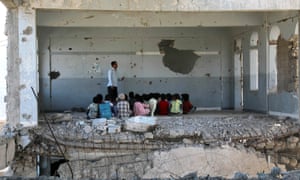
A damaged school in Yemen’s third-city of Taez
A damaged school in the Yemeni city of Taez. Civilian infrastructure has been damaged during the years of war between the Saudi-led coalition and the Houthi rebels. 

Source: The Guardian
By Jamie Doward
March 28 2020

The government has quietly drawn up proposals to lend other countries £1bn of public money so that they can buy British-made bombs and surveillance technology.

The move has been attacked by arms-control campaigners who say that taxpayers’ cash may end up fueling conflict and human rights abuses.

The plan was revealed in a single sentence slipped into this month’s budget. Unveiling a new £2bn lending facility for projects supporting clean growth, the government also announced the creation of “a new £1bn (fund) to support overseas buyers of UK defence and security goods and services”.

It is understood that the fund will be overseen by UK Export Finance, which gives loans to help foreign countries, especially those with developing economies, buy British goods and services.

“Even in times of crisis, the government is showing that it will go to any length to sell as many weapons as possible,” said Andrew Smith of Campaign Against Arms Trade. “The arms deals being supported with this money could be used in enabling atrocities and abuses for years to come. Government should be regulating and controlling arms sales, not using public money and doing everything it can to promote them.”

The government sees the defense industry as a major contributor to Britain’s post-Brexit economy. The Department for International Trade has a specialist team to promote UK arms sales.

In 2018, the latest figures available, the UK won arms contracts worth £14bn. Between 2008 and 2018 the UK was the second biggest arms exporter in the world, with 19% of the market share. Three-fifths of arms sales over the period went to the Middle East.

Some £5.3bn of arms have been licensed to Saudi Arabia since the war in Yemen began. There are concerns that the Saudi-led coalition, which is fighting Houthi rebels in the country, may have committed human rights violations by targeting civilian infrastructure.

Smith said the crisis in Yemen showed how policies to promote UK arms sales could backfire: “Over the last five years we have seen the devastating impact of UK-made fighter jets, bombs and missiles on Yemen. The war has killed tens of thousands of people, and created the worst humanitarian crisis in the world. Those arms sales need to end now, but so do the policies that allowed them to happen in the first place.”

The Treasury did not respond to requests for comment.

UK will have done well if fewer than 20,000 die, NHS medical director says

National Medical Director of NHS England Stephen Powis attends a news conference on the ongoing situation with the coronavirus disease (COVID-19) in London, Britain March 21, 2020.

Source: Reuters
March 28 2020

LONDON (Reuters) - The United Kingdom will have done well if it comes through the coronavirus crisis with fewer than 20,000 deaths, Stephen Powis, the national medical director of the National Health Service, said on Saturday.

Powis, speaking at a news conference in Downing Street, said that intensive care units were not yet full in London. He said the health service was preparing operating theaters and recovery areas to take critically ill patients.


3/26/2020

Coronavirus: how the UK government is using behavioural science


March 24 2020

The UK government’s handling of the novel coronavirus pandemic has come under serious criticism, not just from citizens, but from leaders around the world. One of the reasons for this is because the government is using behavioural science to decide how to coordinate its response to the pandemic.

In fact, more than 600 academics recently signed an open letter “expressing concern” about the UK government’s use of behavioural science in response to the novel coronavirus pandemic. This letter did not reject the use of behavioural science as part of the response, but simply called for the government to release the behavioural evidence it was using to determine policy.

According to the principles of behavioural science, people don’t act rationally. But if we can understand people’s actions, and how they act irrationally, then we can intervene to change behaviour. Such interventions are typically called “nudges”. These can be powerful tools for influencing how people behave but with the added benefit of allowing them to make their own choices. Nudges usually offer positive reinforcement or indirect suggestions that aim to influence decision making and behaviour in people.

Some example nudges in response to the novel coronavirus include singing happy birthday while washing your hands or using funny alternative “handshakes”. These strategies emphasise the need for good hygiene, and create memorable rules of thumb which encourage people to participate.

If the promises of behavioural science can be believed, the UK government’s use of it would potentially minimise economic disruption while still tackling the crisis. This is because, in theory, behavioural science can achieve desirable behaviours without significantly impacting other day-to-day activities. However, the question is whether in practice behavioural science to help mitigate disaster.

Nudges
Behavioural science came into prominence in the UK during the 2010-2015 Conservative-Liberal Democrat coalition government, which set up its own behavioural science advisory group called the Behavioural Insights Team (BIT) – sometimes known as the the Nudge Unit.

The establishment of BIT happened after the publication of Nudge, written by Richard Thaler (who would go on to win the 2017 Nobel Prize in Economics) and and Cass Sunstein (who would later serve in the Obama Administration as a “regulation Tsar”).

Nudge argued that behavioural economics research could be used to transform public policy. Nudges would be cheap, effective, and minimally disruptive. These arguments won support from several governments, and nudges have subsequently been used to encourage organ donation, retirement saving, and reduced plastic bag usage.

Nudges, and the behavioural science which inspired them, face a lot of criticism, even when they’re not being used to tackle a global pandemic. But it’s also unfair to say it’s not sometimes effective. For instance, in 2015 UK workplace pensions changed from being opt-in to opt-out. This “nudged” over 9 million UK employees to begin saving for their retirement, according to a 2017 report.

Using some behavioural science to help tackle the coronavirus pandemic may make sense, as Thaler has recently argued. For instance, Danish supermarkets have started using floor signs at check-outs to encourage customers to maintain a safe distance while purchasing groceries. But what has many experts worried is the government’s reliance on the idea of “behavioural fatigue”.


Foot taps, instead of hand shakes, are another example of a nudge. Linda Bestwick/ Shutterstock
No clear definition of behavioural fatigue exists. But as best understood, behavioural fatigue is the idea that eventually people get bored of doing one thing and start engaging in other, sometimes undesirable, behaviours. For example, if people are placed in quarantine, they may initially be very compliant. But after some time, this compliance will wither away. And it may possibly happen – as the UK government claims – at precisely the moment it’s most needed.

However, in their letter, the 600 behavioural scientists express doubt that enough is known about behavioural fatigue for the government to be building policy around this hypothesis. They ask for the government to release its evidence supporting behavioural fatigue. Until such evidence materialises, the disparity in the UK’s response may continue to be met with criticism.

Many behavioural science strategies, such as nudging, are classified as “soft paternalist interventions”. These strategies try to increase the welfare of a population, but aren’t so coercive as to stop a person making their own decisions. One famous example is automatically registering people as organ donors, unless they choose otherwise. This small change can significantly increase the number of organ donors, while maintaining freedom of choice.

By contrast, a ban on the sale of a product – for example, limiting the number of toilet rolls a single customer can buy – would be a “hard paternalist intervention”. The intervention is increasing welfare (either for a individual, or the popoulation), and an individual can’t do much about it.

By using behavioural science, the UK government chose a soft paternalism approach. This may have some advantages, notably being less disruptive in the short term to the economy and the lives of citizens. However, according to the World Health Organization, a hard paternalism strategy of social distancing and lockdowns, coupled with mass testing and investment in medical infrastructure, would be better.

The UK government’s soft paternalism strategy aimed to control the virus without incurring the same costs and disruptions as other countries. Though the novel coronavirus pandemic has put behavioural science to the test, the UK government has since changed its strategy. The government has now imposed stricter rules to control the spread of the virus. Whether changing to a “hard paternalist” approach will work – or if it was too late – yet remains uncertain.

3/19/2018

No evidence Vladimir Putin was behind U.K. assassination

https://canadiandimension.com/articles/view/no-evidence-vladimir-putin-was-behind-u.k.-assassination

4/01/2016

Former Spy Chief On Britain's 'Libya Mistake'


Πηγή: skyNews
By Alistair Bunkall, Defence Correspondent
March 30 2016

A former Israeli spy chief tells Sky News the actions of the UK and France in 2011 are to blame for the country's current turmoil.

David Cameron has again been criticised for Britain's 2011 intervention in Libya, this time by a former Israeli intelligence chief.

Ephraim Halevy has warned that Libya will be the "biggest problem for Europe in the months to come".

The former head of the Mossad gave a forthright assessment of the situation in an exclusive interview with Sky News.


David Cameron has been criticised over UK involvement in Libya

He said: "I believe the trouble coming from Libya is going to be immense.

"I think the operation originally launched by Britain and France turned out to be the biggest mistake committed by western Europe in recent years.


"I think the result we are now seeing in Libya is a direct result of the policies that were initiated by Paris and London at the start of this campaign."

Mr Cameron was singled out by Barack Obama a few weeks ago in rare criticism from a serving US President.

The Prime Minister was "distracted by a range of other things" after the 2011 invasion, Obama said, and Libya had been left in "a mess".

So far, action against Islamic State in Libya has been confined to a small number of US airstrikes.

Britain, and other European nations, are waiting on a formal request by a Libyan administration before intervening in the country.

If that is forthcoming around 1,000 UK troops are expected to deploy in a training capacity, supporting a larger Italian mission. An air campaign is also being considered.

Mr Halevy also said Britain was more secure as a member of the EU and should not leave.


"I have no doubt that the continued membership of Britain in Europe is vital and essential…to make Britain more secure.

"In order to craft a credible reply, a credible remedy to the Muslim communities' problems as traditional Europe faces them, there must be a common policy.

"A common policy can only be obtained if all the countries who are involved in this actually work together in unison in a very, very profound way.

"Otherwise, each country will go its separate way and it will take much, much longer and the end result will be in doubt."


3/24/2015

UK and France Among Countries Blamed for Chaos in Libya


Πηγή: Sputnik
March 24 2015

The international community - and the UK in particular - has come under severe criticism for allowing the situation in Libya to descend into chaos after the fall of Gaddafi, causing ISIL to establish a foothold in North Africa.


A House of Commons Foreign Affairs committee report, released on March 24, says that following the air and sea strikes, led by the UK and France with the US, Libya was left largely without functioning institutions and there was a failure to dissolve the various militias and prevent the flow of weapons across North Africa.

The report said:

"That the current crisis and conflict in Libya was brought about by failures among the Libyan politicians and militias does not absolve the international community, or the UK, from a particular responsibility to assist Libya to repair itself."

"The fact that ISIL appears to have taken advantage of the chaos in Libya to establish itself there is a security concern reaching beyond Libya, and is further motivation for the international community to provide assistance."


Brave Words, Few Deeds


Britain joined France and the US in the air strikes to allow opponents of Gaddafi to take control of the major cities of Libya. In the aftermath, in September 2011, the UK Prime Minister David Cameron and French President Nicolas Sarkozy were given a rapturous reception as they toured Tripoli and Benghazi.


"It is great to be here in free Benghazi, and free Libya," Mr Cameron said. "Your city was an inspiration to the world as you threw off the dictator and chose freedom. People in Britain salute your courage."


© AP PHOTO/ RAQQA MEDIA CENTER

President Sarkozy said "You wanted peace, you wanted liberty, you want economic progress. France, Great Britain and Europe will be on the side of the Libyan people".

However, the report says the country has now disintegrated into a patchwork of militias fighting each other, which has allowed ISIL to establish itself and take advantage of the chaos. The committee said this had led to a direct threat of terror attacks on mainland Europe.

"Illegal migration through and from Libya is undoubtedly a major concern, not least because of a potential security threat from terrorists who could use this means to travel to Europe to conduct attacks," the report said.

It also said the appointment of Jonathan Powell as the UK Special Envoy to the Libyan Political Transition has led to "some limited criticism of his role and lack of visibility".


6/25/2013

UK and China sign three year currency swap to make business in Yuan

Sir Mervyn King announced the deal. UK banks hold 35bn Yuan in deposits

Πηγή: MP
June 24 2013

The Bank of England and its Chinese counterpart have signed a deal likely to boost trade between the UK and China in the Yuan. The BoE and the People’s bank of China have signed a three year currency swap arrangement worth 200bn Yuan (33bn dollars), the UK central bank confirmed.

The UK is looking to become a centre for the Chinese currency, also known as the Renminbi. British banks hold 35bn Yuan worth of deposits in the Chinese currency.

Currency-swap agreements allow central banks to swap currencies and can be used by firms to settle trade in local currencies rather than in US dollars, as happens now, since China's currency is not fully convertible to other currencies.

The prospective deal was first announced in February by BoE Governor Sir Mervyn King.

“In the unlikely event that a generalised shortage of offshore Renminbi liquidity emerges, the Bank will have the capability to facilitate Renminbi liquidity to eligible institutions in the UK,” Sir Mervyn said on Saturday.

Last year, the UK Treasury announced plans to make London - the world's largest currency trading hub - the leading international centre for trading the Yuan outside mainland China and Hong Kong.

China has been gradually relaxing strict controls on the value of its currency and on flows of capital. Beijing has been using these pacts as part of its push for a more global role for the Yuan.

It has a swap agreement with Brazil worth 30bn dollars and has also signed similar agreements with other trading partners such as Japan, Australia and Hong Kong.


12/28/2012

New MRSA superbug strain found in UK milk supply


Πηγή: The Independent
By JEREMY LAURANCE
Dec 26 2012

A new strain of MRSA has been found in British milk, indicating that the superbug is spreading through the livestock population and poses a growing threat to human health.

The new strain, MRSA ST398, has been identified in seven samples of bulk milk from five different farms in England.

The discovery, from tests on 1,500 samples, indicates that antibiotic-resistant organisms are gaining an increasing hold in the dairy industry.

The disclosure comes amid growing concern over the use of modern antibiotics on British farms, driven by price pressure imposed by the big supermarket chains. Intensive farming with thousands of animals raised in cramped conditions means infections spread faster and the need for antibiotics is consequently greater.

Three classes of antibiotics rated as “critically important to human medicine” by the World Health Organisation – cephalosporins, fluoroquinolones and macrolides – have increased in use in the animal population by eightfold in the last decade.

The more antibiotics are used, the greater the likelihood that antibiotic-resistant bacteria, such as MRSA, will evolve.

Experts say there is no risk of MRSA infection to consumers of milk or dairy products so long as the milk is pasteurised. The risk comes from farmworkers, vets and abattoir workers, who may become infected through contact with livestock and transmit the bug to others.

The discovery was made by scientists from Cambridge University who first identified MRSA in milk in 2011. They say the latest finding of a different strain is worrying.

Mark Holmes, of the department of veterinary medicine, who led the study, published in Eurosurveillance, said: “This is definitely a worsening situation. In 2011 when we first found MRSA in farm animals, the Department of Environment, Food and Rural Affairs [Defra] initially didn’t believe it. They said we don’t have MRSA in the dairy industry in this country.”

“Now we definitely have MRSA in livestock. What is curious is that it has turned up in dairy cows when in other countries on the Continent it is principally in pigs. Could it be in pigs or poultry in this country? We don’t know.”

The MRSA superbug can cause serious infections in humans which are difficult to treat, require stronger antibiotics, and take longer to resolve. Human cases of infection with the new strain have been found in Scotland and northern England according to Defra, but no details are available.

Dr Holmes said supermarket pressure on farmers to hold down prices was leading to the overuse of antibiotics to prevent cattle getting mastitis, an infection of the udder, that might interrupt the milk supply.

“If farmers were not screwed into the ground by the supermarkets and allowed to get a fair price for their milk they would be able to use fewer antibiotics,” he said.

“Common sense tells us that anything we can do to reduce use of antibiotics will reduce the growth of resistant bugs. We want to wean our farmers off antibiotics and the only way we can do that is with better regulation.”

Vets in Norway and Denmark had much more limited prescribing powers than in the UK, he added.


12/02/2012

Cyprus fighters sue Britain for torture during uprising

Those who fought colonial rule in the late 1950s allege they were abused by the British

Πηγή: The Independent
By SAM CREIGHTON and DAVID CONNETT
Dec 2 2012

Britain is facing fresh legal action from victims of alleged abuse and mistreatment by UK security forces during the fight against colonial rule in Cyprus between 1955 and 1959. Scores of veterans from the Eoka insurgency are pressing ahead with claims that they were subject to brutal treatment and are seeking an apology and damages from the British government. The move follows an earlier High Court decision to allow Kenyans to sue Britain over torture during the Mau Mau uprising in the 1950s.


Vasos Sophocleous, president of Eoka Fighters' Federation, the group bringing the action, says he still suffers from the abuse he says he received at the hands of the British. "I was tortured 10 or 15 times over 17 days, all types of torture, of the body, of the mind, everything. I cannot describe them; it's not easy for me to speak about them. I still suffer. I feel pain in my back. I feel pain in my knees. I still cannot hear out of my left ear. If there is, and I believe that there is, a real democratic court, then I'm very hopeful that we will win because I believe the court will do their duty. They have admitted already, 40 or 50 years later, that they tortured people in Cyprus."

Petros Patrides, a businessman, was a 15-year-old schoolboy when he was detained by the British hunting the Eoka leader Georgios Grivas. Mr Patrides says he was waterboarded by his interrogators who were British Special Branch officers. "They tied me on a bed, spread-eagled and naked, and rubbed pepper into my lips and eyelids, and my private parts. They would put a piece of cloth over your nose and mouth and dip water on to it and you would feel like you were drowning. Just before you passed out they would stop and take the cloth off. And then they would start again."

Mr Patrides, who was born in Lincoln and whose father served as a British Army officer during the Second World War, says he has not yet decided whether to sue but wanted an apology. "We all know how polite and proper the British are, but what the British did was wrong and it is payback time and they should say sorry for what they did."

Victims and lawyers said that fresh evidence of abuse is emerging from now declassified British government files as well as a Red Cross investigation into abuse allegations in 1957. Cyprus gained independence in 1960 when Archbishop Makarios was elected president.

Birmingham-based solicitor Kevin Conroy, who is acting for several Eoka fighters, said: "What you've got here is an insurrection that took place in the 1950s and the people were detained. I'm not talking about people who were convicted: two detention camps were set up, like the internment in Northern Ireland in 1971. That is what was happening in Cyprus. People were being detained on suspicion of being members of Eoka, not convicted. I'm no apologist for Eoka – far from it, it was horrible – but while people are in custody, there's a rule of law. If you're tortured or assaulted while in custody, regardless of who you are or what you've done, that's wrong."

Martyn Day, a solicitor who is also acting in the Mau Mau case, said: "It's entirely depressing to look at what happened in Kenya and Cyprus. It's very strong evidence of systemic abuse carried out at the behest of the British government. There are about 600 potential cases in Cyprus, but it's still early days and we're working through them all so we can put forward the strongest case possible. No case is copper-bottomed and no case is total rubbish. Every case has a chance."

Allegations of widespread torture and prisoner abuse by Britain are documented in a new book, Cruel Britannia: A Secret History of Torture. Its author, Ian Cobain, said: "In Cyprus, the British exposed the depth of their ignorance of their adversaries when they resorted to torture. We British have resorted to torture not boastfully, not routinely and rarely with obvious relish. But we have been ready to resort to torture when we have come to believe that the country's situation was desperate, when one prized colonial possession after another was being lost.

"We have shown ourselves to be remarkably reluctant to abandon the calculated use of brutal force and pain when questioning our enemies. One important reason why these crimes have been committed with impunity over the years is that the British public tends not to believe what is happening and the British media is reluctant to make them any the wiser. On the isles of fair play, it is assumed, the use of torture cannot be possible, because it is unthinkable."

A history of abuse

Malaya On 12 December 1948, 24 Malayan villagers were killed by a unit of the Scots Guards in the Batang Kali massacre. Relatives of the victims are pursing legal action against the British government.

Kenya The Mau Mau uprising was a rebellion against British colonial rule in Kenya between 1952 and 1960. In July 2011, surviving members of the rebellion were granted permission to sue the British Government over alleged human rights abuses perpetrated during the uprising's suppression.

Yemen The Aden Emergency was an uprising against British colonial rule of the port town. It began in 1963 and continued until British withdrawal in 1967. Some commentators have said that survivors who were British prisoners during the rebellion could bring cases for the abuse they allege they suffered.


8/19/2012

Full Video and Full Transcript of Julian Assange August 19th 2012 Speech Outside the Ecuadorian Embassy


Πηγή: OpEdNews
By Julian Assange
August 19 2012

"I am here because I cannot be closer to you.

Thank you for being here.

Thanks you for your resolve and your generosity of spirit.

On Wednesday night, after a threat was sent to this embassy and the police descended on the building, you came out in the middle of the night to watch over it, and you brought the world's eyes with you.

Inside the embassy after dark I could hear teams of police swarming up into the building through the internal fire escape. But I knew that there would be witnesses.

And that is because of you.

If the UK did not throw away the Vienna conventions the other that is because the world was watching.

And the world was watching because you were watching.

So the next time somebody tells you that it is pointless to defend those rights we hold dear, remind them of your vigil in the dark before the Embassy Of Ecuador... Remind them how, in the morning, the sun came up on a different world and a courageous and a courageous Latin American nation took a stand for justice.

And so to those brave people I thank President Correa for the courage he has shown in considering and in granting me political asylum.

And so I thank the government and the Foreign Minister Ricardo Patino who have upheld the Ecuadorian constitution and its notion of universal citizenship in their consideration of my case.

And to the Ecuadorian people for supporting and defending this constitution. And I have a debt of gratitude to the staff of this embassy whose families live in London and who have shown me hospitality and kindness despite the threats that they all received.

This Friday there will be an emergency meeting of the foreign ministers of Latin America in Washington DC to address this very situation. And so I am grateful to the people and governments of Argentina, Bolivia, Brazil, Chile, Columbia, El Salvador, Honduras, Mexico, Nicaragua, Peru, Venezuela and to all of the other Latin American countries who have come to defend the right to asylum.

To the people of the United States, the United Kingdom, Sweden and Australia who have supported me in strength even when their governments have not, and to those wiser heads in government who are still fighting for justice, your day will come.

To the staff, supporters and sources of Wikileaks whose courage and commitment and loyalty has seen no equal.

To my family and to my children who have been denied their father forgive me we will be reunited soon.

As Wikileaks stands under threat so does the freedom of expression and the health of our societies. We must use this moment to articulate te choice that is before the government of the United States of America.

Will it return to and reaffirm the values it was founded on? Or will it lurch off the precipice dragging us all into a dangerous and oppressive world in which journalists fall silent under the fear of prosecution and citizens must whisper in the dark?

I say that it must turn back.

I ask President Obama to do the right thing.

The United States must renounce its witch-hunt against Wikileaks.


The United States must dissolve its FBI investigation.

The United States must vow that it will not seek to prosecute our staff or our supporters.

The United States must pledge before the world that it will not pursue journalists for shining a light on the secret crimes of the powerful.

There must be no more foolish talk about prosecuting any media organization be it Wikileaks or the New York Times.

The US administration's war on whistleblowers must end.

Thomas Drake and William Binney and John Kiriakou and other heroic US whistleblowers must - they must - be pardoned and compensated for the hardships they have endured as servants of the public record.

And the Army Private who remains in a military prison in Fort Levenworth Kansas, who was found by the UN to have endured most torturous detention in Quantico Virginia and who has yet after two years in the prison to see a trial, he must be released.

Bradley Manning must be released.

If Bradley Manning really did as he is accused he is a hero an example to us all and one of the world's foremost political prisoners.

Bradley Manning must be released.

On Wednesday Bradley Manning spent his 815th day of detention without trial. The legal maximum is 120 days.

On Thursday my friend Nabeel Rajab, president of the Bharanian human rights center, was sentenced to three years for a tweet. On Friday a Russian band were sentenced to two years in jail for a political performance.

There is unity in the oppression. There must be absolute unity and determination in the response.

Thank you."