Showing posts with label Yemen. Show all posts

6/14/2020

Is Turkey Preparing For Libya-Style Intervention In Yemen?


Source; Mint Press
June 11 2020
By Ahmed Abdulkareem


ADEN, YEMEN — As focus begins to turn to developments in Libya and the foreign interference that plagues the Arab country, it seems that Turkey already has its eye elsewhere, preparing for military involvement in Yemen in a move that has sparked concern among Yemenis already struggling against an intervention led by Saudi Arabia, famine and most recently, COVID-19.

Informed sources in Aden and Taiz revealed to MintPress that a militia belonging to the Muslim Brotherhood-affiliated El-Eslah Party, the ideological and political ally of Turkish President Tayyip Erdogan, is already engaged in the latest round of fighting in Yemen’s southern provinces, particularly in Abyan and Shabwa.

The Turkish intervention, which extends to Marib – an oil-rich province located 173 kilometers to the northeast of Ansar Allah-controlled Sana’a, has so far been led by officers, experts, and training personnel, and has involved the delivery of weapons, including drones, for use by Turkish allies on the ground. The move paves the way for wider intervention in Yemen that would resemble Turkey’s role in Libya in favor of The Government of National Accord, which is currently battling General Khalifa Haftar’s forces for control over the country.

The Turkish officers and advisors in Yemen are lending comprehensive support to El-Eslah’s militants who have been fighting against the Southern Transitional Council (STC) in Abyan since April 26, when the STC imposed emergency rule in Aden and all southern governorates.

Beginning in 2018 and ‘19, dozens of Turkish officers and experts reportedly arrived in many Yemeni areas overlooking the Red Sea and Arabian Sea, particularly in Shabwa, Abyan, Socotra, al-Mahra and coastal Directorate of Mukha near the Bab al-Mandab Strait as well as to Marib. The officers reportedly entered Yemen as aid workers under pseudonyms using Yemeni passports issued illegally from the Yemeni passport headquarters in the governorates of Ma’rib, Taiz, and Al-Mahrah.

Recently, Ankara trained hundreds of Yemeni fighters in Turkey and in makeshift camps inside of Yemen. Moreover, Turkey recruited Libyan and Syrian mercenaries to fight in Yemen bty promising them high salaries to fight for the Muslim Brotherhood in the southern regions and along the western coast of Yemen, according to sources that spoke to MintPress.

One of those sources said that a group of mercenaries was supposed to enter the country last week in a Turkish plane carrying “aid and medicine related to coronavirus pandemic” but the Saudi-led coalition prevented the plane from landing at Aden’s airport. Now, sources say, Turkish intelligence and its allies in Yemen are working on a strategy to enter the country by pushing for eased travel restrictions under the guise of fighting coronavirus.

Yemeni politicians told MintPress that Turkey wants to reach the strategic port of Balhaf and secure for use as a hub to export gas and oil and to control the open coasts of the Arabian Sea and Bab al-Mandab Strait for later use as a gateway for Turkish intervention in the region. Turkish control in those areas would provide access to support and supply Turkish military bases in Somalia and Qatar.

This information provided to MintPress was confirmed by the London-based Syrian Observatory for Human Rights and Libyan Army spokesman Maj. Gen. Ahmed al-Masmari, who is recruiting Syrian and Lybian mercenaries with attractive salaries to fight with the Muslim Brotherhood in Yemen. At this point, both the Saudi-led Coalition and Turkey have exploited the Yemeni poor, recruiting them to fight in both Libya and Syria.

In Taiz, Turkey has opened training camps, the most important of which is located on the outskirts of the al-Hajariya Mountains near the Bab al-Mandab Strait and is run by Hamoud al-Mikhlafi who resides in Turkey and regularly visits Qatar. Al-Mikhlafi also established the “Hamad Camp” in the Jabal Habashi District. Shabwah, and Marib have also received Turkish support.

Ankara has successfully boosted its intelligence presence in Yemen through the use of Turkish humanitarian aid organizations. There are many Turkish “humanitarian relief organizations” operating in three coastal Yemeni regions: Shabwa, Socotra, and the al-Mukha region in Taiz governorate. Among those organizations is the Turkish Humanitarian Relief Agency (IHH) which operates in the governorate of Aden, the Turkish Red Crescent, the Turkish Cooperation and Coordination Agency (TIKA), the Turkiye Diyanet Foundation (Türkiye Diyanet Vakfı) among dozens of other Turkish organizations.

Turkey has been supporting Yemen’s El-Eslah Party, founded in 1990, since before the Saudi-led Coalition launched its offensive in Yemen in 2015. Similar to its support for the Government of Accord in Libya, El-Eslah has gained additional momentum in recent years given the power and money it has received from both Turkey and members of the Saudi-led coalition.

An ally in El-Eslah


In a related event, high-ranking government officials from Turkey have traveled to Yemen to develop strategic interests and conclude agreements which could allow Turkey to resort to military force to protect its interests in the country. ln January 2019, Turkey’s deputy interior minister, Ismail Catakln traveled to Aden and held a meeting with high-ranking officials from the El-Eslah party, including Maeen Abdulmalik Saeed, who has been appointed “Prime Minister of Yemen” by ousted President Abdul Mansour al-Hadi on October 18, 2018.

According to a joint official statement, a number of agreements were concluded at the meeting involving humanitarian aid, health and education, economic and service projects, as well as an agreement to activate the joint committee between Yemen and Turkey. The most important agreement was a security and intelligence agreement between the Deputy Prime Minister and Minister of Interior Ahmed Al-Misri, a member of El-Eslah party.
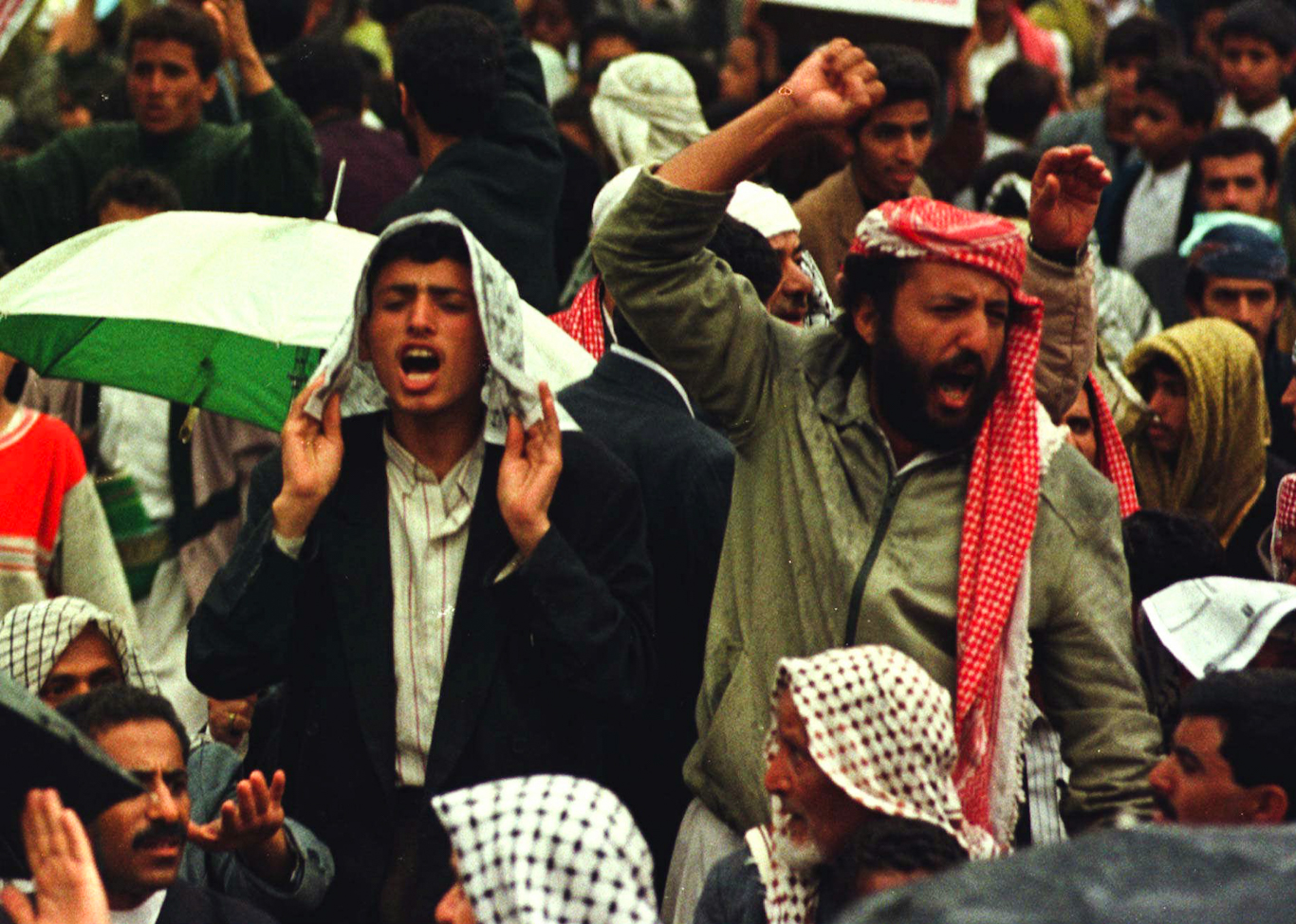
El-Eslah has long been a force in Yemeni politics. In this photo, supporters shout slogans as they await parliamentary election results in Sana’a, April 28, 1997. Enric Marti | AP

This came months after “former Yemeni Transport Minister” Saleh al-Jabwani, a Reform Party affiliate, visited Turkey to sign agreements to hand over Yemeni ports, an agreement that was rejected by “Yemeni government officials” belonging to the Saudi-led coalition.

Prior to that, El-Eslah party officials and ministers have taken trips to Turkey to lobby AKP officials and encourage them to invest in Yemen’s transport sector and ports.

Saudi Coalition reels as Turkey ruffles feathers


It is unlikely that Yemen is currently Turkey’s first priority in the region as it has already established a base in Djibouti and has a presence in both Somalia and Sudan, where Ankara has been granted temporary control of Sudan’s Suakin Island, providing it an important foothold into the Red Sea. But Turkey’s efforts in Yemen not only grant it expanded influence in the Bab al-Mandab Strait and the Red Sea but also with influence in the Arabian Sea.

From the perspective of Saudi Arabia and the United Arab Emirates, who are already at odds with Turkey, the presence of Turkish forces in Yemen could be a real threat to their interests. Moreover, a Turkish presence could serve as a very effective trump card for Turkey’s close ally Qatar, which has had a hostile relationship with these countries since the UAE, Saudi Arabia, Bahrain and Egypt broke ties with Doha in 2017. Furthermore, Turkey’s efforts, particularly in the Bab al-Mandeb Strait, are a threat to Egyptian national security. Egypt is also at odds with Turkey due to Ankara’s support for the Muslim Brotherhood and competition for resources in the Eastern Mediterranean.

The Turkish project in Yemen has given new zeal to the Saudi-led Coalition in its efforts to control Yemen’s islands. This week, Eritrean forces supported by the United Arab Emirates launched a military attack to take Yemen’s Hanish Islands in the Red Sea on Tuesday. The attack comes amid renewed tensions that have seen Yemenis that attempt to approach the Islands, even fishermen, arrested by Eritrean forces.

The proactive move by Eritrean President Isaias Afwerk is no surprise as Afwerk rejected previous Turkish efforts to establish a presence on the Sudanese island of Suakin. Eritrea briefly occupied the Hanish Islands in 1995 before retreating after the international arbitration court granted Yemen sovereignty over them.

A fiery clash in Yemen between the Saudi-led coalition and Turkey could be inevitable as the coalition seeks to dominate the Yemeni arena and eliminate Turkish interests there. It is also unlikely Turkey will abandon its allies and geostrategic ambitions in Yemen, as it refused to do in Libya or Syria. Unfortunately, the biggest losers in this scenario are the Yemeni people and their lands.

A quagmire for the would-be invader


Yemenis for their part are concerned about potential Turkish military intervention in their country. They say any additional foreign interference will complicate the situation and eliminate the hope of ending the conflict for dozens of years. Indeed, Yemen is already grappling with COVID-19, a collapsed healthcare system, and an ongoing Saudi-led coalition war and blockade.

However, Ansar Allah and its allies, as well as major parties in Yemen allied with the Saudi-led Coalition, have warned that Turkey’s military intervention in the country will be considered blatant aggression ad will be met by fierce military resistance. They urged the Turks to learn from the coalition’s failed experience and their own history which saw the Ottman Turks lose thousands of troops in Yemen during their ancient forays.

Yemeni Hussein al-Qwabari promised an armed struggle against any Turkish involvement in his country. He got upset when asked if he supports conditional Turkish intervention in Yemen. Al-Qwabari wons a home in Mathbah, which translates roughly into “The Alter.” Mathbah is so named for a famous incident in which thousands of Turkish soldiers were massacred by Yemeni resistance forces and al-Qwabari says he is enthusiastically prepared to repeat the experience of his grandparents in their armed struggle against the Turks.

In fact, the issue of Turkish interference in Yemen is a sensitive topics which provokes national fervor, especially among those old enough to remember the painful experiences of previous intrusions. The Ottoman Turkish Empire reduced Yemen, particularly the north, to a poor and backward vassal state.

There is good reason that Yemen has gained a reputation as a quagmire for would-be invaders. Yemen was not only conquered by the Ottomans Turks once but twice. The first time was in the sixteenth century under the pretext of thwarting Portuguese ambitions and saw Ottoman forces unable to capture the whole of Yemen. The Turks sent more than 80,000 soldiers to suppress local uprisings against foreign intervention but only 7,000 Turks returned home. The Turks returned in the nineteenth century and were again expelled in the 1910s.

However, many Yemeni activists belong to El-Eslah, including high-ranking officials in the party as well as journalists, have increased calls to make room for Turkey in Yemen, citing the gains made in Libya by groups supported by Turkey,

“We want Turkish intervention in Yemen,” Anis Mansour, the former Media attaché at the Yemeni embassy in Saudi Arabia said in a video posted from Turkey in which he spoke in front of the infamous Hagia Sophia. Mansour runs a network of social media activists and lives in Qatar. Supporters of Turkish intervention among Yemenis stems from the hope that Turkish military activities could stem Saudi and Emirati ambitions in the country and end the chaos and tragedy left by the coalition. They believe that the Turks can end the war and return the former government to Sana’a. Other Yemenis believe that Turkish intervention will be little more than an alternative to Saudi intervention and will do little to change the situation on the ground.

Yemenis collectively have not forgotten their experiences during both British and Turkish intervention. They are well-acquainted with outside forces that yearn for Yemen for its geographic location more than for its people. Today, they are experiencing another intervention, led by the richest countries in the world. They see neighbors that share a common language and faith do nothing while they are killed by hunger, disease, and incessant bombing.

This has ultimately caused an opening for Turkey as war-weary Yemenis may be amenable to a new foreign invader provided that their rights, sovereignty, and independence are respected.

Ahmed AbdulKareem is a Yemeni journalist. He covers the war in Yemen for MintPress News as well as local Yemeni media.

4/25/2020

COVID-19 will prolong conflict in the Middle East

WHO: Middle East providing little details on coronavirus ...

Source: Brookings
April 24 2020
By Ranj Alaaldin

he COVID-19 pandemic could not have come at a worse time for the Middle East. Since the U.S.-led international coalition secured the territorial defeat of ISIS three years ago, the region is still struggling to achieve lasting peace. Much of the region remains engulfed in ongoing conflict. The civil war has not ended in Syria, while Libya and Yemen are mired in proxy wars that have produced untold humanitarian crises.

The humanitarian cost of these ongoing conflicts cannot be understated. Hundreds of thousands have been killed and millions have been displaced. The number of those who have been forced into a life of destitution and misery is far greater. Syria’s war has displaced more than 12 million people (half its population) both internally and externally. A total of 6.5 million more have been internally displaced in Iraq and Yemen. In Libya, more than 435,000 people have been displaced. The startling statistics go on: About 11 million people need humanitarian aid in Syria; in Yemen, 24 million; in Libya, 2.4 million; and in Iraq, 4.1 million.

The Middle East faces a potential moment of reckoning, a convulsion that will have cross-border implications and destabilize countries that have managed to keep conflicts outside of their borders. In countries where state capacity has become either severely diminished or non-existent, the consequences of COVID-19 could be transformational, expanding the reach of militias, terrorists, and other armed sub-state actors who have filled governance voids to provide services to local communities, in some cases combining this with brutal subjugation.

It is in conflict-stricken countries where the impact of the pandemic will be the most acute. In Libya, Syria, and Yemen, hospitals and healthcare facilities have been directly targeted by warring factions and their external sponsors. Meanwhile, political elites, militias, and external powers engaged in proxy wars have fought fiercely over resources and territory.

Far from pushing these conflicts toward peace, the COVID-19 pandemic will most likely be a conflict-multiplier as belligerents move to intensify contestation over territories and resources, which will now include an expanded focus on securing access to vital medical supplies. The crisis is an opportunity to reinforce their reputations, double-down on the conflicts embroiling the region, and consolidate their positions in the process. In other words, COVID-19 will not prompt a rallying call for a lasting peace.

CONFLICTS AROUND THE REGION

In Libya, as Frederic Wehrey and others have pointed out, the pandemic has provided a boost to militias, providing an opportunity for them to channel medical aid to their fighters and instrumentalize the crisis to reward and reinforce patronage networks and favored communities. Troublingly, Libya’s hospitals are routinely targeted by rocket attacks, exacerbating the situation.

In Yemen, militias loyal to the UAE-backed Southern Transitional Council (STC) stormed into the southern port of Aden and stole medical aid donated by the World Health Organization (WHO), including nine ambulances destined for the health ministry. The conflict in Yemen has involved indiscriminate attacks that have devastated medical facilities and water supplies, contributing to what the international community has described as the world’s greatest man-made humanitarian crisis, including the worst cholera outbreak in modern history. In Lebanon, Hezbollah has reinforced its status as an alternative to the Lebanese state by committing close to 5,000 doctors, medics, and nurses to fight the pandemic.

In Iraq, ISIS has ramped up its attacks in northern Iraqi villages and is moving to exploit Baghdad’s growing list of crises — ranging from the escalation between the U.S. and Iran, the decline in oil prices, and country-wide protests. During a public health crisis, ISIS can revive itself and expand its influence by catering to the needs of local communities in ways other authorities — like the Baghdad government — have not. At a minimum, Baghdad’s failures allow ISIS to position itself as a viable alternative. Combined with its current campaign of fear and intimidation, targeted assassinations, and extortion, this provides it with a patchwork, under-ground infrastructure of influence that establishes a launching pad from which to seize towns and cities in the manner it did in June 2014.

In Syria, the civil war has shattered formal governing structures, and the Assad regime and Russia have moved to obliterate hospitals from the outset of the nine-year conflict. Syria is effectively three countries: regime-controlled territories, the Kurdish northeast, and Idlib in the northwest, which has 1.4 doctors per 10,000 people and only 100 ventilators. COVID-19 increases the prospects of another refugee wave that stretches the capacity of neighboring countries like Turkey and Lebanon to meet the humanitarian needs of these refugees. It also puts increased pressure on Western-aligned groups like the Kurdish-dominated Syrian Defense Forces (SDF), on which the West depends to maintain combat operations against ISIS and manage prison cells for detained ISIS combatants.  The SDF also hosts refugee camps like Al-Hor, which houses 70,000 refugees, including ISIS combatants and their families.

The humanitarian devastation in Syria will worsen if these enclaves do not adopt a collective response to the pandemic. Actors on the ground must refrain from targeting supply lines and enable the space for outside assistance. Pro-Turkish forces have cut off water supplies to Kurdish-held areas in the northeast, which compromises the ability of humanitarian agencies to protect vulnerable communities during the pandemic. Meanwhile, the Assad regime has refused to extend the support it receives from the WHO to non-regime-held areas. That, by default, becomes an indictment of the WHO, which refuses to operate beyond regime-held Damascus. Such institutions are paralyzed and ill-suited to conflict zones by design because of international norms that confine them to work around the contours of sovereignty, even though the Assad regime should arguably no longer enjoy the benefits conferred by state sovereignty given its egregious behavior.


3/28/2020

Revealed: £1bn of taxpayers' cash to help foreign countries buy British arms

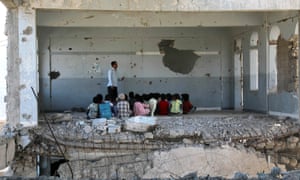
A damaged school in Yemen’s third-city of Taez
A damaged school in the Yemeni city of Taez. Civilian infrastructure has been damaged during the years of war between the Saudi-led coalition and the Houthi rebels. 

Source: The Guardian
By Jamie Doward
March 28 2020

The government has quietly drawn up proposals to lend other countries £1bn of public money so that they can buy British-made bombs and surveillance technology.

The move has been attacked by arms-control campaigners who say that taxpayers’ cash may end up fueling conflict and human rights abuses.

The plan was revealed in a single sentence slipped into this month’s budget. Unveiling a new £2bn lending facility for projects supporting clean growth, the government also announced the creation of “a new £1bn (fund) to support overseas buyers of UK defence and security goods and services”.

It is understood that the fund will be overseen by UK Export Finance, which gives loans to help foreign countries, especially those with developing economies, buy British goods and services.

“Even in times of crisis, the government is showing that it will go to any length to sell as many weapons as possible,” said Andrew Smith of Campaign Against Arms Trade. “The arms deals being supported with this money could be used in enabling atrocities and abuses for years to come. Government should be regulating and controlling arms sales, not using public money and doing everything it can to promote them.”

The government sees the defense industry as a major contributor to Britain’s post-Brexit economy. The Department for International Trade has a specialist team to promote UK arms sales.

In 2018, the latest figures available, the UK won arms contracts worth £14bn. Between 2008 and 2018 the UK was the second biggest arms exporter in the world, with 19% of the market share. Three-fifths of arms sales over the period went to the Middle East.

Some £5.3bn of arms have been licensed to Saudi Arabia since the war in Yemen began. There are concerns that the Saudi-led coalition, which is fighting Houthi rebels in the country, may have committed human rights violations by targeting civilian infrastructure.

Smith said the crisis in Yemen showed how policies to promote UK arms sales could backfire: “Over the last five years we have seen the devastating impact of UK-made fighter jets, bombs and missiles on Yemen. The war has killed tens of thousands of people, and created the worst humanitarian crisis in the world. Those arms sales need to end now, but so do the policies that allowed them to happen in the first place.”

The Treasury did not respond to requests for comment.

12/31/2012

Oil Search Dilutes Interests in Yemen with Sale of Block 3 Stake to Total


Πηγή: Rigzone
By Quintella Koh|
Dec 31 2012

Australia-listed Oil Search revealed Monday that it has completed the sale of its 40 percent interest in Block 3 (Gardan), onshore Yemen, to French major Total for $44 million. As part of the deal, Total will assume operatorship of the block.

Oil Search disclosed that based on the current book value, an after tax profit from the sale will be included in its 2012 full year results.

Commenting on the deal, Oil Search's Managing Director Peter Botten said, "The completion of the sale of Oil Search’s interest in Block 3, Yemen is in line with our strategy to optimize our international acreage portfolio in the Middle East and North Africa, with a focus on licenses with material upside. Drilling is currently underway on a large prospect in Kurdistan, with encouraging preliminary indications, and a high potential well in Tunisia is due to commence drilling in early 2013."

With the sale of its Block 3 interest, Oil Search's remaining asset in Yemen is its 34 percent interest and operatorship of Block 7 (Al Barqa), also onshore Yemen, which contains the Al Meashar oil field discovered in 2010.

"The company is planning to acquire a 2D seismic program over prospective areas in [Block 7], subject to a stable and safe operating environment," Oil Search said in its disclosure.

Block 7 has been in force majeure since mid-2011 due to the "Arab Spring" uprising. Oil Search's most recent well drilled on the block, Al Meashar-1, was in March 2010. The well – at that time – flowed oil, gas and drilling fluids at an unstable rate of 200 barrels of oil per day and 100 barrels of drilling fluid per day.


12/30/2012

Yemen: Al-Qaida offers bounty for US ambassador


Πηγή: mySA
By AHMED AL-HAJ (AP)
Dec 30 2102

SANAA, Yemen (AP) — Al-Qaida's branch in Yemen has offered to pay tens of thousands of dollars to anyone who kills the U.S. ambassador in Sanaa or an American soldier in the country.

An audio produced by the group's media arm, the al-Malahem Foundation, and posted on militant websites Saturday said it offered three kilograms of gold, worth $160,000, for killing the ambassador.

The group said it will pay 5 million Yemeni riyals ($23,000) to anyone who kills an American soldier inside Yemen.

It said the offer is valid for six months.

The bounties were set to "inspire and encourage our Muslim nation for jihad," the statement said.

The U.S. Embassy in Sanaa did not respond to an Associated Press phone call asking for comment.

Washington considers al-Qaida in Yemen to be the group's most dangerous branch.

The group overran entire towns and villages last year by taking advantage of a security lapse during nationwide protests that eventually ousted the country's longtime ruler. Backed by the U.S. military experts based at a southern air base, Yemen's army was able to regain control of the southern region, but al-Qaida militants continue to launch deadly attacks on security forces that have killed hundreds.

In the capital, Sanaa, security officials said two gunmen on a motorbike shot and killed two intelligence officers early Sunday as they were leaving a downtown security facility. The officials, who spoke on condition of anonymity according to regulations, said all intelligence and security officers have been instructed to take precautionary measures outside working hours.

The government blames al-Qaida for the killing of several senior military and intelligence officials this year mainly by gunmen on motorbikes.

The officials said security authorities in Sanaa have launched a campaign against motorcyclists suspected of involvement in these attacks or other crimes, arresting about 200 for questioning for violations, including driving motorcycles without license plates.


9/14/2012

In Libya, Chaos Was Followed by Organized Ambush, Official Says

The United States Consulate in Benghazi, Libya, on Thursday. An Interior Ministry official said the United States ambassador was killed in the initial attack.

Πηγή: New York Times
By SULIMAN ALI ZWAY and RICK GLADSTONE
Sept 13 2012

BENGHAZI, Libya — The mayhem here that killed four United States diplomatic personnel, including the ambassador, was actually two attacks — the first one spontaneous and the second highly organized and possibly aided by anti-American infiltrators of Libya’s young government, a top Libyan security official said Thursday.

The account by the official, Wanis el-Sharif, given to a few reporters here, was the most detailed yet of the chaotic events on Tuesday in this eastern Libyan city that killed J. Christopher Stevens, the first United States ambassador to be killed on duty in more than 30 years.

The deaths occurred amid a wave of anti-American protests convulsing the Middle East, inspired by an inflammatory anti-Islamic video, “The Innocence of Muslims,” that has spread on the Internet in recent days since it was publicized in Egypt. Protests expanded on Thursday to at least a half-dozen other countries, including Iran.

Mr. Sharif, a deputy interior minister, said Mr. Stevens and a second American diplomat, Sean Smith, were killed in the initial attack, which began as a disorganized but angry demonstration by civilians and militants outside the American Consulate on Tuesday, the anniversary of the Sept. 11, 2001, attacks. The protest escalated into an assault by as many as 200 people, some armed with grenades, who set the building on fire.

The second wave, Mr. Sharif said, was hours later, when the consulate staff was being spirited to a safe house a mile away. At that point, a team of Libyan security officials was evacuating them in a convoy guarded by Marines and Libyan security officials who had been flown from Tripoli to retrieve them.

Mr. Sharif said the second attack was a premeditated ambush on the convoy by assailants who were armed with rocket-propelled grenades and apparently knew the route the vehicles were taking. The other two Americans — identified on Thursday as Tyrone S. Woods and Glen A. Doherty, both former members of the Navy SEALs — were killed in that assault. At least 12 Americans and 18 Libyan security officials were wounded, Mr. Sharif said.

“The first part was chaotic and disorganized. The second part was organized and planned,” he said. The ambushers in the second assault, he said, apparently “had infiltrators who were feeding them the information.”

Parts of Mr. Sharif’s account were not consistent with what other Libyan witnesses have said, and his version has not been corroborated by American officials, who have said it remains unclear how and where Mr. Stevens was killed. Many Libyans considered Mr. Stevens a hero for his support of their uprising against Col. Muammar el-Qaddafi.

Two Libyans who were wounded while guarding the consulate said that, contrary to Mr. Sharif’s account, there was no indication within the consulate grounds that a mass protest, including members of armed groups, had been brewing outside. The guards spoke on condition of anonymity for their personal safety, and one of them said he realized the dangers only about 9:30 p.m., when protesters crashed through the gate and “started shooting and throwing grenades.” The other guard said that he had been drinking coffee inside the compound just before the attack, and that it was so quiet “there was not even a single ant.”

Mr. Sharif spoke as Libyan officials said at least four people were in custody. The Obama administration, which has vowed to bring the killers to justice, has sent 50 Marines and two warships to Libya, and the F.B.I. has joined the investigation. But it remains unclear precisely what American military firepower can do. If the attackers were not part of a larger international plot, there are no obvious targets for American retaliation.

“These are not the kind of guys with training camps and caravans to hit,” said Michael W. S. Ryan, an expert on Islamic militants at the Jamestown Foundation, a research group in Washington.

The worst of the video-inspired violence on Thursday was in Yemen, where at least five Yemenis were killed as hundreds of protesters stormed the American Embassy in Sana and were repulsed by Yemeni security forces. The embassy’s staff, sensitive to the danger, had been safely evacuated hours before, and Yemeni leaders apologized to President Obama for the mayhem.

The attackers set cars on fire and plundered offices of their equipment, including computers. They also burned an American flag and hoisted their own standard proclaiming fealty to Islam. By nightfall, witnesses said, smoke was still rising from the embassy compound in the eastern part of the capital as a protest raged 400 yards away.

In Egypt, where the anti-American anger began on Tuesday, protesters scuffled with police officers who were firing tear gas, and news agencies reported that as many as 200 people might have been hurt. Demonstrations were also reported outside United States diplomatic missions in Morocco, Sudan and Tunisia — where the police fired tear gas to disperse the crowds — and an anti-American protest was held in Gaza.

In Iran, where nearly all large protests must get government approval, witnesses and news reports said 500 people screaming “Death to America!” converged at the Swiss Embassy, which handles American diplomatic interests, and were restrained by hundreds of police officers.

The authorities in Afghanistan, where deadly violence has repeatedly flared over perceived insults to Islam, scrambled to keep the video, which portrays the Prophet Muhammad as a perverted buffoon, from being seen. Afghanistan officials said they pressed to indefinitely suspend access to YouTube, where the video, promoted by a shadowy assortment of right-wing Christians in the United States, had been viewed more than 1.6 million times by Thursday.

In Washington, Secretary of State Hillary Rodham Clinton said Mr. Woods and Mr. Doherty — the two victims identified on Thursday — had served multiple tours in Iraq and Afghanistan before going to work as contract security officers for the American diplomatic mission in Libya. Mr. Woods, she said in a statement on Thursday night, was married and had three sons and was a registered nurse and a certified paramedic.

He and Mr. Doherty died “helping protect their colleagues,” she said.

Mrs. Clinton also delivered a strongly worded denunciation of the video in what her spokeswoman later said was an effort to quash the belief in some parts of the Arab world that the United States government had somehow sponsored or condoned it.

“To us, to me personally, this video is disgusting and reprehensible,” Mrs. Clinton said at a briefing with Morocco’s foreign minister. “It appears to have a deeply cynical purpose: to denigrate a great religion and to provoke rage.”

The killings in Libya led to a major political flare-up in the United States on Wednesday, when Mr. Obama’s Republican challenger, Mitt Romney, issued a harsh critique of the president’s handling of the protests and accused him of apologizing for the United States. The administration rejected the accusation, and even some Republicans distanced themselves from Mr. Romney’s criticism as inappropriate under the circumstances.

The Yemen protests came hours after a Muslim cleric, Abdul Majid al-Zindani, urged followers to emulate the protests in Libya and Egypt, residents in Sana said. Mr. Zindani, a onetime mentor to Osama bin Laden, was named a “specially designated global terrorist” by the Treasury Department in 2004.

The crowd in Sana gathered a day after the embassy warned Americans in a posting on its Web site that “in the wake of recent events in Libya and Egypt, there is the possibility of protests in Yemen, and specifically in the vicinity of the U.S. Embassy, in the coming days.”


3/29/2012

Report: US Drone Attacks Escalate in Yemen

As many as 104 civillians killed as a result of US drones in Yemen, report finds

Πηγή: Common Dreams
March 29 2012

The United States has significantly ramped up drone attacks in Yemen in the last year, according to a report done by the Bureau of Investigative Journalism. The report concludes that drone attacks "against alleged militants in Yemen have risen steeply during the Arab spring, and are currently at the same level as the CIA’s controversial drone campaign" in Pakistan.

"At least 26 US military and CIA strikes involving cruise missiles, aircraft, drones or naval bombardments have taken place in the volatile Gulf nation to date, killing hundreds of alleged militants linked to the regional al Qaeda franchise," the report concluded. "But at least 54 civilians have died too, the study found."

There have been as many as 34 drone attacks in Yemen since May of 2011, the report said, which is more than the total number of drone attacks in the country going back 10 years. In total, a range of 275 – 516 have been killed by the attacks, and between 54 -104 of them have been civillians.

All but one of the strikes have taken place under President Obama, who has taken a personal interest in the Yemen campaign. By the time he came to office al Qaeda in the Arabian Peninsula (AQAP) had grown to become, in his words, ‘a network of violence and terror’ that had attracted a number of US citizens to its cause, including radical cleric Anwar al-Awlaki.

AQAP even began publishing online propaganda magazines in English, and was behind a number of attempted terrorist attacks against the US, the UK and their allies.

With the CIA heavily engaged in Iraq and Pakistan, the job of crushing AQAP was handed to the Pentagon’s elite Joint Special Operations Command (JSOC) – the same unit that had captured Saddam Hussein and would later kill Osama bin Laden.

But from the start, JSOC’s operations were mired in controversy.

Acting on intelligence that an AQAP meeting was taking place in the southern Yemen desert on December 17 2009, JSOC launched at least one cruise missile loaded with cluster bombs at the gathering. A Yemen parliamentary commission later found that 14 alleged militants died in the attack. But so too did 44 civilians.

US drone raids in Yemen 'kill hundreds' (Al Jazeera English):


3/11/2012

Al-Qaeda makes ‘alarming’ advances in Yemen, U.N. envoy warns

Al-Qaeda claimed responsibility a February attack in southern Yemen that killed at least 26 people, including members of the Republican Guard. View photos from turmoil in Yemen.

Πηγή: Washington Post
By Colum Lynch
March 10 2012

UNITED NATIONS — A reinvigorated al-Qaeda has made “alarming” advances in Yemen, expanding its military control over several southern towns and launching a series of brazen attacks that threaten the U.S.-backed political transition there, a senior U.N. envoy warned the Security Council in a confidential briefing last week.

“The scale of these attacks serves as a stark reminder of the security threat posed by al-Qaeda,” Jamal Benomar, the U.N. special envoy for Yemen, told the 15-nation council Wednesday, according to a copy of the briefing notes obtained by The Washington Post. “Despite all counterterrorism efforts, al-Qaeda in Yemen has not retreated.”

Members of Al-Qaeda in the Arabian Peninsula, as the group’s Yemen branch is known, have been “intensifying their attacks” against government targets since the election last month of Yemen’s new president, Abed Rabbo Mansour Hadi, Benomar told the council. Hadi, the former vice president, replaced Ali Abdullah Saleh after 33 years in power in a transition brokered by Arab leaders and supported by the United States.

On inauguration day, Feb. 25, al-Qaeda struck a presidential palace in the provincial capital of Mukalla, killing 26 officers. More recently, Benomar said, al-Qaeda has launched a series of attacks on military bases in the south, killing more than 180 soldiers and capturing heavy weapons. Dozens of soldiers, he added, were reportedly paraded through the town square of Jaar, which has been held by al-Qaeda for several months.

The gloomy account underscored the challenges of confronting an enemy that has shown resilience since the United States succeeded last year in killing its leader, Osama bin Laden, and Anwar al-Awlaki, a U.S.-born cleric who was a skilled propagandist and who had a key role in external operations for the Yemen affiliate, according to U.S. officials. The report also highlighted al-Qaeda’s effort to plant roots in Yemen, forming alliances with local tribal leaders while providing basic services to communities.

“This recent campaign launched by al-Qaeda poses a new challenge to the new government,” Benomar said. “It continues to control strategic territory in the south and evolve as a major threat. The group is also increasing their social leverage by ensuring security, administering justice and providing basic social services in the local communities under their control.”

Benomar said that Yemen’s new president has made a “clear commitment” to combat al-Qaeda but that “many Yemenis doubt how progress on this front could be achieved with a fractured army with multiple loyalties.”

On Saturday, the military launched airstrikes that killed 18 militants linked to al-Qaeda in central Yemen and wounded nine in the south, according to the Associated Press.

In response to Benomar’s briefing, a U.S. official, speaking on the condition of anonymity to discuss intelligence, conceded that the threat posed by al-Qaeda in Yemen “is real,” allowing the terrorist organization “to seize territory in southern Yemen.”

But “we believe the unfolding transition process in Yemen will undercut popular support for” al-Qaeda, the official said.

U.S. intelligence officials say that al-Qaeda’s power has been diminished in the aftermath of bin Laden’s death. James R. Clapper, the U.S. director of national intelligence, told the Senate Select Committee on Intelligence in a prepared statement in January that al-Qaeda’s leadership structure will grow increasingly decentralized over the coming two to three years, with the Pakistani-based leadership “diminishing in operational importance.”

Clapper’s statement noted that regional affiliates, including the one based in Yemen, will continue to pose a serious threat to U.S. interests, even with Awlaki dead.

“AQAP remains the most likely to attempt transnational attacks,” Clapper said. “His death probably reduces, at least temporarily, AQAP’s ability to plan transnational attacks, but many of those responsible for implementing plots, including bombmakers, financiers, and facilitators, remain and could advance plots.”

Benomar said that the political “transition remains on track” in Yemen and that “each milestone set out in the agreement has been achieved within the allotted time frame.”

Yet he added: “To judge progress of the transition merely by the fulfillment of the markers in the agreement, however, would be simplistic and misleading. Rather, long-term viability of the transition must be viewed against the many and profound challenges Yemen continues to face on the security, political and economic fronts.”

Yemen remains among the poorest countries in the world, registering the second highest rate of chronic malnutrition in the world after Afghanistan. Half a million children, according to Benomar, are likely to die or endure life-long symptoms from chronic malnutrition, and more than 3 million are in need of humanitarian assistance.

The United States has been engaged in a low-intensity conflict against al-Qaeda in Yemen ever since militants mounted their October 2000 attack against the USS Cole in the port of Aden.

It also has served as an early testing ground for the U.S. government’s use of drone aircraft to kill al-Qaeda members. Last year, the CIA set up a drone base in the region, which was used in the killing of Awlaki.

Al-Qaeda’s ranks in Yemen have grown in recent months, with fresh recruits arriving from Afghanistan, Somalia, Pakistan and other countries in North Africa and the Middle East, according to Richard Barrett, the head of the U.N. panel that monitors the group’s global activities. He said it also has “corralled” other Yemeni groups under an organization, Ansar al-Sharia, which means supporters of sharia, or Islamic law.

Barrett said the movement has benefited from the political turmoil over the past year, which concentrated attention on Saleh’s gradual weakening and departure.

While the movement has demonstrated an impressive capacity to “mount these quite spectacular attacks,” Barrett said it is unlikely al-Qaeda’s local allies will embrace global jihad. “There is not the ideological cement to bind them come what may,” he said.


2/13/2012

3 Executed by Militants for Helping U.S. in Yemen


Πηγή: NYT
By Reuters
Feb 12 2012

ADEN, Yemen (Reuters) — Islamist militants in southern Yemen said they executed three men on Sunday for giving the United States information used to carry out drone strikes in the area.

Residents of the towns of Jaar and Azzan said two Saudis and one Yemeni were beheaded at dawn by the militant group Ansar al-Sharia.

A spokesman for the group later said none of those executed were Saudi citizens, but all three had been working for the intelligence services of the kingdom, a close ally of the United States.

A number of important figures in Al Qaeda’s wing in Yemen are Saudi militants wanted by the authorities in Riyadh.

The United States has been launching drone strikes against militants in the south. Last month, at least 12 people were killed in one such attack.

Federal prosecutors in the United States said Friday that Anwar al-Awlaki, a leader of Al Qaeda’s Yemen affiliate who was killed in a drone strike last year, had personally directed and approved the 2009 attempt to blow up an airliner over Detroit.

Weakened by months of protests against President Ali Abdullah Saleh, Yemen’s government has lost control of whole chunks of the country, giving Islamist militants room to tighten their grip in the south.

In Aden late on Saturday, witnesses said, separatists set fire to a tent camp housing about 100 antigovernment protesters, in opposition to an election on Feb. 21 to replace Mr. Saleh. About 10 people were injured.

Last year, southern separatists joined protesters calling for Mr. Saleh to leave, but the two sides have since grown apart.

The separatists want to revive a southern socialist state that was united with the north in 1990. They fear that the election will not serve their goal.

Anti-Saleh demonstrators broadly back the vote as a step toward ending his 33-year rule.

Northern Shiite rebels have said they too will boycott the vote, in which acting leader Abd-Rabbu Mansour Hadi is the sole candidate.

Mr. Saleh is in the United States receiving medical treatment for injuries inflicted during an assassination attempt, but he has said he will return home before the vote, shedding doubt on his commitment to leave office in line with a Persian Gulf-brokered plan to end a year of political upheaval.


10/09/2011

Secret U.S. Memo Made Legal Case to Kill a Citizen


Πηγή: New York Times
By CHARLIE SAVAGE
Oct 8 2011


WASHINGTON — The Obama administration’s secret legal memorandum that opened the door to the killing of Anwar al-Awlaki, the American-born radical Muslim cleric hiding in Yemen, found that it would be lawful only if it were not feasible to take him alive, according to people who have read the document.

Site Intelligence, via European Pressphoto Agency

Anwar al-Awlaki, a militant cleric who was an American citizen, was killed in Yemen.

The memo, written last year, followed months of extensive interagency deliberations and offers a glimpse into the legal debate that led to one of the most significant decisions made by President Obama — to move ahead with the killing of an American citizen without a trial.

The secret document provided the justification for acting despite an executive order banning assassinations, a federal law against murder, protections in the Bill of Rights and various strictures of the international laws of war, according to people familiar with the analysis. The memo, however, was narrowly drawn to the specifics of Mr. Awlaki’s case and did not establish a broad new legal doctrine to permit the targeted killing of any Americans believed to pose a terrorist threat.

The Obama administration has refused to acknowledge or discuss its role in the drone strike that killed Mr. Awlaki last month and that technically remains a covert operation. The government has also resisted growing calls that it provide a detailed public explanation of why officials deemed it lawful to kill an American citizen, setting a precedent that scholars, rights activists and others say has raised concerns about the rule of law and civil liberties.

But the document that laid out the administration’s justification — a roughly 50-page memorandum by the Justice Department’s Office of Legal Counsel, completed around June 2010 — was described on the condition of anonymity by people who have read it.

The legal analysis, in essence, concluded that Mr. Awlaki could be legally killed, if it was not feasible to capture him, because intelligence agencies said he was taking part in the war between the United States and Al Qaeda and posed a significant threat to Americans, as well as because Yemeni authorities were unable or unwilling to stop him.

The memorandum, which was written more than a year before Mr. Awlaki was killed, does not independently analyze the quality of the evidence against him.

The administration did not respond to requests for comment on this article.

The deliberations to craft the memo included meetings in the White House Situation Room involving top lawyers for the Pentagon, State Department, National Security Council and intelligence agencies.

It was principally drafted by David Barron and Martin Lederman, who were both lawyers in the Office of Legal Counsel at the time, and was signed by Mr. Barron. The office may have given oral approval for an attack on Mr. Awlaki before completing its detailed memorandum. Several news reports before June 2010 quoted anonymous counterterrorism officials as saying that Mr. Awlaki had been placed on a kill-or-capture list around the time of the attempted bombing of a Detroit-bound airliner on Dec. 25, 2009. Mr. Awlaki was accused of helping to recruit the attacker for that operation.

Mr. Awlaki, who was born in New Mexico, was also accused of playing a role in a failed plot to bomb two cargo planes last year, part of a pattern of activities that counterterrorism officials have said showed that he had evolved from merely being a propagandist — in sermons justifying violence by Muslims against the United States — to playing an operational role in Al Qaeda in the Arabian Peninsula’s continuing efforts to carry out terrorist attacks.

Other assertions about Mr. Awlaki included that he was a leader of the group, which had become a “cobelligerent” with Al Qaeda, and he was pushing it to focus on trying to attack the United States again. The lawyers were also told that capturing him alive among hostile armed allies might not be feasible if and when he were located.

Based on those premises, the Justice Department concluded that Mr. Awlaki was covered by the authorization to use military force against Al Qaeda that Congress enacted shortly after the terrorist attacks of Sept. 11, 2001 — meaning that he was a lawful target in the armed conflict unless some other legal prohibition trumped that authority.

It then considered possible obstacles and rejected each in turn.

Among them was an executive order that bans assassinations. That order, the lawyers found, blocked unlawful killings of political leaders outside of war, but not the killing of a lawful target in an armed conflict.

A federal statute that prohibits Americans from murdering other Americans abroad, the lawyers wrote, did not apply either, because it is not “murder” to kill a wartime enemy in compliance with the laws of war.

But that raised another pressing question: would it comply with the laws of war if the drone operator who fired the missile was a Central Intelligence Agency official, who, unlike a soldier, wore no uniform? The memorandum concluded that such a case would not be a war crime, although the operator might be in theoretical jeopardy of being prosecuted in a Yemeni court for violating Yemen’s domestic laws against murder, a highly unlikely possibility.

Then there was the Bill of Rights: the Fourth Amendment’s guarantee that a “person” cannot be seized by the government unreasonably, and the Fifth Amendment’s guarantee that the government may not deprive a person of life “without due process of law.”

The memo concluded that what was reasonable, and the process that was due, was different for Mr. Awlaki than for an ordinary criminal. It cited court cases allowing American citizens who had joined an enemy’s forces to be detained or prosecuted in a military court just like noncitizen enemies.

It also cited several other Supreme Court precedents, like a 2007 case involving a high-speed chase and a 1985 case involving the shooting of a fleeing suspect, finding that it was constitutional for the police to take actions that put a suspect in serious risk of death in order to curtail an imminent risk to innocent people.

The document’s authors argued that “imminent” risks could include those by an enemy leader who is in the business of attacking the United States whenever possible, even if he is not in the midst of launching an attack at the precise moment he is located.

There remained, however, the question of whether — when the target is known to be a citizen — it was permissible to kill him if capturing him instead were a feasible way of suppressing the threat.

Killed in the strike alongside Mr. Awlaki was another American citizen, Samir Khan, who had produced amagazine for Al Qaeda in the Arabian Peninsula promoting terrorism. He was apparently not on the targeting list, making his death collateral damage. His family has issued a statement citing the Fifth Amendment and asking whether it was necessary for the government to have “assassinated two of its citizens.”

“Was this style of execution the only solution?” the Khan family asked in its statement. “Why couldn’t there have been a capture and trial?”

Last month, President Obama’s top counterterrorism adviser, John O. Brennan, delivered a speech in which he strongly denied the accusation that the administration had sometimes chosen to kill militants when capturing them was possible, saying the policy preference is to interrogate them for intelligence.

The memorandum is said to declare that in the case of a citizen, it is legally required to capture the militant if feasible — raising a question: was capturing Mr. Awlaki in fact feasible?

It is possible that officials decided last month that it was not feasible to attempt to capture him because of factors like the risk it could pose to American commandos and the diplomatic problems that could arise from putting ground forces on Yemeni soil. Still, the raid on Osama bin Laden’s compound in Pakistan demonstrates that officials have deemed such operations feasible at times.

Last year, Yemeni commandos surrounded a village in which Mr. Awlaki was believed to be hiding, but he managed to slip away.

The administration had already expressed in public some of the arguments about issues of international law addressed by the memo, in a speech delivered in March 2010 by Harold Hongju Koh, the top State Department lawyer.

The memorandum examined whether it was relevant that Mr. Awlaki was in Yemen, far from Afghanistan. It concluded that Mr. Awlaki’s geographical distance from the so-called hot battlefield did not preclude him from the armed conflict; given his presumed circumstances, the United States still had a right to use force to defend itself against him.

As to whether it would violate Yemen’s sovereignty to fire a missile at someone on Yemeni soil, Yemen’s president secretly granted the United States that permission, as secret diplomatic cables obtained by WikiLeaks have revealed.

The memorandum did assert that other limitations on the use of force under the laws of war — like avoiding the use of disproportionate force that would increase the possibility of civilian deaths — would constrain any operation against Mr. Awlaki.

That apparently constrained the attack when it finally came. Details about Mr. Awlaki’s location surfaced about a month ago, American officials have said, but his hunters delayed the strike until he left a village and was on a road away from populated areas.


10/01/2011

Secret U.S. memo sanctioned killing of Aulaqi


Πηγή: The Washington Post
By Peter Finn
Sep 30 2011


The Justice Department wrote a secret memorandum authorizing the lethal targeting ofAnwar al-Aulaqi, the American-born radical cleric who was killed by a U.S. drone strike Friday, according to administration officials.

The document was produced following a review of the legal issues raised by striking a U.S. citizen and involved senior lawyers from across the administration. There was no dissent about the legality of killing Aulaqi, the officials said.

The Washington Post's Africa bureau chief, Sudarsan Raghavan, reports from Yemen about what Anwar al-Aulaqi's death means for the Yemens and for the long-term U.S.-Yemen relationship. (Audio)
“What constitutes due process in this case is a due process in war,” said one of the officials, who spoke on the condition of anonymity to discuss closely held deliberations within the administration.

The administration has faced a legal challenge and public criticism for targeting Aulaqi, who was born in New Mexico, because of constitutional protections afforded U.S. citizens. The memorandum may represent an attempt to resolve, at least internally, a legal debate over whether a president can order the killing of U.S. citizens overseas as a counterterrorism measure.

The operation to kill Aulaqi involved CIA and military assets under CIA control. A former senior intelligence official said that the CIA would not have killed an American without such a written opinion.

A second American killed in Friday’s attack was Samir Khan, a driving force behind Inspire, the English-language magazine produced by al-Qaeda in the Arabian Peninsula. An administration official said the CIA did not know Khan was with Aulaqi, but they also considered Khan a belligerent whose presence near the targetwould not have stopped the attack.

The circumstances of Khan’s death were reminiscent of a 2002 U.S. drone strike in Yemen that targeted Abu Ali al-Harithi, a Yemeni al-Qaeda operative accused of planning the 2000 attack on the USS Cole. That strike also killed a U.S. citizen who the CIA knew was in Harithi’s vehicle but who was a target of the attack.

The Obama administration has spoken in broad terms about its authority to use military and paramilitary force against al-Qaeda and associated forces beyond “hot,” or traditional, battlefields such as Iraq or Afghanistan. Officials said that certain belligerents aren’t shielded because of their citizenship.

“As a general matter, it would be entirely lawful for the United States to target high-level leaders of enemy forces, regardless of their nationality, who are plotting to kill Americans both under the authority provided by Congress in its use of military force in the armed conflict with al-Qaeda, the Taliban, and associated forces as well as established international law that recognizes our right of self-defense,” an administration official said in a statement Friday.

President Obama and various administration officials referred to Aulaqi publicly for the first time Friday as the “external operations” chief for al-Qaeda in the Arabian Peninsula, a label that may be intended to underscore his status as an operational leader who posed an imminent threat.

A Justice Department spokeswoman declined to comment. The administration officials refused to disclose the exact legal analysis used to authorize targeting Aulaqi, or how they considered any Fifth Amendment right to due process.

Robert Chesney, a law professor at the University of Texas at Austin who specializes in national security law, said the government likely reviewed Aulaqi’s constitutional rights, but concluded that he was an imminent threat and was deliberately hiding in a place where neither the United States nor Yemen could realistically capture him.

Last year, the Obama administration invoked the state secrets privilege to argue successfully for the dismissal of a lawsuit brought in U.S. District Court in Washington by Aulaqi’s father, Nasser, seeking to block the targeting of his son. Judge John Bates found that in Aulaqi’s case, targeting was a “political question” to be decided by the executive branch.

The decision to place Aulaqi on a capture or kill list was made in early 2010, after intelligence officials concluded that he played a direct role in the plot to blow up a jet over Detroit and had become an operational figure within al-Qaeda’s affiliate in Yemen.

“If you are a dual national high in the Japanese operational group responsible for Pearl Harbor, you’re not exempt, and neither was” Aulaqi, the administration official said.

The American Civil Liberties Union and the Center for Constitutional Rights argued on behalf of Aulaqi’s father last year that there is no “battlefield” in Yemen and that the administration should be forced to articulate publicly its legal standards for killing any citizen outside the United States who is suspected of terrorism.

Otherwise, the groups argued, such a killing would amount to an extrajudicial execution and would violate U.S. and international law.

“International human rights law dictates that you can’t unilaterally target someone and kill someone without that person posing an imminent threat to security interests,” said Vince Warren, executive director of the Center for Constitutional Rights. “The information that we have, from the government’s own press releases, is that he is somehow loosely connected, but there is no specific evidence of things he actualized that would meet the legal threshold for making this killing justifiable as a matter of human rights law.”

ACLU lawyer Ben Wizner said that Aulaqi had been targeted for nearly two years and that the government would appear to have a very elastic definition of imminent threat.

The former senior intelligence official said the CIA did reviews every six months to ensure that those targeted for possible killing remained threats as defined by law and presidential findings.

The administration describes al-Qaeda in the Arabian Peninsula as an associated force of the original terrorist group that was led by Osama bin Laden until he was killed, making AQAP subject to congressionally authorized military force. Officials said Aulaqi was part of an enemy force and posed an ongoing, immediate danger.

Staff writer Mary Beth Sheridan and staff researcher Julie Tate contributed to this report.


9/30/2011

US strike kills American al-Qaida cleric in Yemen


Πηγή: AP
By AHMED AL-HAJ
Sep 30 2011


SANAA, Yemen (AP) -- In a significant new blow to al-Qaida, U.S. airstrikes in Yemen on Friday killed Anwar al-Awlaki, an American militant cleric who became a prominent figure in the terror network's most dangerous branch, using his fluent English and Internet savvy to draw recruits for attacks in the United States.

The strike was the biggest U.S. success in hitting al-Qaida's leadership since the May killing of Osama bin Laden in Pakistan. But it raises questions that other strikes did not: Al-Awlaki was an American citizen who has not been charged with any crime. Civil liberties groups have questioned the government's authority to kill an American without trial.

The 40-year-old al-Awlaki was for years an influential mouthpiece for al-Qaida's ideology of holy war, and his English-language sermons urging attacks on the United States were widely circulated among militants in the West.

But U.S. officials say he moved into a direct operational role in organizing such attacks as he hid alongside al-Qaida militants in the rugged mountains of Yemen. Most notably, they believe he was involved in recruiting and preparing a young Nigerian who on Christmas Day 2009 tried to blow up a U.S. airliner heading to Detroit, failing only because he botched the detonation of explosives sewn into his underpants.

Yemen's Defense Ministry said another American militant was killed in the same strike alongside al-Awlaki - Samir Khan, a U.S. citizen of Pakistani heritage who produced "Inspire," an English-language al-Qaida Web magazine that spread the word on ways to carry out attacks inside the United States. U.S. officials said they believed Khan was in the convoy carrying al-Awlaki that was struck but that they were still trying to confirm his death. U.S. and Yemeni officials said two other militants were also killed in the strike but did not immediately identify them.

Washington has called al-Qaida in the Arabian Peninsula, as the branch in Yemen is called, the most direct threat to the United States after it plotted that attack and a foiled attempt to mail explosives to synagogues in Chicago.

In July, U.S. Defense Secretary Leon Panetta said al-Awlaki was a priority target alongside Ayman al-Zawahri, bin Laden's successor as the terror network's leader.

The Yemeni-American had been in the U.S. crosshairs since his killing was approved by President Barack Obama in April 2010 - making him the first American placed on the CIA "kill or capture" list. At least twice, airstrikes were called in on locations in Yemen where al-Awlaki was suspected of being, but he wasn't harmed.

Friday's success was the result of counterterrorism cooperation between Yemen and the U.S. that has dramatically increased in recent weeks - ironically, even as Yemen has plunged deeper into turmoil as protesters try to oust President Ali Abdullah Saleh, U.S. officials said.

Apparently trying to cling to power by holding his American allies closer, Saleh has opened the taps in cooperation against al-Qaida. U.S. officials said the Yemenis have also allowed the U.S. to gather more intelligence on al-Awlaki's movements and to fly more armed drone and aircraft missions over its territory than ever before.

The operation that killed al-Awlaki was run by the U.S. military's elite counterterrorism unit, the Joint Special Operations Command - the same unit that got bin Laden.

A U.S. counterterrorism official said American forces targeted a convoy in which al-Awlaki was traveling with a drone and jet attack and believe he's been killed. The official was not authorized to speak publicly and spoke on condition of anonymity.

The Yemeni government announced that al-Awlaki was "targeted and killed" around 9:55 a.m outside the town of Khashef in mountainous Jawf province, 87 miles (140 kilometers) east of the capital Sanaa. It gave no further details.

Local tribal and security officials said al-Awlaki was traveling in a two-car convoy with two other al-Qaida operatives from Jawf to neighboring Marib province when they were hit by an airstrike. They said the other two operatives were also believed dead. They spoke on condition of anonymity because they were not authorized to talk to the press.

Al-Awlaki, born in New Mexico to Yemeni parents, began as a mosque preacher as he conducted his university studies in the United States, and he was not seen by his congregations as radical. While preaching in San Diego, he came to know two of the men who would eventually become suicide-hijackers in the Sept. 11, 2001 attacks on the World Trade Center and the Pentagon. The FBI questioned al-Awlaki at the time but found no cause to detain him.

In 2004, al-Awlaki returned to Yemen, and in the years that followed, his English-language sermons - distributed on the Internet - increasingly turned to denunciations of the United States and calls for jihad, or holy war. The sermons turned up in the possession of a number of militants in the U.S. and Europe arrested for plotting attacks.

Al-Awlaki exchanged up to 20 emails with U.S. Maj. Nidal Malik Hasan, alleged killer of 13 people in the Nov. 5, 2009, rampage at Fort Hood. Hasan initiated the contacts, drawn by al-Awlaki's Internet sermons, and approached him for religious advice.

Al-Awlaki has said he didn't tell Hasan to carry out the shootings, but he later praised Hasan as a "hero" on his Web site for killing American soldiers who would be heading for Afghanistan or Iraq to fight Muslims.

In New York, the Pakistani-American man who pleaded guilty to the May 2010 Times Square car bombing attempt told interrogators he was "inspired" by al-Awlaki after making contact over the Internet.

After the Fort Hood attack, al-Awlaki moved from Yemen's capital, Sanaa, into the mountains where his Awalik tribe is based and - it appears - grew to build direct ties with al-Qaida in the Arabian Peninsula, if he had not developed them already. The branch is led by a Yemeni militant named Nasser al-Wahishi.

Yemeni officials have said al-Awlaki had contacts with Umar Farouk Abdulmutallab, the accused would-be Christmas plane bomber, who was in Yemen in 2009. They say the believe al-Awlaki met with the 23-year-old Nigerian, along with other al-Qaida leaders, in al-Qaida strongholds in the country in the weeks before the failed bombing.

Al-Awlaki has said Abdulmutallab was his "student" but said he never told him to carry out the airline attack.

The cleric is also believed to have been an important middleman between al-Qaida militants and the multiple tribes that dominate large parts of Yemen, particular in the mountains of Jawf, Marib and Shabwa province where the terror group's fighters are believed to be holed up.

Last month, al-Awlaki was seen attending a funeral of a senior tribal chief in Shabwa, witnesses said, adding that security officials were also among those attending. Other witnesses said al-Awlaki was involved in negotiations with a local tribe in Yemen's Mudiya region, which was preventing al-Qaida fighters from traveling from their strongholds to the southern city of Zinjibar, which was taken over recently by Islamic militants. The witnesses spoke on condition of anonymity for fear of reprisals and their accounts could not be independently confirmed.

Yemen, the Arab world's most impoverished nation, has become a haven for hundreds of al-Qaida militants. The country has also been torn by political turmoil as President Saleh struggles to stay in power in the face of seven months of protests. In recent months, Islamic militants linked to al-Qaida have exploited the chaos to seize control of several cities in Yemen's south, including Zinjibar.

A previous attack against al-Awlaki on May 5, shortly after the May raid that killed Osama bin Laden, was carried out by a combination of U.S. drones and jets.

Top U.S. counterterrorism adviser John Brennan has said cooperation with Yemen has improved since the political unrest there. Brennan said the Yemenis have been more willing to share information about the location of al-Qaida targets, as a way to fight the Yemeni branch challenging them for power.

Yemeni security officials said the U.S. was conducting multiple airstrikes a day in the south since May and that U.S. officials were finally allowed to interrogate al-Qaida suspects, something Saleh had long resisted, and still does so in public. The officials spokes on condition of anonymity to discuss intelligence issues.


9/27/2011

Yemeni defense minister survives assassination attempt in Aden

Yemen’s defense minister Mohammad Nasser Ali escaped a bomb attack on his convoy in the southern city of Aden. 


Πηγή: AL ARABIYA
Sep. 27 2011


Yemeni Defense Minister Mohammad Nasser Ahmad Ali survived an assassination attempt when a suicide bomber blew off a car packed with explosives into the minister’s convoy in the southern port city of Aden, a security official said.

“A suicide bomber driving a car packed with explosives drove into the minister’s motorcade as he was driving out of a tunnel,” the official told AFP, speaking on condition of anonymity.

The assailant was killed, the official said.

Earlier a source told Reuters that the blast, which injured 10 soldiers travelling in the first vehicle in the convoy, had been set off by remote control, adding that the defense minister was in the second car.

The attack came as Ali was heading to a hotel in Aden where he has been staying on a duty visit to the restive south.

Troops have been engaged in deadly fighting for months with al-Qaeda linked militants in Abyan province, east of the city.

A witness told AFP that the explosion “was big and flames erupted from the bomb-laden car,” adding that he saw wounded soldiers.

Investigators found the body of a 19-year-old inside the car which exploded and concluded he was a suicide bomber. A security official told Reuters the attack was consistent with al Qaeda's tactics.

Residents in the area saw two cars ablaze and clouds of smoke where the attack took place.

Since popular protests against President Ali Abdullah Saleh paralyzed impoverished Yemen earlier this year, Islamist militants suspected of links to al-Qaeda have tightened their grip on the south, seizing several towns and targeting troops and security officials.

International powers fear growing lawlessness in Yemen could embolden al-Qaeda’s local wing and imperil shipping routes. Aden lies close to the Bab al-Mandab strait, through which some 3 million barrels of oil pass daily.

The defense minister survived when his convoy drove over a landmine on Aug. 30 in the southern province of Abyan, which neighbors Aden. Two of his bodyguards were killed.


9/23/2011

The World's Top Executioners


Πηγή: Foreign Policy
BY JOSHUA E. KEATING
Sep. 22 2011


CHINA

Number of executions: Thousands -- reliable statistics are hard to come by.*

The number of executions carried out every year in China is a state secret, but Amnesty International believes that it numbers in the thousands. There are 55 crimes punishable by death in China, including economic crimes like corruption and embezzlemen, though a judicial reform carried out this year removed such crimes as issuing false tax invoices, robbing ancient ruins, and smuggling rare animals from the list.

The most common methods of execution are firing squad and lethal injection, though China has been something of a grim innovator on this front, launching a fleet of mobile "death vans" that travel from town to town administering injections.

In a recent high-profile case, China sentenced four Uighur separatists to death for their role in the ethnic unrest that swept through Xinjiang autonomous region in July.

IRAN

Number of executions: 252 in 2010

Depending on the circumstances, crimes punishable by death in Iran can include fornication, adultery, homosexuality, apostasy, and blasphemy -- as well as more traditional capital crimes like rape and murder. The overwhelming number of executions are carried out by hanging. Stoning is theoretically legal for some sexual crimes including adultery, but the policy seems to be under review following the international outcry over the stoning sentence of 43-year-old widow Sakineh Mohammadi Ashtiani last year; her sentence was eventually reduced to a five-year jail term. Iran also periodically carries out public executions for serious crimes such as rape.

There has been a sharp escalation in the number of people executed in the Islamic Republic this year. Amnesty International believes that at least 320 people were executed in the first six months of 2011 -- a rate of nearly two per day. Iran says most of these executions are part of an effort to crack down on drug trafficking -- another capital offense -- but human rights groups believe the government might also be using execution as a means of intimidation as anti-government protests spread throughout the Middle East.

Iran also has the distinction of being the world's top executioner of children, with dozens on death row. Most recently, a 17-year-old was hanged in public in the city of Karaj on Sept. 21.

NORTH KOREA

Number of executions: 60 in 2010

Like China, the exact number of prisoners killed by the North Korean state is hard to come by -- and it's almost certainly higher if you count those who die of illness or malnourishment after being sent to one of the country's massive labor camps. Crimes punishable by death in North Korea include "treason against the Fatherland" and "treason against the people." According to Amnesty International, executions are often carried out even when the crime in question isn't a capital offense under written North Korean law.

Public executions are a hallmark of the North Korean justice system, particularly when they involve officials convicted of embezzlement or smuggling. In 2007, a South Korean aid group reported that a factory chief had been executed by firing squad in a stadium in front of 150,000 spectators for the crime of making international phone calls.

YEMEN

Number of executions: 53 in 2010

Yemen applies the death penalty for a wide range of nonviolent offences, including homosexuality. The country has also been condemned for sentencing defendants under the age of 18 to death -- despite the fact that the country's laws prohibit it. Yemen has also carried out death sentences against thementally ill. Public executions are common, including a widely covered 2009 case in which a man convicted of raping and murdering an 11-year-old boy was shot in front of a crowd in the main square of his hometown.

Since widespread anti-government protests began this year, the government has been accused of carrying out hundreds of extrajudicial killings, many by sniper fire during marches in the capital.

UNITED STATES

Number of executions: 46 in 2010, 35 so far in 2011

The United States is an extreme outlier in its embrace of the death penalty. It is the only county in the Western Hemisphere that allows capital punishment and the only industrialized democracy that executes more than a handful of people per year. There are more than 3,000 people on death row in the United States, though the appeals process can often take years. Usage varies widely by state. Sixteen states, plus the District of Colombia, prohibit the practice altogether, and several other states almost never apply it. Texas is, by far, the national leader in executions, with 17 carried out in 2010. If Texas were its own country, it would have been tied for eighth in the world with Syria.

The death penalty is a hot-button political issue in the United States, with opponents arguing that it constitutes cruel and unusual punishment -- which is prohibited by the U.S. Constitution -- and is disproportionately applied against the poor and minorities. The debate re-emerged recently over the case of Troy Davis, a Georgia man who was executed on Sept. 21 for the killing of an off-duty police officer 22 years ago, despite scant physical evidence and the recantation of several witnesses. The Davis case, as well as the execution of a Mexican national in Texas in July, has drawn widespread criticism from the international community.

Some observers believe the Davis case may be a tipping point in the national debate over the death penalty, and the issue is sure to be a topic of discussion in the 2012 presidential race with Texas Gov. Rick Perry in the running.

THE OUTLIERS

No other democratic, industrialized country carries out executions on the scale of the United States, but there are a few countries where it is used sparingly. Two convicted killers were executed in Japan in 2010, and 107 people are still on death row. Domestic support for the death penalty remains high despite the opposition of some senior officials. South Korea hasn't carried out an execution for over a decade, though it remains legal; a serial killer convicted of the murders of 10 women was sentenced to death in 2009.

India sentenced two Sikh militants to death by hanging on terrorism charges this year, which would be the country's first executions since 2004. However, executions in the country are so rare that Assam state, where the two men were sentenced, was forced to place a newspaper advertisement for the job of hangman.

Every country in the Americas, with the exception of the United States, and every country in Europe, with the exception of autocratic Belarus, has banned the death penalty.