Showing posts with label NATO. Show all posts

1/18/2023

What if Turkey blocks Finland and Sweden NATO bids?


Source: Responsible Statecraft
By Mark Episkopos
January 18 2023


Many believe Ankara can be mollified — at a cost — but rejection of the Nordic countries’ ascension remains a real possibility.

Turkish Foreign Minister Mevlut Cavusoglu is set to meet his U.S. counterpart Antony Blinken in Washington this week. There are scant expectations among observers that the visit will resolve any of the outstanding issues in what has been an increasingly troubled bilateral relationship, with the Biden administration keeping its distance from Ankara over allegations of human rights abuses and the Eurasian country’s increasingly warm ties with Moscow.

Turkey has reaffirmed its uncompromising stance on the fraught NATO bids of Sweden and Finland, setting the stage for a showdown with serious long-term implications for both Ankara and the alliance.

Ibrahim Kalin, a spokesman for Turkish President Recep Tayyip Erdogan, said on Saturday that Ankara is “not in a position” to approve Sweden’s NATO bid until all of Turkey’s concerns have been addressed. “We have a time issue if they want to join NATO before the NATO summit in June,” he added, noting that Sweden’s judicial system must change its legal definition of terrorism for Turkey to lift its opposition to Stockholm’s accession, which requires the unanimous approval of all member states.

Stockholm and Helsinki simultaneously submitted applications to join the alliance in May 2022, citing the new security realities brought on by Russia’s February 24 invasion of Ukraine. Their accession process, which NATO Secretary General Jens Stoltenberg assured last summer will be the fastest in the alliance’s history, has been delayed indefinitely amid unresolved Turkish objections.

Ankara officials said the two Nordic countries have continued to shelter Kurdish militants, with President Erdogan insisting their accession bids cannot move forward until they agree to extradite persons sought by Turkish authorities on terrorism charges. Yet Swedish and Finnish courts have denied several extradition requests, including one reportedly pertaining to exiled dissident journalist Bulent Kenes. Cavusoglu decried the rejection as a “very negative” development, insisting that the two Nordic countries have not taken sufficient steps to satisfy Turkey’s strict conditions for clearing its objection to their accession. “We no longer want to hear good words from Sweden and Finland, we want to see concrete steps,” Cavusoglu said.

Swedish Prime Minister Ulf Kristersson said early in the new year that his country has done all it could to address Ankara’s concerns even as Turkish officials continue to insist Stockholm has not done nearly enough. Tensions over Sweden’s NATO bid reached a fevered pitch after footage emerged last week of an Erdogan effigy hanging from a lamppost in Stockholm, prompting a furious response from Turkish officials. “Unless the activities of terrorist organizations are halted, it is not possible for the NATO membership process to progress,” said Kalin, according to Al Jazeera.

The Nordic applicants appear no closer to sealing an accession deal with Turkey today than they were over half a year ago when talks began. Turkish experts contend Ankara is unlikely to drop its opposition to NATO enlargement until after the June election cycle in Turkey, with Erdogan facing a stiff re-election challenge against a six-party opposition coalition. Others have suggested Turkey’s extradition demands from the two applicants are a facade for larger concessions it is seeking to extract from the United States — namely, a $20 billion sale of F-16 fighter jets. Though the Biden administration has signaled it intends to greenlight the deal, at least one top senate Democrat — Bob Menendez, chairman of the Senate Foreign Relations Committee — has already vowed to block it.

It is generally consistent with Erdogan’s modus operandi to levy ambitious demands vis-a-vis his interlocutors only to settle for a more modest set of concessions when all is said and done. Yet there is also a clear precedent for the Turkish leader doubling down in response to international pressure. Erdogan proceeded in 2018 with plans to purchase the Russian S-400 missile system despite U.S. warnings that there will be significant consequences and refused to reverse his decision even in the face of CAATSA sanctions and Turkey’s costly removal from the F-35 partner program.

The current impasse over NATO enlargement could play out in several ways over the coming months. Anxious to bring the matter to a close, Washington and its allies may become progressively more heavy-handed in pressuring Ankara to back down through public and private channels. Erdogan, who is well-known for his eristic tendencies even in dealing with leaders of allied nations, may very well respond by lashing out in unpredictable ways.

Though it remains unlikely that a confrontation along these lines would lead to Turkey leaving or being expelled from NATO, it would shake the unity of the alliance at a dangerous moment for European security. Further still, an aggrieved Erdogan bent on undermining the organization from within could prove just as corrosive to NATO in the long run as a formal divorce between Turkey and the alliance.

Then there is the not-insignificant possibility — one that appears to have grown more likely in recent weeks and months — that Turkey could end up torpedoing the NATO bids of Finland and Sweden altogether, leaving the applicants and the alliance in uncharted waters. But regardless of how the accession drama plays out, the standoff has exposed what has become a foundational challenge for NATO in the post-Cold War world: the principle of limitless horizontal expansion has heightened the risk of internal contradictions among NATO’s increasingly diverse membership, making it more difficult over time to distill common geopolitical goals and to maintain the credibility of the Article V commitment that is at the heart of the alliance.

This dynamic poses a serious and growing liability for an organization that must make every major decision on a consensus basis.

Turkey’s actions in holding up NATO enlargement come as part of Erdogan’s larger effort to chart what he sees as an independent foreign policy course between Russia and the West. Ankara rejected the maximum pressure strategy against the Kremlin adopted by NATO’s leadership and most member states in response to Russia’s invasion, instead positioning itself as a neutral broker between Moscow and Kyiv.

Ankara’s neutrality has yielded some success in the form of the Black Sea Grain Initiative, the only significant international treaty involving both Russia and Ukraine since the war’s outbreak. Erdogan has been able to carve out this niche in a unique wartime context: none of the major Western powers have been willing to engage Russia in direct talks, giving outside players opportunities to fill the void.

The conflict poses something of a paradox for Ankara. Erdogan is committed to facilitating a negotiated end to the war and came much closer than anyone else to doing so, according to reports from the failed Antalya summit in March. Yet it is precisely the war that has empowered Turkey with a degree of international clout that would otherwise have been unattainable. It remains to be seen to what extent Erdogan’s successor — regardless of whether they enter office as a result of this year’s election or at a later point — will seek to carry on his ambitious vision, nor is it clear how exactly the inevitable transition to a post-Ukraine War landscape will alter the strategic imperatives confronting Turkey.

The war has been a catalyst for geopolitical change, prompting both NATO and Turkey to pursue policies unthinkable in peacetime. The story of these transformations, closely tied as they are to the war’s course and its eventual outcome, is still being written.


12/01/2022

OSCE and the collapse of pan-European security system


Source: CGTN
December 1 2020
By Glenn Diesen

The 29th Ministerial Council of the Organization for Security and Cooperation in Europe (OSCE) takes place from December 1-2 in Poland. Established in 1994 to develop a common peace in an inclusive Europe, the OSCE has become the largest regional security organization in the world, which includes the U.S. on its western edge and Russia on its eastern. Therefore it could have played a key role in restoring peace amid the Ukraine conflict. However, the peace initiative was abandoned in favor of a hegemonic project facilitated by NATO expansionism.

The war in Ukraine and the decline of the OSCE are both symptoms of the collapsing pan-European security order.

A common Europe vs. continued bloc politics

In 1989, then Soviet Union leader Mikhail Sergeyevich Gorbachev and then U.S. President George W. Bush held the Malta Summit, which ultimately led to the declaration of the end to the Cold War, a negotiated peace that promised to replace confrontational bloc politics with a new peaceful Europe. In 1990, the Charter of Paris for a New Europe was signed, in which all participants committed themselves to construct a new and inclusive Europe without dividing lines based on "indivisible security" and "sovereign equality." In 1994, these principles laid the foundation for a new and inclusive pan-European security organization – the OSCE.

But Russia was weak, and the U.S. pushed a parallel security architecture based on unipolarity and hegemony. When the Soviet Union collapsed in 1991, two years after the end of the Cold War, the U.S. abandoned the narrative of a negotiated peace for a common Europe. Jack Matlock, the U.S. ambassador to the Soviet Union who had contributed to negotiating an end to the Cold War, warned that the "mythmaking" and historical revisionism began in Washington as soon as the Soviet Union collapsed. One month after the Soviet Union collapsed, President Bush triumphantly proclaimed: "By the grace of God, America won the Cold War… The Cold War didn't end, it was won… We are the United States of America, the leader of the West that has become the leader of the world." The new narrative of victory legitimized a new Europe based on hegemony, in which the OSCE would be a marginal organization.

NATO expansionism would facilitate the new Europe, which canceled the key principles of the OSCE. "Indivisible security" was abandoned as NATO began to expand its security at the expense of Russian security. "Sovereign equality" was replaced with sovereign inequality as NATO claimed the prerogative to interfere in the domestic affairs of other states, topple governments and invade under the guise of advancing liberal values. Last, the OSCE's principle of "no dividing lines" was abandoned in favor of gradually moving the dividing lines in Europe toward Russian borders.
 
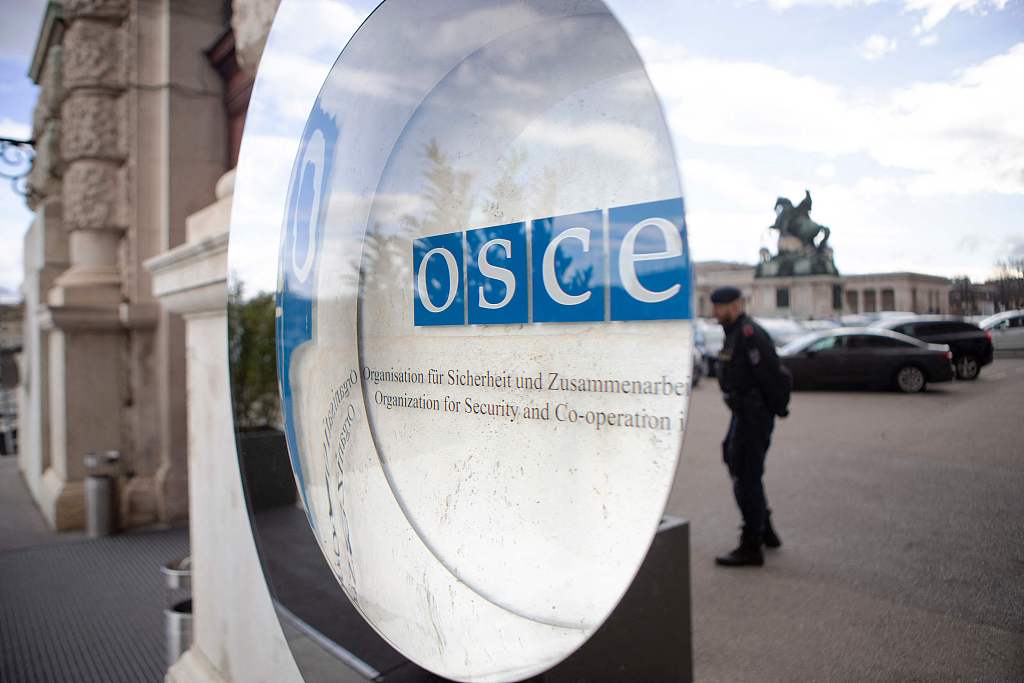
The logo of the Organization for Security and Cooperation in Europe (OSCE), at the OSCE headquarters in the Hofburg Palace in Vienna, Austria, February 21, 2022. /CFP


The consequence of replacing the inclusive OSCE with NATO hegemony might be a new Cold War. The main conflict between NATO and Russia is over where to draw the new dividing lines, in which the divided societies in Ukraine, Georgia, Belarus, and Moldova are becoming the battlefield. The current war was both predictable and avoidable. American diplomat George F. Kennan cautioned in 1998 that NATO expansionism would be the beginning of a new Cold War: "Of course there is going to be a bad reaction from Russia, and then [the NATO expanders] will say that we always told you that is how the Russians are – but this is just wrong."

Excluding Russia from the OSCE

On November 18, Poland refused Russian Foreign Minister Sergey Lavrov to attend the OSCE meeting in Poland as he is under EU sanctions.

Poland's decision to deny Sergey Lavrov access is either inspired or directly advocated by the U.S. In September, Washington denied Russian diplomats to travel to New York for participating in the sessions of the UN General Assembly. We now see Poland similarly abusing its role as a host of the OSCE meeting to dictate who should be allowed to participate.

This decision is very dangerous as the international security architecture collapses when states place exclusive military alliances above inclusive institutions that develop common rules. The principal loyalty to NATO and EU above the UN and the OSCE is a feature, not a bug in the European security architecture.

The erosion of a common Europe began less than two weeks after NATO's first expansion, as NATO claimed the authority to invade Yugoslavia in 1999 without a UN mandate. The invasion was unmistakably a violation of international law, yet it was argued to be legitimate as NATO was argued to serve liberal democratic values. Decoupling legality from legitimacy was intended to assign priority to NATO as the ultimate authority in Europe.

The efforts of replacing international law with the "international rules-based order" formalizes this logic of sovereign inequality. The fundamental idea is that the world should be divided between liberal democracies and authoritarian states – and the former should not be restrained by the same rules as the latter. Consequently, the U.S.-led alliance striving for hegemony is elevated above the OSCE and the UN as inclusive institutions that develop common rules.

The OSCE was developed to mitigate and transcend bloc politics, although it is now used instead as an instrument of bloc politics. The consequence of eliminating the common institutions and rules is now evident. A major war continues to rage on in Ukraine that might escalate into a nuclear war between NATO and Russia, yet there seems to be no willingness to engage in diplomacy.

Glenn Diesen is a professor at the University of South-Eastern Norway. 


4/04/2021

Ukraine to hold join military drills with NATO amid escalating tensions with Russia


Source: The Hill
March 4 2021
By Tal Axelrod


Ukraine’s military announced Saturday that it will hold joint military drills with NATO troops later this year amid escalating violence with pro-Russian separatists in the eastern part of the country.

The armed forces said in a statement on Facebook that the drills will be held with more than 1,000 military personnel from at least five NATO member states in a few months.

“In particular, defensive actions will be worked out, followed by an offensive in order to restore the state border and territorial integrity of a state that has been subjected to aggression by one of the hostile neighboring countries,” the statement said, in an apparent reference to Russia.

An exact date for the drills, which were described as routine, was not provided.

“Exercise Cossack Mace is a routine exercise which is still in the planning stage," a U.K. UK Ministry of Defence spokesperson said in a statement to The Hill. "It is due to take place in Summer 2021.”

Moscow had preemptively rebuked any potential deployment of NATO personnel to Ukraine, warning that it would ramp up pressure along the border between the two countries.

But pressure has already ramped up along the border, with Russia building up its military presence on its side of the barrier. Fighting also increased with separatists backed by Moscow in eastern Ukraine, spelling the potential end to a cease-fire in the Donetsk region.

The Ukrainian parliament this week put out a statement declaring an “escalation” along the front, citing a “significant increase in shelling and armed provocations by the armed forces of the Russian Federation.”

Ukraine, which represents NATO’s front line in Eastern Europe against Russian expansion, pressed Western governments to “continue and increase international political and economic pressure on Russia.”


9/14/2020

War Within NATO? Why Is Turkey Getting So Aggressive With Greece?


Source: The National Interest
By Startfor Worldview
Sept 13 2020


Turkey is putting its 50-year view on maritime rights into practice through its Blue Homeland Doctrine, growing its naval and commercial presence in Mediterranean waters that it claims are part of its exclusive economic zones (EEZs). Oil and gas exploration is becoming a crucial tool in implementing this strategy. But Ankara's attempts to claim extensive maritime resource rights risk broadening to a wider conflict with Greece and other NATO allies that would bring foreign energy projects, and potentially the United States, into the fray.

Turkey's Maritime Ambitions


Turkey claims that all of its neighboring waters in the Aegean, Black and Mediterranean seas deserve special treatment under international law, and that the islands in the Aegean Sea (which Greece controls the majority of) should not enjoy the same rights as large countries like Turkey with lengthy coastlines. The international community never adopted these distinctions, which is why Turkey is not a signatory to the United Nations Convention for the Law of the Sea (UNCLOS) and prefers to resolve disputes through bilateral negotiations in lieu of not international arbitration. This has so far led to two major disputes with Greece in the Aegean and Mediterranean seas, as well as a major dispute with Cyprus in the eastern Mediterranean.


Turkey's most important dispute is in the Aegean Sea, where thousands of Greek islands help boost Greece's maritime claims over Turkey's, and where the two countries disagree on how to even start drawing a maritime border due to the disparity in the number of islands between them. Turkey has just three islands in the Aegean Sea, while Greece claims more than 3,000. Given the higher number of Greek islands, Turkey has long maintained that any expansion of Greek maritime claims from six nautical miles (nm) to 12 nm off Greece's shores would constitute a "casus belli," or cause of war. While Greece and Turkey have nearly gone to war several times over disputes in the Aegean Sea, the two countries have so far avoided declaring full EEZs in the region, as well as claiming territorial waters beyond six nautical miles. But that doesn't mean they can't do so in the future. 

Ankara has argued that if both Greece and Turkey extended their claims beyond 12 nm, Turkey's percent ownership of the territory would only marginally increase, while Greece would see its territorial control reach nearly three-quarters of the entire Aegean Sea.
The use of Greece's islands in the Aegean Sea to demarcate a maritime border for EEZs, which extend up to 200 nm from the coast, would also leave Turkey with virtually no rights to the natural resources and fisheries in the Aegean Sea.
Turkey has argued that a more equitable way to split the sea's resources would be by ignoring the islands altogether and starting off with an equidistant line between the Greek and Turkish mainlands.


By more aggressively flexing its claims through energy exploration and naval exercises in the eastern Mediterranean, Turkey is trying to both legitimize its declared EEZ claim, as well as delegitimize any potential EEZ claims in the region that Greece has through its islands of Crete, Rhodes and Kastellorizo. Kastellorizo, in particular, has the potential to generate a significant EEZ claim for Greece that could connect to Cyprus's own claimed EEZ, thus significantly limiting Turkish claims to resources between Crete and Cyprus. Further escalation could result in Greece finally claiming its full EEZ in the eastern Mediterranean, which Athens has so far been reluctant to do for fear of spurring a wider conflict.

Protected by a Turkish naval convoy, Turkey's Oruc Reis surveying vessel has been active throughout the Mediterranean Sea since the beginning of the year.

Turkey's December 2019 maritime agreement with Libya's Government of National Accord aims to legitimize Turkey's claims by establishing a border between Turkish and Libyan waters that ignores Crete and Kastellorizo. 

On Aug. 27, the Greek parliament ratified a maritime border agreement with Egypt aimed at countering Turkey's pact with Libya by legitimizing a potential EEZ border generated via its control of Crete with Egypt. Greece's deal with Egypt is a first step in potentially declaring a full EEZ in the eastern Mediterranean, but the agreement with Egypt does not legitimize potential claims that Kastellorizo could give Greece rights to.


Turkey has also been actively attempting to delegitimize Cyprus' claimed EEZ in the eastern Mediterranean by both conducting energy exploration in waters that Cyprus directly claims, as well as harassing foreign companies that are operating on behalf of the Cypriot government. Turkey has argued that Cyprus' claimed EEZ is not legal because it was not done in coordination with the Turkish Republic of Northern Cyprus, which Ankara recognizes as a legitimate government for all of Cyprus. Turkey also argues that, as an island, Cyprus cannot claim a full EEZ.

Turkey's Yavuz vessel is currently drilling off the coast of Western Cyprus.

Turkey's Barbados vessel is also currently researching in the Northern Cyprus territorial waters that Turkey recognizes as a part of an oil exploration block held by the state-owned Turkish Petroleum Corporation.

In 2018, the Turkish navy prevented the Italian oil firm Eni from drilling on its Cuttlefish prospect in an exploration block the company received from Cyprus.

The Specter of War


Turkey's increased provocations will continue to drive the United States and other NATO countries, including France and Greece, to boost their own naval presence in the eastern Mediterranean. Both Turkey and Greece will try to refrain from crossing red lines that could spur a larger confrontation that neither wants, but the higher presence of ships in the eastern Mediterranean will nonetheless increase the possibility of incidents, as evidenced by the Aug. 10 collision between the Greek frigate Limnos and the Turkish frigate Kemal Reis. International mediation would likely avoid further escalation to a military conflict between Greece and Turkey, but is unlikely to result in a diplomatic solution to their dispute.

In the case of a wider crisis, most NATO members would view Turkey as the aggressor and would likely back Greece. This would likely reinforce Ankara's overall pursuit of its maritime strategy and intensifying national security push by offering Turkey further proof that NATO does not prioritize its national security priorities. Countries can only leave NATO on their own accord, which Turkey remains is unlikely to do. Instead, Ankara would probably continue to reduce collaboration with NATO countries.


Despite Cyprus and Greece's calls for a more significant response to deter Turkey's behavior, the European Union will likely be hesitant to impose more drastic measures for fear of prompting Ankara to reduce cooperation on migration and other EU priorities. Unless Turkey starts to more directly protect its claims in the Aegean Sea, fires upon a Greek or another European vessel, or conducts drilling or exploration activities around Crete, Brussels will likely limit its sanctions pressure to companies and individuals supporting Turkish activities in the Mediterranean. 

Decisions on implementing EU sanctions require unanimity among the bloc's member states. And some countries, such as Germany, are more concerned about aggressive sanctions only inflaming Brussels' tensions with Turkey. 

If the European Union does not take significant action on Turkey, Cyprus is now threatening to veto proposed EU sanctions against Belarus amid the country's ongoing political crisis. This may result in slightly stronger EU sanctions that target more Turkish individuals and companies, but more broad-based economic sanctions against the Turkish government remain unlikely.

Energy Projects in the Crossfire


The United States will likely let the European Union continue to take the lead in responding to Turkey's attempts to delegitimize Greek and Cypriot maritime claims, but Chevron's recent entry into the eastern Mediterranean could eventually draw Washington more directly into the conflict. On July 20, Chevron announced an agreement to acquire the Houston-based oil and gas firm Noble Energy, which operates both the Leviathan gas field off the coast of Israel and the Aphrodite gas field off the coast of Cyprus. Ankara, however, will likely adopt a more hands-off approach to U.S. companies operating in the region, as the United States would be more willing to impose hardline sanctions in response to American firms being drawn into its maritime disputes.

By continuing to increase the cost of developing resources in Cypriot waters, Turkey's ongoing harassment of foreign energy firms will drive its neighbors closer together on both maritime security and energy exploration issues. But it could also potentially halt their construction of the proposed East Med pipeline. Cyprus, Egypt, Greece and Israel created the East Mediterranean Gas Forum in 2019. The quartet has since collaborated to construct the roughly $6 billion pipeline project, which would carry natural gas from the eastern Mediterranean to Europe. Under international law, Turkey is technically required to allow other countries to build pipelines through its EEZ. But Ankara retains the power to demand that any constructors of the East Med pipeline adhere to its environmental reviews and oversight, which would be de facto recognition of Turkey's EEZ. Otherwise, Turkey could send its navy to harass or intercept vessels involved with construction as Ankara did in 2018 with a drillship planning to spud a well in Cypriot waters. 

7/27/2020

Trump’s Dangerous Diplomacy with Erdoğan


Source: BESA
July 26 2020
By Shay Attias


EXECUTIVE SUMMARY: America’s reputation as a credible actor is an essential matter for US foreign policy, but it has weakened significantly throughout this century. George Bush’s war on the “axis of evil” failed, and Barack Obama’s “red line” speech proved empty. Today, Donald Trump is abandoning allies and conducting dangerous diplomacy with anti-democratic tyrants.

Former US president Barack Obama promised that if evidence emerged proving that Bashar Assad had used chemical weapons on the Syrian people, the US would put together a coalition and attack Assad as retribution. America’s allies, its enemies, Arab governments, and Muslim citizens all looked to Obama to see if he would follow through on this warning.

In August 2013, a year after Obama’s promise, Assad did indeed unleash chemical weapons on his people, killing more than 1,500 men, women, and children. Obama did nothing in response—no coalition, no attack. He failed to keep his word, handing the US a serious diplomatic failure and severely damaging its credibility.

The American War on Terror doctrine (2001-2020), which has continued from Bush through Trump, has had some notable successes, including the killings of Osama bin Laden, Abu Bakr Baghdadi, and Qassem Soleimani. For a short time, ISIS, the last potent global terror threat, was defeated, with many of its troops killed or captured.

But in December 2019, President Trump decided to hand Syria to the Turks. During a phone conversation with Turkish president Recep Tayyip Erdoğan, Trump said, “You know what? It‘s yours.” He also reportedly said regarding Syria, “I’m leaving.”

Later, an official White House spokesperson said that “Turkey will soon move on with its long-planned action in northern Syria,” adding that the US, which had succeeded in defeating ISIS, “will no longer be in the immediate area.”

Criticism of the decision was swift and harsh. Brett McGurk, a special envoy for the coalition to defeat ISIS, resigned, saying: “Bottom line: Trump tonight after one call with a foreign leader provided a gift to Russia, Iran, and ISIS.”

Trump’s decision brought the Syrian War into a new phase: Turkey and Russia are now dominant in Syria while America is almost completely absent. This shift works in Ankara’s favor and against Syria’s Kurds, who had been supported by the US Army in northern Syria and had successfully helped the US fight ISIS.

Erdoğan’s priority is preventing the emergence of an autonomous Kurdish area in Syria on Turkey’s borders. There is deep-seated hostility between the Turkish state and the Kurds, who constitute 15% to 20% of the Turkish population. The Kurds have suffered terrible treatment at the hands of the Turkish authorities for generations, starting in the 1920s. Many Kurds were killed, the Kurdish legacy and Kurdish last names were banned, and the use of the Kurdish language was restricted.

In one phone call, Trump handed Syria to Ankara and abandoned the Kurds, who had fought alongside the Americans to defeat ISIS. This gravely undermined the credibility of the US. He abandoned an ally to cozy up to Erdoğan, a dictator who openly mocks Western values, buys Russian military equipment, jails journalists, intimidates political opponents, and supports Hamas, giving its leaders safe haven within Turkey’s borders. Some say Erdoğan is allowing his Syrian proxies to commit war crimes, and he has alluded to nuclear aspirations.

The absurd part is that Turkey wants to be seen as a strategic partner of NATO and “a real ally to the United States around the world,” as Trump put it when he thanked Erdoğan for his efforts “to uphold a cease-fire in northeastern Syria” (though the fighting hadn’t stopped). On another occasion, Trump said Turkey has made “vital contributions” to operations in Afghanistan, a claim without any substantiation. Despite ample evidence indicating that Erdoğan is no friend to the US, Trump declared, “I am a big fan of the president (Erdoğan).”

Erdoğan keeps threatening to veto NATO’s defense plan for the Baltics, which runs directly contrary to Trump’s foreign policy in Syria. Erdoğan’s position has pushed the European leadership (led by the president of France) to clash with Turkey—and now, Trump as well—over NATO agreements. Even more distance is being created between the US and Europe, distance that had already reached unprecedented heights during Trump’s presidency.

Russia, the only superpower remaining in Syria, might try to build a stronghold there and retain control on the ground. At the same time, ISIS is trying to get back on its feet and has carried out attacks on Syrian Army positions. These occurred in towns near the Syria-Iraq border and at army bases around southeastern Syria.

ISIS is thus taking advantage of the chaos following the American withdrawal. It had been reduced to a few cells in abandoned mountainous and desert villages, but is now regenerating itself. By using communications apps like Telegram, ISIS supporters are donating and helping to rebuild the network of terror. Secret chatrooms continue to spread the cause of jihad.


7/22/2020

Turkish Nationalist Course (PDF)


Source: Rand
By Stephen J. Flanagan, F. Stephen Larrabee, Anika Binnendijk, Katherine Costello, Shira Efron, James Hoobler, Magdalena Kirchner, Jeffrey Martini, Alireza Nader, Peter A. Wilson
Published in 2020

The partnership between the United States and Turkey has become strained in recent years because U.S. and Turkish interests and assessments of various challenges are not as aligned as they once were, and significant disagreements have emerged on policies to address several of these challenges. Differences over dealing with Syria and the Kurdish question, tensions concerning Turkey’s relations with its neighbors, an escalating terrorism threat, and U.S. concerns about the authoritarian drift in Turkish politics under President Recep Tayyip Erdoğan have combined to constrain cooperation and under-mine mutual confidence. Compounding tensions are several thorny bilateral problems, including: 

•The  continued  presence  in  the  United  States  of  Fethullah  Gülen,  a  self-exiled  leader of a Sufi Islamic movement that Turkish authorities contend is a terrorist organization that masterminded a failed July 2016 military coup d’état

•Ankara’s purchase of Russian-made S-400 air and missile defense systems

•Turkey’s arrests of American and European nationals on questionable terrorism charges

•The U.S. trial of a gold trader accused of orchestrating a large money-laundering scheme designed to circumvent sanctions against Iran in coordination with senior officials in the Turkish government. 

Anti-American sentiment in Turkey has deepened, as have doubts in Turkey about the reliability  of  the  U.S.  commitment  to  Turkey’s  stability  and  security—both  exacerbated by inflammatory statements by Erdoğan and other Turkish leaders. 


7/12/2020

France-Turkey spat over Libya arms exposes NATO's limits


Source: Daily Herald
By Lorne Cook
July 5 2020


BRUSSELS (AP) — The festering dispute between France and Turkey over a naval standoff in the Mediterranean Sea has shone a glaring searchlight on NATO’s struggle to keep order among its ranks and exposed weaknesses in a military alliance that can only take action by consensus.

The dispute has also revealed NATO’s limits when its allies are or are perceived to be on different sides of a conflict — in this case in Libya — especially when a major nuclear ally like France has lamented the “brain death” at the world’s biggest security organization due to a lack of American leadership.

According to French accounts of the June 10 incident in the Mediterranean, the French frigate Courbet was illuminated by the targeting radar of a Turkish warship that was escorting a Tanzanian-flagged cargo ship when the French vessel approached.

France said it was acting on intelligence from NATO that the civilian ship could be involved in trafficking arms to Libya. The Courbet was part of the alliance’s operation Sea Guardian, which helps provide maritime security in the Mediterranean.

In a power-point presentation to French senators on Wednesday, which angered the French officials, Turkey’s ambassador to Paris, Ismail Hakki Musa, denied that the Courbet had been “lit up” by targeting radar and accused the French navy of harassing the Turkish convoy.

He also suggested that a NATO probe into the incident was “inconclusive” and that France had pulled out of Sea Guardian. The French defense ministry rushed to release its version of events and underline that it would not take part in the operation until the allies had recommitted to the arms embargo on Libya, among other demands.

NATO headquarters refused to provide details saying the report is “classified,” and it’s unlikely that its findings will be made public. A French diplomat said the investigators probably did the best they could, given that they were provided with two very different versions of what happened.

On Thursday, Turkish Foreign Minister Mevlut Cavusoglu accused France of lying.

“We have proven this with reports and documents and gave them to NATO. NATO saw the truth,” Cavusoglu said. “Our expectation from France at the moment is for it to apologize in a clear fashion, without ifs or buts, for not providing the correct information.”

On Monday, French President Emmanuel Macron had accused Turkey of flouting its commitments by ramping up its military presence in Libya and bringing in jihadi fighters from Syria.

“I think that it’s a historic and criminal responsibility for a country that claims to be a member of NATO,” Macron said. “We have the right to expect more from Turkey than from Russia, given that it is a member of NATO.”

It’s not the first time Turkey has been at the center of controversy at NATO. Ankara’s invasion of northern Syria last year angered its allies, while its purchase of Russian-made missiles, which NATO says would compromise allied defense systems, got Turkey kicked out of the F-35 stealth fighter program.

Despite concerns about its direction and close ties with Russia — NATO’s historic rival — Turkey can't be ejected from the military organization. Legally, there is no mechanism, and decisions require the unanimous agreement of all 30 member nations. In any case, NATO insists that Turkey is too strategically important to lose.

In normal times, the United States — by far the most powerful and influential of the allies — could be expected to bring its partners into line. But the last four years, with President Donald Trump at the helm in the U.S. have been extraordinary times for NATO.

Trump has publicly berated European allies and Canada for not spending enough on defense budgets. He has pulled out of the Iran nuclear agreement, the Intermediate-Range Nuclear Forces Treaty and the Open Skies aerial surveillance pact, which the Europeans regard as important to their security.

Just after Turkey invaded Syria, Trump announced that he was pulling U.S. troops out, surprising and angering his allies. In recent weeks, he’s threatened to take American troops out of Germany, again without consultation.

At the heart of the France-Turkey quarrel is the question of whether NATO allies should respect the U.N. arms embargo for Libya. NATO Secretary-General Jens Stoltenberg said last month that the alliance “of course supports the implementation of U.N. decisions, including U.N. arms embargoes.”

But in a interview on Tuesday, former U.N. Libya envoy Ghassan Salame said just after a Berlin conference in January where countries again backed the Libyan arms embargo, he saw pictures of weapons shipments showing that even Security Council members were sending “ships, planes and mercenaries” there.

With no firm U.S. guiding hand, divisions among the allies over how Libya should be handled, and a decision-making process that requires everyone to agree — even on what they should talk about — it’s difficult to see when NATO might debate the embargo question in earnest.


5/15/2020

NATO ready to support Libya's government: Stoltenberg


Source: ANA
May 14 2020
By Giada Zampano 


ROME

NATO is ready to support Libya’s government led by Fayez al-Sarraj, the head of the military alliance said on Thursday.

In an interview with Italian daily La Repubblica, Jens Stoltenberg noted that NATO has 30 partners, which on many issues have different positions, but added that Turkey remains an important ally.

He also stressed that NATO is supporting the UN’s efforts for peaceful solution to conflicts both in Libya and Syria.

“In Libya there is an arms embargo that needs to be respected by all sides,” Stoltenberg said.

“However, this doesn't mean to put on the same level the forces led by [Khalifa] Haftar and the government of Fayez al-Sarraj, the only one recognized by the UN,” he stressed.

“For this reason, NATO is ready to give its support to the government of Tripoli,” he said.

The Libyan government, also known as the Government of National Accord (GNA), has been under attack by warlord Haftar’s armed forces since April 2019.

Haftar’s illegal forces in eastern Libya have launched several attacks to capture Tripoli, with more than 1,000 killed in the violence.

The Libyan government launched Operation Peace Storm on March 26 to counter attacks on the capital.

Following the ouster of late ruler Muammar Gaddafi in 2011, Libya's new government was founded in 2015 under a UN-led political deal.


5/14/2020

F-35’s Nuclear Weapons Upgrade Delayed as Program Costs Top $1.6 Trillion


Source: Sputnik
May 14 2020


The F-35 Lightning II’s Block 4 upgrade, which will allow the stealth aircraft to carry nuclear weapons, has been delayed by at least nine months. The F-35 is slated to become the primary nuclear strike aircraft for several US allies. Meanwhile, costs for the program have soared above $1.6 trillion.

According to a new report by the Government Accountability Office (GAO), a congressional watchdog agency, the F-35’s planned Block 4 upgrade has been delayed by nine months, pushing the plane’s full-rate production decision back to sometime between September 2020 and March 2021.

While Block 4 will integrate a number of new weapons into the F-35’s repertoire, such as Naval Strike Missile, the Meteor and SPEAR missiles and several laser-guided bombs, by far the most consequential weapon is the B61 nuclear gravity bomb, which is small enough to fit inside the F-35’s internal weapons bay.

Via the F-35 Block 4, NATO partners who wield US nuclear weapons thanks to nuclear sharing agreements will be able to continue to carry out nuclear strikes. With the Panavia Tornado exiting service with most European partners, a delay in fielding the F-35 Block 4 could leave a gap in NATO’s nuclear capabilities, especially for the Italian, Dutch and Belgian air forces.

© PHOTO : YOUTUBE/PHYLICIA NORDYKE
Nuclear Bomb B61 12

However, the GAO report also notes the enormity of the Block 4 upgrade has driven up costs in the already colossal lifetime budget for the F-35. Noting that in 2019 it projected a baseline increase of $8 billion because of Block 4, the GAO stated in its Tuesday report that the update’s development and procurement costs are now estimated to be $13.9 billion and “that the sustainment costs to operate and maintain the F-35 fleet for its planned 66-year life cycle are $1.2 trillion, bringing the total cost of the F-35 program to over $1.6 trillion.”
“The planned $13.9 billion Block 4 effort exceeds the statutory and regulatory thresholds for what constitutes a major defense acquisition program, and Block 4 is more expensive than many of the other major weapon acquisitions already in DOD’s portfolio,” the GAO further states."
“To provide better oversight into Block 4 activities, in 2016, we recommended that the Secretary of Defense hold a milestone B review - a critical point in an acquisition program leading to the engineering and manufacturing development phase - and manage it as a separate major defense acquisition program. DOD did not concur with our recommendation, and it continues to manage Block 4 within the larger F-35 program. We maintain that DOD should manage the Block 4 activities as a separate program.”

"The oversight office further advised the Pentagon to continue oversight reports on Block 4 upgrade progress through 2026, even though its budget only provides for updates through 2023."


Trump envoy accuses Germany of undermining NATO's nuclear deterrent


Source: Reuters
May 14 2020


BERLIN (Reuters) - The U.S. ambassador in Berlin has accused Germany of undermining NATO’s nuclear deterrent, taking aim at Chancellor Angela Merkel’s junior coalition partners after some of their leaders called for nuclear disarmament.

Rolf Muetzenich, parliamentary leader of the Social Democrats (SPD), called earlier this month for the withdrawal of all U.S. nuclear weapons from Germany - a view that divides his left-leaning party and is not shared by Merkel’s conservatives.

In an opinion piece for German newspaper Die Welt, Ambassador Richard Grenell wrote: “Instead of undermining the solidarity that forms the basis of NATO’s nuclear deterrence, it is now time for Germany to meet its commitments to its allies and to continuously invest in NATO’s nuclear participation.”

“Germany’s political leadership, especially that of the SPD, must now make it clear the federal republic is honouring these commitments and standing by its allies,” added Grenell, who is also U.S. President Donald Trump’s acting national intelligence chief.

The remarks are the latest twist in relations between Berlin and Washington that have often been strained during Trump’s presidency. The president has pressed Germany to raise its defence spending and accused Berlin of being a “captive” of Russia due to its energy reliance.

But Grenell’s comments also come a day after Merkel cited “hard evidence” that Russia was behind a 2015 hacker attack on her Bundestag office — an assault that she said “pains me”.

“The dangers threatening peace in Europe are not an ‘anachronism’, as some would have us believe,” Grenell said.

“The Russian invasion of Ukraine, the deployment of new nuclear-weapon-capable missiles by Russia on the periphery of Europe and new capabilities of China, North Korea and other countries make it clear that the threat is all too present.”

The coalition agreement between Merkel’s conservatives and the SPD cites successful disarmament talks as a prerequisite for the withdrawal of tactical nuclear weapons stationed in Germany and Europe.

However, the debate over nuclear weapons was sparked by news last month that the Defence Ministry wanted to purchase 45 F-18 fighter jets from Boeing to replace ageing Tornado aircraft and take over the German military’s task of so-called nuclear sharing - under which the planes would carry U.S. nuclear bombs to target in a crisis.

If Germany does not buy new jets, the nuclear sharing would end with the planned retirement of the Tornadoes from service in 2030.


5/02/2020

Serb leader praises Russian arms 21 years after NATO bombing


Source: abcNews
May 2 2020
By Dusan Stojanovic

Serbia’s president has thanked Russia on Saturday for making the country’s military “10 times” stronger than when Serbia was bombed by NATO in 1999.

BELGRADE, Serbia -- Serbia’s president thanked Russia on Saturday for making the country’s military “10 times” stronger than when it was bombed by NATO in 1999.

Aleksandar Vucic spoke Saturday while visiting an air defense unit near Belgrade that has recently been equipped with the Russian Pantsir-S1 system, which is designed to defend targets on the ground from cruise missiles, drones and low-flying aircraft.

“This is a great support for the defense of our towns, protection of our infrastructure and the strengthening of our military,” Vucic said. “We don’t want to attack anyone, we want to protect the future of our children."

Vucic’s visit to the air defense unit coincided with the anniversary of the day a U.S. Air Force F-16 jet was shot down over Serbia 21 years ago. The pilot, David Goldfein, was rescued by American commandos in a hair-raising operation. Goldfein is now a general who serves as the U.S. Air Force chief of staff.

“I’m proud to be visiting the brigade that has shot down the F-16,” Vucic, who was Serbia’s information minister during the NATO intervention, said.

Russia’s arming of Serbia with warplanes, tanks and anti-aircraft systems is watched with unease in the Balkans and the West amid simmering tensions in the region which went through a devastating civil war in the 1990s.

NATO intervened in Serbia to stop a bloody Serb crackdown against Kosovo Albanian separatists in 1999. Russia, led at the time by President Boris Yeltsin, stayed largely on sidelines.

Despite formally seeking European Union membership, Serbia under Vucic’s populist leadership has strengthened close political and military ties with Slavic ally Russia and China.

Serbia has pledged to stay out of NATO and refused to join Western sanctions against Russia for its policies in Ukraine.


Vucic's visit to the military base took place amid growing popular discontent in Serbia over the president's handling of the coronavirus pandemic and his government's lockdown measures.


4/28/2020

Turkey flies medical aid to coronavirus-stricken U.S.


Source: Reuters
April 28 2020

ANKARA (Reuters) - A Turkish military plane carrying medical supplies and protective equipment was heading for the United States on Tuesday to deliver aid to its NATO ally battling the coronavirus outbreak.

The United States, which has the highest death toll and reported cases in the global pandemic, welcomed the “generous donation” of 500,000 surgical masks, 4,000 overalls, as well as disinfectant, goggles and face shields.

“We are proud to announce that Turkey will deliver medical supplies to the United States, upon our NATO ally’s request, to support America’s fight against the coronavirus,” Turkey’s Communications Directorate said.

The aid comes at a potentially pivotal time in U.S.-Turkish relations, which have been strained by disputes over Iran sanctions, Syria policy and Turkey’s acquisition of Russian missile defence systems.

Turkey had planned to deploy the S-400 missile defences this month, but a senior Turkish official said that Ankara will delay the move - which would likely trigger U.S. sanctions - while it tackles the coronavirus and tries to support the economy.

Ankara has also asked the U.S. Federal Reserve for currency swap facilities to help stem the economic impact of the disease.

“As this delivery indicates, the U.S.-Turkey relationship is strong and one of our most important alliances,” U.S. Ambassador to Turkey David Satterfield said.

Ankara has already sent medical shipments to 55 countries, including Italy, Spain, Britain, Iran, China and others in the Balkans or Africa. Last month it flew 500,000 coronavirus testing kits to the United States.

Turkey also has one of the world’s highest number of registered cases of COVID-19, but officials have reported a slowdown in new cases and fatalities.

Turkey has 112,000 confirmed cases, of which 2,900 have died, according to the Health Ministry. The daily death toll dropped to 95 on Monday, an eighth consecutive daily fall, while new cases fell for a third day running to 2,131.

The United States has reported more than 957,000 cases and nearly 54,000 deaths.


4/19/2018

Greece and Turkey Are Inching Toward War

http://foreignpolicy.com/2018/04/18/greece-and-turkey-are-inching-toward-war/

4/01/2018

US sends reinforcements to Manbij in northern Syria

http://aa.com.tr/en/middle-east/us-sends-reinforcements-to-manbij-in-northern-syria/1105320

3/19/2018

In Afrin ist Europa gefallen

https://www.tichyseinblick.de/daili-es-sentials/in-afrin-ist-europa-gefallen/

3/02/2018

Turkey Is Turning Into the Next Pakistan

https://www.bloomberg.com/view/articles/2018-03-02/as-a-u-s-ally-turkey-is-turning-into-the-next-pakistan

3/27/2017

Responsibility to Protect Justified Imperialist Goals in Libya

Destruction in Benghazi, Libya in July 2015 after fighting between pro-government forces and an alliance of former anti-Gadhafi rebels. | Photo: Reuters

Πηγή: telesur
March 18 2017


Libya is a striking example of the humanitarian norm being used selectively to justify a breach of sovereignty and foreign intervention.


March 19 marks six years since the United States began its “humanitarian intervention” in Libya with the help of NATO. Amid the Arab Spring uprisings against authoritarian governments in the region, intervention in Libya was justified under the concept of “responsibility to protect.” The intervention ended in regime change, leaving many critical that the norm was abused for imperialist means, rather than humanitarian sentiments.

The Responsibility to Protect, otherwise known as “R2P,” aims to prevent human rights abuses, genocide and war crimes through international response. This principle justifies intervention in another sovereign state based on moral grounds.

Critics, however, have argued that R2P has commonly been used as a means to serve the foreign policy interests of Western powers. Policy analyst David Rieff has referred to R2P as a “two-tiered system of interveners and intervened upon,” which is dictated by the rules of historically imperialist powers.

“For those of us who feared that R2P was just a warrant for war, our fears have been vindicated,” said Rieff to the Economist at the time of the NATO intervention in Libya.

According to the R2P norm, a sovereign state is responsible for protecting its own citizens and preventing atrocities, and the international community also has a responsibility to step in when a state fails to protect its citizens. But this should only occur when all other diplomatic options have been exhausted and military action should be a last resort, according to the R2P doctrine.

However, this concept actually leads to an asymmetrical system with imperialist overtones, according to Ugandan political commentator, Mahmood Mamdani, who argues that through the language of R2P, non-Western countries are more often defined as rogue or failed states and singled out for intervention.

Furthermore, Mamdani argues that states earmarked for outside intervention on humanitarian grounds are seen not as “active agents in their own emancipation, but as passive beneficiaries of an external ‘responsibility to protect,’” which is seen largely as a “legitimate exercise.”

“The result is once again a bifurcated system whereby state sovereignty obtains in large parts of the world but is suspended in more and more countries in Africa and the Middle East,” Mamdani wrote in 2010.

In the case of Libya, the R2P concept was used by the UN Security Council to condemn Libyan President Moammar Gadhafi’s regime, impose sanctions and then justify intervention into the country by “all necessary means” to protect civilians. There was concern that unrest and violence under Gadhafi would lead to serious human rights abuses. Others, however, have argued that the NATO intervention was more about wanting to control Libyan oil, than it was for humanitarian motives.

Well before the Security Council resolutions, Gadhafi had been demonized by the West as an evil authoritarian dictator. Already wanted by the International Criminal Court for crimes against humanity, Gadhafi had long been accused of losing his legitimacy for slaughtering his own people.

Professor of African American Studies and Political Science Horace Campbell, explains that amid the demonization of Gadhafi’s regime, “The Security Council authorization was stretched from a clear and limited civilian protection mandate into a military campaign for regime change and the execution of the President of Libya, Moammar Gadhafi.”

Campbell argues that Gadhafi’s rule should have been condemned, but the guise of humanitarian intervention from NATO also should have been opposed. He criticized the organization as “the instrument through which the capitalist class of North America and Europe seeks to impose its political will on the rest of the world, however warped by the increasingly outmoded neoliberal form of capitalism.”

One of the major players pushing for R2P-style intervention in Libya was former U.S. Secretary of State Hillary Clinton. Her decision was likely influenced by international criticism for the failure to prevent the Rwandan genocide in 1994 under then-president Bill Clinton, a tragic miscalculation which many see as a key example of the importance of acting on the “responsibility to protect” doctrine.

But the Libya intervention overstepped the bounds of R2P and soon morphed into a full-blown military operation. While speed was seen as critical in Libya, the intervention dragged on for more than seven months and ended with the killing of Gadhafi.

Clinton adviser, Sidney Blumenthal, only 11 days into the intervention wrote that the “humanitarian motive offered is limited, conditional and refers to a specific past situation,” as revealed in the infamous Benghazi email leaks.

The push for international intervention in Libya was not without dissent. In particular, Brazil, Russia, India, China and South Africa — known as the BRICS countries — were concerned as to how exactly an R2P-style intervention would be carried out, particularly when ceasefire offers were rejected and Libyan rebel forces were given support.

As former Australian Foreign Minister and one of the primary architects behind the original R2P norm, Gareth Evans noted in 2012, “The BRICS complaints were not about the initial military response, but what came shortly after, when it became clear that the U.S., Britain and France were set on regime change.”

President Obama defended the intervention in March 2011, saying that "when our interests and values are at stake, we have a responsibility to act," while also claiming that "we are naturally reluctant to use force to solve the world's many challenges."

Many countries, even those who voted in favor of the resolution, became concerned as the conflict dragged on, unaware that the intervention would be so devastating.

Obama later admitted in April 2016 that the intervention which ousted Gadhafi and subsequently threw Libya into chaos was the worst mistake of his presidency.


8/08/2016

5 explosive secret intelligence memos on Libya everyone must read [VIDEO]


Πηγή: The Canary
August 8 2016

Libya is a mess following the western military intervention that started in 2011. We were told it was necessary because there’s an evil dictator who had to be taken out as he was massacring his own people. But is that really why we went to war with Libya?

Muammar Gaddafi did have much blood on his hands – from the so-called Toyota War (or Chadian-Libyan conflict) to taking responsibility for Lockerbie. Not to mention his handy role in George W. Bush’sextraordinary rendition program.

Gaddafi was an interventionist who favoured shady backroom deals and covert action, as well as support of proxies abroad to accomplish his goals.

When anti-Gaddafi protesters took to the streets of Libya in the midst of the ‘Arab Spring’, the UK, US, and France declared Gaddafi’s rule illegitimate. The soon to follow NATO military intervention on behalf of Libyan rebel militants ended with the brutal execution of Gaddafi on the road out of Sirte – ironically, the very city which Libyan ISIS has now made its de facto headquarters.

Some say Gaddafi deserved it. After all, he haphazardly exported enough Semtex around the world, in support of ‘revolutionary’ causes, to supply a small army of indiscriminate killers.

Libertarians, humanitarians, as well as Responsibility 2 Protect (R2P) ‘true believers’ are right to condemn Gaddafi’s legacy of interventionism.

But when western governments militarily intervened in Libya’s civil war, which included bombing urban centres and arming proxy forces, were they really motivated by notions of justice, democracy, and a desire to protect Libyan civilians?

Listed below are five leaked, declassified, and censored intelligence documents which reveal the ugly truths behind what has been described as the West’s “dirty war” in Libya. Direct excerpts from secret documents are in quotes:

1) France wanted control over Gaddafi’s billions in gold and silver bullion as revealed in Hillary Clinton’s 27 March 2011 confidential intelligence brief:

According to knowledgeable individuals this quantity of gold and silver is valued at more than $7 billion. French intelligence officers discovered this plan shortly after the current rebellion began. This was one of the factors that influenced President Nicolas Sarkozy’s decision to commit France to the attack on Libya.

2) The US and UK knew al-Qaeda terrorists were embedded in rebel groups, yet armed them anyway. Read this quote from another Hillary Clinton 27 March 2011 confidential intelligence brief:


French and British Special Operations troops are working out of bases in Egypt, along the Libyan border. These troops are overseeing the transfer of weapons and supplies to the rebels… …Sarkozy is also concerned about continuing reports that radical/terrorist groups such as the Libyan Islamic Fighting Groups and Al Qa’ida in the Islamic Maghreb (AQIM) are infiltrating the NLC and its military command… …[there’s] a seemingly endless supply of AK47 assault rifles and ammunition… …French, British, and Egyptian Special Forces troops are training rebels inside of western Egypt, and to a limited degree in the western suburbs of Benghazi.

3) A secret Libya to Syria ‘weapons pipeline’ was set up to fuel the devastating conflict in Syria as revealed in this 12 October 2012 Pentagon ‘Secret’ Intelligence Information Report (Defense Intelligence Agency):

Weapons from the former Libya military stockpiles were shipped from the port of Benghazi, Libya to the Port of Banias and the Port of Borj Islam, Syria. The weapons shipped during late-August 2012 were Sniper rifles, RPG’s, and 125 mm and 155mm howitzers missiles.

During the immediate aftermath of, and following the uncertainty caused by, the downfall of the ((Qaddafi)) regime in October 2011 and up until early September of 2012, weapons from the former Libya military stockpiles located in Benghazi, Libya were shipped from the port of Benghazi, Libya to the ports of Banias and the Port of Borj Islam, Syria.


4) Fake propaganda was planted in the media to make Gaddafi look like a fanatical monster that must be stopped. This from a 27 March 2011 Hillary Clinton confidential intelligence brief:

I communicated more than a week ago on this story—Qaddafi placing bodies to create PR stunts about supposed civilian casualties as a result of Allied bombing—though underlining it was a rumor. But now, as you know, Robert Gates gives credence to it. (See story below.)

Sources now say, again rumor (that is, this information comes from the rebel side and is unconfirmed independently by Western intelligence), that Qaddafi has adopted a rape policy and has even distributed Viagra to troops.


5) Secretary of State Clinton was informed there was no real humanitarian basis for NATO’s bombing, though NATO would continue its devastating bombing of Libya for another seven months anyway. This according to Hillary Clinton’s 30 March 2011 confidential intelligence brief:

…extending US influence…should be obvious. It is a vital national interest today, now, at this moment. The humanitarian motive offered is limited, conditional and refers to a specific past situation.

See below video of then Secretary of State Hillary Clinton grilled by a congressional committee over the secret weapons shipments sent from Libya to fuel the war in Syria: