Showing posts with label S-400. Show all posts

8/06/2020

Why Are Egypt And Turkey Risking U.S. Sanctions For These Russian Weapons Systems?


Source: Forbes 
By Paul Iddon
August 5 2020


Egypt and Turkey may face U.S. sanctions in the near future for purchasing advanced Russian military hardware. Despite prior warnings, they pushed ahead with their respective acquisitions anyway. Why have both countries concluded that the procurement of these particular weapons systems is worth the risk?

Cairo has reportedly began taking delivery of the first five of at least 20 Su-35SE “Super Flankers” it ordered from Moscow. The sleek and advanced multirole air superiority fighters were also recently photographed in Russia. 
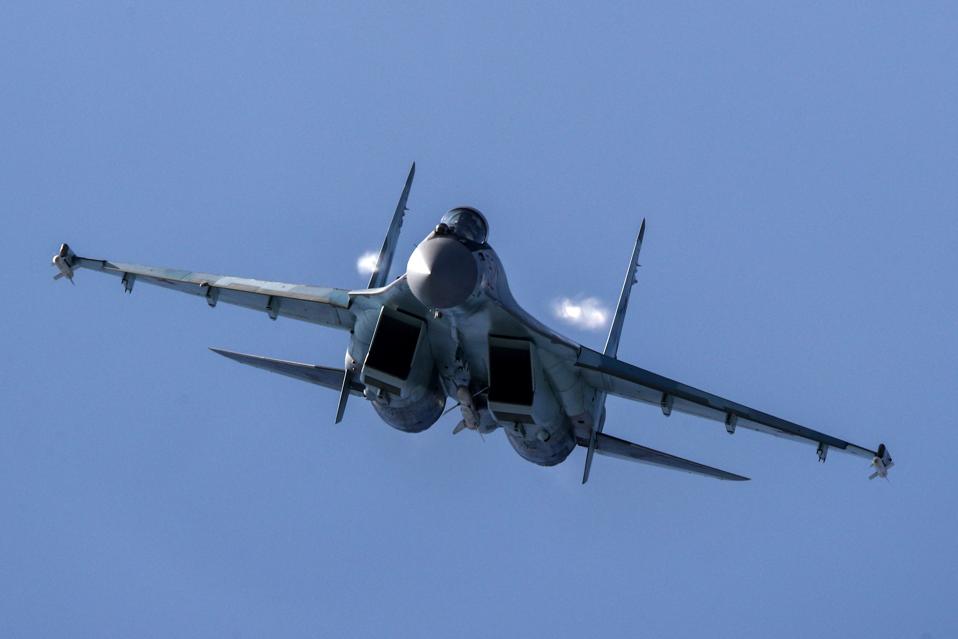
A Russian Air Force Su-35 air superiority fighter jet. Egypt has ordered at least 20 Su-35s from ... [+] SERGEI BOBYLEV/TASS

The delivery of this first batch seems to confirm that Cairo pushed ahead with its reported $2 billion deal for these new warplanes despite warnings from the United States.

Last November, U.S. Secretary of State Mike Pompeo and Secretary of Defense Mark Esper tried to convince Egyptian Defense Minister Mohamed Ahmed Zaki Mohamed to cancel the deal in a letter.
Recommended For You

“Major new arms deals with Russia would – at a minimum – complicate future U.S. defense transactions with and security assistance to Egypt,” the letter reportedly warned.

The U.S. provides Egypt with approximately $1.3 billion in military aid each year. Much of the Egyptian military arsenal consists of American hardware: everything from F-16 Fighting Falcons fighter jets to AH-64 Apache helicopter gunships and M1A1 Abrams main battle tanks.

In 2017, the Countering America’s Adversaries Through Sanctions Act (CAATSA) became federal law. Under that law, any country that makes a “significant transaction” with Russia’s defense sector should face U.S. sanctions. The estimated $2 billion Su-35 deal most certainly constitutes a “significant transaction.”

Given these risks, it’s questionable why Egypt pushed ahead with this procurement.

Egypt has already spent billions of dollars on advanced military hardware from both Russia and France in recent years. It purchased two Mistral-class amphibious assault ships and a fleet of advanced Rafale multirole fighter jets from France.

From Russia, Egypt acquired the most Russian-made military hardware in the 2010s than it has since the 1970s. Acquisitions to date include a fleet of MiG-29M/M2 Fulcrums, Ka-52 attack helicopters, and advanced S-300 air defense missile systems. Cairo ordered these weapons before CAATSA became law.

It’s likely that these purchases were at least partially aimed at diversifying the sources for Egypt’s military hardware to make it less reliant on Washington and less vulnerable to any potential U.S. arms embargo.

Also, some of these weapon systems gave Egypt capabilities it hitherto did not have.

For example, Egypt’s fleet of F-16s conspicuously lack long-range AIM-120 AMRAAM air-to-air missiles, which most other F-16s in Middle East air forces, with the notable exception of Iraq, possess.

Egypt’s Rafales, on the other hand, are armed with Meteor beyond visual range air-to-air missiles. If Egypt’s new supermaneuverable Su-35s are armed with R-77 missiles, the Russian equivalent to the AMRAAM, then its French and Russian fighters will undoubtedly overshadow its American ones when it comes to their air-to-air capabilities.

If it’s confident that it can either avoid or weather any potential U.S. sanctions over its Su-35 procurement and further diversify its military in the process, Cairo may well have calculated that this procurement is worth that risk.

Turkey’s acquisition of an advanced Russian system has so far proven much more controversial in Washington. The NATO member purchased and began taking delivery of long-range S-400 air defense missile systems, straining relations with the United States.

Since the $2.5 billion deal was first announced three years ago, the U.S. repeatedly warned Turkey to cancel it. Ankara staunchly refused.

When Turkey finally began taking delivery of the first components of the system in July 2019, the U.S. immediately suspended it from the F-35 Joint Strike Fighter program and canceled Turkey’s order for a fleet of those stealthy fifth-generation jets.

F-35s initially intended for the Turkish Air Force are already being diverted to the U.S. Air Force.

Under CAATSA, Turkey’s purchase also necessitates U.S. sanctions. However, the Trump administration has avoided imposing any to date and is reluctant to do so.

Nevertheless, it may soon have to.

In July, the House passed the annual defense authorization bill that included a bipartisan provision calling for sanctions on Turkey for the S-400 procurement. The legislation cited the CAATSA condition for sanctions on countries that make a “significant transaction” with Russia’s defense sector.

The bill will require Trump to impose sanctions on Turkey within one month after it becomes law. Under its terms, the only way Turkey can avoid these sanctions is to remove all S-400 components from the country.

How did it come to this?

Turkey conspicuously lacks any other high-altitude long-range air defense missile system. For years, it has relied on much older medium-altitude systems like the MIM-23 Hawk, which are incomparable to newer, more advanced systems like the S-400 or the American MIM-104 Patriot.

It is, therefore, understandable that Turkey wants advanced air defense systems. It’s also understandable that it doesn’t want to have to indefinitely rely on U.S. or NATO deployments of Patriot missiles to protect its airspace.

In March 2015, a Syrian Scud missile crashed into Turkey’s Hatay border province, afflicting minor injuries on five Turkish civilians and causing some property damage. NATO Patriot missiles deployed in southern Turkey did not even attempt to intercept the Scud, which luckily did not kill anyone or cause further damage.

One reason those Patriots remained idle was because the primary objective of their deployment was to protect a radar in Turkey for tracking missile launches in neighboring Iran, not protecting Turkish territory from such stray missiles.

More recently, Turkey had no active high-altitude air defenses to deploy on its southern border with Syria during unprecedented clashes with Syrian regime forces in Idlib in February and March 2020. It requested a U.S. Patriot deployment, Washington didn’t deploy any missiles.

While such incidents do shed some light on why Turkey sought its own high-altitude air defenses, they don’t explain why it pushed for procuring Russian systems rather than American or other Western ones. After all, buying from the U.S. or any Western country certainly would not have incurred sanctions or severely complicated its relationship with the rest of the NATO alliance.

The U.S. offered to sell Turkey Patriot missiles for $3.5 billion if it canceled its S-400 deal in December 2018. Ankara refused. The U.S. offer automatically expired after Turkey took delivery of its first S-400 components in July 2019. Ankara remains open to potentially purchasing Patriots but only in addition to S-400s, not instead of them.

Turkey previously claimed it decided against purchasing Patriot missiles since the U.S. refused to transfer the missile’s technology as part of any deal. However, the S-400 deal has not come with any technology transfer agreement to date, so that reason hardly justifies Turkey’s controversial choice.

A compelling theory that might explain why Turkey risked and sacrificed so much to get its hands on S-400s concerns the Turkish government’s desire to defend Ankara’s airspace from another coup attempt.

On July 15, 2016, coup plotters commandeered some Turkish F-16s and bombed Ankara, including the Turkish parliament. Turkey’s Western-built air defenses proved ineffective against Turkey’s own air force.

In the event of another similar coup attempt, Turkish S-400s that are not integrated with the country’s air defense networks could rapidly combat such airborne threats.

While the real motives behind these acquisitions remain unclear, what is clear is that both Cairo and Ankara believe the benefits of fielding such advanced Russian hardware outweigh the risks of antagonizing their American ally.


7/10/2020

U.S. Faces Serious Dilemma as Turkey Tests Russian-Supplied S-400s Against American F-16 Jets


July 9 2020


Following the delivery of its first unit of S-400 air defence systems in 2019, Turkey has continued to test the platforms and is reportedly considering placing a followup order from Russia for further battalions. The Turkish armed forces are reported to have carried out new tests of the S-400 which have used U.S. made F-16 and F-4 fighters to assess the capabilities of the system’s sensors. Turkey is the largest foreign operator of the F-16, and was previously set to replace them with F-35A stealth fighters before Washington evicted it from the fifth generation fighter program in 2019. The S-400 was designed to be able to guide up to 160 surface to air missiles against up to 160 targets simultaneously, and can detect non-stealthy enemy aircraft up to 600km away and engage them up to 250km away - a range which can be extended to 400km if equipped with 40N6E missiles. The system was developed largely with high end American F-22 and B-2 stealth aircraft in mind, both of which are considerably harder to lock on to than the F-35, and this makes locking onto the old and non-stealthy F-16 a very basic task for the air defence systems.

Turkey’s move to test the S-400s comes despite considerable Western threats, from the United States in particular, of repercussions including economic sanctions if it activates the Russian-supplied systems. Turkey’s decision to purchase the S-400 has come as a major embarrassment to Western arms manufacturers, and has highlighted the considerable discrepancy in the field of mobile multirole air defence systems favouring Russian technology over that of the U.S. and Europe. A number of countries have shown considerable interest in the S-400 system including Morocco, Iraq, Iran, Qatar, Saudi Arabia, Bahrain and Vietnam, with Belarus, China and Algeria already operating the system and India having placed a very large order worth over $5 billion dollars. The U.S. has attempted to gain a greater market share for its own and other Western weapons producers by threatening potential clients for the system with economic sanctions, which in the case of Iraq, Morocco and other Western-aligned states is likely to prove decisive in preventing them from acquiring the system. The U.S. is currently caught between the need to make an example of Turkey with harsh sanctions to deter other countries from buying the S-400, and the need to avoid alienating Ankara which could go on to purchase Russian fighter jets and more S-400 systems if treated in an overly hostile manner. This has left Washington in a serious dilemma regarding how to handle its relations with Turkey, which has shown a strong interest in Russian S-500 air defences systems and Su-57 next generation fighter jets and could quickly move to acquire both of them.


5/04/2020

Turkey Seeks US Funds, but Roadblocks Lie Ahead

Russian President Vladimir Putin and Turkish President Tayyip Erdogan shake hands during a news conference following their talks in Moscow, Russia March 5, 2020.

Source: The Jerusalem Post
May 3 2020
By Christina Jovanovski

Turkey’s pursuit of US funding to limit an economic crisis faces a major roadblock after Ankara said it would eventually go ahead and activate a key Russian weapon system.

The country averted a crisis with Washington in April when it pulled back from a plan to operationally deploy its Russia-made S-400 air-defense missiles. But Ibrahim Kalin, spokesperson for President Recep Tayyip Erdogan, has now said that the system will indeed be activated.

“There has been a delay because of the coronavirus, but [the deployment] will move forward as planned,” he said on Thursday.

Ankara’s purchase of the anti-aircraft system frustrated Washington, which kicked Turkey out of the F-35 fighter jet program and threatened sanctions. The deal still remains a bone of contention, though, as Turkey seeks financial support to stave off further economic turmoil that has seen the lira drop to new lows against the dollar.

The US ambassador to Turkey, David Satterfield, says Ankara has been in contact with the Federal Reserve. The Reuters news agency, citing Turkish sources last month, reported that the country was seeking a lira-dollar swap.

Muzaffer Senel, an assistant professor of political science and international relations at Istanbul Şehir University, says the situation is dire.

“There’s no real prescription that we have for the recovery of the economy,” he told The Media Line. “We need money.”

Senel estimates that nearly half of the Turkish population could find itself unemployed if companies continue to stop operating amid the pandemic.

Erdogan has resisted a full lockdown, instead ordering those above age 65 to stay indoors and applying lockdowns only on weekends, meaning people can still go to work.

Unpacking the S-400s could lead to sanctions from the US Congress, worsening the situation.

“Turkey doesn’t want to harm its good relationship with [US President Donald] Trump,” Senel said. “Ankara needs Trump as a counterbalance to Congress.”

Turkish leaders saw the damage that sanctions could do after a 2018 diplomatic crisis with the US over their detention of an American pastor. Following the sanctions, the country’s currency went into freefall, leading to rising inflation and unemployment, and eventually to a recession.

Senel says Erdogan’s popularity has already taken a hit over his Syria policy. Opinion polls suggest that many in the country are unhappy with the deaths of Turkish soldiers in Idlib Province, where hundreds of thousands of Syrians have moved closer to the border with Turkey amid increased attacks by the Moscow-backed regime of Bashar al-Assad.

“It’s a challenging time for Ankara to create a balance between those groups, the Americans [and] the Russians,” he noted.

Under Erdogan, Turkey has drifted farther away from the US and NATO, especially after a failed 2016 coup attempt that, according to Ankara, showed the military alliance’s unwillingness to defend its member-state. At the same time, Turkey has moved closer to the East, especially Russia, which is a major supplier of energy.

But it was last year’s deal for the S-400s that made the shift take center-stage. The US is concerned that Moscow could uncover secret stealth technology if Turkey were to deploy F-35s alongside the Russian air-defense missiles.

Nicholas Danforth, a senior visiting fellow focusing on Turkey at the German Marshall Fund, is pessimistic that Ankara will succeed in gaining US financial support while remaining committed to activating the S-400s.

“It’s going to make a deal very difficult,” he told The Media Line.

“Turkey keeps saying the United States needs to support [it] during this [economic] crisis, that the two countries have to work together…,” he said. “But then at the same time, [Turkish leaders are] implying that as soon as the crisis is over, they’re going to go right back to the policies that initially antagonized Washington.”

Kerim Has, a Moscow-based political analyst focusing on Russia and Turkey, said the pandemic gave Erdogan an excuse to delay the activation of the weapons, with Moscow unlikely to pressure Turkey to activate them at the moment.

“It’s not an urgent need right now,” he told The Media Line. “The Kremlin is probably going to keep its wait-and-see position.”

Has warned, though, that Russia would at some point lean on Turkey to activate the system, believing that Moscow could block arms being sent to Libya’s Government of National Accord, which Ankara supports, or increase attacks on areas in Syria where Turkey has a military presence.

Additional attacks in Idlib Province would push Syrians fleeing the fighting even closer to the border with Turkey, leading to fears in Ankara of another refugee crisis.

“For [Erdogan’s] political survival, he can’t risk relations with Russia,” Has said.


4/28/2020

Turkey flies medical aid to coronavirus-stricken U.S.


Source: Reuters
April 28 2020

ANKARA (Reuters) - A Turkish military plane carrying medical supplies and protective equipment was heading for the United States on Tuesday to deliver aid to its NATO ally battling the coronavirus outbreak.

The United States, which has the highest death toll and reported cases in the global pandemic, welcomed the “generous donation” of 500,000 surgical masks, 4,000 overalls, as well as disinfectant, goggles and face shields.

“We are proud to announce that Turkey will deliver medical supplies to the United States, upon our NATO ally’s request, to support America’s fight against the coronavirus,” Turkey’s Communications Directorate said.

The aid comes at a potentially pivotal time in U.S.-Turkish relations, which have been strained by disputes over Iran sanctions, Syria policy and Turkey’s acquisition of Russian missile defence systems.

Turkey had planned to deploy the S-400 missile defences this month, but a senior Turkish official said that Ankara will delay the move - which would likely trigger U.S. sanctions - while it tackles the coronavirus and tries to support the economy.

Ankara has also asked the U.S. Federal Reserve for currency swap facilities to help stem the economic impact of the disease.

“As this delivery indicates, the U.S.-Turkey relationship is strong and one of our most important alliances,” U.S. Ambassador to Turkey David Satterfield said.

Ankara has already sent medical shipments to 55 countries, including Italy, Spain, Britain, Iran, China and others in the Balkans or Africa. Last month it flew 500,000 coronavirus testing kits to the United States.

Turkey also has one of the world’s highest number of registered cases of COVID-19, but officials have reported a slowdown in new cases and fatalities.

Turkey has 112,000 confirmed cases, of which 2,900 have died, according to the Health Ministry. The daily death toll dropped to 95 on Monday, an eighth consecutive daily fall, while new cases fell for a third day running to 2,131.

The United States has reported more than 957,000 cases and nearly 54,000 deaths.


3/01/2018

Iraqi foreign minister confirms interest in S-400

http://www.janes.com/article/78273/iraqi-foreign-minister-confirms-interest-in-s-400

2/29/2016

Analyst: United States Lagging behind Russia in Nuclear Delivery Systems

Analyst: United States Lagging behind Russia in Nuclear Delivery Systems - See more at: http://en.alalam.ir/news/1793883?#sthash.6AngADIl.dpuf

Πηγή: ALALM
Feb 28 2016


A political analyst says the United States is lagging behind Russia in terms of its nuclear delivery systems and cannot catch up with it, Press TV reported.

Steven D Kelley, a former CIA/NSA contractor, made the comments in an interview with Press TV on Sunday when asked about US officials who called for modernizing the country’s decades-old nuclear forces.

The commander of the US Strategic Command, Adm. Cecil Haney, and other Pentagon officials have said that the US will risk eroding its credibility as a deterrent to attack by others if it does not start the modernization process now.

“The delivery systems for the United States’ nuclear arsenal are considerably obsolete and out-of-date, they have not been modernized and all of these rockets have actually been used well beyond the useful date that they were intended to be used for, so those useful dates have been extended considerably,” Kelley said.

“The Russians, on the other hand, have become quite advanced in their delivery system and missile technology and unlike the Americans, they have quite a few new systems and development and obviously with the success of the S-300 and S-400, the Americans are certainly long overdue in trying to catch up and maintain some sort of a credible delivery system,” he added.

He went on to say that “the players that would be requiring some sort of a psychological demonstration would mostly be junior players like North Korea."

US officials’ warning over the country’s old nuclear forces came after North Korea conducted a nuclear test on January 6, triggering a diplomatic row.

Following the test, North Korea said it would stop its nuclear tests if the United States signed a peace treaty with Pyongyang and stopped its joint annual military maneuvers with South Korea.