Showing posts with label Ukraine. Show all posts

2/10/2023

Out of Alignment: What the War in Ukraine Has Revealed About Non-Western Powers


Source: Foreign Affairs
By Shivshankar Menon
February 9, 2023


For the past year, many Western analysts have regarded the war in Ukraine as marking a turning point in geopolitics, bringing together not only the United States and its NATO allies but also a broader liberal coalition to counter Russian aggression. In this view, countries around the world should naturally support the West in this defining contest between democracy and autocracy.

Beyond the borders of North America and Europe, however, the past 12 months have looked very different. At the outset of the war, numerous countries in the global South identified with neither the West nor Russia. Several dozen—including such large democracies as India, Indonesia, and South Africa, as well as numerous other countries in Africa—abstained from resolutions condemning Russia at the UN General Assembly and in the UN Human Rights Council. Many of them have also been reluctant to formally adopt the West’s economic sanctions against Russia while respecting them in practice, and as the war has unfolded, some of them have sought to maintain relations with Russia as much as with the West.

Moreover, in many parts of the world, the most crucial issues of 2022 had little to do with the war in Ukraine. Emerging from the havoc of the pandemic and confronted by far-reaching challenges ranging from debt crises to a slowing world economy to climate change, many developing countries have been alienated by what they view as the self-absorption of the West and of China and Russia. For them, the war in Ukraine is about the future of Europe, not the future of the world order, and the war has become a distraction from the more pressing global issues of our time.

Yet despite this disillusionment, a coherent third way, a clear alternative to current great-power rivalry, has yet to emerge. Instead, these countries have sought to work with present realities, respecting Western sanctions on Russia, for instance, in an international system that no longer inspires much faith in its relevance to their security and economic concerns. In this sense, for many parts of the globe, a year of war in Ukraine has done less to redefine the world order than to set it further adrift, raising new questions about how urgent transnational challenges can be met.

GREATER RIVALRY, DIMINISHED POWER

A year of war in Ukraine has weakened the world order in two important ways. First, the Russian invasion, combined with the continuing effects of the pandemic and the global economic slowdown, diminished all the great powers in both power and prestige. The diminution was most apparent for Russia itself: in the unanticipated course of the war, in the country’s increasing economic and political isolation, and in the acceleration of its decline. It was least evident in the United States, which has managed to respond forcefully to the war without involving its own forces or causing serious escalation while strengthening Western unity and staying focused on the main game in Asia.

Worries remain, however, about the United States being distracted by Ukraine from its roles elsewhere, particularly in the Middle East and Africa. The precipitate withdrawal from Afghanistan in 2021 also raised questions about U.S. staying power and perseverance, especially now as it enters a new presidential electoral cycle. Nor has its own domestic politics permitted the United States to provide constructive leadership to the international multilateral system. For Europe, the war has limited its ability to play a broader global role, given its preoccupation with European order for the foreseeable future, regardless of whether the war ends in victory for either side or in a protracted frozen conflict.

China, too, has been taxed by the war. Because of its secondary effects on the world economy, on China’s own energy and food imports, and on China’s virtual alliance with Russia, the war has limited Beijing’s influence abroad. Unlike other permanent members of the UN Security Council, China has not played a meaningful political or military role in the Ukraine crisis. Other middle powers outside Europe have experienced similar effects. But in China’s case, two additional factors have been at play. One was Beijing’s domestic preoccupation through much of the year with its own economic slowdown and its need to project a smooth buildup to the 20th National Congress of the Chinese Communist Party in October. The other was China’s “zero COVID” policy, which compounded its inward fixation. Together, these domestic concerns reinforced the effects of China’s unproductive “Wolf Warrior” diplomacy, which created an inability to find negotiated solutions to bilateral disputes or to play a meaningful role on transnational issues such as climate change and the developing-country debt crisis.

It is not yet certain how China and the other powers will respond to their straitened circumstances. Since the party congress, China seems to be attempting to restore some balance in important relationships with Australia, Europe, and the United States. But Beijing’s domestic imperatives to reignite economic growth and to control the social and political fallout of its COVID-19 policies are likely to take precedence and limit meaningful shifts away from its recent assertive actions in maritime Asia and its land border with India.

The second effect of a year of war is that economic policies of major powers such as China, the United States, and Europe are now shaped by politics as much as by economics. Today, in many cases, security of supply and political interests take priority over price considerations in global manufacturing and value chains. “Friend shoring” and onshoring are being driven by political considerations rather than by economic responses to the changing situation. Although globalized markets have limited the extent of decoupling between China and the United States, they have not prevented strong efforts by both countries to reduce mutual dependence in strategic sectors such as semiconductor manufacturing, artificial intelligence, energy, and rare-earth metals.

The response of countries that have hitherto relied on their economic strength for global influence has varied. Japan is now making a transition to stronger defense and security policies that are better suited for today’s challenges, giving it a more balanced stance that emphasizes political and military power, too. Germany’s government speaks of a Zeitenwende, or historic turning point. And China, a global economic power that is militarily and politically constrained in its own neighborhood, has recalibrated both the nature of its engagement abroad and the way that it projects that engagement to its own people and to the world. Meanwhile, Europe and many countries in the global South pay an economic price for the West’s unprecedented sanctions against Moscow, and recession looms in some of the world’s most important economies.

ALIENATED AND UNALIGNED

As much as the war has affected relations between the major powers, the effect of a weakening world order is also profound on countries outside the West. One year later, these countries seek alternatives to the present order, but a clear third way, whether economically or politically, has yet to emerge. A growing debt crisis has affected over 50 countries in Africa, Asia, and Latin America since before the pandemic, according to the International Monetary Fund. This limits the developing world’s ability to strike out on an independent economic path. Indeed, most countries have respected the sanctions on Russia in practice.

Politically, too, the present situation inhibits the emergence of a single or coherent third way akin to the Non-Aligned Movement during the Cold War. A crucial difference is that today, unlike in the Cold War, there is no bipolar order. For all the talk of autocracies and democracies facing off against each other, economic interdependence between China and the United States and the reality of a globalized economy mean that the world does not have a clear two-part division offering opportunities for traditional balancing. Instead, it is a world in which great-power rivalry is not between two superpowers but among multiple players. As a result, the multisided competition and great-power rivalry have led many countries in the global South to be unaligned rather than nonaligned, dissociated from the present order and seeking their own independent solutions rather than an alternative set of widely held approaches to global issues.

Alienated and resentful, many developing countries see the war in Ukraine and the West’s rivalry with China as distracting from urgent issues such as debt, climate change, and the effects of the pandemic. Take South Asia. Three countries in the region—Bangladesh, Pakistan, and Sri Lanka—have been in talks with the IMF for more than a year about adjustment packages to deal with their debt. And over the last 18 months, five countries in the region—Afghanistan, Myanmar, Nepal, Pakistan, and Sri Lanka—have also changed governments, and not always smoothly or constitutionally. Sri Lanka defaulted on its international debts in April 2022. During the summer, one-fifth of Pakistan’s population was rendered homeless by floods inundating one-third of the country—a devastating consequence of climate change. Neither international institutions, nor the West, nor its Chinese and Russian rivals, have found or offered meaningful solutions to these problems.

Great-power rivalry complicates the task of addressing such issues. In dealing with Sri Lanka’s debt, for instance, the West is naturally reluctant to pay for Sri Lanka to settle accounts with China, the country’s largest creditor. For its part, Beijing is waiting for the rest of the international community to act, worried that if it moves to reschedule Sri Lanka’s debt, it will set a precedent for other countries that have taken on significant loans in China’s $1 trillion Belt and Road Initiative, many of which are only marginally more solvent than Sri Lanka. Indeed, the situation in South Asia is paralleled in many other parts of the developing world. Many countries now feel that they have been left to their own devices in the absence of a working multilateral system or international order. But this malaise has yet to produce a coherent or organized response.

INDIA’S OPPORTUNITY?

All in all, the war in Ukraine and the growing rivalry between China and the United States has produced a fluid situation for countries outside the United States and Europe. For some larger and more powerful middle powers, there are new opportunities in this uncertain world. India, for example, can work with neighbors to build the peaceful and more prosperous periphery that its own development demands. It can participate in the remaking of the rules of the international system now underway, particularly in new domains such as cyberspace. And it can reengage economically with the dynamic economies of Asia, participating in global value chains, to further its own transformation.

But many smaller states are more vulnerable than ever. And overall systemic risk is higher than it has been for many decades. That heightened risk is less about the prospect of a direct great-power conflict: as the first year of the war in Ukraine and the aftermath of former House Speaker Nancy Pelosi’s visit to Taiwan in August have shown, the United States and other great powers are capable of avoiding direct conflict among themselves. But their ability to contain local conflicts, or even to get their way in their own neighborhoods, has been constrained by their rivalry and by the demands of a globalized economy. It is also limited in Asia in particular by the fact that power in the region is much more evenly distributed than it was during the Cold War or the subsequent unipolar moment of U.S. dominance.

With India chairing the G-20 in 2023, New Delhi may be tempted to try to mediate between Ukraine and Russia, though that seems unlikely to produce results for now. A more fruitful way ahead would be for India to bring the concerns of the global South to the forefront of the international agenda. For the time being, however, it seems likely that the international system will continue to drift. Amid a prolonged war and continued great-power rivalry, the coming year is unlikely to see more than incremental progress in addressing the urgent issues that preoccupy much of the developing world.

SHIVSHANKAR MENON is Visiting Professor of International Relations at Ashoka University. From 2010 to 2014, he served as National Security Adviser to Indian Prime Minister Manmohan Singh.


1/23/2023

Over 90% of western firms have remained in Russia


Source: REMIX
January 23 2023
By MONEY.PL/PAP

Only 8.5 percent of all EU and G7 companies have actually left Russia, according to research from the University of St. Gallen and the IMD business school in Lausanne, Switzerland.

Before the outbreak of war, there were more than 2,400 company branches and 1,400 companies from the EU and G7 operating in Russia. By the end of November last year, only 120 companies had left Russia or sold their company there.

The research indicates that the news of a mass exodus of Western firms from Russia has been largely exaggerated. In fact, businesses have resisted calls from governments, media, and civil society, according to the Belgian daily newspaper Het Laatste Nieuws.

Companies remain skeptical and reluctant about leaving Russia over fears of losing their business and staff. Those who have left have ended up transferring assets into Russian hands, even for a single symbolic ruble or euro, as was the case with Renault and Nissan.

According to Forbes, the biggest beneficiary was oligarch Wladimir Potanin, whose Interros company bought Rosbank from Societe Generale, making nearly 50 billion rubles (€667 million) in the process. The second-biggest earner was Vladyslav Sviblov, whose Highland Gold Mining bought the assets of Canada’s Kinross corporation, which netted him almost 40 billion rubles.

Not far behind was Ivan Tirishkin from SPB, who bought 49.5 percent of the shares in HKF-Bank LLC, making over 35 billion rubles. Fourth on the list was the state research center FSUE NAMI, which took over the plants owned by Renault and Nissan, gaining assets worth just under 35 billion rubles.


12/01/2022

Tensions overshadow Macron’s White House visit


From left, US President Joe Biden, French President Emmanuel Macron, Jill Biden, the US first lady, and Brigitte Macron at a restaurant in Washington. Twitter


Source: Gulf Today
December 1 2022

French President Emmanuel Macron arrived in Washington late on Tuesday for a state visit hosted by President Joe Biden where hard-nosed disagreements about US-EU trade will overshadow the White House pomp and ceremony. Due to Covid delays, this is the first formal state visit of Biden’s presidency and US officials say the choice of France for the honour reflects both deep historical ties and their intense current partnership in confronting Russia over its war in Ukraine.

Macron touched down at Joint Base Andrews, the air force facility used by Biden outside Washington. While in the capital, the French leader will be given a full ceremonial military welcome to the White House, an Oval Office sit down with Biden and a state banquet on Thursday, where Grammy-award winning American musician Jon Batiste will perform.

Compared to Macron’s edgy first experience of a state visit as the guest of Donald Trump in 2018, this trip — concluding with a stop Friday to the once-French city of New Orleans — will be a carefully choreographed display of transatlantic friendship. Certainly the diplomatic furor that erupted last year when Australia canceled a deal for French submarines and instead signed up for US nuclear subs is now buried.

But even with little risk of Trump-style fireworks, Macron has major grievances to air. Top of these is tension over Biden’s signature green industry policy, the Inflation Reduction Act, or IRA, which will pump billions of dollars into climate-friendly technologies, with strong backing for American-made products. Similar effort is being put into microchip manufacturing.

Europeans fear an unfair US advantage in the sectors just as they are reeling from the economic consequences of the Ukraine war and Western attempts to end reliance on Russian energy supplies.

Talk in Europe is now increasingly on whether the bloc should respond with its own subsidies and championing of homegrown products, effectively starting a trade war. “China favours its own products, America favors its own products. It might be time for Europe to favour its own products,” French Finance Minister Bruno Le Maire told France 3 radio on Sunday.

Biden was certainly in no mood to apologize, saying in a speech at a microchip factory in Michigan on Tuesday that the push for a revitalized US-based industrial base is “a game changer.”

Companies began moving jobs overseas rather than moving product overseas,” he said. “We’re not going to be held hostage anymore.”

Another gripe in Europe is the high cost for US liquid natural gas exports — surged to try and replace canceled Russian deliveries. Responding to accusations that the United States is effectively profiteering from the Ukraine war, a senior US administration official said this was a “false claim.”

The official also played down IRA-related tensions, saying a “very constructive set of conversations” is underway on how to prevent European companies from being shut out. To underline the importance of the issue for Paris, Macron met with dozens of business executives ahead of his departure to Washington, urging them to keep investing in France. These included representatives from US giants Goldman Sachs and McDonald’s.

The breadth of Macron’s entourage — including the foreign, defense and finance ministers, as well as business leaders and astronauts — illustrates the importance Paris has put on the visit.

However, at the White House, a senior official said the main goal is to nurture the “personal relationship, the alliance relationship” with France — and between Biden and Macron.

That more modest sounding goal will include improving coordination on helping Ukraine to repel Russia and the even more vexing question of how to manage the rise of the Chinese superpower. “We are not allies on the same page,” one adviser to Macron said forecasting “challenging” talks with Biden.

Despite his strong support for Kyiv, Macron’s insistence on continuing to maintain dialogue with Russian President Vladimir Putin has irked American diplomats. The China question — with Washington pursuing a more hawkish tone and EU powers trying to find a middle ground — is unlikely to see much progress. “Europe has since 2018 its own, unique strategy for relations with China,” tweeted French embassy spokesman Pascal Confavreux in Washington. A senior US official said even if their approaches were “not identical,” they should be at least “speaking from a common script.”

Agence France-Presse

OSCE and the collapse of pan-European security system


Source: CGTN
December 1 2020
By Glenn Diesen

The 29th Ministerial Council of the Organization for Security and Cooperation in Europe (OSCE) takes place from December 1-2 in Poland. Established in 1994 to develop a common peace in an inclusive Europe, the OSCE has become the largest regional security organization in the world, which includes the U.S. on its western edge and Russia on its eastern. Therefore it could have played a key role in restoring peace amid the Ukraine conflict. However, the peace initiative was abandoned in favor of a hegemonic project facilitated by NATO expansionism.

The war in Ukraine and the decline of the OSCE are both symptoms of the collapsing pan-European security order.

A common Europe vs. continued bloc politics

In 1989, then Soviet Union leader Mikhail Sergeyevich Gorbachev and then U.S. President George W. Bush held the Malta Summit, which ultimately led to the declaration of the end to the Cold War, a negotiated peace that promised to replace confrontational bloc politics with a new peaceful Europe. In 1990, the Charter of Paris for a New Europe was signed, in which all participants committed themselves to construct a new and inclusive Europe without dividing lines based on "indivisible security" and "sovereign equality." In 1994, these principles laid the foundation for a new and inclusive pan-European security organization – the OSCE.

But Russia was weak, and the U.S. pushed a parallel security architecture based on unipolarity and hegemony. When the Soviet Union collapsed in 1991, two years after the end of the Cold War, the U.S. abandoned the narrative of a negotiated peace for a common Europe. Jack Matlock, the U.S. ambassador to the Soviet Union who had contributed to negotiating an end to the Cold War, warned that the "mythmaking" and historical revisionism began in Washington as soon as the Soviet Union collapsed. One month after the Soviet Union collapsed, President Bush triumphantly proclaimed: "By the grace of God, America won the Cold War… The Cold War didn't end, it was won… We are the United States of America, the leader of the West that has become the leader of the world." The new narrative of victory legitimized a new Europe based on hegemony, in which the OSCE would be a marginal organization.

NATO expansionism would facilitate the new Europe, which canceled the key principles of the OSCE. "Indivisible security" was abandoned as NATO began to expand its security at the expense of Russian security. "Sovereign equality" was replaced with sovereign inequality as NATO claimed the prerogative to interfere in the domestic affairs of other states, topple governments and invade under the guise of advancing liberal values. Last, the OSCE's principle of "no dividing lines" was abandoned in favor of gradually moving the dividing lines in Europe toward Russian borders.
 
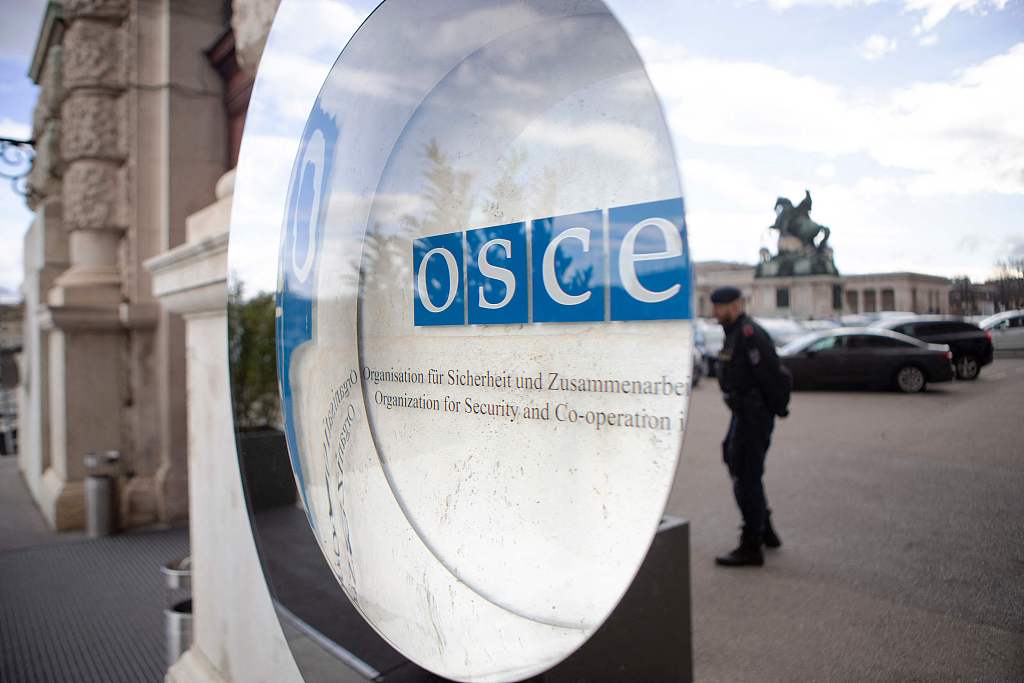
The logo of the Organization for Security and Cooperation in Europe (OSCE), at the OSCE headquarters in the Hofburg Palace in Vienna, Austria, February 21, 2022. /CFP


The consequence of replacing the inclusive OSCE with NATO hegemony might be a new Cold War. The main conflict between NATO and Russia is over where to draw the new dividing lines, in which the divided societies in Ukraine, Georgia, Belarus, and Moldova are becoming the battlefield. The current war was both predictable and avoidable. American diplomat George F. Kennan cautioned in 1998 that NATO expansionism would be the beginning of a new Cold War: "Of course there is going to be a bad reaction from Russia, and then [the NATO expanders] will say that we always told you that is how the Russians are – but this is just wrong."

Excluding Russia from the OSCE

On November 18, Poland refused Russian Foreign Minister Sergey Lavrov to attend the OSCE meeting in Poland as he is under EU sanctions.

Poland's decision to deny Sergey Lavrov access is either inspired or directly advocated by the U.S. In September, Washington denied Russian diplomats to travel to New York for participating in the sessions of the UN General Assembly. We now see Poland similarly abusing its role as a host of the OSCE meeting to dictate who should be allowed to participate.

This decision is very dangerous as the international security architecture collapses when states place exclusive military alliances above inclusive institutions that develop common rules. The principal loyalty to NATO and EU above the UN and the OSCE is a feature, not a bug in the European security architecture.

The erosion of a common Europe began less than two weeks after NATO's first expansion, as NATO claimed the authority to invade Yugoslavia in 1999 without a UN mandate. The invasion was unmistakably a violation of international law, yet it was argued to be legitimate as NATO was argued to serve liberal democratic values. Decoupling legality from legitimacy was intended to assign priority to NATO as the ultimate authority in Europe.

The efforts of replacing international law with the "international rules-based order" formalizes this logic of sovereign inequality. The fundamental idea is that the world should be divided between liberal democracies and authoritarian states – and the former should not be restrained by the same rules as the latter. Consequently, the U.S.-led alliance striving for hegemony is elevated above the OSCE and the UN as inclusive institutions that develop common rules.

The OSCE was developed to mitigate and transcend bloc politics, although it is now used instead as an instrument of bloc politics. The consequence of eliminating the common institutions and rules is now evident. A major war continues to rage on in Ukraine that might escalate into a nuclear war between NATO and Russia, yet there seems to be no willingness to engage in diplomacy.

Glenn Diesen is a professor at the University of South-Eastern Norway. 


4/04/2021

Ukraine to hold join military drills with NATO amid escalating tensions with Russia


Source: The Hill
March 4 2021
By Tal Axelrod


Ukraine’s military announced Saturday that it will hold joint military drills with NATO troops later this year amid escalating violence with pro-Russian separatists in the eastern part of the country.

The armed forces said in a statement on Facebook that the drills will be held with more than 1,000 military personnel from at least five NATO member states in a few months.

“In particular, defensive actions will be worked out, followed by an offensive in order to restore the state border and territorial integrity of a state that has been subjected to aggression by one of the hostile neighboring countries,” the statement said, in an apparent reference to Russia.

An exact date for the drills, which were described as routine, was not provided.

“Exercise Cossack Mace is a routine exercise which is still in the planning stage," a U.K. UK Ministry of Defence spokesperson said in a statement to The Hill. "It is due to take place in Summer 2021.”

Moscow had preemptively rebuked any potential deployment of NATO personnel to Ukraine, warning that it would ramp up pressure along the border between the two countries.

But pressure has already ramped up along the border, with Russia building up its military presence on its side of the barrier. Fighting also increased with separatists backed by Moscow in eastern Ukraine, spelling the potential end to a cease-fire in the Donetsk region.

The Ukrainian parliament this week put out a statement declaring an “escalation” along the front, citing a “significant increase in shelling and armed provocations by the armed forces of the Russian Federation.”

Ukraine, which represents NATO’s front line in Eastern Europe against Russian expansion, pressed Western governments to “continue and increase international political and economic pressure on Russia.”


5/05/2020

The coronavirus crisis as a critical juncture for Ukraine and the world


Source: New Eastern Europe
May 4 2020
By Andreas Umland and Pavlo Klimkin

Deliberations on the political repercussions of the ongoing pandemic for international relations and Ukrainian foreign affairs.

In their seminal 2012 study Why Nations Fail: The Origins of Power, Prosperity and Poverty, Daren Acemoglu and James A. Robinson identified the Bubonic Plague of 1346-1353 not only as one of the greatest calamities in human history. The Black Death – as the pandemic is also called – also acted as a critical juncture in European political history. While the 14th century pestilence encouraged the gradual abolition of feudalism in Western Europe, it led to the so-called Second Serfdom in most of Eastern Europe – not the least, in parts of today’s Ukraine.

The Black Death thus fundamentally reset European affairs during the Middle Ages, resulting in consequences that reach as far as today. The COVID-19 pandemic will presumably result in far fewer victims than the Bubonic Plague, which claimed the lives of between 70 to 200 million people. Yet it seems that the coronavirus crisis could also become a critical juncture in world history, with far-reaching repercussions for both states’ domestic affairs and their international relations.

Today, most serious politicians and experts share a general understanding of the pandemic’s wide-ranging consequences for the world system. But there is, so far, no common and clearly articulated understanding regarding the exact nature of these political repercussions as well as how to properly react to them. There is even less thinking, so far, regarding the international coalitions that will need to be created in order to implement plans designed to address the pandemic’s socio-political impact. For the time being, many leading thinkers are cautious in their inferences, forecasts and proposals.

Being employed at a Kyiv think-tank suggestively called ‘Institute for the Future’, we have decided to do the opposite. At a time when it is still unknown how and when the crisis, as well as the subsequent disorder generated by it, may end, we are starting a series of texts concerned with how the world system could and should change. Drawing far-reaching conclusions and suggestions has become possible as the ongoing crisis is causing a fundamental break with the past and may soon be joined by other challenges in years to come. For Ukraine, moreover, the stakes are especially high regarding how this and other future international crises will be resolved.

Of course, a transformation of the international system is hard to predict and even more difficult to enact by its very nature. Yet postponing debate regarding what is already happening and may happen in the future could delay our understanding of these fundamental changes. A transition to some new world order already appears under way and is likely to become contested in the future. Starting to discuss these issues now may ultimately help improve the quality of future outcomes.

Such reflections can, at this early stage, be neither systematic nor definitive. Rather, we address in the following texts a range of areas where radical changes are likely and/or desirable. Subsequently, we develop some tentative propositions regarding these ideas. The geopolitical transformations we are foreseeing here may, to be sure, not happen in the immediate future. But we expect these transitions ultimately to occur and be comprehensive.

Ukraine needs to take an active part in international discussion regarding these new and forthcoming political challenges. Kyiv also needs to participate, as far as possible, in the search for possible solutions to these problems as well as in their implementation. The current crisis and its political repercussions bear special risks for the Ukrainian nation. But they may also contain chances for the country to move from the global periphery closer to the centre of international decision-making.

The rise of the deep state


First, as a result of the current crisis, both national and international public institutions are likely to obtain stronger popular mandates. In the future, they will consequently play a larger and in some cases more authoritative role in societies than today. The relations between people and their states will likely change as domestic and intergovernmental institutions become increasingly focused on providing basic necessities. In some cases, the transfer of new powers to these institutions may be well-defined and limited. In other cases, such as Orban’s Hungary, this has led and may further lead to a strengthening of executive powers that undermine democracy. Despite this, not all of these new powers will necessarily lead to more authoritarianism, with many state organs using these novel competences in a different manner.

A desire to ensure better public protection and professional expertise may, in particular, lead to a strengthening of what has come to be known as the “deep state”. This concept is here understood in a neutral sense and not in the way the phrase has been misused by Donald Trump and various conspiracy theorists. The original meaning of the term “deep state” refers to those highly qualified bureaucrats, diplomats, experts and researchers whose often invisible work secures the proper functioning of governmental or semi-governmental institutions. Members of the “deep state” are assumed to combine patriotic devotion to their country​​with high professionalism in their public service. If other global challenges similar in scale to the coronavirus crisis appear in the coming years, a trend of strengthening governmental structures as a whole and of the “deep state” in particular may become ever more prominent.

For international relations, this growing importance of state institutions in relation to the wellbeing of societies can mean either of two things. It could imply a strengthening of classical principles of state-centred realism and increased competition between different national institutions. Or it could lead to new levels of interaction between national governments and especially the “deep states” of many countries.

The latter scenario may eventually lead to the formation of a “deep globalism” that would be different from the current structures found in the UN and other international organisations. “Deep globalism” would not only embrace today’s international bureaucrats. Rather, it could result in properly institutionalised, funded and empowered global networks of experts or “epistemic communities”, who would collect and analyse critical information on a transnational scale. Ideally, these associations of specialists – that nascently already exist in academia – would have sufficient authority to make and implement decisions based on the best of their knowledge.

This development would mean that classic representative democracy and relations between governments will no longer operate as they do now. To justify, organise and, most importantly, legitimise this new values-based and expert-driven international structure would constitute a considerable political challenge. Yet it is clear that current models of interaction and cooperation between states have become inadequate. They are only able to produce insufficient responses to various health, economic, environmental and migration crises that we are now facing and will be probably even more encountering in the future.

As for now, the old concept of ‘every country for itself’ is benefitting from these increasing challenges. However, while we are far from the end of the pandemic, the problems facing the national model of crisis management are already visible. They were illustrated, for instance, by the bizarre world-wide hunt for face masks by states during March and April. Still, even an international solution to these material and economic issues may not be enough by itself.

For example, a global multi-phase Marshall Plan is now being discussed by governments and international bodies. Any project that supports the world economy should only be welcomed. Yet, these anti-crisis measures will remain incomplete as long as they only focus on international financial transfers, developmental support and investment incentives. Without a simultaneous reset of the international political system, these measures will not prevent a repetition of past and current problems. Purely economic measures will not provide for a more secure and sustainable future.

The problematic post-World War II system and Ukraine


Second, as countries continue to pursue national forms of crisis management, they naturally draw on lessons from their own experiences. So far, only the corona virus itself appears, to most people, as a truly global question to be solved by international networks of researchers, medical staff and health care workers. Addressing socio-economic issues resulting from the pandemic and meeting today and tomorrow’s international challenges is still largely seen through a national, rather than international, lens.

Since World War II, a number of prominent structures and projects, to be sure, have emerged that are designed to foster closer cooperation between nations and civilizations. Theoretically, they could and should provide platforms for solving virtually all relevant international questions. Yet, today most critical issues continue to be resolved mostly at levels other than global. These uncoordinated efforts sometimes lead to fierce national, regional and local competition for resources. As long as countries continue to prioritize solving their own problems, richer states will possess a better chance to survive and thrive. The strong will become even more powerful while weak states will become even more feeble.

Ukraine is, by most indicators, a third world country. Even among this group it is not in the first tier. Consequently, for Ukrainians it is difficult, if not impossible, to win in this growing competition between nations. For Ukraine and other relatively weak states, therefore, the emergence of stronger intergovernmental and even supranational institutions represents a preferable vision of the future. However, participation in such new or renewed global organisations implies that Ukraine will need to radically improve the quality of its own national institutions.

Third, when Russia’s aggression against Ukraine began in 2014, it was not only Ukrainians who realized that the existing system of post-war international institutions is ineffective. An aggressor that has a permanent seat in the UN Security Council continues to use its position and veto rights to prevent full official acknowledgment that an aggression is taking place. This has led to an absurd situation in which one part of the UN Charter cannot be implemented due to conflict with another. By its mere existence, the UN’s most prominent decision-making body, the Security Council, has implicitly legitimized an illegal territorial expansion by one of its permanent members at the expense of a recognized UN member state. Paradoxically, the UN’s peculiar structure thereby undermines one of its key founding values.

In the past, there was little that Ukraine could do other than to continue fighting Russian aggression. There has been, to be sure, some talk recently about reforming the Security Council. Working groups were created, some new concepts were developed. However, these developments did not lead anywhere.

That is because the world’s key players saw no real need to reset the existing international system. Even worse Russia, despite facing sanctions after being expelled from the G8, has attempted to convene a summit solely comprised of the Security Council’s permanent members. The Kremlin wants to discuss the fate of Ukrainians and others without them being present by exploiting the outdated peculiarities of the UN’s structure.

Towards a new international system


After the pandemic – which has often been compared to a war – a new international situation, however, may emerge. This could amount to a new critical juncture resembling the situations at the end of the two World Wars. Such sentiment may not only renew debate regarding humanity’s general norms. Repercussions from the current pandemic and future global challenges could also trigger a direct crisis in the existing structures of major international organisations. Under these circumstances, it could become possible for countries like Ukraine to find influential, like-minded actors with whom they could raise the issue of a fundamental transformation of the UN.

Resistance, to be sure, to such a proposal would be strong. However, the UN system is already today losing legitimacy as a result of poor crisis management regarding, for instance, the ongoing pandemic. The world’s current institutional set-up is already perceived by many, not least by Ukrainians, as having become irrelevant in dealing with international challenges and ineffective in addressing increasingly acute human problems.

Today’s reform-minded UN Secretary-General, Antonio Guterres, has not been able to implement any of the substantive changes he had planned when he took office. As a result, we may have already missed the chance for gradual reform of the UN system. The world’s current institutional structure is increasingly perceived as inadequate when it comes to addressing some of today’s most burning issues. With every passing month, radical rather than moderate change is becoming increasingly likely.

In order to reset the entire UN system it would have to be thoroughly reassessed. This would ideally be done by an external and independent auditor. The body perhaps in most need of reform is the World Health Organization, which failed to provide adequate monitoring and warning of the corona virus when it began spreading. More timely analysis, clearer public communication and more resolute advice may have saved tens of thousands of lives. Preparations for the pandemic could and should have started earlier. This includes Ukraine where the prior coronavirus surge in Western Europe was at first not taken seriously.

In light of this and other experiences, humanity should ideally reinvent rather than merely reform the current UN system. The organisation and its organs simply do not deliver what they are expected to provide. They often give only belated and/or limited responses to crises or emergency that they are designed to tackle. What is the purpose of a World Health Organization that behaves “politically correct” when assessing the outlook for an epidemic? Why does much of mankind now have to pay dearly because WHO officials were, in a crisis situation, unwilling to complicate their relations with China? International institutions that cannot act on the basis of impartial analysis are doomed to be ineffective. They put under question the reasons why they were created in the first place.

What could the future international system look like?


The question regarding what institutions or groups could adequately deal with these and similar questions remains, however, unresolved. There does not yet seem to be a clear driving force that could initiate and enforce a reset of existing international institutions.

Some speculate that a reboot of the current international system will lead to the emergence of a global structure with executive powers, which would effectively be a form of world government. Yet, the chances of such an institution, even with limited powers, appearing any time soon are low. The creation of a permanent supranational institution by nation-states, that would have to relinquish their powers, is currently unrealistic. In spite of its common values, geography and heritage, European civilization has for almost 70 years failed to transform the European Commission (once founded as the European Coal and Steel Community’s High Authority) into an EU government.

One could imagine, however, a worldwide structure that could act only during emergencies. This organisation would have the task of temporarily coordinating countries in order to ensure an urgent transcontinental crisis is resolved. As the current pandemic continues and ever more clearly global challenges will become urgent, such an idea may increasingly find support among politicians, diplomats, bureaucrats and citizens around the world. The financing of such a new organisation could be secured by collecting a global emergency tax or contributions to a world insurance scheme. Such an institution could have a supervisory board consisting not only or not at all of politicians, but of scientists as well as other experts with a high global reputation.

Obviously, the creation of such an international body would be difficult. For example, the exact conditions under which a supranational structure would take over powers from the national level would be difficult to formulate. Many governments of the world may perhaps support such an idea in principle. Yet, some will try to resist any real sharing of power and cost even in the case of a global emergency. Still, future transnational crises, similar to the current pandemic, could over time delegitimise and gradually reduce such resistance. Each subsequent calamity will presumably increase the popularity of global emergency structures or other similar schemes.

Changing geopolitics and Ukraine’s Western integration


Fourth, there is increasing speculation regarding whether border changes may soon appear on the current world map. Whether or not the unification or separation of countries happens will depend on the length and intensity of crises that question today’s nationally ordered system. What exactly will happen is difficult to foresee. However, it seems clear that a profound transformation of the existing means of interaction between countries is under way.

The peculiar system of balances and institutions created after World War II can neither be wholly abandoned nor be revived. A sort of “Yalta 2.0” – that is, a conference of great powers concerned with the partition of the world into spheres of control – is also no longer possible. Maintaining clear areas of influence in today’s world is difficult. For instance, armed intervention today can be resisted by a variety of non-military means. It can also be repelled with non-conventional methods that cause unforeseen damage and costs to the intervening force.

The domination of regions by the world’s big players will, to be sure, remain a regular fixture of the international system. But zones formerly subject to semi-colonial control will become increasingly hybrid. They will experience neither full nor no control by one large power, but rather a mix of competing influences at various levels. The Kremlin understands this well, as illustrated, for instance, by its issuing of Russian passports in the Donbas and its promotion of Ukraine’s “federalisation” (i.e. Bosnification). Moscow feels that its grip on the former USSR republics is waning. Despite this, it wants to maintain influence in post-Soviet republics like Ukraine that may experience Western integration in the future.

Whatever else Moscow may come up with, joining NATO as a full member will remain Ukraine’s strategic goal. Can Ukrainians, however, be sure that NATO will be ready to embrace a country with potentially millions of Russian passport holders? Will NATO countries be ready to observe, with regards to Ukraine, treaty obligations to protect a fellow member of the alliance? Even today this is an open question among the organisation’s member states.

Ukraine’s desire to be a future EU member is no less of a challenge. Joining the EU requires even more purely Ukrainian action. The basic patterns which govern Ukraine’s state and society must be fundamentally changed. Even so, deep reforms will not be enough.

We also have to win the hearts and minds of other Europeans. This includes, for example, the French and the Dutch, who will one day hold a referendum on the question of whether Ukraine can join the EU. If we act as we have done before, it will be difficult to win this battle. Perhaps, the pandemic and its far-reaching repercussions can give Ukrainians a chance to jump over our own shadow.

Unlike other politicians and commentators, we do not expect today’s crisis to cause the weakening or indeed disintegration of NATO and the EU. On the contrary, we believe that strengthening these organisations is necessary for the West’s continued leadership in the future. If NATO and the EU do not live up to the expectations from them, the transatlantic space of today will no longer exist. The stakes are indeed high, but that may be also an advantage.

For Ukrainians, the stakes are even higher and are nothing less than existential. Will we remain a socio-economic hybrid and geopolitical grey zone, or will we finally enter the Euro-Atlantic community? To believe that we will be welcomed into a renewed transatlantic world simply because of who we are is futile. The coronavirus pandemic as a critical juncture does not change our goals. However, it does provide us an opportunity to abandon old mentalities and build new institutions necessary to integrate into the Euro-Atlantic space with the help of our friends and partners.

Pavlo Klimkin was Minister of Foreign Affairs of Ukraine in 2014-2019, and is Head of the European, Regional and Russian Studies Program of the Ukrainian Institute for the Future in Kyiv.

Andreas Umland is General Editor of the book series “Soviet and Post-Soviet Politics and Society” at ibidem Press in Stuttgart, and a Senior Expert at the Ukrainian Institute for the Future in Kyiv.


4/01/2018

Will Gazprom Leave The Ukraine Forever?

https://oilprice.com/Geopolitics/International/Will-Gazprom-Leave-The-Ukraine-Forever.html

3/01/2018

US weapons to reach Ukraine in 'weeks'

http://www.washingtonexaminer.com/us-weapons-to-reach-ukraine-in-weeks/article/2650432

4/01/2016

Defense News: Ukraine seeks to break Russian arms monopoly in India


Πηγή: interfax- Ukraine
April 1 2016

Ukraine has launched an aggressive effort to manage multiple overloaded armaments and weaponry that New Delhi acquired during the Soviet era and which have become a liability for the Indian defense forces, military news portal Defense News reported on Thursday.

A Ukrainian governmental delegation and over a dozen defense companies showcasing new programs are now at Defexpo, Defense News wrote.

"We are here now [in] India for the long term to manage Soviet-era headaches, which India cannot manage alone," said Perto Fedoruk, chief adviser to Ukraine's largest defense industry consortium, Ukroboronprom.

"For nearly a decade Russia has forcefully blocked our entry," Fedoruk said.

"We have offered multiple solutions to give new life to Soviet-era weaponry [with Indian defense forces], as we are the original equipment manufacturer," he said.

According to a Ukrainian diplomat, "India cannot resolve the headaches of overloaded Soviet-era platforms without Ukraine."

"India has now permitted us to participate in defense programs independently, and we are offering a new solution to manage and refit the Soviet-era aircraft carrier Admiral Gorshkov [renamed as INS Vikramaditya], which is 50% cheaper than the Russian offer," said Mykola Gordienko, head of Ukroboronprom naval projects.

The Indian Navy is evaluating a proposal by Ukraine for overhaul and maintenance of gas turbines used in Delhi-class warships and the carrier Admiral Gorshkov.

The Ukroboronprom deputy director general of strategy, Artur Kheruvymov, said India plans to organize a "joint military technical commission for providing service support for Soviet-era weaponry."

"In addition, the two countries are also planning to form joint ventures in India for upgrading and overhaul and manufacture of spares for Soviet-built air defense systems, including the Kvadrat, OSA-AKM Strela-1, Tunguska, Shilka, portable IGLA and Strela-2 systems," Kheruvymov said.

Ukraine is doing more than $100 million in annual defense business with India, and aims to increase it to $500 million in the next three years, he said.

Over 700 defense contracts related to the delivery of spares, repair and upgrade valued at over $2 billion were signed and completed in the last 10 years.

"We have now managed to make a breakthrough," according to the Ukrainian diplomat, who added: “India has now decided to buy [the] electronic support measure system used to detect and track stealth aircraft and Vympel R-27 medium-range air-to-air missiles from us instead of from Russia."

Ukraine has also offered to collaborate with India's Defense Research and Development Organization (DRDO) to jointly develop multiple rocket launcher systems with a range of 100 kilometers — similar to Russian Grad systems.

"In addition, we will also be developing a variety of new electronic warfare systems with DRDO and a partnership has been sealed recently," Fedoruk said.

Ukroboronprom is also sealing a partnership with state-owned Ordnance Factory Board (OFB) to indigenize Russian T-90 main battle tanks and set up a facility to manufacture spares in India.

Ukraine has also entered into a partnership with state-owned Hindustan Aeronautics for supply of crucial spares for Russian Sukhoi aircraft.


2/29/2016

Obama’s Ukraine policy in shambles

U.S. President Barack Obama during a summit at the White House | Drew Angerer/Getty

Πηγή: Politico
By MICHAEL CROWLEY
29 Feb 2016

Distracted by ISIL, frustrated by infighting in Kyiv, the administration makes little progress against Putin in Europe.
President Barack Obama’s effort to rescue Ukraine from Russia’s military grip has stalled, and turmoil inside Ukraine’s government may hand Russian President Vladimir Putin a victory in a conflict that Obama has said involves “the most basic principles of our international system.”

Two years after the pro-western protests that toppled Kyiv’s government, enraged Putin, and caused an international crisis, Obama’s Ukraine policy is foundering — the victim of Putin’s steely determination, the distractions of Syria and ISIL, and wavering support from European allies eager to move past the conflict.

Despite personal pleas from Vice President Joe Biden, U.S. officials fear that Kyiv’s leaders are near a political implosion that would derail efforts to stabilize the country and eject Russia from its eastern territories.

“Syria has really taken the focus off of Ukraine. It feels to me like its going to be difficult for Europe to stay together and continue to pressure Russia with sanctions,” the Republican chairman of the Senate Foreign Relations Committee, Bob Corker, told POLITICO. “At some point you’re going to have a frozen conflict that’s very much to Putin’s advantage.”

Critics like Corker say that Obama’s actions have failed to live up to his rhetoric, which casts Russia’s presence in Ukraine as a grave threat to European security. Obama has rejected calls from several top advisers to provide Ukraine with weapons to fight off Moscow-backed separatists.

“Putin has paid no price,” Corker said, adding that European leaders have told him Putin says “there is just no push back” from the U.S.

Nonetheless, the U.S. and Europe have imposed several rounds of economic sanctions on Moscow, and in recent months Obama has beefed up America’s military presence on NATO’s eastern flank.

But even as he warily partners with Putin on a cease-fire for Syria, Obama has not shaken the Russian leader’s support for the pro-Russian separatists in eastern Ukraine, where fighting has killed nearly 10,000 people and stunted the country’s political and economic progress. After a lull in violence, combat has spiked in recent weeks to the highest levels since last summer.

“Nothing has happened to suggest that the Russians are any more willing to give us control of Ukraine than they were before,” said Ivo Daalder, Obama’s first ambassador to NATO and now President of the Chicago Council on Global Affairs. “In some ways, Syria became a distraction for us because it led us to work with Russia to try to address the Syrian crisis and to ignore what’s happening in Ukraine.”

Obama officials insist that the core of their strategy — implementing a February 2015 peace accord signed in Minsk that calls for Russia to withdraw forces from the country’s east — is still on track.

“We are pressing hard to see Minsk fully implemented by the time the president leaves office,” said a senior administration official, referring to the pact brokered by France and Germany and signed by Ukraine and Russia. “We’re aiming for implementation during the second half of 2016.”

Protesters clash behind burning barricades during the face off against heavily-armed police on February 20, 2014 in Kiev | Bulent Kilic/AFP/Getty
Under the Minsk deal, Moscow must withdraw forces from eastern Ukraine and end its support for separatists; Kyiv must allow elections and greater autonomy for the country’s relatively pro-Russian east; and the U.S. and Europe will lift sanctions on Moscow.

Privately, U.S. officials concede that a government collapse could make implementing the Minsk accord — something that was supposed to happen by the end of 2015 — all but impossible, at least before Obama departs the White House.

“The worst thing that could happen right now is for the government to collapse and to have new elections,” said a second senior administration official, “because everything will spin into chaos, and the whole system will get locked up.”

That was Biden’s concern when he flew to Kyiv in early December. In an address to parliament, Biden urged Ukraine’s government to remain focused on political unity and reform in the face of Putin’s intimidation.

“It is no exaggeration to say that the hopes of freedom-loving people the world over are with you because so much rides on your fragile experiment with democracy succeeding,” Biden said. “It may be your last moment.”

Biden had barely departed when, two days later, the country’s beleaguered prime minister, Arseniy Yatsenuk addressed the same parliament. As he spoke at the podium, a rival member threw his arms around him and carried him off like a mannequin, touching off a wild brawl.

The government nearly fell earlier this month when Yatsenuk, who enjoys a single-digits approval rating, narrowly survived a no confidence vote in parliament. Ukraine’s President, Petro Poroshenko, has called for Yatsenuk’s resignation, but Poroshenko is barely more popular, and faces charges he has done too little to combat rampant corruption.

Biden has been conducting damage control from Washington. The vice president, who has visited Ukraine four times since 2014 and says he’s logged “close to a thousand hours on the telephone” with its leaders, has placed several more calls to Yatsenuk and Poroshenko this month.

Russia has gleefully exploited the political disarray, casting Ukraine’s leadership as unable or unwilling to take the political steps required by the Minsk deal.

“Our Ukrainian friends aren’t doing their share,” Moscow’s ambassador to Washington, Sergey Kislyak, said in a recent interview. Russia wants the Ukrainians to move first on steps like amending the country’s constitution to grant more autonomy to the east.

U.S. officials are adamant that Moscow is mainly to blame for the stalemate, saying that Kyiv can’t be expected to move first when a portion of their country is a combat zone stoked by Russia.

But even some Western officials concede that the Russians have a partial point.

“The implementation of Minsk now is more or less frozen,” said a European diplomat. “Unfortunately, the Ukrainians are now actually carrying a big part of the responsibility of the blockage, because of the crisis in Kyiv.”

Such talk from Europe is ominous given the pressure European leaders are facing to end sanctions on Moscow, which have slowed their economies and cost their businesses profits.

Despite the occasional fistfight, U.S. officials insist things in the capital are not quite as bad as they appear. Ukraine’s parliament has passed some significant reform measures in recent months. Poroshenko recently fired the country’s prosecutor general, whom the U.S. saw as a major obstacle to battling Kyiv’s endemic corruption.

“It’s not necessarily pretty to watch,” said one Western diplomat, arguing that “rooting out the vestiges of the old Soviet state” was never going to be easy — particularly amid “a concerted effort from their big neighbor to see that the reform project fails,” he added.

That “big neighbor” is Russia, where Putin has worked to thwart Ukraine’s political progress — including through the use of organized crime, according to Western officials.

And although Putin dialed down the violence in Ukraine’s east last fall, Obama officials have been alarmed by a recent spike in fighting there. It remains unclear whether Putin is escalating the conflict, officials say, or if the separatists might be acting on their own.

U.S. officials say that until Putin stands down in the east, Kyiv will be hard-pressed to pass the political reforms required by Minsk. The problem was illustrated when the parliament considered a measure granting limited autonomy for separatist-controlled areas last summer; violent protests broke out in Kyiv, leaving several people dead.

“Minsk is now in tatters. Western attention at the highest level is gone due to the migration crisis and the Obama administration’s priorities lying elsewhere,” said Andrew Weiss, a former Clinton White House national security aide now at the Carnegie Endowment for International Peace. “The whole thing just looks really messy.”

“The Russian bet here is that we have ADD, won’t be able to keep the sanctions regime together, and will find other stuff to worry about,” Weiss added.

The second administration official said the U.S. would remain focused on Ukraine, but that resolving the crisis could be impossible so long as its parliament looks like a fight club.

“Our message is, you have to have a government that functions. You can’t have disarray” the official said. “Otherwise, support from the international community is going to evaporate. So that’s the main point: ‘You guys have got to figure this out.'”


2/15/2016

Syrian Kurds open missions in Moscow, Donetsk

Kurdish officials attend the opening ceremony of the representation office of the Syrian Kurdish region in Moscow, Russia, 10 February 2016

Πηγή: NewEurope
By Dan Alexe
Feb 15 2016

Russia-backed separatists in the Donbas region, in Eastern Ukraine, are in talks to host a Syrian Kurdish embassy in Donetsk.

A Syrian Kurdish mission has already opened on 10 February in Moscow, a move that would anger Turkey which sees the Syrian Kurdish Democratic Union (PYD) as a terrorist group. The office will campaign for the rights of some 250,000 Kurds who currently live in Russia, as well as those living in Syria.

Turkey suspects Russia, which launched air strikes in Syria three weeks ago, to lend support to the PYD and its armed wing People’s Protection Units (YPG).

Ankara has warned Moscow it would not tolerate Kurdish territorial gains close to its frontiers in north-western Syria.

On Sunday, the Syrian Kurdish PYD party rejected Turkish demands that allied militia withdraw from positions near the border that are being shelled by Turkish army, and warned that Syrians would resist any Turkish intervention in the country.

Turkish Prime Minister Ahmet Davutoglu on Saturday demanded the PYD withdraw from areas north of Aleppo he said had been captured by the Kurdish group. Asked if he rejected that demand, Muslim said: “Of course”.

Turkey on Saturday demanded the YPG militia withdraw from areas that it had captured in the northern Aleppo region in recent days from insurgents in Syria, including the Menagh air base. The Turkish shelling has targeted those areas.

Turkey has been alarmed by the expansion of Kurdish sway in northern Syria since the start of the conflict in 2011. The YPG controls nearly all of Syria’s northern frontier with Turkey, and has been a close ally of the United States in the campaign against Islamic State in Syria.

Ankara views the group as an extension of the Kurdistan Workers Party (PKK), which has waged a three-decade-old insurgency for autonomy in southeast Turkey.

According to Gazeta.ru, Putin had the idea of allowing Syrian Kurds to open missions in Russia after relations between Moscow and Ankara became tense following due to their conflicting interests in Syria and to the downing of Russian fighter jet by Turkey.


11/10/2015

The Pentagon wants to boost troop numbers in Europe to 'counter' Russian aggression

US Army paratroopers training in Europe.
Πηγή: Business Insider
By Jeremy Bender
Nov 9 2015

US military officials have proposed boosting troop numbers in Europe to deter potential Russian aggression across the continent and against NATO members, The Wall Street Journalreports.

Currently, the US Army maintains two brigades in Europe. Each brigade has approximately 3,500 soldiers, with an additional brigade based in the US that rotates into and out of Europe.

Speaking at the Reagan National Defense Forum over the weekend, US Army Chief of Staff Gen. Mark Milley said he would like to increase both the number of brigades based in Europe and the number of US-based brigades intended for rotation into the European theater.

The Journal notes that Milley said during the forum that ideally, the newly formed US brigades would include mixed capabilities, including helicopter-attack teams, artillery units, and engineering groups.

However, Milley noted during the forum that the key to increasing US troop placements throughout Europe was a delicate balancing act. He noted that although Russian aggression demanded a strong response to deter future aggression, too large a deployment could only further heighten hostilities.

“The challenge here is to deter further aggression without triggering that which you are trying to deter,” Gen. Milley said. “It is a very difficult proposition.”

According to The Journal, Milley said the Army was also currently engaging in developing new training programs intended to counter Russia's military operations. The new Army training focuses on preparing soldiers to deal with unconventional hybrid tactics, such as what Russia used in Crimea and eastern Ukraine.

Although Milley floated the idea of boosting deployments throughout Europe, the plan still has to be approved by the White House before it can be put into effect.

The US's and Russia's relationship is currently under intense strain as Moscow tries to check US influence across the world. In Syria, Russia is bombing CIA-backed rebels that are trying to overthrow the regime of Syrian President Bashar al-Assad. In a sign of the tension, the US hasmoved dog fighting jets into Turkey that could be used to engage with Russian and Syrian aircraft in the event of establishing a no-fly zone.

And in Europe, NATO concluded its largest military exercise in more than a decade on November 6. Although the exercise has been in the works for two years, elements of the exercise have been reworked to better address NATO's growing discomfort with Russia following Moscow's annexation of Crimea and military activities in eastern Ukraine.


11/06/2015

Nord Stream 2 gas pipeline project to deprive Ukraine of $2 bln revenue – Yatseniuk


Πηγή: Interfax
6 Nov 2015

Ukrainian Prime Minister Arseniy Yatseniuk is concerned about the Nord Stream 2 gas pipeline project, the Ukrainian government secretariat's information and public relations department has said.

"If Russia and certain Western companies build Nord Stream 2, Ukraine will lose $2 billion in revenue, Slovakia – $0.8 billion and Poland – $0.4 billion. And it will leave the European Union without real energy independence," Yatseniuk said after a meeting with Baltic prime ministers during his working visit to Riga on Thursday.

The Ukrainian prime minister asked the European Commission and the Baltic prime ministers "to take the matter seriously."

The project must meet every criteria of the Third Energy Package, Yatseniuk said, adding, "we are confident that this project has nothing to do with economic issues, only with political ones."

Nord Stream 2 envisages the construction of two undersea lines with a total capacity to transport 55 billion cubic meters of gas a year from Russia to Germany across the Baltic Sea bottom. Shareholders of the company's project signed an agreement in early September. The consortium has six members, namely Gazprom, E.ON, BASF/Wintershall, OMV, Engie and Shell.


4/15/2015

The Republics of the former USSR, CIA, 1991

The ballot paper used in the UKraine referendum back in 1991, with the text of the Declaration of Independence printed on it.


From Wikipedia:

"A referendum on the Act of Declaration of Independence was held in Ukraine on 1 December 1991. A majority of 92.3% of voters approved the declaration of independence made by the Verkhovna Rada on 24 August 1991.

The referendum

Voters were asked "Do you support the Act of Declaration of Independence of Ukraine?" The text of the Declaration was included as a preamble to the question. The referendum was called by the Parliament of Ukraine to confirm the Act of Independence, which was adopted by the Parliament on 24 August 1991. Citizens of Ukraine expressed overwhelming support for independence. In the referendum, 31,891,742 registered voters (or 84.18% of the electorate) took part, and among them 28,804,071 (or 92.3%) voted "Yes".

On the same day, a presidential election took place. All six candidates campaigned in favour of a "Yes" vote in the independence referendum. Leonid Kravchuk, the parliament chairman and de facto head of state, was elected to serve as the first President of Ukraine.

From 2 December 1991 on Ukraine was globally recognized as an independent state (by other countries). That day thePresident of the Russian SFSR Boris Yeltsin did the same.[6] In a telegram of congratulations President of the Soviet UnionMikhail Gorbachev sent to Kravchuk soon after the referendum, Gorbachev included his hopes for close Ukrainian cooperation and understanding in "the formation of a union of sovereign states".

Ukraine was the second-most powerful republic in the Soviet Union both economically and politically (behind only Russia), and its secession ended any realistic chance of Gorbachev keeping the Soviet Union together. By December 1991 all former Soviet Republics except the RSFSR[8] and the Kazakh SSR[8] had also proclaimed themselves independent.[9] A week after his election, Kravchuk joined with Yeltsin and Belarusian leader Stanislau Shushkevich in signing the Belavezha Accords, which declared that the Soviet Union had ceased to exist.The Soviet Union officially dissolved on December 26."


2/01/2015

Russia To Replace Ukrainian Weaponry With Help From CSTO Allies


Πηγή: Eurasianet
Jan 31 2015

Russia's post-Soviet security bloc will work to build up the capacity of other member states to produce substitutes for Ukrainian weaponry, the bloc's top official announced.

The Collective Security Treaty Organization will strengthen its commission on defense industry cooperation and focus its efforts on "import substitution." That term has become a buzzword over the last year in Russia as the country scrambles to replace products it can no longer buy as a result of Western sanctions. Here, though, the focus is Ukrainian weaponry, said CSTO Secretary General Nikolay Bordyuzha at a January 30 press conference in Moscow.

The commission will be led by Dmitry Rogozin of Russia, who is now the chief government defense industry official in Russia. The effort "will allow us to take into account and maximally use all the existing possibilities in CSTO countries for manufacturing military equipment which had previously been produced on the territory of Ukraine. The activities of this commission will be focused primarily on implementing this program of import substitution," he said.

"There are possibilities in Kazakhstan. And today, by the way, we are having substantive discussions regarding two factories' possibilities in this program of import substitution. There are also possibilities in Belarus, in Armenia there are very serious possibilities, in Kyrgyzstan, you know, there are several factories."

It's not clear exactly whose imports are being substituted. Ukraine says it has already cut off all of its defense business with Russia, but many of the other CSTO countries also have relied significantly on weaponry from Ukraine (which usually ranks in the top 10 arms exporters in the world).

Kazakhstan, in particular, cooperates closely with Ukraine in the defense-industrial sphere. The two sides have set up a joint venture to manufacture Ukrainian armored vehicles in Kazakhstan, and when President Nursultan Nazarbayev visited Kiev in December, he discussed deepening that cooperation with his Ukrainian counterpart Petro Poroshenko. "I'm happy to state that we are fully renewing our military-technical cooperation, and the experience and potential of the Ukrainian military-industrial complex can be fully utilized for the strengthening of Kazakhstan's military capabilities," Poroshenko said at their meeting.

But in his statement, Bordyuzha just started talking about import substitution, leaving it unclear whether only Russia's imports from Ukraine would require substitution, or all CSTO members. It's somewhat indicative of the Russia-heavy nature of the CSTO that Bordyuzha didn't even feel the need to specify that -- clearly Russia's imports are the ones that matter.


Russia to get more missiles, NATO urges increase in spending


Πηγή: DW
Jan 30 2015

Russia's top general has pledged to use a strengthened arsenal to ensure military superiority over the West. NATO, meanwhile, has urged its member states to invest more in defense.

A statement issued by the head of Russia's military on Friday said that despite the country's economic woes due to European and US sanctions as well as a sharp drop in oil prices, the armed forces were to take delivery of 50 additional ballistic missiles by the end of this year.

"Support for our strategic nuclear forces to ensure their high military capability combined with...growth of the military potential of the general forces will assure that (the United States and NATO) do not gain military superiority over our country,"General Valery Gerasimov's statement said.

The new missiles are just part of a plan to modernize Russia's armed forces by 2020. President Vladimir Putin has pledged that Russian defense spending will remain stable despite a growing economic crisis that has forced budget cuts at other government ministries.

Gerasimov said Russia had no choice but to modernize its military due to threats from beyond its borders.

"Western countries are actively using new forms of aggression, combining military as well as non-military means. Political, economic and information methods are also being used," Russia's Interfax news agency quoted him as saying.

The view from NATO

The Western military alliance, NATO, however, sees the threat as coming from Russia, particularly since it annexed Ukraine's Crimean peninsula last March, something that lead both the EU and the US to impose sanctions on Russia.

Since then, tensions between Russia and the West have only risen further, with the EU and the US accusing Moscow of actively supporting pro-Russia separatists fighting government troops in eastern Ukraine, a charge the Kremlin has denied.

NATO's eastern European member states in particular have been on edge since Russia took Crimea. NATO's response has been to deploy more aircraft ships and personnel not just to the Baltic countries, Estonia, Latvia and Lithuania, but also to Poland.

On Friday, NATO Secretary General Jens Stoltenberg told reporters in Brussels that the alliance was working on plans to deploy forward military units to Estonia, Latvia, Lithuania, Poland, Bulgaria and Romania. These he said, would comprise only a few dozen personnel, but be responsible for organizing exercises and planning for the arrival of reinforcements if required.

Presenting NATO's annual report Stoltenberg also called on NATO allies to step up spending on defense, in light of the current threats.

"It is not possible to get more out of less indefinitely. That is the reason why we have to stop the cuts and gradually start to increase defense spending as our economies grow," he said, noting Russia's commitment to increased defense spending.

He also highlighted the increased presence of Russian warplanes in European skies over the past year, saying NATO fighter jet had been scrambled to intercept Russian aircraft more than 400 times over the past year.