

Source: CGTN
December 1 2020
By Glenn Diesen
The 29th Ministerial Council of the Organization for Security and Cooperation in Europe (OSCE) takes place from December 1-2 in Poland. Established in 1994 to develop a common peace in an inclusive Europe, the OSCE has become the largest regional security organization in the world, which includes the U.S. on its western edge and Russia on its eastern. Therefore it could have played a key role in restoring peace amid the Ukraine conflict. However, the peace initiative was abandoned in favor of a hegemonic project facilitated by NATO expansionism.
The war in Ukraine and the decline of the OSCE are both symptoms of the collapsing pan-European security order.
A common Europe vs. continued bloc politics
In 1989, then Soviet Union leader Mikhail Sergeyevich Gorbachev and then U.S. President George W. Bush held the Malta Summit, which ultimately led to the declaration of the end to the Cold War, a negotiated peace that promised to replace confrontational bloc politics with a new peaceful Europe. In 1990, the Charter of Paris for a New Europe was signed, in which all participants committed themselves to construct a new and inclusive Europe without dividing lines based on "indivisible security" and "sovereign equality." In 1994, these principles laid the foundation for a new and inclusive pan-European security organization – the OSCE.
But Russia was weak, and the U.S. pushed a parallel security architecture based on unipolarity and hegemony. When the Soviet Union collapsed in 1991, two years after the end of the Cold War, the U.S. abandoned the narrative of a negotiated peace for a common Europe. Jack Matlock, the U.S. ambassador to the Soviet Union who had contributed to negotiating an end to the Cold War, warned that the "mythmaking" and historical revisionism began in Washington as soon as the Soviet Union collapsed. One month after the Soviet Union collapsed, President Bush triumphantly proclaimed: "By the grace of God, America won the Cold War… The Cold War didn't end, it was won… We are the United States of America, the leader of the West that has become the leader of the world." The new narrative of victory legitimized a new Europe based on hegemony, in which the OSCE would be a marginal organization.
NATO expansionism would facilitate the new Europe, which canceled the key principles of the OSCE. "Indivisible security" was abandoned as NATO began to expand its security at the expense of Russian security. "Sovereign equality" was replaced with sovereign inequality as NATO claimed the prerogative to interfere in the domestic affairs of other states, topple governments and invade under the guise of advancing liberal values. Last, the OSCE's principle of "no dividing lines" was abandoned in favor of gradually moving the dividing lines in Europe toward Russian borders.
The consequence of replacing the inclusive OSCE with NATO hegemony might be a new Cold War. The main conflict between NATO and Russia is over where to draw the new dividing lines, in which the divided societies in Ukraine, Georgia, Belarus, and Moldova are becoming the battlefield. The current war was both predictable and avoidable. American diplomat George F. Kennan cautioned in 1998 that NATO expansionism would be the beginning of a new Cold War: "Of course there is going to be a bad reaction from Russia, and then [the NATO expanders] will say that we always told you that is how the Russians are – but this is just wrong."
Excluding Russia from the OSCE
On November 18, Poland refused Russian Foreign Minister Sergey Lavrov to attend the OSCE meeting in Poland as he is under EU sanctions.
Poland's decision to deny Sergey Lavrov access is either inspired or directly advocated by the U.S. In September, Washington denied Russian diplomats to travel to New York for participating in the sessions of the UN General Assembly. We now see Poland similarly abusing its role as a host of the OSCE meeting to dictate who should be allowed to participate.
This decision is very dangerous as the international security architecture collapses when states place exclusive military alliances above inclusive institutions that develop common rules. The principal loyalty to NATO and EU above the UN and the OSCE is a feature, not a bug in the European security architecture.
The erosion of a common Europe began less than two weeks after NATO's first expansion, as NATO claimed the authority to invade Yugoslavia in 1999 without a UN mandate. The invasion was unmistakably a violation of international law, yet it was argued to be legitimate as NATO was argued to serve liberal democratic values. Decoupling legality from legitimacy was intended to assign priority to NATO as the ultimate authority in Europe.
The efforts of replacing international law with the "international rules-based order" formalizes this logic of sovereign inequality. The fundamental idea is that the world should be divided between liberal democracies and authoritarian states – and the former should not be restrained by the same rules as the latter. Consequently, the U.S.-led alliance striving for hegemony is elevated above the OSCE and the UN as inclusive institutions that develop common rules.
The OSCE was developed to mitigate and transcend bloc politics, although it is now used instead as an instrument of bloc politics. The consequence of eliminating the common institutions and rules is now evident. A major war continues to rage on in Ukraine that might escalate into a nuclear war between NATO and Russia, yet there seems to be no willingness to engage in diplomacy.
December 1 2020
By Glenn Diesen
The 29th Ministerial Council of the Organization for Security and Cooperation in Europe (OSCE) takes place from December 1-2 in Poland. Established in 1994 to develop a common peace in an inclusive Europe, the OSCE has become the largest regional security organization in the world, which includes the U.S. on its western edge and Russia on its eastern. Therefore it could have played a key role in restoring peace amid the Ukraine conflict. However, the peace initiative was abandoned in favor of a hegemonic project facilitated by NATO expansionism.
The war in Ukraine and the decline of the OSCE are both symptoms of the collapsing pan-European security order.
A common Europe vs. continued bloc politics
In 1989, then Soviet Union leader Mikhail Sergeyevich Gorbachev and then U.S. President George W. Bush held the Malta Summit, which ultimately led to the declaration of the end to the Cold War, a negotiated peace that promised to replace confrontational bloc politics with a new peaceful Europe. In 1990, the Charter of Paris for a New Europe was signed, in which all participants committed themselves to construct a new and inclusive Europe without dividing lines based on "indivisible security" and "sovereign equality." In 1994, these principles laid the foundation for a new and inclusive pan-European security organization – the OSCE.
But Russia was weak, and the U.S. pushed a parallel security architecture based on unipolarity and hegemony. When the Soviet Union collapsed in 1991, two years after the end of the Cold War, the U.S. abandoned the narrative of a negotiated peace for a common Europe. Jack Matlock, the U.S. ambassador to the Soviet Union who had contributed to negotiating an end to the Cold War, warned that the "mythmaking" and historical revisionism began in Washington as soon as the Soviet Union collapsed. One month after the Soviet Union collapsed, President Bush triumphantly proclaimed: "By the grace of God, America won the Cold War… The Cold War didn't end, it was won… We are the United States of America, the leader of the West that has become the leader of the world." The new narrative of victory legitimized a new Europe based on hegemony, in which the OSCE would be a marginal organization.
NATO expansionism would facilitate the new Europe, which canceled the key principles of the OSCE. "Indivisible security" was abandoned as NATO began to expand its security at the expense of Russian security. "Sovereign equality" was replaced with sovereign inequality as NATO claimed the prerogative to interfere in the domestic affairs of other states, topple governments and invade under the guise of advancing liberal values. Last, the OSCE's principle of "no dividing lines" was abandoned in favor of gradually moving the dividing lines in Europe toward Russian borders.
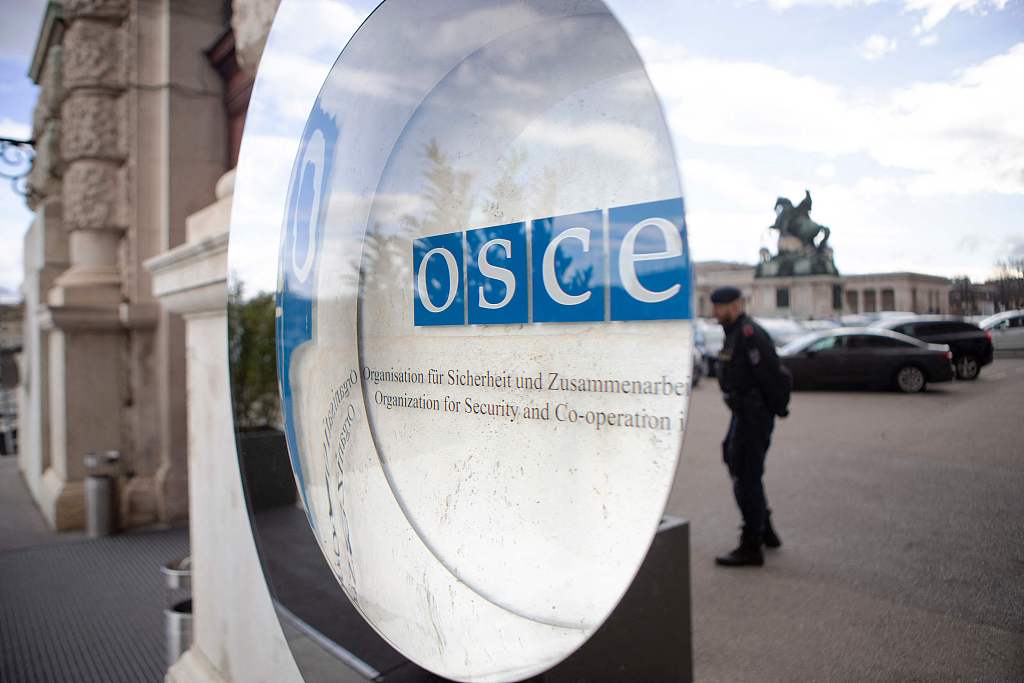
The logo of the Organization for Security and Cooperation in Europe (OSCE), at the OSCE headquarters in the Hofburg Palace in Vienna, Austria, February 21, 2022. /CFP
The consequence of replacing the inclusive OSCE with NATO hegemony might be a new Cold War. The main conflict between NATO and Russia is over where to draw the new dividing lines, in which the divided societies in Ukraine, Georgia, Belarus, and Moldova are becoming the battlefield. The current war was both predictable and avoidable. American diplomat George F. Kennan cautioned in 1998 that NATO expansionism would be the beginning of a new Cold War: "Of course there is going to be a bad reaction from Russia, and then [the NATO expanders] will say that we always told you that is how the Russians are – but this is just wrong."
Excluding Russia from the OSCE
On November 18, Poland refused Russian Foreign Minister Sergey Lavrov to attend the OSCE meeting in Poland as he is under EU sanctions.
Poland's decision to deny Sergey Lavrov access is either inspired or directly advocated by the U.S. In September, Washington denied Russian diplomats to travel to New York for participating in the sessions of the UN General Assembly. We now see Poland similarly abusing its role as a host of the OSCE meeting to dictate who should be allowed to participate.
This decision is very dangerous as the international security architecture collapses when states place exclusive military alliances above inclusive institutions that develop common rules. The principal loyalty to NATO and EU above the UN and the OSCE is a feature, not a bug in the European security architecture.
The erosion of a common Europe began less than two weeks after NATO's first expansion, as NATO claimed the authority to invade Yugoslavia in 1999 without a UN mandate. The invasion was unmistakably a violation of international law, yet it was argued to be legitimate as NATO was argued to serve liberal democratic values. Decoupling legality from legitimacy was intended to assign priority to NATO as the ultimate authority in Europe.
The efforts of replacing international law with the "international rules-based order" formalizes this logic of sovereign inequality. The fundamental idea is that the world should be divided between liberal democracies and authoritarian states – and the former should not be restrained by the same rules as the latter. Consequently, the U.S.-led alliance striving for hegemony is elevated above the OSCE and the UN as inclusive institutions that develop common rules.
The OSCE was developed to mitigate and transcend bloc politics, although it is now used instead as an instrument of bloc politics. The consequence of eliminating the common institutions and rules is now evident. A major war continues to rage on in Ukraine that might escalate into a nuclear war between NATO and Russia, yet there seems to be no willingness to engage in diplomacy.
Glenn Diesen is a professor at the University of South-Eastern Norway.


