Showing posts with label economic crisis. Show all posts

5/02/2020

A decade after debt crisis, Greece on verge of virus recession


Source: AFP
May 2 2020
By Hélène Colliopoulou

Athens (AFP) - Ten years after sinking into its worst economic crisis in living memory, Greece once again faces the spectre of a grave recession in the midst of a global coronavirus lockdown.

Though the country has so far been spared the death toll of other European nations at fewer than 150 fatalities from COVID-19, it will not escape the resulting economic downturn, Prime Minister Kyriakos Mitsotakis warned this week.

"The consequences of this coronavirus attack will undoubtedly be dramatic," he told parliament on Thursday.

"We know with certainty that (the recession) will be deep... we don't know how long the health crisis will last, we don't yet know if we'll have tourism."

Tourism is one of Greece's most important sources of revenue, along with shipping.

The Greek state alone could lose 8-10 billion euros ($8.8-11 billion) in income this year, the prime minister said.

- Where's the money? -


Greece has already adopted measures worth 17.5 billion euros, or 10 percent of national output, to support businesses and employees, Mitsotakis said.

Including EU funds, the package will reach 24 billion euros, he said.

But the opposition has questioned whether the money has actually reached the intended recipients.

"Where is this money? It's good for announcements but actual businesses and (employees) have not received a single euro," former leftist prime minister Alexis Tsipras said Thursday, predicting that layoffs will soon be "out of control".

Greece this year had been counting on a growth spurt of 2.4 percent. After exiting the final debt crisis bailout in 2018, its borrowing rates were at historic lows -- in October Athens even sold treasury bills at a negative rate -- and it has cash reserves of more than 36 billion euros at hand.

But with most of its economy in virus quarantine since March and global lockdowns expected to wreak havoc on tourism, Greece is expected to sink into a 10 percent recession this year, according to the International Monetary Fund.


- 'Irreparable' damage -


Panagiotis Petrakis, professor of finance at the University of Athens, argued that the economic blow will be less severe.

"The most likely scenario is a six percent contraction, provided there is no deterioration in the pandemic," he told AFP.

Petrakis also believes that the economic impact of this crisis will be less protracted. The IMF itself estimates a 5.5 percent Greek recovery in 2021.

The Greek finance ministry says the downturn could be limited to 4.7 percent through support measures, followed by a 5.1 percent rebound. The jobless rate will approach 20 percent, it said Friday.

The government will begin easing lockdown restrictions this month, with most shops opening by May 11 and restaurants and year-round hotels following on June 1.

But few expect any foreign visitors before July.

Many Greek businesses fear the damage will be irreparable, especially with minimum two-metre (6.5-feet) social distancing requirements squeezing out customers.

"Last summer I had 10 tables outside and 10 inside. Now, I will just have three tables outside and I'm supposed to make do," says Costas Gogos, owner of a tavern in the port of Rafina near Athens.

"Many will not even reopen, they won't manage with so few tables," added a neighbouring restaurant owner.

- Memories of 2010 -


It was on May 2, 2010, when the socialist government of George Papandreou signed the first of three eventual bailouts with the European Commission, the European Central Bank and the IMF that would total 350 billion euros.

A week earlier, Papandreou had stunned the nation by announcing the call for international assistance. His televised address from the tiny island of Kastelorizo is indelibly etched in the nation's collective memory.

In the years that followed, a quarter of Greek national output would be wiped out in wave upon wave of wage and pension cuts and tax hikes demanded by the so-called troika of creditors.

Unemployment soared to a high of 27 percent before eventually falling to 16 percent in March, still the highest in the eurozone.

Dozens of general strikes and hundreds of street protests would follow, many of them violent. In one of the worst incidents on May 5, 2010, three people died in a bank set on fire during an anti-austerity protest, one of them a pregnant woman. The culprits were never caught.

The crisis was sparked by reckless state spending and misreporting of fiscal data to the EU. When revealed by Papandreou's government, it caused Greece's borrowing rates to spike beyond reach.


3/29/2020

World economy has entered a recession 'as bad or worse' than the global financial crisis – IMF chief

World economy has entered a recession 'as bad or worse' than the global financial crisis – IMF chief

Source: RT
March 29 2020

IMF chief Kristalina Georgieva said it’s “clear” that the global economy has “entered recession” due to the evolving Covid-19 pandemic, and that the organization is working on projections to assess how severe it will be.
Georgieva said she expects the recession to be “quite deep.” Recovery is projected for 2021, but only if the virus can be contained, she said.

She said countries needed to step up their response measures aggressively, adding that the IMF has received a large number of requests for emergency financing. Georgieva said the international body has received pledges from Britain, Japan, and China for a “catastrophic containment and relief trust” for the poorest countries and that she hopes more will follow.

A key concern about a long- lasting impact of the sudden stop of the world economy is the risk of a wave of bankruptcies and layoffs that not only can undermine the recovery but can erode the fabric of our societies.

She predicted that emerging markets will need assistance of $2.5 trillion, and that estimate is “on the low end.” A practical approach will be needed to prevent indebted countries from “falling off the cliff,” she said.

Speaking about the US in particular, Georgieva said it will be absolutely necessary to cushion the world’s biggest economy and said the $2 trillion package of measures already agreed on by the Trump administration was a welcome step.

The IMF boss also confirmed the body is working closely with the World Health Organization (WHO) to raise global production of critical medical equipment. She said China is an important source of health supplies and is stepping up production.

She predicted that the global recovery will be staggered, much like the way the pandemic hit countries one after the other.

Global confirmed cases of the Covid-19 virus surpassed 550,000 on Friday, with more than 25,000 deaths, according to a Johns Hopkins University tally. Europe is the current epicenter of the pandemic, with countries including Italy, France, Spain, and the UK in national lockdown mode in a bid to contain the spread.

The WHO said this week that the US, which has more confirmed cases than any other individual country, has the potential to become the next epicenter.

5/01/2013

What America's $2 Trillion Underground Economy Says About Jobs


Πηγή: Money Morning
By DAVID ZEILER
April 29 2013

Doing what they can to survive in a dour job market, millions of Americans exist in an underground economy that has ballooned to $2 trillion annually.

By "underground economy," we're talking about all the business activity that is not reported to the government, which includes a growing number of people getting paid for their labor in cash.

That means the shadowy figures of the underground economy - the drug dealers and Mafia godfathers, for example - now have a lot more company.

But most of these new participants in the underground economy are ordinary hard-working Americans who are increasingly taking jobs that pay "under the table" either because nothing else is available or they need a second source of income to make ends meet.

America's underground economy is nothing new, but since the Great Recession hit, experts estimate it has doubled in size, driven by unemployed or underemployed people desperate for income.

Paying workers off the books also has great appeal to employers, who then can avoid paying benefits and, starting next year, some of the costs imposed by the Obamacare law.

"It's typical that during recessions people work on the side while collecting unemployment," Bernard Baumohl, chief global economist at the Economic Outlook Group, told The New Yorker. "But the severity of the recession and the profound weakness of this recovery may mean that a lot more people have entered the underground economy, and have had to stay there longer."

Who Lives in America's Underground Economy?

Some of the folks who've become trapped in the underground economy have been there for years, such as construction workers, childcare workers, illegal aliens and housekeepers.

People who do such service jobs often get paid partly or entirely under the table. The huge job losses caused by the Great Recession forced more people to switch to service jobs.

Many long-term unemployed people have struggled to survive by taking odd jobs, for which they almost invariably get paid in cash.

But the biggest contributor to the underground economy in the past few years has been employers increasing their use of freelancers or "independent contractors" - even many who actually work full-time.The weak U.S. economy has already given businesses plenty of incentives to cut costs by paying workers under the table. But the arrival of Obamacare Jan. 1 - particularly rules that requireemployers with 50 employees or more to offer health insurance while allowing them to avoid offering plans to part-timers -- will give them even more.

"This type of regulation could put more people out of work and into an underground economy," Peter McHenry, an assistant professor of economics at the College of William & Mary, told CNBC.

It's a sea change in how businesses traditionally have hired, and if it sticks through a recovery of the U.S. economy, it will have grim implications for American workers.

"Businesses are not angels, and they exist to make a profit," Alexandre Padilla, associate professor of economics at Metropolitan State University of Denver, told CNBC. "They are going to do everything they can to keep costs down, and if that means paying people off the books, they will do it. The government doesn't really have the resources to track down every business that does this."

What the Underground Economy Costs

The rapidly growing amount of unreported wages in the U.S. is costing the nation billions in lost tax revenue.

The Internal Revenue Service estimated that the losses from unreported wages have grown from about $385 billion in 2006 to about $500 billion last year.

State governments lose another $50 billion to the overall underground economy.

That means the people who play by the rules are getting a raw deal.

"Those working and not paying the taxes put the burden on those who pay the tax," David Fiorenza, an economy professor at Villanova University, told CNBC. "Taxes could be lower if the government were able to capture the underground economy instead of raising taxes on those currently paying the various income and payroll taxes."

Even the workers getting paid under the table don't get off scot-free. They forfeit contributions to Social Security, which will greatly reduce benefits in their retirement years, and get no healthcare, paid vacation or other benefits.

And they may end up with lower average pay to boot.

"People who do these types of jobs run the risk of getting exploited with lower pay or not being paid at all," Laura Gonzalez, professor of personal finance at Fordham University, toldCNBC. "There could be more exploitation if more people are forced into this type of economy."


4/05/2013

Key data missing at troubled Bank of Cyprus - inquiry

Bank of Cyprus operations are now severely restricted
Πηγή: BBC
April 5 2013

Some key data about bond purchases by Bank of Cyprus - now the focus of a controversial EU-IMF bailout - is missing, investigators have found.

The gaps were found in computer records studied by a financial consultancy, Alvarez and Marsal, Cypriot media say.

Bank of Cyprus - the island's biggest bank - bought Greek bonds which turned into some 1.9bn euros (£1.6bn; $2.4bn) of losses in the Greek debt crisis.

Depositors with more than 100,000 euros in the bank are now facing a big loss.

The "haircut" for such deposits in Bank of Cyprus is expected to be about 60%.

The money taken from those accounts, and from deposits above 100,000 euros at Laiki (Popular) Bank, will be used by the government to contribute billions towards the bailout.

Strict capital controls - unprecedented for the eurozone - are in force in Cyprus, limiting cash withdrawals to prevent a run on the banks.

The "haircut" - hugely unpopular in Cyprus - is a condition for the EU and IMF to grant a 10bn-euro bailout to rescue the Cypriot economy.'Mass deletion'

The Cyprus Mail website says information provided by Bank of Cyprus was incomplete and data-deleting software was found on some computers there.

There were significant gaps in computer records for the period 2007-2010. It is not yet clear whether the wiping of records was accidental or deliberate. There were signs of mass deletion of data.

The Central Bank of Cyprus says that Alvarez and Marsal are now investigating Laiki too - Cyprus's second largest bank, which is being wound up and folded into Bank of Cyprus.

"The investigation will continue and cover: the purchase of Greek government bonds by Laiki Bank; the expansion of Laiki Bank outside Cyprus; the role and responsibilities of all parties involved," the central bank said on Friday.

The consultancy's report on Bank of Cyprus has been leaked to Cypriot media, but not yet published.

Besides the Greek bond purchases the consultancy also scrutinised Bank of Cyprus operations in Romania and Russia.

The consultancy's findings have been handed over to the Cypriot parliament and the attorney-general, Petros Clerides.

The Cypriot government has appointed a special judicial panel to clarify what happened in the country's financial crash and pinpoint any wrongdoing.

3/11/2013

As GDP Drops In Greece's Financial Crisis, Heart Attack Rates Rise


March 11 2013

Heart attack rates have spiked in Greece since the start of the country's financial crisis, especially among women and residents older than 45, according to a study of patient records presented at the American College of Cardiology's 62nd Annual Scientific Session.

The study examined the medical records of 22,093 patients admitted to the cardiologydepartment of the General Hospital of Kalamata over an eight-year span, with patients divided into a pre-financial crisis period from January 2004 through December 2007 or the crisis period, January 2008 through December 2011. The crisis period was defined by change in the country's gross domestic product, or GDP. Patient numbers and demographics were similar in both groups, with 10,870 (49.2 percent) pre-crisis patients and 11,223 (50.8 percent) crisis patients. Because General Hospital has the only cardiology department in Messinia prefecture, one of the country's regional units, these data represent this entire region in southwest Greece.

Researchers found a significant crisis-period spike in heart attacks, with 1,084 heart attacks compared with 841 pre-crisis (22.46 per 10,000 people vs. 17.43 per 10,000). Heart attack incidence rose across the board: 20.8 percent for patients age 45 or younger (64 vs. 53), 25.7 percent for men (807 vs. 642), 29.4 percent for those older than 45 (1,020 vs. 788), and 39.2 percent for women (64 vs. 52).

"Greek women have a higher unemployment rate than men, they are responsible for child care and they also work outside the home - a formula for stress," said Emmanouil Makaris, MD, a consulting cardiologist at Kalamata's General Hospital.

Factors that might contribute to the higher heart attack rate among older patients include limited job opportunities for unemployed middle-aged men and their much greater prevalence of atherosclerosis, a major risk factor, he said.

"Unemployment is a stressful event and stress is connected with heart disease, but other issues also come with financial difficulties," Dr. Makaris said. "In these times a lot of people do not have money to buy medications or to go to their primary care doctor. There's a great increase in cardiovascular diseases across the country. The cost to the society is very high."

Researchers plan to continue to track heart health and the economy and also hope to expand their work to encompass all of Greece.

"Although Messinia has both urban and agricultural regions, we don't know what is going on in Athens," Dr. Makaris said. "The capital has almost 3 million people and is an urban industrialized area that may be more affected by the financial crisis."

The total GDP loss has been almost 25 percent since the crisis began, and the country remains in financial crisis, with a GDP in 2012 of minus 6 percent and an unemployment rate of 26.8 percent that is still growing.

"We need more support for doctors and patients, more people who can recognize warning signs of myocardial infarction earlier in hospitals," Dr. Makaris said. "In everything surrounding health care - biomedical supplies, personnel in hospitals - there are shortages."

With these findings, researchers aim to educate health professionals and policymakers about the serious impact the financial crisis is having on heart health at a time when austerity measures are leading to reductions in medical staff, supplies and services - and, ultimately, to increase the resources required to cope with escalating need by changing the country's health policy.


11/30/2012

Health officials tell Greece to act fast to control HIV


Πηγή: Reuters
By Kate Kelland
Nov 30 2012

A spiraling outbreak of HIV in debt-stricken Greece could run out of control unless urgent action is taken, European health officials said on Friday.

The European Centre for Disease Prevention and Control (ECDC) said infections with the AIDS-causing virus among drug users and other high-risk groups were rising fast, and that a failure to act would mean far higher costs in future.

ECDC director Marc Sprenger was in Athens on Friday visiting hospitals and needle exchanges. He said he would tell officials that free syringes and methadone programs must be stepped up, and testing and treatment for the human immunodeficiency virus made available to all.

"Immediate concerted action is needed in order to curb and eventually stop the current outbreak," he told Reuters as the ECDC published a report on Greece's HIV problem.

Since 2009, recession in Greece has reduced economic output by a fifth and sent unemployment to a record high.

The healthcare system is under extreme pressure, making it harder for the poor, unemployed or homeless to get treatment.

The ECDC said it was unclear how much Greece's debt crisis is contributing to the HIV outbreak, but it was evidently having "a significant social and health impact". There were fears in Athens that "HIV treatment services have reached a ceiling" because of a leap in case numbers in 2012.

While Greece has only 7.4 HIV infections per 100,000 people, compared to 10 per 100,000 in Britain or 27.3 in Estonia, rates have soared since 2011 in high-risk groups such as drug users.

From 2007 to 2010, there were only 10 to 15 cases a year of HIV infection in injecting drug users.

But during 2011, there were 256 such cases - or 27 percent of the total. Another 314 drug use HIV cases were reported between January and August 2012, bringing the total HIV cases for the year to August to 768.

Combination drugs can give patients with HIV near-normal life expectancy, but the drugs must be taken for life, and cost 10,000 to 22,000 euros ($13,000 to $28,500) a year.

"If a scale-up (in prevention and testing) is not achieved, it's likely that HIV transmission among people who inject drugs in Athens will continue and even accelerate - and could eventually spread," Sprenger said.

"The cost of prevention ... will be significantly less than the provision of treatment to those who become infected."

The ECDC said waiting times for methadone programs in Athens were more than seven years in August 2010, and only around seven syringes a year were given to each drug user.

Efforts by authorities to address this have now brought waiting lists down below four years and increased the number of syringes to 15 a year in 2011 and an expected 45 in 2012, but this is well below the international standard of 200 needles.

Rates of other health problems such as depression and suicide have been rising in Greece, which is also battling the re-emergence of mosquito-borne diseases such West Nile Virus and malaria.


11/06/2012

Money Laundering Accusations Could Delay Aid

The presidential palace in Nikosia, Cyprus, which is in talks to receive a euro-zone bailout.

Πηγή: Spiegel
By Carsten Volkery
Nov 6 2012

Talks on a euro-zone bailout for Cyprus could be delayed by accusations reported in SPIEGEL that the island is helping rich Russians launder money. Cyprus has denied the accusations but is likely to come under increasing pressure to reform its financial sector to secure aid.

Negotiations about the planned bailout for Cyprus from the European Stability Mechanism, the euro zone's permanent bailout fund, will likely not be completed until 2013, a spokesman for the German Finance Ministry said.

Cyprus had applied in June to become the fifth nation to receive a bailout in the euro crisis. But not much has happened since that first call for help. The talks between the Cypriot government and the troika, made up of the European Commission, the European Central Bank and the International Monetary Fund, have been stalled for weeks. There are no signs whatsoever that Cyprus is willing to commit to a serious austerity program, sources in Brussels said.

The talks could now be delayed by accusations that Cyprus is lax on money-laundering. According to informationobtained by SPIEGEL and first reported on Monday, an internal study by the German foreign intelligence agency, the Bundesnachrichtendienst (BND), says banks in Cyprus hold $26 billion (€20.33 billion) in deposits by Russian investors. According to the BND, most of this money has been illegally moved abroad to evade Russian tax authorities. By Cypriot standards it's a tremendous sum given that the island's entire annual GDP amounts to €17 billion.

The Cypriot government on Monday denied the money-laundering accusation. A government spokesman said SPIEGEL was trying to besmirch the reputation Cyprus has as an international investment location. The country had effective money-laundering rules and adhered to EU law, the spokesman said.

Low Taxes Attracting Russian Money

But Russia's crucial role for the Cypriot economy is well known. This mini-state with just 900,000 inhabitants is the biggest foreign direct investor in Russia thanks to its huge holdings of Russian money. It works like this: attracted by low tax rates, wealthy Russians transfer their money to Cyprus and then re-invest it in Russia via companies registered in Cyprus.

Opposition lawmakers from Germany's Social Democrat and Green parties have already called on the German government to broach the low corporate tax rate of 10 percent and the money-laundering accusations in the aid negotiations with Cyprus. The two parties have long been complaining about the tax haven in the Eastern Mediterranean. They want the ESM aid to be attached to strict conditions such as the creation of an EU task force to combat money laundering, similar to the task force set up for Greece. "It's time to exert pressure," said one SPD lawmaker.

The German Finance Ministry has given assurances that it will raise the issue. But the Euro Group, which includes the 17 euro-zone finance ministers, hasn't had a single in-depth discussion about Cyprus yet, say members. EU diplomats expect that several European finance ministers will insist on Cyprus taking effective steps against money laundering once the government has come up with a workable reform plan.

The problem played a role during the visit by German Economy Minister Philipp Rösler in Slovakia in August. Newly-elected Slovakian Prime Minister Robert Fico told Rösler that his country could imagine backing EU aid for Cyprus, but only if the island reveals the people investing their money there. Slovakia too wants to find out which wealthy Slovakians are using Cyprus to evade tax in their home country.

Ireland Also Refused to Hike Taxes -- And Still Got Aid

So far, the Cypriot government has tried to maintain the status quo by playing off the euro group against Russia. At European summits President Dimitris Christofias and his finance minister have told their colleagues that Cyprus can get help from Russia if the EU refuses aid. After all, the Kremlin wants the island's banking sector to remain intact to protect the Russia investments there. It helped out Cyprus once before, in 2011, when it granted a credit of €2.5 billion. But that money has now been used up and the Russian government appears reluctant to provide any more.

Christofias, a communist, is reluctant for domestic political reasons to accept EU aid because it would only be granted on condition that Cyprus undergo a three-year austerity program including a 15 percent cut in public sector wages and the sale of state-owned enterprises to the private sector. The EU also wants Cyprus to abolish the inflation-indexing of wages and the payment of an extra month's salary at the end of the year.

Cyprus faces a presidential election on February 17 and although Christof ias is not standing again, his party doesn't want to wreck its chances of staying in power.

The election is one of the reasons why officials in Brussels don't expect any progress in the aid talks before 2013. In addition, Christofias appears to be trying to secure direct aid for Cypriot banks from the ESM so that the help wouldn't have to be channelled through his creaking budget. But the German government says any direct banking aid won't be available before 2014 at the earliest.

It's uncertain whether Cyprus will end up with an EU task force against money laundering. It is even more unlikely that Cyprus will raise it corporate tax. After all, the EU bailed out a European tax haven once before. In 2010, Ireland got €85 billion. Germany wanted Ireland to raise its corporate tax rate above 12.5 percent. But the Irish government refused -- and got its way.

Editor's note: It is reported that German lawmakers will be allowed to review a classified intelligence report on alleged Russian money laundering in Cyprus before voting on a bailout for the country.


10/17/2012

Corruption Continues Virtually Unchecked in Greece

While Athens waits for more aid from the European Union, the country continues to be administered in the same old careless manner. Corrupt politicians and the rich continue to help themselves to Greece's funds, and little is being done about it.

Πηγή: Spiegel
By Julia Amalia Heyer
Oct 16 2012

How can someone who has declared an annual income of €25,000 ($32,400) transfer €52 million abroad? What kind of supplementary income must an individual have who, according to his tax returns, earned €5,588 in 2010, yet still managed to move €19.8 million abroad? And how can it be that a Greek citizen sequesters €9.7 million abroad although he supposedly earned exactly zero euros?

These are the questions that tax fraud investigators will have to ask of a number of individuals whose identity has so far only been made public in the form of initials. For instance, a "G. D." stands at the top of a list with the names of 54,000 Greek citizens who relocated major assets abroad between 2009 and 2011. The list stems from the Greek central bank and is now in the hands of the Finance Ministry.

It is the longest of four lists that are currently circulating in Athens. Each contains the names of people whose financial circumstances -- bank balances and real estate holdings -- do not correspond at all with what they claimed on their tax returns. But hardly anything is being done about it. The Greek reality is sometimes paradoxical: While the governing coalition was busy squabbling with international creditors over how many hundreds of euros can still be trimmed from teachers' and nurses' paychecks, and Athens continued slashing employee pensions, wealthy Greeks moved billions abroad with relative impunity.

The odyssey of the "Lagarde list," as it's known, exemplifies the typically lax attitude toward tax criminals. For many months, it was thought to be lost, but then it resurfaced in early October. Now, the public prosecutor for financial crimes has a copy. It lists 1,991 Greek owners of Swiss bank accounts, and reportedly includes many prominent individuals from the realms of politics, business and culture.

List Goes Missing

The story of this list primarily illustrates the unwillingness of politicians to do anything to improve the situation. In the autumn of 2010, Christine Lagarde, who was still the French finance minister at the time, gave her Greek counterpart Giorgos Papakonstantinou a digitalized list of bank accounts with information on Greek customers at the HSBC Bank in Switzerland. The accounts contained a total of some €1.5 billion. While the French state was using this list to help collect half a billion euros from its own tax offenders, the Greeks showed little interest in attempting a similar initiative.

It wasn't until many months later, in June 2011, that Papakonstantinou finally relinquished only 10 names from the list to the head of Greece's Financial and Economic Crime Unit (SDOE). The former minister said a few days ago that he didn't pass on all of the information because he had "no confidence in the agency."

He was succeeded by Evangelos Venizelos, who is the leader of the Panhellenic Socialist Movement, better known as PASOK, and thus part of the governing coalition. Venizelos served as finance minister for nine months. He negotiated the debt haircut and the second bailout package -- and vowed time and again to tackle the big problem of tax evasion.

Meanwhile, tucked away in a drawer of his secretary's desk, there was a USB stick with information that had already been gathered on Greek tax offenders -- the Lagarde list. The authorities merely needed to launch investigations. But Venizelos didn't instruct the SDOE to conduct inquiries, nor did he inform anyone of the existence of this information. Everyone else in the government thought that the list had disappeared. It was only when the current Finance Minister Yannis Stournaras heard about the lost information, and wanted to ask Paris for a copy, that Venizelos supposedly remembered the USB stick in the drawer. He sent it by express courier to Greek Prime Minister Antonis Samaras. Venizelos maintains that he didn't know "that no one aside from me had a copy."

Both Venizelos and Papakonstantinou have had to justify their actions before an investigative parliamentary committee -- and both men have attempted to shift the blame on each other.

Allegations Ignored

There is yet another, shorter list, which despite its diminutive size is even more politically charged. Greek tax authorities are currently investigating the assets of some 60 politicians, and the probe apparently extends beyond suspicions of tax evasion alone. The speaker of the Greek Parliament, Evangelos Meimarakis -- a member of the governing conservative Nea Dimokratia, or New Democracy party -- recently stepped down due to corruption allegations, and he is not the only one implicated. A number of high-ranking former ministers are also suspected of involvement in sham transactions and money-laundering schemes.

Corruption allegations still don't necessarily interfere with a political career in Greece, as exemplified by the case of the former prefect of Thessaloniki, Panagiotis Psomiadis. He allegedly personally received nearly €1 million for public works projects that were never built. Psomiadis is also suspected of being connected with a mafia ring of loan sharks. None of this has apparently damaged him. In May, Prime Minister Samaras made him his election campaign organizer for northern Greece.

"We are very bad now as a society. We have become bad. We are greedy and asocial," says Costas Bakouris, 75, chairman of Transparency International Greece. Bakouris sounds very different than many European politicians who suddenly find that things are taking a turn for the better in Greece. Now that it's clear that the creditors will continue to pay, he says people are turning a blind eye to the inevitable.

In reality, says Bakouris, an incompetent political class continues to govern the country -- the same people, the same story. For decades, they have created a sick system that permeates all segments of society.

Indeed, it's not just former ministers and parliamentarians who have squirreled away millions of euros of dubious origin in their bank accounts. Investigators even discovered €2.8 million -- none of which had been declared -- in an account belonging to the deputy mayor of a town of only 14,000 inhabitants in the Thessaly region. The man receives a monthly salary of approximately €1,500.

Conditions Ripe for Corruption

Greece's largest social security organization, IKA, has been used by many in the country as their personal piggy bank. The fact that IKA coffers are actually empty hasn't stopped department heads or low-level employees from continuing to transfer money to friends and relatives who are not entitled to receive any payments whatsoever. But even everyday citizens take advantage of the system: Of the supposedly 700 blind people on the island of Zakynthos, for instance, in reality there are only 60 who truly cannot see.

Thanks to such commonplace tricks, an estimated 40 percent of Greece's annual gross domestic product (GDP) still generates no revenues for state coffers, says Athens-based corruption investigator Leandros Rakintzis.

According to Transparency International's Costa Bakouris, Greece has all the right conditions for corruption: plenty of bureaucracy, no functioning justice system, laws with numerous loopholes -- and economic pressure. Bakouris was himself an entrepreneur and lived for 20 years in Switzerland. He says Greeks like him, who have lived abroad for many years, have the clearest perception of the problems in their homeland. Bakouris also briefly worked for the state as the managing director of preparations for the 2004 Olympic Games in Athens. After two years, he "more or less fired" himself. He says that he refused to accept that all bids -- whether they were for major infrastructure projects or for the carpeting in the Olympic village -- should be roughly three times as high as they were in Sydney, which hosted the games in 2000.

Bakouris doesn't believe that all the information on the lists will actually be investigated. Only one top politician has been sitting in jail awaiting trial for the past six months: former Defense Minister Akis Tsochatzopoulos. He allegedly accepted many millions of euros in kickbacks for defense projects. Tsochatzopoulos, who denies all of the allegations, was a political protégé of socialist Andreas Papandreou, the founder of PASOK and the father of former Prime Minister Georgios Papandreou.

The legacy of corruption goes back generations. In the days when Papandreou the elder governed the country, after the story broke that the head of the state electricity provider had lined his own pockets with some 1.5 million drachmas, the prime minister reacted with the following quip: "We all agree, of course, that we are allowed to give ourselves a little present from time to time. But please don't make it too large."

Translated from the German by Paul Cohen


10/14/2012

Business defections hit Greece amid recovery effort


Πηγή: Channel News Asia
Oct 14 2012

ATHENS: Efforts to restore investor confidence in Greece's struggling economy took a double blow this week when a major European bottler and a prominent dairy company announced relocation plans.

Coca-Cola's second biggest bottler worldwide, Athens-based Coca-Cola Hellenic (CCHBC), on Thursday said it was moving its headquarters to Switzerland and looking to establish a listing on the London stock exchange.

This followed an announcement by Fage, one of the country's main dairy producers and a major exporter, that it was moving its headquarters to Luxembourg "to better reflect the increasingly global nature" of its activities.

Greek companies have been relocating to lower-cost neighbouring markets such as Bulgaria for years, a process accelerated by wave-upon-wave of austerity cuts and sales tax hikes over the past two years that have felled consumer demand.

But in a week when German Chancellor Angela Merkel was in Athens pledging to support growth initiatives in return for further budget savings, the news wreaked havoc in Greece.

"I cannot tell each and every company how to act, nor can I impose police measures to influence strategic decisions made by companies," Greece's normally mild-mannered Development Minister Costis Hatzidakis told reporters.

"The climate has markedly changed compared to the past. I will not say it's all gardens of roses ahead of us...but if we can cover this final stretch, and with (EU) support, companies will not leave and others will start returning to the country," the minister argued.

Hatzidakis has spearheaded efforts to get money pumping back into the country in the form of loans from the European Investment Bank.

The EIB is to release some 1.44 billion euros (US$1.86 billion) by 2015 to support projects that have ground to a halt such as highway construction.

The money will partly cover debts owed by the Greek government to the private sector, now estimated at around eight billion euros.

"In conjunction with austerity measures and structural reforms, which demand a great deal from the people, there must also be growth stimulus," Merkel told reporters this week after talks with Greek Prime Minister Antonis Samaras.

"Therefore, we will support everything possible to provide Greece access to credit from the European Investment Bank," she said.

With a sixth year of recession in sight and with little hope of winning a decades-long battle against red tape, Greece has laboured to attract investors even in the midst of an unprecedented privatisation drive.

Under the terms of its EU-IMF loan rescue, the country is obliged to offload some 19 billion euros (US$24.5 billion) in state assets by 2015 but has so far managed around a tenth of that total.

Forced to take part in a state debt rollover, Greek banks have slowed business loans to a trickle.

And there was speculation earlier this year, during a Greek political deadlock that took two elections to produce a workable government, that the country could even be forced to leave the euro.

French supermarket giant Carrefour and banks Credit Agricole and Societe Generale have all recently taken steps to extricate themselves from Greece as well.

These are precautions not unrelated to so-called 'Grexit' fears, concern that Greece may return to a devalued Drachma, rating agency Fitch said in a Friday note with respect to Coca-Cola's move.

But it added that what CCHBC and Fage did were "limited precedents" for other eurozone corporates for now, "despite incentives to ... protect against the risk of a full-blown sovereign crisis."

Both Coca-Cola Hellenic and Fage claimed they were not abandoning Greece.

"We are a Greek multinational company having its headquarters in Switzerland," CCHBC chief executive Dimitris Lois said in a conference call.

"Having a new headquarters in Switzerland will provide stability that will be evaluated by credit agencies...more stability, that's what we are looking forward to," he added.

CCHBC said the move would also improve access to equity and debt capital markets and increase its flexibility in raising new funds.


8/14/2012

Greece sinks deeper into devastating depression


Πηγή: CITY A.M.
By Harry Banks
August 14 2012

GREECE’S battered economy shrank by an annual rate of 6.2 per cent in the second quarter of the year as it sank further into a devastating recession, data revealed yesterday.

The figure came ahead of today’s GDP figures for France, Germany and the Eurozone.

The Greek economy shrank by 6.5 per cent annualised in the first three months of the year, meaning the pace of decline has slowed.

Yet the troubled Eurozone member state’s economy is now 16 per cent smaller than its 2008 peak, returning to a size last seen nearly a decade ago, in 2003.

“Hopefully it’s some sign that the rate of decline is starting to bottom out,” said Markit economist Chris Williamson. “And hopefully the first half of the year was as bad as it gets and we’ll see some improvement now.”

But the think tank IOBE expects Greek GDP to shrink 6.9 per cent during the course of this year as a whole.

The dire economic situation continues to harm any attempts to rein in the substantial annual government deficit towards sustainable levels – the core target of Greece’s bailout programme.

Meanwhile, Bank of Greece data yesterday revealed that Greek lenders turned to their country’s central bank for liquidity last month after the European Central Bank (ECB) stopped accepting Greek government bonds as collateral from 25 July.

The ECB has cut off the banks pending the latest report on Greece by EU and IMF inspectors, stepping up pressure on Athens to adhere to the terms of its bailout programme.

ECB funding to Greek banks fell by €49.67bn in July from a month earlier while emergency liquidity assistance from the Greek central bank increased by €44.37bn, according to the figures.

The ECB also confirmed yesterday that it did not restart its bond buying programme last week, although it still plans to launch a new and more transparent scheme for purchasing sovereign debt that will be tied to intervention by the European rescue funds and political action.

Italy yesterday sold €8bn (£6.3bn) of 12-month Treasury bills at an auction yet had to pay 2.767 per cent – slightly higher than at a similar auction last month. Germany, meanwhile, sold €3.77bn of six-month Treasury bills at a negative yield.


8/07/2012

Spiral of banks warns of financial meltdown


Πηγή: New Scientist
By Andy Coghlan
August 2 2012

Call it the financial meltdown forecaster. The team of economists who last year demonstrated that a small number of companies wield disproportional power over the global economy has now produced a simple visual tool that can monitor financial stability in real-time.

Like a weather forecast, DebtRank could monitor global financial activity for telltale signs of impending disaster. Its designers say it could anticipate and so help prevent global economic crises like the events of 2008, from which the world is still reeling.

Importantly, it's not just size that matters when it comes to how much risk a troubled bank poses to the financial system. Even a relatively small loss at a firm intimately connected to many other banks could cause a ripple effect that threatens the whole system.
High stakes

To test DebtRank, Stefano Battiston of the Swiss Federal Institute in Zurich used previously confidential data on the 2008 crisis gathered by the US Federal Reserve. The analysis identifies a number of firms that were particularly precarious: had just one of those defaulted on its obligations, it could have resulted in the depletion of more than 70 per cent of the wealth in the entire network. During the crisis, coordinated – and very expensive – intervention prevented such an outcome.

Regulators like Andy Haldane at the Bank of England have called for tools that would provide regulators with a clearer understanding of the state of the global financial system in real time.

DebtRank is an answer to such calls. Battiston says that armed with tools like this, regulators could theoretically spot potential problems as they occur and intervene before the entire system is at risk of collapses. They could also model the impacts of interventions ahead of time, allowing them to experiment until an optimal solution is decided upon.
1000 days

The previously confidential data included detailed daily balance sheets for 407 institutions that between them received bailout funds worth $1.2 trillion from the Federal Reserve. The data covers 1000 days from before, during and after the peak of the crisis, from August 2007 to June 2010.

Battiston and his colleagues focused on the 22 banks that collectively received three-quarters of that bailout money, and which turned out to be intimately linked to one another in a closely-knit network. Almost all were members of the "super-entity" found at the heart of the global economy by last year's study.

From the data, Battiston and his colleagues calculated a daily DebtRank value, ranging from 0 to 1, for each bank. The value reflects the likelihood that a bank will default, and how much this would damage the creditworthiness of other banks and companies in the network.
Spiral to collapse

A DebtRank value of 0 means that if a bank defaults, it poses no risk whatsoever to other members of the network. Theoretically, if a bank with a value of 1 were to fail, it would obliterate the economic value of the entire network.

Battiston represents DebtRank values pictorially within a spiral. Companies ranked 0 sit on the outside of the spiral, and a company ranked 1 would occupy dead centre. As a company's DebtRank value rises, it moves steadily towards the centre of the spiral, posing ever greater threats to the entire system as it does so.

Representations of the 22 companies before and at the peak of the crisis show visually how valuable the tool could be to regulators. In August 2007, well before the crisis, all 22 banks sit around the edge of the spiral (see image 1), with DebtRank values averaging just 0.08. By the crisis, the average had risen to 0.52, sending banks plunging towards the centre (see image 2).


Image 1
In August 2007, well before the financial crisis, all 22 banks sat safely around the edge of the spiral


Image 2
As the 2008 crisis arrived, many of the banks had plunged towards the centre of the spiral, where greater risk lies

At that point, several of the individual institutions could have wiped out more than 70 per cent of the total value of the network on their own, had they failed.

The model also demonstrated how shocks to the system can be rapidly propagated between the closely connected banks. If all 22 simultaneously suffered a 10 per cent loss in the value of their assets, as was seen in the sub-prime mortgage crisis, the losses to the entire network could have caused a the system to crash.
Confidentiality hurdle

Battiston says that his team is collaborating with the European Central Bank and a selection of national banks in Europe to experiment with DebtRank and other systems designed to avoid financial meltdown. To create DebtRank registers, regulators would need to receive daily or weekly updates of all transactions, debt profiles, detailed balance sheets and other assets.

The problem, he says, is that most global financial transactions are confidential, and any regulation that does occur is only at national level. "The police are local, but the transactions international," he says. "There's no authority keeping track at international level," he says.

If such a system was installed globally, the data the regulator receives could be kept confidential, and highly-connected banks at risk of defaulting could be spotted early and warned privately to fix the situation, to solve the problem without panicking the markets.

The study is a good proof of principle and its methodology looks promising, says Simone Giansante at the University of Bath in the UK. Though he cautions that Battiston's study has only looked at two types of transactions, and says a more comprehensive tool would be better – assuming the researchers could obtain the relevant data.


7/26/2012

100 Million Poor People In America And 39 Other Facts About Poverty That Will Blow Your Mind


Πηγή: The Economic Collapse
July 24 2012

Every single day more Americans fall into poverty. This should deeply alarm you no matter what political party you belong to and no matter what your personal economic philosophy is. Right now, approximately 100 million Americans are either "poor" or "near poor". For a lot of people "poverty" can be a nebulous concept, so let's define it. The poverty level as defined by the federal government in 2010 was $11,139 for an individual and $22,314 for a family of four. Could you take care of a family of four on less than $2000 a month? Millions upon millions of families are experiencing a tremendous amount of pain in this economy, and no matter what "solutions" we think are correct, the reality is that we all should have compassion on them. Sadly, things are about to get even worse. The next major economic downturn is rapidly approaching, and when it hits the statistics posted below are going to look even more horrendous.

When it comes to poverty, most Americans immediately want to get into debates about tax rates and wealth redistribution and things like that.

But the truth is that they are missing the main point.

The way we slice up the pie is not going to solve our problems, because the pie is constantly getting smaller.

Our economic infrastructure is being absolutely gutted, the U.S. dollar is slowly losing its status as the reserve currency of the world and we are steadily getting poorer as a nation.

Don't be fooled by the government statistics that show a very small amount of "economic growth". Those figures do not account for inflation.

After accounting for inflation, our economic growth has actually been negative all the way back into the middle of the last decade.

According to numbers compiled by John Williams of shadowstats.com, our "real GDP" has continually been negative since 2005.

So that means we are getting poorer as a nation.

Meanwhile, we have been piling up astounding amounts of debt.

40 years ago the total amount of debt in the United States (government, business and consumer) was less than 2 trillion dollars.

Today it is nearly 55 trillion dollars.

So we have a massive problem.

Our economic pie is shrinking and millions of Americans have been falling out of the middle class. Meanwhile, we have been piling up staggering amounts of debt in order to maintain our vastly inflated standard of living. As our economic problems get even worse, those trends are going to accelerate even more.

So don't look down on the poor. You might be joining them a lot sooner than you might think.

The following are 40 facts about poverty in America that will blow your mind....

#1 In the United States today, somewhere around 100 million Americans are considered to be either "poor" or "near poor".

#2 It is being projected that when the final numbers come out later this year that the U.S. poverty rate will be the highest that it has been in almost 50 years.

#3 Approximately 57 percent of all children in the United States are living in homes that are either considered to be either "low income" or impoverished.

#4 Today, one out of every four workers in the United States brings home wages that are at or below the poverty level.

#5 According to the Wall Street Journal, 49.1 percent of all Americans live in a home where at least one person receives financial benefits from the government. Back in 1983, that number was below 30 percent.

#6 It is projected that about half of all American adults will spend at least some time living below the poverty line before they turn 65.

#7 Today, there are approximately 20.2 million Americans that spend more than half of their incomes on housing. That represents a 46 percent increase from 2001.

#8 During 2010, 2.6 million more Americans fell into poverty. That was the largest increase that we have seen since the U.S. government began keeping statistics on this back in 1959.

#9 According to the U.S. Census Bureau, the percentage of "very poor" rose in 300 out of the 360 largest metropolitan areas during 2010.

#10 Since Barack Obama became president, the number of Americans living in poverty has risen by 6 million and the number of Americans on food stamps has risen by 14 million.

#11 Right now, one out of every seven Americans is on food stamps and one out of every four American children is on food stamps.

#12 It is projected that half of all American children will be on food stamps at least once before they turn 18 years of age.

#13 The poverty rate for children living in the United States is 22 percent, although when the new numbers are released in the fall that number is expected to go even higher.

#14 One university study estimates that child poverty costs the U.S. economy 500 billion dollars a year.

#15 Households that are led by a single mother have a 31.6% poverty rate.

#16 In 2010, 42 percent of all single mothers in the United States were on food stamps.

#17 According to the National Center for Children in Poverty, 36.4 percent of all children that live in Philadelphia are living in poverty,40.1 percent of all children that live in Atlanta are living in poverty, 52.6 percent of all children that live in Cleveland are living in poverty and 53.6 percent of all children that live in Detroit are living in poverty.

#18 Since 2007, the number of children living in poverty in the state of California has increased by 30 percent.

#19 Child homelessness in the United States has risen by 33 percent since 2007.

#20 There are 314 counties in the United States where at least 30% of the children are facing food insecurity.

#21 More than 20 million U.S. children rely on school meal programs to keep from going hungry.

#22 A higher percentage of Americans is living in extreme poverty (6.7 percent) than has ever been measured before.

#23 If you can believe it, 37 percent of all U.S. households that are led by someone under the age of 35 have a net worth of zero or less than zero.

#24 A lot of younger Americans have found that they cannot make it on their own in this economy. Today, approximately 25 millionAmerican adults are living with their parents.

#25 Today, one out of every six elderly Americans lives below the federal poverty line.

#26 Amazingly, the wealthiest 1 percent of all Americans own more wealth than the bottom 95 percent combined.

#27 The six heirs of Wal-Mart founder Sam Walton have a net worth that is roughly equal to the bottom 30 percent of all Americans combined.

#28 At this point, the poorest 50% of all Americans now control just 2.5% of all of the wealth in this country.

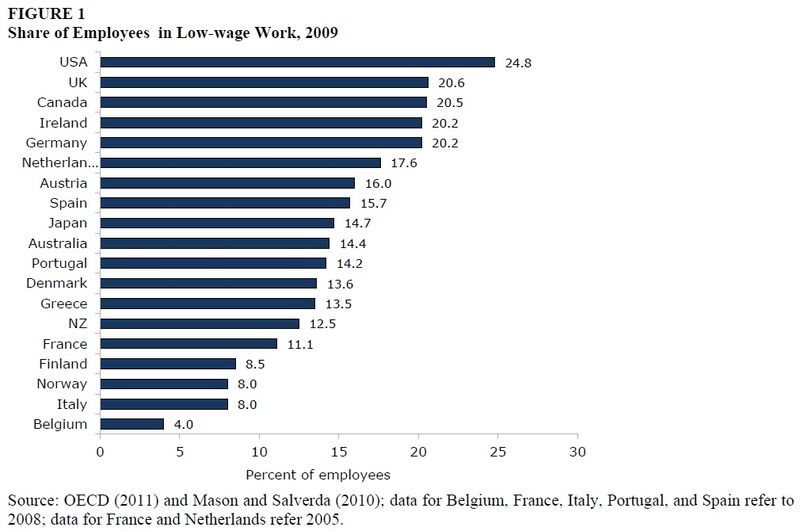
#29 Back in 1980, less than 30% of all jobs in the United States were low income jobs. Today, more than 40% of all jobs in the United States are low income jobs.

#30 Right now, the United States actually has a higher percentage of workers doing low wage work than any other major industrialized nation does.

#31 Half of all American workers earn $505 or less per week.

#32 In 1970, 65 percent of all Americans lived in "middle class neighborhoods". By 2007, only 44 percent of all Americans lived in "middle class neighborhoods".

#33 Federal housing assistance outlays increased by a whopping 42 percent between 2006 and 2010.

#34 Approximately 50 million Americans do not have any health insurance at all right now.

#35 Back in 1965, only one out of every 50 Americans was on Medicaid. Today, approximately one out of every 6 Americans is on Medicaid.

#36 It is being projected that Obamacare will add 16 million more Americans to the Medicaid rolls.

#37 Back in 1990, the federal government accounted for 32 percent of all health care spending in America. Today, that figure is up to45 percent and it is projected to surpass 50 percent very shortly.

#38 Overall, the amount of money that the federal government gives directly to the American people has risen by 32 percent since Barack Obama entered the White House.

#39 It was recently reported that 1.5 million American families live on less than two dollars a day (before counting government benefits).

#40 The unemployment rate in the U.S. has been above 8 percent for 40 months in a row, and 42 percent of all unemployed Americans have been out of work for at least half a year.

Recently, I wrote a long article about why there will never be enough jobs in the United States ever again.

That means that a whole lot of Americans are not going to be able to take care of themselves.

As our economy gets even worse, there is going to be a tremendous need for more love, compassion and generosity all over the country.

Don't be afraid to lend a helping hand, because someday you may need one yourself.


7/15/2012

Iceland Has Hired An Ex-Cop To Hunt Down The Bankers That Wrecked Its Economy


Πηγή: Business Insider
By Rob Wile
July 12 2012

If you were involved in Icelandic high finance in the runup to the recession, you might want to start watching your back.

That's because the government has appointed a white collar crime bounty hunter who wants to haul your behind in (alive, to be sure).

LeMonde reporter Charlotte Chabas has a profile of Ólafur Þór Hauksson, a former local police lieutenant whom the Iceland government appointed to track down individuals likely to have helped sink the country's banking sector during the credit crunch.

Hauksson's job description, according to PressEurop's translation of the piece:

"On one hand, we have to investigate all suspicion of fraud and offences committed before 2009, on the other hand, we bring the lawsuits against the suspects to court ourselves," Hauksson explains. This is a 'totally new' method which allows the investigators to "follow the case" and the judicial system to "know the cases like the back of their hand". This is indispensable in order "to compete with the well-prepared defence attorneys".

Hauksson oversees a posse of 100 researchers to help track down outlaws. He's netted some major convictions since starting in 2009, including the former chief of staff of the country's finance minister on insider trading charges. Many others await their day in court, Chabas writes.

And he will track you down even if you've fled abroad.

"Searches continue and the team pursues its investigations abroad in the foreign subsidiaries of the Icelandic banks and includes questioning foreigners," Chabas writes. " 'We enjoy full international cooperation,' stresses Olafur Hauksson."


6/30/2012

Cooking the Books, Not the Big Macs, in Argentina & Greece


Πηγή: Goldseek
By Robin Molinas and Adrian Ash
June 29 2012

So does Argentina a decade ago set a template for today's crisis in Greece...?

BACK IN 2001, Argentina was hit by a crisis similar to Greece's today.

Imposing a strict currency peg of 1 Peso to 1 US Dollar meant the currency was over-valued. Or the state should have reined in its spending. Or the economy needed to be more productive. Or all three, depending on your view. But either way, the trade deficit widened as imports became cheaper than exports – especially after neighboring Brazil devalued its Real in 1998-99, adding more pressure to the currency peg, and leading the government to borrow huge amounts of money overseas, including $40 billion arranged by the International Monetary Fund in December 2000.

High tax rates already meant tax evasion was widespread, so raising taxes to try and cover debt interest didn't bring extra revenue. Well aware how such crises had ended before, the middle-class quickly moved to withdraw money from bank deposits, even though interest rates jumped to 16%, because that wasn't enough to beat inflation. Squeezed by falling wages and rising prices, many Argentinians took to the streets of big cities, especially Buenos Aires, banging pots and pans in protest at soaring food costs, corruption and economic mismanagement – protests that became known as cacerolazo.

Pressure on the Peso, prices and now the banks mounted. Amid domestic riots and an international debate over the currency peg during the last week of 2001, and with bank deposits already frozen, an interim government – led by right-wing governor Rodríguez Saá – proposed a new currency, the Argentino. Named after the gold coin issued at the height of Argentina's 19th-century boom, it was to be backed by the country's housing and real estate, not by central-bank reserves, which were virtually empty anyway. But it never came to anything, as Saá proved literally a "seven-day president", whose only achievement was finally to declare default on the national debt.

Totaling $132 billion, that debt was approximately one-seventh of all the money borrowed by developing states worldwide. Some payments have since been refinanced and some restructured, but the International Monetary Fund, just as with Greece today, would accept no losses on its portion of the Argentine debt.

The difference between these two great crises? Argentina could devalue its currency, whereas Greece cannot. For 10 years before the 2001 crisis, Argentina had a currency exchange standard of 1 US Dollar to 1 Argentinian Peso. For the last 10 years, Greece has been part of the Eurozone, with 1 Greek Euro equal in every way to 1 German, Dutch, Spanish or Belgian Euro. During the Argentinian crisis, however, the currency's exchange rate fell dramatically, with the US Dollar rising from 1 to 4 Pesos.

This huge Peso depreciation in turn propelled inflation, but the official measure refused to show it. Annual inflation in Buenos Aires at one stage during the crisis actually showed a negative reading, as the government fought to avoid comparisons with the dictators' crises of the 1970s and '80s.


The Argentinian people nevertheless stopped trusting their government, their currency, and their banks, and the US Dollar began to overtake the country's Peso as a store of wealth. They were right to worry.

After 10 years of the currency peg, some 70% of bank deposits, credit and loans were denominated in US Dollars. In January 2002, new Argentine president Eduardo Duhalde pushed through a "forced Pesification", whereby everything was switched to the Peso. Bank loans were converted at 1-to-1, despite the real exchange rate already standing at 2 Pesos per Dollar. The conversion rate on deposits was better, but it was still well shy of the true rate and also handed the banks an immediate 30% shortfall on their balancesheets. In total, the 44 billion US Dollars in Argentinian bank depositswere switched to 55 billion Pesos. So the net loss of value to people's savings was more than 65% by the end of the year, when the Dollar exchange rate hit 4 Pesos. The poverty rate rose from 1-in-3 to worse than 1-in-2 inside a year.

Finally, under the next president, Néstor Kirchner, and with Duhalde's finance minister Roberto Lavagna still in his post, the external debt restructuring – which affected more than 76% of Buenos Aires' public debt, originally worth some $93 billion – came in January 2005. Did it work? Already in 2007, the government of Néstor's widow – Cristina Kirchner – imposed new exchange controls, capping the daily amount of money people were allowed to withdraw from the banks. But "Today we celebrate today our well-gained economic independence," said the Kirchner government in 2010, wrangling with the International Monetary Fund over $6 billion in loan repayments while enjoying economic growth of 9% annually, plus unemployment down by two-thirds from the crisis peak.

"The outcome would have been totally different if we had followed the recommendations traditionally made by the IMF – opening our economy, foreign indebtedness, financial liberalization and 'unbeatable' market-oriented reforms. Today we would have been embroiled in a fresh economic, social and political crisis."

Here in 2012, however, and with commodity prices now falling and economic growth quickly fading, cacerolazo is being revived in protest at the government, and again middle-class savers are attempting to flee their currency.

An unofficial exchange rate, offered by Buenos Aires' illegal casa de cambioshas been created, known as the "Parallel Dollar" or "Blue Dollar", which trades at an extremely high price compared to the official price. Today's exchange rate standard is 1 Dollar to 5 Pesos, but 1 "Blue Dollar" is 6.15 Pesos, which is closer to the official Peso-Euro rate. The "Blue Dollar" is available in the downtown area, where traders now known as arbolitos, or little-trees, can be found at the side of the road flashing wads of green notes like leaves.

To block the black-market in Dollars, Argentina's tax inspectors – the AFIP – were last year armed with 300 sniffer dogs, trained to find money. By mid-December 2011, they'd found $2.7 million in illegal Dollars. But the government continues to support the thriving Blue Dollar market by blocking legal exchange. This month, on its website, the AFIP deleted any choice beyond "travel" or "business procurement" from the options for enquirers wanting to know if they're allowed to buy US currency. "Savings and investment" queries are no longer available. And the Argentinian government is also playing games with inflation data again, worsening the loss of confidence as strikes break out over inflation-linked wage increases and state benefits.

In particular, Kirchner's secretary for domestic trade, Guillermo Moreno, has been accused of cooking the books by encouraging McDonald's not to cook Big Macs. "In some branches of McDonald's," noted the Cronista newspaper in March 2011, "the Big Mac is advertised only by a small hand-written note, hidden on a side wall. In other places there is not even that.

"What's led Ronald McDonald in Buenos Aires to hide your favorite dish?"

Well, The Economist magazine's Big Mac index – launched in 1986 – tries to get round government manipulation of statistics, by comparing the price of McDonald's iconic burger around the world. Because "the price of a good should not vary much across efficient markets," as The Economist puts it. Comparing the different local prices of a Big Mac is therefore a blunt, if frivolous way of measuring the purchasing power of different currencies.

So by suppressing the Big Mac's price, people believe, Argentina would be able to suppress its apparent rate of inflation from what El Cronista calls "the very British Economist magazine." But it would also put McDonald's at risk of selling lots of under-priced burgers to hungry Porteños, however. So the world's most famous burger was hidden from view. Until now.

"Moreno lost the battle," reported Cronista.com in early June. "The Big Mac combo is out of the price freeze and has jumped in price by 26.2%." A discount of 2 Pesos two days later was "a result of negotiations with the Ministry of Internal Trade," according to the Argentinian press. But it also affected the burger alone – not the meal-deal including fries and a shake – edging down the Big Mac's Peso price where it might matter most. On the Big Mac Index.

Now, the Greek government already had a reputation for cooking the bookslong before its crisis broke, specifically to meet the requirements for Euro entry in 2001. Tax evasion has also been widespread, with untaxed business worth some 27.5% of the annual economy on one estimate. Given these drags, external debt has also leapt as Athens struggles to maintain its currency regime – a relatively strong currency that's seen relatively unproductive Greece slip to last place in Western Europe's league table of competitiveness. A run on the banks has already begun, with withdrawals now reaching €80 billion – one third of total deposits before the crisis began in 2010 – as household and business depositors fear the very same "freeze" imposed by Argentina a decade ago.

The difference is, quitting the Euro – unlike Argentina quitting the Dollar – can't be done overnight. "Pesification" would first mean create (or recreating) a currency to switch to. Whatever mess Argentina has suffered – before and since abandoning its currency peg – the mess in Greece would likely be much uglier still.


6/26/2012

Debt Overhangs: Past and Present


FIGURE 1. Gross Central Government Debt as a Percent of GDP: Advanced and
Emerging Market Economies, 1860-2011
(unweighted averages)


Preliminary Draft
By: Carmen M. Reinhart
(Peterson Institute for International Economics, NBER and CEPR)
Vincent R. Reinhart
(Morgan Stanley)
Kenneth S. Rogoff
(Harvard University and NBER)
April 15 2012


Abstract


We identify the major public debt overhang episodes in the advanced economies since the early 1800s, characterized by public debt to GDP levels exceeding 90% for at least five years. Consistent with Reinhart and Rogoff (2010) and other more recent research, we find that public debt overhang episodes are associated with growth over one percent lower than during other periods. Perhaps the most striking new finding here is the duration of the average debt overhang episode. Among the 26 episodes we identify, 20
lasted more than a decade. Five of the six shorter episodes were immediately after World Wars I and II. Across all 26 cases, the average duration in years is about 23 years. The long duration belies the view that the correlation is caused mainly by debt buildups during business cycle recessions. The long duration also implies that cumulative shortfall in output from debt overhang is potentially massive. We find that growth effects are significant even in the many episodes where debtor countries were able to secure continual access to capital markets at relatively low real interest rates. That is, growthreducing effects of high public debt are apparently not transmitted exclusively through high real interest rates.


Debt Overhangs: Past and Present

6/14/2012

Insight: Germany and Greece. A tale of estrangement


Πηγή: Reuters
By Noah Barkin and Gernot Heller
June 14 2012

In early October of last year, German Economy Minister Philipp Roesler landed in Athens on a plane packed full of corporate executives, carrying a message of hope.

Germany and its leading firms, the young minister told Greek leaders, stood ready to help Greece overcome the debt crisis that had plunged its economy into recession and pushed it to the brink of its second EU/IMF rescue in little more than a year.

The mood in the meetings that followed was described by German officials who participated as "euphoric". Roesler received assurances that commercial disputes with German firms would be resolved. As soon as they were, Roesler promised, German investments would flow, focused on Greece's solar sector.

Yet within weeks the relationship had sunk to a postwar low. From interviews with German and European officials, Reuters has traced how and why trust broke down, with grave implications for Greece and Europe's single currency project.

"The minister was held up as a messiah who would save Greece," said a senior German official who travelled with Roesler and sat in on the meetings. By the time Roesler boarded his plane back to Berlin, he and his Greek counterpart Mihalis Chrysohoidis were using the familiar "du" and "esy".

Just weeks after Roesler's visit, Greece's then Prime Minister George Papandreou shocked his European partners by announcing plans - swiftly reversed - for a referendum on Greece's new 130 billion euro bailout package.

That gambit, a half dozen senior German officials told Reuters, marked the start of a dizzying deterioration in ties between Berlin and Athens, characterized by misunderstandings, broken promises and highly unusual public attacks.

A little more than half a year later, with Greece poised for an election that could determine whether it stays in the euro or returns to the drachma, the level of frustration in Berlin with the country's entrenched political class is sky high and its confidence that Athens can get back on track abysmally low.

German officials, many speaking on condition of anonymity due to the sensitivity of the issue before Sunday's vote, speak of a broken Greek bureaucracy incapable of implementing decisions taken at the top. A drive to root out corruption and tax-dodging has largely failed, they say.

Looking back, however, some German officials also acknowledge that Greece's descent into disarray, and the resulting risks for the broader euro zone, cannot be blamed on the Greeks alone.

It is also a story of neglect by Greece's European partners, they say, including Germany, which reluctantly bailed out Greece over two years ago, but then proceeded to ignore it until late 2011, when its dire economy, unstable politics and abysmal finances forced it back onto the agenda.

Roesler's trip came nearly a year-and-a-half after Germany bankrolled an initial rescue for Greece. Yet that still made him the first member of German Chancellor Angela Merkel's cabinet to visit the country since the rescue.

European Commission President Jose Manuel Barroso has not been to Greece in three years and European Council President Herman van Rompuy visited once in April 2011, a year after the rescue, their aides confirmed.

"For a year after the first bailout, neither Berlin nor Brussels made any symbolic political gestures towards Greece. No one travelled there to take stock of the situation for themselves," said Markus Kerber, chief executive of the BDI industry federation and a former finance ministry official.

"There was a fundamental misunderstanding that this would end up with big countries like Spain and Italy in the sights of the markets. They didn't realize that a single currency zone doesn't work on auto-pilot."

Merkel's spokesman Steffen Seibert vigorously denied Germany had ignored Greece, saying Berlin had closely followed the work of the so-called "troika" - the European Commission, European Central Bank and International Monetary Fund - which was charged with monitoring the country's progress. He noted that Papandreou himself had praised Germany for its support and cooperation in meetings with Merkel in March 2010 and September 2011.