Showing posts with label poverty. Show all posts

2/19/2022

Biden's real challenge is not Russia or China, but poverty in America


Source: MEMO
February 19 2022
By Dr Ramzy Baroud


Mainstream US media continues to celebrate the supposed strength of the US economy. Almost daily, headlines speak of hopeful numbers, sustainable growth, positive trends and constant gains. The reality on the ground, however, tells of something entirely different, which raises the questions: Are Americans being lied to? And for what purpose?

"US Economy Grew 1.7% in Fourth Quarter, Capping a Strong Year," the New York Times reported. "US Economy Grew 5.7% in 2021, Fastest Full-Year Clip," the Washington Post added. Reuters, Voice of America, the Financial Times, CNN, Market Watch and many others all concurred. But if that is the case, why then is US President Joe Biden's approval rating at an all time low? And why are many Americans literally going hungry?

In a national opinion poll conducted by Reuters/Ipsos and published on 3 February, only 41 per cent of US adults approved of Biden's performance in office. A whopping 56 per cent disapproved. The numbers were not a complete shock as the downward trajectory of the Biden presidency has been in effect since soon after he moved to the White House over a year ago.

The truth is, Biden was not the Democrats' top choice nominee for president. Judging by various opinion polls and the early results of the Democratic primaries in 2020, it was Bernie Sanders who represented the Democratic hope for real, substantive change. Party politics, liberal media insistence that Sanders was not 'electable' and fear-mongering regarding a second Trump term in office pushed Biden through the ranks of nominees to be presented as America's only hope for salvation.

While Republicans remain committed to the Donald Trump legacy and are still largely politically and ideologically united, Democrats are growingly unconfident in their leadership and uncertain regarding the future of their democracy, governance and economy. Of course, they are blameless in holding such views.

While the Democratic leadership continues to obsess with its fear of Trump, and while liberal media insists that the US economy is as healthy as it can be, the average American continues to struggle against encroaching poverty, inflation and lack of future prospects.

Here are some sobering numbers: 56 per cent of all Americans cannot produce a meager $1,000 as an emergency expense from their existing savings, CNBC reported; one in 10 US adults went hungry last December as a result of poverty, Forbes.com reported; Columbia University Center on Poverty and Social Policy revealed that child poverty rate in the US stands at 17 per ent, "one of the highest among developed countries".

If American workers are studied separately from the larger population, the numbers are even more grim: three quarters of American workers said that "it was very or somewhat difficult to make end's meet," according to a study conducted by Shift Project, and reported in NBC News online. Forty per ent of the polled workers said that they are not able to come up with $400 in emergency money. But the most shocking of all, according to the same study, is that "around 20% said that they went hungry because they couldn't afford enough to eat".

Aside from occasional government handouts, which were provided by both the Trump and Biden administrations, little has been done by way of structural changes to the US economy that would ensure greater equality among all sectors of society. Instead, the administration's priorities seem to be allocated to something else entirely.

Writing in Politico, David Siders describes the current political discourse within Democratic Party circles, where "Democrats are losing their minds over 2024". Since the Democratic President's public approval ratings are "dismal", Democrats fear the return of Trump. "All anyone can talk about is Trump —donors, policy folks, party insiders, the media," Siders quoted a Democratic adviser as saying. The same adviser described "a weird cycle" where the "conversation keeps coming back to Trump".

Whether conscious of this obsession or not, the Biden administration seems to operate entirely according to a political strategy that is predicated on tarnishing Trump and his supporters, retelling, over and over again, the story of the January 6 insurrection, hoping for a Republican split or any other miracle that would bolster their chances of maintaining their Congressional majority in the next November mid-term elections.

While doing so, the Democratic leadership seems oblivious to the harsh reality on the ground, where food prices are skyrocketing and where inflation has reached unbearable levels. According to new data, released on 10 February by the Bureau of Labor Statistics, the US consumer price index (CPI) rose by 7.5 per cent in January compared to the same month a year ago, making it the "fastest annual pace since 1982," the Financial Times reported.

The rise in inflation is not a one time off event, as CPI has been rising at a sustainable level of 0.6 per cent on a monthly basis. Ordinary people can feel this increase almost every time they go shopping. Small business owners, especially restaurants, bakeries and grocery stores, are left with one out of two options: either increasing their prices or shutting down completely. Consequently, large segments of the already vulnerable US population are growing more desperate than ever.

To avoid providing real answers to difficult questions about the welfare of millions of Americans, about the real function of their democratic institutions and about existing corruption within the US political system – regardless of who controls the Congress or resides in the White House – Democrats and their media are either blaming their Republican rivals or creating foreign policy distractions. They continue to speak of a 'China threat' and an 'imminent' Russian invasion of Ukraine and such, while the real threat is that of detached politicians who are amassing wealth, fighting for power and prestige while their countrymen and women continue to go hungry.


4/14/2015

Greece’s poor are back to where they were in 1980


Πηγή: WP
By Matt O'Brien
April 10 2015


In the last seven years, Greece's economic collapse has wiped out all the progress its poor had made in the 28 years before that.

Now there are a lot of ways to think about how historic Greece's recession has been. Its economy has fallen about as much as the U.S.'s did during the Great Depression. Its unemployment rate peaked at 28 percent. And, as Derek Thompson points out, its cities have become filled with smog during the winters, because its people can't afford to heat their homes any other way than burning whatever they can get their hands on. But think about this last one. It probably gets us the closest to having a real idea what it's been like to live through Greece's slump.


Well, other than the chart above. It shows how much money Greek people from the richest to the poorest 10 percent have had after accounting for taxes and inflation the past 40 years. The simple story, as you can see, is that there was a big jump for everybody after the junta was pushed out in 1974, a big stagnation from the mid-80s to the mid-90s, an even bigger jump, especially for the rich, after that, and then a big crash that's erased 30 years of gains—or more. Greece's rich have done a little better than the rest, with their real disposable incomes "only" falling to 1985 levels. But its poor have fallen even further, all the way back to where they were in 1980.

That's why it's no exaggeration to say that Greece really does have a humanitarian crisis on its hands. The left-wing Syriza government has made this a priority—they want food stamps for the hungry, healthcare for the sick, and electricity for people who can't afford to keep on the lights—but even with a limited victory in its first round of negotiations with Europe, it's not clear where the money's going to come from. Or if it will even have what it needs to pay back its creditors. It hasn't helped that all this political uncertainty has killed what was a nascent recovery—which in this case, was a very relative term—and sent its economy back down again.

It's going to be a long, long time before Greece is back to where it was in 2008. But at some point it will, right?


3/24/2015

Poverty and Homelessness in Athens: Governance and the Rise of an Emergency Model of Social Crisis Management


By Vassilis Arapoglou and Kostas Gounis
March 2015


ABSTRACT

This paper presents findings from the study “Caring for the homeless and the poor in Greece: implications for the future of social protection and social inclusion”. First, we offer an overview on the types of existing provisions for the homeless and the poor in Athens. Second, a wider concern of this paper is to discuss whether changes in social and urban policies in Greece enhance or inhibit access of the poor to secure housing, employment, and good quality of care. We identify key elements of an ‘emergency’ model for managing the social crisis associated with the sovereign debt crisis and austerity, offer some interpretation about the processes of its formation, and highlight its criticisms and alternatives suggested by service providers and civil society organizations.

6/07/2013

Greece Slides Into The "Fourth World" - The Full Photo Album


Πηγή: Zerohedge
By Tyler Durdrn
June 6 2013

With Greek government bonds at multi-year highs (up 300% in the last year), the Athens Stock Index still up 100% in the last year, and leaders all over the Euro-zone proclaiming the crisis is over (and that Greece has "made big strides"); we thought it perhaps useful to look at the reality behind the propagandized talk and manipulation. The sad truth is Greece is rapidly dissolving into a 'fourth world' nation with unemployment rates (broad and youth) at unprecedented levels, poverty widespread, and homelessness rife. Perhaps, as Germany today stated that there will be no more debt reduction for Greece, it is 'math' in the first image that the TROIKA and the Greek representatives should pay special attention to...

A homeless scrap collector sleeps outside in central Athens May 26, 2013.
Stephanos became homeless in late 2012 when the clothes shop, where he had worked for over a decade, closed down and he had no income to pay for his flat. He now lives next to a church in central Athens and eats in soup kitchens. Stephanos smokes a cigarette as he sits on a rug in central Athens May 16, 2013.
36-year-old unemployed clerk Michael sits in the sun near a bridge in central Athens May 24, 2013. Michael worked as a hotel clerk for over fifteen years but when the hotel closed he was unable to find work and in late 2011 became homeless, two months later he was diagnosed with lymph node and thyroid cancer. He now lives outside a church.
51-year-old Romanian truck driver Adrian, who lost his job in 2010 when the lorry company he was working for closed down, sits with his head in his hands in central Athens January 18, 2013. Adrian survives by collecting scrap and lives in an abandoned warehouse in Athens central vegetable market.

40-year-old Yiorgos, who became homeless in 2010 after his grocery shop went out of business, sleeps outdoors in central Athens February 3, 2013.
42-year-old Alexandros, from Serres in northern Greece, sits in the abandoned car he lives in, at the port of Piareus near Athens April 10, 2013. Alexandros owned a plant shop in Athens until 2010, when it was forced to close, he became homeless soon after.
Homeless people sleep outdoors in central Athens April 14, 2013.
35-year-old Vassilis, who has been treated for severe physiological issues, sits in the afternoon sun under the bridge where he has lived for the last year and half in central Athens May 25, 2013.
58-year-old Matheos stands next to the makeshift shelter where he has lived since late 2011, on a hill in central Athens January 23, 2013.

50-year-old Giorgos sits with his belongings under a bridge, where he lives with a group of other homeless people, in central Athens May 25, 2013. Giorgos was forced to close down the billiard hall he owned in 2006, and spent time in prison for not paying his social security debts.
56-year-old Boris Potev, a Bulgarian immigrant, lies on a mattress amid garbage in an Athens suburb April 9, 2013.
Michael, a 36-year-old unemployed man, poses by an abandoned open-air cinema in central Athens February 8, 2013. Michael worked as a hotel clerk for over fifteen years but when the hotel closed he was unable to find work and in late 2011 became homeless. Two months later he was diagnosed with lymph node and thyroid cancer. He now lives outside a church.
Marialena, a former drug addict who is on a methadone rehabilitation program, pushes away her boyfriend Dimitrios who is trying to clean up her self-inflicted wounds, under a bridge in central Athens May 15, 2013.
42-year-old Marialena, a homeless AIDS sufferer and former drug addict who is on a methadone rehabilitation program, drinks coffee after waking up next to her boyfriend Dimitrios in central Athens May 26, 2013. Dimitrios, 51, was a dancer in a famous Greek folk dancing troupe until he lost his job three years ago and became homeless.
Source: Reuters


5/05/2013

Crisis-hit Greece sees rise in social inequality

Greek society is experiencing an "unheard-of fragmentation", made worse by fierce austerity measures, experts say.

Πηγή: The Economic Times
By AFP
May 5 2013

ATHENS: After six consecutive years of brutal recession, with homeless and unemployment rates skyrocketing, Greek society is experiencing an "unheard-of fragmentation", made worse by fierce austerity measures, experts say.

Battered by the eurozone's three-year debt crisis and four years of austerity, Greece has the highest unemployment rate in the 27-nation European Union, with more than one in four people out of work.

And this economic crisis has now transformed into a social emergency, according to UN expert on debt and human rights, Cephas Lumina.

During a recent visit to the country, Lumina said there had been "an estimated 25 percent increase in the country's homeless population since 2009" and the poverty rate for under-17s was close to 44 percent.

"Adjusted for inflation and using 2009 as the fixed poverty threshold, more than one out of three Greeks (38 percent) had already fallen below the poverty line in 2012," he estimated.

Drastic spending cuts imposed by the country's international creditors in exchange for multi-billion-euro bailouts has made a difficult situation even worse, many believe.

One of 13,000 people demonstrating on traditional May Day marches, Yannis Papageorgiou, a teacher specialised in special needs children, said austerity had pushed the country back to levels of care last seen in ancient times.

"With the budgetary measures, handicapped children in Greece are being abandoned, like they were in the days of Ancient Sparta," said Papageorgiou.

Another protester, trained archeologist Eleni Mlouke, who has been out of work for two years, said that even a top-level education was no guarantee of progress in today's Greece.

"Having a degree in Greece means no work in the future," complained the 28-year-old.

Economic pressures have meant that Greek society is experiencing an "unheard-of fragmentation", economist Dionysis Balourdis told AFP, with output shrinking by some 20 percent during the six years of recession.

"The middle class has shrunk and is getting close to the poverty line, while the poor are getting poorer, which makes the inequality worse," said the expert.

According to EU data, Greece ranks close to the bottom of the bloc in terms of poverty, with only Spain, Romania and Bulgaria worse off.

Lumina said that what he termed "excessively rigid" austerity measures were endangering citizens' "right to work, social security, healthcare and housing."

Prompted partly by the election of a new prime minister in Italy, who has vowed to reverse the austerity policy in the eurozone, opponents of the German-led insistence on budgetary rigour have started to find their voice again.

"Instead of strengthening the social welfare net and making it comprehensive, priority appears to have been accorded to fiscal consolidation at the expense of the people," Lumina charged.

Throttled by economic crisis, Greece is now lacking the "social tools indispensable in the battle against extreme poverty," said Katerina Poutou, head of the Greek branch of the European anti-poverty network.

Greece was obliged by its EU and International Monetary Fund creditors to slash its minimum wage to 570 euros ($747) in 2012.

On Friday, the European Commission offered a ray of hope to the Greek economy, saying a recovery was expected "by the end of the year, supported by improved confidence and the return of liquidity."

Nevertheless, the economy is predicted to crawl slowly out of recession, achieving a sluggish 0.6-percent growth in 2014.

Even the Greek family, traditionally a solid grounding in times of crisis, "is no longer able to act as an economic refuge," noted lawyer and researcher Nikos Georgarakis.

"Inequality could lead to a social explosion," he warned.

"For the time being, the fact that leaders have placed the burden of the crisis on to the people has broken society, which cannot react with a single voice," said Georgarakis.


3/23/2013

Sprawling and struggling: Poverty hits America's suburbs

Tara Simons, left, and her daughter Alexis talk in their kitchen in West Hartford, Conn.
Πηγή: NBCnews
By Allison Linn
March 22 2013

WEST HARTFORD, Conn. – Like many Americans who move to the suburbs, Tara Simons came to West Hartford because she wanted her daughter to grow up in a nice, safe place with good schools.

Her fall from a more financially secure suburban life to one among the working poor also happened for the same reason it’s happened to so many others. She had a bout of unemployment and couldn’t find a new job that paid very well.

As a single mother, that’s made it hard to hold on to the suburban life that is, in her mind, key to making sure her daughter gets off to the right start.

“I’m basically paying to say I live in West Hartford,” she said. “It is worth it.”

It’s a struggle that many Americans bruised by the weak economy can relate to.

The number of suburban residents living in poverty rose by nearly 64 percent between 2000 and 2011, to about 16.4 million people, according to a Brookings Institution analysis of 95 of the nation’s largest metropolitan areas. That’s more than double the rate of growth for urban poverty in those areas.

“I think we have an outdated perception of where poverty is and who it is affecting,” said Elizabeth Kneebone, a fellow at the Brookings Institution and co-author of the research. “We tend to think of it as a very urban and a very rural phenomenon, but it is increasingly suburban.”

Simons’ situation is complicated by the fact she’s a single mom. Poverty and financial insecurity among single moms is far higher than for households headed by single dads or two parents.

The rate of poverty among single mothers actually improved dramatically through the 1990s, thanks to a strong economy, more favorable tax breaks and the success of so-called welfare-to-work programs. But two recessions and years of high unemployment erased many of those gains.

Moving for a better life
Simons and her daughter Alexis moved from Massachusetts to West Hartford eight years ago because Simons had a job with a local rug retailer.

Alexis, now 14, made friends, became an avid lacrosse player and is now a high school freshman.

The picturesque suburb, with its well-kept homes and an upscale town center, has a median household income of $80,061, more than double that of Hartford itself, which is $29,107 according to the Census Bureau.

And yet the number of people needing help has skyrocketed in recent years, said Susan Huleatt, the human services manager for West Hartford.

About five years ago, Huleatt said a mobile van began coming to town once a month to distribute fresh produce to people in need. Now, four vans come each month, and more than 200 people sometimes line up for the food. That’s in addition to the city’s own food pantry.

Simons chooses an outfit for a job interview.
Simons expected to work for the rug retailer until retirement, but about a year ago she quit after disputes with one of the two owners. She had never had trouble finding a new job and was unprepared for how hard it would be.

“I know that part of it is my fault and I absolutely take responsibility for that, but I never in a million years thought that I would (be in this position),” she said.

Simons went without work or unemployment benefits for five months before she got her current job about six months ago. The position, as a customer service representative for a local health products company, pays $14 an hour. That leaves her with take-home pay of about $460 to $480 a week, plus about $127 a week in child support. Simons has full custody of her daughter.

She is behind on her electric and gas bills and owes nearly $400 to her daughter’s club lacrosse team, which has her worried that her daughter won’t be able to play this spring.

Like many working poor people, she has fallen into a debt spiral. She took out an $800 payday loan, and she estimates that it will end up costing her $1,600 to pay it back. She also has several hundred dollars in credit card debt and has worked to pay off hundreds of dollars in bank overdraft fees. She’s sold jewelry for cash.

She and Alexis had to leave the house they were renting after she lost her job and a roommate. She got one-time aid from the city’s crisis fund to help with the down payment for her new, cheaper apartment. Still, the $1125 rent eats up more than half of her monthly take-home pay.

She went on Medicaid after being unable to afford health insurance.

Simons said it’s been hard, and sometimes embarrassing, to accept help.

“The thing is, I don’t want it,” she said. “I want to pay my bills.”

Hoping for a break
Simons has continued to apply for jobs daily, hoping to land a higher-paying position with health insurance she can afford.

One morning in early March, she got a break. A rug retailer about 40 miles from West Hartford offered her a job interview.

Excited and anxious, Simons carefully picked out her clothes and fretted about her hair. She was too nervous to eat.

A few hours before the interview, her boyfriend Phil Volonis stopped by to give Simons some gas money. Her 2005 Chevrolet Cavalier had broken down the day before, so he had lent her a car.

Simons takes cover from the rain as she heads into a job interview.
Later that evening, Simons walked out of the interview confident that she had done well, but still not sure if she had gotten the job.

Driving home in the pouring rain, Simons said that while living in West Hartford has been good for her and her daughter, she dreams of moving somewhere warmer.

She mused that perhaps Alexis will go to University of Florida – which has a good women’s lacrosse team - and she could move down there, too.

But for now, she said, she would do almost anything to keep her daughter in this town.

“The kid’s been through enough,” Simons said. “So, I just want her to feel as safe and settled as possible, and I want her to know that she can count on her mom to keep her where she is and keep promises.”

12/22/2012

Hunger and homelessness rise dramatically in the U.S.: study


Πηγή: The Raw Story
By AFP
Dec 21 2012

Hunger and homelessness are on the rise in the United States, and cash-strapped cities and social services are being forced to turn needy people away empty-handed, a study published Thursday found.

The number of homeless people seeking help had increased seven percent from 2011, according to a survey of social service operators in 25 of the nation’s large cities commissioned by the Conference of Mayors.

Even though food pantries and soup kitchens have cut back how much people received in an attempt to make their limited resources go further, the survey found that about 19 percent of the people asking for help didn’t get any.

“In Philadelphia, I see people who are hungry and in need of shelter on a daily basis,” said the city’s mayor Michael Nutter.

“Explaining to them that Congress is cutting funding for the help they need is not acceptable. What they need are jobs so they can support their families, and Congress can help to create those jobs if it passes a fair and balanced budget with investments in infrastructure, innovation, and real people.”

The most striking increase in homelessness was among families, and shelters had to turn away about 17 per cent of people seeking a place to sleep due to lack of space.

A lack of affordable housing was the most common reason for homelessness among families with children, followed by poverty, unemployment, eviction and domestic violence. The same reasons held true for individuals, who were also affected by mental illness and substance abuse.

The survey found that 30 per cent of homeless adults were severely mentally ill, 18 per cent were physically disabled, 17 per cent were employed, 16 per cent were victims of domestic violence, 13 per cent were veterans, and four per cent were HIV-positive.

Some 51 per cent of the people seeking food assistance were families, 37 per cent were employed, 17 per cent were elderly and nine per cent were homeless.

Unemployment was nonetheless the leading cause of hunger, followed by poverty, low wages and high housing costs.


10/10/2012

One in eight of world population going hungry - U.N.

Rohingyas from Myanmar eat food distributed by Border Guards of Bangladesh (BGB) on a jetty after being arrested while trying to get into Bangladesh, in Teknaf June 18, 2012.
Πηγή: Reuters
By Catherine Hornby
Oct 10, 2012

One out of every eight people in the world is chronically undernourished, the United Nations' food agencies said on Tuesday, warning that progress to reduce hunger has slowed since 2007/08 when high food prices sparked riots in several poor countries.

In their latest report on food insecurity, the UN agencies estimated that 868 million people were suffering hunger in 2010-2012, or about 12.5 percent of the world's population, down more sharply than previously estimated from about 1 billion, or 18.6 percent in 1990-92.

The new figures are lower than the last estimates for recent years that pegged the number of hungry people at 925 million in 2010 and 1.02 billion in 2009.

"That is better news than we have had in the past, but it still means that one person in every eight goes hungry. That is unacceptable, especially when we live in a world of plenty," said Jose Graziano da Silva, director general of the Food and Agriculture Organisation (FAO).

"Most of the progress in hunger reduction was made until 2006, as food price levels continued to decline. With the rise in food prices and the economic crisis that followed, there have been many fewer advances," he warned.

Food prices have been on an upward trend over the past few months, fuelled by drought in the United States, Russia and other major exporters, and FAO expects prices to remain close to levels reached during the 2008 food crisis.

But Graziano da Silva said the world can still achieve the Millennium Development Goal to halve the prevalence of undernourishment in the developing world by 2015 if efforts are boosted to reverse the slowdown in progress.

The goal is one of a series of targets adopted by world leaders at the United Nations in 2000 to slash poverty, hunger and disease in poor countries by 2015

Broad-based economic recovery, especially in the agriculture sector, will be crucial for sustained hunger reduction, according to the report by FAO, the World Food Programme (WFP) and the International Fund for Agricultural Development (IFAD).

EMPLOYMENT FOR THE POOR

"Agricultural growth involving smallholders, especially women, will be most effective in reducing extreme poverty and hunger when it generates employment for the poor," the agencies said.

They said factors holding up progress include growing biofuel demand, financial speculation in food commodity markets and inefficiencies in food supply and distribution which lead to almost a third of total production being wasted.

FAO, WFP and IFAD define undernourishment, or hunger, in the State of Food Insecurity in the World 2012 (SOFI) report as "food intake that is insufficient to meet dietary energy requirements continuously".

The vast majority of people suffering hunger, 852 million, live in developing countries, where the prevalence of undernourishment is estimated at 14.9 percent, the report found.

In the past two decades hunger fell nearly 30 percent in Asia and the Pacific, thanks to socio-economic progress. Africa was the only region where the number of hungry grew over the period, to 239 million in 2010-12 from 175 million in 1990-92.

Analysts from FAO and WFP said the new figures followed adjustments to population size and human height estimates.

They also took into account a more detailed assessment of food availability and the amount of food wasted along the supply chain.

The new numbers suggest the impact of the 2008 economic crisis and the spike in international food prices had a less pronounced impact in many developing countries than was feared, the agencies said, with many governments succeeding in cushioning the shocks and protecting the most vulnerable.


7/26/2012

100 Million Poor People In America And 39 Other Facts About Poverty That Will Blow Your Mind


Πηγή: The Economic Collapse
July 24 2012

Every single day more Americans fall into poverty. This should deeply alarm you no matter what political party you belong to and no matter what your personal economic philosophy is. Right now, approximately 100 million Americans are either "poor" or "near poor". For a lot of people "poverty" can be a nebulous concept, so let's define it. The poverty level as defined by the federal government in 2010 was $11,139 for an individual and $22,314 for a family of four. Could you take care of a family of four on less than $2000 a month? Millions upon millions of families are experiencing a tremendous amount of pain in this economy, and no matter what "solutions" we think are correct, the reality is that we all should have compassion on them. Sadly, things are about to get even worse. The next major economic downturn is rapidly approaching, and when it hits the statistics posted below are going to look even more horrendous.

When it comes to poverty, most Americans immediately want to get into debates about tax rates and wealth redistribution and things like that.

But the truth is that they are missing the main point.

The way we slice up the pie is not going to solve our problems, because the pie is constantly getting smaller.

Our economic infrastructure is being absolutely gutted, the U.S. dollar is slowly losing its status as the reserve currency of the world and we are steadily getting poorer as a nation.

Don't be fooled by the government statistics that show a very small amount of "economic growth". Those figures do not account for inflation.

After accounting for inflation, our economic growth has actually been negative all the way back into the middle of the last decade.

According to numbers compiled by John Williams of shadowstats.com, our "real GDP" has continually been negative since 2005.

So that means we are getting poorer as a nation.

Meanwhile, we have been piling up astounding amounts of debt.

40 years ago the total amount of debt in the United States (government, business and consumer) was less than 2 trillion dollars.

Today it is nearly 55 trillion dollars.

So we have a massive problem.

Our economic pie is shrinking and millions of Americans have been falling out of the middle class. Meanwhile, we have been piling up staggering amounts of debt in order to maintain our vastly inflated standard of living. As our economic problems get even worse, those trends are going to accelerate even more.

So don't look down on the poor. You might be joining them a lot sooner than you might think.

The following are 40 facts about poverty in America that will blow your mind....

#1 In the United States today, somewhere around 100 million Americans are considered to be either "poor" or "near poor".

#2 It is being projected that when the final numbers come out later this year that the U.S. poverty rate will be the highest that it has been in almost 50 years.

#3 Approximately 57 percent of all children in the United States are living in homes that are either considered to be either "low income" or impoverished.

#4 Today, one out of every four workers in the United States brings home wages that are at or below the poverty level.

#5 According to the Wall Street Journal, 49.1 percent of all Americans live in a home where at least one person receives financial benefits from the government. Back in 1983, that number was below 30 percent.

#6 It is projected that about half of all American adults will spend at least some time living below the poverty line before they turn 65.

#7 Today, there are approximately 20.2 million Americans that spend more than half of their incomes on housing. That represents a 46 percent increase from 2001.

#8 During 2010, 2.6 million more Americans fell into poverty. That was the largest increase that we have seen since the U.S. government began keeping statistics on this back in 1959.

#9 According to the U.S. Census Bureau, the percentage of "very poor" rose in 300 out of the 360 largest metropolitan areas during 2010.

#10 Since Barack Obama became president, the number of Americans living in poverty has risen by 6 million and the number of Americans on food stamps has risen by 14 million.

#11 Right now, one out of every seven Americans is on food stamps and one out of every four American children is on food stamps.

#12 It is projected that half of all American children will be on food stamps at least once before they turn 18 years of age.

#13 The poverty rate for children living in the United States is 22 percent, although when the new numbers are released in the fall that number is expected to go even higher.

#14 One university study estimates that child poverty costs the U.S. economy 500 billion dollars a year.

#15 Households that are led by a single mother have a 31.6% poverty rate.

#16 In 2010, 42 percent of all single mothers in the United States were on food stamps.

#17 According to the National Center for Children in Poverty, 36.4 percent of all children that live in Philadelphia are living in poverty,40.1 percent of all children that live in Atlanta are living in poverty, 52.6 percent of all children that live in Cleveland are living in poverty and 53.6 percent of all children that live in Detroit are living in poverty.

#18 Since 2007, the number of children living in poverty in the state of California has increased by 30 percent.

#19 Child homelessness in the United States has risen by 33 percent since 2007.

#20 There are 314 counties in the United States where at least 30% of the children are facing food insecurity.

#21 More than 20 million U.S. children rely on school meal programs to keep from going hungry.

#22 A higher percentage of Americans is living in extreme poverty (6.7 percent) than has ever been measured before.

#23 If you can believe it, 37 percent of all U.S. households that are led by someone under the age of 35 have a net worth of zero or less than zero.

#24 A lot of younger Americans have found that they cannot make it on their own in this economy. Today, approximately 25 millionAmerican adults are living with their parents.

#25 Today, one out of every six elderly Americans lives below the federal poverty line.

#26 Amazingly, the wealthiest 1 percent of all Americans own more wealth than the bottom 95 percent combined.

#27 The six heirs of Wal-Mart founder Sam Walton have a net worth that is roughly equal to the bottom 30 percent of all Americans combined.

#28 At this point, the poorest 50% of all Americans now control just 2.5% of all of the wealth in this country.

#29 Back in 1980, less than 30% of all jobs in the United States were low income jobs. Today, more than 40% of all jobs in the United States are low income jobs.

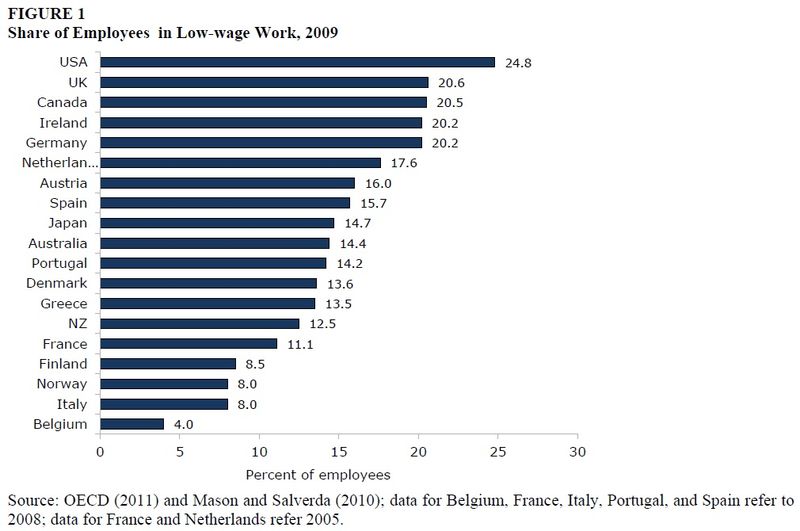
#30 Right now, the United States actually has a higher percentage of workers doing low wage work than any other major industrialized nation does.

#31 Half of all American workers earn $505 or less per week.

#32 In 1970, 65 percent of all Americans lived in "middle class neighborhoods". By 2007, only 44 percent of all Americans lived in "middle class neighborhoods".

#33 Federal housing assistance outlays increased by a whopping 42 percent between 2006 and 2010.

#34 Approximately 50 million Americans do not have any health insurance at all right now.

#35 Back in 1965, only one out of every 50 Americans was on Medicaid. Today, approximately one out of every 6 Americans is on Medicaid.

#36 It is being projected that Obamacare will add 16 million more Americans to the Medicaid rolls.

#37 Back in 1990, the federal government accounted for 32 percent of all health care spending in America. Today, that figure is up to45 percent and it is projected to surpass 50 percent very shortly.

#38 Overall, the amount of money that the federal government gives directly to the American people has risen by 32 percent since Barack Obama entered the White House.

#39 It was recently reported that 1.5 million American families live on less than two dollars a day (before counting government benefits).

#40 The unemployment rate in the U.S. has been above 8 percent for 40 months in a row, and 42 percent of all unemployed Americans have been out of work for at least half a year.

Recently, I wrote a long article about why there will never be enough jobs in the United States ever again.

That means that a whole lot of Americans are not going to be able to take care of themselves.

As our economy gets even worse, there is going to be a tremendous need for more love, compassion and generosity all over the country.

Don't be afraid to lend a helping hand, because someday you may need one yourself.


12/17/2011

Poverty peaks in Greece amid financial crisis, experts say


Πηγή: The Economic Times
Dec 17 2011

ATHENS: Poverty in Greece has risen to new heights under a gruelling recession exacerbated by austerity that has swelled the ranks of the unemployed, the homeless and the destitute, experts said on Saturday.

In comments to Ethnos daily, public officials, senior churchmen and welfare group representatives warned of a brooding humanitarian crisis as official data showed over 320,000 people had lost their jobs in a year.

Athens Mayor George Kaminis told the daily that the city's homeless had increased by around 20 percent while queues at soup kitchens organised by municipal and church organisations were up 15 percent.

"Care workers no longer meet typical homeless people, they meet a person who likely had a perfectly organised life weeks previously," said Kaminis, who has asked for additional state funding for city welfare services.

"We have noticed a dramatic increase in our mess halls over the recent period," added Chrysostomos Symeonidis, head of the Athens archdiocese poverty fund.

"We distribute over 10,000 meals on a daily basis and 250,000 meals are given out nationwide on a weekly basis," Symeonidis said.

Greek unions warn that the number of jobless will exceed 20 percent next year because of the recession and public sector cutbacks demanded by the country's creditors, the European Union and the International Monetary Fund.

The Greek government has pledged to reduce the state payroll by 150,000 people by 2015 but only a fraction will be staff already near retirement.

Greece is in the grip of a four-year recession set to continue next year, bringing the cumulative fall in economic output to 15 percent, according to EU estimates.

Official data this week showed there were over 878,000 people out of work in the third quarter of the year, most of them women and persons aged under 30.

The state statistics agency said the number of employed had fallen to nearly 4.1 million from 4.4 million a year earlier.

"It can be quite hard for young people who can't find work, but imagine the psychological anxiety of someone my age," 60-year-old radio technician George Barkouris, who lost his job just before retirement, told Ethnos.

"Everything shows that the family fabric as we once knew it is fading, those close to us aren't there when you need them the most," said Barkouris, who has children but is now staying at a homeless shelter.


11/11/2011

UPD - Austerity Measures: ‘Causes and Possible effects on Greek society’


This is just a simple glance on the effects of the rapidly implemented austerity measures and on the allegedly causes of the huge debt of Greece that brought it to the bridge of default rendering possible the exit from Eurozone or even EU. Being far from comprising a scientific research this article should urge the specialists to focus on producing relevant and impartial studies which could shed some light on the dark future of Greece and on the implications of the present crisis to the EU.

“Austerity not the way to go for Europe”


In a recent article titled “Austerity not the way to go for Europe” the well Known economist Stiglitz commenting on the Eurozone crisis stated that “I think there is a reasonably good chance that a year from now you would find the Eurozone smaller than what it is today”. Concerning Greece he noticed that “It's not inevitable that will default if they come forward with enough assistance for it to grow. It has enormous growth potential, so if Europe comes up with enough money, it will grow and that will enable it to manage its debts”.

Nevertheless, except the apparent slowdown of the country’s development, austerity measures could prove to have crucially negative effects on corruption, income inequalities and wealth distribution.

Recently, Greece was to be blamed from different directions for it’s lazy, overspending, tax evading and corrupted citizens. More interestingly, last week’s PM Papandreou’s proposal for a referendum on the last economic “savior” agreement with it’s European counterparts, triggered an immediate collision. In the G20 conference the duo: Merkel-Sarkozy threatened Greece, by both pointing to the same direction: Europe’s Exit Door.

The assumption of the Greeks sharing pleasure and luxury, drinking coffees on the sunny cafés while their European counterparts are working hard seems to be invalid. The same applies to the ‘wealthy’ Greek pensioner. According to “20 Popular Fallacies Concerning The Debt Crisis” published by the Rosa Luxemburg Foundation “The (Greeks’) actual weekly working hours – minus lunch breaks – before the crisis were 44.3 hours according to Eurostat. In Germany, this figure was 41 hours and the EU average was 41.7 hours”, “ Greek employees have a right to 23 days holiday leave on average per year. The Germans are in the lucky position of being able to enjoy 30 days holiday leave – a figure that is right at the top in Europe”, “ The wage level in Greece is only 73% of the Eurozone average “, “a quarter of all Greek employees earn less than 750 euros per month” (a figure that is now changed due to the austerity measures), while “the average pension in Greece is about 55% of the Eurozone average, that amounted to 617 euros in 2007. Two-thirds of Greek pensioners had to survive on less than 600 euros per month”.

Bankrupted Greece is the first loud “emergency alarm” inside Europe’s spaceship. Functioning as a paradigm of what will happen to next similar cases, Greece is unfolding an unknown path of the future. So, we can see why it is treated with a beneficial manner on the haircuts of the loans while on the other hand is threatened with the harshest punishments. Greece in fact represents only the 2,5% of the Eurozone's GDP and just 3% of Eurozone’s public debt.

The implications of the duo’s threats were dramatic. Next day Papandreou scraped the referendum while accepted to resign in favor of a new unity government. He ascribed this U-turn to the ND’s opposition leader Samaras, who for the first time hastily backed the agreement for the new loan. Liana Kanelli, a Greek Communist MP, on a Channel 4 interview denounced the referendum – though for years her party steadily promoted a proportional representation voting system– and asked for elections. The formation of the unity government which will sign the pending agreements underlines the unwillingness and incapability of the political parties to bare the responsibility for the future. Notably Papandreou have unsuccessfully tried to convince Samaras to include members of his party into the “cooperation government” – as coined by the PASOK party – which Samaras prefers to name as a “transitional government”. It seems like under the duo’s pressure the whole parliament resigned.

On Thursday Lucas Papademos was chosen as the new PM of the unity government which Angela Merkel and Nicolas Sarkozy think is the sort of hard-line technocrat with whom they can do business. Now he is going to sign the new bailout loan set up, which includes a write-down on their Greek government bond holdings of 50 percent, a fact for he was recently warned that in reality, less than half of Greece's debt would be beneficially open to restructuring, stating that “The potential economic benefits of a debt restructuring will be much smaller than what is frequently forecast and the procedure entails important dangers for Greece and the euro-zone".

In the bottom line, the recent “referendum versus eurozone” controversial approach mirrors a European Union that has always had problems with democracy, a messy process that can interfere with the grand designs of people at the top who know best, namely the Frankfurt Group, an unelected cabal made of up eight people: Lagarde; Merkel; Sarkozy; Mario Draghi, the new president of the ECB; José Manuel Barroso, the president of the European Commission; Jean-Claude Juncker, chairman of the Eurogroup; Herman van Rompuy, the president of the European Council; and Olli Rehn, Europe's economic and monetary affairs commissioner.


Corruption and shadow economy in Greece


Back in 2006, Stavros Katsios of the Ionian University presented a paper titled the “The Shadow Economy and Corruption in Greece”, in which analyzes the main reasons triggering and sustaining the corrupted status of Greece. Katsios concludes that “Greece shows profound signs of a transition country in terms of the high level of regulation leading to a high incidence of bribery and a large shadow economy”.
Concerning the “Tax Reformation” the following table summarizes the key points:


Austerity measures admittedly is having serious negative effects on:
  • “Greater growth and higher incomes” (obvious)
  • “Greater tax visibility so that the people can measure the cost of the government” (nobody Knows how many taxes are going to pop-up in the near future)
  • “Fewer and slow-growing tax bases to control better the overall tax burdens” (obvious)
Additionally, it is well-known that one of the greatest failures of the government is that it was incapable of reducing effectively the tax evasion tuning the gunpoint on the middle and lower classes. Not need to say that nothing was done on “equal treatment of citizens”, “equal treatment of industries, assets and investments” and “reduced time and expense for administration, planning and enforcement”. Katsios referring to higher tax rates states that “Greek politicians seem to ignore the research findings that higher tax rates are associated with less unofficial activity as a percent of GDP and that corruption is associated with more unofficial activity.

Entrepreneurs go underground not to avoid official taxes, but to reduce the burden of bureaucracy and corruption. As a result, only relatively honest governments can sustain high tax rates.” The Greek governments are far from being the “relatively honest governments” and as we’ll see, Transparency International in Greece (TI-Greece) emphasized the importance of upgrading the Elections Committee along with reinforcing the procedure of politician’s asset declarations. Nothing have been done.

Back in 2010 (TI-Greece) published its Annual Survey on Corruption in the country covering the period between July and December. It estimated that bribery cost Greece €632 million in 2010 (US$837 million). Although down from a high of €787 million (US$1.09 billion) in 2009, this was mainly due to a reflection of the effects of the financial crisis and the shrinking size of the Greek economy. On average more than one in ten people report having to pay a bribe for some kind of service, predominantly to public sector institutions.

TI has submitted a series of recommendations to the government:
  • On political financing, it wants the Elections Committee upgraded, parties to comply with accounting requirements, and the procedure of politician’s asset declarations to be reinforced.
  • On the tax system, a TI conference in Athens identified the need for a codified, unified set of tax regulations which would not include the formalities and excessive red tape in the current tax code and the permanent abrogation of tax settlements (where unpaid taxes are resolved with a once-off payment).
  • On public contracting, it wants the government to implement Integrity Pacts – a tool for keeping public procurement clean (the Integrity Pact is an agreement between a government or a government department (at the federal, national or local level) and all bidders for a public contract that neither side will: pay, offer, demand or accept bribes; collude with competitors to obtain the contract; or engage in such abuses while carrying out the contract. Transparency International has used Integrity Pacts for ten years in hundreds of contracts in over 15 countries, which shows that practical solutions can make a difference if the political will is there).
The all growing number of impoverished and unemployed citizens (16%) it will arguably add water in the tank of the “less privileged” which according to Katsios are “the ones who are not willing, cannot afford or have no connections to central or local government bureaucrats” and “are systematically choosing the dark (shadow) side of the economy as a substitute for corruption (bribery), making the shadow economy complementary to a corrupt state”.

Therefore the combined unwillingness of the governments and politicians to fight corruption in their own ranks, with the increasing number of pushed low-income population, the growing insecurity related to possible new austerity measures, the political and economic instability and foremost the feeling of injustice on the distribution of the economic burdens will ultimately ease the path of the increment of the corruption and especially of the shadow economy even if its overall value will be diminished due to the shrinking size of the Greek economy. It must be underlined that a main trigger of tax-evasion, although unmentioned, remains the distrust between the citizens and the governors as history is abound in corrupted contracts on every public project making the tax-payer to believe that his money go to some private pockets and not invested properly for the society’s benefit. The Olympic Games, a huge public project that was accomplished by direct award contracts has left us with about 15 billion euros debt and a Siemens scandal, for which nobody was ever punished while many of the involved persons remain at large in the Parliament ‘striving’ to save Greece from the cliff where they have admittedly pushed it.

One other aspect of the corruption is tied to the adverse effects in terms of horizontal and vertical equity, as well as in terms of efficiency. In the following, we will discuss the Distributional Implications of Tax Evasion in Greece referring the findings of the Hellenic Observatory and LSD paper, written by Manos Matsaganis and Maria Flevotomou back in 2010. By that time, the study estimated the income under-reporting at 10%, resulting in a 26% shortfall in tax receipts. Tax-evasion has wider implications as it “ violates notions of fairness and equal treatment, and undermines the idea of reciprocity which lies at the heart of the social contract between taxpayers and the state”. The key findings are that “Predictably, in terms of income source, farming or self-employment incomes are more likely to be under-reported in tax returns: average under-reporting rates for these two sources are 53% and 24% respectively, while reported incomes from wages and salaries or pensions are nearly identical to survey incomes. In terms of region, under-reporting appears to be most pronounced in Southern Greece - Central, Western and Peloponnese - (16%) and least so in Greater Athens (less than 6%)”. In the following table we can see the tax-under reporting related to the income.


It is evident that tax-evasion is increased in the three lowest deciles remaining though close to the average rate of -10% (the first three of the table). In the last decile (the reach) it is greater as increased to –14,7% toping at the richest 1% where the difference between the survey and tax reported income is up to –23,6%. This highlights effectively the distortion of the unequal distribution of the unjustly imposed austerity measures that target mainly the middle and lower incomes resulting to a much greater inequality and poverty reducing tax progressivity.

The same argument is indirectly backed by another resent study, titled “Inequality and poverty in Greece: Myths, realities and the crisis”, written by Chrysa Leventi (Athens University of Economics and Business), Manos Matsaganis (Athens University of Economics and Business), Theodore Mitrakos (Bank of Greece) and Panos Tsakloglou (Athens University of Economics and Business & IZA). For the period 1974 – 2008 the study states that “unlike what was observed in most OECD and EU countries, during the period under consideration inequality and poverty were declining in Greece. However, various international comparisons show that even after these decreases the levels of inequality and (relative) poverty in Greece are substantially higher than in most developed countries”. In the next table you can see the estimated situation after the adoption of the austerity measures in 2010.


Overall the study implies that the effects of the austerity measures were neutral. “Between 2009 and 2010 the average (equivalised) disposable income of all deciles declined substantially. In absolute terms the decline was close to 2000 euros per capita for the top decile, but less than 200 euros for the two bottom deciles. In proportional terms the decline in the income of the top decile was close to 5% while the corresponding figure was less than 3% for the three bottom deciles”.

Well, if we consider the preview table and count in the tax evasion percentages of the lowest and highest deciles (-9,9% and –14,7% respectively) we can roughly conclude that the impact of this difference on the real income decline (2%) is rather over-inflated.

The study underlines the poverty issue stating that "when the poverty line is fixed at its 2009 level in real terms,
there is a substantial increase in poverty from 20.1% to 25.1%, while considerable changes are observed regarding the structure of poverty".

Additionally, we should consider the last wave of taxation that included a dramatic decrement on the lowest year income that is exempted from taxation (from 12,000 it will reduced to 5,000 euros by 2012), new taxes on houses and fixed extra taxation on the self employed combined with a substantial increment of his self-insurance cost.

It seems that the austerity measures while render growth impossible, boost poverty, unemployment and consequently corruption, and the shadow economy though especially black labor and black market which unfortunately will serve as a relief valve to the all growing pressure.

On October, the Lancet medical journal study stated that Greece's economic crisis is taking a huge toll on the country's health, with an increase in suicides, risky behavior, and a decrease in the number of people seeking medical help. Predicting a 52 percent rise in AIDS cases this year because of prostitution and unsafe sexual practices, the authors said that overall, they are concerned about the health picture in Greece, stating that ordinary people are losing access to health care and preventive medical services as the government tries to finance its debt.


Causes of the Greek crises


The present crises is attributed in different causes as it is actually a multi-factor and complex phenomenon. On 18th August, the Congressional Research Service analyzed the situation in a paper titled “Greece’s Debt Crisis: Overview, Policy Responses, and Implication”. The main causes are described in the following table:


The main features are an overgrown State overwhelming the private sector and a remarkably overspending on the public sector wages and social benefits. Although the spending on public administration as a percentage of total public expenditure has been the highest in the OECD, there has been “no evidence that the quality of the services are superior”. Other main causes are corruption, clientelism, tax evasion, and a partially favorable complex tax code, which grants exemptions to numerous professions and income brackets and the shadow economy (30% of the GDP). In my opinion the public and private sector – that is in fact a welter of oligopolies consisting an elite which backs and is backed by the political family dynasties – are the interlacing branches and the main guilty party in the process, functioning without any transparency behind closed doors, a fact that was correctly described as a systemic crisis back in 2009 in the International Journal of Inclusive Democracy.

To this end, justice had to be vestigial and ineffective as the governments used to promote their own people in the judicial system that left them at large and unpunished. The lack of quality of the expensive public services combined with the low level of the wages and of the average pension in Greece – as described at the beginning of this article ( “20 Popular Fallacies Concerning The Debt Crisis”) - point to a heavy discrimination between the low-middle and low incomes and the rest. Beyond this conventional painting of Greece’s situation there are other views more dynamic.

On April 2010, the Gardiff Business School presented a report titled “ The Greek Debt Crisis: Likely Causes, Mechanics and Outcomes” which attributes the crisis mainly to the following three reasons:
  • Deteriorating macroeconomic fundamentals over the period 2001-2009, mirrored in an external competitiveness deficit coupled with an un-sustainable path for fiscal finances.
  • A shift in market expectations pricing a possible exit of Greece from the EMU, mainly due to the lack of commitment of Greek authorities to undertake unpopular structural reforms.
  • The pricing by markets of a (previously nonexistent) default risk that follows the withdrawal of an implicit guarantee on Greek debt by other EMU countries (mainly Germany).
The pivotal point of the crisis happened in 2010 when by “the exceedingly cautious, under the circumstances, proposed 2010 budget submitted to the European Commission in mid-November 2010” the markets “interpreted the revealed unwillingness, or inability, of two successive Greek governments from both sides of the political spectrum to address unsustainable fundamentals as new information regarding the arithmetic of Greece’s loss function. In response, for the first time in the crisis they started questioned Greece’s commitment to the euro”. Another crucial factor in the process was the German’s “constructive ambiguity” towards the Greece’s bail-out which “would be seen as a shift in long-standing Germany policy, causing moral hazard discouraging Greece and other countries from pursuing reforms, thereby intensifying the present crisis and making future crises more likely.

This was a fully plausible analysis which, however, now seems to have been wrong. It turns out that markets had never believed the no-bail-out clause and had been pricing, even well into the crisis, Greek and other EMU bonds assuming a bailout. Hence, from the markets point of view, a bailout would not be news and thus would not destabilize the Eurozone further; instead the news was that there was to be no bail-out. All in all, the German-led policy of “constructive ambiguity” seems to have backfired: The withdrawal of the fiscal guarantee not only contributed to the collapse of the Greek bonds’ market, thus escalating the crisis it was meant to contain, but may have also sown the seed of contagion to the markets for other EMU periphery bonds, also operating hitherto under the assumption of a German fiscal guarantee”. Indeed, EU was not equipped with the appropriate tools to deal swiftly and effectively with the crisis.

The report finally proposes the creation of a “low euro” currency used by the “periphery” for a suitable period while “the hard euro will be maintained by the core EMU members”. “All existing debts will continue to be denominated in strong euro terms. The plan involves a one-off devaluation of the weak euro versus the strong one simultaneously with the introduction of far reaching reforms and rapid fiscal consolidation in the periphery EMU countries. We argue that due to enhanced market credibility the plan will have a realistic chance of success, maintaining the project of European monetary integration and leaving the door open to the periphery countries for a return to the strong euro”.

Interestingly, on July of 2010 the Defense Academy of the UK published a report in the Balkan Series, written by Mr. James Pettifer titled: “The Greek Crisis – A Pause”. The reader gets a good idea of the writer’s conception of Greeks in the opening of the report where at the header reads: “The second common meaning of the word ‘Greek’ which developed during the sixteenth century, was based upon the opinion of Greek wickedness, rather than of Greek dissoluteness. A ‘Greek’ meant what we should call a ‘twister’, that is, a sharper, a cheat, a crook, any kind of confidence trickster.......this popular usage received full encouragement from learning and literature” (Terence Spencer, ‘Fair Greece, Sad Relic- Literary Philhellenism from Shakespeare to Byron’, Athens, 1954 , P.37). In the following you can see the key findings:


Besides the causes that already mentioned the report underlines the inability of Greece to devaluate – as being member of the EMU - resulting to a sharp rise on it’s prices on transportation, hotels and food, that consequently caused a remarkable fall of tourism which was estimated up to 15-20% in 2009. To this I would add the adaptation of the agricultural sector to the EU’s needs which resulted in a more expensive product along with a much lower quality (mutant seeds). Additionally, investments like the Olympic Games and Athens Metro have significantly increased the burden of the debt, – one can recall Mr. Simitis’ (that brought Greece inside the Eurozone by secretly borrowing loans from the Goldman Sachs) motto by this time: “Powerful Greece – Powerful economy”… – or the “grandiose border posts where there is hardly any traffic, and major new roads, even motorways, in northern Greece where in many cases existing roads were quite adequate.
The background to this goes back a long time and is ultimately linked to Athens Right wing government’s perceptions of the national security issues. At the end of the Civil War in 1949 much of northern Greece was in an economically ruined state. The communist KKE still had strong and genuine popular support in many places, particularly Macedonia, even though their Democratic Army had been defeated in the Civil War. Insecurity remained. The northern border was a long boundary with either belligerent Hoxhaist Albania, Yugoslavia, Warsaw Pact member Bulgaria and always difficult Turkey in Thrace”.

Accordingly, there are other reasons without a particular order of importance: “… the centrality of a few political extended families within the political elite- the parataxis of the families of both major party leaders the
strength of Marxist and quasi-Marxist ideology and political parties, the political and economic influence if not direct unmediated power of the Greek Orthodox church, high defense expenditure caused by poor relations with Turkey, the virulent anti-Americanism among very large sections of the educated population caused by US policies in the junta period, the fiscal burden of the Olympics and Bush administration international politics,
massive on-costs for the state caused by the fragmented landmass and islands and the dependence on external finance for much infrastructure construction since the end of the civil war in 1949”. The report states that even that the reform of the Greek state have been an uncontroversial demand, it is extremely difficult as the major parataxis – families “would destroy their own political bases in so doing”.

The report foresees that there will be a great resistance on the public spending cuts that demanding external players as these “often do not always appreciate the very poor wage and salary levels of many people in Greece such as schoolteachers, let alone unskilled workers. The fact that in some parts of Athens and Thessaloniki as many as twenty per cent of the vote in the 2009 national elections went to the Marxist parties to the left of PASOK is an indicator. In the cafe climate of Greek politics, there is fertile ground for the argument that the whole crisis is a product of the greed of Anglo-American bankers, Jews, local monopolists and their own expatriate rich. Public attitudes to the Euro are hard to evaluate and often contradictory. When Greece finally became a member in 2001 there was widespread national satisfaction that the country had seemed to have overcome the burden of the conflicts of the past and had become a respectable mainstream European nation. But, within a year, food and daily living costs were rising rapidly because of the Euro and tourist decline had significantly set in seriously. The end of the drachma was widely regretted, particularly by small business”. One more cause of Greece’s failure is the “social change and population movement in Greece in the last generation has emptied much of the mountain and rural hinterlands and brought a new consumerist middle class in and around Athens into being. The overconsumption patterns of this social orbit are a major cause of the current crisis, irrespective of whether those involved are in the public or private sector”.

The report implies that the exit of Greece from the euro was faced like a taboo inside the country and outside, while Mr. Provopoulos, governor of the Bank of Greece, “set out a cogent position for Greece remaining in the Eurozone” while admitting that the euro “has caused Greece, a major loss of competitiveness since 2001”. But challenging his opinion it states that his “nightmare picture of the role of drachma devaluations is likely to be unconvincing”, “particularly to older Greeks, who saw the social and economic progress of the late 1970’s and 1980’s and 1990’s under the Karamanlis and Papandreou governments”.

As said in the beginning of this article it is just a glance to the present unprecedented economic crises. Regardless the path that Greece is going to follow, any solution will prove to be inadequate if it fails on these three key factors: Informed citizens and not ignorant tax-payers, transparency in every process and justice in the distribution of economic burdens.

Finally, as beyond numbers, statistics and analyses there is experience that underlines the grave symptoms of the present economic crisis I will close this post with a little event I happened to hear from a 21 years old girl. She was coming back home in a taxi from a Saturday party when three armed Pakistani stopped the car under gunpoint. They forced them out, took their money and vanished in the dark streets. But this was not what really shocked her as when they got back in the car the driver told her: “I am sorry, but I can’t drive you back home as you don’t have money any more”, and left her there all alone.

Apart from this profound change of social behavior two persons that I know – brother and sister – both disabled, saw their pensions lowering from 800 to 600 and from 600 to 400 euros respectively. The mental disordered that had a helping 300 euros pension every two months now they are supposed to pay with that for their medicines. Sorry, I forgot that they were overspending all this years and who knows maybe they do have a secret pool in their family home after all.
-----

For an updated study on the subject see: