
Showing posts with label tourism. Show all posts

5/13/2020

A global tourism catastrophe


Source: NewsZetu
May 13 2020

  • 2020 is a catastrophe for tourism businesses. Here's what the industry needs to get back on its feet.

Socrates Gavriel is bracing for a dramatic drop in visitors to his boutique hotel in Athens this summer.

Located a short distance from the Greek capital’s commercial center, Pi Athens ordinarily welcomes droves of American and Australian tourists this time of year.

“The concern this summer is that those who will come — if and when they do — will skip the big cities and head directly to a beach location,” Gavriel told CNN Business. “The hotel is a rented property and there are many bills to pay. I have invested in it heavily. We are hoping for some revenue in the summer but we don’t know if this is going to happen.”


Gavriel’s story is playing out across the globe, as government restrictions designed to curb the coronavirus pandemic keep billions of people at home, bringing international travel and tourism to a standstill. The shutdown is affecting everything from small businesses like Gavriel’s to massive companies, such as Marriott International (MAR) and Carnival Corporation (CCL). TUI, the world’s biggest tour operator, said Wednesday that it could shed up to 8,000 jobs.

Even some of the biggest global airlines, such as Germany’s Lufthansa (DLAKF), are seeking government bailouts in order to survive.

Travel and tourism accounts for some 10% of global GDP and one in 10 jobs, according to the World Travel and Tourism Council, an industry group. As many as a third of these jobs, or more than 100 million positions, and some $2.7 trillion in GDP could be at risk as a result of the current crisis, the council said last month.

Countries that rely most heavily on tourist dollars will be hardest hit. A 25% decline in tourism income will knock on average 7% off GDP among “small island developing states,” a contraction that could go as deep as 16% in places such as the Maldives and Seychelles, according to the United Nations Conference on Trade and Development.

The situation is also dire in Europe, which boasts half the world’s international tourist arrivals. The European Parliament estimates that the bloc’s tourism industry is losing around €1 billion ($1.1 billion) in revenue per month, a devastating blow to the 27 million EU workers whose jobs are connected to the sector.

“The crisis in the tourism sector is deeper than we could imagine two months ago,” said Isabel Oliver, Spain’s secretary of state for tourism. “The sector was one of the first to suffer the consequences of the crisis and will be one of the last to recover,” she added.

While hotel owners such as Gavriel desperately need international visitors, reopening borders risks a surge in new coronavirus infections even if it could mean economic relief. Greece hopes to start welcoming tourists by July 1, but Prime Minister Kyriakos Mitsotakis admits that “it’s a very tough trade off.”
“Nobody knows exactly how to do this,” he told CNN in an interview earlier this month.

Kickstarting tourism, while crucial for the global economy, will be especially complex. Reopening businesses and restarting factories is proving hard enough, but the return of travel will require an easing of border controls, international cooperation and, most crucially, travelers themselves.
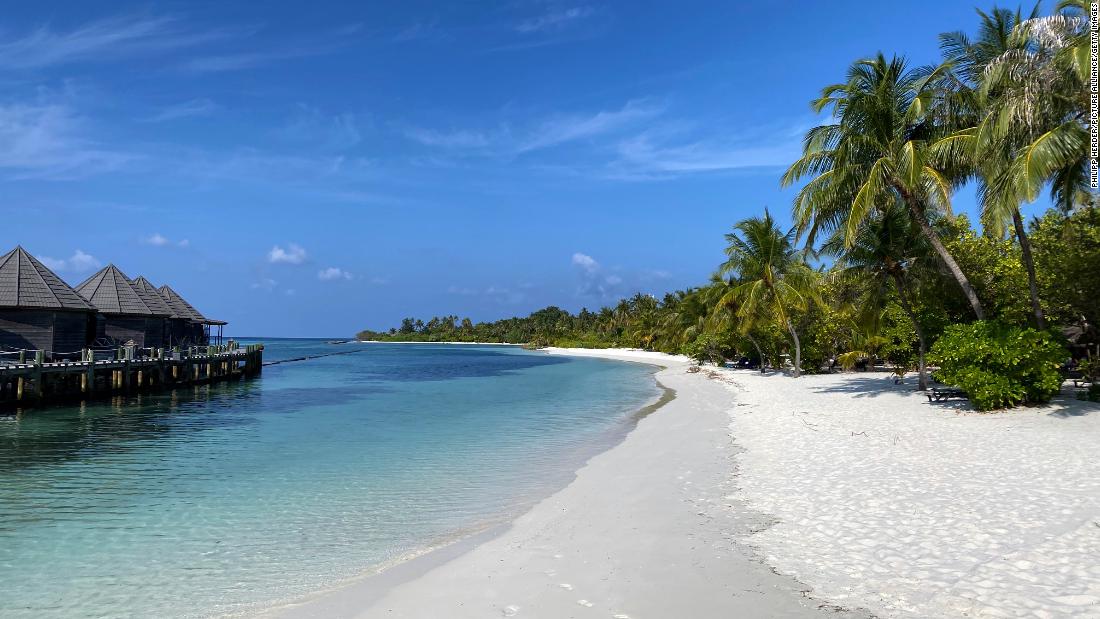
Kuredu island, Maldives.

“The critical issue is to build confidence between countries that it is safe to reopen borders without risk of reinfection and to build confidence in the general public that it is safe to fly,” John Holland-Kaye, CEO of London’s Heathrow, the busiest airport in Europe, said last month.

Airports hold the key

But airlines are already downsizing, trimming fleets and slashing thousands of jobs, in expectation that people will fly less. British Airways parent IAG (ICAGY) said last week that it does not expect passenger demand to recover to 2019 levels before 2023. Princess Cruises, a division of Carnival Corporation, has canceled virtually all its summer sailings, citing limited flight availability and the closure of many popular cruise ports. And rival cruise line Norwegian has had to raise more than $2 billion in the capital markets to stay afloat.


Airports and hotels are trying to lure travelers back with health checks and enhanced cleaning protocols, all of which will add layers of cost at a time when the sector’s finances are in tatters because of the collapse in travel.

But such measures are necessary to restore confidence before a Covid-19 vaccine is widely available, said World Travel and Tourism Council CEO Gloria Guevara. “The most critical piece is the airports,” she told CNN Business.
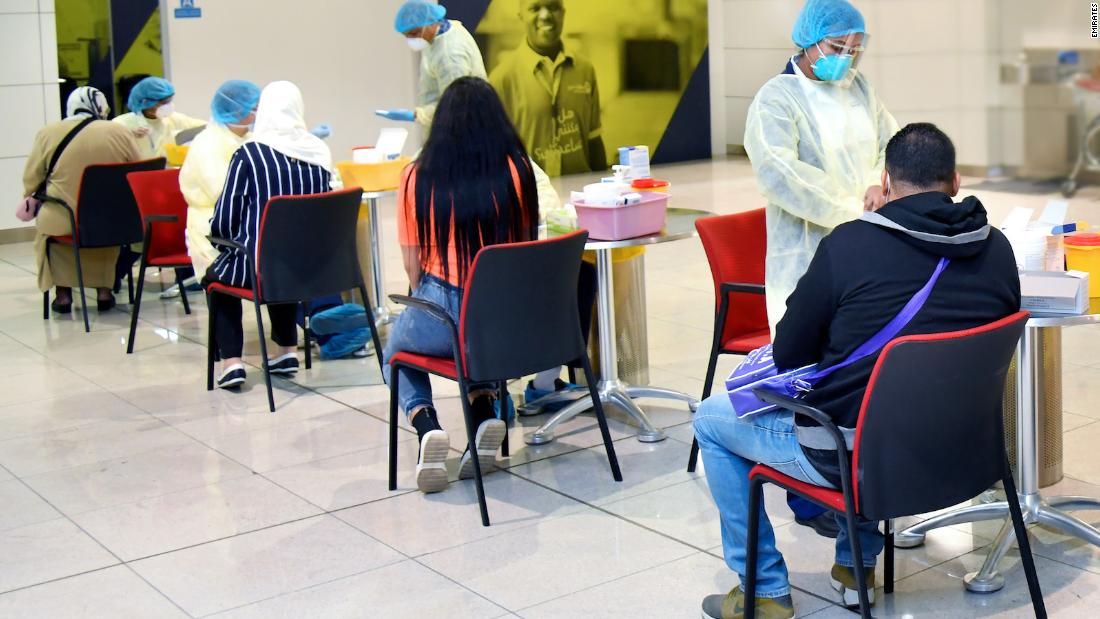
The Dubai Health Authority carries out coronavirus screening on passengers heading to Tunisia on a repatriation flight.

The World Travel and Tourism Council is working with governments and travel organizations to agree on standardized health checks and cleaning protocols. It expects to issue guidelines for the hospitality industry this week with guidance for airports to follow.

Ryanair (RYAAY), which carries millions of tourists around Europe each year, on Tuesday announced new health measures to be implemented on board aircraft as part of plans to restore 40% of flights starting on July 1. The measures illustrate the daunting task facing airlines as they seek to resume flying.

“A quick and effective restart of travel will only happen if governments around the world agree to a common set of health protocols developed by the private sector,” Guevara said in a statement.

Even if that does happen, international tourist arrivals are predicted to be virtually nonexistent this year.

The United Nations World Tourism Organization estimates a decline of as much as 80% from 2019, depending on how long travel restrictions remain in place. That compares with a 0.4% decline during the SARS epidemic in 2003 and a 4% drop in 2009 following the global financial crisis.

“This is by far the worst crisis that international tourism has faced since records began [in 1950],” the UN body said in a statement last week. “The impact will be felt to varying degrees in the different global regions and at overlapping times, with Asia and the Pacific expected to rebound first.”

Domestic travel offers glimmer of hope


There are some early signs that domestic travel is gradually picking up again in certain countries, although it’s too soon to call a recovery.

China began to ease coronavirus lockdown restrictions in March, after the country’s near complete shutdown in late January. More than 30% of domestic airline capacity has returned since March 1, according to aviation analytics company, Cirium.

“Green shoots in the Chinese domestic market … is a positive sign for short-haul travel recovery,” the company said in a research note. “It’s clear that, as some travel restrictions ease, it will be the domestic market which will start to return first.”

But flight cancellations remain elevated and the recovery has plateaued, suggesting consumer confidence has not yet been fully restored, Cirium added.

Marriott said Monday that occupancy at its hotels in Greater China reached 25% in April, up from less than 10% in mid February. Meituan Dianping, an app that allows consumers to shop, order food and book trips, recorded increased spending on local tourist attractions, and a pickup in hotel and bed and breakfast bookings last month.
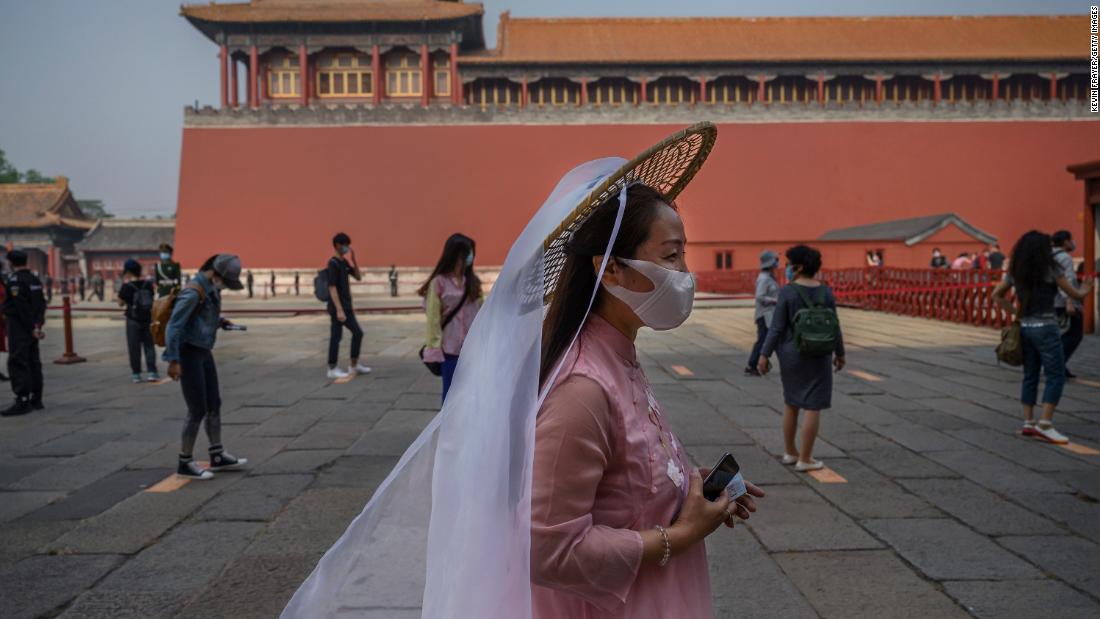
Chinese tourists wear protective masks as they line up to enter the Forbidden City.

However, some tourist attractions in China were forced to shut shortly after reopening due to an influx of visitors. The country is now renewing restrictions in some areas after new cases of the virus were reported in two cities, including the pandemic’s epicenter Wuhan.

Elsewhere, Airbnb has observed a surge in domestic bookings in Denmark and the Netherlands, CEO Brian Chesky told the Financial Times recently. “People will want options that are closer to home, safer, and more affordable,” Chesky said in a letter to staff posted to the company’s website.

But that doesn’t mean a full recovery will be achieved anytime soon, and China’s experience could cause other countries to reopen with even greater caution. In the same letter, Chesky announced a 25% cut to the company’s workforce and said revenue in 2020 is expected to be less than half what it took in last year.

With “staycations” expected to spearhead the sector’s eventual revival, countries that rely more heavily on domestic and regional visitors will fare better.

At the top of this list are the United States, Mexico, Brazil, China, Japan, India, the Philippines, Germany and the United Kingdom, where domestic tourism accounts for more than 80% of total travel and tourism spending, according to the World Travel and Tourism Council.

Asia Pacific has the largest regional travel market, which bodes well for some islands, such as the Maldives and Fiji, assuming tourists choose destinations that are closer to home. Countries such as Thailand and Cambodia, which both derive more than 20% of their GDP from travel and tourism, could also benefit. Visitors from Asia accounted for nearly 70% of all tourist arrivals in Thailand in 2018, according to Bangkok Bank.

Chinese tourists spend most on world travel, accounting for one fifth of international tourism spending in 2018, or $277 billion, according to the World Tourism Organization. Tourists from the United States follow at $144 billion.

With journeys to international destinations expected to recover last, small business owners like Gavriel, whose patrons travel long distances to come to Greece, face an uncertain future.

— Elinda Labropoulou, Nic Robertson, Laura Perez Maestro and Sherisse Pham contributed reporting.


5/08/2020

EU backs keeping external borders shut until mid-June over coronavirus


Source: Reuters
May 8 2020

BRUSSELS (Reuters) - The European Union (EU) executive on Friday backed keeping curbs on travel to the continent in place for another 30 days until mid-June as part of extraordinary measures to limit the spread of coronavirus but also hurting trade and tourism.

The bloc decided in mid-March to close its external borders for any non-essential travel in a largely failed bid to prevent the 27 member states from closing frontiers inside Europe’s control-free travel zone.

The EU’s Home Affairs Commissioner Ylva Johansson said this week Europe would have to “go back to the future” of open borders once the pandemic is under control.

But for the time being, at least 17 of the Schengen zone’s 26 countries have various travel restrictions in place. The Schengen zone brings together most EU countries as well as Norway, Iceland and others.

“Restrictions on free movement and internal border controls will need to be lifted gradually before we can remove restrictions at the external borders and guarantee access to the EU for non-EU residents for non-essential travel,” Johansson said in a statement on Friday.


5/02/2020

A decade after debt crisis, Greece on verge of virus recession


Source: AFP
May 2 2020
By Hélène Colliopoulou

Athens (AFP) - Ten years after sinking into its worst economic crisis in living memory, Greece once again faces the spectre of a grave recession in the midst of a global coronavirus lockdown.

Though the country has so far been spared the death toll of other European nations at fewer than 150 fatalities from COVID-19, it will not escape the resulting economic downturn, Prime Minister Kyriakos Mitsotakis warned this week.

"The consequences of this coronavirus attack will undoubtedly be dramatic," he told parliament on Thursday.

"We know with certainty that (the recession) will be deep... we don't know how long the health crisis will last, we don't yet know if we'll have tourism."

Tourism is one of Greece's most important sources of revenue, along with shipping.

The Greek state alone could lose 8-10 billion euros ($8.8-11 billion) in income this year, the prime minister said.

- Where's the money? -


Greece has already adopted measures worth 17.5 billion euros, or 10 percent of national output, to support businesses and employees, Mitsotakis said.

Including EU funds, the package will reach 24 billion euros, he said.

But the opposition has questioned whether the money has actually reached the intended recipients.

"Where is this money? It's good for announcements but actual businesses and (employees) have not received a single euro," former leftist prime minister Alexis Tsipras said Thursday, predicting that layoffs will soon be "out of control".

Greece this year had been counting on a growth spurt of 2.4 percent. After exiting the final debt crisis bailout in 2018, its borrowing rates were at historic lows -- in October Athens even sold treasury bills at a negative rate -- and it has cash reserves of more than 36 billion euros at hand.

But with most of its economy in virus quarantine since March and global lockdowns expected to wreak havoc on tourism, Greece is expected to sink into a 10 percent recession this year, according to the International Monetary Fund.


- 'Irreparable' damage -


Panagiotis Petrakis, professor of finance at the University of Athens, argued that the economic blow will be less severe.

"The most likely scenario is a six percent contraction, provided there is no deterioration in the pandemic," he told AFP.

Petrakis also believes that the economic impact of this crisis will be less protracted. The IMF itself estimates a 5.5 percent Greek recovery in 2021.

The Greek finance ministry says the downturn could be limited to 4.7 percent through support measures, followed by a 5.1 percent rebound. The jobless rate will approach 20 percent, it said Friday.

The government will begin easing lockdown restrictions this month, with most shops opening by May 11 and restaurants and year-round hotels following on June 1.

But few expect any foreign visitors before July.

Many Greek businesses fear the damage will be irreparable, especially with minimum two-metre (6.5-feet) social distancing requirements squeezing out customers.

"Last summer I had 10 tables outside and 10 inside. Now, I will just have three tables outside and I'm supposed to make do," says Costas Gogos, owner of a tavern in the port of Rafina near Athens.

"Many will not even reopen, they won't manage with so few tables," added a neighbouring restaurant owner.

- Memories of 2010 -


It was on May 2, 2010, when the socialist government of George Papandreou signed the first of three eventual bailouts with the European Commission, the European Central Bank and the IMF that would total 350 billion euros.

A week earlier, Papandreou had stunned the nation by announcing the call for international assistance. His televised address from the tiny island of Kastelorizo is indelibly etched in the nation's collective memory.

In the years that followed, a quarter of Greek national output would be wiped out in wave upon wave of wage and pension cuts and tax hikes demanded by the so-called troika of creditors.

Unemployment soared to a high of 27 percent before eventually falling to 16 percent in March, still the highest in the eurozone.

Dozens of general strikes and hundreds of street protests would follow, many of them violent. In one of the worst incidents on May 5, 2010, three people died in a bank set on fire during an anti-austerity protest, one of them a pregnant woman. The culprits were never caught.

The crisis was sparked by reckless state spending and misreporting of fiscal data to the EU. When revealed by Papandreou's government, it caused Greece's borrowing rates to spike beyond reach.


3/21/2012

Greece sales already 10% down, warn operators


Πηγή: Travel Weekly
March 21 2012

One of the largest specialist tour operators to Greece has backed calls for a promotional campaign funded by the country's government as sales fall 10% to the destination.

The Sunvil Group, of which Sunvil Holidays is its main brand, has supported Abta and the Association of Independent Tour Operators' letter to the Greek prime minister warning capacity could be cut to the destination if funds are not provided to the tourist board to boost visitor numbers. Greece has suffered from negative publicity in recent months because of civil unrest in the country.

The group, which sends 18,000 to 20,000 holidaymakers to Greece each year and is one of the largest specialist operators to the destination, said the government needed to "put its hand in its pockets" or risk losing business from the UK this summer.

Managing director Noel Josephides said: "We are putting pressure on Greece; if you [Greek government] don't help to repair the image, then you will lose business."

Sunvil's sales to Greece are around 10% down year on year but it is difficult to gauge how badly the destination will be hit because a large proportion of bookings tend to come in the lates market, said Josephides, who stressed a campaign was needed now, "not in August".

"If we could have a contribution in our advertising we would be able to make our offers to Greece more visible. If they could match our spend £1 for £1 it would go so much further," he added..

The operator does not plan to cut capacity, however. Josephides said: "We cannot afford to cut capacity. We are committed. We can tinker around the edges by starting flights a week later, but we are tied in."

But Aito chairman Derek Moore said "one or two" operators had indicated that capacity to Greece could be cut. "They are thinking that way and wondering what to do about charter capacity for the summer," he said. Operators offering a range of destinations including Greece were more likely to be able to shift capacity out to other areas, he added.

He added: "This letter is meant as a wake-up call to the Greek government . Figures to Greece are down and most tourist boards would put a campaign in place to correct this. UK operators which depend on Greece will be suffering badly."


2/12/2012

Cyprus hopes for 400,000 Russian tourists in 2012


Πηγή: Cyprus Mail
By Poly Pantelides
Feb 11 2012

SEVEN new airports from the Russian Federation will be offering flights to Cyprus this year, the Cyprus Tourism Organisation (CTO) said yesterday.

“We hope to have over 400,000 tourists from Russia in 2012,” CTO head Alecos Orountiotis said at a news conference.

Last year over 330,000 Russian tourists visited Cyprus, over 100,000 more than the year before when about 224,000 came and about 230,000 more from 2005 when 97,000 Russian people visited.

Seven new airports in the Russian Federation will now be offering flights from Perm, Arkhangelsk, Kemerovo, Tyumen, Chelyabinsk, Omsk and Nizhny Novgorod.

There are already flights from nine other airports in the Russian Federation: Moscow, Saint Petersburg, Yekaterinburg, Ufa, Rostov, Novosibirsk, Kazan, Krasnoyarsk and Samara.

The 16 cities are located on both European Russia and Asian Russia’s West Siberian plain.

Some cities are among the most populous in the Russian Federation and many are administrative centres in their region.

“The Russian market is a major priority for us,” Orountiotis said.

A CTO representation went over to Moscow and Saint Petersburg earlier this month and held meetings with major tourist agents, Orountiotis said adding that indications were “encouraging”.

Russian investments in Cyprus in 2010 were worth €2.7 billion, 12 per cent of the island’s GDP, according to economists at the fourth Cyprus Economist Summit last March.

Economists said at the summit that tourism brought in €221 million annually and was expected to rise.

The government has secured a €2.5 billion loan from Russia to cover its financing requirements for this year receiving two instalments in December and January with the final €590 million tranche expected in March.

The Russian market brings in the second largest number of tourists after the UK and has “grown by leaps and bounds” over the past few years, Orountiotis said.