Showing posts with label unemployment. Show all posts

5/15/2020

Three million more U.S. layoffs intensify fears of lasting damage


Source: AP
May 15 2020
By Christopher Rugaber


WASHINGTON -- Nearly 3 million laid-off workers applied for U.S. unemployment benefits last week as the viral outbreak forced more companies to slash jobs even though most states have begun to let some businesses reopen.

Roughly 36 million people have now sought jobless aid in just the two months since the coronavirus first forced businesses to close down and shrink their workforces, the government said Thursday. An additional 842,000 people applied for aid last week through a separate program for self-employed and gig workers.

All told, the figures point to a job market gripped by its worst crisis in decades and an economy that is sinking into a deep downturn. The pace of new applications for aid has declined over the past several weeks but is still four times the record high that prevailed before the coronavirus struck hard in March.

The waves of job cuts have heightened concerns that additional government aid, on top of the nearly US$3 trillion already allocated, is necessary to sustain the economy. Without another aid package, many economists worry that thousands of small businesses will go bankrupt, leaving millions of the unemployed with no job to return to. And state and local governments, facing huge revenue shortfalls, could be forced to lay off millions more workers and cut services.

Federal Reserve Chair Jerome Powell this week stressed his belief that Congress should consider providing additional rescue money to avoid prolonging an economic catastrophe.

Republicans in Congress are locked in a standoff with Democrats, who have proposed trillions more in aid. Republican leaders say they want to first see how the previous rescue packages affect the economy and have expressed skepticism about approving much more spending now. That sentiment has alarmed some economists.

"There really isn't any sign that the labour market is bottoming out yet," said Daniel Zhao, senior economist at Glassdoor, the career website.

The Trump administration insists that as states reopen, more Americans will shop, dine out and resume other activities, thereby stimulating the economy. But early data suggests it is fear of contracting the virus, even more than shutdown orders, that may be impairing the economy. Without stronger public health measures, such as widespread testing or a vaccine, economists say such fear will depress growth even as more states reopen their economies.

Even though Georgia reopened its restaurants for sit-down dining late last month, Adam Ozimek, chief economist at Upwork, said data from the reservation site OpenTable shows that reservations are still 91 per cent below their pre-virus level.

"Simply ending lockdowns is not going to be a panacea for these companies," Ozimek said. "People aren't going out because they don't feel safe yet."

The number of people seeking unemployment benefits actually rose last week in Georgia, as well as in Florida, which has also started to reopen. In Florida, that increase likely reflects a troubled system that caused a belated processing of claims that had been filed earlier.

A few other states that have lifted some restrictions, like South Carolina and Texas, reported declines in jobless claims.

President Donald Trump appeared to respond to the report by tweeting, "Good numbers coming out of States that are opening. America is getting its life back!"

In Ohio, shopping malls have reopened for the first time since March but have seen little traffic. Roughly two-thirds of the stores in one mall outside Toledo were still closed Tuesday.

Ozimek pointed to signs that business failures are rising. A survey by the Census Bureau, released Thursday, found that 41 per cent of small businesses have closed temporarily since the pandemic hit. Other research has found that half of small businesses lack enough cash to survive longer than a month without revenue.

"Those are the signs that we've stretched the economy too far, and it's starting to tear," Ozimek said.

State and local governments, which cut nearly 1 million workers in April, are running out of money and collectively posing a threat to the national economy. The recession will likely produce the sharpest plunge in state tax revenue since the centre began tracking such data in the early 1970s, said Lucy Dadayan, senior research associate at the Urban-Brookings Tax Policy Center.

About two-thirds of the states have reported data for April, with most showing worrisome declines. California's tax revenue fell 65 per cent compared with a year earlier. New Jersey's dropped 59 per cent, Pennsylvania's 51 per cent. Sales tax revenue has shrunk as consumer spending has tumbled. And income taxes have been diminished by the widespread job losses.

Spending by states and localities plays a vital role in the national economy: It amounted to US$2.33 trillion last year -- 11 per cent of the U.S. gross domestic product. States and localities employed nearly 20 million workers in February.

In the meantime, jobless workers in some states are still reporting difficulty applying for or receiving benefits. These include free-lance, gig and self-employed workers, who became newly eligible for jobless aid this year.

Kelly Kelso, a stage crew member in Nashville, filed for unemployment aid after her company, Live Nation, cancelled all summer tours. She has no idea when touring will resume. She applied in late March but hasn't received a single check. And she can't get answers.

"I've probably called a hundred times and been disconnected every time," Kelso said.

Kelso's partner is a self-employed musician who finally began receiving unemployment benefits after five weeks. But for the couple, who have a 5-year-old son, money is scarce. Their landlord is demanding rent.

The latest jobless claims follow a devastating jobs report last week. The unemployment rate soared to 14.7 per cent in April, the highest rate since the Great Depression, and employers shed 20.5 million jobs. A decade's worth of job growth was wiped out in a single month.

Even those figures failed to capture the full scale of the damage. Many workers in April were counted as employed but absent from work but should have been counted as temporarily unemployed.

Millions of other laid-off workers didn't look for a new job in April, likely discouraged by their prospects in a mostly shuttered economy, and weren't included, either. If all those people had been counted as unemployed, the jobless rate would have reached nearly 24 per cent.

Most economists have forecast that the official unemployment rate could hit 18% or higher in May before potentially declining by summer.


5/07/2020

Coronavirus: US unemployment claims hit 33.3 million amid virus


Source: BBC
May 7 2020

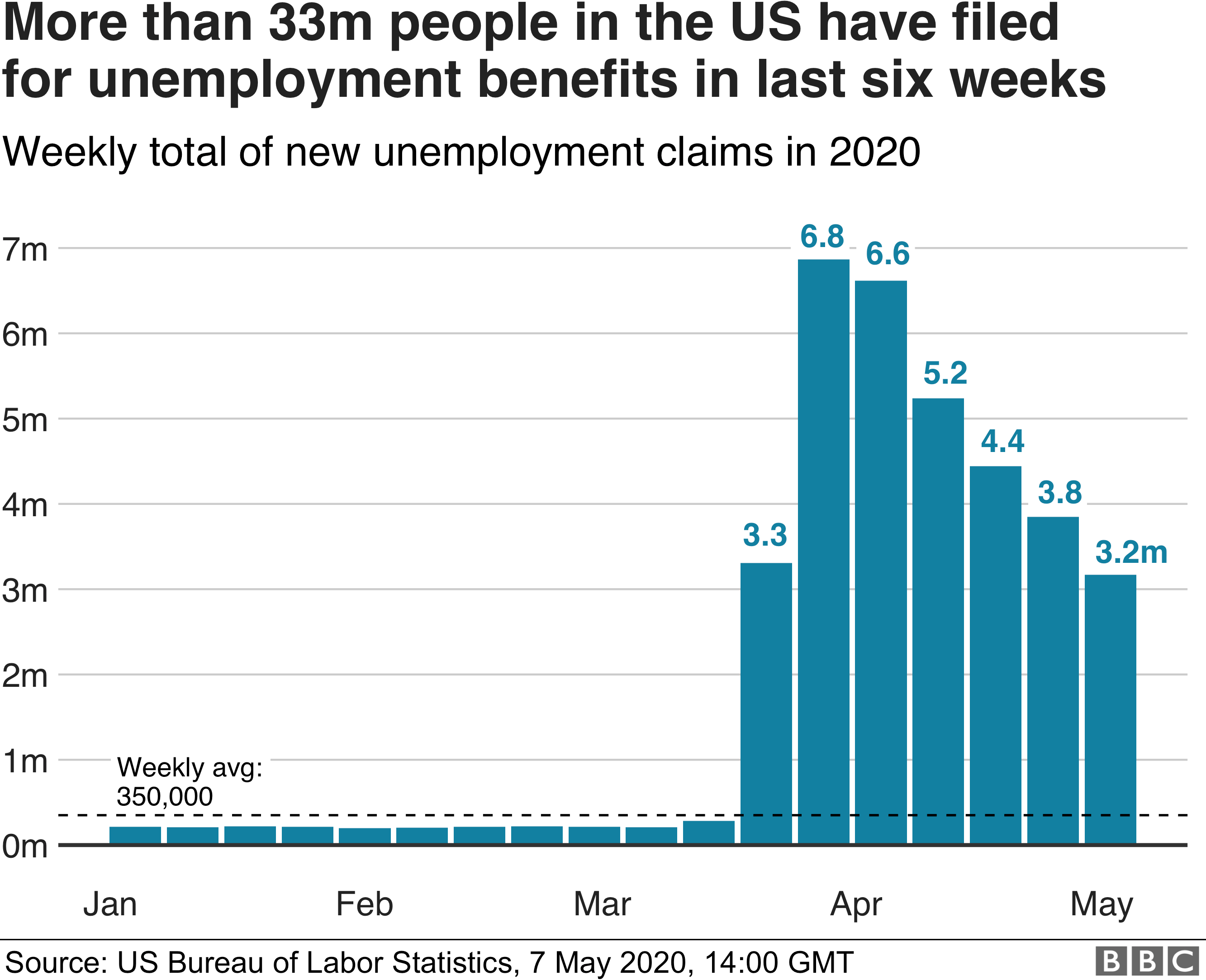
A further 3.2 million Americans sought unemployment benefits last week as the economic toll from the coronavirus pandemic continued to mount.

The new applications brought the total number of jobless claims since mid-March to 33.3 million.

That amounts to more than 15% of the US workforce.

However, it was less than the 3.8 million a week ago and down from the record 6.9 million for one week in March.

Although the number of people filing claims is on the decline, it is still extraordinarily high, says BBC Business correspondent Samira Hussain in New York.


Although the unprecedented job losses seem to be slowing, economists say the monthly unemployment rate for April, which will be released on Friday, could reach 15% or higher.

Just two months ago, the unemployment rate was at 3.5%, a 50-year low.

Since the coronavirus has taken hold in the US, the country has suffered its worst growth numbers in a decade, the worst retail sales report on record and the highest weekly unemployment claims ever seen.


4/28/2020

German employment survey plummets to historic low as coronavirus crisis hits

GS - Volkswagen AG Restarts Assembly Lines At World's Largest Car Factory

Source: CNBC

April 28 2020

  • The latest reading represents a “historic low,” where all four sectors (manufacturing, construction, services and trade) faced sharply lower employment.
  • In a separate release, German exporters revealed concerns about their prospects too.
  • Earlier this month, the International Monetary Fund (IMF) forecast a 7% contraction in Germany this year, on the back of the ongoing pandemic.


Germany is experiencing an “unprecedented” drop in employment levels, the German economic institute Ifo said on Tuesday, as the coronavirus pandemic hits Europe’s growth engine. 

The Ifo’s employment barometer dropped to 86.3 points in April, having reached 93.4 points in March. The latest reading represents a “historic low,” where all four sectors (manufacturing, construction, services and trade) faced sharply lower employment.

“There has never been such a marked decline in the barometer itself, which will correspond to a rise in unemployment in Germany,” the Ifo institute said in a statement on Tuesday.

In a separate release, German exporters revealed concerns about their prospects too.

The Ifo’s export expectations for manufacturing plummeted to -50.0 points in April, down from -19.0 points in March.

The picture is particularly gloomy for some of the country’s key industries, such as automotive manufacturing and mechanical and electrical engineering.

“This is the lowest value ever measured, and the severity of the decline is also unprecedented. The coronavirus pandemic is leaving deep scars on export markets,” the Ifo said in a statement.

Earlier this month, the International Monetary Fund (IMF) forecast a 7% contraction in Germany this year, on the back of the ongoing pandemic. The IMF also estimated a 3.9% unemployment rate in Germany for 2020, up from 3.2% last year.

Germany first introduced lockdown measures on March 22, but it has since started to slowly lift some of these restrictions. Smaller shops have reopened their doors as well as bike stores, bookstores and car dealerships.

Germany has had 158,758 confirmed infections from Covid-19 and 6,126 deaths, according to the latest figures from Johns Hopkins University. Health experts have said the robustness of the German healthcare system has contributed to a relatively low number of deaths when compared to total cases.


4/12/2020

US economy purged 17 mn jobs amid pandemic

The coronavirus has put around 17 million people out of work in the United States
The coronavirus has put around 17 million people out of work in the United States (AFP Photo/CHANDAN KHANNA)

Source: AFP
April 12 2020

Washington (AFP) - US unemployment is rising at a jarring rate, with data released Thursday showing 17 million people have lost their jobs since mid-March as officials scramble to apply a tourniquet to stem the damage from the coronavirus pandemic.

The Federal Reserve launched a series of new lending programs Thursday to pump $2.3 trillion into the damaged US economy, but Fed Chair Jerome Powell tried to offer reassurance, saying the recovery could be "robust."

The Fed's announcement came at the same time as the Labor Department's latest weekly report showed 6.6 million more people filed for unemployment benefits last week, following 6.9 million in the prior week and 3.3 million in the week ended March 21.

That is a stunning reversal for the world's largest economy where the jobless rate was near historic lows before it was forced to shut down to stop the spread of COVID-19.

Analysts expect the malaise to persist for months, with the jobless rate surging into double digits in April, as President Donald Trump eyes getting the country back in business.

Treasury Secretary Steven Mnuchin meanwhile gave a more definitive timeframe, saying on CNBC businesses could restart as soon as May.

"As soon as the President feels comfortable with the medical issues, we are (doing) everything necessary (so) that American companies and American workers can be open for business and that they have the liquidity that they need to operate their businesses in the interim," he said.

The unemployment data indicate the coronavirus pandemic is set to eclipse job losses from the 2008 financial crisis, and International Monetary Fund chief Kristalina Georgieva warned Thursday that the world faces the worst global emergency since the Great Depression.

The 17 million total unemployed in the US "is just over half the nearly 30 million in job losses we expect to result from the spread of the coronavirus, which would be three times the number of job losses that occurred" during the last recession, Oxford Economics said, projecting the unemployment rate reaching 14 percent in April and 16 percent in May.

- Hitting the bottom? -

The US government has mobilized to stem the losses, with the Federal Reserve announcing on Thursday a new $2.3 trillion financing measure aimed at helping businesses, households and state and local governments facing a cash crunch.

Included in the measures is the Main Street Lending Program, which may purchase up to $600 billion in loans owed by small- and medium-sized firms "that were in good financial standing before the crisis," the Fed said in a statement.

Another program, the Municipal Liquidity Facility, will offer up to $500 billion in lending to states and municipalities by directly purchasing short-term debt.

The Fed also is backstopping the new Paycheck Protection Program launched last week as part of the massive $2.2 trillion rescue package Congress approved late last month.

The central bank will buy up all the loans issued by private banks worth up to the full $349 billion allocated to the program, which will free up the banks to provide more loans to customers.

Powell acknowledged the US is facing a "truly rare" economic crisis, and unemployment is moving up at an "alarming speed," but the Fed is committed to using its emergency lending powers as long as the crisis lasts.

"There is every reason to believe that the economic rebound, when it comes, can be robust," Powell said in a speech.

Ian Shepherdson of Pantheon Macroeconomics said there are signs the initial jobless claims will decline in coming weeks.

"Google searches for 'file for unemployment' are now falling consistently on a week-on-week basis, by about one third," he wrote, forecasting a decline in claims next week to a still-enormous 4.5 million.

- More help needed -

Georgieva said the coronavirus pandemic could cause "the worst economic fallout since the Great Depression," turning global growth negative and requiring a massive governmental response.

Even in the best case, the IMF expects only a "partial recovery" next year, assuming the virus fades and economic activity restarts later in 2020.

In Washington, policymakers already are trying to bolster the $2.2 trillion emergency measures now being implemented.

The bill includes direct cash payments to Americans and expanded unemployment insurance in addition to the small business loan program, which has had a tumultuous rollout.

Mnuchin wants an additional $250 billion for these loans, however a vote in the Republican-controlled Senate to unanimously approve allocating that money failed on Thursday, with Democrats blocking it in favor of their own proposal.


5/01/2013

What America's $2 Trillion Underground Economy Says About Jobs


Πηγή: Money Morning
By DAVID ZEILER
April 29 2013

Doing what they can to survive in a dour job market, millions of Americans exist in an underground economy that has ballooned to $2 trillion annually.

By "underground economy," we're talking about all the business activity that is not reported to the government, which includes a growing number of people getting paid for their labor in cash.

That means the shadowy figures of the underground economy - the drug dealers and Mafia godfathers, for example - now have a lot more company.

But most of these new participants in the underground economy are ordinary hard-working Americans who are increasingly taking jobs that pay "under the table" either because nothing else is available or they need a second source of income to make ends meet.

America's underground economy is nothing new, but since the Great Recession hit, experts estimate it has doubled in size, driven by unemployed or underemployed people desperate for income.

Paying workers off the books also has great appeal to employers, who then can avoid paying benefits and, starting next year, some of the costs imposed by the Obamacare law.

"It's typical that during recessions people work on the side while collecting unemployment," Bernard Baumohl, chief global economist at the Economic Outlook Group, told The New Yorker. "But the severity of the recession and the profound weakness of this recovery may mean that a lot more people have entered the underground economy, and have had to stay there longer."

Who Lives in America's Underground Economy?

Some of the folks who've become trapped in the underground economy have been there for years, such as construction workers, childcare workers, illegal aliens and housekeepers.

People who do such service jobs often get paid partly or entirely under the table. The huge job losses caused by the Great Recession forced more people to switch to service jobs.

Many long-term unemployed people have struggled to survive by taking odd jobs, for which they almost invariably get paid in cash.

But the biggest contributor to the underground economy in the past few years has been employers increasing their use of freelancers or "independent contractors" - even many who actually work full-time.The weak U.S. economy has already given businesses plenty of incentives to cut costs by paying workers under the table. But the arrival of Obamacare Jan. 1 - particularly rules that requireemployers with 50 employees or more to offer health insurance while allowing them to avoid offering plans to part-timers -- will give them even more.

"This type of regulation could put more people out of work and into an underground economy," Peter McHenry, an assistant professor of economics at the College of William & Mary, told CNBC.

It's a sea change in how businesses traditionally have hired, and if it sticks through a recovery of the U.S. economy, it will have grim implications for American workers.

"Businesses are not angels, and they exist to make a profit," Alexandre Padilla, associate professor of economics at Metropolitan State University of Denver, told CNBC. "They are going to do everything they can to keep costs down, and if that means paying people off the books, they will do it. The government doesn't really have the resources to track down every business that does this."

What the Underground Economy Costs

The rapidly growing amount of unreported wages in the U.S. is costing the nation billions in lost tax revenue.

The Internal Revenue Service estimated that the losses from unreported wages have grown from about $385 billion in 2006 to about $500 billion last year.

State governments lose another $50 billion to the overall underground economy.

That means the people who play by the rules are getting a raw deal.

"Those working and not paying the taxes put the burden on those who pay the tax," David Fiorenza, an economy professor at Villanova University, told CNBC. "Taxes could be lower if the government were able to capture the underground economy instead of raising taxes on those currently paying the various income and payroll taxes."

Even the workers getting paid under the table don't get off scot-free. They forfeit contributions to Social Security, which will greatly reduce benefits in their retirement years, and get no healthcare, paid vacation or other benefits.

And they may end up with lower average pay to boot.

"People who do these types of jobs run the risk of getting exploited with lower pay or not being paid at all," Laura Gonzalez, professor of personal finance at Fordham University, toldCNBC. "There could be more exploitation if more people are forced into this type of economy."


12/22/2012

Hunger and homelessness rise dramatically in the U.S.: study


Πηγή: The Raw Story
By AFP
Dec 21 2012

Hunger and homelessness are on the rise in the United States, and cash-strapped cities and social services are being forced to turn needy people away empty-handed, a study published Thursday found.

The number of homeless people seeking help had increased seven percent from 2011, according to a survey of social service operators in 25 of the nation’s large cities commissioned by the Conference of Mayors.

Even though food pantries and soup kitchens have cut back how much people received in an attempt to make their limited resources go further, the survey found that about 19 percent of the people asking for help didn’t get any.

“In Philadelphia, I see people who are hungry and in need of shelter on a daily basis,” said the city’s mayor Michael Nutter.

“Explaining to them that Congress is cutting funding for the help they need is not acceptable. What they need are jobs so they can support their families, and Congress can help to create those jobs if it passes a fair and balanced budget with investments in infrastructure, innovation, and real people.”

The most striking increase in homelessness was among families, and shelters had to turn away about 17 per cent of people seeking a place to sleep due to lack of space.

A lack of affordable housing was the most common reason for homelessness among families with children, followed by poverty, unemployment, eviction and domestic violence. The same reasons held true for individuals, who were also affected by mental illness and substance abuse.

The survey found that 30 per cent of homeless adults were severely mentally ill, 18 per cent were physically disabled, 17 per cent were employed, 16 per cent were victims of domestic violence, 13 per cent were veterans, and four per cent were HIV-positive.

Some 51 per cent of the people seeking food assistance were families, 37 per cent were employed, 17 per cent were elderly and nine per cent were homeless.

Unemployment was nonetheless the leading cause of hunger, followed by poverty, low wages and high housing costs.


7/26/2012

100 Million Poor People In America And 39 Other Facts About Poverty That Will Blow Your Mind


Πηγή: The Economic Collapse
July 24 2012

Every single day more Americans fall into poverty. This should deeply alarm you no matter what political party you belong to and no matter what your personal economic philosophy is. Right now, approximately 100 million Americans are either "poor" or "near poor". For a lot of people "poverty" can be a nebulous concept, so let's define it. The poverty level as defined by the federal government in 2010 was $11,139 for an individual and $22,314 for a family of four. Could you take care of a family of four on less than $2000 a month? Millions upon millions of families are experiencing a tremendous amount of pain in this economy, and no matter what "solutions" we think are correct, the reality is that we all should have compassion on them. Sadly, things are about to get even worse. The next major economic downturn is rapidly approaching, and when it hits the statistics posted below are going to look even more horrendous.

When it comes to poverty, most Americans immediately want to get into debates about tax rates and wealth redistribution and things like that.

But the truth is that they are missing the main point.

The way we slice up the pie is not going to solve our problems, because the pie is constantly getting smaller.

Our economic infrastructure is being absolutely gutted, the U.S. dollar is slowly losing its status as the reserve currency of the world and we are steadily getting poorer as a nation.

Don't be fooled by the government statistics that show a very small amount of "economic growth". Those figures do not account for inflation.

After accounting for inflation, our economic growth has actually been negative all the way back into the middle of the last decade.

According to numbers compiled by John Williams of shadowstats.com, our "real GDP" has continually been negative since 2005.

So that means we are getting poorer as a nation.

Meanwhile, we have been piling up astounding amounts of debt.

40 years ago the total amount of debt in the United States (government, business and consumer) was less than 2 trillion dollars.

Today it is nearly 55 trillion dollars.

So we have a massive problem.

Our economic pie is shrinking and millions of Americans have been falling out of the middle class. Meanwhile, we have been piling up staggering amounts of debt in order to maintain our vastly inflated standard of living. As our economic problems get even worse, those trends are going to accelerate even more.

So don't look down on the poor. You might be joining them a lot sooner than you might think.

The following are 40 facts about poverty in America that will blow your mind....

#1 In the United States today, somewhere around 100 million Americans are considered to be either "poor" or "near poor".

#2 It is being projected that when the final numbers come out later this year that the U.S. poverty rate will be the highest that it has been in almost 50 years.

#3 Approximately 57 percent of all children in the United States are living in homes that are either considered to be either "low income" or impoverished.

#4 Today, one out of every four workers in the United States brings home wages that are at or below the poverty level.

#5 According to the Wall Street Journal, 49.1 percent of all Americans live in a home where at least one person receives financial benefits from the government. Back in 1983, that number was below 30 percent.

#6 It is projected that about half of all American adults will spend at least some time living below the poverty line before they turn 65.

#7 Today, there are approximately 20.2 million Americans that spend more than half of their incomes on housing. That represents a 46 percent increase from 2001.

#8 During 2010, 2.6 million more Americans fell into poverty. That was the largest increase that we have seen since the U.S. government began keeping statistics on this back in 1959.

#9 According to the U.S. Census Bureau, the percentage of "very poor" rose in 300 out of the 360 largest metropolitan areas during 2010.

#10 Since Barack Obama became president, the number of Americans living in poverty has risen by 6 million and the number of Americans on food stamps has risen by 14 million.

#11 Right now, one out of every seven Americans is on food stamps and one out of every four American children is on food stamps.

#12 It is projected that half of all American children will be on food stamps at least once before they turn 18 years of age.

#13 The poverty rate for children living in the United States is 22 percent, although when the new numbers are released in the fall that number is expected to go even higher.

#14 One university study estimates that child poverty costs the U.S. economy 500 billion dollars a year.

#15 Households that are led by a single mother have a 31.6% poverty rate.

#16 In 2010, 42 percent of all single mothers in the United States were on food stamps.

#17 According to the National Center for Children in Poverty, 36.4 percent of all children that live in Philadelphia are living in poverty,40.1 percent of all children that live in Atlanta are living in poverty, 52.6 percent of all children that live in Cleveland are living in poverty and 53.6 percent of all children that live in Detroit are living in poverty.

#18 Since 2007, the number of children living in poverty in the state of California has increased by 30 percent.

#19 Child homelessness in the United States has risen by 33 percent since 2007.

#20 There are 314 counties in the United States where at least 30% of the children are facing food insecurity.

#21 More than 20 million U.S. children rely on school meal programs to keep from going hungry.

#22 A higher percentage of Americans is living in extreme poverty (6.7 percent) than has ever been measured before.

#23 If you can believe it, 37 percent of all U.S. households that are led by someone under the age of 35 have a net worth of zero or less than zero.

#24 A lot of younger Americans have found that they cannot make it on their own in this economy. Today, approximately 25 millionAmerican adults are living with their parents.

#25 Today, one out of every six elderly Americans lives below the federal poverty line.

#26 Amazingly, the wealthiest 1 percent of all Americans own more wealth than the bottom 95 percent combined.

#27 The six heirs of Wal-Mart founder Sam Walton have a net worth that is roughly equal to the bottom 30 percent of all Americans combined.

#28 At this point, the poorest 50% of all Americans now control just 2.5% of all of the wealth in this country.

#29 Back in 1980, less than 30% of all jobs in the United States were low income jobs. Today, more than 40% of all jobs in the United States are low income jobs.

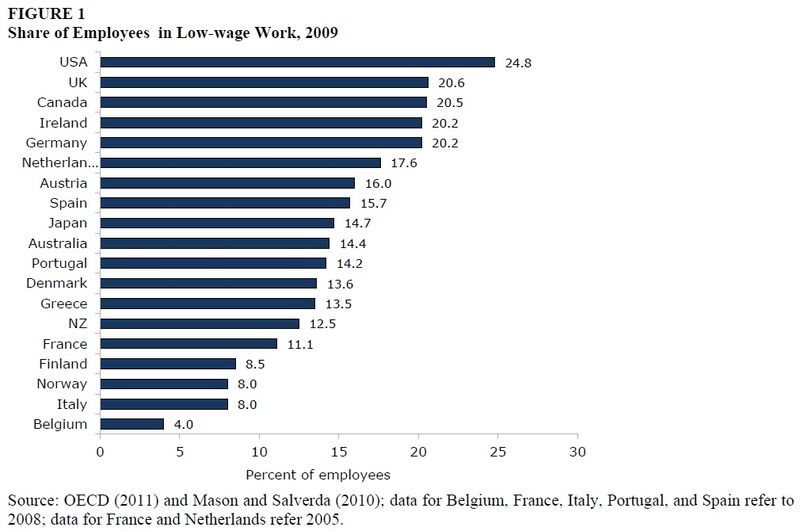
#30 Right now, the United States actually has a higher percentage of workers doing low wage work than any other major industrialized nation does.

#31 Half of all American workers earn $505 or less per week.

#32 In 1970, 65 percent of all Americans lived in "middle class neighborhoods". By 2007, only 44 percent of all Americans lived in "middle class neighborhoods".

#33 Federal housing assistance outlays increased by a whopping 42 percent between 2006 and 2010.

#34 Approximately 50 million Americans do not have any health insurance at all right now.

#35 Back in 1965, only one out of every 50 Americans was on Medicaid. Today, approximately one out of every 6 Americans is on Medicaid.

#36 It is being projected that Obamacare will add 16 million more Americans to the Medicaid rolls.

#37 Back in 1990, the federal government accounted for 32 percent of all health care spending in America. Today, that figure is up to45 percent and it is projected to surpass 50 percent very shortly.

#38 Overall, the amount of money that the federal government gives directly to the American people has risen by 32 percent since Barack Obama entered the White House.

#39 It was recently reported that 1.5 million American families live on less than two dollars a day (before counting government benefits).

#40 The unemployment rate in the U.S. has been above 8 percent for 40 months in a row, and 42 percent of all unemployed Americans have been out of work for at least half a year.

Recently, I wrote a long article about why there will never be enough jobs in the United States ever again.

That means that a whole lot of Americans are not going to be able to take care of themselves.

As our economy gets even worse, there is going to be a tremendous need for more love, compassion and generosity all over the country.

Don't be afraid to lend a helping hand, because someday you may need one yourself.


7/13/2012

UN agency warns of 4.5m more jobless in eurozone


Πηγή: EUbusiness
By AFP
July 12 2012

(GENEVA) - Eurozone nations must act now to prevent creating a further 4.5 million unemployed workers in the next four years, the head of the UN's labour agency warned on Wednesday.

"The eurozone is facing its worst crisis since the creation of the single currency," International Labour Organization Director-General Juan Somavia told reporters at the launch of a report on the eurozone crisis.

"Unemployment is on the rise in the majority of the 17 members and if policy does not change quickly, it is possible that 4.5 million jobs will be lost in the next four years," he said.

Somavia said that the ILO had long warned against austerity measures as a way out of financial difficulties.

He added that unless all eurozone members embraced a growth strategy with jobs at its core, even the wealthiest countries would be hit.

"Recovery is still possible within a single currency setting, but the window of opportunity is closing," he said.

"Unless policies change, all -- and I underline all countries in the eurozone -- will be hit, both those under stress and their wealthier counterparts," Somavia added.

The eurozone unemployment rate reached 11 percent in April 2012, with 17.4 million jobseekers, according to the ILO report.

Of particular concern was the level of youth unemployment, at 22 percent overall but 30 percent in Italy, Portugal and Slovakia and 50 percent in Spain and Greece.

Unemployment levels could deteriorate further, the ILO said, if businesses started to lay off workers which they have been holding on to in the expectation of a better economy.

"Despite the fact that we are four years into the (financial) crisis many enterprises have kept workers ... because they thought at some point there would be a recovery," said Raymond Torres, head of ILO's Institute for Labour Studies.

"But if the room for opportunity is not used soon these enterprises may reconsider these policies."

The ILO report called for a series of confidence-boosting measures by eurozone nations and institutions, and collaboration on policies in relation to income, productivity, taxation and investment.

These measures include boosting lending by banks to small businesses, a matter of concern given that the European Investment Bank's operations increased by 65 per cent to counteract the effects of the crisis, but have fallen back to their pre-crisis level in 2012, according to the ILO report.

The ILO report also called for a youth employment initiative at a cost of 21 billion euros ($25.7 billion), the equivalent of 0.5 percent of eurozone government spending.


7/03/2012

Greece plea amid 'alarming' data


Πηγή: Breakingnews
July 3 2012

Greece’s new government will present “alarming” data on its recession and unemployment to international debt inspectors this week in a bid to renegotiate the terms of its bailout agreements, a spokesman said.

Simos Kedikoglou said in a television interview that the data would demonstrate that the current austerity programme was counterproductive.

Greece is relying on rescue loans from its partners in the eurozone and the International Monetary Fund (IMF) to avoid bankruptcy. In exchange, it has made painful austerity cuts such as tax hikes and cuts to public sector jobs, pensions and salaries.

Along with uncertainty over the country’s finances, those austerity measures have hit the economy hard – it is in a fifth year of recession, with unemployment topping 22%, roughly double the eurozone average.

The Greek government will argue that it cannot withstand the current pace of austerity terms.

Debt inspectors from the European Commission, the European Central Bank and the IMF are due in Athens tomorrow.

“We will present information that is astounding. It is alarming in terms of the recession and unemployment, and it shows beyond any doubt that the current policy does not bring results. It brings the opposite results,” Mr Kedikoglou told private Antenna television.

Conservative prime minister Antonis Samaras has promised to seek more time to meet the deficit reduction targets after winning a general election last month and joining traditional rival Socialists in a coalition government.

Evangelos Venizelos, the Socialist leader, told a financial conference today that a renegotiation of bailout terms was inevitable.

“Greece, regardless of which government represents it, cannot remain indifferent to this deep recession ... that is approaching an aggregate 20% of gross domestic product. No government can remain indifferent to an unemployment rate that exceeds 22% and 55% among young people,” he said.

“The extension of the economic adjustment programme is the cornerstone of the country’s strategy and of the basis of the coalition government’s co-operation.”

Rescue creditors have so far appeared cool to the idea of extending Greece’s deficit reduction deadlines.

On Monday, a senior official from the European Central Bank, Joerg Asmussen, warned that lengthening the programme would simply put off unavoidable reforms and could threaten efforts to make Greek national debt sustainable.


7/02/2012

Unemployment in Euro Zone Hits Record High


Πηγή: New York Times
By DAVID JOLLY
July 2 2012

PARIS — Fundamental weaknesses in the euro zone economy were back in the spotlight Monday, with the release of reports showing record unemployment in May and intense pressure on French public finances just days after European leaders decided on measures to reinforce the longer-term prospects for the currency union.

Unemployment in the euro zone rose in May to 11.1 percent from 11.0 percent in April, Eurostat, the statistical agency of the European Union, reported from Luxembourg. The May jobless figure was the highest recorded since the creation of the euro in 1999.

A separate report Monday showed euro zone manufacturing falling in June for an eleventh straight month. Markit Economics said its survey of purchasing managers in the manufacturing sector showed operating conditions continuing “to deteriorate at the fastest pace for almost three years.”

In Paris, the French national auditor, the Cour des Comptes, said Monday that President François Hollande’s government would need to cut between 6 billion euros and 10 billion euros from this year’s budget to meet its deficit-reduction targets.

The auditor said 2013 would be even more challenging, with 33 billion euros of spending cuts and tax increases essential if France is to meet the European Union’s 3 percent limit on the budget deficit as a percentage of gross domestic product next year.

The economic data starkly illustrate the scale of the problem facing the currency bloc: Even as its members seek to curtail spending to reassure markets that government finances are manageable, economic weakness threatens to create a vicious cycle in which reduced government outlays contribute to declining growth, government revenue falls further, generating new pressure to cut spending.

“The data show the euro zone is in a recession,” Holger Schmieding, chief economist at Berenberg Bank in London, said. “I’m afraid they show that the European Central Bank has to step up and do its part” when its policy council meets on Thursday.

Mario Draghi, the E.C.B. president, said May 31 that the bank was nearing the limits of its powers and that politicians needed to act decisively to resolve the euro crisis. He warned that the structure of the currency union had become “unsustainable unless further steps are undertaken.”

European leaders surprised markets on Friday with an agreement that included using their bailout funds to recapitalize struggling banks directly. They also agreed to begin work on a unified banking regulator to restore faith in the euro zone financial system, something they hope will break the link between worries about banks and sovereign finances.

Between the dim economic outlook and political cover provided by European officials’ relatively bold moves Friday, analysts believe the E.C.B. now has the scope for new measures to bolster the economy.

Mr. Schmieding predicted the central bank would cut its main interest rate target from the current 1.0 percent and possibly “do something on liquidity.” If the bank does not act, he said, “the current relief in the market won’t last very long, and it’s going to be a very rough summer.”

The French auditor’s 2013 prediction is based on the assumption that the French economy will grow by 1 percent. Mr. Schmieding said that was in line with his own forecast, but it might not be achievable if the auditor’s call for 33 billion euros of austerity measures was acted upon.

Italy may announce the results of a spending review Monday or Tuesday that is thought likely to include cuts to public administration and the national health system. Rome is looking to raise money quickly to avoid raising the value-added tax, a sales tax, as planned in October.

In early afternoon trading, the Euro Stoxx 50 index, a barometer of euro zone blue chips, rose 0.8 percent, after soaring about 5 percent on Friday. The FTSE 100 index in London was up 0.5 percent.

U.S. equity index futures suggested Wall Street would open for trading with a slightly bullish tone. The Standard & Poor’s 500-stock index gained 2.5 percent on Friday.

The euro fell to $1.2623 from $1.2667 late Friday in New York. Prices rose for Spanish government 10-year bonds, and the yield, which moves in the opposite direction, fell 5 basis points to 6.20 percent. Italian 10-year yields also fell, dropping 7 basis points to 5.73 percent. A basis point is one-hundredth of a percent.


6/29/2012

More Greeks relying on charity as austerity measures kick in

A man passes by a closed shop in central Athens shopping area.

Πηγή: channelnewasia
By Kitty Logan
June 29 2012

ATHENS: The economic crisis in Greece has taken a toll on its people. Ordinary citizens, who were once able to support themselves and their families, are now out of a job and dependent on handouts.

Many in Greece have come to depend on the kindness of others.

A local charity -- called 'Bread and Action' -- lives up to his name. It has help centres all over Athens to feed people and offer support. Volunteers hand out cooked meals and groceries to those in need. Amongst them are people who never imagined they would end up here.

Panagiotis Covas, an unemployed businessman, said: "My business was destroyed. And after this I was forced to live without money. Without enough money to have a normal life."

Many Greeks share a similar story of jobs lost and their wages, cut.

For those left with little or no income, charity is the only help they are getting.

"I have worked for so many years in my life, but I never expected that at this stage, I wouldn't get any help. Nothing. What can I hope for? I don't expect someone to care for me," said Sarandis, an unemployed butcher.

While Panagiotis is reluctant to take charity, he has no choice as he cannot find a job.

He said: "I'm not a beggar. Why ask? I don't like to ask. Like this I want to work. I want to take my money and live with my money. In the Europe of 2012, to be a person who has nothing eat is very sad."

The problem is huge. In the Athens city centre, hundreds line up in the heat for handouts.

These are people who up until recently were able to support themselves and their families. However, many Greeks are now trapped in poverty - one in four is unemployed and there is little state support.

These are just ordinary people from all backgrounds but it is they who are paying the price for the economic turmoil in Greece.

While a new Greek government comes as a relief to world leaders and global markets, it means more hardship for the average Greek as austerity cuts begin to bite even deeper.

A free medical clinic in Athens said that they are seeing increasing numbers of local people who simply cannot afford to see a doctor or buy the basic medicines they need.

That is because those unemployed also lost their health insurance along with their jobs. Overwhelmed by the bills they cannot pay, they have no money left for medicine. To complicate matters, the economic crisis means that drugs companies have not been paid by insurers and pharmacies no longer dispense medication on credit.

Aspasia Michalaki, a medical doctor, said: "We see all kinds of medical problems of Greek people, either chronic illnesses or that they need their medication. Some of them have stopped taking the medicine because they don't have money to buy (it)."

The strained Greek state has no means to step in but doctors want the government to guarantee at least basic medical care for those affected by the crisis.

"It is definitely very urgent for people to feel safe at least for their health, that they can be treated in public hospitals and that they can have medication for their diseases," added Dr Michalaki.

The EU bailout terms will mean yet more cuts have to be made to state funding and so Greeks are likely to become increasingly dependent on charity.

It could be a long wait until this crisis is resolved and life gets even a little bit better. Until then, people here will continue to struggle with the most basic needs.


6/28/2012

Austerity To Growth: IMF Double-Talk On Greece And Spain


Πηγή: Seeking Alpha
By Elliot Morss
June 27 2012

Austerity - What Should Have Been Learned

The IMF should have known that austerity policies (reduce government deficits) cause unemployment to grow. After all, its own research found that a reduction in the government deficit of 1% in GDP results in an increase of .3 percentage points in the unemployment rate.

But it got roped into pushing austerity in both Greece and Spain by the Germans. So what happened? Table 1 provides the IMF's GDP growth rate projections made in both 2010 and 2012. Back in 2010, the Fund estimated growth rates of 0.2% and 1.5% for Greece and Spain, respectively for 2012. The IMF now projects GDP to decline this year by 4.7% in Greece and by 1.8% in Spain.

Table 1. - IMF Growth Rate Estimates, Made in 2010 and 2012

Source: IMF (WEO Database and Country Reports)

It also appears the IMF missed the effect of austerity on unemployment. Back in 2010, the Fund thought unemployment in Spain would be 18% this year - bad enough. In fact, unemployment is over 24% with more than 50% of younger people out of work. The situation is similar in Greece - in 2010 the Fund estimated 2012 unemployment at 15% where it is in fact at 22%. Well, the Fund learned its lesson. What has happened to Greece and Spain in the last two years convinced the IMF and many others that more austerity will not work.

So now, the new "buzz" word is "growth". All Eurozone leaders are talking about it. I have two questions:
What now is being said about government deficits, the target of the austerity hawks?
How exactly is growth to be promoted?

Government Deficits

Keynes and economists that followed him believed that at a time the private sector is not providing enough jobs (Greece and Spain today), the government must step in to get people back to work. Governments can do this either by cutting taxes (leaving citizens with more income to spend) or by increasing expenditures. In either case, government deficits will increase. So what is the IMF saying now, and how does it compare with what it was saying a few years back in the "austerity era"?

To get an answer to this question, I compared IMF statements in the recent Concluding Statement of its 2012 Article IV Consultation with Spain with what it said in 2010. In 2010, it said:

"Spain has started ambitious fiscal consolidation to reach the 3 percent of GDP deficit target by 2013. This new package significantly strengthened the envisaged adjustment and enhanced credibility by taking concrete and emblematic measures.…The new deficit path is also appropriately front-loaded, with nearly two-thirds of the required adjustment achieved by 2011."

So that was the plan in 2010. But that is not how things turned out. The 2011 deficit turned out to be closer to 9% than 6%. The Fund was clearly not happy. I quote from the "Concluding Statement":

"The impact of the large overrun (almost 3 percent of GDP) was exacerbated by maintaining the message, until almost the end of the year, that the deficit was on track, and by the lack of timely and reliable data."

Looking ahead, the IMF says: "…the very ambitious 5.3 percent of GDP deficit target for 2012 will likely be missed.

So as the Fund and its partners move from "Austerity" to "Growth", how are the statements on government deficits changing? The following are quotes from the IMF:
Because structural reforms will take time to generate growth, aggregate demand support is needed in the short run.
Fiscal consolidation should proceed decisively and credibly where market pressure is high, but more gradually elsewhere to help support demand in the region….In this context, the flexible implementation of the current fiscal framework is essential.
Growth projections are in line with ours, but incorporating the fiscal consolidation envisaged in the Stability Program would entail lower growth under staff's framework.
Given the weak growth outlook, however, slippage should not be made up in a compressed timeframe.
The deficit path envisaged in the Stability Program should be less front-loaded (in agreement with European partners).

I quote further from a paper written by Nemat Shafik, a senior official in the Fund

"We all know that fiscal consolidation―reducing deficits by cutting spending or raising revenues―can stifle growth. When a number of countries need to engage in fiscal consolidation simultaneously, the negative impact on growth is reinforced. Getting the pace of fiscal consolidation right is therefore of paramount importance, especially given the current context of weak growth and employment…. Overall, fiscal adjustment plans for this year are broadly appropriate in Europe. In a few euro area countries, however, the nominal fiscal targets for 2013 agreed before the current slowdown in growth may prove too pro-cyclical and may need to be adjusted or at least expressed in structural terms. The Stability and Growth Pact's excessive deficit procedure does allow for some flexibility in deciding how fast to bring deficits below 3 percent of GDP. Should economic conditions worsen, this flexibility should be used to revise deadlines for meeting the targets."

The quotes make it clear the Fund has learned its lesson on austerity. It is saying as clearly as it says anything: ease up on government deficit reductions - they will reduce growth and make things worse. Germany is now pretty much by itself in still pushing austerity for Greece and Spain.

Growth - How Is It To Be Achieved?

So the Fund has backed away from austerity as the solution in Greece and Spain. Growth is now in. How will it be achieved? To answer this question, I again quote from the 2012 statement referenced above. While this document applies to Spain, the IMF is saying exactly the same thing to Greece.
To restore growth across the union, long-standing structural rigidities need to be tackled to raise long-term growth prospects. In many countries, labor market reforms are needed to raise participation and address disparities in protection that confine "outsiders" (typically younger workers) to low-wage, temporary jobs….
…targeted investment in infrastructure and human capital will support growth and employment.
Lowering unit labor costs in the tradables sector is essential for deficit countries. This means productivity-enhancing reforms (e.g., lowering barriers to entry, making it easier for small firms to expand into foreign markets) and labor market measures that ensure that nominal wage developments are aligned with productivity growth.
To foster relative price adjustment between the North and the South, monetary policy should ensure that overall inflation does not drop far below the two percent for the euro area as a whole, while allowing for larger inflation differentials between North and South.
Unfortunately, there is no magic bullet to spur growth and job creation. Crisis-hit countries in Europe will only be able to revitalize their economies by selling more goods abroad and creating new jobs in the private sector.
This challenge is complicated by the constraints imposed by the Eurozone. In a context where the exchange rate cannot be devalued and productivity increases only take hold over time, improving competitiveness unfortunately requires a reduction in costs, including labor costs.

So what, in essence is the Fund saying? What is its formula for growth?
Growth will require Greece and Spain to become competitive with Germany.
This cannot happen via an adjustment in the exchange rate because all Eurozone countries use the Euro.
How can it be accomplished? Greek and Spanish workers will have to become more productive.
That means cutting jobs and reducing wages.
Eurozone monetary policy should be inflationary. This will cause prices to increase in the full employment countries. Prices will not increase in Greece and Spain and that differential will improve their competitive position.

Conclusion

There is nothing promising in what the IMF saying in moving from Austerity to Growth. Growth apparently means Greece and Spain must get their costs down so they can compete with Germany. How to get there? Greece and Spain must cut jobs and wages. This is not going to happen, and without currencies they can devalue to make the adjustment, the Greece and Spain are locked into a system in which they cannot compete. This is not a sustainable situation.

And while one side of the IMF is calling for this "technological fix" that will not work the political side of the IMF is calling for more Eurozone backing to avoid "contagion".

Is there a legitimate reason for a contagion concern? In an earlier piece, I calculated Foreign Claim/Other Potential Exposures of banks in major countries to banking collapses in Greece, Italy, Portugal and Spain. The results are presented in Table 2. The percent of total deposits is worrisome as are the sizeable amounts.

Table 2. - Foreign Bank Exposures

Source: Morss

Another contagion concern - possible bank runs in Greece, Italy, Portugal and Spain. According to the European Central Bank, total banks deposits in these four countries are $6.3 trillion. They should be insured.

Investing in these troubled times? I will stick with 4-5% yields I can get on emerging market debt (ELD, TGEIX) and US real estate (FRIFX).

Disclosure: I am long ELD.


4/12/2012

The Perils of 2012


Πηγή: Social Europe Journal
By Joseph Stiglitz
Jan 13 2012

The year 2011 will be remembered as the time when many ever-optimistic Americans began to give up hope. President John F. Kennedy once said that a rising tide lifts all boats. But now, in the receding tide, Americans are beginning to see not only that those with taller masts had been lifted far higher, but also that many of the smaller boats had been dashed to pieces in their wake.

In that brief moment when the rising tide was indeed rising, millions of people believed that they might have a fair chance of realising the “American Dream.” Now those dreams, too, are receding. By 2011, the savings of those who had lost their jobs in 2008 or 2009 had been spent. Unemployment checks had run out. Headlines announcing new hiring – still not enough to keep pace with the number of those who would normally have entered the labor force – meant little to the 50 year olds with little hope of ever holding a job again.

Indeed, middle-aged people who thought that they would be unemployed for a few months have now realised that they were, in fact, forcibly retired. Young people who graduated from college with tens of thousands of dollars of education debt cannot find any jobs at all. People who moved in with friends and relatives have become homeless. Houses bought during the property boom are still on the market or have been sold at a loss. More than seven million American families have lost their homes.

The dark underbelly of the previous decade’s financial boom has been fully exposed in Europe as well. Dithering over Greece and key national governments’ devotion to austerity began to exact a heavy toll last year. Contagion spread to Italy. Spain’s unemployment, which had been near 20% since the beginning of the recession, crept even higher. The unthinkable – the end of the euro – began to seem like a real possibility.

This year is set to be even worse. It is possible, of course, that the United States will solve its political problems and finally adopt the stimulus measures that it needs to bring down unemployment to 6% or 7% (the pre-crisis level of 4% or 5% is too much to hope for). But this is as unlikely as it is that Europe will figure out that austerity alone will not solve its problems. On the contrary, austerity will only exacerbate the economic slowdown. Without growth, the debt crisis – and the euro crisis – will only worsen. And the long crisis that began with the collapse of the housing bubble in 2007 and the subsequent recession will continue.

Moreover, the major emerging-market countries, which steered successfully through the storms of 2008 and 2009, may not cope as well with the problems looming on the horizon. Brazil’s growth has already stalled, fuelling anxiety among its neighbours in Latin America.

Meanwhile, long-term problems – including climate change and other environmental threats, and increasing inequality in most countries around the world – have not gone away. Some have grown more severe. For example, high unemployment has depressed wages and increased poverty.

The good news is that addressing these long-term problems would actually help to solve the short-term problems. Increased investment to retrofit the economy for global warming would help to stimulate economic activity, growth, and job creation. More progressive taxation, in effect redistributing income from the top to the middle and bottom, would simultaneously reduce inequality and increase employment by boosting total demand. Higher taxes at the top could generate revenues to finance needed public investment, and to provide some social protection for those at the bottom, including the unemployed.

Even without widening the fiscal deficit, such “balanced budget” increases in taxes and spending would lower unemployment and increase output. The worry, however, is that politics and ideology on both sides of the Atlantic, but especially in the US, will not allow any of this to occur. Fixation on the deficit will induce cutbacks in social spending, worsening inequality. Likewise, the enduring attraction of supply-side economics, despite all of the evidence against it (especially in a period in which there is high unemployment), will prevent raising taxes at the top.

Even before the crisis, there was a rebalancing of economic power – in fact, a correction of a 200-year historical anomaly, in which Asia’s share of global GDP fell from nearly 50% to, at one point, below 10%. The pragmatic commitment to growth that one sees in Asia and other emerging markets today stands in contrast to the West’s misguided policies, which, driven by a combination of ideology and vested interests, almost seem to reflect a commitment not to grow.

As a result, global economic rebalancing is likely to accelerate, almost inevitably giving rise to political tensions. With all of the problems confronting the global economy, we will be lucky if these strains do not begin to manifest themselves within the next twelve months.


2/16/2012

Better US jobs and housing figures

US jobless claims fall to lowest level since March 2008

Πηγή: RTE
Feb 16 2012

Hopes that the US economy is gaining momentum have been boosted by the latest figures.

Hopes that the US economy is gaining momentum have been boosted by the latest figures on jobless claims and house-building.

A Labor Department report showed that new US claims for unemployment benefits unexpectedly fell last week to a near four-year low.

Initial claims for state unemployment benefits dropped 13,000 to a seasonally adjusted 348,000, the lowest level since March 2008. The previous week's figure was revised up to 361,000 from the previously reported 358,000. Economists had expected claims to increase last week.

The four-week moving average for new claims, seen as a better measure of labour market trends, fell 1,750 to 365,250 - the lowest since April 2008.

Last week's drop pushed claims below the 350,000 level that economists normally associate with sustained strength in the labour market. New jobless claims have declined for three straight weeks. The US unemployment rate dropped to a three-year low of 8.3% in January. But considerable slack still remains, with 23.8 million Americans either out of work or underemployed.

Separate figures show that US housing starts rose by more than expected in January due to a surge in the construction of rental property. The figures boosted hopes that the country's still-weak housing sector could help economic growth this year.

The Commerce Department said housing starts climbed 1.5% to an annual rate of 699,000 units. Initial estimates for housing starts can be subject to large revisions and the government revised the December reading significantly higher to 689,000 units from an initial 657,000.

Starts of multi-unit buildings, which are often rented, jumped 8.5% last month. New construction on buildings with five units or more increased 14.4%. Groundbreaking on single-family units, which make up a much larger portion of the sector, fell 1%.

Big rise in core US producer prices

Official figures show that US producer prices outside food and energy recorded their largest increase in six months in January.

The Labor Department said its seasonally adjusted core producer price index rose 0.4% last month, the largest gain since July, after increasing 0.3% in December. Economists had expected a 0.2% rise.

In the 12 months to January, core producer prices rose 3% after increasing 2.7% in December.

But overall prices received by farms, factories and refineries edged up 0.1% in January after dipping 0.1% in December. The rise, which was smaller than economists' expectations, reflected declines in food and energy prices.

In the 12 months to January, producer prices increased 4.1%, moderating from 4.8% in December.

The Federal Reserve last month viewed inflation as largely contained and said it expected to hold interest rates near zero at least through late 2014.


12/17/2011

Poverty peaks in Greece amid financial crisis, experts say


Πηγή: The Economic Times
Dec 17 2011

ATHENS: Poverty in Greece has risen to new heights under a gruelling recession exacerbated by austerity that has swelled the ranks of the unemployed, the homeless and the destitute, experts said on Saturday.

In comments to Ethnos daily, public officials, senior churchmen and welfare group representatives warned of a brooding humanitarian crisis as official data showed over 320,000 people had lost their jobs in a year.

Athens Mayor George Kaminis told the daily that the city's homeless had increased by around 20 percent while queues at soup kitchens organised by municipal and church organisations were up 15 percent.

"Care workers no longer meet typical homeless people, they meet a person who likely had a perfectly organised life weeks previously," said Kaminis, who has asked for additional state funding for city welfare services.

"We have noticed a dramatic increase in our mess halls over the recent period," added Chrysostomos Symeonidis, head of the Athens archdiocese poverty fund.

"We distribute over 10,000 meals on a daily basis and 250,000 meals are given out nationwide on a weekly basis," Symeonidis said.

Greek unions warn that the number of jobless will exceed 20 percent next year because of the recession and public sector cutbacks demanded by the country's creditors, the European Union and the International Monetary Fund.

The Greek government has pledged to reduce the state payroll by 150,000 people by 2015 but only a fraction will be staff already near retirement.

Greece is in the grip of a four-year recession set to continue next year, bringing the cumulative fall in economic output to 15 percent, according to EU estimates.

Official data this week showed there were over 878,000 people out of work in the third quarter of the year, most of them women and persons aged under 30.

The state statistics agency said the number of employed had fallen to nearly 4.1 million from 4.4 million a year earlier.

"It can be quite hard for young people who can't find work, but imagine the psychological anxiety of someone my age," 60-year-old radio technician George Barkouris, who lost his job just before retirement, told Ethnos.

"Everything shows that the family fabric as we once knew it is fading, those close to us aren't there when you need them the most," said Barkouris, who has children but is now staying at a homeless shelter.


12/09/2011

Household wealth in US takes huge hit


Πηγή: montgomeryadvertiser
By AP
Dec 9 2011

WASHINGTON -- Americans' wealth last summer suffered its biggest quarterly loss in more than two years as stocks, pension funds and home values lost value.

At the same time, corporations raised their cash stockpiles to record levels.

Household net worth fell 4 percent to $57.4 trillion in the July-September quarter, according to a Federal Reserve report released Thursday. It was the sharpest drop since the tumultuous period after the September 2008 bankruptcy of investment bank Lehman Brothers. And it was the second straight quarterly fall.

Household wealth, or net worth, is the value of assets like homes, bank accounts and stocks, minus debts like mortgages and credit cards.

Lower net worth can hurt the economy. When people feel poorer, they spend less. That slows growth. Businesses typically then cut back on hiring and expansion.

Stock market declines, in particular, have held back Americans' quest to recover losses from the 2008 financial meltdown. The Standard & Poor's 500 stock index tumbled about 14 percent in the July-September period, ending a streak of four quarterly increases. The decline was driven by worries about Europe's debt crisis and the U.S. economy.

Stocks have rebounded about 9 percent since last quarter ended. But the S&P index is still about 21 percent below its peak of four years ago.

The value of Americans' stock portfolios fell 5.2 percent last quarter. T. Rowe Price Associates estimates that two-thirds of that decline has been recouped in the October-December period. Much of that comes from continuing contributions to retirement accounts.

Home prices remain under pressure, diminishing home equity. Home equity is the biggest source of wealth for most Americans. Last quarter, home values slipped 0.6 percent. Total values fell to $16.1 trillion, down from nearly $21 trillion in 2007, before the recession began.

At the same time, corporations are amassing record cash stockpiles -- $2.1 trillion at the end of September. Their reluctance to spend more of that money helps explain why job growth remains modest. The unemployment rate fell to 8.6 percent in November. But it's hovered near 9 percent for more than two years.


11/07/2011

Revised gov't estimates show new poverty high

Havre Food Bank volunteers Marysue Davis and Don Johnson prepare a package of food for a client in Havre, Mont., Friday, Oct. 28, 2011. (AP Photo/Havre Daily News, Nikki Carlson)

Πηγή: CBSNews
By AP
Nov 7 2011

WASHINGTON - The ranks of America's poor are greater than previously known, reaching a new level of 49.1 million — or 16 percent — due to rising medical costs and other expenses that make it harder for people to stay afloat, according to new census estimates.

The numbers released Monday are part of a first-ever supplemental poverty measure aimed at providing a fuller picture of poverty. It is considered experimental and does not replace the Census Bureau's official poverty formula, which continues to determine eligibility and distribution of billions of dollars in federal aid for the poor.

Based on the revised formula, the number of poor people exceeds the record 46.2 million, or 15.1 percent, that was officially reported in September.

Broken down by groups, Americans 65 or older sustained the largest increases in poverty under the revised poverty formula — nearly doubling to 15.9 percent, or 1 in 6 — because of medical expenses that are not accounted for in the official rate. Those include rising Medicare premiums, deductibles and expenses for prescription drugs.

Working-age adults ages 18-64 also saw increases in poverty — from 13.7 percent to 15.2 percent — due mostly to commuting and child care costs.

For the first time, the share of Hispanics living in poverty surpassed that of African-Americans, 28.2 percent to 25.4 percent. That is due to an increase in the poverty rate for Hispanics under the new measure because of lower participation of immigrants and non-English speakers in government aid programs such as housing and food stamps.

Due to new adjustments for geographical variations in costs of living, people residing in the suburbs, the Northeast and West were the regions mostly likely to have poor people — nearly 1 in 5 in the West.

Economists have long criticized the official poverty rate as inadequate. Based on a half-century-old government formula, the official rate continues to assume the average family spends one-third of its income on food. Those costs have actually shrunk to a much smaller share — more like one-seventh — failing to account for other expenses such as out-of-pocket medical care, child care and commuting.

The official formula also does not consider non-cash government aid when calculating income, such as food stamps and tax credits, which have increased in the last few years.

Kathleen Short, a research economist at the Census Bureau, said many of the shifts in poverty reflect the large numbers of older people who hover near the poverty line after receiving Social Security cash payments. The poverty line is defined under the official measure as $11,139 for an individual, or $22,314 for a family of four.


Because of Social Security benefits, only 9 percent of seniors, or roughly 3.5 million, live in poverty according to the official formula. But that number increases by roughly 2.7 million when taking into account the additional health care costs. If it weren't for those health care costs, the poverty rate for seniors would have dropped to 8.6 percent.

"The medical expenses are very large," Short said.

Not all groups saw increases in poverty under the new measure. For instance, children and African-Americans saw small declines in their poverty rates, mostly due to the positive effects of government aid programs including food stamps. Residents living in more rural areas as well as the Midwest and South also fared better, due to lower costs of living.

Among the findings:
Poverty for Asians increased, from 12.1 percent under the official measure to 16.7 percent; among whites, it rose from about 10 percent to 11.1 percent.
The poverty rate for children declined, from 22 percent to 18.2 percent.
Without the earned income tax credit, the poverty rate under the revised formula would jump from 16 percent to 18 percent. Without food stamps the poverty rate would rise to 17.7 percent.
Under the revised formula, the West had the most people in poverty at 19.4 percent. It was followed by the South (16.3 percent), the Northeast (14.5 percent) and the Midwest (13.1 percent).

Economists and anti-poverty experts continue to differ widely on how best to calculate poverty. On Monday, the Census Bureau acknowledged that its new measure remains a "work in progress," with additional refinements needed to better determine commuting and housing costs.