
Source: The Guardian
April 23 2020
By Ryan Felton
In recent weeks, on a quiet stretch of Detroit’s west side dotted with vacant homes, a 262,000 sq ft Coca-Cola manufacturing facility has buzzed with activity, even as many businesses in Michigan were ordered by the state to temporarily close to combat the coronavirus pandemic.
Coca-Cola churns out a number of beverages here, including Dasani, the company’s well-known bottled water that generated more than $1bn in US sales in the past year, according to the market research firm IRI.
It’s a good time to be in the water business: as the coronavirus outbreak spread in the US throughout March, bottled water sales increased 57% over the same period last year.
But among the products, like toilet paper or hand sanitizer, that Americans are panic-buying, bottled water is unusual: there is no shortage of safe drinking water, and health officials have tried to assure people that public water supplies are not contaminated by the coronavirus. Hoarding bottled water simply isn’t necessary for most people.
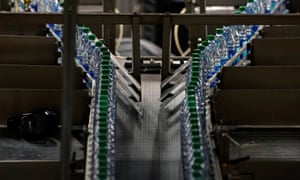
What’s more, most bottled water sold in the US comes from the same municipal sources that supply tap water – a fact probably unknown to most consumers. Coca-Cola makes Dasani at the company’s Detroit plant by purchasing, treating and bottling municipal water before selling it at a significant mark-up to consumers. Pepsi bottles its Aquafina water brand in Detroit the same way.
The business model is hugely profitable. The cost to buy that municipal water is exceedingly low – and once bottled, the mark-up can be about 133 times greater, a Consumer Reports analysis of company water billing and usage records found.
But what’s good for businesses isn’t necessarily good for consumers, according to CR’s review, which included the examination of hundreds of pages of billing and other records obtained through public records requests, and interviews with environmental law experts, industry consultants, residents of Detroit and consumer advocates.
For starters, bottlers and consumers aren’t always treated as equals by water utilities, CR found. In Detroit, whose policy before the coronavirus crisis called for shutting off water to residents if they fall $150 behind in their water bills, 2,800 homes were estimated to be without running water at the start of the pandemic.
But bottlers in Detroit have also racked up tens of thousands of dollars of past due water bills that went unpaid for months, CR found. Not once has their access to water been shut off over the period we examined. When asked why, the city cited the companies’ strong payment history and an ability to pay their bills. The city said in a later statement that it had made errors collecting past-due balances.
From a regulatory point of view, companies that want to put vast quantities of public water into bottles for profit face few hurdles and minimal ancillary costs, leading some experts to call for taxes on the bottlers. And because the water supply, including the processing and infrastructure, that bottlers rely on is paid for by local taxpayers, the companies’ business is subsidized by the public, consumer advocates say.
Shutoffs pose health risk
Detroit has been questioned about the potential health risk of water shutoffs before. In August 2014, residents who had their taps turned off argued in court to suspend shutoffs because a lack of water could create unsanitary conditions and lead to the transmission of hepatitis A, influenza and other diseases.
Detroit’s lawyers argued that those residents could rely on alternative sources – like bottled water. “Just because a person is out of water doesn’t mean they can’t get water,” a city lawyer said at a court hearing.
The judge in the case ultimately sided with the city, and the shutoff campaign carried on.
Now, six years later, Detroit and other cities have taken some steps to address residential water shutoffs during the coronavirus crisis – people need running water not just to cook and bathe, but to practice basic virus-fighting hygiene.
But the reprieve is only temporary. And it hasn’t necessarily reached everyone.
A Detroit spokesperson said all customers who called to enroll in a program that would turn their water back on during the pandemic had either been restored or were in the process of a restoration. But the spokesperson conceded that some occupants may not have called, and advocates dispute the city’s reported progress.
“We believe the city of Detroit is vastly exaggerating their progress and underreporting the number of people without water,” said Shea Howell, a member of the Detroit-based advocacy group the People’s Water Board Coalition, during a recent teleconference with reporters.
The coronavirus pandemic has underscored just how problematic water shutoffs can be, as utilities servicing nearly 40% of the US population still have not committed to suspending water shutoffs, according to Food & Water Watch. This has consumer advocates worried.
“It’s just unconscionable to make people fear losing their water service at this time,” said Mary Grant, director of the Public Water for All Campaign at Food & Water Watch. “We need every governor to step up to address this crisis immediately.”
‘Paying twice for bottled water’
People whose water gets shut off because they can’t afford their bill may have no choice but to buy bottled water that comes from the same source that feeds their tap. They may be obtaining bottled water from companies that have been behind on their water bills but didn’t face a shutoff, and whose business depends on access to publicly funded water systems.
And it’s not just in Detroit: Coca-Cola and Pepsi get water from other major cities, including Phoenix and Denver, with a history of shutting off water to residents before the coronavirus crisis.
Coca-Cola didn’t respond to questions from CR about water shutoffs or its late payments, but the company says it obtains water from a variety of sources, including municipal supplies, and uses a treatment process that “creates a consistent pure, clean, and crisp taste”. The company said it remains in operation as the federal government identified the food and beverage industry as “critical” to keeping grocery stores stocked.
Pepsi did not respond to repeated requests for comment from CR.
Beulah Walker, chief coordinator for the local not-for-profit group Hydrate Detroit, which assists local residents without running water, pointed out the irony of the situation for residents who have lost their water service at home and may turn to bottled water – possibly Aquafina or Dasani made with city tap water – as an alternative.
“Detroit residents are paying twice when they buy bottled water,” Walker says.
‘Picking on the little guy’
In 2014, Detroit’s shutoff policy drew national attention, when the city, which emerged that year from bankruptcy, launched a campaign to disconnect service to residents in arrears – forcing them to turn to other sources such as capturing rainwater or buying bottled water. Shutoffs have continued since then, but officials concluded in early March that a reprieve was needed to help residents during the coronavirus outbreak.
Ricky Reynolds is one of the beneficiaries. The 65-year-old Detroit resident moved into his home down the road from Coca-Cola’s bottling plant last summer, after obtaining the deed from an acquaintance for $500. It should have been a happy occasion. Reynolds had been homeless, bouncing between family and friends, so it was a relief to get his own place – until he tried to get the water bill put in his name.
Reynolds, who is retired, learned from the city that his new home had a nearly $20,000 unpaid water bill.
Ricky Reynolds, a Detroit resident, who moved into his new home to find out that it had a nearly $20,000 unpaid water bill.
“It’s hard to catch up with $20,000 when you have a fixed income,” he said. And the city refused to turn on his water until he paid 10% of the bill, he said, a monumental demand for someone living on social security income. Reynolds was never able to pay the bill.
In the months before the city finally restored his water service during the pandemic, Reynolds says, he had to fill up containers with water from family members, then haul them home. And he bought bottled water whenever he could – including, he said, Dasani, which may have been made around the corner at the Coca-Cola plant. (The city didn’t directly respond to questions about Reynolds’ case.)
Detroit’s temporarily suspended shutoff policy states that residents or businesses are delinquent and potentially risk having their water shut off if they are 60 days past due with a minimum balance of $150, a spokesperson said. (The city considers a company’s accounting practices, as well, before determining whether to proceed with a service interruption.)
Records show that, since 2017, both Pepsi and Coca-Cola met that threshold at points.
Between April and July 2017, billing records show, Coca-Cola had a $77,600 balance that went unpaid for three months. From August to November of that year, it carried a balance of as much as $287,250, before finally paying it off. That December to March of 2018, the company had a balance that fluctuated between $1,860 to $108,170, before paying it off in full. Meanwhile, from December 2018 to February 2019, Pepsi had a balance between $1,410 and $29,710, until paying it off.
The city never shut off the company’s water, and bottling continued.
“Since both Pepsi and Coca-Cola have a strong payment history and an unmatched ability to pay their bills, DWSD does not pursue service interruptions,” said Bryan Peckinpaugh, spokesman for Detroit’s water and sewage department.
“These companies never go longer than three months past due, at which time the balances due, including late fees, are paid. These companies are not a priority target for service interruption due to their payment history and ability to pay.”
(After this article was first published, the DWSD said that, contrary to Peckinpaugh’s previous statement, the past-due balances cited on the billing data were due to errors on the city’s part, including address mailing issues. Regardless, while the city registered Pepsi and Coca-Cola as delinquent, and continued sending bills and assessing late fees, it never shut off the companies’ water.)
Coca-Cola and Pepsi did not respond to CR’s questions about why they went months without paying their bills.
Grant, of Food & Water Watch, takes exception to the city’s position. “You should have a policy and should apply it equitably,” she said. “I think this is discrimination against low-income households in Detroit, that you’re having a shutoff policy and you’re not applying it, the same shutoff policy, to these big corporations because you expect them to pay down the road.”
Reynolds was also stunned to hear that Detroit let Coke and Pepsi’s bills slide.
“That’s not fair,” he said. “They’re picking on the little guy.”


