Showing posts with label economy. Show all posts

8/12/2020

Erdogan Has Hidden an Economic Disaster Deep in Turkish Banks


Source: FP
August 11 2020
By Chris Miller


Turkish President Recep Tayyip Erdogan is not usually known as an economic innovator. But for the past year, his government has been running a high-stakes economic experiment. The test: How long can Turkey hide the fact that it is spending far beyond its means? Normally when governments spend more than they tax, the difference appears as a budget deficit. They fund that deficit by issuing bonds, which are traded on international markets and so are easy to track. If the debt load grows too large, and if borrowing costs spike, then then country must default or seek a bailout. This type of debt crisis isn’t pleasant, as Argentina or Greece or Pakistan could attest, but it is at least straightforward and familiar.

Turkey has also spent well more than it should, but it has done so in way that hid the costs deep in its financial system, leaving them invisible to all but the most committed financial sleuths. There’s relatively little sovereign debt—the type usually funded by international bonds—to be found, though its overall value is ticking up somewhat. The big borrowing has been by the country’s banks, including both private and state-owned banks—and that is where Turkey’s trouble has built up.

Since the 2008 financial crisis, the U.S. Federal Reserve has kept interest rates low, hoping to spur an economic recovery in the United States. This had the side effect of making it cheap to borrow dollars, for both Americans and for anyone else looking for credit. Turkish banks took note and binged on cheap dollar loans.

And so Turkey’s banks came to have lots of dollars. What to do with them? First, they lent the dollars to Turkish firms, in industries such as tourism, energy, infrastructure, and real estate, which preferred loans in dollars rather than lira due to the cheap interest rates on offer. Sectors like infrastructure and real estate sell primarily to Turks, so their revenues are priced in Turkish lira. But their loan repayments were still in dollars. The problem is that, if the lira fell against the dollar—and it has fallen substantially over the past few years—it would become harder for Turkish firms to repay their dollar loans. And that, in turn, could lead to a banking crisis.

Not all the dollars that Turkish banks borrowed from abroad were given out to Turkey’s companies. Individual Turks mostly take out loans to buy houses or cars in lira, not dollars. So Turkey’s banks needed lira to lend them. The banks took the dollars they had accumulated and swapped them into lira on financial markets, paying a fee linked to the lira interest rate set by the Turkish central bank. This created a second risk burrowed deep in the country’s banking system: If interest rates rise, the cost of banks’ lira borrowing would shoot upward, cutting into bank profits.

Fast forward to the past few months. As COVID-19 slammed into the global economy, emerging markets such as Turkey were hard hit. The lira lost 10 percent of its value in March and April alone. When the lira falls, the price of imported goods rises, and Turks’ living standards fall. Fearing a backlash, Turkey’s government decided to stop the lira from falling further. It used a standard tactic, selling dollars to buy up lira on the open market, bolstering the value of Turkey’s currency. For most of the summer, this trick worked: The lira was steady at around 6.85 to the dollar for almost all of June and July.

But spending dollar reserves to defend the value of your currency only works so long as you have dollars to spend. The government started the year with far fewer reserves than it should have, and it soon faced demand for more spending, as Erdogan insisted that the currency be defended. Where to find more dollars?

This is where Turkey’s banks come back in. They had an excess, having borrowed billions from abroad in previous years. So Turkey’s central bank began borrowing dollars from the country’s own banks, too. The central bank owes $54 billion—dollars, not lira—to Turkey’s banks. But it spent even more than that, around $65 billion already this year, according to estimates from Goldman Sachs, on top of an additional $40 billion in 2019. So according to the most recent data released by Turkey’s government, the central bank is facing a shortfall of around $25 billion, once you subtract the funds they hold in gold and Qatari riyal.

A big hole is not what you want in your central bank’s balance sheet, but this it is the reality that Turkey faces. It is no longer possible to defend the lira at its level of earlier this summer. It has already slipped by several percent in value, and a steeper fall seems only a matter of time.

What options does Erdogan have? The path ahead is strewn with risks. Let the lira fall, and Turkish companies with dollar debts will struggle to pay them bank. A steep decline in the lira could even make Turkey’s banks go bust. Hike interest rates, and currency might stabilize, but the economy would be thrown into a deeper recession, exacerbating the coronavirus slump and denting Erdogan’s popularity. Both options are dangerous. But doing nothing is probably worse: The lira will fall anyway, and the economy will sink into a prolonged recession, too. Erdogan’s economic experiment was interesting while it lasted, generating a false sense of stability. But hiding the country’s economic problems deep in the banking system was never more than a temporary cover-up.

5/27/2020

Coronavirus: EU to announce huge recovery package


Source: BBC
May 27 2020


A major recovery fund for Europe worth between €500bn ($545bn; £448bn) and €1 trillion will be proposed by European Commission President Ursula von der Leyen on Wednesday.

Economies across the 27-nation EU bloc have been ravaged by the Covid-19 pandemic, but several southern states had big debts even before the crisis.

Germany has backed calls for the money to be raised on the capital markets.

However, several "frugal" states object to taking on debt for other countries.

Austria, the Netherlands, Denmark and Sweden reject the idea of cash handouts to relatively poorer countries rather than low-interest loans.

Without the backing of all 27 governments in the EU, the recovery plan cannot go ahead.

What will the Commission leader say?


Mrs von der Leyen will give details both of the recovery "instrument" and how it will be integrated into the EU's wider 2021-27 budget. The fund is likely to be paid out in a mixture of grants and loans, with particular emphasis on both investment and reform.

She will need to address the concerns of the "frugal four" as well as others, and is expected to seek a way of avoiding member states having to pay more money to cover the recovery fund.

That means that the money will have to be raised on financial markets, but it would still have to be paid back, perhaps over 30 years.

So the question is how and over what period the money would be repaid. Reports suggest some EU-wide taxes may be imposed on the turnover of multinationals, as well as on plastics and CO2 emissions.


Coronavirus leads to food industry crisis in Europe

Commissioner Maros Sefcovic says recovery has to be based on green and digital policies as well as "increased resilience" and lessons learned from the Covid-19 crisis.

The budget will be "equipped with increased firepower to be able to generate massive investment at the scale and speed needed to kick-start all our economies", he says.

The European Central Bank has played a key role in helping eurozone countries emerge from the debt crisis with its stimulus programme of bond-buying. But concerns about the ECB programme's future were raised earlier this month when Germany's top court ruled that it violated the German constitution.

The UK has left the EU so is unlikely to have any involvement in the fund as it stands.

What do the member states say?


Dutch Prime Minister Mark Rutte summed up the feelings of the wealthier states of Northern Europe on Tuesday. A fund was necessary to stimulate recovery, he said, but "we believe this should consist of loans, without any mutualisation of debts".

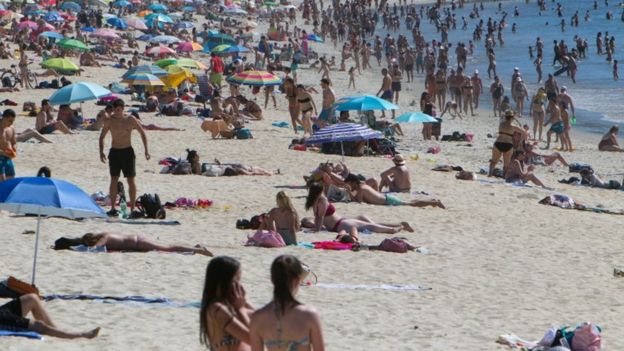
This beach at Vigo in northern Spain was crowded with tourists on Tuesday as Spain's economy began to reopen

Spain and Italy have seen the highest number of deaths in the EU during the coronavirus crisis and, along with Greece and Portugal are reliant on tourism for a large amount of their economic output.

According to Italian media, Mr Rutte discussed the fund with Prime Minister Giuseppe Conte on Tuesday.

Italian Economy Minister Roberto Gualtieri said he was expecting an "ambitious proposal" that Italy had fought for and which "initially saw us isolated and then saw the consensus of many countries".


5/25/2020

Factbox: EU recovery fund - the battle lines


Source: Reuters
May 25 2020


BRUSSELS (Reuters) - The European Commission will issue on Wednesday a new proposal for a long-term European Union budget and a coronavirus recovery fund to help economies in the bloc rebound from recession.

Both measures are controversial because they entail transfers of wealth across the 27-nation bloc, and views differ widely on how that should happen. The recovery package is also creating new faultlines because it entails financing through debt issued in the bloc’s name.

Below are key points of contention that the Commission will have to address and on which EU leaders must find a compromise.

SIZE

The recovery package is to be a mix of grants, loans and guarantees that together add up to 1-2 trillion euros over the next few years. Most likely only part of this will be real cash: the rest is likely to entail financial engineering such as leveraging.

THE MIX

A key sticking point is likely to be how much of the money comes in the form of grants and how much in loans. France and Germany want 500 billion euros in grants. The Netherlands, Austria, Sweden and Denmark want no grants, only loans. The Commission will propose a mix of both, but it is unclear in what proportion.

STRINGS ATTACHED

Access to the recovery money is to be linked to “sound economic policies and structural reforms”. This could become a friction point with Italy and Spain, worst-affected by the epidemic, which are wary of northern fiscal hawks dictating their policies.

HOW TO SPEND IT

The recovery money would have to be spent on what the EU sees as long-term priorities: making the bloc climate-neutral by 2050, digitalising the economy, investing in research and innovation.
WHERE WILL IT COME FROM?

The Commission would borrow money cheaply on the market thanks to its triple-A rating, using government guarantees for the joint EU long-term budget as security.
WHEN WILL IT BE AVAILABLE?

The funds will be front-loaded over the next two-three years when they are needed the most, but because of the complex legal process required it is not clear if any will be disbursed before 2021.

FINANCING THE RECOVERY

Loans from the recovery package will be repaid by the governments that take them. Grants don’t need to be paid back, but there’s a hitch: The EU would have to borrow the money for grants, and some doubt whether this is legal because EU law prohibits the EU budget from running a deficit.

One solution could be to allot future revenues from some new tax assigned to the EU in budgets after 2027 to repay the Commission’s borrowing now. This would be a milestone in further EU integration and a major step towards fiscal union, which is also why some governments will oppose it.


If there is no new tax, the Commission borrowing could also be repaid through higher national contributions of governments to the long-term budget in the future - also an unprecedented sign of EU solidarity.

LINK TO LONG-TERM BUDGET

The recovery fund will be linked to the EU’s 2021-2027 budget, which operates on the basis of grants and is itself a highly divisive issue. Governments and EU institutions are at odds over the overall size of the budget, which is around 1 trillion euros over seven years, and what to spend it on.


5/21/2020

American billionaires got $434 billion richer during the pandemic

Jeff Bezos

Source: CNBC
May 21 2020
By Robert Frank


  • U.S. billionaires saw their fortunes soar by $434 billion during the nation’s lockdown between mid-March and mid-May, according to a new report.
  • Amazon’s Jeff Bezos and Facebook’s Mark Zuckerberg had the biggest gains.
  • Bezos added $34.6 billion to his wealth and Zuckerberg picked up $25 billion.

America’s billionaires saw their fortunes soar by $434 billion during the U.S. lockdown between mid-March and mid-May, according to a new report.

Amazon’s Jeff Bezos and Facebook’s Mark Zuckerberg had the biggest gains, with Bezos adding $34.6 billion to his wealth and Zuckerberg adding $25 billion, according to the report from Americans for Tax Fairness and the Institute for Policy Studies’ Program for Inequality. The report is based on Forbes data for America’s more than 600 billionaires between March 18, when most states were in lockdown, and May 19.

The billionaire gains highlight how the coronavirus pandemic has rewarded the largest and most tech-focused companies, even as the economy and labor force grapples with the worst economic crisis in recent history.

According to the report, the net worth of America’s billionaires grew 15% during the two-month period, to $3.382 trillion from $2.948 trillion. The biggest gains were at the top of the billionaire pyramid, with the richest five billionaires -- Bezos, Bill Gates, Zuckerberg, Warren Buffett, and Larry Ellison -- seeing combined wealth gains of $76 billion.

Elon Musk had among the largest percentage gain of billionaires during the two months, seeing his net worth jump by 48% in the two months to $36 billion. Zuckerberg was close behind, seeing his wealth surge by 46% in the two months, to $80 billion. Bezos’ wealth increased by 31% to $147 billion. Bezos’ ex-wife, MacKenzie Bezos, who received Amazon shares in their divorce, also saw her wealth increase by a third, to $48 billion.

Because the study timeline captures the stock market bottom and quick rebound, it creates a slightly sunnier picture for billionaires than the full year. For the year, Buffett’s wealth has declined by $20 billion, according to the Bloomberg Billionaire’s Index, while Gates is down by $4.3 billion. For the year, Jeff Bezos has gained $35.5 billion while Zuckerberg is up by $9 billion.

There were some losers during the two-month period, especially for billionaires in the travel, hospitality or retail business who have yet to see their stocks and companies recover. Ralph Lauren saw his wealth drop by $100 million to $5.6 billion, while hotelier John Pritzker saw his wealth drop by $34 million to $2.56 billion.


Franco-German Recovery Fund will not Fix Eurozone


May 21 2020
By Pepijn Bergsen


The proposed fund to aid recovery from the coronavirus is a welcome sign of EU solidarity. But it does not do nearly enough to address the bloc’s underlying weaknesses, and is not a game changer for fiscal integration.

We don’t know yet exactly what Angela Merkel and Emmanuel Macron's proposed temporary fund of €500 billion will be spent on, but it will likely include investment in green infrastructure, research and support for the hardest-hit sectors.

Although the money will flow through the EU budget, it is likely to be spent early in the next budget period from 2021 to 2027. There are different options for dealing with the debt load created by the fund - it could be paid back over a long period, or continuously rolled over. The latter option is preferable given the likely high demand for these safe assets in financial markets.

As described by Merkel, the Franco-German proposal would mean that the debt servicing (the repayment of interest and principal) would be done through funds allocated to the EU through contributions from the member states, based on their share in the regular EU budget.

This would mean Italy would need to contribute around 15 per cent of these new liabilities. As a result, this technically increases the Italian state’s liabilities by around €75 billion, although accounting rules mean this will probably remain off the state’s balance sheet and thus not increase its headline debt to GDP ratio.

For those more in need?


To be net beneficiaries, countries must receive more from the fund than their share of liabilities. Therefore, if the EU spends more than €75 billion of the recovery fund in Italy, the country will be coming out ahead and it would constitute a transfer from those less in need to those more in need.

Given the relative severity of the coronavirus-related disruption, this is likely to be the case. However, given that other large countries, most notably Spain, have also been hit hard, there will be a limit to the upside for Italy. All member states, not just eurozone countries, will need to receive some of this money, with the political bargaining meaning it likely can’t be too far off from their share of the liability.

Assuming that spending from the fund in Italy is just over 50 per cent more than its share of the liabilities, at €115 billion or 6 per cent of Italy’s 2019 GDP it would constitute an increase in spending in Italy of around 2-3 per cent of GDP for the next couple of years. Some of this spending could have happened without the fund. But this would have come with higher debt servicing costs and it is thus safe to call this plan a significant fiscal boost for Italy, and other fiscally weaker economies.

A fiscal boost should not be confused with a revolution. Some have referred to this as a 'Hamiltonian' moment for the eurozone, referring to the American treasury secretary who bartered the compromise that led to the US federal government assuming the debts incurred by the states during the war of independence.

However, the recovery fund would, for now, remain a one-off and European countries will remain liable for their current debt loads, and for the increase in their debt stocks that will result from the coronacrisis anyway. The European Commission forecasts that the Italian debt stock will increase from 135 per cent of GDP last year to 153 per cent at the end of next year.

The size of the fiscal stimulus provided by the fund means it is likely to boost the growth potential for the Italian economy, particularly if accompanied by other reforms, as the plan suggests it should. However, it would require an unrealistically large boost to significantly improve Italian debt dynamics, especially given the disruption from the coronavirus crisis is going to be felt for a long time anyway.

The Italian state will continue to have to aim for large primary surpluses to finance interest expenditures significantly higher than that of its eurozone peers. If you believed that the Italian situation was economically and politically unsustainable over the long term before the crisis, even a larger version of this fund should not change your mind.

The recovery fund could turn out to be a template for future crisis responses and thereby represent a move towards a proper Hamiltonian moment. But as the fund is an EU instrument, instead of a eurozone instrument, this is harder. Furthermore, the next crisis is unlikely to be as symmetrical as the current one, meaning it will be even more difficult to get those member states already opposed to this plan to agree to a repetition or an expansion into something more like a fiscal union.

This does not mean the recovery fund is a bad idea. On the contrary, it should be welcomed as part of the EU’s response to the COVID-19 crisis. Ensuring the southern economies can recover is also in the interest of the fiscally stronger EU member states, who rely on their neighbours to buy many of their exports.

Furthermore, it would be something of a bargain for them, as it should only cost them their share of the interest costs and some of the fund will be spent in their economies. If that is too much to ask in solidarity, the EU has much bigger problems.


5/20/2020

Turkish central bank triples Qatar currency swap line to $15 billion as economy flounders


Source: CNBC
May 20 2020
By Natasha Turak


  • The move amended the original limit of $5 billion on the two countries’ initial swap agreement in 2018, raising it to $15 billion. 
  • Funding markets have deteriorated in Turkey, with the lira hitting its lowest point ever just this month amid investor concerns over the country’s finances. 
  • Still, “it’s unclear whether the Turkey-Qatar currency swap deal will have tangible effects on the Turkish economy,” one forecasting expert told CNBC. 

Turkey’s central bank tripled its currency swap agreement with Qatar on Wednesday, securing much-needed funding as the country of 82 million burns through its reserves and faces a widening fiscal deficit and potential full-year recession.

The move amended the original limit of $5 billion on the two countries’ initial swap agreement in 2018, raising it to $15 billion.

“The core objectives of the agreement are to facilitate bilateral trade in respective local currencies and to support financial stability of the two countries,” the bank said. The swaps are performed in Turkish lira and Qatari riyal.

A currency swap line is an agreement between two central banks to exchange currencies, set up to improve liquidity conditions and provide foreign currency funding to domestic banks during periods of market stress. Funding markets have deteriorated in Turkey, with the lira hitting its lowest point ever just this month amid investor concerns over the country’s finances.

The Turkish central bank has drawn down millions of dollars from its foreign currency reserves in recent months to buy lira and prop it up against the dollar. The expanded swap line with Qatar — which in recent years has strengthened its political and economic relationship with Ankara — enables Turkey’s central bank to provide its domestic banks with the foreign liquidity they need without using its own foreign reserves.

Turkey’s lira saw a slight rise Tuesday amid talk of currency swap lines from Qatar, the Bank of Japan and the Bank of England, moving from 6.877 to the dollar earlier that day to a close of 6.7806. The dollar edged back up slightly against the Turkish currency Wednesday, buying 6.794 lira at 9 a.m. London time. Swap lines from the Japanese and U.K. central banks have yet to be confirmed.
Turkey-U.S. tensions

Still, “it’s unclear whether the Turkey-Qatar currency swap deal will have tangible effects on the Turkish economy,” says Agathe Demarais, global forecasting director at the Economist Intelligence Unit. “Turkey is desperate for access to U.S. dollar swap lines, which the U.S. Fed continues to hold off on. The swap deal is relevant only for trade with Qatar, which remains limited.”

That kind of support from the U.S. Federal Reserve is highly unlikely, economists say; the Fed remains reluctant to meet Turkey’s request of dollar swap lines because of what is deems the high level of politicization of the Turkish central bank.

U.S. President Donald Trump greets Turkey’s President Tayyip Erdogan during a joint news conference at the White House in Washington, November 13, 2019.
Joshua Roberts | Reuters

Turkey’s central bank is seen in recent years to have increasingly come under President Recep Tayyip Erdogan’s control, putting off investors and undermining confidence in the independence of the country’s monetary authorities. Political tensions between the two NATO allies also remain high in the wake of Turkey’s purchase of the Russian S-400 missile defense system.

“From a geopolitical perspective, the U.S. is staunchly opposed to the conclusion of such deals, which aim at ditching the U.S. dollar,” Demarais remarked, noting a key function of such swap deals, which are often used to circumvent U.S. sanctions and render the dollar irrelevant. “U.S.-Turkey tensions will only rise further, which represents the main threat to the Turkish economy.”
Banking regulator attempting to quash lira speculation

The country’s banking regulator also announced Wednesday the exemption of two banks — Euroclear Bank and Clearstream Banking — from limitations imposed on Turkish banks against transacting with foreign institutions in lira. The regulator’s sweeping restrictions on foreigners trading lira in early May was an attempt to stem short-selling and speculating against the currency, but backfired spectacularly, scaring off investors and sending the lira to record lows.


Of Wednesday’s exemption, Tim Ash, senior emerging markets strategist at Bluebay Asset Management, said: “Positive move. Guess (this) underlines that the Turkish authorities want sticky money still to invest in Turkish markets, but the warnings are clear to ‘speculators’ not to take on the authorities in shorting the lira.”

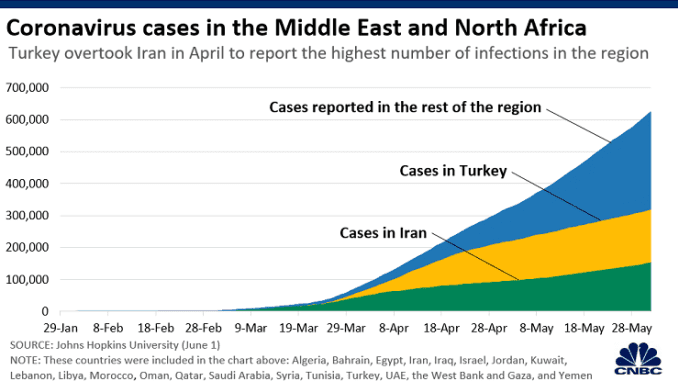
Turkey is currently home to the highest number of coronavirus cases in the Middle East region at nearly 150,000, having surpassed Iran in mid-April. But its economy was already under pressure before the coronavirus hit.

Now, after nearly two years of a weakening currency, high debt and fast-disappearing foreign reserves, the country is in a particularly bad place to weather a pandemic. Its unemployment rate was already nearly 14% in January, before the economy felt the impact of the coronavirus, and its massive tourism industry is on course to be decimated for the near future.


5/16/2020

Welcome to the First Global Economic Depression of Our Lifetimes


Source: TIME
May 16 2020
By Ian Bremmer


Another week, another grisly job reports for the US. The data is still streaming in, but it’s time to start calling this what it is—a global economic depression.

Why It Matters:


Technically, there’s no official definition of the term “depression.” But compared to a “recession” (defined as two consecutive quarters of contracting economic growth), there are some general rules we can apply—depressions are global, much worse than typical recessions, and their impact on both the economy and society last far longer. It’s this latter point why we still call 2008 the “Great Recession.” For all the drama and chaos, outside the banking industry those handful of months in 2008/2009 didn’t irrevocably alter our society and/or economic system. Awareness about inequality was raised by movements like “Occupy Wall Street,” but the underlying issue went largely unaddressed for more than a decade because large swaths of society could effectively ignore it. Given the coronavirus’ damage to our global economy, they won’t have the luxury of ignoring it any longer. Especially not in the U.S., where the US Fed released a survey this week pointing out that 39% of households making under $40,000 a year lost at least one job in March alone.

What Happens Next:


And that’s the U.S., still the world’s largest economy and one with ostensibly the most resources to combat both coronavirus and its worst economic effects. In the early days of the pandemic, the U.S. government sprung into action with the idea to provide support to workers and keep businesses afloat with credit lines and other financial instruments, all with the idea of building a bridge till the time when the economy was turned back on. The Federal Reserve joined in with unprecedented support to ensure markets continued to function. In other words, policymakers were aiming for a “V” shaped recovery, one where the economy was shut off for a short period of time and would then immediately snap back to pre-pandemic levels of economic activity (or close to it). Given the scope and scale of the economic carnage, it’s clear we aren’t getting that V-recovery. Recent economic data out of China reinforces that point.

Some of that has to do with the nature of the economic shock itself. Unlike 2008, this is a crisis of the real economy, as both supply and demand are taking massive hits in an unprecedented amount of time. But just as important is the continuing threat posed by the coronavirus. For all the talk of us reaching “peak” coronavirus cases, this is not going to be a “peak” in the style of Mount Fuji—steep ascent, a sharp peak up top, followed by a steep descent. As the examples of South Korea and others have already made clear, that’s not the way this pandemic is playing out; secondary outbreaks are virtually guaranteed, and governments will struggle much harder to impose lockdown restrictions another time around. Rather than a Fuji-like peak, we’re looking at continuing smaller waves of coronavirus outbreaks that ebb and flow until a vaccine is found. And even then, we will have to wait for mass production and distribution of that vaccine, as well as global education and uptake. All told, we are looking at a time horizon closer to 2-3 years rather than the 2-3 months that policymakers may have initially hoped for.

It’s difficult to criticize policymakers for planning on a V-shape recovery—laid off employees want to get back to work, and the desire to rehire many of the workers who lost their jobs in recent weeks is there on the part of business owners, as is the desire for them to resume business operations. That desire for returning to work has given plenty of U.S. governors the cover they need to reopen their economies sooner rather than later, but doing so ensures a stop-start rebound process. It also remains an open question whether business owners will be able to rehire those workers if their businesses don’t manage to make a profit in our next period of social distancing and consumer-wariness of venturing outside.

Combine that with some big trends already in motion—chief among them technology dislocation and insufficient government coordination—and we’re looking at a future where a lot of the jobs lost in the last two months aren’t coming back. There are plenty on unknowns, but for my money, I’d say it’s years before the U.S. unemployment rate falls back down below 10 percent.

Again, we’ve been talking primarily about the U.S., theoretically among the best-equipped to deal with economic shocks like this. But Europe is largely in the same boat, albeit with better social safety nets but lower economic growth trajectory, so let’s call it a wash. And China is about to discover that shutting down was the easy part, too; while Beijing has greater tools at its disposal to impose draconian surveillance and social distancing measures, it too will face serious challenges in making sure government debt doesn’t spiral out of control while regaining its economic footing. China does have one major advantage going for it, however—an unprecedented alignment between politics, business and society. Those who don’t face even larger difficulties ahead.

We should really be concerned about middle-income and developing economies in a coming global depression given that they have even less resources, less resilient healthcare infrastructure, much larger populations and much more unsustainable debt. And they’re the next phase coming. We could well be looking at multiple defaults, which in turn could lead to the global financial crisis that policymakers are currently struggling to avoid, compounding global economic woes even further.

The One Major Misconception About It:


That all is lost. Not exactly.

When we use the word “depression,” the images we conjure up tend to be of Hoovervilles and soup lines circa 1930’s. But the world has come a long way since then, and the last 100 years or so of globalization has catapulted humanity into unprecedented levels of human, economic, political and technological capital. When the Great Depression happened, we didn’t have the social safety nets and political institutions we have today. We also didn’t have a decades-long track record showing the world was better off when cooperating rather than in conflict. Thanks to technology and other advancements, today’s “global middle class” enjoys a quality of life that would have made even the well-off of 1930 envious.

Also, the same things that make pandemics so deadly in 2020—global supply chains and international travel, for example—has also enabled the global interdependence that keeps the world in a relative peace even when the global politics seem to be pushing in the other direction. As a collective whole, humanity is better prepared to weather this depression than we were a century ago.

The One Thing to Say About It on a Zoom Call:


To avoid the worst of what’s to come, we need better global cooperation. Maybe starting to use the term “depression” will begin focusing minds in the right direction. And if we play our cards right, maybe we could avoid a “great” depression and just get a middling one instead.

The One Thing to Avoid Saying About It on a Zoom Call:


The last Great Depression was started in the U.S.; this new one will have started in China. Emerging markets are moving up in the world.


5/13/2020

A global tourism catastrophe


Source: NewsZetu
May 13 2020

  • 2020 is a catastrophe for tourism businesses. Here's what the industry needs to get back on its feet.

Socrates Gavriel is bracing for a dramatic drop in visitors to his boutique hotel in Athens this summer.

Located a short distance from the Greek capital’s commercial center, Pi Athens ordinarily welcomes droves of American and Australian tourists this time of year.

“The concern this summer is that those who will come — if and when they do — will skip the big cities and head directly to a beach location,” Gavriel told CNN Business. “The hotel is a rented property and there are many bills to pay. I have invested in it heavily. We are hoping for some revenue in the summer but we don’t know if this is going to happen.”


Gavriel’s story is playing out across the globe, as government restrictions designed to curb the coronavirus pandemic keep billions of people at home, bringing international travel and tourism to a standstill. The shutdown is affecting everything from small businesses like Gavriel’s to massive companies, such as Marriott International (MAR) and Carnival Corporation (CCL). TUI, the world’s biggest tour operator, said Wednesday that it could shed up to 8,000 jobs.

Even some of the biggest global airlines, such as Germany’s Lufthansa (DLAKF), are seeking government bailouts in order to survive.

Travel and tourism accounts for some 10% of global GDP and one in 10 jobs, according to the World Travel and Tourism Council, an industry group. As many as a third of these jobs, or more than 100 million positions, and some $2.7 trillion in GDP could be at risk as a result of the current crisis, the council said last month.

Countries that rely most heavily on tourist dollars will be hardest hit. A 25% decline in tourism income will knock on average 7% off GDP among “small island developing states,” a contraction that could go as deep as 16% in places such as the Maldives and Seychelles, according to the United Nations Conference on Trade and Development.

The situation is also dire in Europe, which boasts half the world’s international tourist arrivals. The European Parliament estimates that the bloc’s tourism industry is losing around €1 billion ($1.1 billion) in revenue per month, a devastating blow to the 27 million EU workers whose jobs are connected to the sector.

“The crisis in the tourism sector is deeper than we could imagine two months ago,” said Isabel Oliver, Spain’s secretary of state for tourism. “The sector was one of the first to suffer the consequences of the crisis and will be one of the last to recover,” she added.

While hotel owners such as Gavriel desperately need international visitors, reopening borders risks a surge in new coronavirus infections even if it could mean economic relief. Greece hopes to start welcoming tourists by July 1, but Prime Minister Kyriakos Mitsotakis admits that “it’s a very tough trade off.”
“Nobody knows exactly how to do this,” he told CNN in an interview earlier this month.

Kickstarting tourism, while crucial for the global economy, will be especially complex. Reopening businesses and restarting factories is proving hard enough, but the return of travel will require an easing of border controls, international cooperation and, most crucially, travelers themselves.

Kuredu island, Maldives.

“The critical issue is to build confidence between countries that it is safe to reopen borders without risk of reinfection and to build confidence in the general public that it is safe to fly,” John Holland-Kaye, CEO of London’s Heathrow, the busiest airport in Europe, said last month.

Airports hold the key

But airlines are already downsizing, trimming fleets and slashing thousands of jobs, in expectation that people will fly less. British Airways parent IAG (ICAGY) said last week that it does not expect passenger demand to recover to 2019 levels before 2023. Princess Cruises, a division of Carnival Corporation, has canceled virtually all its summer sailings, citing limited flight availability and the closure of many popular cruise ports. And rival cruise line Norwegian has had to raise more than $2 billion in the capital markets to stay afloat.


Airports and hotels are trying to lure travelers back with health checks and enhanced cleaning protocols, all of which will add layers of cost at a time when the sector’s finances are in tatters because of the collapse in travel.

But such measures are necessary to restore confidence before a Covid-19 vaccine is widely available, said World Travel and Tourism Council CEO Gloria Guevara. “The most critical piece is the airports,” she told CNN Business.

The Dubai Health Authority carries out coronavirus screening on passengers heading to Tunisia on a repatriation flight.

The World Travel and Tourism Council is working with governments and travel organizations to agree on standardized health checks and cleaning protocols. It expects to issue guidelines for the hospitality industry this week with guidance for airports to follow.

Ryanair (RYAAY), which carries millions of tourists around Europe each year, on Tuesday announced new health measures to be implemented on board aircraft as part of plans to restore 40% of flights starting on July 1. The measures illustrate the daunting task facing airlines as they seek to resume flying.

“A quick and effective restart of travel will only happen if governments around the world agree to a common set of health protocols developed by the private sector,” Guevara said in a statement.

Even if that does happen, international tourist arrivals are predicted to be virtually nonexistent this year.

The United Nations World Tourism Organization estimates a decline of as much as 80% from 2019, depending on how long travel restrictions remain in place. That compares with a 0.4% decline during the SARS epidemic in 2003 and a 4% drop in 2009 following the global financial crisis.

“This is by far the worst crisis that international tourism has faced since records began [in 1950],” the UN body said in a statement last week. “The impact will be felt to varying degrees in the different global regions and at overlapping times, with Asia and the Pacific expected to rebound first.”

Domestic travel offers glimmer of hope


There are some early signs that domestic travel is gradually picking up again in certain countries, although it’s too soon to call a recovery.

China began to ease coronavirus lockdown restrictions in March, after the country’s near complete shutdown in late January. More than 30% of domestic airline capacity has returned since March 1, according to aviation analytics company, Cirium.

“Green shoots in the Chinese domestic market … is a positive sign for short-haul travel recovery,” the company said in a research note. “It’s clear that, as some travel restrictions ease, it will be the domestic market which will start to return first.”

But flight cancellations remain elevated and the recovery has plateaued, suggesting consumer confidence has not yet been fully restored, Cirium added.

Marriott said Monday that occupancy at its hotels in Greater China reached 25% in April, up from less than 10% in mid February. Meituan Dianping, an app that allows consumers to shop, order food and book trips, recorded increased spending on local tourist attractions, and a pickup in hotel and bed and breakfast bookings last month.

Chinese tourists wear protective masks as they line up to enter the Forbidden City.

However, some tourist attractions in China were forced to shut shortly after reopening due to an influx of visitors. The country is now renewing restrictions in some areas after new cases of the virus were reported in two cities, including the pandemic’s epicenter Wuhan.

Elsewhere, Airbnb has observed a surge in domestic bookings in Denmark and the Netherlands, CEO Brian Chesky told the Financial Times recently. “People will want options that are closer to home, safer, and more affordable,” Chesky said in a letter to staff posted to the company’s website.

But that doesn’t mean a full recovery will be achieved anytime soon, and China’s experience could cause other countries to reopen with even greater caution. In the same letter, Chesky announced a 25% cut to the company’s workforce and said revenue in 2020 is expected to be less than half what it took in last year.

With “staycations” expected to spearhead the sector’s eventual revival, countries that rely more heavily on domestic and regional visitors will fare better.

At the top of this list are the United States, Mexico, Brazil, China, Japan, India, the Philippines, Germany and the United Kingdom, where domestic tourism accounts for more than 80% of total travel and tourism spending, according to the World Travel and Tourism Council.

Asia Pacific has the largest regional travel market, which bodes well for some islands, such as the Maldives and Fiji, assuming tourists choose destinations that are closer to home. Countries such as Thailand and Cambodia, which both derive more than 20% of their GDP from travel and tourism, could also benefit. Visitors from Asia accounted for nearly 70% of all tourist arrivals in Thailand in 2018, according to Bangkok Bank.

Chinese tourists spend most on world travel, accounting for one fifth of international tourism spending in 2018, or $277 billion, according to the World Tourism Organization. Tourists from the United States follow at $144 billion.

With journeys to international destinations expected to recover last, small business owners like Gavriel, whose patrons travel long distances to come to Greece, face an uncertain future.

— Elinda Labropoulou, Nic Robertson, Laura Perez Maestro and Sherisse Pham contributed reporting.


5/08/2020

Top US and Chinese officials agree to strengthen cooperation for a Phase 1 trade deal


May 8 2020
By Reuters

  • Top US and Chinese trade representatives discussed their Phase 1 trade deal on Friday.
  • China said the countries agreed to improve the atmosphere for the trade deal's implementation and the United States said both sides expected obligations to be met.
  • The US Trade Representative's office said both sides "also agreed that in spite of the current global health emergency, both countries fully expect to meet their obligations under the agreement in a timely manner".


BEIJING (Reuters) - Top U.S. and Chinese trade representatives discussed their Phase 1 trade deal on Friday with China saying they agreed to improve the atmosphere for its implementation and the United States saying both sides expected obligations to be met.

The discussion in a telephone call comes amid escalating tension between the countries, exacerbated by a war of words over U.S. criticism of China's handling of the novel coronavirus outbreak.

U.S. President Donald Trump and other top officials have blamed China for the deaths of hundreds of thousands from the outbreak and have threatened punitive action, including possible tariffs and shifting supply chains away from China.

Chinese Vice Premier Liu He, U.S. Trade Representative Robert Lighthizer and U.S. Treasury Secretary Steven Mnuchin agreed during the call that the two countries would work together to create a favourable environment for implementing the Phase 1 trade deal reached this year, China's commerce ministry said.

The U.S. Trade Representative's office said both sides "also agreed that in spite of the current global health emergency, both countries fully expect to meet their obligations under the agreement in a timely manner".

The negotiators also agreed that "good progress" was being made on creating governmental infrastructures to make the Phase 1 trade deal a success, the U.S. office said.

Under the deal, China agreed to increase its purchases of U.S. goods from a 2017 baseline by $200 billion over two years, with about $77 billion in increased purchases in the first year and $123 billion in the second year.

But the coronavirus, which emerged in China late last year, has dealt a sharp blow to Chinese demand and its economy is only starting to recover.

The two countries will continue to hold required meetings under the trade agreement via conference call on a regular basis, the U.S. office said.

(Reporting by Roxanne Liu, Huizhong Wu and Lusha Zhang in Beijing, Kanishka Singh in Bengaluru ; writing by Se Young Lee; Editing by Murali Anantharaman)


5/07/2020

Coronavirus hits Greece’s economy the most in the EU


May 7 2020

Greece’s economy this year is expected to be hit severely by the Covid-19 pandemic and the counter measures taken to limit its spread, according to the European Commission’s Spring 2020 Economic Forecast released on Wednesday.


The forecast gives a discouraging picture for Greece in 2020, as it says the country’s GDP is expected to contract by 9.7 percent this year – the highest out of all EU countries – and its unemployment rate may reach 19.9 percent from 17.3 percent in 2019. However, the Commission says a rebound should be expected in 2021.

Regarding the the euro area as a whole, GDP is expected to contract by 7.7 percent.

“Economic activity in Greece, Italy, Spain, Croatia, and to a lesser extent France are forecast to contract the most,” said Paolo Gentiloni, European Commissioner for the Economy, during a press conference.

According to the forecast’s chapter on Greece, while the main effects of the lockdown are expected to be concentrated in the second quarter of this year, Greece’s large tourism sector is likely to be affected in the third quarter as well, as restrictions on travel are expected to remain in place and foreign demand for overseas travel may remain subdued.

“Since more than 70 percent of tourism receipts are concentrated in the main summer months, impediments during this period would have a large impact on overall exports of services in 2020,” says the Commission.


Moreover, due to the global nature of the crisis, exports in Greece are expected to suffer strong declines in 2020. The country’s main export markets are expected to be amongst the worst affected countries, leading to a drop in demand for Greek goods and services, also amplified by the large share of tourism and shipping in exports.

“Despite the swift policy response, the strong contraction in output is forecast to take a toll on employment,” the forecast continues.

According to the Commission, while the measures introduced by the Greek government to protect the labour market are expected to avoid large-scale lay-offs and insolvencies, some 160,000 jobs could still be lost due to the crisis and the unemployment rate could rise to 19.9 percent in 2020.

“The partial recovery in 2021 is expected to have positive effects on the labour market, bringing the unemployment rate down again, to about 16.5 percent.”

Consumer prices are expected to drop by 0.6 percent in 2020 – and see a limited increase in 2021 – due to the downward pressure from wages, energy prices and industrial production.

The forecast also sees private consumption in Greece experiencing a strong decline this year amid limited consumption opportunities during the lockdown and falling disposable income.

Investment is also expected to be strongly affected by the increased uncertainty and lower turnover in 2020 but, according to the Commission, the liquidity support provided by the Greek government and the EU institutions should help companies to bridge the lockdown period and speed up the recovery.


In conclusion, the Commission’s forecast says the cost of tackling the crisis will take toll on Greece’s primary balance.

The general government deficit is forecast to reach 6.4 percent of GDP in 2020 and to decrease to about 2 percent in 2021 based on a no-policy-change assumption.

Public debt is expected to increase to around 196 percent of GDP in 2020 before declining to around 183 percent in 2021, supported by the economic recovery.

“Nevertheless, the crisis in Greece is expected to be followed by a rebound in 2021. The recession and the cost of fiscal measures to tackle the crisis is expected to lead to a sizeable deficit in 2020,” the Commission says.

Coronavirus: US unemployment claims hit 33.3 million amid virus


Source: BBC
May 7 2020

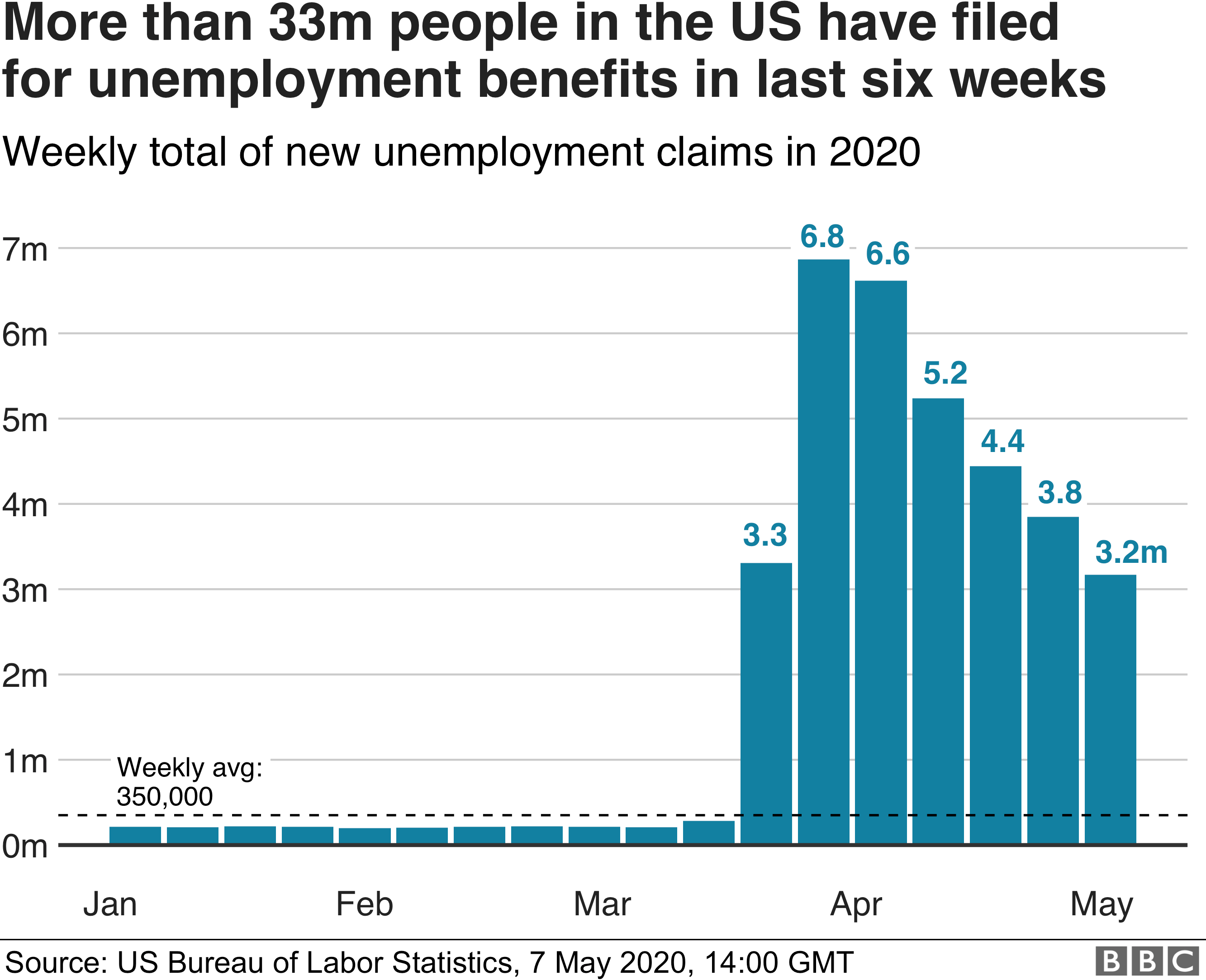
A further 3.2 million Americans sought unemployment benefits last week as the economic toll from the coronavirus pandemic continued to mount.

The new applications brought the total number of jobless claims since mid-March to 33.3 million.

That amounts to more than 15% of the US workforce.

However, it was less than the 3.8 million a week ago and down from the record 6.9 million for one week in March.

Although the number of people filing claims is on the decline, it is still extraordinarily high, says BBC Business correspondent Samira Hussain in New York.


Although the unprecedented job losses seem to be slowing, economists say the monthly unemployment rate for April, which will be released on Friday, could reach 15% or higher.

Just two months ago, the unemployment rate was at 3.5%, a 50-year low.

Since the coronavirus has taken hold in the US, the country has suffered its worst growth numbers in a decade, the worst retail sales report on record and the highest weekly unemployment claims ever seen.


China exports see surprise 3.5 percent jump in April, imports fall


Source: Raw Story
May 7 2020
By AFP

China’s exports saw a shock 3.5 percent rise in April despite the global impact of the coronavirus pandemic, official figures showed Thursday, partly due to rising medical exports.

But analysts warned of weakness ahead as key markets suffer downturns, as well as the brewing threat of a renewed trade war with the United States.

Imports fell 14.2 percent on-year, a steeper drop than last month, according to the Customs Administration.

A forecast of analysts by Bloomberg had predicted an 11 percent dive in exports and a 10 percent plunge in imports.

Exports of medical instruments and devices rose 11 percent in the first four months from a year ago, according to customs data, while most other categories contracted.

ING chief economist for Greater China Iris Pang told AFP that China’s exports of medical supplies provided a boost as the rest of the world grappled with the pandemic.

Pang added that while exports of clothing shrank, sales of textile yarns, fabrics and other products grew, implying they were used to make medical supplies.

Beijing says it has been successful in largely curbing the spread of the virus in the country, and many businesses and factories are now back at work after months of closure.

And Louis Kuijs of Oxford Economics noted that “April shipments may have been boosted by exporters making up for shortfalls in the first quarter due to supply constraints then”.

In the January-February period, the height of China’s coronavirus outbreak, exports plummeted 17.2 percent.

– US trade threat –


In spite of the bounceback — the first return to positive territory for exports this year — analysts do not expect the trend to last as China’s key trading partners fall into recession.

And although the US and China signed a phase one trade pact in their bruising trade war in January, Julian Evans-Pritchard of Capital Economics warned that “the threat of additional US tariffs on Chinese goods shouldn’t be ignored”.

Customs data showed that in April China’s trade surplus with the US widened from a year ago by 8.8 percent, to around $22.8 billion.

Over the last few months tensions have ramped up again as the two sides exchanged barbs over the pandemic and its origins, with US President Donald Trump recently threatening new trade tariffs against Beijing.

Nick Marro, global trade lead at The Economist Intelligence Unit, said that it could be hard for both sides to meet earlier commitments.

“Shipments from the US remain well below the levels needed to achieve the purchase pledges under the trade accord… with the deterioration in US-China ties, there’s a risk that the US might act brashly,” he said.

In China — already tackling weak overseas demand and a lingering trade war — virus recovery has been slow.

An independent gauge released Thursday, the Caixin PMI, showed that the services sector is still in contraction and below analyst expectations.

There are still some social distancing rules in places and fears about mounting unemployment are hitting consumer confidence.

The daily average of domestic trips over the Labour Day holiday at the beginning of May was half of last year’s total, while daily tourism revenues fell 68 percent.

On Wednesday, Beijing pledged to roll out and improve on policies to keep employment stable, following an earlier series of support measures.

– Falling orders –


The rebound in exports contrasts against the official Purchasing Managers’ Index data recently, which showed firms reporting insufficient demand and, last month, a sharp drop in new export orders.

Marro said China’s exports data also showed considerable divergence from the rest of the region.

“The government seems committed to publishing positive headline GDP data for the second quarter, with a technical recession likely politically unpalatable,” Marro said.

In contrast, the eurozone economy is expected to contract by a staggering 7.7 percent this year, while the US private sector has lost 20.2 million jobs last month alone, according to payrolls firm ADP.

Analysts have warned of an enormous impact on world trade from the pandemic, which has killed more than 260,500 worldwide.

Oxford Economics says global trade in goods and services could be cut by up to 15 percent in 2020, much larger than the decline during the 2009 global financial crisis.


5/06/2020

Exclusive: Greece to issue two new bonds by year-end, may postpone early IMF payment


Source: Reuters
May 5 2020
By Lefteris Papadimas

ATHENS (Reuters) - Greece plans at least two more bond issues by the end of the year and could postpone an early repayment to the International Monetary Fund to boost cash reserves and cover extra funding needs related to COVID-19, government officials told Reuters on Tuesday.

It is also shelving a decision to carry out fewer treasury bill issues this year, the sources said, speaking on condition of anonymity.

“Our plan is for at least two more bond issues by the end of the year to raise about 4 billion euros,” a senior government official said.

“The first issue might take place in the next coming months, in the summer,” the official said without giving details on the maturities of the new bonds.

Greece raised a total of 4.5 billion euros from 15- and 7- year bond issues earlier this year.

Its initial borrowing roadmap had Greece reducing annual treasury bill issues by about 5 billion to 7.5 billion euros this year. It had also pencilled in paying an early instalment of 1.7 billion euros to the IMF on loans maturing in 2021, and that is now subject to review.

“We might postpone the early repayment to the IMF, there is not a final decision yet. We will revisit the issue in September,” the official said. He did not say when Greece was planning to make the payment.

Greece repaid 2.7 billions euros of IMF loans last year, making the instalments ahead of schedule, thus reducing its total exposure to the fund to about 6 billion euros.

During its worst debt crisis in decades, which broke out in late 2009, Greece was shut out of financial markets. Unable to fund itself, it borrowed heavily from euro zone governments and the IMF. Its third international bailout expired in August 2018.

Three months ago, Athens was projecting growth of 2.8% for 2020 but now expects its economy to contract by between 4.7% to 8.9%, taking into account the impact of the coronavirus pandemic and the resulting shutdown in financial activity from mid-March. The country has only just started to emerge from its lockdown.

The cost of urgent fiscal measures to help businesses, workers and the unemployed is estimated to reach 12.3 billion euros by June.

“The adjustment (in borrowing strategy) focuses mainly on a change in the use of the borrowing proceeds and does not necessarily constitute a change in the overall funding activity,” a second official said.

Total t-bill issues this year will reach 12.5 billion euros, the same as in 2019.

Greece has cash reserves of 15.7 billion euros from undisbursed bailout loans and proceeds from bond issues.


5/04/2020

Why The US Economy May Never Be the Same Again After Coronavirus: Analysis

White House economic advisor Kevin Hassett talks to reporters about the Trump administration’s economic policy during a news conference in 2019. He is whistling a different tune now.
Source: NewsWeek
May 4 2020
By Sam Hill

It's been a crazy couple of weeks in the pandemic economic prediction business.

So crazy that even the White House can't get its stories straight. In one corner President Trump's advisor/son-in-law Jared Kushner and U.S. Treasury Secretary Steven Mnuchin told us that happy days will be here again—and the country "rocking" by July. In the other, former White House Council of Economic Advisors chair Kevin Hassett and now White House consultant called the economic situation "grave." (Granted, he was quickly told to knock off the "gloom and doom" by his colleague, Peter Navarro.)

But be wary of those rosy forecasts put out by market analysts and the White House. It's going to take a while. Exactly how long depends on science, not politics, as Warren Buffett said April 2 at Berkshire Hathaway's annual meeting.

Now, nobody likes that answer. But Hassett, before his time out, was simply saying what most economists are saying. His mistake was being honest and saying it in words we can all understand— instead of talking about V, L, W-shaped recoveries and SAAR's (seasonally adjusted annual rates.) As Bart van Ark, global chief economist at The Conference Board, says, "Growth rates are confusing. Of course we'll get a recovery. If one store opens that will be a recovery. That doesn't mean we'll be anywhere close to where we were."

Recovery starts when the economy bottoms out and shifts from negative growth to positive. But what the person-on-the-street means by recovery is when we will get back to where we would have been without COVID. That's not going to happen for a while. Oxford Economics is predicting the US economy will contract by -12 percent in the first half of the year and then grow slowly. (Arithmetic alert: Even recovering at the same rate doesn't get us back to level. If the economy contracts by 12 percent over six months and then expands by 12 percent over the next six, it will end the year smaller.)

Here's what the experts told us will happen—in English:

Good news first. Don't panic. We aren't headed for a Great Depression. During the Great Depression the economy went backward for four years in a row. David Wessel, director of the Hutchins Center on Fiscal & Monetary Policy at the Brookings Institution and winner of two Pulitzers says, "We aren't going to repeat the 1930s: Monetary and fiscal policy have responded aggressively and quickly. Congress hasn't done all that it should...but both Congress and the Fed saw the economic threat and acted. They learned both from the mistakes of the 1930s and from those made just a decade ago in the Great Recession."

However, the economy won't be back to the pre-pandemic baseline until mid-2021 or later. This year will be one of fits and starts. The economy will improve as pandemic numbers fall and as the government pumps trillions into election-year stimuli. Then it will fall back if pandemic numbers rise as restrictions are loosened or a second wave hits in the fall. Growth will only become less saw-toothed once there's a vaccine or treatment. Very best case, a vaccine will become widely available late in 2020.

But even if the virus were to vanish overnight, restarting an economy isn't like turning on the tap. Think about reopening a restaurant. It's not just flipping the light switch and unlocking the front door. The premises will need to be cleaned and restocked. Staff will have to be rehired, and in an industry with high turnover that may be challenging. Customers will have to be convinced it's safe to return. More complex enterprises will face more complex restarts. It's weeks and months, not days.

Scott Minerd of Guggenheim Investments predicts it will be four years before the entire economy gets back to where it was. Even that may be optimistic. It took 51 months for the economy to come back after the Great Recession, and the economy is in a much bigger hole today. After any downturn, there's a lot that has to be flushed from the financial system—CLO's (bundles of low grade debt), weak business models, bad real estate projects, and industries that can only exist in a booming economy, like shale oil.

Don't be fooled by the stock market. The stock market will catch up long before the economy does. Gregory Daco, Chief US Economist at Oxford Economics US, estimates the economy contracted by -5 to -7 percent in March. The S&P 500 rose by almost 13 percent the following month as unemployment claims boomed. In other words the market moved in the opposite direction of the economy.

Call it economic PTSD. Van Ark says consumer confidence before COVID was at near-record levels, but fell by a record 19 percent in April. For many, the economic hardships haven't even hit yet, as they will when savings are exhausted. Jerry Nickelsburg, director of the UCLA Anderson Forecast says, "After the Great Recession, we saw people responding in two ways. People who'd been unemployed had to rebuild savings. People also had a greater sense of insecurity. Both led to more savings and less consumption, and a slower recovery, not the rapid snap-back some people are calling for." Which is why...

Some sectors will come back slowly. Van Ark says The Conference Board forecasts seventy different sectors. He believes many will adjust easily, but many will not. Service industries whose business model is based on making money by running a lot of people through, like airlines, sports venues, and cruise lines, will struggle to adapt to what he calls "the six foot economy."

If there's no vaccine or treatment, airlines might need to leave every other seat empty in order to convince customers (and maybe crew) to return. But airlines must fill around 80 percent just to break even. It's no surprise that Buffett has dumped his airline holdings. Until there's a vaccine, it's hard to envisage the sector rebounding. Other industries with high levels of face-to-face interaction, like ride-sharing, will also come back slowly.

Some sectors may never recover. Nickelsburg says brick and mortar "Retail was in decline before in an expanding economy. There will be fewer people re-employed there after this is over." The decrease in consumer demand and the interruption of operations may also be a death knell for many small businesses. Van Ark says, "We will see a lot of bankruptcies. The problem with small businesses is 'Do they have the time to recover?' Every week they're closed means they're closer to insolvent." According to the National Restaurant Association, 3 percent of restaurants that have closed so far will never reopen. There could also be a shake-out for businesses based on the gig economy, i.e., part-time employees, as many shift to full time jobs that pay less but are more certain.

But what about people?

Some families will never recover economically. Patricia McIlreavy, CEO of the Center for Disaster Philanthropy, says, "The arc of a disaster is very long. We have to be careful not to be overly simplistic in our definition of recovery." Those just entering the workforce and those down the economic pyramid will fall behind and may not catch up. Income inequality will get worse. That's what happened in the Great Recession. According to Pew Research Center, those at the bottom of the income ladder had less in 2016 than they did in 2007, $10,800 vs. $18,500 before the recession. Middle-income families saw their net worth drop from $163,300 (2007) to $110,100 (2016.) After almost a decade, the only ones to have caught up and gained ground were upper-income families.

The economy will be more volatile going forward. We're unlikely to see any more 10-year expansions. Our modern, hyper-specialized economy is very efficient, but it's surprisingly fragile. There's not a lot of spare capacity or inventory lying about, as we found with ventilators. Despite talk of building resilience in, it's unlikely we will because it comes at a cost. It's hard for companies that live quarter to quarter to take the long view. Instead, we will deal with shocks as they come. The last decade has been a great ride, but it's taken a lot to pull it off. We've used every tool in the economic toolkit—tax cuts, monetary policy, and fiscal stimulus. The Fed Funds Rate is at 0.25 percent, almost zero. The deficit is at record levels. With the COVID crisis, the Fed has used its emergency 13(3) powers to lend to business for only the second time since the Great Depression. At some point we'll run out of tricks.


***

We all want to get back to "normal" right now (although the levels of sustained growth and low unemployment we've experienced over the last 126 months weren't truly "normal.") That's not going to happen. Wessel says, "We don't know how quickly science can come up with treatments and a vaccine. And we don't know how consumer and business behavior will change. The rapid V-shaped recovery seems unlikely. The question is how long it takes for us to recover. Quarters? Years? A decade? And whether we'll ever get back to the pre-COVID baseline." And things will be different after COVID.

That's what Kevin Hassett wanted to say—before Pete Navarro pulled the plug on his microphone.


Sam Hill is a Newsweek contributor, author and consultant.

Politics In a Post-COVID World

Crises change countries. We're not the same country we were before 9-11. Remember walking into an airport and right onto an airplane? Or checking into a hotel without an ID? Here are some big ways big ways that COVID might affect the world of politics:


Sanders-style Socialism: TRENDING BLUE. The CARES act is perhaps the greatest expansion of the social safety net since the New Deal, certainly since the Great Society. It's intended to be temporary. It's easy to see across-the-board monthly checks becoming an entitlement like Social Security or Medicare. As the recession hits hard in the third quarter, expect to see debt relief programs like those in the CARES act for small business extended to individuals. Post-election, expect a push for a wealth tax or rollback of the 2017 Tax Cuts and Jobs Act.

Healthcare Reform: TRENDING BLUE. It's hard to imagine healthcare remaining the same, says Jerry Nickelsburg, director of the UCLA Anderson Forecast. "After the pandemic we're going to have a very serious discussion about how we'll deliver healthcare in this country," he explains. "That could lead to fundamental change." Perhaps we'll see a shift toward healthcare-for-all. At a minimum, we'll see more telemedicine, which could over time de-localize the medical industry. Imagine your medical testing is done locally and those results are shipped to your doctor—who works at the Mayo Clinic in Rochester.

Big Government: TRENDING BLUE. Billionaire hedge-fund investor Leon Cooperman has proclaimed the crisis will end "free-market capitalism as we know it." That may be an over-statement. But economists talk about a "ratchet effect" in which government permanently expands during a crisis. Explains Ryan Bourne, who occupies the R. Evan Scharf Chair for the Public Understanding of Economics at the Cato Institute, "Crises normalize certain types of interventions. After the Great Recession, people said 'never again,' but there is always a next time, and often that results in more extreme interventions with weaker cases, although the current crisis is certainly not a weak case."

Increased government involvement won't meet a lot of resistance. President Trump is inclined toward economic activism anyway, and the libertarian wing of the GOP is in full retreat. As recently as the early 2000's, some argued FDR's economic interventions made the Great Depression worse. That argument is done and dusted. The recovery from the Great Recession proved that intervention works. (It also made a case for regulation, e.g., rules forcing banks to keep more reserves.) Bailouts have gone from being rarities (Chrysler, 1980) to frequent (TARP-2009) to expected (CARES.) And as happened after the Great Depression, there will be a retreat from globalization and an increase in protectionism.

Climate Change Mitigation: TRENDING RED. Bourne argues this will make the Sanders Green New Deal and similar initiatives less likely. His logic is that absent significant technology advances, reversing climate change is likely to require cutting back on consumption. The Great Lockdown was a taste of austerity. It wasn't very popular. If we can't last a month without tattoo parlors and beaches, it's hard to see any program that results in slower economic growth getting traction.

The Presidential Election: TBD. As former British Prime Minister Harold Wilson said, "A week is a long time in politics." Six months is an eternity.


7/25/2012

The U.S. Economic Policy Debate Is a Sham


Πηγή: Bloomberg
By Betsey Stevenson & Justin Wolfers
July 24 2012

Watching Democrats and Republicans hash out their differences in the public arena, it’s easy to get the impression that there’s a deep disagreement among reasonable people about how to manage the U.S. economy.

Nothing could be further from the truth.

About Betsey Stevenson & Justin Wolfers

Betsey Stevenson and Justin Wolfers are, respectively, an assistant professor and an associate professor in the Business and Public Policy Department at the University of Pennsylvania's Wharton School. More about Betsey Stevenson & Justin Wolfers

In reality, there’s remarkable consensus among mainstream economists, including those from the left and right, on most major macroeconomic issues. The debate in Washington about economic policy is phony. It’s manufactured. And it’s entirely political.

Let’s start with Obama’s stimulus. The standard Republican talking point is that it failed, meaning it didn’t reduce unemployment. Yet in a survey of leading economists conducted by the University of Chicago’s Booth School of Business, 92 percent agreed that the stimulus succeeded in reducing the jobless rate. On the harder question of whether the benefit exceeded the cost, more than half thought it did, one in three was uncertain, and fewer than one in six disagreed.

Or consider the widely despised bank bailouts. Populist politicians on both sides have taken to pounding the table against them (in many cases, only after voting for them). But while the public may not like them, there’s a striking consensus that they helped: The same survey found no economists willing to dispute the idea that the bailouts lowered unemployment.
No Support

Do you remember the Republican concern that Obama had somehow caused gas prices to rise, a development that Newt Gingrich promised to reverse? There’s simply no support among economists for this view. They unanimously agreed that “market factors,” rather than energy policy, have driven changes in gas prices.

How about the oft-cited Republican claim that tax cuts will boost the economy so much that they will pay for themselves? It’s an idea born as a sketch on a restaurant napkin by conservative economist Art Laffer. Perhaps when the top tax rate was 91 percent, the idea was plausible. Today, it’s a fantasy. The Booth poll couldn’t find a single economist who believed that cutting taxes today will lead to higher government revenue -- even if we lower only the top tax rate.

The consensus isn’t the result of a faux poll of left-wing ideologues. Rather, the findings come from the Economic Experts Panel run by Booth’s Initiative on Global Markets. It’s a recurring survey of about 40 economists from around the U.S. It includes Democrats, Republicans and independent academics from the top economics departments in the country. The only things that unite them are their first-rate credentials and their interest in public policy.

Let’s be clear about what the economists’ remarkable consensus means. They aren’t purporting to know all the right answers. Rather, they agree on the best reading of murky evidence. The folks running the survey understand this uncertainty, and have asked the economists to rate their confidence in their answers on a scale of 1 to 10. Strikingly, the consensus looks even stronger when the responses are weighted according to confidence.

The debate in Washington has become completely unmoored from this consensus, and in a particular direction: Angry Republicans have pushed their representatives to adopt positions that are at odds with the best of modern economic thinking. That may be good politics, but it’s terrible policy.

The disjunction between the state of economic knowledge and our current political debate has important consequences. Right now, millions of people are suffering due to high unemployment. Our textbooks are filled with possible solutions. Instead of debating them seriously, congressional Republicans are blocking even those policy proposals that strike most economists as uncontroversial.
Raw Politics

This inaction has no basis in economics. Instead, it’s raw politics -- a cynical attempt to score points in a phony rhetorical war or a way of preventing their opponents from scoring a policy win.

The debate about the long-run challenge posed by the federal budget deficit has also become divorced from economic reality. The same panel of economists was almost unanimous in agreeing that “long run fiscal sustainability in the U.S. will require cuts in currently promised Medicare and Medicaid benefits and/or tax increases that include higher taxes on households with incomes below $250,000.” Only one in 10 was uncertain. None objected.

Likewise, popular tax deductions such as that for mortgage interest didn’t fare well in the surveys and would be on almost any economist’s list of targets for reform. Yet neither party is willing to propose such policies.

The consensus, of course, can be wrong. On the probable consequences of economic reforms, though, leading economists are more likely to be right than politicians running for re- election. Their solidarity needs to be taken seriously. Too much of what passes for economic debate in Washington is the product of faith, not evidence.

It’s time to put economics back into the economic debate.

Betsey Stevenson is associate professor of public policy at the University of Michigan. Justin Wolfers is associate professor of business and public policy at the University of Pennsylvania, and a non-resident senior fellow of the Brookings Institution. Both are Bloomberg View columnists. The opinions expressed are their own.