Showing posts with label gas. Show all posts

7/19/2020

Turkey fuels regional power game over Mediterranean gas reserves


Source: FT
By Laura Pitel and David Sheppard
July 19 2020


Europe’s top diplomat smiled for the camera as he took a helicopter flight over the disputed waters of the island of Cyprus at the end of June. Strapped in next to the Cypriot defence minister, Josep Borrell was signalling his support for the island and its allies in a bitter dispute with Turkey over access to the region’s huge gas reserves. 

Beneath them, the Turkish drill ship Yavuz was stalking a drilling block licensed to the French and Italian oil companies Total and Eni — a commercial agreement that Ankara views as invalid. Turkey’s pro-government press decried Mr Borrell’s chopper ride as an “ugly provocation”. 

 Yet Ankara itself is also being accused of behaving in a provocative way. Under the direction of President Recep Tayyip Erdogan, Turkey has adopted an increasingly assertive response to being excluded from regional efforts to exploit the area’s gas resources, which are subject to claims from at least eight countries ranging from Libya to Egypt and Israel. The interventions threaten billions of dollars of investment as countries seek to boost their energy security.  

 “We are tearing up and throwing away the maps of the Eastern Mediterranean that imprison us on the mainland”, Mr Erdogan’s deputy, Fuat Oktay, declared in June.  


 The region has the potential to become one of the last great fossil fuel plays — with bountiful gas to supply energy-poor countries around the basin, with enough left over to export. Having been under-developed and under explored for decades, the discovery of huge natural gas deposits in the past 10 years has created the potential to transform energy supplies in the region, and forge alliances between countries that might once have seemed unthinkable. 

Egypt and Israel are collaborating. Greece, Cyprus and others believe they can exploit a gas bounty that will help wean their economies off more highly polluting fuels like coal. The initial target is to provide the fuel to drive Egypt’s growing economy. Longer-term, some energy executives believe they will be able to pump gas supplies into southern Europe, reducing the region’s reliance on Russia.  

But Turkey — excluded due to its fraught relations with many of the other players in the region — could stymie those ambitions. Mr Erdogan has responded to being left out of his neighbours’ co-operation by sending the Turkish navy to intimidate drill ships belonging to international oil companies and dispatching his own exploration vessels. 

What began as a dispute between Turkey and Cyprus is fuelling a regional power game, drawing in nations as far away as the Gulf, and causing deep unease in the EU and the US. The latest flashpoint is Libya, where Turkey this year expanded its military presence after sealing an agreement with a UN-backed government in Tripoli that could enable Ankara to drill for oil and gas off the Libyan coast.


Josep Borrell, Europe’s top diplomat, on a helicopter flight with Cypriot politician Savvas Angelides over the disputed waters of the island of Cyprus at the end of June © Savvas Angelides/Twitter 

Turkey’s open intervention into the North African Opec member’s conflict has put it at risk of a direct confrontation with Egypt, the United Arab Emirates and Russia, which back a renegade Libyan general fighting the Tripoli-based administration. 

“It has built into a big strategic issue,” says Dorothée Schmid, an expert on Turkey at the French Institute of International Relations, a Paris-based think-tank. Ankara, she says, is seen by many in Europe as “a very aggressive player that is waging war in several parts of the region and is behaving very aggressively against the EU”.

The decision to send Turkish drill ships and frigates into disputed waters is characteristic of the more muscular foreign policy vision pursued by Mr Erdogan in recent years that has unsettled Turkey’s traditional allies and alarmed its regional foes.

“Erdogan and some of his allies believe that Turkey is restoring its importance in the eyes of its western allies,” says Ozlem Kaygusuz, an associate professor of international relations at Ankara University. “They believe that the more Turkey plays an assertive role, the more it will become valuable and impossible to ignore for western interests in the region.”

Top row: Greek Prime Minister Kyriakos Mitsotakis (C), Israel’s Benjamin Netanyahu (R) and Cypriot President Nikos Anastasiadis. Bottom row: from left, Cypriot Energy Minister Yiorgos Lakkotrypis, 
Greek counterpart Kostis Hatzidakis and Israeli Energy Minister Yuval Steinitz, sign an agreement for the EastMed pipeline project in January © Aris Messinis/AFP 

Anthony Skinner, director of Middle East research at the consultancy Verisk Maplecroft, believes that Ankara would ultimately like to reach a negotiated deal with Cyprus that could unlock the broader regional conflict — but that talks are probably years away. Until then, he says, the waters of the Eastern Mediterranean are likely to remain choppy. “Erdogan’s penchant for brinkmanship and pulling back just before it gets really dangerous means there’s always a risk of escalation.” 

Regional confrontation 


The Eastern Mediterranean dispute has its roots in the long-running conflict over Cyprus, which has for almost 50 years been split between a Greek Cypriot south and a Turkish Cypriot north. Ankara sees itself as the protector of the Turkish Cypriot population — and is the only nation to recognise their enclave as an independent state. 

Turkey first grew alarmed in the late 2000s when, after gas finds in the region by Israel, Cyprus hired energy groups to begin hunting for hydrocarbons in the area around the island. In December 2011, the US company Noble Energy announced the discovery of “significant natural gas resources”. Four years later Eni unearthed the supergiant Zohr field in Egyptian waters, which holds an estimated 850bn cubic metres of gas, rapidly developing it with partners and showing the region’s potential.

At the time, Demetris Christofias, then president of Cyprus, hailed the Noble discovery as a “historic development”. He added that the find could be “a tool for the promotion of peace and co-operation in the region”.  

But successive rounds of Cypriot peace talks failed and the dispute over gas has grown into a regional confrontation. 

A drilling platform near Larnaca port in Cyprus © Petros Karadjias/AP 

On one side is Turkey and Northern Cyprus. On the other is Cyprus, Greece, Egypt and Israel, as well as the UAE and France — which in February deployed its Charles de Gaulle aircraft carrier to the Eastern Med in a show of support for the Total-Eni consortium in the face of Turkish pressure.

Cyprus says that its drilling for hydrocarbons in the waters around the island is backed by international law, citing the exclusive economic zone that it declared in accordance with a 1982 UN convention on the law of the sea that has been ratified by 167 countries as well as the EU. But the determination of Nicosia to plough ahead despite the lack of a peace deal has angered Turkey, which is not a signatory to the UN convention and objects to its rules. Ankara claims that Cyprus is both impinging on Turkey’s continental shelf and violating the rights of the island’s north.

Turkey’s deteriorating relations with many of the countries adjoining the Eastern Mediterranean over the past decade offered an opportunity for Cyprus. And it acted as a spur to co-operation between Israel and Egypt. Along with Greece, they forged a joint plan to extract and export gas from the region that bypassed Turkey. And last year, they were joined by Italy, Jordan and the Palestinian Authority that runs the West Bank in establishing an official East Mediterranean Gas Forum.

Among the group’s grandest plans is a pipeline to create a new export market for the region’s gas by piping it to Greece. But the scheme has long faced scepticism due to the challenges of a route that stretches almost 2,000km through deep water. And with gas prices depressed due to a global supply glut, the cost of moving the gas that distance may be enough to make it economically unviable.

“It’s not clear that Europe [even] needs this gas as it already has supplies from Russia, Algeria and Norway,” says Jean-Baptiste Bouzard at the consultancy Wood Mackenzie. A more realistic aim, he adds, is to supply gas to Egypt and “perhaps utilise the country’s liquefied natural gas terminals for additional exports”. 

‘Pirate state’ 


Increasingly isolated, Turkey has sought to disrupt the activities of the oil companies that were drilling under licences issued by Cyprus. In early 2018, Turkish warships blocked an Eni rig drilling off Cyprus — the first of several such episodes. Claudio Descalzi, the Italian company’s chief executive, subsequently said that he didn’t want “to have a war break out to drill wells”. 

Later that same year, Turkey began conducting exploration of its own. In October 2018, its first deep sea drill ship — named Fatih after the Ottoman Sultan who conquered Byzantine Constantinople — set sail flanked by warships and began work in the contested waters. 

Officials insist Turkey is acting out of a need to diversify its energy supplies. Its heavy reliance on imported energy contributes to a persistent current account deficit and limits Ankara’s political room for manoeuvre with key suppliers such as Russia and Iran. But many in the industry see its actions as a spoiling tactic rather than a genuine ambition to develop resources it views as its own. 

“Turkey is in an ideal position to frustrate the further development of the Eastern Mediterranean,” says Richard Bronze, co-founder of the consultancy Energy Aspects. “But its actions are being led at least as much by politics as economics.” 

The drilling ship ‘Yavuz’ scheduled to search for oil and gas off Cyprus, at the port of Dilovasi, outside Istanbul, in June last year © Bulent Kilic/AFP 

That view is shared by Cyprus, which has responded to what it called the illegal drilling by issuing arrest warrants for the crew of one of the Turkish ships, and making a series of denunciations of Ankara’s actions. In January, after Turkey announced its second drill ship would soon begin a new mission, the Cypriot presidency accused Turkey of “turning into a pirate state”.

Cyprus has also pressed for support from the EU, which controversially decided to welcome the island as a member in 2004 despite its divided status. The 27-member bloc has repeatedly condemned Turkey’s drilling efforts as “illegal” and urged it to stop. 

Turkish paratroopers land in Cyprus on July 20 1974, during Turkey’s invasion of north Cyprus © STR/AFP 

Ankara accuses Brussels of taking sides. “The EU seems to have been completely taken hostage by the maximalist positions of Greece and Greek Cypriots,” Cagatay Erciyes, director-general for maritime affairs at the Turkish foreign ministry, told the Financial Times. The EU, he said, “prefers to be a party to the problem, rather than helping to solve it”.

Turkey was left further isolated when, at the end of last year, the US Congress lifted an arms embargo on Cyprus and increased foreign aid to the island in a show of support for its gas exploration. One of the senators behind the move, Robert Menendez, said at the time that, “We made it clear that we will no longer accept Turkey’s aggression in the Eastern Mediterranean region.

” ExxonMobil, the largest American oil major, plans to do further evaluation work on a potential discovery identified in 2019 — raising the question of whether Ankara would dare to risk a maritime confrontation with a giant of US industry. 

Nigar Goksel, Turkey director of the conflict prevention organisation International Crisis Group, says there was always hope of a breakthrough, whether it was Cyprus peace talks or EU-Turkey dialogue. “But now there are only sticks, no carrots,” she says. “There’s no good faith, there’s no dialogue. 
There’s nothing in sight.” 

Libya deal 


Against this backdrop, Turkey signed a landmark deal with the UN-backed Government of National Accord in Libya, drawing Ankara deeper into the conflict in the country but winning it a rare ally in its hydrocarbons battle. 

Turkey had already been deepening its involvement in the Libyan civil war, sending military support to the embattled government in Tripoli that was under siege from General Khalifa Haftar, a warlord fighting to take control of the capital. 

Ankara has a series of overlapping political, geopolitical and business interests in Libya — Gen Haftar is backed by some of Turkey’s arch rivals including Egypt and the UAE. But gas is also critical. In November, the two countries signed an agreement that delineated new maritime boundaries between them. 

Libyan National Army members head out of Benghazi to reinforce the troops advancing to Tripoli, in April last year © Esam Omran/Reuters 

Nikos Dendias, Greek foreign minister, dismissed the deal as “verging on the ridiculous” for ignoring the existence of Crete. The EU said that it “infringes upon the sovereign rights of third states [and] does not comply with the law of the sea”.

“The purpose of the deal,” admits one Turkish official, was that it “blocks any pipeline going through the Med.” 

Diplomats are braced for a serious escalation of tensions if Turkey pushes ahead with plans to conduct exploratory work off the waters of Crete. One European official says: “If Turkey drills off Crete, Greece will have to react.” 

Following the maritime agreement, Mr Erdogan reinforced his backing for the administration in Tripoli, sending more military equipment and advisers as well as several thousand Syrian mercenaries who fought under Turkey’s aegis in Syria. It has helped to turn the tide in the conflict, forcing Gen Haftar’s forces to retreat. 

Recep Tayyip Erdogan, Turkey’s president. The country has adopted an assertive response to being excluded from regional efforts to exploit the area’s gas resources © Burhan Ozbilici/AP 

But it has enraged many. The UAE added its voice in May to a joint declaration with Cyprus, Greece, Egypt and France condemning Turkey’s regional policies, accusing it of “illegal activities” in the Eastern Mediterranean and of seeking to “undermine regional stability” through its actions in Libya. Turkey responded by accusing the group of seeking to form an “alliance of evil” against it.  

While cautioning that any resolution is a long way off, some analysts and energy executives do see the potential for economics to eventually trump politics.  

“I hope that one day we will see some logic and Turkey will also become part of this development as it’s a huge market sitting right on the doorstep,” says Mathios Rigas, chief executive of London-listed Energean, which is developing projects in the region. “Energy can become a solution rather than a problem and that's the way politicians should be looking at this.” 

Turkish Defence Minister Hulusi Akar visits an operations centre with Interior Minister in Libya’s Government of National Accord, Fathi Ali Bashagha, in Misrata, Libya on July 4 © Arif Akdogan/Anadolu Agency/Getty


5/04/2020

Russia’s Gazprom Moves Forward With New Mega Pipeline


Source: Oil Price
May 3 2020
By Viktor Katona

The Russian gas export monopoly Gazprom has hit the wall with new European projects – Nord Stream 2 will be finished at some point in the second half of 2021, the exact route of TurkStream’s second line remains veiled in ambiguity and no other major gas importer voiced their interest in carrying out a new project. Thus, the only remaining prospect for growth lies in Eastern Asia and primarily China. Apart from a tangible gas market saturation in Europe, there are two main premises for a second-phase Gazprom expansion into China: its largely untapped Eastern Siberian gas reserves that would be very costly to move all across Russia onto European markets and the competitiveness of Russian pipeline gas on the Chinese market.

Gazprom’s current China-bound project, the 38 BCm per year Power of Siberia (PoS) pipeline, started up in December 2019. Surprisingly, the Russian firm halted gas exports via PoS mid-March for a (previously non-indicated) two-week maintenance which turned out to be an elegant way of circumventing the massive demand drop in China. Even with another round of maintenance announced for autumn, Gazprom should be able to meet its export target for 2020 – 5 BCm, rising steadily to 10 BCm per year in 2021 and 15 BCm in 2022. By 2025 Power of Siberia should reach its nominal capacity and it is the next step after that currently exercises the minds of Russian policy makers and gas traders alike.

The contours of the next major project have been emerging for some time already – the idea to construct Power of Siberia-2 (PoS-2) was flaunted already in the early 2010s, its purpose being of meeting the gas requirements of Western Chinese provinces via Mongolia. This late March Gazprom’s request of conducting a feasibility study for PoS-2 has found President Putin’s approval. The projected pipeline would have a throughput capacity of 50 BCm per year and would be traversing Russia’s Altay region before crossing over to Mongolia and Western China. The first thing that struck market observers was that at some point in early 2020 the capacity of Power of Siberia-2 was upgraded from a preliminary estimate of 30 BCm per year to an officially presented volume of 50 BCm per year.

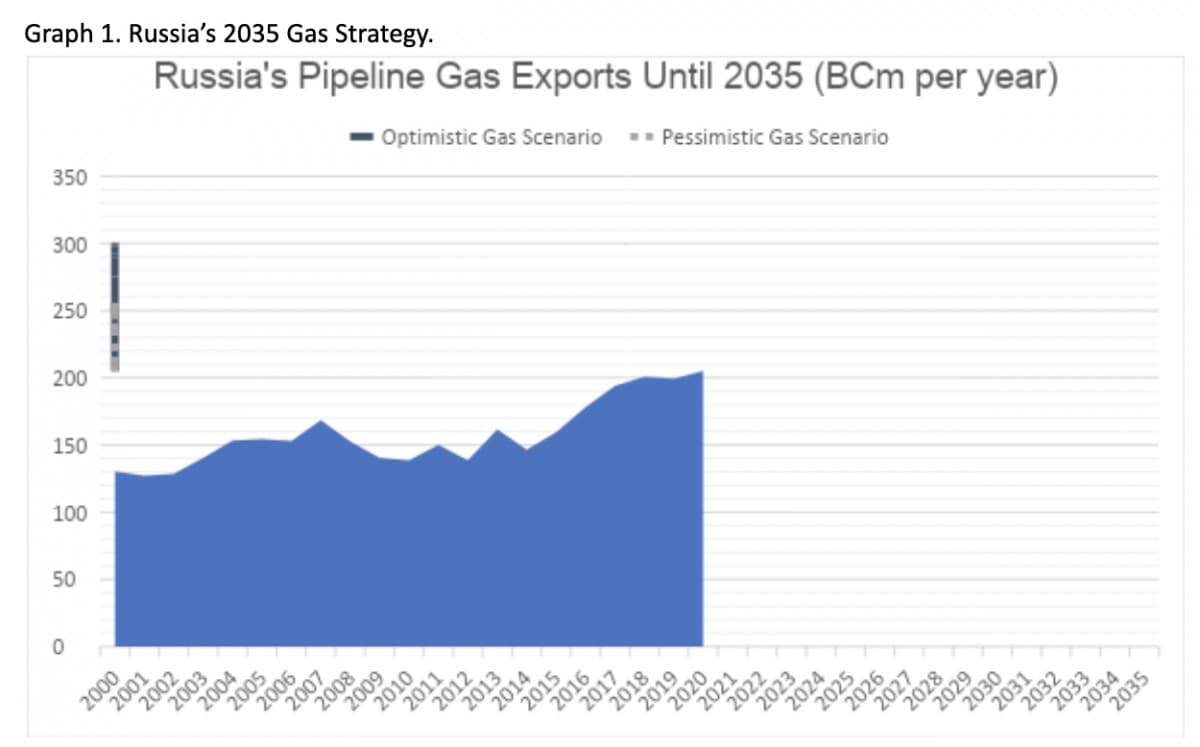
The framework for Power of Siberia-2 (also known as the Altai pipeline) was laid down in 2015 when Gazprom and the Chinese state-owned company CNPC signed a preliminary gas supply deal, without specifying the technicalities of pricing. Given that Pos-1 pricing talks took a decade to conclude, the tardiness of PoS-2 negotiations is hardly surprising. Yet at the same time Russian authorities are betting heavily on it happening – the recently issued Energy strategy-2035 sees pipeline gas exports reaching 300 BCm per year by 2035, of which 80 BCm per year will go to China, with European pipeline exports effectively stalling for the next decade and half. It has to be noted that the Energy Strategy also surmises a “pessimistic scenario”, whereby Gazprom’s gas exports increase from 220 BCm in the base year of 2018 to 255 BCm per year in 2035, meaning a slight decline in European demand and Power of Siberia-1 remaining the only China-bound gas conduit, with no Pos-2 construction taking place.


Graph 1. Russia’s 2035 Gas Strategy.


(Click to enlarge)
Source: Author’s data. 

Gazprom needs Power of Siberia-2 for many reasons. First of all, its immense 2P reserve base of 24.3 TCm (which keeps on increasing with time by 0.1-0.2 TCm in the last couple of years) compels it to act upon it whilst Eurasian economies still perceive natural gas as a bridging energy source and do not penalize its utilization. Second, China is the only easy-to-access market outlet whose demand for natural gas has still not peaked – once China reaches that stage, there remain only more adventurous and technologically complex variants (eg.: constructing a pipeline to South Korea, subsea or transiting North Korea). Thirdly, Gazprom might dovetail Pos-2 with one of its long-time ambitions – linking the gas transmission system of Russia’s Far East to the ones in Western Siberia and Europe. Given that still only 69 percent are connected to the federal gas transmission system, this would be a politically very useful objective.

Graph 2. Map of Power of Siberia-2.


(Click to enlarge) 

There is one additional novelty in how Power of Siberia-2 would look like – namely, the inclusion of Mongolia as a transiting country. Heretofore Mongolia has neither produced nor imported natural gas, hence Gazprom could potentially enter a completely new market. This being said, as of today the main reason for including Mongolia lies in the possible bifurcation of the pipeline so that at least some part of it heads towards northeast China. In addition to the above listed commercial rationale, the agreement, as indicated during President Putin’s meeting with Mongolian Prime Minister Ukhnaagiin Khurelsukh in December 2019, might also turn out to be a stepping stone to something much more politically complex. Despite all the benefits that Russia might garner from Power of Siberia-2, Gazprom has to face an array of challenges that will seriously jeopardize its viability.

Above all others, there is the question of Chinese pipeline gas demand – the Western route (from the Chinese point of view) pits Gazprom against Central Asian producers, namely Kazakhstan and Turkmenistan, who already have a separate conduit to supply the Chinese market. The 55 BCm/year capacity Central Asia Gas Pipeline was utilized last year to the extent of 87 percent (47.9 BCm), with most of the delivered gas coming from Turkmenistan. China remains the main market outlet for Galkynysh production, therefore unwanted competition in the form of Gazprom vying for a place under the sun would be hardly welcome news for Ashgabat. Thus, it is not only competition against LNG that Gazprom ought to win but also deal with a China-dependent Turkmenistan, all this against the background of tough-as-usual Chinese price negotiations. At least things have started moving after a prolonged lull.


4/01/2018

Will Gazprom Leave The Ukraine Forever?

https://oilprice.com/Geopolitics/International/Will-Gazprom-Leave-The-Ukraine-Forever.html

2/19/2015

Gazprom Hopes to Sign Second Gas Deal With China Soon

A monitoring instrument is seen on a gas distribution pipeline.

Πηγή: The Moscow Times
By Reuters
Feb 18 2015

Russian Energy Minister Alexander Novak said Tuesday he hoped Gazprom would finalize its second deal to export gas to China in the coming months.

Last year, Russia and China signed a $400-billion gas deal with exports via the yet-to-be-built Power of Siberia pipeline. Last November, Russia and China clinched a framework agreement for a second deal, known as the Western Route.

Novak also told reporters that Russia was awaiting specific proposals from the European Union to build a gas link from a new pipeline to run from Russia to a new gas hub at the Turkish-Greek border.


4/06/2013

SOCAR vs. Gazprom for Greece’s DEPA


Πηγή: New Europe
By KOSTIS GEROPOULOS
April 6 2013

BAKU – State Oil Company of Azerbaijan SOCAR is competing with Russian gas monopoly Gazprom for Greece’s public gas corporation, DEPA, which is being sold as part of the Greece's privatisation programme. But there is more at stake than just buying one more EU energy company.

SOCAR is likely to compete with Gazprom to control non-Russian transportation routes to Europe, Gulmira Rzayeva, Research Fellow at Azerbaijan's Centre for Strategic Studies, told New Europe in Baku on 5 April. This is a healthy competition in the tender bidding for the same stake although the companies' financial capacities are not equal, she added.

“The Azerbaijani company will also need the Greek gas transmission company to invest in the EU country’s downstream market, which is in line with SOCAR’s long-term strategy,” she said.

It seems that SOCAR does not want to let Gazprom take over the control of transportation of the gas via Greece, the only entry point to the South Europe, Rzayeva said.

Even if the Shah Deniz consortium picks Nabucco instead of the Trans Adriatic Pipeline (TAP) to carry 10 billion cubic metres of Azerbaijani gas to Europe, SOCAR wants to keep the Greek market in hand to use the infrastructure to export up to 1 billion cubic metres to the Mediterranean country via the Turkey-Greece Interconnector, she said.

Greece’s DEPA has 50% stake at the Greece-Bulgaria Interconnector (IGB). Another 50% belongs to Italian Edison. Edison is a close partner of Gazprom in the Russian-backed South Stream gas pipeline project as well as one of its biggest clients.

Considering the importance of IGB in the Southern Corridor, Gazprom, by influencing Edison, can freeze indefinitely the construction of the 168-kilometre pipeline, Rzayeva said, pointing out that during three years the construction of the pipeline has still not been completed.

A Memorandum for understanding has been signed between Bulgarian BEH EAD and the Greek gas distribution operator DESFA, which foresees natural gas supplies for the Bulgarian market through utilisation of the capacity of the Greek liquefied natural gas (LNG) terminal Revitusa, gas interconnection Greece-Turkey, as well as capacity in the Greek national gas network if required by the Bulgarian country in compliance with the national legislation.

Rzayeva said that by buying Greece’s DEPA/DESFA, SOCAR can also automatically get a share in IGB as DEPA has stakes in the project and push the project to finalise the construction.

Asked if Azerbaijan is interested in DEPA, Minister of Industry and Energy Natiq Aliyev told New Europe in Baku that this is a decision that concerns SOCAR. He added that it’s too early to say about interest in DEPA because it is not known which pipeline route will be selected.

Azerbaijan’s Shah Deniz consortium said on 1 April it started a final “detailed evaluation” on the Nabucco West and the Tran-Adriatic Pipeline (TAP) proposals. “At the end of June it will be clear,” Aliyev said, adding that Azerbaijan does not prefer one project over the other. “Both of them Nabucco West, TAP are a priority of the European Union. But I think for us there is no difference,” Aliyev said.

Rzayeva told New Europe that the final proposals submitted by Nabucco West and TAP as well as the sale and purchase agreements between gas buyers and the Shah Deniz consortium will play a key role in the decision.

“Both projects have their strengths and weaknesses. For example, to build TAP is cheaper than Nabucco. On the other hand, the Italian market can be oversupplied in the short-term and gas demand there will not grow,” Rzayeva said. “More or less both projects are now equal. It’s the final countdown. We have to wait two more months to see."


4/05/2013

For Cyprus, Gaslight at the End of Tunnel?


Πηγή: New York Times
By STANLEY REED
April 5 2013

LONDON — If there are any bright spots in the gloom surrounding the economy of Cyprus, one place to look would be about 170 kilometers south of the coastal city of Limassol. There, about 1,700 meters below the surface of the Mediterranean Sea, is a potentially lucrative natural gas field called Aphrodite.

Noble Energy, the Houston-based company that found Aphrodite in 2011, so far has drilled only a single exploratory well in the mile-deep water 100 miles south of the island. But based on that early look, the company estimates that the field contains 142 billion cubic meters to 227 billion cubic meters, or 5 trillion to 8 trillion cubic feet, of gas. It is a significant find — potentially worth $45 billion or more at current prices, if it proves extractable. That would be enough to supply Cyprus’s domestic needs for years and turn the debt-strapped island country into an energy exporter.

“I am certain that gas will be the answer to our future,” said Charles Ellinas, chief executive of the Cyprus National Hydrocarbons Company, a state concern that was recently formed to help spearhead development of a Cypriot natural gas industry.

Cyprus has the potential to become one of the hubs of an eastern Mediterranean region that could become an important source of natural gas for Europe, with political unrest making supplies from North Africa uncertain.

Over the past two decades an Israeli-American-led group of small and medium-size oilcompanies has made a series of big discoveries in what is known as the Levantine basin, a vast area loosely bounded by Cyprus, Syria, Lebanon, Israel and Egypt. Israel, which has begun gradually tapping the gas, began production in a big offshore field called Tamar on March 30.

Gideon Tadmor is the chairman of Delek Drilling and chief executive of Avner Oil, affiliates of Delek Group, an Israeli company that has led exploration in the area since the 1990s. He said the Israeli oil explorers had taken their cues from successful earlier exploration to the south, in waters off Egypt. “We had a notion there was a good reason for the geological play to extend beyond the geopolitical borders,” Mr. Tadmor said.

While it is still hard to predict how large an exporter the eastern Mediterranean might eventually become, it is attracting industry attention well beyond the region.

“If you look at new sources of supply in the eastern Mediterranean, with what we’ve seen in Cyprus, in Israel and other places — you’ve got to say those will probably be the real competition,” said Al Cook, a vice president on the giant Shah Deniz pipeline project that BP is leading in Azerbaijan, which is meant to transport natural gas to Europe.

But enabling the Mediterranean to approach its energy potential will require navigating potentially treacherous politics. Any export deals by the Greek Cypriot government in Nicosia will risk the ire of Turkey, which warned during recent bailout negotiations that the Turkish Cypriot northern part of the island should share in any exploitation of natural resources. Cyprus has been divided since a Turkish invasion in 1974.

Meanwhile, Israel, where larger gas finds have been made by Noble and Delek, will also need to figure out what export routes make geopolitical and economic sense.

Top priority will go to making sure that the country, which has long been overly dependent on imported fuel, is assured of sufficient domestic supplies before the Israeli government authorizes exports.

When the government does choose export routes for its gas — a decision expected soon — security and political considerations probably will take precedence. While pipelines might be less expensive, Israel is wary of sending gas north through Syria and Lebanon, both of which, by the way, may have their own offshore gas deposits.

Mr. Tadmor said many options were on the table for Israel as the industry awaited a decision from Prime Minister Benjamin Netanyahu’s new government on whether to permit exports and in what form.

“It could be L.N.G. onshore or offshore and also piped gas solutions like Jordan or even Turkey,” he said. L.N.G. is liquified natural gas, which can be carried on special tanker ships.

The recent thaw between Israel and Turkey brokered by President Barack Obama has made energy cooperation between the two countries more likely. Sending gas to Egypt, which has been running short of late, is also possible, analysts say.

Also under consideration is piping some Israeli gas to a Cypriot L.N.G. processing plant — if one is built. Some of the companies are involved in both Cyprus and Israel. And the Aphrodite field may extend into Israeli waters, analysts say, which would be further reason for the countries to collaborate.

Mainly, it is the lure of substantial amounts of natural gas within easy reach of Europe — a huge consumer and importer of the fuel for industry and power generation — that has drawn some major fossil-fuels players to Cyprus. In January, Eni or Italy, with the Korean giant Kogas as a 20 percent partner, signed an exploration deal for a vast swath of sea bottom off Cyprus. France’s Total signed a similar agreement with Cyprus a month later.

“It is promising for Cyprus that companies the caliber of Eni and Total are getting involved — that is an early sign of confidence,” said Catherine Hunter, an analyst at the energy research firm IHS in London.

As for Cyprus, it is uncertain how much the country’s gas can do for its besieged economy, and how quickly. In one big concession in its recently arranged bailout, the troika of international lenders — the International Monetary Fund, the European Central Bank and the European Commission — agreed that the country’s gas reserves would remain under Cypriot jurisdiction.

Noble and its partners are still preparing to drill a second well to begin confirming the size of Aphrodite. So far, the volumes of gas that the companies think they have discovered, while suggesting a large find, are not far above the minimum analysts say would justify building a multibillion dollar facility to liquify the gas for ship transport.

Mr. Ellinas says that L.N.G. is the preferred option for exporting the gas but that the big liquification plant he envisions for Vassilikos, an industrial site on the south coast, would cost $6 billion for the first of what might eventually be three export units.

But if it can be cost-justified, such a plant wold give “us flexibility, security and everything else,” he said. “We can export to Europe and everywhere else. If you have a pipeline and gas prices go down you are stuck.”

Construction of an L.N.G. plant would take four to five years, once a final investment decision was made and could stretch the finances of the Cypriot government and the balance sheets of the companies that hold the leases for the Aphrodite field.

To put the potential construction bill into perspective, Cyprus’s entire economy — before the crash, at least — was only about €18 billion, or $23 billion, and the country is counting on its recently arranged €10 billion bailout to keep its banks from further collapse.

Noble, for its part, has a relatively modest annual capital budget of about $4 billion, and has commitments elsewhere, including Israel.

One banker, who insisted on not being named because of the sensitivity of the matter, said that the costs of developing Cyprus’s deepwater gas would probably be so high that an L.N.G. project would be only marginally profitable for the government at current gas prices, unless more gas was found. Mr. Ellinas, though, predicted that much more would be discovered.

Other options include a less-expensive floating L.N.G. facility. The cheapest approach might be an offshore pipeline to Turkey. But no matter how grim its financial predicament the government of Cyprus might have little interest in supplying Turkey, its longtime enemy.

“A subsea pipeline is a lot cheaper than an L.N.G. terminal, but a no-go politically,” said Laura El-Katiri, a research fellow at the Oxford Institute for Energy Studies.

Of course, Cyprus’s financial meltdown could lead to new attitudes. The country could come under pressure from its international creditors to adopt quicker ways to turn gas into cash — even if it meant a Turkish pipeline. And the role of Mr. Ellinas’s company, which was created by the previous Cypriot government, voted out of office in February, may come under review, Ms. Hunter said.

L.N.G. might be the preferred choice of the Israelis. A liquification plant would be easier to guard, than a long pipeline, which could be cut. Or if Cyprus built a plant, Israel might want to shunt some gas to that facility, to gain economies of scale. Delek, an Israeli company, is already a minority partner in Aphrodite.

“Setting up an export facility in an area under Israeli control appears to be the best alternative,” said an Israeli interministerial committee in September. The committee also recommended that a major international company be brought in to orchestrate development of the gas industry.

The offshore Tamar field, which began piping gas to the Israeli domestic market in late March, was developed by a consortium led by Noble and Delek. Tamar alone is enough to power the Israeli economy for many years.

Now the two companies are working on plans for exploiting a much bigger field near Cypriot waters called Leviathan, which is double or triple the size of estimates for Aphrodite.

In December, Noble and its Israeli partners brought in and experienced L.N.G. player by reaching an agreement in principle with Woodside Petroleum, a company that operates a half-dozen L.N.G. plants in Australia. Woodside said in a statement at the time that the pact, which gives it a 30 percent stake in Leviathan, could lead to “a key role in the potential development of a liquefied natural gas industry in Israel. ”

Mr. Ellinas, of Cyprus, said he hoped that the Israelis would use the Cypriot L.N.G. plant and would hook Leviathan into it. That solution would certainly be one way to reduce costs. But in the end, each country may want to keep its big gas-processing investments close to home. In a tough neighborhood, control may trump economics.


4/03/2013

What Happens to Cyprus’s Natural Gas with the Current Bailout Plan?


Πηγή: Oilprice
By James Burgess
April 2 2013

Where does the Cyprus bailout deal leave its energy reserves?

It has been estimated over the years that the southeastern waters of Cyprus contain 50 to 60 trillion cubic feet of natural gas and 1.7 billion barrels of crude oil, worth around $400 billion.

The government in Nicosia has always based plans for the future on this projected income, so the idea of raising money based on future natural gas revenues as a means to alleviate some of the pressure caused by the immense debt that the island nation found itself in, was out of the question.

Natural gas production is not expected until around 2018 or 2019, and Cyprus refused to use any discounted future valuations to raise money in the present, not wishing to run the risk of selling their future for far less than it might be worth.

After the first bailout plan offered by the EU was rejected, however, a viable option that was considered was to accept direct financial assistance from Russia in return for the rights to explore and develop Cyprus’s natural gas.

This worried the EU who had, for a long time, been hoping that Cyprus’s natural gas would offer genuine relief from an almost complete reliance on Russian exports.

Luckily the deal with Russia never really materialised, and, possibly motivated by the fear that Russia could get hold of the gas reserves, Europe was able to agree a deal with Cyprus, leaving all natural gas reserves completely untouched.

Unfortunately analysts are predicting that this bailout plan will be just the first step on the road to recovery, and the security of the natural gas reserves may be threatened again in the future as Nicosia looks for other methods to raise capital.


3/29/2013

Turkey sees three alternatives for Cyprus, all involving gas


Πηγή: Cyprus Mail
March 29 2013

TURKISH Foreign Minister Ahmet Davutoglu has proposed three alternatives to end the stalemate in Cyprus, all involving the exploitation of natural gas around the island.

According to Turkish channel NTV, the Turkish minister said he has proposed three alternative endings for the Cyprus problem.

Either the two communities form a united Cyprus state and jointly exploit the natural resources around the island, or, in parallel to ongoing peace negotiations, Greek Cypriots and Turkish Cypriots form a joint committee to exploit and market natural gas.

The third option is a two-state solution on the island.

According to NTV, the minister said all three proposals were formulated within the framework of how to make use of the natural resources in the island’s exclusive economic zone (EEZ).

Turkey has strongly objected to Cyprus’ early development of its energy sector in its EEZ through the awarding of exploratory licences to French, Italian, South Korean and American energy companies.

The Turkish government argues the natural resources belong to both communities on the island and, as a non-signatory to the UN Convention on the Law of the Sea, even claims parts of Cyprus’ EEZ for itself.

As Cypriot leaders recently scrambled to find €5.8 billion to unlock a €10 billion troika bailout, the idea of borrowing money in lieu of future gas revenues triggered an immediate response from Turkey.

The Turkish Foreign Ministry released a statement saying: “It is not acceptable that the Greek Cypriot side uses the economic crisis it is facing as an opportunity to create new fait accompli.”

It added that the “only way to exploit the natural resources of the island” is “the clear consent of the Turkish Cypriot side regarding the sharing of these natural resources”.

Having seen their economy pummeled in the last two weeks, with talk of recession and a massive drop in GDP in the coming months and years, many Greek Cypriots are now resting their hopes on the plentiful natural gas reserves believed to be sitting in Cyprus’ EEZ.

Some commentators have argued now that Cyprus is under the economic gun, and in desperate need of proceeding rapidly with gas exploration, international efforts should focus on nudging or perhaps even pushing the Cypriots towards a solution to the island’s division.


3/25/2013

Turkey and Israel change the gas game


Πηγή: Cyprus Mail
By Stefanos Evripidou
March 25 2013

THE US-brokered Israeli apology to Turkey has opened the door to the resumption of close relations between the two former allies and raised the prospect of energy collaboration in the eastern Mediterranean, raising questions as to the potential impact on Cyprus’ own gas plans. 
 
Last Friday, Israeli Prime Minister Benjamin Netanyahu expressed Israel’s apology to Turkish Prime Minister Tayyip Erdogan “for any mistakes that might have led to the loss of life or injury” during the raid on the Turkish ship Mavi Marmara, which tried to reach Gaza in 2010, resulting in the death of nine Turkish activists.

The next day, Erdogan said Israel’s apology highlighted Turkey’s growing regional clout. 

“We are entering a new period in both Turkey and the region,” said Erdogan, who plans to visit the Palestinian territories, including the Gaza Strip, next month.

“We are at the beginning of a process of elevating Turkey to a position so that it will again have a say, initiative and power, as it did in the past,” he said.

Netanyahu, in a post on his Facebook page on Saturday, said deteriorating circumstances in Syria were a main factor behind his decision to resolve the crisis with Turkey.

According to Reuters, a source close to Netanyahu said the new chapter in Turkish-Israeli relations could be very important for the future not just regarding what happens in Syria but also developments in Iran. 
 
Apart from removing Turkish objections to Israeli participation in NATO exercises, the prospect of reconciliation has also “removed a big obstacle to collaboration over the development of strategic energy resources in the eastern Mediterranean”, reported the Financial Times (FT) yesterday. 

The London-based paper noted that improved ties between Turkey and Israel could also affect Cyprus should greater energy cooperation result in Nicosia getting sidelined. 

A Turkish official told FT that reconciliation also made a possible gas pipeline from Israel to Turkey a “much more viable” idea. 

According to FT, Noble Energy and Delek Energy, who are the main investors in Israel’s large offshore natural gas fields- as well as partners in Cyprus’ Block 12- have in recent weeks “sounded out possible customers in energy-hungry Turkey”. 

The paper noted that until now, the private sector was eager to proceed with a possible pipeline between Israel and Turkey but that the political rift between the two governments did not allow progress to be made.
With the first step in reconciliation taken, will further collaboration in the hydrocarbons sector leave Cyprus with fewer choices as to where and how to export its own gas? 
 
Israeli deputy ambassador to Cyprus Shani Cooper said yesterday: “The normalisation of relations between Turkey and Israel was an important bilateral step but it will not affect any multilateral, trilateral or bilateral relations between Israel and other countries. Israel will maintain its close relations with Cyprus, and continue strengthening them as we have done the last few years.” 
 
Matthew Bryza, a former US ambassador to Azerbaijan, was quoted by FT saying that without Israel to provide economies of scale, “in the short term the Cypriots lose their ability to do a pipeline or an LNG (liquefied natural gas) option”, adding that in the longer run a Cypriot pipeline to Turkey would make most commercial sense.

However, speaking to the Cyprus Mail, an industry insider argued that a pipeline from Cyprus to Turkey was not so obviously beneficial, even if the financial savings appeared attractive at first glance. 

“You’ve got a 25-year project. Are you comfortable having Turkey being your best friend for that length of time? With LNG, you can change your customers, do whatever you want. With a pipeline to Turkey, you only can sell to Europe, and the pipeline to Europe is too far,” he said. 

The source argued that LNG was the best option for Cyprus: “The key is to find enough gas to make it commercial. And if you can add gas from the nearby Israeli gas field Leviathan, even better.” 
 
A Cypriot diplomatic source told the Cyprus Mail that reports suggest Turkey is seriously considering a pipeline between Israel and Ceyhan. 

“This could very well be a game-changer. There is much more (to the apology) than meets the eye,” he said.
“It is naive not to think that they will put everything in one basket in the future: the Cyprus problem, hydrocarbons, Erdogan’s water pipeline project. All of this will come to a head,” he said, adding, “With Cyprus’ gas reserves, there is a light at the end of the tunnel, but let’s hope it’s not a train.” 
 
Regarding a pipeline between Israel and Turkey, another diplomatic source reminded that Israel has yet to even take a decision on whether it will allow the export of natural gas. The latest opinion of an advisory committee of the Israeli government is that if gas should be exported, it will have to go through Israel first.
The industry source argued that it was too early to tell whether a Turkey-Israel pipeline was even feasible both politically and physically. 

One has to take into consideration the route that any pipeline would take. Will it pass through Lebanese and Syrian waters or go around them by cutting through Cyprus’ Exclusive Economic Zone (EEZ)?
“We’re talking about going up against horrendous engineering challenges. And it’s not just about building it, but maintaining it. It’s doable but it won’t be cheap,” said the source. 

Should Israel and Turkey decide to go ahead with the pipeline, the industry source argued this would not affect Cyprus’ decision to build an LNG plant initially with one train to accept gas via pipeline from Noble’s Block 12 A-structure, which has an estimated 7 trillion cubic feet of natural gas.
The thinking behind the ‘stand alone’ project is to get gas from the Aphrodite field in Block 12 to the LNG plant earmarked for construction at Vassilikos by 2019. 

“This is an aggressive, challenging but achievable target,” said the source.
 
Should more gas be found in other parts of Block 12, or in the blocks recently acquired by French, Italian and South Korean companies, Total, ENI and KOGAS, then more trains will be built at the LNG plant to take in more gas. The current thinking is that Cyprus’ EEZ has plenty of potential for more hydrocarbon discoveries. 

The source argued that a pipeline from Block 12 to Vassilikos and the operation of an LNG plant are not dependant on the inclusion of Israeli gas from the nearby Leviathan gas fields. In any case, should Israel agree to export its gas, it would have to build its own pipeline to Vassilikos as the depth of water in the region does not allow a big enough pipeline to be built to cover the needs of both Aphrodite and Leviathan fields. 

Asked whether the current economic crisis in Cyprus could affect energy development, the source said only if the government should take its foot off the pedal, though at the moment, it “seems willing to proceed expeditiously”. 

He added: “The whole project could provide very robust and meaningful amounts of money that would be coming into the country.” 

Regarding press reports that Russia could participate in the financing of an LNG plant, the source said Russia would then have a say over the tariff charged to gas companies using the plant. 

“If the Russians want to make a killing they will have very high fees, making LNG very costly, and as a result, Cyprus won’t make a big profit. If they’re reasonable, it could work. But you don’t want someone not totally trustworthy having their hand around your throat.”


3/14/2013

Gazprom Mulls for an Eventual South Stream Link to Greece

Gazprom CEO Alexey Miller and Greek PM Antonis Samaras

Πηγή: Natural Gas Europe
March 14 2013

The visit of a high-level delegation from Gazprom headed by CEO Alexey Miller to Athens for talks with Greek stakeholders has led to an announcement concerning local and regional natural gas politics.

Following discussions with the Greek Premier Antonis Samaras, Miller revealed that his company still has plans to link the country with South Stream, although there was no mention of taking the pipeline all the way to Southern Italy. This implies that the Russian strategy is to use Greece as a potential LNG hub, supplied by South Stream.

When Gazprom announced plans in November 2012 to take out the Greece-Italy route from the pipeline, this further supported the general trend of Russian natural gas corporations such asNovatek to move towards the global LNG trade in a more dynamic fashion, since the Asian and EU markets are said to need substantial amounts of that gas over the coming decades, a strategy that Natural Gas Europe reported on at the time.

There is also the question of the Trans-Adriatic Pipeline (TAP), which is currently vying withNabucco West for the transfer of Azeri gas to the EU. Greek media reported after the delegation's visit that in fact both projects could co-exist since they will transfer different sources of gas, potentially reducing prices at a pan-European level and at the same time they could open up a lucrative LNG market for the whole of Southern Europe.

Talks between the two parties also revolved around the intention of the Greek government to request substantial deceases in the price of gas imported by Gazprom and in respect to the long-term contract, which ends in 2016. According to recent DEPA announcements, Greece is seeking a minimum 15 percent price cut in order to renew the contract for a minimum of 10 years.

The official Russian response regarding the DEPA-DESFA privatization was to request "fair treatment" by Greek authorities citing fears of political interference by other energy players or local business interests. Concurrently, the recent change of the head of the agency responsible for the privatization (TAIPED) resulted in a two week delay for the submission of the final binding offers, with a new date set for the 29th of April 2013.

TAIPED provided the opportunity to those involved to join in their final bid with other companies, aiming to attract more interest from European corporations, and since there is no development on this front, Gazprom and Sintez-Negusneft are left as favorites to win due to their higher offers and presumed more extensive business/gas plan.

Information from a variety of sources within the Greek energy community reveal the possibility that SOCAR and PPF-GEK will not submit a final offer for DESFA, thereby leaving Sintez as the sole competitor by the end of April. This information has not been able to be verified by the respective companies, which seem to prefer a low profile regarding their involvement in the competition.

A clear indication from the above is that Gazprom is still undecided and prefers to "wait and see" if it will suit its strategy to lay a pipeline through Greece and the decisive factor would be the outcome of its bid for DEPA.

Lastly, it is of great interest to view the month by month delays of the privatization process that seem to coincide with the announcement of the successful bidder for the Southern Corridor route, another assessment Natural Gas Europe made previously. Overall there is certainly a formation of a regional gas and political triangle between South Stream, Greek privatization and the Southern Corridor, in addition to newly discovered gas in the eastern Mediterranean. In that sense, a multilayered energy game is in full swing with tremendous interest for all key energy players in Europe.


2/28/2013

Greece and Turkey Spar Over Aegean Energy


Πηγή: Oil Price
By Alex Jackson
Feb 28 2013

The relationship between Turkey and Greece has improved immeasurably over the past few years. Once locked in a miniature Cold War, Ankara and Athens have now realised that they need to cooperate on a host of issues – particularly gas transit. But as many other countries have come to realise, natural gas is just as often a source of division as cooperation. A new row over offshore drilling rights, along with the ongoing disputes over eastern Mediterranean gas, is posing new difficulties for their relationship.

In January news reports began to circulate that Greece was planning unilateral drilling in disputed areas, prompting a cautious warning from Turkey. Not much more was heard until, in mid-February, Greek Prime Minister Antonis Samaras insisted that Greece has the right to explore for oil and gas anywhere within its territory and that it could declare an Exclusive Economic Zone (EEZ) for that purpose.

The following day, Greece submitted a note to the United Nations raising the issue of “Turkey’s granting of exploration permits [for oil and gas drilling] for areas of the Greek continental shelf” which, Athens said, violated the UN Convention on the Law of the Sea.

Ankara promptly responded by vowing to submit its own note to the UN and take appropriate counter steps. Turkey said that “the licenses that Turkey has given to the TPAO since 2007 are within the borders of the Turkish continental shelf in the Eastern Mediterranean and Turkey has sovereign rights concerning exploration and drilling for natural sources in these fields.”

The dispute over maritime boundaries in the Aegean and eastern Mediterranean has been rumbling on for decades, complicated by the presence of Greek islands near the Turkish coast. Both sides have threatened to use force if the other drills in what they see as their own waters.

As Turkey noted, TPAO has been granted exploration licences in the Aegean and Mediterranean since 2007, although activity since then has been limited. In 2008 Turkey conducted some exploratory work in Turkish waters and in late 2009 TPAO reportedly discovered gas in the area but little has happened subsequently. International investors are cautious until absolute clarity on continental shelf and EEZ rights can be assured.

So why has the dispute flared up again, and what does it mean for the regional gas picture? The answer to the first question is clearer. Samaras was speaking shortly after French President Francois Hollande visited Greece and expressed interest in French firms helping to explore for oil and gas in the Aegean. Total is reportedly keen to drill in the Aegean, which is believed to be extremely prospective but remains under-explored due to the political tensions. Reportedly Hollande is already encouraging Athens to lease two French frigates for the exploration, though whether as escorts or to be fitted with seismic equipment is unclear.

Samaras’s statement also came just a few weeks before he visits Ankara with members of his Cabinet for high-level meetings. Announcing Greece’s right to declare an EEZ and drill in the Aegean was a clear statement of intent to the Turks in advance of that trip, even if he hasinsisted that a peaceful solution must be found.

Greece is evidently laying its cards on the table and trying to force some movement on the Aegean border issue. Turkey, however, is unlikely to compromise. It is already at loggerheads with (Greek) Cyprus over natural gas issues in the eastern Mediterranean and sees Greece as the endpoint of an axis running from Israel and through Cyprus. Ankara has already warned the three states that a subsea pipeline isn’t going to happen; the fact that Total has recently signeda deal with Cyprus to drill offshore (a decision which blackballs it from working in Turkey) underlines the connection.

Given Turkey’s sense of a confrontation stretching from the Aegean to the Levant, and its efforts to increase its own offshore drilling, don’t expect Ankara to compromise on Greek demands. Samaras almost certainly knows this. But Greece’s economic woes have raised the stakes. Developing a new source of revenue whilst also flying the flag for sovereignty might be a popular move.

Worsening Turkish-Greek relations may have an impact on wider gas export patterns. Most obviously it would exacerbate existing tensions in the eastern Mediterranean between Turkey and Cyprus, as both relationships tend to influence each other. The chances of a rapprochement between Ankara and Nicosia on energy, or of a subsea pipeline from Israel, would get even slimmer.

Indirectly it could also affect the chances of the Trans-Adriatic Pipeline being chosen by the Shah Deniz consortium in June. Formally of course the decision of the consortium, in which TPAO has a small stake, is not supposed to be at all political. But in practice a political crisis over the Aegean, or a Turkish decision to suspend energy cooperation with Greece on existing gas pipelines, would raise serious questions about the viability of another pipeline crossing between them.

For now both sides are committed to dialogue and finding a constructive solutions. Greece and Turkey have come a long way in the past few years: this is not 1987, when attempted hydrocarbon exploration by Turkey almost led to a military confrontation. But the energy stakes in the Aegean could be very high, and both sides will try and take things down to the wire.


2/25/2013

Cheney-Linked Company to Drill in Occupied Golan Heights

Richard Cheney, K. Rupert Murdoch and Lord Jacob Rothschild are in the Genie's Board of Diectors.

Πηγή: Oilprice
By Daniel J. Graeber
Feb 24 2103

The Israeli government awarded a local subsidiary of U.S.-based Genie Energy the rights to explore for oil and natural gas in about 150 square miles of the southern section of the Golan Heights. The United Nations last year extended the mandate for the region's U.N. Disengagement Observer Force mission, one of the oldest peacekeeping missions, for another six months. U.N. Secretary-General Ban Ki-moon said keeping Blue Helmets stationed in the area was essential to peace given the potential for conflict spilling out of the Syrian civil war. Genie Energy said there may be a significant amount of oil and natural gas in the license area. When Israel set its sights on offshore natural gas, Hezbollah warned that Israel shouldn't encroach on Lebanese territory. If recent concerns about Hezbollah's influence are any indication, the Shiite resistance movement may focus its guns onshore amid expanding Israeli energy interests. With former U.S. Vice President Dick Cheney serving as an adviser to Genie, however, the implications may go beyond immediate worries over Hezbollah.

Genie Energy said there may be "significant quantities" of natural resources in the region. The license area encompasses about 150 square miles of the southern portion of the Golan Heights, considered territory occupied by the Israeli military.

"Genie Energy intends to conduct an exploration program to further investigate the size and quality of the resource in the new license area," the company explained in a statement.

Last year, Israeli Energy Minister Uzi Landau said the government was looking to open the territory up for oil and natural gas exploration. Israel claims the territory as its own after capturing the region in a 1967 war with Syria. In November, UNDOF peacekeepers monitoring the 1973 cease-fire between Israel and Syria came under fire near Damascus during a troop rotation. U.N Secretary-General Ban Ki-moon said he was concerned the Syrian civil war could spillover the borders given the latest escalation of violence. Last month, the United Nations expressed further concern amid reports that Israeli planes flew over the region to conduct an air strike on Hezbollah territory in southern Lebanon.

Landau's comments last year came amid optimism about natural gas reserves located off Israel's coast. The Tamar natural gas field is said to hold as much as 8.4 trillion cubic feet of natural gas. The Leviathan field may hold nearly twice that, with an estimated 16 trillion cubic feet of natural gas. Located more than 50 miles off the Israeli coast in the Mediterranean Sea, Lebanon contends some of that natural gas may lie in its territorial waters. Two years ago, Hezbollah warned that it wouldn’t tolerate any company working offshore where sovereignty is uncertain.

"The Israeli enemy cannot drill a single meter in these waters to search for gas and oil if the zone is disputed," it warned.

Hezbollah claimed victory in a 2006 war with Israel. Since then, Hezbollah has come under fire for ties to a terrorist attack on Israeli tourists in Bulgaria. Last week, former Lebanese Prime Minister Rafik Hariri saidhe was concerned the Lebanese government was ceding military control over the southern borders to the Shiite movement, which holds Cabinet-level positions in the Lebanese government.

Israel has faced increasing isolation for its settlement activity in the West Bank and for violating the border of its northern neighbors. A 1993 foreign policy doctrine from Israel's ally Washington, meanwhile, linked U.S. national security interests as they relate to oil and natural gas tacitly to Israel's security.

"The United States is committed to the security of Israel and to maintaining the qualitative edge that is critical to Israel's security," it read.

That document was drafted with the help of then Defense Secretary Dick Cheney. He's serving as an adviser to Genie as it plans work in an area encompassing about 30 percent of the Golan Heights. U.S. President Barack Obama, meanwhile, has plans to visit Israel next month. Cheney expressed recent concern that the Middle East was "as dangerous now as it has ever been" under Obama's leadership. With Cheney working the back channels, that "qualitative edge" may manifest itself in drilling operations in the occupied Golan Heights, a powder keg for potentially broad-based war in the Middle East.


2/12/2013

Israel, Cyprus Sign Gas and Oil Deal


Πηγή: Israel National News
Feb 11 2013

Israeli firms Delek and Anver signed an agreement Monday to acquire a 30 percent of rights to explore for gas and oil off the Cyprus shore.

Israeli firms Delek Drilling and AnverOil and Gas Exploration signed an agreement Monday to acquire a 30 percent stake in exploration rights for gas and oil off the southern shore of Cyprus.

The drilling is to be carried out by U.S.-based Noble Energy. Both Delek and Anver own majority rights in Israel’s own mammoth gas discoveries, the Leviathan and Tamar fields off Israel’s northern coast.

Cypriot Commerce Minister Neoclis Sylikiotis acknowledged in making the announcement that the deal provided a “new era of Cyprus-Israeli strategic cooperation which includes economic and political dimensions,” AFP reported.

The deal comes less than a week after Cyprus signed an agreement with French energy giant Total, to conduct exploratory drilling for gas and oil in two blocks off its southern shore.

Noble Energy, Inc was the first to drill when awarded Block 12, after Cyprus launched its search for an underwater gas field in 2007.

In December 2011, Noble announced it had discovered natural gas reserves of up to 8 trillion cubic feet (226.5 billion cubic meters), at an estimated value of 100 billion euros.

Cypriot analysts estimated the field could satisfy domestic needs “for decades” and enable the country to become a regional player with the export of gas to Europe by 2019.


2/02/2013

CEO of Sintez Group: 'Greece’s transformation into a natural gas transit hub for Europe'


Πηγή: Natural Gas Europe
Jan 29 2013

The CEO of Sintez Group, Andrey Korolev, provides us his views and comments regarding the participation of Sintez's subsidiary Company Negusneft in the privatization competition for the Greek natural gas companies DEPA & DESFA.

He answers on the key questions surrounding this privatization, especially competition issues, corporate challenges and considerations, along with Negusneft’s future intention regarding the Greek natural gas market.

"If we win the DEPA/DESFA auction we will be committed to comply in full with EU energy regulation"

What are the general intentions regarding Negusneft's participation in the DEPA-DESFA privatization process, and more specifically, how does your company view the prospects of the Greek natural gas market?

“We believe that DEPA and DESFA are high-quality assets that can play a meaningful role inGreece’s transformation into a natural gas transit hub for Europe. This development would clearly be of benefit to the Greek economy through diversifying Europe’s gas supply options and ultimately bringing gas prices to a more competitive level, with lower energy prices being a key element of any long term economic recovery. As a long-term player in the Balkan’s energy market, SINTEZ wants to play a role in that transformation.

DEPA and DESFA are a natural fit with SINTEZ Group’s existing business assets in the Balkans, namely our combined cycle heat and power project in Skopje, which we have already been in talks with Greece about connecting to DEPA via a Greece-Skopje interconnector project. There are a number of additional infrastructure-related opportunities that make DEPA and DESFA a strong platform for growth in the region.

The challenges that Greece is currently facing cannot last forever. Having operated for 25 years in the former Soviet Union and countries such as Namibia and Indonesia, our company is quite adept to working in such challenging and transitional environments.”

What is your opinion regarding any challenges you may have experienced as a company during the privatization process thus far and how do you assess your communication and cooperation with the Greek authorities?

“We are pleased that the HRADF (Privatization agency) recently has commenced the final round of the privatization of DEPA and DESFA, albeit later than was originally announced. Now, shortlisted companies, including SINTEZ subsidiary Negusneft, will have access to the data room and necessary documentation in order to put together a comprehensive binding offer for DEPA and DESFA.”

It would be of great interest to note from you, around the future projects or strategy by your company in relation to DEPA-DESFA. How do you see a potential partnership unfolding and what may be your investment plans for these companies?

“Clearly, the transformation of Greece into a gas transit hub for Europe will require a great deal of investment for new infrastructure. However, it goes without saying that the development of the Greek gas market will be beneficial for the country, as it can create new jobs and, more importantly, diversify natural gas supplies into the country, thereby spurring competition and having a positive effect on gas prices in the region.”

With regards to another issue that has recently gained prominence in the EU and Greece, that is the competition rules as implemented by Brussels and the compliance of natural gas companies with the Thrid Energy Package. In your view, does this affect your company in relation with its intentions to bid for both DEPA & DESFA?
“SINTEZ Group is an independent company and we do not have the conflicts of interests as with some other bidders, who are state-owned gas producers. If we win the DEPA/DESFA auction we will be committed to comply in full with EU energy regulation, while at the same time diversifying gas supplies and investing in infrastructure to transform Greece into a natural gas transit hub. We remain confident that given our strategic focus on the Balkans and relevant sector expertise, SINTEZ Group is the right fit to further develop DEPA and DESFA.”


".