
Showing posts with label Gazprom. Show all posts

5/04/2020

Russia’s Gazprom Moves Forward With New Mega Pipeline


Source: Oil Price
May 3 2020
By Viktor Katona

The Russian gas export monopoly Gazprom has hit the wall with new European projects – Nord Stream 2 will be finished at some point in the second half of 2021, the exact route of TurkStream’s second line remains veiled in ambiguity and no other major gas importer voiced their interest in carrying out a new project. Thus, the only remaining prospect for growth lies in Eastern Asia and primarily China. Apart from a tangible gas market saturation in Europe, there are two main premises for a second-phase Gazprom expansion into China: its largely untapped Eastern Siberian gas reserves that would be very costly to move all across Russia onto European markets and the competitiveness of Russian pipeline gas on the Chinese market.

Gazprom’s current China-bound project, the 38 BCm per year Power of Siberia (PoS) pipeline, started up in December 2019. Surprisingly, the Russian firm halted gas exports via PoS mid-March for a (previously non-indicated) two-week maintenance which turned out to be an elegant way of circumventing the massive demand drop in China. Even with another round of maintenance announced for autumn, Gazprom should be able to meet its export target for 2020 – 5 BCm, rising steadily to 10 BCm per year in 2021 and 15 BCm in 2022. By 2025 Power of Siberia should reach its nominal capacity and it is the next step after that currently exercises the minds of Russian policy makers and gas traders alike.

The contours of the next major project have been emerging for some time already – the idea to construct Power of Siberia-2 (PoS-2) was flaunted already in the early 2010s, its purpose being of meeting the gas requirements of Western Chinese provinces via Mongolia. This late March Gazprom’s request of conducting a feasibility study for PoS-2 has found President Putin’s approval. The projected pipeline would have a throughput capacity of 50 BCm per year and would be traversing Russia’s Altay region before crossing over to Mongolia and Western China. The first thing that struck market observers was that at some point in early 2020 the capacity of Power of Siberia-2 was upgraded from a preliminary estimate of 30 BCm per year to an officially presented volume of 50 BCm per year.

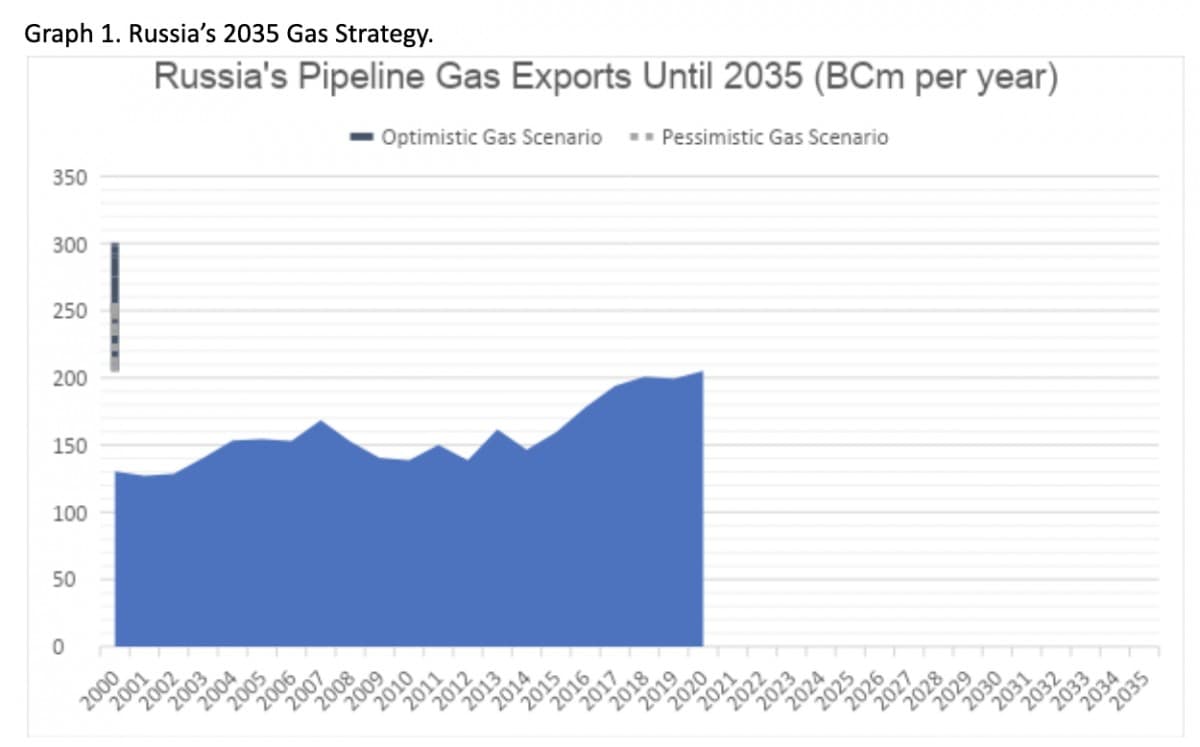
The framework for Power of Siberia-2 (also known as the Altai pipeline) was laid down in 2015 when Gazprom and the Chinese state-owned company CNPC signed a preliminary gas supply deal, without specifying the technicalities of pricing. Given that Pos-1 pricing talks took a decade to conclude, the tardiness of PoS-2 negotiations is hardly surprising. Yet at the same time Russian authorities are betting heavily on it happening – the recently issued Energy strategy-2035 sees pipeline gas exports reaching 300 BCm per year by 2035, of which 80 BCm per year will go to China, with European pipeline exports effectively stalling for the next decade and half. It has to be noted that the Energy Strategy also surmises a “pessimistic scenario”, whereby Gazprom’s gas exports increase from 220 BCm in the base year of 2018 to 255 BCm per year in 2035, meaning a slight decline in European demand and Power of Siberia-1 remaining the only China-bound gas conduit, with no Pos-2 construction taking place.


Graph 1. Russia’s 2035 Gas Strategy.

(Click to enlarge)
Source: Author’s data. 

Gazprom needs Power of Siberia-2 for many reasons. First of all, its immense 2P reserve base of 24.3 TCm (which keeps on increasing with time by 0.1-0.2 TCm in the last couple of years) compels it to act upon it whilst Eurasian economies still perceive natural gas as a bridging energy source and do not penalize its utilization. Second, China is the only easy-to-access market outlet whose demand for natural gas has still not peaked – once China reaches that stage, there remain only more adventurous and technologically complex variants (eg.: constructing a pipeline to South Korea, subsea or transiting North Korea). Thirdly, Gazprom might dovetail Pos-2 with one of its long-time ambitions – linking the gas transmission system of Russia’s Far East to the ones in Western Siberia and Europe. Given that still only 69 percent are connected to the federal gas transmission system, this would be a politically very useful objective.

Graph 2. Map of Power of Siberia-2.


(Click to enlarge) 

There is one additional novelty in how Power of Siberia-2 would look like – namely, the inclusion of Mongolia as a transiting country. Heretofore Mongolia has neither produced nor imported natural gas, hence Gazprom could potentially enter a completely new market. This being said, as of today the main reason for including Mongolia lies in the possible bifurcation of the pipeline so that at least some part of it heads towards northeast China. In addition to the above listed commercial rationale, the agreement, as indicated during President Putin’s meeting with Mongolian Prime Minister Ukhnaagiin Khurelsukh in December 2019, might also turn out to be a stepping stone to something much more politically complex. Despite all the benefits that Russia might garner from Power of Siberia-2, Gazprom has to face an array of challenges that will seriously jeopardize its viability.

Above all others, there is the question of Chinese pipeline gas demand – the Western route (from the Chinese point of view) pits Gazprom against Central Asian producers, namely Kazakhstan and Turkmenistan, who already have a separate conduit to supply the Chinese market. The 55 BCm/year capacity Central Asia Gas Pipeline was utilized last year to the extent of 87 percent (47.9 BCm), with most of the delivered gas coming from Turkmenistan. China remains the main market outlet for Galkynysh production, therefore unwanted competition in the form of Gazprom vying for a place under the sun would be hardly welcome news for Ashgabat. Thus, it is not only competition against LNG that Gazprom ought to win but also deal with a China-dependent Turkmenistan, all this against the background of tough-as-usual Chinese price negotiations. At least things have started moving after a prolonged lull.


5/03/2020

German Regulator Plans to Deny Nord Stream 2 Waiver from New Gas Directive - Reports


Source: Sputnik
May 3 2020

Nord Stream 2 is a joint venture between the Russian energy giant Gazprom and five European companies. The gas pipeline will carry up to 55 billion cubic metres of natural gas per year from Russia to Germany under the Baltic Sea, passing through the territorial waters or exclusive economic zones of Denmark, Finland, Germany, Russia, and Sweden.

The Nord Stream 2 operator disagrees with the German regulator's intention to deny the gas directive waiver, the company said in a statement on Friday. The firm pledged to defend its rights and wait for the final decision by the regulator, the statement added.

Handelsblatt newspaper reported, citing the draft decision of the Federal Network Agency of Germany (BNA), that the BNA intends to reject an application filed by Nord Stream 2 for an exemption of the pipeline project from the requirements of the updated EU gas directive.

The agency announced in mid-January that it had accepted applications from the Nord Stream 1 and Nord Stream 2 operators to exempt the gas pipelines from the requirements of the EU gas directive. According to Handelsblatt, the agency earlier on Friday sent a draft decision to the parties involved in the process. The newspaper added that the BNA will accept replies from them until 8 May, after which it will "promptly" make a final decision.

The reason for the rejection of the Nord Stream 2 application was the fact that in order to exempt the gas pipeline from the updated directive, the pipeline must have been completed before May 2019. Nord Stream 2 insisted that it was necessary to not proceed from the "construction" point of this requirement, but to take into account the fact that "billions of investments had already been made in accordance with the previous legal regime by the time the new directives of the domestic gas market came into force".

The spokesman for Nord Stream 2, Jens Mueller, said in January that the project meets all the requirements for its exemption from the rules of the updated EU gas directive in Germany and that this also applies to the completion date of the project.


2/19/2015

Gazprom Hopes to Sign Second Gas Deal With China Soon

A monitoring instrument is seen on a gas distribution pipeline.

Πηγή: The Moscow Times
By Reuters
Feb 18 2015

Russian Energy Minister Alexander Novak said Tuesday he hoped Gazprom would finalize its second deal to export gas to China in the coming months.

Last year, Russia and China signed a $400-billion gas deal with exports via the yet-to-be-built Power of Siberia pipeline. Last November, Russia and China clinched a framework agreement for a second deal, known as the Western Route.

Novak also told reporters that Russia was awaiting specific proposals from the European Union to build a gas link from a new pipeline to run from Russia to a new gas hub at the Turkish-Greek border.


2/01/2015

Gazprom investments into South Stream Jan-Sept 2014 amount to $502 million


Πηγή: Tass
Jan 29 2015

Gazprom's net loss from participating in the project is estimated at $31 million (2.1 billion rubles) for the end of the reporting period.

MOSCOW, January 29. / TASS / Gazprom investment into the South Stream project in January-September 2014 amounted to $502 million (33.7 billion rubles), the company report says.

At the beginning of 2014, the amount of investment was estimated at $103.5 million (7 billion rubles).

Gazprom's net loss from participating in the project is estimated at $31 million (2.1 billion rubles) for the end of the reporting period.

South Stream is Gazprom's global infrastructure project for the construction of gas pipelines, with capacity of 63 billion cubic meters. It was slated to go across the Black Sea to South and Central Europe, in order to diversify export routes for natural gas and lower transit risks.

However, on December 1, 2014 Russian President Vladimir Putin announced that "under current circumstances, Russia will not implement the South Stream project."

In turn, head of Gazprom Alexey Miller said that that "South Stream project is no longer relevant." "That's it, the project is closed," he said, while commenting the Russian-Turkish summit talks.


Russian gas supplies to Europe: existing routes


THE MAIN EXPORT ROUTES OF RUSSIA’S NATURAL GAS SUPPLIES TO EUROPE. Infographics by TASS


8/20/2014

South Stream ‘Plan B’ opts for route through Greece and Turkey


Πηγή: EurActiv
Aug 19 2014

A Russian newspaper has published an article suggesting that the Kremlin-favoured South Stream gas pipeline could drop Bulgaria, Serbia, Hungary, and Slovenia for its route, and instead reach its final destinations, Italy and Austria, through Turkey and Greece.

On Monday (18 August), Russian business newspaper Vzglyad published an article by journalist Oleg Makarenko, claiming that Gazprom has a “plan B” in case Bulgaria continues to obstruct the construction of the South Stream pipeline.

A caretaker government in Sofia, which took office on 6 August, has frozen the construction of South Stream, following clear indications from Brussels that the EU executive would impose infringements on Bulgaria, unless the country re-negotiates its bilateral agreement with Russia for the construction of the pipeline, which is in breach of EU law.

>> Read: Barroso warns Bulgaria on South Stream

According to the Vzglyad article, Russian President Vladimir Putin has already hinted at another route for South Stream, during his meeting with leaders of world media, on 24 May.

The article quotes Turkish energy Minister Taner Yıldız as saying that Ankara would allow South Stream to reach Turkey under the Black Sea instead of Bulgaria, as originally planned.

However, Russian sources are quoted as saying that the Turkish route is not Moscow’s preferred one, as it is longer, and because of the lost possibility of reaching Serbia and Hungary.

‘Good partners’

Turkey is seen as a “good partner” for Russia, as Prime Minister Recep Tayyip Erdoğan is described as a “cynical pragmatist” who wants revenge on the USA, which has reportedly tried to oust him twice. Greece is described as a country where social unrest is boiling. “The attempts to leave Greece without money, without agriculture [as a result of the Russian counter-sanctions] and without gas will trigger massive social unrest,” the article says.

Bulgaria, Serbia, Hungary and Romania are described as the biggest victims of plan B. In the event that the Ukrainian gas transmission system is “blocked permanently”, Russia would reportedly not be able to supply any gas to these countries.

The article ends by saying that Russia would prefer not to opt for a plan B, but if the Commission doesn’t stop pressuring Bulgaria to freeze the construction of the pipeline, this alternative appears to be a viable option.

“We have to be very happy that Russia has a working spare plan to supply gas to Southern and Central Europe,” the article concludes.

A direct competitor to TAP?

If Gazprom decides to choose Turkey and Greece for the South Stream route, the pipeline project would largely resemble the TANAP-TAP project to bring Azeri gas to Italy through the territories of the same countries.

The Trans-Anatolian gas pipeline (TANAP) is a proposed natural gas pipeline from Azerbaijan running through Turkey. The approximately 870 km long TAP pipeline connects with TANAP, and will cross Greece and Albania before reaching Italy through an offshore section. It is to be built by a consortium led by BP, Norway's Statoil and Azerbaijan's SOCAR.

TAP is in an advanced stage of preparation and the start of its construction is planned in 2016.

Asked by EurActiv to comment, the European Commission said it was unable to confirm reports that NGOs were funded with Russian money, in order to delay the TAP project.


3/16/2014

Greece Moves On Russian Gas Concerns With Pipeline Project


Πηγή: Forbes
By Christopher Coats
March 13 2014

As much of Europe spent the last month worrying about what might happen if Russia decided to shut the valve on its gas supply, Athens has apparently decided the time is right to push a new energy role. This week, Greece’s Energy Ministry launched an international tender for a pipeline project that would transport about 8 billion cubic meters of gas into the European market from offshore fields controlled by Cyprus and Israel. According to a Reuters report, the project would link Israel’s Leviathan natural gas field to Europe by way of Greece through the IGI-Poseidon pipeline, managed by Italy’s Edison and Greece’s state-backed utility, DEPA.

For Israel, the pipeline would provide the country’s first long-distant export option. Israel has recently announced a series of export agreements for its offshore efforts, 40 percent of which is allotted for sale outside of the country. However, so far, they have all been local, including sales to Jordan, Palestinian utilities and talks with both Egypt and Turkey. For Greece, a successful pipeline would help them carve out a long-sought energy role in the area.

Over the last three years, Athens has made a concerted effort to lay claim to the Eastern Mediterranean’s recent energy rush, both as a potential transport hub for Israeli and Cypriot gas reserves and as a producer itself. The latter role, which has included studies suggesting offshore reserves near Crete, has failed to catch fire beyond political rhetoric. Meanwhile, after this week, it appears the country’s transport aspirations may have some potential.

Europe’s Diversification Key?

The transmission line would create a direct line between the Eastern Mediterranean’s vast offshore reserves and a European market in need of energy diversification – a goal that has become central to the region’s energy policy since 2009. That year saw Russia halt natural gas imports to Ukraine in the cold winter months, leading to shortages across East Europe.

In the years since, Europe has set out to establish new import options, increase domestic production alternatives, encourage renewable options – all meant to ease dependence on Russian reserves. While moderately successful, these efforts have suffered from a series of setbacks, including a downturn in renewable financial support and unrest in North African producing countries like Libya and Algeria. The region’s progress grabbed the spotlight this month as tension between Moscow and Ukraine highlighted just how dependent Europe is on Russian reserves.

Months before the most recent flare-up with Russia, the proposed pipeline received a vote of confidence from the European Commission when it was selected as one of their Projects of Common Interest (PCI). This 2013 plan designated 248 energy infrastructure projects across the EU that would receive their support as well as give them access to $8.13 billion in available funds. It was chosen as one of Cyprus’ three PCI projects.

However, despite such support and the recent attention diversification efforts have gotten since Russia began moving troops toward the Crimea, the pipeline is not without its challenges. First and foremost the pipeline could extend into contested waters between Greece and Turkey. Already frustrated with Cypriot progress towards exploration and gas production in the region, Ankara could prove difficult to win over, especially if the project sidelined proposed Turkish transport alternatives.

Recent reunification talks between the Republic of Cyprus and the Turkish held north side of the island have allowed some hope that the issue of sharing regional gas benefits to bed, though bringing the 40 year old dispute to an end soon could be wishful thinking.

The Greek-led pipeline could also face a significant challenge when it comes to financing. While access to the EC fund could provide some support, paying for what promises to be an incredibly expensive endeavor (especially considering the pipeline depth), could be difficult. Both Greece and Cyprus remain weighed down by years of economic turmoil. In the case of Greece, now entering its sixth year of recession, attracting needed investment partners will be difficult, bordering on impossible without firm support from Europe and other global lenders.


1/13/2014

Greece stresses its role as EU’s energy hub


Πηγή: EurActiv
Jan 13 2014

Greece, holding the rotating presidency of the EU until June, said it would promote the enhancement of energy security in the 28-country bloc and fully support the European Commission’s approach to Russian energy giant Gazprom.

Speaking to the press in Athens last week, the Greek minister for energy, Yiannis Maniatis, said the first pillar for European energy security was the support of initiatives to diversify gas supply, including gas from the Caspian Sea and the gradual implementation of the Southern Corridor.

According to the minister, “interconnectors” for big pipelines were key contributor to Europe's energy security.

The Trans Adriatic Pipeline AG (TAP) and the Interconnector Greece-Bulgaria (ICGB) recently signed an agreement laying the foundations for linking the two projects and thus bringing gas from Azerbaijan to Bulgaria, a country which depends on Russia for almost 100% of its gas imports.

The two sides will work together on realising a possible interconnection point in the vicinity of Komotini, Greece. “These interconnectors are choices that objectively enforce the energy security of Europe,” Maniatis said.

The second pillar for European energy security, Maniatis said, was the recent developments in oil exploration in the eastern Mediterranean.

“I would like to highlight that the perfect cooperation between Greece, Cyprus and Israel, shapes new policies of energy supply in Europe and sends a quite hopeful message,” he noted.

The "Projects of Common Interest” (PCI) constitutes the third pillar and will be implemented with the participation of Greece, the minister said.

“This issue is a priority and is being shaped through Greece’s ambition to become an energy hub of the greater region ... we hope that the Informal Meeting of Energy Ministers will note that a new source of energy supply for Europe is being shaped,” Maniatis added.

Doubts about the future of South Stream

The European Commission said last month (4 December) that the bilateral agreements for the construction of the Gazprom-favoured South Stream gas pipeline – concluded between Russia, Bulgaria, Serbia, Hungary, Greece, Slovenia, Croatia and Austria – are all in breach of EU law and need to be renegotiated from scratch.

“We agree with the strategic plans of the European Commission, which we have supported for all these years, as it was the case with the Southern Corridor”, said the Greek deputy minister of environment, energy and climate change, Makis Papageorgiou.

But he conceded that there were conflicting signs from Gazprom’s side on the South Stream pipeline.

“As a plan, it has been around since 2007. The company has made many moves, and as you already know, Greece has signed an agreement with the Russian company. After that, Gazprom abolished the southern branch and made new agreements focusing on the northern branch.”

“It is still unclear what exactly will happen with South Stream,” he noted.

“The position of the European Commission on the issue is pretty clear: Gazprom has to make its plans clear, under what conditions it will operate in the EU,” he added.

Privatisations in energy sector

Even though debt-ridden Greece is on the recovery path, the country may need to accelerate privatisation, especially in the energy sector, namely the Hellenic Gas Transmission System Operator (DESFA) and the public Natural Gas Supply Corporation of Greece (DEPA).

The privatisation of the Hellenic Gas Transmission System Operator (DESFA) is in the process of final approval by Brussels.

“By the summer, this process will be finalised and Azeri company SOCAR will acquire 66% shares of the company while 34% will remain in the Greek state”, said Papageorgiou.

As for DEPA, the international bid was inconclusive since Gazprom pulled out, despite its initial interest.

According to the Greek deputy minister, Gazprom finally backed off as a result of EU conditions.

“Evidently, the reason for this, as stated by Russian PM Alexander Medvedev, is that the EU conditions at some point should change. As long as the conditions of the EU don’t change and Greece is a member of the EU and abides by its rules in the energy market, no more moves can be made”, the deputy minister noted.

He added that the privatisation of DEPA will happen later, as currently Greece holds discussions with the Commission about gas market reform.

BACKGROUND:

Crisis-hit Greece took over the reins of the EU Council of Ministers on Wednesday (1 January) with a record low budget of €50 million set aside as the “absolute maximum” to run the presidency during the next six months.

While analysts have predicted Greece will require more aid, albeit on a smaller scale than previous bailouts totalling about €240 billion, the troubled country has vowed to spend considerably less than other countries'
presidencies.

Greece takes the helm of the EU at a critical time, just months before the end of the current European Parliament. This means that Greece will have less than four months to deliver on complicated dossiers, rather than the full six months.

The main presidency priorities are the European Banking Union, growth and jobs, migration and a European maritime policy.

Editor's Note: At the same time Greece didn't reach an agreement with Gazprom over the natural gas price.

6/10/2013

Gazprom withdraws interest for Greek gas firm DEPA on deadline day, say reports


Πηγή: ekathimerini
June 10 2013

Russian energy giant Gazprom did not submitt a binding offer for Greek natural gas firm DEPA before Monday’s deadline, reports said.

Gazprom was expected to be the only major bidder for DEPA but both capital.gr and Reuters reported that the Russian firm did not declare its interest.

Capital.gr reported that a disagreement over the price at which Gazprom would supply gas to Greek households led to the firm withdrawing its interest. Greece currently pays about 30 percent more than the European Union average for the natural gas it imports from Russia.

The government had been hoping to secure a commitment from Gazprom to lower prices.

Gazprom's only rival for DEPA is M&M Gas, a joint venture by Greek energy firms Motor Oil and Mytilineos. But reports suggested that M&M had also failed to submit a binding bid by Monday’s deadline.

The Russian firm has made a preliminary bid of 900 million euros, whereas M&M offered 550 million.

The failure to secure an offer for DEPA would be embarrassing for the government, which had extended the deadline as it sought to accommodate Gazprom.

The sale of DEPA, along with that of state gambling firm OPAP, were the flagship privatizations of this year. Even with those sales, it appeared that the government would not meet its reduced target of 2.6 billion euros in revenues for this year.

Reuters also reported that another Russian firm, Sintez, withdrew its interest for the purchase of gas network operator DESFA on Monday.

If this is the case, Azerbaijan΄s state company SOCAR is likely to be the only firm to place a binding offer for DESFA.

Editor's note: According to protothema it was the EU Competition Commission that blocked potential acquisition of DEPA and DESFA by Gazprom and Sintez respectively.

4/06/2013

SOCAR vs. Gazprom for Greece’s DEPA


Πηγή: New Europe
By KOSTIS GEROPOULOS
April 6 2013

BAKU – State Oil Company of Azerbaijan SOCAR is competing with Russian gas monopoly Gazprom for Greece’s public gas corporation, DEPA, which is being sold as part of the Greece's privatisation programme. But there is more at stake than just buying one more EU energy company.

SOCAR is likely to compete with Gazprom to control non-Russian transportation routes to Europe, Gulmira Rzayeva, Research Fellow at Azerbaijan's Centre for Strategic Studies, told New Europe in Baku on 5 April. This is a healthy competition in the tender bidding for the same stake although the companies' financial capacities are not equal, she added.

“The Azerbaijani company will also need the Greek gas transmission company to invest in the EU country’s downstream market, which is in line with SOCAR’s long-term strategy,” she said.

It seems that SOCAR does not want to let Gazprom take over the control of transportation of the gas via Greece, the only entry point to the South Europe, Rzayeva said.

Even if the Shah Deniz consortium picks Nabucco instead of the Trans Adriatic Pipeline (TAP) to carry 10 billion cubic metres of Azerbaijani gas to Europe, SOCAR wants to keep the Greek market in hand to use the infrastructure to export up to 1 billion cubic metres to the Mediterranean country via the Turkey-Greece Interconnector, she said.

Greece’s DEPA has 50% stake at the Greece-Bulgaria Interconnector (IGB). Another 50% belongs to Italian Edison. Edison is a close partner of Gazprom in the Russian-backed South Stream gas pipeline project as well as one of its biggest clients.

Considering the importance of IGB in the Southern Corridor, Gazprom, by influencing Edison, can freeze indefinitely the construction of the 168-kilometre pipeline, Rzayeva said, pointing out that during three years the construction of the pipeline has still not been completed.

A Memorandum for understanding has been signed between Bulgarian BEH EAD and the Greek gas distribution operator DESFA, which foresees natural gas supplies for the Bulgarian market through utilisation of the capacity of the Greek liquefied natural gas (LNG) terminal Revitusa, gas interconnection Greece-Turkey, as well as capacity in the Greek national gas network if required by the Bulgarian country in compliance with the national legislation.

Rzayeva said that by buying Greece’s DEPA/DESFA, SOCAR can also automatically get a share in IGB as DEPA has stakes in the project and push the project to finalise the construction.

Asked if Azerbaijan is interested in DEPA, Minister of Industry and Energy Natiq Aliyev told New Europe in Baku that this is a decision that concerns SOCAR. He added that it’s too early to say about interest in DEPA because it is not known which pipeline route will be selected.

Azerbaijan’s Shah Deniz consortium said on 1 April it started a final “detailed evaluation” on the Nabucco West and the Tran-Adriatic Pipeline (TAP) proposals. “At the end of June it will be clear,” Aliyev said, adding that Azerbaijan does not prefer one project over the other. “Both of them Nabucco West, TAP are a priority of the European Union. But I think for us there is no difference,” Aliyev said.

Rzayeva told New Europe that the final proposals submitted by Nabucco West and TAP as well as the sale and purchase agreements between gas buyers and the Shah Deniz consortium will play a key role in the decision.

“Both projects have their strengths and weaknesses. For example, to build TAP is cheaper than Nabucco. On the other hand, the Italian market can be oversupplied in the short-term and gas demand there will not grow,” Rzayeva said. “More or less both projects are now equal. It’s the final countdown. We have to wait two more months to see."


3/22/2013

Russia's Energy Ministry Eyes Incentives for New LNG Projects


Πηγή: Downstream Today
By Russia & CIS Energy Newswire
March 19 2013

Russia's Energy Ministry is considering the possibility of introducing additional incentives, including discounts on duties, for new projects to produce liquefied natural gas (LNG), Energy Minister Alexander Novak told reporters.

"It will be possible to consider some incentives," Novak said.

He said the Yamal LNG project already enjoys a discount on the natural resource extraction tax (NRET), but stressed that such tax breaks will not be targeted and will be worked out for all new LNG projects.

Production of LNG must be encouraged because Russia faces the challenge of winning a place on the global LNG market, the minister said. "We have too small a share of this market. However, there is a niche for new supplies on the LNG market and we must occupy this niche," Novak said.

"There is a window of opportunity until 2018-2020. After this period, analysts estimate, supply will already exceed demand," Novak said, recalling that Australia, for example, plans to increase production of LNG by 40 million tonnes after this period.

The most realistic new LNG projects in Russia, Novak said, are Novatek's (RTS: NVTK) Yamal LNG, Gazprom's project to build an LNG plant in Vladivostok, and Rosneft's proposal to build an LNG plant on Sakhalin Island.

"We see this as one of the Russian LNG projects. Rosneft (RTS: ROSN) has a resource base in this region. Rosneft and its partner ExxonMobil must now work out everything in more detail and prepare more detailed proposals," Novak said.

Novatek in talks to sell stake in Yamal LNG

Novatek, Russia's biggest independent gas producer, is holding negotiations with South Korean, Japanese and Chinese companies on the sale of part of its stake in the Yamal LNG projects, Novak said.

"Novatek is prepared to reduce its stake in the project from 80% to 51%. It is offering a stake in the project to Korean, Japanese and Chinese companies. Competition for this stake will be very great," the minister said.

Novatek has already agreed with a number of Japanese companies - Tokyo Gas, Tokyo Electric, Marubeni and Mitsui - to form working groups that will "work out in greater detail the possibility of their joining the project," Novak said. "For we are not only offering gas supplies from this project, but also minority participation," he added.

Yamal LNG is expected to produce 16.5 million tonnes of LNG. The plant will be launched in three phases of 5.5 million tonnes per year each, at the end of 2016, 2017 and 2018 respectively.

Novak said the project will remain on schedule on the condition that a decision is made in the first half of the year on liberalizing exports of LNG. "We are working on this, in order to work out the issue of liberalization, provide additional possibilities for financing the project. I think that if we make this decision by the middle of the year, everything will be quite alright in terms of the timetable," the minister said.

He said Gazprom (RTS: GAZP) has not yet presented its proposals on the possibility of foreign companies participating in the Vladivostok LNG project. The company plans to hold a separate meeting with Japanese companies to discuss this topic.

These issues were discussed during a visit to these Asia-Pacific countries by a Russian delegation that included the management of Novatek and Gazprom Export, Novak said.

The $20 billion Yamal LNG project calls for the development of the South Tambei field on the Yamal Peninsula. Novatek has an 80% stake in Yamal LNG and France's Total owns the other 20%. Novatek said earlier that it plans to retain a controlling stake in the project, and did not rule out that a consortium of new partners, primarily such that could ensure the marketing of the product, might join the project.

Vladivostok LNG could produce 10 mln tonnes in 2020

Gazprom's project to build an LNG plant in Vladivostok could reach the stated production target of 10 million tonnes in 2020, Novak said. The first phase of 5 million tonnes per year is expected to be launched in 2018 and a second phase for another 5 million tonnes could start up in 2020, he said.

Therefore, with the launch of Yamal LNG, new LNG production capacity in Russia could reach 26.5 million tonnes by 2020. The CIS is expected to account for about 15% of total gas exports by 2020.

Gazprom's management board in February approved the rationalization for investment in the Vladivostok LNG project, which calls for building an LNG plant on the Lomonosov Peninsula in Perevoznaya Bay with three production lines of 5 million tonnes each. The resource base for the plant will be the Sakhalin, as well as Yakutia and Irkutsk gas producing regions. The target market will be the Asia-Pacific region.

Ministry proposes pipeline gas for Europe, LNG for Asia-Pacific

The Energy Ministry believes that Russian gas exports to Europe should be dominated by pipeline gas, while LNG should predominate in exports to the Asia-Pacific region, Novak said.

He said such an approach would make it possible to avoid having Russian gas compete on global markets, including if exports of Russian LNG are liberalized.

"For example, while Gazprom dominates in Europe and there is the possibility of increasing supplies of purely pipeline gas, there is no point in going there with LNG. There is the eastern market, where we don't have a pipeline, there we must compete. So in addition to Gazprom we should give other companies the opportunity to participate in this market," Novak said.

He said other proposals for tackling the problem of Russian LNG competing against itself on global market include the creation of non-commercial partnerships. There is also the possibility of issuing licenses for production of LNG that would specify export markets, the minister said.

"There can be various ways of coordination, there could a non-commercial partnership with oil and gas companies. It could be simply by way of permitting exports of LNG only with the issue of corresponding licenses to specific projects, and the licenses could specify the conditions of shipments. There is the option of going through a government commission," Novak said.

"There should be a strong mechanism here for coordinating the activities of all participants in the process, so that we don't have a situation where, to the detriment of the domestic market, we allow everyone to build LNG plants and everyone starts to chaotically ship to Europe or Asia," Novak said.

He said that his ministry would within a month complete an updated report on mechanisms for liberalizing LNG exports and tackling the problem of regulating this market. The proposals will consider granting certain projects the opportunity to export LNG.

"We're not talking about cancelling Gazprom's monopoly on gas exports. Gazprom remains the gas exporter by law, we are talking about the possible access of certain projects to LNG markets," Novak said.

The final decision on liberalizing LNG exports will be made by the Russian president.

The minister stressed that the global challenge in Russia's entry into the LNG market should not be fighting competition among Russian LNG suppliers, but competition with other global suppliers of LNG.

"Russia still only has 10% of the market, how can we compete internally here. Competition must be not among our projects, but with the projects of other countries that also plan to increase LNG exports, including Australia and Qatar," Novak said.

He remarked that not only is global demand for LNG growing, but so is the number of countries that are starting to use liquefied gas.

"In the last few years eleven countries have been added that have begun to build regasification terminals, and in the next few years there will be even more. The market will grow not only by volume of consumption, but also by number of countries. New countries are emerging - Argentina, Thailand. We need to occupy this niche and compete not against ourselves but for new markets," Novak said.

3/14/2013

Gazprom Mulls for an Eventual South Stream Link to Greece

Gazprom CEO Alexey Miller and Greek PM Antonis Samaras

Πηγή: Natural Gas Europe
March 14 2013

The visit of a high-level delegation from Gazprom headed by CEO Alexey Miller to Athens for talks with Greek stakeholders has led to an announcement concerning local and regional natural gas politics.

Following discussions with the Greek Premier Antonis Samaras, Miller revealed that his company still has plans to link the country with South Stream, although there was no mention of taking the pipeline all the way to Southern Italy. This implies that the Russian strategy is to use Greece as a potential LNG hub, supplied by South Stream.

When Gazprom announced plans in November 2012 to take out the Greece-Italy route from the pipeline, this further supported the general trend of Russian natural gas corporations such asNovatek to move towards the global LNG trade in a more dynamic fashion, since the Asian and EU markets are said to need substantial amounts of that gas over the coming decades, a strategy that Natural Gas Europe reported on at the time.

There is also the question of the Trans-Adriatic Pipeline (TAP), which is currently vying withNabucco West for the transfer of Azeri gas to the EU. Greek media reported after the delegation's visit that in fact both projects could co-exist since they will transfer different sources of gas, potentially reducing prices at a pan-European level and at the same time they could open up a lucrative LNG market for the whole of Southern Europe.

Talks between the two parties also revolved around the intention of the Greek government to request substantial deceases in the price of gas imported by Gazprom and in respect to the long-term contract, which ends in 2016. According to recent DEPA announcements, Greece is seeking a minimum 15 percent price cut in order to renew the contract for a minimum of 10 years.

The official Russian response regarding the DEPA-DESFA privatization was to request "fair treatment" by Greek authorities citing fears of political interference by other energy players or local business interests. Concurrently, the recent change of the head of the agency responsible for the privatization (TAIPED) resulted in a two week delay for the submission of the final binding offers, with a new date set for the 29th of April 2013.

TAIPED provided the opportunity to those involved to join in their final bid with other companies, aiming to attract more interest from European corporations, and since there is no development on this front, Gazprom and Sintez-Negusneft are left as favorites to win due to their higher offers and presumed more extensive business/gas plan.

Information from a variety of sources within the Greek energy community reveal the possibility that SOCAR and PPF-GEK will not submit a final offer for DESFA, thereby leaving Sintez as the sole competitor by the end of April. This information has not been able to be verified by the respective companies, which seem to prefer a low profile regarding their involvement in the competition.

A clear indication from the above is that Gazprom is still undecided and prefers to "wait and see" if it will suit its strategy to lay a pipeline through Greece and the decisive factor would be the outcome of its bid for DEPA.

Lastly, it is of great interest to view the month by month delays of the privatization process that seem to coincide with the announcement of the successful bidder for the Southern Corridor route, another assessment Natural Gas Europe made previously. Overall there is certainly a formation of a regional gas and political triangle between South Stream, Greek privatization and the Southern Corridor, in addition to newly discovered gas in the eastern Mediterranean. In that sense, a multilayered energy game is in full swing with tremendous interest for all key energy players in Europe.


1/20/2013

Gazprom and the European imbroglio


Πηγή: Europolitics
By Marie-Martine Buckens
Jan 18 2013

The presence of the Russian giant Gazprom on the short list of companies selected by the Greek privatisation fund as potential buyers of the Greek gas company DEPA is still a hot topic of debate (see Europolitics 4563).The Financial Times reported, on 10 January, that the EU and the United States had cautioned against seeing the Greek economy controlled by Russian interests, while a Commission spokesman, interviewed byEuropolitics on 17 January, simply stated that “the Commission, in the framework of the World Bank, IMF and EU troika, is in permanent contact with the Greek government and the privatisation fund in particular on the privatisation of DEPA and its subsidiary DEFSA”. He added that the executive “is aware that while the privatisation fund has not yet finalised its selection process, the acquisition of DEPA and/or DEFSA will have to comply fully with competition rules in force in the EU single market”.

The fact remains that Gazprom’s intrusion in Greece adds to the Russian firm’s image of dominant position, already fuelled by the anti-trust procedure launched against it by the Commission last September.

INTERVIEW WITH AURÉLIE BROS

Things are not quite that straightforward, according to Aurélie Bros, doctoral candidate in geopolitics at University Panthéon-Sorbonne and at the Russian Academy of Sciences. For this researcher, co-author with Yann Richard of a study entitled ‘Les stratégies de Gazprom: un problème géopolitique?’ (‘Gazprom’s strategies: A geopolitical problem?’), the company’s relations with the EU should be analysed in the light of the structural divisions that can be observed in Europe and not as a head-on confrontation between the EU and Gazprom or even between the EU and Russia. There is no real consensus for now on the position to take towards Gazprom, whether at European or national level, or between energy firms. But above all, she adds, it is important not to mask the strategies of large European firms that participate in steering this dialogue with the Russian firm by setting up consortia, common projects and so on.

In your 2011 study (1) , you highlight the fact that European gas companies find themselves caught between EU legislation, in particular the third energy package, and their need to carry out profitable operations.

The energy sector has been built on vertically integrated companies that operate primarily on national markets. At present, EU legislation and particularly the third energy package has prompted these firms to reconsider their strategy, organisation (separation of certain activities), etc, since the EU’s aim is to create a single market. This phase of adaptation for energy companies has created tension.

This tension is not limited to differences of views between the EU institutions and companies, which have to combine strategy and compliance with internal market rules. It is very difficult to build consensus in the energy sector and there is multi-scale opposition. It can be seen within member states. Take the case of Germany, for example, where the phase-out of nuclear power is still giving rise to many questions. There are also divisions between member states, divisions stemming from history, geography, etc. The Western EU countries do not have the same position on Gazprom or Russia as the Central and Eastern European member states. And there are many more examples. This accumulation of divisions that are not always directly perceptible confuses the issue, with the result that the foreign partners, in this case Russia, sometimes have trouble analysing and understanding the European market.

What is your analysis of the policy implemented by the EU institutions, the Commission in particular?

Within the Commission there are also different ways of addressing the problem. That is the case for the anti-trust procedure initiated last September against Gazprom. It was launched by DG Competition, whose role is to guarantee fair competition.

In parallel, DG Energy tends to focus more on establishing and strengthening dialogue with external partners, for instance with its negotiation of the EU-Russia road map until 2050, aimed at setting up a stable and lasting energy sector dialogue between the EU and Russia.

How do you analyse developments in the Southern Corridor gas negotiations?
This is a key project for the European Commission, aimed at supplying Europe with gas resources from the Caspian Sea (Shah Deniz). The negotiations have not been completed but it is certain that the Nabucco project in its initial form will not come into existence. It is more likely that there will be a smaller, mixed project. The EU’s support is primarily political, yet in the final analysis it is companies that will have to put up the money. The case of Nabucco – backed by the EU – is exemplary. It turned out that the project was no longer profitable and that gas supply was uncertain, since Iran cannot be considered as a potential supplier. The Russians wish to circumvent Ukraine after the tension that occurred in 2009 and will build the South Stream gas pipeline, a project that does not form part of the Southern Corridor.

How do you explain that, in contrast with Gazprom, there are no European companies on the list of possible buyers of the Greek public gas company?

Good question. I can only say that Greece has a very advantageous geographical situation. The country is close to Turkey, through which gas from Azerbaijan will likely be delivered, but also to Israeli and Cypriot gas fields. Gazprom will have to comply with the separation of gas production and distribution activities required under the third energy package. In the case of Greece, the distribution aspect is important. The companies are positioning themselves either on the production aspect or on distribution. Gazprom seems to be giving priority to distribution.“The Western EU countries do not have the same position on Gazprom or on Russia as the Central and Eastern European member states” 
 
(1) The study is available here


1/07/2013

Cyprus and Turkey Speed up their Gas Research


Πηγή: Natural Gas
Jan 7 2013

Natural gas research in the eastern Mediterranean will result in Cyprus and Turkey engaging in activities to explore for new reserves.

Cypriot energy Minister, Neocles Sylikiotis, met recently with a high-level delegation from Total SA in order to push forward negotiations regarding the research of a sea block awarded to the company. Cyprus has concluded final details with Italian Eni and the Korean Kogas, who have pledged to invest into researching two other sea blocks. Sylikotis in the meantime relayed to local media that over the coming years when all sea blocks are awarded, a total amount of USD 10 billion in investments should be expected based on the estimations that considerable amounts of gas will be found, similar to Noble Energy’s Block 12.

According to estimations by the Cypriot Ministry, by early 2013 all negotiations should have reached an end and by mid 2014 the newly established Cypriot hydrocarbon state agency should have found a strategic investor. The schedule details that by 2018 production at Block 12 should have started and by 2020 other potential gas reserves should also be exploited. For the moment companies such as Gazprom, Shell, BP and E.ON seem unofficially interested in becoming strategic partners with the Cypriot agency, although negotiations for that sector will commence in the near future, once the remaining blocks are awarded to various competing companies.

Turkey is also speeding up its Mediterranean gas investment strategy. It has started negotiating with the Norwegian corporation Polarcus in order for the Turkish Petroleum Company (TPAO) to acquire the research vessel Polarcus Samur built in 2001. TPAO is in a final negotiation stage with the Norwegians for the acquisition that is said to cost USD 165 million, according to the Oslo based bank DNB. If the deal is concluded, the vessel could be in Turkish ports by March 2013. Polarcus Samur has eight streamer sensors and multitude of other high-tech equipment for far-ranging offshore research.

The CEO of Polarcus, Rolf Ronningen, stated recently that TPAO is interested in wide-range 3D seismic research in all corners of the Turkish continental self, including the Black Sea.

It is also interesting to note that TPAO in 2011 signed an agreement with Shell to jointly conduct natural gas research in the eastern Mediterranean through an energy exploration and production sharing agreement. This deal details that first a region offshore Antalya should be explored. Shell is estimated it will contribute USD 300 million along with technical expertise and according to the Hurriyet newspaper, reserves to be found will be equally divided between TPAO and Shell.


12/30/2012

Gazprom launches construction of Southern Corridor pipeline section


Πηγή: Panarmenian
Dec 28 2012

Gazprom has started construction and assembly work on the western section of the Southern Corridor gas pipeline in Russia, that will feed into the South Stream gas export pipeline, Russia’s natural gas monopoly said on Friday, December 28, according to RIA Novosti.

The Southern Corridor system will also provide additional gas supplies to Russia’s central and southern regions and help develop industries and utilities.

The system’s total length will be 2,506 kilometers with annual capacity of 63 billion cubic meters. The project is due to be completed in 2017.

The system encompasses eight regions of Russia: Nizhny Novgorod, Penza, Saratov, Volgograd, Voronezh and Rostov Regions; the Republic of Mordovia; and Krasnodar Territory.

The western section runs from the Pisarevka compressor station in the Voronezh Region to the Russkaya station in Krasnodar Territory, totaling 880.6 kilometers.

Russkaya will be the Southern Corridor’s end point and South Stream’s point of entry.

Stage 2 of the project - the Eastern Section - which also terminates at Russkaya, will run 1,625 kilometers from Pochinki (Nizhny Novgorod Region).


11/19/2012

Putin And Merkel Tango In Moscow, Gazprom Stirs Up Old Ghosts, But Deals Are Signed


Πηγή: Tetosterone Pit
Nov 17 2012

Last week, the German Parliament passed a resolution that asked Chancellor Angela Merkel to needle Russian President Vladimir Putin about the resurgence of repressive, antidemocratic tendencies in Russia. It did not go unnoticed at the Kremlin. And it paved the way, so to speak, for her trip to Moscow on Friday—to re-cement their “strategic partnership.”

Complaints about the resolution filtered back to the point where Foreign Minister Guido Westerwelle, just before departing for Moscow, warned his countrymen not to overdo their criticism of Russia. It’s in the interests of Germany, he mused, to expand the “strategic partnership”; Russia was needed as a geopolitical and economic partner.

Indeed. Merkel arrived in Moscow with her entourage that included eight ministers and corporate chieftains by the planeload—she doesn’t leave home without them. With Merkel and Putin looking on, these chieftains and their Russian counterparts signed contracts for billions of euros, a ritual that German chancellors have to perform when abroad. It’s part of Germany’s mercantilist foreign policy. Siemens CEO Peter Löscher bagged perhaps the biggest deal, a declaration of intent to deliver 695 electric locomotives for €2.5 billion ($3.2 billion) to Russian Railways (RZD), an elephantine state-owned company with 950,000 employees.

That’s what really mattered. Criticism of Russia—carefully calibrated and range-bound—would be for consumption at home, where anti-Russian sentiment has been rising. With elections coming up next year, Merkel, the consummate political animal, is treading a fine line: deliver a bland rebuke that would barely satisfy voters in Germany and help arrange deals that would fully satisfy German industry.

The initial meeting was at the concluding session of the annual Petersburg Dialogue, a four-day forum, this year titled ominously, “Russia and Germany: the Information Society Facing the Challenges of the 21st Century.” So the first question from the audience was posed by a Russian participant: what about the recent deterioration in the Russian-German relationship—a reference to the resolution—and its consequences on economic cooperation?

A government had to be able to digest criticism, Merkel said in response. Yes, some of the recent laws the State Duma had passed “irritated” her. “I cannot see that they further freedom,” she said. “We ask ourselves if that is good for the development of Russian society or not.” But that didn’t change the intense relationship between both countries. “If I were offended every time I opened the paper at home, I couldn’t be chancellor for three days,” she said. Putin smiled.

It kicked off a bizarre tangle of questions and answers, comments, attacks, and counterattacks, fact-based or not, that carried over into a panel discussion and press conference. Putin claimed that Germany had been criticized by human rights groups because some of its states didn’t have laws for the protection of information. Which baffled attendees. And about Merkel’s statement—incomprehensible, given current conditions—that Europe always tried to speak with one voice, Putin retorted: “That’s called a cartel.” Even the Pussy Riot case came up.

A representative from Gazprom, the giant state-owned Russian natural gas company without which no German-Russian meeting is complete, and on which Germany depends for much of its natural gas, complained about the “gloomy atmosphere” in the relations between both countries that was hindering making deals.

The meeting was a far cry from when Gerhard Schröder was still Chancellor. He’d raised the “strategic partnership” to new heights through his close personal and political relationship with Putin. For example in November 2004, he described Putin as a “flawless democrat,” which stirred up a ruckus even in Germany. He also championed the Nord Stream gas pipeline that would pump gas from Russia directly to Germany via the Baltic Sea, without crossing other countries, a very costly project. Gazprom controlled the Nord Stream consortium. A deal was signed in October 2005. It included a loan guarantee by the German government of €1 billion. That’s how close German-Russians relations were.

On November 22, 2005, Schröder got kicked out of office. Days later, Gazprom appointed him Chairman of Nord Stream AG, causing another ruckus in Germany; it was clear what his intentions had been all along, now that he was on the lavish payroll of the Russian government. Turns out, the Baltic pipeline would allow Russia to cut off gas to countries its other pipelines crossed on their way to Germany, while still supplying Germany—a powerful political weapon against those countries. The “strategic partnership” had made it possible.

Gazprom is deeply involved in the rest of Europe as well. For example, why would Francesuddenly prohibit shale gas exploration? Sure, there are environmental issues. But French governments have had, let’s say, an uneasy relationship with environmentalists. Its spy service DGSE, sank Greenpeace’s flagship, the Rainbow Warrior, killing one person. No, there must have been another reason. Read... Russia’s Gazprom Tightens Its Stranglehold On Europe: The Natural Gas War Gets Dirty.

With the euro debt crisis came absurdities. Now the currency is creating artificial problems between peoples. And by being “irreversible,” as ECB President Mario Draghi had said, it has become a curse—and a religious dictum that must not be questioned regardless of how much havoc it may ultimately wreak. Read... The Curse Of The “Irreversible” Euro.


11/11/2012

Gazprom may buy gas company DEPA from cash hungry Greece


Πηγή: RT
Nov 7 2012

Russian energy companies Gazprom and Negusneft are among the main bidders for Greece’s state –owned gas operator DEPA. The deal is largely expected to bring Greece between €500mn and €1bn, which could make a small dent in its huge debt.

Azerbaijan's SOCAR, as well as two other Greek consortiums are also on the DEPA short list, as the deadline for accepting preliminary applications expired on Tuesday. The Greek Government plans to sell its entire 65% stake in the gas company, as well as the remaining 35% owned by Hellenic Petroleum by the start of 2013.

The deal enters a livelier stage right before Greece is set to vote on another austerity package on Wednesday. Athens has already received €240bn in loans from the EU and the International Monetary Fund, and international creditors are insisting Greece should tighten its belt further in return. The next €31bn tranche of bailout funds would cost Greece €13.5bn in wage cuts and tax hikes by 2016. The looming austerity caused massive protests across Greece, with the 48-hour strikes having almost paralyzed the country.Public transport, schools and air traffic control were shut down, and hospitals are also working with skeleton crews. News broadcasts and publications were halted as journalists joined the nationwide strike.

Given past rows with Ukraine over gas deliveries to Europe Russia’s interest in the region’s energy players looks logical. But the deal is likely up against serious hurdles from the EU. It is seeking to cut its energy dependence on Russian resources. At the moment the Union is monitoring Gazprom for price manipulation, while the third energy package bans the Russian gas monopoly from controlling European pipelines.

Among other contenders for the Greece’s gas asset were Italy's ENI, French EDF's subsidiary Edison, and Spain's Gas Natural and Enagas.

The sale of DEPA comes as part of Greece’s broad privatization plan, which includes the sale of the betting company OPAP and prime real estate projects. Through privatization the country hopes to raise up to €11bn by 2016.


11/05/2012

Size Isn't Everything in Russian Oil


Πηγή: The Wall Street Journal
By LIAM DENNING
Nov 4 2012

The arrival of a new heavyweight usually unsettles smaller rivals—but not always.

Assuming Rosneft's $56 billion acquisition of TNK-BP happens, it would become the world's largest publicly traded oil-and-gas company by reserves and output. Its oil reserves and output will roughly match those of and BP combined.

But unlike diversified Western majors, the Russian state-controlled company's assets are concentrated in its own country. It hasn't competed aggressively for foreign oil assets in the way other national oil companies such as PetroChina have.

Nor is it likely to soon. Besides taking on more debt to buy TNK-BP, there is too much to do at home. While a decade of rising oil output and prices fueled the resurgence of the Russian economy and the Kremlin, a tougher future beckons. The International Energy Agency forecasts a slight decline in Russian oil output for the next two decades.

Even achieving this will require a step up in capital expenditure: $740 billion between 2011 and 2035. Russia's western Siberian fields—60% of the country's current output—are a declining Soviet legacy. Offsetting this with new fields in areas like the Arctic offshore will be challenging and, hence, expensive.

Lower exports and rising costs point to smaller margins for oil companies—and a smaller take for a state whose dependence on energy revenue has increased. Unless Russia can crack modernization and diversification for its economy, this represents a crisis in the making.

So a heavy burden rests on Russia's national oil champion to lead the charge in developing the country's next generation of resources. This was why Rosneft signed the original Arctic partnership with BP in 2011 that led to the TNK-BP deal. Indeed, for BP, the potential opportunity arising from Rosneft's need for foreign expertise is one rationale for selling its stake. Rosneft's need also lies behind other recent development deals with the likes of Exxon.

Bigger scale should help Rosneft take on some of these projects, especially in terms of getting financing in place and infrastructure built.

But further concentration of Russia's oil assets in large, state-backed firms raises concerns about efficiency. The stocks of Rosneft and its natural-gas counterpart Gazprom trade at persistent discounts to those of their Western and emerging-markets peers on price/earnings multiples, despite the companies' vast reserves.

Moreover, as a vibrant ecosystem of minnows and majors in much of the rest of the world demonstrates, the biggest companies aren't always the best tools for the job.

This is especially true because of Russia's need to enhance production from its older fields while also striking out for new frontiers. Elsewhere, it is often the smaller, nimbler companies that take on the mature fields from majors—who have bigger fish to fry—and squeeze more out of them. This has been the experience in older areas like the North Sea.

Smaller companies also have been at the forefront of America's shale boom. Unfortunately, Russia's longstanding tendency toward gigantism and state control saw larger oil firms swallow up smaller rivals over much of the past 15 years. Indeed, in "Wheel of Fortune," his new history of the post-Soviet oil industry, Thane Gustafson writes that small companies produce less than 5% of Russia's oil, and that share is declining.

Rosneft has partnered with Exxon to develop Siberian shale, but it remains to be seen whether two big integrated companies can replicate the success of the smaller U.S. exploration and production firms.

Rosneft's bigger scale is in some ways emblematic of the structural challenges faced by Russia's oil sector and economy. Far from being a threat, this latest shift in the landscape may represent an opportunity for western majors.


10/26/2012

Gazprom set to bid for Greek energy firm


Πηγή: EurActiv
Oct 24 2012

Gazprom has expressed the strongest interest of all prospective bidders eyeing the privatisation of Greek gas firm Depa, two Greek energy sources said yesterday (23 October). The deal could undermine EU efforts to reduce Russian involvement in Europe's energy markets.

The sources said the Russian firm has lobbied across media, industry and government ahead of a sale decision which is due in January.

Both sources shied away from touting Gazprom as the likely tender winner, however, stressing that the outcome remains wide open.

Depa plays a key role in integrating south-east European energy markets with interconnectors.

Greece could also become a vital link in bringing vast East Mediterranean and Caspian Sea gas resources to western Europe.

Commission ‘not happy’

"Gazprom has expressed the strongest interest in Depa and [oil refiner] Hellenic Petroleum ... although the European Commission [is] not so happy about this," a source familiar with the situation said.

Greek sales of energy assets have been imposed by lenders including the EU to help Athens repay debt. But they could also contradict wider EU energy goals if Gazprom beats rivals to buy the regionally strategic gas company, the source said.

Gazprom's pursuit of Depa clashes with EU efforts to diversify gas supplies away from Russia, which provides about a quarter of Europe's gas demand, by bankrolling new import corridors from the Caspian Sea via Azerbaijan and Turkey.

The EU has also launched a probe into Gazprom amid allegations that it is hindering the free flow of gas across the continent and overcharging customers.

"Gazprom as well as all other potentially interested investors should be treated equally as long as compliance with third [energy] package [regulations] and merger rules are guaranteed," said an EU official, who wished to remain anonymous.

Gazprom is also pursuing other interests in the region, including a stake in Israel's Leviathan gas field, the source with knowledge of DEPA said.

As an acquisition target, Depa offers Gazprom a chance to head off competition from new suppliers in the East Mediterranean.

But the Greek firm is also in talks with Texas-based Noble Energy and Israel's Delek Group to combine gas exports from Leviathan via a pipeline to Europe,

Other companies bidding for Depa (see background), include Azeri state-run energy firm Socar, Italy's Eni and Edison, Spain's Gas Natural and Algeria's Sonatrach. Non-binding offers and business plans are due by 6 November.

The East Mediterranean has emerged as a significant gas province on Europe's doorstep in recent years following a string of discoveries in Israeli, Greek-Cypriot and Lebanese waters that companies are now racing to develop.

Currently, Russia supplies Greece with a majority of its gas under a 20-year deal set to expire in 2016.

Political instability

In the meantime, a concession from Greece's lenders on Tuesday failed to win over two junior parties in the ruling coalition who blocked agreement on a vital austerity package because they oppose labour reforms.

Hopes that a final deal on the austerity cuts was near had grown after inspectors from the lenders left Athens last week saying the two sides had agreed on most reforms and austerity cuts needed to unlock the country's next tranche of aid.

Still, Greece's government first has to overcome internal divisions before it can strike a comprehensive deal on the cuts.

The Democratic Left and PASOK Socialist parties in Prime Minister Antonis Samaras's conservative-led coalition have long opposed unpopular proposals from EU and International Monetary Fund lenders to cut wages, reduce severance payments and scrap automatic pay rises.

"I won't accept or vote for the labour reforms the troika demands, and neither will the deputies of the Democratic Left," Fotis Kouvelis, the party's leader, told reporters after a meeting of the three leaders in Samaras's coalition.

Evangelos Venizelos, head of the PASOK Socialists, also reiterated his opposition to the reforms and urged Samaras to convince his European counterparts to back down on the proposals.

The continued refusal of the junior coalition parties to approve the package threatens a political impasse that could jeopardise Athens' efforts to obtain aid before cash runs out next month.


10/04/2012

Greece looks out to sea for gas wealth salvation


Πηγή: Reuters
By Oleg Vukmanovic and Stephen Jewkes
Oct 3 2012

Offshore natural gas could dramatically change Greece's fortunes, should early estimates of $600 billion worth of reserves be confirmed, according to a study presented to Prime Minister Antonis Samaras in June and seen by Reuters.

The study, collating existing scientific data, says that geological similarities indicate that reserves offshore Crete may match the prolific Levantine Basin where recent Israeli and Cypriot discoveries are clustered.

It points to strategically significant reserves in Greek waters south of Crete in the range of 3.5 trillion cubic meters (Tcm), enough to cover over six years of EU gas demand, and the equivalent of about 1.5 billion barrels of oil.

While it will take years to explore and develop any offshore gas sector,Greece has launched a licensing round and has commissioned a seismic survey company to pin down the extent of hydrocarbon deposits. The results are expected in mid-2013.

Presenting their findings, study authors Antonis Foscolos, Elias Konofagos and Nikos Lygeros said they expected the reserves to generate $599 billion in state earnings over 25 years.

"We feel this is a very conservative figure," Konofagos, whose Athens-based company Flow Energy informally advises the government on energy strategy, told Reuters.

Foscolos, professor emeritus at the Technical University of Crete and the Canadian Geological Survey, said that subsea methane emissions and the presence of gas hydrate mounds on the seabed indicate the presence of large reservoirs.

Another study published in the Journal of Environmental Science and Engineering in June estimated that Greece had 4 Tcm of gas and a further 3 billion barrels of crude oil.

Taking into account savings from fuel imports - Greece spends five percent of GDP on energy imports - discoveries on the scale envisaged could clear the country's debt and bring billions in annual cost savings.

LITTLE-EXPLORED REGION

Geologists say that the little-explored region, riven by converging tectonic plates that form folds or petroleum traps, displays promising geology that now requires surveying to confirm any actual deposits.

One of the world's biggest seismic surveyors, Petroleum Geo-Physical (PGS), which recently won a tender to scan Greek waters, told the country's Department of Energy and Climate Change during a sales pitch in July 2011 that waters south of Crete had significant hydrocarbon potential.

"Hydrocarbon analyses of mud from ODP (Ocean Drilling Program) cores suggests the presence of an active hydrocarbon system at depth," according to a presentation seen by Reuters.

PGS goes on to say that there are also potential analogues to proven hydrocarbon provinces in the Mediterranean, including Libya.

"Hydrocarbon systems don't recognize international boundaries, proven extensions of the Greek hydrocarbon systems exist in Albania, Turkey and Libya," it said.

PGS suggests that the Mediterranean Ridge near to Crete is a productive accretionary prism.

"So a good hydrocarbon kitchen, the proof of which is that some of the many mud volcanoes along it are emitting gas of thermogenic (deep, cooked) origin," geologist Daniel Praeg from Italy's Institute of Oceanography and Experimental Geophysics said in an email.

Exploration successes in Albania could also be replicated in waters to the west of Greece, PGS adds, a licensing area that was recently opened to bidding by the government.

With its potential wealth, Greece could also become a transit hub for gas to Europe if it establishes an exclusive economic zone allowing it to legally extract hydrocarbons, which it currently lacks south of Crete and in other areas.

Finds off Israel, Cyprus and Lebanon have spurred a broader prospecting frenzy across the region, and there are now plans to combine exports via a pipeline to Europe.

The head of the ITGI pipeline, which lost out in the race to carry Caspian supplies to Europe, hopes to convert his project into a conduit linking East Mediterranean discoveries with the gas-thirsty continent.

Despite high hopes, geologists caution that estimates alone mean nothing, and that only drilling can determine the facts.

Poland, which slashed its wildly optimistic estimates of shale gas reserves this summer, saw its hopes of achieving energy self-sufficiency in tatters.

Comparisons between the East Mediterranean and the North Sea may be vindicated if reserve estimates turn out to be accurate, petroleum geologist David Peace said.

Total gas volumes in the East Mediterranean Sea are estimated at over 10 trillion cubic meters, according to U.S. Geological Survey estimates but excluding south of Crete, enough to meet Europe's gas demand for more than 15 years.

That could breathe new life into Mediterranean Europe's flagging, mostly onshore, oil and gas industries as harsh economic realities rekindle interest in domestic exploration long neglected by policymakers.

Prospects in the West Mediterranean Sea, which the U.S. Geological Survey says holds 1.4 Tcm of gas, also look brighter after Italy relaxed a two-year drilling ban and promised to reduce red-tape.

"If you look at the offshore license map of Italy, about two-thirds of it is open...Italy is one area that has been overlooked, especially the south," Peace said.

Spanish policymakers, desperate to plug an energy sector deficit of $31 billion, are repositioning towards developing their natural resources sectors with a view to offshore exploration.

As well as bolstering local economies, the burgeoning gas province gives Europe ammunition against Russian gas giant Gazprom (GAZP.MM), now the subject of an EU antitrust case, with an opportunity to diversify supplies.