Showing posts with label sanctions. Show all posts

1/23/2023

Over 90% of western firms have remained in Russia


Source: REMIX
January 23 2023
By MONEY.PL/PAP

Only 8.5 percent of all EU and G7 companies have actually left Russia, according to research from the University of St. Gallen and the IMD business school in Lausanne, Switzerland.

Before the outbreak of war, there were more than 2,400 company branches and 1,400 companies from the EU and G7 operating in Russia. By the end of November last year, only 120 companies had left Russia or sold their company there.

The research indicates that the news of a mass exodus of Western firms from Russia has been largely exaggerated. In fact, businesses have resisted calls from governments, media, and civil society, according to the Belgian daily newspaper Het Laatste Nieuws.

Companies remain skeptical and reluctant about leaving Russia over fears of losing their business and staff. Those who have left have ended up transferring assets into Russian hands, even for a single symbolic ruble or euro, as was the case with Renault and Nissan.

According to Forbes, the biggest beneficiary was oligarch Wladimir Potanin, whose Interros company bought Rosbank from Societe Generale, making nearly 50 billion rubles (€667 million) in the process. The second-biggest earner was Vladyslav Sviblov, whose Highland Gold Mining bought the assets of Canada’s Kinross corporation, which netted him almost 40 billion rubles.

Not far behind was Ivan Tirishkin from SPB, who bought 49.5 percent of the shares in HKF-Bank LLC, making over 35 billion rubles. Fourth on the list was the state research center FSUE NAMI, which took over the plants owned by Renault and Nissan, gaining assets worth just under 35 billion rubles.


9/02/2020

Double standards in U.S. economy


Source: CGTN
By Johannes Drooghaag
Sept 2 2020


There is an important rule that one must adhere to in the manufacturing industry: secure the process to sell the products. This rule has a double meaning. Securing the process means understanding the process and stabilizing it, as variations in the process can lead to failures and quality issues. Securing the process also means ensuring that your competitors don't know all the details about the process lest they get close to producing your products.

What many people remain unaware of is the fact that a large section of the manufacturing industry produces parts, components and even complete products for other companies.

Take a car for example. On average, manufacturing a car involves about 30,000 parts and up to 150 suppliers. Automobile manufacturers and part suppliers collaborate to ensure that quality standards are met and new products are developed in time to respond to market developments.

These complex supply chains and collaborations entail a constant transfer of knowledge and transparency around the processes. Suppliers want to make sure they deliver according to the requirements while their customers want to make sure they get the quality they need.

Without knowledge transfer and collaboration, none of these complex supply chains would be possible. To "secure the process" with all these partners is a matter of contractual conditions that keep the manufacturing engine running.

In the mid 1980s, most U.S. corporations discovered the advantages of outsourcing production to so called low-cost countries which launched a plethora of manufacturing jobs being outsourced, offshored and whatever other marketing slogan was invented to describe the strive to increase profits by producing abroad.

Mexico and Brazil got the first boost of manufacturing jobs. Being cheaper than local production meant higher profits, and less people on the payroll meant fewer liabilities and obligations.

Some U.S. corporations started building factories in low-cost countries while others contracted existing factories to produce parts and components. In the mid 1990s, they even shifted toward producing entire products abroad, with the U.S. automobile industry reaching a break even between cars produced locally and abroad. In the same wave, U.S. corporations discovered an even better market for low-cost manufacturing: Asia. With China being the largest market worldwide aspiring to become the factory of the world, a lot of deals were made.

It started with simple and large volume standard parts like screws. They were fast to produce and had standard specifications. The major advantage for U.S. corporations was that despite the shipping costs from China, the price was still significantly lower. And with that a journey to outsource more production capacity to China began. It doesn't take much effort to understand that outsourcing production to another country means less jobs locally. But corporate profits were rising and that is what mattered for shareholders and investors.


A woman records a video on TikTok, a short video-sharing platform highly popular among the American youth. /AP

At the turn of the century, China had become what it was inspiring to be: the factory of the world and supplier of parts and products for all sectors of the global economy. And with that, the transfer of knowledge about processes and products continued to grow. Partnerships were built, relationships deepened. I remember weekly calls with our Chinese partners to improve processes and increase volumes, and I certainly was not the only one.

I also remember asking our Chinese partners to help us out with certain issues to increase volume or speed up deliveries. That is how partners collaborate. I also remember the wonderful stories from U.S. peers about their business trips to China to startup new products on entire production lines moved from U.S. factories to China. Stories about culture and food, theaters and expositions. And stories about people being every eager to learn and improve.

China worked hard to become good at what it does and move away from just being a manufacturer of inexpensive products. U.S. corporations started this push to decrease their costs and increase their profits. U.S. consumers joined the party by ordering products made in China, even when some were labeled "designed in California" to hide where they were actually produced.

And suddenly there was an outcry about jobs being stolen by China and technologies being copied. Sanctions were imposed to reduce volumes produced by Chinese companies, and those Chinese companies that were able to surpass the technology of their U.S. competitors were slapped with bans and attempts to push them out of the market. This is what is happening now with Huawei and TikTok.

Will these measures really bring jobs back to the U.S. or are they only designed to harm China's economic growth? U.S. corporations, commonly mimicked to be the Corporate America, have outsourced their production to increase their profits and are unlikely to decrease profits for political purposes. Shareholders are not interested in seeing their dividends and portfolio downgraded because "MAGA" says it's a great idea.

The U.S. semiconductor industry is already feeling how this strategy is harming their business interests and becoming very vocal about the negative impact of the aggressive campaign against Chinese companies. And this is just the beginning. Even if the shortsighted intention is to bring jobs back to the U.S., it will only harm the U.S. economy, and it already has.

U.S. President Donald Trump has offered stimulus packages to decrease this negative impact. But wait, isn't that state sponsoring, an accusation we hear coming from the White House about China? Trump even stated that he will impose sanctions on U.S. corporations which refuse to reduce imports from China.

This is not about improving the U.S. economy, this is a power play to force China into being the subordinate of Corporate America again, like it was some 20 odd years ago.

Johannes Drooghaag is an analyst and strategist for cybersecurity in the Netherlands and author of "The Human Element in Cyber Security.


8/15/2020

Greek Shippers Threatened With Sanctions, Forced to Hand Over Iranian Oil Cargo to US, Report Says


Source: Sputnik
By Aleksandra Serebriakova
August 15 2020


Last year, the White House pledged to sanction any actor involved in purchase or transaction of Iranian oil, citing Tehran’s alleged support for militant groups in the region and its ballistic missile programme. Despite the threats, a number of countries still continued their oil business with Iran.

Washington has forced Greece-based shipowners to surrender their cargo of Iranian fuel to the US government or face sanctions from the Trump administration, The Wall Street Journal reported, citing people familiar with the confiscation.

The ships in question, reportedly owned by Greek Vienna LTD and Palermo SA, were said to be loaded with Iranian oil, despite the sanctions imposed on Tehran. According to the report, their owners “grew frightened” due to the threat of US sanctions that could target the shippers and their crews, potentially depriving them from access to US banks and dollar depositions.

After a US federal prosecutor filed a suit to seize the tankers, the shippers agreed to transfer the oil cargo to Greece’s Eurotankers and Denmark’s Maersk vessels. They were subsequently expected to arrive in Houston, and according to US President Donald Trump’s comments to the press, might have already come to the US port. If the oil cargo will be recovered from the court, the money from its sale will go to the US Victims of State-Sponsored Terrorism Fund, the Department of Justice said in a press release. According to sources familiar with the transaction, the cargo has already been paid for by Venezuela.

The operation was confirmed by the US Justice Department, which said that oil cargo was confiscated from four Greek vessels: the Luna, the Bella, the Bering and the Pandi, which were heading to Venezuela. The development took place in international waters, with no physical presence of US authorities, insiders revealed, including one unnamed American governmental official. There was no personal communication between the owners of the ships and the US officials, the sources said.

© AP PHOTO / ERNESTO VARGAS
Iranian oil tanker Fortune is anchored at the dock of the El Palito refinery near Puerto Cabello, Venezuela, Monday, May 25, 2020

The DoJ thanked US Special Representative for Iran Brian Hook for assisting the department and the Homeland Security office in the cargo’s confiscation. From his part, Hook argued that Iran was using “oil revenues to fund terrorism”.
“We have collapsed Iran’s oil sector through a significant sanctions regime, and we enforce our sanctions. We have warned the maritime community for two years of the dangers of moving Iranian oil,” the official alleged.

Following reports about the seizure of the four ships, which were initially alleged to be Iranian, the country’s Ambassador to Venezuela Hojat Soltani denied the claims, calling them “psychological warfare by the US propaganda machine”.

The US is set to target any actors, companies or countries which purchase Iranian oil or take parts in the transaction, accusing Tehran of supporting terrorist groups operating within the country. The Trump administration is also attempting to halt the Iranian nuclear programme and the development of ballistic missiles by Tehran. Recently, the US also introduced a proposed UN Security Council resolution that will call for an extension of the arms embargo on the country, which is set to expire in October.


8/08/2016

Siemens to take part in Crimea power project in spite of sanctions


Πηγή: NewEurope
By Dan Alele
August 8 2016

Siemens is ready to build part of a power plant in Crimea, in spite of the European and international embargo.

According to an investigation by Reuters, the builders of two power plants in the Russian-occupied Ukrainian territory Crimea have finalised plans to install turbines made by a joint venture of Siemens.
Siemens says its joint venture is only for making turbines for a separate plant on Russia’s Taman peninsula, which is separated from Crimea by a strait, but not for plants inside in Crimea itself.

However, three separate sources told Reuters that two power plants in Crimea are being built to house Siemens turbines. The sources, who are all familiar with the technical details of the plants, said they are compatible only with Siemens turbines.

The sources include one person involved in the plant project itself, one employee of a company working alongside state builder Technopromexport on the project, and one person from a company that bid on the construction tender. All three spoke on condition of anonymity.

EU sanctions bar European individuals and companies from providing energy technology to Crimea, and from taking any actions designed to circumvent those rules.

If the turbines end up in Crimea – which one of the sources said could happen as soon as within the next two months – it could test the limits of what is allowable under sanctions imposed by the European Union after Russia annexed the territory from Ukraine in 2014. Legal experts say there are no court precedents to say whether Siemens could be held responsible if a third party brought the turbines to Crimea.

The European Commission in Brussels had no specific comment about the Siemens turbines and said it was up to EU member countries to enforce sanctions rules on their companies: “The restrictive measures adopted by the EU are clear. Their implementation is in the hands of the member states,” a spokeswoman said. (with Reuters)


9/12/2014

Russia Weighs Response as U.S. and EU Add More Sanctions

Germany's foreign Minister Frank-Walter Steinmeier, center, arrives for an informal..
Πηγή: Bloomberg
By James G. Neuger, Daryna Krasnolutska and Ilya Arkhipov
Sept 12 2014

Russia threatened retaliation to a U.S. and European Union decision to stiffen sanctions against Moscow over Ukraine and may ban some imports including clothing and used cars.

The EU added 15 companies, including OAO Gazprom Neft, OAO Rosneft and OAO Transneft, and 24 people to the list of those affected by its sanctions against Russia. European companies and taxpayers “will have to pick up the costs” for the penalties, Dmitry Peskov, a spokesman for Russian PresidentVladimir Putin, told Interfax yesterday. President Barack Obama said yesterday the U.S. will also “deepen and broaden” its measures against Russia’s financial, energy and defense industries.

The moves raise the level of confrontation and follow reprisals last month, when the Russian leader banned a range of food imports after an earlier round of U.S. and European penalties. Putin denies any involvement in the fighting that broke out after he annexed Crimea in March in what has become the worst crisis between Russia and its former Cold War adversaries since the fall of the Berlin Wall.

“The current political risks, various restrictions and barriers are worsening the situation,” Putin said today in Dushanbe, Tajikistan. “They directly harm the global business climate and reduce trust in international trade and the financial system.

New Penalties

Under the new penalties published today in the Official Journal, the EU extended a ban on share or bond sales with a maturity of more than 30 days to the three energy companies and three industrial producers -- Oboronprom, Uralvagonzavod and United Aircraft Corp. Nine defense companies are subject a curb on the import of dual-use technology.

The targeted individuals include Rostec Corp. Chief Executive Officer Sergei Chemezov and Vladimir Zhirinovsky, a lawmaker in Russia’s lower house of parliament, as well as eight members of eastern Ukraine separatist groups and two Crimean officials.

Russia’s Economy Ministry drafted a list of goods that may be banned, including automobile imports, particularly used cars, as well as textiles and clothing, state-run RIA Novosti reported, citing Kremlin economic aide Andrei Belousov yesterday. The country was also weighing restrictions on overflights to the Asia-Pacific as a response to sanctions against Aeroflot’s low-cost unit Dobrolet.

Thousands Killed

The ruble weakened to a record for a second day. The currency retreated as much as 0.6 percent to 37.7265 per dollar before trading 0.4 percent lower at 11.35 a.m. in Moscow, bringing this week’s loss to 2 percent. Ten-year local-currency bonds retreated for a fifth day, sending the yield up two basis points to 9.78 percent.

The fighting in Ukraine has killed more than 3,000 people and driven more than 1 million from their homes, according to the United Nations. The Sept. 5 cease-fire continued to show signs of strain, with the separatists firing at checkpoints and the Donetsk airport overnight, Ukrainian military spokesman Oleksiy Dmytrashkovskyi said today.

Although Ukrainian authorities said separatists continued to fire on government positions, President Petro Poroshenko said Russia is beginning to withdraw troops from the border conflict zones.

The 28-member EU is offering to ease the restrictions once the Kremlin makes a good-faith effort to end the conflict.

Reversing Measures

“We have always stressed the reversibility and scalability of our restrictive measures,” EU President Herman Van Rompuy said in a statement from Brussels. A review of the cease-fire in eastern Ukraine by the end of September may lead to EU “proposals to amend, suspend or repeal the set of sanctions in force, in all or in part.”

The EU won’t spell out what it wants to see on the ground to justify an easing or lifting of sanctions, according to an official from the bloc who spoke on condition of anonymity. It also won’t predict exactly when this decision will be made. The review will cover all sanctions now in force.

The latest sanctions and the ones adopted in July run until end-July 2015, the official said. A unanimous decision by all 28 EU government will be required to renew them.

EU governments first voted for the sanctions on Sept. 5, laying bare the bloc’s divisions over Russia by putting the curbs on hold as the cease-fire between Ukraine and Russian-backed separatists kicked in. Some countries had argued that rushing ahead with the restrictions now would give the Kremlin a pretext to restart the fighting.

“It is certainly a difficult situation because every further set of sanctions can lead to counter reactions that we don’t know today,” Austrian Finance Minister Hans Joerg Schelling said today before the meeting of euro-area finance ministers in Milan, Italy.


8/16/2014

Sanctions Are Eating their Lunch: Russian CEO Begs for Bailout, German Economy Swoons


Πηγή: Wolf Street
By Wolf Richter
Aug 14 2014

“The glue of the sanctions is starting to dry,” mused Sergio Trigo Paz, head of emerging market fixed income at BlackRock, the world’s largest asset manager. Investors fret that holders of Russian corporate bonds might not receive interest payments because a “blocked person” has a large stake in the company, he said. “All transactions could start to freeze.”

That was in mid-May. Now, the glue has dried: Igor Sechin, CEO of Russian oil company Rosneft and a major shareholder, whose name graces the “Specially Designated Nationals and Blocked Persons List,” is begging the Russian government for a $41.6 billion bailout in response to the sanctions.

The company has net debt of $44.5 billion, the hangover from its $54 billion acquisition of TNK-BP last year. But the US sanctions ban loans to Rosneft with maturities over 90 days, and EU countries are sticking to these sanctions as well. So dealing with this debt and paying dividends is going to be tough.

And the advance payments from China from the Holy-Grail gas deal that analysts had seen washing over Rosneft? $63 billion between 2014 and 2018, according to Raiffeisenbank’s energy specialist in Moscow, Andrey Polishchuk, who didn’t think Rosneft would have any problems paying its debts and dividends “until 2019.” A hype-ventilating analyst’s pipedream for now.

But Russia’s National Wealth Fund, where the bailout money is supposed to come from, already doled out much of its $86 billion for other projects and cannot fund the bailout, according to the Vedomosti newspaper (picked up by Reuters). The paper cited government sources and a letter from Prime Minister Dmitry Medvedev that asked officials to analyze the request, which one of the unnamed officials called “horrible.”

Thus, the sanctions are beginning to wreak havoc. Everywhere. German industrialists and exporters have long complained about them. CEOs step up to the microphone on a near daily basis and, after pronouncing the requisite pledge to submit to the “primacy of politics,” slam the sanctions and the impact they have on their companies. They’ve been doing this for months, trying to jawbone the German government into compliance with their needs.

Now the official results are in. And they’re ugly.

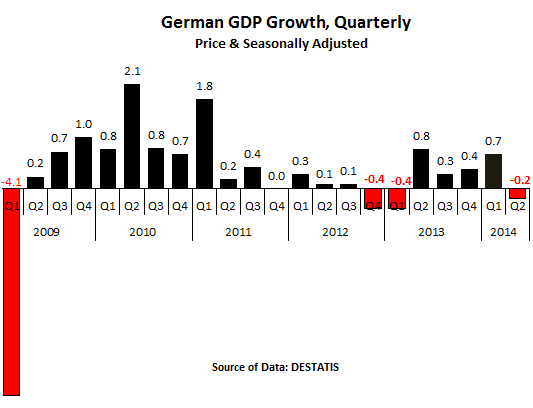
Germany’s economy shrank 0.2% in the second quarter from the first quarter, worse than feared recently, and much worse than the blue-sky forecasts from earlier this year. As the chart shows, the economy has been languishing for three years – with the exception of two quarters – in low-growth purgatory, interrupted by a technical recession of two consecutive negative quarters.


The German statistical agency Destatis blamed exports; or as it said, that imports outpaced exports, thus bringing down the trade surplus. The German economy can’t do without a big trade surplus. It lives and dies by it. But it didn’t blame exports to Russia specifically, which would have been too politically charged. Russia ranks in 13th place on the list of German export destinations, but it’s still important, and exports have swooned [Sanction Spiral Successful: German Exports to Russia Plunge].

The data in Q2 preceded the tragedy of Malaysian Flight MH17 and the subsequent tightening of the sanction spiral and Russia’s countersanctions. Companies on both sides are now beginning to feel serious heat. Unless a miracle happens, Q3 is going to be tough.

Destatis also blamed the weather, of course. Investments in construction declined, after the balmy winter weather in Q1 had apparently caused builders to frontload their activities. Private and public consumption however were up, for which the weather wasnot blamed. Compared to a year ago, real GDP edged up a measly 0.8%.

Germany, the vibrant economy, the big locomotive of the Eurozone, didn’t just stall. It reversed direction. And it dragged what little growth there was in the 18-member Eurozone into stagnation. France, the second largest economy, had no growth – for the second quarter in a row! Italy declined 0.2%. And GDP for the Eurozone remains 2.4% below its pre-financial crisis peak. This is the picture of the “recovery” in the Eurozone, though no one has yet told the stock markets which have been soaring for years. And hope is already spreading that the recent hiccups won’t be anything but blips on the way up into the stratosphere.

But each country has its own set of problems. In Italy, which is now in a perma-recession, the government refuses to pay its suppliers. It’s a way to keep its fiscal disorder under wraps and bamboozle the markets, but it’s strangling the private sector. Read…. Italy’s Economic ‘Recovery’ from Hell in One Chart


5/19/2013

UANI Calls for Greek Ship Owner to End Illicit Business Relationships with Iranian Regime


Πηγή: The Meritime Excecutive
By Marex
May 15 2013

United Against Nuclear Iran (UANI) unveiled evidence of illicit business practices between Victor Restis, Chairman of Greece's First Business Bank S.A. (FBB), and the Iranian regime.

UANI has written to Mr. Restis, presenting evidence of a significant and potentially lucrative relationship between FBB, blacklisted Greek businessman Dimitris Cambis, and Iran's Ministry of Petroleum (MoP).

The documents demonstrate that Mr. Restis, through FBB and in conjunction with Mr. Cambis, is conspiring with individuals acting on behalf of the Iranian regime to serve as a front for the MoP in Greece by securing a "strategic alliance" with the regime. In exchange, FBB will receive investments apparently in excess of one billion dollars from Iranian authorities.

In March, Mr. Cambis was sanctioned by the U.S. Department of Treasury for conspiring with the Iranian regime to acquire a fleet of oil tankers and disguise their ownership in order to illegally export Iranian oil to foreign customers in contravention of international sanctions.

In a letter sent to Restis, UANI CEO, Ambassador Mark D. Wallace, wrote:

United Against Nuclear Iran is writing to express its serious concern about the apparent business dealings of two of your companies, namely First Business Bank S.A. and Enterprises Shipping and Trading S.A., with sanctioned-designated individuals and Iranian oil and shipping entities. Specifically, UANI is seriously alarmed by your relationships with Dimitris Cambis, President of Athene Consulting House S.A., a notorious Greek businessman recently sanctioned by the U.S. government for conspiring with the Iranian regime and Iran's Ministry of Petroleum, to illegally export Iranian oil in violation of international sanctions.

UANI has been provided recent documentation confirming the existence of a significant and potentially lucrative illicit business relationship between FBB, of which you serve as Chairman, Cambis, and the Iranian MoP. The documents demonstrate that you, through FBB, and in conjunction with Cambis, are conspiring with individuals acting on behalf of the Iranian regime to serve as a front for the MoP in Greece by securing a "strategic alliance" with the regime wherein FBB will receive investments apparently in excess of one billion dollars from Iranian authorities. Put simply, you are providing extensive and critical shipping and financial services to the Iranian regime and facilitating the expansion of its oil industry, in flagrant contravention of the international sanctions regime.

****

In addition to Cambis, the other partner in this illicit business relationship is the Iranian MoP. Surely you are aware that the MoP manages the regime's oil industry through two key affiliate companies: the National Iranian Oil Company and the National Iranian Tanker Company and that all three entities are sanctioned by both the U.S. and EU.

In a letter dated April 25, 2012 and addressed to you and Professor Christos Kazantzis, CEO of FBB, Cambis, writing on behalf of Athene, clearly defines the relationship between Athene and the sanctioned Iranian MoP: "We [Athene Consulting House] have established a long term strategic collaboration with the Iranian Ministry of Petroleum and a number of major Iranian private entities operating globally..."

Cambis goes on to explain his rationale for identifying you and FBB as a potential partner in this illicit Iranian investment scheme: "We have been mandated, among others, to propose a Greek financial institution...From our point of view we have proposed FBB because we trust Prof Kazantzis and his strategic thinking and because we believe that Mr Restis is an eminent international businessman who can attain numerous synergies out of a strategic alliance with our clients."

Cambis also clearly describes the motivation of the Iranian partners i.e. Sir Kazem Vaziri, Mr. Homayoun Ansari and Dr. M. Ali Izadi, who "represent the Iranian authorities" and "are in charge of international investments of the Iranian Ministry of Oil." According to Cambis, the objective of Vaziri, Ansari and Izadi is to initiate and conclude a strategicagreement with FBB including "by acquiring a substantial stake in the equity of the Bank....and acquiring other financial institutions in Greece..." According to Cambis, the monthly transactions to be directed to FBB by these Iranian partners "are a few billions."

***

Clearly, the purpose of the partnership between FBB and the stigmatized and sanctioned Cambis, and MoP, respectively, is to secure Iranian regime control over FBB, a non-sanctioned and seemingly legitimate entity headed by an ostensibly credible Greek businessman with the façade of an EU-protected financial institution, in order to enable the Iranian regime to engage in, and enlarge, its fraudulent financial and shipping activity in exchange for an enormous investment from the Iranian regime.

UANI is also in possession of a second document corroborating the main details of the first, namely that the Iranian MoP plans to invest heavily in FBB.

Both documents - the letter from Cambis and the consultancy engagement agreement letter - confirm the existence of a scheme in which FBB serves as a front for the MoP in exchange for an infusion of investment from the Iranian regime. Clearly, you and Cambis are acting as front-men for the Iranian MoP, enabling the regime to massively expand its capacity to finance illicit shipping operations. ...

UANI has highlighted the shipping industry as an area where the international community can further pressure Iran. Earlier this year, UANI revealed the results of a comprehensive investigation into the Iranian regime's actions to evade international oil sanctions.

All thirteen of the world's major shipping services stopped certifying Iranian vessels following UANI's Shipping Campaign, including Bureau Veritas, Germanischer Lloyd, the Russian Maritime Register of Shipping, Korean Register of Shipping, China Classification Society, and ClassNK. UANI has also announced that Barbados, Hong Kong, Moldova and Mongolia have stopped their reflagging of Iranian vessels.

Click here to read UANI's full letter to Restis.


8/23/2012

RBS may face sanctions inquiry after internal review


Πηγή: BBC
August 22 2012

Royal Bank of Scotland (RBS) is understood to be facing investigations into whether it has broken economic sanctions against Iran.

The bank would not comment, but confirmed that it had voluntarily given information on its procedures to UK and US authorities.

It stated that it had approached officials after an internal inquiry.

Standard Chartered and HSBC have been accused of breaking rules designed to prevent transactions with Iran.

The US Department of Justice and the UK's Financial Services Authority both refused to comment on whether they were investigating RBS.

Internal review

RBS referred to recent financial reports in which it said that it had "initiated discussions" with regulators "to discuss its historical compliance with applicable laws and regulations, including US economic sanctions regulations".

RBS said that it voluntarily gave information to regulators about the potential infringements when an internal review uncovered them.

That review was started by Stephen Hester, RBS chief executive, when he joined the business.

"The Group may become subject to formal and informal supervisory actions and may be required by its US banking supervisors to take further actions and implement additional remedial measures with respect to these and additional matters," RBS said when it published its half-year results earlier this month.

Earlier this month, Standard Chartered agreed to pay a $340m (£217m) settlement with New York regulators after it was accused of hiding $250bn of transactions with Iran.

The New York State Department of Financial Services says Standard Chartered spent the best part of 10 years, from 2001 to 2010, hiding billions of Iranian financial deals.

The dollar transactions originated and terminated in European banks in the UK and the Middle East, and were cleared through its New York branch, the complaint said.

Press reports earlier this week suggested that Germany's Deutsche Bank is also being investigated by the US Treasury's Office of Foreign Assets Control, the Federal Reserve, the US Justice Department and Manhattan's district attorney's office for alleged infringements of US-Iran economic sanctions.

Deutsche Bank refused to comment on the reports.

Sanctions regime

Iran has been subject to US economic sanctions since 1979. The current regime operates under the US Treasury Department's Office of Foreign Assets Control.

They were toughened in 1997 by then-President Bill Clinton, who signed an order for sanctions that prohibited "virtually all trade and investment activities with Iran by US persons, wherever located".

Under US criminal law, violations of the Iranian Transactions Regulations may result in a fine up to $1m and/or jail for up to 20 years.

Under the sanctions regime, until 2008, banks in the US in some circumstances were allowed to undertake so-called U-turn transactions with Iranian financial institutions.

Those U-turn transactions move money for Iranian clients among non-Iranian foreign banks, such as those in the UK and the Middle East. They are cleared through the US, but neither start nor end in Iran.

To ascertain whether these transactions are permitted, US clearing banks use the wire-transfer messages they get from banks, using the SWIFT payments system.

If the banks do not have enough information to make the call, they are supposed to freeze the assets.

The allegations involving Standard Chartered and HSBC, both centred on U-turn transactions.

Standard Chartered was accused of stripping the messages of data that showed the clients were Iranian, replacing it with false entries.

The UK-based bank said that not only did "99.9% of the transactions" relating to Iran comply with U-turn regulations, but that the total value of transactions that did not comply was under $14m - converse to the $250bn worth of Iran transactions US regulators said it had hid.

In July, a US Senate Committee found that HSBC carried out 25,000 transactions totalling $19bn that were connected to Iran between 2001-07, which it suggested was evidence that the bank may have broken economic sanctions.


7/05/2012

State Department Investigating UN Agency for Computer Shipments to Iran and North Korea


Πηγή: Fox News
By George Russell
July 05 2012

The U.S. State Department is investigating the shipment of computers and other sophisticated equipment to North Korea and Iran by way of an obscure United Nations agency, despite ongoing U.N. and U.S. sanctions against both governments aimed at blocking their development of nuclear weapons.

The broadening inquiry raises new concerns about the ways in which U.N. agencies have managed to side-step restrictions that the world body expects the rest of the world to obey in halting the spread of sensitive technologies to nuclear-ambitious pariah regimes.

It also calls into question how much U.N. member states know about the activities of agencies they supposedly approve and supervise.

In this case, there are hints that the top official at the U.N. agency, the Geneva-based World Intellectual Property Organization, or WIPO, “has not yet been fully open” to the inquiries, according to a senior U.S. official.

The State Department probe came in the wake of Fox News revelations in April about the actions by the agency, the Geneva-based World Intellectual Property Organization, or WIPO, in sending such sensitive equipment to North Korea by a complicated method that seemed designed to bypass U.N. Security Council sanctions against the country.

The shipments took place in late 2011 or early 2012, and were financed through the Beijing offices of the United Nations Development Program (UNDP).

The WIPO actions also violated the sweeping restrictions of the equipment manufacturer, Hewlett-Packard, which forbids any HP equipment from being sent to such regimes.

The U.S. is a member of WIPO, yet apparently knew little or nothing about the controversial delivery of computers and sophisticated services. And within a month, the State Department discovered the problem went beyond North Korea, a spokesman said in response to questions from Fox News.

“The State Department first became aware of a WIPO development project in Iran in early May 2012, while conducting a review of all WIPO projects in countries under U.N. Security Council sanctions,” the spokesman said. “We have made several inquiries to the WIPO Secretariat and requested any related documentation.”

The spokesman added that State is now “working with like-minded countries” to press WIPO’s director general, Australia-born Francis Gurry, to “conduct an independent, external fact-finding exercise into past WIPO projects in countries under [Security Council] sanctions” presumably to discover if there are further unpleasant surprises in store, and also to “ensure future development projects are properly reviewed prior to being approved and implemented.”

Word of the new revelations first surfaced at a meeting of the House Judiciary Committee last week, in which two California Democrats, Howard Berman and Zoe Lofgren, raised questions with U.S. Deputy Secretary of Commerce Teresa Stanek Rea about the transfers, which Berman declared “highly distressing and Lofgren called “an outrage.”

Stanek confirmed the fact by replying that her department was “disappointed—to say the least” by the transfers and pointed to State as the investigating agency. She also hinted at director general Gurry’s limited response so far, and predicted that “more information will likely be forthcoming.”

A State Department spokesman provided additional hints in declaring that “we have had several conversations with director general Gurry” about reforming WIPO’s project development and implementation, and “will continue to work...to put in place policies that provide greater accountability and transparency at WIPO.”

According to documents obtained by Fox News, WIPO only forwarded detailed information about the specifics of its shipments to its own in early June.

In the case of Iran, the WIPO computer shipment included 20 Hewlett-Packard Compaq desktop computers, now outmoded in the U.S. but which nonetheless still gave Iran’s Industrial Property Office significant computing power. In the case of North Korea, the equipment included both more sophisticated computers and data-storage servers.

As was the case in North Korea, WIPO experts made technical visits to Iran in advance of the shipments to scope out the project, help orchestrate financing and payment by the local office of UNDP in Tehran, and OK the deliveries, according to WIPO’s documentation.

Complicating any oversight of WIPO is that the agency essentially administers and supervises a variety of U.N. sponsored treaties on trademarks and other aspects of intellectual property, including the world-wide patent system. But different countries have signed different treaties, and thus are only party to parts of the WIPO system, making supervision a challenge.

Iran, for example, most recently signed onto WIPO agreements that govern the international administration of trademarks and international protection of place-names for products (e.g. “Champaigne”). It signed onto an arrangement known as the Patent Cooperation Treaty in 1970, or nearly a decade before the Islamic revolution that installed the current bellicose regime.


4/12/2012

Obama, Merkel call for more resolute UN action on Syria


Πηγή: People's Daily
By Xinhoua
April 12 2012

WASHINGTON, April 11-- U.S. President Barack Obama and GermanChancellor Angela Merkel agreed that the UN Security Council needs to take "moreresolute action" on Syria, the White House said in a statement on Wednesday.

"On Syria, the President and Chancellor shared the concern that the Assadgovernment was not complying with the terms of the agreement negotiated by KofiAnnan and continued to engage in unacceptable brutality against its own people," saidthe statement.

"They agreed that this underscored the need for the UN Security Council to cometogether to take more resolute action," the statement said.

The two also discussed the Iranian nuclear issue, urging Iran to take advantage of theupcoming nuclear talks with the six world powers in order to address the internationalconcerns about Tehran's disputed nuclear program.

They reiterated their determination to increase the pressure on Iran through sanctionsand other measures if it remained "unresponsive," said the statement.

Obama also looked forward to hosting Merkel for the G8 Summit which is due to beheld at Camp David in Maryland next month, said the statement.

According to the peace plan proposed by UN-Arab League joint special envoy Kofi Annan, the deadline for a ceasefire in Syria is set for Thursday.

Annan said Wednesday that he had been informed by the Syrian government that thecease of all military fighting across Syria will go into effect as of 6 a.m. local time (0300GMT) on Thursday, according to Annan's spokesman Ahamd Fawzi.


3/14/2012

Official: Chinese Bank Cold On Iran-Pak Gas Deal


Πηγή: Official Wire
By Asif Shahzad
March 14 2012

A state-owned Chinese bank that had agreed to finance the Pakistani section of a gas pipeline from Iran that is opposed by the United States is no longer interested in the project, a Pakistani finance ministry spokesman said Wednesday.

Finance Ministry spokesman Naveed Iqbal said he didn't know why the Industrial and Commercial Bank of China was apparently backing out, but said "the geopolitical situation" had previously been cited by the petroleum ministry as the reason.

The U.S. has warned Pakistan and companies assisting the project could face sanctions if they go ahead.

Washington believes Iran is trying to develop a nuclear bomb, and wants to isolate Tehran economically to try and get it to abandon any nuclear plans. Iran says its nuclear program is for peaceful purposes.

Iqbal said the Chinese bank and Pakistan's Habib Bank Limited had jointly agreed to help finance the Pakistani section of the pipeline, but now seemed to "have no more interest in the project." Neither company could immediately be reached for comment Wednesday.

Pakistani leaders have vowed to press ahead with the pipeline despite U.S. opposition, saying it was vital for the supply of gas to the energy-starved country. But there have been widely expressed doubts over who will finance the project given U.S. opposition.

Asked about the Chinese bank's apparent withdrawal, Pakistani Foreign Minister Hina Rabbani Khar said, "There are always a multiplicity of funding sources which are available for any project."

"This is a fairly viable project and we hope and we will not see any problem in trying to find ways and means of ensuring its funding," she said.


2/20/2012

Oil Jumps to 9-Month High After Iran Cuts Supply


Πηγή: abc News
By ALEX KENNEDY (AP)
Feb 20 2012

Oil prices jumped to a nine-month high near $105 a barrel Monday in Asia after Iran said it halted crude exports to Britain and France in an escalation of a dispute over the Middle Eastern country's nuclear program.

Benchmark crude was up $1.75 to $104.99 per barrel at midday Singapore time in electronic trading on the New York Mercantile Exchange. Earlier in the day, it rose to $105.21, the highest since May. The contract rose 93 cents to settle at $103.24 per barrel in New York on Friday.

Brent crude was up $1.52 at $121.10 per barrel in London.

Iran's oil ministry said Sunday it stopped crude shipments to British and French companies in an apparent pre-emptive blow against the European Union after the bloc imposed sanctions on Iran's crucial fuel exports. They included a freeze of the country's central bank assets and an oil embargo set to begin in July.


Iran's Oil Minister Rostam Qassemi had warned earlier this month that Tehran could cut off oil exports to "hostile" European nations. The 27-nation EU accounts for about 18 percent of Iran's oil exports.

The EU sanctions along with other punitive measures imposed by the U.S. are part of Western efforts to derail Iran's disputed nuclear program, which the West fears is aimed at developing atomic weapons. Iran denies the charges, and says its program is for peaceful purposes.

Oil prices were also boosted by China's decision to boost money supply in a bid to spur lending and economic growth. China's central bank said Saturday it will lower the ratio of funds that banks must hold as reserves, a move that frees tens of billions of dollars.

Oil has jumped from $96 earlier this month amid optimism the global economy may grow more this year than previously expected. J.P. Morgan raised its Brent crude price forecast to as high as $135 from $120.

"Building economic momentum has the potential to pull oil prices higher for the next 12 to 24 months," J.P. Morgan said in a report.

In other energy trading, heating oil added 0.6 cent to $3.22 per gallon and gasoline futures rose 1.4 cents to $3.22 per gallon. Natural gas jumped 9.2 cents to $2.66 per 1,000 cubic feet.


1/30/2012

India will not scale down petroleum imports from Iran: Pranab Mukherjee

India's Union Finance Minister Pranab Mukherjee


Πηγή: Business Today
Jan 30 2012

India will not scale down its petroleum imports from Tehran despite US and European sanctions against the Islamic republic, Finance Minister Pranab Mukherjee has said.

India imports 12 per cent of its oil from Iran.

"It is not possible for India to take any decision to reduce the imports from Iran drastically, because among the countries which can provide the requirement of the emerging economies, Iran is an important country amongst them," Mukherjee told reporters in Chicago.

Speaking at the end of a two-day visit aimed at wooing US investment, Mukherjee said on Sunday: "Some other countries, Saudi Arabia, Nigeria, the other Gulf countries they also contribute but Iran contributes substantially."

"We (India) imports 110 million tonnes of crude per year. We will not decrease imports from Iran. Iran is an important country for India despite US and European sanctions on Iran," the finance minister said.

India, the world's fourth-largest oil consumer, is Iran's second-biggest oil client after China.

The US and other Western sanctions have been imposed on Iran's economy over Tehran's controversial nuclear programme.

US President Barack Obama added to those measures on December 31, last year when he signed into law additional sanctions targeting Iran's central bank and financial sector.

Indian Ambassador to the US Nirupama Rao last week said that India's purchase of oil from Iran has dropped slightly in last two years and is expected to drop further given the difficulties New Delhi might have in making payments through banks due to tough sanctions imposed against Iranian banks.

Rao had said India was in touch with the US Government and closely monitoring the developing situation concerning Iran, when asked about the pressure from the US that India needs to reduce its dependency on Iranian oil.


1/29/2012

Iran: Nuke Inspectors Arrive Amid Oil Ban Vote

Iran insists its work at sites including the Bushehr nuclear power plant is peaceful

Πηγή: Sky news
Jan 29 2012

UN nuclear inspectors have arrived in Iran to investigate the suspected development of atomic weapons - on the day lawmakers are expected to ban oil exports to Europe.

Iran - which could implement the embargo in revenge for new EU sanctions - insists its nuclear programme is peaceful, while Western governments believe it has a military purpose.

The head of the International Atomic Energy Agency delegation said he aimed to "resolve all the outstanding issues with Iran" over the programme.

IAEA deputy director general Herman Nackaerts said: "In particular we hope that Iran will engage with us on our concerns regarding the possible military dimensions of Iran's nuclear programme."

It comes amid fears tensions - already heightened by the recent assassination of Iranian nuclear scientist Mostafa Ahmadi-Roshan - could escalate into military conflict.

Tehran has repeatedly demanded its right to peaceful nuclear technology be recognised by sceptical countries.

Western leaders have claimed its uranium enrichment activities - some of which have been moved to a bomb-proof bunker - go beyond what is needed for atomic energy.

And tensions with the West rose this month when Washington and the European Union imposed the toughest sanctions yet in their campaign to force concessions.


IAEA inspector Herman Nackaerts speaks to reporters en route to Iran

Less than one week after the EU's 27 member states agreed to stop importing Iranian crude from July 1, lawmakers in Tehran are due to debate a bill that would cut off oil supplies to the EU in a matter of days.

The Iranian lawmakers hope to deny the EU a six-month window it had planned to give those of its members most dependent on Iranian oil - including some of the most economically fragile in southern Europe - to adapt.

The head of the state-run National Iranian Oil Company said the export embargo would hit European refiners, such as Italy's Eni, that are owed oil from Iran as part of long-standing contracts.

Ahmad Qalebani told the ISNA news agency: "Generally, the parties to incur damage from the EU's recent decision will be European companies with pending contracts with Iran."

But Robert Smith, a consultant at Facts Global Energy, said: "The Saudis have made it clear that they'll step in to fill the void. It would not pose any serious threat to oil market stability."


1/23/2012

EU Imposes Iran Oil Embargo, Central Bank Freeze

Iranian President Mahmoud Ahmadinejad had said the EU will "regret" the economic sanctions it is planning to impose on Tehran on 26 July 2010 at a foreign ministers' meeting in Brussels. 


Πηγή: WSJ
By Samuel Rubenfeld
Jan 23 2012

European Union foreign ministers agreed Monday to impose an oil-import embargo on Iran and an asset freeze on the country’s central bank, escalating the confrontation over Tehran’s nuclear program.

The embargo bans the importation of petroleum and crude oil products from Iran, as well as insurance on such products. It goes into effect as of July 1 (sub req) on existing contracts, and a review of the economic effects of the measures on oil will take place before May 1, according to a statement (pdf) from the EU Council.

Crude prices rose modestly on the news.

The Council also froze the assets of Iran’s central bank, Bank Markazi, within the EU, though the statement allowed that “legitimate trade can continue under strict conditions.” No longer can the EU trade gold, precious metals and diamonds with Iranian public bodies or the central bank.

The Iranian currency, the rial, which has been battered since U.S. sanctions targeted Bank Markazi, fell to record lows on the EU announcement.

In addition, the EU outlawed the importation of petrochemical products from Iran, along with the export of technology for the sector there. It froze the assets of eight more entities and slapped visa bans and asset freezes on three more individuals, the statement said.

The measures come as the U.S. and Europe ratchet up their efforts at isolating Iran over a nuclear program that an International Atomic Energy Agency report found was producing technology that could result in Tehran possessing the means to make nuclear weapons.

Iran maintains its nuclear program is peaceful, and President Mahmoud Ahmadinejadsaid over the weekend that any new sanctions won’t affect the country. Lawmakers, however, again threatened on Monday to close the Strait of Hormuz in response to the EU sanctions.

The Wall Street Journal reported on Monday’s measures, and there’s more from theGuardian, CNN, AP, BBC, Reuters, Haaretz, Global Post and NY Times.

Late last week, EU diplomats talking ahead of Monday’s ministerial meeting couldn’t agree on a full oil embargo because Greece, which imports a significant amount of its oil from Iran and is in the middle of an economic crisis, was holding out. Athens didn’t win a special concession it requested for extra time to implement the embargo, the Journal report said.

Refiners in Spain and Italy, both nations that also rely heavily on Iranian oil and are dealing with crises, were already phasing out some Iranian oil purchases and they will continue apace, according to the Journal report.

Separately, the EU Council followed through and expanded its Syria sanctions blacklist, bringing the total number of people facing visa bans and asset freezes to 108, and the number of entities with their assets frozen to 38.

“Today’s decision will put further pressure on those who are responsible for the unacceptable violence and repression in Syria,” said EU foreign policy chief Catherine Ashton in a statement (pdf).

The names of the individuals and entities sanctioned Monday will be published Tuesday in the EU’s Official Journal.


1/16/2012

All You Need to Know About Iran, $200 Oil, and $6.00 Gas


Πηγή: Money Morning
BY JASON SIMPKINS
Jan 16 2012

If you're unsettled by the thought of gasoline at $4.00 a gallon, brace yourself.

With tensions between Iran and the West quickly escalating, we could see gas jump to $6.00 a gallon at the pump in a matter of months.

Make no mistake about it: If Iran were to follow through on its threats to close the Strait of Hormuz, oil priceswould surge as high as $200 a barrel in matter of days.

But that's just the beginning...

A wider Iranian war could throw the entire region into chaos -- making $100 oil seem like a bargain.

None of this is hyperbole. In fact, these dangers are likely according to of one of world's leading energy analysts, Dr. Kent Moors.

Dr. Moors is an advisor to six of the world's top 10 oil companies, including natural gas producers throughout Russia, the Caspian Basin, the Persian Gulf and North Africa. He also consults for high-level officials from the U.S., Russian, Kazakh, Bahamian, Iraqi and Kurdish governments on all things energy related.

In short, Kent's insights are invaluable.

That's why we've given Dr. Moors a chance to address all of the concerns swirling around the energy market today.

In the interview that follows you'll learn what you really need to know about Iran, the global oil market, and most importantly, what you can do to profit...

Dr. Kent Moors on the Brewing Crisis in the GulfQ) Dr. Moors, how serious are the recent developments in Iran?

Moors: This is the most serious U.S.-Iranian crisis since the fall of the Shah in 1979. There's a very dangerous situation inside Iran that is only being accentuated by the oil market problems that have resulted from Western sanctions.

First off, on the Strait of Hormuz: This is the most significant oil choke point in the world. Some 35% of the world's seaborne oil shipments and at least 18% of daily global crude shipments pass through this narrow channel in the Persian Gulf. And while the Iranian Revolutionary Guard Navy is not large enough to blockade the Strait of Hormuz for any length of time, it could disrupt traffic.

Q) What effect would closing the Straits of Hormuz have on oil and gas prices?

Moors: Closing the strait would result in a rise in crude oil prices of between $20 and $40 a barrel in a matter of hours. Any interruption beyond 72 hours would push prices to between $150 and $200 a barrel.

As far as gas prices are concerned, the basic rule of thumb is that each $1.00 rise in a barrel of oil results in a 3.2-cent rise in a gallon of gasoline. So $200 oil would equal $6.00-plus gasoline.

Q) Why is this crisis unfolding right now?

Moors: Three major elements are causing Iran to become belligerent:

Massive economic and political problems inside the country.

The last round of sanctions that restricted Tehran's access to international banking.

And the European Union's (EU) decision to boycott Iranian crude imports.I'll explain each of these further.

First, Iran is undergoing significant economic and political problems. The rial (the Iranian currency) has inflated almost 80% against the dollar in less than a year. The governmenthas not accounted for almost $120 billion in oil proceeds kept out of the country, resulting in a split between Iranian President Mahmoud Ahmadinejad and some of his former supporters in the Majlis (parliament). Several of the president's closest advisors are, or shortly will be, under indictment for corruption. That includes a multi-billion dollar case of banking fraud, the largest in the country's history.

Ahmadinejad is in a flat out political war with both the supreme religious leader Ayatollah Khamenei and major clerics.

Now come the sanctions, which have gotten unbearably strict.

The last round of U.S., EU and United Nations (UN) sanctions began cutting Tehran off from international banking. Since global oil sales are denominated in dollars, access to exchange and clearing banks is essential.

Germany, under pressure from Washington, closed Europäish-Iranische Handelsbank (EIH). This small bank is Hamburg-based but Iranian-owned and registered by the Bundesbank (German Central Bank). American intelligence and Treasury officials are convinced (almost certainly correctly) that EIH had been a primary means through which Tehran accessed the international exchange, acquired equipment for its nuclear program, financed arms deals, and provided subsidies to Hezbollah and Hamas.

That was followed by the end of Asian Clearing Union (ACU) services for Iranian oil sales (despite Iran being one of the ACU members). That resulted in a full-blown crisis in India, where Iranian crude imports are essential. New Delhi had no mechanism to pay for the consignments until it set up a very inefficient system of rupee accounts in Turkish banks to exchange them for rials.

Iran must now resort to inefficient and costly substitutes - such as shadowy exchanges around the Dubai Exchange and barter arrangements (especially with China) via the Singapore Exchange. Since China has a trade surplus with Iran, it can effectively finance its crude purchases with its own exports.

Finally, the EU has decided to stop importing Iranian oil. Europe is the second-largest buyer of Iranian crude after China. Iran cannot find customers to replace such a large volume in short-order. The EU must be careful not to spike the price of crude through such a policy, especially for certain member countries already having problems of their own.

Greece, for example, usually receives a third of its crude oil directly or indirectly from Iran. Spain also would be immediately impacted. There's also a range of daily swap contracts in Europe involving Iranian oil as an element. These would also be thrown out of balance resulting in a price rise.

Risk is now an exacerbating concern in the oil market. The Iranian situation is rapidly becoming a major crisis.

Q) So what's the next move? How do you see this crisis playing out over the next several months?

Moors: The crisis will probably intensify. Western intelligence agencies have already concluded Iran will get nuclear weapons at the current rate of development. The attempt now is to destabilizeIran internally - hence the latest round of sanctions. Tehran will not allow this to happen. Threateningto close the Strait of Hormuz is one response;moves to destabilize the regionwill be another. Iran is a main sponsor of both Hezbollah and Hamas and neitherof these will sit idly by and have a financiallifeline cut.

Saudi Arabia will increase its own pressure against Iran, while any genuine attempt toclose the Strait will be met with an immediate Saudi response.

Q) Finally, how can investors profit? In the past, Money Morning has advocated exchange-traded funds such as the United States Oil Fund LP (NYSE: USO) and stocks as Suncor Energy (NYSE: SU) as ways to profit from higher oil prices. Are these stocks still good investments?

The longer the crisis remains, the greater the benefit from emphasizing North American-based production.

Companies - like the Calgary-based Suncor - that are active in Canada's oil sands are one way for investors to go. According to the government of Alberta, nearly 173 billion barrels of recoverable oil rest in these tar sands, based on current production costs. This represents nearly 75% of the total North American reserves currently available. Canada is the largest supplier of oil and gas to the United States, shipping approximately 75% of its exports here each month.

Dr. Kent Moors is A prolific writer and lecturer, his six books, more than 750 professional and market publications, and over 250 private/public sector presentations and workshops have appeared in 44 countries.

Editor's Note: This Post should not considered as an investment advise from FACTDROP.


Iran warns Gulf nations not to boost oil production


Πηγή: Irish Examiner
By Tarek El-Tablawy
Jan 16 2012


IRAN warned Gulf Arab oil producers against boosting production to offset any potential drop in Tehran’s crude exports in the event of an embargo affecting oil sales, the latest salvo in the dispute between the West and the Islamic Republic over its nuclear programme.

The comments by Iran’s OPEC governor, published yesterday, came as Saudi Arabia’s oil minister was quoted denying his country’s earlier pledges to boost output as needed to meet global demand was linked to a potential siphoning of Iranian crude from the market because of sanctions.

World oil markets have been jolted over concerns that Iran may choke off the vital Strait of Hormuz in retaliation for sanctions hampering its ability to sell its oil. Saudi Arabia and other key Gulf Arab producers have recently said they are ready to provide stable and secure supplies of oil.

The US recently imposed sanctions targeting Iran’s central bank and, by extension, refiners’ ability to buy and pay for crude. The European Union is also weighing an embargo on Iranian oil, while Japan, one of Iran’s top Asian customers, has pledged to buy less crude from the country.

Mohammad Ali Khatibi, Iran’s OPEC governor, was quoted yesterday by the pro-reform Shargh newspaper as saying that attempts by Gulf nations to replace Iran’s output with their own would make them an "accomplice in further events".

"These acts will not be considered friendly," Khatibi said, adding that, if the Arab producers "apply prudence and announce that they will not participate in replacing oil, then adventurist countries will not show interest" in the embargo.

The embargo concerns are linked to Iran’s nuclear programme. The West maintains Iran is enriching uranium for weapons purposes while Tehran says its programme is for purely peaceful purposes such as generating electricity.

Saudi Arabia, the world’s largest oil producer and a close US ally, had said that it was ready to raise its output to accommodate global market needs.

The country is the only member of 12-nation OPEC that has significant spare capacity, currently estimated at roughly more than 2 million barrels a day.

With concerns building amid the standoff between Iran and the West over Tehran’s nuclear programme, a string of Asian and Western officials have visited Saudi Arabia over the past week. While offering assurances that it could meet a shortfall in supply through its spare capacity, Saudi officials have also been careful to say that it was an internal matter if nations chose to abide by any sanctions.

Oil Minister Ali Al-Naimi appeared to try to further clarify the country’s position in comments yesterday in the daily Al-Ektisadiyah newspaper.

"We never said Saudi Arabia is trying to compensate for Iranian oil in the case that sanctions (are enacted)," Al-Naimi was quoted as saying. "We said that we are prepared to meet the increase in global demand as a result of any circumstances."

Washington has said it would not tolerate any closure of the strait — the export route for one third of all seaborne traded oil — with Defence Secretary Leon Panetta has saying such a move would require a response.


1/15/2012

US Plans Set In Case Israel Strikes


Πηγή: Arab Times
Jan 15 2012

IRAN CLAIMS EVIDENCE OF U.S. ROLE IN N-BRAIN HIT

WASHINGTON, Jan 14, (Agencies): The US government is concerned that Israel is preparing to take military action against Iran over US objections, and has stepped up contingency planning to safeguard US facilities in the region, The Wall Street Journal reported late Friday.

The newspaper said President Barack Obama, Defense Secretary Leon Panetta and other top officials have delivered a series of private messages to Israeli leaders, warning about the dire consequences of a strike.
Obama spoke by telephone on Thursday with Israeli Prime Minister Benjamin Netanyahu, and General Martin Dempsey, chairman of the Joint Chiefs of Staff, will meet with Israeli military officials in Tel Aviv next week, the report said.

The Journal noted that the US military was preparing for a number of possible responses to an Israeli strike, including assaults by pro-Iranian Shiite militias in Iraq against the US Embassy in Baghdad.

Up to 15,000 US diplomats, federal employees and contractors still remain in Iraq.

To deter Iran, the United States is maintaining 15,000 troops in Kuwait, and has moved a second aircraft carrier strike group to the Persian Gulf area, the paper said.

Evidence

Iranian state television said on Saturday Tehran had evidence Washington was behind the latest assassination of one of its nuclear scientists.

In the fifth attack of its kind in two years, a magnetic bomb was attached to the door of 32-year-old Mostafa Ahmadi-Roshan’s car during the Wednesday morning rush-hour in the capital. His driver was also killed.

The United States has denied involvement in the killing and condemned it. Israel has declined to comment.
“We have reliable documents and evidence that this terrorist act was planned, guided and supported by the CIA,” the Iranian foreign ministry said in a letter handed to the Swiss ambassador in Tehran, state TV reported.

“The documents clearly show that this terrorist act was carried out with the direct involvement of CIA-linked agents.”

The Swiss Embassy has represented US interests in Iran since Tehran and Washington cut diplomatic ties shortly after the 1979 Islamic revolution.

State TV said a “letter of condemnation” had also been sent to the British government, saying the killing of Iranian nuclear scientists had “started exactly after the British official John Sawers declared the beginning of intelligence operations against Iran”.

In 2010, chief of the British Secret Intelligence Service Sawers said one of the agency’s roles was to investigate efforts by states to build nuclear weapons in violation of their international legal obligations and identify ways to slow down their access to vital materials and technology.

Tehran has urged the UN Security Council and Secretary-General Ban Ki-moon to condemn the latest killing, which Tehran says is aimed at undermining its nuclear work, which the West and Israel say is aimed at building bombs. Tehran says its nuclear programme is purely civilian.

Action

British Prime Minister David Cameron warned that the “whole world” would take action if Iran closed the strategic Strait of Hormuz, in a television interview during a visit to Saudi Arabia on Friday.

“It is in the interests of the whole world that those straits are open and, if there was any threat to close them, I am sure the whole world would come together and make sure they stayed open,” Cameron told Al-Arabiya television.

Cameron’s first visit as premier to OPEC kingpin Saudi Arabia comes as Western governments move to step up sanctions over Iran’s controversial nuclear programme, threatening an embargo on its oil exports.

The move has drawn an angry response from Tehran which has in turn threatened to shut the strait — a chokepoint for a fifth of the world’s sea-borne oil exports — if it is attacked or heavy sanctions are imposed.

The New York Times reported late on Thursday that the United States has used a secret channel to warn Iran’s leaders against closing the Strait of Hormuz, saying that doing so would provoke a US response.

Cameron also called for a UN Security Council resolution on Syria, where the United Nations estimates an uprising has left more than 5,000 dead since March in a crackdown on protests against President Bashar al-Assad’s regime.

“We stand ready as a permanent member of the UN Security Council to take a fresh resolution to that Council, based on what the Arab League is doing and saying,” the prime minister said.

He said any party which vetoed, in apparent reference to Russia, would have to “try to explain why they are willing to stand by and watch such appalling bloodshed by someone who has turned into such an appalling dictator.”

UN chief Ban Ki-moon, who was in Lebanon on Friday, made a similar appeal, urging the international community to stand together to address the crisis in Syria.

Hostile

Small Iranian military motorboats approached US vessels passing through the Strait of Hormuz twice last week but the Pentagon said the interactions were not seen as hostile, even at a moment of heightened tensions between the two countries.

Video released by the Pentagon showed the armed boats with the Iranian Revolutionary Guard Corps’ navy approaching within several hundred yards (metres) of the USS New Orleans, an amphibious transport ship, on Jan. 6, a US military official said.

The same day, a similar incident occurred with the US Coast Guard cutter Adak, with the Iranian boats seen riding in its wake, guns visible.

“This interaction between US naval vessels and the Iranian vessels is commonplace,” said Captain Jane Campbell, a Pentagon spokeswoman. “There is nothing in these that shows any kind of hostile intent.”
US officials say it is routine to take video of such incidents and the US military decided to release imagery at the request of news organizations.

Nine American vessels have passed through the strait since the start of the year. It was not immediately clear whether any of the other seven had been approached in this manner by Iranian vessels.

The approaches come at a time of concern about the possibility of a clash between the United States and Iran in the Strait of Hormuz, the world’s most important oil shipping lane.

Tehran has threatened to close the strait if new US and EU sanctions over its nuclear program cut off Iranian oil exports. Iran has also threatened action if another US carrier moves into the Gulf.

Defense Secretary Leon Panetta has warned that closure of the strategic waterway would be seen as a red line by the United States and would require a response.

The Pentagon also sought on Friday to discourage speculation the US military was quietly building up its forces in the region to counter any perceived threat.

1/13/2012

U.S. slaps sanctions on China state oil trader over Iran


Πηγή: Reuters
By Andrew Quinn
Jan 12 2012

* U.S. takes first swipe at China state energy sector

* Move comes as U.S. seeks to squeeze Tehran

* Sanctions seen as signal to China oil majors

* Follows trip to China this week by U.S. Treasury Secretary

WASHINGTON, Jan 12 (Reuters) - The United States on Thursday imposed sanctions on China's state-run Zhuhai Zhenrong Corp, which it said was Iran's largest supplier of refined petroleum products, as it sought to impress on Beijing and Tehran its resolve to increase economic pressure over Iran's nuclear program.

Secretary of State Hillary Clinton also imposed sanctions on Singapore's Kuo Oil Pte Ltd and FAL Oil Company Ltd, an independent energy trader based in the United Arab Emirates, the State Department said in a notice.

The State Department said the move was part of a broadening international effort to target Iran's energy sector and persuade Tehran to rein in its nuclear ambitions.

"The sanctions announced today are an important step toward that goal, as they target the individual companies that help Iran evade these efforts," the statement said.

The sanction bar all three companies from receiving U.S. export licenses, U.S. Export Import Bank financing or loans over $10 million from U.S. financial institutions, the department said, stressing that the sanctions apply only to the companies and not to their governments or countries.

The U.S. announced the decision after China's rebuff this week of Treasury Secretary Timothy Geithner, who traveled to Beijing to press China on U.S. demands it do more to help curb Iran's oil revenues.

A Zhenrong spokeswoman and China's Foreign Ministry both said they had no immediate comment.


'SHOT ACROSS THE BOW'

Analysts said the U.S. move was largely symbolic, given that Zhenrong was unlikely to have much U.S. business exposure.

But the move will send a signal to Beijing and its state-run oil giants such as China National Petroleum Corp (CNPC), China Petroleum and Chemical Corp (Sinopec Corp) and China National Offshore Oil Corp. , they said.

These companies have invested billions of dollars in the U.S. energy sector, and are much more exposed to the impact of potential sanctions.

"It's a good shot across the bow and signals the U.S. is serious about vigorous sanctions enforcement," said Mark Dubowitz, executive director of the Foundation for Defense of Democracies, a Washington pressure group that favors stronger sanctions on Iran.

"This could be the beginning of a cascade of more sanctions on Chinese companies if China doesn't curtail its Iranian trade."

Zhuhai Zhenrong - one of four dominant Chinese state oil traders - brokered the delivery of over $500 million in gasoline to Iran between July 2010 and January 2011 in contravention of U.S. sanctions law, the State Department said.

While the U.S. move targeted Zhenrong for its gasoline sales, the Chinese company has a broader role in Beijing's energy dealings with Iran.

It has been a major buyer of Iranian oil since at least 1995, typically selling the oil to Sinopec and PetroChina, the country's two dominant refiners.

Zhenrong has been buying about 240,000 barrels per day for several years, representing about 5 percent of China's imports. Sources last week said China would cut crude imports from Iran for a second month in February.

In mid-2010, Zhenrong joined Chinese state energy giants in filling a void left by Western oil companies and trading houses that had halted sales of gasoline to Iran because of toughening U.S. sanctions.

Derek Scissors, an expert in the Chinese economy at the Heritage Foundation think tank, said the action against Zhenrong would send a message to other Chinese state oil majors.

"We don't want to be taking action against Sinopec, CNPC and CNOOC. They are huge, and politically powerful," he said.

"But Zhenrong is close enough to them, and won't really do that much harm beyond sending the signal."


TARGETING COMPANIES

The U.S. announcement followed Western moves to tighten the economic noose on Tehran through unilateral sanctions.

President Barack Obama has signed a U.S. law imposing sanctions on financial institutions that deal with Iran's central bank, its main clearinghouse for oil exports, while the European Union is expected soon to agree to a new ban on Iranian oil imports.

Washington has sought to impress on friends and foes that it means business, sending U.S. officials around the world to warn of the dangers of dealing with Iran.

A senior Obama administration official stressed that the purpose of sanctions was to draw Iran back to the negotiating table to discuss curbing its nuclear ambitions, the other half of the 'two-track' U.S. policy of pressure and engagement.

"The theory of the case here is that these two tracks will ultimately converge and Iran will make a decision that it is important to come to the table to try to remove some of these sanctions, to improve their economy," the official told reporters on condition of anonymity.

The other two companies listed by the State Department, both well-known names in the Asian oil trading world, are smaller, private trading firms that typically specialize in shipping bunker fuel or heavy residual products but, like Zhenrong, had also begun doing deals to sell gasoline to Iran.

The State Department said Kuo Oil had provided over $25 million in refined petroleum to Iran between late 2010 and early 2011, while FAL provided over $70 million in refined petroleum to Iran over multiple shipments in late 2010.

Kuo had no immediate comment, a senior official said.

In all cases, individual deliveries were worth significantly more than the $1 million threshold under U.S. law and the total value of the transactions was well above the $5 million threshold for sanctionable activities within a 12-month period, the State Department said.