Showing posts with label eurozone crisis. Show all posts

8/16/2014

Sanctions Are Eating their Lunch: Russian CEO Begs for Bailout, German Economy Swoons


Πηγή: Wolf Street
By Wolf Richter
Aug 14 2014

“The glue of the sanctions is starting to dry,” mused Sergio Trigo Paz, head of emerging market fixed income at BlackRock, the world’s largest asset manager. Investors fret that holders of Russian corporate bonds might not receive interest payments because a “blocked person” has a large stake in the company, he said. “All transactions could start to freeze.”

That was in mid-May. Now, the glue has dried: Igor Sechin, CEO of Russian oil company Rosneft and a major shareholder, whose name graces the “Specially Designated Nationals and Blocked Persons List,” is begging the Russian government for a $41.6 billion bailout in response to the sanctions.

The company has net debt of $44.5 billion, the hangover from its $54 billion acquisition of TNK-BP last year. But the US sanctions ban loans to Rosneft with maturities over 90 days, and EU countries are sticking to these sanctions as well. So dealing with this debt and paying dividends is going to be tough.

And the advance payments from China from the Holy-Grail gas deal that analysts had seen washing over Rosneft? $63 billion between 2014 and 2018, according to Raiffeisenbank’s energy specialist in Moscow, Andrey Polishchuk, who didn’t think Rosneft would have any problems paying its debts and dividends “until 2019.” A hype-ventilating analyst’s pipedream for now.

But Russia’s National Wealth Fund, where the bailout money is supposed to come from, already doled out much of its $86 billion for other projects and cannot fund the bailout, according to the Vedomosti newspaper (picked up by Reuters). The paper cited government sources and a letter from Prime Minister Dmitry Medvedev that asked officials to analyze the request, which one of the unnamed officials called “horrible.”

Thus, the sanctions are beginning to wreak havoc. Everywhere. German industrialists and exporters have long complained about them. CEOs step up to the microphone on a near daily basis and, after pronouncing the requisite pledge to submit to the “primacy of politics,” slam the sanctions and the impact they have on their companies. They’ve been doing this for months, trying to jawbone the German government into compliance with their needs.

Now the official results are in. And they’re ugly.

Germany’s economy shrank 0.2% in the second quarter from the first quarter, worse than feared recently, and much worse than the blue-sky forecasts from earlier this year. As the chart shows, the economy has been languishing for three years – with the exception of two quarters – in low-growth purgatory, interrupted by a technical recession of two consecutive negative quarters.
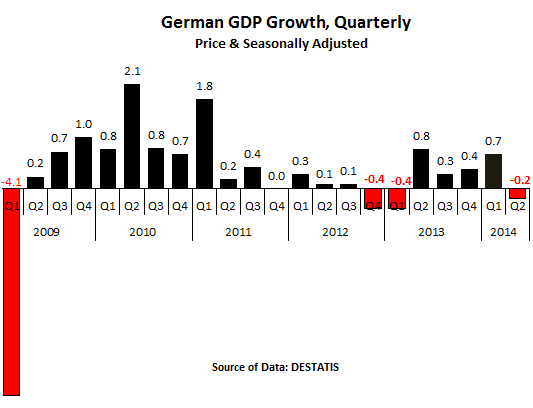


The German statistical agency Destatis blamed exports; or as it said, that imports outpaced exports, thus bringing down the trade surplus. The German economy can’t do without a big trade surplus. It lives and dies by it. But it didn’t blame exports to Russia specifically, which would have been too politically charged. Russia ranks in 13th place on the list of German export destinations, but it’s still important, and exports have swooned [Sanction Spiral Successful: German Exports to Russia Plunge].

The data in Q2 preceded the tragedy of Malaysian Flight MH17 and the subsequent tightening of the sanction spiral and Russia’s countersanctions. Companies on both sides are now beginning to feel serious heat. Unless a miracle happens, Q3 is going to be tough.

Destatis also blamed the weather, of course. Investments in construction declined, after the balmy winter weather in Q1 had apparently caused builders to frontload their activities. Private and public consumption however were up, for which the weather wasnot blamed. Compared to a year ago, real GDP edged up a measly 0.8%.

Germany, the vibrant economy, the big locomotive of the Eurozone, didn’t just stall. It reversed direction. And it dragged what little growth there was in the 18-member Eurozone into stagnation. France, the second largest economy, had no growth – for the second quarter in a row! Italy declined 0.2%. And GDP for the Eurozone remains 2.4% below its pre-financial crisis peak. This is the picture of the “recovery” in the Eurozone, though no one has yet told the stock markets which have been soaring for years. And hope is already spreading that the recent hiccups won’t be anything but blips on the way up into the stratosphere.

But each country has its own set of problems. In Italy, which is now in a perma-recession, the government refuses to pay its suppliers. It’s a way to keep its fiscal disorder under wraps and bamboozle the markets, but it’s strangling the private sector. Read…. Italy’s Economic ‘Recovery’ from Hell in One Chart


2/18/2014

Russians Return to Cyprus, a Favorite Tax Haven

Nearly a year ago, European authorities sought to drive a stake into the heart of this country's role as an offshore tax heaven, when Cyprus briefly became the newest epicenter of the euro xone's debt crisis.

Πηγή: New York Times
By LIZ ALDERMAN
Feb 17 2014

NICOSIA, Cyprus — When the Cypriot government forced bank depositors — many of them Russian — to pay their share of an international bailout last spring, Vasilis Zertalis’s phone started ringing.

The companies his consultancy helps incorporate on this breezy Mediterranean island — many of them Russian, too — wanted to know how quickly they should get out.

These days, the calls are coming for another reason: Businesses are eager to get in.

“We are registering twice as many companies than when after the crisis hit,” Mr. Zertalis, the head of a big registrar, Prospectacy Limited, said as the sun set over palm trees near his office one recent weekday. “Russians, Germans, Latin Americans, Canadians — they’re all coming,” he said.

Especially the Russians. And that is even though they were the category of foreign investors that the Cypriot government and its international bailout creditors seemed to single out for punishment last spring, when officials tried to turn the economy here into something more than an offshore tax haven whose banks looked the other way as money of questionable provenance rolled in from abroad.

Launch media viewerA woman at the Alkyonides charity in Nicosia, the capital of Cyprus, where the unemployment rate is 17.5 percent. 
The banking system has been drastically overhauled. But the tax haven part less so.

“People are still interested because the legal and tax system remains much more stable than in Russia, and they think that the threat of another haircut is remote,” said Costas Erotocritou, the vice president of the Russian Business Association here, and a lawyer whose firm specializes in setting up offshore accounts.

The haircut he referred to was the Cypriot government’s move last spring to seize vast sums, much of it deposits from wealthy Russians, at the nation’s biggest banks. (Because part of the money seized was converted into bank shares, one other anomaly of the bailout was that it turned wealthy Russians into some of the biggest shareholders in Cypriot banks.)

A year after the bailout, Cyprus’s economy is still in deep trouble and its banking sector is half its former size. With bank tellers, construction workers and retail employees caught in the fallout, unemployment has jumped to 17.5 percent from 14 percent a year earlier; youth unemployment is above 40 percent.

Banks sharply curbed lending as the level of deposits shrank, and nearly half their outstanding loans are in arrears or default. Private debt has surged to around 300 percent of Cyprus’s 17 billion euro economy.

But the one rebounding business is foreign incorporation. Cyprus is once again a favorite tax haven, even after international bailout officials forced the government to nudge the corporate tax rate up to 12.5 percent, from 10 percent. That is still the lowest in the euro zone, on par with Ireland and well below Germany’s 29.5 percent and France’s 33.3 percent.

The registration of what are mostly shell companies created to shelter income was 1,454 in January alone. That is more than double the nadir of last spring, after the bailout, and even slightly more than were registered in December 2012, before the collapse.

As a result, there are now about 273,000 companies on Cyprus’s corporate registry, a staggering figure in a country whose population is only 839,000. “This is not an industry that has died,” said Yiorgos Lakkotrypis, 
Cyprus’s commerce and energy minister.

Launch media viewerThe Alkyonides food bank, which is serving many more Cypriots.
And the Russians have dug in.

“The Russians won’t leave because they really don’t have any other option,” Mr. Zertalis said. “Sure they lost money in the haircut, but when it comes to business they will continue to use the island because returning to Russia is not a better solution for them.”

But there is one place where neither the Russians nor any other foreign investors are putting much money: Cypriot banks.

After deposits were seized, “companies generally won’t hold more than 100,000 euros in a Cypriot bank now,” said Mr. Erotocritou.

He was referring to the radical move by officials who, for the first time in a euro zone bailout, forced some depositors to take a loss. The authorities last spring liquidated Laiki Bank, Cyprus’s second-biggest financial institution, and folded its remains into the largest one, Bank of Cyprus, where the government then confiscated 60 percent of deposits above €100,000 to recapitalize the lender.

Total deposits in Cypriot banks, which were €57 billion last April, dropped to €47 billion by November. They might have fallen further and faster if the government had not tightly controlled withdrawals and foreign transfers at the height of the crisis.

By now those controls have been relaxed to the extent that they hardly affect business operations anymore, enabling companies that are still comfortable keeping their money in a Cypriot bank account to conduct transactions more easily than they did six months ago.

Some controls remain in place for individual accounts, including a €300 daily withdrawal limit and central bank vetting of large cash transfers. But last week the finance ministry said further loosening of the rules was in the offing. That was in response to a review by the International Monetary Fund, which found that Cyprus was fulfilling the fiscal promises it made as part of the bailout.

Launch media viewerThe streets in Nicosia’s main shopping area are lined with shuttered stores and largely empty of people
Even so, many businesses are taking no chances. They are setting up bank accounts entirely outside of the euro zone on the concern that, as in Cyprus, their assets could be seized to pay for banking crises that might blow open in other European countries, Mr. Zertalis, the consultant, said.

“No matter what European leaders say now, all of our clients are saying, ‘Let’s split our accounts among as many different countries and banks as we can,’ ” Mr. Zertalis said. “They say ‘We won’t keep our money in Cyprus, but we don’t feel secure about Europe anymore, either.’ ” He said many had turned to financial institutions in Canada, Switzerland and Asian countries.

Yet while financial agents like Mr. Zertalis are enjoying a bounce-back — he doubled the size of his small staff in the last six months and plans to double it again this year — many other people across the island are casualties of the banking collapse.

Thousands of small and midsize businesses have been hobbled by the dearth of bank lending, said George Pamboridis, a senior partner at the law firm Pamboridis.

On Nicosia’s main shopping street, storefronts once adorned with mannequins, shoes and electronics now sit empty. In Nicosia’s main square, retail space formerly occupied by a Laiki Bank branch is vacant, with debris strewn where teller windows once stood.

Outside Nicosia, at a hulking warehouse near green meadows and olive trees, volunteers at the Alkyonides charity rushed on a recent weekday to prepare for the 50 families who had trekked there to receive handouts of food, diapers and used clothing.

Two years ago, the charity typically served around 15 families a month. Today, it is overwhelmed with as many as 1,000 families in need, mostly people who used to work in banking, construction or retailing, said Koulla Demetriou, a volunteer.

“Many people can’t find jobs, and every month it gets worse,” Ms. Demetriou said, as she typed up a food ticket for Angeliki, 42, a mother of three who recently lost her job working in security for a bank.

“The main hope now is that the people of Cyprus will care for each other.”

In the meantime, the gap between Cypriots out of luck and foreigners with money — especially the Russians — has never been starker.

“Rich Russians love this country,” Mr. Erotocritou said. “They will keep coming back.”


6/11/2013

The ECB’s Forked-Tongue Policy To Save The Euro


Πηγή: Testosterone Pit
June 10 2013

In theory, Germany’s Federal Constitutional Court could throw a monkey-wrench into the efforts to keep the Eurozone duct-taped together; it could rule against the ECB’s money-printing and bond-buying mechanism, lovingly dubbed Outright Monetary Transactions. It was launched with fanfare last September. Actually, not with fanfare but with a few vague words, uttered by ECB President Mario Draghi himself, including the magic one, “unlimited.”

A word so powerful that it would bail out speculators and banks that had bought crappy Spanish and Italian debt at steep discounts. Bonds and stocks surged – as did unemployment and other problems, but what the heck, OMT wasn’t about curing sick economies. It was about a central bank promising to bail out speculators.

During oral arguments on Tuesday and Wednesday, the Court weighs if OMT violates the constitution’s requirement that budget matters be controlled by Parliament, but a ruling will be delayed until after the general elections on September 22. If the Court, which has no authority over the ECB, rules that aspects of OMT are unconstitutional in Germany, it could forbid the Bundesbank from participating in the one measure that has kept the Eurozone together. The Eurozone as we know it would unravel.

In practice, the Court would never do that. Given how it has ruled on euro-related issues so far, it will find a way out of the debacle, regardless of what it says in the constitution. And if it really wants to throw the book at the ECB, it could nod with an impish frown, impose some stipulations, and rubberstamp the rest.

But that hasn’t kept the mess from ballooning beautifully out of control in Germany where the ECB’s efforts to save the euro and itself – without euro there would be no ECB – are viewed with a decided lack of enthusiasm: 48% of the Germans side with the 37,000 plaintiffs, believing that the Court should stop the ECB’s whatever-it-takes-to-save-the-euro approach;only 31% believe that the plaintiffs are wrong; and despite the dense coverage in the media and in every corner of the internet, 21% still have no opinion.

Bundesbank President and ECB board member Jens Weidmann lambasted OMT from day one as “equivalent to funding governments by printing money,” warned of the risks of these measures, and questioned their legality under German law. He claimed that the ECB had overstepped its mandate by promising to fund the deficits of teetering countries, ultimately exposing German taxpayers to the risks and costs of bailing out speculators in foreign debt.

At the hearing, Weidmann faces a former associate and now antagonist, Jörg Asmussen, member of the ECB’s executive board, who’d praised OMT last week as “probably the most successful monetary policy measure undertaken in recent times.” Then, just before the hearings, he counter-attacked in the mass-circulation tabloid Bild:

"When we announced the program, the Eurozone was near uncontrolled disintegration. Important companies and banks began to prepare for it. At that time, the ECB was the only European institution capable of taking action, and it had to make clear to every speculator, ‘Do not mess with the ECB.’ The euro will be defended. The markets have learned the lesson.”

Draghi and his ilk must be getting cold feet. Over the last few days, a 52-page document that the ECB submitted to the Court in defense of its policies surfaced. In it, the ECB declared that its “unlimited” purchases of debt were suddenly not unlimited at all, but were in fact limited to €524 billion!

It had to do with internal limits. The OMT program could only purchase debt that would mature in 1-3 years. As of December 2012, Spain had €143 billion of this type of debt outstanding, a mere 26% of its total debt, and Italy €343 billion, or 32% of its debt. The ECB assured the court that it actually wouldn’t even go that far.

The message should have been a deafening alarm for the market; it should have sent speculators scrambling for the exits. Well, some scrambled alright. But the slick calculus wasn’t meant for them. It was meant for the justices of the Court, perhaps to fool them, perhaps to offer them a fig leaf. And market participants already know that the ECB doesn’t have to stick to these internal limits, or any limits; it has already figured out how to get around treaty limitations against buying sovereign debt.

And on Monday, Draghi said in an interview on German TV that the ECB would suddenly not use its OMT program to save bankrupt countries – or as he said more politely, “we will not intervene to ensure the solvency of the countries if they are profligate.” So profligate countries would be allowed to go bust. But – and there his tongue split in two again – “if there is a confidence crisis in the euro which is threatening the solvency of the countries not beyond what their fundamentals are, then we are ready to intervene.”

The plaintiffs, who want to keep the Bundesbank from participating in these interventions, were not impressed. Eternal euro-critic and Member of Parliament Peter Gauweiler (CSU)assured his fellow citizens that OMT would turn the ECB into an “uncontrolled power.” In exchange for giving up control, Europeans could live “in a brave new Huxley-world of the unlimited debt,” a world where “money is no longer earned but printed.”

So the Eurozone debt crisis remains “solved,” and there is nothing to worry about, other than a few cosmetic details, for example that the ECB, in order to keep the monetary union glued together, has one message for the Court and another for the markets – based on its forked-tongue policy.

Just when you thought the concept of universal justice was dead, a courageous Spanish judge did what no other judge in the Western world, bar Iceland, dared to do.


4/25/2013

Global Insight: Politics draws out accidental truth on austerity Europe

Voter outrage sparks José Manuel Barroso’s concerns about eurozone belt-tightening

Πηγή: FT
By Peter Spiegel
April 24 2013

There is an old saw in US political circles that the definition of a Washington gaffe is accidentally telling the truth.

In an unscripted moment at one of the surfeit of panel debates that dominate Brussels’ daily rhythms, José Manuel Barroso this week appeared to do just that. He publicly stated what many European leaders had previously only acknowledged in private: the eurozone’s austerity-led crisis response has run smack into increasingly implacable voter outrage.

“I know that there are some technocratic advisers who tell us what the perfect model to respond to a situation is, but when we ask how we implement it, they say: ‘That is not my business,’” the European Commission president said in a not-so-subtle dig at his own staff. “We need to have a policy that is right. At the same time we need to have ... acceptance, political and social.”

His admission came at the end of a bad few weeks for austerity advocates. The International Monetary Fund has published new estimates showing recessions deepening in some of the most austerity-hit eurozone economies, such as Spain, Portugal and Greece. That coincided with the tarnishing of one of the most influential academic papers tying high government debt to economic stagnation.

There are also increasing signs that advocates for easing the austerity drive are gaining the upper hand in Brussels, with about a half dozen eurozone countries – including some in the so-called “core”, such as France and the Netherlands – seeking more time to hit tough EU-mandated deficit targets, Brussels’ most powerful tool in setting eurozone-wide fiscal policy.

But if it were just a deepening economic recession or academic one-upmanship, it is unlikely proponents of less belt-tightening would be able to have this much success in changing the tenor of the Brussels debate. After all, Europe’s recession has been deepening for well over a year with little policy change, and the occasionally vitriolic attacks between Keynesians and austerians have been a feature of the eurozone debate since the outset of the crisis.

What has changed is the issue Mr Barroso put his finger on: politics. In the wake of February’s Italian elections – where more than half the voters in the eurozone’s third-largest economy backed candidates running on overtly anti-EU and anti-austerity platforms – public acquiescence to the crisis’ policy response is evaporating.

Those close to the commission president insist there was nothing accidental about his remarks; for months he has been privately fretting about anti-EU sentiment provoked by eurozone economic policy, but kept his mouth shut for fear of rocking an already shaky boat. This week, he followed his political instincts and let loose.

Undoubtedly, the political destruction left in the crisis’ wake is already long and wide. Ireland’s Fianna Fáil, once the country’s presumptive ruling party, was decimated when it was forced into a €67.5bn bailout. Greece’s three-generation Papandreou dynasty was dismantled over the course of a weekend. Italy’s Silvio Berlusconi was openly ridiculed by his counterparts and summarily dismissed after a not-so-subtle nudge from Berlin and Brussels.

But the voter revolution, like the crisis itself, is now moving from the periphery to the core. Mario Monti, the Brussels-blessed technocratic prime minister who was crushed by the Italian electorate when he tried to win the job at the polls, warned shortly afterwards that other leaders would also be turfed out unless more was done to boost growth.

And there is no government now more at risk, and no country more central, than France, where François Hollande won the presidency last year promising to reverse the eurozone’s austerity-led response. Thus far, he has been singularly unsuccessful in that effort. His approval ratings have fallen below 30 per cent, near an all-time low for a president of the Fifth Republic.

German officials have made clear to eurozone counterparts that France has become their biggest concern, and may yet be the reason they allow an easing of austerity measures for now. They dare not risk a Franco-German rift just months ahead of a German national election.

But they also warn that at some point, and perhaps very soon, France’s day of reckoning will come. Then, the German push for austerity and economic reform could well meet French protesters at the barricades. If it comes to this, Mr Barroso’s accidental truth may instead prove an unsettling harbinger.

3/14/2013

Germany has one last chance to really save the eurozone

Youth unemployment protest in Madrid, 2011. ‘The pain has been immense, with 50% youth unemployment and house prices falling between 30% and 40%, but somehow people are getting through it.

Πηγή: The Guardian
By Timothy Garton Ash\
March 13 2013

Europe's largest economy must try harder. It has far more to lose from a collapse than any other country in the union.

'The crisis of the euro is over. Crisis in the euro is strong." Thus a senior French politician. A looming collapse in Cyprus, which eurozone leaders will discuss after the European Union summit dinner in Brusselstomorrow, may yet prove him wrong in a matter of days. My hunch, though, is that he is probably right, at least for a year or two.

Germany and the European Central Bank have done just enough to convince the markets that the eurozone will survive, for now. But many eurozone economies remain on the critical list. Some have made heroic efforts, with results already visible. In Spain, for instance, unit labour costs are already down and exports are at a 30-year high. The pain has been immense, with 50% youth unemployment and house prices fallingbetween 30% and 40%, but somehow people are getting through it. This has had political spin-off effects – literally so, encouraging Catalans to want to spin off from the Spanish state – but in terms of conventional party politics, the centre has held. There has been very little xenophobic rhetoric and virtually no scapegoating of immigrants.

What has happened in Spain is remarkable testimony to the resilience of the European political mainstream, with its almost instinctive commitment to moderation, bound up in a deep-rooted desire to remain part of a larger European project. But for how long, oh Lord, how long? For how many more years can these societies endure such levels of socioeconomic stress before their democratic politics lurch to extremes?

We have seen the danger already with the electoral success of the ultra-nationalist, xenophobic and (for once, the label is justified) neo-fascist Golden Dawn party in Greece. Quite different in kind, but larger in its political impact, is the Italian political impasse, which results from voters being split between the comedian Beppe Grillo's protest movement, Silvio Berlusconi and the left, plus a smaller vote for Mario Monti's "Monti for Italy" grouping, with the votes breaking differently in the two houses of parliament. With a stalemate between the two chambers, reform is stymied in the eurozone's third largest economy.

Some of this was inevitable, but it has been made worse by human error in general and German error in particular. I can entirely understand German voters' initial angry reaction to being asked to bail out other Europeans who had been much less disciplined, hard-working and productive than them, in order to save a currency which the Germans never voted to join. (In bringing down its unit labour costs, Spain is doing, in an involuntary crash course, what Germany started doing a decade ago, on its own initiative.) I would have felt that way myself. I can understand Angela Merkel and her colleagues hanging tough.

But facts are stubborn things. When the facts change, or at least become clearer, policies must be adjusted accordingly. The duty of politicians in a well-functioning liberal democracy is to recognise those facts and then explain them to voters, not to string voters along with waffle and false promises. Here's an example: the so-called fiscal multipliers, that is, the impact on GDP of a cut (or increase) in public spending. In normal times, when most of the countries with which you do business are faring OK, this multiplier may be as low as 0.2 or 0.4 – that is, GDP declines by some 0.2-0.4% for every 1% you cut public spending. But when everyone around is in recession, the effect is dramatically increased.

This was the case in the Great Depression, as the Oxford economic historian Kevin O'Rourke and his collaborators have clearly established. It is the case again today, in our Great Recession, as the economists at the IMF, the EU and other institutions are now acknowledging. In conditions of all-round recession, the fiscal multipliers can soar above one, so a 1% cut in public spending may cause a 1.5% drop in GDP. That significantly alters the calculus of austerity.

Here's another fact, slightly larger and therefore more contestable, but still quite firm: the pain of adjustment has been born mainly by the southern European "periphery", not the north European "core". Yet it took two to create this mess. Blame the feckless borrower in the south but also the shortsighted lender in the north – for instance, in German banks. That leads to another, only slightly more speculative statement. Germany has more to lose than any other country from a collapse of the eurozone. One estimate puts its banks' exposure to Greek, Spanish, Portuguese and Irish debtors alone at about €400bn. The German government's own council of economic advisers last year assessed the maximum potential losses to German creditors in a eurozone breakup at €2.8 trillion, topping the country's €2.65trn annual GDP. Any successor currency, be it an old-new Deutschmark or a north European euro (the Nordo or Neuro), would have a less advantageous exchange rate for German exports.

Not from any Keynesian dogma, not from idealism, not from sentimentality towards fellow Europeans, but in its own enlightened national interest, Germany needs to do more. It should increase its domestic demand, support a strong banking union, and embrace something like its own economic advisers' proposal for a limited mutualisation of eurozone debt – with appropriately stringent conditions. In terms of the political economy of the whole eurozone or, perhaps more accurately, its economy-driven politics, the best moment to do this has passed. That was what we must now call the Monti Moment.

As prime minister, Monti was wrestling manfully to do the right thing in Italy, but also urging Germany to do its part. Having failed to grasp that moment, Germany has one more opening. Whoever emerges as chancellor in the German general election this September, in whatever coalition, needs to go that extra kilometre to save the eurozone properly, making sure that future euro-crises are never again "of" but only "in". What people call "the European elections" are scheduled for June 2014, but the truly decisive elections for Europe are all national – and none more so than Germany's.

It is, of course, pure coincidence that Germany faces this challenge as we approach the 100th anniversary of 1914; but it is a coincidence that also reveals a historic opportunity for constructive European leadership by the continent's central power. Go on, Germany, seize what Fritz Stern once called your historic "second chance", and use it well.


11/21/2012

EU budget: the trillion-euro split


Πηγή: FT
By Joshua Chaffin
Nov 20 2012

Negotiations over the bloc’s budget are never easy but the current round has exposed deep ideological fissures.

The bargaining over the EU’s next long-term budget began nearly two years ago when David Cameron, the freshly minted British prime minister, stormed a summit meeting in Brussels with a surprise request.

Angela Merkel, the German chancellor, Nicolas Sarkozy, then the French president, and others were consumed with creating a rescue fund to stem the eurozone crisis. As the price of British acquiescence, Mr Cameron persuaded them to sign a letter pledging to rein in EU spending for the rest of the decade.

In the best of times, agreeing the long-term budget is a brutal and complex negotiation. Even diplomats practised in the arts of arm-twisting, conniving and “constructive ambiguity” say it is excruciating.

Each of the bloc’s 27 member states has its own urgent priority, each wields a veto and each must be able to go home and declare victory. The joke is that the EU only undertakes the exercise every seven years because it is so painful.

But as heads of government converge on Brussels on Thursday for a special budget summit, the process is looking more fraught than ever. The hope is to strike a deal on roughly €1,000bn in spending from 2014 to 2020 for agricultural subsidies, roads and infrastructure projects, research and development and other items – a 5 per cent increase from the current budget.

Yet the worst economic crisis since the second world war – and the resulting bailouts and austerity – have opened a faultline between the bloc’s richer and poorer countries, while hardening public opinion in many corners about the merits of EU spending.

Advocates of a bigger EU budget have adapted their arguments to the circumstances. José Manuel Barroso, European Commission president, claims the budget is no longer a butter mountain of farm subsidies but a “catalyst for growth”.

To which one sceptical diplomat replies: “Only if you’re a cow.”

After more than a year of negotiations, even optimists are bracing for the worst. “It’s do-able,” one senior diplomat says, “but the chances of failure are still 50-50.”

Such an outcome would cast legal uncertainty over public investment projects worth hundreds of billions of euros, dealing a further blow to the bloc’s already fragile economy.

It would also poison efforts to co-operate on the more pressing business of the crisis. Ms Merkel has been desperate to get a budget deal – if only so leaders can resume work on a far-reaching overhaul of economic and budget policies that she believes are crucial to safeguard the euro.

Perhaps most worrying, a budget breakdown might open deeper cracks in the overall European project.

“Let’s be honest. It’s not the money behind this, it’s ideology,” says Martin Schulz, president of the European parliament. “It’s representative of the EU today: a deep split about which direction the EU should go.”

Separating the extremes is a financial gap that once stood as wide as €200bn that Herman Van Rompuy, the European Council president, has been working frantically to narrow.

On one side, the wealthy countries, including the UK, Sweden, the Netherlands and Germany – who contribute the majority of the EU budget – have been fighting to tighten Brussels’ purse strings. Seven of them have formed a coalition known as the Friends of Better Spending.

Pitched against them are the Friends of Cohesion, 15 countries mostly from central and eastern Europe who are determined to keep the EU’s development funds flowing. They have enlisted the parliament, which must sign off on any deal.

On closer inspection, both camps are rife with contradictions. Finland, for example, wants to cut spending – but not for a special fund that supports “sparsely populated regions”. France, a Friend of Better Spending, is also a friend of the biggest part of the budget – agriculture spending – and fond of cohesion, too.

Yet on Thursday, all eyes will be focused on Mr Cameron, who has threatened to veto anything beyond a spending freeze. With EU popularity plunging at home, and the UK enduring its own budget cuts, Mr Cameron may have much to gain politically from making good on that threat.

On Thursday morning the prime minister is set for a private, 10-minute “confessional” meeting with Mr Van Rompuy before the negotiations begin. No doubt the rest of Europe will be straining to listen at the door.

The biggest subject of debate – and the most sensitive issue for most parties – is the budget’s size. The arguments have been complicated by rubbery figures and confusing accounting that may ultimately allow staunch opponents to hold up the same document and declare victory.

The commission has proposed €1,033bn for 2014 to 2020. But its offer included numerous off-budget items that member states would still have to fund. All in, its proposal is more like €1,091bn.

The UK – with support from the Netherlands and Sweden – has called for a real-terms freeze on payments, based on 2011 levels. That would come to as little as €886bn, but the UK has never specified a precise figure, creating an ambiguity that may allow Mr Cameron more room for manoeuvre.

The UK’s accounting has also been subject to question. Critics say 2011 was selected as the base – not 2013, the final year of the current cycle – to skew the figures downward. The UK has also chosen to focus on budget “payments”, while most other parties are negotiating on the higher ceiling of budget “commitments”. This makes a comparison difficult.

A German compromise would cap the budget at 1 per cent of the bloc’s collective gross national income, which amounts to €960bn. A proposal published last week by Mr Van Rompuy came to €1,011bn.

Mr Van Rompuy is hoping his offer will prove acceptable to budget hawks because it is about €20bn less than the current long-term budget, thus allowing them to claim victory. Others believe he will need at least another €20bn in cuts to win a deal.

If the talks fail, diplomats say there is no obvious time to reconvene, and they worry that the process may become even more difficult as political events, such as German elections, intrude.

Time is already short. Although the new budget does not begin until 2014, it takes as long as a year to draw up the related legislation that underpins EU development programmes. Without it, hundreds of billions of euros in payments will simply grind to a halt when the current budget expires in December 2013 – a disaster for governments in central and eastern Europe. “It would be a mess,” a diplomat says.

Wealthy countries, such as Germany, the Netherlands and Sweden, would also suffer because their budget rebates would expire. The UK is the exception since its cherished rebate, sealed by Prime Minister Margaret Thatcher in 1984, is guaranteed in perpetuity.

But, in a perverse feature of EU law, Mr Cameron may be the biggest loser. If there is no agreement, the 2013 budget ceiling would be repeated – plus inflation – for each successive year. The result would far exceed the UK’s freeze.

That realisation might explain why Mr Cameron has made more encouraging noises this week. Still, some EU officials have begun exploring the feasibility of something once unthinkable: creating a long-term budget without the UK.

“There are some very frustrated people,” says one diplomat.

“Most people want to work with [the UK], but they say, ‘there’s a limit’.”


11/16/2012

Warning on £66bn public bank stakes


Πηγή: FT
By Jim Pickard
Nov 15 2012

Taxpayers may never see the return of the £66bn spent on shares in Royal Bank of Scotland and Lloyds Banking Group four years ago, an influential group of MPs warns on Friday.

The Public Accounts Committee, the spending watchdog for parliament, says it is not convinced that the government will be able to sell its stakes in the banks for the price it paid “any time soon”.

The MPs argue that the “temporary public ownership” is likely to last for a protracted period so long as the government retains the objective of getting value for its investment.

More starkly, the accounts committee report goes on to say: “The £66bn cash spent purchasing shares in RBS and Lloyds may never be recovered.”

The report comes just weeks after Jim O’Neil, chief executive of UK Financial Investments – which controls the two giant stakes – admitted that a sale was not imminent.

Mr O’Neil told another Commons committee that 2013 should be the final year of “major restructuring” for the pair, which nearly collapsed during the financial crisis.

But he said retrieving full value for taxpayers would also depend on economic recovery, stabilisation in the eurozone and a “settling down” of financial regulation.

The MPs’ report, primarily into the collapse of Northern Rock, admits that the case was not directly comparable to RBS and Lloyds but says “lessons may be read across”.

It says the Northern Rock sale – to a consortium of Virgin Money and US financier Wilbur Ross – was handled well. “But the low level of competition does not give us confidence that the taxpayer will make a profit on the sale of RBS or Lloyds”, it adds.

Not only were there just two bidders for Northern Rock but Virgin put up £1.4bn, a small sum compared with the £66bn invested in the two bigger banks. “The taxpayer is likely to hold its stake in RBS and Lloyds for many years,” the report says.

A Treasury official said the report was “speculative” in suggesting the money might never be retrieved. “The government will wait for the right time with a view to wanting to get the best deal for taxpayers,” he said.

It may be able to sell the stakes more gradually, given that both are still listed on the London Stock Exchange. That process could involve a large number of retail and institutional investors rather than a single buyer as in the case of Northern Rock.

Taxpayers will make an economic loss of £2bn on the 2007 rescue of Northern Rock, according to a report earlier in the year by the National Audit Office.

The committee says on Friday that government has “many competing objectives for its shares in the banks and the tensions will continue as the period of temporary public ownership extends.

Ministers’ suggestions include a share offering aimed at households; the sale of a large chunk to sovereign wealth funds; and even full nationalisation. The idea of selling for less than the government paid is still seen as politically unpalatable and the shares are now worth much less than when they were bought.

The report admits that reconciling public policy with shareholder value objectives can be difficult because the “cost of meeting the former can have a negative impact on the latter”.

The sale of the two stakes is not included in the Treasury’s fiscal modelling for this parliament, meaning that any successful privatisation could deliver a well-needed boost to the Exchequer – and a political coup for chancellor George Osborne.

UKFI manages 82 per cent of RBS and 40 per cent of Lloyds Banking Group.

The committee argues that the Treasury was part of a “monumental collective failure” by the establishment to understand how the pre-crisis boom could lead to a banking crisis.

The ministry did not have enough capacity or skills to respond to the crisis and realise that it was “systemic”.

Richard Bacon, a Tory MP on the committee, said the report suggested that the civil service lacked skills and experience from outside Whitehall.

“As the banking crash unfolded and Northern Rock collapsed the Treasury clearly did not have the skills to understand what the crisis meant or how to address it,” he said.


9/22/2012

France, Germany out of step on eurozone crisis


Πηγή: Gulf Times
By AFP
Sept 21 2012

Differences between France and Germany on solving the eurozone crisis are increasingly evident, with Paris pushing with more urgency than Berlin for banking reform and a Spanish bailout. 

German Chancellor Angela Merkel and French President Francois Hollande will have an opportunity to try to narrow those differences when they meet in the southwestern German town of Ludwigsburg today. 

The occasion is to mark the 50th anniversary of a speech by French post-war president Charles De Gaulle to German youth. 

Although the meeting is largely ceremonial, officials say that Merkel and Hollande will discuss the possible merger of the British defence group BAE and European aerospace giant Eads, as well as common banking supervision. 

With the German-French partnership the engine of European integration, disagreements between Berlin and Paris bode ill for a coherent response to the crisis. 

Differences on the key issue of common banking supervision spilled out into the open after a meeting last weekend of finance ministers in Nicosia. 

Germany’s Wolfgang Schaeuble said it became immediately clear during a feisty debate that the target-date for adoption of January 1, 2013, was no longer attainable. 

“January 1st, that will not be possible,” Schaeuble said, adding that it was “not even worth having that discussion.” 

His French counterpart Pierre Moscovici retorted that “losing time by not moving fast is a mistake.”
In order to break a dangerous link between bank and sovereign debt, EU leaders decided in June to allow the EU’s new ESM bailout fund to re-capitalise banks directly instead of passing the loans through governments and adding to their debt loads. 

But EU leaders linked this to shift to a common banking supervisor, with the goal of having this in place by the beginning of 2013. 

However, Germany and France differ on what common banking supervision should entail, although they both agree on handing the job to the European Central Bank. 

Berlin believes the common supervisor should handle, especially to begin with, only big banks whose failure could have an impact across the eurozone, with national regulators to continue to monitor smaller lenders.
Paris however wants to the ECB be responsible for all the roughly 6,000 banks in the eurozone.
Differences on other key issues, such as a bailout for Spain, have also become apparent. 

While in public Hollande has recognised that Spain has the right to decide for itself whether and when to ask for help from the EU and European Central Bank, in private French officials do not mince their words.
“It would be better if Spain demands help, everyone knows that it needs it,” a senior French official said recently on condition on anonymity. 

While not mentioning Spain directly, Moscovici said earlier this month that the ECB’s new programme to help struggling eurozone states by buying up their bonds on the secondary market should be used. 

At the beginning of September the ECB unveiled its new bond-buying programme, but to unlock help from the central bank eurozone states must first ask for an EU bailout programme, which has conditions attached and entails outside supervision. 

But the announcement itself of the ECB programme helped reduce tensions in the government bond markets, reducing Spain’s borrowing costs to some degree, although analysts say if it becomes clear that Madrid is dead set against a bailout the period of calm could end quick. 

Spanish officials have indicated they would prefer to continue the current course of deficit reduction and structural reforms in the hope that their borrowing costs come down enough to avoid resorting to a bailout.
This is a strategy the German government supports. 

Finance Minister Wolfgang Schaeuble said yesterday that he was “steadfast” in agreeing with the government in Madrid that “Spain is on the right path and needs no further programme.” 

A bailout for Spain would be politically inconvenient for Merkel’s coalition, which is divided on the issue on bankrolling rescues for countries which have failed to manage their finances, and would need to seek parliamentary approval. 

Germany faces a similar problem on Greece, struggling through a fifth year of recession and have already slashed spending, wants more time to implement additional cutbacks needed unlock €31.5bn ($41bn) in bailout loans. 

France was one of the first countries to indicate that it was receptive to a Greek request to spread out the cuts, but the Germans are reluctant to risk a refusal by lawmakers. 

Germans want to see that any delay accorded Greece doesn’t cost any additional money so it won’t have to seek parliamentary approval, according to French officials. 

However, an IMF official said yesterday that any extension of the programme would require more funding and that it would be up the EU to find the cash. 

German officials have repeatedly said that a resolution of the eurozone crisis will take time, but Hollande has called for decisions to be taken at an EU summit next month to help restore confidence and the prospects of growth.


8/28/2012

Merkel marks ‘special’ China relationship

Chinese President Hu Jintao had met with German Chancellor Angela Merkel in Los Cabos on  June to discuss bilateral ties and other issues of common concern.


Πηγή: FT
By Gerrit Wiesmann in Berlin and Kathrin Hille
August 28 2012

Angela Merkel, the German chancellor, will visit China this week to celebrate what her officials see as Germany’s “special relationship” with the Asian heavyweight.

But she will be ducking the sensitive question of whether Chinese solar-power equipment makers are selling products below the cost of production and forcing global rivals to their knees.

Ms Merkel will meet Hu Jintao, China’s president, and Wen Jiabao, the country’s premier, bringing along seven German ministers for something that will almost resemble a joint cabinet meeting with 13 Chinese counterparts.

The chancellor will then visit Tianjin on Friday with a group of German executives, where she will tour the Chinese assembly plant of Airbus, the European aircraft maker, and witness the signing of a big order, if talks finish in time.

With trade between the two export economies topping €150bn last year, German officials see Thursday’s “government consultations” – which involve more members of the ruling elites than the strategic and economic dialogue that China holds with the US – as an expression of a relationship which they say Beijing has with no other EU player, including the European Commission.

Trade has led to investment, although Berlin officials note that the €1.2bn which Chinese companies have invested in Germany pales beside the €26bn that German companies have put in to China. The eurozone crisis, and the shockwaves it has sent across the global economy, has increased the need for communication.

“Chinese officials feel Brussels is failing to deliver a consistent, decisive policy message,” says Jonathan Holslag of the Brussels Institute of Contemporary China Studies think-tank. “For an authoritative voice, they turn to [EU] member states”.

With François Hollande only installed as president of France in May, and the UK’s David Cameron less involved in the struggles of the single currency bloc, the German chancellor is the go-to European leader for China, says Jonas Parello-Plesner of the European Council for Foreign Relations think-tank.

“The Chinese want to hear from the horse’s mouth what’s going on with the euro crisis – they view Merkel as the one with the purse,” he says. “It is a watershed moment for German diplomacy.”

In that context, Ms Merkel’s reticence to address claims that Chinese manufacturers are “dumping” solar equipment on the world markets is all the more surprising. The US government imposed punitive import tariffs on solar equipment from China this year, and the European Commission is considering whether it should follow suit.

Officials in Berlin say Germany has “no option of acting” until the Commission makes a decision. They are also aware of the danger of a trade war with China – which could see Germany’s carmakers, for example, suffer retribution for steps to shore up a small solar sector.

“But we have no indications we’re moving towards trade war,” one official says. “We’re very optimistic we’ll find a good solution.”

The solar issue comes as Berlin’s relations with China face scrutiny from others in the EU. Ms Merkel’s visit takes place just weeks before a China-EU summit, which has left some experts wondering who is representing who.

“Somebody has to show leadership, and she is showing it. But in the design of the EU, this role should have been played by the institutions and such leadership by a big member, however benign, will raise fears,” Mr Parello-Plesner says.

German officials insist that Ms Merkel’s diplomacy will “complement” that of Brussels. “We have a very strong interest in ensuring that the excellent relations between China and Germany do not develop at the expense of China-EU relations,” says one German diplomat in Beijing.

Insisting that Germany would be speaking for Europe as a whole, German officials say Ms Merkel will discuss the course of the European debt crisis, aware that Beijing’s currency reserves make it a major player on the global financial markets.

Officials hope “broad and deep” Sino-German ties will permit an “open discussion” about the civil war in Syria. One hope is to prise China from Russia’s side in blocking UN Security Council action against Bashar al-Assad, the Syrian president. “We’re talking about a mature relationship,” says one official in Berlin.