
FACTDROP

860137_cda0d3b5c72f4e0b98e952b9f2227b18~mv2.gif

Pages

  • Home
  • Reports
  • Art
  • Podcasts
Showing posts with label State Department. Show all posts

7/22/2020

Whistleblower files complaint about Pompeo's 'questionable activities,' senior staff's push to block questions


Source: ABC News
By Conor Finnegan
July 21 2020

Senior staff reportedly "blocked" the employee from addressing it internally.

Pompeo responds to newly released transcripts of inspector general's interview
Secretary of State Mike Pompeo confirmed that he was aware of one "particular investigation" and submitted answers in writing for it "some time earlier this year," without specifying which probe.

A newly released whistleblower complaint from a State Department employee alleges "questionable activities" by Secretary of State Mike Pompeo and efforts by senior department leadership to block questions about it and to order staff to continue the unnamed activities.

The complaint is heavily redacted, with few details on the allegations, but it is the latest indication that there are internal concerns about the top U.S. diplomat's behavior, two months after he had the department's inspector general fired.

Pompeo has dismissed similar reports before, blasting questions about his involvement in politics before a trip to Iowa last week, where he met with social conservative leaders and local politicians in the key battleground state.

According to the complaint, the whistleblower said they "directly" observed the activity, along with other staffers who "tried on several occasions to obtain clarifications and guidance from senior leadership in S/ES (the secretary's executive secretariat) and from the Office of Legal Advisors, but were blocked from doing so."
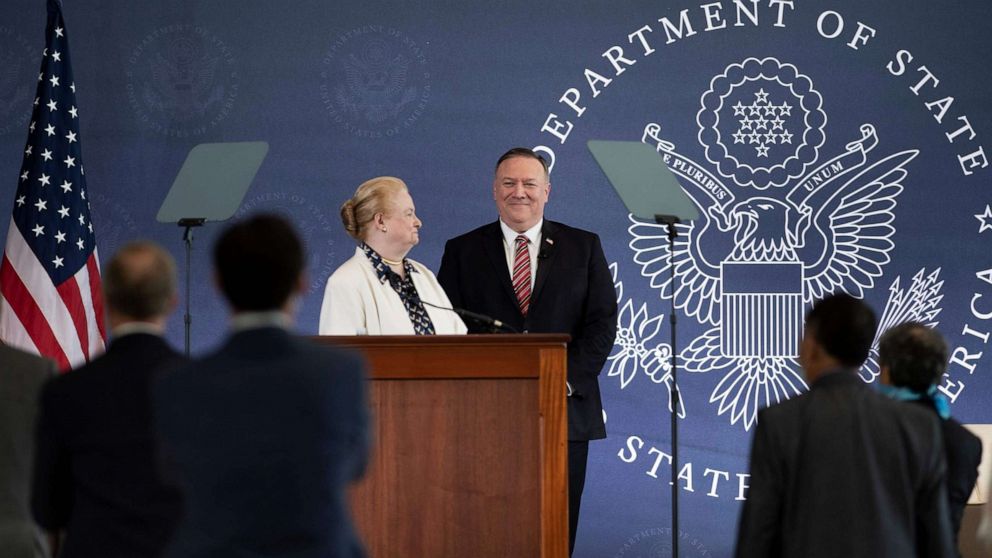


Secretary of State Mike Pompeo is introduced by Commission chair Mary Ann Glendon at the National Constitution Center where he spoke about the Commission on Unalienable Rights, July... moreSecretary of State Mike Pompeo is introduced by Commission chair Mary Ann Glendon at the National Constitution Center where he spoke about the Commission on Unalienable Rights, July 16, 2020, in Philadelphia.Brendan Smialowski/Pool via AFP/Getty Images

The activity took place in Washington, D.C.; New York, Florida, and possibly elsewhere in the U.S.; and overseas, the complaint said. Only one allegation is not redacted -- "false or misleading statements" -- although it's unclear who the charge is filed against.

While senior department figures "were made aware of these concerns on repeated occasions," the whistleblower told the Office of the Inspector General, which recorded the complaint, "none of them ever took action to resolve the issues, and several of them specifically directed subordinate staff to continue facilitating questionable activities after the concerns were raised."

The State Department did not respond to a request for comment.
MORE: Pompeo slams 'rioters pulling down statues' for 'assault' on tradition

Pompeo had President Donald Trump fire the department's inspector general Steve Linick in May, later citing concerns about him or his office leaking to the press -- an allegation Linick denied in congressional testimony.
MORE: Pompeo refuses to explain why he recommended inspector general's firing

At the time, the OIG was investigating Pompeo's role in the use of an emergency authority to bypass Congress and sell Saudi Arabia and the United Arab Emirates $8 billion in arms and his use of staff to run personal errands for him and his wife.

Pompeo has denied that Linick's firing was retaliation, at first saying he was unaware of any investigations and then saying while he answered questions about the arms sale probe, he didn't know the full scope.
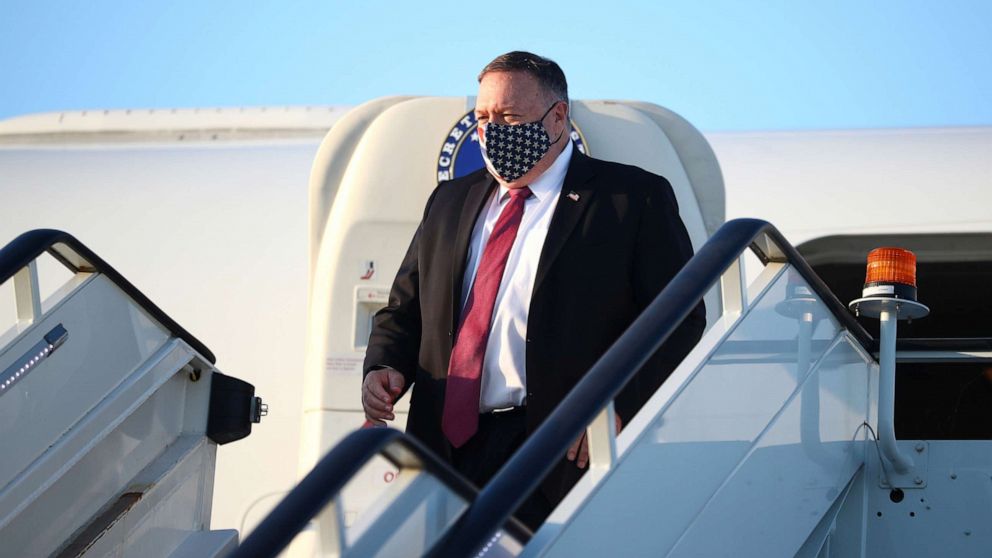


Secretary of State Mike Pompeo disembarks an airplane in London, July 20, 2020.Secretary of State Mike Pompeo disembarks an airplane in London, July 20, 2020.Hannah McKay/WPA Pool/Getty Images

"Someone was walking my dog to sell arms to my dry cleaner. I mean, it's all just crazy," he said in May.

It's unclear if those two probes are related to the behavior described in the complaint, which was released to the left-leaning watchdog group American Oversight as part of a Freedom of Information Act lawsuit.

At least some of the information that is redacted is because there is an ongoing investigation into it, according to a letter from the OIG's acting counsel to American Oversight.
MORE: Cleared of wrongdoing for Kansas trips, Pompeo turns to attack Dem requesting probe

Pompeo's tenure has come under increased scrutiny in recent months -- especially after Linick's firing -- and focused on his own political future.

While he long denied he was running for an open Senate seat from Kansas, four trips to his adopted home state last year fueled speculation. Sen. Bob Menendez, D-N.J., even requested a probe into the trips, which later cleared Pompeo because he ultimately never ran.
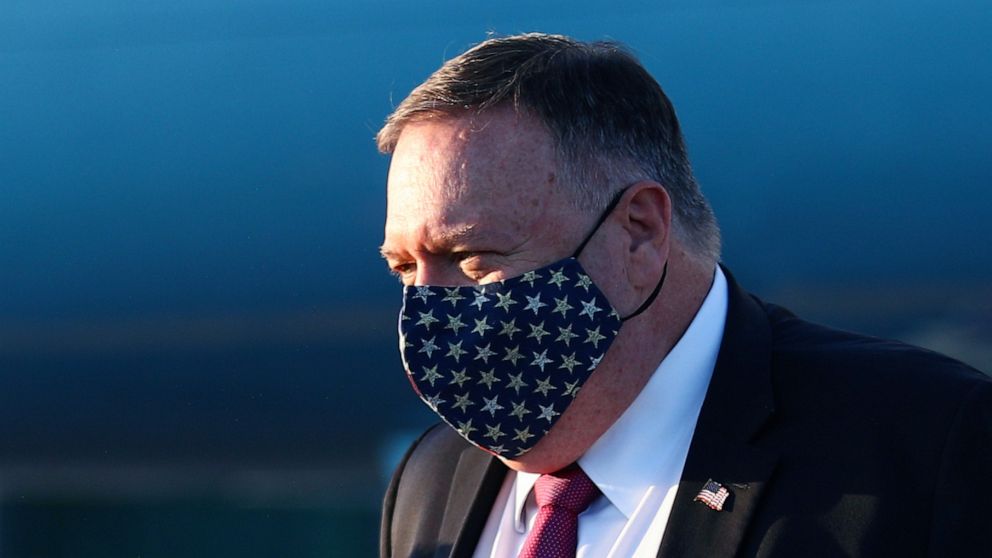


Secretary of State Mike Pompeo disembarks an airplane in London, July 20, 2020.Secretary of State Mike Pompeo disembarks an airplane in London, July 20, 2020.Hannah McKay/WPA Pool/Getty Images

But Pompeo has been more open about his presidential ambitions, and some critics have accused him of using meetings on overseas trips or dinners at the department for the wealthy and powerful to lay the groundwork for a White House run.

During a visit to Iowa, which holds the nation's first contest for each party's nominee, Pompeo met behind closed doors with "Iowa business leaders," "local leaders," "elected officials," and "members of the Iowa Farm Bureau," according to his public schedule.
MORE: State Department inspector general fired by Trump testifies for 7 hours

He, his wife Susan, and their son Nick also attended the Family Leadership Summit, a social conservatives gathering that's influential in the Republican Party, where Pompeo attacked "rioters" tearing down statues and mayors not keeping Americans safe.

Asked about the political nature of that visit two days earlier, Pompeo told "The Hill" that he wanted to visit "America's heartland."

"Every American ought to hear from America's secretary of state about our foreign policy, about our trade policies that affect the people of Iowa greatly," he added, without addressing the moderator's question about a 2024 presidential run.


0 comments
Email ThisBlogThis!Share to XShare to FacebookShare to Pinterest
Labels: Mike Pompeo, State Department

6/19/2020

US State Department sets a different course than Trump on Libya


Source: Middle East Online
June 18 2020
By Mona el Mahruki


The failure of the Cairo settlement means that the war in Libya will take a new turn, with one or more major powers being directly involved on the side of the army.

The US State Department statement which clearly opposes the Cairo initiative to resolve the Libyan crisis, and for which President Donald Trump had previously announced his support, reflects the existence of moves to thwart efforts aimed at giving control of the Libyan file to the US President.

David Schenker, US Assistant Secretary of State for Near East Affairs, said that there were “useful” aspects to the Egyptian proposal for a truce in Libya, but a UN-led mediation effort to bring peace to that country is the best way forward.

On June 10, Trump expressed his support for the Cairo initiative launched by his Egyptian counterpart Abdel Fattah al-Sisi for an immediate ceasefire in Libya and the return to the search for a peaceful solution to the crisis, which many considered a sign of the White House’s desire to retake control of the US policy in Libya from the dominance of the Department of State.

Trump, who implicitly supports the Libyan National Army, rejects the control of Libya by Islamist groups since the overthrow of the late Colonel Muammar Gaddafi’s regime, which had led, among many other things, to the assassination of former US ambassador to Libya Christopher Stevens.

United States officials view with concern Turkey’s transfer to Libya of Syrian fighters from Idlib, among them elements belonging to the Islamic State and the Al-Nusra Front, and which constitutes a threat to the security of US allies in North Africa and Europe.

According to statements a few days ago by Josep Borrell, the European Union’s High Commissioner for Security and Foreign Policy, the Cairo initiative does not contradict the decisions of the Berlin Conference.

And precisely regarding the Berlin Conference, the countries supporting the Libyan National Army, especially France and Russia, have made serious efforts to force the army and its commander Field Marshal Khalifa Haftar to accept the outcome of that conference, by stopping their support for the army’s campaign to take control of Tripoli and turning a blind eye to the Turkish intervention on the side of the Government of National Accord’s militias. The aim of that approach was creating a new military balance on the ground to end the LNA’s superiority.

The LNA recently withdrew from the entire western region in a move it said was aimed at completing the Berlin political process, but that withdrawal whetted Turkey’s and the militias’ appetites for more gains and they vowed to continue the fight until they gain control the city of Sirte, the southern region, and the oil crescent.

The US State Department’s rejection of the Cairo initiative raises questions about the US intentions in Libya and reinforces doubts that there is an intention to overturn the Berlin understandings through the United Nations new envoy to Libya, American diplomat Stephanie Williams, who is said to be affiliated with the State Department lobby.

It is widely believed in Libyan circles that Williams, who was Chargé d’Affaires at the American Embassy in Libya and has good relations with the Islamist movement and especially with the GNA’s Minister of Interior, Fathi Bashagha, was appointed as a deputy to the former UN envoy Ghassan Salameh to ensure the American Department of State’s control of the Libyan file.

Defenders of this theory point out to the celerity with which Williams and US Ambassador to Libya Richard Norland have endorsed the Libyan Islamists’ claims about the LNA committing war crimes, claims which are of course denied by the army and dismissed as pure propaganda in order to smear its image and put it on same footing as the militias.

The State Department appears to be encouraging Turkey to ignore the Cairo initiative, even though this initiative is offering an acceptable and fair settlement to the two parties, in exchange for launching Libyan-Libyan talks known as 5 + 5 talks under the aegis of Stephanie Williams, despite the great risk of guiding such talks towards a settlement made to measure to the Islamists, an outcome that will definitely lead to its failure.

The failure of the settlement automatically means that the war in Libya will take a new turn, with one or more major powers being directly involved on the side of the army. Such speculations are intensifying in light of Egypt’s recent military build-up on its western border with Libya. While observers exclude an Egyptian military intervention comparable to the Turkish intervention in Libya, they do, however, expect that there will a Russian-Egyptian coordinated scenario whereby Cairo assumes a limited military role, limiting itself for example to conducting air strikes aimed at stopping the militias’ advance towards the centre, east and south of the country.

The US-led narrative on Libya has focused on amplifying Russia’s role in Libya, even though that role has been limited so far to providing some logistical support to the Libyan army, which is by far not comparable to Turkey’s support to the Islamist and regional militias. The aim behind Turkey’s move was to create justification for the continuation of the fighting in order to enable the Islamists to gain control of vital areas in Libya, especially the Oil Crescent area and the oil fields in the south.

These political and media campaigns have deliberately omitted France’s role in Libya, even though France is by far the top competitor to the United States in Libya. But the goal of the propaganda campaigns is to highlight Russia as a common threat to the West and to suggest the existence of Western understandings to make the Islamists as caretakers of Western interests in Libya.

The American-Turkish-Islamist lobby is betting on the assumption that, in Russia’s plans, Libya is nothing but a pressure card that can be used to obtain gains and profits in other regions, especially in Syria, and that the Russians are not ready now to spend on a war in Libya; so the only option is to continue fighting and monitor the opportunity for a settlement similar to what happened in Western Libya.

Consequently, the “Syrianisation” of the conflict appears to be a plan in which the US Department of State is involved and its success will be a threat to European interests. This is why Europe is trying to activate its role in Libya, which was reflected in the discussions conducted by the German Ambassador Oliver Owcza in Benghazi and his meeting with the LNA’s Commander-in-Chief, Field Marshal Khalifa Haftar.

The German diplomat’s visit, during which he praised the discipline of the Libyan army, carried a clear message to international and regional parties working to exclude Haftar from the scene and replace him with Speaker of Parliament Aguila Saleh.

That visit deepened doubts about whether Europe —fearing the scenario of being blackmailed by Turkish President Recep Tayyip Erdogan with illegal immigrants after Turkey’s control of western Libya — would bet more on Haftar to prevent the scenario of “Syrianising” the Libyan conflict.

While Europe, and especially France and Greece, are fighting Turkey’s ambitions to control the Mediterranean, Glen Howard, President of the American Jamestown Research Foundation, said that “Turkey’s insistence on obtaining a role in the Eastern Mediterranean should be accepted, and the United States should reconsider its (Turkey’s) role in this region.”

Howard and other experts defending the idea of an alliance with Turkey and the risk that this might cause the loss of the European partner may be seen as tools of the Turkish lobby in the United States, which is currently living at the height of its glory.


0 comments
Email ThisBlogThis!Share to XShare to FacebookShare to Pinterest
Labels: State Department

10/01/2012

Senate Libya letter sparks partisan disagreement

Senate Foreign Relations Committee Chairman John Kerry (D-MA) (2nd R) poses for photographs with Libyan Transitional National Council (TNC) representative Mahmoud Jibril (3nd L) before a meeting with Sen. Ben Cardin (D-MD) (2nd L) and former Libyan Ambassador to the United States Ali Aujali (R) at the U.S. Captiol May 11, 2011 in Washington, DC. Jibril was met with administration officials, lawmakers, and gave a speech at the Brookings Institution.
Πηγή: CNN
By Ted Barrett
Sept 29 2012

Washington (CNN) -- As scrutiny of a deadly attack on the U.S. consulate in Benghazi, Libya intensifies, Democrats and Republicans on the Senate Foreign Relations Committee sent a letter to the State Department seeking additional details of the incident.

But almost immediately the letter, which was made public Friday, sparked a partisan disagreement. Sen. John Kerry, the Democratic chairman of the committee, accused committee Republicans of trying to exploit it for political reasons.

Kerry said Republicans were wrongly trying to suggest that the Democrats who signed the letter are critical of what has been an evolving explanation about the attack coming from the White House, State Department, Defense Department, and U.S. intelligence agencies.

"Republicans are working overtime to try to exploit a very normal, run-of-the-course administrative letter that we agreed to on a bipartisan basis in our committee simply to get some additional questions put in front of the State Department that are part of their already existing investigation," the Massachusetts senator told Andrea Mitchell in an interview on MSNBC.

"This is not a challenge. It is nothing new. It is not something out of the ordinary. And I agreed to do it as a matter of bipartisanship because we thought these were important questions that people ought to be examining."

In an interview Thursday with CNN's Erin Burnett, Sen. Bob Corker of Tennessee, a GOP member of the committee who has called the shifting explanation of the attack, "Benghazigate," also spoke about the letter.

"Everybody on the Foreign Relations Committee, Republicans and Democrats, wants to know what has happened," he said. "I just find it incredibly strange when in a bipartisan way everyone wants to understand what's happened, but the administration has been unbelievably not forthcoming."

The political back and forth came as the Office of the Director of National Intelligence issued a statement revising its initial assessment that the attack stemmed from a protest against an anti-Muslim film and instead was "a deliberate and organized terrorist assault," by people associated with or sympathetic to al Qaeda, something many congressional Republicans have argued for weeks.

The statement represents the fullest accounting yet of the intelligence community's changed understanding of the attack, and suggests it is trying to distance itself from the political debate over whether the administration is being fully forthcoming about its understanding of events.

The release of such information outlining an ongoing investigation is rare and underscores just how controversial the issue has become.

Democrats believe Republicans are exploiting the issue politically in order to damage President Barack Obama by suggesting the administration was slow to respond to a terrorist attack on its watch. Republicans, meantime, are suspicious Democrats and the White House are trying to protect the president's national security credentials by downplaying the administration's poor handling of the security situation at the diplomatic post in Benghazi, where the U.S. ambassador to Libya and three other Americans were killed.

A Democratic source said Kerry agreed to send the letter -- which expounded on an earlier letter Kerry sent on his own September 17 to the State Department with several questions related to the incident -- after a committee meeting during which GOP members pushed for legislation requiring a formal investigation of what happened. Kerry responded by explaining that there is already a law requiring an investigation by the State Department.

But he agreed to a request from Sen. Johnny Isakson, a Republican from Georgia, to send a letter signed by all the committee members with "additional questions" beyond what Kerry asked in his first letter.

The letter doesn't require a response from the State Department until November 13, a week after the U.S. presidential election.


0 comments
Email ThisBlogThis!Share to XShare to FacebookShare to Pinterest
Labels: Libya, Senate Foreign Relation Committee, State Department, US, US Embassy in Benghazi

8/24/2012

Amnesty International is US State Department Propaganda

Image: From Amnesty International USA's website, "Free Pussy Riot." "Help Amnesty International send a truckload of balaclavas to Putin." This childish stunt smacks of US State Department-funded Gene Sharp antics - and meshes directly with the US State Department's goal of undermining the Russian government via its troupe of US-funded "opposition activists" including "Pussy Riot." That Amnesty is supporting the US State Department's agenda should be no surprise, it is run literally by the US State Department'sDeputy Assistant Secretary for International Organizations, Suzanne Nossel. 
Πηγή: BLN
By Tony Cartalucci
August 22 2012

Mistakenly considered by many as the final word on human rights worldwide, it might surprise people to know that Amnesty International is in fact one of the greatest obstacles to real human rights advocacy on Earth. In its most recent 2012 annual report (page 4, .pdf), Amnesty reiterates one of the biggest lies it routinely tells:

"Amnesty International is funded mainly by its membership and public donations. No funds are sought or accepted from governments for investigating and campaigning against human rights abuses. Amnesty International is independent of any government, political ideology, economic interest or religion."This is categorically false. Amnesty international is indeed funded and run by not only governments, but also immense corporate-financier interests, and is not only absolutely entwined with political ideology and economic interests, it is an essential tool used for perpetuating just such interests.

Amnesty International's Funding

Finding financial information on Amnesty International's website is made purposefully difficult - specifically to protect the myth that the organization is "independent." Like any organized criminal operation, Amnesty separates compromising financial ties through a series of legal maneuvers and shell organizations. Upon Amnesty's website it states:

"The work carried out through Amnesty International's International Secretariat is organised into two legal entities, in compliance with United Kingdom law. These are Amnesty International Limited ("AIL") and Amnesty International Charity Limited ("AICL"). Amnesty International Limited undertakes charitable activities on behalf of Amnesty International Charity Limited, a registered charity." And it is there, at Amnesty International Limited, where ties to both governments and corporate-financier interests are kept. On page 11 of Amnesty International Limited's 2011 Report and Financial Statement (.pdf) it states (emphasis added):

"The Directors are pleased to acknowledge the support of the John D. and Catherine T. MacArthur Foundation, the Oak Foundation, Open SocietyGeorgia Foundation, the Vanguard Charitable Endowment Programme,Mauro Tunes and American Jewish World Service. The UK Department for International Development (Governance and Transparency Fund) continued to fund a four year human rights education project in Africa. TheEuropean Commission (EuropeAid) generously awarded a multi-year grant towards Amnesty International’s human rights education work in Europe."Clearly then, Amnesty does take money from both governments and corporate-financier interests, one of the most notorious of which, Open Society, is headed by convicted financial criminal George Soros. In March, 2012, it was reported that a Bloomberg's report, "Soros Loses Case Against French Insider-Trading Conviction," indicated that an appeal based on a "human rights" violation against Wall Street speculator George Soros had been rejected by the "European Court of Human Rights."

Soros, whose Open Society also funds Human Rights Watch and a myriad of other "human rights" advocates, literally attempted to use the West's human rights racket to defend himself against charges of financial fraud in perhaps the most transparent illustration of just how this racket operates.

Soros, who was convicted and fined for insider trading in 2002 regarding French bank Société Générale shares he bought in 1988, has built an empire out of obfuscating global criminal activity with the cause of "human rights." His support, as well as that of the British and European governments, of Amnesty International aims solely at expanding this obfuscating.

Amnesty International's Leadership

Amnesty's leadership is also telling of its true agenda. Suzanne Nossel, Executive Director of Amnesty International USA, for instance was drawn directly from the US State Department - again, utterly contradicting Amnesty's claims of being "independent" of governments and corporate interests. Nossel continued promoting US foreign policy, but simply behind a podium with a new logo, Amnesty International's logo, attached to it. Amnesty International's website specifically mentions Nossel's role behind US State Department-backed UN resolutions regarding Iran, Syria, Libya, and Cote d'Ivoire.

Image: Same lies, different podium. Suzanne Nossel previously of the US State Department, is now executive director of Amnesty International USA. Her primary function of dressing up aspirations of corporate-financier global hegemony as "human rights advocacy" has not changed. 
It has been documented at great length how these issues revolve around a decades long plan devised by corporate-financier interests to divide, destroy and despoil these nations who are seen as obstacles to US global hegemony. In the case of Syria specifically, it was revealed that the current "human rights" catastrophe stems back to a malicious 2007 conspiracy documented by "New Yorker" journalist Seymour Hersh, between the US, Israel, and Saudi Arabia which sought to purposefully fund, arm, and deploy sectarian extremists to undermine and overthrow the Syrian government - thisknowing full well the human tragedy that would unfold.

Nossel's "contributions" then are simply to dress up naked military aggression and the pursuit of global corporate-financier hegemony with the pretense of "human rights" advocacy.

A glance at AmnestyUSA.org reveals that each and every front the US State Department is currently working on and has prioritized is also coincidentally prioritized by Amnesty International. This includes rallies and campaigns to support US State Department-funded Russian opposition groups (currently fixated on "Pussy Riot"), undermining the Syrian government, toppling the government of Belarus, and supporting the Wall Street-London created Aung San Suu Kyi of Myanmar (still called by its British Imperial nomenclature of "Burma" by Suu Kyi herself).

Amnesty International Betrays Real Human Rights Advocacy

Amnesty does indeed cover issues that are critical of US foreign policy, toward the bottom of their websites and at the back of their reports. Likewise, the corporate-media selectively reports issues that coincide with their interests while other issues are either under-reported or not reported at all. And it is precisely because Amnesty covers all issues, but selectively emphasizes those that are conducive to the interests of immense corporate-financiers that makes Amnesty one of the greatest impediments to genuine human rights advocacy on Earth.

Images: Manufacturing Dissent. "Free Pussy Riot" (above). Ironically, FIDH is directly funded by the US State Department via the Neo-Con lined US National Endowment for Democracy (NED) as well as George Soros' Open Society. "Russia: Stop Arms Transfer to Syria!" (below). If the US State Department wants it, be sure that US State Department-run Amnesty International will stage a demonstration for it - and regardless of size or legitimacy of the demonstration, expect the corporate-media to make it headline news. 
Ordinary people are given the false impression that "someone is watching out" for human rights abuses, when in reality, all Amnesty and other organizations like it are doing, is managing public perception selectively of global human rights abuses, fabricating and/or manipulating many cases specifically to suit the agenda of large corporate-financier interests. This can be seen when entire reports out of Amnesty or Human Rights Watch consist solely of "witness reports" compiled from accounts of US-backed opposition groups.

In the rare instance that a report includes references to actual photographic, video, or documented evidence, such as Human Rights Watch's 2011 "Descent into Chaos" (.pdf)report, deceptive language is intentionally included along with throwaway passages to enable selective reporting and spinning by not only the Western corporate media, but by a myriad of faux-NGOs funded and run by Amnesty International and Human Rights Watch's sponsors and affiliates. The Descent into Chaos report, regarding Thailand, was promply and amply spun and manipulated by US State Department-funded faux-NGO and "rights advocate" Prachatai.

When people erroneously believe that credible organizations are handling "rights advocacy" they will not only become complacent, they will become negligent of their own responsibilities to objectively examine potential abuses and speak out against them. Wall Street and London's corporate-financier interests have filled a void - that should be occupied by their greatest opponents - instead with a large advocacy racket of their own creation. Not only are they given a free pass to abuse human rights globally, they've actually used their controlled opposition to attack their opponents.

It is clear that Amnesty International is by no means an "advocate" of human rights, but rather an affront to human rights advocacy. It goes without saying that it should be boycotted out of existence and at the very least, identified as illegitimate and fraudulent - from its funding to its compromised leadership.

Additionally, we the people must tackle real violations of each others rights at the grassroots - because it is absolute folly to believe that global spanning organizations, funded by corporate-financiers, echoing the agenda of governments driven by special interests has our best interests and rights in mind.


0 comments
Email ThisBlogThis!Share to XShare to FacebookShare to Pinterest
Labels: Amnesty International, Free Pussy Riot, Human rights, Soros, State Department, Suzanne Nossel

7/05/2012

State Department Investigating UN Agency for Computer Shipments to Iran and North Korea


Πηγή: Fox News
By George Russell
July 05 2012

The U.S. State Department is investigating the shipment of computers and other sophisticated equipment to North Korea and Iran by way of an obscure United Nations agency, despite ongoing U.N. and U.S. sanctions against both governments aimed at blocking their development of nuclear weapons.

The broadening inquiry raises new concerns about the ways in which U.N. agencies have managed to side-step restrictions that the world body expects the rest of the world to obey in halting the spread of sensitive technologies to nuclear-ambitious pariah regimes.

It also calls into question how much U.N. member states know about the activities of agencies they supposedly approve and supervise.

In this case, there are hints that the top official at the U.N. agency, the Geneva-based World Intellectual Property Organization, or WIPO, “has not yet been fully open” to the inquiries, according to a senior U.S. official.

The State Department probe came in the wake of Fox News revelations in April about the actions by the agency, the Geneva-based World Intellectual Property Organization, or WIPO, in sending such sensitive equipment to North Korea by a complicated method that seemed designed to bypass U.N. Security Council sanctions against the country.

The shipments took place in late 2011 or early 2012, and were financed through the Beijing offices of the United Nations Development Program (UNDP).

The WIPO actions also violated the sweeping restrictions of the equipment manufacturer, Hewlett-Packard, which forbids any HP equipment from being sent to such regimes.

The U.S. is a member of WIPO, yet apparently knew little or nothing about the controversial delivery of computers and sophisticated services. And within a month, the State Department discovered the problem went beyond North Korea, a spokesman said in response to questions from Fox News.

“The State Department first became aware of a WIPO development project in Iran in early May 2012, while conducting a review of all WIPO projects in countries under U.N. Security Council sanctions,” the spokesman said. “We have made several inquiries to the WIPO Secretariat and requested any related documentation.”

The spokesman added that State is now “working with like-minded countries” to press WIPO’s director general, Australia-born Francis Gurry, to “conduct an independent, external fact-finding exercise into past WIPO projects in countries under [Security Council] sanctions” presumably to discover if there are further unpleasant surprises in store, and also to “ensure future development projects are properly reviewed prior to being approved and implemented.”

Word of the new revelations first surfaced at a meeting of the House Judiciary Committee last week, in which two California Democrats, Howard Berman and Zoe Lofgren, raised questions with U.S. Deputy Secretary of Commerce Teresa Stanek Rea about the transfers, which Berman declared “highly distressing and Lofgren called “an outrage.”

Stanek confirmed the fact by replying that her department was “disappointed—to say the least” by the transfers and pointed to State as the investigating agency. She also hinted at director general Gurry’s limited response so far, and predicted that “more information will likely be forthcoming.”

A State Department spokesman provided additional hints in declaring that “we have had several conversations with director general Gurry” about reforming WIPO’s project development and implementation, and “will continue to work...to put in place policies that provide greater accountability and transparency at WIPO.”

According to documents obtained by Fox News, WIPO only forwarded detailed information about the specifics of its shipments to its own in early June.

In the case of Iran, the WIPO computer shipment included 20 Hewlett-Packard Compaq desktop computers, now outmoded in the U.S. but which nonetheless still gave Iran’s Industrial Property Office significant computing power. In the case of North Korea, the equipment included both more sophisticated computers and data-storage servers.

As was the case in North Korea, WIPO experts made technical visits to Iran in advance of the shipments to scope out the project, help orchestrate financing and payment by the local office of UNDP in Tehran, and OK the deliveries, according to WIPO’s documentation.

Complicating any oversight of WIPO is that the agency essentially administers and supervises a variety of U.N. sponsored treaties on trademarks and other aspects of intellectual property, including the world-wide patent system. But different countries have signed different treaties, and thus are only party to parts of the WIPO system, making supervision a challenge.

Iran, for example, most recently signed onto WIPO agreements that govern the international administration of trademarks and international protection of place-names for products (e.g. “Champaigne”). It signed onto an arrangement known as the Patent Cooperation Treaty in 1970, or nearly a decade before the Islamic revolution that installed the current bellicose regime.


0 comments
Email ThisBlogThis!Share to XShare to FacebookShare to Pinterest
Labels: Iran, North Korea, sanctions, State Department, UN, WIPO

1/07/2012

US State Department Expanding Use of Social Media

US State Department spokeswoman Victoria Nuland gestures during a meeting in Skopje, Macedonia,

Πηγή: VOAnews
By Scott Stearns
Jan 6 2012

U.S. diplomats are expanding their use of social media during what the Obama administration is calling 21st Century Statecraft Month.

U.S. State Department spokeswoman Victoria Nuland stood at the same podium she uses every day in the Carl Rowan briefing room. But the questions Friday came not from the State Department press corps. They came from users of the social media site Twitter tweeting to the hashtag #AskState.

Nuland's answers were compressed, translated, and tweeted on the State Department's 10 official Twitter feeds in Arabic, Chinese, English, Farsi, French, Hindi, Portuguese, Russian, Spanish and Urdu.

It is part of what she says is Secretary of State Hillary Clinton's drive to expand U.S. diplomatic outreach.

"Secretary Clinton has made the use of new technology and innovation a key part of our foreign policy agenda around the world. So here at State and at [US]AID, we are adopting new approaches to meet the diplomatic and development challenges that we see,” said Nuland.

Nuland said the State Department has 193 social media accounts, about 100 of which are associated with specific embassies.

"Part of this effort is making sure that we are making full use of digital networks and technologies to more quickly and more directly engage people and audiences at home and abroad,” said Nuland.

Next week, the U.S. Embassy in Port-au-Prince will hold a Twitter question-and-answer session about recovery efforts two years after the earthquake there, and the U.S. Mission to International Organizations in Vienna will hold a virtual town hall about nuclear nonproliferation, nuclear security, and nuclear safety.


0 comments
Email ThisBlogThis!Share to XShare to FacebookShare to Pinterest
Labels: social media, State Department, US

11/22/2011

US removes maps showing PoK as part of Pakistan from website


Πηγή: moneycontrol
By Lalit K Jha
Nov 22 2011

Washington, Nov 22 (PTI) The US State Department has taken off "inaccurate" maps of India and Pakistan from its website which did not reflect the correct boundary and geographical locations, its spokesperson said Monday. 

"We have taken the map (of India) off the website. It did contain some inaccuracies which were associated with the boundaries of some geographic features," the State Department spokesperson Victoria Nuland told reporters at a news conference. "My understanding is that is the way that it was inaccurate, that it wasn't drawn properly," Nuland said in response to a question. 

"We will put up the new map when we acquire one that we are confident is accurate," she said in response to a question but did not answer questions from where such inaccurate map came from. "This was unintentional. We're going to get the map fixed and put up a fixed map," Nuland said. 

The State Department is also pulling out such maps from other sections of its website, she said adding that this was unintentional. 

The State Department pulled out from its website the maps of both India and Pakistan, as they showed Pakistan Occupied Kashmir (PoK) as part of Pakistan, which was first reported by a major Indian daily, following which the Indian Government had lodged a strong protest with the State Department. 

Under its A-Z list of countries, the website www.state. gov carries profiles and maps of all countries with which the US has diplomatic relations.

Editor's Note: For background article see: "India asks US govt to correct its maps"


0 comments
Email ThisBlogThis!Share to XShare to FacebookShare to Pinterest
Labels: India, Pakistan, Pakistan Occupied Kasmir, sh, State Department, US

CEO of Islamic Relief USA Appointed to U.S. State Department Working Group


Abed Ayoub, CEO of Islamic Relief USA

Πηγή: prnewswire
By Islamic Relief USA
Nov 21 2011

WASHINGTON, Abed Ayoub, CEO of Islamic Relief USA, has been appointed to the U.S. State Department's Religion and Foreign Policy Working Group to help inform U.S. policy.

Along with the other members, Ayoub will take part in dialogue and provide input on relevant topics including the challenges and opportunities for partnership. The group also will identify model action programs or projects for collaboration between the U.S. government and NGOs.

"We feel honored to be in this group, working with diverse leaders," Ayoub said. "As a humanitarian organization, we can bring a lot to the table. Unfortunately, most of the disasters in the world are in the Muslim world, and we're hoping that we can maximize the benefits going to the beneficiaries by being in this group."

The Religion and Foreign Policy Working Group is divided into sub-groups. Ayoub will serve on the Sub-Group on Faith-Based Groups and Development and Humanitarian Assistance, which examines faith-based organizations' challenges, opportunities and resources in addressing societal needs for such assistance. This forum also will work to ensure NGOs' freedom to operate and deliver humanitarian aid.

Other members of the Development and Humanitarian Assistance sub-group include Richard Stearns, President/CEO of World Vision; Carolyn Woo, CEO of Catholic Relief Services; David Beckmann, President of Bread for the World; and Ruth Messinger, President of American Jewish World Service.

The group held its first meeting in October. Ayoub said the Development and Humanitarian Assistance sub-group discussed the role of humanitarian organizations and heard issues facing the State Department, particularly the drought and famine inEast Africa.

"The State Department wants to engage faith-based organizations," Ayoub said. "Hopefully Islamic Relief can participate in solving world issues and ease the suffering of the people."

The group will continue to meet through November 2012.

Islamic Relief USA, based in Alexandria, Va., is a nonprofit 501(c)(3) humanitarian organization with eight consecutive 4-star ratings from Charity Navigator. Its mission is to alleviate suffering, hunger, illiteracy and disease regardless of color, race, gender or creed, and to provide aid in a compassionate and dignified manner. Islamic Relief USA aims to provide rapid relief in the event of human and natural disasters and to establish sustainable local development projects, allowing communities to better help themselves. In 2010, Islamic Relief USA programs benefited more than 4.3 million people in 34 countries, including the United States.

In addition to its 4-star rating on Charity Navigator, Islamic Relief USA meets all of the Standards for Charity Accountability of the BBB Wise Giving Alliance, a national charity monitoring group affiliated with the Better Business Bureau system. Islamic ReliefUSA is on the U.S. government's Combined Federal Campaign (CFC) charity list, and it is also a signatory to the code of conduct of the International Federation of Red Cross and Red Crescent Societies.


0 comments
Email ThisBlogThis!Share to XShare to FacebookShare to Pinterest
Labels: Abed Ayoub, Islamic Relief USA, State Department

10/19/2011

Briefing Skipper: Libya, Iran, Gilad Shalit, Bahrain, Tibet

Πηγή: Foreign Policy
Posted By Josh Rogin
Oct 19 2011

In which we scour the transcript of the State Department's daily presser so you don't have to. These are the highlights of Tuesday's briefing by deputy spokesman Mark Toner:

Secretary of State Hillary Clinton made an unannounced visit to Libya Monday, with a stopover in Malta. In Tripoli, she met with the National Transition Council Chairman Mustafa Abdul Jalil, Prime Minister Mahmoud Jibril and Finance Minister Ali Tarhouni. She also visited a hospital and spoke to students at the University of Tripoli. In Malta, she met with Prime Minister Lawrence Gonzi.

"As [Ambassador] Gene [Cretz] and Assistant Secretary [Jeffrey] Feltman and I were walking through here, they were talking about how the last time Jeff was here was when we were very worried that Gadhafi and Sanussi were going to kill you," Clinton said at the U.S. Embassy in Tripoli, referring to Cretz. "And we were debating and just pulling our hair out about what to do and how to respond to it, and then the threats got worse and the intimidation got worse, and so we had to bring Gene home for consultations, as they say. But here you are, you're back and Gadhafi's gone. So it somehow seems to be all's right with the world."
Toner opened the briefing by praising the report by the U.N. special rapporteur for human rights in Iran, Ahmed Shaheed. "Under international law and its own constitution, Iran has committed itself -- committed to, rather, to protect and defend the rights of its people. But officials continue to stifle all forms of dissent, persecute religious and ethnic minorities, harass and intimidate human rights defenders, and engage in the torture of detainees," Toner said.

No substantive progress to announce on holding Iran accountable for the alleged plot to hire a Mexican drug cartel to bomb the Saudi Ambassador at Café Milano in Georgetown. "In terms of additional steps we might take, I think we're continuing to have those discussions," Toner said. The U.S. doesn't have to allow Iran to have consular access to used-car salesman-turned-international-terror-mastermindMansour Arbabsiar because he's a dual citizen, but the State Department might grant the access anyway, Toner said.
Toner also commented on the new report by the International Institute for Strategic Studies, which says that Iran's uranium enrichment program is struggling. "While sanctions are clearly impacting Iran's efforts to procure items in support of its nuclear missile activities, we don't believe the international community can become complacent as Iran continues to stockpile enriched uranium in defiance of U.N. resolutions," he said.

The Obama administration had no role in the deal to trade 1,027 Palestinian prisoners for Israeli soldier Gilad Shalit, but the U.S. did give the Israelis their opinions on some of the people who were being considered for release. The State Department isn't speculating on whether this development will improve the atmosphere for negotiations. "If you're parsing what this means for the peace process, it's difficult for us to say," Toner said. Israeli Ambassador Michael Orenpredicts no change in the status quo.

When the State Department called the family of al-Qaida propagandist Samir Khan, who was killed in a CIA drone strike in Yemen, it was NOT a "condolence call,"Toner wants you to know. "Just a reminder: It was not a condolence call. It was an acknowledgment of the family's grief. It was a very short call, and it was also an offer of consular assistance, such as a death certificate; and just a reminder to folks, that we are legally bound to offer this to any relatives of an American citizen. But it was not a condolence call. I've seen it characterized as such in the press," he said. "Again, it was not a condolence call." By the way, State can't confirm that the son ofAnwar al-Awlaki was killed in a separate drone strike.

Seems like the Congressional campaign to halt the Bahrain arms sale is having an effect. Toner said that human rights would be taken into consideration as the sale moves forward. "But it's also important to note that there are several procedural steps that remain before this equipment, which, I would add, is for Bahrain's external defense purposes, can take delivery of any equipment listed in the congressional notification," he said. A State Department letter to Congress Thursday tied the sale directly to the pending report of the Bahrain Independent Commission of Inquiry (BICI).

Six Tibetan monks have set themselves on fire and the State Department is "seriously concerned" about it. "In the light of the continuing underlying grievances of China's Tibetan population, we would urge China and its leaders to respect the rights of Tibetans, to address some of the policies in these areas, in Tibetan areas, that have created tension, and to protect the Tibetans' unique religious, cultural and linguistic identity," Toner said. Ok, but has the administration actually raised this with the Chinese? "I'll have check on that," Toner said.
National Security Advisor Tom Donilon is going to Beijing Oct. 21 and will meet with Vice Premier Wang Qishan and State Councilor Dai Bingguo. He will then go to India to meet with National Security Advisor Shiv Shankar Menon.


0 comments
Email ThisBlogThis!Share to XShare to FacebookShare to Pinterest
Labels: European Union, Hillary CLinton, Mexico, NTC, Obama, State Department

10/08/2011

State Department readies Iraq operation, its biggest since Marshall Plan

U.S. soldiers patrol outside Contingency Operating Site Taji, north of Baghdad.


Πηγή: The Washington Post
By Mary Beth Sheridan and Dan Zak
Oct 8 2011


The State Department is racing against an end-of-year deadline to take over Iraq operations from the U.S. military, throwing up buildings and marshalling contractors in its biggest overseas operation since the effort to rebuild Europe after World War II.

While attention in Washington and Baghdad has centered on the number of U.S. troops that may remain in Iraq, they will be dwarfed by an estimated 16,000 civilians under the American ambassador — the size of an Army division.

The scale of the operation has raised concerns among lawmakers and government watchdogs, who fear the State Department will be overwhelmed by overseeing so many people, about 80 percent of them contractors. There is a risk, they say, of millions of dollars in waste and limited supervision of bodyguards.

“We’re very, very worried,” said Christopher H. Shays, a former Republican member of Congress who served on the Commission on Wartime Contracting, at a House hearing on Tuesday. “I don’t know how they’re going to do it.”

State Department officials say they are working flat-out to finish their preparations, adding contracting professionals to prevent fraud and focusing on ensuring U.S. personnel will be protected.

“We’ve spent too much money and lost too many kids’ lives, not to do this thing right,” said Deputy Secretary of State Tom Nides.

But officials acknowledge they have never done anything quite like this. “Make no mistake, this is hard,” said Nides.

There are currently 43,000 U.S. servicemembers in Iraq. Under an agreement negotiated by the George W. Bush administration, they are to leave by the end of 2011.

Iraqi leaders Tuesday said they wanted a small contingent of U.S. military trainers to remain, but without immunity from local prosecution, a condition the Obama administration has said it cannot accept. The administration has been planning to keep 3,000 to 5,000 military trainers if the two sides can hammer out an agreement.

The list of responsibilities the State Department will pick up from the military is daunting. It will have to provide security for the roughly 1,750 traditional embassy personnel — diplomats, aid workers, Treasury employees and so on — in a country that is still rocked by daily bombings and assassinations.

To do so, State is contracting a security force of about 5,000. They will not only protect the Baghdad embassy but two consulates, a pair of support sites at Iraqi airports and three police-training facilities.

The State Department will operate its own air service — the 46-aircraft Embassy Air Iraq — and its own hospitals, functions the U.S. military has been performing. About 4,600 contractors, mostly non-American, will provide cooking, cleaning, medical care and other services. Rounding out the civilian presence are about 4,600 people scattered over 10 or 11 sites where Iraqis will be instructed on how to use U.S. military equipment they’ve purchased.

“This is not what State Department people train for, to run an operation of this size. Ever since 2003, they’ve been heavily reliant on U.S. military support,” said Max Boot, a national security expert at the Council on Foreign Relations.

In its final report issued last month, the bipartisan Commission on Wartime Contracting said that billions of U.S. taxpayer dollars had been squandered in Iraq and Afghanistan, and charged that the State Department hadn’t made the necessary reforms in its contracting operation.

“Therefore, significant additional waste — and mission degradation to the point of failure — can be expected as State continues with the daunting task of transition in Iraq,” it warned.
State Department officials dispute that conclusion, saying they have hired dozens of extra contracting personnel and have gained experience in managing contractors in Iraq.

Shays said he also worried that the State Department’s small security force will be stretched too thin to supervise armed contractors. He told the hearing he feared a repeat of the 2007 incident in which guards from the security firm then known as Blackwater opened fire at a Baghdad traffic circle, killing 17 Iraqi civilians.

Stuart Bowen, the inspector general for Iraq reconstruction, said in an interview that the transition would have other costs. Without the military protection, U.S. government personnel will have limited reach throughout Iraq, he said. Already, the 1,200 personnel in the consulate in the southern city of Basra can’t adequately move around that region, he said.

“In between this area and Baghdad, there will be a void” of diplomatic coverage, Bowen said.

Nides emphasized that the State Department wasn’t trying to duplicate the military mission.

“That’s not what the Iraqis want. Frankly that’s not what was agreed to” with the government in Baghdad, he said. Instead, the department was trying to transition to a diplomatic presence, he said.

While the Iraq operation will be huge by State Department standards, it will still represent a significant scaling down from the military-led mission, which currently involves 50,000 defense contractors. And State Department officials say their use of contractors is expected to drop sharply over the next three years, as security improves in Iraq.

Nides noted that the State Department planned to spend less than $6 billion in Iraq in 2012, compared to an outlay of about $50 billion by the military this year.

“That’s a pretty good transition dividend,” he said.

The State Department had originally planned a more ambitious network of consulates and police training sites, but cut back after failing to get enough funding from Congress.

Its smaller footprint will be evident in the police training program, which will be run out of three locations in Iraq. In contrast, the U.S. military had training programs in every one of the country’s 18 provinces, said Maj. Gen. Jeffrey S. Buchanan, chief spokesman for U.S. forces in Iraq.

“We had a partnership at a much lower level but I think [State will] bring a very needed expertise at a higher level, a more strategic level,” he said.

The department’s inspector-general reported in May that there was a risk that some of the new embassy facilities — such as hospitals and housing — wouldn’t be ready by year’s end.

A State Department official acknowledged housing construction will probably extend into 2012. But at least temporary accommodations will be ready by year’s end for 10,000 people at the Baghdad embassy, said the official, who was not authorized to comment on the record. There will be no need — as initially feared — to make people use beds in shifts.

“We will have the basics for everyone,” he said.


0 comments
Email ThisBlogThis!Share to XShare to FacebookShare to Pinterest
Labels: Iraq, State Department, US

9/07/2011

Plan Would Keep Small Force in Iraq Past Deadline

Leon E. Panetta, left, and Gen. Lloyd J. Austin III in Iraq in July. Mr. Panetta is said to support keeping troops there longer.


Πηγή: Washington Post
By ERIC SCHMITT and STEVEN LEE MYERS
September 6, 2011


WASHINGTON — Defense Secretary Leon E. Panetta is supporting a plan that would keep 3,000 to 4,000 American troops in Iraq after a deadline for their withdrawal at year’s end, but only to continue training security forces there, a senior military official said on Tuesday.

Leon E. Panetta, left, and Gen. Lloyd J. Austin III in Iraq in July. Mr. Panetta is said to support keeping troops there longer.

The recommendation would break a longstanding pledge by President Obama to withdraw all American forces from Iraq by the deadline. But it would still involve significantly fewer forces than proposals presented at the Pentagon in recent weeks by the senior American commander in Iraq, Gen. Lloyd J. Austin III, to keep as many as 14,000 to 18,000 troops there.

The proposal for a smaller force — if approved by the White House and the Iraqi government, which is not yet certain — reflected the shifting political realities in both countries.

It also reflected the tension between Mr. Obama’s promise to bring all American forces home and the widely held view among commanders that Iraq is not yet able to provide for its own security. And it reflected the mounting pressures to reduce the costs of fighting in Iraq and Afghanistan, both wars that have become increasingly unpopular as the 10th anniversary of the attacks of Sept. 11, 2001, approaches.

Even as the military reduces its troop strength in Iraq, the C.I.A. will continue to have a major presence in the country, as will security contractors working for the State Department.

In Iraq, a lingering American military presence is hugely contentious, even though some political leaders, especially among the Kurds and Sunnis, would like some American troops to stay as a buffer against what they fear will be Shiite political dominance, coupled in turn with the rising influence of neighboring Iran.

Prime Minister Nuri Kamal al-Maliki, a Shiite, has also indicated he would consider allowing American trainers to stay beyond the deadline, negotiated by President George W. Bush. At the same time, he owes his position as prime minister to the political followers of the Shiite cleric Moktada al-Sadr, who vehemently opposes any Americans remaining.

The Iraqi cabinet authorized the beginning of talks over an American military presence, but insisted that they be limited to a training mission, a senior administration official said. Mr. Panetta’s recommendation fell “within the confines of what the Iraqis said they need,” the official said.

Mr. Panetta himself, in comments to reporters as he traveled to New York for a Sept. 11 commemoration on Tuesday, said that no decisions had been made about how many American troops would remain in Iraq after the end of this year.

But despite the reluctance of several administration officials to publicly get out ahead of a formal recommendation and a presidential decision on such a delicate issue, as a practical matter Mr. Panetta has almost run out of time for the military to plan the logistics of a withdrawal by year’s end.

A recommendation to keep 3,000 American troops, first reported on Tuesday by Fox News, would leave in place a token force where many commanders had hoped to see a robust presence continue in a region that is viewed as strategic to American interests.

News of the plan was met with dismay by three senators who visited Iraq many times during the war: Joseph I. Lieberman, the Connecticut independent, and his Republican colleagues John McCain of Arizona and Lindsey Graham of South Carolina. The three released a statement calling the 3,000 troops “dramatically lower than what our military leaders” have said “is needed to support Iraq in safeguarding the hard-won gains that our two nations have achieved at such great cost.”

Mr. Obama has steadily withdrawn troops from Iraq since taking office — to fewer than 50,000 now from more than 140,000 in January 2009 — without the drastic deterioration of security that many predicted along the way.

With the deadline for a final withdrawal now less than four months away, the debate over what if any to leave has intensified. Iraq remains deeply unsettled, if less violent than the worst years of the war in 2006 and 2007. In the last several weeks, a string of bombings and attacks have intensified the violence, renewing fears about Iraq’s ability to main security without American backup. Its political system, though democratic, remains riven by sectarian conflicts and crippled by corruption.

Underscoring the delicacy of the question at home and in Iraq, the senior administration official referred to any potential post-2011 force as “a small, temporary military presence.” Even that might be difficult for Mr. Maliki to sell. The security agreement Mr. Maliki’s government negotiated with the Bush administration outlined, among other things, the legal protections for American forces in the country.

Those protections expire with the agreement on Dec. 31, and American officials have long said they will have to negotiate new ones to cover any soldiers that remain.

In some ways, the debate over an American military presence is a rhetorical one. The administration has already drawn up plans for an extensive expansion of the American Embassy and its operations, bolstered by thousands of paramilitary security contractors. It has also created an Office of Security Cooperation that, like similar ones in countries like Egypt, would be staffed by civilians and military personnel overseeing the training and equipping of Iraq’s security forces.

Even without an extension of the deadline after 2011, that office is expected to be one of the largest in the world, with hundreds if not thousands of employees. Officials have previously suggested that keeping American soldiers in this office might not require a new security agreement to replace the expiring one since they would be cover by the same protection offered to diplomats.

All year administration officials have repeated the vow to withdraw all American troops but left open the possibility of an extended mission — if the Iraqi government requested one.

The State Department’s spokeswoman, Victoria Nuland, reiterated the administration’s pledge to go to zero by the end of the year.

“I think our public position, our private position, hasn’t changed, that our plan is to withdraw by the end of the year,” she said on Tuesday when asked about reported comments by the Kurdish regional leader, Massoud Barzani, that he favored an American presence beyond 2011. “Were the Iraqi government to come forward and make a request for some continued security assistance, we would be prepared to look at it.”

Military and administration officials emphasized again on Tuesday that the Iraqis had not yet made any request and still might not. Nor has the administration made its final decision, though the planning for various contingencies has been under way for months. “Absent a request from the Iraqis, it’s difficult to settle on any one thing,” one of the military officials said.

With the year-end deadline looming large because of the lead time the Pentagon needs to withdraw forces from Iraq, the combination of these pressures has been forcing military commanders in Iraq to come up with options that call for fewer and fewer American troops.

American military analysts and planners say that 3,000 American troops would represent a bare-bones approach, with those forces likely to be assigned a training mission “with a limited capability at that,” said one military official, who like others interviewed for this article agreed to speak on condition of anonymity because of the delicate nature of the talks with the Iraqis.

A senior American military officer said the planning at this point seemed to be driven more by the troop numbers than the missions they could accomplish, exactly the opposite of how military planners ideally like to operate. “I think we’re doing this backwards,” the officer said. “We should be talking about what missions we want to do, and then decide how many troops we’ll need.”

0 comments
Email ThisBlogThis!Share to XShare to FacebookShare to Pinterest
Labels: CIA, Iraq, Leon Panetta, Obama, OSC, State Department, troops, White House

8/24/2011

What Next for Libya? Various Opinions on the Future of a U.S.-Backed Civil War


Πηγή: Reason
By Mike Riggs
August 22, 2011


After six months of protracted fighting, U.S.- and NATO-backed Libyan rebels are finally days, not weeks, away from taking Tripoli and ousting the Gaddafi clan. Now that the initial fighting appears to be over, what happens next in this choose-your-own-adventure novel? Do we stay involved for a decade or two in order to build a successful Western-style Democracy, a la Iraq Afghanistan Grenada? Do we "cut and run"? Does President Obama get to eat cake? The blogosphere has some suggestions. Let's start with the hawks!

American Enterprise Institute uber hawk Michael Rubin writes at Commentary that the U.S. should resist "flooding" Libya with aid (in a post at AEI, he calls for the U.S. to prioritize re-capturing Lockerbie bomber Abdelbaset Mohmed Ali al-Megrahi and securing Gaddafi's papers):

In the name of reconstruction and development, the Pentagon, State Department, and USAID flooded both Afghanistan and Iraq with money–spurring not progress, but massive corruption. Terrorism may make headlines, but corruption has a far more corrosive effect on society. Aid and assistance can actually do more harm than good.

The State Department and USAID may want to prove their relevance, but they should also do what’s right: Send the diplomats back, but keep aid to a minimum.

NRO's Stanley Kurtz is relieved, to say the least, but still angry at Obama for "leading from behind," (one of the worst things an Obama staffer has ever said about his boss, on or off the record):

Above all, President Obama prolonged this war by his conscious decision to “lead from behind” — to assist and orchestrate NATO’s efforts, but without providing the close-in air support that could have ended the conflict far sooner. In part, Obama’s policy stemmed from a reluctance to see American casualties, since low-flying close-air-support planes could have been shot down. And in part, Obama was determined that Libya should stand as a precedent for multilateral interventions under United Nations auspices, fought according to U.N. rules of war, and, implicitly, subject to the authority of the International Criminal Court.

So Qaddafi has been toppled, but only after a notably weak and unnecessarily prolonged campaign. If this is what it takes for America and its allies to dislodge an unpopular dictator in open terrain, our more dangerous potential adversaries cannot be feeling much fear right now.

At the American Spectator, John R. Guardiano argues that wars in failed or failing states aren't actually "over" until those states are stable and democratic:

[T]his, in turn, requires much-derided "nation building."

Of course, no one likes to admit that. We Americans especially prefer quick, neat and tidy wars, with a clear beginning and a clear ending. The real world, though -- the world that we now live in -- doesn't work that way.

[...]

[H]istory has accorded the Libyan people little opportunity to develop democratic habits and mores. And that is why, I think, it is imperative that the United States act with dispatch to aid and assist the Libyan people. "Leading from behind" won't cut it; America needs to set the example and show the way.

John Glaser at antiwar.com (along with Salon's Glenn Greenwald and the Washington Examiner's Tim Carney, whose opinions Nick Gillespie noted here, and Adam Serwer of The American Prospect whose post I'll note in a second) steps way, way, way back from this weekend's news to point out that American involvement in Libya is still illegal:

More than just a military triumph, the US-NATO also lays claims of victory over the intentions of this war. That is, regime change. The US has done it again, managing to hold out long enough for everybody to forget that this war was waged in violation of the law. The US-NATO almost immediately abandoned their stated goals of protecting civilians from Gadhafi’s attacks, switching to ousting him.

(Glaser also has some thoughts on nation building, which you can read here.)

At WaPo Adam Serwer compares premature celebrations over Gaddafi's ouster to the fetes that followed Saddam Hussein's ouster from a dirty spider hole. At The American Prospect, Serwer writes:

No matter how things work out in Libya, nothing will vindicate the Obama administration's decision to ignore the advice of the Office of Legal Counsel, the Pentagon and the Attorney General that congressional approval wasn't required for war in Libya. That decision may have serious longstanding consequences when future presidents decide to push the line even farther, pursuing far riskier and more perilous military interventions relying on the precedent Obama has set. Whatever the long term consequences of intervention in Libya, Obama has made it easier for his successors to unilaterally start wars without congressional approval.

In an incredibly morose (and shouldn't we all be?) but thoughtful post, Cato's Christopher Preble raises concerns similar to Serwer's that a loosely defined victory in Libya will forever change America's criteria for when it's acceptable to war:

What does U.S. intervention in Libya signal for the future of U.S. foreign policy? Will U.S. warplanes soon be flying over Syria? Will U.S. bombs soon be raining down on Iran? Or on any other country that has the misfortune of being ruled by an incompetent or venal government? Once, the answer was clearly no; now we just don’t know.

When President Obama chose to intervene in Libya, with authorization from the UN Security Council, but not from the U.S. Congress, he violated nearly every one of the principles of the venerable Weinberger-Powell Doctrine: the war didn’t advance a vital U.S. security interest, and it lacked public support, a clear military objective, and an obvious exit strategy. It will be unfortunate if the likely outcome of the war in Libya — Qaddafi’s ouster — is used to repudiate the W-P doctrine once and for all. If it does, we are likely to see even more U.S. interventions, in a whole host of places that have not even the slightest connection to U.S. national security.

Writing at Counterfire, John Rees sees Gaddafi's ouster as the perfect opportunity for NATO forces to demand safe haven for Western oil companies and military bases, and that concerned citizens in the U.S., Britain, and France should all immediately demand that the imperial powers live up to their own propaganda: Cameron, Sarkozy and Obama all said that this operation was simply about saving civilian lives. The course of military operations proved this false. But, nevertheless, the NATO powers should now get out of Libya. Their task, by their own definition, is over. It should be left to the Libyan people to determine their future. William Hague, the British Foreign Secretary, has talked of sending troops to ‘keep the peace’ in Libya. That should never happen: Iraq surely shows us the kind of failure that awaits any such scheme.


0 comments
Email ThisBlogThis!Share to XShare to FacebookShare to Pinterest
Labels: American Enterprise Institute, Guardiano, Libya, NATO, Obama, State Department, US, USAID

8/22/2011

U.S.: AQ "Affiliates Have Grown Stronger"

Anwar al-Awlaki advocates violent jihad against the United States


Πηγή: Investigative Project
August 19, 2011


Al-Qaida's core in Pakistan has become weaker, while al-Qaida franchises have grown stronger, a new government report finds.

The 2010 State Department Country Report on Terrorism released Thursday highlights growing dangers from the Yemeni-based al-Qaida in the Arabian Peninsula (AQAP) and al-Shabaab, a Somali Islamist group which has pledged allegiance to al-Qaida.

The report notes the groups' abilities to hatch terrorist plots outside of their stomping grounds. AQAP was behind the December 2009 failed attempt to blow up a Detroit-bound airliner and a 2010 plot to destroy several U.S.-bound cargo planes. Al-Shabaab claimed responsibility for the 2010 twin suicide bombings that killed 76 at the World Cup in Uganda.

AQAP, the report said, has taken on "a great share of the propaganda work," with the launch of the glossy English-language magazine Inspire.

Al-Qaida in Iraq (AQI) and al-Qaida in the Islamic Maghreb (AQIM), the terrorist group's Algerian-based North African affiliate did not represent a serious threat to the United States in 2010, the report said.

Al-Qaida "remained the preeminent terrorist threat to the United States in 2010," it concluded. The group "developed stronger relationships with its affiliates in the Middle East, North Africa and Europe in 2010."

Much of the 2010 report's findings remain true in 2011. Witnesses at a recent House hearing said that al-Shabaab poses a "direct threat" to the United States and AQAP has been identified as the most dangerous al-Qaida branch by officials. U.S. Defense Secretary Robert Gates in March called AQAP "the most active and at this point perhaps the most aggressive branch of al-Qaida."

But 2011 may also mark the beginning of al-Qaida cells metastasizing in countries experiencing Arab Spring unrest.

Recent reports indicate the creation of another al-Qaida branch in Egypt. A statement from a group claiming to be the newest al-Qaida branch was posted online earlier this month. In March, a Libyan rebel commander admitted that his fighters included some al-Qaida militants who had fought in Iraq.

Meanwhile, President Barack Obama said Tuesday that "lone wolf" extremists are a greater threat than a well-coordinated attack. Al-Qaida is a "much weaker organization with much less capability than they had just two or three years ago," he added.


0 comments
Email ThisBlogThis!Share to XShare to FacebookShare to Pinterest
Labels: Al Qaida, Arab Spring, Iraq, Obama, State Department, Terrorism

8/12/2011

U.S. Threatens to Halt Gaza Aid Over Hamas Audits

A Palestinian boy carted food aid he had received at a U.N. distribution center at the Shatie refugee camp in the southern Gaza Strip last month.

Πηγή: New York Times
By ETHAN BRONNER
Published: August 11, 2011


JERUSALEM — The State Department sent a message to Gaza’s Hamas leaders on Thursday that it would withdraw some $100 million it is spending in Gaza on health care, agriculture and water infrastructure if they did not back off a demand to audit the books of American-financed charities operating there.

The threat, delivered via an intermediary, came after Hamas officials suspended the operation of the International Medical Corps on Sunday for its refusal to submit to a Hamas audit at the charity’s site.

Tensions have been simmering for months over Hamas’s relations with the nongovernmental organizations of a number of countries operating in Gaza as the authorities have sought to increase surveillance of the groups. Early this year, Hamas asked all such groups to register with the central government, pay a fee and submit financial reports.

Although those requests were resisted, most groups ultimately agreed to them, officials at charities based in Gaza said. But in June, when Hamas demanded that the groups permit its officials to audit their books, the objections grew. Though Hamas did not explain the reason for its demand, many governments are suspicious of foreign financing of charities, fearing that money can be diverted for political or intelligence-gathering uses.

For American organizations, United States policy forbids direct contact with Hamas, labeled a terrorist group by the State Department. As a result, on-site audits by Hamas officials would lead to suspension of aid, American officials said. The United States accounts for a large share of the money that foreign governments spend on humanitarian assistance in Gaza.

The hope of the charities and American and European officials is that Hamas will drop its demand in the coming days so that all programs can continue. They argued that the insistence on on-site audits violated Palestinian law and American policy. All officials spoke on the condition of anonymity because negotiations with Hamas were continuing.

But Taher al-Nounou, a spokesman for the Hamas government, rejected their argument, saying: “These organizations do not recognize and do not want to recognize the Palestinian law. We do not kneel down to any threat. Any organization that wants to operate in the Palestinian territories must respect the laws.”

Aid provided by American and other foreign groups goes to hundreds of thousands of Palestinians in Gaza, where most of the 1.6 million residents are refugees. Like the Palestinian Authority in the West Bank, Hamas has had trouble meeting its payroll recently, and foreign officials hope that the threat of losing outside financing will persuade Hamas officials to drop their demand.

There may be disagreement among various ministries and officials, with some insisting on the audit and others willing to abandon it.

American and some other foreign governments do not consider Hamas the legitimate government in Gaza. Although Hamas won Palestinian parliamentary elections in 2006, the Palestinian Authority, dominated by Fatah, is still viewed by many abroad as the legitimate government in Gaza and the West Bank.

The authority was thrown out of Gaza in 2007 after a brief civil war and now governs only in the West Bank. Hamas set up its own government in Gaza after that. Relations between Hamas and Fatah have alternated between tense and vicious, although the two factions are now trying to negotiate a reconciliation.

Most foreign charities submit their own audits to the Interior Ministry in Ramallah in the West Bank, under their interpretation of Palestinian law. They also publish reports on their sources and activities and believe that should suffice for Hamas.

In July Norway’s government sent Hamas a letter saying it was “clear under Palestinian law that the competent authority to monitor the activities of the NGOs is the P.A. Ministry of Interior in Ramallah.” If Hamas insisted on an on-site audit, the organizations “might suspend their operations, which will affect significant parts of Gaza’s population who depend on outside assistance.” It said the Norwegian government would hold Hamas responsible for the suspension in services.   
0 comments
Email ThisBlogThis!Share to XShare to FacebookShare to Pinterest
Labels: audit, Gaza, Hamas, NGO, State Department
Older Posts Home
Subscribe to: Posts (Atom)

Total Pageviews

Art

Death in Art

Radial Chart
Infogram

Latest News

Subscribe

Enter your email address:

Delivered by FeedBurner

Links

  • Voltaiernet
  • The Progressive Realist
  • The Middle East Channel
  • The Coming Depression
  • Stratfor
  • Just Foreign Policy
  • Greek American News Agency
  • Global Research
  • Strategy Report

Headlines

Top Posts

  • Λιβύη Ώρα Μηδέν (PDF)
  • Το Καρτέλ του Δικομματισμού στην Ελλάδα και η Χρεοκοπία της Μεταπολίτευσης
  • Template Revolutions: Marketing U.S. Regime Change in Eastern Europe (2008)
  • UPD - Austerity Measures: ‘Causes and Possible effects on Greek society’
  • 5 explosive secret intelligence memos on Libya everyone must read [VIDEO]
  • Defense News: Ukraine seeks to break Russian arms monopoly in India
  • In Syria, CIA & Pentagon-Funded Militias Clash (Video)
  • Gaddafi son Saif al-Islam wants to 'contribute to unification of Libya'
  • Blackwater in Greece: Fears of Coup as Mercenaries Drafted for Guarding Govt, Overseeing Police
  • Greece 'deliberately' exploited migrants: Research

Search FACTDROP

Blog Archive

My Ping in TotalPing.com
Powered by Blogger.