By Nic Mitchell
29 April 2025
Alarm bells have been sounded by a leader of one of the main European university research stakeholder groups at plans by the European Commission to abandon the exclusive civilian focus of the Horizon Europe framework programme (FP) for research and innovation.
Professor Kurt Deketelaere, secretary-general of the League of European Research Universities (LERU), warned that the commission is preparing a raid on Horizon Europe funds to “incentivise defence-related investments” to support the European Union’s “ReArm Europe Plan”.
The European defence plan aims to accelerate the use of disruptive innovation, such as AI and quantum technology, to enhance European readiness for worst-case scenarios and support Ukraine in the short term – while boosting Europe’s independent military capabilities following uncertainty over the Trump administration’s commitment to defend fellow NATO countries against external aggression.
Deketelaere claimed the commission – the European Union’s executive arm – wants to “redirect parts of the framework programme’s budget for dual-use and defence-related activities” despite Horizon Europe research and innovation (R&I) activities being “strictly limited to civil applications”.
Regulation amendment
Deketelaere said “such investments would therefore be illegal under the current legal framework” and explains why Defence Commissioner Andrius Kubilius has announced that regulation (EU) 2021/695, which governs Horizon Europe, will be amended later this year.
Deketelaere told University World News that the amendment “will allow support for technologies with potential dual-use applications under the Horizon Europe funded European Innovation Council (EIC) Accelerator” and permit equity investments in defence-focused technologies.
The EIC was established as part of the €95 billion (US$108 billion) EU Horizon Europe programme (2021 to 2027). It was given a budget of €10.1 billion to support game-changing innovations, from early-stage research to proof of concept, technology transfer, and the financing and scale-up of start-ups and small and medium enterprises (SMEs).
In a white paper on options for enhancing support for research and development involving technologies with dual-use potential in January 2025, the commission said “dual-use” refers to R&D support in relation to software and technology that has the potential to be used for both civil and military purposes and will address the gap between exclusively civil and exclusively defence R&D activities, in particular on critical and emerging technologies.
European Commission (EC) spokesperson Thomas Regnier told University World News: “The commission’s proposal only concerns the EIC Accelerator, which supports the market deployment and scale-up of individual start-ups and innovative SMEs.
“The EIC Accelerator targets start-ups and SMEs with disruptive innovations and emerging technologies and already supports many companies with technologies that have a potential dual use, for example in cybersecurity, drones, and artificial intelligence.
“The proposed change will clarify that these companies can continue to be fully supported in case of defence applications of their technologies, which is important both for the objective of scaling up deep tech companies in Europe and for addressing EU policy objectives concerning defence and security.”
Undermining trust of academics
Professor Jan Palmowski, secretary-general of The Guild of European Research-Intensive Universities, agreed that it “can be very hard to decide where the line is between what is, and what is not, research for both civilian and defence purposes”.
However, he told University World News: “We would oppose research being funded through Horizon Europe if it explicitly rewards dual-use research through extra points in the evaluation of proposals.
“Horizon is a civilian programme first and foremost whose purpose is to address our common European and global challenges, and that focus should remain.”
Deketelaere said that the EU already has the European Defence Fund, and he was “happy to discuss all options under the framework programme, but not a fait accompli halfway through the duration of Horizon Europe [from] the commissioner of defence”.
He warned that the move would undermine the limited trust between Europe’s academic sector and the European Commission in the run-up to negotiations over the successor to Horizon Europe, which runs until the end of 2027.
The commission already appears to be on a collision course with members of the European Parliament (MEPs) and the European Council (which represents member states) over attempts to absorb the next framework programme for research and innovation (FP10) into a giant European Competitiveness Fund, as University World News has reported.
Power grab
Critics, including Deketelaere, say the commission is making a power grab which will “step-by-step contaminate the whole framework programme” with the €95 billion Horizon Europe budget being raided to fund different priorities of the European Commission led by President Ursula von der Leyen.
“So, LERU’s concerns go beyond the principle of civilian exclusivity,” said Deketelaere. “Diverting Horizon Europe’s budget to fund defence and dual-use activities – now made eligible through the proposed amendment – threatens to undermine its core purpose.
“This reinforces LERU’s call for a ring-fenced budget for R&I in the [next] framework programme. It is unacceptable that the FP’s budget be raided each time a new political priority arises.
“This latest initiative may be a sign of what is to come if the FP’s budget is absorbed into a future European Competitiveness Fund. Under such a scenario, pooled resources could be allocated to whatever the political priority of the day is,” he added.
“The European Commission’s push to decouple budgets from programmes, or to eliminate programmes like the FP altogether, signals a desire for unfettered spending flexibility. For LERU, this is unacceptable.
“We will continue to advocate for a self-standing FP with a dedicated and protected budget for a R&I,” said Deketelaere.
Emmanuelle Gardan, director of the Coimbra Group (an association of long-established European multidisciplinary universities), told University World News: “We share the concern over the process and lack of stakeholder consultation and lack of reference to the results of the public consultation launched by the commission in January-April 2024 after the white paper (on options for enhancing support for research and development involving technologies with dual-use potential) was published.”
Call for new standalone R&I framework
The European Parliament’s budget committee has called the proposed European Competitiveness Fund “inadequate” and “not fit for purpose” in a report on the EU’s next Multiannual Financial Framework.
The committee also backed the call for a new standalone research and innovation framework programme after 2028.
The lengthy motion was approved by the committee on Wednesday 23 April, by 23 votes to nine, with two abstentions, and will now be debated in the Parliament’s plenary session on 7 May.
Nic Mitchell is a UK-based freelance journalist and PR consultant specialising in European and international higher education. He blogs at www.delacourcommunications.com.
5/05/2025
Alarm at EU plans to end Horizon Europe’s civilian focus
4/10/2025
Athens pays $600,000 to Washington lobbyists to be 'Trump-whisperers'
Source: euobserver
By Benjamin Fox
Apr. 10 2025
Greece has become the latest European government to hire Washington lobbyists as it seeks to curry favour with president Donald Trump.
The contract between the Greek foreign ministry and BGR group, a Republican-focused spin shop with close links to Trump and his officials, is worth $600,000 [€577,000] per year and started on Monday (10 February).
BGR has been the big winner on K-Street (the eponymous location of most upmarket Washington lobbying outfits) since Trump’s presidential election win in November. It has taken on the governments of Qatar and Panama, as well as the Yemeni National Resistance in contracts worth around $3.3m in the three weeks since Trump’s inauguration on 20 January.
BGR will offer “strategic guidance and counsel with regard to government affairs activity within the US” the contract, filed under the Foreign Agents Registration Act, states.
“This may include relevant outreach to US government officials, non-government organizations,” it adds.
Greece’s main lobbyist will be Fred Turner, a former Democrat Congressional aide, whose support team will include Lester Munson, a former Republican staffer and former senior USAID official in the George W. Bush administration.
Greece’s move is the latest in a trend of European governments seeking political influence in Washington. Though a cluster of EU countries have lobbyists in Washington to help promote their tourist industries, the bloc’s governments have rarely hired consultants with a brief to give them access and influence in Congress and the White House.
That appears to have changed following Trump’s election.
Earlier this week, the president imposed tariffs on steel and aluminium imports that will hit the EU economy, and are likely to be followed by a wider package of import duties. He has also shuttered USAID and ordered a 90-day freeze on US aid programmes, many of which operate in the EU.
The European Commission has been in negotiations with DCI group, another Republican lobby firm, while Denmark, facing aggressive demands from the Trump administration to buy Greenland, is also in the market for lobbyists.
Meanwhile, Greek prime minister Kyriakos Mitsotakis has joined the EU’s criticism of Trump’s approach to Greenland, describing it as the latest in a series of “relatively unprecedented announcements announcing geo-strategic changes [and] changes in zones of influence.”
He has also spoken of “tectonic upheaval” caused by Trump’s election
However, the Mitsotakis government may have reason to expect favourable treatment from the US over the next four years. Trump has appointed Kimberley Guilfoyle, a TV personality, lawyer and former fiancee of his son Don Jr, as the new US ambassador in Athens.
4/07/2025
Turkey moves to put military agreements into force with three Balkan countries surrounding Greece
Source: Nordic Monitor
April 7 2025
Levent Kenez/Stockholm
Turkey is set to ratify military framework agreements signed with three Balkan nations, a move that further strengthens Ankara’s military presence in the region while extending its strategic influence around Greece.
The agreements, signed in 2024 with Albania, Kosovo and North Macedonia, come at a time of heightened geopolitical tensions in the eastern Mediterranean. Greece has expressed concern over Turkey’s expanding defense partnerships, particularly in regions with historical and strategic significance. The Balkans have long been a battleground for influence between NATO allies and external powers, and Turkey’s deepening military ties with these countries signal its intent to play a more active role in regional security dynamics.
The agreements have been fast-tracked to the Turkish Parliament’s agenda, unlike similar military pacts that typically undergo lengthier review processes. Ankara sees these agreements as part of a broader strategy to enhance its defense cooperation with neighboring and allied nations while countering regional security threats.
Under the agreements Turkey and its partners will collaborate in a range of military and defense areas, including training and education, joint exercises, defense industry cooperation, intelligence sharing, logistics support, medical services, cyber defense, peacekeeping missions and countering landmines and improvised explosive devices. The agreements also facilitate personnel exchange, joint research in military science and technology and operational cooperation in humanitarian assistance and disaster relief missions.
Turkey views such formal military agreements as stepping stones for deeper defense ties and future deals. They also serve as a reference for broader defense industry cooperation. A strategy initially linked to Turkey’s sale of drones produced by President Recep Tayyip Erdogan’s son-in-law’s company Baykar has since expanded to include various defense products.
Nordic Monitor previously reported that Turkey has been increasingly leveraging comprehensive framework agreements to obscure subsequent military, defense and intelligence deals from public scrutiny. The report cited Brig. Gen. Esat Mahmut Yılmaz, head of the General Directorate of Legal Services at Turkey’s Defense Ministry, who disclosed this approach in a May 21, 2024, closed-door session with the Foreign Affairs Committee in parliament.
According to Yılmaz, Turkey has consolidated the three agreements, which were initially negotiated separately, into a single framework to expedite engagement in foreign military operations.
Once ratified and published in the Official Gazette, these agreements will allow the Turkish military to enter secondary deals with foreign partners without requiring further parliamentary approval. This method limits public debate on the scope and extent of Turkey’s overseas military activities. By streamlining the approval process, Ankara aims to remove bureaucratic obstacles and ensure continuity in its defense engagement. Analysts note that this approach mirrors similar strategies used in previous defense agreements with African and Central Asian nations, where Turkey has sought long-term defense partnerships through overarching legal frameworks.
Until recently, Turkey negotiated separate agreements for military training, defense industry cooperation and general military collaboration. However, the government has now streamlined these into broader framework agreements. This approach, particularly applied to partners in Africa, Eastern Europe and Asia, aims to accelerate military operations, minimize bureaucratic hurdles and keep secondary agreements confidential. Such agreements have played a crucial role in Turkey’s growing defense influence, particularly in countries where Turkish military technology and training programs have been well received.
“We used to present these three separately as individual agreements to our parliament. However, we later combined all three. We now negotiate these under a single framework and defense cooperation agreement,” Yılmaz said.
As of December 2024 Turkey had signed military framework agreements with 89 countries and military training cooperation agreements with 65. Negotiations are ongoing with 47 nations for military framework deals and 13 for training agreements. Additionally, Turkey has signed defense industry cooperation agreements with 90 countries.
Most international agreements processed by the Turkish Parliament in recent years have fallen under these broad military frameworks. Notably, the Foreign Affairs Committee, rather than the Defense Committee, often oversees their review and approval despite lacking expertise in military affairs. This suggests an effort by the Erdogan administration to limit parliamentary scrutiny. Lawmakers critical of the government have raised concerns about the lack of transparency in such agreements, arguing that they grant excessive discretion to the executive branch in military affairs.
Erdogan’s strong personal interest in foreign military and defense deals has played a significant role in accelerating such agreements. His family has benefited financially from military hardware sales, particularly the Bayraktar drones produced by Baykar. Over the years, the Erdogan family has also reportedly profited indirectly from commissions tied to defense contracts, facilitated through favorable government policies such as no-contest bids, tax breaks and subsidies.
Text of the military framework agreements with Albania, Kosovo and North Macedonia:
8/13/2023
‘Greenlash’: Why it’s getting harder to pass environmental reforms in the EU
Source: Euronews
August 13 2023
What is ‘greenlash’? Here's how right-wing parties are using the cost of living crisis to roll back green policies.
A growing 'greenlash' against Europe's environmental agenda has so far failed to derail its decarbonisation plans. But looming elections could put future climate and nature measures at risk.
The European Union has polished its role as a leader on climate change, enshrining carbon reduction targets in law and proposing policies to slash emissions this decade.
And so far the impact of the green backlash is limited, say policymakers and analysts, because most of Europe's main CO2-cutting policies are fixed into law.
But as policymakers seek to translate net-zero targets into measures that extend beyond power generation to areas such as buildings and transport, they face increasing resistance as citizens struggle with a cost of living crisis.
Angst over a law to phase out oil and gas heating brought Germany's ruling coalition close to breaking point, while in the Netherlands, anger at plans to cut nitrogen pollution led to a shock poll win for a new farmers' protest party.
Politicians are tapping into fears about the cost of green policies
Analysts say politicians are increasingly tapping into worries about the expense of green policies ahead of regional, national and EU elections over the next year-and-a-half.
"It's definitely different circumstances than in 2019 when we started with this maximum support and the political willingness to act from... across the parties," European Environment Commissioner Virginijus Sinkevicius told news agency Reuters.
Politicians must take into account polls showing a large majority of citizens are worried about climate change and strong business interests behind the green transition.
"We have this stable majority which supports the green deal," he said, referring to the level of support in the European Parliament for the EU's overall green agenda.
"But then we come to more difficult files [EU legal proposals] where I think, inevitably, they are very much affected by the political debate," Sinkevicius added.
It's getting harder to pass green laws in the EU
As a result, officials say it is getting harder to pass green laws, with some EU governments resisting new emissions limits for cars and seeking to weaken pollution controls for livestock farms. A proposal to improve the energy efficiency of buildings faces pushback from countries worried by the cost.
Poland's government, which faces October elections, is even suing Brussels over climate policies.
"Does the EU want to make authoritarian decisions about what kind of vehicles Poles will drive?" its Minister of Climate and Environment Anna Moskwa asked last month.
Nature conservation measures face even greater opposition than decarbonisation ones due to lobbying by the powerful agriculture sector and a lack of strong business incentives for change, said Nathalie Tocci, director of Italian international relations think tank Istituto Affari Internazionali.
'Selfish': UK to grant 100 new licenses for North Sea oil and gas exploration
Although a recent campaign by the centre-right European People's Party, the biggest group in the European Parliament, to kill off a proposed law to restore damaged environments failed, the proposal looks set to be diluted.
"The elections to the European Parliament next year will be very decisive if one looks further ahead, because the centre right group is turning more negative to green policies," the European Council on Foreign Relations' Mats Engström said.
Europe risks falling behind on green technology
Another concern is the impact on Europe's diplomatic standing and investor confidence, coming as the United States offers multi-billion dollar green subsidies and tax breaks.
"It's slightly ironic that Europe is having these problems when the United States has finally got its act together," said Bob Ward, policy and communications director at the Grantham Research Institute on Climate Change and the Environment at the London School of Economics and Political Science.
Ward said Europe risked falling behind India and China in establishing green industries and technologies.
Last year, India boosted solar capacity by 28 per cent, outpacing the capacity growth of European heavyweights.
"If Europe is wavering, it will allow other countries to take advantage in the international markets in electric vehicles and other technologies," Ward said.
Britain has already quickly gone from being a leader on the world stage to looking quite weak on green policies, he said.
Britain's climate advisers said in June the country is not doing enough to meet its 2050 net zero target, while a government-commissioned review found businesses complained of weaknesses in Britain's investment environment.
Progress in UK onshore and offshore wind has been hampered by rule changes, for example, prompting some developers to warn they will struggle to invest without better incentives.
Prime Minister Rishi Sunak, who faces an election within 18 months, last month warned of climate policies that "unnecessarily give people more hassle and more costs".
How can the EU drum up support for green policies?
Europe's green policies are still more credible than US ones, given see-sawing between electoral cycles in the United States, some analysts said.
But EU politicians are going to need to address more concerns of citizens and businesses if they want to maintain support as they legislate on sectors that hit close to home.
Dutch Minister for Climate and Energy Policy Rob Jetten told Reuters in June that the main challenge for the next few years was for politicians to show that the green transition was also a just one, with support available for those in need.
Rows over green policies have propelled right-wing populist parties to second place in both Dutch and German polls.
The German heating law debacle underscored the importance of ensuring green laws enabled transition without overwhelming anyone, Nina Scheer, climate protection spokesperson for the ruling Social Democrats in parliament, said.
"Otherwise citizens might start to feel that climate policy is always financially overwhelming and bad, and that sentiment is then exploited by populists."
Crafting a strong green industrial policy is key, said Simone Tagliapietra, Senior Fellow at think-tank Bruegel.
"If we don't create green jobs in Europe, if we don't make sure to have these industrial and economic opportunities, we will be in trouble," Tagliapietra said.
7/05/2023
India again refrains from extending support to China's Belt and Road Initiative: SCO Joint Statement
Source: ANI
Jul 5 2023
India again refrains from extending support to China's Belt and Road Initiative: SCO Joint Statement India has again opted out of supporting China's Belt and Road Initiative becoming the only country in the Shanghai Cooperation Organisation (SCO) refusing to endorse the project.
The New Delhi Declaration after the conclusion of the summit, which took place on Tuesday under India's chairmanship, stated that Russia, Pakistan, Kazakhstan, Kyrgyzstan, Tajikistan and Uzbekistan reaffirmed their support to the BRI
The SCO summit concluded under India's presidency earlier in the day. Prime Minister Narendra Modi and heads of state of other SCO nations virtually took part in the event.
According to the Ministry of External Affairs (MEA), the Delhi Declaration stated, "Reaffirming their support for China's "Belt and Road Initiative" initiative, the Republic of Kazakhstan, Kyrgyz Republic, Islamic Republic of Pakistan, Russian Federation, Republic of Tajikistan and Republic of Uzbekistan note the ongoing work to jointly implement this project, including efforts to link the construction of the Eurasian Economic Union and BRI."
"They spoke in favour of implementing the Roadmap for gradual increase in the shar of national currencies in mutual settlements by the interested Member States," the statement also said.
India has earlier as well refused to support Xi Jinping's flagship programme for trade and connectivity. During the previous SCO meets as well, India has not changed its stance on the BRI (/topic/bri) and has become the country not to endorse the project.
"The Member States intend to broaden and deepen cooperation for sustainable socioeconomic development and to improve the well-being and living standards of the people in the SCO region," the SCO New Delhi Declaration said, adding, "They consider it important to ensure the implementation of the SCO Economic Development Strategy 2030 adopted by interested Member States, other joint programmes and projects aimed at promoting cooperation in such priority areas."
Meanwhile, virtually addressing the SCO meeting of heads of state on Tuesday, Xi reiterated Beijing's stand of enhancing BRI and talked about "high-quality Belt and Road cooperation" with development strategies of various countries and regional cooperation initiatives, state news agency Xinhua reported.
Addressing the 23rd SCO summit, Xi Jinping said, "Efforts should be made to further promote trade and investment liberalization and facilitation, speed up the development of port infrastructure and regional and international logistic corridors, and ensure stable and smooth functioning of regional industrial and supply chains".
"Ten years ago, I proposed the Belt and Road Initiative, and on its tenth anniversary, China will hold the third Belt and Road Forum for International Cooperation," Xinhua quoted Xi as saying.
However, India has said that although connectivity is very important, the sovereignty and territorial integrity of all the countries should be respected.
"Prime Minister clearly said in his remarks that connectivity is important for SCO member states. But connectivity has to be respectful of sovereignty and territorial integrity. India's position on the BRI has been clear," Foreign Secretary Vinay Kwatra said while addressing the briefing of the Ministry of External Affairs on Tuesday.
The summit, chaired by PM Modi, was joined by Chinese President Xi Jinping, his Russian counterpart Vladimir Putin, Pakistan Prime Minister Shehbaz Sharif and other leaders of the grouping.
India's chairmanship of SCO has been a period of intense activity and mutually beneficial cooperation between Member States. India has hosted a total of 134 meetings and events, including 14 Ministerial-level meetings.
India remains committed to playing a positive and constructive role in the organization and looks forward to a successful SCO Summit as the culmination of its Chairmanship.
The rotational presidency remains with India until September 2023. (ANI)
7/02/2023
BRICS at a Historical Turning Point: Unexpected Challenges
Source : moderndiplomacy
July 2 2023
By Tiomfey Bordachev
The BRICS group (Brazil, Russia, India, China, South Africa) was created in conditions where the universal power of the West had already entered a period of slow decline, but few had any doubts that the United States and Europe would be able to determine the main characteristics of the world economy and international politics for a long time. Globalisation and the system of international institutions created with their vigorous participation were still coping, on the whole, with their tasks, and there were not enough obvious prerequisites and reasons for their landslide collapse. In fact, it was globalisation and the international institutions created by the West that determined the “packaging” of the international order, centred around the wealth accumulated over several centuries and the military and political capabilities of its founders.
The main systemic characteristic of BRICS is that it is a community of revisionists, i. e. powers that did not set as their goal the destruction of the world order, but sought to achieve the inclusion of their interests in this order. All its participants were able to extricate themselves from their previous plight thanks to the opportunities that the unjust international order led by the West gave them. All of them grew at the expense of resources, although they were dramatically curtailed in the realisation of their basic interests and values. Finally, none of the BRICS countries has plans to forcibly change the existing order of things, as revolutionary France, Germany and Japan have tried to do at one point or another over the past 250 years.
However, as contradictions accumulated in the world, even the modest revisionist wishes of the BRICS members became a factor that is leading, if not to the destruction of the existing international order, then to its most fundamental restructuring. Accordingly, the expectations regarding the BRICS countries are being shaped by their main partners, as well as opponents to their rise. Many countries throughout the world are now looking at the BRICS as a group that can, if not pick up the banner of global governance from the West, then at least become its second pillar; one that is more just and less selfish in relation to the small and medium-sized states of the world. In other words, expectations about the role of the BRICS in world affairs are shaped independently of the will of the participants in this group: they become the product of the evolution of the entire international order in a direction whose main features we have yet to witness.
The most striking manifestation of such hopes is the numerous ideas about expanding the BRICS by including new states. A list of countries has already been formed — candidates for joining the group, some of which look like real heavyweights. But in order to move forward in understanding how the BRICS’ contribution to new global governance can truly be decisive, we need to ask ourselves a few questions. First, can the BRICS group maintain internal unity in an era when even the strongest international partnerships are being severely challenged? Second, is it possible in the current circumstances for the BRICS to maintain the revisionist nature of their behaviour in relation to the order that was created with their minimal participation and, in part, at the expense of their interests?
No one can doubt that the decisive influence of the BRICS in the shaping of the main aspects of the global agenda will make the world more just and stable. Russia, which assumes the chairmanship of the group in 2024, can set this as one of its main general political goals. Such a contribution is virtually inevitable, simply because the BRICS countries are not parasitic powers whose success and achievements depend on the ability to get the rest of the world to serve their interests. Their economic opportunities and political influence aren’t grounded in a history of bloody wars, conducted with the purpose of establishing regional and global dominance. On the contrary, it was through wars — within itself and with those around it — that the modern community of Western countries, has created “its own” international order.
However, in order to fully realize the BRICS mission, this association will very likely have to answer the aforementioned questions, regarding its own destiny. We cannot ignore the fact that all the experience of strong institutions and global governance is the experience of the West, i.e. a community united by common values and, most importantly, interests in relation to the surrounding world. This is what allows them to stick together and be relatively effective in opposing the rest of humanity. Only forceful dictate of the US against its main allies would not be enough. It certainly plays an important role, but it cannot be the only fundamental factor. In the centre are the interests and values that led to the situation of the impossibility of any serious internal conflicts among the countries of the West.
Unlike the US and Europe, the BRICS community is not based on the idea of exploiting other countries and regions. The political systems of its members do not come from a single source, as is certainly the case of Europe and the United States. Moreover, the different civilizational foundations of the BRICS countries directly prevent them from creating an association whose internal discipline would be comparable to the West. Therefore, any observer can now question the ability of the BRICS to set the world agenda in the same way as the G7 countries have been doing for decades. The BRICS members may yet have to figure out how they can respond to the expectations of the international community, which has come to expect the dictatorship of the West and the patronage of Brazil, Russia, India, China and South Africa. The BRICS are already establishing concrete ways of contributing to the formation of the agenda for the whole world, and there are obvious achievements. However, as the ability of the United States and Europe to indicate the direction of movement to everyone collapses, the demand for clear support from the BRICS will only increase.
This means that the member countries of the group may, theoretically, face some challenges to their unity. Forming an alternative agenda to the dictates of the West is one thing, but creating ways to solve global development and security problems for the whole world, or at least for the countries of the World Majority, may turn out to be a more difficult task. In the near future, the BRICS may be required to be able to offer others new tools to address their core development problems, which means that the group’s degree of unity on key issues will need to go beyond weighty political statements.
An equally serious issue may be the preservation of the nature of the BRICS as a community aimed not at destroying the existing world order, but at improving it for the better. This is what makes it revisionist, and not revolutionary in terms of the intentions of the participating countries and the tasks that they set for themselves. The BRICS countries do not want the collapse of globalisation, institutions and international law. This means that their task is more complex: to create within the existing order such rules, norms and ways of cooperation that would allow for the preservation of its advantages and the elimination of its shortcomings. That revision, and not revolution, is the goal of the BRICS countries, the basis for the sustainability of this association and its relations with other countries of the World Majority. Preserving this nature is completely within the interests of the BRICS member countries and the entire international community. The alternative can only be a split in the group and the continuation of the power of that narrow group of countries, to counteract whose egoism the BRICS was created.
2/10/2023
Out of Alignment: What the War in Ukraine Has Revealed About Non-Western Powers
Source: Foreign Affairs
By Shivshankar Menon
February 9, 2023
For the past year, many Western analysts have regarded the war in Ukraine as marking a turning point in geopolitics, bringing together not only the United States and its NATO allies but also a broader liberal coalition to counter Russian aggression. In this view, countries around the world should naturally support the West in this defining contest between democracy and autocracy.
Beyond the borders of North America and Europe, however, the past 12 months have looked very different. At the outset of the war, numerous countries in the global South identified with neither the West nor Russia. Several dozen—including such large democracies as India, Indonesia, and South Africa, as well as numerous other countries in Africa—abstained from resolutions condemning Russia at the UN General Assembly and in the UN Human Rights Council. Many of them have also been reluctant to formally adopt the West’s economic sanctions against Russia while respecting them in practice, and as the war has unfolded, some of them have sought to maintain relations with Russia as much as with the West.
Moreover, in many parts of the world, the most crucial issues of 2022 had little to do with the war in Ukraine. Emerging from the havoc of the pandemic and confronted by far-reaching challenges ranging from debt crises to a slowing world economy to climate change, many developing countries have been alienated by what they view as the self-absorption of the West and of China and Russia. For them, the war in Ukraine is about the future of Europe, not the future of the world order, and the war has become a distraction from the more pressing global issues of our time.
Yet despite this disillusionment, a coherent third way, a clear alternative to current great-power rivalry, has yet to emerge. Instead, these countries have sought to work with present realities, respecting Western sanctions on Russia, for instance, in an international system that no longer inspires much faith in its relevance to their security and economic concerns. In this sense, for many parts of the globe, a year of war in Ukraine has done less to redefine the world order than to set it further adrift, raising new questions about how urgent transnational challenges can be met.
GREATER RIVALRY, DIMINISHED POWER
A year of war in Ukraine has weakened the world order in two important ways. First, the Russian invasion, combined with the continuing effects of the pandemic and the global economic slowdown, diminished all the great powers in both power and prestige. The diminution was most apparent for Russia itself: in the unanticipated course of the war, in the country’s increasing economic and political isolation, and in the acceleration of its decline. It was least evident in the United States, which has managed to respond forcefully to the war without involving its own forces or causing serious escalation while strengthening Western unity and staying focused on the main game in Asia.
Worries remain, however, about the United States being distracted by Ukraine from its roles elsewhere, particularly in the Middle East and Africa. The precipitate withdrawal from Afghanistan in 2021 also raised questions about U.S. staying power and perseverance, especially now as it enters a new presidential electoral cycle. Nor has its own domestic politics permitted the United States to provide constructive leadership to the international multilateral system. For Europe, the war has limited its ability to play a broader global role, given its preoccupation with European order for the foreseeable future, regardless of whether the war ends in victory for either side or in a protracted frozen conflict.
China, too, has been taxed by the war. Because of its secondary effects on the world economy, on China’s own energy and food imports, and on China’s virtual alliance with Russia, the war has limited Beijing’s influence abroad. Unlike other permanent members of the UN Security Council, China has not played a meaningful political or military role in the Ukraine crisis. Other middle powers outside Europe have experienced similar effects. But in China’s case, two additional factors have been at play. One was Beijing’s domestic preoccupation through much of the year with its own economic slowdown and its need to project a smooth buildup to the 20th National Congress of the Chinese Communist Party in October. The other was China’s “zero COVID” policy, which compounded its inward fixation. Together, these domestic concerns reinforced the effects of China’s unproductive “Wolf Warrior” diplomacy, which created an inability to find negotiated solutions to bilateral disputes or to play a meaningful role on transnational issues such as climate change and the developing-country debt crisis.
It is not yet certain how China and the other powers will respond to their straitened circumstances. Since the party congress, China seems to be attempting to restore some balance in important relationships with Australia, Europe, and the United States. But Beijing’s domestic imperatives to reignite economic growth and to control the social and political fallout of its COVID-19 policies are likely to take precedence and limit meaningful shifts away from its recent assertive actions in maritime Asia and its land border with India.
The second effect of a year of war is that economic policies of major powers such as China, the United States, and Europe are now shaped by politics as much as by economics. Today, in many cases, security of supply and political interests take priority over price considerations in global manufacturing and value chains. “Friend shoring” and onshoring are being driven by political considerations rather than by economic responses to the changing situation. Although globalized markets have limited the extent of decoupling between China and the United States, they have not prevented strong efforts by both countries to reduce mutual dependence in strategic sectors such as semiconductor manufacturing, artificial intelligence, energy, and rare-earth metals.
The response of countries that have hitherto relied on their economic strength for global influence has varied. Japan is now making a transition to stronger defense and security policies that are better suited for today’s challenges, giving it a more balanced stance that emphasizes political and military power, too. Germany’s government speaks of a Zeitenwende, or historic turning point. And China, a global economic power that is militarily and politically constrained in its own neighborhood, has recalibrated both the nature of its engagement abroad and the way that it projects that engagement to its own people and to the world. Meanwhile, Europe and many countries in the global South pay an economic price for the West’s unprecedented sanctions against Moscow, and recession looms in some of the world’s most important economies.
ALIENATED AND UNALIGNED
As much as the war has affected relations between the major powers, the effect of a weakening world order is also profound on countries outside the West. One year later, these countries seek alternatives to the present order, but a clear third way, whether economically or politically, has yet to emerge. A growing debt crisis has affected over 50 countries in Africa, Asia, and Latin America since before the pandemic, according to the International Monetary Fund. This limits the developing world’s ability to strike out on an independent economic path. Indeed, most countries have respected the sanctions on Russia in practice.
Politically, too, the present situation inhibits the emergence of a single or coherent third way akin to the Non-Aligned Movement during the Cold War. A crucial difference is that today, unlike in the Cold War, there is no bipolar order. For all the talk of autocracies and democracies facing off against each other, economic interdependence between China and the United States and the reality of a globalized economy mean that the world does not have a clear two-part division offering opportunities for traditional balancing. Instead, it is a world in which great-power rivalry is not between two superpowers but among multiple players. As a result, the multisided competition and great-power rivalry have led many countries in the global South to be unaligned rather than nonaligned, dissociated from the present order and seeking their own independent solutions rather than an alternative set of widely held approaches to global issues.
Alienated and resentful, many developing countries see the war in Ukraine and the West’s rivalry with China as distracting from urgent issues such as debt, climate change, and the effects of the pandemic. Take South Asia. Three countries in the region—Bangladesh, Pakistan, and Sri Lanka—have been in talks with the IMF for more than a year about adjustment packages to deal with their debt. And over the last 18 months, five countries in the region—Afghanistan, Myanmar, Nepal, Pakistan, and Sri Lanka—have also changed governments, and not always smoothly or constitutionally. Sri Lanka defaulted on its international debts in April 2022. During the summer, one-fifth of Pakistan’s population was rendered homeless by floods inundating one-third of the country—a devastating consequence of climate change. Neither international institutions, nor the West, nor its Chinese and Russian rivals, have found or offered meaningful solutions to these problems.
Great-power rivalry complicates the task of addressing such issues. In dealing with Sri Lanka’s debt, for instance, the West is naturally reluctant to pay for Sri Lanka to settle accounts with China, the country’s largest creditor. For its part, Beijing is waiting for the rest of the international community to act, worried that if it moves to reschedule Sri Lanka’s debt, it will set a precedent for other countries that have taken on significant loans in China’s $1 trillion Belt and Road Initiative, many of which are only marginally more solvent than Sri Lanka. Indeed, the situation in South Asia is paralleled in many other parts of the developing world. Many countries now feel that they have been left to their own devices in the absence of a working multilateral system or international order. But this malaise has yet to produce a coherent or organized response.
INDIA’S OPPORTUNITY?
All in all, the war in Ukraine and the growing rivalry between China and the United States has produced a fluid situation for countries outside the United States and Europe. For some larger and more powerful middle powers, there are new opportunities in this uncertain world. India, for example, can work with neighbors to build the peaceful and more prosperous periphery that its own development demands. It can participate in the remaking of the rules of the international system now underway, particularly in new domains such as cyberspace. And it can reengage economically with the dynamic economies of Asia, participating in global value chains, to further its own transformation.
But many smaller states are more vulnerable than ever. And overall systemic risk is higher than it has been for many decades. That heightened risk is less about the prospect of a direct great-power conflict: as the first year of the war in Ukraine and the aftermath of former House Speaker Nancy Pelosi’s visit to Taiwan in August have shown, the United States and other great powers are capable of avoiding direct conflict among themselves. But their ability to contain local conflicts, or even to get their way in their own neighborhoods, has been constrained by their rivalry and by the demands of a globalized economy. It is also limited in Asia in particular by the fact that power in the region is much more evenly distributed than it was during the Cold War or the subsequent unipolar moment of U.S. dominance.
With India chairing the G-20 in 2023, New Delhi may be tempted to try to mediate between Ukraine and Russia, though that seems unlikely to produce results for now. A more fruitful way ahead would be for India to bring the concerns of the global South to the forefront of the international agenda. For the time being, however, it seems likely that the international system will continue to drift. Amid a prolonged war and continued great-power rivalry, the coming year is unlikely to see more than incremental progress in addressing the urgent issues that preoccupy much of the developing world.
2/07/2023
US Inflation Reduction Act ‘existential threat’ to EU and UK
![]() |
| Hugh Brady, president of Imperial College London. Photo: Imperial College London |
Source: Science Business
By David Matthews
February 7 20223
The US Inflation Reduction Act (IRA) is an “existential threat” to the economies of both the UK and EU, the president of Imperial College London has warned, and means London and Brussels should end their “family row” over Horizon Europe.
Hugh Brady told Science|Business that unless the UK and EU resolve their differences, they risk having their green technology industries decimated by the US.
“The US has made this major play,” he said. “If we don't man mark them, in 20 years’ time, we could be answering some pretty awkward questions from the younger generation.”
“There's a danger that we're fixated on the family row that’s happening, and miss this major play by a competitor.”
This week, the French and German economy ministers, Bruno Le Maire and Robert Habeck, are in Washington trying to convince the US government to carve out exceptions for EU companies in the IRA.
The act, worth hundreds of billions of dollars, imposes requirements that certain green technologies like electric vehicles have US-made parts, threatening European manufacturers. It also promises huge blanket subsidies for green hydrogen, tempting EU producers to set up shop across the Atlantic.
The Commission has unveiled plans to counter the IRA in the form of a Green Deal Investment Plan, although MEPs and think tanks were underwhelmed when it was released last week.
Car manufacturers based in the UK have also voiced concerns about the IRA making them less competitive. And last month, Britishvolt, a much hyped lithium-ion battery startup with government backing, collapsed into administration, heightening anxieties about the UK’s own green industrial sector.
Brussels mission
Brady is in Brussels this week to argue the threat from the US means the Commission should finally allow the UK to associate to Horizon Europe. He has spoken to MEPs and EU research leaders, and met the UK ambassador to the EU, Lindsay Croisdale-Appleby.
Since 2021, the Commission has blocked the UK from joining because of threats from London to ditch the Northern Ireland Protocol, a key part of the wider Brexit deal, designed to avoid a hard border on the island of Ireland.
Brady, who is Irish, and whose career as an academic clinician and university leader has spanned Harvard Medical School, University College Dublin and the University of Bristol, said both the UK and EU have struggled with productivity and growth compared to the US. “If we don’t react to it, we can fall further behind”.
However, this is not the first time hopes have been raised that geopolitical events would shock the Commission into allowing the UK to associate. When Russia invaded Ukraine last February, and the UK and EU coordinated on sanctions on military aid, some thought this would overcome differences and smooth an agreement on Horizon – but Brussels has held firm.
Glimmers of progress
Still, under the recently-installed UK prime minister Rishi Sunak, whose political style involves less Brussels-bashing than his predecessors, London and Brussels appear to have made tentative negotiating progress on the Northern Ireland Protocol in recent weeks.
If a deal is reached, this could unlock Horizon Europe association, although the UK government faces a tough task selling any agreement to Brexit hardliners in the ruling Conservative party and to the Democratic Unionist Party in Northern Ireland, which opposes the protocol because it puts a form of customs barrier in the Irish sea between Northern Ireland and Great Britain.
“The mood, the language, has definitely changed,” Brady said of the new negotiations. “We understand that there is the bones of agreement there. It of course has to be sold to a variety of different constituencies.”
“I’m an optimist without being deluded,” he said.
Over the last 18 months, UK universities have faced a kind of stick-or-twist dilemma over Horizon association. Their preference has been to associate, but the UK government has also worked up a “Plan B” alternative to Horizon Europe, complete with a British alternative to the European Research Council (ERC), in case association doesn’t work out.
London has set aside money for both contingencies – association and Plan B – but the longer the impasse drags on, the greater the risk the cash-strapped government decides to use this money for something else. Hence some in the UK research system have wondered whether to simply “bank” the money and launch Plan B, giving up on Horizon.
But Brady said UK universities are still committed to association. Last week, at a regular meeting of the Russell Group of large research universities, vice chancellors unanimously voted to keep trying for association. This has been communicated to the science minister George Freeman, Brady said.
UK guarantee
Still, without association, UK universities that were once big winners from the EU framework programmes have barely received anything from Horizon Europe.
Imperial received €323 million from Horizon 2020, the previous framework programme, but has won less than €1 million so far in Horizon Europe. A similar story is true for other former big winners like the universities of Oxford, Cambridge and Edinburgh.
But Brady stressed that this doesn’t mean Imperial is losing out financially, nor that its researchers aren’t applying to Horizon grants.
Under a UK government guarantee scheme, UK-based winners of ERC grants get an equivalent award (although whether it is as prestigious is debatable). The UK is also funding participants in Horizon consortia projects, meaning the UK can still play a role in industrial and global challenge calls, although participation in this area has dropped off somewhat compared to Horizon 2020.
These UK guarantee schemes have replaced “virtually all” of what Imperial would have expected to receive through Horizon Europe, said Brady.
In the academic year 2021-22, Imperial received over £52 million from the UK guarantee scheme in over 100 projects, “which is, roughly speaking, what we would expect to get if we were fully associated,” he said. Applications to Horizon calls have held up too, he said.
“It still gives us optimism that with the mood music changing around the Northern Ireland Protocol, hopefully, hopefully, association with Horizon Europe ends up being a win-win that would follow on quickly,” he said.
The Indigenous-led movement shaking a divided Peru
Source: MercoPress
By Eduardo Gamarra*
February 6 2023
Peru is in the midst of a political and civil crisis. Weeks of protest have culminated in thousands descending on the capital amid violent clashes and running battles with police.
Triggered by the recent removal from office of former leader Pedro Castillo, the protests have exposed deep divisions within the country and are being encouraged by a confluence of internal factors and external agitators.
The Conversation asked Eduardo Gamarra, an expert in Latin American politics at Florida International University, to explain the wider context of the protests and what could happen next.
What sparked the protests in Peru?
The immediate trigger was events on December 7, 2022, that saw now-ousted President Castillo embark on what has been described as an attempt coup. But whether it was a “coup” is subject to debate. Castillo’s supporters say he was trying to head off a different type of coup, one instigated by Congress.
Castillo – a leftist, Indigenous former teacher from the country’s south – tried to shut down a Congress intent on impeaching him over corruption claims and accusations of treason. He called on the military to support him, and his intention was to form a constituent assembly to reform the country’s constitution. But his plan didn’t work. The military rejected Castillo’s ploy, and Congress refused to be dissolved and went ahead with its impeachment vote, removing him from power.
The events of that day set off the protests that have built in momentum over the subsequent weeks. But while the events of Dec. 7 were the immediate trigger, it is important to understand that this crisis was long in the making.
What is the wider background of the political crisis?
The crisis is rooted in the nature of Peru’s political system. In part by design, the country's constitution, which was adopted in 1993 but amended a dozen times since, creates ambiguity in who has the greater power – the president or Congress. Constitutionally, Congress is given enormous scope to limit executive power, including removal through impeachment. The idea was to serve as a bulwark against the excesses of authoritarian-minded presidents. But in reality, it encourages instability and a weak executive. The constitution is so ambiguously written that it also gives wiggle room for presidents who want to shut down Congress, as Castillo unsuccessfully tried to do.
Meanwhile, Peru has seen a dismantling of its old, established political party system. Once-powerful parties no longer exist or struggle to get support. As a result, the country’s party system has fractured – more than a dozen parties are represented in Congress, which makes it hard for any one leader or party to achieve a majority. In short, it makes it hard to govern when you have no legislative base to do so. For example, Castillo had the support of only 15 members of his own party in the 130-seat assembly.
On top of all that, the country is deeply polarized and divided along a number of different lines: ethnic, racial, economic and – as the protests have fully shown – regional.
Who is protesting and just how large is the movement?
First off, they are Castillo supporters. While he had no real power base in the country’s capital, Lima, Castillo – as the first real rural president the country has had – had significant support in the south.
The protests have been concentrated around the city of Puno, but support has come from the whole high Andes of southern Peru.
The area is predominantly Quechua and Aymara – the two major Indigenous groups in the Peruvian south. Peruvian Quechua and Aymara are “first cousins” to the same groups over the border in Bolivia. And this is important in the context of the current protests.
Evo Morales, the former president of Bolivia, has long talked about runasur” – the concept of uniting Indigenous people across the Andes region.
Morales has been blamed by the Peruvian government for stirring up the protests – indeed he has now been banned from entering Peru. No doubt, Bolivian allies have been in Peru-s south, mobilizing the movement, and some have been arrested.
But what you are really seeing is a “Bolivia-ization” of the protest movement in Peru. The tactics of the protest movement in Peru are similar to those of the forces behind the pro-Morales unrest in Bolivia of both 2003 and 2019 – the road blockades, the violence against police that has seen at least one officer killed and others injured. That in no way excuses the the brutal response by police, which has seen more than 50 demonstrators killed.
But even in the treatment of these deaths you see echoes of Bolivia. Just as in Bolivia, protesters are framing the anti-demonstration violence by authorities as a -genocide” – claiming that police are targeting Indigenous groups because of who they are.
In my view, that is incorrect. The police are obviously using excessive force, but the officers involved are themselves, in many cases, Indigenous.
What are the demands of protesters?
Primarily they are trying to force the government in Lima to agree to a constituent assembly to devise a new constitution; what that new constitution would look like is a secondary concern.
They are also trying to force the resignation of the woman brought in to replace Castillo, Dina Boluarte. I believe that is an achievable goal. Boluarte suffers from many of the same problems as her predecessor – she has little real support in Congress and no support in the streets. On top of that, having not been elected into office, she lacks democratic legitimacy in the eyes of many.
President Boluarte has said she will not resign. She is studying the possibility of calling early elections, but there is little chance of her agreeing to a constituent assembly at this time.
As to how this movement will advance the concept of a regional runasur, that is difficult to judge. Certainly the Peruvian situation is no longer just a Peruvian issue – it involves Bolivia, and the protest has vocal support from the Latin American left.
But it is tough to say how well supported the protest movement is within Peru, given how divided the country is. It certainly hasn’t got the backing of urban areas in the north of the country.
Nonetheless, it has shown the mobilizing capacity of Indigenous people – just as in Bolivia. And the goal of many is not to win support, but to demonstrate this strength.
Will Peru’s protest follow the course of past unrest in the region?
That is anybody’s guess. If you follow the logic of the Bolivian comparison you will see increasing turmoil, and potentially more violence – such as that country experienced in 2003 and 2019. If that is the case, returning Peru to the old style Lima-centric politics will be difficult. The deep divides in Peruvian society and the fracturing of its political system make it hard to envision a political force emerging that can deal with all of these issues. And that is what makes the current situation so difficult to resolve.
Meanwhile, comparisons to the protests in Peru that ousted Alberto Fujimori in 2000 may be misplaced. Those protests took place in a very different context – Fujimori was perceived by then as a dictator who had plundered the country of billions of dollars. It was an uprising to remove a dictator.
What you have now is an unpopular ex-president in jail and an unpopular president with contested claims to legitimacy in power. It is very different context. It isn’t a transition from authoritarianism to democracy; it is protest resulting from an inefficient democratic system at a time of a deeply divided country.
(*) Professor of Politics and International Relations, Florida International University
1/23/2023
Over 90% of western firms have remained in Russia

January 23 2023
Only 8.5 percent of all EU and G7 companies have actually left Russia, according to research from the University of St. Gallen and the IMD business school in Lausanne, Switzerland.
Before the outbreak of war, there were more than 2,400 company branches and 1,400 companies from the EU and G7 operating in Russia. By the end of November last year, only 120 companies had left Russia or sold their company there.
The research indicates that the news of a mass exodus of Western firms from Russia has been largely exaggerated. In fact, businesses have resisted calls from governments, media, and civil society, according to the Belgian daily newspaper Het Laatste Nieuws.
Companies remain skeptical and reluctant about leaving Russia over fears of losing their business and staff. Those who have left have ended up transferring assets into Russian hands, even for a single symbolic ruble or euro, as was the case with Renault and Nissan.
According to Forbes, the biggest beneficiary was oligarch Wladimir Potanin, whose Interros company bought Rosbank from Societe Generale, making nearly 50 billion rubles (€667 million) in the process. The second-biggest earner was Vladyslav Sviblov, whose Highland Gold Mining bought the assets of Canada’s Kinross corporation, which netted him almost 40 billion rubles.
Not far behind was Ivan Tirishkin from SPB, who bought 49.5 percent of the shares in HKF-Bank LLC, making over 35 billion rubles. Fourth on the list was the state research center FSUE NAMI, which took over the plants owned by Renault and Nissan, gaining assets worth just under 35 billion rubles.
Washington Ratchets Up Maritime Disputes in the Eastern Mediterranean
Washington is reportedly pushing a deal with Ankara that would see the US sell Türkiye F-16s (which it has been requesting the past two years), and in exchange Türkiye would forgo any military incursion into northern Syria and would agree to the admission of Finland and Sweden to NATO.
It’s unlikely this will meet Türkiye’s price as Ankara has demanded that Sweden stop supporting what Türkiye deems to be Kurdish terrorists and made specific requests, including extraditions. Sweden has said it will not meet these demands, and the Quran-burning protests against Türkiye in Stockholm on Saturday almost certainly made it politically untenable for Turkish President Recep Tayyip Erdoğan to agree to any deal ahead of what’s expected to be a tight election on May 14.
Additionally, any deal would likely need to include promises from Washington to scale back its military support for Greece, such as its planned F-35 sale. As the following post illustrates, Washington is also using contested waters in the eastern Mediterranean as another pressure point and is likely to escalate there if Erdogan doesn’t relent on Sweden’s NATO bid and back off in Syria.
***
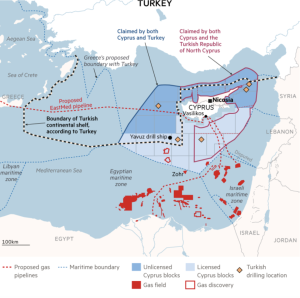
The race to drill and bring to market natural gas in the eastern Mediterranean Sea has taken on additional importance ever since Europe decided to cut itself off from its main supplier in Russia. The rush for underwater natural gas comes at a time when the US is heavily arming Greece and Cyprus in an effort to pressure Türkiye into falling in line on Washington-led policies on Russia and NATO.
Disagreements over waters and exploratory rights have brought Greece and Türkiye to the brink of conflict recently, and as more gas fields are discovered and the US inserts itself on the side of Athens, conflict is becoming increasingly likely.
The following is a rundown of Greek, Turkish, and Cypriot competing claims and the current situation in the race for eastern Mediterranean gas.
***
Last year saw new gas discoveries off Cyprus, including an estimated 70 billion cubic meters (bcm) field and a 57-84 bcm field. The finds raise the possibility of the island country finally becoming a gas exporter; it also raises the possibility of conflict as Türkiye, Greece, and Cyprus have wide-ranging disagreements over maritime boundaries.

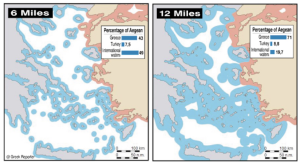
Greece argues that its islands in the Aegean sea can generate their own Exclusive Economic Zones (EEZ) which would allow Greece to explore more than 200 nautical miles. Türkiye has argued that islands can not generate their own EEZs and that Greece’s EEZ should start from its mainland, rather than from each of its hundreds of islands.
Under the UN’s Law of the Sea (UNCLOS), every state has the right to establish the breadth of its territorial sea up to a limit not exceeding 12 nautical miles. Türkiye, however, is not a signatory to UNCLOS and does not agree with the rights of the Aegean islands to such a distance. Ankara has threatened Athens with military action should it extend its waters. Both Greece and Türkiye currently claim six nautical miles off of their territory in Aegean and 12 nautical miles off their other shores.
While the EEZ governed by UNCLOS allows trading ships to pass freely, the passage of military naval ships is highly contested and Türkiye is threatened by the possibility of having to ask Greece permission for military navigation. Should Greece extend its EEZ to 12 nautical miles off its Aegean islands, it would make a drastic difference:

Six nautical miles have been in force since 1936. Tensions over the 12 nautical mile question ran highest between the two countries in the 1990s when UNCLOS was coming into force. In 1995, the Turkish Parliament officially declared that unilateral action by Greece to extend the Aegean islands to 12 nautical miles would constitute a casus belli, a position Ankara maintains today.
Well now Greece says that in March it’s going to extend its territorial waters to 12 nautical miles off of the island of Crete, which also happens to host a US naval base at Souda Bay. The US and Greece are also upgrading and expanding the facility with the goal to transform it into a permanent base for part of the Hellenic Navy, in order to facilitate faster and more direct access to the Eastern Mediterranean.
The move is reportedly being driven by ExxonMobil efforts to drill for natural gas and oil to the west and southwest of Crete. The Greek daily Kathimerini reported last week that ExxonMobil, in partnership with Greece’s HELLENiQ Energy, will push ahead with its search for natural gas and oil to the west and southwest of Crete despite Turkish opposition, fueling further suspicion in Ankara that the US is trying to punish the NATO member for its refusal to join the bloc’s aggressive approach against Russia.
US Arms Add Fuel to Fire
For decades the US acted as an impartial mediator between Greece, Türkiye, and Cyprus. Greece and Türkiye came close to military conflict in 1987, 1996 and in 2020, the last of which was over an accident when a Greek and a Turkish warship were involved in a minor collision during a standoff in the eastern Mediterranean. NATO stepped in in 1987 and in 1996 to help both sides cool off, and in 2020, Germany, which had the rotating presidency of the EU, took on the role of mediator.
The US is neutral no more. NATO’s war in Ukraine has brought long-festering issues between Ankara and Washington out into the open. The disagreements include US support of Kurds in Syria, Türkiye blocking Sweden’s NATO bid, Ankara’s refusal to open the Dardanelles to NATO warships, US sanctions and threat of sanctions, Washington’s refusal to extradite a cleric Türkiye blames for a 2016 coup attempt, Ankara’s purchase of Russian S-400 missile systems, Türkiye’s refusal to apply sanctions on Russia, and Ankara’s overall unwillingness to follow orders from Washington.
The US is now providing strong backing for Greece, which is clearly meant to send a message to Erdogan – at least that’s the belief inside Türkiye. Hasan Koni, a scholar on strategic studies at Istanbul Kultur University, told Türkiye’s Anadolu Agency::
The American security apparatus has also recognized that the balance of power in the region is shifting toward Türkiye and needs to be “checked by empowering Greece,” he said, adding that Washington’s push for more Greek bases is aimed at “containing Türkiye.”
The US has backed Greece despite the risk of a full break with Türkiye – the most important member of NATO due to its control of the Dardanelles and access to the Black Sea, as well as its second largest standing army in NATO.
Last year Greece deployed US-donated armored vehicles on the islands of Lesbos, Chios, and Samos, which is in violation of the 1923 Treaty of Lausanne and the 1947 Paris Peace Treaty. Ankara is also enraged about Greece’s militarization of islands within sight of Türkiye’s western coast, such as the Dodecanese chain that includes Rhodes.
There have been reports of Greek military exercises involving tanks, artillery and attack helicopters being held on Rhodes and Lesbos. Ankara has issued protests through diplomatic channels to both Athens and Washington and sent letters of complaint to the UN, all to no avail.
The US is also proposing to the Greek armed forces to replace all Russian-made military equipment including air defense systems with new military equipment produced by the US, including US Patriot missiles, which is a slap in Türkiye’s face.
Beginning during the Gulf War, Türkiye asked NATO multiple times to deploy early warning systems and Patriot missiles to Türkiye, but was always turned down. US security experts Jim Townsend and Rachel Ellehus explained it like this:
Long suspicious that NATO did not appreciate Türkiye’s vulnerability in such a dangerous neighborhood, Ankara came to view its missile defense requests as a litmus test for how much NATO really cared about Türkiye.
Ankara didn’t like the answer to that litmus test. Türkiye felt ignored by its western partners as its EU membership was all but dead, and it wasn’t getting the military hardware it requested. In 2017 Türkiye turned to Russia. It purchased Russian S-400 missile defense systems, which only further strained ties with NATO.
In December, a consortium of Italy’s Eni and France’s TotalEnergies found more natural gas off Cyprus. The Greek Cypriot administration’s exploration program is also disputed by Türkiye, which claims overlapping jurisdictions either on its own continental shelf or in the waters of the Republic of Northern Cyprus. Cyprus is split between the internationally recognized Republic of Cyprus in the south and the Turkish Republic of Cyprus in the north, which is recognized only by Ankara.
The US, wanting to keep the peace in NATO between Greece and Türkiye, had a decades-old policy of favoring negotiations on divided Cyprus and often acted as a mediator between the Turkish and Greek Cypriots.
But In September the Biden administration lifted the 35-year-old ban on the sale of US arms to the Republic of Cyprus. Congress restricted the sale of U.S. arms to Cyprus in 1987, hoping it would incentivize a diplomatic settlement to the island’s conflict.
Cyprus was required to block Russian naval vessels from accessing its ports in order to get the US arms sale ban lifted. Türkiye already has about 40,000 troops on the island, and Erdogan recently declared plans to reinforce them with land, naval and aerial weapons, ammunition and vehicles.
The decades’ old and UN-sanctioned principle of a bizonal, bicommunal federation on Cyprus has now broken down in favor of a two-state solution.
Despite the mad rush for Mediterranean gas in the wake of Europe and Russia schism, it still will not come close to replacing the amount that was piped in from Russia and requires rapid expansion of liquefaction capabilities, the connection of Israeli and Cypriot gas fields to such facilities, and/or implement pipelines, all of which will take years.
The EastMed Pipeline
The Trump administration backed a gas pipeline that would connect Israeli and Cypriot offshore gas fields to Greece and Italy. From there it would be shipped to the rest of Europe. The EastMed pipeline would have been the world’s longest (1,900 kilometers) and deepest underwater pipeline, initially providing 9-12 billion cubic meters annually.
One problem with the plan, however, was that it excluded Türkiye. In response, Erdogan opted to pursue Türkiye’s self-interest in gas through aggressive offshore oil exploration in disputed waters claimed by Cyprus. Turkish war vessels accompanied its drill ships near Cyprus, resulting in standoffs with Greek and French naval fleets. Ankara also began signing agreements with the government in Tripoli. From Dr Othon Anastasakis, Director of the European Studies Centre at the University of Oxford:
In November 2019, in response to Greece’s backing of the Mediterranean Gas Forum with Cyprus, Egypt, Israel, Italy and Jordan, Türkiye signed a maritime agreement with Libya that cuts a corridor across the Aegean to demarcate new maritime boundaries, with the proposed line in this accord running close to the eastern side of the island of Crete. On October 3, 2022, Ankara signed a follow up preliminary agreement with the Tripoli government to explore for oil and gas off the Libyan coast without specifying whether the surveys would take place in waters south of Greece. In effect, Libya has become an important third actor in the bilateral dispute between Greece and Türkiye and relations between the Athens and Tripoli governments have suffered a major blow as a result.
In January 2022, the Biden Administration abruptly halted American support of EastMed. Israeli and even some American officials were reportedly surprised by the sudden decision as the State Department did not appear to have adequately consulted with Cyprus, Greece, and Israel ahead of time. Additionally, Biden was a vocal supporter of the project during his time as Obama VP, and the US position was consistently that Europe needed to wean itself off of Russian natural gas.
The US government and American private sector were not directly involved in the pipeline project (the agreement was signed in January 2020 by the governments of Israel, Greece, and Cyprus), but as Henri Barkey, an adjunct senior fellow at the Council on Foreign Relations, told the National:
American support always affects a good housekeeping seal. When you have American buy-in, it’s easier for banks to provide financing for more countries to be interested. In that sense, what the US says is important.
US Under Secretary of State for Political Affairs Victoria “Fuck the EU” Nuland has taken an active role in the Eastern Mediterranean and had this to say about the pipeline:
“Frankly, we don’t have 10 years, but in 10 years from now, we want to be far, far more green and far more diverse” in energy sources, Nuland said. “So what we’re looking for within the hydrocarbon context are options that can get us more gas, more oil for this short transition period.”
That short transition period also happens to rely heavily on US exports of LNG.
In November Greece canceled the long-planned privatization for the Alexandroupolis port with Mitsotakis declaring it too precious of a resource to relinquish. Instead the US military has set up shop there, using it as an entry point to funnel weapons to Ukraine. There are also plans in the works to create a floating gas storage and regasification unit at the port, which will be serviced by American LNG supplies. A pipeline from Alexandroupolis is also planned to send that gas north to the Balkans.
1/18/2023
What if Turkey blocks Finland and Sweden NATO bids?
Source: Responsible Statecraft
By Mark Episkopos
January 18 2023
Many believe Ankara can be mollified — at a cost — but rejection of the Nordic countries’ ascension remains a real possibility.
Turkish Foreign Minister Mevlut Cavusoglu is set to meet his U.S. counterpart Antony Blinken in Washington this week. There are scant expectations among observers that the visit will resolve any of the outstanding issues in what has been an increasingly troubled bilateral relationship, with the Biden administration keeping its distance from Ankara over allegations of human rights abuses and the Eurasian country’s increasingly warm ties with Moscow.
Turkey has reaffirmed its uncompromising stance on the fraught NATO bids of Sweden and Finland, setting the stage for a showdown with serious long-term implications for both Ankara and the alliance.
Ibrahim Kalin, a spokesman for Turkish President Recep Tayyip Erdogan, said on Saturday that Ankara is “not in a position” to approve Sweden’s NATO bid until all of Turkey’s concerns have been addressed. “We have a time issue if they want to join NATO before the NATO summit in June,” he added, noting that Sweden’s judicial system must change its legal definition of terrorism for Turkey to lift its opposition to Stockholm’s accession, which requires the unanimous approval of all member states.
Stockholm and Helsinki simultaneously submitted applications to join the alliance in May 2022, citing the new security realities brought on by Russia’s February 24 invasion of Ukraine. Their accession process, which NATO Secretary General Jens Stoltenberg assured last summer will be the fastest in the alliance’s history, has been delayed indefinitely amid unresolved Turkish objections.
Ankara officials said the two Nordic countries have continued to shelter Kurdish militants, with President Erdogan insisting their accession bids cannot move forward until they agree to extradite persons sought by Turkish authorities on terrorism charges. Yet Swedish and Finnish courts have denied several extradition requests, including one reportedly pertaining to exiled dissident journalist Bulent Kenes. Cavusoglu decried the rejection as a “very negative” development, insisting that the two Nordic countries have not taken sufficient steps to satisfy Turkey’s strict conditions for clearing its objection to their accession. “We no longer want to hear good words from Sweden and Finland, we want to see concrete steps,” Cavusoglu said.
Swedish Prime Minister Ulf Kristersson said early in the new year that his country has done all it could to address Ankara’s concerns even as Turkish officials continue to insist Stockholm has not done nearly enough. Tensions over Sweden’s NATO bid reached a fevered pitch after footage emerged last week of an Erdogan effigy hanging from a lamppost in Stockholm, prompting a furious response from Turkish officials. “Unless the activities of terrorist organizations are halted, it is not possible for the NATO membership process to progress,” said Kalin, according to Al Jazeera.
The Nordic applicants appear no closer to sealing an accession deal with Turkey today than they were over half a year ago when talks began. Turkish experts contend Ankara is unlikely to drop its opposition to NATO enlargement until after the June election cycle in Turkey, with Erdogan facing a stiff re-election challenge against a six-party opposition coalition. Others have suggested Turkey’s extradition demands from the two applicants are a facade for larger concessions it is seeking to extract from the United States — namely, a $20 billion sale of F-16 fighter jets. Though the Biden administration has signaled it intends to greenlight the deal, at least one top senate Democrat — Bob Menendez, chairman of the Senate Foreign Relations Committee — has already vowed to block it.
It is generally consistent with Erdogan’s modus operandi to levy ambitious demands vis-a-vis his interlocutors only to settle for a more modest set of concessions when all is said and done. Yet there is also a clear precedent for the Turkish leader doubling down in response to international pressure. Erdogan proceeded in 2018 with plans to purchase the Russian S-400 missile system despite U.S. warnings that there will be significant consequences and refused to reverse his decision even in the face of CAATSA sanctions and Turkey’s costly removal from the F-35 partner program.
The current impasse over NATO enlargement could play out in several ways over the coming months. Anxious to bring the matter to a close, Washington and its allies may become progressively more heavy-handed in pressuring Ankara to back down through public and private channels. Erdogan, who is well-known for his eristic tendencies even in dealing with leaders of allied nations, may very well respond by lashing out in unpredictable ways.
Though it remains unlikely that a confrontation along these lines would lead to Turkey leaving or being expelled from NATO, it would shake the unity of the alliance at a dangerous moment for European security. Further still, an aggrieved Erdogan bent on undermining the organization from within could prove just as corrosive to NATO in the long run as a formal divorce between Turkey and the alliance.
Then there is the not-insignificant possibility — one that appears to have grown more likely in recent weeks and months — that Turkey could end up torpedoing the NATO bids of Finland and Sweden altogether, leaving the applicants and the alliance in uncharted waters. But regardless of how the accession drama plays out, the standoff has exposed what has become a foundational challenge for NATO in the post-Cold War world: the principle of limitless horizontal expansion has heightened the risk of internal contradictions among NATO’s increasingly diverse membership, making it more difficult over time to distill common geopolitical goals and to maintain the credibility of the Article V commitment that is at the heart of the alliance.
This dynamic poses a serious and growing liability for an organization that must make every major decision on a consensus basis.
Turkey’s actions in holding up NATO enlargement come as part of Erdogan’s larger effort to chart what he sees as an independent foreign policy course between Russia and the West. Ankara rejected the maximum pressure strategy against the Kremlin adopted by NATO’s leadership and most member states in response to Russia’s invasion, instead positioning itself as a neutral broker between Moscow and Kyiv.
Ankara’s neutrality has yielded some success in the form of the Black Sea Grain Initiative, the only significant international treaty involving both Russia and Ukraine since the war’s outbreak. Erdogan has been able to carve out this niche in a unique wartime context: none of the major Western powers have been willing to engage Russia in direct talks, giving outside players opportunities to fill the void.
The conflict poses something of a paradox for Ankara. Erdogan is committed to facilitating a negotiated end to the war and came much closer than anyone else to doing so, according to reports from the failed Antalya summit in March. Yet it is precisely the war that has empowered Turkey with a degree of international clout that would otherwise have been unattainable. It remains to be seen to what extent Erdogan’s successor — regardless of whether they enter office as a result of this year’s election or at a later point — will seek to carry on his ambitious vision, nor is it clear how exactly the inevitable transition to a post-Ukraine War landscape will alter the strategic imperatives confronting Turkey.
The war has been a catalyst for geopolitical change, prompting both NATO and Turkey to pursue policies unthinkable in peacetime. The story of these transformations, closely tied as they are to the war’s course and its eventual outcome, is still being written.