
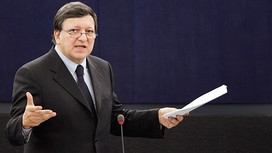
Showing posts with label Barroso. Show all posts

4/25/2013

Global Insight: Politics draws out accidental truth on austerity Europe

Voter outrage sparks José Manuel Barroso’s concerns about eurozone belt-tightening

Πηγή: FT
By Peter Spiegel
April 24 2013

There is an old saw in US political circles that the definition of a Washington gaffe is accidentally telling the truth.

In an unscripted moment at one of the surfeit of panel debates that dominate Brussels’ daily rhythms, José Manuel Barroso this week appeared to do just that. He publicly stated what many European leaders had previously only acknowledged in private: the eurozone’s austerity-led crisis response has run smack into increasingly implacable voter outrage.

“I know that there are some technocratic advisers who tell us what the perfect model to respond to a situation is, but when we ask how we implement it, they say: ‘That is not my business,’” the European Commission president said in a not-so-subtle dig at his own staff. “We need to have a policy that is right. At the same time we need to have ... acceptance, political and social.”

His admission came at the end of a bad few weeks for austerity advocates. The International Monetary Fund has published new estimates showing recessions deepening in some of the most austerity-hit eurozone economies, such as Spain, Portugal and Greece. That coincided with the tarnishing of one of the most influential academic papers tying high government debt to economic stagnation.

There are also increasing signs that advocates for easing the austerity drive are gaining the upper hand in Brussels, with about a half dozen eurozone countries – including some in the so-called “core”, such as France and the Netherlands – seeking more time to hit tough EU-mandated deficit targets, Brussels’ most powerful tool in setting eurozone-wide fiscal policy.

But if it were just a deepening economic recession or academic one-upmanship, it is unlikely proponents of less belt-tightening would be able to have this much success in changing the tenor of the Brussels debate. After all, Europe’s recession has been deepening for well over a year with little policy change, and the occasionally vitriolic attacks between Keynesians and austerians have been a feature of the eurozone debate since the outset of the crisis.

What has changed is the issue Mr Barroso put his finger on: politics. In the wake of February’s Italian elections – where more than half the voters in the eurozone’s third-largest economy backed candidates running on overtly anti-EU and anti-austerity platforms – public acquiescence to the crisis’ policy response is evaporating.

Those close to the commission president insist there was nothing accidental about his remarks; for months he has been privately fretting about anti-EU sentiment provoked by eurozone economic policy, but kept his mouth shut for fear of rocking an already shaky boat. This week, he followed his political instincts and let loose.

Undoubtedly, the political destruction left in the crisis’ wake is already long and wide. Ireland’s Fianna Fáil, once the country’s presumptive ruling party, was decimated when it was forced into a €67.5bn bailout. Greece’s three-generation Papandreou dynasty was dismantled over the course of a weekend. Italy’s Silvio Berlusconi was openly ridiculed by his counterparts and summarily dismissed after a not-so-subtle nudge from Berlin and Brussels.

But the voter revolution, like the crisis itself, is now moving from the periphery to the core. Mario Monti, the Brussels-blessed technocratic prime minister who was crushed by the Italian electorate when he tried to win the job at the polls, warned shortly afterwards that other leaders would also be turfed out unless more was done to boost growth.

And there is no government now more at risk, and no country more central, than France, where François Hollande won the presidency last year promising to reverse the eurozone’s austerity-led response. Thus far, he has been singularly unsuccessful in that effort. His approval ratings have fallen below 30 per cent, near an all-time low for a president of the Fifth Republic.

German officials have made clear to eurozone counterparts that France has become their biggest concern, and may yet be the reason they allow an easing of austerity measures for now. They dare not risk a Franco-German rift just months ahead of a German national election.

But they also warn that at some point, and perhaps very soon, France’s day of reckoning will come. Then, the German push for austerity and economic reform could well meet French protesters at the barricades. If it comes to this, Mr Barroso’s accidental truth may instead prove an unsettling harbinger.

7/28/2012

Is “Grexit” at hand?


Πηγή: The Economist
July 28 2012

ON HIS visit to Athens this week, José Manuel Barroso, the head of the European Union (EU) Commission, brought a stern warning for Antonis Samaras, the new prime minister of a precarious right-left coalition government. Greece has only a couple of weeks left to convince its creditors that it can put economic reforms back on track. Should its latest plans for making €14.5 billion ($17.6 billion) of spending cuts over the coming two years be judged unrealistic, the next €31.2 billion loan tranche will again be held back.

If that happens, Greece would be unable to finish recapitalising its big banks. Without credit, the economy will seize up. Pensions and public-sector salaries would not be paid. A “Grexit” from the euro could occur within weeks. The worry for Greeks is that with Spain and Italy coming under attack in financial markets, some euro-zone members may be tempted to sacrifice Greece.

Two previous Athens governments have failed dismally since mid-2010 to implement reforms agreed on with the Commission and the IMF, thanks to widespread official corruption and a lack of political will. Mr Samaras opposed the first Greek bail-out while in opposition; he still wants, at some point, to renegotiate parts of the second.

Yannis Stournaras, the technocratic finance minister, has the difficult job of persuading Greece’s creditors that his government can do better than its predecessors. The troika of officials from the EU, IMF and European Central Bank were especially dismayed by a looming €3 billion gap in privatisation revenues this year, as well as by the lack of progress in cutting jobs in the public sector.

Just after the troika arrived, on July 25th, Mr Stournaras announced new bosses for the privatisation agency. And Antonis Manitakis, the public-administration minister, declared that five public-sector entities would be shut immediately and another 16 merged. Their 5,250 employees would retire or be transferred to other jobs. That is still far short of the 15,000 dismissals in 2012 agreed to by the previous government. Annual savings would be a modest €40m. Mr Manitakis promises another 180 mergers, with much bigger savings, within weeks. The civil service union is already threatening to strike. Will Mr Barroso and the troika think it is enough?


11/23/2011

Showdown in Greece: EU Gives Deadline on Signatures; Samaras Won't Sign, Sends Letter Instead, Seeks Policy Changes

Eurogroup chief Jean-Claude Juncker (r) said Greek party leaders must back Greek PM Lucas Papademos and give guarantees by Tuesday summit

By Mike Shedlock / Mish
Nov 23 2011

European officials have had enough of the technocrat leadership in Greece. They have given a week for Antonis Samaras, the leader of New Democracy party, and member of the coalition to sign a document saying he will support the European Union debt plan.

He says he will support the plan (with modifications). The EU wants a signature now, with no changes.

Does a Signature Even Matter?

Other than pigheadedness on behalf of the EU, does a signature even matter? Why? The next government can easily vote to undo whatever this government does. Will Samaras remain in power? Is his signature binding on the next parliament (or even this one)?

I will have more questions in a moment but first consider a couple of articles.

EU Gives Deadline on Signatures

Ekathimerini reports EU sets deadline for signatures

European officials insisted on Tuesday that party leaders in Greece’s coalition government must provide written guarantees expressing their commitment to a new European Union debt plan before a Eurogroup summit next Tuesday to unlock crucial rescue funding. But center-right New Democracy appeared unmoved and the right-wing Popular Orthodox Rally (LAOS) -- the third party in the coalition -- appeared to harden its stance against the country’s creditors.

Sources in Brussels told Kathimerini that the EU decided to send Athens the ultimatum after talks between European Commission President Jose Manuel Barroso and New Democracy’s vice president Stavros Dimas, who is also foreign minister, failed to secure a shift in the stance of ND president Antonis Samaras, who has refused to offer written guarantees to Brussels, saying his word should be enough.

Eurogroup chief Jean-Claude Juncker, who received Greek Prime Minister Lucas Papademos in Strasbourg, said he hoped party leaders would fulfill EU demands by Tuesday. “Would there be no cross-party agreement, that disbursement of course could not take place,” Juncker said, referring to an 8-billion-euro loan without which Greece faces default next month.

There was pressure from elsewhere too. Dutch Finance Minister Jan Kees de Jager said his country would bar further aid unless Samaras changes his tune. “We want to see a signature from Mr Samaras… otherwise, as far as I am concerned, they will get no money. Absolutely not.” But ND spokesman Yiannis Michelakis indicated that ND’s leader was unmoved. “I have nothing to add on the issue of the signature that is being asked of Samaras,” he said.

Meanwhile the leader of LAOS, Giorgos Karatzaferis, shifted from his earlier suggestion that he would do “everything necessary” to secure crucial loans, saying that instead of signing a letter, he would write an article outlining his commitments in his party’s newspaper.

Samaras Won't Sign, Sends Letter Instead

Athens News reports Samaras won't sign, EPP letter published

As the pressure mounts on the major Greek party leaders to provide written support for the October 26/27 eurozone deal, New Democracy (ND) president Antonis Samaras has reiterated his stance that he will not sign such a statement.

ND party spokesman Yiannis Mihelakis stressed on Tuesday that he has nothing further to add on the issue of Samaras' signature over commitments requested by the EC-ECB-IMF 'troika'. Mihelakis added that Samaras has made specific statements saying he backs the October 26 EU summit agreement, adding that no request has been made on behalf of the European Union as regards the ND leader’s signature.

In the letter, Samaras underlines the fact that he supports Prime Minister Lucas Papademos and the targets of fiscal adjustment but notes that “certain policies have to be modified”.Policy Changes?

Who blinks first? Samaras or the EU?

While pondering that question, consider this logic from my friend Bran who every day sends me links like those above.

Bran writes ...

Imagine a US bill launched by the Democrats affecting international shipping. Suppose the bill gets a mixed vote and passes.

Along come the Chinese who are part beneficiaries of the bill and they then insist not just the President sign it, but also demand the head of the Republican party to do so, or they will not abide by their reciprocally enacted legislation.Just imagine that setup and tell me how Speaker of the House John Boehner or Senate Minority Leader Mitch McConnell might react.

Even if the Congressional leaders did sign such a document, would it be binding on the next Congress?

In the case of Greece, elections will be held early next year (supposedly). With all these demands and all this political posturing, one has to wonder.

I for one hope Samaras holds firm and does not sign. The quicker the Eurozone blows up, the better it will be for everyone.


10/12/2011

EU: Commission to unveil bank bail-out plan

Barroso backs the Dutch plan for a 'super-commissioner' (Photo: European Commission)

Πηγή: EUobserver
BY LEIGH PHILLIPS
Oct 12 2011


European Commission President Jose Manuel Barroso on Tuesday said that the EU executive will put forward plans for a fresh round of bank bail-outs across Europe on Wednesday (12 October).

"Tomorrow in the commission I will make some proposals on some of those topics, for instance recapitalisation of European banks. We believe that we need a kind of comprehensive response taking into consideration all the aspects, not only one," he said, speaking to reporters in The Hague.

EU officials are racing to co-ordinate a substantial bank recapitalisation after weeks of denying that there was any problem with the sector. Declaring the bloc's banks liquid and solvent, leaders said that all but eight had passed stress tests in July.

But a faltering European economy and fears over exposure to peripheral debt has significantly worsened the situation for the bloc's troubled lenders since the tests were organised.

An emergency rescue of Franco-Belgian bank Dexia on Sunday forced the hands of EU officials, with German Chancellor Angela Merkel and French President Nicolas Sarkozy saying the same day that bank re-capitalisation plans were underway.

Barroso last week had said that a "co-ordinated" bank recapitalisation is necessary.

Also on Tuesday, credit rating agency Fitch downgraded six Spanish banks.

Adding to the gloom on Tuesday, the outgoing chief of the European Central Bank, Jean-Claude Trichet, warned that the renewed banking crisis now threatened the world economy.

"The high interconnectedness in the EU financial system has led to a rapidly rising risk of significant contagion. It threatens financial stability in the EU as a whole and adversely impacts the real economy in Europe and beyond," he told MEPs, speaking in his capacity as head of the European Systemic Risk Board.

In the Hague after a meeting with Dutch Prime Minister Mark Rutte, Barroso also said for the first time that the commission backs the Netherlands' proposals for a 'super-commissioner' who would have the power to make a 'ward' of any heavily indebted member state and take over all economic policy-making from an elected government.

He said the role should rest with the current economic and monetary affairs commissioner, Finnish liberal Olli Rehn.

"We need a stronger governance, a stronger discipline," he explained, "and that's why I favour the idea put forward by prime minister Rutte of a stronger role for the commission, including the naming of a commissioner of economic and financial affairs."

Finland has also publicly backed the Dutch plans and it is understood that Germany finds aspects of the proposals favourable.

Europe needs "strengthened discipline, with a stronger governance and a common approach by independent European institutions," Barroso went on in The Hague.

"It has to do with the credibility of the eurozone and the credibility of our common effort."


EU banks could shrink to hit capital rules


Πηγή: FT
By Patrick Jenkins, Brooke Masters and Alex Barker
Oct 12 2011


Leading European banks say they would rather sell assets than raise expensive new capital to meet compulsory demands from the European Union for higher capital ratios, threatening a further contraction of credit to the enfeebled eurozone economy.

This radical approach, led by French banks BNP Paribas and Société Générale, would be copied by lenders across Italy, Spain and Germany, bankers said. “Why should we raise capital at these [depressed share price] levels?” said one eurozone bank boss. The average European bank’s equity is trading at only about 60 per cent of its book value.

Another top banker said: “It’s fundamentally wrong to increase capital at the moment. Deleveraging needs to happen.”

However, the banks’ “shrinkage” strategy is likely to prove controversial with politicians and regulators if it led to bankers lending less money to customers, jeopardising the eurozone’s fragile recovery, analysts warned.

European companies rely on banks for as much as 80 per cent of their funding compared with only 30 per cent for US companies.

On Wednesday, José Manuel Barroso, president of the European Commission, outlined the broad terms of a compulsory recapitalisation for Europe’s leading banks, requiring “a temporarily higher capital ratio”, with restrictions on dividends and banker bonus payments in the interim.

Mr Barroso stopped short of specifying the target ratio, but people close to the process told the Financial Times on Tuesday that the European Banking Authority, the regulator, is poised to set a higher bar than expected – a 9 per cent ratio of core tier one capital to risk-weighted assets – for banks across the continent. A deadline of six to nine months would be set for forceable recapitalisation by governments, if banks have not reached the ratio under their own steam.

Banks and their advisers said their scope to raise fresh capital from investors was all but non-existent. “I don’t think anyone has access to the markets now,” said one senior European investment banker. Investors are loath to commit to fresh equity injections, in the knowledge that the new money would simply be soaked up by sovereign debt writedowns, bankers said.

But by shrinking assets – the denominator of capital ratios – many banks believe they can reach the targets without resorting to government recapitalisation. In recent weeks, both BNP and SocGen have signalled plans to offload a combined €150bn of risk-weighted assets. Further businesses could now be sold. Italy’s Unicredit and Germany’s Commerzbank were likely to find themselves under most pressure to deleverage and divest assets, bankers said.

Many economists, however, support the European authorities’ efforts to recapitalise the banks quickly even if it results in lower lending levels.

Richard Reid, an economist at the International Centre for Financial Regulation, said that stress tests had to be credible with markets and “there is no alternative to a plan to take on board the obvious risks from sovereign debts” even if the action “could circumscribe the financial system’s ability to promote credit”.

It is unclear exactly how the 9 per cent ratio will be calculated, but several people involved in the process said it would be after taking sovereign writedowns but without the macro-economic stresses applied in the EBA’s July stress test.

There are wildly different estimates of the economic impact of the Basel III regulatory reforms, which are in effect being accelerated by the European recapitalisation drive. An industry sponsored study by the Institute of International Finance predicted that borrowing costs would rise by 3.5 percentage points and global output would be reduced by 3.2 per cent, 10 times the estimate of regulators.
<div>


</div>

10/09/2011

Barroso says Greek default would spread crisis: paper


Πηγή: Reuters
By Sarah Marsh
Oct 9 2011


A Greek default would have unforeseeable consequences and cause the euro zone crisis to spread, European Commission President Jose Manuel Barroso was quoted as saying in mass-selling Bild daily.

Talks are continuing over a vital aid tranche for debt-stricken Athens, which could run out of cash as soon as mid-November, dragging the euro zone deeper into a debt crisis already shaking financial markets worldwide.

"If we give up on Greece, there is a big danger that the crisis will spread to other countries," Barroso told Bild in an interview to be published on Monday, echoing comments of German Chancellor Angela Merkel.

Merkel warned last week the threat of contagion from a euro zone state rescheduling its debt would be huge and only made sense once it had achieved a primary surplus.

Barroso noted the euro zone had no experience with the possible bankruptcy of a member state.

"This is new territory for us and we are discussing solutions which have not really been tested before," he said.

But the European Union was convinced that a Greek bankruptcy was "not cheaper for all participants than the current aid schemes," he said.

European finance ministers are considering making banks take bigger losses on Greek debt -- an issue that could be discussed at a meeting between Merkel and French President Nicolas Sarkozy later on Sunday.

It is still uncertain whether Greece, which was hit by strikes and riots over austerity measures last week, will receive the next tranche of aid given doubts over its willingness to reform.

"The reforms must be faster, otherwise Greece will lose its credibility," said Barroso.

Barroso added that Europe needed to correct the "orgy of consumption" that had taken place in some countries due to the introduction of a strong common currency with low interest rates.

Merkel meets with Sarkozy on Sunday to thrash out differences over how to use the euro zone's financial firepower to counter the debt crisis, which is threatening to spiral into financial meltdown as the value of banks' sovereign debt holdings slide.


9/30/2011

Europe presses ahead with controversial financial tax

Jose Manuel Barroso - State of the Union address - Photo EC


Πηγή: EUbusiness
Sep. 29 2011


(STRASBOURG) - Europe went ahead with landmark proposals to tax the financial sector on Wednesday, ignoring US opposition in a move also sure to provoke a row with London which fears capital flight from the City.

On the drawing-board for more than a year, the idea was given fresh impetus last month when given the nod by Europe's power couple, French President Nicolas Sarkozy and German Chancellor Angela Merkel.

The plan will go before all 27 European Union heads of state and government at an October 17-18 summit, and also be put to a summit of G20 leaders in Cannes on November 3-4.

European Commission president Jose Manuel Barroso said the tax could generate around 55 billion euros a year as he lodged the draft legislation with the European Parliament in Strasbourg.

"The tax would be levied on all transactions on financial instruments between financial institutions when at least one party to the transaction is located in the EU," a commission statement said.

The EU executive stressed that "house mortgages, bank loans, insurance contracts and other normal financial activities carried out by individuals or small businesses fall outside the scope of the proposal."

The aim is to ensure that the financial sector "makes a fair contribution" after EU governments ploughed 4.6 trillion euros into bailouts mainly for banks caught in a US-triggered property credit meltdown in late 2008, only for taxpayers to suffer as public finances had to be cut as a result.

The commission also has another key goal in mind: some of the receipts from the tax, which would not be implemented before 2014, would go directly into the EU's budget, giving Brussels more independently-raised resources than under the present system of contributions from national governments.

Controversy over where the money will go erupted almost immediately with grassroots activists One, the group co-founded by U2's Bono, saying the tax should fund the fight against poverty and efforts to mitigate climate change.

"At least half the revenue of an EU financial transactions tax should be allocated to the fight against extreme poverty and climate change, to help millions of people trapped in misery," said Guillaume Grosso of the group's French arm.

Charity group Oxfam said the commission should "go further," covering "all financial transactions" and fixing "more ambitious rates for derivatives products," blamed in part for exacerbating the global financial crisis of the last three years.

The parliament's socialists and democrats grouping hailed the fact the proposal will target "the most speculative financial products including transactions carried out off-exchange," and bring the date for implementation forward by four years.

But the head of an international network of tax advisers, Taxand, said the plans "will cause severe tension with those countries opposed to the tax."

Frederic Donnedieu de Vabres also maintained that "importantly, the proposals currently do little to stop the tax ultimately being passed on to the clients of financial institutions."

The latest known proposals would slap 0.1 percent on shares and bonds and 0.01 percent on derivatives, although countries wanting higher levels would be free to raise the rate domestically.

While Merkel and Sarkozy offered no details on the tax in August, their support helped send shares into an immediate tailspin with financial sector players warning the measure would push business away from Europe.

Britain, at the heart of the global financial industry, reiterated demands for any such tax to "apply globally," after a Treasury official argued that "otherwise the transaction covered would simply relocate."

The Netherlands are also opposed to it.

"The tax would not be based on where transactions take place but on the parties involved," an EU source has argued.

Decisions on tax matters, the bedrock of national sovereignty, require unanimity under EU rules.


7/21/2011

Euro reaches eleventh hour as Angela Merkel and Nicolas Sarkozy hold crisis talks


Πηγή: The Telegraph


7:05AM BST 21 Jul 2011


Angela Merkel and Nicolas Sarkozy held crisis talks in Berlin amid warnings that a failure to break the debt crisis deadlock within 24 hours would send shockwaves around the global economy.
Early on Thursday morning, after seven hours of talks, Germany and France reached a common position on a second bailout of Greece but details of the the accord were not revealed.

The German chancellor and the French president had been barraged with pleas from political and financial leaders to reach an agreement – or risk the collapse of the single currency.

The accord between the two most powerful states in the eurozone will now be presented to the crisis summit in Brussels on Thursday of all 17 leaders of the bloc, described as the "last chance saloon" for the euro project.

Mr Sarkozy decided to travel to Berlin after the pair repeatedly failed to agree on how to get private bondholders to share the costs of a new €115bn (£101bn) bail-out for Greece.

Jose Manuel Barroso, the president of the European Commission, said: "Nobody should be under any illusion: the situation is very serious. It requires a response. Otherwise the negative consequences will be felt in all the corners of Europe and beyond."

In a rare outburst, Mr Barroso, accused European leaders of endangering "a strong single market and a strong euro".

"That is what is at stake. That is why we must provide a solution tomorrow. I believe now is the time to decide," he said. "Leaders need to come to the table saying what they can do and what they want to do and what they will do. Not what they can't do and won't do."

Mr Barroso rounded on Germany, France and the European Central Bank (ECB), blaming them all for obstructing a deal on the "feasibility and limits" of private sector involvement in a second Greek bail-out.

He criticised Germany for blocking "scope for more flexible action" through the European Financial Stability Facility (EFSF), France for holding up "repair of the banking sector" and the ECB for failing "to ensure the provision of liquidity to our banking system".

Jyrki Katainen, Finland's prime minister, said: "We are trying to avoid a total catastrophe, that is, Greece's insolvency which would most likely be highly contagious."

Meanwhile, George Papandreou, the Greek prime minister, called the summit "a make-or-break moment".

On Wednesday night tensions over the European sovereign debt crisis reached fever pitch as:

• A crucial meeting of "eurozone sherpas" – senior officials from all 17 finance ministries – was cancelled pending the possible agreement between Ms Merkel and Mr Sarkozy. The meeting, designed to thrash out details of a fresh Greek bail-out, has been pencilled in for Thursday morning, before the summit begins at lunchtime.

• A group of leading economists wrote an open letter to European leaders warning: "For the first time, the very survival of the euro is at stake." The 12 economists, including Richard Portes from the London Business School, called for the expansion of the EFSF and for permission for the fund to operate in secondary bond markets. They said: "The important thing is to acknowledge that leaders are out of time. Deciding to not decide could mark the end of the Eurozone as we know it."

• Yields on lower-rated eurozone debt fell for the second day running in the hope that European leaders can agree a fresh bail-out for Greece's debt burden and find a way to prevent the crisis from spreading. One trader said: "It might be wishful thinking – but the alternative is unthinkable."

In an attempt to assuage the rising panic across Europe, Alain Juppe, the French foreign minister, said that Mr Sarkozy and Ms Merkel's meeting was a good sign and he was "sure we will find an accord". He insisted that "there is a very broad convergence of views" among eurozone countries.

Steffen Seibert, the German government spokesman, said Ms Merkel and Mr Sarkozy knew the stakes were high. He said the pair were not intending to dictate terms to the other 15 eurozone countries, but admitted that "if France and Germany cannot agree, Europe does not move forward".

While Germany wants private bondholders to take a "haircut", France and the ECB are determined to avoid any credit event that could be seen as a default. The possible compromises, contained in a leaked document, include imposing a tax on eurozone banks; a vast debt swap in which investors would roll over their current bonds for new longer-term maturities; and an expansion of the EFSF.

Sharon Bowles, MEP, said: "The leaders must change tack from the squabbling and mixed messages ... the summit is the last chance saloon before problems become even greater."

Meanwhile, Brazil's central bank has boosted its main interest rate to 12.5pc, a quarter-point increase, extending its effort to rein in inflation in the booming South American economy.

The increase keeps the base rate at the highest in the G20 group of developed and emerging economies and was the fifth hike this year.

President Dilma Rousseff, who only took over from predecessor Luiz Inacio Lula da Silva on January 1, had promised to bring the rate down, but has been caught by rising consumer prices.