
Showing posts with label European Union. Show all posts

5/07/2020

Democracy At Risk In Central And Eastern Europe, Report Finds

Hungarian Prime Minister Viktor Orbán speaking last month in Parliament, when lawmakers granted him the power to rule indefinitely by decree. One aspect of the law ostensibly passed to cope with the coronavirus calls for prison terms of up to five years for those convicted of spreading falsehoods or distorted facts during the emergency.

Source: npr
May 7 2020
By Joanna Kakissis

Democracy is weakening across Central and Eastern Europe as well as Eurasia amid the rise of Chinese and Russian influence, according to a new report by Freedom House, a Washington, D.C.-based nonprofit.

The annual report — Nations in Transit 2020, Dropping the Democratic Facade — covers 29 countries from Central Europe to Central Asia, and says there are now fewer democracies in the area than at any point in the last 25 years.

"Many leaders in this region are no longer pretending to care about democracy or the rule of law," Freedom House President Michael J. Abramowitz said in a statement, adding that the coronavirus pandemic is exposing the people of these countries to even more abuse.

The study found that Hungary no longer qualifies as a democracy, Poland is headed in the same direction, and China and Russia are compromising fragile democratic institutions in nations that emerged from the former Yugoslavia.

Abramowitz says both the European Union and the United States are failing to stand up for basic democratic values, ceding regional influence to Beijing and Moscow.

"It is time for European leaders who are committed to freedom to address the crisis in their own neighborhood," Abramowitz said. "The United States also has a pivotal role to play and should rededicate itself to a foreign policy that emphasizes the defense of democratic values."

Democracy fades within a democratic bloc of nations


Hungary is in the European Union and yet Prime Minister Viktor Orbán has faced little blowback from Brussels after a decade of dismantling democratic institutions. His nationalist Fidesz party has demonized migrants and "pro-migration liberals" such as Hungarian-American philanthropist George Soros.

Human rights monitors accuse Orbán and Fidesz of stoking renewed anti-Semitism in Hungary by attacking Soros — among others — who survived the Holocaust in Budapest with forged papers.

Fidesz has sidelined its opponents by pushing through constitutional and legal changes to consolidate power. Most media outlets in Hungary are run by the government or its supporters. More recently, the government pushed through a revisionist school curriculum promoting nationalist writers and dropping the works of Hungary's only recipient of the Nobel Prize in Literature, Imre Kertész, a Holocaust survivor.

Since March, Orbán has been running the country by decree, after securing emergency powers to manage the coronavirus pandemic. The emergency law has no sunset clause. Freedom House says Orbán, who is a strong ally of President Trump, has "dropped any pretense of respecting democratic institutions."

Hungary's government spokesman, Zoltán Kovács, responded by calling the report biased because it receives some funding from Soros' Open Society Foundations. "With their Soros funding they've declined, becoming the fist of the party that is the Soros network," Kovács tweeted. "Anyone who doesn't conform to their liberal view, gets downgraded."

Mike Smeltzer, a Freedom House research analyst, points out that the nonprofit receives funding from many sources, including the U.S. government.

"The Hungarian government would rather try to shoot the messenger than deal with the substantive points raised in our reports, which exhaustively document a serious decline in freedom and democratic practice in the country," Smeltzer told NPR. "In our report, Hungary is the only country in the EU that's not a democracy."
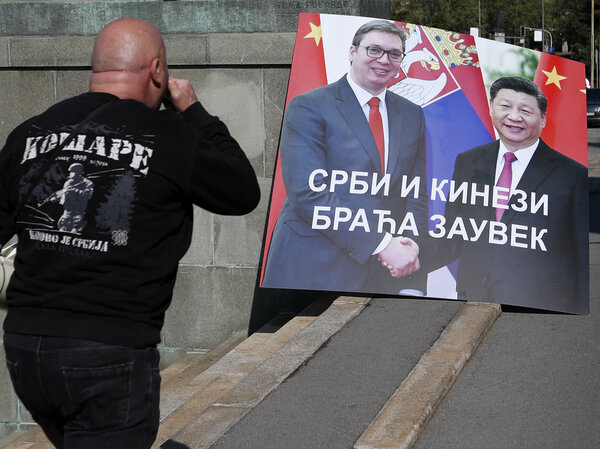

A man protests the declaration of a state of emergency last week in Belgrade with a banner showing Serbian President Aleksandar Vučić, left, and China's President Xi Jinping. The banner reads, "Serbs and Chinese Brothers Forever."Darko Vojinovic/AP

Freedom House says democracy is also slipping away in Poland, another EU nation. The report blames the "systematic, targeted, and aggressive nature of the government's attacks on judicial independence."

In the Balkans, Serbia and Montenegro — once part of Yugoslavia — have also seen democratic declines after "years of increasing state capture, abuse of power, and strongman tactics," according to the report. Serbian President Aleksandar Vučić and Montenegrin President Milo Đukanović "have tipped those countries over the edge."

Stung by years of contentious relations with the EU, both countries have grown closer to Beijing and Moscow. "The Russian and Chinese governments are moving in with money and propaganda, trying to win hearts and minds," Smeltzer says. "And yes, it's in large part due to the absence of the EU and U.S. But, that does not mean that Balkan politicians are not making use of the situation and trying to turn it to their own advantage."

In an effort to check China's growing financial influence in the Balkans, EU leaders on Wednesday expressed "unequivocal support" for all Balkan nations to eventually join the bloc. They also said they would help the Balkans with a coronavirus recovery plan in addition to $3.6 billion already promised.


2/12/2016

EU hits China with new steel anti-dumping probes


Πηγή: EA
Feb 12 2016


The EU launched new probes today (12 February) into imports of Chinese steel, warning it would not allow "unfair competition" to threaten Europe's industry already crumbling under a flood of cheap imports.

European steelmakers are reeling from a global glut and last week Luxembourg-based world leader ArcelorMittal blamed China for a colossal $8-billion (€7.1 billion) loss in 2015 while thousands of jobs are being cut.

"We cannot allow unfair competition from artificially cheap imports to threaten our industry. I am determined to use all means possible to ensure that our trading partners play by the rules," EU Trade Commissioner Cecilia Malmström said in a statement.

The European Commission, the EU's executive arm, had opened an investigation into imports of seamless pipes, heavy plates and hot-rolled flat steel from China, the statement said.

The Commission separately imposed anti-dumping duties on cold-rolled flat steel imports from China and Russia.

It recalled that it recently also imposed anti-dumping measures on Chinese steel bars used in the construction industry.

EU urges China output cut


Malmström last month urged China to cut output for everyone's sake.

"In the wake of a worrying trend, I urge you to take all appropriate measures to curb the steel overcapacity and other causes aggravating the situation," Malmström wrote in a letter to Chinese Commerce Minister Gao Hucheng.

The letter also warned China that it faced new probes if nothing was done after its steel exports soared 50% in 2015, destabilising the global market and the EU in particular.

China accounts for half of global steel production but internal demand has slowed sharply along with the economy, forcing it to look overseas.

Beijing has announced plans to cut production by as much as 150 million tonnes over the next five years but this is far short of the 340 million tonnes that experts say the country is overproducing every year.

Long history of disputes

The latest measure on steel comes amid a growing stand-off between the EU and China, which are major trading partners but which have also had many trade disputes in the past, most bitterly over solar panels which continues to rumble on.

>> Read: EU slaps anti-dumping duties on China, Taiwan steel

In a separate statement Friday, the Commission said it was extending existing anti-dumping and anti-subsidy measures on imports of Chinese solar modules and cells via Taiwan and Malaysia.

It said an investigation showed that China was getting around duties by transhipping the goods via Taiwan and Malaysia.

Tensions with China have also grown as Beijing presses the EU to recognise it as a fully market-based economy, not a communist, state-controlled giant which now ranks second in the world only after the United States.

China joined the World Trade Organization in 2001 as a developing country, a status giving it 15 years to progressively remove government controls.

Beijing insists it has done just that and should now be recognised as a market economy but many in Brussels disagree.

They say the change in status could mean they will have fewer options to control trade with a China they believe is still dumping exports on the global markets.

Malmström's spokesman Daniel Rosario said the EU currently had 37 trade defence regimes in force against imported goods and 16 of these involved Chinese products.

Steel industry group Aegis Europe plans a march in Brussels Monday, expecting to draw several thousand people to a protest against China's market-economy ambitions.

BACKGROUND


In 2008, the European Commission launched an investigation into imports of steel from China, South Korea and Taiwan, which European steelmakers have complained are being dumped on the market at below cost price, putting thousands of jobs at stake.

>> Read: Commission to probe cheap China steel imports

The EU executive has opened a series of inquiries into alleged dumping from China in a broad range of industrial sectors.

In 2012, it launched its largest investigation to date, into alleged dumping of, and subsidies for, an annual 21 billion euros of solar panels and components China exports to the EU.

It followed up the year after with an investigation into industry claims that Chinese solar glass producers are dumping their products in the European Union at below market value

>> Read: EU launches anti-dumping probe of Chinese solar glass

Beijing hit back immediately, by launching its own anti-dumping and anti-subsidy probe into European wine.

>> Read: EU-China solar trade spat escalates as Beijing hits back with wine probe

In 2013, EU states agreed to impose duties on imports of Chinese plates and other table and kitchenware.

>> Read: EU countries to impose anti-dumping duties on Chinese ceramics

In the telecoms sector, the EU executive is also investigating alleged subsidies to Huawei and ZTE – emanating from export credits given by Chinese banks – which the EU executive believes offer the Chinese companies preferential terms for investing into foreign markets.

>> Read: EU holds off China telecoms trade probe amid US 'cyber-espionage' claims


1/13/2014

Greece stresses its role as EU’s energy hub


Πηγή: EurActiv
Jan 13 2014

Greece, holding the rotating presidency of the EU until June, said it would promote the enhancement of energy security in the 28-country bloc and fully support the European Commission’s approach to Russian energy giant Gazprom.

Speaking to the press in Athens last week, the Greek minister for energy, Yiannis Maniatis, said the first pillar for European energy security was the support of initiatives to diversify gas supply, including gas from the Caspian Sea and the gradual implementation of the Southern Corridor.

According to the minister, “interconnectors” for big pipelines were key contributor to Europe's energy security.

The Trans Adriatic Pipeline AG (TAP) and the Interconnector Greece-Bulgaria (ICGB) recently signed an agreement laying the foundations for linking the two projects and thus bringing gas from Azerbaijan to Bulgaria, a country which depends on Russia for almost 100% of its gas imports.

The two sides will work together on realising a possible interconnection point in the vicinity of Komotini, Greece. “These interconnectors are choices that objectively enforce the energy security of Europe,” Maniatis said.

The second pillar for European energy security, Maniatis said, was the recent developments in oil exploration in the eastern Mediterranean.

“I would like to highlight that the perfect cooperation between Greece, Cyprus and Israel, shapes new policies of energy supply in Europe and sends a quite hopeful message,” he noted.

The "Projects of Common Interest” (PCI) constitutes the third pillar and will be implemented with the participation of Greece, the minister said.

“This issue is a priority and is being shaped through Greece’s ambition to become an energy hub of the greater region ... we hope that the Informal Meeting of Energy Ministers will note that a new source of energy supply for Europe is being shaped,” Maniatis added.

Doubts about the future of South Stream

The European Commission said last month (4 December) that the bilateral agreements for the construction of the Gazprom-favoured South Stream gas pipeline – concluded between Russia, Bulgaria, Serbia, Hungary, Greece, Slovenia, Croatia and Austria – are all in breach of EU law and need to be renegotiated from scratch.

“We agree with the strategic plans of the European Commission, which we have supported for all these years, as it was the case with the Southern Corridor”, said the Greek deputy minister of environment, energy and climate change, Makis Papageorgiou.

But he conceded that there were conflicting signs from Gazprom’s side on the South Stream pipeline.

“As a plan, it has been around since 2007. The company has made many moves, and as you already know, Greece has signed an agreement with the Russian company. After that, Gazprom abolished the southern branch and made new agreements focusing on the northern branch.”

“It is still unclear what exactly will happen with South Stream,” he noted.

“The position of the European Commission on the issue is pretty clear: Gazprom has to make its plans clear, under what conditions it will operate in the EU,” he added.

Privatisations in energy sector

Even though debt-ridden Greece is on the recovery path, the country may need to accelerate privatisation, especially in the energy sector, namely the Hellenic Gas Transmission System Operator (DESFA) and the public Natural Gas Supply Corporation of Greece (DEPA).

The privatisation of the Hellenic Gas Transmission System Operator (DESFA) is in the process of final approval by Brussels.

“By the summer, this process will be finalised and Azeri company SOCAR will acquire 66% shares of the company while 34% will remain in the Greek state”, said Papageorgiou.

As for DEPA, the international bid was inconclusive since Gazprom pulled out, despite its initial interest.

According to the Greek deputy minister, Gazprom finally backed off as a result of EU conditions.

“Evidently, the reason for this, as stated by Russian PM Alexander Medvedev, is that the EU conditions at some point should change. As long as the conditions of the EU don’t change and Greece is a member of the EU and abides by its rules in the energy market, no more moves can be made”, the deputy minister noted.

He added that the privatisation of DEPA will happen later, as currently Greece holds discussions with the Commission about gas market reform.

BACKGROUND:

Crisis-hit Greece took over the reins of the EU Council of Ministers on Wednesday (1 January) with a record low budget of €50 million set aside as the “absolute maximum” to run the presidency during the next six months.

While analysts have predicted Greece will require more aid, albeit on a smaller scale than previous bailouts totalling about €240 billion, the troubled country has vowed to spend considerably less than other countries'
presidencies.

Greece takes the helm of the EU at a critical time, just months before the end of the current European Parliament. This means that Greece will have less than four months to deliver on complicated dossiers, rather than the full six months.

The main presidency priorities are the European Banking Union, growth and jobs, migration and a European maritime policy.

Editor's Note: At the same time Greece didn't reach an agreement with Gazprom over the natural gas price.

4/04/2013

The Euro Split and the Rebirth of the Black Market


Πηγή: NewEurope
By BASIL A. CORONAKIS
April 2 2013

The economic crisis of Europe is at a dead end.

Incompetent leaders, a distorted financial system, large and inefficient administrations in most member states, dysfunctional trade unions, flourishing local cartels and widespread corruption, are the main reasons of the crisis. As European leaders are themselves responsible for the crisis generating reasons in their countries, it is obvious that they cannot resolve the problems they have created.

They are all part of the problem and thus they will not try to resolve it. On the contrary, they will all try to maintain it as is with further temporary remedies (more controls, more taxes, more confiscation of citizens' assets) having in the back of their minds that in politics, there is nothing more permanent than the temporary.

However, such a situation cannot last forever and after the new element, the confiscation of assets (Eurogroup decision for Cyprus), has pushed the crisis beyond the point of no return, we understand that only two alternatives are left for the future of the euro and Europe.

A large event such as war or a popular revolt and for us Europeans large events are unpredictable. A war will be decided by others, i.e. USA, China, Russia and a popular revolt (with only precedent being the French Revolution) as it will be a “bottom-up” large event.

The second alternative is the rapid self-depletion of the obstructive structures created by the Euroidiots in their naïve efforts to save Europe and the ruling financial elite. This is what has begun to happen after the recent looting of the Cypriot deposits.

The “wise” decision of the Eurogroup to give a haircut to private deposits in Cyprus, introducing the concept of getting the citizens to pay with their savings the price of the corruption of their leaders (because this is in essence is the end result of the Eurogroup’s decision), gave birth to three different euros.

We do not believe that what is now happening was premeditated. Because if it were premeditated it could be controlled. It happened because Wolfgang Schaeuble, Jeroen Dijsselbloem and Olii Rhen (in this order) cannot see beyond their nose. It was a bloody mistake which now they cannot correct.

Indeed, the Eurogroup decision for Cyprus has automatically split the euro into three new currencies.

First the euro that ordinary citizens they know. The one which is deposited in the various banks on Europe and can be simply transacted by bank transfer to beneficiaries or used through plastic. This is the official euro and so far its value is “one to one.”

Second comes the euro of the blocked time deposits in Cyprus. The value of this second euro is less than “one to one.” Indeed as time deposits cannot be freely unblocked, even if one pays a penalty, they can be used as collateral for private loans in the free market certainly at an interest rate higher than the interest given by the bank to the blocked deposits. Such interest differential, to be best of our knowledge, varies from 5 to 20%. This is why the value of the this euro is less than “one to one.”

Confidence is an abstract concept, which takes time to build but is can be lost in no time. And this loss is what the Eurogroup has initiated with its naïve decision for Cyprus. People began losing faith to the European banking system thinking “Yesterday Cyprus, tomorrow Spain, after tomorrow France and from there the sky is the limit.” Under this thinking the “cash euro” was born.

The “cash euro” is the third new currency, which people all over Europe, starting from the South and the Southerns living in the North, begin collecting and saving under the mattress gradually as confidence in the European banks is fading out.

This may not be that bad, as it could trigger the beginning of the exit from the crisis in a human and natural way.

With ordinary people turning to hard cash, there will come a moment when most of their transactions with other ordinary people, merchants and providers, will be in the black. Realistically, once a transaction is in cash in times of stagnation and income losses, the first collateral damage will be VAT and the second will be part of the income tax of the seller. Indeed, with businesses at low and shops closing one after the other all over Europe, if one is given to opportunity to survive at the expense of paying VAT, why he should think it twice? As to the buyer, who when purchasing on debit or credit card does not think of the VAT, in the case of counting cash to pay do you think that will think twice to keep in his pocket the VAT?

With the new “cash euro” reality, if the Eurogroup does not manage to restore the confidence of citizens to the European banking institutions, a lot of small firms will emerge all over.

State budgets will be loosing VAT, big retail conglomerates will be loosing business, but the bottom line will be that the black economy will begin soaring, contributing to the exit of the economic crisis.


4/02/2013

Germany and European Commission help Greece expand renewable energy sector

Germany, the European Commission and Greece have signed a joint declaration of intent.
Πηγή: PVTECH
By Nilima Choudhury
April 2 2013

Germany, the European Commission and Greece have signed a joint declaration of intent to reform and expand the Greek renewable energy sector.

All parties concerned aim to help Greece to profit both from the recent fall in technology costs, especially in the PV sector, and from Germany and the EU's experience in the renewable energy sector, thus making the country fitter to address the challenges of renewable energy expansion.

At the signing on 27 March the secretary of the German Federal Environment Ministry, Jürgen Becker, emphasised the potential and opportunities offered by expanding renewable energy in Greece. "Over the years Germany has gained valuable experience in promoting renewable energy. In the last two years we have more than halved support costs for photovoltaics to the current level of between €0.11 and €0.16 per kilowatt hour."

The European Commission's Task Force for Greece also underlined the importance of the project: "If we work together to improve conditions in Greece, the country can soon become a model of renewable electricity generation which can practically compete with conventional sources. Energy policy in the whole of Europe will benefit from this."

Although Greece has far more solar radiation than Germany, its support costs for PV are significantly higher, which the Greek government last year proposed on cutting.

In November 2012, the Greek Parliament passed an austerity package which included a tax on existing solar power plants.

In its proposed state, the tax will affect solar plants connected to the grid between 2007 and 2011, which will result in revenue cut by around 25%. The revenue from solar plants connected from January to August 2012 will drop by 35%.

In response, law firm Metaxas and Associates, representing several foreign and Greek renewable energy investors lodged a complaint with the European Commission on the retroactive taxation.

At the end of November, Hellenic Association of Photovoltaic Energy Producers also filed a complaint to the European Commission but in this instance it was against the country’s Variable Cost Recovery Mechanism which acts in favour of natural gas producers and to the detriment of renewable energy companies.

The project, scheduled to last up to three years, is an important element of the EC's assistance package for Greece. The Task Force for Greece aims to help stimulate investment in various branches by providing technical assistance.

The task force stressed: "If we set the right course, renewable energy can provide vital impetus for growth in Greece."

Becker added: "In Germany, we have already created around 380,000 jobs through renewable energies. In 2011 alone, we avoided fossil energy imports amounting to €25 billion through the combined use of renewable energies and energy efficiency measures. This highlights the potential contained in the expansion of renewables. For the Greek islands especially, renewable energy can be a real alternative to expensive diesel generators."

Within the framework of the task force, the Germany's Environment Ministry has taken on the role of domain leader for the field of renewable energy. Together with the EC, the ministry will finance the first phase of the project until 2015.

Greece now has a total installed PV capacity of 1.732GW.


2/12/2013

Greece is facing a humanitarian crisis

'The number of homeless people has risen to unprecedented levels for a European country: unofficial estimates put them at 40,000.'
Πηγή: The Guardian
By Alex Politaki
Feb 11 2013

The EU's own poverty standards show that Greece is in crisis. But member states won't admit their 'bailout' was to blame.

European societies typically assume that humanitarian crises only take place in the aftermath of natural disasters, epidemics, wars or civil conflicts.That such a crisis could happen in a European country, especially one that is a member of the European Union, seems out of the question to many of us.

And yet a number of experts would maintain that Greece is currently in the centre of a humanitarian crisis. The head of Médecins du Monde, Nikitas Kanakis, the largest and most prominent NGO in Greece, was among the first to declare it openly. The port area of Perama, near Athens, in particular, is in the midst of a humanitarian disaster. The Medical Society of Athens, the largest professional body of its kind, has even sent a formal letter to the UN asking for intervention.

If this humanitarian crisis has so far been little talked about, there are political reasons why. By acknowledging the severity of the situation, the Greek government and the EU would also have admitted that the current state of affairs has been brought about by the so-called economic "rescue" of Greece. So the authorities have chosen to keep quiet.

It is true that there is no general agreement on what constitutes a humanitarian crisis. But the definition used by those with experience in the field is practical and straightforward. A humanitarian crisis is usually marked by rising poverty, heightened inequality in education and social protection, and lack of access to social welfare services. Particularly important indicators are loss of access to primary health services, medical examinations, hospitalisation and medication. In other words: when you see a crisis, you will not mistake it for anything else.

Greece never imagined that it could face a humanitarian crisis. According to the UN Human Development Index, in 2008 Greece was ranked 18th in the world. No one in the country really thought that this could change so dramatically.

It was false security offered by the institutions and mechanisms of the EU. Member states had to pay for this imaginary security by meeting demanding economic and political criteria. The paradox is that even the EU, the supposed guarantor of the security and prosperity of member states, has well-defined ways of measuring poverty, both absolute and relative, which show that a humanitarian crisis exists in Greece.

On the basis of the criteria and the data of the EU, Greece is a country in serious poverty. In 2011, 31.4% of the population, or 3.4 million people, lived on an income below 60% of the national median disposable income. At the same time, 27.3% of the population, or 1.3 million people, were at risk of poverty. There is no data yet for 2012, though things have certainly got worse.

Using further EU indicators, a large proportion of Greek households currently live in conditions of "material deprivation". A little more than 11% actually live in "extreme material deprivation", which means without enough heating, electricity, and use of either a car or a telephone. It also means having a poor diet, devoid of meat or fish on a weekly basis, as well as total or partial inability to meet emergency expenses or payments for rent and bills.

The ineffectiveness of European programmes for reintegrating the unemployed into the labour market and the lack of national social protection programmes have pushed Greece even further down the ranks of poverty. The adult unemployment rate stood at 26.8% in October 2012. This level, although huge in comparison to the recent past, still does not give the whole picture.

It misses, for instance, unemployment resulting from the failure of thousands of small businesses. To the unemployed should be added the working poor, ie, workers with such low wages that they cannot meet basic needs. At 13% of the workforce they represent the highest proportion of the working poor in the eurozone.

There are three more indicators that point to a humanitarian crisis. First, the number of homeless people has risen to unprecedented levels for a European country: unofficial estimates put them at 40,000. Second, the proportion of Greek beneficiaries of NGO medical services in some urban centres was recorded at 60% of the total in 2012. This would have been unthinkable even three years ago, since such services were typically provided to immigrants, not Greeks.

Third, there has been explosive growth in soup kitchens and general food distribution. The levels are not officially recorded, but the Church of Greece distributes approximately 250,000 daily rations, while there are unknown numbers of rations distributed by municipal authorities and NGOs. By recent government order, municipal rations will be expanded further because of rising incidence of children fainting at school due to low calorie intake. There will also be light meals provided to young students.

The evidence of poverty, inequality, and inability to access primary services confirms the increasingly desperate statements by people at the frontline. The country has become a field of humanitarian action, and should be treated as such. It is shameful for the Greek government and the EU to turn a blind eye to it. The international humanitarian community should respond with urgency.


6/08/2012

Greece's arms spree ends in defeat


The creation of the eurozone now seems such an ill-considered idea.


Πηγή: Mail@Guardian
By Kavin Dave
Jan 8 2012

The creation of the eurozone now seems such an ill-considered idea that it is hard to imagine what its founders were thinking.

How could a set of such mismatched economies hope in the longer term to be served by a common currency when the essence of how modern economies work is that they rely on fluctuating exchange rates to determine the relative buying power of their trading partners.

If I want to sit in the sun and watch my fruit grow while you ferret away at developing fancy technology that I want, I may have to sell you tonnes of my fruit to be able to afford one of your fancy pieces of technology.

Considering that the individual eurozone members have notably different productive capabilities, it was always only a matter of time before a common currency would threaten to bring them all down.

I was not paying attention to this when the eurozone was first mooted, perhaps in part because I was taken up by the euphoria of the united Europe the fall of the Berlin Wall offered.

Reunification

So I was thankful to a German diplomat who gave me a crash course in the subject.

With the Berlin Wall down, the Germans wanted reunification, but other Europeans, notably the French, were less than keen on this – splitting Germany was a penalty imposed after World War II as a disincentive for the Germans to go to war against their neighbours again.

French president Francois Mit­terand had a single condition for him to agree to German reunification: monetary union, the idea being that you will not go to war with a neighbour with whom you share a common currency.

So politics trumped economics and the eurozone was born.

For a long time, it was all hunky-dory as borrowers and lenders went on a spending spree as though they were all triple-A rated, which they were not. But money was cheap.

Then the poorly managed Greece ran up unsustainable debts, in part by buying vast amounts of arms. The Guardian reported that Greece was the world’s fourth-largest importer of arms from 2002 to 2006 and is now the 10th largest importer.

Financial armageddon

Now the whole of the eurozone is threatened with financial armageddon. Leading voices who have warning of imminent catastrophe include billionaire George Soros and out-going World Bank chief Robert Zoellick.

But as interesting as this story is, what is truly fascinating is who holds Greece’s debt. As quoted by the New York Times, using investment bank UBS as a source, about three-quarters of Greece’s debt, $229-billion, is in effect owned by a troika – the European Union, the European Central Bank (ECB) and the International Monetary Fund.

If you are unsure who ultimately picks up the tab, think taxpayers. As explained by Deutsche Bank’s Thomas Meyer, the ECB in particular wants to be paid back. It bought billions of euros in Greek bonds to calm financial markets.

“It’s why they want to get paid back every month now,” he told the New York Times. “The ECB bought at a high price and now insists in being paid in full.”

So the troika is trying to put pressure on Greece to collect more tax revenue to service the debt.

Overrun by a conquering army

Since May 2010, Greece has been loaned $177-billion – European taxpayers’ money – to keep it afloat. Of that, two-thirds has gone to pay bondholders and the troika, the newspaper reported.

It is estimated the ECB’s Greek debt is between $44-billion to $68-billion, and the European Financial Stability Facility’s exposure to Greek debt is $88-billion.

The ECB makes loans on terms that exclude it from being part of any restructuring deal and part of the loan goes straight back to it as an interest payment.

Whatever you think of the Greeks and the mismanagement of their economy, as a nation they must feel as if they have been overrun by a conquering army – exactly what monetary union was meant to prevent.


10/19/2011

Briefing Skipper: Libya, Iran, Gilad Shalit, Bahrain, Tibet

Πηγή: Foreign Policy
Posted By Josh Rogin
Oct 19 2011

In which we scour the transcript of the State Department's daily presser so you don't have to. These are the highlights of Tuesday's briefing by deputy spokesman Mark Toner:

Secretary of State Hillary Clinton made an unannounced visit to Libya Monday, with a stopover in Malta. In Tripoli, she met with the National Transition Council Chairman Mustafa Abdul Jalil, Prime Minister Mahmoud Jibril and Finance Minister Ali Tarhouni. She also visited a hospital and spoke to students at the University of Tripoli. In Malta, she met with Prime Minister Lawrence Gonzi.

"As [Ambassador] Gene [Cretz] and Assistant Secretary [Jeffrey] Feltman and I were walking through here, they were talking about how the last time Jeff was here was when we were very worried that Gadhafi and Sanussi were going to kill you," Clinton said at the U.S. Embassy in Tripoli, referring to Cretz. "And we were debating and just pulling our hair out about what to do and how to respond to it, and then the threats got worse and the intimidation got worse, and so we had to bring Gene home for consultations, as they say. But here you are, you're back and Gadhafi's gone. So it somehow seems to be all's right with the world."
Toner opened the briefing by praising the report by the U.N. special rapporteur for human rights in Iran, Ahmed Shaheed. "Under international law and its own constitution, Iran has committed itself -- committed to, rather, to protect and defend the rights of its people. But officials continue to stifle all forms of dissent, persecute religious and ethnic minorities, harass and intimidate human rights defenders, and engage in the torture of detainees," Toner said.

No substantive progress to announce on holding Iran accountable for the alleged plot to hire a Mexican drug cartel to bomb the Saudi Ambassador at Café Milano in Georgetown. "In terms of additional steps we might take, I think we're continuing to have those discussions," Toner said. The U.S. doesn't have to allow Iran to have consular access to used-car salesman-turned-international-terror-mastermindMansour Arbabsiar because he's a dual citizen, but the State Department might grant the access anyway, Toner said.
Toner also commented on the new report by the International Institute for Strategic Studies, which says that Iran's uranium enrichment program is struggling. "While sanctions are clearly impacting Iran's efforts to procure items in support of its nuclear missile activities, we don't believe the international community can become complacent as Iran continues to stockpile enriched uranium in defiance of U.N. resolutions," he said.

The Obama administration had no role in the deal to trade 1,027 Palestinian prisoners for Israeli soldier Gilad Shalit, but the U.S. did give the Israelis their opinions on some of the people who were being considered for release. The State Department isn't speculating on whether this development will improve the atmosphere for negotiations. "If you're parsing what this means for the peace process, it's difficult for us to say," Toner said. Israeli Ambassador Michael Orenpredicts no change in the status quo.

When the State Department called the family of al-Qaida propagandist Samir Khan, who was killed in a CIA drone strike in Yemen, it was NOT a "condolence call,"Toner wants you to know. "Just a reminder: It was not a condolence call. It was an acknowledgment of the family's grief. It was a very short call, and it was also an offer of consular assistance, such as a death certificate; and just a reminder to folks, that we are legally bound to offer this to any relatives of an American citizen. But it was not a condolence call. I've seen it characterized as such in the press," he said. "Again, it was not a condolence call." By the way, State can't confirm that the son ofAnwar al-Awlaki was killed in a separate drone strike.

Seems like the Congressional campaign to halt the Bahrain arms sale is having an effect. Toner said that human rights would be taken into consideration as the sale moves forward. "But it's also important to note that there are several procedural steps that remain before this equipment, which, I would add, is for Bahrain's external defense purposes, can take delivery of any equipment listed in the congressional notification," he said. A State Department letter to Congress Thursday tied the sale directly to the pending report of the Bahrain Independent Commission of Inquiry (BICI).

Six Tibetan monks have set themselves on fire and the State Department is "seriously concerned" about it. "In the light of the continuing underlying grievances of China's Tibetan population, we would urge China and its leaders to respect the rights of Tibetans, to address some of the policies in these areas, in Tibetan areas, that have created tension, and to protect the Tibetans' unique religious, cultural and linguistic identity," Toner said. Ok, but has the administration actually raised this with the Chinese? "I'll have check on that," Toner said.
National Security Advisor Tom Donilon is going to Beijing Oct. 21 and will meet with Vice Premier Wang Qishan and State Councilor Dai Bingguo. He will then go to India to meet with National Security Advisor Shiv Shankar Menon.


10/11/2011

Amnesty presses Canada to act after UN details systemic Afghan torture


Πηγή: The Globe and Mail
By MURRAY BREWSTER
Oct 11 2011

Amnesty International is demanding that Ottawa check on the welfare of the prisoners it handed over to Afghan authorities, even though the Canadian combat mission in Afghanistan has ended.

The demand comes in the wake of a blistering United Nations report that documents the torture of suspected Taliban fighters in Afghan jails.

An Amnesty letter to Defence Minister Peter MacKay, obtained by The Canadian Press, warned that Ottawa's obligations under international law have not ceased just because troops are no longer capturing insurgents in the field.

The Canadian army handed over its portion of the battlefield in Kandahar in July as part of a withdrawal ordered by Parliament. It now runs a training mission in Kabul.

However, operations went on right up until the changeover and Canadian soldiers continued to turn prisoners over to local authorities, including the notorious National Directorate of Security, the Afghan intelligence agency named in the UN report.

“Given the widespread nature of these reports, it is likely that some of the prisoners alleging abuse were transferred by the Canadian Forces,” wrote Paul Champ, the lawyer for the human rights group.

“Canada must immediately take action to confirm the physical condition of every individual transferred by the Canadian Forces to Afghan authorities.”

The report does suggest, however, that Canadian-captured prisoners may have been treated better than those taken by other countries, perhaps due to pressure applied to Afghan authorities in the wake of a hot political debate in Canada over torture claims.

It quoted one prisoner as saying: “Except those arrested by Canadians, every single person arrested by NDS officials has to go through the similar experience I went through. Even the detainees handed over by Americans are interrogated by NDS and tortured.

“For those arrested by Canadians, two NDS officials were allocated for further interrogation and those interrogated by them never complained about ill-treatment by NDS officials.”

It is unclear how many Canadian-captured fighters remain in the Afghan justice system. At the conclusion of the military and civilian missions in Kandahar, the Foreign Affairs left a staff officer to monitor those cases until the end of this year.

The letter to Mr. MacKay urged the Harper government to clarify its legal responsibility toward the prisoners that remain in the Afghan system and to press the Karzai government to take the torture allegations seriously.

“Canada must ensure that independent and competent investigations of these allegations are carried out, with charges and prosecution where appropriate. Unfortunately, there is no evidence that Afghanistan has properly investigated past allegations of abuse.”

A complaint from Amnesty and the B.C. Civil Liberties Association started a public inquiry by the Military Police Complaints Commission into the transfer of suspected insurgents by Canadian soldiers.

The watchdog agency has yet to finalize its report into the question of whether military police knew, or should have known, about alleged torture.

Handing over prisoners to torture is a violation of international law.

The UN report, released Monday, painted a stark, alarming picture of systemic torture within the Afghan justice system. It fingered the country's brutal and corrupt police force as well as the intelligence service.

The report found evidence of a compelling pattern and practice of torture and ill-treatment among those detained by the intelligence service.

UN researchers found that Afghan police were somewhat less brutal and not as routine in their practise of abuse.

Use of interrogation methods, including suspension, beatings, electric shock, stress positions and threatened sexual assault is unacceptable by any standard of international human rights law, the report said.

Throughout the public hearings by the complaints commission, Canadian officials insisted there was no solid evidence of abuse. Although Canadian transfers were suspended on several occasions, they were never stopped entirely throughout the five-year combat mission in Kandahar.

When a draft version of the UN report was circulated a number of weeks ago, NATO stopped the handover of prisoners.

The Canadian government initially refused to monitor the prisoners turned over by the army, but it eventually set up such a system in the spring of 2007 after published reports revealed over two dozen suspected cases of abuse.

Champ said the level of diligence by Canadians has never been adequate. The British army mandates multiple follow-up visits to each prisoner it captures.

Brigadier-General Tim Grant, a former Canadian task force commander, recommended in 2007 that Ottawa adopt a similar practice, conducting perhaps as many as three visits to each prisoner. Mr. Champ said that advice was ignored.

“Unfortunately, Brig-Gen Grant's advice on the appropriate level of monitoring was not followed and it was decided in Ottawa that even a single visit to every detainee was unnecessary,” he wrote.

“In 2010, the England High Court of Justice ordered the British military to continue its rigorous monitoring regime, holding that regular, private interviews with each detainee were necessary to meet the minimum requirements under international human rights law. At a bare minimum, Canada should meet this same standard.”


8/31/2011

Libya: Leaked UN Report Sees 200 Military Observers, NATO but Not AU Role

Ban & Ian Martin - nouveau L. Paul Bremer?

Πηγή: Inner City Press
By Matthew Russell Lee
August 26 2011


UNITED NATIONS -- Before rebel fighters entered Tripoli, and before UN Special Adviser Ian Martin traveled this week to Doha and Istanbul to belatedly meet with National Transitional Council officials, Martin on August 22 handed a detailed plan to Secretary General Ban Ki-moon.

After its requests to the UN to release the document, at least to member states, were denied, Inner City Press obtained a copy of the report and is putting it online today, here (10 page Martin report) and here (longer background report).

The UN Secretariat is proposing up to 200 Military Observers, to begin with a Multi-National Force led by two member states, up to 190 UN Police, and additional elections and other civil staff.

The report estimates that Gross Domestic Production could decline as much as 47%. It puts frozen Libyan assets at $150 billion, and recommends that many of the assets not be sold and quickly returned to Libya (Paragraph 136).

Martin's report offers some praise of the Qadhafi -- its spelling -- regime, for example in the fields of health and education (Paragraph 71). It speaks of "reforms" by Saif al-Islam, now indicted by the International Criminal Court, and former Prime Minister Ghanem.

It asserts that the (TNC) opposition engaged in some killings and property seizures, even constituting war crimes, and like Qadhafi used child soldiers (Paragraph 88). It several times expresses doubt about Qadhafi's "alleged" use of foriegn fighters or mercenaries.

The report assumes at a minimum sending military and police advisers and liaisons, saying that "no specific [Security] Council mandate would be required for these type of tasks."

  It flatly says that "the Security Council's 'protection of civilians' mandate implemented by NATO does not end with the fall of the Qadhafi government and, therefore, NATO would continue to have some responsibilities." (Introduction, Paragraph 8)

Significantly, while it envisions a continued NATO presence, particularly in Tripoli, it allows for no role for the African Union. It archly notes that only in Qadhafi's post-coup declaration was Libya said to be part of Africa. As Inner City Press has reported, even staff in the UN Department of Political Affairs Africa Divisions have expressed outrage at this, as well as the central role assigned to "the Brit" Ian Martin, to the agitated displeasure of DPA chief Lynn Pascoe when Inner City Press asked him about it on August 25, click here for that.

Troubling, but perhaps indicative of Ban Ki-moon's UN, is the report's recommendation that non-State media be "monitored" lest it "rush to resort to public opinion."

While Pascoe called "extraordinary" the failed mediation work of Ban Ki-moon's envoy for Libya Abdul Ilah Al Khatib, Martin's report mentioned Al Khatib only once, as a person consulted with. (Al Khatib has throughout remained a paid Senator in Jordan.)

Also consulted were UN funds and programs (the UN Office on Drugs and Crimes wants in and UNDP plans a "Surge" and to play a role in procurement), the International Migration Organization and the World Bank -- but, despite discussion for example of currency stabilization and exchange rates, NOT the International Monetary Fund.

Even to compile the report, the UN and Martin reached outside of the UN System and hired Dartmouth professor Dirk Vandewalle as a consultant. When Inner City Press first asked, UN deputy spokesman Farhan Haq refused to even confirm Vandewalle's hiring.

This week, when Inner City Press asked that the report be released in light of Vandewalle's public description of his role, Haq said no, and his associate spokesperson even claimed the report is "not a UN document."

One of the many questions arising from the report is under what mandate, and with what accountability, the UN Secretariat developed this "post-conflict" Libya plan, and then refused to share it even with member states.

There will be many other questions. For now, in advance of the (August 16 video) meeting convened by Ban Ki-moon, Inner City Press is making the UN's plan public, as it should have been. Watch this site.


7/10/2011

Soaring suicides in Europe: A way out of the economic crises


According to Lancet's report suicides have increased in the European Union as a consequence of the economic crises. Using existing data on mortality from the WHO European Health for All about ten countries (Austria, Finland, Greece, Ireland, the Netherlands, UK, Czech Republic, Hungary, Lithuania, and Romania ) and from EUROSTAT concerning the unemployment trends assessed that the increase on suicides among the old members of the EU was almost 7% since 2008. Greece proudly takes the first price with an increase rate of 17% and Ireland the second with 13%.
In another report Lancet assessed that rapid mass privatisation as an economic transition strategy was a crucial determinant of differences in adult mortality trends in post-communist countries associated with an increase in short-term adult male mortality rates of 12·8%.


7/03/2011

Democracy’s Cradle, Rocking the World


Πηγή: New York Times

By MARK MAZOWER

Published: June 29, 2011

YESTERDAY, the whole world was watching Greece as its Parliament voted to pass a divisive package of austerity measures that could have critical ramifications for the global financial system. It may come as a surprise that this tiny tip of the Balkan Peninsula could command such attention. We usually think of Greece as the home of Plato and Pericles, its real importance lying deep in antiquity. But this is hardly the first time that to understand Europe’s future, you need to turn away from the big powers at the center of the continent and look closely at what is happening in Athens. For the past 200 years, Greece has been at the forefront of Europe’s evolution.

6/28/2011

The Divided States of Europe


Πηγή: Stratfor

June 28, 2011 | 0848 GMT

By Marko Papic

Europe continues to be engulfed by economic crisis. The global focus returns to Athens on June 28 as Greek parliamentarians debate austerity measures imposed on them by eurozone partners. If the Greeks vote down these measures, Athens will not receive its second bailout, which could create an even worse crisis in Europe and the world.

It is important to understand that the crisis is not fundamentally about Greece or even about the indebtedness of the entire currency bloc. After all, Greece represents only 2.5 percent of the eurozone’s gross domestic product (GDP), and the bloc’s fiscal numbers are not that bad when looked at in the aggregate. Its overall deficit and debt figures are in a better shape than those of the United States — the U.S. budget deficit stood at 10.6 percent of GDP in 2010, compared to 6.4 percent for the European Union — yet the focus continues to be on Europe.