Showing posts with label Qatar. Show all posts

7/11/2020

Qatar invests €25bn in Germany


July 9 2020

Qatari investments in Germany were estimated at around €25 billion with more than 300 German companies operating in the Qatari market in various sectors, Qatari Ambassador to Germany Mohammed Jaham Al-Kuwari disclosed.

In an interview with the German Near and Middle East Association, Al-Kuwari notes that the Qatari economy is continuing to grow sustainably, creating a wide variety of opportunities for local and foreign investors.

Excerpts of the interview were reported by the Qatari Foreign Ministry, where Al-Kuwari affirms that Qatar is an investor in major German companies and aims to further enhance its ties with Germany.

Al-Kuwari explains that: “Qatar continues to prosper, with the country looking to diversify its economic streams by investing in major companies like Siemens, Duetsche Bank and Volkswagen,” adding that recent years have seen the country become more independent, investing in new markets through economic partnerships.

Al-Kuwari expressed Qatar’s desire to enhance its economic ties with Germany, with a focus on small and medium enterprises, which represent 80 per cent of German companies in 2018.


For a detailed analysis on Qatar-Turkey cooperation see: Turkey-Qatar relations, bilateral ties, strategic partnership


5/20/2020

Turkish central bank triples Qatar currency swap line to $15 billion as economy flounders


Source: CNBC
May 20 2020
By Natasha Turak


  • The move amended the original limit of $5 billion on the two countries’ initial swap agreement in 2018, raising it to $15 billion. 
  • Funding markets have deteriorated in Turkey, with the lira hitting its lowest point ever just this month amid investor concerns over the country’s finances. 
  • Still, “it’s unclear whether the Turkey-Qatar currency swap deal will have tangible effects on the Turkish economy,” one forecasting expert told CNBC. 

Turkey’s central bank tripled its currency swap agreement with Qatar on Wednesday, securing much-needed funding as the country of 82 million burns through its reserves and faces a widening fiscal deficit and potential full-year recession.

The move amended the original limit of $5 billion on the two countries’ initial swap agreement in 2018, raising it to $15 billion.

“The core objectives of the agreement are to facilitate bilateral trade in respective local currencies and to support financial stability of the two countries,” the bank said. The swaps are performed in Turkish lira and Qatari riyal.

A currency swap line is an agreement between two central banks to exchange currencies, set up to improve liquidity conditions and provide foreign currency funding to domestic banks during periods of market stress. Funding markets have deteriorated in Turkey, with the lira hitting its lowest point ever just this month amid investor concerns over the country’s finances.

The Turkish central bank has drawn down millions of dollars from its foreign currency reserves in recent months to buy lira and prop it up against the dollar. The expanded swap line with Qatar — which in recent years has strengthened its political and economic relationship with Ankara — enables Turkey’s central bank to provide its domestic banks with the foreign liquidity they need without using its own foreign reserves.

Turkey’s lira saw a slight rise Tuesday amid talk of currency swap lines from Qatar, the Bank of Japan and the Bank of England, moving from 6.877 to the dollar earlier that day to a close of 6.7806. The dollar edged back up slightly against the Turkish currency Wednesday, buying 6.794 lira at 9 a.m. London time. Swap lines from the Japanese and U.K. central banks have yet to be confirmed.
Turkey-U.S. tensions

Still, “it’s unclear whether the Turkey-Qatar currency swap deal will have tangible effects on the Turkish economy,” says Agathe Demarais, global forecasting director at the Economist Intelligence Unit. “Turkey is desperate for access to U.S. dollar swap lines, which the U.S. Fed continues to hold off on. The swap deal is relevant only for trade with Qatar, which remains limited.”

That kind of support from the U.S. Federal Reserve is highly unlikely, economists say; the Fed remains reluctant to meet Turkey’s request of dollar swap lines because of what is deems the high level of politicization of the Turkish central bank.

U.S. President Donald Trump greets Turkey’s President Tayyip Erdogan during a joint news conference at the White House in Washington, November 13, 2019.
Joshua Roberts | Reuters

Turkey’s central bank is seen in recent years to have increasingly come under President Recep Tayyip Erdogan’s control, putting off investors and undermining confidence in the independence of the country’s monetary authorities. Political tensions between the two NATO allies also remain high in the wake of Turkey’s purchase of the Russian S-400 missile defense system.

“From a geopolitical perspective, the U.S. is staunchly opposed to the conclusion of such deals, which aim at ditching the U.S. dollar,” Demarais remarked, noting a key function of such swap deals, which are often used to circumvent U.S. sanctions and render the dollar irrelevant. “U.S.-Turkey tensions will only rise further, which represents the main threat to the Turkish economy.”
Banking regulator attempting to quash lira speculation

The country’s banking regulator also announced Wednesday the exemption of two banks — Euroclear Bank and Clearstream Banking — from limitations imposed on Turkish banks against transacting with foreign institutions in lira. The regulator’s sweeping restrictions on foreigners trading lira in early May was an attempt to stem short-selling and speculating against the currency, but backfired spectacularly, scaring off investors and sending the lira to record lows.


Of Wednesday’s exemption, Tim Ash, senior emerging markets strategist at Bluebay Asset Management, said: “Positive move. Guess (this) underlines that the Turkish authorities want sticky money still to invest in Turkish markets, but the warnings are clear to ‘speculators’ not to take on the authorities in shorting the lira.”

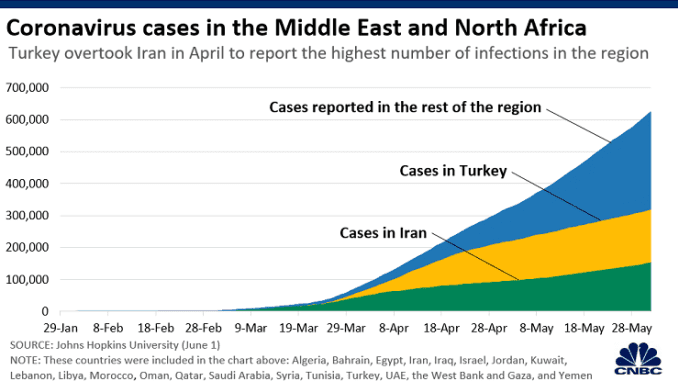
Turkey is currently home to the highest number of coronavirus cases in the Middle East region at nearly 150,000, having surpassed Iran in mid-April. But its economy was already under pressure before the coronavirus hit.

Now, after nearly two years of a weakening currency, high debt and fast-disappearing foreign reserves, the country is in a particularly bad place to weather a pandemic. Its unemployment rate was already nearly 14% in January, before the economy felt the impact of the coronavirus, and its massive tourism industry is on course to be decimated for the near future.


3/26/2018

Qatar’s farewell to the GCC?

https://www.alaraby.co.uk/english/indepth/2018/3/25/qatars-farewell-to-the-gcc

12/06/2012

Weapons Sent to Libyan Rebels With U.S. Approval Fell Into Islamist Hands

Libyans in Benghazi last year in front of a Libyan flag, right, and a Qatari flag painted on the wall.


Πηγή: New York Times
By JAMES RISEN, MARK MAZZETTI and MICHAEL S. SCHMIDT
Dec 5 2012

WASHINGTON — The Obama administration secretly gave its blessing to arms shipments to Libyan rebels from Qatar last year, but American officials later grew alarmed as evidence grew that Qatar was turning some of the weapons over to Islamic militants, according to United States officials and foreign diplomats.

No evidence has emerged linking the weapons provided by the Qataris during the uprising against Col. Muammar el-Qaddafi to the attack that killed four Americans at the United States diplomatic compound in Benghazi, Libya, in September.

But in the months before, the Obama administration clearly was worried about the consequences of its hidden hand in helping arm Libyan militants, concerns that have not previously been reported. The weapons and money from Qatar strengthened militant groups in Libya, allowing them to become a destabilizing force since the fall of the Qaddafi government.

The experience in Libya has taken on new urgency as the administration considers whether to play a direct role in arming rebels in Syria, where weapons are flowing in from other countries.

The Obama administration did not initially raise objections when Qatar began shipping arms to opposition groups in Syria, even if it did not offer encouragement, according to current and former administration officials. But they said the United States has growing concerns that, just as in Libya, the Qataris are equipping some of the wrong militants.

The United States, which had only small numbers of C.I.A. officers on the ground in Libya during the tumult of the rebellion, provided little oversight of the arms shipments. Within weeks of endorsing Qatar’s plan to send weapons there in spring 2011, the White House began receiving reports that they were going to Islamic militant groups. They were “more antidemocratic, more hard-line, closer to an extreme version of Islam” than the main rebel alliance in Libya, said a former Defense Department official.

The Qatari assistance to fighters viewed as hostile by the United States demonstrates the Obama administration’s continuing struggles in dealing with the Arab Spring uprisings, as it tries to support popular protest movements while avoiding American military entanglements. Relying on surrogates allows the United States to keep its fingerprints off operations, but also means they may play out in ways that conflict with American interests.

“To do this right, you have to have on-the-ground intelligence and you have to have experience,” said Vali Nasr, a former State Department adviser who is now dean of Paul H. Nitze School of Advanced International Studies, part of Johns Hopkins University. “If you rely on a country that doesn’t have those things, you are really flying blind. When you have an intermediary, you are going to lose control.”

He said that Qatar would not have gone through with the arms shipments if the United States had resisted them, but other current and former administration officials said Washington had little leverage at times over Qatari officials. “They march to their own drummer,” said a former senior State Department official. The White House and State Department declined to comment.

During the frantic early months of the Libyan rebellion, various players motivated by politics or profit — including an American arms dealer who proposed weapons transfers in an e-mail exchange with a United States emissary later killed in Benghazi — sought to aid those trying to oust Colonel Qaddafi.

But after the White House decided to encourage Qatar — and on a smaller scale, the United Arab Emirates — to ship arms to the Libyans, President Obama complained in April 2011 to the emir of Qatar that his country was not coordinating its actions in Libya with the United States, the American officials said. “The president made the point to the emir that we needed transparency about what Qatar was doing in Libya,” said a former senior administration official who had been briefed on the matter.

About that same time, Mahmoud Jibril, then the prime minister of the Libyan transitional government, expressed frustration to administration officials that the United States was allowing Qatar to arm extremist groups opposed to the new leadership, according to several American officials. They, like nearly a dozen current and former White House, diplomatic, intelligence, military and foreign officials, would speak only on the condition of anonymity for this article.

The administration has never determined where all of the weapons, paid for by Qatar and the United Arab Emirates, went inside Libya, officials said. Qatar is believed to have shipped by air and sea small arms, including machine guns, automatic rifles, and ammunition, for which it has demanded reimbursement from Libya’s new government. Some of the arms since have been moved from Libya to militants with ties to Al Qaeda in Mali, where radical jihadi factions have imposed Shariah law in the northern part of the country, the former Defense Department official said. Others have gone to Syria, according to several American and foreign officials and arms traders.

Although NATO provided air support that proved critical for the Libyan rebels, the Obama administration wanted to avoid getting immersed in a ground war, which officials feared could lead the United States into another quagmire in the Middle East.

As a result, the White House largely relied on Qatar and the United Arab Emirates, two small Persian Gulf states and frequent allies of the United States. Qatar, a tiny nation whose natural gas reserves have made it enormously wealthy, for years has tried to expand its influence in the Arab world. Since 2011, with dictatorships in the Middle East and North Africa coming under siege in the Arab Spring, Qatar has given arms and money to various opposition and militant groups, chiefly Sunni Islamists, in hopes of cementing alliances with the new governments. Officials from Qatar and the emirates would not comment.

After discussions among members of the National Security Council, the Obama administration backed the arms shipments from both countries, according to two former administration officials briefed on the talks.

American officials say that the United Arab Emirates first approached the Obama administration during the early months of the Libyan uprising, asking for permission to ship American-built weapons that the United States had supplied for the emirates’ use. The administration rejected that request, but instead urged the emirates to ship weapons to Libya that could not be traced to the United States.

“The U.A.E. was asking for clearance to send U.S. weapons,” said one former official. “We told them it’s O.K. to ship other weapons.”

For its part, Qatar supplied weapons made outside the United States, including French- and Russian-designed arms, according to people familiar with the shipments.

But the American support for the arms shipments from Qatar and the emirates could not be completely hidden. NATO air and sea forces around Libya had to be alerted not to interdict the cargo planes and freighters transporting the arms into Libya from Qatar and the emirates, American officials said.

Concerns in Washington soon rose about the groups Qatar was supporting, officials said. A debate over what to do about the weapons shipments dominated at least one meeting of the so-called Deputies Committee, the interagency panel consisting of the second-highest ranking officials in major agencies involved in national security. “There was a lot of concern that the Qatar weapons were going to Islamist groups,” one official recalled.

The Qataris provided weapons, money and training to various rebel groups in Libya. One militia that received aid was controlled by Adel Hakim Belhaj, then leader of the Libyan Islamic Fighting Group, who was held by the C.I.A. in 2004 and is now considered a moderate politician in Libya. It is unclear which other militants received the aid.

“Nobody knew exactly who they were,” said the former defense official. The Qataris, the official added, are “supposedly good allies, but the Islamists they support are not in our interest.”

No evidence has surfaced that any weapons went to Ansar al-Shariah, an extremist group blamed for the Benghazi attack whose members have ties to an offshoot of Al Qaeda. That episode has set off a furor on Capitol Hill, where Republicans accuse the federal government of having failed to provide adequate security to the diplomats and of trying to play down any terrorist links.

The case of Marc Turi, the American arms merchant who had sought to provide weapons to Libya, demonstrates other challenges the United States faced in dealing with Libya. A dealer who lives in both Arizona and Abu Dhabi in the United Arab Emirates, Mr. Turi sells small arms to buyers in the Middle East and Africa, relying primarily on suppliers of Russian-designed weapons in Eastern Europe.

In March 2011, just as the Libyan civil war was intensifying, Mr. Turi realized that Libya could be a lucrative new market, and applied to the State Department for a license to provide weapons to the rebels there, according to e-mails and other documents he has provided. (American citizens are required to obtain United States approval for any international arms sales.)

He also e-mailed with J. Christopher Stevens, then the special representative to the Libyan rebel alliance. The diplomat said he would “share” Mr. Turi’s proposal with colleagues in Washington, according to e-mails provided by Mr. Turi. Mr. Stevens, who became the United States ambassador to Libya, was one of the four Americans killed in the Benghazi attack on Sept. 11.

Mr. Turi’s application for a license was rejected in late March 2011. Undeterred, he applied again, this time stating only that he planned to ship arms worth more than $200 million to Qatar. In May 2011, his application was approved. Mr. Turi, in an interview, said that his intent was to get weapons to Qatar and that what “the U.S. government and Qatar allowed from there was between them. “

Two months later, though, his home near Phoenix was raided by agents from the Department of Homeland Security. Administration officials say he remains under investigation in connection with his arms dealings. The Justice Department would not comment.

Mr. Turi said he believed that United States officials had shut down his proposed arms pipeline because he was getting in the way of the Obama administration’s dealings with Qatar. The Qataris, he complained, imposed no controls on who got the weapons. “They just handed them out like candy,” he said.


8/06/2012

Qatar, Saudi Arabia giving arms to Syria rebels: SNC

Syrian rebels prepare to advance into the Salaheddin district in the northern city of Aleppo to fight against forces loyal to the government on August 4, 2012. Syrian regime warplanes pounded rebel positions in second city Aleppo ahead of a threatened ground assault by more than 20,000 troops assembled around the commercial capital.

Πηγή: The Daily Star
August 6 2012

PARIS: Qatar and Saudi Arabia are giving light arms to Syria's rebels but the fighters do not have the advanced weapons needed to confront Bashar al-Assad's regime, a spokeswoman for the opposition SNC said Monday.

"Rebels on the ground are searching desperately for arms wherever they can find them," a spokeswoman for the Syrian National Council, Bassma Kodmani, told France's Europe 1 radio.

"There are certain countries that are providing light and conventional weapons," she said.

Asked which countries, Kodmani said: "It is Qatar, Saudi Arabia, it is maybe a little bit Libya with what it has left over from its own battle."

She said some countries were also providing money to the rebels so they could buy weapons on the black market.

But Kodmani said the rebels were still massively outgunned by pro-regime forces and were lacking "more advanced types of weapons that could be used to confront aviation".

"This is a political decision that the major countries must take, it has not been taken," she said.

Warning of "carnage" in Syria's commercial capital Aleppo, Kodmani condemned the political and diplomatic failure to find a solution to the conflict.

"Waiting for a military solution is catastrophic," she said.

Fighting continued to rage in Syria on Monday, with a bomb blast rocking state television headquarters in the heart of Damascus and the army bombarding a string of rebel neighbourhoods in Aleppo.


7/27/2012

Kurdish worries drag Turkey deeper into Syria war


Πηγή: Reuters
By Henry Meyer and Anatoly Temkin
July 27 2012

Turkey may be some way from acting on Prime Minister Tayyip Erdogan's threat to strike Kurdish separatists in Syria, but week by week it finds itself sucked ever further into its neighbor's worsening war.

The shooting down of a Turkish reconnaissance jet last month was seen by many as a turning point, prompting Ankara to join Saudi Arabia at Qatar in semi-covert support for the Free Syrian Army fighting against President Bashar al-Assad.

On Friday, Reuters revealed the existence of a secret Turkish operations centre where it worked with the two Gulf states to provide aid and weaponry to the rebels.

For most foreign powers, events in Syria's Kurdish provinces are largely seen a sideshow compared Assad's battle to survive. But Erdogan's comments on Thursday made it clear that Turkey is alarmed by worries over Kurdish PKK rebels taking advantage of the chaos.

The Turkish leader - once a friend to his Syrian counterpart who helped to rehabilitate Assad on the international stage, but now apparently an increasingly implacable foe - accused Damascus of allocating five provinces to the PKK.

Both Ankara and most Western powers view the Kurdistan Workers Party (PKK) as a terrorist group, blaming it for a long-running conflict that has killed some 40,000 people since it took up arms in 1984. Turkey regularly strikes PKK bases in Iraq's northern self-ruled Kurdish enclave, and Erdogan made it clear the same option was being discussed for Syria.

"We will not allow a terrorist group to establish camps in northern Syria and Turkey," he told a news conference before travelling to London for the opening of the Olympics. "If there is a step which needs to be taken against the terrorist group, we will definitely take this step."

Rising numbers of refugees crossing the border could put further pressure on Turkey. If, as many expect, Assad's forces target the partially rebel-held city of Aleppo in the coming days, numbers could soar. Turkey has already closed its borders to commercial traffic but says it will allow fleeing civilians through.

Whatever might happen on the Kurdish front, a senior Turkish official speaking on condition of anonymity said support for the rebels was set to continue - although clear caution remains.

"Naturally we are watching developments in the Kurdish region, but Ankara will not give up on its support for the whole revolution because something has happened in the Kurdish region," he said.

"We have been saying from the start, we do not think it is right to impose a regime from outside... The Syrian people must decide its own future."

The official declined to comment on what Turkey might do if the PKK established itself in the region.

CROSSING RED LINES

What Turkey is desperate to avoid is a scenario in which Kurdish parts of Syria quietly break away from the rest as the government, rooted in Assad's Alawite minority sect, slugs it out with the predominantly Sunni Muslim opposition.

"Any area which serves as a potential haven for the PKK or its affiliated groups poses a direct threat to Turkish security and Ankara's jingoistic rhetoric should be judged in this context," says Anthony Skinner, head of the Middle East practice at UK-based security consultancy Maplecroft.

"Any government which allows the PKK to set up training camps represents a red line for Ankara.... Ankara is again warning Damascus not to cross Turkey."

But if it is to take military action, Turkey's options are somewhat limited. Turkey might have the largest military in the region, but a large-scale ground incursion is seen as unlikely for now.

An airstrike on a known PKK facility - or perhaps a Syrian government post believed supporting them - seems a much more probable approach. But while air defenses over Kurdish areas are seen as a much less sophisticated than those along the coast, the loss of one Turkish jet already points to the dangers of entering Syrian airspace.

"If Turkey could prove that there was an attack coming out of Syria against Turkey, then it could launch an air strike, if it could identify a specific PKK camp in Syria," said Istanbul-based security expert Gareth Jenkins. "The problem is there would inevitably be civilian casualties because these camps would be put near civilians."

Then, there is the risk of severe retaliation. Earlier this week, Syria's government said that while it would not use chemical weapons against its own people, it might against any foreign intervention.

"Unlike with Iraq, attacks in Syria can very likely draw Turkey into a prolonged military confrontation with the Assad regime, which has a formidable military and the political will to respond," says Hayat Alvi, lecturer in Middle Eastern politics at the US Naval War College. "Syria and Turkey are both heightening the rhetoric, but it would be a huge gamble for both sides to engage in military confrontation."

Turkish leaders have long regretted the way in which northern Iraqi Kurdistan effectively seceded after the 1991 Gulf War. At worst, Turkey now fears Iraqi and Syrian Kurdish areas might try to come together to form a larger Kurdistan - an entity that might yearn for swathes of Turkish territory.

SIMPLY SABRE RATTLING?

Already, commentators in Turkish newspapers express growing concern that that is exactly what is happening. What the PKK may end up running in parts of Syria, they say, may not just be assorted training camps but a de facto Kurdish state.

The image of PKK members directing traffic and performing other civic duties, some Turks worry, could help swell its support both amongst Kurds and more broadly. At the very least, the PKK would probably have access to both new recruits and some of the weaponry made available by Syria's wider and fast-growing conflict.

"The recent developments could provide the PKK with significant military opportunities. If the government doesn't take any precautions and wastes this most precious time, Turkey will face serious security problems," Nihat Ali Ozcan, a security analyst at the Ankara-based think tank TEPAV, wrote in Hurriyet Daily News.

"The PKK wants to harvest the political opportunities these military advantages would provide, will rise up and be more aggressive about reaching its aims."

Exactly how much support Syria might be giving Kurdish separatists is far from clear, although some Syrian opposition figures accused the PKK's local partners, the PYD, of acting as enforcers for Assad.

Under both Assad and his father, Hafez, Turkish accusations of Syrian backing for the PKK were points of contention and occasionally led to threats of outright conflict.

In 1998, Turkey moved tanks to the border and explicitly threatened to send them into Syria if Damascus did not expel PKK leader Abdullah Ocalan, at the time sheltering in Syria. Hafez al-Assad took the threat seriously enough to evict Ocalan - who was shortly afterwards captured in Kenya by Turkish forces and probable US support.

Some kind of at least tacit agreement from Washington might still be needed for the Turks to be willing to take action.

"The Turks have been going for a gold medal when it comes to sabre rattling," says David Lea, regional analyst for Control Risks, a consultancy firm.

"But someone - most likely the Americans - has been sitting on their tail. I don't think the Turks would do anything unless they knew the Americans were with them. They want to act, but they don't have any good options. It's a microcosm of the whole Syria situation."


2/12/2012

Iran discovers large oilfield


Πηγή: Payvant Iran News
By Tehran Times
Feb 12 2012

Mahmoud Mohaddes made the announcement without giving further details on specifications of the oilfield, Fars news agency reported.

An official with the National Iranian Oil Company has said that the country's oil output would rise by one million barrels per day by 2015.

Mehr news agency quoted Mohammad-Ali Emadi as saying that Iran's crude oil reserves will end by the next 50 years, adding that the oil deposits are recoverable by 29 percent on the average.

Oil minister Rostam Qasemi has announced the country's recoverable oil reserves stands at 154.8 billion barrels.

Qasemi said in August 2011 that the Iranian government should consider plans for the development of joint oilfields. The government should increase the budgets for the development of joint oilfields, he added.

"The oil industry's infrastructure needs more than 500 trillion rials (about $41 billion) of investment to achieve objectives of the country's 20-Year Economic Outlook Plan," Qasemi was quoted as saying.

Officials have put Iran's current output at between 3.6 million and 4 million barrels per day, with the latest estimate, given by Hormoz Qalavand, head of the National Iranian Southern Oil Company, of 3.92 million bpd.

Iran sits on the world's second largest natural gas reserves after Russia and is trying to grow its gas production by increasing foreign and domestic investments, especially in its South Pars gas field.

The South Pars gas field is shared by Iran and Qatar. The Iranian share, which is divided into 29 phases, has about 14 trillion cubic meters of gas, or about eight percent of the total world reserves, and more than 18 billion barrels of liquefied natural gas resources.


1/29/2012

Taliban in 'trust-building' process with US in Qatar


Πηγή: Nation
By AFP
Jan 29 2012

KABUL // Taliban negotiators have begun holding preliminary talks with US officials in Qatar on plans for peace negotiations aimed at ending the decade-long war in Afghanistan, a former Taliban official said yesterday.

"The actual peace talks have not yet begun - they are in the process of trust-building and obviously this will take some time," Mawlavi Qalamuddin said.

Mr Qalamuddin, who once led the Taliban's religious police when they were in power, is now a member of the High Peace Council appointed by the government of President Hamid Karzai. The Taliban, ousted from power by a US-led invasion after the September 11 attacks, announced earlier this month that they planned to set up a political office in Qatar ahead of talks with Washington.

Mr Qalamuddin said the delegation already in the Gulf state included Mohammad Tayeb Agha, a close ally and secretary of the Taliban leader, Mullah Omar, and Shahabuddin Delawar, the Taliban's former ambassador to Riyadh.

With them were Sher Mohammad Abaas Stanikzai, the former deputy foreign minister in the Taliban government, and Aziz-Ul Rahman, a former Taliban diplomat in Dubai, said Mr Qalamuddin.

"At the moment, the delegation is holding preliminary talks. It's in its very early phases. You need to build some trust before starting talks."

One of the trust-building measures demanded by the Taliban is the release of five of its members from Guantanamo Bay in Cuba, while Washington wants the insurgents to renounce violence.

Mr Qalamuddin said the Taliban delegation "obviously" went to Qatar from Pakistan, indicating that Afghanistan's southern neighbour - accused by Kabul of blocking past attempts at peace talks - could be getting on board.

Another sign of a thaw between the two countries came with the announcement yesterday that the Pakistani Foreign minister, Hina Rabbani Khar, will visit Kabul on Wednesday.

The Afghan foreign ministry spokesman, Janan Mosazai, said the visit would mark a "new phase" in cooperation between the two countries, adding that Mr Khar would hold talks with the Afghan foreign minister, Zulmai Rasoul, and President Hamid Karzai.

Mr Khar's visit comes after Pakistan made overtures to Afghanistan to resume talks over the Taliban which broke down following the assassination of Kabul's chief peace envoy, Burhanuddin Rabbani, in September, officials said.

Mr Karzai accused Pakistan of responsibility for the murder and last month said Islamabad was sabotaging all attempts at negotiations with the Taliban.

The president was initially wary of being sidelined in the Qatar talks, and Washington dispatched its special envoy, Marc Grossman, to Kabul last week to assure him of a central role for his government in any major negotiations.


1/15/2012

Qatar Favors Military Intervention in Syria


Πηγή: israelnationalnews
By Elad Benari
Jan 15 2012

Qatar favors sending Arab forces into Syria to stop the deadly crackdown on anti-regime protests, AFP reported on Saturday.

According to the report, the emir of Qatar, Sheikh Hamad bin Khalifa al-Thani, said in an interview with CBS to air Sunday that he favors dispatching Arab troops to Syria to “stop the killing” that the United Nations says has claimed more than 5,000 lives since March.

The interview, which will air on the 60 Minutes program, is the first public call by an Arab leader for an Arab military presence in Syria.

“For such a situation to stop the killing ... some troops should go to stop the killing,” Sheikh Hamad was quoted as having replied when asked whether he supports Arab intervention.

The interview with Sheikh Hamad, excerpts of which were sent to AFP by CBS, comes amid increasing concern that the Arab League’s mission to monitor conditions on the ground in Syria was failing.

On Thursday it was reported that the League is rethinking its observer mission and may decide to pull its monitors from the country altogether.

An attack on observers Monday in the city of Latakiya made it increasingly unlikely the League would send any more monitors to the country, sources said, "until the situation is suitable" for them to return.

Meanwhile, the League is set to review the work of its Syria monitoring mission later this month.

“There is an overall reassessment of the work of the observer mission which we will discuss at the next ministerial meeting to be held in Cairo on Saturday, January 21,” League chief Nabil Elaraby told AFP on Saturday. “There has been partial progress until now but there is daily bloodshed in Syria that the League aims to end.”

On Friday, Elaraby warned that Syria may be sliding toward civil war, as President Bashar Assad’s regime was either not complying or only partially complying with an Arab League plan that Syria signed last month to end its crackdown on anti-regime protesters.

Egypt’s official MENA news agency quoted Elaraby as having said on Saturday, “The Arab League general secretariat is now examining whether it would be beneficial for the mission to pursue its work in light of the continuing violence.”


12/26/2011

Exclusive: Afghanistan sets ground rules for Taliban talks

An Afghan policeman keeps watch near the house of the head of Afghanistan's High Peace Council Burhanuddin Rabbani, after a blast in Kabul September 20, 2011.

Πηγή: Reuters
By Sanjeev Miglani and Hamid Shalizi
Dec 26 2011

Afghanistan will accept a Taliban office in Qatar to help peace talks but no foreign power can get involved in the process without its consent, the government's peace council said, as efforts gather pace to find a solution to the 10-year war.

Afghanistan's High Peace Council, in a note to foreign missions, has set out ground rules for engaging the Taliban after Kabul grew concerned that the United States and Qatar, helped by Germany, had secretly agreed with the Taliban to open an office in the Qatari capital, Doha.

It said that negotiations with the Taliban could only begin after they stopped violence against civilians, cut ties to al Qaeda, and accepted the Afghan constitution which guarantees civil rights and liberties, including rights for women.

The council, according to a copy of the 11-point note made available to Reuters, also said any peace process with the Taliban would have to have the support of Pakistan since members of the insurgent group were based there.

"The Islamic Republic of Afghanistan is in agreement regarding the opening of an office for the armed opposition, but only to move forward the peace process and conduct negotiations," the council said.

The government would prefer such an office in either Saudi Arabia or Turkey, both of which it is close to, but was not averse to Doha as long as the authority of the Afghan state was not eroded and the office was only established for talks, officials said.

"We are saying Saudi or Turkey are preferable, we are not saying it has to be there only. The only condition is it should be in an Islamic country," said a government official.

President Hamid Karzai's administration recalled its ambassador from Doha last week, apparently angry that it had been kept in the dark about the latest round of negotiations with the insurgent group.

Officials said Kabul was also deeply concerned about reports that the United States was considering the transfer of a small number of Afghan prisoners from Guantanamo Bay military prison to Doha as a prelude to the talks.

"We are a sovereign country, we have laws. How can you transfer our prisoners from one country to another. Already it's a violation to have them in Guantanamo Bay," the official said.

The Afghan government wanted the prisoners to be returned to its custody, the official said.

Reuters reported this month that the United States was considering the transfer of an unspecified number of Taliban prisoners from Guantanamo Bay into Afghan government custody as part of accelerating, high-stakes diplomacy.

"We have no problem with this. In fact we have been demanding this for a while. These are Afghan prisoners," said the official, who declined to be identified.

The tension between the Karzai administration and the United States over engaging the Taliban underscores the challenges of seeking a political settlement as the West prepares to withdraw most combat troops from the country by 2014.

Efforts to engage the insurgent group have faced a string of setbacks, the most recent being the assassination of the head of the peace council and former president, Burhanuddin Rabbani, in September at the hands of a suicide bomber who pretended to be a Taliban emissary.

HARDENING OF POSITIONS

It led to a hardening of positions with Karzai saying the government could not talk to suicide bombers and that there should be an address for the Taliban so that negotiators know they are talking to the right representatives.

"We are committed to the reconciliation process, the experience of the last 10 years shows no military solution is possible. Talking to the armed opposition is the key in this regard," said presidential spokesman Aimal Faizi.

The peace council, laying down the markers for engagement with the Taliban, said well known figures from both the Taliban and the government had to be involved in talks.

It said that "before any negotiations can take place, violence against Afghan people must stop and that the armed opposition must cut ties to al Qaeda and other terrorist groups."

It also said that the Taliban must accept the constitution and honor the gains made in the last 10 years since they were ousted from power, conditions that the Taliban have shown no sign of accepting.

The Taliban do not accept the constitution and have vowed to carry on fighting until all foreign troops have left the country.

The peace council said Pakistani support was necessary for talks to take place, another condition that makes the task harder because of fraught ties between the United States and Pakistan which fears it is being shut out of the process.

Opening a Taliban office in a third country itself is seen as a way to create distance from Pakistan which has longstanding ties to the insurgent group.

But the government official said he did not think the peace council had laid down such tough conditions that the talks would fail even before they started.

"We don't think it's a deal breaker. We are quite optimistic," he said.


11/16/2011

Libya: Celebrating Peace and Unity in Libya, but Feeling Tension Beneath the Surface


Πηγή: feb17
By Clifford Krauss (NYT)
Nov 16 2011

Few towns sacrificed or contributed as much to the Libyan insurrection as this dusty mountain town southwest of Tripoli. On Tuesday there was joy, poetry, exhibitions of masterful horsemanship, parachute jumps, speeches and symbols of national unity. Dozens of war prisoners were even quietly freed.

But between the lines in many of the speeches by political leaders from around the country, there were warnings, threats and subtle jabs that suggest the revolution has many challenges ahead.

A leader from Misurata, another rebel stronghold, warned the interim government not to include anyone aligned with the regime of Col. Muammar el-Qaddafi in the new administration. A national leader made several veiled warnings about the growing influence of the Persian Gulf state of Qatar. And there was no sign that any rebel militias would give up their arms soon.

“Libya should have no differences between north and south nor between tribes,” said Mahmoud Jibril, who led the rebels’ Transitional National Council through the revolt and served as interim prime minister before stepping down two weeks ago. “We should be united so we can prove to the world that the last 42 years were an exception to Libyan history.”

There were many pitch-perfect calls for competing militias, towns and tribes to meld together as one nation, as were the cheers and responses of “God is great” from a crowd of 5,000 gathered on the hilltops above an equestrian field used for Zintan festivals. The city has a population of only 50,000, but its support is critical for the new government, because so many people here have weapons at a time when sporadic confrontations continue between militias around the country.

While government officials are negotiating in Tripoli and Benghazi over who will get which posts in a new cabinet, militia leaders in Zintan and Misurata are jockeying over who will command a new national army, which is scheduled to be formed over the next month. Zintan fighters were ordered by the interim government to leave Tripoli four days ago, but they still have not departed from their checkpoints around the capital.

So it was not insignificant that Abdulrahman Souweli, a senior Misurata militia leader, told the crowd: “The people of Misurata and Zintan were together in victory. We have to remain united.” But, Mr. Souweli added, “there’s no place for those who worked with Qaddafi in the new government. We won’t allow that.”

Sitting behind him under a canopy with national leaders and foreign ambassadors was Muktar al-Akhdar, a former Qaddafi army colonel who played a critical role in leading the Zintan forces to take control of Tripoli’s airport at the end of the war.

Still a militia leader, Mr. Al-Akhdar did not address the crowd. But in an interview after the speeches, he made it clear that he intended to pursue a significant national role. He said his forces did not plan to surrender their weapons until they were satisfied that a good national army and police force had been formed to protect the country.

“The people of Zintan will safeguard Libya’s well-being and stability,” he said, adding that even if his forces disarmed, “we know how to get weapons if anything happens to Libya.”

The central message of the day was the one that officials in the interim government have been trying to project every day for weeks: One battle is over, but another is beginning — to rehabilitate the wounded, rebuild destroyed cities and get the country moving again. Unity is paramount, government officials and even militia leaders say.

The day’s festival was called in the name of freedom, which Zintan fighters said was their banner throughout the war as they created a vital southern front against the forces loyal to Colonel Qaddafi.

Zintan is a poor town, but one that celebrates horsemanship and poetry, and there was plenty of both on a sunny day. A young boy wearing a flowing white traditional robe recited a poem to the crowd, declaring, “Freedom is like a flower, like a bird flying over the sky.”

During the festivities, according to Zintan security guards, as many as 80 people taken prisoner during the war — mostly those suspected of supporting the Qaddafi government — were released. It was done without being announced, so as not to anger the people celebrating their recent victory, the guards said.

But Mr. Jibril warned that there were threats to the nation’s freedom, both internal and external. He did not mention a country by name, but it was clear he was making one more in a series of warnings about Qatar, which had offered crucial military, financial and political support to the rebels.

“If we don’t stay together I’m afraid another power will have an impact in Libya,” he said during his speech. At another point, he said, “If we don’t unite, that could lead to foreign intervention in Libya.”

Mr. Jibril is not the only leader who has warned that Qatar has gone around the rebel authorities to arm militias on their own to increase its influence and possibly to promote an Islamist agenda.

His remarks came a day after the vice chairman of the Transitional National Council, Abdel-Hafidh Ghoga, criticized other leaders for distancing themselves from Qatar.

“These statements are personal statements and do not represent the ideas of the Transitional National Council,” he said. “The Transitional National Council appreciates the role of Qatar in supporting Libya.”


10/17/2011

Arab League stops short of suspending Syria

Syrians shout slogans against President Bashar al-Assad during a protest outside the Arab League headquarters in Cairo.

Πηγή: usatoday
Oct 17 2011

CAIRO (AP) – Gulf countries seeking to suspend Syria's membership to the Arab Leagueover its bloody crackdown on protesters failed to gain enough support Sunday to push the measure through, reflecting deep divisions among the body's 22 nations.

Arab foreign ministers met at the group's Cairo headquarters behind closed doors for an initial 3-hour session without Syria's representative, then took a break and reconvened for talks with Syrian diplomats that lasted late into the night.

Just after the meeting with Syrian diplomats, Qatar Foreign Minister Hamad bin Jassim made no mention of a possible suspension and instead gave Syria a 15-day deadline to enact a cease-fire.

The Arab League also agreed to create a committee led by Qatar to oversee the situation in Syria and said a national dialogue between Syrian officials and the opposition would take place at the League's headquarters in Cairo.

"A national dialogue in 15 days is one of the most important decisions of the day," bin Jassim said.

The national dialogue is to include members of the opposition from outside Syria as well as inside. If the meeting and a cease-fire do not take place within the allotted time frame, the Arab League will meet again in an emergency session, participants said.

Syrian state TV reported that Damascus was not eager to hold the dialogue in Cairo, suggesting it should be held in Syria instead.

The newly formed Syrian National Council, a broad based opposition umbrella group, was also seen unlikely to accept the call for dialogue, though some factions within the fragmented opposition who might be willing to hold talks.

Some activists rejected the idea of talks with the Assad regime.

"We said it from the day the first martyr fell: No dialogue with the killers. The killers will be put on trial by the free Syrian people," wrote prominent Syrian opposition figure Suhair Atassi on her Twitter feed. She is in hiding.

To suspend Syria's membership, at least two-thirds of the members would have had to support the measure. A bloc of six Gulf nations, including Saudi Arabia, was leading the push for the measure along with recognition of the opposition leadership, the Syrian National Council, said an Arab diplomat who spoke on condition of anonymity because he was not authorized to brief the media.

Many Gulf states, including Saudi Arabia, already have withdrawn their ambassadors from Syria to protest the regime's bloody response to the protests.

However, the diplomat said a significant bloc of countries was opposed, including Sudan, Algeria, Lebanon and Yemen, whose leader is also facing a serious uprising. According to Arab League diplomats, Mideast heavyweight Egypt did not indicate yet which side it is on.

Suspension of an Arab League member is rare. Although the move would not likely have a direct, tangible impact on Syria, it would constitute a major blow to President Bashar Assad's embattled regime by stripping Damascus of its Arab support and further deepening its isolation.

The group suspended Libya's membership earlier this year after Moammar Gadhafi's violent crackdown on protesters there, but has since reinstated Libya under the country's new leadership.

Syria's ambassador to the Arab League, Youssef Ahmad, held up a document he said was shared with the Arab foreign ministers. In it, he alleged, was proof that weapons from Israel had been found in Syria among the protesters.

"The Syrian opposition is also getting logistical support from Arab countries," he said in his public remarks to the body. The Syrian regime frequently claims outside forces are fomenting the violence. The opposition denies that, opposing foreign intervention.

The U.N. says more than 3,000 people have been killed since the uprising began in mid-March.

"Unfortunately the situation remains dangerous," Arab League Secretary-General Nabil Elaraby said.

During the meetings, about 2,000 anti-Assad protesters rallied outside the Arab League building on the edge of Cairo's Tahrir Square, the center of Egypt's uprising.

Despite the growing chorus for an end to the crisis, Assad has shown no sign of easing his campaign to crush the 7-month-old uprising. On Sunday, security forces opened fire on a funeral for a slain activist in the east. Forces elsewhere arrested at least 44 people in the capital's suburbs in house-to-house raids and activists said more than 900 people in the central city of Homs had been detained over the past week.


Tiny Kingdom's Huge Role in Libya Draws Concern

Πηγή: WSJ
By SAM DAGHER, CHARLES LEVINSON and MARGARET COKER
Oct 17 2011

Three weeks after rebel fighters drove Libyan strongman Col. Moammar Gadhafi from power in Tripoli, military leaders gathered on the leafy grounds of an Islamic institute to hash out a way to unite the capital's disparate fighting groups. The Tripoli chiefs were nearing a deal on a unified command when two visitors stepped in.


NTC Prime Minister Mahmoud Jibril, in blue tie, in Doha in August. He has sought to have supplies from Qatar sent through NTC-approved channels.

One was Abdel Hakim Belhaj—a former Islamic fighter briefly held in 2004 by the Central Intelligence Agency, who had led one of the militias that marched triumphantly into Tripoli. Now the city's most visible military commander, he accused the local militia leaders of sidelining him, say people briefed on the Sept. 11 meeting.

"You will never do this without me," he said.

Standing wordlessly behind him, these people say, was Maj. Gen. Hamad Ben Ali al-Attiyah—the chief of staff of the tiny Arab Gulf nation of Qatar. Mr. Belhaj won a tactical victory: The meeting broke up without a deal, and efforts to unite disparate Tripoli militias, including Belhaj's Tripoli Military Council, remain stalled to this day.

The foreign military commander's appearance in Tripoli, which one person familiar with the visit said caught Libya's interim leaders by surprise, is testament to Qatar's key role in helping to bring down Libya's strongman. Qatar provided anti-Gadhafi rebels with what Libyan officials now estimate are tens of millions of dollars in aid, military training and more than 20,000 tons of weapons. Qatar's involvement in the battle to oust Col. Gadhafi was supported by U.S. and Western allies, as well as many Libyans themselves.


Qatar flew at least 18 weapons shipments to anti-Gadhafi rebel forces this spring and summer.

But now, as this North African nation attempts to build a new government from scratch, some of these same figures worry that Qatar's new influence is putting stability in peril.

At issue, say Libyan officials and Western observers, are Qatar's deep ties to a clique of Libyan Islamists, whose backgrounds variously include fighting in Afghanistan in the 1980s and spending years in jail under Col. Gadhafi. They later published a theological treatise condemning violent jihad. With Qatar's support, they have become central players in Libyan politics. As they face off with a transitional authority largely led by secular former regime officials and expatriate technocrats, their political rivals accuse Qatar of stacking the deck in the Islamists' favor.

With the blessing of Western intelligence agencies, Qatar flew at least 18 weapons shipments in all to anti-Gadhafi rebel forces this spring and summer, according to people familiar with the shipments. The majority of these National Transition shipments went not through the rebels' governing body, the National Transitional Council, but directly to militias run by Islamist leaders including Mr. Belhaj, say Libyan officials.

Separately, approximately a dozen other Qatari-funded shipments, mostly containing ammunition, came to Libyan rebels via Sudan, according to previously undisclosed Libyan intelligence documents reviewed by The Wall Street Journal as well as officials.

Qatar Connection


Abdel Hakim Belhaj

Leader of Tripoli Military Council

After fighting the Soviets in Afghanistan, he from 1995 led the Libyan Islamic Fighting Group, whose members say it is disbanded but remains on U.S. list of terrorist organizations. Captured in a CIA operation in Malaysia in 2004 and eventually handed over to Col. Gadhafi's regime after being interrogated in Thailand and Hong Kong.


Role in Uprising:His troops, trained by Qatari special forces in Libya's Western Mountains, marched on Tripoli.


Ali al-Sallabi

Cleric

Born in 1963 in Benghazi to a family with Islamist ties, he was jailed in Tripoli's Abu Salim prison among other Islamists for most of the 1980s. After studying theology in Saudi Arabia and Sudan, he joined fellow clerics hosted by Qatar.

Role in Uprising:Key conduit for Qatari humanitarian aid, money and arms.


Ismail al-Sallabi

Deputy commander, Tajamuu Saraya al-Thuwar

Born in 1976, he was accused in 1997 of working with Islamists to topple Col. Gadhafi's regime. Not religious at the time, he said he began memorizing the Koran in prison. Released in 2004 as part of his brother's Qatari-encouraged détente with regime.

Role in Uprising:Deputy commander of an umbrella group of militias in eastern Libya; received Qatari aid and arms.


Jalal al-Dugheily

NTC Defense Minister

A Libyan army veteran, he grew up in the same Benghazi neighborhood as the Sallabis. Became rebel defense minister in May with backing from the Sallabis, says a militia leader.

Role in Uprising:His support among former army officers in the rebel ranks decreased because they felt he favored Islamist militia leaders.


Some Tripoli officials allege Qatari arms have continued to flow straight to these Islamist groups in September, after Tripoli's fall, to the open frustration of interim leaders.

"To any country, I repeat, please do not give any funds or weapons to any Libyan faction without the approval of the NTC," said Libyan Oil and Finance Minister Ali al-Tarhouni, when asked last week about reports that Qatar had sent weapons directly to Tripoli-based militias.

Qatari military and diplomatic officials deny they have played favorites or armed any rebel faction at the expense of any other. They declined to address whether they had made weapons shipments to the rebels. They say they support a democratic Libya in which all factions are represented.

Islamist leader Mr. Belhaj, in an interview, disputed the account of the Sept. 11 meeting. He said he had merely escorted Mr. Attiyah to provide security and wasn't present during the closed-door discussions. He and other Islamist leaders say they seek only their fair share of power and support a broad-based government.

Qatar's defense ministry didn't return calls seeking comment. Mr. Attiyah couldn't be reached.

Qatar's role in the Libyan uprising has been a heady diplomatic coming-out party for the emirate, located on a tiny thumb of land jutting off the Arabian Peninsula into the Persian Gulf. Fewer than 300,000 native Qataris control some of the world's largest natural-gas reserves. The country is the world's richest, per capita.

Qatar's ruler, Sheik Hamad Bin Khalifa al-Thani, has dismissed some Libyans' fears that Qatar is angling for influence over Libya's gas reserves, Africa's fourth-largest.

Instead, one of Qatar's main goals in supporting popular uprisings in the region, say people familiar with its leaders' thinking, is to promote its political vision—that in a Muslim-majority region, Islamic political figures can help build modern, vibrant Arab nations by being included in new democracies.

Qatar sees itself as a showcase for marrying Islamic ideals with modernity—a counterpoint to the more unyielding doctrine of neighboring Saudi Arabia.

Qatar, though an absolute monarchy, has helped promote a freer media in the region through the al-Jazeera satellite network, which the ruling family funded and founded in 1996 in the capital, Doha. The al-Thanis have opened branches of U.S. political think tanks, liberal-arts universities and biotech research foundations.

Politically, Qatar maintains a seemingly contradictory set of alliances. U.S. officials consider Doha a close ally. Qatar hosts U.S. Central Command and has the Gulf's only Israeli Interests Section.

But for years, Doha has also openly fostered ties with some of the region's most controversial Islamic militant groups, such as Hamas and Hezbollah.

Sheikh Hamad, in a Sept. 7 interview with al-Jazeera, said he believed radical Islamists whose views were forged under tyrannical governments could embrace participatory politics if the promise of real democracy and justice of this year's Arab revolts is fulfilled.

If so, the Qatari ruler said, "I believe you will see this extremism transform into civilian life and civil society."

Libya presents the biggest test for the Qatar model. Whether Islamist political groups can be the guarantors of democracy in the Muslim world—and whether Qatar has hitched its fortunes to individuals who will make that happen—is being closely watched in Libya and beyond.

Qatar has played "a very influential role in helping this [Libyan] rebellion succeed," U.S. Ambassador to Libya Gene A. Cretz said in an interview. Asked later about the Islamists Qatar has endorsed, he was more cautious: "We are going to have to take it step by step."

Much of Qatar's aid to the Libyan revolt has been guided by an influential Libyan cleric named Ali al-Sallabi.

Mr. al-Sallabi, the son of an eastern Libyan banker with ties to the Muslim Brotherhood, was jailed at the age of 18 for nearly eight years on charges of knowing about an alleged plot to assassinate Col. Gadhafi. He left Libya in 1988 to study in Saudi Arabia and Sudan. His younger brother Ismail, who now commands a division of rebel fighters, was also arrested and imprisoned by the Gadhafi regime.

In 1999, already something of a spiritual leader for a segment of Libyans, Mr. al-Sallabi moved to Doha to join the roster of politically active Islamic theologians hosted by Qataris.

When international sanctions were lifted on Col. Gadhafi's regime in 2003, Qatar encouraged Ali al-Sallabi to accept a reconciliation offer guaranteed by the Gadhafi regime, Ismail al-Sallabi said in an interview.

Ali al-Sallabi returned to Libya and spearheaded a "de-radicalization program" for imprisoned Libyan militants and those on the run abroad. The effort, which used theological arguments to attempt to delegitimize armed opposition to the regime, culminated in a book co-authored by Mr. Sallabi, "Corrective Studies in Understanding Jihad, Enforcement of Morality and Judgment of People," which was published with Qatari funding and promoted on al-Jazeera.

Another author was Mr. Belhaj, who had fought the Soviets in Afghanistan alongside Osama bin Laden and Ayman al-Zawahiri. From 1995, Mr. Belhaj became the emir of the Libyan Islamic Fighting Group, which waged a bloody insurgency against Col. Gadhafi until it was defeated by the regime in 1998.

This spring, the Sallabis were among the first to take up the fight against Col. Gadhafi's regime, followed by Mr. Belhaj.

Qatar was the first Arab country to recognize the National Transitional Council. It backed a United Nations resolution imposing a no-fly zone to protect Libyan civilians and, later, North Atlantic Treaty Organization air strikes on Gadhafi regime military targets.

As violence escalated in Libya, Western diplomats said it soon became clear that without an armed ground effort by the rebels, the NATO strikes would only enforce a stalemate. But U.S. and European governments thought it too risky to directly arm a rebellion against a sitting leader.

Qatar volunteered to fill that role, according to people familiar with the situation, who say Doha sent weapons to rebel factions in Libya as far back as April with the consent of the U.S., U.K., France and the United Arab Emirates.

Throughout the conflict, representatives of the four nations met regularly with Qatari officials, who kept them apprised of Doha's aid, these people said. "Everyone was quite happy" with the Qatari arms shipments, said a Western observer in Libya with direct knowledge of the diplomacy. "It's what everyone wanted to do but wasn't allowed to."

A team of about 60 Qataris helped set up rebel command centers in Benghazi, the mountain city of Zintan and later in Tripoli, according to Qatari Staff Colonel Hamad Abdullah al-Marri, who later accompanied Mr. Belhaj on the march into Tripoli on Aug. 22, broadcast live on al-Jazeera. Mr. Marri said that during the rebel training, he interacted with about 30 Western liaison officers, including Britons, French and several Americans.

Between April and the fall of Tripoli, at least 18 cargo planes left Qatar for Libya, filled with assault rifles, rocket-propelled grenade launchers and other small arms, as well as military uniforms and vehicles, say people familiar with the situation.

Qatar funneled much of its aid through Ali al-Sallabi, say NTC-allied officials. They say the cleric's aid network, manned with his associates, allowed affiliated militias to receive the lion's share of both guns and money.

Ali al-Sallabi helped to orchestrate more than a dozen of the shipments from Qatar, including 10 through Benghazi, these people say. At least three others went to the Western Mountains, where Mr. Belhaj was a top leader of rebels being trained by Qatari and Western advisers.

Ali al-Sallabi couldn't be reached for comment but has said he and his religious colleagues are working to give all Libyans fair representation. Last Wednesday, he agreed to join an organization working under NTC auspices to build bridges between political factions.

Ismail al-Sallabi said Qatari shipments came through the brothers not out of any ideological solidarity with Doha but because these militias were the most organized and effective forces on the ground.

People close to Mr. Belhaj emphasize they operated under the auspices of the NTC's Defense Ministry and that any weapons shipments were blessed by transitional Defense Minister Jalal al-Dugheily.

Qatari aid shipments soon appeared to be having unanticipated repercussions within the rebel ranks.

By May, rebel commanders outside of Mr. Sallabi's circle were openly complaining they lacked weapons and medical supplies. Defected army officers in particular said they felt they have been squeezed out of the rebel fight.

That month, an envoy from NTC Prime Minister Mahmoud Jibril set up residence in Doha to lobby for weapons supplies to be sent through him. But of the 18 planeloads from Qatar, only five were sent through this NTC-approved channel, say people familiar with the situation.

By late summer, NTC and Western officials began raising concerns to the Qataris that their aid seemed to be empowering primarily Islamist leaders at the possible expense of the embryonic rebel government.

After Col. Gadhafi's fall, Libyans renamed a square in Tripoli in Qatar's honor. In Misrata's Baraka Hotel, framed portraits of Qatar's emir and crown prince are displayed where Col. Gadhafi's portrait once hung.

But some Libyans are souring. "Our Qatari brothers helped us liberate Libya," said Muktar al-Akhdar, a military leader from Zintan. "But it's now interfering in our internal affairs."


10/12/2011

Libya Finance Minister Blasts Qatari Aid to Militia Groups

NTC leader Jalil visits fighters Tuesday in Gadhafi's hometown of Sirte.


Πηγή: Wall Street Journal
By CHARLES LEVINSON
Oct 12 2011


TRIPOLI—Libya's governing National Transitional Council issued its sternest public rebuke of Qatar on Tuesday, warning the Gulf emirate to stop funneling arms, money and other support to Libyan factions without the approval of Libya's interim governing authority.

"It's time we publicly declare that anyone who wants to come to our house has to knock on our front door first," Ali Tarhouni, Libya's oil and finance minister and the deputy chief of the NTC's executive committee, told a news conference. "I hope this message will be received by all our friends, both our Arab brothers and Western powers."

Mr. Tarhouni didn't name Qatar, but his comments came in response to a journalist's question about recent allegations that Qatar has continued to ship weapons to militia leaders in Libya weeks after the capital's fall, and without the approval or knowledge the ruling NTC. An NTC official said afterward that Qatar was "without any doubt" the target of his comments.

Abdel Hakim Belhaj, the controversial Islamist commander of the Tripoli Military Council who is alleged to have received the most recent weapons shipments, denied the allegations. "We do not receive any help, military or non-military from any entity," he said in an interview. "I challenge anyone to prove otherwise."

Mr. Tarhouni's comments come as tensions are heating up between the country's Western-backed and more secular minded NTC leadership, and a loose-knit coalition of Islamist militia leaders who played a leading role in the fight to oust Col. Moammar Gadhafi.

Those tensions have been evident elsewhere in the capital as well. In recent days, followers of the rigid Salafi school of Islam have destroyed dozens of gravestones at mosques around Tripoli, saying gravestones are a form of idolatry that violates Islamic law. On Tuesday night, they faced off with local militia men defending a mosque in Tripoli's Zawiyat al-Dahmani neighborhood that had gravestones the hardliners sought to destroy.

NTC head Mustafa Abdel Jalil denounced the grave vandalism at Tuesday's news conference and asked religious authorities to issue a decree against it. "It's not allowed in Islamic law to do this," he said.

Mr. Tarhouni's comments mark a jarring change in tone for Libya's leadership toward Qatar. The tiny sheikhdom was one of the rebels' most robust backers throughout the conflict, providing aid, weapons and advanced communications gear, among other support, for the six-month rebel effort to oust Mr. Gadhafi.Qatar also dispatched teams of special-forces soldiers to train rebel fighters.

But the Qatari aid circumvented the NTC, the official interim governing body established by rebels to oversee territories freed after more than three decades of Gadhafi rule. Instead, Qatar channeled most of its support to independent rebel militias that were dominated by Islamist commanders, according to Western and rebel officials.

Qatari officials deny they have played favorites or armed any faction of the rebels at the expense of another.

Mr. Tarhouni spoke Tuesday during the unveiling of budget documents that cover the NTC's spending from March to late September. Little of the funds needed to arm, equip and supply rebel forces were channeled to fighters through the NTC, according to the records, which were reviewed by The Wall Street Journal.

NTC officials have grumbled for months about what they allege is Qatar's favoritism within the rebel ranks. But they have largely avoided airing their criticisms publicly at the risk of alienating a key backer for their struggle against Col. Gadhafi.

Now that Col. Gadhafi is on the run and rebel commanders and political leaders are jockeying for influence, Qatar's support for mostly Islamist forces in the country has become increasingly controversial. Mr. Tarhouni's comments appear to be the most defiant challenge to Qatar by a senior NTC leader to date.

"To any country, I repeat, please do not give any funds or weapons to any Libyan faction without the approval of the NTC," Mr. Tarhouni said. "Do not enter our territory unless NTC approves it."


10/06/2011

The Strange Power of Qatar

Doha, Qatar, with the ‘dallah,’ or coffee pot, monument in the foreground, 2010


Πηγή: nybooks
By Hugh Eakin
Oct 6 2011


1.

On August 23, Libyan rebels raised their flag over Bab al-Aziziya, the once-impregnable complex housing Muammar Qaddafi’s headquarters in Tripoli. Though the dictator himself still remained at large, the overrunning of one of the nerve centers of his regime had enormous symbolic power and seemed to offer definitive proof of the rebels’ strength. And yet on several newscasts, a different story about the uprising was emerging: along with the rebels’ tricolor with white crescent and star, the presidential compound at Bab al-Aziziya was briefly shown flying the maroon and white flag of Qatar, the tiny, gas-rich Arabian emirate more than two thousand miles away.

Though little noted in the West, Qatar’s enthusiasm for the Libyan revolt had been on display from the outset. The emirate was instrumental in securing the support of the Arab League for the NATO intervention back in March, contributing its own military aircraft to the mission. It also gave $400 million to the rebels, helped them market Libyan oil out of Benghazi, and set up a TV station for them in Doha, the Qatari capital. Following the conquest of Bab al-Aziziya, however, it became clear that the Qataris were deeply involved on the ground as well. Not only did Qatar arm the rebels and set up training camps for them in Benghazi and in the Nafusa Mountains west of Tripoli; its own special forces—a hitherto unknown contingent—helped lead the August offensive on the capital. (Although Qatar’s military is one of the smallest in the Middle East, with just over 11,000 men, its special forces were trained by the French and other Western countries and appear to possess considerable skill.) The day the rebels captured Bab al-Aziziya, Mahmoud Jibril, the leader of Libya’s interim government, singled out Qatar for its far-reaching support, despite “all the doubts and threats.”

In fact, the battle for Libya is only one of several Arab uprisings this year in which Qatar has played a provocative part. In Tunisia and Egypt, no Internet and broadcast medium did more to spread the cause of popular protest than Al Jazeera, Qatar’s government-backed satellite television news network. In early April, the Qatari prime minister publicly called for the resignation of embattled Yemeni president Ali Abdullah Saleh—a statement that departed from the more conciliatory position of other Gulf nations and led Saleh to charge that Qatar “has conspired against Yemen.”

In May, the Qatari government hosted the Doha Forum, an annual, Davos-like conference about democracy and free trade that featured an opening session about the “revolutions” that have “rocked the Arab world.” And in July, despite Qatar’s good relations with the Assad regime before the Syrian uprising began, it became the first Gulf nation to close its embassy in Damascus.

Nor is 2011 the first time Qatar has been accused of stirring up trouble against entrenched regimes in the Middle East. As long ago as 2002, nearly every country in the Arab League had formally protested unfavorable coverage on Al Jazeera, and no fewer than six—Jordan, Saudia Arabia, Kuwait, Tunisia, Libya, and Morocco—had at some point withdrawn their ambassadors to Doha. “In the past, many Arab leaders didn’t even want to talk to me,” the Qatari emir, Sheikh Hamad bin Khalifa al-Thani, told the Financial Times in an interview last year.1

At the same time, Qatar has been something of a gadfly in Middle East diplomacy, styling itself (not always successfully) as a third-party broker everywhere from Israel and Lebanon to Darfur and Afghanistan. Since the autumn of 2010, Qatar has helped stage a series of meetings between Western officials and representatives of the Taliban—leading to speculation that the Taliban might open an office in Doha. In mid-June, WikiLeaks released a US State Department cable showing the extent to which Qatar’s tentacular involvement in regional politics had managed to irritate Mubarak’s Egypt, with a native population some three hundred times larger:
Egypt is determined to thwart every single initiative Qatar proposes during its current term as president of the Arab League, to include proposals that are in Egypt’s national interest…. The Egyptian DCM [Deputy Chief of Mission] said Qatar’s involvement in Sudan, Palestine, and Al Jazeera’s vitriolic broadcasts against Egypt were the main causes of Egyptian leaders’ ire, to include that of President Mubarak. Challenged to list actions Qatar had taken in Sudan against Egypt’s interest, Naguib readily conceded there were none. Qatar’s offense, he said, stemmed from the mere act of its mediation in Egypt’s back yard.

There is little about Qatar to suggest it as a hotbed of political agitation. Occupying a thumb-shaped peninsula in the Persian Gulf, it is a country the size of Connecticut, wedged between two of the largest and most reactionary powers in the region: Saudi Arabia, which abuts it, and Iran, with which it shares its economic lifeline, the largest natural gas field in the world.

Like most of its near neighbors, Qatar is a hereditary monarchy; it has been ruled by the same family since the nineteenth century. (The inaugural speech of the democracy conference was given by Qatar’s heir apparent, His Highness Sheikh Tamim bin Hamad al-Thani.) There is no independent legislature and political parties are forbidden; civil society groups outside the state are virtually nonexistent. Qatar is also the only country other than Saudi Arabia to be dominated by the conservative Wahhabi branch of Sunni Islam, and its legal system is based in part on Sharia law. Owing to the country’s acute demand for labor, moreover, more than 85 percent of the 1.7 million people who live in Qatar—and 90 percent of the labor force—are foreign workers with no political rights. (The native population is 225,000.)

In view of its extraordinary economic situation, it is difficult to see why the Qatari leadership would want to upset the political status quo. With the third-largest gas reserves of any country, it is now the leading exporter of liquefied natural gas (LNG). Over the last decade, rapidly growing demand for LNG has turned Qatar into the richest country in the world as measured by GDP per capita, which theCIA estimates at $179,000—a figure that is only expected to increase in coming years. Allowing the emirate to develop at breakneck speed, this vast resource has also permitted it to offer its citizens an enviable standard of living without having to bother with the encumbrances of deliberative democracy. When I visited Doha this summer, there was much talk about the revelation that 29,000 Qataris—more than a tenth of the native population—are now millionaires.

10/03/2011

Qatar plans $10bn investment in gold producers, why not silver too?


Qatar Holdings will invest a total of $1bn in European Goldfields, including $600mn to finance operations in Greece, where the London-based firm has a permit to mine gold, the chief executive of the sovereign wealth fund said yesterday.


Πηγή: Silverseek
By Peter Cooper, Arabian Money
Oct 3 2011


So the news is out that Qatar is planning a $10 billion investment in gold producers, according to The Daily Telegraph today citing banking sources. The ArabianMoney investment newsletter published last week is already there with a comprehensive report on how its readers can achieve this exposure.
On Sunday the nation’s sovereign wealth fund Qatar Holdings confirmed rumors that it is set to invest $1 billion in European Goldfields which is developing a large mine in Greece and publicly quoted in London. Some commentators interpreted this as a rescue plan for Greece but access to physical gold at low cost is the real reason.

Gold study

Bankers who put the deal together said the Qataris had commissioned a ’systematic and detailed study of the gold sector’ and like European Goldfields mainly for its chairman Martyn Konig who is a 30-year veteran of the sector, exceptionally qualified to lead their expansion into gold.

He is going to pursue acquisitions in Africa and Russia and not in the US where the Telegraph says ‘valuations are too high’. Qatar Holdings has just bought a 9.9 per cent stake in European Goldfields with Credit Suisse advising them.

Far from seeing the recent correction in the gold price as the end of the bull market, the Qataris clearly think there is life in this bull yet, and are apparently planning acquisitions spread over years rather than months, weeks or days.

This will be music to gold investors who have blazed a trail in emerging markets like Jim Sinclair in Tanzania. It also shows a new twist in the gold investment game. For obtaining gold sector assets at reasonable prices now entails taking more risk and all assets in this sector will be driven higher in value over time.

Powerful investors

That a financial force like Qatar is backing gold surely heralds much higher prices for the metal itself as this scale of investment in the narrow gold market tend to have a self-fulfilling impact, particularly when followers join in from the Middle East and elsewhere.

Somebody asked why the Qataris are not looking for silver mines? Well silver tends to be produced as a by-product of large copper mines and they are very expensive and closely held. That makes it far more difficult to ramp up silver production than gold, and with silver reserves already less than a hundredth those of gold the price implications are interesting to say the least.

But who knows the Qataris may have plans for the silver market too. With $10 billion Qatar could take a third of the global silver market and exercise the domination of the Hunt Brothers in 1980. Could history repeat itself again?