

Source: SCMP
April 26 2020
By Daniel Wagner
- The absence of critical health care coupled with food insecurity in highly indebted poor countries could set off social and political unrest
- People from the developed world may find they suddenly have something fundamental in common with their developing world brethren – survival
That has not been the subject of much public focus since the pandemic began, but as the virus spreads rapidly through more nations, civil disobedience and associated violence is becoming a greater concern.
Those most at risk in the near term are populations in the highly indebted poor countries, where a combination of food insecurity and ongoing fiscal strain make meeting basic needs a real challenge. Nearly all these countries are in Africa, where critical resources necessary to fight the virus are in extremely short supply.
Although not all of these countries publish data on the number of intensive care unit beds that exist, a 2015 study from the US National Library of Medicine noted that seven African countries each had 10 or fewer such beds. Of the 13 African countries addressed in the study, Tanzania had the highest number of ICU beds, at 50. Ethiopia, Kenya and Uganda each had about 30.
Similar statistics are undoubtedly true among most of the world’s poorest countries. Although global aid organisations will surely donate additional equipment to these countries as the virus progresses, the acute demand for ICU beds and personal protective equipment will surely outstrip supply by a wide margin.
To starve or get sick: Africa’s lockdown dilemma amid the coronavirus pandemic
Combining the absence of critical care capabilities with food insecurity could produce a combustible mix. The United Nations Food and Agricultural Organisation recorded significant spikes in the price of food in 2008 and 2011, which corresponded with rising political violence in countries throughout Africa and the Middle East.
Although food prices dropped globally by around 4 per cent in March, supply chains are being tested as the virus progresses, making future food supply uncertain.
The risk of famine had risen considerably in recent months as a plague of locusts has ravaged large parts of East Africa. Rice prices have risen for the past three months as some governments have begun stockpiling food and some disruption in food supplies has already occurred.
 |
| A motorcyclist rides through a swarm of desert locusts in Kipsing, Isiolo county, Kenya, on March 31. Weeks before the coronavirus spread through much of the world, parts of Africa were already threatened by another kind of plague, the biggest locust outbreak some countries had seen in 70 years, and now the second wave of the voracious insects, some 20 times the size of the first, has arrived. Photo: FAO via AP |
In the developed world, rationing and shortages have already occurred for some food and other high-demand items, such as toilet paper and cleaning products. In America, multiple meat processing plants have been closed because of large outbreaks of the virus. Ongoing outbreaks along the food supply chain have impacted the delivery and distribution of food.
It does not take too much imagination to envision a scenario where a significant portion of the population has run out of savings, local and state governments have run out of money, rents and mortgages are not being paid, food prices rise, and individuals desperate to meet their basic needs decide they have nothing to lose by rioting and looting.
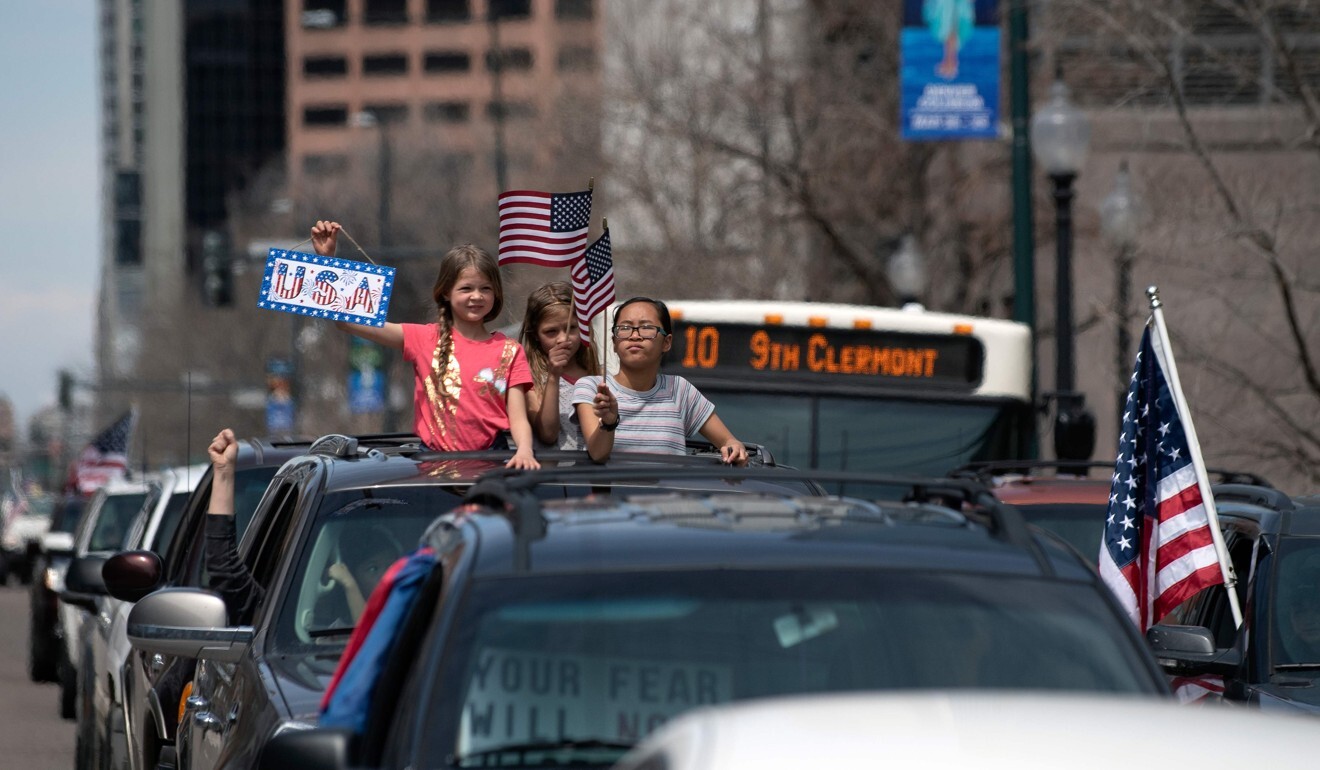 |
| Girls hold US flags as demonstrators gather to protest against coronavirus stay-at-home orders during a rally in Denver, Colorado, on April 19. Photo: AFP |
That does not seem so far-fetched in America where, surprisingly, around 40 per cent of the population could not afford to pay off a US$400 emergency expense in cash before the arrival of Covid-19. As lengthy delays in securing unemployment benefits, small business loans and other forms of assistance endure, more people could become desperate.
That is surely at least part of the reason so many developed-nation governments around the world are incessantly printing money in an attempt to delay the day of reckoning. Clearly, that cannot continue indefinitely. Although it has been only three months since the virus began its march across the globe, it has taken little time to turn our collective world upside down.
Assuming, as many now do, that the new normal will last for months, or possibly years, in the absence of an effective treatment, the tipping point between when governments run out of
stopgap funding solutions and citizens begin to gravitate toward lawlessness en masse may appear sooner than we might like to think.
Extension of India’s nationwide coronavirus lockdown sparked chaos in Mumbai
Only in a few countries are stay-at-home orders mandatory and actually backed by police or military force. In many parts of the world, lockdown orders are entirely voluntary, and most of the world’s citizens have been willing to comply.
But as money and resources become more scarce, they endure more pressure, and find they have increasingly fewer options, many people may decide to stop complying and take desperate measures to keep a roof over their heads and food on the table.
If that time comes, people from the developed world may find they suddenly have something fundamental in common with their developing world brethren – survival. How will the world’s governments react? Would a crackdown result in forcing these populations back into their homes, or would it sow the seeds of future political revolutions?
As the rule book continues to be rewritten with each month that passes during this pandemic, anything is possible.
Daniel Wagner is CEO of Country Risk Solutions and author of the new book The America-China Divide


No comments:
Post a Comment