Showing posts with label AFRICOM. Show all posts

8/11/2017

US Africa Command Confirms Sending Special Forces to Libya to Fight Daesh


By Spootniknews
11 August 2017

Special forces of the United States and their allies have lately been providing support to Libya’s local forces in their fight against the Daesh (banned in Russia) terrorist organization in the country, the United States Africa Command (AFRICOM) confirmed to Russia’s Izvestiya newspaper on Friday.

MOSCOW (Sputnik) — According to AFRICOM’s commentary as quoted by Izvestiya, US forces were sent to Libya and back within the framework of supporting Libyan forces affiliated with the Government of National Accord in their fight with Daesh and other terrorist groups. Additionally, AFRICOM stated that the practice of sending special forces to Libya would continue.

Undisclosed sources in the US Army and Congress also said earlier, as cited by Izvestiya, that the United States, the United Kingdom, France, and Italy had deployed a few dozen of their own special forces soldiers in Libya for the same purpose.

In July, Prime Minister of the Libyan Government of National Accord Fayez Sarraj told Sputnik that there were concerns that Daesh militants would enter Libya after having been defeated in Syria and Iraq.

12/06/2015

Warplanes in Libyan skies may signal next major battle in fight to contain Islamic State


Πηγή: The Guardian
By Chris Stephen
Dec 6 2015

Jihadis in Libya are seizing control of greater chunks of the fractured nation’s territory and imposing a rule of terror. As another strategic city, Ajdabiya, comes under Isis attack, military planners across Europe are preparing the way for Nato forces to intervene.

Libyans have become expert sky watchers. On many days, social media fills with pictures of the latest American drone or spy plane making low passes over Sirte, the local headquarters of Islamic State. There are grainy snaps of the squat, white Lockheed P-3 Orions, and hazier captures of dark drones, while discussion over a twin-engined aircraft that makes figure-of-eight passes could fill a chatroom. With the intensification of bombing of the terror group in Syria, Libya’s sky watchers think airstrikes are imminent.

Speculation about airstrikes heightened last week when the UN reported what intelligence agencies have been saying for months – that Libya has become Isis’s fallback position. More than 800 fighters sent from Libya to battle in Syria and Iraq have now made the journey the other way, as Isis expands its Libyan caliphate.

Last week France flew its first reconnaissance missions over Sirte, joining the drones and spy planes of the United States. This small town on Libya’s central coast was the birthplace of former dictator Muammar Gaddafi – and the scene of his brutal execution. During his tyrannical rule, Gaddafi turned what was a sleepy coastal village into a town of garish concrete, hoping to fulfill a megalomaniac dream to make it the capital of a United States of Africa.

Now the town’s giant concrete Ouagadougou conference centre is bedecked with black flags. The grounds outside are bloody execution sites for the terrorists who have brought Raqqa-style horror to north Africa. Recent escapees tell of a litany of horrific acts, including crucifixions and townsfolk hanged from mechanical diggers and lampposts, some accused of being apostates, some of being spies.

Barbers are banned from shaving off beards and women are forced to wear dark robes, while zealots ensure that music is banned from radio stations. “People live for one thing, which is to get out,” said one resident, newly arrived in Tripoli, the capital far to the west.

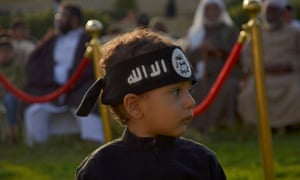
Sirte’s airbase, the biggest in Libya, is being readied by Isis to take suicide planes, while 85 of the town’s children have been paraded as “suicide cubs”, ready to detonate themselves for the cause.


FacebookTwitterPinterest An image from Twitter purporting to show an Isis ‘child radicalisation program’ in Sirte, Libya. Photograph: Twitter

Jihadism has a long history in Libya. Members of the Libyan Islamic Fighting Group staged an unsuccessful guerrilla rebellion against Gaddafi in the 1990s. That uprising was crushed, and its members fled to Afghanistan and Iraq. With the removal of Gaddafi in the bloody 2011 Arab Spring revolution, the jihadis came home.

The first sign of this was Ansar al-Sharia, or Partizans of Islam, which followed up attacks on British and French diplomats with the killing in September 2012 of the US ambassador Chris Stevens in the American consulate in Benghazi.

Then came Isis, seizing its opportunity in the summer of last year when elections were followed by civil war after Libya Dawn, a coalition of Islamist and Misratan forces, seized Tripoli. The elected government fled to the eastern city of Tobruk and fighting has since raged across the country.

Taking advantage of the chaos, Isis quickly established a foothold in the eastern coastal town of Derna, spearheaded by 300 militants of the al-Battar Brigade, battle hardened in Syria.

But Sirte was the true prize, offering an airport, seaport and something Isis wanted more than anything else: oil. South of the town is the massive Sirte Basin, the centre of Libya’s oil industry. In a few months its units conquered the town and pushed south into the Sirte Basin, taking a 100-mile stretch of coastline. In January, it killed 22 Christians, 21 of them Egyptians, on the Sirte shore, triggering Egyptian airstrikes.

Many Ansar al-Sharia units defected to Isis, gifting it a base at Sabratha, 60 miles east of Tunisia’s border. Tunisia says Seifeddine Rezgui Yacoubi, the gunman who killed 38 tourists, 30 of them British, at Sousse, was trained at Sabratha, as were the gunmen who attacked tourists in the capital’s Bardo museum last March.

Isis in Libya has had reverses. In June, Derna youths, backed by a militia loyal toal-Qaida, rose up, pushing its units out of the town into the Green Mountain to the south. But a similar uprising in Sirte in August was brutally put down. After Isis regained control of the rebel district, survivors said, gunmen set fire to the local hospital, burning 22 patients alive. Last week, Isis launched its most audacious attack so far, striking at Ajdabiya, 70 miles east of Sirte, and threatening Libya’s four key oil ports. “Another assassination on Ajdabiya tonight, IS expansion,” one desperate Libyan tweeted 
last Friday night. “Wake up Libyans!”

FacebookTwitterPinterest The main square of Ajdabiya, at the time of the uprising against Gaddafi in 2011. Photograph: Gianluigi Guercia/AFP/Getty Images

Fears are building among Libya’s neighbours. Tunisia, reeling from the slaughter last month of 12 presidential guards by a Libyan-trained bomber, has closed its border with Libya and on Friday banned Libyan planes from the capital, fearing suicide attacks.
Advertisement

In fact, alarm bells about Isis expansion in Libya have been ringing all year. In the summer, the European Union high representative, Federica Mogherini, warned: “In Libya, there is the perfect mix ready to explode and in case it explodes, it will explode just at the gates of Europe.”

In October, Wolfgang Pusztai, Austria’s former Libya defence attaché, told the British parliament’s foreign affairs committee: “The more Islamic State is put under pressure in the Middle East, the more active it will be in Libya.”

Loudest of all has been France’s defence minister, Jean-Yves Le Drian, issuing periodic warnings that Libya has become the “hub” for Isis to supply terrorists and weapons to affiliated groups in Algeria and Mali and to Boko Haram in Nigeria.

Sources in Paris say Le Drian agreed to “go quiet” in the summer, as Europe put its faith in a UN mediation process, hoping that a newly united Libyan government could turn its guns on Isis. But those talks collapsed amid acrimony in October, the UN discredited and, even before the Paris attacks, talk in foreign capitals had turned to direct action.

Last week, the minister again sounded the alarm, telling a French magazine: “We see foreign jihadis arriving in the region of Sirte who, if our operations in Syria and Iraq succeed in reducing the territorial reach of Isis, could tomorrow be more numerous.”

The US has already struck. In June, two F-15s bombed what it said was an al-Qaida gathering at Ajdabiya. In November, the jets struck again, hitting Derna, with the Pentagon claiming to have killed a prominent Isis leader.

But pinpoint strikes have failed to slow the group’s expansion, and the possible loss of Ajdabiya will be a disaster for Libya, cutting off oil ports and the gas fields that generate electricity, a move that the London-based oil expert John Hamilton says would mean “game over” for the economy.

Officials from the American military’s African Command, Africom, based in Stuttgart, have been visiting the region and, should the political decision be made, western forces are already deployed in strength around Libya’s borders. Along with drones and spy planes, the US has bombers and Marine helicopter-borne units stationed in Spain and Italy. More US drones operate from two bases in Niger, guiding a 3,000-strong force of French paratroopers, Operation Barkhane, on the southern Libyan border against jihadi convoys passing out of the country.

RAF Tornados and Typhoons, newly arrived in Cyprus, are within strike range of Libya, as are jets on the French aircraft carrier Charles de Gaulle. And a dozen European warships are off the Libyan coast, currently tasked with an ineffective mission to intercept the country’s people smugglers.

But the military option comes with risks. Isis bases at Derna, Sirte and Sabratha would be obvious targets but, as in Syria, Isis units in Libya can melt into the civilian population. Hours after the US Derna strike last month, Sirte residents reported Isis gunmen forcing their way into civilian homes, calculating that US jets would not bomb them for fear of civilian casualties.

One crumb of comfort for western planners is that Isis has yet to become a mass movement in Libya. In what is a tribal-based society, the population is largely immune to calls to join a worldwide caliphate. Set against that are the continuing arrival of foreign volunteers from Tunisia, Sudan and Yemen.

As in Syria, only ground forces are likely to decisively crush Isis. Western diplomats, working out of Tunis, with Tripoli too dangerous, are continuing to try to persuade Libyans to unite against the terrorist threat. But the French jets and the US drones in the skies over Sirte are vivid proof that another narrative is taking shape.


11/22/2012

The Secret War Between China and the US for Africa's Oil Riches


Πηγή: Oilprice
By Chris Mansur
Nov 20 2012

In the struggle to secure energy resources, the great powers consider all states to be fair game. Indeed, this is precisely what characterizes American foreign policy in the modern era. When it comes to economic and geopolitical interests, Washington seldom differentiates between democratic leaders and despots, especially when those interests involve oil. Currently, the stakes are high in the rush to secure oil resources and nowhere is this more evident than in the Sino-American rivalry in Africa. Both states are competing to secure their share of oil supplies in order to quench their addiction to the coveted ‘black gold.’

One of Washington’s primary energy security concerns has been to diversify its sources of foreign oil. During the 1970s oil crisis, the United States imported one-third of its petroleum. Now, it imports approximately 11.4 million barrels per day of petroleum (which includes crude oil and petroleum products), amounting to 45 percent of all petroleum consumed in America [1]. While most of its foreign oil comes from the western hemisphere, a sizable portion comes from Africa and the Persian Gulf [2]. Despite the fact that America’s reliance on foreign oil has decreased since its peak in 2005, it is still vulnerable to supply disruptions, oil price shocks and OPEC supply squeezing. For Washington, the need to decrease its vulnerability to foreign oil is a principle national security interest, and the solution lies in diversifying imports away from overreliance on any one region.

West African oil remains strategically important for U.S. policy makers, especially since it provides an alternative to Persian Gulf oil. West Africa is also geographically closer, making transportation less costly than oil from the Persian Gulf. The high-quality sweet crude that is produced by the Gulf of Guinea states is crucial to the U.S. market. As such, oil corporations are doing whatever they can to secure this important hydrocarbon and Washington is fervently promoting free trade in Africa in order to make it easier for them.

Sub-Saharan Africa is home to two of the largest oil-producing states: Nigeria and Angola. These two states account for 53 percent and 26 percent of total U.S. petroleum imports from Sub-Saharan Africa respectively [3]. Thus, it is no surprise that the two states also receive the largest share of U.S. security assistance to Africa.

In order to boost its influence in Africa and secure the loyalty of governments, the U.S. has provided military arms and developed military training programs with individual African governments. To increase its military presence, it has acquired basing rights and access to airfields in Djibouti, Uganda, Mali, Senegal and Gabon, along with port facilities in Morocco and Tunisia. In addition, it has also expanded its covert intelligence operations across Africa in the name of combatting terrorism [4]. Yet, these operations also serve another purpose. By expanding its military presence in Africa, Washington is reminding its rivals that it is both willing and able to respond to threats to its strategic interests, the likes of which include the unimpeded flow of African oil.

In 2007, the U.S. African Command (AFRICOM) was established as the ninth of the Unified Combatant Commands under the supervision of the U.S. Department of Defence (DoD). The alleged purpose is to oversee American military operations on the African continent in order to enhance the stability of the region and to promote U.S. national security objectives. Many critics of AFRICOM, including energy security expert Michael T. Klare, believe there is a direct relationship between the existence of AFRICOM and America’s interest in African oil [5].

There is a parallel between America’s increased military presence in Africa and its military expansion into the Persian Gulf since the establishment of the Carter Doctrine. While this endeavour is noticeably more limited in Africa and does not involve any significant oil-for-security arrangements- at least, not yet- there is no doubt that America would respond with force if oil supplies were threatened. The difference is in style, not substance; America seeks a more subtle presence in order to engage in rapid combat and covert operations, when necessary. This operational capacity is equal parts the U.S. bending to the strategic realities of the 21stcentury and a response to African governments, for obvious historical reasons, not welcoming permanent military bases on their soil.

There may be another, often overlooked, purpose of AFRICOM. The presence of China in Africa is creating some concern for American officials. Beijing is competing with Washington for both the loyalty of African governments and the steady supply of African oil. There is a growing sentiment in Washington that China’s presence in Africa could challenge U.S. security interests now and in the years to come. China’s unconditional financial aid and its steady flow of cheap goods to African states (in exchange for oil contracts) have often made it a more appealing trading partner than America. Indeed, a 2005 DoD report indicated that China’s need to forge close ties with African governments to secure energy supplies could lead to ‘a more activist [Chinese] military presence abroad’ [6]. In this regard, AFRICOM would monitor Chinese activity and contain any Chinese incursion into American zones of interest by flexing America’s naval presence.

The stakes for Beijing, however, seem to be greater for three reasons. First, China has an annual GDP growth rate of 7.4 percent. To sustain this, the Chinese economy relies heavily on the consumption of oil. It is constantly seeking new sources of oil to meet its domestic demand, but its African oil supplies are indispensable. Second, China imports more from oil from Africa than America does (30 percent vs. 20 percent) [7]. China’s oil imports from Africa will likely grow to be bigger than America’s in the decades to come, and China is expected to take America’s spot as the world’s biggest oil importer very soon. By 2020, China will import approximately 65 percent of its oil [8]. Lastly, China is not a newcomer to Africa. In the 1960s and 1970s, it supported many national liberation movements, provided a large share of arms to post-independence governments and invested heavily in national infrastructure projects [9]. In this sense, Beijing perceives its presence in Africa as a continuation of its legacy and as an important geopolitical interest on the road to major power status.

However, Africa might not provide the most secure alternative to Persian Gulf oil. Africa’s production capacity is more limited than that of the Persian Gulf, and it also has fewer proven reserves. In terms of aggregate global oil production, Africa is still lagging behind other major crude oil-producing regions [10]. If we assume that ‘peak oil’ estimates are accurate, then (according to BP’s reserves-to-production ratio) Sub-Saharan Africa, as a whole, has an oil-producing capacity that will end by 2030. This would leave only Nigeria and Sudan as major oil-producing states in the region (of course, this assumes that production will remain constant and that no new reserves will be discovered) [11].

In addition, Africa’s political environment can be as unstable as the Persian Gulf. Internal instability, the rise of transnational terrorist networks, military coups, civil strife, endemic corruption and the conflict-stricken Niger Delta all pose significant problems for business operations in the African continent.

America must show restraint in its expansion into Africa. While a military conflict with China over access to African oil may seem presently unrealistic- especially given America and China’s mutual economic dependence- future regional developments and the further militarization of the region could shift the Sino-American rivalry into a more adversarial direction [12]. The ‘military security paradox’ is an important lesson to be learned by the great powers. Militarizing a region in the pursuit of regional stability and security can often have the opposite effect. Only time will tell if Washington and Beijing heed this warning.

References

[1] http://www.eia.gov/tools/faqs/faq.cfm?id=727&t=6

[2] http://www.eia.gov/energy_in_brief/foreign_oil_dependence.cfm

[3] http://www.nationalaglawcenter.org/assets/crs/RL31772.pdf (p. 8)

[4] http://www.washingtonpost.com/world/national-security/us-expands-secret-intelligence-operations-in-africa/2012/06/13/gJQAHyvAbV_story.html

[5] http://www.tomdispatch.com/post/174943

[6] http://www.defense.gov/news/jul2005/d20050719china.pdf (p. 10).

[7] http://www.cfr.org/china/expanding-china-africa-oil-ties/p9557

[8] http://www.china-briefing.com/news/2011/04/13/the-geopolitics-of-china-african-oil.html

[9] Klare, Michael and Daniel Volman. “America, China, and the Scramble for Africa’s Oil.” Review of African Political Economy. No. 108 (2006): 297-309.

[10] http://www.eia.gov/todayinenergy/detail.cfm?id=4710

[11] Yates, Douglas. The Scramble for African Oil: Oppression, Corruption and War for Control of Africa’s Natural Resources (New York: Pluto Press, 2012), 21.

[12] Klare, 307.

(Chris Mansur is a contributor to Geopolitical Monitor.

Geopoliticalmonitor.com is a Canadian intelligence publication and consultancy. Our team of experts provide a unique Canadian perspective on situations and events that have a substantive impact on political and economic affairs both domestically and abroad.

Based in Toronto, Canada, Geopoliticalmonitor.com offers members an original, timely and comprehensive analysis on nations of international significance to Canadian and international readers).


10/18/2012

Liberia: Report Reveals Why Ellen Wants Africom in Liberia


Πηγή: All Africa
Oct 11 2012

Report gathered by this paper has revealed that Liberian President Ellen Johnson-Sirleaf's interest in hosting in Liberia a base for the United States Africa Command (AFRICOM) appears to have had more to do with protecting the George Soros and Rothschild mining operations in West Africa than in championing stability and human rights.

George Soros is a Hungarian-American business magnate, investor, philosopher and philanthropist. The 82- year-old is the chairman of Soros Fund Management, and also the chairman of the Open Society Institute.

HE IS THE NEW YORK HEDGE FUND MANAGER AND ONE OF THE MOS

Since the mid-1980s in particular, he has used his immense influence to help reconfigure the political landscapes of several countries around the world--in some cases playing a key role in toppling regimes that had held the reins of government for years, even decades. Vis à vis the United States, a strong case can be made for the claim that Soros today affects American politics and culture more profoundly than any other living person.

The report, which was published online nearly a year now, indicates that for the sole purpose of protecting the George Soros and Rothschild mining operations in West Africa, President Johnson-Sirleaf and her friend Leymah Gbowee received two Nobel gold medals to help the Rothschild/Soros team control all the gold metal," adding, "A little gold for all the gold."

The report divulges that: "As with so many international constructs that started out with good intentions, the Norwegian Nobel Committee, like the International Olympic Committee, has become contrivances for global corporations," adding that: "It is now clear that the decision by the Nobel committee to award the Nobel Peace Prize to two Liberian women, along with a female Yemeni human rights campaigner, was to engage in a bit of influence-peddling in mineral resource-rich West Africa while also attempting to recognize the "Arab Spring" democracy movement."

The report avers that, While the awarding of the Nobel Peace Prize to Yemeni human rights activist seems appropriate, considering the work she has done to oust Yemen's brutal dictator Ali Abdullah Saleh from power, the awarding of the Peace Prize gold medals to Liberian President Johnson-Sirleaf and Liberian human rights activist Leymah Gbowee, just before the Liberian presidential election in 2011, appears to be a blatant act of trying to influence the outcome of the election and rewarding the Liberian leader for her support for the U.S. Africa Command (AFRICOM).

"In addition to being Africa's first elected female head of state, the report adds, "Sirleaf also has the distinction of being the only African head of state to offer AFRICOM a base of operations and headquarters in Africa - Liberia."

According to the report, "Sirleaf's invitation to AFRICOM was unsettling to many Liberians who are cognizant of Liberia's past as a colony founded by freed slaves from the United States and run for decades by a series of American-Liberian dictators who acted as virtual proxies for Washington and the Firestone Rubber Corporation."

The report maintains that President Johnson-Sirleaf was implicated in supporting Liberia's brutal dictator, Charles Taylor, in a report issued in 2009 by the Liberian Truth and Reconciliation Commission (TRC), but she rejected the TRC report and also reneged on her promise to serve only one term as president.

Winston Tubman, the nephew of Liberia's long-serving President William Tubman and who ran against then candidate Johnson-Sirleaf, the report indicates, "questioned the timing of the Nobel Committee's awarding of the peace prize to his opponent, only a few days before the October 11 election," adding that "It is also noteworthy that after the announcement of this year's Nobel awards, Gbowee, the other Liberian peace prize awardee, endorsed Sirleaf's re-election."

"Sirleaf, a Harvard graduate, has long been a darling of George Soros's "human rights" and "civil society" contrivances, including the Open Society Institute and Foundation," says the report. The report states that: "On September 9, 2008, WMR reported: "Soros is a close friend of Liberian President Ellen Johnson Sirleaf, a former Vice President of Equator Bank in Washington, DC. Equator was later bought by HSBC, which, not surprisingly is a financial partner of Soros."

"Soros has much more of an interest in Liberia and surrounding countries -- including Ivory Coast, which saw French troops fight troops loyal to ousted president Laurent Gbagbo to install a Rothschild/Soros-run World Bank veteran, Alassane Ouattara and his French Zionist wife, into power -- than promoting "civil society," the report adds.

The report unveils that: "Liberia is a nexus for gold mining and Soros's senior partner, Nathaniel Rothschild, is, according to WMR's sources, buying up all the world's gold mines in anticipation of the collapse of several world currencies, including the euro and the dollar."

"Rothschild and Soros, through Rothschild-controlled Newmont Mining Corporation, along with other Rothschild-controlled companies like Vallar and Glencore, are currently moving in to buy up gold mining companies and mining operations in Indonesia, Papua New Guinea, the United States, Peru, Ghana, Guinea, Canada, Namibia, Kyrgyzstan, Russia, Ivory Coast, Mexico, Sierra Leone, and Liberia," the report among others stated.

When the 2nd Vice Presidential Press Secretary of President Johnson-Sirleaf, Mr. Christopher Sele was Monday 8 October 2012 contacted via cell phone for the Liberian leader's reaction to the report, an unidentified individual believed to be a staff member of the office of the Presidential Press Secretary, answered the call and stated that he [Mr. Sele] was upstairs, but promised that Mr. Sele would immediately return the call. However, neither did the unidentified staff nor Mr. Sele return the call up to press time.


8/17/2012

America's 'shadow wars' in Africa


Πηγή: Defence Management
By Peter Feuilherade
August 15 2012

Peter Feuilherade sheds light on the Pentagon's ongoing operations in Africa and the continent's growing strategic importance to US interests…

America's new and still evolving defence strategy is strongly focused on Asia-Pacific and the Middle East, as well as heralding a new phase of restraint in military spending. Over the next 10 years, the Pentagon faces budget cuts of $487bn.

On his first visit to Japan as Pentagon Chief in October 2011, US Defense Secretary Leon Panetta stated that America would remain a global economic and military power despite the cuts, and that the Asia-Pacific region would be central to the US national security strategy. Washington's shift in focus towards Asia is in response to China's growing military power.

But the expanding US military presence in Africa suggests that Washington is also increasingly concerned about the expansion of transnational terrorism into the sub-Saharan region of the continent.

US forces or advisers are active in the Horn of Africa, and East and Central Africa, while in at least 10 countries in the Maghreb, the Sahel and West Africa US personnel are providing counterterrorism training and building up national armies.

Africom

Countering extremists is the top military priority for the continent, says General Carter Ham, Commander of the US Africa Command (Africom). Africom's mission, its website notes, is to 'protect and defend the national security interests of the United States by strengthening the defense capabilities of African states and regional organizations and, when directed, conduct military operations, in order to deter and defeat transnational threats and to provide a security environment conducive to good governance and development'.

Responsible for US military relations with 54 African countries, Africom's operational launch took place in 2008. With President George W Bush facing almost unanimous opposition from African leaders to hosting the command on the continent, its HQ was located in Stuttgart, Germany instead. Africom typically has fewer than 5,000 troops in Africa at any time.

Drones

The US media spotlight turned briefly to Africa in 2011 when the US sent 100 military advisers, mostly Army Special Forces, to help soldiers from four Central African countries – Uganda, Congo, South Sudan and the Central African Republic – fight the rebel Lord's Resistance Army and capture its leader Joseph Kony. But for several years, the US Air Force has been flying drones over Northeast Africa and Yemen from bases in Djibouti and more recently southern Ethiopia and the Seychelles.

In combating the Somalia-based Islamic insurgent group al-Shabaab, only a handful of US troops are involved directly, usually special forces who enter the country on clandestine missions to kill militant targets. However, America has funded 9,000 African Union troops from Uganda and Burundi, and provided background support to invading Kenyan and Ethiopian troops, all involved in military operations against al-Shabaab.

In March 2012, General Ham told the US House of Representatives Armed Services Committee that al-Qaeda affiliates in East and Northwest Africa posed the greatest security threat to the US. Noting that al-Qaeda and al-Shabaab (which has recruited and trained dozens of American citizens) had publicly formalised their longstanding merger, he described the stated intention of the leaders of these extremist groups to work more closely together as "his greatest concern".

Unholy trinity

On the other side of the continent, the US is conducting counterterrorism training and equipping armies in Algeria, Burkina Faso, Chad, Mali, Mauritania, Morocco, Niger, Nigeria, Senegal and Tunisia. US involvement could escalate if events confirm reports that some members of al-Qaeda's core leadership have moved to North Africa from Pakistan after suffering heavy losses in US drone attacks there.

US officials say there are 'clear indications' that al-Qaeda in the Islamic Maghreb (AQIM) is involved in trafficking arms from Libya, and that the upheavals in Libya and Tunisia have created opportunities for AQIM to establish new 'safe havens'. The US, along with several European countries, is concerned that AQIM and Boko Haram, the militant group from northern Nigeria formed in the 1990s, together with al-Shabaab, are "attempting to share training and to collaborate in other ways in pursuit of their goal of attacking the US and other foreign targets", according to a September 2011 speech by General Ham. Some analysts dismiss such an alliance as unlikely, given the cultural and ethnic differences that separate the three groups.

Both AQIM and separatist Tuareg insurgents in northern Mali opposed to the Malian government received sophisticated weapons from Libya in 2011, allowing Tuareg rebels to resume armed operations inside Mali in January 2012.

In March, a group of Malian junior officers, angered by the lack of government support to help the army fight the rebels, seized control in a coup, before agreeing to the return of civilian rule in mid-April. At the time of writing, rebel groups remained in control of northern Mali, their ranks reportedly swelled by foreign Islamist militants. The whole country was also mired in a regional humanitarian crisis, with over 1.4 million Malians in need of emergency food assistance, according to EU estimates.

The New York Times recently described Mali as 'an impoverished desert nation' and, 'an important American ally against the regional al-Qaeda franchise'. Mounting insecurity there, and fears that destabilisation could spread to Niger and elsewhere in the Sahel region, suggest that the American military mission in Mali is likely to have its work cut out combating regional terrorism.

The US will share similar concerns to France, which has warned that the seizure of northern Mali by Tuareg separatists, in a loose alliance with Islamic militants, could turn the region into an AQIM stronghold.

Oil rush

US military operations in Africa face a range of difficulties, including a lack of bases and international agreements on flight paths, limited communications and the reluctance of many African countries to have any significant US force within their borders. One option for the US is increasing the use of sea-based intelligence, surveillance and reconnaissance.

As the Pentagon cuts back on traditional military operations in the post-Iraq and Afghan war era, and after defence budget cuts kick in, it will rely increasingly on smaller elite units to carry out targeted operations. US special operations forces (SOF) will expand to maintain a continuous presence around the globe. SOF will 'begin to return to its roots as expert trainers of counterterrorism forces in other countries', with a large portion of the worldwide SOF presence focusing on Africa and the Pacific, according to Pentagon officials.

However, public opinion and legislators in the US are concerned about the costs of military forays into Africa at a time of budget cuts, while the deployment of advisers has prompted comparisons with the escalation of US involvement in South Vietnam in the 1960s.

In Africa too, the growing US presence is regarded with some suspicion. "After the Libyan case of 2011 (the imposition of the no-fly zone) some African leaders, intellectuals and policymakers are advocating change in the way international organisations or individual states intervene in African political crises. Some issues that make Africans suspicious about US involvement include the increased deployments of special forces, trainers and military contractors by the Pentagon, and the political objectives behind some of the interventions," Dr Petrus De Kock, Senior Researcher at the South African Institute of International Affairs, told DMJ.
America's critics, meanwhile, see Africa becoming a battleground where the US and its European allies jostle for access to the continent's strategic oil and mineral resources with China, which has been striking commercial deals with governments across Africa for decades.

The last few years have seen significant new oil and natural gas discoveries reported across East Africa, from the Horn of Africa in the northeast, down to Tanzania and Mozambique in the south, and inland in Uganda and the Democratic Republic of Congo around Lake Albert.

As General Ham stated in March 2012: "With six of the world's fastest growing economies in the past decade, combined with democratic gains made in a number of African nations in 2011, Africa's strategic importance to the United States will continue to grow."

For all parties involved, the stakes are high and rising.

Peter Feuilherade, a former BBC World Service Journalist, is a UK-based writer specialising in Middle East affairs.


6/03/2012

Libya: the ongoing disaster

NATO Secretary General Anders Fogh Rasmussen had said on March 28 2011: "We are there to protect civilians ... and that will be our focus."

Πηγή: Al-Ahram
By Dan Glazebrook
June 3 2012

The scale of the ongoing tragedy visited on Libya by NATO and its allies is becoming horribly clearer with each passing day. Estimates of those killed so far vary, but 50,000 seems to be a low estimate. Indeed, the British Ministry of Defence was boasting that the onslaught had killed 35,000 as early as last May, and this number is constantly growing, as the destruction of Libyan state forces by the British, French and American blitzkrieg has left the country in a state of total anarchy.

Having nothing to unite them other than their former willingness to act as NATO's foot soldiers, Libya's former "rebels" are now turning on each other. 147 people were killed in in-fighting in southern Libya in a single week earlier this year, and in recent weeks government buildings including the prime ministerial compound have come under fire from rebels demanding cash payment for their services.

$1.4 billion has already been paid out, demonstrating that it was the forces of NATO colonialism, and not former Libyan leader Muammar Gaddafi, who were reliant on "mercenaries". However, these payments were suspended last month due to widespread nepotism. Corruption is becoming endemic in Libya, with a further $2.5 billion in oil revenues that was supposed to have been transferred to the national treasury remaining unaccounted for.

Libya's resources are now being jointly plundered by the oil multinationals and a handful of chosen families from among the country's new elites: this is a case of a classic neo-colonial stitch-up. The use of these resources for giant infrastructure projects such as the Great Manmade River project, and the massive raising of living standards over the past four decades that came about as a result -- Libyan life expectancy rose from 51 to 77 after Gaddafi came to power in 1969 -- sadly look to have become things of the past.

However, woe betide anyone who mentions that now. It was decided long ago that no supporters of Gaddafi would be allowed to stand in the upcoming Libyan elections, but recent changes have gone even further. Law 37, passed by the NATO-imposed Libyan government last month, has created a new crime of "glorifying" the former government or its leader, subject to a maximum sentence of life imprisonment. Would this include a passing comment that things were better under Gaddafi? The law is deliberately vague enough to be open to interpretation. It is also a recipe for institutionalised political persecution.

Even more indicative of the contempt for the rule of law amongst the members of the new government -- a government, remember, which has yet to receive any semblance of popular mandate and whose only power base remains foreign armed forces -- is Law 38. This guarantees immunity from prosecution for anyone who committed crimes aimed at "promoting or protecting the revolution".

As a result, those responsible for the ethnic cleansing of the town of Tawergha -- such as the self-proclaimed "brigade for the purging of black skins" -- can continue hunting down refugees in the full knowledge that they have the new law on their side. Those responsible for the massacres in the town of Sirte and elsewhere also have nothing to fear. Those involved in the widespread torture of detainees can continue to do so without any repercussions -- so long as their torture is aimed at "protecting the revolution" -- i.e. maintaining the NATO-Libyan Transitional National Council dictatorship.

This is the reality of the new Libya: civil war, squandered resources, and societal collapse, where voicing a preference for the days when Libya was prosperous and at peace is a crime, but lynching and torture are not only permitted, but also encouraged.

Nor has the disaster remained a national one. Libya's destabilisation has already spread to Mali, prompting a coup, and huge numbers of refugees, especially amongst Libya's large black migrant population, have fled to neighbouring countries in a desperate attempt to escape both aerial destruction and lynch mob rampage, putting pressure on resources and stoking tensions elsewhere. Many Libyan fighters, their work done in Libya, have now been shipped to Syria to spread their sectarian violence there also.

Most worrying for the African continent, however, is the forward march of AFRICOM -- the US military's African command -- in the wake of the aggression against Libya. It is no coincidence that barely a month after the fall of Tripoli, and in the same month that Gaddafi was murdered in October 2011, the US announced it was sending troops to no fewer than four more African countries -- the Central African Republic, Uganda, South Sudan and the Democratic Republic of Congo. AFRICOM has now announced the unprecedented number of 14 major joint military exercises in African countries for 2012. The military re-conquest of Africa is rolling steadily on.

None of this would have been possible when Gaddafi was still in power. As founder of the African Union, its biggest donor, and its one-time elected chairman, Gaddafi wielded major influence on the continent. It was partly thanks to him that the US was forced to establish AFRICOM's HQ in Stuttgart in Germany when it was established in February 2008, rather than in Africa itself, as Gaddafi offered cash and investment to African governments that rejected US requests for bases.

Libya under Gaddafi's leadership made an estimated $150 billion of investments in Africa, and the Libyan proposal, backed with £30 billion in cash, for an African Union Development Bank would have seriously reduced African financial dependence on the West. In short, Gaddafi's Libya was the single biggest obstacle to AFRICOM penetration of the continent.

Now that Gaddafi has gone, AFRICOM is stepping up its work. The invasions of Iraq and Afghanistan showed the West that wars in which its own citizens get killed are not popular. AFRICOM is designed to ensure that in the coming colonial wars against Africa, it will be Africans who do the fighting and dying, not westerners. The forces of the African Union are to become integrated into AFRICOM under a US-led chain of command. Gaddafi would never have allowed this, which is why he had to go.

If you want a vision of Africa under AFRICOM tutelage, look no further than Libya, NATO's model of an African state. This has now been condemned to decades of violence and trauma and has been made incapable either of providing for its people, or of contributing to regional or continental independence. This new military colonialism should not be given another inch of African support.


1/08/2012

Libya recolonised

On the outskirts of Tripoli, a residential building reduced to rubble in a NATO airstrike on June 19. Even the most conservative estimates suggest that the war in Libya has led to the loss of at least 50,000 lives, mostly at the hands of NATO's bombers and local allies.


Πηγή: FRONTLINE
By AIJAZ AHMAD
Volume 28 - Issue 23 :: Nov. 05-18, 2011

Libya is the first country that the Euro-American consortium has invaded exclusively on the pretext of human rights violations.

FROM Kabul in October 2001 to Tripoli in October 2011, a decade of unremitting planetary warfare has seen countries devastated and capitals occupied over a vast swathe of territory from the Hindu Kush to the northern end of Africa's Mediterranean coast. Within the Arab world, this ultra-imperialist offensive of Euro-American predators may yet move on to Syria as well – and beyond that to Iran at some future date. For now, in any case, the occupation of Libya by the North Atlantic Treaty Organisation's (NATO) clients and corporations marks the vanquishing of the spirit of rebellion that was ignited in neighbouring Tunisia and Egypt earlier this year and has been under attack ever since. For much of Africa, though, this may yet be merely a beginning of a new conquest by the Euro-American consortium that may ravage the continent even more ferociously than did the famous “Scramble for Africa” that was sanctified in Berlin at the end of the 19th century.

Humanitarian interventionism

Afghanistan was invaded in the name of “War on Terror” plus human rights. Iraq was invaded in the name of “War on Terror” plus nuclear non-proliferation plus human rights. Libya is the first country that has been invaded almost exclusively in the name of human rights. In the very early days of hostilities in Libya, President Barack Obama said dramatically that if NATO had waited “one more day, Benghazi could suffer a massacre that would have reverberated across the region and stained the conscience of the world”. His senior aides claimed that the imminent “massacre” could have led to the death of one lakh people, and this is what got repeated ad nauseum on U.S. television channels as well as in all the halls of power where the option of human rights interventionism got discussed with a view to obtaining a United Nations Security Council (UNSC) resolution. This was a bare-faced lie, very much in the mould of the lie about Iraq's purported nuclear weapons that was brandished around by Obama's predecessor, President George Bush Jr. It was on the basis of such disinformation that Resolutions 1970 and 1973 were passed in the Security Council, invoking the dubious principle of the “responsibility to protect”, which was inserted into the duties of the U.N. as late as 2005, after the invasions of Afghanistan and Iraq were already afoot.

This was the time when the Bush administration was openly claiming in international fora, including at the U.N. itself, that (a) in this Age of Terror the U.S. reserved the right of pre-emptive military attack against any state that the U.S. considered a threat to its national security, and that (b) in the conditions of the “War on Terror” many aspects of the Geneva Conventions were no longer applicable. This discourse of the right to pre-emptive invasion was then supplemented by the discourse of the benign nature of the empire itself, in the shape of human rights interventionism. The claim now was that the “international community” – as defined by Euro-American powers – had the right to intervene in the internal affairs of any sovereign country if “massacre” or “genocide” was imminent. The NATO bombings in Libya that began in the third week of March were the first that had ever been authorised by the Security Council in its entire history on this dubious principle of human rights interventionism. Nicolas Sarkozy, the French President, was in his own way quite right when he asserted in the early hours of March 25: “It's a historic moment… what is happening in Libya is creating jurisprudence… it is a major turning point in the foreign policy of France, Europe, and the world” (emphasis added).

No credible evidence has ever emerged to support Obama's claim that a massacre (of up to 100,000) was imminent in Benghazi, and no massacres ensued in the rebellious cities and towns that Qaddafi's troops did occupy in the earlier stages of the fighting. On the contrary, there is incontrovertible evidence of massacres at the hands of NATO's mercenaries. Neighbouring countries, such as Niger, Mali and Chad, have reported the eviction of some three lakh black African residents from Libya as NATO's local allies and clients rolled on towards Tripoli under the devastating shield of NATO's own 40,000-plus bombings over large parts of Libya. Together with these mass evictions of workers and refugees from neighbouring countries – whom the Qaddafi regime had welcomed to make up for labour shortages in an expanding economy – there are also credible reports of lynchings and massacres of black Libyans themselves. The scale of these depredations is yet undetermined but it is already clear that upwards of 50,000 have died as a result of the war unleashed by NATO with the collusion of the Security Council, and half a million or more have been rendered homeless, mostly at the hands of NATO-armed “rebels” who have now been appointed as the new government of the country. Neither the Security Council nor NATO commanders nor, indeed, President Obama – the first black President in the history of the U.S. and himself the son of a Kenyan father – has seen it fit to take up the “responsibility to protect” these hapless people, most of them black Africans, even though several heads of African states have protested, including the very pro-U.S. President of Nigeria.

One of the most pernicious aspects of the liberal discourse of human rights in our time is that this doctrine is utilised in country after country to justify imperialist interventionism in the affairs of the sovereign countries of the tricontinent in direct violation not only of the United Nations Charter and the Westphalian order of nation-states as such but, even more fundamentally, of the very spirit and practices of the anti-colonial movements that fought to dismantle the colonial empires of yesteryear. The right to independent nationhood is inseparable from the right to choose one's own government without foreign interference. In virtually every country of Latin America over the past half a century, peoples have fought against the most brutal kinds of dictatorship but without ever asking for a foreign intervention. For three simple reasons: (1) it is only the people themselves, in their collectivity, who have the right to change their government; (2) it would be hard to find a dictator, including Qaddafi and Saddam Hussein, who has not colluded with imperialism at one point or another; and (3) a military intervention is always, without exception, the intervention of the strong against the weak – always, without exception, in pursuit of the interests of those who intervene.


Given this basic principle, the issue of Qaddafi's dictatorial rule is just as irrelevant today as was the nature of Saddam Hussein's rule in the past; and as irrelevant as would be the dictatorial temper of Bashar al-Asad in Syria or Mahmoud Ahmedinejad in Iran in case of invasions yet to come. We shall come to the paradoxical character of the Qaddafi regime, and it cannot be anyone's case that Qaddafi was some sort of liberal democrat. It needs to be said, though, that he was no more dictatorial than most rulers of Africa and the Arab world, most notably the friends of the West in Saudi Arabia and the whole complex of various emirates in the Gulf. His authoritarianism was indeed ferocious. However, if matters are viewed from the perspective of the well-being of the Libyan people, we shall also have to concede that Qaddafi built the most advanced welfare state in Africa – just as Iraq was the most advanced welfare state in the Arab East, Saddam's authoritarianism notwithstanding. Dismantling of the welfare state – and privatisation and corporatisation of the national assets – is in fact the filthy underbelly of this human rights imperialism. If human rights were even remotely the issue in such interventionism, Saudi Arabia would be the logical first target. And, why should there not be a NATO occupation of Israel, immediately, for protecting the human rights of the Palestinian people and the implementation of numerous Security Council resolutions?

In reality, the great crusade for human rights and democracy in Libya was conducted by NATO with the aid of, among others, personnel from Qatar and the Emirates, just as NATO's own Islamists in Turkey have joined hands with Saudi Arabia in providing weapons to the Muslim Brotherhood and its allies in Syria against the Assad regime in the name of democracy and human rights.

Empire goes where oil is

The Security Council resolution that authorised NATO's “humanitarian intervention” in Libya was well reflected in a secret proposal to the French government by the National Transitional Council (NTC) in the early days of the “rebellion”, which offered to France 35 per cent of Libya's gross national oil production “in exchange”, in the words of the proposal, for “total and permanent” French support for the NTC. The French government, of course, denied it when the French newspaper Liberation published the communication. This coyness of the conspirators was not to last long. On October 21, less than 24 hours after the announcement of Qaddafi's assassination, Britain's new Defence Minister, Philip Hammond, announced that the United Kingdom had presented to the NTC a “request” for a licence to drill for oil. He then added:

“Libya is a relatively wealthy country with oil reserves, and I expect there will be opportunities for British and other companies to get involved in the reconstruction of Libya…. I would expect British companies, even British sales directors, [to be] packing their suitcases and looking to get out to Libya and take part in the reconstruction of that country as soon as they can.”

As the U.S. Ambassador, Gene Cretz, unfurled the flag over the American Embassy in Tripoli, at its reopening ceremony on September 22, he was equally upbeat:


“We know that oil is the jewel in the crown of Libyan natural resources, but even in Qaddafi's time they were starting from A to Z in terms of building infrastructure and other things. If we can get American companies here on a fairly big scale, which we will try to do everything we can to do that, then this will redound to improve the situation in the United States with respect to our own jobs.”

Referring to the Italian oil company, the Foreign Minister of Italy, Franco Frattini, added his own gleeful chime to this triumphalist chorus: “Eni will play a No.1 role in the future.” Qatar, whose overt and covert contribution to the NATO offensive was very considerable indeed, is already handing oil sales in eastern Libya and will also be entering the distribution of the spoils of war from a position of strength. The New York Times noted: “Libya's provisional government has already said it is eager to welcome Western businesses (and)… would even give its Western backers some ‘priority' in access to Libyan business.” That was accurate. “We don't have a problem with Western countries like Italians, French and U.K. companies,” Abdeljalil Mayouf, a spokesman for the NTC-controlled oil company, Agogco, was quoted by Reuters as saying, “but we may have some political issues with Russia, China and Brazil.”

Libya's 46 billion barrels of oil make it home to Africa's largest proven deposit of conventional crude, though Nigeria and Angola dispute this Libyan pre-eminence. Before the civil war began in earnest in February, Libya was pumping about 1.6 million barrels a day, most of which went to southern Europe, whose refineries were tailored to refine Libya's light, high-quality crude. By contrast, Saudi crude is heavier and unsuitable for many of those refineries, while Libya's geographical proximity also makes it much more attractive. Almost 70 per cent of Libya's oil went to four countries, Spain, Germany, France and Italy, even before the NATO war, and oil-producing regions were of course the first to be secured as NATO started bombing its way to victory. The oil industry's biggest players, meanwhile, are ready to reclaim their old concessions and get new ones. The vast Ghadames and Sirte basins, largely off limits to foreign oil companies since Qaddafi came to power 42 years ago, are now expected to be privatised and opened to foreign corporations. The same applies to Libya's offshore oil and gas resources.

The loss of political sovereignty thus leads necessarily to great curtailment of economic sovereignty as well.

AFP/HANDOUT

THE PRODUCTION FACILITIES of a German oil firm in the Libyan desert near the oasis of Jakhira, which was shut in February following the violence. Almost 70 per cent of Libya's oil went to four countries - Spain, Germany, France and Italy - even before the NATO bombings, during which the oil-producing regions were the first to be secured.

African Union vs “The international Community”

At a meeting between the two parties on June 15 this year, some three months after NATO initiated its aerial bombings of Libya, the High Level Ad hoc Committee of the African Union (A.U.) handed over to the Security Council a letter spelling out the A.U. position on the Libyan crisis. Now, even after the fall of Tripoli and the assassination of Qaddafi, the contents of that communication are worth re-visiting if we wish to assess the great gap of perceptions and prescriptions, on issues of interventionism, between nation-states of the tricontinent on the one hand, and, on the other hand, those institutions of “the international community” whose task it is to justify Euro-American interventionism. We shall first offer a series of quotations from that key document:

1. “Whatever the genesis of the intervention by NATO in Libya, the A.U. called for dialogue before the U.N. Resolutions 1970 and 1973 and after those resolutions. Ignoring the A.U. for three months and going on with the bombings of the sacred land of Africa has been high-handed, arrogant and provocative.”

2. “An attack on Libya or any other member of the African Union without express agreement by the A.U. is a dangerous provocation… sovereignty has been a tool of emancipation of the peoples of Africa who are beginning to chart transformational paths for most of the African countries after centuries of predation by the slave trade, colonialism and neocolonialism. Careless assaults on the sovereignty of African countries are, therefore, tantamount to inflicting fresh wounds on the destiny of the African peoples.”

3. “Fighting between government troops and armed insurrectionists is not genocide. It is civil war…. It is wrong to characterise every violence as genocide or imminent genocide so as to use it as a pretext for the undermining of the sovereignty of states.”

4. “The U.N. should not take sides in a civil war. The U.N. should promote dialogue…. The demand by some countries that Col. Muammar Qaddafi must go first before the dialogue is incorrect. Whether Qaddafi goes or stays is a matter for the Libyan people to decide. It is particularly wrong when the demand for Gaddafi's departure is made by outsiders…. Qaddafi accepted dialogue when the A.U. mediation committee visited Tripoli on April 10, 2011. Any war activities after that have been provocation for Africa. It is an unnecessary war. It must stop…. The story that the rebels cannot engage in dialogue unless Qaddafi goes away does not convince us. If they do not want dialogue, then, let them fight their war with Qaddafi without NATO bombing…. The externally sponsored groups neglect dialogue and building internal consensus and, instead, concentrate on winning external patrons.”

It goes without saying that the A.U. is by no means a conglomeration of radicals; it is a conservative grouping of state governments, most of whom are, in one way or another, allied with the West; many of the heads of states participating in A.U. proceedings at any given time are venal, corrupt, authoritarian or worse. That is, however, no more relevant than the personal venality of Sarkozy or Silvio Berlusconi or any other Western leader. The point, rather, is that the A.U.'s is the only united voice through which African states speak and that the principles and points of fact raised here are unexceptionable.

The very first point is that the Security Council, NATO or any other conglomeration of states and institutions simply have no right to represent themselves as “the international community” when what they say and do is opposed by the united voice of the African state system. The second point is that the issue of state sovereignty is posed in Africa and Asia not only in European, Westphalian terms, but, far more sensitively and explosively, in the perspective of the recently won and still very fragile independence of states after a long history of colonial predation. Further, the A.U. letter rejects the position – enunciated by Obama, his NATO allies and the Security Council – that there was any genocide or imminent genocide in Libya. Rather, it speaks strictly of a “civil war” between “government troops and armed insurrectionists”, calls upon the U.N. not to take sides in the “civil war” and goes on then to contemptuously dismiss the “externally sponsored groups” and their “demands” that are designed for “winning external patrons”.

The most important practical point in any case is that Qaddafi had accepted the principle of negotiation and arbitration by the A.U. as early as April 10, after which the A.U. quite rightly demanded that NATO stop its military mission and the U.N. concentrate on facilitating negotiations under A.U. auspices. A significant section of the letter laid out an elaborate plan for negotiations, for policing of violence inside Libya by an A.U. brigade as had been done in Burundi, and for conflict resolution processes using the principles of “provisional immunity” during the peace negotiations, and for the establishment of truth and reconciliation bodies for reconciliation after peace has been re-established.

None of it was heeded, precisely because the voice of reason had come from the weak, while the will for intervention and regime change had come from self-appointed masters of the universe.

Civilisation and the ecstasy of conquest

In the moment of victory, President Obama was relatively more measured in his words than many other Western leaders. The fall of Libya to 40,000-plus NATO bombings was proof, he said, that “we are seeing the strength of the American leadership across the world”. And he was not entirely mistaken in taking the credit. The Security Council resolution that authorised NATO operations would have been inconceivable without the coercive powers of the U.S. Obama's cavalier condoning of assassination and extra-judicial execution, as displayed to the world in the cases of Osama bin Laden and Anwar al-Awlaki among others, was part of the implicit licence to kill the unarmed Qaddafi as well. Less than 48 hours before Qaddafi was actually assassinated, Hillary Clinton, the U.S. Secretary of State, was on a triumphant visit to Tripoli, the Libyan capital now occupied by NATO and its local clients, and said unambiguously: “We hope he [Qaddafi] can be captured or killed soon.” Incitement to murder could hardly be couched in words more stark.

This issue of an authorised assassination should detain us somewhat, for it does impinge upon the imperial duplicity of the human rights discourse. Details of Qaddafi's death and burial are still unclear. We do know that the town of Sirte, to which he had retreated during the siege of Tripoli, was devastated by hundreds of aerial bombings by NATO with the single-minded intent to kill him and those close to him. We also know that he was leaving Sirte in a convoy when the convoy too was bombed; the French claimed that it was their Rafale fighter jet that disabled his vehicle; the Americans claimed that it was the work of one of their Predators. The main point is that he was captured alive and unarmed by NATO's mercenaries on the ground, kicked around, beaten and killed. Considering how many American, French, British, Qatari and other special forces have been there, commanding the Libyan “rebels”, it is significant that the body of the dead man was never taken away from the milling “rebels”. Christof Heyns, the U.N. Special Rapporteur, seems to be clear on this point: “The Geneva Conventions are very clear that when prisoners are taken they may not be executed wilfully and if that was the case then we are dealing with a war crime, something that should be tried.”

The complication, however, is that the Western alliance had previously announced an award of $20 million to anyone who kills (or helps kill/capture) Qaddafi. So, here is a test for Western values: should the man who killed Qaddafi be tried in a court of law? Should he be awarded $20 million and celebrated as a hero? Or should he be allowed to slip out of the grip of the law, history and public memory – and settled, with a handsome settlement, in Miami, southern California or a villa on the Rhine?

Qaddafi's own tribe issued this statement: “We call on the U.N., the Organisation of the Islamic Conference and Amnesty International to force the [National] Transitional Council to hand over the martyrs' bodies to our tribe in Sirte and to allow them to perform their burial ceremony in accordance with Islamic customs and rules.” But there was no such luck! NATO's mercenaries displayed Qaddafi's body, along with that of his son Mutassim, naked to the waist, in freezers in a meat store in Misrata, inviting souvenir photographs.

Human rights imperialism seems to be inventing a brand new entertainment industry: that of necrophilic tourism.

Be that as it may. President Obama is right in claiming that the event proved “the strength of American leadership”. U.S. Special Forces and Central Intelligence Agency (CIA) teams were on the ground since before the beginning of the rebellion and made sure that those who were destined to be NATO's mercenary army on the ground were armed from the start; they were then joined by their French and British counterparts and backed by armed groups from Qatar, the Emirates and the like. Bombings were left largely to the Franco-British component of NATO but much of the high electronics and infrastructural nitty-gritty was handled by the U.S. forces: collecting electronic intelligence and smashing the Libyan anti-aircraft systems, for example, and blockading the coast. NATO warplanes used U.S. bases for refuelling and these bases supplied munitions when their European counterparts ran low. In an important sense, the military operation in Libya was a highly successful experiment in an assault coordinated between AFRICOM – the U.S. Command for the control of Africa – and its European partners.

If President Obama was cryptic, his icy Vice President, Joe Biden, was precise: “In this case, America spent $2 billion and didn't lose a single life. This is more of the prescription for how to deal with the world as we go forward than it has been in the past.” By “life”, Biden obviously means American life, considering that even the most conservative estimates suggest that the war in Libya has led to the loss of at least 50,000 lives, mostly at the hands of NATO bombers and their local allies.

More broadly, what is at issue is a U.S. objective, first conceived during the Vietnam War, to develop an “automated battlefield” with technologies so advanced that wars may be won and entire countries conquered without any significant ground deployment. Across the Atlantic, that same idea was invoked by people like Paddy Ashdown, who once served for four years as E.U. High Representative in Bosnia-Herzegovina, who said that from now on the West should adopt the “Libyan model” of intervention rather than the “Iraqi model” of massive invasion.

This kind of hard-boiled Anglo-Saxon pragmatism can easily be translated by an ambitious politician like Nicolas Sarkozy, the current French President, into the sophistries of a high-minded Gallic discourse on history and civilisation. Pierre Lévy, a former editor of L'Humanité, recently recalled a passage from a speech Sarkozy delivered in 2007 in which he glorified “the shattered dream of Charlemagne and of the Holy Roman Empire, the Crusades, the great schism between Eastern and Western Christianity, the fallen glory of Louis XIV and Napoleon…” and then went on to declare that “Europe is today the only force capable of carrying forward a project of civilisation.” This claim to a unique civilisational mission then led quickly to an ambition to conquer: “I want to be the President of a France which will bring the Mediterranean into the process of its reunification after 12 centuries of division and painful conflicts…. America and China have already begun the conquest of Africa. How long will Europe wait to build the Africa of tomorrow? While Europe hesitates, others advance.”

Lévy then goes on to quote Dominique Strauss-Kahn, a senior leader of the Socialist Party (much in the news recently for alleged sexual misdemeanours), who matched Sarkozy's bombast with his own desire for a Europe stretching “from the cold ice of the Arctic in the North to the hot sands of the Sahara in the South (…) and that Europe, I believe, if it continues to exist, will have reconstituted the Mediterranean as an internal sea, and will have re-conquered the space that the Romans, or Napoleon more recently, attempted to consolidate.”

In this world view, then, NATO is seen as having inherited a mission from the Roman Empire and the Napoleonic conquests, which then involves the “re-conquest” of North Africa. It was, after all, only about 50 years ago that France finally relinquished its claim that Algeria was not a foreign colony but an “outlying province” of France itself. What is very striking in any case is how closely the rhetoric of “civilisation” is woven into the rhetoric of “conquest” and even “re-conquest.”

Obama, Africa and the Imperial Project

Poor little “Olde Europe”! Even in its wildest civilisational ravings, all it can imagine is the re-conquest of its colonial empire in North Africa. By contrast, the U.S. knows how to get directly to the point. In the second week of October, when the war against Libya had been won but Qaddafi yet not assassinated, President Obama announced: “I have authorised a small number of combat-equipped U.S. forces to deploy to central Africa to provide assistance to regional forces…. On October 12, the initial team of U.S. military personnel with appropriate combat equipment deployed to Uganda. During the next month, additional forces will deploy…. These forces will act as advisers to partner forces that have the goal of removing from the battlefield Joseph Kony and other senior leadership of the LRA [Lord's Resistance Army]…. Subject to the approval of each respective host nation, elements of these U.S. forces will deploy into Uganda, South Sudan, the Central African Republic, and the Democratic Republic of the Congo.”

So, in the wake of the Libyan conquest, U.S. troops are to be immediately deployed to countries across the middle of Africa, in four countries and in cooperation with regimes that have hideous records of dictatorship and human rights abuses, not the least on the part of Uganda's “President-for-life”, Yoweri Museveni. Obama justified this newly minted “humanitarian mission” in Uganda in the name of eliminating the LRA. This is odd. The LRA has actually been around for almost a quarter century and has never been weaker than it is today. Why, suddenly, such an operation across a huge part of Africa? Paul Craig Roberts, a former Under Secretary of State for Treasury under President Ronald Reagan (and thus not a left-winger by a long shot), put the matter succinctly: “With Libya conquered, AFRICOM will start on the other African countries where China has energy and mineral investments…. Whereas China brings Africa investment and gifts of infrastructure, Washington sends troops, bombs and military bases.”

Even this recent deployment may be just the tip of an oncoming iceberg. For many years now, the U.S. has been building up a special Command for Africa, the AFRICOM, in tandem with CENTCOM that is responsible for operations in the Middle East (West Asia). As part of this imperial mission in Africa, the U.S. is actively engaged in training the militaries of Mali, Chad, Niger, Benin, Botswana, Cameroon, the Central African Republic, Ethiopia, Gabon, Zambia, Uganda, Senegal, Mozambique, Ghana, Malawi and Mauritania. Together with other NATO countries, the U.S. has staged numerous military exercises in Africa with the ostensible purpose of preparing contingency plans for “protecting energy supplies” in the Niger delta and the Gulf of Guinea. Aside from Libya, major oil producers in the region include Angola, Nigeria, Cameroon, Gabon, Equatorial Guinea, Chad and Mauritania. All these, and many others besides, are to be “protected” – pretty much on the “Libyan model” if need be.

This is not the place to go into details. Suffice it to say that the fall of Libya is likely to serve as the first major step in the offensive to capture Africa's plentiful natural resources. In the fullness of time, as multiple insurgencies and bloodlettings are let loose across the continent, we are likely to see the erection of many new bases for the AFRICOM-NATO combine, very much on the model of Iraq and Afghanistan. The objective is not only to reserve African resources for the Euro-American imperium as much as possible but also to deny those resources to China, which gets about one third of its oil from Africa – Angola and Sudan in particular – in addition to important materials like platinum, copper, timber and iron ore. Some 75 Chinese companies were working in Libya with 36,000 personnel, not so much in the oil sector as in infrastructural development projects; and China accounted for about 11 per cent of Libya's pre-war exports. It evacuated its personnel and complained that NATO had unilaterally changed the U.N. resolution from protecting civilians to regime change.

The U.S. would like to see this eviction of China from Libya to become permanent and for such evictions to be repeated across Africa. Will that happen? Too soon to tell. The U.S. has the military might and the impatient arrogance of a declining superpower, but China is the one that has the cash and the almost glacial patience of a rising economic power. A confrontation is on, and it will take decades to settle.

Conclusion

Major issues pertaining to the significance of the Libya war have not been addressed here: the meaning of all this for the so-called “Arab Spring”; the nature of the fallen Qaddafi regime; the likely composition of the emerging dispensation; the social disintegration and multiple internal conflicts that are now likely to ensue; the destabilisation and the prospect of multiple civil wars across the Sahel region caused by the war on Libya; and so on. Other contributors to this issue of Frontline may clarify these issues, or this author may return to them in a future contribution.

So, let me conclude this piece by noting that Qaddafi did leave a brief will, and it is important that we recall some of his last words:

“Let the free people of the world know that we could have bargained over and sold out our cause in return for a personally secure and stable life. We received many offers to this effect but we chose to be at the vanguard of the confrontation as a badge of duty and honour. Even if we do not win immediately, we will give a lesson to future generations that choosing to protect the nation is an honour and selling it out is the greatest betrayal that history will remember forever despite the attempts of the others to tell you otherwise.”

That is true. Friendly African countries had offered him safe sanctuaries, while some European countries would have preferred to have him as a neutralised client rather than a celebrated martyr in (at least parts of) Libya. Offers were indeed made. Given the choices, he preferred to die. In that brief will, he also expressed a simple wish:

“Should I be killed, I would like to be buried, according to Muslim rituals, in the clothes I was wearing at the time of my death and my body unwashed, in the cemetery of Sirte, next to my family and relatives. I would like that my family, especially women and children, be treated well after my death.”

In Islamic custom, the stipulation that the body be washed and wrapped in a fresh shroud is lifted in the case of martyrs. Right or wrong, Qaddafi did think of his own impending death as martyrdom. We may not think so, but many others probably will. Qaddafi was quite largely a buffoon, in many ways brutish, more so as he grew older and more egomaniacal, but not everyone is going to forget that he also had a visionary side to him and built for his people the most advanced welfare state on the continent. His is a contradictory legacy. We have described earlier in this piece what the winners did to his corpse. Not just the members of his own family or his tribesmen, but many, many others might not so easily forget all that.