Showing posts with label Ahmadinejad. Show all posts

2/15/2012

Iran loads own fuel rods into research reactor

A 2007 photo showing a section of Tehran's oil refinery in Iran.

Πηγή: USAtoday
By AP
Feb 15 2012

TEHRAN, Iran – Iran began loading domestically made nuclear fuel rods into its Tehran research reactor on Wednesday, a defiant move in response to toughening Western sanctions over its controversial nuclear program.

The official IRNA news agency said President Mahmoud Ahmadinejad inserted the first Iranian-made rod into the reactor in northern Tehran, and state TV broadcast live images from the ceremony with Iranian nuclear experts briefing Ahmadinejad on the process.

Iran touted the development as an incremental step in the country's efforts to master the complete nuclear fuel cycle, despite Western penalties and U.N. sanctions.

The West suspects Iran's nuclear program is aimed at producing atomic weapons, a charge Tehran denies, insisting it's geared for peaceful purposes only, such as energy production. The Tehran reactor, for example, produces nuclear isotopes for treating cancer patients.

The development came as Iran said Wednesday it cut oil exports to six European countries — the Netherlands, Spain, Italy, France, Greece and Portugal — in response to recent new European Union sanctions.

The move comes days after Iran's Oil Minister Rostam Qassemi said Tehran could cut off oil exports to "hostile" European nations as tensions rose over suggestions that military strikes are an increasing possibility if sanctions fail to rein in the Islamic Republic's nuclear ambitions.

Iran argues that the EU oil embargo will not cripple its economy, claiming that the country already has identified new customers to replace the loss in European sales that account for about 18 percent of Iran's exports. Members of Iran's parliament have been discussing a draft bill, although not finalized, which would cut off the flow to the European Union before the latest EU sanctions on Iran go into effect this summer.

Iran has said it is forced to manufacture nuclear fuel rods, which provide fuel for reactors, on its own since international sanctions ban it from buying them on foreign markets. In January, Iran said it had produced its first such fuel rod.

Iran's unchecked pursuit of the nuclear program scuttled negotiations a year ago but Iranian officials last month proposed a return to the talks with the five permanent U.N. Security Council members plus Germany.

In the past, Iran has angered Western officials by appearing to buy time through opening talks and weighing proposals even while pressing ahead with the nuclear program.

Apart from the EU's recent measures on Iran, which include an oil embargo and a freeze of the country's central bank assets, Washington also recently levied new penalties aimed at limiting Iran's ability to sell oil — which accounts for 80 percent of its foreign revenue.

Israel is worried Iran could be on the brink of an atomic bomb and many Israeli officials believe sanctions only give Tehran time to move its nuclear program underground, out of reach of Israeli military strikes. The U.S. and its allies argue that Israel should hold off on any military strike on Iranian nuclear facilities to allow more time for sanctions to work.


2/12/2012

Iran to unveil 'big nuclear achievement'


Πηγή: Independent
By NASSER KARIM
Feb 12 2012

Iran will soon unveil "big new" nuclear achievements, President Mahmoud Ahmad-inejad said yesterday, while reiteratingTehran's readiness to revive talks with the West over the country's controversial nuclear programme.

Mr Ahmadinejad spoke at a rally in Tehran as tens of thousands of Iranians marked the 33rd anniversary of the Islamic Revolution that toppled the pro-Western monarchy and brought Islamic clerics to power.

Mr Ahmadinejad did not elaborate on the upcoming announcement but insisted that Iran would never give up uranium enrichment, a process that makes material for reactors as well as weapons.

The West suspects Iran's nuclear programme is aimed at producing atomic weapons, a charge Tehran denies, insisting it's geared for energy production. Four rounds of UN sanctions and recent tough financial penalties by the US and theEuropean Union have failed to get Iran to halt aspects of its atomic work.

"Within the next few days the world will witness the inauguration of several big new achievements in the nuclear field," Mr Ahmadinejad told the crowd in Tehran's Azadi Square yesterday.


1/10/2012

Iran's Ahmadinejad and Venezuela's Chavez taunt US over 'big atomic bomb'


Πηγή: Independent
By Barney Henderson
Jan 10 2012

IRAN’S President Mahmoud Ahmadinejad and Venezuela's Hugo Chavez joked about having "a big atomic bomb" and mocked US disapproval during a meeting between the two allies in Caracas.

Despite their geographical distance, the two countries have forged increasingly close ties, a lot of which is down to their shared anti-Americanism, although concrete projects have often lagged behind the rhetoric.

"One of the targets that Yankee imperialism has in its sights is Iran, which is why we are showing our solidarity," Chavez said during a joint press conference. "That hill will open up and a big atomic bomb will come out," he said of a hill next to his Miraflores Palace.

"When we meet, the devils go crazy," he said, mocking US warnings that Latin American nations should not help the Islamic Republic.

Ahmadinejad concurred: "Despite those arrogant people who do not wish us to be together, we will unite forever," he said.

The two men hugged, beamed, held hands and showered each other with praise. "President Chavez is the champion in the war on imperialism," Ahmadinejad said.

But the two countries signed only vague co-operation accords and Chavez gave few signals that Venezuela would seek to undercut toughened sanctions over Iran's nuclear programme by providing fuel or cash.

Meanwhile, the Iranian envoy to the UN nuclear watchdog said on Tuesday that Western expressions of alarm over uranium enrichment begun at a new underground plant in Iran are "politically motivated,"

"These reactions are exaggerated and politically motivated and have been made over previous years," Ali Asghar Soltanieh was quoted as saying by the ISNA news agency.

He was commenting on Western reaction to the International Atomic Energy Agency's confirmation on Monday that Iran had begun enriching uranium to up to 20 per cent level in its new Fordo plant – a fortified bunker sunk into a mountain southwest of Tehran.

The United States said the activity was "a further escalation of their (the Iranians') ongoing violations with regard to their nuclear obligations," while Britain called it "provocative" and France said it was a "particularly grave violation by Iran of international law."


11/30/2011

Death to England! Iran mob storms British Embassy as terrified staff cower from rioters and police stand by


Πηγή: Mailonline
By IAN DRURY, MICHAEL PURCELL and TIM SHIPMAN
Nov 30 2011

David Cameron expressed outrage last night after hardline Iranian protesters stormed the British Embassy in Tehran and tried to take staff hostage.

A frenzied mob of militant students ransacked the main building and a smaller diplomatic compound in the city.

They lobbed petrol bombs, smashed windows, stole classified documents, torched the Union flag and even tore up a portrait of the Queen.


Protesters break into the British Embassy and tear down the Union Jack. Some then proceeded to ransack offices


Clashes: Students wearing some form of purple and green bandanna with Islamic writing on it push against riot police who had been protecting the embassy


A car goes up in flames as an Iranian protester fearing an explosion flees across the road inside the British Embassy


Up in smoke: Protesters inside the British Embassy compound watch as an embassy car burns
The rioters also chanted 'Death to England' and threw rocks. One man held up a Union flag with a skull and cross bones on it.

The embassy came under siege despite being guarded by Iranian police and private security guards.

One of those who took part in the attacks said they were driven by their 'hatred' of Britain. Others denounced the embassy as a 'den of spies'.

Yesterday a furious Prime Minister denounced the attack as 'outrageous and indefensible'.


Disrespect: An angry student tears a picture of the Queen, while right, another man in glasses and with a beard holds up-side-down a picture of Queen Elizabeth


A protester holds up a banner as his fellow Iranians wave flags and shout insults at Britain


Hundreds of students surge through the gates of the British embassy today as anti-English feelings reached boiling point


Breaking in: Dozens of protesters enter the gate of the embassy, throwing rocks, petrol bombs and burning documents looted from offices

'The failure of the Iranian government to defend British staff and property was a disgrace,' Mr Cameron said.

'We hold the Iranian government responsible for its unacceptable failure to protect diplomats in line with international law.

'The Iranian government must immediately ensure the continued safety of our staff, return all property and secure the compound immediately.


Masked demonstrators hurl embassy papers into the crowd. Right, a student uses a metal bar to strike the British emblem


Students from some universities and seminaries burned British flags as they clashed with police, while others held flags proclaiming their hatred of Britain... while not leaving out the U.S. and Israel


Flash point: Iranian protesters burn the Union Jack outside the embassy in Tehran


Fury: A Union Jack flag is symbolically burned by a jeering crowd of Iranians


Dressing down: A protester kicks away the coat of arms from the embassy building

Shattered glass: Iranians have long been suspicious of the UK in large part due to Britain's long-held influence on its rulers and economy prior to the Islamic revolution


On the loose: Rampaging demonstrators use whatever they can find to smash up property

THE HATED SYMBOL OF THE WEST

America severed ties with Iran within months of the storming of the U.S. embassy in 1979.

Iran also swiftly expelled Israeli diplomats, handing their embassy over to the PLO.That left Britain as the most hated Western power to have a functioning embassy in Iran. The British embassy was shut down three times in the turbulent decade that followed the Islamic revolution.

It re-opened fully in 1988. But a year later diplomatic ties were broken again over Ayatollah Khomeini’s fatwa against British author Salman Rushdie.

In the late 1990s Britain spent £1.3million renovating the embassy. The Rushdie affair had been resolved and London hoped for better relations with Iran.

But that hope dimmed when moderate president Mohammad Khatami was succeeded by the anti-Western Mahmoud Ahmadinejad.

'Those responsible for this criminal attack must be prosecuted. The Iranian Government must recognise that there will be serious consequences for failing to protect our staff.'

Whitehall sources said President Mahmoud Ahmadinejad's regime would be hit with 'robust and resolute' sanctions as early as today when ministers update the Commons.

Foreign Secretary William Hague spoke to Iranian foreign minister Ali Akbar Salehi in the 'strongest terms' over his government's 'very serious failure' to protect the British Embassy.

The United Nations, U.S., France and Russia all joined in condemnation of the incident.

Last night Mr Hague said all embassy staff and their families were safe.

He played down reports that staff had been held hostage, saying the situation had been 'confusing'.

But insiders said that at one point employees were holed up in a compound surrounded by several hundred marauding rioters.

Mr Cameron chaired a meeting of the Government's Cobra emergency committee and the Iranian charge d'affaires to London was summoned to the Foreign Office to be rebuked.

Iran said it 'regretted' the attacks on the British Embassy and the Gulhak Garden diplomatic compound several miles away in northern Tehran.


Iranian riot police stand guard as protesters gather outside the British Embassy in Tehran. A handful of demonstrators managed to break their rank


An Iranian Basij militia member throws stones towards the embassy building as riot police look on

A HARD-LINE RIOT: NOT THE FIRST TIME THE BRITISH EMBASSY HAS COME UNDER ATTACK


The British embassy in Tehran is an oasis of green tranquillity in the dusty centre of the teeming Iranian capital.

But when hard-line students threw stones at the symbol of British power, it was far from the first time the building had come under attack.

In November 1978 - a turbulent year before the Islamic Revolution - the embassy was ransacked by a crowd angry at Britain's support for the Shah of Iran.

The mob forced open the high gates, despite the gallant efforts of a lone junior diplomat to keep them out, then set fire to the Chancery building, but no one was hurt.

The embassy was shut down three times in the decade that followed the Shah's overthrow in 1979, re-opening in 1988.

A year later diplomatic ties were broken off again over the fatwah on Salman Rushdie, finally being restored at ambassador level in 1998.

In the early 1980s a narrow street flanking the embassy was renamed after the IRA hunger striker Bobby Sands, although a new street sign now misspells it as Babi Sandz street. Taxi drivers, however, still refer to it by its old name - Churchill Street.But Whitehall officials said the protesters could not have acted without the approval of President Ahmadinejad's repressive regime.

A senior source said: 'Things like this don't happen in Tehran without part of the Iranian state giving authority or permission. If they had wanted to put a stop to it, they would have.'

The attack was the most serious assault on foreign diplomatic missions in Iran since the seizing of the U.S. Embassy compound in 1979 when 52 Americans were held captive for 444 days.

The demonstrations were reported to have been staged by a new pro-regime group called The Muslim Students Followers of the Supreme Leader. They were protesting against tough new financial sanctions imposed by London last week over Iran's nuclear programme.

Iran retaliated on Monday by passing a law to expel the British ambassador, Dominick Chilcott, who took up his post only last month.

Some 15 British nationals are stationed at the embassy. They had been confident the protest would pass peacefully because scores of Iranian anti-riot police were deployed outside. But security forces stood idly by when protesters, chanting 'The Embassy of Britain should be taken over' and 'Death to England', swarmed over the gates.

Embassy staff fled the main compound by the back door before mobs broke in. Smoke rose from the grounds after a car was driven in and set alight.

It is understood Mr Chilcott was at the embassy when it was attacked. His residence and offices are on the compound.

He was praised by Mr Cameron for handling a 'dangerous situation with calm and professionalism'.

After police regained control of the main site about 300 protesters swarmed into the Gulhak Gardens complex.

The U.S. last night condemned the attack 'in the strongest terms' with President Obama urging the Iranian government to deal with those responsible.

Russia, Iran's closest ally, described the assault as 'unacceptable and deserving condemnation'.


Earlier in the day, Iranian police had prepared for a demonstration but protesters still managed to break their way through


A protester ducks on the ground after apparently being beaten by riot police outside the British Embassy


Booty: One protester seemed to forget his disgust at Western culture when he emerged from the British Embassy with a poster of the U.S. film Pulp Fiction


Motion: The Iranian parliament agreed to expel British ambassador Dominic Chilcott by 171 votes to four.


10/16/2011

Iran’s Ahmadinejad denies US assassination claims


Πηγή: Arab News
Oct 16 2011


TEHRAN: Iran’s President Mahmoud Ahmadinejad dismissed on Sunday US accusations that Iranian government agents plotted to kill the Saudi ambassador in the United States.


“Iran is a civilized nation and doesn’t need to resort to assassination,” Ahmadinejad was quoted by the official IRNA news agency as saying. “Terror belongs to you,” he said, addressing the United States.

Two men, including a member of Iran’s special foreign actions unit known as the Quds Force, have been charged in New York federal court with conspiring to kill the Saudi diplomat, Adel Al-Jubeir.

Iranian officials have consistently denied the allegations since they first emerged last week. Ahmadinejad’s statements, and similar Saturday remarks by Supreme Leader Ayatollah Ali Khamenei, are the first comments made by the country’s two highest leaders.

Khamenei, who has the final say on all state matters in Iran, had said that the US seeks to bring greater pressure on Iran through making unsubstantiated allegations.

“They (Americans) conduct such conspiracies against us frequently, which are all useless and ineffective. They say that they want to isolate Iran but they have become isolated themselves,” Khamenei said on state TV.

“By attributing an absurd and meaningless accusation to a few Iranians, they tried ... to show that Iran is a supporter of terrorism ... This conspiracy didn’t work and won’t work,” he said.

Khamenei warned on Sunday that Tehran would respond robustly to any “inappropriate measure” by Western powers linked to the alleged plot, state television reported.

“Any inappropriate measure against Iran, whether political or security-related, will be strongly confronted by the Iranian nation,” Khamenei said.

Iran says the allegation is without foundation and has been cynically engineered to further isolate Tehran — whose disputed nuclear program has triggered several rounds of international sanctions against it.

In a formal statement released Saturday, the Iranian government said it has no connection to Manssor Arbabsiar, the man arrested in the alleged plot.

“Unilaterally announcing accusations without showing documentation and creating a media wave against Iran is in no way compatible with legal logic, and can only be a purely media and political show,” it said.

President Barack Obama said Thursday that the US will be able to support all of its allegations that Iran was directly involved in a plot to kill Al-Jubeir.

Arbabsiar is a 56-year-old naturalized US citizen who also had an Iranian passport. In May 2011, the criminal complaint says, he approached someone he believed to be a member of the vicious Mexican narco-terror group, Los Zetas, for help with an attack on a Saudi embassy. The man he approached turned out to be an informant for US drug agents, it says.

The US charges that Arbabsiar had been told by his cousin Abdul Reza Shahlai, a high-ranking member of the Quds Force, to recruit a drug trafficker because drug gangs have a reputation for assassinations.

Iranian lawmakers and analysts have said Iran would not benefit from killing the Saudi ambassador in Washington, and thus has no reason to do so.


10/04/2011

Spy games come to New York for UN General Assembly


Πηγή: PTR
By ADAM GOLDMAN and MATT APUZZO
Oct 4 2011

NEW YORK (AP) -- When Iran's president accused the U.S. at the United Nations General Assembly last year of orchestrating the 9/11 attacks, American diplomats were not caught flat-footed by the tirade.

Even before President Mahmoud Ahmadinejad finished his incendiary rant, U.S. diplomats marched out of the cavernous U.N. hall in protest and were ready with a written statement condemning his comments.

It was as if the U.S. knew exactly what Ahmadinejad intended to say.

The walkout hinted at one of the well-known but seldom spoken truths about the United Nations: The international organization, which was founded in the name of peace and security, is also a hotbed of spying and clandestine operations, where someone might very well be listening to your conversations and monitoring your emails - or perhaps reading your speeches in advance.

The start of the General Assembly each year is the Super Bowl of the U.N. spy games.

Foreign leaders descend upon New York with entourages of aides and security officers. Many have not been dispatched to practice diplomacy. They are intelligence officers, and they've come instead to recruit agents in hotels and quiet cafes around the city. In their line of work, trickery and deception trump political niceties.

While the diplomats inside the United Nations are often making headlines, FBI agents are chasing spies around the city. Justice Department lawyers are asking judges to approve wiretaps. And the CIA is searching for foreigners who might be persuaded to commit treason.

All this makes for a frenzied few weeks, especially for the FBI's Manhattan field office. The FBI's counterintelligence unit there is responsible for monitoring foreign diplomats in the city.

It's one of the most sophisticated intelligence-gathering operations in the U.S. and involves one of the FBI's most extensive electronic surveillance programs, according to former U.S. intelligence officials speaking on the condition of anonymity to discuss sensitive matters.

It's hardly a secret to foreign intelligence officers, who are skilled at evading surveillance.

The Iranians, for example, are known to rent multiple rooms in hotels around the city and sometimes cancel and re-book at the last moment to conceal who's staying where. In one instance, a former FBI official recalled, the Iranians crammed perhaps a dozen people into one room, leaving U.S. officials to conclude that at least one Iranian official was sleeping in the bathroom, probably in the bathtub.

It's not just the Iranians in New York. Former intelligence officials said the Israelis operate unilaterally in New York, often creating confusion.

One former CIA official said it's hard to distinguish Israelis because they will often enter the country under another nationality - like they did in Dubai, when Mossad operatives killed a Hamas official. In that case, Mossad agents used forged British, Irish and Australian passports.

Other intelligence agencies like Britain's Secret Intelligence Service, better known as the MI6, work more closely with the U.S. MI6 is allowed to operate in New York but any information its officers collect must be shared with U.S. intelligence, the official said.

The CIA is prohibited from domestic intelligence-gathering but, since the United Nations is considered foreign soil, it is authorized to run covert actions there. Its officers are also allowed to recruit foreigners to spy for the U.S., a primary goal for the CIA during the opening of the General Assembly.

Despite the popular narrative that the FBI and CIA are constantly at odds, the two agencies coordinate closely during the General Assembly.

The CIA and FBI vet the names from visas provided to enter the U.S. Those entering the country from places where the FBI and CIA can't operate, like Iran and North Korea, make attractive recruitment possibilities.

Preparation for these operations can take months. The stakes can be high. And the General Assembly can provide the perfect backdrop for such an operation as journalists and diplomats flood the city.

Prior to the 2003 U.S.-led invasion of Iraq, the CIA had been enticing high-level Iraqi officials to defect. One such target was Naji Sabri, Iraq's foreign minister. The White House was hoping he would do it in a dramatic way at the General Assembly.

First, though, the CIA had to feel out Sabri to see whether he truly intended to betray Iraqi leader Saddam Hussein. The CIA needed a cutout, or middleman, a person who could introduce the CIA to Sabri and then walk away plenty richer for doing the job, according to CIA officers familiar with the operation and previously published accounts.

In September 2002, Sabri flew to New York, where the CIA had arranged a meeting with a former foreign journalist who had since moved to France. The journalist, who had provided information to French intelligence in the past, acted as the middleman for an initial $250,000, the former CIA officials said, speaking on condition of anonymity because they were not authorized to discuss intelligence matters publicly.

But the CIA also had to see whether it could trust the journalist who had claimed he was friendly with Sabri but who was also looking for a big payday of up to $1 million. The CIA relied upon the FBI for this and its extensive eavesdropping capability. When the journalist called Sabri at the Iraq Mission at the U.N., the FBI was listening.

With the FBI's help, the CIA learned Sabri did, in fact, know the journalist. Sabri was handed a list of carefully crafted questions about Saddam's nuclear weapons program.

Sabri answered each question. He said Saddam had never possessed fissile material. There had been stockpiles of chemical weapons but Saddam had destroyed them. The CIA believed that Sabri's responses indicated he had been truthful. His answers were given to President George W. Bush and Vice President Dick Cheney.

But the CIA still needed to know whether Sabri wanted to defect. One former CIA official believed the spy agency got its answer on Sept. 19, 2002, when Sabri addressed the General Assembly. He was wearing one of the suits that CIA had purchased for him, the sign he was going abandon Saddam.

But the defection never happened. Sabri left New York and later vehemently denied the episode publicly in 2006 after NBC published details about the operation. He called it "totally fabricated and unfounded."


9/27/2011

Iran and Geopolitics


Πηγή: Stratfor
By Kamran Bokhari
Sep. 27 2011


Geopolitically, a trip to Iran could not come at a better time. Iran is an emerging power seeking to exploit the vacuum created by the departure of U.S. troops from Iraq, which is scheduled to conclude in a little more than three months. Tehran also plays a major role along its eastern border, where Washington is seeking a political settlement with the Taliban to facilitate a U.S. withdrawal from Afghanistan.

The Islamic republic simultaneously is trying to steer popular unrest in the Arab world in its favor. That unrest in turn has significant implications for the Israeli-Palestinian conflict, an issue in which Iran has successfully inserted itself over the years. The question of the U.S.-Iranian relationship also looms — does accommodation or confrontation lie ahead? At the same time, the Iranian state — a unique hybrid of Shiite theocracy and Western republicanism — is experiencing intense domestic power struggles.

This is the geopolitical context in which I arrived at Imam Khomeini International airport late Sept. 16. Along with several hundred foreign guests, I had been invited to attend a Sept. 17-18 event dubbed the “Islamic Awakening” conference, organized by the office of Supreme Leader Ayatollah Ali Khamenei. Given the state of Iranian-Western ties and my position as a senior analyst with a leading U.S.-based private intelligence company, the invitation came as surprise.

With some justification, Tehran views foreign visitors as potential spies working to undermine Iranian national security. The case of the American hikers jailed in Iran (two of whom were released the day of my return to Canada) provided a sobering example of tourism devolving into accusations of espionage.

Fortunately for me, STRATFOR had not been placed on the list of some 60 Western organizations (mostly American and British think tanks and civil society groups) banned as seditious in early 2010 following the failed Green Movement uprising. Still, the Iranian regime is well aware of our views on Iranian geopolitics.

In addition to my concerns about how Iranian authorities would view me, I also worried about how attending a state-sponsored event designed to further Iranian geopolitical interests where many speakers heavily criticized the United States and Israel would look in the West. In the end, I set my trepidations aside and opted for the trip.


Geopolitical Observations in Tehran


STRATFOR CEO and founder George Friedman has written of geopolitical journeys, of how people from diverse national backgrounds visiting other countries see places in very different ways. In my case, my Pakistani heritage, American upbringing, Muslim religious identity and Canadian nationality allowed me to navigate a milieu of both locals and some 700 delegates of various Arab and Muslim backgrounds. But the key was in the way STRATFOR trains its analysts to avoid the pitfall that many succumb to — the blurring of what is really happening with what we may want to see happen.

The foreigner arriving in Iran immediately notices that despite 30 years of increasingly severe sanctions, the infrastructure and systems in the Islamic republic appear fairly solid. As a developing country and an international pariah, one would expect infrastructure along the lines of North Korea or Cuba. But Iran’s construction, transportation and communications infrastructure shares more in common with apartheid-era South Africa, and was largely developed indigenously.

Also notable was the absence of any visible evidence of a police state. Considering the state’s enormous security establishment and the recent unrest surrounding the Green Movement, I expected to see droves of elite security forces. I especially expected this in the northern districts of the capital, where the more Westernized segment of society lives and where I spent a good bit of time walking and sitting in cafes.

Granted, I didn’t stay for long and was only able to see a few areas of the city to be able to tell, but the only public display of opposition to the regime was “Death to Khamenei” graffiti scribbled in small letters on a few phone booths on Vali-e-Asr Avenue in the Saadabad area. I saw no sign of Basij or Islamic Revolutionary Guard Corpspersonnel patrolling the streets, only the kind of police presence one will find in many countries.

This normal security arrangement gave support to STRATFOR’s view from the very beginning that the unrest in 2009 was not something the regime couldn’t contain. As we wrote then and I was able to see firsthand last week, Iran has enough people who — contrary to conventional wisdom — support the regime, or at the very least do not seek its downfall even if they disagree with its policies.

I saw another sign of support for the Islamic republic a day after the conference ended, when the organizers arranged a tour of the mausoleum of the republic’s founder, Ayatollah Ruhollah Khomeini. We visited the large complex off a main highway on the southern end of town on a weekday; even so, numerous people had come to the shrine to pay their respects — several with tears in their eyes as they prayed at the tomb.

Obviously, the intensity of religious feelings varies in Iran, but a significant stratum of the public remains deeply religious and still believes in the national narrative of the revolutionary republic. This fact does not get enough attention in the Western media and discourse, clouding foreigners’ understanding of Iran and leading to misperceptions of an autocratic clergy clinging to power only by virtue of a massive security apparatus.

In the same vein, I had expected to see stricter enforcement of religious attire on women in public after the suppression of the Green Movement. Instead, I saw a light-handed approach on the issue. Women obeyed the requirement to cover everything but their hands and faces in a variety of ways. Some women wore the traditional black chador. Others wore long shirts and pants and scarves covering their heads. Still others were dressed in Western attire save a scarf over their head, which was covering very little of their hair.

The dress code has become a political issue in Iran, especially in recent months in the context of the struggle between conservative factions. President Mahmoud Ahmadinejad, who has encountered growing opposition from both pragmatic and ultraconservative forces, has come under criticism from clerics and others for alleged moral laxity when it comes to female dress codes. Even so, the supreme leader has not moved to challenge Ahmadinejad on this point.


Ahmadinejad and the Clerical-Political Divide


In sharp contrast with his first term, Ahmadinejad — the most ambitious and assertive president since the founding of the Islamic republic in 1979 — has been trying to position himself as the pragmatist in his second term while his opponents come out looking like hard-liners. In recent months his statements have become less religiously informed, though they have retained their nationalist and radical anti-Western tone.

For example, his speech at the conclusion of the second day of the conference on the theme of the event, Islamic Awakening, was articulated in non-religious language. This stood in sharp contrast to almost every other speaker. Ahmadinejad spoke of recent Arab unrest in terms of a struggle for freedom, justice and emancipation for oppressed peoples, while his criticism of the United States and Israel was couched in terms of how the two countries’ policies were detrimental to global peace as opposed to the raw ideological vitriol that we have seen in the not too distant past.

But while Iran’s intra-elite political struggles complicate domestic and foreign policymaking, they are not about to bring down the Islamic republic — at least not anytime soon. In the longer term, the issue at the heart of all disputes — that of shared governance by clerics and politicians — does pose a significant challenge to the regime. This tension has existed throughout the nearly 32-year history of the Islamic republic, and it will continue to be an issue into the foreseeable future as Iran focuses heavily on the foreign policy front.


Iran’s Regional Ambitions


In fact, the conference was all about Iran’s foreign policy ambitions to assume intellectual and geopolitical leadership of the unrest in the Arab world. Iran is well aware that it is in competition with Turkey over leadership for the Middle East and that Ankara is in a far better position than Iran economically, diplomatically and religiously as a Sunni power. Nevertheless, Iran is trying to position itself as the champion of the Arab masses who have risen up in opposition to autocratic regimes. The Iranian view is that Turkey cannot lead the region while remaining aligned with Washington and that Saudi Arabia’s lack of enthusiasm for the uprisings works in Tehran’s favor.

The sheer number of Iranian officials who are bilingual (fluent in Persian and Arabic) highlights the efforts of Tehran to overcome the ethno-linguistic geopolitical constraints it faces as a Persian country trying to operate in a region where most Muslim countries are Arab. While its radical anti-U.S. and anti-Israeli position has allowed it to circumvent the ethnic factor and attract support in the Arab and Muslim worlds, its Shiite sectarian character has allowed its opponents in Riyadh and elsewhere to restrict Iranian regional influence. In fact, Saudi Arabia remains a major bulwark against Iranian attempts expand its influence across the Persian Gulf and into Arabian Peninsula, as has been clear by the success that the Saudis have had in containing the largely Shiite uprising in Bahrain against the country’s Sunni monarchy.

Even so, Iran has developed some close relations across the sectarian divide, something obvious from the foreign participants invited to the conference. Thus in addition to the many Shiite leaders from Lebanon and Iraq and other parts of the Islamic world, the guest list included deputy Hamas leader Mousa Abu Marzook; Palestinian Islamic Jihad (PIJ) chief Ramadan Abdullah Shallah; a number of Egyptian religious, political, intellectual and business notables; the chief adviser to Sudanese President Omar al Bashir as well as the leader of the country’s main opposition party, Sadiq al-Mahdi; a number of Sunni Islamist leaders from Pakistan and Afghanistan, including former Afghan President Burhanuddin Rabbani whom I had the opportunity of speaking with only two days before he was assassinated in Kabul; and the head of Malaysia’s main Islamist group, PAS, which runs governments in a few states — just to name a few.

Tehran has had much less success in breaching the ideological chasm, something evidenced by the dearth of secular political actors at the conference. Its very name, Islamic Awakening, was hardly welcoming to secularists. It also did not accurately reflect the nature of the popular agitation in the Arab countries, which is not being led by forces that seek revival of religion. The Middle East could be described as experiencing a political awakening, but not a religious awakening given that Islamist forces are latecomers to the cause.

A number of my hosts asked me what I thought of the conference, prompting me to address this conceptual discrepancy. I told them that the name Islamic Awakening only made sense if one was referring the Islamic world, but that even this interpretation was flawed as the current unrest has been limited to Arab countries.

While speaker after speaker pressed for unity among Muslim countries and groups in the cause of revival and the need to support the Arab masses in their struggle against autocracy, one unmistakable tension was clear. This had to do with Syria, the only state in the Arab world allied with Iran. A number of speakers and members of the audience tried to criticize the Syrian regime’s efforts to crush popular dissent, but the discomfort this caused was plain. Syria has proven embarrassing for Iran and even groups like Hezbollah, Hamas and PIJ, which are having a hard time reconciling their support for the Arab unrest on one hand and supporting the Syrian regime against its dissidents on the other.


The Road Ahead


Attending this conference allowed me to meet and observe many top Iranian civil and military officials and the heads of Arab and other Muslim non-state actors with varying degree of relationships with Tehran. Analyzing them from a distance one tends to dismiss their ideology and statements as rhetoric and propaganda. Some of what they say is rhetoric, but beneath the rhetoric are also convictions.

We in the West often expect Iran to succumb to international pressure, seek rehabilitation in the international community and one day become friendly with the West. We often talk of a U.S.-Iranian rapprochement, but at a strategic level, the Iranian leadership has other plans.

While Iran would like normalized relations with Washington and the West, it is much more interested in maintaining its independence in foreign policy matters, not unlike China’s experience since establishing relations with the United States. As one Iranian official told me at the conference, when Iran re-establishes ties with the United States, it doesn’t want to behave like Saudi Arabia or to mimic Turkey under the Justice and Development Party.

Whether or not Iran will achieve its goals and to what extent remains unclear. The combination of geography, demography and resources means Iran will remain at the center of an intense geopolitical struggle, and I hope for further opportunities to observe these developments firsthand.


9/23/2011

Harsh Words From Turkey About Israel, and From Iran About United States

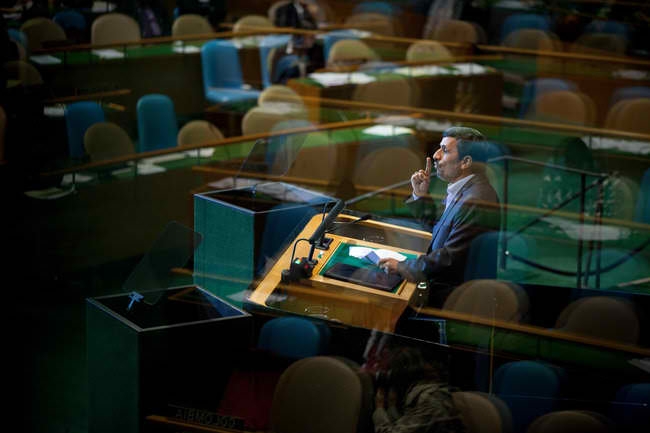
The floor of the General Assembly was largely empty on Thursday when President Mahmoud Ahmadinejad of Iran offered his annual list of denunciations.


Πηγή: New York Times
By NEIL MacFARQUHAR
Sep. 23 2011


UNITED NATIONS — Evidently heedless of American attempts to engineer a thaw in Turkish-Israeli relations, Prime Minister Recep Tayyip Erdogan of Turkey used his appearance before the annualGeneral Assembly on Thursday to enumerate a long list of grievances with Israel, a former regional ally.
Enlarge This Image
Damon Winter/The New York Times

The floor of the General Assembly was largely empty on Thursday when President Mahmoud Ahmadinejad of Iran offered his annual list of denunciations.

Mr. Erdogan was the second major Middle Eastern leader addressing the General Assembly, with the widespread focus on the region’s most intractable problem, the Israeli-Palestinian conflict, due to culminate Friday with speeches by Prime Minister Benjamin Netanyahu of Israel and President Mahmoud Abbas of the Palestinian Authority.

Representatives of the so-called quartet — the United States, the United Nations, the European Union and Russia — were still trying late Thursday to reach an agreement on a statement about moving peace negotiations forward, intended to counterbalance the controversial proposal for United Nations membership that Mr. Abbas has vowed to present. The future of the Quartet could be at risk, some diplomats suggested, with the Americans and the Europeans, close to an agreement, ready to abandon the other two members and issue a statement by themselves. It could go down to the very moment after the Netanyahu and Abbas speeches, the diplomats said.

At the General Assembly, a couple of hours before Mr. Erdogan spoke, Iran’s president, Mahmoud Ahmadinejad, delivered one of his characteristic anti-Western broadsides, embroidered with tinges of religious mysticism. He blamed the United States, Israel and Europe for the globalrecession and a list of other ills.

He also suggested that the American military’s killing of Osama bin Laden last May and the disposal of his body at sea were part of a dark conspiracy to conceal the real perpetrators of the Sept. 11 attacks.

Mr. Ahmadinejad’s remarks provoked what has become a ritual large-scale walkout of delegations, led by the United States.

Mr. Erdogan, describing the Israeli-Palestinian conflict as a “bleeding wound” that the international community can no longer accept, accused Israel of thwarting all attempts to solve the problem. From nuclear weapons to control of the occupied territories to humanitarian aid, Mr. Erdogan said, Israel has contradicted the wishes and norms of the rest of the world.

“If you want to send a box of tomatoes to Palestine, this is subject to approval from Israel, and I don’t think that is humanitarian,” Mr. Erdogan said, suggesting that the new spirit of change in the Middle East meant Israel could no longer continue to foster strife.

The Turkish leader repeated a drumbeat of accusations against the Israelis that he has leveled for months, and there was no immediate reaction from Israel.

The tension is rooted in differences over the Gaza Strip, particularly a May 2010 raid by the Israeli military on a Turkish-organized flotilla trying to run the Gaza blockade, which left eight Turks and a Turkish-American dead. Turkey rejected a United Nations reportthat found the blockade legal but said Israel had used excessive force.

Mr. Erdogan’s veiled threats to take action against joint efforts by Israel and Cyprus over gas exploration in the eastern Mediterranean did elicit a response from Demetris Christofias, the president of Cyprus, divided into hostile Turkish and Greek halves. He called Turkish naval maneuvers in the area “provocative and a real danger for further complications in the region.”

Mr. Ahmadinejad, appearing before the General Assembly for the seventh year in a row, said poverty, homelessness and denial of basic rights were traceable to “greed for materialism in the United States and Europe.”

Iran has been estranged from the United States since the Islamic Revolution more than 30 years ago, and Mr. Ahmadinejad’s speech has become something of a signature event at the annual session. There were no surprises in either his criticisms or his singular interpretation of world events.

As he has done in previous speeches, Mr. Ahmadinejad raised questions about the Holocaust, blaming the West for using it as an excuse for unwavering support for Israel and for the oppression of the Palestinian people. “They threaten anyone who questions the Holocaust and Sept. 11 with sanctions and military action?” he said.

By the time he got to that line in his 30-minute speech, the low-level American and European diplomats who had been there were no longer around.

The United States delegation was the first to leave when Mr. Ahmadinejad referred to the Sept. 11 attacks as “mysterious” and suggested that the decision to kill Bin Laden, instead of bringing him to trial, was intended to bury the truth of who sent the planes to attack New York and Washington. “Is there any classified material secret that must remain a secret?” he said.

After the Europeans walked out, the hall, not terribly full in the first place, was mostly empty. Oddly, King Hamad bin Isa al-Khalifa of Bahrain, whose government has repeatedly blamed Iran rather than domestic ills for inflaming the Shiite population there, stuck around.

The United States quickly condemned the speech, as did many other Western governments and nongovernmental organizations. “Mr. Ahmadinejad had a chance to address his own people’s aspirations for freedom and dignity, but instead he again turned to abhorrent anti-Semitic slurs and despicable conspiracy theories,” said Mark Kornblau, the spokesman for the United States Mission to the United Nations.

The Iranian leader, whose previous visits to New York have been contentious, generated less interest this year. Though he did inspire protests outside the United Nations and his Midtown Manhattan hotel, his power clashes at home with Iran’s supreme leader, Ayatollah Ali Khamenei, have cast some doubt over the extent of his authority.

That doubt, in turn, has made him personally a less threatening figure, despite significant international concerns about important issues like the possibility that Iran is developing nuclear weapons.


9/13/2011

Iran’s president says he intends to release, ‘pardon’ U.S. hikers

Laura Fattal kisses son Josh after a news conference in Tehran in May, 2010. Josh Fattal and fellow hiker Shane Bauer will be released this week, Iranian President Mahmoud Ahmadinejad said Tuesday.


Πηγή: Washington Post
By Lally Weymouth
September 13, 2011


TEHRAN — Iran’s President Mahmoud Ahmadinejad says he intends to release two Americans who have been jailed on charges of espionage for two years and grant them a “unilateral pardon.”

“I am helping to arrange for their release in a couple of days so they will be able to return home,” Ahmadinejad told The Washington Post in an hour-long interview at his office here. “This is of course going to be a unilateral humanitarian gesture.”
The Americans, Shane Bauer and Josh Fattal, both 29, were arrested along with another American while they were hiking along the Iran-Iraq border two years ago. In August, they were sentenced to eight years in prison.

The other American, Sarah Shourd, was released in September 2010 after posting a $500,000 bail.

Asked if Bauer and Fattal would definitely be released this week, Ahmadinejad said: “I hope so. I hope I will do that.”

The president’s decisions are subject to review by clerical authorities in the Islamic republic.

Massoud Shaffi, a lawyer representing the hikers, said he had been told by court officials that each of them would have to pay $500,000 in bail, as Shourd had to do.

“Basically if they don’t pay their bail, they won’t be freed,” Shaffi said. “I don’t know who arranged this, the court or the president. The judiciary has said that everything is being done according to their procedures.”

Ahmadinejad said Bauer and Fattal will be “free to choose” how they return to the United States.

“It is a unilateral pardon,” of the hikers, he said.


8/15/2011

Iran's "nuclear partner" Russia seeks to revive global talks


Πηγή: Reuters
By Robin Pomeroy
Mon Aug 15, 2011 3:35am EDT


Russia will look to revive nuclear talks between Iran and the world's biggest economic and military powers this week, hoping its special relationship with Tehran can help jolt back to life negotiations that some analysts consider "dead in the water."

Presidential Security Council secretary Nikolai Patrushev is due to meet his Iranian counterpart and President Mahmoud Ahmadinejad in Tehran on Monday and is expected to raise a Russian plan to restart the talks that collapsed in January.

Russian Foreign Minister Sergei Lavrov told U.S. President Barack Obama in July of Moscow's "step-by-step" approach under which Iran could address questions about its nuclear program and be rewarded with a gradual easing of sanctions imposed by countries that fear Tehran is seeking nuclear weapons, a charge it denies.

With Israel and Washington both keeping open the possibility of launching pre-emptive strikes on Iran to stop it getting nuclear weapons, the negotiations are a possible way of avoiding what analysts say would be highly risky military action.

But after the failure of the last talks, between Iran and the five permanent members of the U.N. Security Council, the United States, Russia, China, Britain and France, plus Germany (known as the EU3+3 or P5+1), in Istanbul in January, few analysts expect a breakthrough.

Russia backed a fourth round of U.N. sanctions against Tehran in June 2010 but has criticized tighter measures imposed unilaterally by the United States and the European Union and emphasized its opposition to military action.

So Tehran might be more receptive to an approach from Moscow than one from the West -- the E3+3's delegation is led by EU foreign policy chief Catherine Ashton.

"It's certainly easier for Iran to respond to a Russian gambit than to Western pressure. The E3+3 negotiating efforts with Iran are stuck dead in the water," said Mark Fitzpatrick, a non-proliferation expert at London's International Institute for Strategic Studies.

"If Russia's plan can get Iran to the negotiating table, then great. Talks have to start somehow."

PARTNER

Not only is Moscow not part of the Western alliance Iran sees as its greatest enemy, it is also involved in developing part of the Islamic Republic's nuclear program, as builder of its first atomic power plant at Bushehr on the Gulf coast.

"Russia has maintained a long-standing relationship with Iran, effectively it is a partner in Iran's nuclear program through its construction of the Bushehr nuclear plant, and has never shown the slightest ambition of changing the government of Iran," said Farideh Farhi, an Iran expert at the University of Hawaii.

But, Farhi said, the "step-by-step" approach mentioned by Lavrov did not appear to be substantively new, and it looked less, not more, likely to work that it had before.

"Tying Iran's step-by-step moves to reduction of sanctions is something that has not worked and it works even less now that so many sanctions against Iran are unilateral sanctions imposed by the U.S. Congress and cannot be negotiated by representatives of executive branches in both countries."

While Ahmadinejad maintains the sanctions are having no impact, other officials have started admitting some of the measures -- particularly ones that restrict Iran's access to foreign banks -- are hurting the economy.

Any new talks are likely to focus on concerns about Iran's nuclear enrichment which a U.N. Security Council resolution requires it to stop but which Tehran says it is entitled to do as a member of the nuclear Non-Proliferation Treaty.

Iran denies seeking nuclear weapons and says it is enriching uranium for electricity production and medical applications.

But its decision last year to raise the level of enrichment from the 3.5 percent purity needed for normal power plant fuel to 20 percent worried countries that saw it as a significant step toward the 90 percent needed for bombs.

Far from reducing its uranium enrichment program, Tehran has stepped it up, announcing in June it would triple its production capacity of higher grade fuel and shift that work to an underground bunker that would be less vulnerable to a military strike.

"Iran will try to persuade Russia and China to accept its precondition of accepting its right to enrichment before sitting down at the table," said Fitzpatrick. "Russia and China don't see eye-to-eye with the U.S. and the Europeans, and ... Iran will seek to exploit the differences."

While Tehran has welcomed Russian know-how in developing nuclear power, it has become increasingly frustrated by successive delays in the project which was initially started by Germany's Siemens in 1975, but has yet to start working.

Some Iranians suspect the latest delays might be a deliberate attempt by Russia to gain leverage over Tehran, a view shared by Russian analyst Fyodor Lukyanov.

"I can imagine that there are some real technical problems, but also since this is the only means now at Russia's disposal to influence Iran maybe Russia is trying to push Iran toward a more constructive position by finding new 'technical problems'," said Lukyanov, editor of the journal Russia in Global Affairs.

Russia has also declined to deliver an S-300 air defense system Iran had ordered, winning applause from Israel which said the arms could help fend off any future strike but infuriating Tehran. Medvedev banned export in September, saying it would violate the expanded U.N. sanctions.