Showing posts with label Palestine. Show all posts

4/28/2020

US says would recognize Israel annexation


Source: Digital Journal
April 28 2020
By AFP

The United States said Monday it was ready to recognize Israel's annexation of much of the West Bank but asked the new unity government also to negotiate with the Palestinians.

Prime Minister Benjamin Netanyahu, who has reached a power-sharing deal to remain in office after three inconclusive elections, has vowed to press ahead with annexations that the Palestinians say will shut the door to a two-state solution.

A Middle East "vision" unveiled in January by US President Donald Trump gave a green light to annexations, but Netanyahu's coalition deal with centrist Benny Gantz said the cabinet would consult Washington before moving forward.

"As we have made consistently clear, we are prepared to recognize Israeli actions to extend Israeli sovereignty and the application of Israeli law to areas of the West Bank that the vision foresees as being part of the State of Israel," a State Department spokesperson said.

The step would be "in the context of the Government of Israel agreeing to negotiate with the Palestinians along the lines set forth in President Trump's Vision," she said.

Trump, whose evangelical Christian base is staunchly pro-Israel, has granted a wish-list to Netanyahu over the past three years.

His Middle East plan would let Israel annex Jewish settlements in the West Bank -- which the rest of the world considers illegal -- and exert sovereignty all the way to Jordan.

The Palestinians would be granted a sovereign but demilitarized state along with promises of major investment.

The Palestinian state's capital would be on the outskirts of Jerusalem, the contested holy city which would remain fully under Israeli sovereignty.

"This is an unprecedented and highly beneficial opportunity for the Palestinians," the State Department spokesperson said.

The comments expand on remarks to reporters Wednesday by Secretary of State Mike Pompeo, who said annexation was ultimately "an Israeli decision."

The Palestinians have refused to negotiate with the Trump administration, considering it biased, and the European Union has also criticized Trump's plan as failing to achieve a two-state solution.

The Arab League plans to hold a virtual meeting this week to discuss the annexation plan, which under the Israeli coalition deal could happen as soon as July.


3/26/2018

US embassy move to Jerusalem could spark 'something big and dangerous'

https://www.alaraby.co.uk/english/indepth/2018/3/24/arab-coalition-in-yemen-provides-aid-but-debilitates-country

5/02/2013

Israelis welcome revised Arab peace plan


Πηγή: The Globe and Mail
By PATRICK MARTIN
May 1 2013

A recently revised Arab peace initiative has received positive responses in many Israeli quarters this week, with remarks by Israeli Prime Minister Benjamin Netanyahu even being interpreted as a sign of support for a proposal he previously rejected.

Politicians and commentators on the left and the right – including the Israeli President and the government’s chief negotiator with the Palestinians – welcomed the latest effort from the Arab League, shepherded by U.S. Secretary of State John Kerry.

The initiative, presented to Mr. Kerry on Monday by a high-level Arab delegation, renews a 2002 call for a comprehensive Arab-Israeli peace in which all Arab states normalize relations with Israel in exchange for Israeli withdrawal from territories captured in the 1967 Middle East War. But whereas previous versions of the proposal had been rejected in Israel for being an all-or-nothing ultimatum, the initiative has been amended to allow for negotiations to determine the exact location of a border between Israel and a Palestinian state.

This revision would allow Israel to keep certain occupied areas in which it has built large settlement blocs, in exchange for ceding to a Palestinian state Israeli lands commensurate in size and quality.

Israeli President Shimon Peres, speaking in Rome, embraced the development. “The ministers of the Arab League once again expressed their support for the two-state solution, which is also accepted by us, and a broad structure of support is being created for making progress.”

Justice Minister Tzipi Livni, who is the government’s chief negotiator with the Palestinians, applauded the new wording. “It is good news that should be welcomed,” she said.

It is important to note, Ms. Livni added, that “during days of turmoil in the Arab world, [the Arab states] are committed to normalization with Israel when an agreement is reached with the Palestinians.”

While Mr. Netanyahu has not yet formally commented on the Arab initiative, remarks he made Wednesday to senior Israeli Foreign Ministry officials indicate a surprising degree of commonality.

Speaking in his capacity as acting foreign minister, Mr. Netanyahu said: “The purpose of the future agreement with the Palestinians is to prevent the eventuality of a bi-national state and to guarantee stability and security.”

“It’s not about a Palestinian state,” he said. “It’s about a Jewish state.”

Israel, Mr. Netanyahu said, “has to make sure that, at the end of the negotiations … there is recognition for our nation state.”

In these lines, the Prime Minister said two things he has not said before, noted Ben-Dror Yemini, a columnist for the Maariv newspaper.

“When he said that recognition of Israel as a Jewish state should come ‘at the end of the negotiations,’ that was a positive signal on his behalf,” Mr. Yemini said. In recent years, Israel has made such recognition a condition for agreeing to negotiations on a Palestinian state.

“And he referred to the ‘eventuality of a bi-national state,’” Mr. Yemini noted. “That’s the first time he’s acknowledged that there’s a risk involved if there are no negotiations.” Most Israelis do not want a bi-national state.

He’s sending a very meaningful signal, Mr. Yemini said.

Mr. Yemini urged support of the Arab initiative in his column Wednesday, taking many readers by surprise. “We don’t have to accept all the terms right at the start,” he explained, but the approach “is a good way going forward.”

Opposition leader Shelly Yachimovich also called on Mr. Netanyahu to endorse the plan, and said she would even possibly join his government if right-wing parties pulled out of the coalition should he agree to the initiative.

For their part, the politicians on the right were uncharacteristically tight-lipped Wednesday, but the initiative will be criticized by several elements in the coalition, especially by many in the Prime Minister’s own Likud party, Mr. Yemini noted. The party moved far to the right in choosing those who would lead the Likud list in January’s national election.

Should members of the Jewish Home party, Yisrael Beitenu and the Likud bolt from the government, Ms. Yachimovich’s Labour party alone, with 15 seats in parliament, couldn’t save the coalition.

“We may see a situation much like Sharon faced in 2005,” Mr. Yemini conjectured, referring to the opposition then-prime minister Ariel Sharon faced when he decided to withdraw Israeli troops and settlers from the occupied Gaza Strip. The tension split the Likud party. But, with the Israeli public largely behind him, Mr. Sharon established Kadima, a makeshift group that led a coalition government for four more years.

“These days,” Mr. Yemini said, “anything’s possible.”

11/30/2012

U.N. vote recognises state of Palestine; U.S. objects

Palestinian President Mahmoud Abbas, right, listens as UN Secretary-General Ban Ki-moon speaks during a meeting on Palestine on Thursday. The UN later voted to upgrade the status of the Palestinian Authority to a non-member observer state in the General Assembly, despite an aggressive US campaign to head off the vote.

Πηγή: The HIndu
Nov 30 2012

Palestine overwhelmingly won a historical UN General Assembly vote which will upgrade its status to non-member observer state at the world body, despite intense opposition from the US and Israel.

India was among the 138 nations in the 193-member body that voted in favour while nine countries opposed the resolution that sought upgrading the status of Palestinian Authority from ‘entity’ to ‘non-member observer state.

Forty-one countries abstained from the voting which took place on Thursday.

UN Secretary General Ban Ki-moon said “an important vote” has taken place in the General Assembly. “Today’s vote underscores the urgency of a resumption of meaningful negotiations. We must give new impetus to our collective efforts to ensure that an independent, sovereign, democratic, contiguous and viable State of Palestine lives side by side with a secure State of Israel,” Mr. Ban said in his remarks after the votes were cast.

The symbolic vote signified the huge international backing for Palestine and came as a stinging defeat for Israel and the US.

The vote could enable Palestine to access bodies like the International Criminal Court in The Hague, which prosecutes people for genocide, war crimes and major human rights violations. Some nations like the UK have said Palestine could use access to the ICC to complain about Israel.

In his address to the General Assembly before the vote, Palestinian Authority President Mahmoud Abbas said the vote will “issue a birth certificate of the reality of the state of Palestine”.

“Our people have witnessed, and continue to witness, an unprecedented intensification of military assaults, the blockade, settlement activities and ethnic cleansing, particularly in occupied East Jerusalem, and mass arrests, attacks by settlers and other practices by which this Israeli occupation is becoming synonymous with an apartheid system of colonial occupation, which institutionalises the plague of racism and entrenches hatred and incitement,” Mr. Abbas said.

“The moment has arrived for the world to say clearly: enough of aggression, settlements and occupation,” he said.

“We did not come here seeking to delegitimise a State established years ago, and that is Israel; rather we came to affirm the legitimacy of the State that must now achieve its independence, and that is Palestine,” Mr. Abbas told the Assembly before the vote.

The Palestinian Authority President said with the vote the world was being asked to undertake a significant step in the process of rectifying the “unprecedented historical injustice” inflicted on the Palestinian people since 1948.

“Your support for our endeavour today,” he said, “will send a promising message - to millions of Palestinians on the land of Palestine, in the refugee camps both in the homeland and the Diaspora, and to the prisoners struggling for freedom in Israel’s prisons - that justice is possible and that there is a reason to be hopeful and that the peoples of the world do not accept the continuation of the occupation.”

Israel’s Ambassador to the UN Ron Prosor said his delegation could not accept the resolution “because this resolution is so one-sided, it doesn’t advance peace, it pushes it backwards,” he stated, adding that peace could only be achieved through negotiations.

Mr. Prosor said the resolution would do nothing to advance the peace process.

“Today the Palestinians are turning their back on peace,” he said. “Don’t let history record that today the UN helped them along on their march of folly.”

“There’s only one route to Palestinian statehood and that route does not run through this chamber in New York. That route runs through direct negotiations between Jerusalem and Ramallah that will lead to a secure and lasting peace between Israelis and Palestinians,” he added. “There are no shortcuts. No quick fixes. No instant solutions.”

The Israelis and Palestinians have yet to resume direct negotiations since talks stalled in September 2010, after Israel refused to extend its freeze on settlement activity in the occupied Palestinian territory.

In the resolution, the Assembly also voiced the hope that the Security Council will “consider favourably” the application submitted in September 2011 by Palestine for full UN membership.

The vote comes on the same day that the UN observed the annual International Day of Solidarity with the Palestinian People.

Established in 1977, the Day marks the date in 1947 when the Assembly adopted a resolution partitioning then-mandated Palestine into two States, one Jewish and one Arab.


11/27/2012

Yasser Arafat: Eyes on Ramallah as Palestinian leader's body is exhumed

A tarpaulin erected around the mausoleum housing the former Palestinian Yasser Arafat is seen in Ramallah on Nov 26. The iconic leader's body was exhumed Tuesday.
Πηγή: The Telegraph
By AFP
Nov 27 2012

One of the biggest Middle East enigmas came closer to a resolution today, as the remains of iconic Palestinian leader Yasser Arafat were exhumed to enable investigators to seek traces of poison.

The remains were exhumed this morning, according to Palestinian officals, and now international forensic experts will search for additional clues to Arafat's death.

The investigation will cap eight years of speculation about whether the former president was murdered, as many Palestinians believe.

French judges in charge of the investigation arrived on Sunday in the West Bank city of Ramallah, where Arafat's mausoleum stands in the grounds of the Muqataa complex, from which the late leader ruled and where president Mahmoud Abbas has his headquarters.

Rumours and speculation have surrounded Mr Arafat's death ever since a quick deterioration of his health before he died at the Percy military hospital near Paris in November 2004 at the age of 75.

Doctors were unable at the time to say what killed the Palestinians' first democratically-elected president and an autopsy was never performed, at his widow Suha's request.

But many Palestinians believed he was poisoned by Israel - a theory that gained ground in July when Al-Jazeera reported Swiss findings showing abnormal quantities of the radioactive substance polonium on Arafat's personal effects.

France opened a formal murder inquiry in late August at Suha's request.

Polonium was the substance that killed Russian ex-spy and fierce Kremlin critic Alexander Litvinenko in London in 2006.

Experts from the Swiss lab that tested the samples for the Al-Jazeera news network will work alongside the French investigators. Russian specialists will also be taking part in the process, at the request of the Palestinian leadership.

The exhumation process is to take place behind blue plastic sheets and far from the public view, with the French investigators overseeing the process.

Tawfiq Tirawi, head of the Palestinian team investigating Arafat's death, said the tomb will be opened, samples taken and a reburial ceremony held all on the same day.

An official statement is expected at the end of the process.

The samples will then be flown to laboratories in the three countries involved, with results expected within several months.

Some experts, however, have questioned whether anything conclusive will be found because polonium has a short life and dissipates quicker than some other radioactive substances.

And Jean-Rene Jourdain, deputy head of human protection at the Institute for Radiological Protection and Nuclear Safety (IRSN), cautioned it would take several weeks of analysis to be sure that the traces were man-made polonium rather than just coincidental contamination by naturally-occurring polonium.

"Even if traces of polonium are found, it doesn't mean that they are man-made," the French nuclear expert told AFP on Monday.


Experts take samples of Arafat belongings, Palestinians await Tuesday's exhumation


Πηγή: Xinhua
Nov 26 2012

Experts took Monday evening samples of late Palestinian leader Yasser Arafat's belongings for testing, a well-informed Palestinian source said, while Palestinians wait with anxiety the exhumation of his remains on Tuesday to know the reasons behind his mysterious death.

The samples were taken from Arafat's personal office at al- Muqat'aa, the headquarters of the Palestinian National Authority ( PNA) in the West Bank, the source told Xinhua on condition of anonymity.

This move came just hours before Tuesday's exhumation of his remains in the West Bank city of Ramallah to investigate into the death of Arafat in November 2004.

The source added that a meeting was held Monday between PNA officials and international experts in Ramallah, who agreed on the preparations made to reopen Arafat's tomb and take the samples of his remains. The remains will be dug up without media coverage.

Experts from the Lausanne-based Institute of Radiation Physics on Sunday evening secretly examined the grave, which was near the Palestinian leadership's Ramallah headquarters, Palestinian sources told Xinhua earlier on Monday.

Delegations from France and Russia will also join the exhumation and investigation.

Adham Manasra, a young man from Ramallah, said that opening the tomb and testing samples of Arafat's remains "is the only way to know the real reasons behind his death."

"I'm concerned that the results will lead to internal disputes and mutual accusations," said Manasra.

The Palestinians accused Israel of being behind the death of Arafat, who died of a mysterious disease in a hospital in Paris eight years ago.

Debates over Arafat's death renewed after the Swiss experts tested Arafat's personal belongings as part of a documentary movie aired in July by Al-Jazeera, the Doha-based Arab news network. The report cited the Institute of Radiation Physics as saying that traces of radioactive polonium-210 were found on Arafat's underwear and toothbrush.

Farid Abu Dheir, a teacher at al-Najah University in the city of Nablus in the West Bank, told Xinhua that looking for the reasons behind Arafat's death was too late and has been delayed, noting that the PNA should also go on with all legal measures to take Israel to "international criminal court for killing Arafat."

However, other Palestinians expressed opposition against opening Arafat's grave. Amani Abu Shamseyeh, a Palestinian woman from Ramallah, said "Let President Arafat rest in peace."

Munir al-Jagoub, another young Palestinian activist, said " President Arafat always said that he wants to be buried in Jerusalem, so instead of opening and closing, they should take his remains to Jerusalem."

"Although Arafat died, his spirit is living inside us. No matter how he was killed or how he died, our love to him won't be changed," said al-Jagoub.

Meanwhile, many other Palestinians believe the death of Arafat has become part of the past and the Palestinians "should pay attention more to their future."

11/15/2011

Across The Wall. Narratives of Israeli-Palestinian History


Πηγή: InternationalTO
By Dr. Ludwig Watzal
15 Nov 2011

GERMANY 15 November 2011. “Across the Wall” arose from collaboration between scholars from Israel and Palestine, seeking to arrive at a shared framework for studying the history of this tormented land. Historians from Israel/Palestine came together for dialogue on history, identity, and the meaning of the conflict. They argue for a concept of a “bridging narrative” that can accommodate incompatible national met-narratives. “Bridging narratives are usually intercalary chapters, short pieces that help connect the so-called ‘plot` chapters”. (3) All contested issues in the history of the Israeli-Palestinian conflict are discussed.

This get-together was characterized by mutual respect for each other not like a meeting between Israeli and Palestinian historians in Paris in May 1998, in which they clashed about issues such the equation between Zionism and colonialism and the designation of the Nakba as “ethnic cleansing”. At the forefront of this clash were Benny Morris and Itamar Rabinovitch. These Israeli historians, according to Pappé, doubted the expertise of, or the access to historical documents by, Palestinians necessary for writing their own history. This would mean that, at least in that case, only the colonizer can write the history of the colonized. The late Edward Said rebuffed vehemently this patronizing attitude by saying that not only had the “Israelis perpetrated the Nakba, they now also tried to confiscate its historiography”. (9)

The group focused only on issues of the past that haunt the present and surely affect the future. They also agreed on ditching the Western “paradigm of parity” i. e. that there are two warring parties in Palestine who each carries equal responsibility for both the outbreak of, and the solution to, the conflict. So far, this paradigm failed, because the situation on the ground is dominated by disparity and inequality between a brutal colonial regime and an oppressed, dispossessed and colonized people. And the parties do not have the same claim on the Land of Palestine.

The book contains articles by Ilan Pappé, Jamil Hilal, Moshe Zuckermann, Ehud Aviv, Dan Rabinowitz, Salim Tamari, Nur Masalha, Issam Nassar, Rema Hammami, Oren Yiftachel, Musa Budeiri, Lev Grinberg and Uri Davis. All the authors have one thing in common; they all transcend the biases inherent in national narratives, although most of the articles are critical of the Zionist narrative.

Aviv, Rabinowitz and Zuckermann try to deconstruct the hegemonic Israeli scholarly narrative of the past and present. They show early Israeli anthropological studies on Palestinians and their fabrications and manipulations embedded in the Zionist presentation of the realities in Israel and Palestine. The “cultural” views by the “Israeli Orientalist establishment” and their “adherence to certain segments of Zionism ideology and rationalization, had a profound political and intellectual impact” on the narrative, writes Rabinowitz. (68) Zuckermann exposes the instrumentalization of the Holocaust memory in Israel and concludes that “the memory of the Holocaust still remains to be liberated from the ideological chains of its instrumentalization”. (86)

Tamari explores the chronicles of the Palestinian community of Jerusalem in 1948 and beyond, an field of inquiry neglected by historians. For him, there is no doubt that the Zionist expelled 60 000 Palestinian Arabs from West Jerusalem according to a “central blueprint”; perhaps the best evidence of their true erstwhile intentions is that Israel continues to refuse to allow the refugees to return; “to this day, not one Palestinian Arab refugee has been able to make it back to his or her home in West Jerusalem”. (105) Masalha expands the notion of the Nakba – the Palestinian catastrophe created by Israel – beyond 1948, well into the late 1950s. Israeli policies towards the question of the refugees are integrated into the concept of the Nakba. On the one hand, Israel denies the Nakba, on the other hand, tries to resettle the refugees in the Arab world. This liquidation of the Palestinian refugee problem, through dispersal and resettlement remained a constant Israel goal, writes the author. These Israeli “solutions” underscore “Israel´s denial of any responsibility or culpability for the creation of the refugee problem. Morally, this is of course a highly questionable position to maintain, one that the victiims of the Nakba and their descendents will continue to challenge.” (154)

Pappé focuses on colonialism and Israeli nationalism and Hilal on the Palestinian nationalism. Pappè argues that before making “peace”, reconciliation between the Zionist victimizer and the Palestinian victim must come first. There has to be a “national discourse” between the two because “neither Israel´s huge sophisticated weapon arsenal nor the real or imaginary fears that are brought into play will enable Israel to silence its victims and escape the justice they demand.” (176) For Hilal, Israel´s unilateral separation accompanied by a forced Bantustanization with symbolic sovereignty might lead to the “re-emergence of a Palestinian resistance movement rekindling the struggle for decades to come”. (215)

Grinberg´s outlook on Israeli democracy is rather pessimistic. It will have ended together with the so-called peace process with Yitzhak Rabin`s assassination by a religious fundamentalist. Rabin´s assassination returned Israel to a “mythological debate”. This lies at the bottom of the political crisis that has “characterized Israel ever since (…) just when it was to imagine peace and the process seemed irreversible, Rabin´s assassin targeted the democratization process and succeeded in derailing it.” (391)

Two authors see the future of the inhabitants of Israel/Palestine in a “one-state”. Uri Davis searches for an a-national or de-segregationist definition of the inhabitants of a unitary democratic state in Palestine “liberated from colonization, occupation, and Apartheid”. For 2 000 years, Palestine was part of Great Syria within the Ottoman empire till the Zionist started colonizing it. Pappé sees the only solution to the conflict just in such one entity again: “One-State Palestine, a state for all its citizens, free and sovereign, democratic and independent.” (435) Why isn´t such an idea thrilling to the political classes in Israel and Palestine? Unfortunately, the authors do not answer this question.

The book presents a detailed analysis of the central issues of the Israeli Palestinian conflict. A tiny minority of scholars got together and published their excellent findings in an appealing book. Where are the forces that can translate these farsighted ideas into practice and make them a reality? The reading could be very inspiring for everybody interested in the Middle East.

Dr. Ludwig Watzal lives as a journalist and editor in Bonn, Germany. He can be reached: www.watzal.com

Ilan Pappé/Jamil Hilal eds., Across The Wall. Narratives of Israeli-Palestinian History, I. B. Tauris, London-New York 2010, 462 pp., € 56.


11/11/2011

Inside the Security Council deliberations on Palestine


Πηγή: Foreign Policy
By Colum Lynch
Nov 9 2011

For more than a month, the U.N. Security Council has deliberated on the question of whether the Palestinians meet the basic requirements to become a U.N. member. The exercise, which involves countless hours of debate and legal analysis by U.N. member-state lawyers, was largely pointless. Everyone knew going into the discussions what the outcome would be: a split, paralyzed, Security Council incapable of rendering a judgment.

So, what did the Security Council do next? It instructed the U.N. Secretariat to provide a written summary of the council's internal deliberations, outlining the differences -- but in classic council fashion concealing the identity of countries that weighed in on the matter.

At the end of the day, what matters is whether the Palestinians proceed, as they insist they will, to press for a Security Council vote on Palestinian membership.

A vote carries risks for the Palestinians. Nine votes are required for passage of a resolution in the Security Council. The Palestinians have secured only eight. Bosnia, a Muslim nation that already recognizes the Palestinians as a state, could give the Palestinians the ninth vote they need. But Bosnia's government is divided over the issue and is expected to abstain.

Even if the Palestinians get the nine votes, they will confront a certain U.S. veto. France and Britain have sought to persuade the Palestinians to back down, saying they will achieve nothing in the council, and that their campaign could fuel violence in the region.

France has promised to help the Palestinians try to muster broad European support for a General Assembly resolution that would upgrade the Palestinians status to an non-member observer state, on par with the Vatican.

In the meantime, Turtle Bay, decided to post a copy of the latest report on the Security Council's deliberations on Palestinian statehood. The report, which will be officially issued tomorrow, was first reported by Al Hurra.

See if you can figure out which position each of the council's 15 member states took.

A hint: Britain, Colombia, and France revealed they would abstain on the resolution. The United States, meanwhile, argued that Palestine could not be considered a "peace-loving" state so long as Palestinian militants were firing rockets across the border at Israeli communities.

REPORT OF THE COMMITTEE ON THE ADMISSION OF NEW MEMBERS CONCERNING THE APPLICATION OF PALESTINE FOR MEMBERSHIP IN THE UNITED NATIONS

1. At its 6624th meeting on 28 September 2011, the Security Council had before it the application of Palestine for admission to membership in the United Nations(S/2011/592). In accordance with rule 59 of the provisional rules of procedure and in the absence of a proposal to the contrary, the President of the Council (Lebanon) referred the application to the Committee for examination and report.

2. At the 109th and 110th meetings of the Security Council Committee on the Admission of New Members, held on 30 September and 3 November 2011, respectively, the Committee considered the application.

3. Following the 109th meeting of the Committee, the Presidency of the Security Council for the month of October (Nigeria) convened five informal meetings of the Committee, four of which took place at the expert level, to carefully consider whether Palestine met the specific criteria for admission to membership contained in Article 4 of the Charter of the United Nations. Experts considered whether Palestine met the criteria for statehood, was a peace-loving State, and was willing and able to carry out the obligations contained in the Charter.

4. In the course of the meetings of the Committee on the Admission of New Members, differing views were expressed. The view was expressed that the applicant fulfils all the criteria set out in the Charter. Questions were raised as to whether the applicant meets all of the Charter membership requirements. The view was also expressed that deliberations should take into account the broader political context of the matter at hand.

5. It was stated that the criteria set out in Article 4 of the Charter were the only factors that could be taken into consideration in the Committee's deliberations. In support of this position, reference was made to the Advisory Opinion of 28 May 1948 of the International Court of Justice (ICJ), on the Conditions of Admission of a State to Membership in the United Nations (Article 4 of the Charter).

6. It was also asserted that the Committee's work, whatever its outcome, should be mindful of the broader political context. The view was expressed that a negotiated solution remained the only option for a long-term sustainable peace and that final status issues had to be resolved through negotiations. Support was expressed for a two-State solution based on pre-1967 borders, resulting from political negotiations, leading to an independent State of Palestine with East Jerusalem as its capital. It was stressed that the granting of Palestine's right to self-determination and recognition must not be seen as contrary to Israel's inalienable right to exist.

7. It was stated that the Committee's work should not harm the prospects of the resumption of peace talks, particularly in light of the Quartet statement on 23 September 2011 that had set out a clear timetable for the resumption of negotiations. Similarly, it was also stated that the prospect of negotiations should not delay the Security Council's consideration of Palestine's application. In addition, It was stated that Palestine's application was neither detrimental to the political process nor an alternative to negotiations. Concerns were raised in relation to Israel's continued settlement activities, which were considered illegal under international law and were an obstacle to a comprehensive peace.

8. In relation to the application of Palestine (S/2011/592), attention was drawn to the letter received by the Secretary-General from the President of Palestine on 23 September 2011, which contained a declaration - made in a formal instrument - stating that the State of Palestine was a peace-loving nation; that it accepted the obligations contained in the Charter of the United Nations; and that it solemnly undertook to fulfil them.

9. On the criterion of statehood, reference was made to the 1933 Montevideo Convention on the Rights and Duties of States, which declares that a State as a person of international law should possess a permanent population, a defined territory, a government and the capacity to enter into relations with other States.

10. With regard to the requirements of a permanent population and a defined territory, the view was expressed that Palestine fulfilled these criteria. It was stressed that the lack of precisely settled borders was not an obstacle to statehood.

11. Questions were raised, however, regarding Palestine's control over its territory, in light of the fact that Hamas was the de facto authority in the Gaza Strip. It was affirmed that the Israeli occupation was a factor preventing the Palestinian government from exercising full control over its territory. However, the view was expressed that occupation by a foreign power did not imply that the sovereignty of an occupied territory was to be transferred to the occupying power.

12. With regard to the requirement of a government, the view was expressed that Palestine fulfilled this criterion. However, it was stated that Hamas was in control of 40 percent of the population of Palestine; therefore the Palestinian Authority (PA) could not be considered an effective government. However, it was stressed that the PLO, and not Hamas, was the legitimate representative of the Palestinian people.

13. Reference was made to reports of the World Bank, the International Monetary Fund and the Ad Hoc Liaison Committee for the Coordination of the International Assistance to Palestinians, which had concluded that Palestine's governmental functions were now sufficient for the functioning of a State.

14. With regard to the requirement that a State have the capacity to enter into relations with other States, the view was expressed that Palestine fulfilled this criterion. It was recalled that Palestine had been accepted into membership in the Non-Aligned Movement, the Organization of the Islamic Conference, the United Nations Economic and Social Commission for Western Asia, the Group of 77 and UNESCO. In addition, over 130 States had recognized Palestine as an independent sovereign State. Questions were raised, however, regarding the authority of the PA to engage in relations with other States, since under the Oslo Accords the PA could not engage in foreign relations.

15. With regard to the requirement that an applicant be "peace-loving", the view was expressed that Palestine fulfilled this criterion in light of its commitment to the achievement of a just, lasting and comprehensive resolution of the Israeli-Palestinian conflict. It was further stated that Palestine's fulfilment of this criterion was also evident in its commitment to resuming negotiations on all final status issues on the basis of the internationally endorsed terms of reference, relevant United Nations resolutions, the Madrid principles, the Arab Peace Initiative and the Quartet road map.

16. Questions were raised as to whether Palestine was indeed a peace-loving state, since Hamas refused to renounce terrorism and violence, and had the stated aim of destroying Israel. Reference was made, on the other hand, to the Advisory Opinion of the ICJ on Namibia of 1971, which stated that the only acts that could be attributable to a State were those of the State's recognized authority.

17. With regard to the requirement that an applicant accept the obligations contained in the Charter and be able and willing to carry out these obligations, the view was expressed that Palestine fulfilled these criteria, as was evident, inter alia, from the solemn declaration to this effect contained in its application. It was recalled that in 1946, when considering the application of Israel for membership, it had been argued that Israel's solemn pledge to carry out its obligations under the Charter was sufficient to meet this criterion.

18. The view was also expressed that the Charter required more than a verbal commitment by an applicant to carry out its Charter obligations; an applicant had to show a commitment to the peaceful settlement of disputes and to refrain from the threat or the use of force in the conduct of its international relations. In this connection, it was stressed that Hamas had not accepted these obligations.

19. The view was expressed that the Committee should recommend to the Council that Palestine be admitted to membership in the United Nations. A different view was expressed that the membership application could not be supported at this time and an abstention was envisaged in the event of a vote. Yet another view expressed was that the applicant did not meet the requirements for membership and a favourable recommendation to the General Assembly would not be supported.

20. Further, it was suggested that, as an intermediate step, the General Assembly should adopt a resolution by which Palestine would be made an Observer State.

21. In summing up the debate at the 110th meeting of the Committee on the Admission of New members, the Chairman stated that the Committee was unable to make a unanimous recommendation to the Security Council.

22. The Security Council Committee on the Admission of New Members concluded its consideration of the application of Palestine for admission to membership in the United Nations.

23. At its 111th meeting, the Committee approved the present report on its consideration of the application of Palestine for membership in the United Nations.


11/10/2011

Palestinians' UN blow reveals extent US influenced by Israel

Norway’s Foreign Minister recognises the right of Palestine to ask for recognition by the United Nations, but stops short of full commitment until the resolution text is published (July 2011)

Πηγή: The National
By Omar Karmi
Nov 10 2011

WASHINGTON //With no consensus in the UN's Security Council over a Palestinian statehood application, US efforts to avoid having to cast a veto on the issue appear to have paid off.

A draft report written by the membership committee looking into the Palestinian application said it had been unable to make a "unanimous recommendation" to the Security Council. It is now possible that a vote may not even go ahead.

The news comes a day after the Obama administration succeeded in persuading the US Congress, with a little help from Israel, to release US$200 million (Dh734.6m) in security aid to the Palestinian Authority.

It ends a series of setbacks for the administration over the Palestinian issue, including a private exchange about Benjamin Netanyahu, the Israeli prime minister, overheard at the G20 summit, and Palestinian membership of Unesco, the UN's cultural agency.

But the Palestinian UN gambit has also thrown into sharp relief the extent to which years of lobbying by pro-Israel groups in the US has narrowed the room for manoeuvre a US administration has on the Palestinian-Israeli conflict, a situation exacerbated as campaigning for the 2012 presidential elections start to grind into gear.

The four-page draft report from the membership committee was circulated to all 15-members of the Security Council on Tuesday and indicated that there was not enough support in the council to bring the Palestinian application for full membership to a vote on Friday, when the council meets to discuss the issue.

Riyad Malki, the Palestinian foreign minister, on Tuesday acknowledged that, due to "the US counter effort and intervention ... we are not going to have these nine votes."

Yesterday, Palestinian officials said they were resigned to defeat and would instead seek an upgraded observer status that would give them access to key international organisations. They spoke to the Associated Press on condition of anonymity.

Since the report is in draft form, State Department officials yesterday refused to comment. But the news will be met with relief in Washington, which has lobbied hard to avoid having to cast a veto.

The administration says it supports Palestinian statehood, but rejects any move by Palestinians to secure independence outside bilateral negotiations with Israel. More than a year after Barack Obama, the US president, launched a new round of negotiations with the assertion that a Palestinian state was possible in a year, however, diplomatic efforts remain frozen over the issue of Israeli settlement building.

Representatives of the Quartet of Middle East mediators - Russia, the EU, the US and the UN - are due to meet Israeli and Palestinian officials next week in a bid to restart negotiations, but it is not clear what they are bringing to the table that could convince the Palestinians that Israel is serious about the talks.

Palestinians have been frustrated by Israel's unwillingness to define the framework for talks, specifically on borders, as well as the Israeli refusal to entertain a full settlement construction freeze. For its part, Israel has rejected what it calls Palestinian preconditions.

But the administration will be buoyed by news that Congress will not have to follow through on threats to end US security assistance to the Palestinians.

Ileana Ros-Lehtinen, head of the Foreign Affairs' Committee in the House of Representatives, blocked US$189 million (Dh694m)in late August when it became clear Palestinians were serious about their UN application.

After pressure from the White House, which also asked the Israeli government to intervene, Ms Ros-Lehtinen relented in recent weeks, citing administration assurances and the non-objection of the Israeli government to the aid.

The Florida legislator, a hard-core Israel supporter, is still blocking US$190m that would have gone to infrastructure projects.

The release of the funds will also provide some relief to an administration that now has to deal with the fallout of an off-microphone exchange between Mr Obama and Nicolas Sarkozy, the French president, about their mutual exasperation with Mr Netanyahu.

The White House has so far refused to comment, and the incident has not made as loud as splash as might have been expected. The media in America have been consumed with the travails of Herman Cain, a Republican presidential hopeful whose unexpected front-runner status has recently taken a hit as a number of allegations of past sexual harassment have come to light.

Nevertheless, that the US administration had to appeal to the Israeli government to help it convince Congress to release funds to the PA indicates how deeply the American legislature is in thrall to pro-Israel groups in the country.

Last week, the US had to withhold its funding of Unesco after the Palestinians were admitted as members. Under a law dating back to the 1990s, the US is barred from giving any funds to any UN agency that admits Palestinians as full members absent a Palestinian-Israeli peace agreement.

State Department officials acknowledged at the time that ending the funding could adversely affect US interests. "If we don't pay into these organisations, we could lose our ability to influence their actions so we are making the case to members of Congress that at some point we need some flexibility," one official said last week on condition of anonymity.

Palestinians are next poised to seek membership of the World Health Organization. Should they be accepted there, the body that coordinates international measures against pandemics, among other health crises, would also lose US funding under the same law.

The law was originally passed by Congress due to the influence of pro-Israel lobbying groups, such as the American-Israel Public Affairs Committee, AIPAC, said Stephen Walt, professor of international relations at Harvard University and co-author of The Israel Lobby, a critical look at the influence of pro-Israel organisations on US foreign policy.

It is, he said, "a perfect illustration of how the lobby's influence leads to policies that are not in the overall national interest of the United States."

And while, Mr Walt added, it was "widely understood" that the special relationship with Israel was "increasingly harmful" to the US, few in Washington are prepared to say it out loud, not least in an election year when the administration "will bend over backwards to portray itself as bending over backwards" to defend Israel.

"It is, in a sense, a dirty little secret that nobody wants to admit."


11/01/2011

Palestine becomes member of UNESCO, US cuts funds

Permanent delegate of the US to UNESCO David Killion, center, reacts as delegates vote on the Palestinian membership, during a session of UNESCO's 36th General Conference, in Paris, Monday Oct. 31, 2011. Palestine became a full member of the U.N. cultural and educational agency Monday, in a highly divisive move that the United States and other opponents say could harm renewed Mideast peace efforts.

Πηγή: AP
By SARAH DiLORENZO and BRADLEY KLAPPER
Oct 31 2011

PARIS (AP) -- Palestine won its greatest international endorsement yet on Monday, full membership in UNESCO, but the move will cost the agency one-fifth of its funding and some fear will send Mideast peace efforts off a cliff.

In an unusually dramatic session at the Paris-based United Nations Educational, Scientific and Cultural Organization, there were cheers for "yes" votes and grumbles for the "no's" and abstentions. When the results were in, many delegates jumped to their feet and applauded and someone let out a cry of "Long live Palestine!" in French.

"Joy fills my heart. This is really a historic moment," said Palestinian Foreign Minister Riad Malki. "It's the return of he who was banished."

But the jubilation was quickly pierced by reality: The United States said it wouldn't make a $60 million payment to fill out its contributions for this year and would suspend all future funding.

UNESCO depends heavily on that money - Washington provides 22 percent of its budget - but has survived without it in the past: The United States pulled out of UNESCO under President Ronald Reagan, rejoining two decades later under President George W. Bush.

Monday's vote was a grand symbolic victory for the Palestinians, but it alone won't make Palestine a state. The issues of borders for an eventual Palestinian state, security, a solution for Palestinian refugees, the fate of Jerusalem and other disputes that have thwarted Middle East peace for decades remain unresolved. Some argued it would even make it harder for the Palestinians to reach their goal.

White House spokesman Jay Carney called UNESCO's decision "premature" and said it undermines the international community's efforts toward a comprehensive Middle East peace plan. He called it a distraction from the goal of restarting direct negotiations between Israel and the Palestinians.

Israeli Ambassador Nimrod Barkan said the decision did "a great disservice to international law and to chances for peace."

"UNESCO deals in science, not science fiction," he said in a speech to delegates after the vote. "However, a large number of member states, though most emphatically less than two-thirds of the member states of this organization, have adopted a science fiction version of reality."

His government said it was reconsidering its cooperation with UNESCO.

The request to grant Palestine full membership passed 107-14, with 52 abstentions. Eighty-one votes were needed for approval - or two-thirds of the 173 eligible member delegations present. There are now 195 members in all.

In a surprise, France voted "yes" - and the room erupted in cheers. It was joined by Ireland, Austria and the Arab states. The "no" votes included the United States, Israel, Sweden, the Netherlands and Germany, while many American allies abstained, including Japan, Britain and New Zealand.

Monday's vote is definitive, and the membership formally takes effect when Palestine signs UNESCO's founding charter.

It is part of a broader Palestinian quest for greater international recognition in hopes of moving closer to statehood through channels other than simply negotiations with Israel.

There, however, are concerns that strategy could backfire. Before the vote, Israel's outspoken foreign minister, Avigdor Lieberman, said that if the measure passed, Israel should cut off ties with the Palestinian Authority. It was not clear whether he was voicing government policy.

By contrast, Malki said he hoped the vote would only provide momentum for the Palestinians' quest for statehood. But he added that it was no substitute for the Palestinians' more high-profile request for admission to the United Nations.

The Obama administration has vowed to use its veto power in the Security Council to quash Palestinian membership in the broader U.N., but had been hoping it wouldn't come to that since wielding its veto could undermine the United States' typically pivotal role as negotiator between Israel and the Palestinians.

However, Malki, indicated Monday that he thought he had enough support to win a Security Council vote, which has not yet been scheduled.

UNESCO, like many U.N. agencies, is a part of the world body but has separate membership procedures and can make its own decisions about which countries belong. The disconnect between memberships is rare but not unprecedented. Two tiny Pacific island nations - the Cook Islands and Niue - are members of UNESCO but not the U.N., while Liechtenstein belongs to the larger world body but not the cultural agency.

Even if the vote's impact isn't felt right away in the Mideast, it will be quickly felt at UNESCO, which protects historic heritage sites and works to improve world literacy, access to schooling for girls and cultural understanding. One of the first concrete results of Palestine's membership could be that the Church of the Nativity in Bethlehem is listed as a world heritage site; the Palestinians have already prepared an application for the traditional birthplace of Jesus.

In addition to the reduction in funding, the vote will also set back UNESCO's efforts in recent years to shed its image as an anti-Israeli agency. When the U.S. pulled out of UNESCO in the 1980s, it was to protest the passage of a resolution equating Zionism with racism.

UNESCO Director-General Irina Bokova has been at the forefront of remaking the agency's image, and she expressed concern about the vote's effect.

"It is my responsibility to say that I am concerned by the potential challenges that may arise to the universality and financial stability of the organization," Bokova said. "I am worried we may confront a situation that could erode UNESCO as a universal platform for dialogue. I am worried for the stability of its budget."

While the U.S. has cut off funding - which typically amounts to $80 million annually - Washington has said it will remain a member, though if it fails to pay its dues for two years, it will lose its vote.

U.N. Secretary-General Ban Ki-moon said it was up to member states "to ensure the United Nations system as a whole consistent political and financial support."

"As such, we will need to work on tactical solutions to preserve UNESCO's financial resources," he said, while urging a negotiated solution to Mideast peace.


10/25/2011

For the U.S., a forced withdrawal from UNESCO

Mahmoud Abbas waves to supporters in the West Bank town of Ramallah. Behind are flags recently erected of countries that support the Palestinians' bid for statehood in the United Nations.

Πηγή: LAtimes
By Timothy E. Wirth
Oct 24 2011

If the organization accepts Palestine as a member, the U.S. will have to resign.

The Palestinian bid for statehood recognition by the United Nations is almost certain to be rejected if it is taken up by the Security Council. But as early as this week, the governing assembly of the United Nations Educational, Scientific and Cultural Organization could grant the Palestinians membership in that organization.

If this happens, as is widely expected, the United States would have to resign from UNESCO because of a 20-year-old law forbidding the payment of dues by the U.S. to any U.N. body that accepts Palestine as a member.

And the consequences wouldn't end there. UNESCO's acceptance of Palestine would automatically trigger Palestinian membership in the U.N.'s World Intellectual Property Organization, and it could smooth the way for membership in other U.N. entities, such as the International Atomic Energy Agency and the World Health Organization.

American critics of the U.N. assert that a UNESCO pullout wouldn't matter. Last week, a spokesman for the conservative Heritage Foundation insisted that UNESCO does very few things that are "central to U.S. interests around the world." But that is far from true.

Alongside its important functions facilitating peace and cooperation among nations and helping to conserve the world's cultural heritage, UNESCO is also good for American business. Through the organization, American companies such as Cisco, Intel and Microsoft have been introduced to expanding Third World markets hungry for high-tech products, and that facilitation by UNESCO has helped to create or retain thousands of American jobs.

UNESCO also does work that protects the lives and safety of U.S. citizens. For example, it was a tsunami warning system coordinated by UNESCO that alerted Californians to a possible tsunami following Japan's devastating earthquake in March. The organization also supports U.S. national security by teaching literacy skills to Afghan citizens who will be taking over security functions when allied forces leave the country.

Because Palestinian membership in UNESCO would trigger its acceptance into the World Intellectual Property Organization, the United States would also have to give up participation in that group, which plays a key role in the international safeguarding of intellectual property, including the vast range of patents, copyrights and trademarks belonging to U.S. companies and individuals.

Lest you think that recognition of UNESCO's crucial role is a partisan issue, it's not. Not only is President Obama a strong UNESCO supporter; it was President George W. Bush who led the U.S. effort to rejoin UNESCO in 2003, and former First Lady Laura Bush remains a goodwill ambassador for the organization.

It is clear that whatever happens at UNESCO, Palestinians will continue to seek membership in the U.N.'s many specialized agencies. And each time they succeed, the United States will have to resign from another world body, thereby losing influence and input on international issues. We might no longer be able to participate in decisions about how nuclear weapons and nuclear fuel stockpiles are safeguarded around the world by the International Atomic Energy Agency, or decisions about how people are protected during pandemic outbreaks by the World Health Organization, or about how international food supplies are kept safe from disease and terrorism by the Food and Agriculture Organization.

Within a few short months, without discussion at the White House or debate in Congress, the U.S. could find itself shut out of a great many international decisions that have a direct impact on American jobs, lives, safety and security.

The Obama administration and U.S. allies are scrambling to put together a diplomatic solution, at least in the short term. But in the long run, Congress must also take a fresh look at a law that could literally force the U.S. off the international stage.

There are those who would like to believe that the U.S. brings more to the U.N. table than it takes away, and that our leaving these U.N. agencies would be a bigger loss for the rest of the world than for Americans. But that is simply not true.

The U.N. and its related organizations bring the world together to consider issues that affect all of the planet's human beings. Every day, decisions are made that have a direct effect on American prosperity, health, safety and security. The discussions won't stop and the international policies won't disappear just because the U.S. no longer participates. Our absence would only lessen our ability to influence how the world functions and would undermine the legitimacy of vitally important global institutions.

Timothy E. Wirth is a former U.S. senator and is president of the United Nations Foundation.


10/14/2011

Israel, Palestine and the art of war


Πηγή: Asia Times
By Francesco Sisci
Oct 14 2011


BEIJING - Last week, recently appointed United States Secretary of Defense and former Central Intelligence Agency boss Leon Panetta expressed concern about Israel's growing political isolation while Egypt and Turkey were taking more vocal stands against the Jewish state. This underscores the lingering centrality of the US-Israeli relationship on the backdrop of the ongoing "Jasmine" revolutions that are reshuffling Middle Eastern politics.

In fact, Egypt's politics - unshackled by the absence of former president Hosni Mubarak, who had a central role in the peace agreement with Israel - is drifting towards a more anti-Israeli stand. Turkey, led by more vocal Muslim Prime Minister Recep

Tayyip Erdogan, is stepping into new territory with a growing critical position against Israel. (See Instant obsolescence of the Turkish model Asia Times Online, August 10, 2011.)

Some Palestinians, fighting for the recognition of their state, are openly gloating at what they see as converging international pressure against Israel, possibly able to even move the US from its long-held unwavering support of the Jewish state. Some even think this opens a new chance for Israel to be isolated (Turkey, North Atlantic Treaty Organization member and staunchly anti-Soviet, has been for decades a hidden ally of Israel) and at last beaten. In this vision, the Panetta statement can be considered almost a glitch in the wave of changes in the region.

However, looking at the issue from a Chinese strategic perspective, this vision appears very wrong and self-defeating for the gloaters. It can make a few Palestinians feel better, but it does not help their cause in the long run. The central issue is that over 60 years of experience have proved that Israel can't be beaten. Palestinians and their allies have tried to defeat them with many wars and many strategies - even in very difficult times for Israel - and never managed to do so.

The failure of the Arab cause with Israel is not all the fault (or merit) of the US. The US lost in Vietnam twice, directly and when it supported France against the wily Vietnamese communists. Over one billion Muslims, supported by then-number-two superpower the USSR, had much better odds of winning against puny Israel, yet they could not defeat Israel. So now direct confrontation by a divided Arab front without the support of a superpower is simply impossible, even if one were to add Turkey to this motley equation.

According to Chinese strategy, you should not fight a war you cannot win. You only want to fight a war in which you have a 90% chance of winning. Wars are not to vent anger or to make a point, but to be won. Then the gloating may antagonize Israel without scoring any real points.

Then looking at the Palestinian issue from a sympathetic Chinese viewpoint, it appears that since you don't have a 90% chance of winning against Israel, Palestinians should simply switch their mindset. Antagonizing Israel without a high probability of winning seems to be the worst of all possible outcomes for the Palestinians.

The only positive result of gloating and antagonizing would be to exalt the Palestinians heroic position before the world and especially before Muslims. But even this is tapering out, as the benefits of cutting a long-term deal with Israel could outweigh appeals to the Muslim brethren and as the Jasmine Revolution is dramatically changing regional geopolitics. It may be time for a new mindset also because the Muslim world is moving very fast.

In Turkey, Erdogan's movements on the side of the Muslim cause can be seen as a return to the traditional religious beliefs of many Turkish people, but politically it de facto reclaims Turkey's old role of guidance of Sunni Islam. It reclaims the vestiges of the Turkish Empire over its long-lost territories, just as the return to power of the Shi'ite clerics in Iran was a political appeal to fellow Shi'ites in the Muslim world and also a de facto assertion of the old Persian Empire.

The present social and political difficulties of Egypt and its lack of economic impetus further help Erdogan's more religiously inclined Turkey to regain its role as the political lighthouse of the Sunnis, as Iran has long affirmed its role as leader of the Shi'ites.

This may become an important consequence as the two old empires could vie and clash with each other, like in past centuries, to conquer the divided Arabs with the crown prize of getting to stretch its hand over the oil in the super-rich Saudi dominion.

Here, almost paradoxically, Arabs and Israelis could have common ground, and Palestinians could be in the golden position of being able to mediate between Arabs and Israelis - and between the Arab-Israeli front and Turkish or Persian ambitions. This could change forever the shape of the Middle East, and potentially bring about a more integrated market where Muslims, Christians and Jews could co-exist and thrive outside of an oil-driven economy.

This in turn would change global politics and economics, making the Middle East a source of growth and not of strife. This possibility is extremely important as the Jasmine revolution could turn into more riot and crackdown in the next months. Money is flowing out of Egypt and economy is faltering in many Arab states.

Here, an important political assessment and recognition of the situation is important. Religion without oil did not produce any growth. Turkey and Iran presently have gained political weight thanks to their economies, which developed through secular rule and reforms, under loose military oversight in Turkey and under the shah in Iran.

In fact, religious rule slowed economic and technological development in Iran, which now exports oil but has no gasoline, and it could have a similar effect in Turkey, scaring important partners all over the world and not just in the West.

Here again, more secular Palestinians could play a function in aiding understanding and development.

Against this backdrop, conflicts could be better solved, yet they would not disappear. But with a different atmosphere, a different mindset could help all sides to find a more suitable solution.

It is a pipedream? Possibly. Many theories were proven wrong in the past decades trying to find a solution to a possibly unsolvable tangle of hatred. Yet this is also the land of dreams, the cradle of prophets people blessed by God. Here this time prophets of all religions could have a reason for hope out of despair, the recent Jasmine Revolution, and something to look forward - money to be made from the dividends of peace.

The Palestinian business leaders could be in a special position to play for the welfare of the whole world. Will they be able to play it? Will they be hindered or helped in their play? This remains to be seen, as strong forces in the Middle East remain against peace and development in the region, thinking that the logic of war and a fundamental clash must prevail.


10/08/2011

Libya's missing weapons being smuggled into Gaza

A Libyan fighter carries ammunition on the outskirts of Sirte on Oct. 4, 2011.


Πηγή: globalpost
By Noga Tarnopolsky
Oct 8 2011


Israeli intelligence is increasingly concerned about the quantity of Libyan arms flowing into Gaza.

JERUSALEM — Israel’s military intelligence is increasingly concerned about the quantity of Libyan arms flowing into the Gaza strip through its increasingly volatile southern border.

Egypt has a northwestern border point with Israel, at the top of the Sinai desert, and a long eastern boundary with Libya. The fall of Muammar Gaddafi's Tripoli represents a new source for weaponry, and has opened up a new land route, enabling smugglers to bring “thousands” of weapons into Gaza by way of tunnels that run from Rafah, in northern Egypt, into the Hamas-run territory, according to numerous Israeli military sources.

Before the influx of Libyan contraband, Israeli assessments have been that most of the weapons coming into Gaza, albeit also illegally, have been from Iran, transported by ships crossing the Mediterranean Sea or over land via Sudan.

A September report by Israeli military intelligence, widely quoted in public, stated that the weapons smuggled in from Libya constitute an increase in Gaza stockpiles, but not necessarily a qualitative enhancement of Hamas’s military capacities. Mostly, SA-7 anti-aircraft missiles and rocket-propelled grenades (RPGs) have been detected.

The Soviet-era SA-7 is a shoulder-fired, heat-seeking missile that Israel says has already infiltrated Gaza. Rocket-propelled grenades, designed to penetrate armor, are also fairly common in the strip. While Libya is known to possess a stockpile of antiquated chemical weapons, Israeli officials say there is no indication Hamas has been seeking them out.

Victoria Nuland, a spokesperson for the U.S. State Department, said at a briefing Friday in Washington that the United States was actively scouring Libya in search of conventional weapons that may have gone missing since the conflict in Libya began earlier this year.

“The Libyans have asked for our help, and we have increased our support apace,” Nuland told reporters.

Several hoards of weaponry incoming from Libya were caught and confiscated during the late summer and early fall by Egyptian police operating near the Libyan border.

The Sinai has increasingly acquired the feel of an untamed no man’s land. With Egyptian military and police personnel occupied keeping the peace in Cairo and other urban centers, and with the military government apparently distancing itself from promises of democratic reform, it is unclear who rules the desert.

A fringe group of extremists calling itself “Al Qaeda of Sinai” has taken control of growing stretches of the peninsula and appears to be attempting to cement ties to the Bedouin tribes that reside there.

Egyptian-Israeli relations have become severely strained since the fall of President Hosni Mubarak last February, and despite the grave concern both governments express at the influx of arms, these apprehensions have not brought about renewed cooperation.

Late last month, Egyptian authorities briefly closed the Rafah border crossing without consulting their Israel counterparts after another, larger than usual, cache of Libyan arms was detected on its way into Gaza.

Speaking on Army Radio, Gen. (Ret.) Shlomo Gazit, a former head of military intelligence who was privy to the intelligence report, brought up the inflow of weapons from Libya as a primary reason for the urgency of establishing a new base for Israeli-Egyptian relations.

“It is another reason Israel has to get itself back on track with its neighbors. I just read the study about Libyan weapons coming into Gaza, and it’s not clear we know who we can even talk to about this right now,” he said.

Israel’s ambassador to Egypt, Yitzhak Levanon, has not returned to Cairo since being evacuated when the Israeli embassy was attacked and invaded by a mob three weeks ago, and with the sharp deterioration in bilateral military contacts, it is not evident who the counterparts for pressing diplomatic consultations would be.

There is some concern in Israel that the new weapons may increase the range of missiles that Hamas or splinter groups have access to, possibly even allowing for attacks against the two main population centers of Tel Aviv and Jerusalem.

The menace posed by Libyan arms is another in a growing heap of challenges awaiting the government of Israeli Prime Minister Benjamin Netanyahu as he embarks upon the new year of the Jewish calendar.

The threats are not all external. As the nation hunkered down for the Day of Atonement, Israel Police announced the arrest of a man, aged 18, who is accused of setting a mosque in the Galilee town of Tuba Zangaria on fire last week.

There were major concerns that the Bedouin residents of the village, which, located within the Green Line, are Israeli citizens, would take to the streets in anger. The day after the mosque burning youngsters set a municipal building on fire.

In an attempt to prevent an uprising or further loss of control, Israeli President Shimon Peres visited the town to express his solidarity, accompanied by Chief Rabbi Yona Metzger.


10/03/2011

Abbas is punished by $200m cut in aid from US


Πηγή: The Independent
By Donald Macintyre
Oct 1 2011

The United States Congress has blocked nearly $200m in aid for the Palestinians, threatening projects such as food aid, health care, and support for efforts to build a functioning state.

The decision to delay the payments runs counter to the wishes of the Obama administration and reflects Congressional anger at Palestinian President Mahmoud Abbas's so far unrealised pursuit of Fatah-Hamas reconciliation and statehood recognition at the UN.

The freezing of the funds, which were to have been dispersed in the US fiscal year that ends today, is the most tangible sign yet of the seriousness of Congressional leaders' threats of an even wider halt to funding in the coming year if Mr Abbas continues with his actions at the UN. It was strongly condemned yesterday by the Palestinian Authority.

There have been persistent demands in Congress to withhold up to $600m – the average amount given by the US in bilateral assistance to the West Bank and Gaza every year since 2008 – in the next financial year over the issue.

The administration remains, as does Congress, opposed to the Palestinians' application for full UN membership, which Mr Abbas submitted last week. But it argues that assistance to the Palestinian people is what a US official described as "an essential part of the US commitment to a secure future and two-state solution for Palestinians".

Former President Bill Clinton, among others, this month warned legislators to leave the issue of aid to the administration, adding: "Everybody knows the US Congress is the most pro-Israel parliamentary body in the world. They don't have to demonstrate that."


9/30/2011

To isolate Abbas, US prods Jordan to host Hamas-Damascus

Khaled Meshaal in Jordan


Πηγή: DEBKAfile
Sep 30 2011


Washington has played a strong card against Mahmoud Abbas' push for UN acceptance of a Palestinian state and his playing hard to get for resumed peace talks. After some arm-twisting, Jordan's King Abdullah agreed to let his main rival, the radical Hamas political leader, Khaled Meshaal, visit Amman. The Hamas leader arrived Wednesday, Sept. 29, for the second time since he and the entire Hamas leadership were expelled from the kingdom 12 years ago. He last visited Jordan in 2009 to attend his father's funeral.
Jordanian Interior Minister Mazen Saket made it clear that the special entry permit covered only a limited stay. Some Jordanian sources explained it was granted on the grounds of his ailing mother's admission to hospital.

However, DEBKAfile's Washington and intelligence sources report that the Hamas leader came to Amman for bigger fish: negotiations in the hope of permission to transfer the organization's political headquarters and staff from Damascus to Amman.

The Jordanian King is flatly opposed to this step – especially now - given the Palestinian terrorist leader's past history with the kingdom. He faces heavy US pressure, backed by Saudi Arabia, to relent. So far, he only agreed very reluctantly to Meshaal paying a short visit.
The Obama administration began pushing hard for the move when in the first half of September, the military rulers of Egypt decided to shut the door against Meshaal and his staff's relocation in Cairo. At first, they were amenable, hoping to use the transfer to get at Syrian President Bashar Assad and weaken Iran's westward drive into the Arab world. In the second half of August, they invited Meshaal to Cairo to discuss the transfer.
But in early September they changed their minds for three reasons:

1. The Muslim Brotherhood in Egypt's earlier flirtation with Iran had gone sour and the generals decided it was not a good time to introduce a pro-Iranian Palestinian entity into Cairo's unstable political scene.

2. Hamas-Gaza had become a major thorn in their sides. Its armed militias and terrorists had poured out of the Gaza Strip to seize parts of northern Sinai and were taking delivery of burgeoning consignments of Libyan arms through Egypt and the peninsula. The last thing Egypt needed, they reckoned, was for Hamas to gain a second organized logistic headquarters in Cairo.
3. Like other Middle East rulers, the Supreme Military Council of Egypt recognizes that Assad is on the point of finally crushing the popular uprising against his rule. They are therefore wary of unnecessarily antagonizing him. Accepting the Hamas political bureau in Cairo would be seen as a vote of no-confidence in the Syrian ruler's chances of survival.
Washington's decision to arrange for the Hamas politburo to move to Amman was motivated most of all by the wish to put Palestinian Authority Chairman Mahmoud Abbas in his place by having Hamas breathe down his neck not just from the Gaza Strip but also from Amman, where he maintains a large residence.
Washington was guided by four further considerations:

- Khaled Meshaal's exit from Damascus would divest Assad of a key regional power lever as well as excluding him from a role on the Palestinian issue;

- His relocation in Amman would, it is hoped, eventually weaken Hamas' ties with Tehran and the Lebanese Hizballah;

- Washington decided to help Hamas to move house in its capacity as a branch of the transnational Muslim Brotherhood headquartered in Egypt, a movement whose interests the Obama administration opted to promote in the Arab Spring. At the same time, by refraining from pushing Assad out, the Obama administration paradoxically aided in the failure of the Syrian uprising and its Muslim Brotherhood spearhead.

- The US administration sought to discipline the Palestinian leader for going through with his application for UN membership in defiance of President Barack Obama's strong objections.
Abbas, his Palestinian Authority and the PLO have always treated Jordan and its capital Amman as their logistical hinterland and sanctuary. Abbas spends at least as much time in his Amman mansion as he does in Ramallah. Placing Hamas' political leader cheek to jowl with him in his second home would pose a potential challenge to Abbas' position as the sole internationally-acceptable spokesman for the Palestinian cause.
If after moving to Jordan, Hamas should one day moderate its extremist agenda, which calls for Israel's annihilation and refuses to relinquish terror, Washington and Riyadh would acquire a second Palestinian option for negotiations outside Ramallah and the PLO establishment – or so it is believed in some US circles.
For more than a decade, the Hashemite king has kept Khaled Meshaal at arm's length and physically distant from his following among the violent elements of Jordan's Muslim Brotherhood leadership. His presence in Amman would strengthen those elements at a time when they are on the offensive.
But Abdullah found it hard to stand up to Saudi pressure which was accompanied by a guarantee that the oil kingdom's clandestine forces would stamp down on any Hamas subversion against the throne. He therefore relented – albeit only so far as letting Meshaal pay a short visit to the kingdom.


9/27/2011

Israel approves 1,100 new homes in east Jerusalem

Israel go-ahead for construction of 1,100 new housing units in Gilo at southeast Jerousalem


Πηγή: AP
By JOSEF FEDERMAN
Sep. 27 2011


JERUSALEM (AP) -- Israel's government on Tuesday granted the go-ahead for construction of 1,100 new housing units in occupied east Jerusalem, raising already heightened tensions fueled by last week's Palestinian move to seek U.N. membership.

Israel's Interior Ministry said the homes would be built in Gilo, a sprawling Jewish enclave in southeast Jerusalem. It said construction could begin after a mandatory 60-day period for public comment, a process that is largely a formality.

The Palestinians claim east Jerusalem as their future capital. They have demanded that Israel halt all settlement construction in east Jerusalem and the adjacent West Bank - territories captured by Israel in the 1967 Mideast war - as a condition for resuming peace talks.

Israel says east Jerusalem, home to sensitive Jewish, Muslim and Christian holy sites, is an eternal part of its undivided capital.

Saeb Erekat, the chief Palestinian negotiator, swiftly condemned the Israeli decision, saying it amounted to "1,100 no's to the resumption of peace talks."

He urged the United States, Israel's closest and most important ally, to change its position and support the Palestinians in their quest for U.N. membership.

With peace talks stalled for the past three years, the Palestinians last week asked the United Nations to recognize an independent Palestinian state in the West Bank, east Jerusalem and Gaza Strip.

The U.S. opposes the measure and has vowed to veto the request in the Security Council. Like Israel, the U.S. says a Palestinian state can only be established through negotiations.

In an interview published Tuesday, Israeli Prime Minister Benjamin Netanyahu said he would not freeze settlement construction again.

Speaking to the Jerusalem Post, he said that a 10-month moratorium on new construction last year failed to yield results. He said he saw no need for another freeze.

Netanyahu says negotiations should begin without any preconditions.


9/23/2011

Harsh Words From Turkey About Israel, and From Iran About United States

The floor of the General Assembly was largely empty on Thursday when President Mahmoud Ahmadinejad of Iran offered his annual list of denunciations.


Πηγή: New York Times
By NEIL MacFARQUHAR
Sep. 23 2011


UNITED NATIONS — Evidently heedless of American attempts to engineer a thaw in Turkish-Israeli relations, Prime Minister Recep Tayyip Erdogan of Turkey used his appearance before the annualGeneral Assembly on Thursday to enumerate a long list of grievances with Israel, a former regional ally.
Enlarge This Image
Damon Winter/The New York Times

The floor of the General Assembly was largely empty on Thursday when President Mahmoud Ahmadinejad of Iran offered his annual list of denunciations.

Mr. Erdogan was the second major Middle Eastern leader addressing the General Assembly, with the widespread focus on the region’s most intractable problem, the Israeli-Palestinian conflict, due to culminate Friday with speeches by Prime Minister Benjamin Netanyahu of Israel and President Mahmoud Abbas of the Palestinian Authority.

Representatives of the so-called quartet — the United States, the United Nations, the European Union and Russia — were still trying late Thursday to reach an agreement on a statement about moving peace negotiations forward, intended to counterbalance the controversial proposal for United Nations membership that Mr. Abbas has vowed to present. The future of the Quartet could be at risk, some diplomats suggested, with the Americans and the Europeans, close to an agreement, ready to abandon the other two members and issue a statement by themselves. It could go down to the very moment after the Netanyahu and Abbas speeches, the diplomats said.

At the General Assembly, a couple of hours before Mr. Erdogan spoke, Iran’s president, Mahmoud Ahmadinejad, delivered one of his characteristic anti-Western broadsides, embroidered with tinges of religious mysticism. He blamed the United States, Israel and Europe for the globalrecession and a list of other ills.

He also suggested that the American military’s killing of Osama bin Laden last May and the disposal of his body at sea were part of a dark conspiracy to conceal the real perpetrators of the Sept. 11 attacks.

Mr. Ahmadinejad’s remarks provoked what has become a ritual large-scale walkout of delegations, led by the United States.

Mr. Erdogan, describing the Israeli-Palestinian conflict as a “bleeding wound” that the international community can no longer accept, accused Israel of thwarting all attempts to solve the problem. From nuclear weapons to control of the occupied territories to humanitarian aid, Mr. Erdogan said, Israel has contradicted the wishes and norms of the rest of the world.

“If you want to send a box of tomatoes to Palestine, this is subject to approval from Israel, and I don’t think that is humanitarian,” Mr. Erdogan said, suggesting that the new spirit of change in the Middle East meant Israel could no longer continue to foster strife.

The Turkish leader repeated a drumbeat of accusations against the Israelis that he has leveled for months, and there was no immediate reaction from Israel.

The tension is rooted in differences over the Gaza Strip, particularly a May 2010 raid by the Israeli military on a Turkish-organized flotilla trying to run the Gaza blockade, which left eight Turks and a Turkish-American dead. Turkey rejected a United Nations reportthat found the blockade legal but said Israel had used excessive force.

Mr. Erdogan’s veiled threats to take action against joint efforts by Israel and Cyprus over gas exploration in the eastern Mediterranean did elicit a response from Demetris Christofias, the president of Cyprus, divided into hostile Turkish and Greek halves. He called Turkish naval maneuvers in the area “provocative and a real danger for further complications in the region.”

Mr. Ahmadinejad, appearing before the General Assembly for the seventh year in a row, said poverty, homelessness and denial of basic rights were traceable to “greed for materialism in the United States and Europe.”

Iran has been estranged from the United States since the Islamic Revolution more than 30 years ago, and Mr. Ahmadinejad’s speech has become something of a signature event at the annual session. There were no surprises in either his criticisms or his singular interpretation of world events.

As he has done in previous speeches, Mr. Ahmadinejad raised questions about the Holocaust, blaming the West for using it as an excuse for unwavering support for Israel and for the oppression of the Palestinian people. “They threaten anyone who questions the Holocaust and Sept. 11 with sanctions and military action?” he said.

By the time he got to that line in his 30-minute speech, the low-level American and European diplomats who had been there were no longer around.

The United States delegation was the first to leave when Mr. Ahmadinejad referred to the Sept. 11 attacks as “mysterious” and suggested that the decision to kill Bin Laden, instead of bringing him to trial, was intended to bury the truth of who sent the planes to attack New York and Washington. “Is there any classified material secret that must remain a secret?” he said.

After the Europeans walked out, the hall, not terribly full in the first place, was mostly empty. Oddly, King Hamad bin Isa al-Khalifa of Bahrain, whose government has repeatedly blamed Iran rather than domestic ills for inflaming the Shiite population there, stuck around.

The United States quickly condemned the speech, as did many other Western governments and nongovernmental organizations. “Mr. Ahmadinejad had a chance to address his own people’s aspirations for freedom and dignity, but instead he again turned to abhorrent anti-Semitic slurs and despicable conspiracy theories,” said Mark Kornblau, the spokesman for the United States Mission to the United Nations.
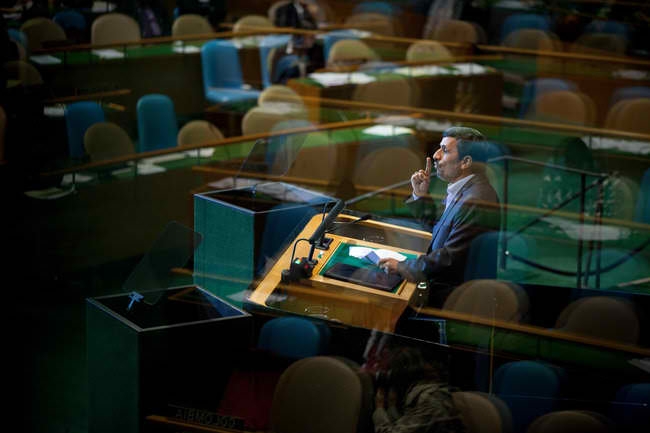
The Iranian leader, whose previous visits to New York have been contentious, generated less interest this year. Though he did inspire protests outside the United Nations and his Midtown Manhattan hotel, his power clashes at home with Iran’s supreme leader, Ayatollah Ali Khamenei, have cast some doubt over the extent of his authority.

That doubt, in turn, has made him personally a less threatening figure, despite significant international concerns about important issues like the possibility that Iran is developing nuclear weapons.