
Showing posts with label immigration. Show all posts

4/27/2020

Greeks in danger

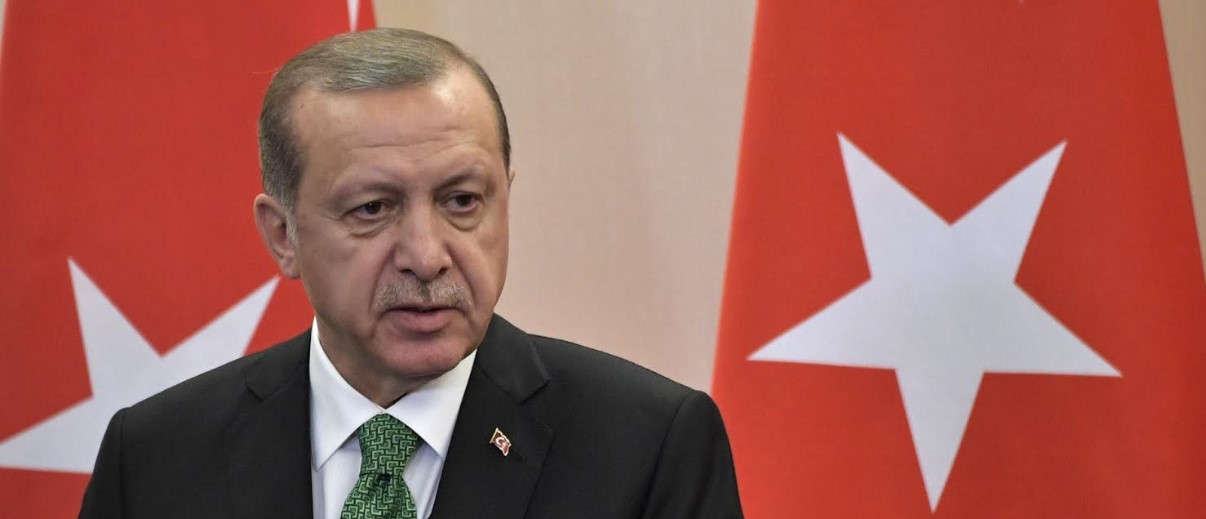
Turkish president Recep Tayyip Erdogan: Will he send illegal migrants to Albania? Photo: The Russian Presidential Press and Information Office
April 26 2020

Albania and Turkey have signed a military cooperation plan, but this document has attracted increased media attention because it is shrouded in secrecy. Albanian media are confident that the leaders of the two countries have agreed to relocate 30 000 Syrian refugees to southern Albania. This news alarmed Greece, since around 120 000 ethnic Greeks live the region known as Northern Epirus.

Athens fears that Ankara and Tirana agreed on such a plan in order to “dilute the national minority in this Albanian region”.

On February 27, 2020, the defense ministers of Albania and Turkey signed a plan for military cooperation but details of the document were not disclosed. It is only known that part of the agreement “includes actions which the ministries of defense of the two countries undertake to carry out in 2020 in order to strengthen and intensify cooperation in the field of security and defense”.

The Albanian, and subsequently the Greek media have claimed that Ankara and Tirana are talking about their intention to accommodate 30 000 “refugees” and illegal migrants in Albania, who are now in Turkey.

News agencies citing sources, claim that the Prime Minister of Albania Edi Rama and Turkish President Recep Tayyip Erdogan agreed on this earlier. At the same time, the area where migrants will be relocated to has also been determined – in Northern Epirus, located on the border of Albania and Greece.

Greece liberated this area during the First Balkan War in 1912–1913, but the international powers decided to give it to Albania, with the same scenario being repeated after the World War II. The region thus remained in Albania.

Greek newspapers reported that Orthodox Greeks in the area “were constantly harassed by Muslims”.

Tensions intensified in the 1990s. Today, there are even fewer Greek schools in the region, “the shops of Greeks are attacked, property is sometimes confiscated by means of a far-fetched pretext, and they are not allowed to conduct religious rites”. In addition, Greeks are discriminated against on a national basis. For example, Greeks can neither serve in the police, the army, nor occupy high positions of state, etc.

Albanian media reported in early March that the construction of six refugee reception centers were being planned on the border with Greece, able to accommodate 30 000 people, as well as first aid centers. It was noted that construction was necessary if ever “Albania faces an influx of Syrian refugees from Greece”.

More information has been leaked since: that “work is being carried out to provide the resettlement of refugees either in rural houses or in new special settlements in the area”. At the same time, the media has been drawing attention to the fact that Tirana has no money for the construction of the corresponding infrastructure.

Albania is still struggling to recover from the earthquake that happened on November 26, 2019.

Additional indirect confirmation of cooperation between Tirana and Ankara, is the fact that, in the background of the Coronavirus pandemic, Albania has banned all international flights to the capital, except flights to and from Istanbul.


Igoumenitsa is the main port in Epirus, and links the Greek region to Italy. Wikipedia

There is no official evidence that Turkey and Albania have entered into a secret agreement. However, the Greek community in Northern Epirus is very concerned about this prospect.

Thodoris Goumas, the editor of the news portal Himara.gr, which is located in one of the biggest Greek towns of Northern Epirus Himara, gave an interview to the Greek newspaper Protothema. He expressed the huge misgivings that both native Greeks and their brethren in Northern Epirus have about the deal between Ankara and Tirana.

“The activities of the Albanian Prime Minister are rather suspicious, rumors do not come out of nowhere. The choice of the Northern Epirus region for resettlement of Muslim refugees means a deliberate provocation against Greece,” Goumas concluded.

Vladimir Avatkov, associate professor at the Diplomatic Academy of the Russian Ministry for Foreign Affairs, noted the existence of rather close ties between Ankara and Tirana and believes that agreements regarding the resettlement of refugees to Albania quite likely exist:

“Turkey is an extremely active player in the Balkans, it proceeds from the fact that Albania, like many other states on this peninsula, is within Turkey’s sphere of influence. Ankara supported Tirana’s entry into NATO. It is through Albania, as well as through some other states of the Balkan peninsula, that Turkey pursues its active policy of influencing Europe.

“Albania is also important from the point of view of the refugee transfer, and for blackmailing Europe with the migration crisis. Turkey proceeds from the fact that it is a world power and is capable of exerting pressure on a number of states, including the developed countries of Europe.

“In addition, despite the fact that some states of the Balkan peninsula have a negative historical perception of Turkey due to the fact that it occupied these lands a while back, some states have close ties with Ankara and carry out functions of a conductor for Turkey.”

Currently, there are 3,6 million refugees in Turkey. In March 2016, Ankara entered into an agreement with Brussels, according to which Turkey agreed to keep migrants out of European countries. In exchange, the EU promised Turkey assistance in supporting refugees, a visa-free regime and a launch of negotiations on accession to the European Union.

However, Erdogan had repeatedly complained that the funds allocated by the European Union are insufficient and, moreover, Brussels does not comply with other conditions of the agreement.

Turkey has repeatedly stated that it is becoming increasingly difficult for the country to cope with the placement of refugees. At the end of February this year, the Turkish authorities announced that they were not going to interfere with the free movement of refugees to Europe. This caused consternation in Greece, which has already suffered a lot due to the migration crisis.


3/05/2016

UN: The situation Greece is faced with is not fair


Πηγή: Independent Balkan News Agency
By Spiros Sideris
March 4 2016

The representative of the UN High Commissioner for Refugees (UNHCR) Melissa Fleming assures that UNHCR “does what it can to help Greece and will do more”, but admits that “it is clear that it will be a very difficult situation”.

What Greece is facing is not fair, stresses in an interview the spokeswoman of the UN High Commissioner for Refugees (UNHCR) Melissa Fleming, while on the new restrictions imposed by some countries in terms of the refugee flows, she notes that “they are very isolationist and not consistent with the spirit of unity and european values” and expresses hope that “this is only temporary measures and that it will change”.

“This is not fair for Greece. It is not a problem that should be a problem of only one country due to its geographical location. This is a problem of the entire European Union, to fight and to show solidarity with all those who bear the heavier burden”, Fleming says.

“We, as United Nations High Commission for Refugees ‘increase the pace’. The High Commissioner met with Prime Minister Tsipras, we have five offices in Greece, a lot of personel and provide any kind of functional help – equipment, tents, specialisation”, she says.

“The problem is that we have proposed many solutions to rid Greece of part of this burden. As there are some European proposals, but now a few states decided to act unilaterally and were not willing to await for constructive proposals which, yes, yhey would have taken a little while longer, but they would have made sense”, she stresses.

Fleming admits once again that “we are facing the worst humanitarian crisis since the Second World War”, with 60 million displaced due to conflict or persecution seeking safe haven, but unfortunately, she says, “the doors are closed and people do not know where to go, as we now see in such a dramatic way in Greece”.

2/29/2016

Media not allowed into Greek migrant camps


Πηγή: eKathimerini
29 Feb 2016


Greek authorities have suspended media access to all migrant registration and transit camps in the country, citing overcrowding in the facilities.

An immigration policy ministry announcement Monday said no permits would be issued for members of the media to visit mainland or island migrant facilities "until further notice."

The ministry said this is due to the large numbers of refugees and migrants at the packed facilities, most of which were only constructed earlier this month.

More than 117,000 migrants have reached Greeces eastern Aegean islands from Turkey so far this year — compared with 4,500 in January and February 2015.

Nearly all head north for Former Yugoslav Republic of Macedonia (FYROM) and the Balkans, but only a few are allowed into FYROM every day. [AP]


5/14/2013

EU commissioner criticizes Greece for refusing Syrians asylum

EU Commissioner for Home Affairs Cecilia Malmstrom
Πηγή: Yahoonews
By Renee Maltezou -Reuters
May 14 2013

The European Union's top immigration official criticized Greece on Tuesday for refusing asylum to Syrian refugees and detaining other migrants that flock to its borders under "unacceptable" conditions.

Greece, the main gateway into the EU for migrants from Asia and the Middle East, arrested more than 8,000 Syrian refugees last year for illegally crossing into the country.

Most hope to make their way to northern Europe, but many have ended up trapped in the financially-ravaged nation where rights groups say they face arrest, detention for long periods and even deportation.

Greece denies deporting Syrian refugees but says it is obliged to detain anyone who crosses it borders illegally.

After meeting Greek Citizen Protection Minister Nikos Dendias in Athens, EU Commissioner for Home Affairs Cecilia Malmstrom said Greece's asylum system is still below EU standards and that access to it is "full of obstacles".

"We can all watch every day atrocities going on in Syria and in all other member countries there is almost 100 percent recognition rate of them as asylum applicants and they are given protection or some temporary permission to stay," she said.

"In Greece it is almost 0 percent. This of course has to change and I've been given assurances by the minister that this will change."

Greece rejected 150 asylum applications from Syrians last year and approved only two, the UN refugee agency has said, when thousands fled a conflict that has claimed 70,000 lives.

Malmstrom added that the Commission would be closely monitoring Greece's progress on this issue.

Greece has made progress by setting up a new asylum system and closing down some of the detention facilities criticized for shocking conditions but still needs to set up thousands of new centers forasylum seekers across the country, Malmstrom said.

"Many regular migrants and asylum seekers are still not treated in a dignified way and are kept under unacceptable conditions," she said. "In many detention centers the conditions there are still inappropriate and detention is applied to everybody without discrimination."

Greece's deep financial crisis has exacerbated its long-running struggle to handle the influx of migrants from Asia and Africa, and rising hostility towards migrants has prompted a surge in attacks against them and helped usher the far-right Golden Dawn party to parliament last year for the first time.


4/25/2013

Switzerland imposes quotas on EU migrants


Πηγή: FT
By James Shotter
April 23 2013

Switzerland has imposed immigration quotas on the rising numbers of European citizens seeking to work there, in a move which threatens to open up another front in the Alpine republic’s array of disputes with the EU.

Switzerland already restricts arrivals from the eight eastern European states which joined the EU in 2004. However, the Federal Council said on Wednesday that, as well as extending those limits for another year from May 1, from June 1 it would also apply restrictions to nationals from other EU states, if certain conditions are met.

The quotas will apply for one year, during which time a limit of 2,180 citizens from the EU8 and 53,700 workers from the rest of the EU will be issued with so-called B-permits, which allow foreigners to work for up to five years in Switzerland.

The federal council said the measures were necessary because net immigration had been running at between 60,000 and 80,000 each year for several years, a significant influx for a nation of just 8m. Nearly a fifth of Switzerland’s inhabitants are now from the EU.

“This constant growth has both positive and negative effects, for example on the economy and the labour market, on the social insurance system, spatial planning, the housing market and infrastructure,” the federal council said. “Today the Federal Council addressed the question of how to deal with the negative consequences of immigration.”

Under an agreement signed in 1999, Swiss and EU nationals are entitled to move freely between the two territories. However, the agreement contains a so-called “safeguard clause” that allows Switzerland to impose quotas if, in a given year, the number of EU arrivals exceeds the average for the three preceding years by at least 10 per cent. This condition is likely to be met at the end of May.

However, the EU was quick to criticise the move, with Lady Ashton, its foreign policy chief, saying that she “regretted” the Swiss government’s decision.

“The measures adopted today by the Swiss government are contrary to the agreement on the Free Movement of Persons, since they differentiate between groups of member states,” she said.

The Swiss business lobby, Economiesuisse, acknowledged that popular concerns about the impact of high immigration could not be ignored, but urged the Swiss government to strive to prevent the quotas doing further damage to Switzerland’s difficult relations with the EU.

For several years, the EU has been ratcheting up the pressure on Switzerland to deal with the billions of euros of untaxed money thought to be managed by its banks. This year relations have been strained further, as the bloc has also pushed Switzerland to reform the low tax rates it offers multinational companies.

In addition to its concerns about the impact on bilateral relations, Economiesuisse also warned the Swiss government that the restrictions could hurt the country’s businesses.

“For businesses, peripheral regions, and farmers, this decision has big implications. Against an economic backdrop which continues to to be difficult, and given the shortage of skilled employees, these groups depend on an open labour market and will now have to reckon with hiring problems,” the lobby group said.

The Federal Council said that it was aware the safeguard clause was “only an effective instrument in the short term” and conceded that further measures would be required that have a long-term impact.

2/04/2013

Greece swamped by illegals from North Africa, Mideast

Christos P. Panagopoulos
Πηγή: Washington Times
By Shaun Waterman
Feb 3 2013

Greece has been hit by a “devastating” wave of illegal immigration from chaos induced by Arab Spring uprisings in North Africa and continued instability in South and Central Asia, according to Athens’ Ambassador to the United States Christos P. Panagopoulos.

“For a country of 10.11 million, to have 1 million [immigrants], most of them illegal in a period of hardship and economic crisis, it’s devastating,” he told editors and reporters of The Washington Times.

Greece, also suffering from economic upheaval because of a huge national debt, has imposed stiff austerity measures, precipitating a recession that has left the country with an unemployment rate of more than 25 percent and public unrest.

Mr. Panagopoulos said most of the illegal immigrants came from countries in “destabilized regions,” like Pakistan, Afghanistan and more recently Libya and Syria, the latter engulfed in a 23-month-long civil war. Most entered Greece across the short land border or long, island-dappled maritime frontier with Turkey.

“Unfortunately, our Turkish friends are not very cooperative on this issue,” he said.


Turkey had sought to link cooperation on border enforcement against third-country nationals to what the ambassador called the “unrelated” issue of visa-free travel into Greece by Turkish citizens, leading to an impasse on the question.

“Most of these people,” Mr. Panagopoulos said of the illegal entrants, do not see Greece as their final destination.

“They are not [aiming to stay in] Greece because they know there is an economic crisis [there.] They use Greece as a transit [point] to other European countries … and eventually to Germany, which is where most of them hope to get to,” he said.

But the ambassador said that barriers such as the Balkan mountains to the north and border control agents on the ferries to Italy block their goal of reaching Germany.

“Ninety-nine percent, they stay in Greece,” he said.

Because many claimed asylum under international refugee conventions, they cannot be legally deported without a lengthy and expensive legal process. While they remain, Mr. Panagopoulos said, “They have needs” for food, shelter and clothing.

“Under the current circumstances, Greece cannot afford this burden by itself,” he said, adding that Greece has raised the issue with European Union officials.

“Up to now — let me say cynically — that we get all the good words; but when it comes to practical measures, we don’t have that much support,” he said of Greece’s EU partners.

Greece has also failed to persuade other European nations that the wave of illegal immigration is also their problem.

“If you reside in France or the Nordic countries, you will think, ‘Oh, it’s a bad thing, but it doesn’t affect me,’” he said.

More than 22,000 people were caught trying to cross into the European Union in the last three months of 2012, with nearly 9,000 of them attempting to come through the Greek-Turkish frontier, according to the EU border-control agency Frontex.

Analysts generally say that cross-border apprehensions are an imperfect measure of illegal migration, because the number excludes those who successfully sneak across. But most agree it is one of the better measures available, at least to detect trends.

Mr. Panagopoulos said up to 300 people every day successfully cross the Turkish border into Greece illegally, calling the number the equivalent of the population of a small Greek village.

“It is a village every single day,” he said. “It’s devastating for a small country such as ours

According to Frontex, the most common nationalities caught trying to enter the EU in the first half of 2012 were Afghans, Algerians, Bangladeshis and Pakistanis. But later in the year, Frontex detected a huge jump in the number of immigrants from Syria.

“Some of them are coming as a result of the aftermath of the Arab Spring,” the ambassador said.

12/05/2012

Irregular migrants stuck in Greece are also the European Union’s responsibility, says UN expert

François Crépeau (Canada) was appointed Special Rapporteur on the human rights of migrants in June 2011 by the UN Human Rights Council

Πηγή: UNHR
Dec 3 2021

ATHENS / GENEVA (3 December 2012) – The United Nations Special Rapporteur on the human rights of migrants, François Crépeau, stressed today that the plight of the growing number of irregular migrants trapped in Greece on their way to other European Union destinations requires a EU-wide approach focused on human rights. He also urged the Greek Government to step up its efforts to ensure that the rights of all migrants within its territory are fully respected.

“As the large number of irregular migrants stuck in Greece is mainly a result of EU policies and practices, there is a strong need for solidarity and responsibility-sharing within the EU in order to ensure full respect of the human rights of all these migrants,” Mr. Crépeau said at the end of his visit* to Greece, as part of his yearlong study on the management of the EU external borders, which has already taken him to Brussels, Tunisia, Turkey and Italy earlier this year.

During his visit, many Greek interlocutors expressed to him dismay at the reluctance of other EU countries at taking on a number of migrants stuck in Greece with little possibility of being returned home, and little chance of being integrated in the local labour market and society, given the economic crisis the country is going through. However, he said, “while the role of the EU in managing the migration flows in Greece is crucial, the Greek government also needs to adopt and implement a comprehensive migration policy which has the human rights of migrants as its framework.”

“I urge the Greek authorities to undertake all the necessary measures to combat discrimination against migrants,” he said. “I am deeply concerned about the widespread xenophobic violence and attacks against migrants in Greece, and I strongly condemn the inadequate response by the law enforcement agencies to curb this violence, and to punish those responsible.”

Mr. Crépeau drew special attention to the Greek government’s new policy of systematically detaining everyone they detect irregularly entering the Greek territory, including unaccompanied children and families. “There does not seem to exist a clear, coherent strategy as to what to do with irregular migrants who are not clearly and easily deportable,” the rights expert said.

Unaccompanied or separated migrant children are often released from detention, without any particular status, and without the appointment of a guardian, even though the public prosecutor is supposed to appoint guardians to all unaccompanied children. “I met migrant children who lived in abandoned buildings or under highway overpasses, without any proper status and without any institutional support apart from the action of some civil society organisations,” Mr. Crépeau said.

“It is contrary to the human rights framework to pursue a policy that leaves individuals in a state of legal limbo such that one cannot build a future of any kind and can only live day after day at a level of precarious survival, in constant fear of arrest, detention and deportation,” he underscored.

The expert acknowledged the EU’s extensive support to the Greek authorities in the realisation of their Action Plan on Migration and Asylum, and commended the Greek authorities for the plans regarding the future civilian asylum service and first reception service.

For the UN Special Rapporteur, such measures could effectively quickly screen in migrants with vulnerabilities, such as asylum seekers, children, migrants with illnesses or disabilities, victims of trafficking, victims of violence, persons in need of family reunification, if properly implemented. They would help reduce the hardship experienced at present by many migrants by allowing individual assessment of migrants for whom detention is necessary and the reasons why it is necessary, and the release all the other migrants with an appropriate status.

“I am concerned however by the lack of appropriate staffing and budget yet dedicated to these two services, and I urge the Greek government and the EU to work together in order to ensure their swift operationalization,” the Special Rapporteur said.

During his 9-day visit, the expert visited Athens, the Evros region bordering Turkey, the Aegean island of Lesvos, and the western port city of Patras. He met with Government representatives, civil society organisations, international organisations, the EU’s representation in Greece, as well as migrants themselves, including in detention centres.

The study, launched by the UN Special Rapporteur on the human rights of migrants, will result in a special report which will be presented to the UN Human Rights Council in June 2013.


7/15/2012

For Illegal Immigrants, Greek Border Offers a Back Door to Europe

Shamzur Rahmat, 17, and other Afghans who earn $40 a week in Istanbul. Many are saving to pay smugglers to get them into Greece. 

Πηγή: New York Times
By J. MICHAEL KENNEDY
July 14 2012

ALEXANDROUPOLIS, Greece — At the train station here, an unshaven man with a weary look leaned against the brick wall of a building, taking in the morning sun.

He said that his name was Zulifoar Baht; that he was 38, from Pakistan; and that his train for Athens would not arrive until midafternoon. So there was nothing to do but wait, along with a dozen or so other illegal immigrants who had finally made it into Greece from Turkey, crossing one of the most porous borders in Europe.

The 126-mile border between Turkey, which is not in the European Union, and Greece, which is, has become the back door to the European Union, making member countries ever more resentful as a tide of immigrants from the Middle East, South Asia and Africa continues to grow.Frontex, the European Union’s border policing agency, estimated that a vast majority of the crossings in 2011 occurred at the Greece-Turkey border. Last year, Frontex said, more than 55,000 people crossed the border, a 17 percent rise from the year before.

The flow has raised tensions throughout Europe, to the point where the top French official responsible for immigration seriously suggested that a wall be built along the entire border. In Greece, one person in 20 is estimated to be here illegally, at a time when the country is sinking in debt, the far right is making political gains and instances of knife-wielding vigilantes taking out their frustrations on immigrants are becoming increasingly common.

Zarif Bakhtyri, 28, a wiry, streetwise playwright and aspiring film director, said he fled Afghanistan in 2006 after rankling the authorities by writing and directing a play that criticized polygamy. Mr. Bakhtyri’s story is a familiar one — making it to Greece, where he was jailed and then released, then moving along a route that led him to Italy, Norway, Sweden, and back to Greece in 2010 because it was his point of entry.

He, like many others, has been trapped in Greece’s backlogged refugee system, the result, in part, of a longtime European Union rule that stipulated an asylum petition must originate in the first country the immigrant entered. That changed in January 2011, when the European Court of Human Rights ruled that sending asylum seekers back to Greece could infringe on their fundamental rights because the Greek system had become so saturated and living conditions were so poor.

The increase in illegal immigrants in Greece has created support for the extreme-right Golden Dawn party, which has vowed to rid Greece of foreigners who enter the country illegally. Even the country’s mainstream parties have taken a harder line, though the Greek government is widely derided as inept in its efforts to police the border.

Athens is building a $7.3 million fence on the Turkish border to close off the short land crossing between the two countries, but few expect it to stem the flow. In rejecting a request from Greece to help pay for the fence, the European Commission described it as “pointless.”

The last hurdle to Greece is the Evros River Valley, beginning in the north at the Turkish city of Edirne, once the capital of the Ottoman Empire. To the south, on the Greek side, farms sometimes abut barbed-wire fencing, with signs warning of minefields along the dirt roads adjacent to cornfields. Villagers along the border talk of immigrants emerging from the river, wet and cold, as they begin their trek toward Athens.

But the last staging area for most immigrants is really Istanbul, the teeming Turkish city that is a magnet for those who have often walked for months through the wilds of Afghanistan, Pakistan and Iran.

Turkey has come under criticism because of its liberal visa requirements, which make it easy for immigrants to legally enter the country and then move on. Citizens of Kazakhstan, Kyrgyzstan, Syria and Iran, among many other nations, do not need a visa to enter the country.

Once in Turkey, they share crowded apartments and try to find work and save enough to pay smugglers for false papers and passage across the border.

In the cluttered cellar of a dingy Istanbul garment factory, Mustafa Mirzaie, 18, worked with his friend Hussein Rezaie to repair a sink. Both are from Afghanistan, a major source of refugees trying to make their way to Europe. Last winter, they walked for 24 hours over the frigid mountains of Iran into eastern Turkey. Now they do odd jobs to sustain themselves until moving on.

“It’s a difficult way, but it’s the only choice we have,” Mr. Mirzaie said. “I’ll work here and find a smuggler. We have no choice.”

Immigrants in Istanbul often find themselves stuck on a financial treadmill, barely able to meet their basic living expenses. One 17-year-old Afghan named Shamsollah lives and works in a basement sweatshop. He says he will need about $5,000 for the next stage of the journey, though he makes only about $250 a month — just enough to cover expenses.

“Istanbul is very big and very expensive,” Shamsollah said. “I have $1,500 now. But that is not enough for me. I don’t want to stay in Greece without money. There is no work in Greece.”

Sitting at an outdoor cafe recently in one of Istanbul’s poor neighborhoods, a smuggler named Mustafa talked about how he operated his business.

He takes 16 people at a time by van from Istanbul to the border, where his customers walk for an hour to the Evros River and then float across on rubber rafts. He charges $1,000 a person for the three-hour journey. He said he tells his clients not to fear being caught on the Greek side of the border.

“I say to my passengers don’t worry because they don’t want to deport them,” he said. “They just want to register you and take money from the United Nations.”

Sometimes, though, the journey is just too hard. There is a small but growing number of people who have made it to Greece, but returned to Turkey.

Earlier this year, on a windy day in Istanbul, Mustafa and Ali, two 17-year-old Afghan refugees, stood shivering in a park on the Marmara Sea. They had made it to Alexandroupolis but had run out of money. So they returned to Istanbul.

Their only possessions were the shoes, pants and T-shirts they wore. They had waited for hours for an Istanbul contact, but he had not shown up. Without papers, they were afraid even to leave the park and look for help.

And so they sat there, looking out on the sea, wondering what they would do next.


7/04/2012

Cameron vows to bar Greek influx


Πηγή: FT
By Jim Pickard
July 3 2012

Britain would be prepared to close its borders to immigrants from Greece if that country was ejected from the eurozone, David Cameron has said.

The prime minister revealed that the government was “prepared to do what it takes” to prevent a large influx of Greeks coming to Britain to escape the financial downturn in their own country.

Mr Cameron made clear that such restrictions would only be imposed in the event of “extraordinary stresses” on the system. But his comments came as a surprise because EU nationals are usually entitled to work anywhere in the single market without restrictions.

“We obviously have contingency plans for all sorts of eventualities . . . the legal position is that if there are extraordinary stresses and strains, it is possible to take action to restrict migratory flows,” he said in evidence to the liaison committee of MPs. “Obviously we hope that doesn’t happen . . . I would be prepared to do what it takes.”

Such fears centre on the prospect of a further spike in Greek unemployment which could force large numbers of people to seek work elsewhere in the EU.

In May, the Home Office admitted it was planning for the potential for a large increase in immigration from not only Greece but also other EU nations because of the eurozone crisis.

Theresa May, home secretary, said at the time that work was ongoing to tackle large movements of people if the eurozone broke up in the coming months or years.

Officials are already studying data to see whether immigration from beleaguered European countries has increased, according to Ms May, although she admitted that there was not yet any evidence of increased migration.

Speaking to the liaison committee, Mr Cameron said closer political and fiscal union between eurozone nations would be a positive outcome for the British economy if it helped to damp down the eurozone crisis. Yet those countries would have to make some “very difficult decisions about giving up sovereignty . . . and areas of their democracy”.

He repeated his line that it was too early to seek a referendum on Britain’s relationship with Europe given that the EU was set for rapid change in the coming months. Stating that “big change” was happening on the continent, he said it was essential for the UK to show “tactical and strategic patience” until the current crisis had fully played out.

Tacitly admitting that the tightening eurozone bloc of 17 single currency nations could threaten Britain’s interests, he added: “The key thing here is obviously making your case with vigour and defending your interests, but it’s also about building alliances.”

Mr Cameron raised the hopes of his own eurosceptic backbenchers at the weekend by indicating that he was not opposed to a referendum on the terms of Britain’s membership of the EU, although he said he was opposed to a simple “in-out” vote.

On Tuesday, he argued that a new EU treaty could be agreed without a referendum in the UK, so long as it did not pass powers from Westminster to Brussels.

He also refused to say when the government’s proposed “audit” of the UK’s relationship with the EU would go ahead. Although he hoped it would begin before the summer, it was necessary to achieve Lib Dem agreement before its launch, he emphasised.


9/29/2011

Companies Use Immigration Crackdown to Turn a Profit

The Woomera Detention Center, in Australia, was the scene of a detainee breakout in 2002.


Πηγή: New York Times
By Nina Bernstein
Sep 28 2011


The men showed up in a small town in Australia’s outback early last year, offering top dollar for all available lodgings. Within days, their company, Serco, was flying in recruits from as far away as London, and busing them from trailers to work 12-hour shifts as guards in a remote camp where immigrants seeking asylum are indefinitely detained.

It was just a small part of a pattern on three continents where a handful of multinational security companies have been turning crackdowns on immigration into a growing global industry.

Especially in Britain, the United States and Australia, governments of different stripes have increasingly looked to such companies to expand detention and show voters they are enforcing tougher immigration laws.

Some of the companies are huge — one is among the largest private employers in the world — and they say they are meeting demand faster and less expensively than the public sector could.

But the ballooning of privatized detention has been accompanied by scathing inspection reports, lawsuits and the documentation of widespread abuse and neglect, sometimes lethal. Human rights groups say detention has neither worked as a deterrent nor speeded deportation, as governments contend, and some worry about the creation of a “detention-industrial complex” with a momentum of its own.

“They’re very good at the glossy brochure,” said Kaye Bernard, general secretary of the union of detention workers on the Australian territory of Christmas Island, where riots erupted this year between asylum seekers and guards. “On the ground, it’s almost laughable, the chaos and the inability to function.”

Private prisons in the United States have long stirred controversy. But while there have been conflicting studies about their costs and benefits, no systematic comparisons exist for immigration detention, say scholars like Matthew J. Gibney, a political scientist at the University of Oxford who tracks immigration systems.

Still, Mr. Gibney and others say the pitfalls of outsourcing immigration enforcement have become evident in the past 15 years. “When something goes wrong — a death, an escape — the government can blame it on a kind of market failure instead of an accountability failure,” he said.

In the United States — with almost 400,000 annual detentions in 2010, up from 280,000 in 2005 — private companies now control nearly half of all detention beds, compared with only 8 percent in state and federal prisons, according to government figures. In Britain, 7 of 11 detention centers and most short-term holding places for immigrants are run by for-profit contractors.

No country has more completely outsourced immigration enforcement, with more troubled results, than Australia. Under unusually severe mandatory detention laws, the system has been run by a succession of three publicly traded companies since 1998. All three are now major players in the international business of locking up and transporting unwanted foreigners.

The first, the Florida-based prison company GEO Group, lost its Australia contract in 2003 amid a commission’s findings that detained children were subjected to cruel treatment. An Australian government audit reported that the contract had not delivered “value-for-money.” In the United States, GEO controls 7,000 of 32,000 detention beds.

The second company, G4S, an Anglo-Danish security conglomerate with more than 600,000 employees in 125 countries, was faulted for lethal neglect and abusive use of solitary confinement in Australia. By the middle of the past decade, after refugee children had sewed their lips together during hunger strikes in camps like Woomera and Curtin, and government commissions discovered that Australian citizens and legal residents were being wrongly detained and deported, protests pushed the Liberal Party government to dismantle some aspects of the system.

But after promising to return the work to the public sector, a Labor government awarded a five-year, $370 million contract to Serco in 2009. The value of the contract has since soared beyond $756 million as detention sites quadrupled, to 24, and the number of detainees ballooned to 6,700 from 1,000.

Dangerous Problems

Over the past year, riots, fires and suicidal protests left millions of dollars in damage at Serco-run centers from Christmas Island to Villawood, outside Sydney, and self-harm by detainees rose twelvefold, government documents show. In August, a government inspection report cited dangerous overcrowding, inadequate and ill-trained staff, no crisis planning and no requirement that Serco add employees when population exceeded capacity.

At the detention center Serco runs in Villawood, immigrants spoke of long, open-ended detentions making them crazy. Alwy Fadhel, 33, an Indonesian Christian who said he needed asylum from Islamic persecution, had long black hair coming out in clumps after being held for more than three years, in and out of solitary confinement.

“We talk to ourselves,” Mr. Fadhel said. “We talk to the mirror; we talk to the wall.”

Naomi Leong, a shy 9-year-old, was born in the detention camp. For more than three years, at a cost of about $380,000, she and her mother were held behind its barbed wire. Psychiatrists said Naomi was growing up mute, banging her head against the walls while her mother, Virginia Leong, a Malaysian citizen accused of trying to use a false passport, sank into depression.

Naomi and her mother became a cause célèbre in protests against the mandatory detention system, leading to their release in 2005 on rare humanitarian visas. They are now citizens.

“I come here to give little bit of hope to the people,” Ms. Leong said during a recent visit to Villawood, where posters display the governing principles of Serco, beginning with “We foster an entrepreneurial culture.”

Free-Market Solutions

Companies often say that losing a contract is the ultimate accountability.

“We are acutely aware of our responsibilities and are committed to the humane, fair and decent treatment of all those in our care,” a Serco spokesman said in an e-mail. “We will continue to work with our customers around the world and seek to improve the services we provide for them.”

But lost detention contracts are rare and easily replaced in this fast-growing business. Serco’s $10 billion portfolio includes many other businesses, from air traffic control and visa processing in the United States, to nuclear weapons maintenance, video surveillance and welfare-to-work programs in Britain, where it also operates several prisons and two “immigration removal centers.”

“If one area or territory slows down, we can move where the growth is,” Christopher Hyman, Serco’s chief executive, told investors last year, after reporting a 35 percent increase in profits. This spring, Serco reported a 13 percent profit rise.

Its rival G4S delivers cash to banks on most continents, runs airport security in 80 countries and has 1,500 employees in immigration enforcement in Britain, the Netherlands and the United States, where its services include escorting illegal border-crossers back to Mexico for the Department of Homeland Security.

Nick Buckles, the chief executive of G4S, would not discuss the company. But last year he told analysts how its “justice” business in the Netherlands blossomed in one week after the 2002 assassination of a politician with an anti-immigrant and law-and-order agenda.

“There’s nothing like a political crisis to stimulate a bit of change,” Mr. Buckles said.

In Britain last fall, the company came under criminal investigation in the asphyxiation of an Angolan man who died as three G4S escorts held him down on a British Airways flight. Soon afterward, British immigration authorities announced that the company had lost its bid to renew a $48 million deportation escort contract because it was underbid by a competitor.

Even so, G4S has more than $1.1 billion in government contracts in Britain, a spokesman said, only about $126 million from the immigration authority. It quickly replaced the lost revenue with contracts to build, lease and run more police jails and prisons.

In 2007, Western Australia’s Human Rights Commission found that G4S drivers had ignored the cries of detainees locked in a scorching van, leaving them so dehydrated that one drank his own urine. The company was ordered to pay $500,000 for inhumane treatment, but three of the five victims already had been deported. Immigration officials, relying on company misinformation, had dismissed their complaints without investigation, the commission found.

There was a public outcry when an Aborigine man died in another G4S van in similar circumstances the next year. A coroner ruled in 2009 that G4S, the drivers and the government shared the blame. The company was later awarded a $70 million, five-year prisoner transport contract in another state, Victoria, without competition.

G4S pleaded guilty to negligence in the van death this year, and was fined $285,000. Mr. Buckles, its chief executive, alluded to the case at a meeting with analysts in March, reassuring them.

“There is only two or three major players, typically sometimes only two people bidding,” Mr. Buckles said. “In time, we will become a winner in that market because there’s a lot of outsourcing opportunities and not many competitors.”

In August, when GEO, the Florida prison company, posted a 40 percent rise in second-quarter profits, its executives in Boca Raton spoke of new immigration business on both sides of the Atlantic.
John M. Hurley, a GEO executive for North American operations, cited “the continued growth in the criminal alien population,” larger facilities, and longer federal contracts, some up to 20 years.

At the company’s Reeves County Detention Center in Texas, immigrant inmates rioted in 2009 and 2010 after several detainees died in solitary confinement. GEO executives declined to comment. But speaking to shareholders, they credited much of the quarter’s $10 million increase in international revenue to the expansion of a detention center in Britain, where immigration was a hot issue in the 2010 election.

A Policy Backfires

“Britain is no longer a soft touch,” Damian Green, the immigration minister, said in August 2010 when he visited the center, near Heathrow Airport, reopening wings that had burned in 2006 during detainee riots under a different private operator.

The riots started the day the chief inspector of prisons released a blistering report about abuses there, including excessive waits for deportation. Months after Mr. Green’s appearance, an independent monitoring board complained that at the expanded center — now Europe’s largest, with 610 detainees — at least 35 men had been waiting more than a year to be deported, including one locked up for three years and seven months at a cost of at least $237,000.

The camp that Serco took over in the Australian outback, the Curtin Immigration Detention Center, had also been shut down amid riots and hunger strikes in 2002. But it was reopened last year to handle a surge of asylum seekers arriving by boat even as the government imposed a moratorium on processing their claims. Refurbished for 300 men, the camp sits on an old air force base and held more than 1,500 detainees in huts and tents behind an electrified fence. Serco guards likened the compound to a free-range chicken farm.

On March 28, a 19-year-old Afghan from a group persecuted by the Taliban hanged himself after 10 months’ detention — the system’s fifth suicide in seven months. A dozen guards, short of sleep and training, found themselves battling hundreds of grieving, angry detainees for the teenager’s body.

“We have lost control,” said Richard Harding, who served for a decade as Western Australia’s chief prison inspector. He is no enemy of privatization, and his praise for a Serco-run prison is posted on the company’s Web site. But he said Curtin today was emblematic of “a flawed arrangement that’s going to go wrong no matter who’s running it.”

“These big global companies, in relation to specific activities, are more powerful than the governments they’re dealing with,” he added.