FACTDROP

860137_cda0d3b5c72f4e0b98e952b9f2227b18~mv2.gif

Pages

  • Home
  • Reports
  • Art
  • Podcasts
Showing posts with label Hollande. Show all posts

5/18/2013

France Calls For Establishment of Eurozone Government


Πηγή: Economy Watch
May 17 2013

French president Francois Hollande on Thursday called for a eurozone-wide “economic government”, with its own budget and full-time president as well as a harmonised tax system, as a step to deepen integration in the increasingly divided currency bloc.

With the appointed president, the proposed eurozone government would meet monthly to shed light on key economic developments in the unified bloc, said Hollande, who marked his first year in office as the most unpopular president in modern French history.

The French proposal, which Hollande said he would submit to his eurozone partners, also calls for much deeper fiscal integration between the eurozone nations, with a common budget and the authority to issue debt. The government would also debate the main political and economic decisions to be taken by member states and launch a battle against tax fraud.

"It is my responsibility as the leader of a founder member of the European Union...to pull Europe out of this torpor that has gripped it, and to reduce people's disenchantment with it," he said. "If Europe stays in the state that it is now, it could be the end of the project."

He acknowledged he could face resistance from Germany, Europe's paymaster, which opposes mutualising debt among member states. Berlin is also reluctant to give the eurozone its own secretariat for fear of deepening division in the European Union, between the 17 members of the single currency and the 10 others.

Instead, members have committed to much closer coordination of budget policies as well as the establishment of a centralised banking supervisor for the region.

Speaking at a separate event before Hollande announced his initiative, German Chancellor Angela Merkel said she may not have a "bosom friendship" with her French counterpart, but her working relationship with Hollande was strong and crucial for Europe.
"Living in an open society we must have nuances between conflict and bosom friendship. It seems there is nothing between the two - but the reality is different," Merkel told a conference on Europe in Berlin.
Promising to lead the bloc towards a fully-fledged “political union” – implying EU treaty change – within two years, Hollande added:

Germany has several times said it is ready for political union, for a new phase in integration. Well France is ready to give body to this political union and gives itself two years to do so … It is a question of European urgency.

Hollande’s comments come a day after official data showed that France had fallen back into recession in the first quarter of this year and for the third time since 2008.

Critics say Hollande has been slow to tackle France’s job crisis which has seen unemployment hit 10 percent – its highest since records began in 1996 – as well as failing to bring the budget deficit back under 3 percent of GDP.

Brussels has since given Paris two extra years to bring its deficit in line with EU targets, but in return it is demanding tougher reform of the French welfare state and high public spending.


0 comments
Email ThisBlogThis!Share to XShare to FacebookShare to Pinterest
Labels: eurozone, France, Hollande

1/19/2013

Stakes for France Are High as Hollande Continues an Intervention in Mali

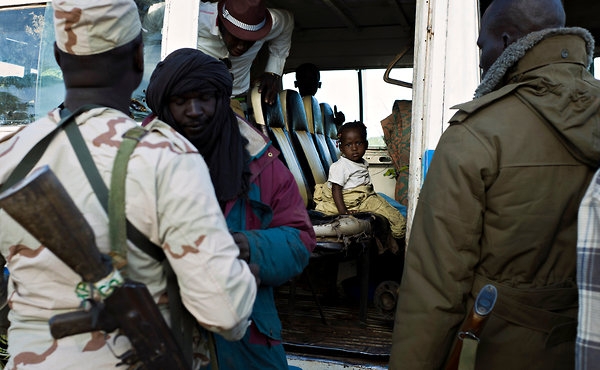
Malian Army soldiers ran a checkpoint in Nioni on Friday. Officials said that 1,800 French troops were in Mali, with more coming.
Πηγή: New York Times
By STEVEN ERLANGER
Jan 18 2013

PARIS — This was not the war President François Hollande wanted.

In just two hours last Thursday, after a plea for help from Mali’s interim president, Dioncounda Traoré, Mr. Hollande decided to send in French warplanes and ground troops.

It was supposed to be a quick and dramatic blow that would send the Islamists scurrying back to their hide-outs in northern Mali, buying time for the deployment of an African force to stabilize the situation. Instead it is turning into what looks like a complex and drawn-out military and diplomatic operation that Mr. Hollande’s critics are already calling a desert version of a quagmire, like Vietnam or Afghanistan.

Some here speak of Mr. Hollande’s “Sahelistan.” Valéry Giscard d’Estaing, the former French president, reminded Mr. Hollande of “the danger of a military operation without a clear enemy, with the risk to civilians that is bound to engender hostility among the citizens.” He warned of “neocolonialism.”

Mr. Hollande, who has a reputation for indecisiveness, has certainly taken on a difficult task. The French are fighting to preserve the integrity of a country that is divided in half, of a state that is broken. They are fighting for the survival of an interim government with no democratic legitimacy that took power in the aftermath of a coup.

But Mr. Traoré, 70, does represent the internationally recognized government of Mali, said a senior French official, shrugging. And then, like every French official on the topic, he asked a questioner to imagine the alternative — “another Somalia” on the western edge of Africa, lawless and dominated by Islamic radicals close to Al Qaeda in the Islamic Maghreb, who would set about instituting the harshness of Shariah law all over Mali, stoning adulterers and cutting off the hands of thieves, while engaging in the drug and arms smuggling, kidnapping and terrorism that funds their notion of jihad.

That prospect, the officials insist, is why the entire region, including Algeria, has supported the French intervention, which was also backed by the Security Council. The French initiative has also had public support, if provoking quiet concern about overreaching, from allies like the United States and Britain.

It was not supposed to be this way, French officials and experts acknowledge. Sometime in the autumn, under United Nations Security Council Resolution 2085, African troops from the Economic Community of West African States, or Ecowas, together with a retrained and reinspired Malian Army, were supposed to take back the north of the country. Those African forces were to be trained with the help of the European Union and guided in their mission by French forces in an advisory capacity, with the United States helping to provide financing and airborne reconnaissance, intelligence, air transport and air-to-air refueling.

France was supposed to have a largely civilian role, not itself engaged in fighting and with no troops on the ground. Ecowas and the Malians were supposed to fight their way into northern Mali and clear it of Islamists.

Just 10 days ago, before Mr. Hollande’s sudden action, a senior adviser at the Élysée described how slowly the Mali operation was going. He described the difficulties with Ecowas, with squabbles over financing, training and transporting Ecowas troops, and how hard it had been to get Washington, after the Libyan civil war, to pay attention to a deteriorating situation in Mali and the risks of Islamic terrorism spreading in the Sahel.

The Americans finally started listening to French concerns last September, he said, but had their doubts about how easy it would be to drive the Islamists out of the vastness of northern Mali. And Washington did not consider the Ecowas plan to be well conceived.

The Islamist rebels chose not to wait around, of course, launching their push to the south and prompting French intervention in a singularly leading role. With 1,800 troops now in Mali and a projected total of 2,500, the French do not need help on the ground, officials insist. But they are pushing Washington to move more quickly through the interagency process to provide reconnaissance drones, air transport planes and refueling planes. European and NATO allies like Britain have already moved to help, with the British quickly providing two C-17 transport planes to move troops and equipment.

On Friday, Prime Minister David Cameron of Britain gave explicit support to France and an implicit push to Washington and European allies to do more in West Africa to fight radical Islamic terrorism. “Those who believe that there is a terrorist, extremist Al Qaeda problem in parts of North Africa, but that it is a problem for those places and we can somehow back off and ignore it, are profoundly wrong,” he told Parliament.

Mr. Cameron called the Algerian drama a warning. “What we know is that the terrorist threat in the Sahel comes from Al Qaeda in the Islamic Maghreb, which aspires to establish Islamic law across the Sahel and northern Africa, and to attack Western interests in the region and frankly, wherever it can,” Mr. Cameron said in words that will please Paris. “Just as we have reduced the scale of the Al Qaeda threat in other parts of the world, including in Pakistan and Afghanistan, so it has grown in other parts of the world. We need to be equally concerned about that, and equally focused on it.”

Most experts think that the French, even if they drive the Islamists out of major populated areas in the north of Mali, will not move in force throughout the vast desert. The French still mean to prepare the ground for Ecowas and Malian troops, to create the stability that can allow new political negotiations on Mali’s future.

Mali will only succeed, French officials say, if the state is reconfigured, with significantly more autonomy for the Tuaregs in the north, who have long wanted their independence, and rebuilt governmental institutions and legitimacy. That of course will take some time, even if it is done under the auspices of Ecowas or the United Nations.

Camille Grand, a defense expert and director of the Foundation for Strategic Research in Paris, said the French objective is “to return to the status quo ante, where those Islamist groups are cornered in the gray zones on the borders, with limited ability to act and not controlling population centers, where it is difficult for them to make raids or take hostages.”

Those goals, he said, are “definitely something that makes sense from a military standpoint. But “if the ultimate objective is to eradicate the presence of radical Islam in the Sahel,” he warned, “it probably won’t happen; it’s a bridge too far for anyone.”

In all likelihood, Paris is not that ambitious. But Mr. Hollande’s critics worry that he may already have gotten himself in deeper than he planned, or even realizes. In a column Friday in Le Monde, Natalie Nougayrède wrote that the French endgame is unclear. “In launching itself militarily in the front line, France also takes on a responsibility” for the reconstruction of the state, she said. “The after-intervention — we have seen it elsewhere in the world — is the true headache of interventions. The ultimate test will be there.”


0 comments
Email ThisBlogThis!Share to XShare to FacebookShare to Pinterest
Labels: Algeria, France, Hollande, Islamists, Mali, UN

9/13/2012

BAE puts conditions on EADS talks


Πηγή: FT
By Carola Hoyos, Andrew Parker and David Oakley
Sept 13 2012

BAE Systems has warned EADS that it will walk away from merger talks unless the combined European champion in aerospace and defence was allowed to operate as a normal company without political interference.

BAE is also insisting that the combined entity’s defence business would have to be based in the UK if the plan, news of which was leaked on Wednesday before the structure was finalised, is to go ahead.

The management of EADS has indicated it would be willing to de-politicise the company, but it remains far from certain that Paris, in particular, and Berlin would agree to give up their strategic stakes.

The uncertainty over the fate of the deal as well as the lack of clarity on possible cost-savings and strategy prompted deep investor scepticism. Shares in EADS fell 10.2 per cent to €25.2 and BAE dropped 7.3 per cent to 337.1p.

In hastily arranged conference calls, several major BAE investors expressed concerns over the tie-up. They warned that they would become sellers if BAE was unable to shed more light on its long-term dividend policy and the degree of French and German influence over the merged entity.

People close to BAE said the company would give up on the deal if it did not create a commercial company, with a balanced board, free of political influence. The UK-based company’s talks with EADS which started in March came after BAE considered a combination with Northrop Grumman of the US or a tie-up with engine maker Rolls-Royce. Neither however was as attractive as a deal with EADS, which would give BAE a strong balance sheet and a diversified portfolio in defence and civil aerospace, one person close to BAE said.

BAE and many analysts see the French government as the biggest potential obstacle in the way of the deal. However, both companies, believe Francois Hollande, the socialist president, could be more amenable to a deal than his predecessor, Nicolas Sarkozy, a close ally of Dassault, BAE’s and EADS’s fiercest French competitor.

Tom Enders, who became chief executive of EADS in May, wants to use the deal to reduce the level of political influence of the French and German governments, whose involvement has lost EADS contracts and dictated key executive appointments, said people close to the company.

The French and German governments each effectively control 22.5 per cent of EADS, but Mr Enders wants their shareholdings in the combined entity to fall below 10 per cent.

EADS is proposing that the French, German and UK governments would each have a golden share, allowing them to block hostile takeovers but no additional veto rights.


0 comments
Email ThisBlogThis!Share to XShare to FacebookShare to Pinterest
Labels: BAE, EADS, Europe, France, Hollande

8/24/2012

Europeans to Debate Further Aid for Greece


Πηγή: New York Times
By STEVEN ERLANGER
August 23 2012

PARIS — Vacation is over early this year in the euro zone, withGreece and its shaky future back on the table and Spain waiting in the wings to ask for help from European bailout funds.

The political debate in Germany over the euro has resumed at a heated level, Italy is preparing for a spring election and the new Socialist government of France must come to grips with how it will meet its own deficit targets for next year when growth is close to zero.

“September promises to be pretty dramatic in the euro zone,” said Megan Greene, director of European research at Roubini Global Economics.

The first problem for euro zone leaders is Greece. After two rounds of legislative elections, the Greeks finally gave the center-right leader Antonis Samaras enough votes to form a coalition without the leftist party Syriza, and he has spent the summer trying to find another $14.5 billion in spending cuts and new revenue over 2013 and 2014 to qualify for the next round of bailout money it needs to stay solvent.

Mr. Samaras, citing an ever-deeper recession, is asking for two years more to get the economy growing and increase revenue before hitting deficit targets. Germany’s chancellor, Angela Merkel, seems willing to consider it because she is committed to keeping Greece in the euro zone.

But with German elections next year, there are strong voices in her coalition warning against yet another bailout — a third, for a Greece that never seems to meet its deficit targets — and who suggest that a Greek departure from the euro is no longer out of the question.

To coordinate a response to Mr. Samaras, Ms. Merkel met President François Hollande of France in Berlin on Thursday night for a private, working dinner. Mr. Hollande is a firm supporter of Greece’s remaining with the euro and a vocal opponent of a steady diet of austerity for the suffering countries of the European periphery, not to speak of his own.

In a brief news conference before the dinner, Ms. Merkel said that Greece must stick to its commitments and that she was waiting for a report from the international lenders known as the troika on how Greece was performing. “We will, and I will, encourage Greece to continue on its path to reform, which has demanded a lot of the Greek people,” she said.

Ms. Merkel said Wednesday that for the European Union, Greece is “not just about economic questions, but about deeply political questions and thus also about the future of Europe as a whole.”

She will meet with Mr. Samaras on Friday, to hear his plans, while he will come to Paris for a Saturday morning meeting with Mr. Hollande.

But Ms. Merkel and French officials caution that no decisions will be reached at these meetings, and that they will await a report on Greece by the troika — the European Union, the European Central Bank and the International Monetary Fund — which is expected by late September or early October. That will lead to a European Union summit meeting scheduled for Oct. 18-19, in which some decisions on Greece are expected.

In an interview with Le Monde published Thursday, Mr. Samaras said he “will explain” to Ms. Merkel and Mr. Hollande, “with all the necessary details, that Greece can succeed and that it is changing.”

The troika is expected to accept Mr. Samaras’s plans in good faith, authorizing the next loans to Greece, in part because the permanent European bailout fund, the European Stability Mechanism, will not yet be in place to handle whatever instabilities might develop. The $600 billion fund, scheduled for July, has been held up by a lawsuit in Germany; the nation’s Constitutional Court is expected to rule on Sept. 12.

The German debate over Greece continues to be harsh and the government appears divided, with skepticism that Mr. Samaras’s plan would not mean extra costs for Germany. The finance minister, Wolfgang Schäuble, said Thursday that the issue was to get Greece economically credible so it could go back to the market. “More time is not a solution for the problems,” he said. “More time possibly means more money, and more money would require a new program.”

Even if Mr. Samaras gets more slack, Greece may not make it, Ms. Greene, from Roubini Global Economics, said. “Two more years are not a game-changer for Greece, and even if the troika accepts Samaras’s plans, they will have to be legislated through the Greek Parliament, and the coalition could fall apart.”

Ms. Greene expects that the Samaras coalition will eventually collapse under the fierce political pressure of the effort to remake the country, and that a new government could abandon the euro.

“There’s very little chance that Greece will stay inside the euro zone,” she said. “I think Greece could leave as early as next spring.”

Others disagree, saying that the risks of contagion if Greece leaves are enormous, and that it is simply less costly in the long run to nurse it along.

Greece aside, Italy and Spain, the third- and fourth-largest economies in the euro zone, represent another major headache, with investors earlier this summer pushing the interest rates on their bonds to unsustainable levels. The European Central Bank director, Mario Draghi, made a large impact on the soft summer market in a news conference this month after the bank’s board met when he said that “the euro is irreversible” and that the bank was unanimous in agreeing “to do whatever it takes to preserve the euro as a stable currency.”

The board will meet again on Sept. 6. There are suggestions in the news media that the bank will try to intimidate speculators by setting limits to the spreads, agreeing to buy Spanish or Italian bonds in sufficient quantities for a long enough time to beat back speculation.

But there is no confirmation of this plan from the bank, and there are problems with the idea, especially, as some suggest, if the bank decides to set a limit but not make it public, to try to keep flexibility. The markets will try to test the limits, and the bank is insistent on conditionality: it will buy bonds only if those governments agree to meet economic conditions, on debt limits, for example, or structural reform.

The bank is insistent on intervening only on short-term debt, while longer-term bonds should be bought by the bailout funds, which are themselves limited in size — and too small to cope with a full-scale bailout of Spain or Italy, let alone both of them.

The bank, Ms. Greene said, “is building a bridge to a bridge” — to give policy makers time to come up with a real response to the euro zone crisis — “a clear and credible road map to a fiscal and banking union.”

If the politicians can do that, the bank is likely to be even more adventurous, but Mr. Draghi and the director of the International Monetary Fund, Christine Lagarde, have both made it clear that their institutions cannot and will not take the place of political leaders, who must agree on how to restructure the European Union and the euro zone to reduce economic imbalances, create growth and enforce sustainable economic policies.

Spain, which has received approval for a $123 billion bank bailout, has been reluctant to ask for bond-buying help because Prime Minister Mariano Rajoy is nervous about the conditions that might be imposed and the political reaction to them. But many expect Spain to seek help after the permanent bailout fund is set up and before a big rollover of debt on Oct. 19.


0 comments
Email ThisBlogThis!Share to XShare to FacebookShare to Pinterest
Labels: ECB, eurozone, Greece, Hollande, Merkel, Samaras, Spain

6/28/2012

Merkel set to face down France and Italy over pleas for action in eurozone crisis as world leaders meet for summit

Give us some slack: German Chancellor Angela Merkel said even Europe's strongest economy must not be overburdened


Πηγή: MailOnline
By MATT BLAKE
June 28 2012

  • The German Chancellor spoke on the eve of EU summit
  • Fears that leaders have never been more divided
  • Italy and Spain want rapid action to lower their soaring borrowing costs
  • France wants eurozone countries to share joint liability for each other's debts.
  • It comes as Britain plans to pump another £1billion into propping up the eurozone’s stricken economy
German Chancellor Angela Merkel is preparing to square up to France and Italy over their pleas for emergency action in the eurozone crisis.

Instead she will demand that they roll up their sleeves and join in with the effort to clean up Europe's existing financial mess.

Her put down comes on the eve of the EU's 20th summit since the crisis began and as Britain unveiled plans to pump another £1billion into propping up the eurozone’s stricken economy – a move critics have called a ‘backdoor bailout’.

Italy, along with Spain, have begged Germany for rapid action to lower their soaring borrowing costs, while France wants eurozone countries to share joint liability for each other's debts.

But on the eve of the EU summit, which is due to start at 2pm British time, Merkel brushed aside their demands, accusing top EU officials of getting their priorities wrong.

'I fear that at the summit we will talk too much about all these ideas for joint liability and too little about improved controls and structural measures [on national budgets and economic policies],' she told parliament in Berlin today.


Friends or foes: Mrs Merkel talks to (right to left) Italian Prime Minister Mario Monti, French President Francois Hollande and Spanish Prime Minister Mariano Rajoy at a meeting in Rome last week

French President Francois Hollande is championing joint 'eurobonds' to bring down borrowing costs for the weaker euro zone countries as the pool of guarantors would include the strongest - meaning Germany.

But before the summit - the EU's 20th since the crisis began - Merkel repeated her objections to the plan, saying even Europe's strongest economy must not be overburdened.

The German chancellor said she did not expect to see the introduction of debt-sharing measures ‘as long as I live’.

But as Spain’s borrowing costs approached the 7 per cent danger zone yesterday, its prime minister, Mariano Rajoy, warned: ‘We can’t continue for a long time to finance ourselves with these prices.’

The EU’s 27 leaders first met to discuss the crisis formally at a summit in February 2010, when they agreed to ‘stand behind’ failing Greece.

David Cameron is expected to announce today that the UK will hand over £1.3billion to the European Investment Bank as part of an EU-wide growth plan.

The initiative – to be unveiled at a summit in Brussels, the 19th since the euro crisis began – came after demands by France’s new Socialist president, Francois Hollande.

Mr Cameron is expected to argue that kickstarting growth in Europe could have knock-on benefits for Britain.The EIB has also directly funded a number of projects in the UK.

In return, the Prime Minister is demanding that EU leaders sign up to reforms to boost competitiveness in their own economies.

The deal is designed to distract attention from continued infighting over radical measures to save the euro.

However, the decision is likely to anger many Conservatives and taxpayers. Britain is already liable for £12billion as a result of the bailouts of Ireland, Portugal and Greece.

Mr Cameron is also likely to come under pressure to hand over more cash to the European Commission after it warned yesterday that it was running £3.5billion over budget.

Eurosceptic Tory MP Douglas Carswell said: ‘It is just more money wasted. What part of “stop giving them more money” does the Government not understand?


Bailout: Prime Minister David Cameron is expected to announce that the UK will give £1.3billion to help the EU economy

‘They know they can’t get more money voted through Parliament and this seems like a way of achieving the same result by the backdoor.

‘If there is £1billion going spare I would much rather it was spent here delaying the fuel duty rise for another year or fixing potholes in my constituency.’

Christopher Howarth, of the think- tank Open Europe, added: ‘This feels an awful lot like spending for the sake of spending without doing anything to solve the eurozone crisis. We fear this won’t be good use of taxpayers’ cash.’


EUROPEAN LEADERS NEVER MORE DIVIDED


The summit is the 20th between leaders of the 27 EU states since the crisis erupted in early 2010.

The many meetings has given them a reputation for failing to match their talk with decisive action.

But EU leaders go into a Brussels meeting today more openly divided than at any time since the euro crisis began.

Germany's Chancellor Angela Merkel shows no sign of relenting in her refusal to back other countries' debts.

But French President Francois Hollande is championing joint 'eurobonds' to bring down borrowing costs for the weaker euro zone countries as the pool of guarantors would include the strongest - meaning Germany.

Meanwhile Spain is desperate for support for its ailing banks.

But Germany does not want to use its credit rating to support other members unless they first agree to share control of taxing and spending powers.

She is being urged at home to stay tough and reject all efforts to make Germany underwrite European partners' debts or banks, while her EU partners say that may be the only way to save the single currency.

'Nein! No! Non!' shouted a headline splashed across the front page of the normally sober German business daily Handelsblatt, with a commentary by its editor-in-chief saying Merkel must remain firm at the two-day summit.


0 comments
Email ThisBlogThis!Share to XShare to FacebookShare to Pinterest
Labels: David Cameron, England, EU, France, Hollande, Italy, Mariano Rajoy, Merkel
Older Posts Home
Subscribe to: Posts (Atom)

Total Pageviews

Art

Death in Art

Radial Chart
Infogram

Latest News

Subscribe

Enter your email address:

Delivered by FeedBurner

Links

  • Voltaiernet
  • The Progressive Realist
  • The Middle East Channel
  • The Coming Depression
  • Stratfor
  • Just Foreign Policy
  • Greek American News Agency
  • Global Research
  • Strategy Report

Headlines

Top Posts

  • Λιβύη Ώρα Μηδέν (PDF)
  • Το Καρτέλ του Δικομματισμού στην Ελλάδα και η Χρεοκοπία της Μεταπολίτευσης
  • Template Revolutions: Marketing U.S. Regime Change in Eastern Europe (2008)
  • UPD - Austerity Measures: ‘Causes and Possible effects on Greek society’
  • 5 explosive secret intelligence memos on Libya everyone must read [VIDEO]
  • Defense News: Ukraine seeks to break Russian arms monopoly in India
  • In Syria, CIA & Pentagon-Funded Militias Clash (Video)
  • Gaddafi son Saif al-Islam wants to 'contribute to unification of Libya'
  • Blackwater in Greece: Fears of Coup as Mercenaries Drafted for Guarding Govt, Overseeing Police
  • Greece 'deliberately' exploited migrants: Research

Search FACTDROP

Blog Archive

My Ping in TotalPing.com
Powered by Blogger.