
Showing posts with label water. Show all posts

4/25/2020

How Pepsi and Coke make millions bottling tap water, as residents face shutoffs


Source: The Guardian
April 23 2020
By Ryan Felton

The drinks giants were allowed to keep bottling in Detroit, despite substantial uncollected water bills, a Consumer Reports investigation finds

In recent weeks, on a quiet stretch of Detroit’s west side dotted with vacant homes, a 262,000 sq ft Coca-Cola manufacturing facility has buzzed with activity, even as many businesses in Michigan were ordered by the state to temporarily close to combat the coronavirus pandemic.

Coca-Cola churns out a number of beverages here, including Dasani, the company’s well-known bottled water that generated more than $1bn in US sales in the past year, according to the market research firm IRI.

It’s a good time to be in the water business: as the coronavirus outbreak spread in the US throughout March, bottled water sales increased 57% over the same period last year.

But among the products, like toilet paper or hand sanitizer, that Americans are panic-buying, bottled water is unusual: there is no shortage of safe drinking water, and health officials have tried to assure people that public water supplies are not contaminated by the coronavirus. Hoarding bottled water simply isn’t necessary for most people.

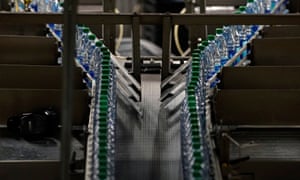
What’s more, most bottled water sold in the US comes from the same municipal sources that supply tap water – a fact probably unknown to most consumers. Coca-Cola makes Dasani at the company’s Detroit plant by purchasing, treating and bottling municipal water before selling it at a significant mark-up to consumers. Pepsi bottles its Aquafina water brand in Detroit the same way.

The business model is hugely profitable. The cost to buy that municipal water is exceedingly low – and once bottled, the mark-up can be about 133 times greater, a Consumer Reports analysis of company water billing and usage records found.

But what’s good for businesses isn’t necessarily good for consumers, according to CR’s review, which included the examination of hundreds of pages of billing and other records obtained through public records requests, and interviews with environmental law experts, industry consultants, residents of Detroit and consumer advocates.

For starters, bottlers and consumers aren’t always treated as equals by water utilities, CR found. In Detroit, whose policy before the coronavirus crisis called for shutting off water to residents if they fall $150 behind in their water bills, 2,800 homes were estimated to be without running water at the start of the pandemic.

But bottlers in Detroit have also racked up tens of thousands of dollars of past due water bills that went unpaid for months, CR found. Not once has their access to water been shut off over the period we examined. When asked why, the city cited the companies’ strong payment history and an ability to pay their bills. The city said in a later statement that it had made errors collecting past-due balances.

From a regulatory point of view, companies that want to put vast quantities of public water into bottles for profit face few hurdles and minimal ancillary costs, leading some experts to call for taxes on the bottlers. And because the water supply, including the processing and infrastructure, that bottlers rely on is paid for by local taxpayers, the companies’ business is subsidized by the public, consumer advocates say.

Shutoffs pose health risk

Detroit has been questioned about the potential health risk of water shutoffs before. In August 2014, residents who had their taps turned off argued in court to suspend shutoffs because a lack of water could create unsanitary conditions and lead to the transmission of hepatitis A, influenza and other diseases.

Detroit’s lawyers argued that those residents could rely on alternative sources – like bottled water. “Just because a person is out of water doesn’t mean they can’t get water,” a city lawyer said at a court hearing.

The judge in the case ultimately sided with the city, and the shutoff campaign carried on.

Now, six years later, Detroit and other cities have taken some steps to address residential water shutoffs during the coronavirus crisis – people need running water not just to cook and bathe, but to practice basic virus-fighting hygiene.

But the reprieve is only temporary. And it hasn’t necessarily reached everyone.

A Detroit spokesperson said all customers who called to enroll in a program that would turn their water back on during the pandemic had either been restored or were in the process of a restoration. But the spokesperson conceded that some occupants may not have called, and advocates dispute the city’s reported progress.

“We believe the city of Detroit is vastly exaggerating their progress and underreporting the number of people without water,” said Shea Howell, a member of the Detroit-based advocacy group the People’s Water Board Coalition, during a recent teleconference with reporters.

The coronavirus pandemic has underscored just how problematic water shutoffs can be, as utilities servicing nearly 40% of the US population still have not committed to suspending water shutoffs, according to Food & Water Watch. This has consumer advocates worried.

“It’s just unconscionable to make people fear losing their water service at this time,” said Mary Grant, director of the Public Water for All Campaign at Food & Water Watch. “We need every governor to step up to address this crisis immediately.”

‘Paying twice for bottled water’

People whose water gets shut off because they can’t afford their bill may have no choice but to buy bottled water that comes from the same source that feeds their tap. They may be obtaining bottled water from companies that have been behind on their water bills but didn’t face a shutoff, and whose business depends on access to publicly funded water systems.

And it’s not just in Detroit: Coca-Cola and Pepsi get water from other major cities, including Phoenix and Denver, with a history of shutting off water to residents before the coronavirus crisis.

Coca-Cola didn’t respond to questions from CR about water shutoffs or its late payments, but the company says it obtains water from a variety of sources, including municipal supplies, and uses a treatment process that “creates a consistent pure, clean, and crisp taste”. The company said it remains in operation as the federal government identified the food and beverage industry as “critical” to keeping grocery stores stocked.

Pepsi did not respond to repeated requests for comment from CR.

Beulah Walker, chief coordinator for the local not-for-profit group Hydrate Detroit, which assists local residents without running water, pointed out the irony of the situation for residents who have lost their water service at home and may turn to bottled water – possibly Aquafina or Dasani made with city tap water – as an alternative.

“Detroit residents are paying twice when they buy bottled water,” Walker says.

‘Picking on the little guy’

In 2014, Detroit’s shutoff policy drew national attention, when the city, which emerged that year from bankruptcy, launched a campaign to disconnect service to residents in arrears – forcing them to turn to other sources such as capturing rainwater or buying bottled water. Shutoffs have continued since then, but officials concluded in early March that a reprieve was needed to help residents during the coronavirus outbreak.

Ricky Reynolds is one of the beneficiaries. The 65-year-old Detroit resident moved into his home down the road from Coca-Cola’s bottling plant last summer, after obtaining the deed from an acquaintance for $500. It should have been a happy occasion. Reynolds had been homeless, bouncing between family and friends, so it was a relief to get his own place – until he tried to get the water bill put in his name.

Reynolds, who is retired, learned from the city that his new home had a nearly $20,000 unpaid water bill.

Ricky Reynolds, a Detroit resident, who moved into his new home to find out that it had a nearly $20,000 unpaid water bill.

“It’s hard to catch up with $20,000 when you have a fixed income,” he said. And the city refused to turn on his water until he paid 10% of the bill, he said, a monumental demand for someone living on social security income. Reynolds was never able to pay the bill.

In the months before the city finally restored his water service during the pandemic, Reynolds says, he had to fill up containers with water from family members, then haul them home. And he bought bottled water whenever he could – including, he said, Dasani, which may have been made around the corner at the Coca-Cola plant. (The city didn’t directly respond to questions about Reynolds’ case.)

Detroit’s temporarily suspended shutoff policy states that residents or businesses are delinquent and potentially risk having their water shut off if they are 60 days past due with a minimum balance of $150, a spokesperson said. (The city considers a company’s accounting practices, as well, before determining whether to proceed with a service interruption.)

Records show that, since 2017, both Pepsi and Coca-Cola met that threshold at points.

Between April and July 2017, billing records show, Coca-Cola had a $77,600 balance that went unpaid for three months. From August to November of that year, it carried a balance of as much as $287,250, before finally paying it off. That December to March of 2018, the company had a balance that fluctuated between $1,860 to $108,170, before paying it off in full. Meanwhile, from December 2018 to February 2019, Pepsi had a balance between $1,410 and $29,710, until paying it off.

The city never shut off the company’s water, and bottling continued.

“Since both Pepsi and Coca-Cola have a strong payment history and an unmatched ability to pay their bills, DWSD does not pursue service interruptions,” said Bryan Peckinpaugh, spokesman for Detroit’s water and sewage department.

“These companies never go longer than three months past due, at which time the balances due, including late fees, are paid. These companies are not a priority target for service interruption due to their payment history and ability to pay.”

(After this article was first published, the DWSD said that, contrary to Peckinpaugh’s previous statement, the past-due balances cited on the billing data were due to errors on the city’s part, including address mailing issues. Regardless, while the city registered Pepsi and Coca-Cola as delinquent, and continued sending bills and assessing late fees, it never shut off the companies’ water.)

Coca-Cola and Pepsi did not respond to CR’s questions about why they went months without paying their bills.

Grant, of Food & Water Watch, takes exception to the city’s position. “You should have a policy and should apply it equitably,” she said. “I think this is discrimination against low-income households in Detroit, that you’re having a shutoff policy and you’re not applying it, the same shutoff policy, to these big corporations because you expect them to pay down the road.”

Reynolds was also stunned to hear that Detroit let Coke and Pepsi’s bills slide.

“That’s not fair,” he said. “They’re picking on the little guy.”


2/26/2018

Coca-Cola and Nestlé to Acquire Private Ownership of the Largest Reserve of Water in South America. Report

https://www.globalresearch.ca/coca-cola-and-nestle-to-acquire-private-ownership-of-the-largest-reserve-of-water-in-south-america-report/5629994

8/14/2015

Germany's hypocrisy over Greece water privatisation

 A protester holds a greek flag in front of the Greek parliament during an anti-austerity demonstration in Athens. Photograph: LOUISA GOULIAMAKI/AFP/Getty Images

Πηγή: The Guardian
By Karl Mathiesen
Aug 14 2015

Germany has been criticised for pushing Greece to sell off its water utilities when many of Europe’s largest cities, including Berlin, are buying back theirs.

Greek activists are warning that the privatisation of state water companies would be a backward step for the country.

Under the terms of the bailout agreement (pdf) approved by the Greek parliament today, Greece has pledged to support an existing programme of privatisation, which includes large chunks of the water utilities of Greece’s two largest cities – Athens and Thessaloniki.


Hamburg at forefront of global drive to reverse privatisation of city services


There is an ongoing debate about water privatisation and the role of business. Across Europe a wave of austerity-driven privatisation proposals have led to protests in Ireland, Italy, Greece and Spain. At the same time, some of northern Europe’s largest cities, including Paris and Berlin, are buying back utilities they sold just last decade.

President of the Thessaloniki water company trade union George Argovtopoulos said a move to a for-profit model would raise prices for consumers and degrade services.

“It’s not any more a democracy or equality in the European Union. It’s a kind of business,” he said, adding that austerity measures that require water privatisation smacked of a “do as I say, but not as I do” approach from Germany.

“We know that in Berlin, just two years ago they remunicipalised the water there, although they paid just under €600m to Veolia [to buy back its stake]. It’s clear that the model of privatisation of water has failed all around the world,” he said.

The German finance ministry refused to comment ahead of a Eurogroup meeting in Brussels on Friday where the third bailout deal looks set to be signed. But the deputy finance minister Jens Spahn told German breakfast television on Tuesday that sell offs of the electricity and rail sectors had benefited Germans.

“Privatisation isn’t just about raising money, it’s about changing parts of the economy,” he said. The new bailout requires Greece to sell off €50bn worth of public assets.


The best answer to bad government is good government. Don’t hold out for privatisation.Maude Barlow, Food & Water Watch

Manuel Schiffler, a former project manager for the World Bank and author of the book Water, Politics and Money, said privatisation only made sense where there was a need to improve efficiency. In the case of Thessaloniki in particular, he said, the water system was already quite well run.

“I think it’s a privatisation for the wrong reasons. It’s only for fiscal reasons and not in order to improve the services provided by the utility,” he said.

Maude Barlow, the chair of Food & Water Watch said that years of experimentation with privatisation in developing countries had shown: “The best answer to bad government is good government. Don’t hold out for privatisation. It’s not a perfect system and I know Greece has it’s problems, but privatising their water systems is not a good answer to the crisis there.”

Argovtopoulos’s complaint was backed by public water campaigners in Germany. “There’s a wave of public repossession of this resource going on in Germany after it sunk in that pricing it can’t be left to profit-seeking boardroom managers,” managing director of the German Alliance of Public Water Management Christa Hecht told Greek newspaper Kathimerini. “Water is a vital public asset and the Greeks are right to want to keep it that way.”

Germany rebels

In Berlin, 12 years of private ownership saw tariffs rise by nearly a quarter, according to Schiffler. But whether or not privatisation was to blame is disputed. Schiffler said that the rise was only marginally higher than the German average and that privatisation in Berlin actually lead to positive consumer outcomes through improved efficiency and service.

Even so, a Berlin consortium of Veolia, RWE and Allianz bore the brunt of public price dissatisfaction. The city bought back its shares in utility Berlinwasser in 2012 and 2013, despite being saddled with very high levels of debt. The process has been repeated in eight other German cities, including Stuttgart andHamburg.

“[Now] they demand that they do in Greece, exactly what they are undoing in Germany,” said Barlow.

France’s Suez and Veolia, the world’s two largest water companies, will be among those interested in Greece’s utilities if the government’s shares are sold off. Yet in France – another of Greece’s creditors – as many as 49 cities (pdf) have bought back their water since 2000.

“It’s a financial colonisation,” said Argovtopoulos. “It’s an attempt for companies in the north of Europe, the rich countries. To own monopolies, like water systems, electricity and gas, in the poor southern countries in Europe. It’s a game of power and money.”


Water privatisation: a worldwide failure?

Austerity-led changes to water supply have been fiercely resisted across Europe’s most indebted countries. In Dublin this year, huge protests erupted over plans to directly charge water users who previously paid for water through their taxes. This was seen as a first step towards selling off Ireland’s water supply.

A water privatisation push by former Italian prime minister Silvio Berlusconi wascrushed by a 95% referendum vote in 2011. A similar referendum in Thessaloniki last year delivered a 98% vote against.

A 2014 report by the Transnational Institute’s Satoko Kishimoto found that across the world 180 cities had bought back (or remunicipalised) their water supply. She said this was a response to almost universally higher water prices and the loss of control over a fundamental resource.

“A public water company is much more tightly regulated and obliged to provide water services for all,” said Kishimoto.

Barlow said the austerity-driven privatisation of water supplies was a challenge to the recently enshrined UN right to water.

“Up to five years ago, when people were talking about the human right to water they meant the global south. Now it’s come to the north,” she said.

In Greece, where the people voted overwhelmingly against a less severe bailout package than the one prime minister Alexis Tsipras is set to sign, there is great anxiety over where the axe will fall first.

In 2014, the pro-austerity Samaras government’s attempt to sell off the Athenian water supply was stymied when the country’s highest court ruled the sale was unconstitutional. Argovtopoulos said any move by Tsipras to proceed against the will of the public and the ruling of the judiciary would be very poorly received in the frustrated community.

“We expect this government to respect this decision [from the court]. This is a check point for this government. If it passes this red line, it’s going to be like the former government,” said Argovtopoulos.


8/19/2012

Lawsuit Claims One-Third of California Drinking Water Contaminated with Cancer-Causing Chemical


Πηγή: AllGov
By Ken Broder
August 19 2012

The movie Erin Brockovich made the chemical carcinogen chromium-6 infamous in 2000. A state law was passed in California the following year requiring formulation of a standard limiting its presence in drinking water by 2004.

Eight years later, two environmental groups have sued the state not only for its failure to put a standard in place; but for not even having agreed on one.

The Natural Resources Defense Council and the Environmental Working Group filed suit in Alameda County Superior Court this week, pressing the government to accelerate the process. The state Environmental Protection Agency (EPA) suggested a “goal” in 2011, but it is up to the California Department of Public Health to set the standard.

The department’s website says it will release a draft recommendation next year on its way to a 2015 final determination.

Erin Brockovich chronicled the experience of residents in the small town of Hinckley, who were exposed to chromium-6 whenPacific Gas & Electric used the heavy metal to prevent rust in water towers. The water seeped into the groundwater and caused health problems that included bronchitis, asthma and lung cancer. PG&E settled with Hinckley residents in 1996 for $333 million.

There is some evidence that chromium-6 can damage DNA. Other studies have linked it to male reproductive harm, liver toxicity and blood disorders. The chemical is on California’s Prop. 65 list of substances known to cause cancer and reproductive harm.

It has long been known as dangerous if inhaled and in 2007 the federal government determined that it’s not OK to eat it either. There is no federal standard for chromium-6.

The state EPA suggested a standard of .02 parts per billion (ppb), which would be a significant improvement over levels found in some California cities by the Environmental Working Group. A 2010 study by the group found chromium-6 in 31 cities, including Riverside (1.69 ppb) and San Jose (1.34 ppb), both of which made the top 5 in the United States.


9/10/2011

Death for Libyans; Billions for the West


Πηγή: allAfrica
By Garikai Chengu
9 September 2011


People who think that the West's intervention in Libya is just another oil grab are mistaken. Broadly speaking, for Britain military intervention is mainly about arms, Italy its natural gas, France its water and for the US its counter-terrorism and reconstruction contracts. Spreading democracy and saving the people of Benghazi form merely tangential benefits used to justify these ends.

Lest we forget, Nato's bombardment began because Mr Gaddafi threatened to do to Benghazi what Mr Bashar al-Assad's forces are doing to various Syrian cities and Nato itself is poised to do in Sirte.

"History is a set of lies agreed upon" once remarked Napoleon Bonaparte. If left unchallenged the true motives behind what the French mainstream media have coined "Sarkozy's War" may be lost in the fog of war.

So what makes Libya so important to the West? Any real estate agent could tell you: location. Given that Libya sits atop the strategic intersection of the Mediterranean, African, and Arab worlds, control of the nation, has always been a remarkably effective way to project power into these three regions and beyond.

Ever since time immemorial Western control over Libya has been of great importance. After Libyan independence in 1951, US, British and French payments for military basing rights formed the single-largest element of Libyan GDP until oil exports began to flow in 1961.

Nowadays, Mr Sarkozy's interest in Libya lies in a commodity more precious than oil, namely water. It is becoming increasingly accepted that water promises to be to the 21st century what oil was to the 20th century: the precious commodity that determines the wealth of nations.

Unlike oil, there are no substitutes, alternatives or stopgaps for water. Nature has decreed that the supply of water is fixed. Meanwhile demand rises inexorably as the world's population increases and enriches itself. Population growth, climate change, pollution, urbanization and the rapid development of manufacturing industries are relentlessly combining such that demand for fresh water will outstrip supply by 40 per cent by 2040.

Libya sits on a resource more valuable than oil, the Nubian Sandstone Aquifer, which is an immensely vast underground sea of fresh water. Colonel Gaddafi had cleverly invested $25 billion in the Great Man-made River Project, a complex 4,000-km long water pipeline buried beneath the desert that could transport two million cubic metres of water a day. Such a monumental water distribution scheme could turn Libya - a nation that is 95 per cent desert - into a food self-sufficient arable oasis.


Today France's global mega-water companies like Suez, Ondeo and Saur, control more than 45 per cent of the world's water market and are rushing to privatize water, already a $400 billion global business. For these French companies, Libya will be a bonanza. No wonder Le Mondé coined it "Sarkozy's War" and had a "Victoire" front page splash when Mr Gaddafi's compound was stormed.

Late last year, the Central Intelligence Agency suspiciously raised the spectre of "future 'hydrological warfare' in which rivers, lakes and aquifers become national security assets to be fought over," or controlled through proxy armies and client states. Regime change in Libya is the first major instance of hydrological warfare.

With the spoils of war from Libya's water market largely reserved for the French, Mr. Cameron is eyeing another market, that of arms.

The subject of the West selling arms to regimes suppressing uprisings remains as wilfully overlooked as an American war crime. Even as The Times of London has just reported that Britain enjoyed a 30 per cent spike in arms sales to regimes in the Middle East during the Arab Spring. Arms sold between February and July jumped to $101 million, the Times' report says, noting that these include weapons that could be used to suppress domestic protests.

Mr Obama's administration is even more steeped in the controversial arms trade. The US accepts no rival on this front. Over the past decade the US has averaged a staggering $5.8 billion per year in arms sales with the Middle East.

The very Libyan military hardware that Nato boastfully claims to have downgraded by 90 per cent will need to be rebuilt. US arms companies will gleefully be on hand to arm their proxy regime to the teeth. Libya will be a bonanza for American arms dealers.

American infrastructure contractors will also reap the windfalls of post-war reconstruction. The grim reality is that every bridge, road, rail-link and building that US war-planes bomb will have to be rebuilt and paid for by the Libyan taxpayer.

Even grimmer still is the fact that the approximately $1.1billion spent by the US government on bombarding Libya is a drop in the ocean compared to the profit that American contractors stand to make. Many of whom have strong ties to the upper echelons of the military and the Obama administration.

In-fact, more than 70 American companies and individuals have won up to $8 billion in contracts for work in post-war Iraq and Afghanistan over the last two years, according to a new study by the Center for Public Integrity.

According to the study, nearly 70 per cent of these companies had employees or board members who either served in or had close ties to the executive branch for Republican and Democratic administrations, for members of Congress of both parties, or at the highest levels of the military.

Therefore, those in the military tasked with minimising 'collateral damage' to property stand to directly profit from less than pin point precision. In short, dropping bombs can be profitable.

The recent bombshell revelations of correspondence between the CIA and Libya's security apparatus prove that the US has been outsourcing its torture or "enhanced interrogation" of terror suspects to Libya through the internationally illegal rendition process. These revelations are embarrassing but hardly surprising. Nevertheless, there is little doubt a pliant proxy regime will continue to do America's dirty work.

Last but not least there is oil. Much as the self-righteous West might pretend otherwise, oil is unquestionably a key part of the equation. Libya has the largest oil reserves in Africa and 85 per cent of its exports are to Europe.

Archival footage of Italian Premier Silvio Berlusconi surrounded by Mr Gaddafi's female bodyguards, kissing the Libyan strongman's hand at Leonardo Da Vinci airport is indicative of just how important Libya is to Italy.

Libya's oil is especially important to Italy because of its proximity, the ease of its extraction, and the sweetness of its crude. Most refineries in Italy and elsewhere are built to deal with sweet Libyan crude, they cannot easily process the heavier Saudi crude that has recently replaced the Libyan production shortfall.

Libyan natural gas reserves are estimated to be over 52.7 trillion cubic feet and large areas of the country are still to be surveyed. With assured supplies available from Libya, Italy will become less dependent on supplies from Russia, which on the energy front, is increasingly flexing its muscles and thumbing its nose at mainland Europe.

Libya has a 1,800km coastline just miles from Italy and porous southern borders with three poor African nations. Therefore, a pliant regime that will stem the flow of asylum seekers and keep the oil and gas flowing is vital for Rome.

From oil to water, water-boarding to arms and from gas to reconstruction the war in Libya will rake in billions of dollars for the West. Just how much will trickle down to the people of Libya remains to be seen.

(The author is a research scholar at Harvard University's Faculty of Arts and Sciences.)