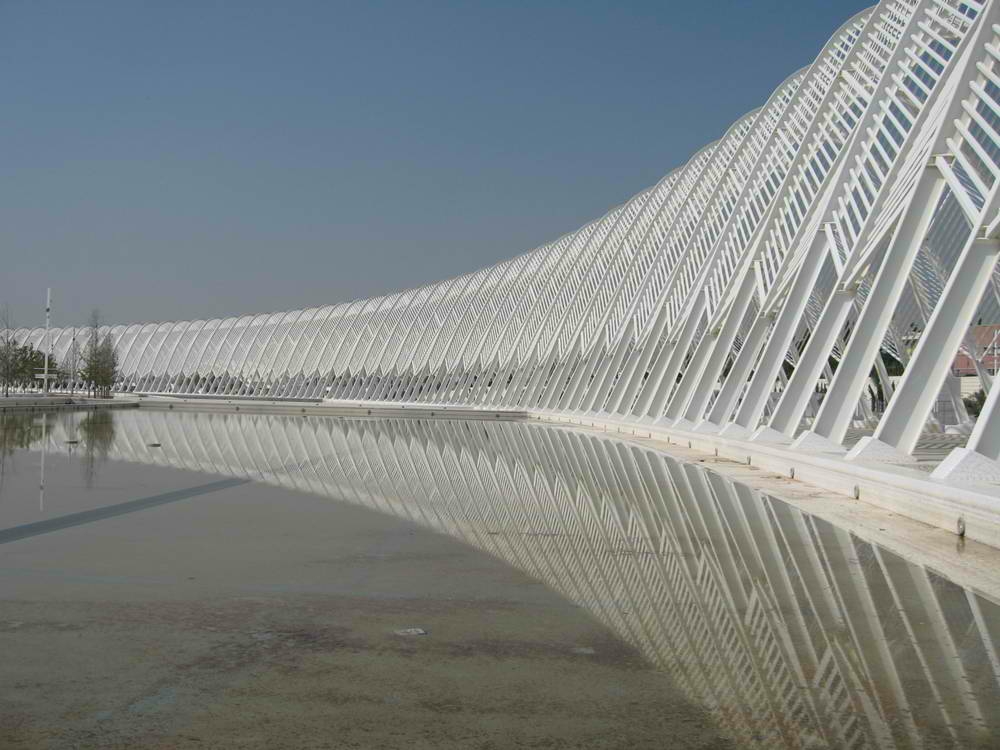

A view of the disused Olympic softball stadium in Athens on June 11, 2012.
Πηγή: Time
By JOSH SANBURN
July 9 2012
The Helliniko Olympic Complex in Athens was supposed to be thriving long after the 2004 Summer Olympics had ended. Built on part of the site of the city’s old airport for those games, the facility housed the canoe and slalom events as well as arenas and sites for field hockey, baseball, softball, basketball and fencing. There were big plans to turn much of the complex into the largest metropolitan park in Europe, but that neverhappened, largely because of the bureaucracy that hampers most development in Greece. Today, the complex sits amid overgrown weeds, virtually deserted.
It’s been eight years since Greece, the birthplace of the Games, proudly hosted the Olympics, which London will host this summer. But as the country grapples with the destabilizing effects of the European economic crisis, many Greeks now look back on those games with more regret than pride.
“It felt good at the time because we were the center of the world and we got to show off our country,” says gymnast Christos Libanovnos of the Hellenic Gymnastics Federation, which uses the former Olympic complex for training.
“But what did it cost? So much money – billions of euros. And now we are bankrupt and everything just gets worse and worse every day. It’s hard not to see a connection. It’s hard not to think that maybe it wasn’t worth it.”
Libanovnos helps train young gymnasts – including some visiting from other countries – in the former Olympic complex, but the facility is so run down that proper practice can be difficult. “We were embarrassed to let them in here. There’s a layer of dust everywhere and no air conditioning,” he says. “And the trash bins are overflowing because there’s no cleaning staff.”
Hosting the Olympics certainly didn’t cause the country’s financial mess. Greece has a long history of systemic problems with labor productivity, public sector debt and corruption. But in retrospect, the Athens Games appear now to be a high mark for modern-day Greece. It came at a moment when the euro, which Greece adopted a few years before, had brought the country a remarkable degree of wealth in a short period of time. Greece – and Europe’s – financial instability would’ve seemed unimaginable.
But in fact, the 2004 Olympics were a microcosm of Greek economic dysfunction: missed budget estimates, poor planning, financial mismanagement. It cost Greece about $11 billion, at least double what the Greek government had initially budgeted – and that doesn’t include the money it has spent trying to maintain its rarely used Olympic facilities over the last eight years. It was forced – mainly by the U.S. and U.K. – to spend $1.2 billion on security alone because of fears over terrorism, and in the months leading up to the opening ceremonies, Athens had to rush its schedule just to get construction projects completed on time.
“If you look at the mistakes they made in preparing for the Games, you could say that similar types of mistakes led Greece into the debt difficulties they’re facing now,” says Mark Spiegel, who works for the Federal Reserve Bank of San Francisco and has written about the economic effects of hosting the Olympics, referring to Greece’s budget and construction problems.
Andrew Rose, a University of California-Berkeley economics professor who co-authored a paper with Spiegel called “The Olympic Effect,” says that even though Greece’s debt is in the hundreds of billions of dollars today, the Games clearly added to Greece’s fiscal woes. “Such events are almost all wasteful for advanced open economies like Greece,” he says.
For years, studies have shown that holding the Olympics often has severe negative economic effects on host cities, despite the temporary burst of tourism and global attention. The competition between cities often causes governments to go financially overboard merely to win an Olympic bid. Once construction gets underway, governments often fail to budget properly. And after the Games are over, many cities are left with infrastructure that suddenly has no real use.
Not everyone, however, accepts that rationale. Some argue, for instance, that hosting the Olympics brings cities much-needed infrastructure projects.
“Because of the Games, we now have the metro, a new airport and new roads,” says Isidoros Kouvelos of the Hellenic Olympic Committee. “Of course there are idle stadiums – these white elephants – but that’s not the whole story.”
The Summer Olympics in London appear to be no different. Even though the coalition government has made some budget cuts in Olympic spending as part of its attempts to reduce its budget deficit, a new report by Oxford University shows that the London Olympics are on track to be the most over-budget Games since Atlanta in 1996.
Even though the Greeks were jubilant eight years ago, many are completely ignoring the Games this time around.
“No one wants to talk about the Olympics, even though we have athletes at the London Games – and athletes who could win medals,” says Vassilis Sambrakos, a Greek sports radio personality and columnist. “Many Greeks believe the 2004 Games was all built on a big lie – a lie that we had the money to pay for all these lavish centers and ceremonies. That seems like ancient history.”