Showing posts with label Wuhan Institute of Virology. Show all posts

5/16/2020

Trump Spreads Distorted Claim on Wuhan Lab Funding


Source: FactCheck
May 15 2020
By Lori Robertson


The Wuhan Institute of Virology received $600,000 as part of a larger five-year U.S. government grant to a U.S.-based nonprofit studying emerging infectious diseases. But President Donald Trump put the figure at $7.5 million, saying he “ended it.”

We asked the White House where the $7.5 million figure may have come from, but we haven’t received a response.

False claims that the Wuhan lab had received $3.7 million in National Institutes of Health grant money have circulated online after an April 11 Daily Mail story made that assertion and Republican Rep. Matt Gaetz repeated it in a Fox News interview. The NIH didn’t award such a grant. Instead, it gave a grant totaling $3.4 million, beginning in 2014, to the U.S.-based EcoHealth Alliance to study the risk of the future emergence of coronaviruses from bats. And EcoHealth distributed $600,000 of that total to the Wuhan Institute of Virology, a collaborator on the project, pre-approved by NIH.

We wrote about this distortion of the EcoHealth grant after the claim appeared in the conspiracy theory video “Plandemic.”

Trump echoed the claim in an interview that aired May 14 on Fox Business News. Host Maria Bartiromo asked of the Wuhan institute, “Didn’t we as a country give money to that lab?” Trump responded:

Trump, May 14: Yeah. As I understand it, before I got here, $7.5 million in 2014. And look, they said they were studying different things and you know, things like that happen. But, you know, money was given by the Obama administration early on. … I ended it. … I took a lot of heat too. They said, “Oh, we’re studying all sorts of stuff.” You saw what happened. I ended it.

It’s unclear what other funding the president may be including in his figure. An April 16 Fox News story cited another $3.4 million grant, regarding a behavioral study, that may have included some funding that went to the Wuhan lab. But the grant, which was awarded to Cold Spring Harbor Laboratory in New York, hasn’t been terminated. It was originally for 2014-2019 and a second related grant was approved this year. We reached out to Cold Spring Harbor Lab, and we’ll update this story if we receive additional information.

Fox News acknowledged that it was “not clear exactly how much U.S. funding went directly to the Wuhan Institute of Virology because it worked in collaboration with other institutions on the projects funded by the American grants.”

In the case of the EcoHealth grant — the one that was canceled — we do know how much went to the Wuhan lab and it was well short of even $1 million.

In a statement, the NIH said the total grant to EcoHealth was $3.4 million over six years (2014 through 2019) and that the grant had been terminated. “NIH does not discuss details of the decision making process regarding specific grant awards,” the statement said. Information on the NIH website shows the project began on June 1, 2014, and was ended on April 24, 2020.

Nearly all of the $3.4 million was part of a five-year grant awarded in 2014, EcoHealth spokesman Robert Kessler told us in an email, and the $600,000 given to the Wuhan Institute of Virology was part of that grant. In 2019, the project was renewed for another five years, and EcoHealth received $292,161 in 2019 before NIH canceled the grant last month.

USA Today reported that about $76,000 had been budgeted for the Wuhan lab as part of the 2019 renewal. Kessler confirmed to us that money had been budgeted but it hadn’t been distributed to the lab before the grant was ended.

The Wuhan, China, lab — located in the city where the novel coronavirus outbreak began in late 2019 — was pre-approved as a collaborator by NIH and the State Department, Kessler said. Researchers used the lab to conduct genetic analyses of the viruses.

“In each of nearly 30 countries around the world where we work, we collaborate with local institutions, all of which are pre-approved by our federal funders,” EcoHealth said in an April 28 statement about the terminated funding. “It’s been EcoHealth Alliance’s position for the past 15 years that coronaviruses present a clear and immediate threat to our safety. That seems clearer now than ever before.”

The NIH grant — technically funded through the NIH’s National Institute of Allergy and Infectious Diseases — backed research into the emergence of coronaviruses that can affect humans and originate in bats, which is the origin, experts suspect, of SARS-CoV-2, or the novel coronavirus, as well as severe acute respiratory syndrome, or SARS, virus, which caused a global outbreak in 2003, and the Middle East Respiratory Syndrome, or MERS, virus, identified in 2012.

The EcoHealth project description on the NIH website says that zoonotic coronaviruses — meaning those that can transfer from animals to humans — “are a significant threat to global health” and that bats “appear to be the natural reservoir of these viruses.” The project “aims to understand what factors increase the risk of the next CoV emerging in people by studying CoV diversity in a critical zoonotic reservoir (Bats), at sites of high risk for emergence (wildlife markets) in an emerging disease hotspot (China).”

EcoHealth, which has received government grant money nearly every year since 2002, according to an NIH database, said in its April 28 statement that the research terminated by the Trump administration “aimed to analyze the risk of coronavirus emergence and help in designing vaccines and drugs to protect us from COVID-19 and other coronavirus threats. In fact, genetic sequences of two bat coronaviruses that we discovered with this grant have been used as lab tools to test the breakthrough antiviral drug Remdesivir.”

Clinical trials are underway to determine whether remdesivir is safe and effective in treating COVID-19. The Food and Drug Administration issued an emergency use authorization on May 1 for the drug based on early results.

The Wuhan Institute of Virology has been the subject of baseless conspiracy theories claiming SARS-CoV-2 was created or manipulated in a lab. As we’ve written, the authors of a March article in Nature Medicine concluded: “Our analyses clearly show that SARS-CoV-2 is not a laboratory construct or a purposefully manipulated virus.”

University of Sydney professor Edward Holmes, who was involved in mapping the genome of SARS-CoV-2, also said in an April statement: “Coronaviruses like SARS-CoV-2 are commonly found in wildlife species and frequently jump to new hosts. This is also the most likely explanation for the origin of SARS-CoV-2.”

Responding to what he called “unfounded speculation” that a bat coronavirus named RaTG13, being kept at the Wuhan Institute of Virology, was the origin, Holmes said that for various reasons he concluded: “SARS-CoV-2 was not derived from RaTG13.” Holmes said more sampling of other animals “is needed to resolve the exact origins” of the novel coronavirus.

The U.S. Intelligence Community said in an April 30 statement that it “concurs with the wide scientific consensus that the COVID-19 virus was not manmade or genetically modified,” and that it “will continue to rigorously examine emerging information and intelligence to determine whether the outbreak began through contact with infected animals or if it was the result of an accident at a laboratory in Wuhan.”

In remarks the same day, Trump answered, “Yes, I have,” when asked if he had “seen anything at this point that gives you a high degree of confidence that the Wuhan Institute of Virology was the origin of this virus.” But the president also said: “We’re going to see where it comes from. And you know — look, you know every theory, whether you had the theory from the lab, you had the theory from many different — the bats, and the type of bat, and the bat is 40 miles away, so it couldn’t have been here and it couldn’t have been there. And we have a — there’s a lot of theories. But, yeah, we have people looking at it very, very strongly.”

Investigations into the origin of the virus aside, Trump was wrong to claim the U.S. government has given $7.5 million to the Wuhan lab under his predecessor. The lab received only $600,000 through a five-year grant to EcoHealth Alliance, a grant that spanned both the Obama and Trump administrations and had been renewed last year. We don’t know how much, if anything, the lab may have received as part of other grants.


5/09/2020

'What about COVID-20?' U.S. cuts funding to group studying bat coronaviruses in China


Source: USA Today
May 9 2020
By Kim Hjelmgaard 


The head of a research group that studies bat-borne coronaviruses in China similar to the COVID-19 strain that's ravaged the globe has warned that a U.S. government decision to cut funding to his organization imperils American public health.

EcoHealth Alliance's research grant was abruptly terminated last month by the National Institutes of Health, the primary agency of the U.S. government responsible for biomedical and public health research. EcoHealth Alliance's research in China is focused on identifying and warning about coronaviruses dangerous to human health.

"I'm really concerned about where this leaves us," said Peter Daszak, director of the New York-based organization, in a USA TODAY interview.

"Once we've overcome COVID-19, what about COVID-20? What about COVID-21? Who is going to go out and find those? Our grant was specifically designed to locate where these viruses are and to stop them from harming Americans," he said.

The National Institutes of Health confirmed EcoHealth Alliance's $3.4 million grant, distributed over six years, was canceled on April 24. But it would not discuss details about how the decision was made. Daszak, a respected disease ecologist, said he received a letter from the National Institutes of Health stating the award was terminated for "convenience" because it didn't "fit" with the agency's goals.

EcoHealth Alliance has collaborated with the Wuhan Institute of Virology, a state-run Chinese lab in the city where COVID-19 first emerged in December. The institute has attracted negative attention because of hypotheses connecting it to unanswered questions about the origins of the virus. These questions center around the lab's biosecurity, interpretations of circumstantial evidence that link the lab to early infections and China's unwillingness to share information about some aspects of the outbreak.

Politico, which first reported on the grant cancellation on April 27, said a few days prior to the termination of EcoHealth Alliance's funding National Institutes of Health Deputy Director for Extramural Research Mike Lauer informed the organization it needed "to know all sites in China that have been in any way linked to this award."

EcoHealth Alliance has been studying coronaviruses in bats in China for more than a decade. In that time it has established deep links and worked closely with the Wuhan Institute of Virology. The Chinese research lab has fallen under a cloud of suspicion because President Donald Trump and senior U.S. officials such as Secretary of State Mike Pompeo have persistently linked it with unproven theories about COVID-19's origins.

No evidence has emerged to support Trump's accusations, nor are they backed by infectious disease experts. U.S. intelligence agencies have concluded coronavirus was not man-made. They haven't reached any conclusions about whether the disease emerged from a lab in China or was transmitted to humans through animals.


An aerial view shows the Wuhan Institute of Virology in China's central Hubei province on April 17, 2020.
AFP via Getty Images

Daszak has not been able to secure clarification over why the award was cut. EcoHealth Alliance has received funding from the National Institutes of Health since at least 2002.

EcoHealth Alliance was the primary awardee of the $3.4 million grant. The sub-awardees were the Wuhan Institute of Virology, the East China Normal University in Shanghai, the Institute of Pathogen Biology in Beijing, and the Duke-NUS Medical School in Singapore. A "sub-awardee" means EcoHealth Alliance acted as an intermediary between these institutions and the U.S. government for the purposes of funding joint research into bat-borne coronaviruses. It did not pay them directly.

EcoHealth Alliance has not been accused of any wrongdoing and it has not carried out any research in China since the outbreak began in Wuhan late last year.

Founded in 1971 by a British conservationist, more than 90% of EcoHealth Alliance's annual budget of $16 million in 2018 came from government grants, according to the most recent available financial accounts published on its website. The remainder of its funding came from a mixture of donations from scientific foundations, corporations and private individuals. The group has worked in the U.S. and nearly 30 countries around the world on projects ranging from forest health in Liberia to bio-surveillance in western Asia. Charity Navigator, which evaluates the transparency, accountability and governance of non-profit organizations, gives it a 4-star rating – its highest mark.

The State Department, which is obliged to conduct background checks on any foreign organization that is a recipient of U.S. government funds for research, did not respond to a request for comment addressing the reasons for the grant's termination.

The title of EcoHealth Alliance's research proposal, first awarded under the Obama administration and then re-approved under Trump in July last year, is called "Understanding the risk of bat coronavirus emergence."

"That's exactly what we're all suffering from now," Daszak said.

"One of our goals (for the study) was to find out more about the genetic sequences of coronaviruses in bats and to get these into the hands of people who design vaccines and drugs. We had just begun work on this when the pandemic happened," he said.

The Wuhan Institute of Virology has become a focus for Trump and some in his inner circle partly because it houses a lab equipped to study coronaviruses and other dangerous pathogens, and partly because of its relative proximity to a seafood market in Wuhan where some, but not all, of China's coronaviruses were first detected last year.

China's lack of transparency over how the virus first spread has amplified that focus. Beijing has also circulated, on social media and in official statements, false rumors and misinformation that the U.S. military may have brought coronavirus to China.

Trump said during a press conference on April 17 he was aware of EcoHealth Alliance's grant and he intended to end it "very quickly." Asked on April 30 whether he had seen evidence justifying theories the virus may have originated in the lab, Trump answered affirmatively – "Yes, I have." Days later, during a Fox News town hall on May 4, Trump said his administration was waiting on a "very strong report" about whether the lab was involved in the pandemic. "My opinion is they made a mistake. They tried to cover it," he said, referring to an alleged attempt by China's authorities to hide information about the nature and origins of the virus. China denies it withheld or suppressed these details.

Critics of China have also accused it of concealing the extent of its coronavirus outbreak by under-reporting both total cases and the deaths it has suffered from the disease.

'Dangerous dynamic': Coronavirus threatens new 'Cold War' between US and China

Adding to the maelstrom, Pompeo insisted Wednesday there was no obvious contradiction in his competing assertions that "we don't have certainty" about where the virus originated, yet "there is significant evidence that this came from the laboratory."

For more than a month, Senator Sen. Bob Menendez, the top Democrat on the Senate Foreign Relations Committee, has been calling – "to no avail," he said – for Pompeo to share details of U.S. intelligence on the origins of the coronavirus. Menendez wrote another letter to Pompeo on Thursday, stating that the "answers to these questions are critical, as they may inform ongoing efforts to stop any further spread, limit any subsequent waves of infection, and help us prepare against future pandemics."

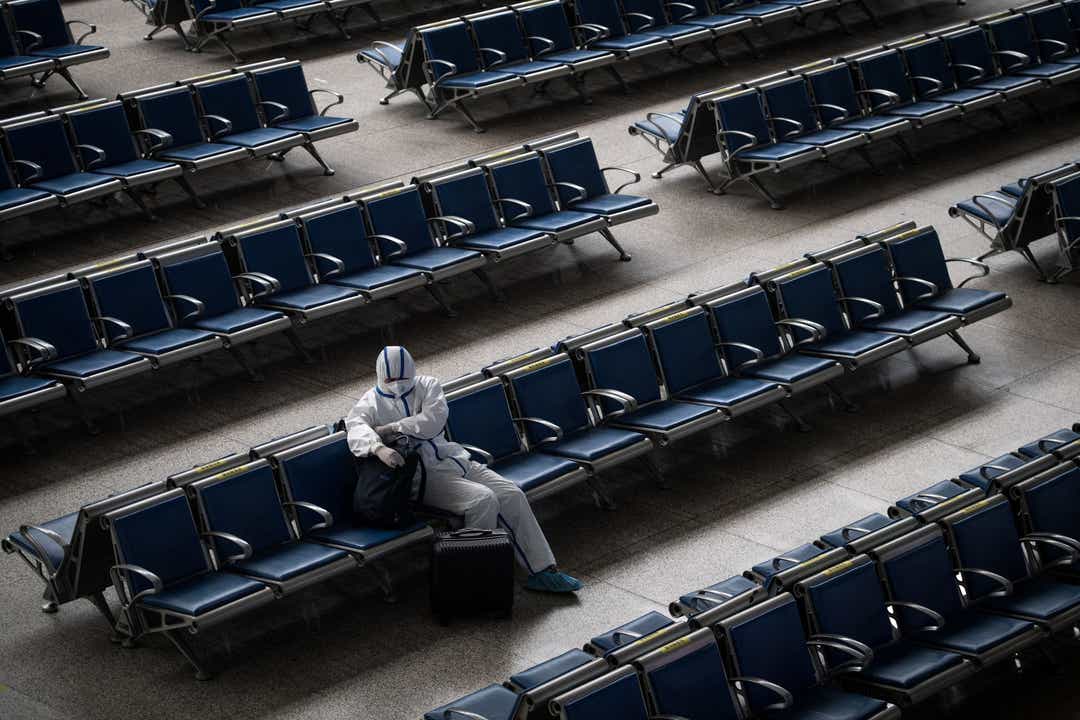
A passenger wears a hazmat suit as a precaution against the COVID-19 coronavirus as he waits for a train at Hankou Railway Station in Wuhan, in China's central Hubei province on May 2, 2020.

Linfa Wang, director of emerging infectious diseases at Duke-NUS Medical School in Singapore, one of EcoHealth Alliance's "sub-awardees," said scientific understanding about why and how viruses jump from animals to humans is relatively poor but improving all the time. He said the consensus among mainstream researchers is that fewer than 1% of viruses that affect mammals have been discovered.

"Fifty years ago nobody was even looking at bats. It was all about mosquitoes and rodents," he said, noting that over time bats have evolved to be particularly effective "reservoirs" of viruses deadly to humans, but not necessarily themselves, because of their unique physiologies that undergo extreme stress in order to be able to fly.

"Can we predict where the next jump (from animals to humans) will come from? No."

Still, Daszak said funding for on-the-ground overseas coronavirus research was needed now more than ever because the viruses that pose the highest risk to public health don't originate in the U.S. but in the world's most populous country.

"If we want to know anything about the next pandemic we need to be working in China," he said. Daszak described the Southeast Asia region as a "hot-bed" for new viruses.

"In peoples' imaginations there might be this image of one person in a lab in China who drops a petri dish and that somehow leads to a massive outbreak. It's just not like that. Every year there are millions of people going in bat caves and hunting and eating wildlife. It happens every day. They are being exposed to bat viruses every day. It only takes one of these people to go to a city, cough and spread a virus," he said.

"The aim of our work is to directly benefit U.S. national security and public health. If we don't do this we are going to be on the front line again when the next virus hits."


5/05/2020

Coronavirus: WHO says US has provided no proof on Wuhan lab claims


Source: SCMP
May 5 2020
By AFP

The World Health Organisation said on Monday that Washington had provided no evidence to support “speculative” claims by the US president that the new coronavirus originated in a Chinese lab.

“We have not received any data or specific evidence from the United States government relating to the purported origin of the virus – so from our perspective, this remains speculative,” WHO emergencies director Michael Ryan told a virtual briefing.

Scientists believe the killer virus jumped from animals to humans, emerging in China late last year, possibly from a market in Wuhan selling exotic animals for meat.

But US President Donald Trump, increasingly critical of China’s management of the first outbreak, claims to have proof it started in a Wuhan laboratory.

China says no evidence to suggest coronavirus virus came from Wuhan’s lab

And US Secretary of State Mike Pompeo on Sunday said “enormous evidence” backed up that claim, which China has vehemently denied.

“Like any evidence-based organisation, we would be very willing to receive any information that purports to the origin of the virus,” Ryan said, stressing that this was “a very important piece of public health information for future control.

“If that data and evidence is available, then it will be for the United States government to decide whether and when it can be shared, but it is difficult for the WHO to operate in an information vacuum in that regard,” he added.

The UN health agency – which has also faced scathing criticism from Trump over accusations it initially downplayed the seriousness of the outbreak to shield China – has repeatedly said the virus clearly appears to have originated naturally from an animal source.

WHO expert Maria Van Kerkhove stressed during Monday’s briefing that there were some 15,000 full genome sequences of the novel coronavirus available, and “from all of the evidence that we have seen … this virus is of natural origin”.

While coronaviruses generally originate in bats, both Van Kerkhove and Ryan stressed the importance of discovering how the virus that causes Covid-19 crossed over to humans, and what animal served as an “intermediary host” along the way.

“We need to understand more about that natural origin, and particularly about intermediate hosts,” Ryan said.

It was important to know “so that we can put in place the right public health and animal-human interface policies that will prevent this happening again”, he stressed.

The WHO said last week it wanted to be invited to take part in Chinese investigations into the animal origins of the pandemic, which in a matter of months has killed nearly 250,000 people worldwide.

“We have offered, as we do with every case in every country, assistance with carrying out those investigations,” Ryan said Monday.

“We can learn from Chinese scientists,” he said.

But he warned that if questions about the virus origin were “projected as aggressive investigation of wrongdoing, than I believe that’s much more difficult to deal with. That is a political issue.

“Science needs to be at the centre,” he said.

“If we have a science-based investigation and a science-based enquiry as to what the origin species and the intermediate species are, then that will benefit everybody on the planet.”

5/03/2020

CIA & MI6 put together 'scientific' dossier ‘targeting China's Covid-19 cover-up’ - as West readies to demand Beijing COMPENSATION

An aerial view shows the P4 laboratory at the Wuhan Institute of Virology in Wuhan, China. April 17, 2020 © AFP / Hector Retamal
Source: RT
May 3 2020

The West’s wish to pin the blame on China (and probably the bill too) for the Covid-19 pandemic has been reportedly incarnated in a 15-page dossier carefully compiled by ‘concerned’ governments.

The document, described by the Australian newspaper the Sunday Telegraph, was prepared by “concerned Western governments.” The publication mentions that the Five Eyes intelligence agencies are investigating China, pointing to the United States, Australia, New Zealand, Canada and the UK.

The authors of the research found some pretty strange ways to paint China’s response to the outbreak in a negative and even sinister way. For instance, despite a presumed requirement for brevity in such a short paper it refers to a study which claimed the killer coronavirus had been created in a lab.

The scientific community’s consensus says otherwise, while US intelligence is on the record agreeing with this position. The study itself has been withdrawn because there was no direct proof to support the theory, as its author Botao Xiao acknowledged. But the ‘China dossier’ found a warm spot for a mention, it appears.


For a report on former "conspiracy theories" now endorsed as formal accusations see:


Image result for coronavirus dracula bat


A large portion of the document is apparently dedicated to the Wuhan Institute of Virology and one of its top researchers, Shi Zhengli, who has a long and distinguished career of studying SARS-like coronaviruses and bats as their natural reservoirs. It seems the dossier is not interested in the database of bat-related viruses she helped create but rather in the claim that the Covid-19 pandemic started as a leak from her lab.

The dossier points to the so-called gain-of-function research that Dr. Shi was involved in. Such studies are aimed at identifying possible mutations in infectious agents that may occur naturally and makes them much more dangerous to humans. Creating stems with such mutations in the lab allows to prepare for a possible outbreak, though whether such research is worth the risk of accidental
release or even bioterrorism attacks has been subject to much debate.

In the contents of the dossier however the implications seem clear: what if China lost control of one of its dangerous samples and then did everything it could to cover it up? The alleged obfuscation seems to be the main focus of the damning document. It claims Beijing was engaged in “suppression and destruction of evidence” including by disinfecting the food market believed to be the ground zero of the Covid-19 pandemic. China is also accused of hypocrisy because it imposed a ban on internal travel from the Hubei province while arguing against a ban on international flights.

“Millions of people leave Wuhan after the outbreak and before Beijing locks down the city on January 23,” the newspaper cited the document as saying. “Thousands fly overseas. Throughout February, Beijing presses the US, Italy, India, Australia, Southeast Asian neighbours and others not to protect themselves via travel restrictions, even as the PRC imposes severe restrictions at home.”

A Senior Intelligence Source tells me there is agreement among most of the 17 Intelligence agencies that COVID-19 originated in the Wuhan lab. The source stressed that the release is believed to be a MISTAKE, and was not intentional.— John Roberts (@johnrobertsFox) May 2, 2020

The leaked dossier is yet to be made public for independent scrutiny. But the dramatic tone of the quotes in the Telegraph and the far-fetched implications indicate that it is along the lines of infamous intelligence assessments and media leaks by anonymous officials, which have been the staple of Western foreign policy for decades. Remember how Saddam Hussein secretly obtained yellowcake uranium and was ready to strike Europe with his missiles in 45 minutes? Or the Russian bots that swayed the 2016 election with memes? If true, we can expect many ‘revelations’ in months to come.


5/01/2020

Trump admin pulls NIH grant for coronavirus research over ties to Wuhan lab at heart of conspiracy theories

Congress Reaches Deal On Russia Sanctions, Leaves Donald ...

Source: abcnews
May 1 2020

The Trump administration has pulled funding for a group of scientists studying coronaviruses in bats and the risk of their spillover into humans -- the very kind of infection that started the COVID-19 pandemic -- according to EcoHealth Alliance, the New York-based nonprofit organization conducting the research.

The cancellation of the grant after more than a decade of work in this field seems to be tied to EcoHealth Alliance's partnership with the Wuhan Institute of Virology, the biomedical lab at the heart of conspiracy theories that the Chinese government created or unleashed the virus or the unproven thesis that the outbreak started with an accident because of faulty safety standards in the lab.

Either way, the group expressed regret at the decision by the National Institutes of Health to terminate funding, saying its work has helped in "designing vaccines and drugs to protect us from COVID-19 and other coronavirus threats" and pointing out the Wuhan Institute's participation had been approved by the NIH for years, including just last year under President Donald Trump.

The president has taken a harder line on China in recent days, saying Thursday he has seen evidence that the Wuhan Institute is responsible for the outbreak, although he wasn't clear whether he believes it was somehow manufactured in the lab or the result of an accident. Most experts have told ABC News the first human infection -- what's known a "zoonotic spillover" -- is much more likely to have happened in the wild, where that kind of transmission occurs increasingly often.
A bat warning sign in Adelaide, April 1, 2020, in Adelaide, Australia. (Tracey Nearmy/Getty Images)
"It's a terrible thing that happened," Trump told reporters at the White House Thursday evening. "Whether they made a mistake or whether it started off as a mistake and then they made another one, or did somebody do something on purpose?"

The U.S. intelligence community agrees with the scientific consensus that the virus is "not man-made or genetically modified," the Office of the Director of National Intelligence said in a rare statement Thursday, but it announced its intel agencies are investigating whether the outbreak could be "the result of an accident at a laboratory in Wuhan."

EcoHealth Alliance has worked with that lab for over a decade, according to a source familiar with the grant, as has the U.S. Agency for International Development's PREDICT project, which for over 10 years has also studied viruses in animals and prepared local partners around the world to detect that kind of "spillover."

But in a letter last Friday, the National Institutes of Health informed the EcoHealth Alliance it was terminating the grant and denying it access to the remaining $369,819 in its account for Fiscal Year 2020.

"At this time, NIH does not believe that the current project outcomes align with the program goals and agency priorities," Michael Lauer, NIH's deputy director for outside research, wrote, according to a copy obtained by Politico, which first reported the news.

Lauer's letter made no direct reference to the president, according to the source familiar with the grant, but just one week prior, Trump said he would terminate it "very quickly" and blamed the Obama administration for it, even though his administration also approved the funding.

In this June 29, 2019, file photo, President Donald Trump meets with China's President Xi Jinping at the start of their bilateral meeting at the G20 leaders summit in Osaka, Japan. (Kevin Lamarque/Reuters, FILE)More
Last Friday's termination letter came after NIH asked EcoHealth Alliance not to send any more funding to the Wuhan Institute of Virology earlier this month, according to the source. The group had halted funding, but largely because the pandemic had put a halt to nearly all its research operations.

The NIH did not respond to requests for comment. EcoHealth Alliance's spokesperson referred ABC News to the statement on its website.

"International collaboration with countries where viruses emerge is absolutely vital to our own public health and national security here in the USA. We stand by our work, and by our mission," the group's statement said in part.

EcoHealth Alliance has received NIH funding for this work since 2008, amounting to $5.96 million over 12 years, according to NIH data. That work has helped "develop predictive models of global 'hot spots' for the future emergence of bat viruses" and used its "large repository of bat biological samples to conduct targeted surveillance in these 'hot spots' for known and undiscovered bat pathogens," according to the group.

That work is now at risk, according to the source, who said U.S. access to those samples and at least some of that data held by the Wuhan Institute would be cut off.

Since Fiscal Year 2014, that work has been awarded to EcoHealth Alliance's "Understanding the Risk of Bat Coronavirus Emergence" project in particular, which is explicitly focused on China and done in partnership with the Wuhan Institute and others.

Chinese virologist Shi Zhengli is seen inside the P4 laboratory in Wuhan, China, Feb. 23, 2017. (Johannes Eisele/AFP via Getty Images, FILE)
"This project aims to understand what factors increase the risk of the next CoV [coronavirus] emerging in people by studying CoV diversity in a critical zoonotic reservoir (bats), at sites of high risk for emergence (wildlife markets) in an emerging disease hotspot (China)," the group's NIH-approved research abstract said.

Scientists have determined that the novel coronavirus that causes COVID-19 originated in a bat, although there's been no conclusion yet about how it jumped from bats to humans. Many of the earliest cases were connected to a wet market in Wuhan, where live and freshly killed animals are sold, but some scientists have cast doubt on it being the original source. The Wuhan municipal government closed the market on Jan. 1 and cleaned it, potentially making the investigation more difficult.

But while U.S. intelligence agencies look for clues of a potential lab accident, epidemiological experts say it's highly unlikely the first transmission happened that way. Virus samples in labs are almost never still infectious, after being frozen in nitrogen during the collection process and then inactivated in the lab to preserve their genetic sequence.

"It's an unlikely probability because the laboratory is a controlled setting and people wear personal protective equipment. I've seen hearsay that they maybe didn't have enough or they weren't skilled enough, but there are barriers, huge barriers between people and viruses in the laboratory setting," said Dr. Christine Johnson, principal investigator with USAID's PREDICT project, which will end this September after 10 years and two six-month extensions as USAID launches a new project that applies the data PREDICT collected.

The probability of infection "is so much higher in the real world, where there are more people and more bats. It's vastly more likely than the potential for a human-bat interaction in the lab," added Johnson, a professor of epidemiology and ecosystem health at UC Davis School of Veterinary Medicine and director of its EpiCenter for Disease Dynamic.

In the face of that, Secretary of State Mike Pompeo has now started to call into the question of China's biomedical labs, demanding that they provide international inspectors access to them, although it's unclear if the administration has formally requested that of the Chinese government. Many of the scientists at the Wuhan Institute of Virology have been trained by the U.S. government's PREDICT project.

Some experts believe there was likely an intermediary animal infected by a bat that then infected a human, such as a pangolin, a scaly-skinned mammal that resembles an armadillo and is sold for meat and traditional medicine, or a civet, a slinky cat-like mammal eaten as a delicacy and believed to be the intermediary responsible for the 2003 SARS outbreak.

But it could also be from direct exposure to a bat. A 2017 report by EcoHealth Alliance's project, whose authors include Wuhan Institute scientists, was published in the research journal Virologica Sinica and warned that "some bat SARSr-CoVs [severe acute respiratory syndrome-related coronaviruses] are able to directly infect humans without intermediate host."


4/28/2020

Wuhan lab coronavirus conspiracy theories shine spotlight on super-secure facilities


Researchers put on protective suits at the Wuhan Institute of Virology. Photo: Xinhua

Source: SCMP
April 28 2020
By Zhuang Pinghui

A biosafety laboratory in the central Chinese city of Wuhan that has become the
centre of a number of conspiracy theories about the coronavirus is one of the world’s most secure facilities.

Despite recent suggestions that the virus may somehow have escaped from the lab, it – and other similar facilities – have strict precautions in place to prevent such an occurrence.

While human error can never be entirely eliminated, such accidents are extremely rare and those familiar with working in this environment have explained that researchers working in them are subjected to a number of strict checks and controls.

But while some Hollywood movies and the video game Resident Evil have popularised the idea of pathogens being accidentally released, scientists say it is unlikely that this could happen in labs that are designed to contain deadly pathogens and must be certified to meet the highest safety standards.

The Wuhan Institute of Virology was certified as a biosafety level four (BSL-4) facility in 2017 and joined an elite club of more than 40 planned or operational facilities worldwide.

The institute has been approved to study the most deadly pathogens such as Ebola, West African Lassa virus and Crimean-Congo haemorrhagic fever viruses. Other less lethal pathogens are also studied in lower-security facilities.

Yuan Zhiming, director of the laboratory, had denied that it had any role in the outbreak and other scientists and the World Health Organisation have repeatedly debunked the suggestion that the virus, officially known as Sars-CoV-2, had been genetically engineered in a lab.

“Experiments that take half an hour in other labs would take three hours in a BSL-4 lab,” researcher Shi Zhengli told Hubei Daily in 2015 after construction work on the Wuhan facility finished.

“You might need to pass through several doors to fetch something from the refrigerator. It’s a very complicated process but it must be done [that way].”

Scientists have repeatedly debunked conspiracy theories surrounding the Wuhan Institute of Virology. Photo: AFP
A researcher who runs a university-affiliated BSL-3 lab, speaking on condition of anonymity, said labs had strict protocols to ensure biosafety.

The researcher said animals used in experiments in these facilities underwent high-pressure sterilisation before being disposed of and all waste material was processed in the lab.

All those entering or leaving the facility had to have their body temperature taken and researchers’ blood was regularly taken for checks. Staff activities were also recorded and saved as part of the safety protocols.

“I have never been to a BSL-4 lab but the protocols and security will be higher than at a level 3 lab,” the researcher said.

Generally, scientists who enter such labs wear full-body biosafety suits, on top of two layers of protective clothing, and they have their own oxygen supply so they do not breathe the air inside the lab.

The facility uses negative air pressure and airlocked doors to stop contaminated air leaking out, and researchers must go through chemical showers when leaving and undergo strict entry and exit procedures.

The lab air is filtered and waste water processed before being discharged.

Researchers also need to be trained in safety protocols before being allowed to work in such high containment facilities.

But scientists concede that accidental releases or lab-acquired infections have happened, usually as a result of human error.

Experiments at the most secure facilities are more time-consuming because of the strict checks involved. Photo: EPA-EFE
In 2004, a doctoral student took a live severe acute respiratory syndrome (Sars) virus that she believed to be inactive from a BSL-3 lab at the Chinese Centre for Disease Control and Prevention to be studied in a lower-level facility. The incident resulted in nine people being infected, one of whom died.

A year earlier, a 27-year-old doctoral student in Singapore became infected with Sars at a government-run facility because of what the WHO later described as “inappropriate laboratory standards and cross-contamination of West Nile virus samples with Sars coronavirus”.

In Britain, a 2007 outbreak of foot-and-mouth, a highly contagious livestock disease, was traced to leaks from a drainage pipe at the BSL-4 lab in the Pirbright Institute, an animal-health research centre.

The US Centres for Disease Control and Prevention reported in December 2014 that samples containing live Ebola virus had been transported from a BSL-4 lab to a BSL-2 lab, where such deadly pathogens were not allowed.


Richard Ebright, a molecular biologist at Rutgers University in New Jersey and laboratory director at the Waksman Institute of Microbiology, said: “Laboratory accidents – especially laboratory-acquired infections – are common. This is true worldwide.

“Laboratory accidents almost always involve human error, even the best-designed and best-constructed biocontainment laboratories cannot prevent human error.”

Filippa Lentzos, from the department of global health and social medicine at King’s College London, said there had been a big increase in the number of high containment labs being built “over the last decade or so”.

“While these are good for learning about viruses and bacteria and the etiology of diseases, they come with a trade-off for safety, security and responsible science,” Lentzos said.

There is no evidence linked the Sars-CoV-2 coronavirus to the laboratory. Photo: EPA-EFE
An international survey published in the European Journal of Clinical Microbiology & Infectious Diseases in 2016 found that while laboratory-acquired infections from level 3 and 4 facilities remained rare, human error was responsible for a high proportion of the cases.
Data from the US Federal Select Agent Programme and from the National Institutes of Health also found human error was the main cause of potential exposures of lab workers to pathogens, accounting for 79 per cent of cases between 2009 and 2015 and 67 per cent of cases between 2004 and 2017.

Lynn Klotz, a senior science fellow at the Centre for Arms Control and Non-Proliferation who obtained the data through the US Freedom of Information Act, said none of the accidents involved BSL-4 labs.

He also said many of the accidents were one-offs that were unlikely to happen again.

“One example was a misplaced tool causing half the liquid in a plate to spill onto a bench top,” said Klotz. “For some errors, there are procedural changes that should reduce their frequency.”

Lentzos said safety lapses related to risk assessments were also a concern.

“The lapses I’d be most concerned about relate to containment, essentially making sure standard lab safety practices are adhered to, including lab waste disposal practices and infection reporting,” she said.