Showing posts with label Bani Walid. Show all posts

1/04/2013

Militias are taking over in post-Gadhafi Libya

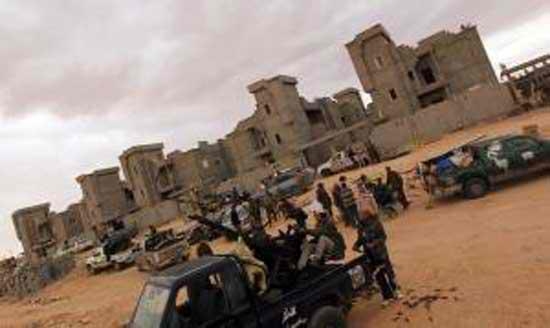
The Brigade of 28 May blocking the local population from entering Bani Waldi, October 25, 2012. Dozens of armed groups have stepped into the role of overlords of cities and towns since Gadhafi was killed and his regime deposed in October 2011. The transitional government that replaced the regime has done little to impose security, leaving many Libyans under the threat of militias that compete for territory.

Πηγή: USA Today
By Mathieu Galtier
Jan 3 2013

BANI WALID, Libya — The bakery in this burnt-out bazaar is one of the few stores that wasn't destroyed by militias that have attacked this former stronghold of Moammar Gadhafi following the civil war.

Sheep slaughterer Abu Salem waits for his turn in line, standing near walls scrawled with curses against the people of the town for siding with the dead dictator.

"When I leave the house, when I see the militiamen, I dart into another street. I'm terrified that they'll stop me and beat me," he said.

Dozens of armed groups have stepped into the role of overlords of cities and towns since Gadhafi was killed and his regime deposed in October 2011. The transitional government that replaced the regime has done little to impose security on its own, leaving many Libyans under the threat of militias that compete for territory and terrorize those without arms to fight back.

"We have to proceed down two paths simultaneously," said Abdurrahman Sewehly, the president of the Libyan National Congress' defense committee.

"On the one hand, we have to work with the brigades because they are the only ones capable of ensuring security in Libya," he said. "On the other, we have to start to create a professional army — but with a view to the long term."

The militias refused to disarm after the revolution, saying at the time that they needed to protect themselves from rival tribes held in check by Gadhafi for decades or to ensure that regime sympathizers did not reorganize.

But militias, which are sometimes acting on behalf of a tribal clan, have since gone on the offensive, setting up operations across Libya.

"Some (militias) are good and some are bad," said Karim Mezran, senior fellow at the Atlantic Council's Rafik Hariri Center for the Middle East.

While some provide legitimate security, others work with criminal organizations in human trafficking for prostitution and forced labor. Some also smuggle drugs and kidnappings for ransom.

"What pushes them is that they have nothing else to do," Mezran said. "Kids who are unemployed and have no hope for the future (find) a role, gain dignity, a position … and protection."

Many militia members are former revolutionary fighters whom the current government relies on for security matters. Others are criminals or those looking for jobs from them, according to testimony before the U.S. Congress.

Some are headed by religious extremists, such as those behind the Sept. 11 attack on the U.S. Consulate in Benghazi. All claim to be acting in the interests of the population, and some are now quite powerful.

"We took the tanks, the anti-aircraft missiles, the heavy artillery that Gadhafi's army left when they fled NATO bombardments (in May 2011)," said Khaled Al Ashlam, the manager at the local government council of Misrata. "That's why Misrata's forces are the strongest."

Two months ago, militiamen from nearby Misrata swept into Bani Walid, a town of 70,000, on the orders of the Libyan National Congress. The government-authorized assault was intended to clear out the last remaining loyalists of Gadhafi.

The militia used artillery to hammer a city whose tribal chiefs have long been rivals of those in Misrata, a city that was pummeled by Gadhafi's forces during the civil war. The Warfallas, the people of Bani Walid, viewed the attack as revenge for their support of Gadhafi rather than a search for loyalists. Not a single former Gadhafi official was arrested in the operation.

Still, some militias have filled in the security gaps left by the deposed army and police of Gadhafi. Under Gadhafi, the military and police were denied weaponry to prevent them from rising up against his regime. Many militias made up of Gadhafi's fiercest opponents have signed an agreement placing their soldiers under the authority of the Defense or Interior ministries. They police areas and maintain checkpoints.

"When the police are looking for someone, or they want to organize a checkpoint, they call us because the police aren't armed — but we are," said Amer Juma, who heads the Saraya el-Hamra brigade in Tripoli, a militia recognized by the government.

There are also non-aligned militia groups who pursue the interests of their tribe or city, acting independently of the authorities even though they have signed agreements with Tripoli to work under the government. Saif El-Islam, a Gadhafi son, is being held by one of these militia groups that has refused government requests to transfer him to Tripoli.

Al-Bayum Ali Bouzid, who heads the Al-Massiba brigades, which controls the Libyan-Tunisian border, says his militia was asked by the Defense Ministry to halt drug and alcohol trafficking in its area and arrest illegal immigrants.

"We're holding them in our prisons until their trials are held," he said.

The government sends Al-Bayum supplies for his 3,000-strong militia, he said, and he is "free to do" as he pleases.

In the past year the government has declared some militias illegal — mostly those involved in trafficking people, arms and drugs. But many young men say they can only make quick money as part of an armed group.

"A lot of [the brigades] are involved in drugs and arms trafficking — especially the brigades in the south — it brings in a lot of money," said Bin Hicham, a member of a pro-government militia.

"We fought during the war because it was our duty," he said. "Now, we're expected to surrender our arms to people who didn't fight. Instead, the government should offer us work or university scholarships in exchange for our weapons."

Yet another reason why the government is not cracking down on militias is because they are organized around tribes that are loyal to their leaders and not Libya's, as Gadhafi knew well.

Libya's first elected post-Gadhafi leader, Mustafa Abushagur, saw his government fall in October when a militia from Zawiya stormed the Libyan National Congress after their demands to be represented in the ministries were not met.

Abushugar's successor, Ali Zeidan, has chosen a cabinet that represents tribes from across Libya to "avoid the errors of the past and avoid provoking people."

Benghazi's residents stormed the headquarters of Ansar El-Sharia, a Salafist militia suspected of involvement in the killing of U.S. Ambassador Christopher Stevens on Sept. 11. Yet just days later people in Benghazi were lamenting the absence of the militia, which had been preventing thefts at the city's hospital.

Government officials say Libya will not get rid of the militias anytime soon.

"Libya doesn't have a real national army," said Ebtsem Steita, a member of the Libyan National Congress. "The government is too weak to control the brigades."

Moustapha El Ahmari, a doctor who was visiting his family in Bani Walid during the recent attack, knows this well.

"They burned everything — for no reason," he said. "My father is a doctor, not a soldier (but) they even took our gold. They burned our birth certificates and our degrees that were in the safe."


11/04/2012

Are Ashton's friends using white phosphorous in Libya?

The Europrean Union High Representative for Foreign Affairs and Security Policy, Catherine Ashton, during a press conference in Tripoli, Libya, 12 November 2011. On 23 Octomber this year, she declared it "the first anniversary of the historic declaration of liberation".

Πηγή: New Europe
By David Cronin
Nov 4 2012

On 23 October, the EU's foreign policy chief issued a statement congratulating the Libyan people "on the first anniversary of the historic declaration of liberation". While Ashton did profess concern about ongoing violence, the general tone of her comments was triumphant.

Four days later, the television channel RT broadcast horrific images from Bani Walid, southeast of Tripoli. The RT report included allegations made by a local lawyer that the militia attacking the city was using white phosphorous munitions.

RT is financed by Russia - like the BBC is financed by the British state - but does that mean its report should be dismissed? Organisations viewed as credible in this part of the world have previously documented the presence of chemical weapons in Libya. A journalist with The New York Times found white phosphorous in a Libyan weapons depot during 2011. According to the journal of record, the depot had belonged to Muammar Gaddafi's regime but had fallen into rebel hands. Human Rights Watch, meanwhile, came across white phosphorous at "multiple sites" in Libya earlier this year.

The fact that the white phosphorous allegations from Bani Walid have been ignored by most media outlets does not make them untrue. The mainstream press failed to probe claims that the US bombarded the Iraqi city of Fallujah with white phosphorous in 2004. Fortunately, a number of bloggers kept digging until they had produced proof that the substance had indeed been used. After a year of obfuscation, the Pentagon finally owned up in 2005.

White phosphorous can cause grievous injuries. Once it comes in contact with human skin, it can burn deeply through the muscle and into the bone. America's best buddy Israel made extensive use of this substance during its all-out offensive on Gaza in late 2008 and early 2009. Just as there have been international campaigns, culminating in agreements to ban landmines and cluster bombs, there ought to be a mass mobilisation against white phosphorous.

The militia attacking Bani Walid appear to be on "our" side. Last year Ashton told rebels fighting Gaddafi that "we will be here to support you all the way". Some of those rebels apparently want to teach Bani Walid a lesson because it was a pro-Gaddafi stronghold. The attack was sparked by the death in September of Omran Shaaban, a rebel suspected of capturing and helping to kill Gaddafi. Shaaban had been kidnapped in Bani Walid.

Are the women and children in this city now being exposed to white phosphorous as part of an act of vengeance? I don't have the answer to that question. But surely it requires investigation.

Of course, our governments have a history of only getting upset about Libya when it suits them? Having been told repeatedly that Gaddafi was a "mad dog", I was astonished to pick up a newspaper one day in 2003 and learn of how his rapprochement with the West. Gaddafi bought so much European weaponry over the next few years that he must have amassed a huge collection of loyalty cards from our arms dealers. He even delivered a lecture in the European Commission's press room, encircled by his troupe of female bodyguards. But then he started making awkward queries about how Libya's oil resources were benefiting some corporations more than others. And so he became a "mad dog" again.

We, on the other hand, are incapable of wrongdoing. Anders Fogh Rasmussen, NATO's secretary-general, expressed pride recently about how the alliance "prevented a massacre and helped protect civilians from attack" in Libya last year. How did NATO achieve that feat? By dropping a total of 7,642 "surface-to-air weapons", according to NATO's own data.

Every so often NATO's legal adviser Peter Olson is invited to speak at prestigious conferences on respecting international humanitarian law in modern warfare. Strangely, the same Peter Olson is less enthusiastic about opening up NATO's own record on respecting international humanitarian law to scrutiny. Earlier this year, he wrote to the UN's International Commission of Enquiry on Libya, expressing concern that incidents involving NATO could be treated in the commission's report as being "on a par" with those that "did violate law or constitute crimes". Olson urged that the report "clearly state that NATO did not deliberately target civilians and did not commit war crimes in Libya."

There was something arrogant about how Olson tried to dictate what the findings of an independent enquiry should be. As it happened, the International Commission did express concern about a number of airstrikes carried out by NATO. Its report stated that the enquiry was "unable to conclude, barring additional explanation, whether these strikes are consistent with NATO's objective to avoid civilian casualties entirely, or whether NATO took all necessary precautions to that effect". Amnesty International has cited "credible reports" that some of NATO's attacks killed "at least tens of civilians". And the aforementioned Human Rights Watch declared in May this year that NATO has "failed to acknowledge dozens of civilian casualties" resulting from its 2011 war and has "not investigate possible unlawful attacks".

Leaving aside NATO's direct responsibility, there is a general consensus among human rights monitors that both rebel and pro-Gaddafi fighters carried out indiscriminate attacks. Shouldn't Catherine Ashton, therefore, admit that some of the rebels she supported "all the way" were war criminals? Of course, she should. But I'm not holding my breath.


10/04/2012

Libya Forces Prepare for Sweep of Pro-Gadhafi Town

Shaaban's death stoked tensions between Misrata and Bani Walid
Πηγή: abc NEWS
By AP
Oct 2 2012

Libyan militias operating alongside the defense ministry readied their forces Tuesday to advance on a town that remains a bastion of support for the ousted regime of Moammar Gadhafi, stoking fears of an impending battle that has already sent dozens of families fleeing.

Bani Walid is one of the last major pockets of support for the former regime, and disarming its militants is one of the most daunting tasks facing the government. Militias in the town of about 100,000 people are heavily armed with rocket-propelled grenades, automatic weapons and artillery left over from last year's eight-month civil war.

During the war, many blamed the town's fighters for the worst of the sniper attacks, shelling, rape and other violence during the bloody siege of the coastal city of Misrata. Calls for revenge again peaked after the death last week of a well-known 22-year-old former rebel fighter after ill treatment at the hands of militiamen from Bani Walid.

Omran Shaaban had been hailed as the first fighter to find Gadhafi hiding in a drainage ditch last October, leading to the dictator's capture and killing. Seen as a hero to many, Shaaban's death raised the prospect of more score-settling. The same day of his death, the newly elected National Congress authorized the police and army to use force if necessary to apprehend those who abducted Shaaban and three of his companions in July near Bani Walid.

The government had brokered Shaaban's release and he was transferred to a hospital in France where he died of his wounds. He had been paralyzed from the waist down and relatives say his chest had been slashed with razors during his 55 days in captivity.

At least four residents of Misrata are still being held by the town's militias, according to local activists.

Militia commander Faraj al-Swehli said dozens of families have fled Bani Walid in anticipation of an offensive. On Tuesday three fighters from Misrata were wounded in clashes during a surveillance operation near the town, according to witnesses.

Al-Swehli ordered his Tripoli-based militia, originally from Misrata, to join others who have surrounded parts of the town. They are operating together in a loose coalition of the country's largest militias known as Libya Shield, which is relied on by the defense ministry. Shaaban was a part of the group before his death.

The government has given Bani Walid's leaders until this coming Friday to handover suspects linked to the torture of Shaaban.

Libya Shield fighters put out a statement Tuesday saying they will not enter Bani Walid without orders from the military chief of staff Gen. Youssef Mangoush. However, even without government orders the militias began surrounding parts of the town last week.

The Libyan government remains weak and has been unable to rein in armed militias in a country awash with weapons. Earlier this month, a demonstration at the U.S. Consulate in the eastern city of Benghazi turned violent, killing four Americans, including the U.S. ambassador.

Misrata activist Ahmed al-Madany said he heard the local Bani Walid radio station say that its fighters will defend the town to the last man.

"I doubt they will turn the suspects in," he said.

A resident inside Bani Walid, who wished to remain anonymous for fear of reprisal, said militias inside have set-up checkpoints to secure the area.


9/26/2012

Death of Libyan rebel raises calls for vengeance

In this undated handout photo released by the family of Omran Shaaban, Shaaban receives treatment from a doctor at a hospital in France. 
Πηγή: AP
By AYA BATRAWY
Sept 26 2012

MISRATA, Libya — One of the young Libyan rebels credited with capturing Moammar Gadhafi in a drainage ditch nearly a year ago died Tuesday of injuries after being kidnapped, beaten and slashed by the late dictator's supporters — the latest victim of persistent violence and instability in the North African country.

The death of Omran Shaaban, who had been hospitalized in France, raised the prospect of even more violence and score-settling, with the newly elected National Congress authorizing police and the army to use force if necessary to apprehend those who abducted the 22-year-old and three companions in July near the town of Bani Walid.

Libya is battling lingering pockets of support for the old regime, and its government has been unable to rein in armed militias in a country rife with weapons. Earlier this month, a demonstration at the U.S. Consulate in the eastern city of Benghazi turned violent, killing four Americans, including the U.S. ambassador.

Shaaban was praised as a "dutiful martyr" by the National Congress, although his family says he never received a promised reward of 1 million Libyan dinars ($800,000) for capturing Gadhafi on Oct. 20, 2011, in the former leader's hometown of Sirte. The eccentric dictator was killed later that day by revolutionary fighters.

The Libyan government said it would honor Shaaban with a funeral befitting a hero. His body was greeted at the airport in his hometown of Misrata by more than 10,000 people for a procession to a soccer stadium for funeral prayers.

Photos on social media websites showed a wooden coffin with a glass window that revealed Shaaban's face, with white gauze covering his head.

In the capital of Tripoli, several hundred protesters gathered outside the headquarters of the National Congress to demand that the government avenge Shaaban's death.

Shaaban's family said that he and three friends had been en route home to the western city of Misrata from a vacation in July when they were attacked by gunmen in an area called el-Shimekh near Bani Walid.

Shaaban and his friends, who like many Libyans were armed, fired back, the family said.

Two bullets hit Shaaban, and he was paralyzed from the waist down, his relatives said. The men were captured by militiamen from Bani Walid, a town of about 100,000 people that remains a stronghold of Gadhafi loyalists and is isolated from the rest of Libya.

President Mohammed el-Megarif visited Bani Walid this month and secured the release of Shaaban and two of his companions. A fourth is still being held.

When Shaaban was finally brought home, he was "skin and bones" — still paralyzed, frail and slipping in and out of consciousness, according to his brother, Abdullah Shaaban.

"It was clear he was beaten a lot," Abdullah Shaaban said. "His entire chest was sliced with razors. His face had changed. It wasn't my brother that I knew."

Omran Shaaban later was flown to France for medical treatment.

Shaaban, the second youngest in a family of nine children, was a member of Libya Shield, a loose coalition of the country's largest militias relied on by the Defense Ministry.

Khalifa al-Zawawi, the former head of Misrata's local council, said the government reneged on paying the reward to Shaaban.

Abdullah Shaaban said his brother did not mind, saying he considered capturing Gadhafi to be his national duty.

Libya's president released a statement Tuesday vowing that those responsible for the violence against Omran Shaaban would be punished.

But apprehending and disarming the militants in Bani Walid are among the most daunting tasks facing the government. The town is heavily armed with rocket-propelled grenades, automatic weapons and artillery left over from last year's civil war.

Residents of Bani Walid say that pictures of Gadhafi are displayed during weddings and youths play his speeches on their cars' stereos. Students refrain from singing Libya's new national anthem and teachers refuse to follow the revised curriculum.

Bani Walid fighters were blamed for many of the sniper attacks, shelling, rapes and other violence against the city of Misrata during the civil war, and there were new calls Tuesday from residents of Misrata for vengeance against Bani Walid.

Shaaban's eldest brother, Walid, insists there will be justice for the family, regardless of whether the government is the one to administer it.

"I plan to pursue his rights legally and join if there is a military incursion. We are going to death, God willing," Walid Shaaban said.

Family friend Abu-Shaala echoed that sentiment.

"If the government does not go in, we are going in," he said. "We are all patient. But our patience has limits."


1/29/2012

Libya: Bani Walid surrounded (again)

Libyan National Transitional Council (NTC) fighters gather at an outpost south of Bani Walid, in October 2011.

According to Punch news “A powerful sense of deja vu grips the men of Libya’s national guard as they mass for battle in the freezing desert outside Bani Walid, the new frontline of a war most had thought was long over”.

The town, one of the last pro-Gaddafi redoubts to hold out against the rebels, and home to the powerful Warfalla tribe, became a “no-go area for government units and the militias, drawn from units across Libya, that are ready to launch a new offensive unless local leaders allow them back in – and round-up war crimes suspects”.

Though the fighters agree with the UN assessment that this is not part of a pro-Gaddafi uprising they claim that there are hundreds of pro-Gaddafi persons in that town which have committed crimes. And this seems to be the real issue. In the well informed article of the Foreign Policy “The Lesson of Bani Walid”, the town is described as a “a refuge for the waifs and strays of the former Gaddafi administration who are on the war crimes lists of other cities”. When a pro-government unit in the town had begun to arrest them on Monday their base was attacked by a local clan. Four soldiers were killed, the rest fled, and the suspects were set free.

The expelled commander of the "28th of May" brigade, Imbarak al-Futmani said in an interview with Reuters at his desert camp near Sadada, 50 km east of Bani Walid, that “"It is our right to reenter Bani Walid and nobody can prevent us”. In his view "These pro-Gaddafis, they see us a rats, like Gaddafi did," "they are murderers and criminals, they will never intergrate into the new Libya because they know they will face justice now".

Though he is skeptical of any peaceful solution predicting more violence ahead he agreed to the Libya’s PM directions to hold off attacks to allow civilians to leave the town and, hopefully, for the assailants to surrender.

According to the Doctors Without Borders and Amnesty International, some 8,500 people accused as Gaddafi’s supporters, are detained without any legal right, tortured, denied medical care, “beaten for hours with whips, cables, plastic hoses, metal chains and bars and wooden sticks, and given electric shocks with live wires and Taser-like electro-shock weapons”, while “several detainees have died in the custody of armed militias in and around Tripoli and Misratah in circumstances that suggest torture”. Obviously the option to get arrested is grave as there is not any legal system in the Post – Gaddafi Libya, contrary to the NTC’s statements followed by ICC’s affirmations that Saif al-Islam could be tried there “according to the International standards”.

The recent protests against the self appointed NTC government underline the existing distrust and frustration. FP reports:
“The NTC has been doing little to help itself. Formed in the eastern city of Benghazi in the heat of battle, it has morphed into an organization both secretive and inefficient. It refuses to make public its membership list, or its meetings, or its voting records. Nor will it open the books on what is being done with the country's swelling oil revenues. On top of everything else, earlier this month it bungled the drafting of legislation for a planned June national election, thus feeding the paranoia of Libyans who believe that many of its members are Gaddafi loyalists trying to manipulate the revolution to their own ends.
It has no press office. Or rather, it does, but as one of its former press officers recently explained to an online journalism forum, a decision was taken that the NTC would have no press officers, so the office is unmanned and the door locked. There is no phone”.
It seems that two towns have turned into some kind of statelets forming an alliance though there is still considerable sympathy for the idea of a unitary Libyan state -- especially among the revolutionaries who hail from the relatively sophisticated towns of the coast:
“Both Zintan and Misrata have transformed themselves into virtual statelets, with heavy security forces that control all movements in and out. Misrata's "gate" boasts thirty white poles flying the flags of the world, giving you the feeling of entering another country”.
But beyond the fragmentation and the numerous (over 300) militias, Libya is awash with arms. The Gulf Today reports: “Out of a population of 6.4 million, about 125,000 people are believed to be armed.

Many are part of the numerous paramilitary groups that remain independent from the transitional government, according to a report recently by the International Crisis Group”.

Recently the UN warned that it is possible that arms reach to the hands of Africa's Sahel region like Boko Haram and al Qaeda. Nevertheless, the presence of arms for some is beneficial.

These are the smugglers (in cooperation with fighters) earning money by trading arms illegally. According to the Asharq Alawsat report: “There are two kinds of dealers who come to buy the new weapons. The first are the dealers who come from [the Egyptian region of] Upper Egypt, who look for small arms, which are sold in the small towns of Upper Egypt. The second are dealers who come from [the Egyptian region of ] Al-Arish, who look for heavy weapons, such as Sam-7 missiles, RPG rockets, hand-grenades, land mines, and night visual equipment”.

The roads of smuggling are those that were used for “smuggling tones of drugs between the Algerian-Libyan border and the Libyan-Egyptian border”. Those activities are well combined with human trafficking as Libya serves as a transit route for human trafficking, mostly of Somali and Ethiopian nationals, to Italy and other European countries. While Gaddafi had asked five billions euros from the EU to stem the flow of the illegals the new government has adopted a different approach as the Interior Minister Fawzi Abdelali stated that Libya will not be the ‘border guard’ for Europe.

Given this chaotic situation – which we had predicted since May – the option of a new military operation in Bani Walid could be catastrophic. Libya has to get used at political solutions to the numerous confrontations.


1/25/2012

Tribalism, simmering grievances help give Gadhafi's loyalists a comeback in new Libya

FILE, in this Sept. 18, 2011 file photo, Former rebel fighters put a pre-Gadhafi flag at the northern gate of Bani Walid, as smokes raise from the town, Libya. Moammar Gadhafi loyalists seized control of a Libyan city and raised the ousted regime's green flag, an official and military commanders said Tuesday Jan 24 2011, in the most serious revolt yet against the country's government.


Πηγή: Global news
By Maggie Michael, Rami Al-Shaheibi
Jan 25 2012

BENGHAZI, Libya - Moammar Gadhafi loyalists have seized control of a Libyan mountain city in the most serious challenge to the central government since the strongman's fall, underlining the increasing weakness of Libya's Western-backed rulers as they try to unify the country under their authority.

The taking of Bani Walid, one of the last Gadhafi strongholds captured by the new leadership late last year, was the first such organized operation by armed remnants of Gadhafi's regime. A simultaneous outbreak of shootings in the capital and Libya's second largest city Benghazi raised authorities' concerned that other networks of loyalists were active elsewhere.

The security woes add to the difficulties of the ruling National Transitional Council, which is struggling to establish its authority and show Libyans progress in stability and good government. Bani Walid's fall comes after violent protests in Benghazi, where Libyans angry over lack of reform stormed the NTC headquarters and trashed offices.

In Bani Walid, hundreds of well-equipped and highly trained remnants of Gadhafi's forces battled for eight hours on Monday with the local pro-NTC revolutionary brigade, known as the May 28 Brigade, said Mubarak al-Fatmani, the head of Bani Walid local council. The brigade was driven out and Gadhafi loyalists then raised their old green flag over buildings in the western city.

Four revolutionary fighters were killed and 25 others were wounded in the fighting, al-Fatmani said.

There were no immediate signs that the uprising was part of some direct attempt to restore the family of Gadhafi, who was swept out of power in August and then killed in the nearby city of Sirte in October. His sons, daughter and wife have been killed, arrested or have fled to neighbouring countries.

Instead, the fighting seemed to reflect a rejection of NTC control by a city that never deeply accepted its rule, highlighting the still unresolved tensions between those who benefited under Gadhafi's regime and those now in power. Those tensions are tightly wound up with tribal and regional rivalries around the country.

The May 28 Brigade had kept only a superficial control over the city, the head of Bani Walid's military council, Abdullah al-Khazmi, acknowledged.

"The only link between Bani Walid and the revolution was May 28, now it is gone and 99 per cent of Bani Walid people are Gadhafi loyalists," he said.

He spoke to The Associated Press at a position on the eastern outskirts of Bani Walid, where hundreds of pro-NTC reinforcements from Benghazi were deployed with convoys of cars mounted with machine-guns, though there was no immediate move to retake the city.

The fighters who captured the city Monday night belong to Brigade 93, a militia newly created by Gadhafi loyalists who reassembled after the fall of the regime, said al-Khazmi and al-Fatmani. The fighters, flush with cash and heavy weaponry including incendiary bombs, have been increasing in power in the city, they said.

There was no possibility to confirm their claims. However, there were no mass evacuations from the town after the clashes, an indication that the residents appear to accept the new arrangement, said Ali al-Fatmani, a revolutionary brigade commander in Bani Walid.

Authorities in Benghazi, where the NTC is centred, appeared concerned that the Bani Walid uprising could have sent a signal to other cells of Gadhafi forces.

An AP reporter who was present in the Benghazi operation room heard military commanders on Monday saying co-ordinated incidents of drive-by shootings in Tripoli and, to a lesser extent, Benghazi erupted as news of the Bani Walid takeover spread. In Tripoli, some shops closed, and fighters responsible for security in the capital were on a state of alert over the shootings.

Five months since the Gadhafi regime's fall and three months since his death, the National Transitional Council has so far made little progress in unifying its armed forces. Instead it relies largely on multiple "revolutionary brigades," militias made up of citizens-turned-fighters, usually all from a specific city or even neighbourhood.

The militias were created during the months of civil war against Gadhafi's forces last year, and since the war ended in October, the various brigades remain in control of security affairs of each city they liberated. Though loyal to the NTC, they have also feuded among themselves and acted on their own initiative, and the council has been unable to control them.

A month ago, Gadhafi loyalists attacked another revolutionary brigade from Tripoli that entered Bani Walid, killing 13, said Mubarak al-Fatmani.

"The council (NTC) did absolutely nothing," said al-Fatmani, who resigned from his local council chief post to protest the NTC's failure to investigate the ambush. He still holds his position, since his resignation has not yet been accepted.

The council has faced increasing complaints that it is doing little to bring stability to the country. It faces a daunting task, since Gadhafi's regime stripped Libya of most institutions, and the civil war has stirred up widespread divisions, rivalries and resentments.

In the Benghazi unrest last Saturday, protesters broke into the NTC headquarters, smashed windows and carted off furniture and electronics, then threw bottles at NTC chief Mustafa Abdul-Jalil as he tried to address them and torched his car. The next day, Abdul-Jalil suspended the Benghazi representatives on the council in an apparent attempt to appease protesters. The deputy chief of the NTC resigned in protest over the suspension.

Bani Walid, a city of 100,000 located in the mountains 90 miles (140 kilometres) southeast of Tripoli, held out for weeks against revolutionary forces after Gadhafi's fall from power, with loyalist fighters dug into its formidable terrain of valleys and crevasses. Pro-NTC fighters finally took it in October.

The main tribe in Bani Walid is a branch of the Warfala tribal confederation, which stretches around the country with around 1 million members. The Bani Walid branch was one of the most privileged under Gadhafi, who gave them top positions and used their fighters to try to crush protests in the early months of last year's uprising against his rule.

That has left a deep enmity between the tribe and others. Ali al-Fatmani said Bani Walid loyalists were among Gadhafi troops that tried to march on Benghazi during the civil war and were used to in the siege of Zawiya, west of Tripoli. There were reports, he said, that Bani Walid fighters desecrated graves of fallen revolutionary fighters in Zawiya.

"The hatred and mistrust have been building up during the revolution," said al-Fatmani, himself a Warfala.


1/24/2012

Libya: Gaddafi Loyalists Seize Bani Walid

The shadow of a resident of the restive city of Bani Walid is casted near the wreck of a rocket propelled grenade on the roof of a damaged building on October 30, 2011. Feeling of vengeance looms over the destiny of one of the last bastions of pro Kadhafi supporters amid hard feelings among the members of the Warfalla tribe against the new rulers of the National Transitional Council.


Πηγή: Huffington Post
By AP
Jan 24 2012

BENGHAZI, Libya — Moammar Gadhafi loyalists have seized control of a Libyan town and raised the ousted regime's green flag, an official and commander said Tuesday.

The retaking of Bani Walid comes as Libya's new leaders have struggled to unify the oil-rich North African nation three months after Gadhafi was captured and killed.

Hundreds of well-equipped and highly trained remnants of Gadhafi's forces raised the green flag over buildings in the western city late Monday after hours of clashes, said Mubarak al-Fatamni, the head of Bani Walid local council.

Al-Fatamni, who fled to the nearby city of Misrata following the attack, said four revolutionary fighters were killed and 25 others were wounded. He said the Libyan Defense Ministry has not sent any forces to the area.

A top commander of a revolutionary brigade in Bani Walid, Ali al-Fatamni, who was present in Benghazi during the attack, says he has lost contact with other fighters in the town.

The bold attacks, which have led authorities to declare states of emergency in several areas, are the latest breakdown in security, three months after Gadhafi's capture and killing. Protests have surged in recent weeks, with people demanding that the interim leaders deliver on promises of transparency and compensation for those injured in the fighting.

Bani Walid, 90 miles (140 kilometers) southeast of Tripoli, was one of the last Gadhafi strongholds to fall to revolutionary forces amid a monthslong civil war. Gadhafi's son and longtime heir apparent, Seif al-Islam, was long believed to have been hiding in the town.

Seif al-Islam, who has been charged with crimes against humanity by the International Criminal Court, was captured in November by fighters from the town of Zintan in Libya's western mountains, who continue to hold him.


Libya minister denies claims Kadhafi men attack town


Πηγή: yahoonews
By AFP
Jan 24 2012

BANI WALID, Libya (AFP) - Deadly clashes erupted on Monday in Bani Walid, with a Libyan minister denying local officials' claims the attack on the former bastion of Moamer Kadhafi was carried out by his loyalists.

An AFP correspondent who managed to enter Bani Walid for a short time said thick smoke billowed into the sky, while the identity of those present was unclear and there was limited evidence of the new Libyan authorities on the roads outside the town.

While local officials said the town was attacked by Kadhafi's men, Interior Minister Fawzi Abdelali dismissed these claims, saying the firefight was caused by "internal problems" in the town.

He told Libyan television that the fighting was among the people of Bani Walid, and linked to "the issue of compensation for those affected by last year's war."

"The information we have from inside the city does not say that there are green flags (hoisted on town buildings) and there is nothing in relation to the former regime."

But Abdelali confirmed that five people were killed in the fighting as claimed by local officials.

"The loyalists of Kadhafi took control of the entire city of Bani Walid," said M'barek al-Fotmani, a former member of the ruling National Transitional Council (NTC) in the desert oasis, 170 kilometres (110 miles) south of Tripoli as he led the claims of the so-called attack.

Fotmani said the daylight attack started with a assault on a base of former rebels which killed "five thuwar (anti-Kadhafi revolutionaries) including a commander." Around 30 former rebels were also wounded, he said from inside the base which he later fled.

Mahmud Warfelli, spokesman of Bani Walid local council, too said that the attack was launched by "a group of remnants of the old regime," and called for outside help against a feared "massacre."

"There are around 100 and 150 men armed with heavy weapons who are attacking. We have asked for the army to intervene, but the defence ministry and NTC have let us down," he said.

"(The gunmen) took control and hoisted the green flag on some districts, some important districts in the centre of the city," Warfelli added.

A senior NTC member, Fathi Baja, said reinforcements had been sent to protect the town, adding the "fighting is between some Kadhafi supporters and thuwar."

Fotmani said the assailants had surrounded the base, which belonged to the May 28 Brigade, a unit attached to the defence ministry.

But Salem al-Ouaer, a military commander from the town told AFP the Brigade of May 28 itself had caused Monday's clashes.

"Recently the brigade arrested two persons from the tribe of Tlatem and after negotiations it was decided it would release them today. But when members of the tribe came to take them, the brigade refused and clashes ensued," he said.

"People may have spoken about being surrounded by pro-Kadhafi elements to get reinforcements...," he said, while a source close to the tribe said that some pro-Kadhafi elements in the town may have "exploited the situation to their advantage."

Another AFP photograher who has also visited the town said that the situation was back to normal later on Monday, but the base remained surrounded and added that he did not see green flags.

Monday's firefight follows an outburst of opposition to the ruling National Transitional Council in the eastern city of Benghazi last week that prompted its chairman, Mustafa Abdel Jalil, to warn of possible "civil war" in post-conflict Libya.

Speaking on Libya al-Hurra television on Sunday, Abdel Jalil warned the new Libya would fall into a "civil war" unless protests against the NTC ended.

Crowds of protesters in Benghazi -- the city which first rebelled against Kadhafi last year -- had earlier thrown home-made grenades at and stormed the NTC office before setting it ablaze, witnesses said.

The demonstrators denounced the interim government for its lack of transparency and accused the NTC of marginalising some wounded veterans of the uprising in favour of people previously loyal to the slain dictator.

In recent months Libya has also seen clashes between rival militias, comprised of the former rebels.

Bani Walid was one of the last pro-Kadhafi bastions to fall in the bloody uprising against Kadhafi.Its capture was followed days later by the fall of his hometown Sirte in a battle which also led to his killing and marked the "liberation" of Libya.


1/23/2012

Libya Clashes Between Gaddafi Loyalists And Revolutionaries Rock Bani Walid

A Libyan National Transitional Council (NTC) fighter walks past a mosque with anti-Moamer Kadhafi graffiti scrawled on its perimeter wall as fighters prepare to attack pro-Kadhafi forces in this desert oasis of Bani Walid, 220 kms southeast of Tripoli, on October 11, 2011


Πηγή: Huffington Post
By RAMI AL-SHAHEIBI
Jan 23 2012

BENGHAZI, Libya -- Forces loyal to Libya's late leader Moammar Gadhafi attacked the former regime stronghold of Bani Walid on Monday, killing at least four revolutionary fighters, officials and residents said.

The fierce clashes in the town, located some 90 miles (140 kilometers) southeast of Tripoli, comes as the Libya's new leaders struggle to stamp out lingering resistance from pro-Gadhafi forces and unify a deeply fractured country after eight months of civil war and more than 40-years of authoritarian rule.

Mahmoud al-Warfali, a spokesman for revolutionary brigade in Bani Walid, said up to 150 pro-Gadhafi fighters raised the old green Libyan flag at the northern gate of the town and were battling revolutionary forces in the streets with rocket-propelled grenades and AK-47s.

"These are Gadhafi remnants who tried to take over the city," al-Warfali said. "They have tried to do this before and take over the interim government's office, but thank God we have been able to fight them off."

He said four revolutionary fighters have been killed. He did not know how many people had been wounded.

Bani Walid resident Moussa al-Warfali said the clashes began early Monday when Gadhafi loyalists angry over the arrest of one of their men attacked revolutionary fighters in the town.

The fighting originally was centered around the revolutionary brigade's base, but has since spread to other parts of the town.

The clashes are considered serious enough that dozens of revolutionary fighters from Tripoli have been dispatched to Bani Walid to help, said brigade commander Saddam Abdel-Zein.

Bani Walid has long tormented Libya's revolutionaries.

After the fall of Tripoli to anti-Gadhafi fighters in August, regime loyalists found refuge in the town, and from there held off revolutionary forces for weeks, using the surrounding mountains and valleys to their advantage to pick off revolutionary forces.

Even after Gadhafi's capture and killing in October, the city and its surrounding region have troubled Libya's new leaders.

In November, 15 soldiers were killed in an ambush by Gadhafi loyalists just outside the town. And revolutionary fighters in Bani Walid have complained that the country's interim government has done little to help secure the city.


10/29/2011

Tribal Unrest In The New Libya

Members of the powerful Warfalla tribe parade on their horses

Πηγή: npr
by LOURDES GARCIA-NAVARRO
Oct 29 2011

Bani Walid was one of the last pro-Moammar Gadhafi bastions to fall to revolutionary forces. It's also the seat of the Warfalla tribe, the largest in Libya. In the wake of Gadhafi's death, NPR's Lourdes Garcia-Navarro reports the tribe is aggrieved and the city is seething.


10/22/2011

Libya's largest tribe is an unnecessary enemy of the NTC

LIBYA. Tripoli. July 31, 2011. Members of the Warfalla tribe--some of them armed--gather in Tripoli's Green Square during a rally in support of their tribe and Colonel Muammar Qaddafi after reports surfaced of the killing of several Warfalla tribesmen during clashes in the city of Benghazi.

Oct 22 2011

As Libya must begin to come together when the fighting ends, it is very unfortunate that we also must accept such tribalism. In my country, the tribes are a source of strength, honour and political power, but also of destructive forces and divisiveness, argues Mustafa Fetouri

As National Council forces advanced towards my hometown of Bani Walid last month, a Libyan-Canadian doctor, Abdalla Kinshel was being touted as a negotiator who could secure the city with a minimum of bloodshed. As a native of Bani Walid, Dr Kinshel appeared to have volunteered for the job.

It was quickly evident; however, that the NTC did not extend its full support to Mr Kinshel and the negotiated approach was failing. Soon he was declaring that resistance against the NTC forces was being led by elements of the Qaddafi regime, possibly even by Saif Al Islam himself. That justified the NATO air strikes that residents of Bani Walid said killed dozens of civilians in September.

Dr Kinshel has declared the fall of Bani Walid no less than three times and now, as foreign media report that NTC forces have almost perceived strength and a certain amount of arrogance. Dr Kinshel's statements in March were much wiser, calling for Bani Walid to be neutral in the conflict and for residents to give up their arms. At the time, town leaders rejected his call but at the same time guaranteed his safety.

Like most of Libya's population, the Warfalla tribe is largely made up of Bedouin people, who have deeply ingrained cultural values of integrity, saving face and tribal honour. They saw Dr Kinshel as making demands for their surrender to which they could not agree.

A better way would have been to use the same approach that was used in the neighbouring city of Tarhouna. There, tribal leaders were told that residents were free to declare their own loyalties, as long as they kept the peace. Pro-Gathafi and NTC supporters took to the streets at the same time without blood being shed.

In May, there was a small meeting of anti-regime Warfalla leaders in Istanbul, a meeting denounced by tribal leaders inside Libya. It showed that there were divided loyalties within the Warfalla that it was not an all-or-nothing scenario, but when I spoke to Dr Kinshel after the meeting, it seemed clear that there was already less of a focus on reaching out to the Warfalla members who remained in Bani Walid.

In retrospect, it is clear that if the goal was to break the Gathafi regime's control of the town and end the bloodshed, the tribal leaders' demands should have been accepted - or at least negotiated. They prohibited NTC representatives from entering the town without permission, banned fighters from entering unless they were native to the town, and said no one would be handed over to the NTC unless there were guarantees of due process and a functioning judiciary. These were the same demands that were made in Tarhouna, which led gradually to the NTC control of the city.

It has been the shorthand in the international media that the Warfalla have been regime supporters and opponents of the NTC. But that simplistic picture is misleading. A prejudice against Warfalla members in general is poisonous in the rebuilding of the country. Not only is it the largest tribe in the country, but its members make up a significant proportion of the educated middle class and civil servant corps.

It is true that if the Warfalla had turned in force against the Gathafis, the regime probably would not have survived until August and lives would have been saved. But the NTC and its clumsy political leadership have to share the blame for this, after having signed on to NATO's policy to attack first, and negotiate later. That left many with little choice but to fight, and still could lead others to sabotage reconciliation efforts.

As Libya must begin to come together when the fighting ends, it is very unfortunate that we also must accept such tribalism. In my country, the tribes are a source of strength, honour and political power, but also of destructive forces and divisiveness.

The hostilities of recent months demonstrated all of the old prejudices, which affect the Warfalla as much as any other tribe. The demand barring NTC fighters from entering Bani Walid was partly based in fear of the Misurata tribe (residents of the town of the same name), who are historical enemies of the Warfalla. (Instead, the Misurata fighters attacked Sirte, which might see new alliances form in the spiralling power struggle that is the new Libya.) Fighters from the town of Zintan, decades-old allies of the Warfalla, refused to fight at Bani Walid despite their loyalties to the NTC.

As a Warfalla member, I refuse to be pigeonholed in this poisonous tribal political atmosphere. I totally reject the Warfalla's support for the Qaddafi regime, support that was bought by favours and benefits. Warfalla suffered at the hands of the Gathafis as much as any other tribe. As one example, after a failed coup in 1993, Warfalla members were targeted viciously. One coup leader, Colonel Ramdan ElEhouri (Dr Kinshel's cousin, in fact), was hanged, his home demolished and family exiled for more than a decade. Many families suffered the same fate and Bani Walid was denied basic services including drinking water.

Libya has to rise above these old tribal prejudices if reconciliation is to take place. But based on its record, I'm not sure that the NTC is up to the job yet.

Mustafa Fetouri is a Libyan academic and political analyst. He won the Samir Kassir Award for best opinion article in 2010.


10/18/2011

Sirte, Bani Walid: ‘A Lost Chance?’

'High precision' weapons used to the siege of Sirte


In the sites of the last pockets of Gaddafi’s supporters the fight rages on. It is the last face of the ‘official’ war. Next, will be the invisible one, triggered by the hatred and pain of the 8 months civil war. The absence of the old regime’s soldiers n the Media narratives doesn’t assure any safety for the future peace, as they are also Libyan citizens which they have families and relatives around. For the Western supporters of the rebellion the ultimate victory on the loyalists was meant to follow the path of ‘fight till death’ doctrine. This underlines the victorious characteristic that legitimize the NTC as the sole governor of Libya. But it also seals the outcome of the conflict with the paint of a no tolerance policy for the other side underlined by the bulldozers tearing down Gaddafi’s compound in Tripoli, a gesture to write off the irreversibly written past. This is purely undemocratic.

Thus, the fractions of the Libyan society is ternal: The secularists, the Islamists and the supporters of the old regime, aka the losers. Both parties do have very strong reasons to stay inside their own conceptions. The secularists have generated all the West’s support which led to the victory by the enforcement of a no-flying zone. The Islamists where probably the best fighters as their leader drove the army inside Tripoli. The old regime’s supporters have strong memories and a lost national pride. In this picture you can add some separate militia leaders and gangs, smugglers, looters, and an extended black market.

The rebels during the war had refused negotiations that would include any of the government’s official in the new political map. This was a signal for a ‘fight till death’, and a message to the population that none of the old ideas would be allowed in the future. But Gaddafi was far more than a beast, a mad and a cruel dictator. He took over Libya’s lead when it was the poorest state in the world and in 2010 it enjoyed a higher Human Development Index than Denmark. Today’s Libya however good or bad, is totally his regime’s work. On top, it is understandable that the vast majority of the population don’t have any clue about free markets, privatization or market competition, unacquainted with this capitalistic culture.

The decision of the West powers not to effect a negotiating table even to the last bloodiest face of the civil war builds the alleged new born Libyan democratic future on a wrong, totalitarian and inhuman fanatic foundation.

This could be easily proved to be a ‘lost chance” rendering the future a lost case.

10/14/2011

UN rights official fears abuse of perceived Gadhafi loyalists when Sirte, Bani Walid fall


Πηγή: Washington Post
By AP
Oct 14 2011

GENEVA — A senior U.N. human rights official says there is a risk of serious abuses occurring when the last strongholds of ousted Libyan dictator Moammar Gadhafi fall to revolutionary forces.

The head of the U.N. human right’s office’s rule of law section, Mona Rishmawi, says perceived Gadhafi loyalists face persecution when fighting in the towns of Sirte and Bani Walid ends.

Rishmawi says Libya’s transitional government is trying to ensure the rights of captured Gadhafi fighters are protected but “the system that is currently in place is not adequate.”

She said in Geneva Friday that “there is a lot of room for abuse” of the estimated 7,000 people detained in sometimes makeshift prisons throughout Libya.

Rishmawi recently visited Libya as part of a U.N. delegation.

10/12/2011

Black Libyans Make Their Stand in Sirte and Bani Walid


Πηγή: Black Agenta Report
By Glen Ford
Oct 11 2011


A Black Agenda Radio commentary by Glen Ford

“Black soldiers are fighting for survival against the world’s biggest lynch mob, armed to the teeth by the United States and Europe.” When it comes to Blacks – whether Libyans or immigrant workers - NATO-backed rebels have shown no respect for the rules of war, or for women and children. If surrender means torture and debasement or summary execution at the hands of racist killers, the only option is a battle to the bitter end.


Black Libyans Make Their Stand in Sirte and Bani Walid


“The Black defenders of Sirte and Bani Walid fight like lions because they have no choice.”

Both NATO and their Libyan rebel surrogates express wonder at the fact that loyalist forces continue to fight so fiercely in the contested cities of Sirte and Bani Walid, despite being vastly outnumbered on the ground and unceasingly pummeled from above by the world’s largest air armada. But one look at a picture of Gaddafi loyalist prisoners, captured at a hospital in Sirte, tells the story: they are all Black. The assault on Libya has largely devolved into a race war, and the Black soldiers are fighting for survival against the world’s biggest lynch mob, armed to the teeth by the United States and Europe.

Where are the people of Tawurgha, the mostly Black Libyan city that was wiped from the face of the earth by the rebels? Many of those who were not killed or captured have clearly made their way to Sirte and Bani Walid, to make a last stand against the racist killers that westerners like Amy Goodman, of Democracy Now! call “revolutionaries.” The rebels are brazen – absolutely without shame – in their determination to cleanse Libya of its Black population. They are like Arab Knights of the Ku Klux Klan, backed by a European and American air force, a racist militia whose fighters have vowed to “purge Black skin” and who scrawl the Arabic equivalent of “nigger” on the homes of their vanquished Black countrymen. Their rationalizations for ethnic cleansing and summary executions of Black prisoners are quite familiar to the American ear, identical to our own practitioners of White Terror. The Tawurghans raped women, the rebels claim, even as international observers report that it is the rebels and the riff-raff that surrounds them who have systematically raped captured Black girls and women. The Tawurghans, say the rebels, tried to “slaughter all the Misuratans” – and “this is something they have to answer for.”

“Many of those who were not killed or captured have clearly made their way to Sirte and Bani Walid, to make a last stand against the racist killers.”

Of course, the town of Tawurgha, with only 30,000 mostly Black Libyan citizens, could not possibly have terrorized Misurata, the third biggest city in the country, 25 miles away. But racists always claim to be the victims of crimes in which they, themselves, specialize. So, the Tawurghans – standing in for all Blacks – are labeled rapists, to justify the racist rampages of the Misurata Brigade.

According to a report by none other than the Voice of America, one-third of all prisoners of the rebels are Black. And they appear to be the lucky ones. The captured Tuwarghan men are nowhere to be found, an indication that the rebels don’t give them a chance to surrender, or keep them long after they do. Wounded Blacks that have made their way to hospitals are snatched from their beds, to an unknown fate.

NATO says it will keep bombing until the last resistance to their Libyan rebel surrogates, is crushed. That appears to mean, until the last free Black men in Libya are captured or killed, their families caged at the mercy of racist brutes and sexual marauders. Black civilians are clearly not the kind of people that the Euro-Americans had in mind, when they claimed to be on a mission to protect civilians.

No wonder, then, that the defenders of Sirte and Bani Walid fight like lions, against all odds. They are heroes, but they also have no choice. The racist death squads will have no mercy. Black skin will be purged, Black women raped and then killed. The First Black President of the United States has unleashed a hell on Black Libya. No decent person can ever forgive him.


10/08/2011

Libyans face heavy resistance in Gadhafi hometown

Libyan revolutionary fighters carry a wounded comrade while attacking pro-Gadhafi forces in Sirte, Libya, Friday, Oct. 7, 2011


Πηγή: AP
By CHRISTOPHER GILLETTE and KIM GAMEL
Oct 8 2011


SIRTE, Libya (AP) -- With NATO warplanes circling overhead, revolutionary fighters battled block by block Saturday as snipers rained fire from rooftops in fierce street fighting in Moammar Gadhafi's hometown - the most important remaining bastion of support for the fugitive leader.

The battle for Sirte is crucial because Libya's new leaders have promised to declare liberation after it is captured even though fighting continues elsewhere and Gadhafi remains on the run. That will allow them to move forward with setting a timeline for elections and establishing normalcy in the oil-rich North African nation.

Revolutionary forces launched a major attack on Friday, pushing into the Mediterranean coastal city from the west, east and south after a three week siege from the outskirts in which they said they were giving civilians time to flee.

Gadhafi forces also remain entrenched in the central city of Bani Walid, but the transitional leaders say they will declare liberation without it because Sirte's fall will give them control over all seaports and harbors.

British Defense Secretary Liam Fox pledged to keep up NATO airstrikes even after Sirte's fall, saying the international military action would continue as long as the remnants of the regime pose a risk to the people of Libya.

"We have a message for those who are still fighting for Gadhafi that the game is over, you have been rejected by the people of Libya," he told reporters Saturday in Tripoli.

Anti-Gadhafi forces met strong resistance as they pushed to within less than half a mile (kilometer) from loyalist fighters dug in around Sirte's Ouagadougou convention center and Green Square in fierce street fighting in the heart of the city.

Libya's de facto leader, Mustafa Abdul-Jalil, the head of the governing National Transitional Council, said the battle has been "ferocious," with 15 revolutionary fighters killed and 180 wounded on Friday.

"Our fighters today are still dealing with the snipers positioned on the high buildings and we sustained heavy casualties," he said at a joint news conference in Tripoli with Fox and Italian Defense Secretary Ignazio La Russa.

Suleiman Ali, commander for revolutionary forces, said loyalist forces have been driven away from Ibn Sina Hospital where hundreds of civilians have sought refuge from the fighting.

A military spokesman in Tripoli, Abdel-Rahman Busin, said he expected the city to be declared free in the next 24 hours.

"They've pretty much taken the city and it's just a few pockets of resistance," he said, adding snipers were still posing a major threat.

NATO warplanes flew overhead but no strikes were immediately reported.

Abdul-Jalil called on the international community to help Libyans treat the wounded, saying they could deduct the cost from Libyan assets that were frozen under Gadhafi's regime.

Sirte, 250 miles (400 kilometers) southeast of Tripoli, is key to the physical unity of the nation of some 6 million people, since it lies roughly in the center of the coastal plain where most Libyans live, blocking the easiest routes between east and west.

The international community has rallied around Libya's efforts to move forward with forming a new government, with transitional leaders promising elections within eight months after liberation is declared.


9/25/2011

Libyans with no leadership quit Bani Walid front


Πηγή: AP
By HADEEL AL-SHALCHI
Sep. 24 2011


WADI DINAR, Libya (AP) — Many revolutionary fighters are abandoning one of the main fronts in the battle to rout Moammar Gadhafi's loyalists, saying they're not afraid of dying in the face of heavy resistance but are tired of the disorganization and lack of ammunition among their own ranks.

Bani Walid has proven impenetrable in part because of its daunting natural defenses — the town of 100,000 is strung along mountain ravines where loyalists hold the high ground. But the nearly month-old assault has only underscored the disarray in the forces of Libya's new rulers, which include both a relatively organized military and brigades of untrained volunteers.

The regular forces have already pulled back from the Bani Walid siege to focusing on Gadhafi's hometown of Sirte, further east on the Mediterranean coast, and other strongholds further south.

Weeks after Tripoli fell and Gadhafi went into hiding, revolutionary forces have struggled with his loyalists' strongholds in Bani Walid and Sirte. Further south deep in the desert lies another bastion, Sabha, and several desert towns in between remain in the hands of the ousted regime — an obstacle as the country's new ruler, the National Transitional Council, tries to solidify its control.

In recent days, even the volunteer fighters who had remained at Bani Walid, determined to continue, have begun to filter away in frustration.

Mohammed Andar, a 35-year-old former police officer, said he decided to return to his home in Zawiya after he was wounded by shrapnel in the back of his leg in an ambush on his brigade. He was being rushed to the hospital Wednesday, the same day his twins celebrated their first birthday.

His wounds were not serious enough to keep him from battle, but he felt it was pointless.

"A martyred father would be an honor for my children, but not in this chaotic, ill-planned way," he said while resting near a revolutionary checkpoint about 25 miles (45 kilometers) north of Bani Walid.

To enter Bani Walid from the northwest, coming from Tripoli, the revolutionary fighters must cross a steep valley, some 400 yards (meters) wide, that divides the city. Gadhafi loyalists hold the high ground on the other side, enabling them to rain down with rockets, mortarts and cluster bombs on fighters trying to approach the valley.

Osama al-Fasi, a field commander from Bani Walid, said his fighters were not prepared for such fierce resistance and blamed the NTC's military leadership for not providing the necessary ammunition, weapons and leadership to sustain a real attack on the city.

"We were shocked at the force of the resistance we faced," al-Fasi told The Associated Press, referring to Gadhafi loyalists as garbage. "Bani Walid is filled with the garbage of Libya and we don't even have heavy weapons to fight them with."

On Friday, leaders of al-Fasi's brigade, the Martyrs of 28 May, decided to officially abandon the northern front and move their base to the southern front because the terrain is easier to fight through.

Five Russian tanks made in the 1970's and seized by fighters when Tripoli fell last month arrived in Wadi Dinar at the revolutionaries' positions on the city's northern outskirts last week, but have sat idle in desert checkpoints requiring maintenance. Fighters spend their days lounging on them, posing for photos from cell phones and using them to dry laundry.

"Can you believe that I enter the front line here with only one magazine for my Kalashnikov?" Hassan Abdel-Qadir, another fighter from the city of Zawiya, east of Tripoli, said in disbelief. "We feel very deflated and frustrated — where is the military council with its leaders and ammunition and help? We've been left to fend for ourselves here."

Military rebel commander Daw Saleheen said it was impossible for the army to inform everyone of movements or information because the resources were not available.

"There are so many fighters and we can't communicate to all of them," he said. "This is a revolution — of course it's going to be chaotic."

Andar said the lack of communication was proving fatal.

On Wednesday, a number of leaderless fighters attempted to push the northernmost checkpoint deeper into the city and enter the center via off-road routes.

Abdel-Salam Genouna planned the attack, which backfired when Gadhafi loyalists armed with heavy machinery ambushed the 10 cars on the expedition from hidden valleys, killing eight fighters, according to Alaa Shafori, a doctor at a field hospital.

"We ran out of ammunition because we were just planning to make this a patrolling expedition," he said. "It was a shock and we are lucky many of us survived."

The remaining fighters have been left shell-shocked and uncertain if Bani Walid is worth the fight.

"I want to die for Libya and for freedom, not for this kind of mess," said Bassam Turki, a 33-year-old fighter from Tripoli who went home after last week's battle.

Fighters besieging Gadhafi's hometown of Sirte, further east on the Mediterranean coast appear much more organized, though they too have faced stiff resistance. On Saturday, they pushed into the western side of the city under heavy fighting. They have also moved around the city to try to cut off supply lines through the desert to the loyalists.

Andar, the former police officer who quit the fight at Bani Walid, said tribal loyalty also was proving stronger in the city than other areas, making it harder to gain local support for the revolution.

"In all the cities we liberated, the people inside the city rose up and helped us — except in Bani Walid," Andar said.

Field commander Fathi Kirshadz said the Bani Walid forces had been diminished because local fighters were worried about their families and defected.

Al-Fasi said he was a wanted man inside Bani Walid. He said Gadhafi forces have his name as well as a number of other Bani Walid fighters on a "wanted for execution" list and were attacking their families.

The fighters are too week to hold positions inside the city, making families that raise the tri-color revolutionary flag vulnerable. Al-Fasi said sources inside Bani Walid have told him about 15 civilians have been killed in raids since last Friday.

"We are responsible for the souls of those dead civilians," al-Fasi said, putting his hand to his neck. "Those families greeted us with celebration, and we left them to die."