

Πηγή: Global Research
by Prof. Peter Dale Scott
August 25, 2011
Breivik’s Terror: Was It a Deep Event?
The most surprising aspect of the recent unexpected terrorist violence in Norway is that, in retrospect, it is not surprising. Our revived hopes after the end of the Cold War, that we might finally be emerging into a world of diminishing bloodshed, have been abundantly disabused. Events of seemingly random irrational violence, such as that which so shocked us when President Kennedy was assassinated, have become a predictable part of the world in which we live.
To some extent we can blame the violence on our social system itself. It is clearly unsatisfactory, and needs fundamental reconstructions that nonviolent actions have been painfully slow to deliver. Thus violence slowly builds up at all levels, from the flash mobs of the hopeless at the base of society to the war schemes of those in high places. In such a milieu Anders Breivik is only one of many, from the Unabomber in America to the jihadi suicide bombers everywhere, who have chosen to dedicate themselves to sacrificial violence, rather than to an eventless survival in an alienating status quo.
But the backgrounds of some violent events are more mysteriously organized than, say, those of a resentful and quasi-spontaneous grudge killing or flash mob. For some time I have discussed acts such as the Kennedy assassination as what I have called deep events: events, obscured and/or misrepresented in mainstream media, whose origins are mysterious but often intelligence-related, attributed to marginal outsiders, but intersecting with large and powerful but covert forces having the power and the intent to influence history. More recently I have emphasized the need to analyze deep events comparatively, as part of an on-going hidden substrate in so-called developed societies. And to raise the question whether key deep events are interrelated.
Breivik’s mayhem on July 22, 2011, (henceforth 7/22) has forced me to clarify my definition of a deep event, to distinguish between those which are merely unsolved or mysterious in themselves, and those which have proved to be part of a larger systemic mystery grounded in the structures of either society itself, or its shadow underworld (demi-monde, Irrwelt), or in some combination of the two. As I wrote three years ago, “The unthinkable – that elements inside the state would conspire with criminals to kill innocent civilians – has become not only thinkable but commonplace in the last century.”1

Breivik under arrest
There is no evidence that Unabomber’s actions, or the two assassination attempts against President Gerald Ford (by Lynette Fromm and Sara Jane Moore) were deep events in this second, more limited sense. The still not understood nerve gas attacks of 1995 in the Tokyo subway, by the Buddhist group Aum Shinrikyo, can be seen as a possible deep event.2 The attack on Pope John Paul II is a more probable one, because of the murderer’s membership in the Turkish Grey Wolves, an activist movement close to the Turkish security apparatus now known as Turkey’s gizli devlet or deep state.3
As examples of systemic deep events, we can point to two spectacular bombings in Italy, the Piazza Fontana bombing in Milan and simultaneous Rome bombing of 1969. These were initially blamed on marginal left-wing anarchists, but were ultimately revealed to have been false-flag attacks organized, as part of a strategy of tension, by right-wing neo-fascists inside the Italian military intelligence agency SISMI, with a possible green light (according to the chief of SISMI) from elements in the CIA.4 Since then an Italian premier has confirmed that the parallel intelligence structure responsible for the bombings was part of a stay-behind network, Gladio, which we now know was originally organized by NATO as a potential resistance in the event of a Soviet occupation of western Europe. Moreover, in the words of an Italian parliamentary commission, “Those massacres, those bombs, those military action had been organized or promoted or supported…by men linked to the structures of the United States.”5
In country after country, the Gladio networks soon deteriorated into activist anti-democratic cells with intelligence connections. They have been shown to have been behind other acts of violence, including the actions of the Grey Wolves in Turkey, and the Brabant massacres of 1983-85 in Belgium.6 Nor is this ancient history. In November 1990 Italian Premier Andreotti revealed that Italy, along with France and the other NATO countries, had just convened at a secret NATO Gladio meeting just the month before – i.e., after the fall of the Berlin Wall.7
This persisting presence of Gladio networks throughout Europe, including Norway, raises the question: was 7/22 a systemic deep event, or at least a possible deep event? Having pondered this for a month, my conclusions, all tentative except the first, are these:
1) Breivik most probably did not act alone, despite the latest official reports: “prosecutors and police have said they are fairly certain that Breivik planned and committed them on his own.”8
2) We should probably look for his associates in the demi-monde mobilized outside and against the state, rather than in the structures of the state itself.
3) 7/22 is probably not a traditional false-flag operation; the milieu of Breivik’s associates is indeed probably that pointed to, without incrimination, in the alleged Breivik manifesto and video.
4) The motive of 7/22 may have been to maximize publicity for the political message of one particular group in this milieu, the Euronationalist Knights Templar of former neo-Nazi turned counter-jihad publicist Nick Greger.
5) We should look behind the counter-jihad ideology of Breivik and Greger’s Knights Templar to the arms-for-drugs trafficking connections of their avowed heroes and contacts – particularly of the Serbian Mafioso and Red Beret veteran Milorad Ulemek.
6) Of particular interest are the criminal connections between the drug trafficker Ulemek (and possibly Breivik) and the Russian arms-and-drugs meta-group Far West LLC – a group I have discussed elsewhere for its involvement in systemic destabilization and conceivably even 9/11.9
7) Far West’s involvement in systemic destabilization was probably not just self-motivated, but had protection if not instigation from Far West’s connections to what David Rothkopf, in an important book, has called the illicit shadow elites that are part of the world’s elite superclass.10
8) Thus Norway’s terror, like comparable bombings in Italy and Turkey, illustrates, once again, the congruence between the dark quadrant of systemic destabilization (or what I once called “managed violence”) and the milieu of the international drug traffic.11
James Petras has wondered whether Breivik’s actions on 7/22 were part of a Norwegian strategy of tension on the model of Piazza Fontana. He has raised what he calls the “obvious question…as to the degree to which the ideology of right wing extremism – neo-fascism – has penetrated the police and security forces, especially the upper echelons?”12 He thus suspects the extreme delay of the police in reaching the island of Utøya – a suspicion enhanced by “confirmed reports in the Norwegian news media that Mr. Breivik had called the police several times during the attack on Utoya.”13
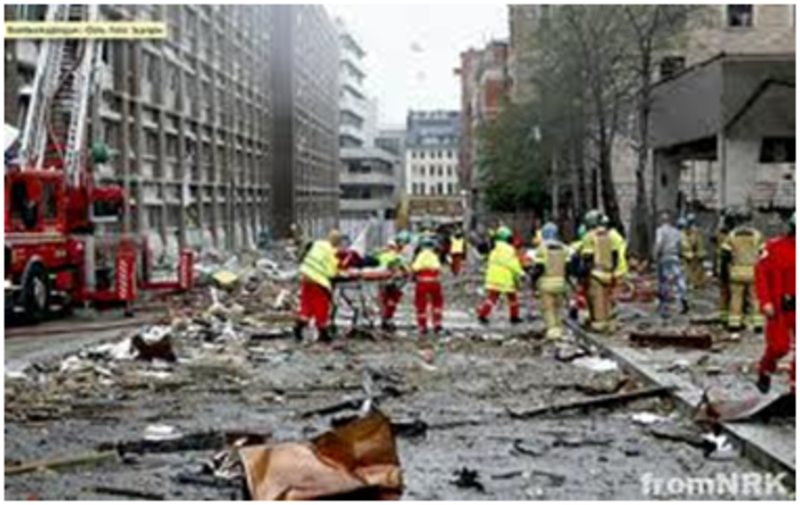
The Oslo bombing
In response, the Norwegian peace researcher Ola Tunander has observed that the Norwegian security establishment and police resources are smaller than foreigners might imagine: “Norway is a small country with a relatively unified power structure, where everyone knows each other, and there is less of a clear split between the security forces and the political elite. Close friends of the Chief of Police, for example the Deputy Foreign Minister, were among those with children on the Utøya island."14
This may not close the debate. For Norway also had a Gladio stay-behind network, ROCAMBOLE (ROC), that was partly funded and controlled by NATO, the CIA, and the British service MI6. ROC was also controversial. In the 1950s a secret controversy arose from Norway’s discovery that an American in Norway’s NATO HQ had “spied upon high-ranking Norwegian officials.” The left-wing Norwegian intelligence chief who discovered this situation and protested it to NATO, Vilhelm Evang, was later forced out of office by other Norwegian security officials, as the indirect result of a secret allegation forwarded by CIA Counterintelligence Chief James Angleton.15 So Norway’s security apparatus was not entirely homogeneous and autonomous.
Whatever the facts, 7/22 must be distinguished from a classical false-flag event by Gladio stay-behind networks. Traditionally in such cases, the designated perpetrator was associated, not with right-wingers, but the left.
The Key to 7/22 Lies in the Event, Not in the Man
Breivik the man is unique, proclaiming his affiliations with both the Unabomber’s philosophy and the right-wing counter-jihad milieu. But 7/22 the event is more familiar, and presents a number of features that are also familiar from past deep events:
1) a “legend” or documented characterization of the perpetrator;
2) “planted clues,” or what I have elsewhere referred to as a “paper trail,” often including videos suitable for post-event promotion of the legend;
3) in particular, planted autodocumentation, a genre ranging in variety from the “historic diary” of Lee Harvey Oswald to the manifesto of the Unabomber;
4) a tested modus operandi for a mass bombing.
The word “legend” is a term of art from the intelligence world meaning a myth created around a person, usually to hide their real intent or loyalties.16 I use it here without prejudging the truth or falsity of the myth, or the related question of authorship. Above all, in what follows, I do not mean to imply that the myth can be dismissed as a cynical artifact. Indeed it seems clear that the author of the manifesto/video, whether Breivik alone or someone else, was consciously creating a myth of a crusade against Islam which they sincerely believed in.
Let me digress for a moment, as someone who believes in the long-term future of democracy, open societies, and multiculturalism as it is developing in America. I see the widespread resentments of Breivik and countless others about “multi-cultis” as a serious phenomenon worthy of sympathetic understanding. Technology and globalization, as much in Russia and China as in the West, are creating problems for the survival and health of cultures everywhere, from Thailand to Tibet to the banlieu of Paris, for which it is difficult to see short-term solutions.
One response, ironically shared by Euronationalist crusaders like Breivik and also their jihadi Islamist opponents, is to be drawn to crusader-jihadi violence. (The secular anarchist Unabomber, quoted by Breivik, shows another version of this response.) Olivier Roy and others have sensitively analyzed the appeal of salafi jihad to young Muslims in Europe, with an identity-crisis caused by their alienation from the various distant cultures of their ancestors, as much as from the Western culture in which they are marginalized.17 We need also to address the identity-crises of those who see their traditional monocultures, in Norway as anywhere else, challenged by rapid cultural changes that are inadequately discussed, let alone managed.
Take the example of Switzerland, a country that has learned over centuries to live with four different languages and two versions of Christianity that once warred bitterly against each other. This cultural maturity does not equip the Swiss to deal easily with new immigrants who wish to establish not only mosques but Sharia in their midst.
A much longer essay than this one would be needed to explore the resonances of Breivik’s myth. But our topic here is 7/22, not Breivik the man.
The planted clues for Breivik’s legend
Breivik the man must be viewed as unreliable, and every statement from him viewed with the greatest suspicion. Yet his extensive autodocumentation -- by which I mean the Internet manifesto, video, and Facebook page attributed to him -- deserve to be assessed carefully regardless of authorship, especially in the light of later statements he is alleged to have made to the Norwegian police. And here we can say that, whatever the truth about Breivik, the autodocumentation shows connections leading ultimately to the shadowy underworld of arms and drug traffickers that may also have fostered al Qaeda.
It is exceedingly common for high-publicity deep events to be accompanied by such autodocumentation, After the diaries of Lee Harvey Oswald and Sirhan Sirhan, the alleged diary attributed to Arthur Bremer (the man said to have shot the 1972 presidential candidate George Wallace, stimulated Gore Vidal to wonder, in an essay for the New York Review of Books, whether the true author of the diary might not have been the CIA officer and Watergate plotter E. Howard Hunt (or in my terms, whether the Wallace shooting might not have been a systemic deep event).
Nearby in a rented car, the police found Bremer’s diary (odd that in the post-Gutenberg age Oswald, Sirhan, and Bremer should have all committed to paper their pensées). According to the diary, Bremer had tried to kill Nixon in Canada but failed to get close enough. He then decided to kill George Wallace. The absence of any logical motive is now familiar to most Americans, who are quite at home with the batty killer who acts alone in order to be on television.18
Gore’s perceptive witticism, the “killer who acts alone in order to be on television,” fits Breivik very well: his documents seem clearly designed to generate maximum publicity and speculation.
Somewhat like Breivik, Oswald left behind him a legacy of autodocumentation, some of which proved to be very suited for post-assassination television. This included, besides a diary and extensive political manuscripts, an audio-video tape involving an ex-Army psychological warfare expert, and expounding his alleged political beliefs. Yet the differences are instructive. Oswald’s autodocumentation of his alleged left-wing identity can be seen in retrospect as false, and probably part of FBI-CIA efforts to discredit the Fair Play for Cuba Committee which Oswald tried to penetrate.19 Breivik’s video appears to express his true beliefs, even though I shall argue in a moment that most of the video may have been prepared by someone else. Yet in contrast to Breivik’s, the misleading Oswald audio-video was aired extensively after the JFK assassination, as part of the propaganda campaign to describe him as a leftist.20 The Breivik video, by comparison, has been downplayed, and has indeed disappeared from many if not most of the web sites where it was originally posted.21
This suggests to me that the Breivik video was intended to capitalize on the publicity caused by his actions, but that the group behind this effort was not part of mainstream western society, and is not currently being supported by those in charge of the mainstream media. I shall suggest shortly that it was designed primarily for a different audience: the world of the resentful who find an outlet for their resentments on the Internet.
What Does Breivik’s Video Indicate? That Breivik Did Not Act Alone
Both the content and the authorship of Breivik’s video remain very mysterious. What seems relatively clear is that it was not composed and controlled by Breivik alone.
The evidence for plural authorship for the video is internal.22 Almost all of the video appears to be a speeded-up version of a text-heavy sequence of stills, possibly originally a slideshow presentation about knights templar and their fellow crusaders. It is clear both that a great deal of work has gone into the preparation and presentation of this text, and also that the text serves little or no purpose in the speeded-up Breivik version, For there are sometimes up to about twenty lines of text on a screen page, of which not more than about four or five lines can be read, even swiftly, in the time now allotted to them.
Otherwise the video is of professional quality, definitely not a home movie. One of the stylistic features unifying it is the steady predictable rhythm in the three- or four-second time-lapses allotted to each still. This rhythm is broken, jarringly, at the very end, when three photos of Breivik himself appear. The first two are presented very swiftly, completely out of sync with the rhythmic presentation in the rest of the video.
I am left with the strong impression that whoever added Breivik’s stills at the end of the video – who may possibly even have been Breivik himself – was not the original videographer or slideshow preparer. It was someone instead with a different style, sensibility, and purpose. (It would not surprise me to learn that there are other discernible and even quantifiable differences between the slideshow and Breivik parts of the video, with respect to such details as light.)
Whoever emailed out the video and manifesto just before the attacks was most likely aware of the massacres about to unfold. And if there is more than one author for the video, then Breivik was most probably not acting alone. For the release of the two documents must be considered an integral, indeed an essential, part of the 7/22 event -- indeed the point of it. I shall argue shortly that its aim was not just slaughter but publicity: to provoke a heightened discussion of the issues and promoters of counter-jihad.
The Modus Operandi of the Bomb
It has been widely noted that Breivik in 7/22 used the same bombing modus operandi as Oklahoma City and the 1993 World Trade Center bombing – an ammonium nitrate bomb concealed in a parked vehicle. As Andrew Gumbel wrote in an op-ed for the Los Angeles Times,


