4/25/2013
Switzerland imposes quotas on EU migrants
Πηγή: FT
By James Shotter
April 23 2013
Switzerland has imposed immigration quotas on the rising numbers of European citizens seeking to work there, in a move which threatens to open up another front in the Alpine republic’s array of disputes with the EU.
Switzerland already restricts arrivals from the eight eastern European states which joined the EU in 2004. However, the Federal Council said on Wednesday that, as well as extending those limits for another year from May 1, from June 1 it would also apply restrictions to nationals from other EU states, if certain conditions are met.
The quotas will apply for one year, during which time a limit of 2,180 citizens from the EU8 and 53,700 workers from the rest of the EU will be issued with so-called B-permits, which allow foreigners to work for up to five years in Switzerland.
The federal council said the measures were necessary because net immigration had been running at between 60,000 and 80,000 each year for several years, a significant influx for a nation of just 8m. Nearly a fifth of Switzerland’s inhabitants are now from the EU.
“This constant growth has both positive and negative effects, for example on the economy and the labour market, on the social insurance system, spatial planning, the housing market and infrastructure,” the federal council said. “Today the Federal Council addressed the question of how to deal with the negative consequences of immigration.”
Under an agreement signed in 1999, Swiss and EU nationals are entitled to move freely between the two territories. However, the agreement contains a so-called “safeguard clause” that allows Switzerland to impose quotas if, in a given year, the number of EU arrivals exceeds the average for the three preceding years by at least 10 per cent. This condition is likely to be met at the end of May.
However, the EU was quick to criticise the move, with Lady Ashton, its foreign policy chief, saying that she “regretted” the Swiss government’s decision.
“The measures adopted today by the Swiss government are contrary to the agreement on the Free Movement of Persons, since they differentiate between groups of member states,” she said.
The Swiss business lobby, Economiesuisse, acknowledged that popular concerns about the impact of high immigration could not be ignored, but urged the Swiss government to strive to prevent the quotas doing further damage to Switzerland’s difficult relations with the EU.
For several years, the EU has been ratcheting up the pressure on Switzerland to deal with the billions of euros of untaxed money thought to be managed by its banks. This year relations have been strained further, as the bloc has also pushed Switzerland to reform the low tax rates it offers multinational companies.
In addition to its concerns about the impact on bilateral relations, Economiesuisse also warned the Swiss government that the restrictions could hurt the country’s businesses.
“For businesses, peripheral regions, and farmers, this decision has big implications. Against an economic backdrop which continues to to be difficult, and given the shortage of skilled employees, these groups depend on an open labour market and will now have to reckon with hiring problems,” the lobby group said.
The Federal Council said that it was aware the safeguard clause was “only an effective instrument in the short term” and conceded that further measures would be required that have a long-term impact.
Global Insight: Politics draws out accidental truth on austerity Europe
![]() |
| Voter outrage sparks José Manuel Barroso’s concerns about eurozone belt-tightening |
Πηγή: FT
By Peter Spiegel
April 24 2013
There is an old saw in US political circles that the definition of a Washington gaffe is accidentally telling the truth.
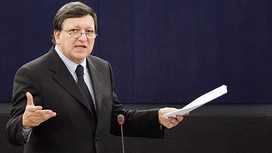
In an unscripted moment at one of the surfeit of panel debates that dominate Brussels’ daily rhythms, José Manuel Barroso this week appeared to do just that. He publicly stated what many European leaders had previously only acknowledged in private: the eurozone’s austerity-led crisis response has run smack into increasingly implacable voter outrage.
“I know that there are some technocratic advisers who tell us what the perfect model to respond to a situation is, but when we ask how we implement it, they say: ‘That is not my business,’” the European Commission president said in a not-so-subtle dig at his own staff. “We need to have a policy that is right. At the same time we need to have ... acceptance, political and social.”
His admission came at the end of a bad few weeks for austerity advocates. The International Monetary Fund has published new estimates showing recessions deepening in some of the most austerity-hit eurozone economies, such as Spain, Portugal and Greece. That coincided with the tarnishing of one of the most influential academic papers tying high government debt to economic stagnation.
There are also increasing signs that advocates for easing the austerity drive are gaining the upper hand in Brussels, with about a half dozen eurozone countries – including some in the so-called “core”, such as France and the Netherlands – seeking more time to hit tough EU-mandated deficit targets, Brussels’ most powerful tool in setting eurozone-wide fiscal policy.
But if it were just a deepening economic recession or academic one-upmanship, it is unlikely proponents of less belt-tightening would be able to have this much success in changing the tenor of the Brussels debate. After all, Europe’s recession has been deepening for well over a year with little policy change, and the occasionally vitriolic attacks between Keynesians and austerians have been a feature of the eurozone debate since the outset of the crisis.
What has changed is the issue Mr Barroso put his finger on: politics. In the wake of February’s Italian elections – where more than half the voters in the eurozone’s third-largest economy backed candidates running on overtly anti-EU and anti-austerity platforms – public acquiescence to the crisis’ policy response is evaporating.
Those close to the commission president insist there was nothing accidental about his remarks; for months he has been privately fretting about anti-EU sentiment provoked by eurozone economic policy, but kept his mouth shut for fear of rocking an already shaky boat. This week, he followed his political instincts and let loose.
Undoubtedly, the political destruction left in the crisis’ wake is already long and wide. Ireland’s Fianna Fáil, once the country’s presumptive ruling party, was decimated when it was forced into a €67.5bn bailout. Greece’s three-generation Papandreou dynasty was dismantled over the course of a weekend. Italy’s Silvio Berlusconi was openly ridiculed by his counterparts and summarily dismissed after a not-so-subtle nudge from Berlin and Brussels.
But the voter revolution, like the crisis itself, is now moving from the periphery to the core. Mario Monti, the Brussels-blessed technocratic prime minister who was crushed by the Italian electorate when he tried to win the job at the polls, warned shortly afterwards that other leaders would also be turfed out unless more was done to boost growth.
And there is no government now more at risk, and no country more central, than France, where François Hollande won the presidency last year promising to reverse the eurozone’s austerity-led response. Thus far, he has been singularly unsuccessful in that effort. His approval ratings have fallen below 30 per cent, near an all-time low for a president of the Fifth Republic.
German officials have made clear to eurozone counterparts that France has become their biggest concern, and may yet be the reason they allow an easing of austerity measures for now. They dare not risk a Franco-German rift just months ahead of a German national election.
But they also warn that at some point, and perhaps very soon, France’s day of reckoning will come. Then, the German push for austerity and economic reform could well meet French protesters at the barricades. If it comes to this, Mr Barroso’s accidental truth may instead prove an unsettling harbinger.
There is an old saw in US political circles that the definition of a Washington gaffe is accidentally telling the truth.
In an unscripted moment at one of the surfeit of panel debates that dominate Brussels’ daily rhythms, José Manuel Barroso this week appeared to do just that. He publicly stated what many European leaders had previously only acknowledged in private: the eurozone’s austerity-led crisis response has run smack into increasingly implacable voter outrage.
“I know that there are some technocratic advisers who tell us what the perfect model to respond to a situation is, but when we ask how we implement it, they say: ‘That is not my business,’” the European Commission president said in a not-so-subtle dig at his own staff. “We need to have a policy that is right. At the same time we need to have ... acceptance, political and social.”
His admission came at the end of a bad few weeks for austerity advocates. The International Monetary Fund has published new estimates showing recessions deepening in some of the most austerity-hit eurozone economies, such as Spain, Portugal and Greece. That coincided with the tarnishing of one of the most influential academic papers tying high government debt to economic stagnation.
There are also increasing signs that advocates for easing the austerity drive are gaining the upper hand in Brussels, with about a half dozen eurozone countries – including some in the so-called “core”, such as France and the Netherlands – seeking more time to hit tough EU-mandated deficit targets, Brussels’ most powerful tool in setting eurozone-wide fiscal policy.
But if it were just a deepening economic recession or academic one-upmanship, it is unlikely proponents of less belt-tightening would be able to have this much success in changing the tenor of the Brussels debate. After all, Europe’s recession has been deepening for well over a year with little policy change, and the occasionally vitriolic attacks between Keynesians and austerians have been a feature of the eurozone debate since the outset of the crisis.
What has changed is the issue Mr Barroso put his finger on: politics. In the wake of February’s Italian elections – where more than half the voters in the eurozone’s third-largest economy backed candidates running on overtly anti-EU and anti-austerity platforms – public acquiescence to the crisis’ policy response is evaporating.
Those close to the commission president insist there was nothing accidental about his remarks; for months he has been privately fretting about anti-EU sentiment provoked by eurozone economic policy, but kept his mouth shut for fear of rocking an already shaky boat. This week, he followed his political instincts and let loose.
Undoubtedly, the political destruction left in the crisis’ wake is already long and wide. Ireland’s Fianna Fáil, once the country’s presumptive ruling party, was decimated when it was forced into a €67.5bn bailout. Greece’s three-generation Papandreou dynasty was dismantled over the course of a weekend. Italy’s Silvio Berlusconi was openly ridiculed by his counterparts and summarily dismissed after a not-so-subtle nudge from Berlin and Brussels.
But the voter revolution, like the crisis itself, is now moving from the periphery to the core. Mario Monti, the Brussels-blessed technocratic prime minister who was crushed by the Italian electorate when he tried to win the job at the polls, warned shortly afterwards that other leaders would also be turfed out unless more was done to boost growth.
And there is no government now more at risk, and no country more central, than France, where François Hollande won the presidency last year promising to reverse the eurozone’s austerity-led response. Thus far, he has been singularly unsuccessful in that effort. His approval ratings have fallen below 30 per cent, near an all-time low for a president of the Fifth Republic.
German officials have made clear to eurozone counterparts that France has become their biggest concern, and may yet be the reason they allow an easing of austerity measures for now. They dare not risk a Franco-German rift just months ahead of a German national election.
But they also warn that at some point, and perhaps very soon, France’s day of reckoning will come. Then, the German push for austerity and economic reform could well meet French protesters at the barricades. If it comes to this, Mr Barroso’s accidental truth may instead prove an unsettling harbinger.
The World's Most Powerful Mercenary Armies
Πηγή: Business Insider
By Robert Johnson
April 23 2013
As different as each of them were, they all had one thing in common, at some point one side wanted more troops.
Most battles eventually come down to boots on the ground and rifles in the field. So when commanders are building their ranks it's often with professional soldiers who know how to fight, and get paid well to do it.
The idea of a mercenary may seem a bit quaint in the 21st century, but those forces make a difference and are often all that stands between a leader and his fate.
Security giant G4S is the second-largest private employer on earth
With more than 625,000 employees, this listed security giant is the second-largest private employer in the world (behind Wal-Mart). While some of its business is focused on routine bank, prison and airport security, G4S also plays an important role in crisis-zones right around the world.
In 2008, G4S swallowed up Armorgroup, whose 9,000-strong army of guards has protected about one third of all non-military supply convoys in Iraq (it's also notorious for its wild parties and for having Afghan warlords on its payroll).
But the combined group has a security presence in more than 125 countries, including some of the most dangerous parts of Africa and Latin America, where it offers government agencies and private companies heavily-armed security forces, land-mine clearance, military intelligence and training.
Unity Resources Group is active in the Middle East, Africa, the Americas and Asia
With more than 1,200 staff worldwide, the Australian-owned Unity Resources has been able to grow its presence in Iraq as sovereign armies withdraw. Its management consists of veterans from Australia, the U.S. and Great Britain.
The private military firm is best-known for guarding the Australian embassy in Baghdad, where, as of 2010, it had trained Chilean soldiers to man gates and machine-gun nests. Unity personnel were also responsible for two controversial car shootings in Iraq: one killed an Australian professor, another resulted in the deaths of two civilian women.
Outside Iraq, Unity has assisted with security during parliamentary elections in Lebanon and helped evacuate private oil companies from crisis zones in Bahrain. The firm also operates throughout Africa, the Americas, Central Asia and Europe.
Erinys has guarded most of Iraq's vital oil assets
Erinys has also followed U.S. State Department contracts to Iraq. Its biggest mission in recent years took 16,000 of its guards to 282 locations around the country, where they protected key oil pipelines and other energy assets.
The group also maintains a presence in Africa, where it has traditionally focused its operations. Erinys was recently awarded two contracts in the Republic of Congo, for security at major iron ore and oil and gas projects.
Asia Security Group is a powerful Afghan force linked to president Karzai
Formerly owned by Hashmat Karzai, the first cousin of Afghan president Hamid Karzai, Asia Security Group is a major local force in the war-torn nation. It employs about 600 guards.
The private army, headquartered in Kabul, has been awarded millions of dollars in contracts from the U.S. military and is said to protect Coalition supply convoys traveling in Afghanistan's south. Mercenaries from Asia Security Group have also been recruited by DynCorp, a U.S.-owned contractor with a big footprint in the region.
DynCorp has battled Colombian rebels and drug-runners in Peru
DynCorp, based in Virginia, is one of eight private military firms specially chosen by the U.S. State Department to remain in Iraq as official American forces pull out.
But the huge group, which brings in about $3.4 billion in revenue every year, is also active throughout Africa, Eastern Europe and Latin America, with a staff in excess of 10,000. The firm earned a trigger-happy reputation as its soldiers fought rebel groups in Columbia in the early 2000s. Its troops have also engaged in anti-drug missions in Peru and were sent to disarm fighters in Somalia, Liberia and southern Sudan.
Triple Canopy has won a security contract in Iraq worth up to $1.5 billion
Another of the eight contractors recruited to replace official U.S. forces in Iraq, Triple Canopy has an army of about 1,800 troops in the country — mostly from Uganda and Peru — on contracts worth up to $1.5 billion.
An official review of the firm's team in Iraq concluded it was a "well-trained, professional work force with significant prior experience." But the private military — whose name refers to the canopies in the jungles where its founding Army specialists received their training — also employs another 3,000 personnel globally.
Contracts in other parts of the world have taken Triple Canopy to Haiti, where it guarded the U.S. embassy, and to Israel, where agents provided personal protective services for the U.S. State Department.
Aegis Defense Services works with the UN, US, and oil companies
Aegis supplies forces for private clients, U.N. missions and the U.S. government, especially in Iraq.
But its staff, estimated to be as big as 5,000, is also spread across offices in Afghanistan and Bahrain, where the contractor offers emergency response, risk assessments, and protects private oil interests.
The private military contractor is probably best-known for a video that surfaced in 2005, which allegedly showed Aegis forces firing at Iraqi civilians.
Defion Internacional recruits thousands of fighters from developing countries
In the past, Triple Canopy has recruited heavily from the ranks of Defion Internacional, which sources and trains private military personnel from Latin America for jobs right around the world.
Headquartered in Peru, and with offices in Dubai, Iraq, Philippines and Sri Lanka, the firm contracts and trains bodyguards, drivers, static guards and logistics specialists from a number of developing countries. In some cases, these agents are paid as little as $1,000 per month, which has drawn international ire — especially for jobs linked to the U.S. State Department.
At one stage there were more than 1,000 Latin Americans guns-for-hire in the Middle East, although it is unclear how many of those fighters Defion was responsible for given that it is not required to disclose numbers.
Academi owns and runs one of the most advanced private military training facilities in the world
Formerly Blackwater, then Xe Services, Academi runs a 7,000 acre training facility deep in the North Carolina wilderness — one of the biggest and most complex private military training grounds in the world.
According to a book written on Blackwater in 2007, the facility had by then produced an army of 20,000 troops, 20 aircraft, a fleet of armored vehicles and trained war dogs. Most of those resources were shipped to Iraq and Afghanistan on U.S. government contracts.
Academi probably scaled back after a number of wrongful shootings and other controversies angered the Iraq government and jeopardized important contracts.
Outside the Middle East, Academi was recruited to protect the streets of New Orleans after Hurricane Katrina. It has also protected Japan's missile defence systems and assisted with the war on drugs around the world.
BONUS: Starting out as a mercenary?
Take a course at Academi's premier training facility in North Carolina.
The firm offers custom courses for allied security forces and corporates, such as live-fire driving instruction, counter-terrorism training — including dealing with weapons of mass destruction — and executive risk assessment.
You can also get equipped at the Academi web store, which stocks everything from protective sunglasses to sniper mission logs — even branded gifts.
The Coming Challenge to U.S. Economic Dominance
Πηγή: TFT
By DAVID FRANCIS
April 23 2013
Late last month, leaders from Brazil, Russia, India, China and South Africa – the so-called BRICS – announced they were forming their own development bank to assist other emerging economies. The yet-to-be-named bank is expected to compete with the World Bank and the International Monetary fund, two institutions with power structures based firmly in the United States and Europe.
The announcement also serves as yet another sign that the world economy is quickly evolving to a place where United States global economic dominance is being challenged by regional interests. Since the end of World War II, the United States was the driver of global monetary policy. When the Federal Reserve acted, the world listened and reacted.
Now, according to officials from the BRICS nations, emerging countries are trying to insulate themselves from the market shocks caused by the United States and Europe. They no longer trust the West to do the right thing. They’re forming their own “union” to create stability that the World Bank, the International Monetary Fund and the Fed have been unable to provide.
“If there were shocks to the global financial market, with credit running short, we'd have credit from our biggest international partner[s], so there would be no interruption of trade," Brazilian economic minister Guido Mantega said.
The bank, which is planning to raise $50 billion in capital, is expected to open next year, according to Indian finance minister P. Chidambaram. Other alliances around the world are also forming, portending the end of Western economic dominance.
To be clear, these alliances are not monetary unions. They don’t share a currency and therefore do not share fiscal policy. Yet they do share the common belief that together, their developing economies can foster and sustain growth.
These alliances do more than simply hedge against Western financial calamities. They encourage investors to keep money in the region instead of sending it to western markets and promote trade between member nations.
Even though many of these alliances lack real teeth, their formation is important symbolically. They give emerging economies a forum to show their strength, as well as send a clear signal that in the future, the United States is not the only game in town.
Rise of the BRICS
It did not take long for the BRICS to become a major force on world markets. The leaders of these countries first met in 2006, but a formal alliance wasn’t made until 2009. South Africa joined the group in 2010.
These countries now represent more than 3 billion people. They have a combined gross domestic product of $14.8 trillion, and hold $4 billion in foreign reserves.
The U.S. economy is still the world’s largest, although experts agree that the Chinese economy will grow larger by 2016. And while BRICS’ economic growth has slowed in recent years, they weathered the global economic slowdown far better than the United States and Europe.
In fact, the new BRICS bank is likely the direct result of the Western response to the crisis. The Fed, the European Central Bank, the World Bank and the IMF all acted repeatedly to soften the blow of the crisis. Yet strong growth, both here and in Europe, remains elusive.
According to a paper by Ritwik Banerjee and Pankaj Vashisht, published at the height of the financial crisis, the ability of the BRICS to sustain growth while Western economies were contracting convinced the emerging nations that a rebalancing of global economic power was necessary.
“The erstwhile engine of global growth, the USA, was weakening and the new growth poles were emerging,” they wrote. BRICS were “one of [the] emerging growth poles that caught the imagination of the world.”
BRICS Not Alone
In the wake of the global financial crisis, other countries are seeking alliances that will make them less reliant on the West. During the financial crisis, Japan, China and South Korea created a $120 billion emergency loan fund to shore up Asian nations’ finances. The Association of Southeast Asian nations, comprised of 10 countries from that part of the world, is also experiencing a period of robust growth.
New partnerships are also emerging closer to home. Álvaro Uribe, former president of Colombia, recently told The Fiscal Times that his country is considering entering into a formal economic alliance with Mexico, Peru and Chile, creating a bloc with a GDP of $2.2 trillion. These countries have already agreed to eliminate trade tariffs on 90 percent of the goods exchanged between them.
But the biggest challenge to U.S. dominance remains in Asia. The Pentagon is shifting its strategy to confront potential rivals in that part of the world. And U.S. companies are gaining ground in huge consumer markets in China, Indonesia and Malaysia.
Even the National Basketball Association recognizes that the key to future success is breaking the Asian market. It has spent $1.5 billion on a sports and entertainment complex outside of Beijing, and has sent Chinese-American star Jeremy Lin on a tour of the country.
"We are at a critical juncture in human history, which could lead to widely contrasting futures," Christopher Kojm, National Intelligence Council chair wrote in a recent intelligence appraisal. "By 2030, Asia will be well on its way to returning to being the world's powerhouse, just as it was before 1500."
4/24/2013
Tug of war over Benghazi could decide control of Libya
![]() |
| Analysts say that whichever group in Benghazi wins in the struggle for influence will also grab power in tomorrow's Libya. |
Πηγή: USA Today
By Mathieu Galtier
April 23 2013
BENGHAZI, Libya — The city that started the revolution to topple strongman Moammar Gadhafi has become a battleground of competing militias, and the winner will very likely be in control of Libya, analysts say.
Benghazi has been subjected to an endless string of bomb attacks and kidnappings over the past 18 months. The city's security chief was murdered in November, and a police station was bombed.
Foreign installations are being targeted, too: An attack on the U.S. Consulate on Sept. 11 left four Americans dead, and there was an assassination attempt on Italian Consul Guido de Sanctis in January.
"Tripoli has the political power and Misurata the military power," said Abeir Imneina, a professor of political science at Benghazi University. "But those who control Benghazi control Libya. The city has its finger on the pulse of the public mood."
Many worry about an Islamist takeover and blame Muslim radicals for the chaos. Police at Fayyad station say the group Ansar al-Sharia is behind a number of the attacks, including the one Sept. 11.
Ansar is a Salafist group, whose adherents favor strict Islamic rule. It is related to Wahhabism, the sect of Osama bin Laden.
"The Islamists are provoking us," said officer Abdelhafid Awami at the Fayyad police station. "They want to run the country, like in Egypt and in Tunisia."
After the attack on the U.S. Consulate, which killed Ambassador Christopher Stevens, Benghazi residents marched on Ansar al-Sharia's Benghazi headquarters and drove the militia out of the city. But unofficially, Ansar al-Sharia never left.
Analysts say the militia isn't made up of hardened terrorists even though Islamist groups abroad provide it with money and training.
"Ansar al-Sharia, like many of the militias (in Libya), is made up of young, unemployed men who have been given power and arms," Imneina said. "They receive financing from abroad — and it's likely that al-Qaeda is behind the money.
"But they're not the only ones: The Martyrs of Feb. 17 (the pro-government force put in charge of securing the U.S. Consulate Sept. 11) is financed by Qatar — everyone knows it," she said.
Politicians close to Ansar al-Sharia reject such accusations.
"My friends in Ansar al-Sharia don't have any links to groups abroad or the Muslim Brotherhood (in Egypt)," said Ahmed Zlitni, a former rebel commander who is spokesman for the Union of Muslims.
Some see that group as the political arm of Ansar al-Sharia. He denies the affiliation but admits to sharing the group's ideology.
"(Ansar al-Sharia members) are just simple Muslims who want the Quran to become law here in Libya," he said. "If they get what they want, they'll stop fighting."
Ansar al-Sharia isn't the only Islamist militia accused of undermining security in Benghazi.
The Supreme Security Committee (SSC) signed an accord with the government and is authorized to participate in law enforcement. The group is decentralized, and some factions of it that are close to religious radicals refuse to pledge allegiance to the government.
Islamists blame the supporters of Gadhafi for the violence.
"Before the revolution, the Islamists were always blamed — it's the same today, and that isn't accidental," said the Union of Muslim's Zlitni, who claimed that pro-Gadhafi forces are killing police officers linked to Gadhafi's regime and framing Islamists for the murders.
Authorities say freed criminals also contribute to the violence. Gadhafi let out 3,000 convicts to try to quell the Benghazi rebellion; two years later, more than two-thirds of them remain on the street, according to Benghazi's police agency.
"Former prisoners could have perpetrated the attacks on police stations in revenge," said Oussama el-Sherif, spokesman for Benghazi's local council.
There have been no major arrests in the attacks, even in the death of the city security chief, Col. Fradj al-Dersi. Col. Mustafa Raqiq, who replaced al-Dersi, was fired three months later in February after police protested that he was not able to improve security. Raqiq blames Islamists for the violence.
"Those who made the homemade bombs are organized," he said, referring to the attacks on police stations. "It's a criminal enterprise that they're involved in. They want to deny us control over security."
The failure to stop the violence may actually lead to a partition of the country, some say. The government's failure to restore security in Benghazi fuels support for autonomy or even independence in eastern Libya, a region called Cyrenaica.
"The government isn't doing anything to help us," said Oussama Buera, a young pro-independence activist who says he's willing to take up arms to free Benghazi from Tripoli's grasp. "Four people were killed at a demonstration (last year), and Tripoli didn't even say sorry."
Bahrain: Hiding Torture and Human Rights Abuses?
![]() |
| Peace activist in Bahrain. Photograph courtesy of Al Jazeera |
April 23 2013
The image the Bahraini government promotes to the world is one of a moderate and reforming regime that is open to trade and tourism, as demonstrated by its hosting of the F1 Grand Prix last weekend. However, beneath that veneer is a country where reports of government crackdowns and arrests of children are common, and a place where the UN special rapporteur on torture is not welcome.
The Bahraini Center for Human Rights describes a number of house raids and arrests across the small country on the day of the Grand Prix, with 96 arrests during the period 18-21 April, including 12 children. They also produced information on protesters receiving a wide variety of injuries including pellet wounds, and being struck directly with tear gas cannisters.
In order to hide this action from the world, the government also deported several foreign journalists who were covering the protests in the villages including a British team from ITV.
By blocking the visit by Juan Mendez UN special rapporteur on torture “until further notice”, the government are preventing discovery of the facts surrounding the continual reports of torture and abuses, damaging their own credibility on the world stage. Brian Dooley of Human Rights First characterize this move as:
“A huge blow to the credibility of Bahrain’s reform process”
The Bahraini government’s decision to prevent a UN investogation into human rights abuses comes after the US State Department published its human rights report last week, which counts a number of abuses in the country, stating:
“The [Bahraini] government limited freedom of speech and press through active prosecution of individuals under libel, slander, and national security laws; firing or attacking civilian and professional journalists; and proposing legislation to limit speech in print and social media”
Greece Internal Devaluation Update
Πηγή: The Wall Street Journal
By Matthew Dalton
April 23 2013
Without the tool of currency devaluation, the euro zone is hoping “internal devaluation” can restore competitiveness to the bloc’s periphery. What’s that?
It’s an economy-wide fall in wages and, more broadly, prices. Officials have been careful not to say the “D” word – that’s “deflation” – but Europe’s policies call for a period of deflation in euro-zone countries with the worst competitiveness problems.
The prime example is Greece. As the International Monetary Fund said in its last report on Greece:
Large external liabilities ultimately require large trade surpluses in order to service them, and achieving these surpluses requires a more depreciated level of the real exchange rate. In a currency union the depreciation has to be achieved largely through deflation, which necessitates a larger negative output gap.
So, how has the deflationary process been playing out in Greece? Not too well. There has been a sharp drop in Greece’s nominal gross domestic product (that’s the one that doesn’t adjust for inflation), which the IMF now projects will have fallen more than 20% by the end of this year since 2008.
Yet annual consumer-price inflation has remained positive for most of Greece’s battle with the crisis (yes, this partly due to tax increases adopted as part of Greece’s austerity program, but still…)
Then look at Greece’s sharply falling labor costs:
(The above chart only has actual labor-cost data through the third quarter of 2012, but indications Greek wages continued to fall in the fourth quarter and possibly after.)
This portrays an economy in which ordinary people have seen their purchasing power crushed by a combination of still rising prices and falling wages. Businesses haven’t been passing through lower labor costs into the prices they charge consumers and other businesses.
The IMF and euro-zone authorities have blamed Greece’s inflation on still-powerful oligopolies in the Greek economy that don’t feel competitive pressure to cut their prices. That’s why overhauls intended to break up these oligopolies are now such a key part of Greece’s bailout program.
The latest inflation data give an indication that some of these measures may be starting pay off. In March, Greek consumer prices actually fell 0.2% from February. Compared with a year earlier, however, inflation was still 1%.
The contrast between the small monthly decline and the persistent annual rise underlines that the road to internal devaluation in Greece likely remains long and hard.
4/23/2013
In Egypt, anger at Islamists brings calls for military to reclaim power
![]() |
| Egyptian army soldiers and military police secure a funeral procession for civilians killed overnight during street battles with police forces, in Port Said last month. |
By Abigail Hauslohner
Tuesday 23 3013
CAIRO — As Egypt’s economy crumbles and its democratic transition falters, some opponents of the country’s Islamist president are pinning their hopes on unlikely saviors: the powerful generals who have been mostly sidelined since last year’s elections.
An argument rapidly gaining traction here holds that the nation could soon slide intoeconomic collapse — or even civil war — unless the military steps in to reassert a dominant role. And suprisingly, among those calling for some kind of coup d’etat are some of the liberal and secular activists who campaigned to end military rule when the generals ran the country in the aftermath of Hosni Mubarak’s fall.
“I think the army has an important role to play in this phase — to get us out of this tragedy that the Muslim Brotherhood has put us in,’’ said Shadi al-Ghazali Harb, a prominent liberal activist, referring to the Islamists headed by President Mohamed Morsi who took power after presidential elections last year.
It’s not that memories of military abuse and the institution’s wholly undemocratic opacity are so fleeting, Harb and other anti-Islamist activists said. But Egypt’s disorganized and deeply divided opposition has struggled to find agreement on a means to best curb the Islamists’ rising influence in recent months. And some see an opportunity in what they believe is a growing popular sentiment for the kind of intervention that would stop Morsi and the Muslim Brotherhood in their tracks.
In February, violent clashes between police and protesters in the Suez Canal city of Port Said yielded an initial wave of local voicescalling for a military coup. The demands, some of which came from middle class men and women who had earlier voted for Morsi, gave a second wind to an opposition movement that had weathered a winter of defeats and divisions, after losing a battle with the Islamists to define the country’s new constitution.
“If law and order is absent, they have a national duty to intervene, and they’ve said that,” opposition leader Mohamed ElBaradei said of the army in an interview with the BBC in February. “Nobody wants the army to come back, and I don’t think if the army were to come back they would come back to govern because they had an awful experience in mismanaging the transition themselves,” ElBaradei cautioned. “But they will just come back to stabilize. And then we will start all over again,” he said.
Starting over again is a popular concept among opposition politicians this spring, as if the best — or the only — answer to unfavorable democratic results is a return to square one.
“We can start over again,’’ said Hoda Abdelbaset, a member of the leftist Popular Current Party, who, while opposed to military rule, envisioned a solution where Morsi would step down and a coalition of other popular leaders would take control until all could reach agreement on a new constitiution.
Impatience and regret are not uncommon in countries weathering the transition from long-term dictatorships to first-time democracies. Frustrated citizens from Iraq and the Arab Spring states to Latin America have, at turns, greeted post-conflict turbulence with a nostalgic hunger for the authoritarian — but more orderly — past.
In Egypt, the backlash to the Muslim Brotherhood and to Morsi, now the country’s first Islamist president — is rooted in post-revolution economic frustration, widening insecurity in the streets, a fear of religious intolerance, and a sense of disenfranchisement by many of the country’s old political elite and the liberal youth who helped to overthrow Mubarak.
And to some activists, the assumption that deepening chaos could yield military intervention is enough of a reason to keep protesting — and to abstain from direct negotiations with the president and his allies to forge compromises on economic and other badly needed reforms.
“[Egyptians] see that the Muslim Brotherhood has power, guns and militias, so no one can face them without the army,” said Harb. “And in Egyptian culture, the army is the one to save the country from any occupation.”
The opposition was unable to achieve its goals of leadership through the country’s first democratic elections last year; losing first the parliamentary, then the presidential votes to the far better organized force of the Muslim Brotherhood and other Islamist groups.
And now the military, which helped to uphold Mubarak’s fiercely anti-Islamist regime for decades, may just be their easiest path to redemption.
“People see the military as the antithesis of the Muslim Brotherhood,” said Samer Shehata, a political scientist at Georgetown University and an expert on Egyptian politics. “And at the same time [the military] is viewed as the only way out, and people are looking for a way out,” he said.
Human rights groups documented extensive military abuses during the generals’ year and a half tenure as transitional rulers, including the arbitrary detention and torture of protesters, and the trials of thousands of Egyptians by closed military tribunals.
But even then, the military, which had long been a symbol of Egyptian cultural pride, never really lost the country’s popular favor. As anti-military protests heated up a year after Mubarak’s fall, some 88 percent of Egyptians still viewed the military with confidence, a Gallup poll reported at the time.
No recent polls are available to indicate the extent of the army’s popularity today, but calls for the generals to save a desperate nation increasingly permeate the public discourse; on street corners, in protest chants, and on talk shows.
“If the army doesn’t come and alleviate our misery, then this country is going to turn out like Syria,” said Rafaat Said, a Cairo taxi driver who, like many Egyptians, laments the atmosphere of rising inflation and deep insecurity in the streets.
Many in Egypt’s Christian minority have also invoked the neutralizing power of an army that many had said they lost faith in after the army took part in an October 2011 massacre of mostly Christian protesters in downtown Cairo.
A spate of sectarian attacks on Christians earlier this month, including clashes outside Cairo’s main cathedral, helped to cement the Islamists’ position as a far more worrying foe.
But some analysts and diplomats dismiss the critics’ calls as wishful thinking, saying that the military would have little incentive to wade back into the political sphere. They say the generals’ top priority may be to maintain their own immunity from prosecution and to preserve a vast military-run economic empire — perks that are preserved under Egypt’s new Islamist-backed constitution.
“The military will only go down [to the streets] when there is chaos in the streets that the country cannot control,” said Mohamed Habib, a former deputy head of the Muslim Brotherhood, who has watched the situation closely.
A Western diplomat who would speak only on condition of anonymity because the sensitivity of the subject echoed that view. “They have zero interest in getting back into the political environment,’’ the diplomat said.
4/22/2013
Lies, Damned Lies & Sadistics: The IMF’s Role As Bankster Enforcer
Πηγή: Tetosterone Pit
By Don Quijones
April 20 2013
“We make or break human life every day of every year as probably no other force on earth has ever done in the past or will ever do again.”
The above rather dramatic quote comes courtesy of one Davison L Budhoo, a former International Monetary Fund economist who in 1988 broke ranks with the Fund, publishing a scathing 150-page resignation letter. In it he accused the organization of corruption, self-interest, and deceit.
Not that the Fund, then headed by Frenchman Michel Camdessus, was particularly fazed by the allegations. In those days there was no Internet, so the story didn’t exactly go “viral”; in fact, it barely got a mention in the mainstream or financial press. As such, following a spattering of articles in a few specialist newspapers and magazines, Buddhoo’s accusations were quickly forgotten.
The IMF breathed a sigh of relief, brushed off its Brook Brothers jacket and continued about its business. No inquiry or investigation was launched, no changes were made to the Fund’s operational policies and no heads rolled.
Such aversion to change has become a defining characteristic of the Fund. The result is that while the global economy may have changed beyond all recognition in the last 35 years, with countries like China, India and Brazil rising to the fore, the IMF’s role within it seems to have remained locked in time. The only difference of note (apart from the fact that, in the ballsy, perma-tanned Christine Lagarde, it has its first ever female managing director) is that instead of preying primarily on the world’s poorest, weakest and most defenseless nations — many of which have since become big creditors — the IMF, now a protagonist in Europe’s dreaded Troika, has its sights set on much bigger trophies.
The chicken, it seems, has finally come home to roost. Now it is Europe’s turn to feel the sharp taste of the Fund’s medicine. Slowly but surely the hapless inhabitants of struggling eurozone countries such as Greece, Portugal and Ireland are beginning to realize what many Africans, Asians, Latin Americans and Eastern Europeans learnt through bitter painful experience in the seventies, eighties and nineties — namely that when the IMF, armed with its balance sheets and a calculator, comes calling, you’d better hope you’re out.
For the IMF is, in plain speaking terms, the global banksters’ number one enforcer — a role it has executed (pun intended) with fervor and aplomb ever since the Bretton Woods agreement (though it wasn’t until Nixon’s launch of the floating exchange regime in 1971 that the organization began forcefully dictating economic policy to supposedly sovereign nations).
The Fund is essentially to the big global banks and corporations what Luca Brasi was to Vito Corleone or, to cite a real-world example, what Francesco Raffaele Nitto was to Al Capone. But rather than use real violence, or even the threat of violence, the IMF’s henchmen have far subtler means at their disposal, as John Perkins, the author of the best-selling book Confessions of An Economic Hitman, explains:
(For more information on the economic hitmen, watch the videos here and here)
Bad Math
Much of the damage the IMF inflicts on national and regional economies stems from its frequent use of flawed statistical data, which often just so happens to suit its own interests (or at least those of its “bosses”), invariably at the expense of its supposed clients’.
The Fund’s program in Trinidad and Tobago in the late seventies and early eighties, in which Budhoo, the IMF whistle-blower, participated, is a perfect case in point. In his resignation letter Budhoo asserted:
We manipulated, blatantly and systematically, certain key statistical indices so as to put ourselves in a position where we could make very false pronouncements about (the) economic and financial performance of that country… Quite frankly, our ‘program’ is nothing but a hotchpotch of irreconcilable and conflicting elements and objectives; it reduces economics to a farce.
Even when the inaccuracy of the IMF’s statistics was exposed by the Fund’s own statisticians, the IMF neither owned up, nor apologized to the Trinidad and Tobagan government. Nor did it publicly correct its misinformation despite the implications of its judgment for foreign investment.
As well it might, for the IMF knows full well that when it comes to its woefully wayward forecasting and deeply flawed track-record, it is protected by a code of silence, or as the Italian mafia would put it, Omerta. As such, the mainstream media always treats the Funds with the gentlest of kid gloves, rarely, if ever, questioning its methods or mission.
But this is no longer 1988 and thanks to the rise of the Internet and the tireless investigative efforts of new online media outlets, more and more people are beginning to see through the obfuscation to the stark reality of the IMF’s less-than-kosher role in the global economy — and not a moment too soon, for it seems that the IMF’s remedial problems with basic math are part of a much broader degenerative condition, as Zerohedge recently reported:
“That the IMF is the most unwavering optimist despite fundamentals, facts and reality has been well-documented… Over the past year’s six outlook revisions, the IMF has been forced to downgrade, with quarterly precision, its overly optimistic forecasts for virtually every part of the world, from the US, to the Euroarea, to China, and of course, the entire world” (click here to see Zerohedge’s graphic presentation of the IMF’s fumbling predictions skills in all their glory).
A Vast Trail of Ruin
When the IMF was founded, in 1945, it was granted two defining missions: to oversee the fixed exchange rate arrangements between countries, thus helping national governments manage their exchange rates and allowing these governments to prioritize economic growth; and to provide short-term capital to aid balance-of-payments.
Which all sounds well and good, and there can be no doubting that the fund played a crucial role in helping stabilize the post-war global economy. However, since becoming an essential tool of the neoliberal agenda in the 1970s, the IMF has failed to help a single country get its economy back on the straight and narrow. As Buddhoo told the New Internationalist, “I dare anyone in the Fund to point to a country and say it is much better off economically today because of a Fund program.”
The tragic reality is that the IMF’s ideologically-driven program of structural reforms and iron-clad conditionalities has left in its wake a vast trail of economic destruction, political instability, poverty, hunger and sickness. Once a country gets caught in its vice-like grip, economic decline and decay is all but guaranteed, as Greece, Portugal and Ireland are now learning.
And what with the list of European countries falling victim to the Troika’s not-so-short-but-pretty-damned-sharp shock treatment continuing to grow, one can only wonder where the trail of carnage will end.
“We make or break human life every day of every year as probably no other force on earth has ever done in the past or will ever do again.”
The above rather dramatic quote comes courtesy of one Davison L Budhoo, a former International Monetary Fund economist who in 1988 broke ranks with the Fund, publishing a scathing 150-page resignation letter. In it he accused the organization of corruption, self-interest, and deceit.
Not that the Fund, then headed by Frenchman Michel Camdessus, was particularly fazed by the allegations. In those days there was no Internet, so the story didn’t exactly go “viral”; in fact, it barely got a mention in the mainstream or financial press. As such, following a spattering of articles in a few specialist newspapers and magazines, Buddhoo’s accusations were quickly forgotten.
The IMF breathed a sigh of relief, brushed off its Brook Brothers jacket and continued about its business. No inquiry or investigation was launched, no changes were made to the Fund’s operational policies and no heads rolled.
Such aversion to change has become a defining characteristic of the Fund. The result is that while the global economy may have changed beyond all recognition in the last 35 years, with countries like China, India and Brazil rising to the fore, the IMF’s role within it seems to have remained locked in time. The only difference of note (apart from the fact that, in the ballsy, perma-tanned Christine Lagarde, it has its first ever female managing director) is that instead of preying primarily on the world’s poorest, weakest and most defenseless nations — many of which have since become big creditors — the IMF, now a protagonist in Europe’s dreaded Troika, has its sights set on much bigger trophies.
The chicken, it seems, has finally come home to roost. Now it is Europe’s turn to feel the sharp taste of the Fund’s medicine. Slowly but surely the hapless inhabitants of struggling eurozone countries such as Greece, Portugal and Ireland are beginning to realize what many Africans, Asians, Latin Americans and Eastern Europeans learnt through bitter painful experience in the seventies, eighties and nineties — namely that when the IMF, armed with its balance sheets and a calculator, comes calling, you’d better hope you’re out.
For the IMF is, in plain speaking terms, the global banksters’ number one enforcer — a role it has executed (pun intended) with fervor and aplomb ever since the Bretton Woods agreement (though it wasn’t until Nixon’s launch of the floating exchange regime in 1971 that the organization began forcefully dictating economic policy to supposedly sovereign nations).
The Fund is essentially to the big global banks and corporations what Luca Brasi was to Vito Corleone or, to cite a real-world example, what Francesco Raffaele Nitto was to Al Capone. But rather than use real violence, or even the threat of violence, the IMF’s henchmen have far subtler means at their disposal, as John Perkins, the author of the best-selling book Confessions of An Economic Hitman, explains:
One of my jobs as an economic hit man was to identify countries that had resources like oil and arrange huge loans for those countries from the World Bank and sister organizations. But the money would never go to the actual country; instead it would go to our own corporations to build infrastructure projects in that country like power plants and industrial parks; things that would benefit a few very wealthy families.According to Perkins, it was only when a national leader took a rare principled stand, refusing to sell off all of their country’s resources to international conglomerates at bargain basement prices, that the real goons, or what Perkins calls “the Jackals,” would be sent in, as is alleged to have happened in the highly suspicious deaths, in the early eighties, of Panama’s leader Omar Efraín Torrijos Herrera and Jaime Roldos, the democratically elected president of Ecuador.
So then the people of the country would be left holding this huge debt that they couldn’t repay… That’s when the IMF comes in [saying] ‘We’ll help you restructure your loan, but in order to do that you have to meet certain conditionalities. You have to sell your oil or whatever the coveted resource is at a cheap price, to the oil companies without restrictions.’ Or they would suggest the country sell electric utilities, water and sewage, maybe even its schools and jails to private multi-national corporations.
(For more information on the economic hitmen, watch the videos here and here)
Bad Math
Much of the damage the IMF inflicts on national and regional economies stems from its frequent use of flawed statistical data, which often just so happens to suit its own interests (or at least those of its “bosses”), invariably at the expense of its supposed clients’.
The Fund’s program in Trinidad and Tobago in the late seventies and early eighties, in which Budhoo, the IMF whistle-blower, participated, is a perfect case in point. In his resignation letter Budhoo asserted:
We manipulated, blatantly and systematically, certain key statistical indices so as to put ourselves in a position where we could make very false pronouncements about (the) economic and financial performance of that country… Quite frankly, our ‘program’ is nothing but a hotchpotch of irreconcilable and conflicting elements and objectives; it reduces economics to a farce.
Even when the inaccuracy of the IMF’s statistics was exposed by the Fund’s own statisticians, the IMF neither owned up, nor apologized to the Trinidad and Tobagan government. Nor did it publicly correct its misinformation despite the implications of its judgment for foreign investment.
As well it might, for the IMF knows full well that when it comes to its woefully wayward forecasting and deeply flawed track-record, it is protected by a code of silence, or as the Italian mafia would put it, Omerta. As such, the mainstream media always treats the Funds with the gentlest of kid gloves, rarely, if ever, questioning its methods or mission.
But this is no longer 1988 and thanks to the rise of the Internet and the tireless investigative efforts of new online media outlets, more and more people are beginning to see through the obfuscation to the stark reality of the IMF’s less-than-kosher role in the global economy — and not a moment too soon, for it seems that the IMF’s remedial problems with basic math are part of a much broader degenerative condition, as Zerohedge recently reported:
“That the IMF is the most unwavering optimist despite fundamentals, facts and reality has been well-documented… Over the past year’s six outlook revisions, the IMF has been forced to downgrade, with quarterly precision, its overly optimistic forecasts for virtually every part of the world, from the US, to the Euroarea, to China, and of course, the entire world” (click here to see Zerohedge’s graphic presentation of the IMF’s fumbling predictions skills in all their glory).
A Vast Trail of Ruin
When the IMF was founded, in 1945, it was granted two defining missions: to oversee the fixed exchange rate arrangements between countries, thus helping national governments manage their exchange rates and allowing these governments to prioritize economic growth; and to provide short-term capital to aid balance-of-payments.
Which all sounds well and good, and there can be no doubting that the fund played a crucial role in helping stabilize the post-war global economy. However, since becoming an essential tool of the neoliberal agenda in the 1970s, the IMF has failed to help a single country get its economy back on the straight and narrow. As Buddhoo told the New Internationalist, “I dare anyone in the Fund to point to a country and say it is much better off economically today because of a Fund program.”
The tragic reality is that the IMF’s ideologically-driven program of structural reforms and iron-clad conditionalities has left in its wake a vast trail of economic destruction, political instability, poverty, hunger and sickness. Once a country gets caught in its vice-like grip, economic decline and decay is all but guaranteed, as Greece, Portugal and Ireland are now learning.
And what with the list of European countries falling victim to the Troika’s not-so-short-but-pretty-damned-sharp shock treatment continuing to grow, one can only wonder where the trail of carnage will end.
Deficit-cutting is European, not German policy: Wolfgang Schaeuble
Πηγή: Economic Times
By AFP
April 21 2013
WASHINGTON: German Finance Minister Wolfgang Schaeuble insisted Saturday that Germany's European partners agreed with deficit reduction, as pressure grew on Berlin to back a less austere, more growth-friendlyeconomic crisis approach.
"Nobody should have the misunderstanding that there is an alternative for reducing deficits," Schaeuble said to reporters at the spring meetings of the International Monetary Fund and World Bank.
"It is not a German position, it is a common position," he said.
"We are totally united."
Germany was pressed at the IMF meetings to ease off pressure on the eurozone's troubled periphery countries to cut spending to right their finances quickly, with IMF experts and other members saying that growth needs more demand stimulation.
Berlin has repeatedly turned back some claims, saying the austere debt and deficit reduction programs of countries like Greece, Portugal, Ireland are essential to rebuilding the eurozone economy.
Schaeuble warned of "unrealistic" expectations for growth in the European Union, which remains deep in recession.
Europe will not be "the big driver of growth," he said. He forecast long-term growth in Europe to be at 1.0-1.5 per cent, "rather than significantly higher."
"We are very successful," he said. "We don't have enough growth actually, but we are on the right path."
"We have made progress to overcome the crisis of confidence in the euro. We have made a lot of progress through structural reforms."
4/21/2013
Horst Reichenbach can save Greece almost a billion
![]() |
| HORST REICHENBACH, HEAD OF THE EUROPEAN COMMISSION TASK FORCE |
Πηγή: New Europe
April 21 2013
The Greek government is desperately trying to collect the last cent from starving Greeks and it is managing pretty well, so far, despite the high political cost for the sitting prime minister and his ruling coalition.
There is an amount of over €700 million in VAT taxes, withheld by the Athens International Airport (AIA S.A.), a privately managed profit making company. The airport company refuses to pay this amount to the state on the excuse that law 2338/95 which ratified the concession agreement for the construction and operation of the Athens airport, provides that the Greek government undertakes the obligation to refund to the company any VAT that the company pays.
The aim of this provision was however, to refund the VAT that AIA SA would pay to the constructors since the airport is the property of the State and given by concession to AIA SA for a period of 30 years.
Under these circumstances, the fiscal authorities from 2001 onwards, when the airport started its operations (under a private company) asked AIA SA to pay the VAT, which was refused. The matter was dealt with by the Council of State, which ruled that AIA SA must pay VAT. In an effort to avoid payments, the airport company took the issue to the Arbitrary Court of London, which refrained from taking a clear position as VAT issues are exclusively under EU jurisdiction.
Indeed EU law provides, with Directive 2006/112/EC, that all EU based companies are subject to VAT payments (part of VAT ends up in the Community budget).
EU law is above any and all national laws and constitutions, and it goes without saying that the only way to avoid VAT payment is to get a exception or a temporary derogation by amending the Directive. This implies unanimity of 27 Ministers of Economy of the Member States (EcoFin).
Our legal counselor examined all 414 articles of the codified text of Directive 2006/112/EC and all its annexes and found no VAT exception or derogation for AIA S.A. Thus, AIA S.A. must pay to the Greek State the long overdue VAT, end of file.
If for any reason, however, AIA S.A. thinks otherwise, the good company has the right to appeal to the European Court of Justice in Luxembourg, only.
Under the circumstances, as head of the Commission’s Task Force in Greece Horst Reichenbach, can explain to the Greeks what exactly is the situation about the obligations of AIA S.A. regarding VAT payments.
The Head of the Task Force in Greece is the right person to explain it, since when law 2338/95 was passed in Greece, he was at the time the Head of Cabinet of then Regional Policy Commissioner, Monika Wulf-Mathies and provided for a cohesion fund co-financing for the construction of the airport to AIA S.A. Thus he is well aware that such an exception for AIA S.A. from VAT does not exist.
Horst Reichenbach, who subsequently served in the European Commission as Director General for Administration knows also very well how to read a Directive and thus can easily explain to the Greek government their obligation to collect at once the VAT owed by AIA S.A.
The government has the means to collect the money immediately (arrest of the CEO, confiscation of assets, etc.).
The airport, a private law monopoly company with the highest charges in continental Europe, must have the cash flow to pay. Indeed, with less than 500 employees and no other expenses with accumulated revenues of over €4 billion since 2001, the company is able to pay its VAT obligations and much more.
Low-birth Greece takes a further hit from crisis
![]() |
| Sunk in recession and struggling to steer its economy through painful austerity cuts, Greece now faces a fertility crisis as well. |
Πηγή: The Economic Times
By AFP
April; 21 2013
ATHENS: In a nursery of a private maternity hospital in Athens, three mothers feed their newborns while another three babies nap nearby.
The room has only a few cots, and yet a number lie empty.
Sunk in recession for the past six years and struggling to steer its economy through painful austerity cuts, Greece now faces a fertility crisis as well.
"Benefits have been cut, the cost of living has risen, wages are down and there is great uncertainty," says Leonidas Papadopoulos, managing director of the Leto hospital and a veteran obstetrician.
"Couples think twice nowadays, not only for a second child but even for their first... It looks like there will be 10,000 fewer births next year," he adds, citing estimates drawn from state and private studies.
According to state statistics agency Elstat, the fertility rate in Greece has fallen from 2.33 children per woman in 1975 to 1.4 in 2011.
The replacement rate, the number of births at which the population remains stable, is 2.07 children.
Papadopoulos also cites a recent study by the University of Athens which found that the rate of miscarriages has doubled to four per cent in the last two years.
And births have gone from 118,000 in 2008 to 101,000 last year, he notes.
"At this rate, Greece will be much smaller in a few years," Papadopoulos says.
The European Union fertility leader is Ireland with 2.05 births in 2012, followed by France with 2.01 children.
In one of its projected scenarios, Elstat sees the population of Greece dropping to 9.7 million in 2050 from 11.29 million in 2012.
A jobless rate of over 27 per cent -- and over 30 per cent among women -- compounds the difficulty facing couples today.
"Policies to protect maternity are easier to apply in good (economic) periods," says a high-ranking state welfare official who declined to be named.
"In the private sector, mothers very frequently do not make use of their rights because unemployment is very high," the official added.
In Greece's more easy-going civil service, staff can take up to 14 months in fully paid maternity leave -- and have been known to obtain extra time for difficult pregnancies.
In the private sector, mothers can on paper claim up to 15 months of non-consecutive maternity leave -- four of them unpaid -- not including holidays.
In reality, however, employees rarely push to obtain full maternity leave for fear of losing their job, officials note.
The Greek ombudsman's office highlights the problem in its latest report for 2012.
"Women who are pregnant or just back from maternity leave, run higher risks of...unemployment and precarious employment," the report said.
"In many cases they accept a violation of their labour rights to avoid losing their job," it noted, adding that having children was also likely to adversely affect a woman's pay and career prospects within a company.
"We even have extreme examples of couples who have been trying to have a child for years, undergo costly treatment and then want to have an abortion because the husband just lost his job," Papadopoulos said.
The 'money is so little that it cannot even cover bread and milk for the children'
Paradoxically, the axe has fallen the hardest on large families.
Until last year, mothers could claim a lump sum of 2,000 euros ($2,618) upon the birth of their third child, and the same amount for each child thereafter.
Then there were additional child support benefits of up to 4,700 euros a year, depending on income and the number of children, which were accessible to even moderately wealthy families.
These were eliminated in 2012 and replaced with a new, means-tested system.
From January 1, families are theoretically eligible for child support benefits of up to 5,880 euros -- but they would need to have six children and be on the verge of starvation to claim it.
Spain is a similar example of a once-generous welfare gone for good -- a 2,500-euro handout per baby was eliminated in 2011.
In Germany, parents receive 184 euros per month for their first two children. For the third child, the state pays 190 euros and for additional children 215 euros.
In Greece, even for couples who are not in dire straits, supporting a large family is tough.
"We cannot meet the needs of our three children and our parents are having to contribute from their pensions," says Georgia Kitsaki, an unemployed hotel worker from Thessaloniki.
Georgia and her husband Nikos, who is also unemployed after a labour accident, received a monthly jobless benefit of 470 euros until December, and child benefit of 276 euros. The latter has since been suspended.
"In any case, this money is so little that it cannot even cover bread and milk for the children," she adds.
4/20/2013
Schaeuble wants investors involved in future bailouts: report
Πηγή: Business Recorder
By Reuters
April 20 2013
BERLIN: Germany's finance minister said investors must be involved in future bank rescues in crisis states but added Cyprus, where a bailout is imposing losses on depositors, was still a unique case, a German magazine reported on Saturday.
Asked whether the charge on depositors in Cypriot banks was a one-off case, Schaeuble said: "The involvement of owners, bondholders and uninsured depositors has to be the norm if a financial institution runs into trouble," according to Wirtschaftswoche.
"Otherwise we will never get a grip on the moral hazard problem whereby banks which do risky business make big profits but then burden the general public with their losses when they fail," he was quoted as saying.
"That cannot be allowed."Last month Dutch Finance Minister Jeroen Dijsselbloem, who heads the Eurogroup of euro zone finance ministers, said Cyprus' rescue programme represented a new template for resolving euro zone banking problems and other countries may have to restructure their banking sectors.
His comments unnerved markets and he later put out a statement that Cyprus was a specific case, that plans were tailor-made for each situation and no models or templates were used.
Schaeuble was quoted as saying Dijsselbloem had been unfairly pilloried for his comments.
"But he said Cyprus could be a 'template' for the future. Financial markets misunderstood that, thinking there was a risk of Cyprus happening elsewhere. But that is not the case because Cyprus is a very unique case."
Cyprus and international lenders decided that depositors who had more than 100,000 euros in the two biggest Cypriot banks would lose some of their money to contribute to the recapitalization of the institutions, along with shareholders and bondholders.
Earlier this week a European Commission document showed they stood to lose up to 8.3 billion euros through the restructuring of the two institutions.
Schaeuble said Cyprus would get 10 billion euros in aid, adding that it would not get any more because otherwise the island's debt sustainability would not be guaranteed.
BERLIN: Germany's finance minister said investors must be involved in future bank rescues in crisis states but added Cyprus, where a bailout is imposing losses on depositors, was still a unique case, a German magazine reported on Saturday.
Asked whether the charge on depositors in Cypriot banks was a one-off case, Schaeuble said: "The involvement of owners, bondholders and uninsured depositors has to be the norm if a financial institution runs into trouble," according to Wirtschaftswoche.
"Otherwise we will never get a grip on the moral hazard problem whereby banks which do risky business make big profits but then burden the general public with their losses when they fail," he was quoted as saying.
"That cannot be allowed."Last month Dutch Finance Minister Jeroen Dijsselbloem, who heads the Eurogroup of euro zone finance ministers, said Cyprus' rescue programme represented a new template for resolving euro zone banking problems and other countries may have to restructure their banking sectors.
His comments unnerved markets and he later put out a statement that Cyprus was a specific case, that plans were tailor-made for each situation and no models or templates were used.
Schaeuble was quoted as saying Dijsselbloem had been unfairly pilloried for his comments.
"But he said Cyprus could be a 'template' for the future. Financial markets misunderstood that, thinking there was a risk of Cyprus happening elsewhere. But that is not the case because Cyprus is a very unique case."
Cyprus and international lenders decided that depositors who had more than 100,000 euros in the two biggest Cypriot banks would lose some of their money to contribute to the recapitalization of the institutions, along with shareholders and bondholders.
Earlier this week a European Commission document showed they stood to lose up to 8.3 billion euros through the restructuring of the two institutions.
Schaeuble said Cyprus would get 10 billion euros in aid, adding that it would not get any more because otherwise the island's debt sustainability would not be guaranteed.
Macedonia Name Dispute With Greece Must End, Say Analysts
![]() |
| The statue oddly reminiscent of Alexander the Great in Skopje has reignited debate with Greece over the Macedonian name |
Πηγή: SETimes
By Miki Trajkovski
April 19 2013
Due to the 22-year-old name dispute with Greece, Macedonia’s Euro-Atlantic accession dreams remain stagnant, and now, analysts said, it is time for the UN to step in and solve the situation.
“After the breakup of Yugoslavia, we got the status of a sovereign country, approved by the international community, to become a member of the UN. We then entered the arena of world politics. But the unsolved issue about the name with Greece is the main reason that, even after 20 years, we couldn’t fulfill our main goals [of] membership in NATO and EU,” Former Macedonian Foreign Affairs Minister Denko Malevski told SETimes.
A large section of northern Greece is called Macedonia, and is home to nearly 3 million people. To the north of that region, the Republic of Macedonia, smaller than Greece’s district and with a million fewer residents, said its claim to the name “Macedonia” is just as strong as the Greeks’.
Because of the name dispute with Greece, Macedonia was admitted to the UN on April 8th 1993 under the temporary name “the Former Yugoslav Republic of Macedonia.” Since, 167 members of the UN have recognised the country under its constitutional name of Republic of Macedonia.
Former Macedonian diplomat Risto Nikovski told SETimes that the UN needs to resolve the problem with Greece because regional security depends on it.
“This country was [withheld] from its constitutional name … [which] completely disrupted the natural course and development of the country. The roots of what is happening in Macedonia today are found in the way that Macedonia was admitted in to the UN. The country is left all by itself with severe disabilities, to fight for its future,” Nikovski said.
Under the auspices of the UN, Macedonia and Greece have held negotiations to find a solution to the name issue since 1991. There have not been any results.
In what is the latest in a string of proposed solutions, UN mediator Matthew Nimitz proposed last week that the country be known as “the Upper Republic of Macedonia.”
According to Belgrade-based B92, Greece has reportedly given its consent to Macedonia to join NATO and start negotiations for EU accession under the proposed name.
In return, Macedonia would be required to enter an amendment into its constitution that says that the Upper Republic of Macedonia will be the international name of the country, B92 reported.
The two countries are expected to react to the proposal in the coming days, and reach an agreement by mid-May.
“Macedonia could act in two ways: either to accept the resolution of the UN security council through which it will request a compromised solution with Greece, or to try to cancel or invalidate that resolution and to request a new admission under its constitutional name, a very difficult mission to be accomplished,” Malevski said.
Macedonia applied for NATO membership in 2005 and believed that it would be accepted in 2008, but Greece blocked a formal invitation. In 2009, Greece blocked EU accession talks with its neighbour over the same issue.
Since that disappointment, Macedonia has made efforts to prove to NATO’s 28 members that it deserves an invitation.
The country has built up its security system including its army, Marjan Gjurovski, a former spokesman at the ministry of defence, told SETimes.
Wolfgang Richter, assistant chief of staff for the Civil Military Co-operation Joint Command of Allied Forces NATO in Naples, Italy, expressed the alliance’s appreciation for the progress achieved so far in defence reform.
“You have done everything that was possible, and … I am firmly convinced that if there was not external political dispute with your constitutional name, you already would have been a member of NATO,” Richter said at a meeting with Macedonia Defence Minister Talat Xhaferi and Army Chief of Staff Major General Goranco Kotesk earlier this month.
Report: Israel, UAE, Saudis in huge US arms deal
![]() |
| US President Barack Obama meets with King Abdullah of Saudi Arabia June 29, 2010. |
Πηγή: Jerusalem Post
April 19 2013
'NY Times' reports deal to address Iranian, other regional threats; Israel to be 1st foreign military to receive V-22 Osprey.
The US Department of Defense is nearing the finalization of a $10 billion arms deal with Israel, Saudi Arabia and the United Arab Emirates, The New York Times reported Thursday.
The arms sale is aimed at bolstering defenses against possible future Iranian threats, the report said.
According to the Times, Israel would be permitted to purchase from American contractors the KC-135 refueling tanker planes, "anti-radiation" missiles that target air-defense radars, new advanced radars for jets and the V-22 Osprey aircraft.
The deal also reportedly will include $3 billion dollars in military aid to Israel this fiscal year.
The sale of the V-22 Osprey will be the first to any foreign military, according to the report.
The deal was designed “not just to boost Israel’s capabilities, but also to boost the capabilities of our Persian Gulf partners so they, too, would be able to address the Iranian threat — and also provide a greater network of coordinated assets around the region to handle a range of contingencies,” the report quoted a US official as saying.
The United Arab Emirates would purchase 26 F-16 warplanes under the deal, and it and Saudi Arabia would be sold precision missiles to be launched from these planes, the report said.
The Times reported that Israel was reassured that the US would monitor Saudi Arabia and the UAE's use of the advanced missiles.
The deal is set to be finalized next week when US Secretary of Defense Chuck Hagel visits Israel and region, according to the report.
Pentagon, NATO allies witness missile defense test in skies over Central New York
Πηγή: Syracuse
By Mark Weiner
April 18 2013
Washington – Military leaders from the Pentagon, Italy and Germany were in Central New York this week to witness a classified test of a missile defense system.
As part of the test, a small plane and a simulated tactical ballistic missile were detected and tracked by the Medium Extended Air Defense System, or MEADS, its developers said today.
MEADS, developed in part by Lockheed Martin with partners in Italy and Germany, was tested using radars placed at Lockheed's test range in Cazenovia and on its campus at Electronics Park in Salina.
Marty Coyne, business development director for MEADS International, said the test conducted Wednesday was a success by all measures.
MEADS and Lockheed Martin officials said they could not release photos or videos of the test because of the classified nature, nor could they disclose the names of the NATO officials who witnessed the demonstration.
"We had visitors from all three nations," Coyne said today. "By all accounts, all of the parties came out quite impressed with both the capability and maturity of those radar assets."
The MEADS 360-degree surveillance radar, developed at Lockheed's campus in Salina, was placed at a testing range in Cazenovia for the demonstration, Coyne said.
The radar in Cazenovia simultaneously tracked and relayed the location of the simulated missile and test aircraft that took off from Syracuse's Hancock International Airport to the MEADS battle manager.
In turn, the system cued a fire-control radar located more than 10 miles away in Salina to acquire and track the target aircraft, Coyne said. In the battlefield, an interceptor missile would have been fired to destroy the target.
Coyne said the test in Central New York was among the last big milestones before a full missile intercept test for MEADS planned this fall at White Sands Missile Range in New Mexico.
In March, Congress approved spending $380 million to pay for the final year of MEADS development.
The Pentagon says it has no intention to deploy MEADS, originally designed as a successor to the Patriot missile defense system, because of cost overruns and early development problems. The United States, Germany and Italy have spent a combined $4 billion on the program.
Sen. Kelly Ayotte, R-N.H., who represents hundreds of people who work for Patriot missile system builder Raytheon Corp., has dubbed MEADS the "missile to nowhere" while trying to cancel the final year of funding.
Pentagon officials have said they intend to "harvest" promising technologies developed as part of the MEADS project, including the 360-degree surveillance radar developed by Lockheed Martin engineers and technicians in Central New York.
Coyne said the purpose of Wednesday's test was to demonstrate the capabilities of MEADS. "All three nations are looking to harvest this investment in MEADS in future modernization plans," he said.
The MEADS project is the largest radar contract in the history of the Lockheed Martin facility at Electronics Park in Salina, which has about 1,900 employees. Lockheed is the major partner in the United States for MEADS International, a multinational joint venture headquartered in Orlando, Fla.
4/19/2013
UN urges Greece to host more Syrian refugees
Πηγή: ABS - CBNnews
By AFP
April 19 2013
ATHENS - The United Nations' refugee agency on Wednesday urged Greece to host more Syrian refugees, saying it needs to pull its weight, despite its financial woes, in order to avoid a humanitarian crisis.
Greece -- a key entry point to the European Union -- has been criticised by several rights groups for its lack of humanitarian response to a crisis that has created an estimated 1.35 million refugees and displaced a further four million people since the conflict erupted over two years ago.
Only a small proportion of refugees have fled to Greece, with the bulk of them instead going to Jordan and Lebanon.
Nevertheless Greece should be prepared for more arrivals, warned the UN High Commissioner for Refugees (UNHCR).
"The situation is deteriorating, but we don't consider that we are in a crisis with the influx of Syrians here in Greece. But we should prepare for a crisis situation," said Giorgos Tsabropoulos, the head of the UNHCR's Athens office.
Panos Moumtzis, a regional UNHCR coordinator based in the Jordanian capital Amman, warned that the humanitarian situation risks becoming "explosive". The agency would have to revise its number of displaced Syrians when it meets in Geneva at the end of next month, he said.
"We're forecasting a possible tripling of the current figures," he said, noting a December estimate had forecast 1.1 million.
"At the time, we were accused of being too pessimistic, but at the end of March, we're already at 1.35 million," he said.
Moumtzis is due to meet this week with Greek authorities to discuss how to better deal with arriving refugees.
UNHCR said it regretted the absence "of a fair system that protects these people" in Greece, where few asylum requests by Syrians are approved.
The UN High Commissioner for Refugees (UNHCR) said that out of the 152 asylum applications by Syrians in 2012 decided in first instance, Greece rejected 150.
Emmanuil Katriadakis, a Greek government official, said that from now on Syrian refugees would be granted temporary six-month residency permits.
In October, Greece said it was ready to host 20,000 Syrian refugees on the islands of Rhodes and Crete.
Subscribe to:
Posts (Atom)